

Influence of Denture Base Fabrication on Candida albicans Adhesion and Early Biofilm: An In Vitro Comparison of Five Techniques

Abstract
1. Introduction
2. Materials and Methods
2.1. Study Design and Sample
2.2. Specimen Preparation
2.3. Microbial Strain and Culture Conditions
2.4. Adhesion and Biofilm Formation Model
2.5. Quantification of Adhesion and Calculation of Ratios
2.6. Scanning Electron Microscopy (SEM)-Based External Qualitative Documentation
2.7. Statistical Analysis
3. Results
External Qualitative SEM-Based Documentation
4. Discussion
5. Conclusions
- •
- The denture base fabrication technique significantly modulates early adhesion and initial biofilm formation of Candida albicans, with a clear Material × Time interaction.
- •
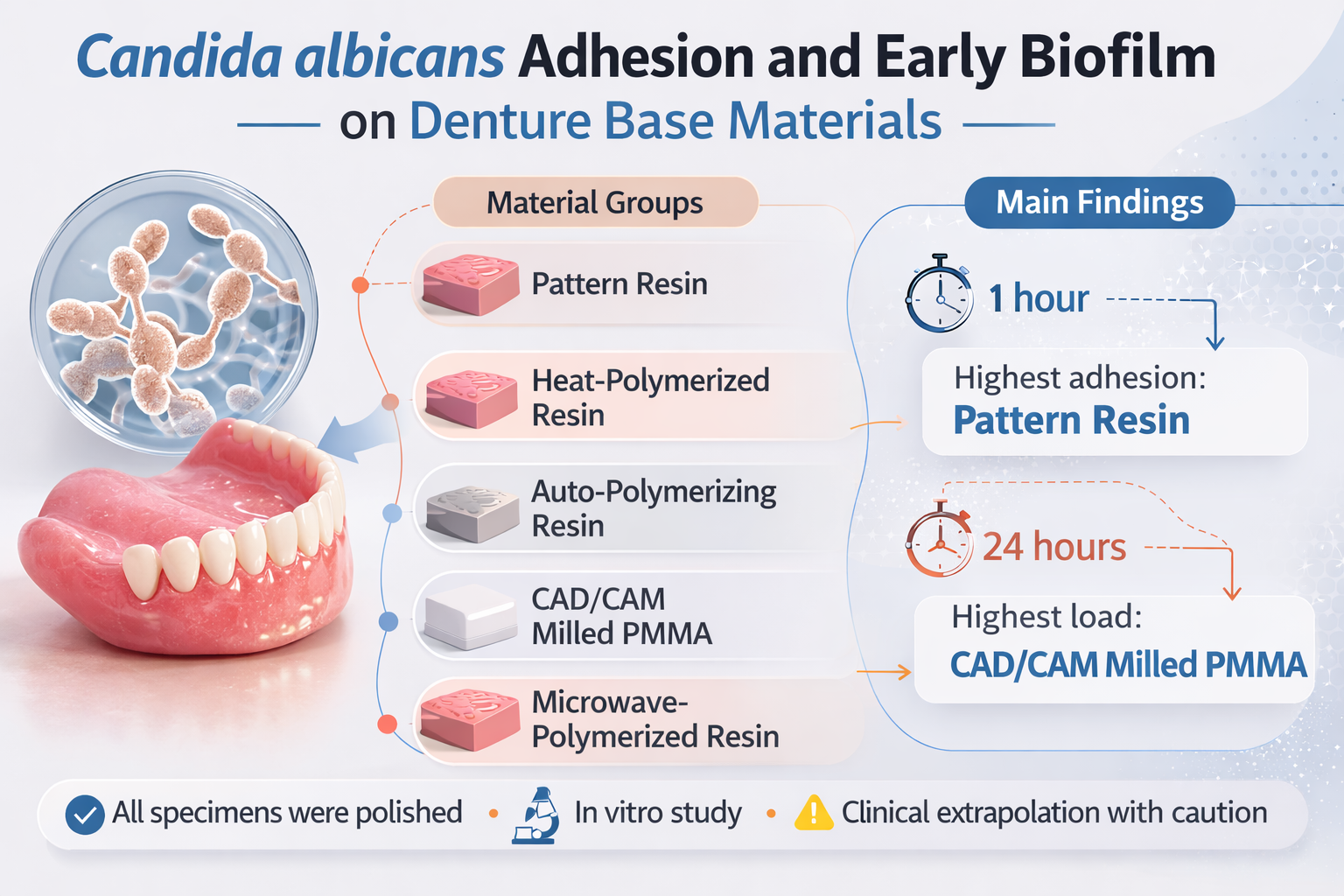
- In this model, under standardized finishing and mechanical polishing conditions, the comparator pattern resin (M01) exhibited the highest adhesion at 1 h, whereas milled CAD/CAM PMMA (M04) showed the highest adhered fungal load at 24 h, and the heat-polymerized acrylic resin (M02) showed the lowest adhered fraction of the inoculum, based on the quantitative microbiological outcomes of this model.
- •
- Both material selection and surface management appear to be relevant determinants of biofilm-related risk on denture bases.
- •
- These results provide a useful comparative in vitro framework to inform material selection and to prioritize finishing and maintenance strategies in patients at risk of denture stomatitis, although clinical extrapolation should be made with caution.
Supplementary Materials
Author Contributions
Funding
Institutional Review Board Statement
Informed Consent Statement
Data Availability Statement
Conflicts of Interest
References
- Perić, M.; Miličić, B.; Kuzmanović Pfićer, J.; Živković, R.; Arsić Arsenijević, V. A Systematic Review of Denture Stomatitis: Predisposing Factors, Clinical Features, Etiology, and Global Candida spp. Distrib. J. Fungi 2024, 10, 328. [Google Scholar] [CrossRef] [Scilit]
- Alqarawi, F.K.; Gad, M.M. Tendency of Microbial Adhesion to Denture Base Resins: A Systematic Review. Front. Oral Health 2024, 5, 1375186. [Google Scholar] [CrossRef] [Scilit]
- Lim, T.W.; Li, K.Y.; Burrow, M.F.; McGrath, C. Prevalence of Respiratory Pathogens Colonizing on Removable Dental Prostheses in Healthy Older Adults: A Systematic Review and Meta-Analysis. J. Prosthodont. 2024, 33, 417–426. [Google Scholar] [CrossRef] [Scilit] [PubMed]
- de Freitas, R.F.C.P.; Duarte, S.; Feitosa, S.; Dutra, V.; Lin, W.-S.; Panariello, B.H.D.; Porto Carreiro, A.d.F. Physical, Mechanical, and Anti-Biofilm Formation Properties of CAD-CAM Milled or 3D Printed Denture Base Resins: In Vitro Analysis. J. Prosthodont. 2023, 32, 38–44. [Google Scholar] [CrossRef] [Scilit] [PubMed]
- Osman, R.B.; Khoder, G.; Fayed, B.; Kedia, R.A.; Elkareimi, Y.; Alharbi, N. Influence of Fabrication Technique on Adhesion and Biofilm Formation of Candida albicans to Conventional, Milled, and 3D-Printed Denture Base Resin Materials: A Comparative In Vitro Study. Polymers 2023, 15, 1836. [Google Scholar] [CrossRef] [Scilit]
- Koujan, A.; Aggarwal, H.; Chen, P.-H.; Li, Z.; Givan, D.A.; Zhang, P.; Fu, C.-C. Evaluation of Candida albicans Adherence to CAD-CAM Milled, 3D-Printed, and Heat-Cured PMMA Resin and Efficacy of Different Disinfection Techniques: An In Vitro Study. J. Prosthodont. 2023, 32, 512–518. [Google Scholar] [CrossRef] [Scilit] [PubMed]
- Alhajj, M.N.; Halboub, E.; Yacob, N.; Al-Maweri, S.A.; Ahmad, S.F.; Celebić, A.; Al-Mekhlafi, H.M.; Salleh, N.M. Adhesion of Candida albicans to Digital versus Conventional Acrylic Resins: A Systematic Review and Meta-Analysis. BMC Oral Health 2024, 24, 303. [Google Scholar] [CrossRef] [Scilit]
- Fouda, S.M.; Gad, M.M.; Abulsaud, R.; Ellakany, P.; AlRumaih, H.S.; Farooqi, F.A.; Matin, A.; Al-Eraky, D.M.; Al-Qarni, F.D.; Al-Harbi, F.A. In Vitro Evaluation of Candida albicans Adhesion and Related Surface Properties of CAD/CAM Denture Base Resins. Eur. J. Dent. 2024, 18, 579–586. [Google Scholar] [CrossRef] [Scilit]
- Silva, M.D.D.; Nunes, T.S.B.S.; Viotto, H.E.d.C.; Coelho, S.R.G.; de Souza, R.F.; Pero, A.C. Microbial Adhesion and Biofilm Formation by Candida albicans on 3D-Printed Denture Base Resins. PLoS ONE 2023, 18, e0292430. [Google Scholar] [CrossRef] [Scilit]
- Li, P.; Kraemer Fernandez, P.; Spintzyk, S.; Schmidt, F.; Yassine, J.; Beuer, F.; Unkovskiy, A. Effects of Layer Thickness and Build Angle on the Microbial Adhesion of Denture Base Polymers Manufactured by Digital Light Processing. J. Prosthodont. Res. 2023, 67, 562–567. [Google Scholar] [CrossRef] [Scilit]
- Li, P.; Kraemer Fernandez, P.; Spintzyk, S.; Schmidt, F.; Beuer, F.; Unkovskiy, A. Effect of Additive Manufacturing Method and Build Angle on Surface Characteristics and Candida albicans Adhesion to 3D Printed Denture Base Polymers. J. Dent. 2022, 116, 103889. [Google Scholar] [CrossRef] [Scilit]
- Sahin, Z.; Ozer, N.E.; Cali, A. Biofilm Inhibition of Denture Cleaning Tablets and Carvacrol on Denture Bases Produced with Different Techniques. Clin. Oral Investig. 2024, 28, 413. [Google Scholar] [CrossRef] [Scilit] [PubMed]
- Ribeiro, A.B.; Tinelli, B.M.; Clemente, L.M.; de Camargo Poker, B.; de Cássia Oliveira, V.; Watanabe, E.; Silva-Lovato, C.H. Effect of Hygiene Protocols on the Mechanical and Physical Properties of Two 3D-Printed Denture Resins Characterized by Extrinsic Pigmentation as Well as the Mixed Biofilm Formed on the Surface. Antibiotics 2023, 12, 1630. [Google Scholar] [CrossRef] [Scilit] [PubMed]
- Geduk, Ş.E.; Sağlam, G.; Cömert, F.; Geduk, G. Antimicrobial Activity of Cleanser Tablets against Streptococcus mutans and Candida albicans on Different Denture Base Materials. BMC Oral Health 2024, 24, 633. [Google Scholar] [CrossRef] [Scilit]
- Chladek, G.; Nowak, M.; Pakieła, W.; Mertas, A. Effect of Candida albicans Suspension on the Mechanical Properties of Denture Base Acrylic Resin. Materials 2022, 15, 3841. [Google Scholar] [CrossRef] [Scilit]
- Krishnamurthy, S.; Hallikerimath, R.B. An In-vitro Evaluation of Retention, Colonization and Penetration of Commonly Used Denture Lining Materials By Candida albicans. J. Clin. Diagn. Res. 2016, 10, ZC84–ZC88. [Google Scholar] [CrossRef] [Scilit]
- Menon, R.K.; Xin, Y.H.; Wei, B.C.T.; AlSaqaf, S.O.; Abu Kariem, A.K.; Al Tabbaa, M.M.; Veettil, S.K. CADCAM versus Conventional Denture Bases: Network Meta-Analysis of In Vitro Studies Comparing Accuracy and Surface Properties. Int. Dent. J. 2025, 75, 2062–2070. [Google Scholar] [CrossRef] [Scilit] [PubMed]
- Azab, A.; Abdelhady, W.A.; Elwakeel, E.; Ashraf, M.; Wally, R.; Soliman, A.; Mohamed, M.A.; Abozaid, D. Systematic Review and Meta-Analysis of Mechanical Properties of 3D Printed Denture Bases Compared to Milled and Conventional Materials. Sci. Rep. 2025, 15, 29207. [Google Scholar] [CrossRef] [Scilit] [PubMed]
- Vetsch, G.; Manoil, D.; Wulfman, C.; Parga, A.; Durual, S.; Srinivasan, M. Candida albicans Colonization on CAD-CAM Denture Resin Surface. J. Dent. 2025, 157, 105756. [Google Scholar] [CrossRef] [Scilit]
- Arslan, E.; Akay, C.; Erdönmez, D.; Avukat, E.N. Evaluation of the Effect of New Generation Denture Base Materials Aged in Artificial Saliva at Different pH Levels on Surface Roughness and Candida albicans Adhesion. BMC Oral Health 2025, 25, 356. [Google Scholar] [CrossRef] [Scilit]
- Camargo, R.; Oliveira, J.S.d.; Ferro, A.C.; Ribas, B.R.; Alves, A.A.V.; Jorge, J.H. Surface Changes Induced by Brushing Increase Candida albicans Biofilms on 3D-Printed Denture Base Resin. J. Fungi 2025, 11, 668. [Google Scholar] [CrossRef] [Scilit]
- Corrêa, P.G.L.; Cruz-Araújo, S.R.; Freiria de Oliveira, C.A.; Silva, R.R.d.; Oliveira, V.d.C.; Pagnano, V.O.; Silva-Lovato, C.H.; Galo, R.; Stirke, A.; Melo, W.C.M.A.; et al. Evaluation of Colonization by Candida albicans and Biofilm Formation on 3D-Printed Denture Base Resins. Materials 2025, 18, 5018. [Google Scholar] [CrossRef] [Scilit]
- Dzhondrova, I.; Todorov, R.; Kirov, D. Evaluation of Candida spp. Adherence to 3D-Printed and Heat-Cured PMMA Resin Dentures. J. IMAB 2024, 30, 5658. [Google Scholar] [CrossRef] [Scilit]
- Radev, R.; Yankova, M.; Radeva, E.; Apostolov, N. Colonization of Candida spp. in Patients Treated with Partial Dentures “ThermoSens”. J. IMAB 2024, 30, 5552–5558. [Google Scholar] [CrossRef] [Scilit]
- Khan, S.A.; Mirani, Z.A.; Khalid, T.; Khan, M.W.A.; Choudhary, Z.; Kazmi, S.M.R. Effect of Polishing Methods on Candida albicans Adhesion and Contributing Factors in Heat-Cured Acrylic Dentures: An In-Vitro Comparative Study. BMC Oral Health 2025, 25, 197. [Google Scholar] [CrossRef] [Scilit] [PubMed]
- Alzaher, Z.A.; Aldobais, F.A.; Albazroun, Z.; Alatiyyah, F.M.; Abualsaud, R.; Alalawi, H.; Al-Thobity, A.M.; Khan, S.Q.; Gad, M.M. Antifungal Efficacy and Surface Properties of Conventional and 3D-Printed Denture Base Materials Modified with Titanium Tetrafluoride (TiF4): In Vitro Study. Polymers 2025, 17, 1403. [Google Scholar] [CrossRef] [Scilit] [PubMed]
- Lee, M.-J.; Kim, M.-J.; Mangal, U.; Seo, J.-Y.; Kwon, J.-S.; Choi, S.-H. Zinc-Modified Phosphate-Based Glass Micro-Filler Improves Candida albicans Resistance of Auto-Polymerized Acrylic Resin without Altering Mechanical Performance. Sci. Rep. 2022, 12, 19456. [Google Scholar] [CrossRef] [Scilit]
- Zahari, N.A.H.; Farid, D.A.M.; Alauddin, M.S.; Said, Z.; Ghazali, M.I.M.; Lee, H.-E.; Zol, S.M. Development of 3-Dimensionally Printed Denture Base Material Utilizing Hybrid Polymer: A Preliminary Investigation. J. Prosthet. Dent. 2024, 132, 1329.e1–1329.e6. [Google Scholar] [CrossRef] [Scilit]
- Teixeira, A.B.V.; Valente, M.L.C.; Sessa, J.P.N.; Gubitoso, B.; Schiavon, M.A.; dos Reis, A.C. Adhesion of Biofilm, Surface Characteristics, and Mechanical Properties of Antimicrobial Denture Base Resin. J. Adv. Prosthodont. 2023, 15, 80–92. [Google Scholar] [CrossRef] [Scilit]
- Salam, M.M.H.; Mateiaș, C.-G.; Farcașiu, A.-T.; Țancu, A.M.C.; Celibidache, A.; Imre, M. The Inclusion of Nanoparticles in the Manufacturing of 3D Printed Complete Dentures: A Review of Current Literature. Roman. J. Oral Rehabil. 2025, 17, 242–251. [Google Scholar] [CrossRef] [Scilit]

| Material | Time | n | Median [IQR] (CFU/mL) | Geometric Mean (CFU/mL) | log10 (Geomean) |
|---|---|---|---|---|---|
| Auto-polymerized acrylic resin | 1 h | 14 | 55,000 [43,500, 66,500] | 53,767 | 4.731 |
| Microwave-polymerized acrylic resin | 1 h | 14 | 41,500 [20,250, 56,000] | 25,096 | 4.4 |
| Heat-polymerized acrylic resin | 1 h | 14 | 27,000 [22,250, 33,000] | 27,345 | 4.437 |
| PMMA (CAD/CAM milled) | 1 h | 14 | 34,000 [23,250, 43,750] | 31,943 | 4.504 |
| Pattern resin | 1 h | 14 | 190,000 [150,000, 287,500] | 182,907 | 5.262 |
| Auto-polymerized acrylic resin | 24 h | 14 | 55,000 [47,750, 70,250] | 57,975 | 4.763 |
| Microwave-polymerized acrylic resin | 24 h | 14 | 50,500 [40,250, 69,250] | 53,196 | 4.726 |
| Heat-polymerized acrylic resin | 24 h | 14 | 39,500 [30,250, 43,750] | 37,017 | 4.568 |
| PMMA (CAD/CAM milled) | 24 h | 14 | 115,000 [100,000, 147,500] | 128,688 | 5.11 |
| Pattern resin | 24 h | 14 | 99,500 [42,500, 147,500] | 75,955 | 4.881 |
| Effect | df | F | p | Partial η2 |
|---|---|---|---|---|
| Material | 4 | 18.028 | <0.001 | 0.357 |
| Time | 1 | 9.096 | 0.003 | 0.065 |
| Material × Time | 4 | 11.926 | <0.001 | 0.268 |
| Time | Group 1 | Group 2 | Mean Difference (log10) | 95% CI of the Difference | Adjusted p |
|---|---|---|---|---|---|
| 1 h | Pattern resin | Heat-polymerized acrylic resin | −0.825 | [−1.186, −0.465] | <0.001 |
| 1 h | Pattern resin | Auto-polymerized acrylic resin | −0.532 | [−0.893, −0.171] | 0.001 |
| 1 h | Pattern resin | PMMA (CAD/CAM) | −0.758 | [−1.119, −0.397] | <0.001 |
| 1 h | Pattern resin | Microwave-polymerized acrylic resin | −0.863 | [−1.224, −0.502] | <0.001 |
| 24 h | Pattern resin | Heat-polymerized acrylic resin | −0.312 | [−0.527, −0.097] | 0.001 |
| 24 h | Pattern resin | PMMA (CAD/CAM) | 0.229 | [0.014, 0.444] | 0.032 |
| 24 h | Heat-polymerized acrylic resin | PMMA (CAD/CAM) | 0.541 | [0.326, 0.756] | <0.001 |
| 24 h | Auto-polymerized acrylic resin | PMMA (CAD/CAM) | 0.346 | [0.131, 0.562] | <0.001 |
| 24 h | PMMA (CAD/CAM) | Microwave-polymerized acrylic resin | −0.384 | [−0.599, −0.169] | <0.001 |
| Material | Time | n | Median [IQR] | Geometric Mean |
|---|---|---|---|---|
| Auto-polymerized acrylic resin | 1 h | 14 | 0.20 [0.17, 0.32] | 0.227 |
| Microwave-polymerized acrylic resin | 1 h | 14 | 0.19 [0.10, 0.35] | 0.143 |
| Heat-polymerized acrylic resin | 1 h | 14 | 0.21 [0.16, 0.28] | 0.215 |
| PMMA (CAD/CAM) | 1 h | 14 | 0.35 [0.26, 0.41] | 0.314 |
| Pattern resin | 1 h | 14 | 0.48 [0.31, 0.67] | 0.453 |
| Auto-polymerized acrylic resin | 24 h | 14 | 0.39 [0.28, 0.53] | 0.382 |
| Microwave-polymerized acrylic resin | 24 h | 14 | 0.26 [0.19, 0.37] | 0.267 |
| Heat-polymerized acrylic resin | 24 h | 14 | 0.15 [0.12, 0.20] | 0.166 |
| PMMA (CAD/CAM) | 24 h | 14 | 0.40 [0.32, 0.45] | 0.389 |
| Pattern resin | 24 h | 14 | 0.43 [0.33, 0.73] | 0.451 |
| Effect | df | F | p | Partial η2 |
|---|---|---|---|---|
| Material | 4 | 11.091 | <0.001 | 0.254 |
| Time | 1 | 4.695 | 0.032 | 0.035 |
| Material × Time | 4 | 2.605 | 0.039 | 0.074 |
| Time | Group 1 | Group 2 | Mean Difference (log10) | 95% CI of the Difference | Adjusted p |
|---|---|---|---|---|---|
| 1 h | Pattern resin | Microwave-polymerized acrylic resin | −0.499 | [−0.840, −0.158] | 0.001 |
| 1 h | PMMA (CAD/CAM) | Microwave-polymerized acrylic resin | −0.341 | [−0.681, −0.000] | 0.05 |
| 24 h | Pattern resin | Heat-polymerized acrylic resin | −0.434 | [−0.621, −0.247] | <0.001 |
| 24 h | Pattern resin | Microwave-polymerized acrylic resin | −0.227 | [−0.414, −0.039] | 0.01 |
| 24 h | Heat-polymerized acrylic resin | Auto-polymerized acrylic resin | 0.362 | [0.175, 0.55] | <0.001 |
| 24 h | Heat-polymerized acrylic resin | PMMA (CAD/CAM) | 0.37 | [0.183, 0.558] | <0.001 |
| 24 h | Heat-polymerized acrylic resin | Microwave-polymerized acrylic resin | 0.208 | [0.02, 0.395] | 0.022 |
Disclaimer/Publisher’s Note: The statements, opinions and data contained in all publications are solely those of the individual author(s) and contributor(s) and not of MDPI and/or the editor(s). MDPI and/or the editor(s) disclaim responsibility for any injury to people or property resulting from any ideas, methods, instructions or products referred to in the content. |
© 2026 by the authors. Licensee MDPI, Basel, Switzerland. This article is an open access article distributed under the terms and conditions of the Creative Commons Attribution (CC BY) license.
Share and Cite
Moreno-Prieto, V.; Guillén-Galarza, C.E.; Gómez-Carrión, C.E.; Schwan-Silva, I. Influence of Denture Base Fabrication on Candida albicans Adhesion and Early Biofilm: An In Vitro Comparison of Five Techniques. Dent. J. 2026, 14, 262. https://doi.org/10.3390/dj14050262
Moreno-Prieto V, Guillén-Galarza CE, Gómez-Carrión CE, Schwan-Silva I. Influence of Denture Base Fabrication on Candida albicans Adhesion and Early Biofilm: An In Vitro Comparison of Five Techniques. Dentistry Journal. 2026; 14(5):262. https://doi.org/10.3390/dj14050262
Chicago/Turabian StyleMoreno-Prieto, Victor, Carlos Enrique Guillén-Galarza, Christian Esteban Gómez-Carrión, and Ignacio Schwan-Silva. 2026. "Influence of Denture Base Fabrication on Candida albicans Adhesion and Early Biofilm: An In Vitro Comparison of Five Techniques" Dentistry Journal 14, no. 5: 262. https://doi.org/10.3390/dj14050262
APA StyleMoreno-Prieto, V., Guillén-Galarza, C. E., Gómez-Carrión, C. E., & Schwan-Silva, I. (2026). Influence of Denture Base Fabrication on Candida albicans Adhesion and Early Biofilm: An In Vitro Comparison of Five Techniques. Dentistry Journal, 14(5), 262. https://doi.org/10.3390/dj14050262