
Review

Emergence Angle and Emergence Profile in Implant-Supported Restorations: A Scoping Review

1
Department of Fixed Prosthodontics, School of Dental Medicine, University of Zagreb, Gunduliceva 5, 10000 Zagreb, Croatia
2
Chair of Design, Faculty of Mechanical Engineering and Naval Architecture, University of Zagreb, Ivana Lucica 5, 10000 Zagreb, Croatia
3
Department of Fixed Prosthodontics, School of Dental Medicine, University of Zagreb, Clinical Hospital Centre Zagreb, Gunduliceva 5, 10000 Zagreb, Croatia
*
Author to whom correspondence should be addressed.
Dent. J. 2026, 14(4), 236; https://doi.org/10.3390/dj14040236
Submission received: 25 January 2026 / Revised: 26 March 2026 / Accepted: 10 April 2026 / Published: 15 April 2026

Abstract

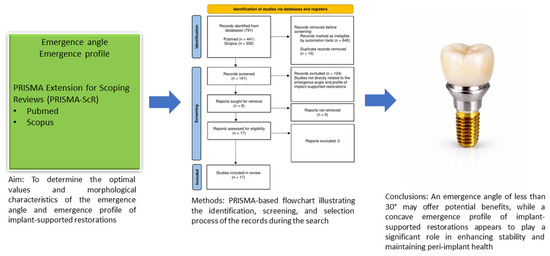
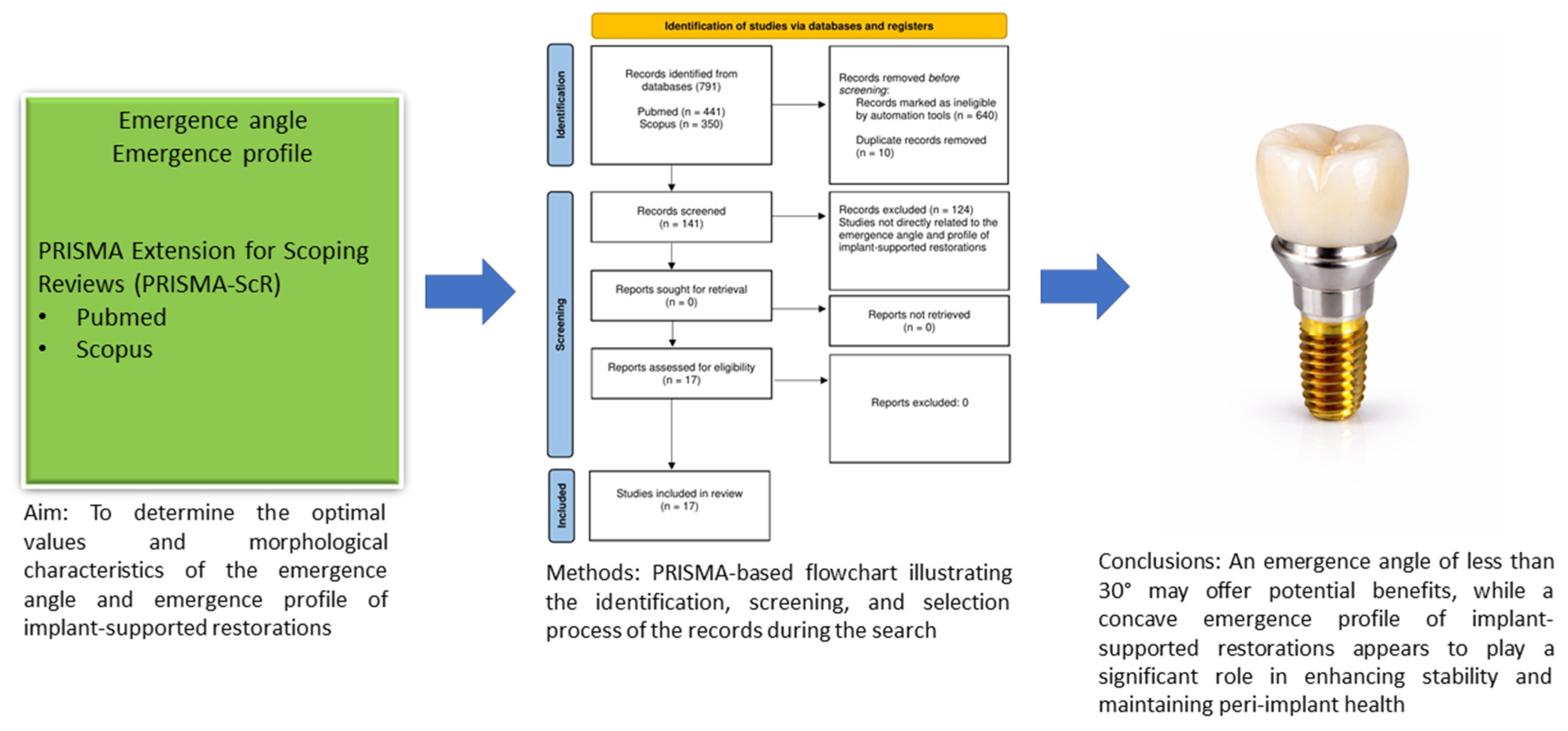
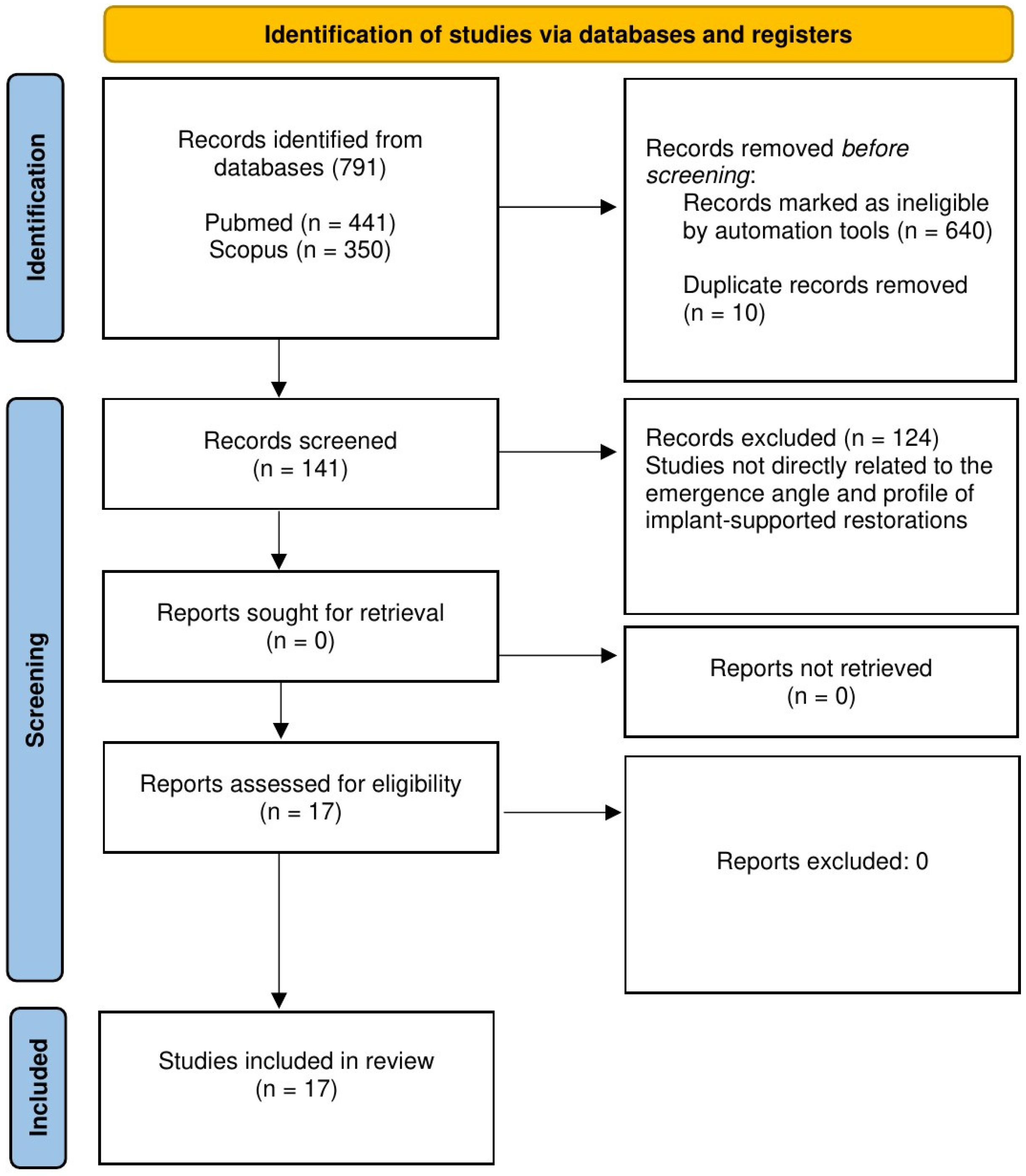
Background/Objectives: Prosthodontic restoration design plays a key role in the long-term success of implant-supported treatments and in maintaining peri-implant tissue health. Inadequate emergence angles and profiles can compromise tissue stability and negatively influence clinical outcomes. Generative design, as an algorithm-driven optimization approach, requires the definition of key parameters in advance to guide the process and determine the final shape of the hybrid implant abutment. Methods: A detailed literature review of the PubMed and Scopus databases was performed to find appropriate studies published up to 1 December 2025. Studies that investigated the emergence angle and emergence profile of implant-supported restorations were included. Seventeen studies fulfilled criteria and were included in the final analysis. Results: While the optimal emergence angle is still debatable, the literature suggests that an angle less than 30° may be beneficial. However, a concave emergence profile of implant-supported restoration has a significant role in improving stability and maintaining peri-implant health. Conclusions: Careful characterization and evaluation of the included parameters provide useful insights for generative design workflows, enabling the creation of implant abutment designs that maintain a balance between mechanical performance and biological compatibility.
Keywords: emergence angle; emergence profile; implant-supported restoration; computer-aided design; prosthodontics emergence angle; emergence profile; implant-supported restoration; computer-aided design; prosthodontics
Graphical Abstract