

Clinical Efficacy and Safety of Photobiomodulation Therapy for Orofacial Conditions in Older Adults: A Systematic Review of Randomized Controlled Trials



Abstract
1. Introduction
2. Materials and Methods
2.1. Focused Question
2.2. Study Selection Criteria
2.3. Search Strategy
2.4. Risk of Bias Assessment and Data Extraction
3. Results
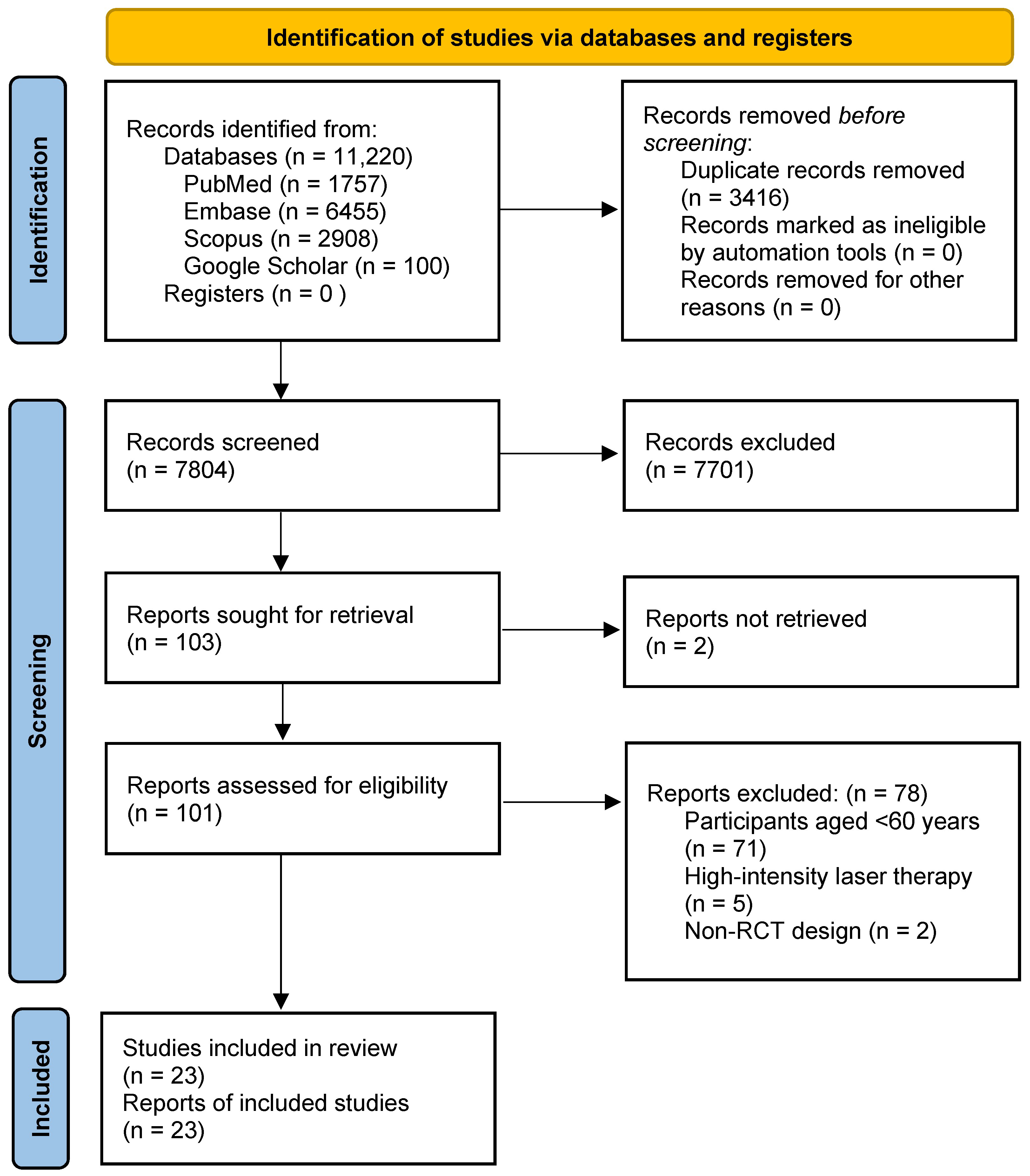
3.1. Search Results and Study Selection
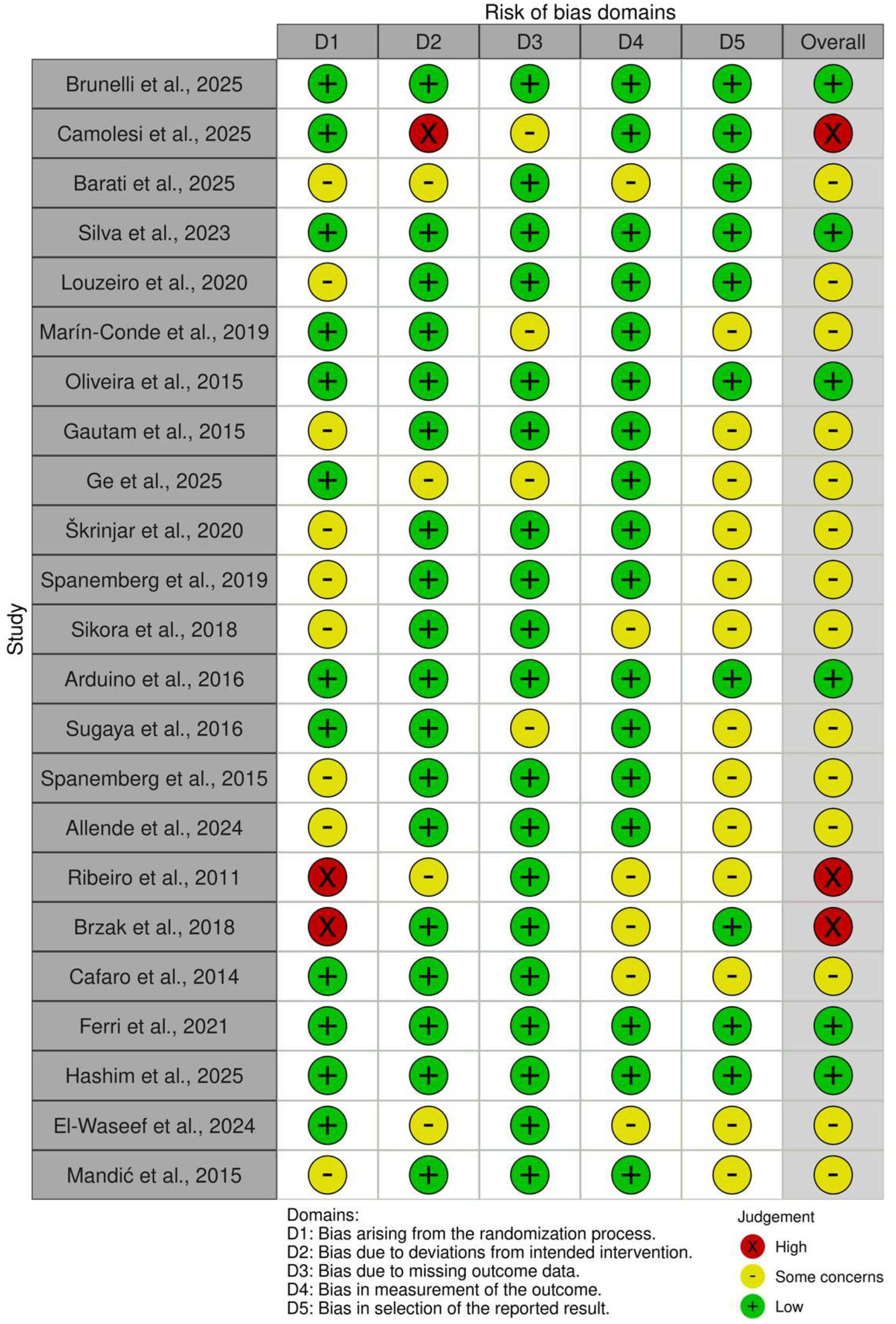
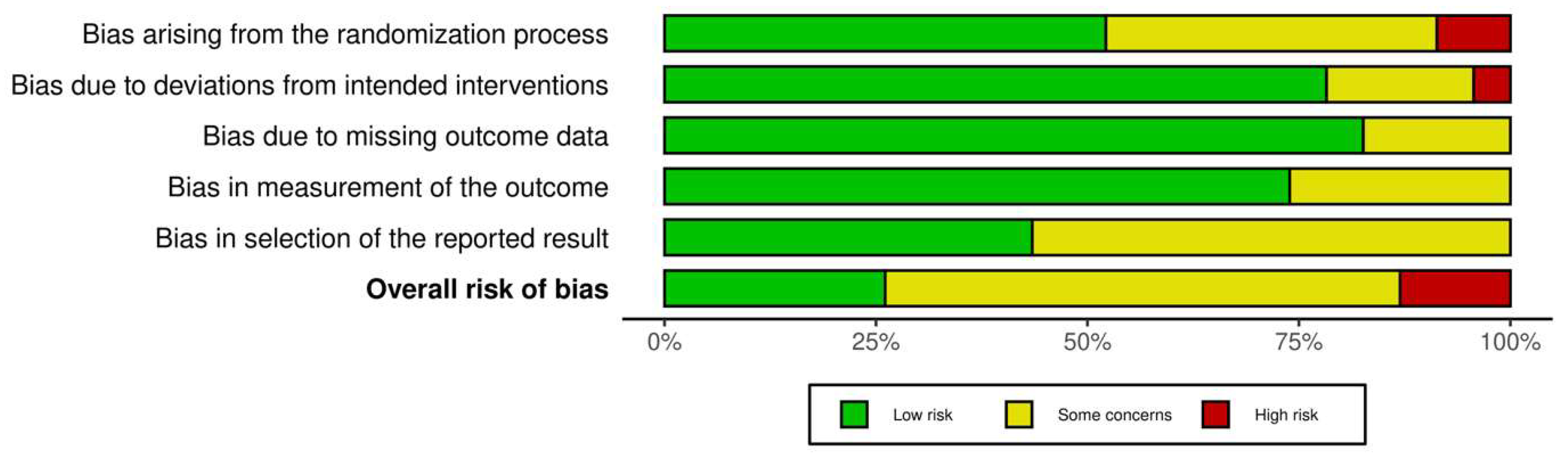
3.2. Analysis of Risk of Bias
3.3. PBMT’s Clinical Efficacy and Safety in Geriatric Dentistry
3.4. Laser Parameters and Irradiation Protocols Used in the Included Studies
4. Discussion
5. Conclusions
Supplementary Materials
Author Contributions
Funding
Institutional Review Board Statement
Informed Consent Statement
Data Availability Statement
Conflicts of Interest
Appendix A

| Domain | Keywords | MeSH Term |
|---|---|---|
| Study domain: population with a mean or median age of at least 60 years | “older adult*”, “geriatric*”, “60 year*”, “senior”, “aging population” | “aged”, “elderly” |
| Study determinant: photobiomodulation | “photobiomodulation*”, “PBM*”, “low-intensity laser therapy”, “LILT”, “biostimulation”, “light therapy”, “LED” | “low-level light therapy”, “LLLT”, “laser therap*” |
| Study outcome: oral and maxillofacial region, clinical outcomes | “orofacial”, “stomatology”, “xerostomia”, “mucositis”, “wound”, “lesion”, “healing”, “recovery”, “pain”, “bleeding control”, “inflammation”, “recovery”, “patient-reported outcomes” | “oral”, “mouth”, “facial”, “head and neck”, “xerostomia”, “mucositis” “dentistry” |
| Electronic Database | Syntax | Number of Records |
|---|---|---|
| PubMed/Medline | ((“Aged”[MeSH Terms] OR “elderly”[Title/Abstract] OR “older adult*”[Title/Abstract] OR “geriatric*”[Title/Abstract] OR “60 year*”[Title/Abstract] OR “senior*”[Title/Abstract] OR “aging*”[Title/Abstract])) AND ((“Low-Level Light Therapy”[MeSH Terms] OR “Laser Therapy”[MeSH Terms] OR “photobiomodulation*”[Title/Abstract] OR “PBM”[Title/Abstract] OR “PBMT”[Title/Abstract] OR “low-intensity laser therapy”[Title/Abstract] OR “LILT”[Title/Abstract] OR “biostimulation”[Title/Abstract] OR “light therapy”[Title/Abstract] OR “LED”[Title/Abstract] OR “LLLT”[Title/Abstract])) AND ((“Mouth”[MeSH Terms] OR “Oral Cavity”[Title/Abstract] OR “Dentistry”[MeSH Terms] OR “Head and Neck Neoplasms”[MeSH Terms] OR “Xerostomia”[MeSH Terms] OR “Mucositis”[MeSH Terms] OR “orofacial”[Title/Abstract] OR “stomato*”[Title/Abstract] OR “oral wound*”[Title/Abstract] OR “oral lesion*”[Title/Abstract] OR “healing”[Title/Abstract] OR “recovery”[Title/Abstract] OR “pain”[Title/Abstract] OR “bleeding”[Title/Abstract] OR “inflammation”[Title/Abstract] OR “patient reported outcome*”[Title/Abstract])) AND (“randomized controlled trial”[Publication Type] OR randomized[Title/Abstract] OR placebo[Title/Abstract] OR “randomly assigned”[Title/Abstract]) AND (“2000/01/01”[Date-Publication]: “2025/03/31”[Date-Publication]) | 1757 |
| scopus | TITLE-ABS-KEY ((“older adult*” OR geriatric* OR “60 year*” OR senior* OR aging* OR aged OR elderly) AND (“photobiomodulation*” OR PBM OR PBMT OR “low-intensity laser therapy” OR LILT OR biostimulation OR “light therapy” OR LED OR LLLT OR “laser therap*”) AND (“orofacial” OR stomato* OR “oral wound*” OR “oral lesion*” OR oral OR mouth OR facial OR “head and neck” OR xerostomia OR mucositis OR healing OR recovery OR pain OR bleeding OR inflammation OR “patient reported outcome*” OR dentistry) AND (randomized OR placebo OR “randomly assigned” OR “randomized controlled trial”)) AND (PUBYEAR > 1999 AND PUBYEAR < 2026) | 6455 |
| Embase | (‘aged’/exp OR elderly:ti,ab OR ‘older adult*’:ti,ab OR geriatric*:ti,ab OR ‘60 year*’:ti,ab OR senior*:ti,ab OR aging*:ti,ab) AND (‘photobiomodulation’/exp OR ‘low level light therapy’/exp OR ‘laser therapy’/exp OR photobiomodulation*:ti,ab OR pbm:ti,ab OR pbmt:ti,ab OR ‘low-intensity laser therapy’:ti,ab OR lilt:ti,ab OR biostimulation:ti,ab OR ‘light therapy’:ti,ab OR led:ti,ab OR lllt:ti,ab) AND (‘oral cavity’/exp OR ‘dentistry’/exp OR ‘head and neck disease’/exp OR ‘xerostomia’/exp OR ‘mucositis’/exp OR orofacial:ti,ab OR stomato*:ti,ab OR ‘oral wound*’:ti,ab OR ‘oral lesion*’:ti,ab OR healing:ti,ab OR recovery:ti,ab OR pain:ti,ab OR bleeding:ti,ab OR inflammation:ti,ab OR ‘patient reported outcome*’:ti,ab) AND (‘randomized controlled trial*’/exp OR randomized:ti,ab OR placebo:ti,ab OR ‘randomly assigned’:ti,ab) AND [2000–2025]/py | 2908 |
| Google scholar | (“older adult” OR “geriatric” OR “60 year” OR “senior” OR “aging” OR “elderly”) AND (“photobiomodulation” OR “PBM” OR “PBMT” OR “low-intensity laser therapy” OR “LILT” OR “biostimulation” OR “light therapy” OR “LED” OR “LLLT” OR “laser therapy”) AND (“orofacial” OR “stomato*” OR “oral wound” OR “oral lesion” OR “oral” OR “mouth” OR “facial” OR “head and neck” OR “xerostomia” OR “mucositis” OR “healing” OR “recovery” OR “pain” OR “bleeding” OR “inflammation” OR “patient reported outcome” OR “dentistry”) AND (“randomized” OR “placebo” OR “randomly assigned” OR “randomized controlled trial*”) | First 100 records |
References
- Shen, X.; Wang, C.; Zhou, X.; Zhou, W.; Hornburg, D.; Wu, S.; Snyder, M.P. Nonlinear dynamics of multi-omics profiles during human aging. Nat. Aging 2024, 4, 1619–1634. [Google Scholar] [CrossRef] [Scilit] [PubMed]
- Nanci, A. Ten Cate’s Oral Histology: Development, Structure, and Function; Elsevier: St. Louis, MO, USA, 2018. [Google Scholar]
- Elad, S.; Cheng, K.K.F.; Lalla, R.V.; Yarom, N.; Hong, C.; Logan, R.M.; Bowen, J.; Gibson, R.; Saunders, D.P.; Zadik, Y.; et al. MASCC/ISOO clinical practice guidelines for the management of mucositis secondary to cancer therapy. Cancer 2020, 126, 4423–4431. [Google Scholar] [CrossRef] [Scilit] [PubMed]
- Rodríguez-Fuentes, M.E.; Pérez-Sayáns, M.; Carreras-Presas, C.M.; Marichalar-Mendia, X.; Bagán-Debón, L.; López-López, R. Prevalence of acute oral mucosal damage secondary to the use of systemic antineoplastics: A systematic review and meta-analysis. Oral Surg. Oral Med. Oral Pathol. Oral Radiol. 2023, 135, 385–395. [Google Scholar] [CrossRef] [Scilit]
- Sonis, S.T.; Elting, L.S.; Keefe, D.; Peterson, D.E.; Schubert, M.; Hauer-Jensen, M.; Bekele, B.N.; Raber-Durlacher, J.; Donnelly, J.P.; Rubenstein, E.B. Perspectives on cancer therapy-induced mucosal injury: Pathogenesis, measurement, epidemiology, and consequences for patients. Cancer 2004, 100, 1995–2025. [Google Scholar] [CrossRef] [Scilit]
- Pedersen, A.M.L.; Sørensen, C.E.; Proctor, G.B.; Carpenter, G.H.; Ekström, J. Salivary secretion in health and disease. J. Oral Rehabil. 2018, 45, 730–746. [Google Scholar] [CrossRef] [Scilit]
- Wu, S.; Zhang, W.; Yan, J.; Noma, N.; Young, A.; Yan, Z. Worldwide prevalence estimates of burning mouth syndrome: A systematic review and meta-analysis. Oral Dis. 2022, 28, 1431–1440. [Google Scholar] [CrossRef] [Scilit]
- Villa, A.; Connell, C.L.; Abati, S. Diagnosis and management of xerostomia and hyposalivation. Ther. Clin. Risk Manag. 2014, 10, 45–51. [Google Scholar] [CrossRef] [Scilit]
- Alrashdan, M.S.; Cirillo, N.; McCullough, M. Oral lichen planus: A literature review and update. Arch. Dermatol. Res. 2016, 308, 539–551. [Google Scholar] [CrossRef] [Scilit] [PubMed]
- Li, C.; Tang, X.; Zheng, X.; Ge, S.; Wen, H.; Lin, X.; Chen, Z.; Lu, L. Global prevalence and incidence estimates of oral lichen planus: A systematic review and meta-analysis. JAMA Dermatol. 2020, 156, 172–181. [Google Scholar] [CrossRef] [Scilit]
- Moraschini, V.; Poubel, L.A.D.C.; Ferreira, V.F.; Barboza, E.D.S.P. Evaluation of survival and success rates of dental implants: A systematic review. Int. J. Oral Maxillofac. Surg. 2015, 44, 377–388. [Google Scholar] [CrossRef] [Scilit]
- Mester, E.; Szende, B.; Gärtner, P. Effect of laser beams on the growth of hair in mice. Radiobiol. Radiother. 1968, 9, 621–626. [Google Scholar]
- National Library of Medicine. PubMed Database. Available online: https://pubmed.ncbi.nlm.nih.gov/ (accessed on 20 April 2025).
- Dompe, C.; Moncrieff, L.; Matys, J.; Grzech-Leśniak, K.; Kocherova, I.; Bryja, A.; Bruska, M.; Dominiak, M.; Mozdziak, P.; Skiba, T.H.I. Photobiomodulation—Underlying mechanism and clinical applications. J. Clin. Med. 2020, 9, 1724. [Google Scholar] [CrossRef] [Scilit]
- Hamblin, M.R. Mechanisms and mitochondrial redox signaling in photobiomodulation. Photochem. Photobiol. 2018, 94, 199–212. [Google Scholar] [CrossRef] [Scilit]
- Seyyedi, S.A.; Taram, S.; Heydari, M.; Valizadeh, R. Efficacy of low-level laser therapy in oral mucosal surgical wound healing. Explor. Med. 2022, 3, 451–460. [Google Scholar] [CrossRef] [Scilit]
- Zhao, H.; Hu, J.; Zhao, L. Low-level laser therapy as adjunct to periodontal surgery. Lasers Med. Sci. 2021, 36, 175–187. [Google Scholar] [CrossRef] [Scilit]
- de Almeida, M.C.L.; Rocha, R.G.G.; Magno, M.B.; Lima, R.R.; Saito, M.T. Palatal wound healing approaches. Clin. Oral Investig. 2024, 28, 347. [Google Scholar] [CrossRef] [Scilit]
- Al-Zainal, Z.; Ashraf, S.F.; Gopinath, D. Laser therapy for recurrent aphthous ulcers. Lasers Med. Sci. 2025, 40, 49. [Google Scholar] [CrossRef] [Scilit] [PubMed]
- Liu, P.; Zhou, Q.; Bao, J.; Chen, M.; Xu, M.; Bian, J.; Wen, Y.; Yan, J. Laser therapy in oral lichen planus. Lasers Med. Sci. 2025, 40, 151. [Google Scholar] [CrossRef] [Scilit] [PubMed]
- Mercadante, V.; Smith, D.K.; Abdalla-Aslan, R.; Andabak-Rogulj, A.; Brennan, M.T.; Jaguar, G.C.; Clark, H.; Fregnani, E.R.; Gueiros, L.A.; Hovan, A.; et al. A systematic review of salivary gland hypofunction and/or xerostomia induced by non-surgical cancer therapies: Prevention strategies. Support. Care Cancer 2025, 33, 87. [Google Scholar] [CrossRef] [Scilit]
- Díaz, L.; Basualdo, J.; Chaple-Gil, A.; Von Marttens, A.; Fernández, E. Effectiveness of low-level laser therapy in patients with maxillofacial neuropathies. A systematic review of randomized controlled trials. Photodiagn. Photodyn. Ther. 2025, 52, 104516. [Google Scholar] [CrossRef] [Scilit] [PubMed]
- Parra-Rojas, S.; Velázquez-Cayón, R.T.; Ciortan-Pop, M.E.; Martins, M.D.; Spanemberg, J.C. Preventive Photobiomodulation for Chemotherapy-Induced Oral Mucositis: A Systematic Review of Randomized Clinical Trials. Biomedicines 2025, 13, 268. [Google Scholar] [CrossRef] [Scilit]
- Okuhara, M.R.; Trevisani, V.F.M.; Macedo, C.R. Effects of Photobiomodulation on Burning Mouth Syndrome: A Systematic Review and Meta-Analysis. J. Oral Rehabil. 2025, 52, 540–553. [Google Scholar] [CrossRef] [Scilit] [PubMed]
- Ren, C.; McGrath, C.; Jin, L.; Zhang, C.; Yang, Y. The effectiveness of low-level laser therapy as an adjunct to non-surgical periodontal treatment: A meta-analysis. J. Periodontal Res. 2017, 52, 8–20. [Google Scholar] [CrossRef] [Scilit] [PubMed]
- Shahbazi, S.; Esmaeili, S.; Moscowchi, A.; Amid, R.; Romanos, G.; Kadkhodazadeh, M. Adjunctive photochemical therapy for management of inflammatory peri-implant diseases: A systematic review and meta-analysis. Photochem. Photobiol. 2025, 102, 163–197. [Google Scholar] [CrossRef] [Scilit] [PubMed]
- Rani, S.; Dhawan, P.; Kruthiventi, H. Clinical efficacy of photobiomodulation therapy in dental implant stability and crestal bone loss in implants placed in healed sites: A systematic review and meta-analysis of randomized clinical trials. Lasers Med. Sci. 2025, 40, 40. [Google Scholar] [CrossRef] [Scilit]
- Díaz, L.; Restelli, L.; Valencia, E.; Atalay, D.I.; Abarca, J.M.; Gil, A.C.; Fernández, E. Effectiveness of low-level laser therapy on temporomandibular disorders. A systematic review of randomized clinical trials. Photodiagn. Photodyn. Ther. 2025, 53, 104558. [Google Scholar] [CrossRef] [Scilit] [PubMed]
- da Silveira, R.B.; Ferreira, I.; Botelho, A.L.; Dos Reis, A.C. Effect of photobiomodulation treatment on pain control in patients with temporomandibular dysfunction disorder: Systematic review. Cranio 2022, 43, 117–127. [Google Scholar] [CrossRef] [Scilit]
- Kumar, N.K.; Abhishek, M.; Naik, B.S.; Brigit, B.; V, S.G.; Manimozhi, M. Evaluation of Effect of Laser in Root Canal Disinfection in Pulp Regenerative Therapy: A Systematic Review. Photobiomodul. Photomed. Laser Surg. 2024, 43, 53–58. [Google Scholar] [CrossRef] [Scilit]
- Elmsmari, F.; Shujaie, H.; Alzaabi, R.; González, J.A.; Aljafarawi, T.; Olivieri, J.G.; Jurado, C.A.; Afrashtehfar, K.I. Lasers efficacy in pain management after primary and secondary endodontic treatment: A systematic review and meta-analysis of randomized clinical trials. Sci. Rep. 2024, 14, 26028. [Google Scholar] [CrossRef] [Scilit]
- Godaert, L.; Dramé, M. Efficacy of Photobiomodulation Therapy in Older Adults: A Systematic Review. Biomedicines 2024, 12, 1409. [Google Scholar] [CrossRef] [Scilit]
- Page, M.J.; McKenzie, J.E.; Bossuyt, P.M.; Boutron, I.; Hoffmann, T.C.; Mulrow, C.D.; Shamseer, L.; Tetzlaff, J.M.; Akl, E.A.; Brennan, S.E.; et al. The PRISMA 2020 statement: An updated guideline for reporting systematic reviews. BMJ 2021, 372, n71. [Google Scholar] [CrossRef] [Scilit]
- Borghesi Brunelli, G.; Pinheiro, S.L. Combined extraoral and intraoral photobiomodulation for the prevention and management of oral mucositis and xerostomia caused by treatment of head and neck cancers. Lasers Med. Sci. 2025, 40, 295. [Google Scholar] [CrossRef] [Scilit]
- Vianna Camolesi, G.C.; Prado-Pena, I.B.; Gómez-Caamaño, A.; Victoria-Fernández, C.; Blanco-Carrión, A.; García-García, A.; Gándara-Vila, P.; Pérez-Sayáns, M. Photobiomodulation for the prevention of oral side effects secondary to head and neck cancer therapy: Results of a randomized, single-blind clinical trial. Oral Oncol. 2025, 164, 107266. [Google Scholar] [CrossRef] [Scilit]
- Barati, S.; Motevasseli, S.; Saedi, H.S.; Amiri, P.; Fekrazad, R. Effectiveness of photobiomodulation on oral mucositis induced by chemoradiotherapy in head and neck cancer patients. J. Photochem. Photobiol. B 2025, 264, 113115. [Google Scholar] [CrossRef] [Scilit]
- de Carvalho e Silva, R.M.; Mendes, F.M.; Degasperi, G.R.; Pinheiro, S.L. Photobiomodulation for the management of xerostomia and oral mucositis in cancer patients: A randomized clinical trial. Lasers Med. Sci. 2023, 38, 101. [Google Scholar] [CrossRef] [Scilit]
- Louzeiro, G.C.; Cherubini, K.; de Figueiredo, M.A.Z.; Salum, F.G. Effect of photobiomodulation on salivary flow and xerostomia during head and neck radiotherapy: A randomized controlled trial. J. Photochem. Photobiol. B 2020, 209, 111933. [Google Scholar] [CrossRef] [Scilit] [PubMed]
- Marín-Conde, F.; Castellanos-Cosano, L.; Pachón-Ibañez, J.; Serrera-Figallo, M.A.; Gutiérrez-Pérez, J.L.; Torres-Lagares, D. Photobiomodulation reduces oral mucositis caused by radiochemotherapy: A randomized controlled trial. Int. J. Oral Maxillofac. Surg. 2019, 48, 917–923. [Google Scholar] [CrossRef] [Scilit] [PubMed]
- de Oliveira, F.M.A.; Borges, M.M.F.; Malta, C.E.N.; de Moura, J.F.B.; Forte, C.P.F.; Barbosa, J.V.; de Barros Silva, P.G.; Dantas, T.S. Comparison of daily and alternate-day photobiomodulation protocols for prevention of oral mucositis: A triple-blind randomized trial. Med. Oral Patol. Oral Cir. Bucal 2024, 29, e430–e440. [Google Scholar] [CrossRef] [Scilit] [PubMed]
- Gautam, A.P.; Fernandes, D.J.; Vidyasagar, M.S.; Maiya, A.G.; Guddattu, V. Low-level laser therapy against radiation-induced oral mucositis in elderly patients: A randomized placebo-controlled trial. J. Photochem. Photobiol. B 2015, 144, 51–56. [Google Scholar] [CrossRef] [Scilit]
- Ge, X.L.; Sun, C.; Zhao, R.; Wang, H.Y.; Jiang, W.W. Comparative efficacy of diode laser wavelengths in burning mouth syndrome: A randomized trial. Lasers Med. Sci. 2025, 40, 165. [Google Scholar] [CrossRef] [Scilit]
- Škrinjar, I.; Brzak, B.L.; Vidranski, V.; Boras, V.V.; Rogulj, A.A.; Pavelić, B. Salivary cortisol and burning symptoms before and after low-level laser therapy: A randomized controlled trial. Acta Stomatol. Croat. 2020, 54, 44–50. [Google Scholar] [CrossRef] [Scilit]
- Spanemberg, J.C.; Segura-Egea, J.J.; Rodríguez-de Rivera-Campillo, E.; Jané-Salas, E.; Salum, F.G.; López-López, J. Low-level laser therapy in burning mouth syndrome: A randomized controlled trial. J. Clin. Exp. Dent. 2019, 11, e162–e169. [Google Scholar] [CrossRef] [Scilit] [PubMed]
- Sikora, M.; Včev, A.; Siber, S.; Boras, V.V.; Rotim, Ž.; Matijević, M. Low-level laser therapy in burning mouth syndrome: A pilot study. Acta Clin. Croat. 2018, 57, 312–315. [Google Scholar] [CrossRef] [Scilit]
- Arduino, P.G.; Cafaro, A.; Garrone, M.; Gambino, A.; Cabras, M.; Romagnoli, E.; Broccoletti, R. Low-level laser therapy versus clonazepam in burning mouth syndrome: A randomized pilot study. Lasers Med. Sci. 2016, 31, 811–816. [Google Scholar] [CrossRef] [Scilit]
- Sugaya, N.N.; da Silva, É.F.P.; Kato, I.T.; Prates, R.; de Barros Gallo, C.; Pellegrini, V.D. Low-intensity laser therapy in burning mouth syndrome: A randomized placebo-controlled study. Braz. Oral Res. 2016, 30, e108. [Google Scholar] [CrossRef] [Scilit] [PubMed]
- Spanemberg, J.C.; López-López, J.; de Figueiredo, M.A.Z.; Cherubini, K.; Salum, F.G. Low-level laser therapy for burning mouth syndrome: A randomized controlled trial. J. Biomed. Opt. 2015, 20, 098001. [Google Scholar] [CrossRef] [Scilit]
- Basualdo Allende, J.; Caviedes, R.; von Marttens, A.; Ramírez, F.G.; Piña, I.V.; Kuga, M.; Fernández, E. Low-level laser therapy for postoperative pain after dental implant surgery: A randomized clinical trial. Photodiagn. Photodyn. Ther. 2024, 49, 104293. [Google Scholar] [CrossRef] [Scilit] [PubMed]
- Ribeiro, A.S.; de Aguiar, M.C.F.; do Carmo, M.A.V.; de Abreu, M.H.N.G.; Silva, T.A.; Mesquita, R.A. 660 nm laser for pain relief after cryosurgery of oral leukoplakia. Photomed. Laser Surg. 2011, 29, 345–350. [Google Scholar] [CrossRef] [Scilit]
- Brzak, B.L.; Cigić, L.; Baričević, M.; Sabol, I.; Mravak-Stipetić, M.; Risović, D. Photobiomodulation protocols for hyposalivation. Photomed. Laser Surg. 2018, 36, 78–82. [Google Scholar] [CrossRef] [Scilit] [PubMed]
- Cafaro, A.; Arduino, P.G.; Gambino, A.; Romagnoli, E.; Broccoletti, R. Laser acupuncture for salivary flow in Sjögren’s syndrome. Lasers Med. Sci. 2015, 30, 1805–1809. [Google Scholar] [CrossRef] [Scilit] [PubMed]
- Ferri, E.P.; Cunha, K.R.L.; Abboud, C.S.; de Barros Gallo, C.; de Sousa Sobral, S.; Teixeira da Silva, D.F.; Horliana, A.C.R.T.; Franco, A.L.S.; Rodrigues, M.F.S.D. Photobiomodulation in oral lichen planus: A randomized controlled study. Oral Dis. 2021, 27, 1205–1216. [Google Scholar] [CrossRef] [Scilit]
- Hashim, D.; Courvoisier, D.; Cionca, N. Surgical versus non-surgical peri-implantitis treatment with adjunctive laser therapy: A randomized trial. Clin. Oral Investig. 2025, 29, 142. [Google Scholar] [CrossRef] [Scilit]
- El-Waseef, F.A.; Helmy, M.A.; Said Ahmed, W.M.; Hegazy, S.A.; El-Shaheed, N.H. Laser biostimulation in mandibular ridge splitting: A preliminary study. J. Prosthet. Dent. 2024, 132, 780.e1–780.e9. [Google Scholar] [CrossRef] [Scilit] [PubMed]
- Mandić, B.; Lazić, Z.; Marković, A.; Mandić, B.; Mandić, M.; Djinić, A.; Miličić, B. Effect of low-level laser therapy on osseointegration of implants. Vojn. Pregl. 2015, 72, 233–240. [Google Scholar] [CrossRef] [Scilit]
- Tanya, S.; Prajaneh, S.; Patcharanuchat, P.; Sattayut, S. Laser-mediated hemostasis for older patients receiving routine dental treatment. Dent. J. 2025, 13, 315. [Google Scholar] [CrossRef] [Scilit] [PubMed]
- Tanya, S.; Patcharanuchat, P.; Sattayut, S. A comparative study of photobiomodulation enhancing hemostasis in older patients at risk of extraction socket bleeding. Laser Ther. 2025, 32, 1. [Google Scholar] [CrossRef] [Scilit]
- Zadik, Y.; Arany, P.R.; Fregnani, E.R.; Bossi, P.; Antunes, H.S.; Bensadoun, R.-J.; Gueiros, L.A.; Majorana, A.; Nair, R.G.; Ranna, V.; et al. Systematic review of photobiomodulation for the management of oral mucositis in cancer patients and clinical practice guidelines. Support. Care Cancer 2019, 27, 3969–3983. [Google Scholar] [CrossRef] [Scilit]
- Scala, A.; Checchi, L.; Montevecchi, M.; Marini, I.; Giamberardino, M.A. Burning mouth syndrome: Overview and management. Crit. Rev. Oral Biol. Med. 2003, 14, 275–291. [Google Scholar] [CrossRef] [Scilit]
- Cheng, K.; Martin, L.F.; Slepian, M.J.; Patwardhan, A.M.; Ibrahim, M.M. Mechanisms and Pathways of Pain Photobiomodulation: A Narrative Review. J. Pain 2021, 22, 763–777. [Google Scholar] [CrossRef] [Scilit]
- de Freitas, L.F.; Hamblin, M.R. Proposed Mechanisms of Photobiomodulation or Low-Level Light Therapy. IEEE J. Sel. Top. Quantum Electron. 2016, 22, 7000417. [Google Scholar] [CrossRef] [Scilit]
- Hamblin, M.R. Mechanisms and applications of the anti-inflammatory effects of photobiomodulation. AIMS Biophys. 2017, 4, 337–361. [Google Scholar] [CrossRef] [Scilit] [PubMed]


| Clinical Applications | Study | Study Site | RCT Design and Duration | Study Size, n | Male, n | Intervention and Control (n) | Average Age, y ± SD |
|---|---|---|---|---|---|---|---|
| Prevention and management of cancer therapy-induced oral side effects | Brunelli et al., 2025 [34] | Brazil | Participant and assessor-blinded RCT/5-week CRT | 70 | 55 | PBMT(intraoral) + sham PBMT (extraoral) (35) PBMT (intraoral + extraoral) (35) | 63.0 ± 9.4 |
| Camolesi et al., 2025 [35] | Spain | Single-blinded RCT/6-week CRT with FU 15 days, 2, 3, 6 months | 53 | 36 | supportive care + PBMT (27) supportive care + sham PBMT (26) | 64.3 ± 9.9 | |
| Barati et al., 2025 [36] | Iran | Single-blinded RCT/1 month | 36 | 23 | PBMT (18) Mouthwash a + sham PBMT (18) | 60.8 | |
| Silva et al., 2023 [37] | Brazil | Participant and assessor-blinded RCT/5 months | 53 | 42 | PBMT intraoral + extraoral (26) Sham PBMT (27) | 60.6 ± 7.1 | |
| Louzeiro et al., 2020 [38] | Brazil | Single-blinded RCT/6 to 7-week CRT | 21 | 16 | PBMT (11) Sham PBMT (10) | 64.1 ± 8.3 | |
| Marín-Conde et al., 2019 [39] | Spain | Double-blinded RCT/9-week CRT with 3-week FU | 26 | 20 | PBMT (11) Sham PBMT (15) | 60.9 ± 9.9 | |
| Oliveira et al., 2015 [40] | Brazil | Triple-blinded RCT/1 month | 16 | 11 | PBMT daily (8) PBMT every other day (8) | 66.5 ± 13.1 | |
| Gautam et al., 2015 [41] | India | Double-blinded RCT/6.5-week CRT | 46 | 39 | PBMT (22) Sham PBMT (24) | 70.6 ± 8.1 | |
| Management of burning mouth syndrome and burning sensation | Ge et al., 2025 [42] | China | Single-blinded RCT/4 weeks | 53 | 5 | 660 nm PBMT (10) 810 nm PBMT (26) 975 nm PBMT (17) | 60 (30 to 77) b |
| Škrinjar et al., 2020 [43] | Croatia | Double-blinded RCT/10 days | 23 | 3 | PBMT (12) Sham PBMT (11) | 62 (47 to 70) b | |
| Spanemberg et al., 2019 [44] | Spain | Double-blinded RCT/4-week intervention with 2-month FU | 21 | 1 | PBMT (12) Sham PBMT (9) | 66.5 ± 6.99 | |
| Sikora et al., 2018 [45] | Croatia | Single-blinded RCT/2 weeks | 44 | 1 | PBMT (22) Sham PBMT (22) | 67.6 | |
| Arduino et al., 2016 [46] | Italy | RCT/5-week intervention with 12-week FU | 33 | 8 | PBMT (18) Clonazepam (15) | 67.1 ± 8.6 | |
| Sugaya et al., 2016 [47] | Brazil | Triple-blinded RCT/2-week intervention with 3-month FU | 23 | 2 | PBMT (13) Sham PBMT (10) | 60.0 ± 11.2 | |
| Spanemberg et al., 2015 [48] | Brazil | Single-blinded RCT/8 weeks | 78 | 11 | 830 nm PBMT, 1×/week (20) 830 nm PBMT, 3×/week (20) 685 nm PBMT (19) Sham PBMT (19) | 62.2 ± 8.0 | |
| Management of postoperative pain | Allende et al., 2024 [49] | Chile | Double-blinded split-mouth RCT/1 week | 20 | 10 | PBMT (20) Sham PBMT (20) | 77.5 |
| Ribeiro et al., 2011 [50] | Brazil | Double-blinded RCT/3-day intervention + 6 to 12-month FU | 18 | 3 | PBMT (8) Sham PBMT (10) | 64.7 ± 11.3 | |
| Management of hyposalivation | Brzak et al., 2018 [51] | Croatia | RCT/10-day intervention with 10-day FU | 30 | 0 | 830 nm PBMT (15) 685 nm PBM (15) | 72 (52 to 85) b |
| Cafaro et al., 2014 [52] | Italy | Single blinded RCT 5-week intervention + 6-month FU | 26 | 0 | PBMT (14) Sham PBMT (12) | 69.3 ± 9.8 | |
| Management of OLP | Ferri et al., 2021 [53] | Brazil | Double-blind RCT/1-month intervention + 3 months FU | 34 | 2 | Placebo gel + PBMT (17) 0.05% clobetasol + sham PBMT (17) | 62.2 |
| Management of peri-implantitis | Hashim et al., 2025 [54] | Switzerland | Assessor-blinded RCT/12 months | 38 | 20 | Mechanical debridement + PBMT (19) Mechanical debridement + surgery (19) | 68.8 ± 11.0 |
| Promoting implant osseointegration | El-Waseef et al., 2024 [55] | Egypt | Single-blinded RCT/12 months | 18 | 8 | PBMT (9) Sham PBMT (9) | 60 (50 to 65) b |
| Mandić et al., 2015 [56] | Serbia | Single-blinded split-mouth RCT/6 weeks | 12 | 6 | PBMT (6) Sham PBMT (6) | 61.3 |
| Author | Study Objective | Outcome Measurement | Significant Finding | Clinical Efficacy | Adverse Effects |
|---|---|---|---|---|---|
| Brunelli et al., 2025 [34] | To evaluate intraoral and extraoral PBMT for prevention and management of OM and xerostomia resulting from CRT | OHIP-14 *, VAS pain score *, XeQOLS *, WHO OM grading, salivary flow using sialometry | Combined intraoral and extraoral PBMT significantly improved OHIP-14, VAS pain score, XeQOLS, WHO OM grading, salivary flow and xerostomia compared with intraoral PBMT alone (p < 0.001). | Combined intraoral and extraoral PBMT was superior to intraoral PBMT for prevention and management of OM and xerostomia | None reported |
| Camolesi et al., 2025 [35] | To assess the effect of PBMT in prevention and treatment of oral side effects during CRT | WHO OM grading *,VAS pain score, VAS dysgeusia, analgesic use, xerostomia inventory questionnaire, global salivary tests, trismus and candidiasis | Supportive care with PBMT delayed onset and reduced severity of OM (p < 0.001), lower VAS pain at week 5 of CRT and 15-day FU (p < 0.05), improved salivary flow (p < 0.001), and reduced VAS dysgeusia at week 6 of CRT and 15-day FU (p < 0.05) | Supportive care with adjunctive PBMT was superior to supportive care alone for reducing oral side effects during CRT | None reported |
| Barati et al., 2025 [36] | To evaluate the effectiveness of PBMT in reducing severity, pain, and discomfort of OM induced by CRT | VAS pain score, WHO OM grading, FACT-HN, OMWQ-HN, QoL and soreness | PBMT significantly reduced pain from week 1 onward (p = 0.001) and improved QoL compared with the mouthwash group. OM severity decreased sharply in the PBMT group at week 1 (p < 0.001), and by week 4, 83% of PBMT patients had no oral soreness versus 44% in controls | PBMT demonstrates superior efficacy in reducing OM severity, alleviating pain, and improving QoL. | None reported. (no moderate and extreme soreness in PBMT group) |
| Silva et al., 2023 [37] | To investigate PBM effectiveness in reducing OM and xerostomia in cancer patients | XeQoL *, WHO OM grading *, DMFT, periodontal indices | PBMT significantly reduced oral mucositis severity (p = 0.0001), improved XeQoL scores (p = 0.0074), and markedly reduced xerostomia prevalence at 5 months (7.7% vs. 100% in controls). | PBMT demonstrated superior efficacy in reducing OM and xerostomia | None reported |
| Louzeiro et al., 2020 [38] | To determine PBMT efficacy in preventing xerostomia and preserving salivary function during RT | Salivary flow rate *, salivary composition, xerostomia questionnaire, VAS, TESS, UW-QoL | Only unstimulated saliva showed a significantly higher pH at the end of RT in the PBMT group compared with the sham group (p = 0.037). | PBMT appeared to have no effect on preventing xerostomia. | None reported |
| Marín-Conde et al., 2019 [39] | To assess the effect of PBMT in prevention and treatment of OM during CRT | Oral mucositis severity * (RTOG/EORTC scale), Duration of OM, Number of mucosal sites affected, pain and analgesic use, infectious complications, adverse events | PBMT significantly reduced the severity and duration of OM, with 73% of PBMT patients were mucositis-free at week 5 compared to 20% of controls. No PBMT patients developed grade 3 OM during weeks 7–8. OM duration was significantly shorter (4 vs. 7.6 weeks, p < 0.01), and fewer mucosal sites were affected. | PBMT was superior in preventing severe OM, reduced duration and complications | None reported |
| Oliveira et al., 2015 [40] | To evaluate whether daily vs. alternate-day PBMT is more effective in preventing OM in oral cancer patients undergoing CRT | WHO OM grading *, VAS pain score, BMI, salivary flow, SGAPP, OHIP-14, DMFT index | Daily PBMT prevented progression to severe oral mucositis with lower pain and better preserved salivary flow (p = 0.006), while alternate-day PBM resulted in significantly more grade 2–3 OM and higher pain scores. | Daily PBMT was more effective than alternate-day PBMT in reducing oral mucositis severity and pain, and in improving salivary flow. | None reported |
| Gautam et al., 2015 [41] | To investigate PBMT effectiveness in reducing OM severity in elderly cancer patients undergoing RT | Incidence * and severity of OM * (RTOG/EORTC scale), VAS pain score, weight loss, opioid analgesics use, enteral feeding, need for RT break | The PBMT group had a significantly lower incidence and shorter duration of severe oral mucositis (10.5 vs. 16.1 days, p = 0.016) and severe oral pain (10.0 vs. 16.5 days, p = 0.023) compared to placebo. | PBMT was superior in reduced OM severity/duration, reduced pain, less weight loss than sham PBMT | None reported |
| Ge et al., 2025 [42] | To compare the efficacy of PBMT using 660 nm, 810 nm, and 975 nm in alleviating pain in primary BMS patients | Burning pain intensity (VAS) *, numbness (VAS), taste alteration (VAS) | Burning pain intensity significantly decreased in all wavelength groups (median reduction: 23.4% at 660 nm, 40% at both 810 and 975 nm), while numbness improved significantly at 810 and 975 nm. | 810 nm showed the most favorable overall results | None reported |
| Škrinjar et al., 2020 [43] | To determine the effect of PBMT on salivary cortisol levels and burning symptom intensity in BMS patients before and after treatments | Burning pain intensity (VAS) *, Salivary cortisol level (ELISA) | VAS scores decreasing (PBMT: median 5.5 to 4; Control: 5 to 3, p < 0.05) and salivary cortisol levels also significantly reduced (PBMT: 0.337 to 0.305 µg/dL; Control: 0.313 to 0.222 µg/dL, p < 0.05). | A reduction in symptoms and cortisol levels was observed in both the PBMT and sham PBMT, suggesting a placebo effect. | None reported. |
| Spanemberg et al., 2019 [44] | To evaluate the effect of PBMT in reducing burning sensation | Burning pain intensity (VAS) *, HADS | Baseline VAS: 8.9 (laser) vs. 8.3 (control). After treatment: 5.5 vs. 5.8. Two-month follow-up: 4.7 vs. 5.1. Significant improvement in the laser group at 2-month follow-up (p = 0.0038). | PBMT showed clinical improvement in BMS symptoms and may represent an alternative therapeutic approach | None reported. |
| Sikora et al., 2018 [45] | To compare the efficacy of PBMT in reducing burning sensation and improving QoL | Burning pain intensity (VAS) *, OHIP-CRO 14 | Pain intensity significant decrease in both PBMT and sham PBMT (p < 0.005). | Both PBMT and sham PBMT reduced pain, suggesting a placebo effect. | None reported. |
| Arduino et al., 2016 [46] | To assess the effects and safety of PBMT compared with topical clonazepam in patients with BMS | Pain perception * (VAS, McGill Pain Questionnaire, PPI), OHIP-49, Anxiety and depression (HADS, GDS) | At 12-week follow-up, PBMT significantly reduced pain scores (VAS, p = 0.004; McGill, p = 0.002; PPI, p = 0.002) and improved OHIP-49, (p = 0.010). Clonazepam improved only some pain scores. PBMT showed superior pain reduction at 8-week FU (p = 0.026). | PBMT resulted in greater and longer-lasting reductions in BMS-related pain than clonazepam. | 32% of clonazepam group reported dizziness, headache, fever, or appetite loss. |
| Sugaya et al., 2016 [47] | To assess the effectiveness of PBMT in reducing symptoms of BMS compared with placebo PBMT | Burning pain (0–10 VAS) * | The PBMT group showed significantly better outcomes, with a higher proportion of patients reporting <25% burning at 2 weeks (p = 0.002) and no burning at day 90 (p = 0.02) | Outcomes favored PBMT, although spontaneous remission was also reported | None reported. |
| Spanemberg et al., 2015 [48] | To evaluate the effect of PBMT in reducing burning mouth symptoms | Burning pain intensity (VAS, VNS) *, OHIP-14 | Significant reduction in burning symptoms in all laser groups after treatment and maintained at 8-week follow-up (p < 0.001). PBMT groups showed greater improvement than control. | PBMT significantly reduced BMS symptoms and improved oral health-related quality of life. | None reported. |
| Allende et al., 2024 [49] | To evaluate PBMT using 660 nm and 808 nm reduces postoperative pain patients undergoing dental implant surgery | Postoperative pain intensity (NRS, VRS) *, onset and duration of first pain episode, pain evolution over 7 days | Pain intensity was significantly lower in the PBMT group at 24 h (p = 0.019), with no significant difference between groups at 7 days (p = 0.331). | Single-dose PBMT reduced early postoperative pain. | None reported |
| Ribeiro et al., 2011 [50] | To investigate the ability of PBMT to alleviate postoperative pain caused by cryosurgery | Postoperative pain intensity (NRS) *, Edema, Recurrence rate | Pain intensity tended to be lower in the PBMT group (p = 0.249). Edema showed no significant difference between groups (p = 0.342). No recurrence occurred during the 6–12-month follow-up, and all lesions healed with normal mucosa and no scarring or infection. | Pain intensity seems to be lower in the PBMT group. | None reported |
| Brzak et al., 2018 [51] | To evaluate the effects of different PBM wavelengths (830 nm vs. 685 nm) on salivation in patients with hyposalivation | Unstimulated and stimulated salivary flow rate (mL/5 min) *, durability of effect 10 days after treatment | Salivary flow increased significantly in both groups after 10 days (p < 0.0001) and remained improved 10 days post-treatment (685 nm: p = 0.0121; 830 nm: p = 0.0347). The 830 nm group showed greater salivary flow (p = 0.0019) | Both PBMT regimens were effective, with greater salivary stimulation observed at 830 nm. | None reported |
| Cafaro et al., 2014 [52] | To evaluate the effects and efficacy of PBMT with acupuncture on salivary flow rates in patients with Sjögren’s syndrome. | Unstimulated salivary flow rate (Schirmer’s test, mm/5 min) *, durability of effect (follow-up at 1, 3, and 6 months), safety/tolerability | PBMT with acupuncture significantly improved salivary flow rate compared with placebo at all post-treatment time points (p < 0.005), with increasing from 5.59 ± 4.79 mm at baseline to 29.7 ± 40.9 mm at week 5 (p = 0.001). | PBMT with acupuncture significantly increased and sustained salivary flow compared to placebo. | None reported |
| Ferri et al., 2021 [53] | To compare the efficacy of PBMT versus topical clobetasol 0.05% in symptomatic oral lichen planus patient. | Pain intensity (VAS) * Thongprasom’s clinical score, functional scores (chewing, swallowing, taste, fluid intake), clinical resolution, recurrence, adverse events. | Both groups demonstrated significant pain reduction from baseline to D14, D21, and D30, which was maintained during follow-up. Complete resolution occurred in both groups at the end of treatment | PBMT showed comparable efficacy to topical 0.05% clobetasol in patients with symptomatic oral lichen planus. | None reported. |
| Hashim et al., 2025 [54] | To evaluate the efficacy of non-surgical debridement with repeated PBMT compared to surgical treatment for peri-implantitis management. | Resolution of peri-implantitis (PD ≤ 4 mm, no BOP, no progressive bone loss) *, PD, recession, marginal bone levels; adverse events; patient-reported discomfort (VAS) | Both groups showed significant PD reduction and bone level improvement at 3 and 12 months. However, surgical treatment achieved significantly lower PD values (p = 0.01) and higher treatment success, while laser therapy failed in 23.5% of cases (p = 0.04). | Surgical approach demonstrated superior clinical outcomes for peri-implantitis management, although diode laser therapy provided a minimally invasive technique | Surgical group reported gastrointestinal disturbances related to ABO. |
| El-Waseef et al., 2024 [55] | To compare the effects of PBMT and placebo on peri-implant tissues in patients with narrow mandibular ridges | PD, plaque index, bleeding index, gingival index, radiographic VBL | Bleeding index was significantly lower in the PBMT group at 3 and 6 months (p = 0.006 and 0.018). Gingival index was significantly lower at 3 and 6 months (p = 0.002 and 0.015). Peri-implant vertical bone loss was significantly greater in the control group at 6 and 12 months (p = 0.015 and 0.001). | PBMT improved peri-implant soft tissue health and reduced marginal bone loss around implants supporting overdentures. | None reported. |
| Mandić et al., 2015 [56] | To investigate the influence of PBMT on osseointegration and early success of implants placed into low-density bone of posterior maxilla. | ISQ *, ALP activity in peri-implant crevicular fluid, Early implant success rate (Buser criteria). | Implant stability was higher in the PBMT group, reaching significance at week 5 (p = 0.030). ALP activity showed no significant difference between groups (p > 0.05). | PBMT produced slightly higher implant stability but did not significantly influence overall osseointegration or early implant success. | None reported. |
| Author | Laser Machine | Wavelength | Power Output | Irradiation Mode | Irradiation Time | Energy Density | Spot Size | Treatment Sessions and Irradiation Sites |
|---|---|---|---|---|---|---|---|---|
| Brunelli et al., 2025 [34] | Therapy EC, DMC (São Carlos, Brazil) | 660 nm (intraoral) | 100 mW | CW | 10 s/point | 1 J/point, 10 J/cm2 | 0.098 cm2 | 1x/week during 5-week CRT; Intraoral (26 points): labial x4/side, lip commissure x2, buccal x3/side, lateral of tongue x3/side, FOM x4, soft palate x2; Extraoral (40 points): face x8/side, submandibular x8/side e, lips x4/side |
| 808 nm (extraoral) | ||||||||
| Camolesi et al., 2025 [35] | Laser Duo (MMOptics Ltd.a., São Carlos, Brazil) | 660 nm (intraoral) | 100 mW, 3.33 W/cm2 | CW | 10 s/point | 1 J/point, 33.33 J/cm2 | 0.03 cm2 | 5×/week during 6-week CRT; Intraoral (at least 78 points):buccal/labial mucosa, lips, tongue, palate, retromolar, uvula); Extraoral (10 points) parotid x3/side, submandibular x2/side |
| 808 nm (extraoral) | 20 s/point | 2 J/point, 66.66 J/cm2 | ||||||
| Barati et al., 2025 [36] | THOR-LX2, Photomedicine Ltd., UK | 810 nm (intraoral) | 200 mW | CW | 30 s/point | 6 J/cm2 | 1.0 cm2 | 4 consecutive days; All visible oral mucositis lesions |
| Silva et al., 2023 [37] | Therapy EC (DMC, São Carlos, Brazil) | 660 nm (intraoral) | 100 mW | CW | 10 s/point | 1 J/point | 0.098 cm2 | Weekly during CRT; Intraoral (21 points): lip x3/side, tongue dorsum x1, buccal mucosa x3/sides, lateral tongue x2/sides, soft palate x2, underside tongue x2; Extraoral (18 points): parotid x6/side, submandibular glands x3/side |
| 808 nm (extraoral) | 3 s/point | 0.3 J/point | ||||||
| Louzeiro et al., 2020 [38] | Photon Lase III (DMC Ltd.a, São Carlos, SP, Brazil) | 660 nm (intraoral) | 40 mW | CW, contact mode | 7 s/point | 0.28 J/point, 10 J/cm2 | 0.028 cm2 | 3×/week throughout RT; Intraoral: lip commissure x2, labial x8/side buccal x12/side, hard palate x12, soft palate x4, lateral tongue x6/side, ventral tongue x6, FOM x4, sublingual gland x2; Extraoral: parotid x6/side and submandibular glands x3/side. |
| 810 nm (extraoral) | 17.5 s/point | 0.7 J/point, 25 J/cm2 | ||||||
| Marín-Conde et al., 2019 [39] | ezlase (BIOLASE, Irvine, CA, USA) | 940 nm | 500 mW, 13.88 W/cm2 | CW | 6 s/point | 3 J/point | 0.036 cm2 | 1x/week during 9 visits of CRT and continued 3 weeks post-radiotherapy (12 sessions total); Intraoral mucosa at 74 identified sites (buccal x6/side, lips x4/side, lip commissure x2 hard palate x12, soft palate x4, lateral tongue x10/side, lingual tongue x12 FOM x4) |
| Oliveira et al., 2015 [40] | Therapy XT (DMC, São Carlos, Brazil) | 660 ± 10 nm | 100 mW | CW, light-contact | n/a | 1 J/point | 0.028 cm2 | Daily group: 5×/week during RT; Alternate-day group: 3×/week with placebo 2×/week; 9 points/area: Labial and buccal mucosa x1/side, lateral tongue borders x1/side, body of tongue x1, FOM x1 |
| Gautam et al., 2015 [41] | He-Ne laser (India) | 632.8 nm | 0.024 W/cm2 | CW, non-contact | 125 s/point | 3 J/point | 1 cm2 | 5x/week; 12 intraoral (tongue lateral and ventral aspect, labial mucosa, buccal mucosa, FOM, and palate; excluding tumor site) |
| Ge et al., 2025 [42] | Laser-HF (Hager & Werken, Germany) | 660 nm | 50 mW | CW, non-contact | 30 s/point | 1.5 J/cm2 | 1 cm2 | 1×/week (4 sessions total); Symptomatic oral mucosa: tongue (17 points), hard palate (6 points), buccal mucosa (12 points), and both the upper and lower lips (4 points each) |
| 975 nm | 30 mW | 33 s/point | 10 J/cm2 | |||||
| Fotona XD-2 (Ljubljana, Slovenia) | 810 nm | 500 mW | 6 s/point | 3 J/cm2 | ||||
| Škrinjar et al., 2020 [43] | BTL-2000 (Medical Technologies, Czech Republic) | 685 nm | 30 mW, 0.003 W/cm2 | CW | 381 s | 2 J/cm2 | 3 cm2 | 10 sessions (1x/day for 10 consecutive days); Burning sites, up to 3 sites/patients |
| Spanemberg et al., 2019 [44] | Thor laser® diode laser | 808 nm | 200 mW | CW | 15 s/point | 3 J/point | 0.088 cm2 | Twice weekly for 4 weeks (8 sessions); applied to symptomatic oral mucosal sites |
| Sikora et al., 2018 [45] | GaAlAs (BTL, Prague, Czech Republic) | 830 nm | 100 mW | Pulse, non-contact | 300 s (800 ms on, 1 ms off) | 12 J/cm2 | 1 cm2 | 10 sessions over 14 days (daily except weekends); on sites with burning symptoms in oral mucosa |
| Arduino et al., 2016 [46] | DM980 diode (DMT, Lissone, Italy) | 980 nm | 300 mW, 1 W/cm2 | CW, non-contact | 10 s/point | 10 J/cm2 | 0.28 cm2 | 10 sessions (2x/week for 5 weeks); All burning mucosal sites, extending 0.5 cm beyond borders |
| Sugaya et al., 2016 [47] | AsGaAl, QTUM00A/QUANTUM (Brazil) | 790 nm | 120 mW, 4 W/cm2 | CW, scanning mode | 50 s/point | 6 J/point | 0.03 cm2 | 4 sessions (2/week for 2 weeks, 3-day interval); Entire area affected by burning (tongue, lips, palate, buccal, gingiva, mandibular ridge) |
| Spanemberg et al., 2015 [48] | Thera Lase™ (DMC Equipamentos LTDA, São Carlos, Brazil) | 830 nm | 100mW, 3.57 W/cm2 | CW | 50 s/point | 5 J/point, 176 J/cm2 | n/a | 830 nm group: 10 sessions (1x/week for 10 weeks) and 9 sessions (3x/week for 3 weeks) 685 nm group: 9 sessions (3x/week for 3 weeks); Oral mucosa sites with burning sensation (tongue apex x3, dorsum x4, sides x10, buccal mucosa x8, labial mucosa x5, hard x8, soft palate x3, alveolar ridge x3/sextants) |
| 685 nm | 35 mW/1.25 W/cm2 | CW | 58 s/point | 2 J/point, 72 J/cm2 | n/a | |||
| Allende et al., 2024 [49] | THERAPY EC (DMC, Brazil) | 660 ± 10 nm, 808 ± 10 nm | 100 mW ± 20% | CW, contact | 45 s/point | 4.5 J point | n/a | 1 session, immediately post-surgery: 5 sites per implant (vestibular x2, palatal x2, occlusal x1) |
| Ribeiro et al., 2011 [50] | Whitening Lase II (DMC LTDA, São Carlos, Brazil) | 660 nm | 50 mW, 1.75 W/cm | CW, contact | 28 s/point | 1.4 J, 49 J/cm2 | 0.029 cm2 | 3 sessions (immediately and at 48 and at 72 h post-surgery): 3 points within 1 cm2 around cryosurgical site |
| Brzak et al., 2018 [51] | BTL-2000 (Medical Technologies, Prague, Czech Republic) | 685 nm | 30 mW, 0.0075 W/cm | Pulse, 5.2 Hz | 5,2 and 1 min | 1.8 J/cm2 | 4,1.6 and 0.8 cm2 | 10 consecutive daily sessions; Bilateral parotid and submandibular (extraoral), sublingual (intraoral) |
| 830 nm | 35 mW, 0.00875 W/cm | 4:17, 1:43 and 0:51 min | ||||||
| Cafaro et al., 2014 [52] | Pointer Pulse (GMT2000, Laveno Mombello, Italy) | 650 nm | 5 mW | CW | 120 s/point | 19.2 J/cm2 | 0.031 cm2 | 5 weekly sessions; Acupuncture points |
| Ferri et al., 2021 [53] | Laser Therapy XT, DMC Equipment, São Carlos, Brazil. | 660 nm | 100 mW, 0.0354 W/cm2 | CW, contact | 5 s/point | 0.5 J/point | 0.003 cm2 | 2×/week for 4 weeks; OLP lesions (buccal mucosa, gingiva, tongue, palate, lips, alveolar ridge, floor of mouth). |
| Hashim et al., 2025 [54] | Wiser diode laser® (Orcos Medical AG, Küsnacht, Switzerland) | 810 nm (Decontamination) | 2.5 W | Pulse, 50 Hz, 10 ms | 30 s/site | n/a | n/a | 3 sessions: baseline (day 0), day 7, and day 14; Contaminated implant surface (submucosal); transgingival peri-implant tissues |
| 810 nm (PBMT) | 1 W/cm2 | 60 s/site | ||||||
| El-Waseef et al., 2024 [55] | BemLase (Wuhan Gigaa Optronics Technology Co., Ltd.) | 980 nm | 100 mW | CW | 10 s/point | 4 J/point | n/a | 5 sessions (immediately after surgery, then 2, 4, 7, and 14 days post-surgery); Labial and lingual to implants areas |
| Mandić et al., 2015 [56] | Medicolaser 637 (Technoline, Belgrade, Serbia) | 637 nm | 40 mW | CW, non-contact | n/a | 6.26 J/cm2 | n/a | Daily for 8 days (immediately after surgery and for the following 7 days); Implant site, orthoradial to implant axis |
| Clinical Application | Wavelengths | Power Output | Energy | Sessions | Clinical Interpretation |
|---|---|---|---|---|---|
| Cancer therapy-induced oral side effects | Combined intra–extraoral (660 with 808/810 nm) Red light (660, 632.8 nm) Near-infrared light (810, 940 nm) | ≤500 mW (most commonly 100 to 200 mW) | 1 to 3 J/point | 3 to 5×/week during CRT | Superior to control in most included RCT |
| Burning sensation | Near-infrared light (808, 810, 830, 790, 980 nm) Red light (685 nm) | 100 to 500 mW | 3 to 6 J/point | 2 to 3×/week at least 2 weeks | Beneficial in several RCT, although placebo effects were also reported |
| Postoperative pain | Combined (660 with 808 nm) | 100 mW | 4.5 J/point | Immediate postoperative | May reduce early postoperative pain |
| Hyposalivation | Near-infrared light (830 nm) Red light (685 nm) | 30, 35 mW | 2 J/cm2 | Daily for at least 10 sessions | Improved salivary flow in the included RCT |
| Oral lichen planus | Red light (660 nm) | 100 mW | 0.5 J/point | 2×/week at least 2 weeks | Comparable to topical 0.05% clobetasol |
| Promoting implant osseointegration | Near-infrared light (980 nm) Red light (637 nm) | ≤100 mW | 4 J/point | 3×/week for 2 weeks | May enhance early implant stability and peri-implant tissue healing during initial osseointegration |
Disclaimer/Publisher’s Note: The statements, opinions and data contained in all publications are solely those of the individual author(s) and contributor(s) and not of MDPI and/or the editor(s). MDPI and/or the editor(s) disclaim responsibility for any injury to people or property resulting from any ideas, methods, instructions or products referred to in the content. |
© 2026 by the authors. Licensee MDPI, Basel, Switzerland. This article is an open access article distributed under the terms and conditions of the Creative Commons Attribution (CC BY) license.
Share and Cite
Tanya, S.; Srisilapanan, P. Clinical Efficacy and Safety of Photobiomodulation Therapy for Orofacial Conditions in Older Adults: A Systematic Review of Randomized Controlled Trials. Dent. J. 2026, 14, 231. https://doi.org/10.3390/dj14040231
Tanya S, Srisilapanan P. Clinical Efficacy and Safety of Photobiomodulation Therapy for Orofacial Conditions in Older Adults: A Systematic Review of Randomized Controlled Trials. Dentistry Journal. 2026; 14(4):231. https://doi.org/10.3390/dj14040231
Chicago/Turabian StyleTanya, Suwat, and Patcharawan Srisilapanan. 2026. "Clinical Efficacy and Safety of Photobiomodulation Therapy for Orofacial Conditions in Older Adults: A Systematic Review of Randomized Controlled Trials" Dentistry Journal 14, no. 4: 231. https://doi.org/10.3390/dj14040231
APA StyleTanya, S., & Srisilapanan, P. (2026). Clinical Efficacy and Safety of Photobiomodulation Therapy for Orofacial Conditions in Older Adults: A Systematic Review of Randomized Controlled Trials. Dentistry Journal, 14(4), 231. https://doi.org/10.3390/dj14040231