
Preheated Composite for Prosthetic Cementation to Enamel and Dentin: A Scoping Review


 , , and
Abstract
1. Introduction
2. Materials and Methods
- P: Preheated composite materials.
- I: Cementation of prosthetic restorations in vitro on dental surfaces.
- C: Comparison between preheated composite and other types of cements.
- O: Mechanical properties, film thickness, color changes, and biological effects on dental tissues.
- T: Studies published within the past 10 years.
2.1. Information Sources and Search Strategy
2.2. Eligibility Criteria
- Articles focusing on the comparison between preheated composite and other cement types.
- In vitro studies performed on dentin or enamel substrate, either human, bovine or analog.
- Studies published in English, completed between 2015 and 2025.
- Studies that did not include at least two groups, with one group using a preheated composite, or that lacked a comparative analysis.
- Clinical studies, reviews.
- Studies evaluating bonding to composite or plastic surfaces, rather than to human or analog dentin or enamel.
- Articles published in languages other than English or published more than 10 years ago.
2.3. Data Extraction and Method of Analysis
3. Results
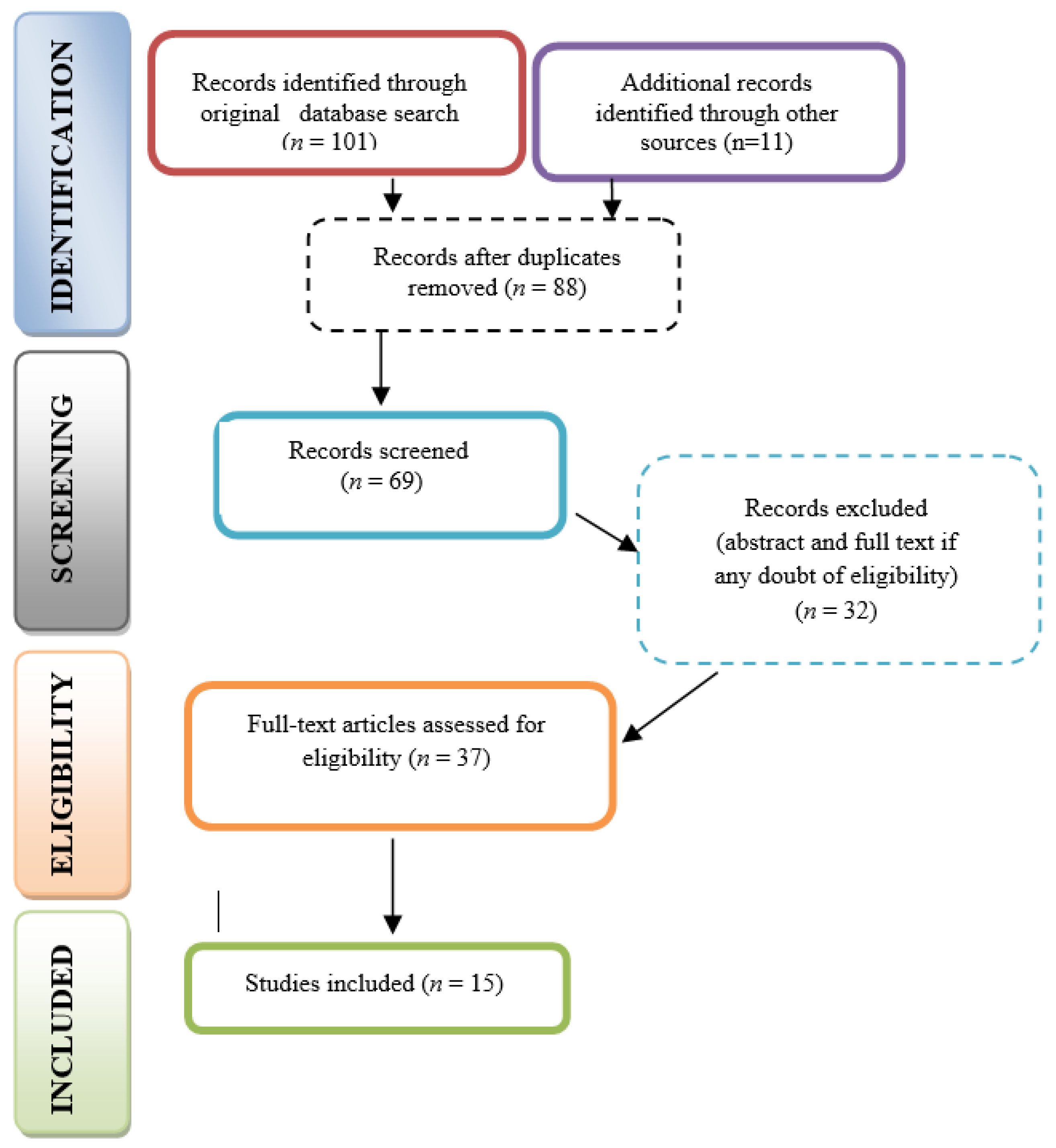
Data Collection
4. Discussion
4.1. Mechanical Characteristics of Preheated Composite Used for Cementation
4.2. Other Characteristics of the Preheated Composite Used for Cementation
4.3. Limitations of This Study and Further Research
4.4. Strengths of This Review
5. Conclusions
Supplementary Materials
Author Contributions
Funding
Institutional Review Board Statement
Informed Consent Statement
Data Availability Statement
Acknowledgments
Conflicts of Interest
References
- Sofan, E.; Sofan, A.; Palaia, G.; Tenore, G.; Romeo, U.; Migliau, G. Classification review of dental adhesive systems: From the IV generation to the universal type. Ann. Stomatol. 2017, 8, 1–17. [Google Scholar] [CrossRef]
- Abad-Coronel, C.; Naranjo, B.; Valdiviezo, P. Adhesive Systems Used in Indirect Restorations Cementation: Review of the Literature. Dent. J. 2019, 7, 71. [Google Scholar] [CrossRef]
- Sakaguchi, R.L.; Ferracane, J.; Powers, J.M. Craig’s Restorative Dental Materials; Elsevier: Amsterdam, The Netherlands, 2018. [Google Scholar]
- Gresnigt, M.M.; Özcan, M.; Carvalho, M.; Lazari, P.; Cune, M.S.; Razavi, P.; Magne, P. Effect of luting agent on the load to failure and accelerated-fatigue resistance of lithium disilicate laminate veneers. Dent. Mater. 2017, 33, 1392–1401. [Google Scholar] [CrossRef]
- Aravind, P.; Mohan Kallat, A.; Kumar Sivabalan, P.; Mathew Velurethu, S.; Vijayan, N.; Augustine, C. An In Vitro Comparison of Shear Bond Strength for Heated Composite Resin With Three Conventional Luting Cements. Cureus 2023, 15, e47110. [Google Scholar] [CrossRef]
- Lucey, S.; Lynch, C.D.; Ray, N.J.; Burke, F.M.; Hannigan, A. Effect of pre-heating on the viscosity and microhardness of a resin composite. J. Oral. Rehabil. 2010, 37, 278–282. [Google Scholar] [CrossRef] [PubMed]
- Blalock, J.S.; Holmes, R.G.; Rueggeberg, F.A. Effect of temperature on unpolymerized composite resin film thickness. J. Prosthet. Dent. 2006, 96, 424–432. [Google Scholar] [CrossRef]
- Poubel, D.; da Silva, R.C.; Ribeiro, A.P.D.; Garcia, F.C.P. Effect of preheating on the viscosity of composite resins. J. Conserv. Dent. Endod. 2024, 27, 360–365. [Google Scholar] [CrossRef] [PubMed]
- Fróes-Salgado, N.R.; Silva, L.M.; Kawano, Y.; Francci, C.; Reis, A.; Loguercio, A.D. Composite pre-heating: Effects on marginal adaptation, degree of conversion and mechanical properties. Dent. Mater. 2010, 26, 908–914. [Google Scholar] [CrossRef]
- Lousan do Nascimento Poubel, D.; Ghanem Zanon, A.E.; Franco Almeida, J.C.; Vicente Melo de Lucas Rezende, L.; Pimentel Garcia, F.C. Composite Resin Preheating Techniques for Cementation of Indirect Restorations. Int. J. Biomater. 2022, 2022, 5935668. [Google Scholar] [CrossRef] [PubMed]
- Deb, S.; Di Silvio, L.; Mackler, H.E.; Millar, B.J. Pre-warming of dental composites. Dent. Mater. 2011, 27, e51–e59. [Google Scholar] [CrossRef]
- Daronch, M.; Rueggeberg, F.A.; De Goes, M.F. Monomer conversion of pre-heated composite. J. Dent. Res. 2005, 84, 663–667. [Google Scholar] [CrossRef]
- Mundim, F.M.; Garcia Lda, F.; Cruvinel, D.R.; Lima, F.A.; Bachmann, L.; Pires-de-Souza Fde, C. Color stability, opacity and degree of conversion of pre-heated composites. J. Dent. 2011, 39, e25–e29. [Google Scholar] [CrossRef]
- Hatner, H.A.O.; Keigo, R.N.; Caneschi, C.S.; Aquino, J.R.J.; Albuquerque, R.C.; Morgan, L.; Moreira, A.N. Evaluation of pulp chamber temperature during cementation with the preheated composite resin technique. J. Prosthet. Dent. 2025, 133, 202.e1–202.e8. [Google Scholar] [CrossRef]
- Al-Ali, A.; Khalifa, N.; Hadj-Hamou, A.; Sheela, S.; El-Damanhoury, H.M. Effect of Thickness and Bonding Technique on Fatigue and Fracture Resistance of Feldspathic Ultra-Thin Laminate Veneers. Eur. J. Dent. 2023, 17, 431–438. [Google Scholar] [CrossRef]
- Coelho, N.F.; Barbon, F.J.; Machado, R.G.; Boscato, N.; Moraes, R.R. Response of composite resins to preheating and the resulting strengthening of luted feldspar ceramic. Dent. Mater. 2019, 35, 1430–1438. [Google Scholar] [CrossRef]
- Kuo, W.-C.; Chang, Y.-H.; Lin, C.-L.; Kuo, J.-S. Effects of different ceramic and dentin thicknesses on the temperature rise during photocuring. J. Dent. Sci. 2011, 6, 210–215. [Google Scholar] [CrossRef][Green Version]
- Kodonas, K.; Gogos, C.; Tziafas, D. Effect of simulated pulpal microcirculation on intrapulpal temperature changes following application of heat on tooth surfaces. Int. Endod. J. 2009, 42, 247–252. [Google Scholar] [CrossRef] [PubMed]
- Lynch, C.D.; Roberts, J.L.; Al-Shehri, A.; Milward, P.J.; Sloan, A.J. An ex-vivo model to determine dental pulp responses to heat and light-curing of dental restorative materials. J. Dent. 2018, 79, 11–18. [Google Scholar] [CrossRef] [PubMed]
- Zach, L.; Cohen, G. Pulp Response To Externally Applied Heat. Oral. Surg. Oral. Med. Oral. Pathol. 1965, 19, 515–530. [Google Scholar] [CrossRef] [PubMed]
- Rueggeberg, F.A.; Giannini, M.; Arrais, C.A.G.; Price, R.B.T. Light curing in dentistry and clinical implications: A literature review. Braz. Oral. Res. 2017, 31, e61. [Google Scholar] [CrossRef]
- Yazici, A.R.; Müftü, A.; Kugel, G. Temperature rise produced by different light-curing units through dentin. J. Contemp. Dent. Pract. 2007, 8, 21–28. [Google Scholar] [CrossRef]
- Guiraldo, R.D.; Consani, S.; Lympius, T.; Schneider, L.F.; Sinhoreti, M.A.; Correr-Sobrinho, L. Influence of the light curing unit and thickness of residual dentin on generation of heat during composite photoactivation. J. Oral. Sci. 2008, 50, 137–142. [Google Scholar] [CrossRef]
- Patussi, A.F.C.; Ramacciato, J.C.; da Silva, J.G.R.; Nascimento, V.R.P.; Campos, D.E.S.; de Araújo Ferreira Munizz, I.; de Souza, G.M.; Lima, R.B.W. Preheating of dental composite resins: A scoping review. J. Esthet. Restor. Dent. 2023, 35, 646–656. [Google Scholar] [CrossRef]
- Souza, J.; Piacenza, L.T.; Mazaro, J.V.Q.; Moreno, A.L.M.; Moreno, N.V.A.; Dos Santos, D.M.; Goiato, M.C. Do preheated composite resins provide better cementation results for indirect restorations? A Systematic Review. J. Clin. Exp. Dent. 2025, 17, e11–e17. [Google Scholar] [CrossRef] [PubMed]
- Abdulsattar, Y.H.; Kadhim, A.J. Effect of immediate dentin sealing on the fracture strength of indirect overlay restorations using different types of luting agents (A comparative in vitro study). J. Conserv. Dent. Endod. 2023, 26, 434–440. [Google Scholar] [CrossRef]
- Akyle, G.; Achour, H. Evaluation of Shear Bond Strength of Lithium Disilicate Veneers Using Pre-heated Resin Composite With Two Conventional Resin Cements: An In Vitro Study. Cureus 2024, 16, e74479. [Google Scholar] [CrossRef]
- Castro-Ramirez, L.C.; Ladera-Castañeda, M.I.; Cachay-Criado, H.R.; Alvino-Vales, M.I.; López-Gurreonero, C.; Cervantes-Ganoza, L.A.; Cayo-Rojas, C.F. Comparative Evaluation of Microtensile Bond Strength in Three Different Dentin Luting Agents: An In vitro Study. J. Int. Soc. Prev. Community Dent. 2024, 14, 43–51. [Google Scholar] [CrossRef] [PubMed]
- Figueiredo, P.S.; Spazzin, A.O.; Bacchi, A.; Alessandretti, R. Effect of preheating and ultrasound application of resin-based luting agents on the failure load of a lithium disilicate glass-ceramic. J. Prosthodont. 2024, 33, 396–401. [Google Scholar] [CrossRef] [PubMed]
- Goulart, M.; Borges Veleda, B.; Damin, D.; Bovi Ambrosano, G.M.; Coelho de Souza, F.H.; Erhardt, M.C.G. Preheated composite resin used as a luting agent for indirect restorations: Effects on bond strength and resin-dentin interfaces. Int. J. Esthet. Dent. 2018, 13, 86–97. [Google Scholar]
- Kramer, M.R.; Edelhoff, D.; Stawarczyk, B. Flexural Strength of Preheated Resin Composites and Bonding Properties to Glass-Ceramic and Dentin. Materials 2016, 9, 83. [Google Scholar] [CrossRef]
- Tribst, J.P.M.; Etoeharnowo, L.; Tadros, M.; Feilzer, A.J.; Werner, A.; Kleverlaan, C.J.; Dal Piva, A.M.O. The influence of pre-heating the restoration and luting agent on the flexural strength of indirect ceramic and composite restorations. Biomater. Investig. Dent. 2023, 10, 2279066. [Google Scholar] [CrossRef]
- Urcuyo Alvarado, M.S.; Escobar García, D.M.; Pozos Guillén, A.J.; Flores Arriaga, J.C.; Romo Ramírez, G.F.; Ortiz Magdaleno, M. Evaluation of the Bond Strength and Marginal Seal of Indirect Restorations of Composites Bonded with Preheating Resin. Eur. J. Dent. 2020, 14, 644–650. [Google Scholar] [CrossRef]
- Secundar, B.; Fathi, A.; Baghaei, K.; Atash, R. Effect of ceramic thickness on the polymerization quality and film thickness of dual-polymerizing versus heated light-polymerizing adhesive cement. J. Prosthet. Dent. 2024, 132, 1328.e1–1328.e6. [Google Scholar] [CrossRef] [PubMed]
- Gugelmin, B.P.; Miguel, L.C.M.; Baratto Filho, F.; Cunha, L.F.D.; Correr, G.M.; Gonzaga, C.C. Color Stability of Ceramic Veneers Luted With Resin Cements and Pre-Heated Composites: 12 Months Follow-Up. Braz. Dent. J. 2020, 31, 69–77. [Google Scholar] [CrossRef] [PubMed]
- Kincses, D.; Jordáki, D.; Szebeni, D.; Kunsági-Máté, S.; Szalma, J.; Lempel, E. Effect of Ceramic and Dentin Thicknesses and Type of Resin-Based Luting Agents on Intrapulpal Temperature Changes during Luting of Ceramic Inlays. Int. J. Mol. Sci. 2023, 24, 5466. [Google Scholar] [CrossRef]
- Mounajjed, R.; Salinas, T.J.; Ingr, T.; Azar, B. Effect of different resin luting cements on the marginal fit of lithium disilicate pressed crowns. J. Prosthet. Dent. 2018, 119, 975–980. [Google Scholar] [CrossRef] [PubMed]
- Sakrana, A.A.; Laith, A.; Elsherbini, A.; Elerian, F.A.; Özcan, M.; Al-Zordk, W. Influence of resin cement on color stability when luting lithium disilicate and zirconia restorations. A spectrophotometry study. Int. J. Esthet. Dent. 2023, 18, 114–126. [Google Scholar]
- Teyagirwa, P.F.; Aquin, C.; Kharouf, N.; Roman, T.; Senger, B.; Reitzer, F.; Etienne, O. Operator versus material influence on film thickness using adhesive resin cement or pre-heated resin composite. J. Esthet. Restor. Dent. 2023, 35, 517–524. [Google Scholar] [CrossRef]


| Concept | Keywords and MeSH Terms |
|---|---|
| Preheated AND composite AND luting | “preheat*” [Tw] AND “composit*” [Tw] AND “lut*” [Tw] |
| Preheated AND luting | “preheat *” [tw] AND “Lut*” |
| Preheated AND composite AND cementation | “preheat*” [tw] AND “composit*” [Tw] AND “cement*” [tw] |
| Preheated AND cementation | “preheat*” [Tw] AND “cement*” [Tw] |
| Database | Search Terms and Combinations |
|---|---|
| PubMed Embase Scopus | “preheat*” [Tw] AND (“lut*” [Tw] AND “composit” [Tw]) OR (“cement” [tw] AND “composit” [Tw]) “preheat*” [tw] AND “cement” [tw] OR “lut*” [Tw] |
| Category | Inclusion Criteria | Exclusion Criteria |
|---|---|---|
| Study Focus/Groups | Articles comparing preheated composite with other cement types | Studies without at least two groups or without a preheated composite comparison |
| Study Design | In vitro studies | Clinical studies and reviews |
| Substrate Type | Performed on dentin or enamel substrates (human, bovine, or analog) | Studies evaluating bonding to composite, plastic, or other non-dental surfaces |
| Language | Published in English | Articles published in languages other than English |
| Publication Date | Published between 2015 and 2025 | Articles published more than 10 years ago |
| Other | — | Studies lacking comparative analysis |
| Author, Year | Luting Surfaces | Luting Agents | Results | |
|---|---|---|---|---|
| 1 | Abdulsattar and Kadhim [26] | Dentine/lithium disilicate | Delay dentin sealing (DDS)/immediate dentin sealing (IDS) + preheated composite or dual cure or flowable composite | Preheated composite had better fracture resistance, followed by resin cement and flowable composite. Fracture resistance for immediate dentin sealing and preheated composite—highest mean value. |
| 2 | Akyle and Achour [27] | Dentine and enamel/lithium disilicate | Light-cured resin cement, preheated composite resin, dual-cured self-adhesive resin cement | Light-cured resin cement—higher SBS compared to preheated resin composite and dual-cured resin cement with a self-etch system. Preheating composite resins may increase mechanical properties and improve luting ceramics. |
| 3 | Castro-Ramirez, Ladera-Castañeda, Cachay-Criado, Alvino-Vales, López-Gurreonero, Cervantes-Ganoza and Cayo-Rojas [28] | Dentin/resin blocks | Flowable resin composite, preheated resin composite, and dual self-adhesive resin cement | Preheated resin composite had significantly higher microtensile bond strength compared to dual self-adhesive cement; flowable resin composite had no significant difference from dual self-adhesive cement or preheated resin composite. Microtensile bond strength in dentin—significantly higher with preheated resin composite at 70 °C compared to dual self-adhesive, but similar to flowable resin composite. |
| 4 | Figueiredo, Spazzin, Bacchi and Alessandretti [29] | Dentin analog/lithium disilicate | Light-cured luting agent, flowable resin composite, supra-nano filled resin composite + preheating or ultrasound | No significant difference among groups considering the type of luting agent, application method and interaction. Preheating and ultrasound application—no effect on failure load of lithium disilicate glass-ceramic, but lower reliability for supra-nano filled resin composite. |
| 5 | Goulart, Borges Veleda, Damin, Bovi Ambrosano, Coelho de Souza and Erhardt [30] | Dentin and enamel/composite | One resin cement, two composite resins—room temperature and preheated to 64 °C | For 2 mm restorations, composite resin, preheated or not, had significantly higher microtensile bond strength than the resin cement, with the other composite equal. 4 mm restorations, preheated composite—significantly higher microtensile bond strength than dual cure cement. Preheating composite resin had thinner luting interfaces. |
| 6 | Kramer, Edelhoff and Stawarczyk [31] | Glass-ceramic/dentin | Three composite materials, different temperatures. | Higher temperature—positive on adhesion; on one group of SBS tests, higher values for preheated composites. Improved adaptation after preheating, less microleakage as lower viscosity—better surface penetration; fracture patterns on dentin were mainly adhesive. |
| 7 | Tribst, Etoeharnowo, Tadros, Feilzer, Werner, Kleverlaan and Dal Piva [32] | Lithium disilicate or resin composite/dentin analog | Dual-curing resin cement/light-curing resin cement/preheated resin composite/high-filled flowable composite with or without preheated restoration | Luting procedures impact the flexural strength of CAD/CAM lithium disilicate and resin composite. Preheated resin composite can replace dual-curing cement; light-curing cement has superior performance for specific thicknesses, but is thicker—less sensitive to luting variations. |
| 8 | Urcuyo [33] | Resin composite/dentin | Preheated composite/self-adhesive resin cement | No significant difference in the degree of microfiltration; microtensile bond strength—greater for resin cement; better adjustment and sealing for preheated composite. |
| 9 | Secundar [34] | Lithium disilicate/enamel, dentin | Dual-component adhesive/preheated composite resin | Vickers hardness of dual resin cement—lower compared to preheated light-cure cement; polymerization of the preheated light-cure composite resin for high thickness onlay—significantly lower; mean film thickness of the dual-polymerizing—significantly lower. |
| Author, Year | Luting Surfaces | Luting Agents | Results | |
|---|---|---|---|---|
| 1 | Gugelmin, Miguel, Baratto Filho, Cunha, Correr and Gonzaga [35] | Bovine enamel/lithium-silicate | Two resin cements, light-cured and dual-cured/three composite resins, minifilled, micro-hybrid, and microfilled | Different luting agents influenced the final color of the restorations; heating had no effect on the degree of conversion. Light-cured and dual-cured resin cements had similar color stability; microfilled composite resin at room temperature and preheated showed clinically relevant color change after 1 year. Heating had no effect on the color stability. |
| 2 | Kincses, Jordáki, Szebeni, Kunsági-Máté, Szalma and Lempel [36] | Dentin/lithium disilicate ceramic | Light-cured/dual-cured adhesive cements/preheated restorative resin-based composite | Pulpal temperature values influenced by the remaining dentin thickness, by the applied resin-based adhesive luting materials, and least by ceramic thickness. Preheated composite raised pulpal temperature to the highest value, not significantly different. |
| 3 | Mounajjed, Salinas, Ingr and Azar [37] | Lithium disilicate/dentin, enamel | Resin cement, flowable resin composite, high viscosity composite resin | The least amount of marginal increase after cementation—flowable composite; the highest marginal increase—preheated composite resin. Also exceeded clinically acceptable range of marginal discrepancy. |
| 4 | Sakrana, Laith, Elsherbini, Elerian, Özcan and Al-Zordk [38] | Lithium disilicate/zirconia/dentin/enamel | Resin cement G-CEM LinkForce/Panavia SA Cement Plus Automix—preheating temperature 25 °C or 54 °C + thermocycling Immersed in coffee | Cement at a temperature up to 54 °C enhances the color stability of lithium disilicate and zirconia restorations. |
| 5 | Teyagirwa, Aquin, Kharouf, Roman, Senger, Reitzer and Etienne [39] | Dentin/composite disks | Two preheated composites, two resin cements | Preheated composites require a better level of expertise for a clinically acceptable film thickness. |
| 6 | Hatner [14] | Lithium disilicate/enamel, dentin bovine | Preheated composite resin, photopolymerizable resin cement | Preheated composite resin + deepest preparation—highest mean intrapulpal temperature, up to 5.70 ± 2.14 °C. |
Disclaimer/Publisher’s Note: The statements, opinions and data contained in all publications are solely those of the individual author(s) and contributor(s) and not of MDPI and/or the editor(s). MDPI and/or the editor(s) disclaim responsibility for any injury to people or property resulting from any ideas, methods, instructions or products referred to in the content. |
© 2026 by the authors. Licensee MDPI, Basel, Switzerland. This article is an open access article distributed under the terms and conditions of the Creative Commons Attribution (CC BY) license.
Share and Cite
Labunet, A.; Kui, A.; Vigu, A.; Voina-Tonea, A.; Burde, A.; Sava, S. Preheated Composite for Prosthetic Cementation to Enamel and Dentin: A Scoping Review. Dent. J. 2026, 14, 69. https://doi.org/10.3390/dj14010069
Labunet A, Kui A, Vigu A, Voina-Tonea A, Burde A, Sava S. Preheated Composite for Prosthetic Cementation to Enamel and Dentin: A Scoping Review. Dentistry Journal. 2026; 14(1):69. https://doi.org/10.3390/dj14010069
Chicago/Turabian StyleLabunet, Anca, Andreea Kui, Alexandra Vigu, Andrada Voina-Tonea, Alexandru Burde, and Sorina Sava. 2026. "Preheated Composite for Prosthetic Cementation to Enamel and Dentin: A Scoping Review" Dentistry Journal 14, no. 1: 69. https://doi.org/10.3390/dj14010069
APA StyleLabunet, A., Kui, A., Vigu, A., Voina-Tonea, A., Burde, A., & Sava, S. (2026). Preheated Composite for Prosthetic Cementation to Enamel and Dentin: A Scoping Review. Dentistry Journal, 14(1), 69. https://doi.org/10.3390/dj14010069