


Effect of Lithium-Disilicate Liners on Bond Strength and Fracture Resistance of Bilayered Zirconia Systems: A Systematic Review of In Vitro Evidence


Abstract
1. Introduction
2. Materials and Methods
2.1. Protocol and Registration
2.2. Eligibility Criteria
2.3. Information Sources and Search Strategy
2.4. Study Selection and Data Extraction
2.5. Risk of Bias
3. Results
4. Discussion
4.1. Summary of Evidence
4.2. Limitations
5. Conclusions
Supplementary Materials
Author Contributions
Funding
Institutional Review Board Statement
Data Availability Statement
Conflicts of Interest
References
- Agustín-Panadero, R.; Román-Rodríguez, J.L.; Ferreiroa, A.; Solá-Ruíz, M.F.; Fons-Font, A. Zirconia in fixed prosthesis. A literature review. J. Clin. Exp. Dent. 2014, 6, e66–e73. [Google Scholar] [CrossRef] [PubMed] [PubMed Central]
- Raigrodski, A.J.; Hillstead, M.B.; Meng, G.K.; Chung, K.H. Survival and complications of zirconia-based fixed dental prostheses: A systematic review. J. Prosthet. Dent. 2012, 107, 170–177. [Google Scholar] [CrossRef] [PubMed]
- Pjetursson, B.E.; Valente, N.A.; Strasding, M.; Zwahlen, M.; Liu, S.; Sailer, I. A systematic review of the survival and complication rates of zirconia-ceramic and metal-ceramic single crowns. Clin. Oral Implant. Res. 2018, 29 (Suppl. S16), 199–214. [Google Scholar] [CrossRef] [PubMed]
- Tanaka, C.B.; Ballester, R.Y.; De Souza, G.M.; Zhang, Y.; Meira, J.B. Influence of residual thermal stresses on the edge chipping resistance of PFM and veneered zirconia structures: Experimental and FEA study. Dent. Mater. 2019, 35, 344–355. [Google Scholar] [CrossRef] [PubMed] [PubMed Central]
- Zhang, Y.; Vardhaman, S.; Rodrigues, C.S.; Lawn, B.R. A Critical Review of Dental Lithia-Based Glass-Ceramics. J. Dent. Res. 2023, 102, 245–253. [Google Scholar] [CrossRef] [PubMed] [PubMed Central]
- Moreira, P.M.; Carvalho, G.L.M.; de Castro Albuquerque, R.; André, C.B. Effect of hydrofluoric acid and self-etch ceramic primers on the flexural strength and fatigue resistance of glass ceramics: A systematic review and meta-analysis of in vitro studies. Jpn. Dent. Sci. Rev. 2024, 60, 198–210. [Google Scholar] [CrossRef] [PubMed] [PubMed Central]
- Aguilera, M.A.R.; Bortolazzo, A.C.; Correr-Sobrinho, L.; Consani, R.L.X. Surface treatments of the zirconia-reinforced lith-ium disilicate ceramic in the adhesion to the resin cement. Braz Dent J. 2024, 35, e245674. [Google Scholar] [CrossRef]
- Alghazzawi, T.F.; Janowski, G.M. Effect of liner and porcelain application on zirconia surface structure and composition. Int. J. Oral Sci. 2016, 8, 164–171. [Google Scholar] [CrossRef] [PubMed] [PubMed Central]
- Jikihara, A.N.; Tanaka, C.B.; Ballester, R.Y.; Swain, M.V.; Versluis, A.; Meira, J.B. Why a zero CTE mismatch may be better for veneered Y-TZP structures. J. Mech. Behav. Biomed. Mater. 2019, 96, 261–268. [Google Scholar] [CrossRef] [PubMed]
- Renda, J.J.; Harding, A.B.; Bailey, C.W.; Guillory, V.L.; Vandewalle, K.S. Microtensile bond strength of lithium disilicate to zirconia with the CAD-on technique. J. Prosthodont. 2015, 24, 188–193. [Google Scholar] [CrossRef] [PubMed]
- Kim, S.H.; Park, C.J.; Cho, L.R.; Huh, Y.H. Evaluation of the ceramic liner bonding effect between zirconia and lithium disilicate. J. Prosthet. Dent. 2018, 120, 282–289. [Google Scholar] [CrossRef] [PubMed]
- ISO 9693:2019; Dentistry—Compatibility Testing for Metal- and Ceramic-Ceramic Systems. International Organization for Standardization: Geneva, Switzerland, 2019. Available online: https://www.iso.org/standard/75855.html (accessed on 8 December 2025).
- Sreekala, L.; Narayanan, M.; Eerali, S.M.; Eerali, S.M.; Varghese, J.; Zainaba Fathima, A.L. Comparative evaluation of shear bond strengths of veneering porcelain to base metal alloy and zirconia substructures before and after aging—An in vitro study. J. Int. Soc. Prev. Community Dent. 2015, 5 (Suppl. S2), S74–S81. [Google Scholar] [CrossRef] [PubMed] [PubMed Central]
- Siarampi, E.; Sarafidou, K.; Papadopoulou, L.; Kantiranis, N.; Kontonasaki, E.; Koidis, P. Effect of different zirconia surface pretreatments on the flexural strength of veneered Y-TZP ceramic before and after in vitro aging. J. Prosthodont. Res. 2022, 66, 491–501. [Google Scholar] [CrossRef] [PubMed]
- Fischer, J.; Stawarzcyk, B.; Trottmann, A.; Hämmerle, C.H. Impact of thermal misfit on shear strength of veneering ceramic/zirconia composites. Dent. Mater. 2009, 25, 419–423. [Google Scholar] [CrossRef] [PubMed]
- Page, M.J.; McKenzie, J.E.; Bossuyt, P.M.; Boutron, I.; Hoffmann, T.C.; Mulrow, C.D.; Shamseer, L.; Tetzlaff, J.M.; Akl, E.A.; Brennan, S.E.; et al. The PRISMA 2020 statement: An updated guideline for reporting systematic reviews. BMJ 2021, 10, 89. [Google Scholar] [CrossRef] [PubMed] [PubMed Central]
- Jang, Y.-S.; Noh, H.-R.; Lee, M.-H.; Lim, M.-J.; Bae, T.-S. Effect of Lithium Disilicate Reinforced Liner Treatment on Bond and Fracture Strengths of Bilayered Zirconia All-Ceramic Crown. Materials 2018, 11, 77. [Google Scholar] [CrossRef] [PubMed]
- Jang, Y.-S.; Oh, S.-H.; Oh, W.-S.; Lee, M.-H.; Lee, J.-J.; Bae, T.-S. Effects of Liner-Bonding of Implant-Supported Glass–Ceramic Crown to Zirconia Abutment on Bond Strength and Fracture Resistance. Materials 2019, 12, 2798. [Google Scholar] [CrossRef]
- Wattanasirmkit, K.; Srimaneepong, V.; Kanchanatawewat, K.; Monmaturapoj, N.; Thunyakitpisal, P.; Jinawath, S. Improving shear bond strength between feldspathic porcelain and zirconia substructure with lithium disilicate glass-ceramic liner. Dent. Mater. J. 2015, 34, 302–309. [Google Scholar] [CrossRef] [PubMed]
- Moses, A.; Ganesan, L.; Shankar, S.; Hariharan, A. A comparative evaluation of shear bond strength between feldspathic porcelain and lithium di silicate ceramic layered to a zirconia core—An in vitro study. J. Clin. Exp. Dent. 2020, 12, e1039–e1044. [Google Scholar] [CrossRef] [PubMed] [PubMed Central]
- Yadav, P.; Dabas, N.; Phukela, S.S.; Malhotra, P.; Drall, S.; Ritwal, P.K. A comparative evaluation of the effect of liners on the shear bond strength of veneered zirconia block: An in vitro study. J. Indian. Prosthodont. Soc. 2019, 19, 338–344. [Google Scholar] [CrossRef] [PubMed] [PubMed Central]
- Mainjot, A.K.; Schajer, G.S.; Vanheusden, A.J.; Sadoun, M.J. Influence of cooling rate on residual stress profile in veneering ceramic: Measurement by hole-drilling. Dent. Mater. 2011, 27, 906–914. [Google Scholar] [CrossRef] [PubMed]
- Mainjot, A.K.; Najjar, A.; Jakubowicz-Kohen, B.D.; Sadoun, M.J. Influence of thermal expansion mismatch on residual stress profile in veneering ceramic layered on zirconia: Measurement by hole-drilling. Dent. Mater. 2015, 31, 1142–1149. [Google Scholar] [CrossRef] [PubMed]
- Al-Amleh, B.; Neil Waddell, J.; Lyons, K.; Swain, M.V. Influence of veneering porcelain thickness and cooling rate on residual stresses in zirconia molar crowns. Dent. Mater. 2014, 30, 271–280. [Google Scholar] [CrossRef] [PubMed]
- Göstemeyer, G.; Jendras, M.; Dittmer, M.P.; Bach, F.-W.; Stiesch, M.; Kohorst, P. Influence of cooling rate on zirconia/veneer interfacial adhesion. Acta Biomater. 2010, 6, 4532–4538. [Google Scholar] [CrossRef] [PubMed]
- Zicari, F.; Monaco, C.; Vivan Cardoso, M.; Silvestri, D.; Van Meerbeek, B. Bonding Effectiveness of Veneering Ceramic to Zirconia after Different Grit-Blasting Treatments. Dent. J. 2024, 12, 219. [Google Scholar] [CrossRef] [PubMed] [PubMed Central]
- Cheng, C.W.; Yang, C.C.; Yan, M. Bond strength of heat-pressed veneer ceramics to zirconia with various blasting conditions. J. Dent. Sci. 2018, 13, 301–310. [Google Scholar] [CrossRef] [PubMed] [PubMed Central]
- Ishibe, M.; Raigrodski, A.J.; Flinn, B.D.; Chung, K.H.; Spiekerman, C.; Winter, R.R. Shear bond strengths of pressed and layered veneering ceramics to high-noble alloy and zirconia cores. J. Prosthet. Dent. 2011, 106, 29–37. [Google Scholar] [CrossRef] [PubMed]
- Pandurangan, K.K.; Veeraiyan, D.N.; Nesappan, T. In vitro evaluation of fracture resistance and cyclic fatigue resistance of computer-aided design-on and hand-layered zirconia crowns following cementation on epoxy dies. J. Indian. Prosthodont. Soc. 2020, 20, 90–96. [Google Scholar] [CrossRef] [PubMed] [PubMed Central]
- Kirmali, O.; Akin, H.; Ozdemir, A.K. Shear bond strength of veneering ceramic to zirconia core after different surface treatments. Photomed. Laser Surg. 2013, 31, 261–268. [Google Scholar] [CrossRef] [PubMed]
- Dimitriadis, K.; Tulyaganov, D.U.; Agathopoulos, S. Evaluation of bond strength between zirconia milled ceramic material and veneered dental porcelain. Eur. J. Oral Sci. 2024, 132, e12989. [Google Scholar] [CrossRef] [PubMed]

| Study | Randomization and Allocation | Aging Protocol (Thermocycling/Fatigue) | Reporting of Materials and Protocols | Statistics (Analysis and Reporting) | Overall Risk of Bias |
|---|---|---|---|---|---|
| Jang et al. 2018 [17] | NR; groups defined, but no randomization description | Water storage only; no thermocycling → some concerns | Zirconia and liner materials described; firing schedule partially specified → some concerns | Appropriate group comparisons; dispersion reported; no power calculation → some concerns | High (limited aging) |
| Jang et al. 2019 [18] | NR; allocation method not stated | Water storage only; no thermocycling → high concerns for long-term behavior | Materials and bonding protocols described; interface thickness reported → low | Appropriate statistics; no power calculation → some concerns | High |
| Wattanasirmkit et al. 2015 [19] | NR | Thermocycling (10,000 cycles) reported → low | Materials, liner, and press-on protocols described → low | Appropriate tests; dispersion reported; no power calculation → some concerns | Some concerns |
| Moses et al. 2020 [20] | NR | Thermocycling (5000–10,000 cycles) as experimental factor → low | Liner types, firing temperatures, and cycles described → low | Three-way ANOVA with post hoc tests; no power calculation → some concerns | Some concerns |
| Yadav et al. 2019 [21] | NR | Thermocycling n.r.; only storage → some concerns | Materials, liner thickness, and firing temperatures detailed → low | Appropriate statistical comparisons; dispersion reported; no power calculation → some concerns | Some concerns |
| Study (Year; Journal) | Country/Setting | Zirconia and Veneer Configuration | LD Interface Type (Brand/Processing) | Thermocycling/Aging | Primary Outcomes |
|---|---|---|---|---|---|
| Jang et al. 2018 [17] | Korea (in vitro) | CAD/CAM 3Y-TZP zirconia core + heat-pressed lithium-disilicate glass–ceramic veneer (Amber LiSi-POZ) | Lithium disilicate–reinforced spray-type liner (Hass, Seoul, Republic of Korea) applied to zirconia; heated to ~940–950 °C for 90 s before heat-press veneering | Water storage 24 h at 37 °C (no thermocycling reported) | Microtensile bond strength; crown fracture strength (with Weibull analysis) |
| Jang et al. 2019 [18] | Korea (in vitro) | Implant-supported CAD/CAM zirconia abutment (3Y-TZP) + milled lithium-disilicate–reinforced glass–ceramic crown (Amber Mill-Q) | Liner bonding (heat-bonding) of the LD-reinforced ceramic to zirconia versus dual-cure self-adhesive resin cement (cement-bonding) | Water storage 24 h at 37 °C prior to testing (no thermocycling reported) | Microtensile bond strength; initial chipping load; fracture resistance of implant-supported crowns |
| Wattanasirmkit et al. 2015 [19] | Thailand (in vitro) | Zirconia substructure + veneering porcelain | Lithium disilicate glass–ceramic liner fired on zirconia prior to veneering (vs no-liner) | Thermocycling: 10,000 cycles (protocol present in full text; abstract confirms 10 k cycles; detailed temps/dwell not stated in abstract) | Shear bond strength (SBS); phase/microstructure |
| Moses et al. 2020 [20] | India (in vitro) | Zirconia core + veneering by (A) feldspathic layering vs. (B) heat-pressed lithium disilicate over zirconia | Press-on LD scheme (vs feldspathic layering); no separate liner arm | Thermocycling: 20,000 cycles (per methods in open-access article) | Shear bond strength (SBS) |
| Yadav et al. 2019 [21] | India (in vitro) | VITA 3Y-TZP disks veneered with VITA VM9 dentin/enamel | Three interface variants vs. control: (1) Lithium disilicate glass–ceramic liner (IPS e.max Press) fired at 930 °C (0.5 mm), (2) Silicon-dioxide-based liner (VITA), (3) Glass-ceramic interlayer; each followed by VM9 dentin (910 °C) and enamel (900 °C) | No thermocycling stated; specimens finished to uniform thickness; universal testing without prior TC | SBS; SEM failure mode |
| Study | Test | Group(s) Compared | Bond Strength (Mean ± SD) | Δ vs. Control/Notes |
|---|---|---|---|---|
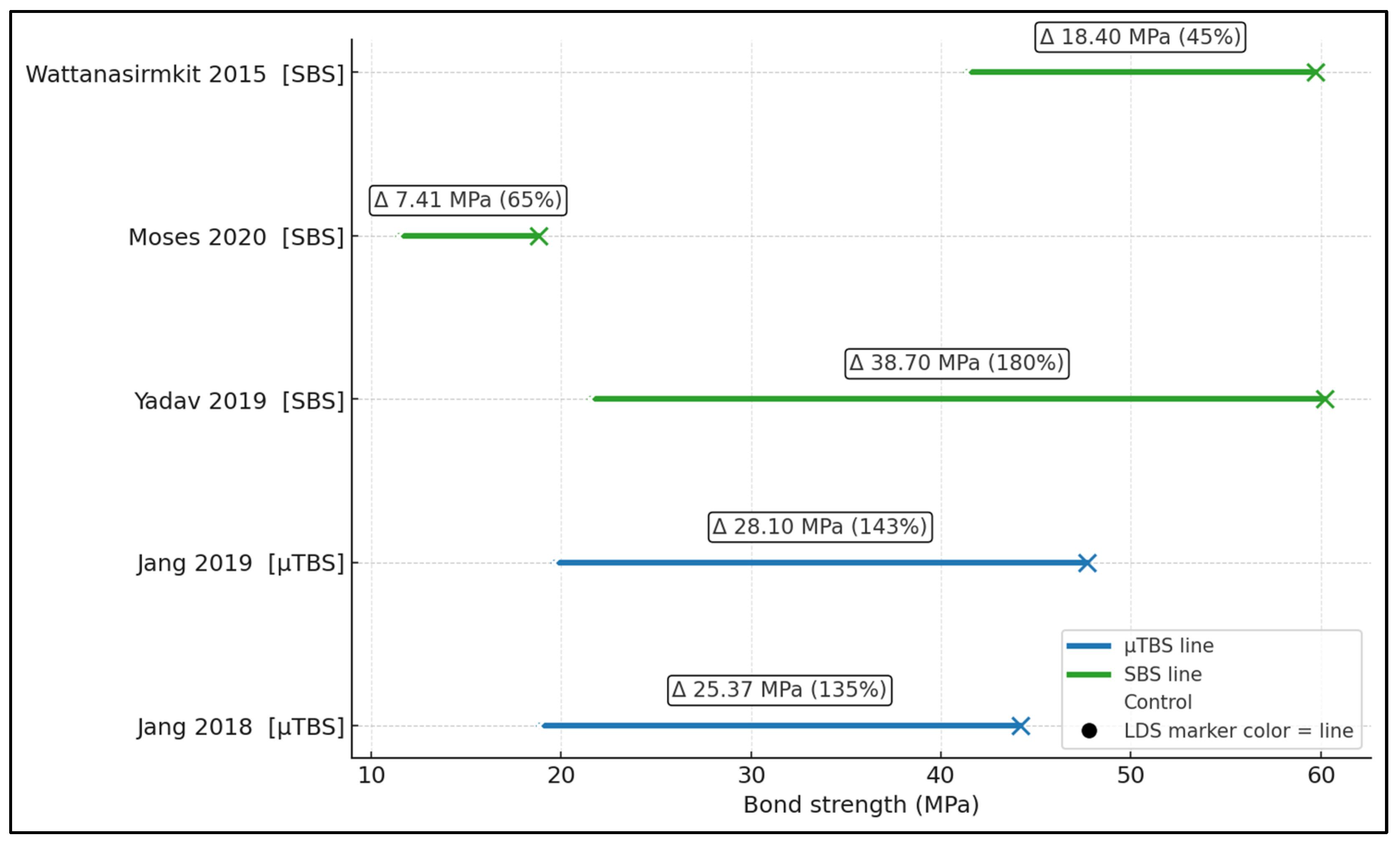
| Jang et al. 2018 [17] | Microtensile | LD spray-liner vs. no-liner | 44.20 MPa (liner) vs. 18.83 MPa (no-liner) | Liner +25.4 MPa |
| Jang et al. 2019 [18] | Microtensile | Liner-bonded vs. resin-cement-bonded | 47.7 MPa (liner-bonded) vs. 19.6 MPa (cement-bonded) | Liner +28.1 MPa |
| Wattanasirmkit et al. 2015 [19] | Shear (SBS) | LD glass–ceramic liner (best condition) | ~59.7 MPa (pre-TC); >25 MPa post-10,000 TC | Highest SBS observed; remained > ISO threshold |
| Moses et al. 2020 [20] | Shear (SBS) | LD press-on vs. feldspathic layering | 18.81 ± 1.76 MPa (LD) vs. 11.40 ± 1.29 MPa (feldspathic) | LD significantly higher (p < 0.01) |
| Yadav et al. 2019 [21] | Shear (SBS) | LD liner vs. SiO2 liner vs. glass–ceramic interlayer vs. control | NR (LD highest per text; numeric in image-only table) | LD ranked highest; failure mostly adhesive |
| Study | Specimen/Test | Groups | Chipping/Local Fracture | Global Fracture (Weibull Mean or Mean) | Notes |
|---|---|---|---|---|---|
| Jang et al. 2018 [17] | Crown-like; load-to-fracture; Weibull | LD spray-liner vs. no-liner | — | σf(avg): ~3.45 kN (liner) vs. ~2.18 kN (no-liner); characteristic strength 5.64 vs. 3.42 kN | Liner increased both average and characteristic fracture strengths |
| Jang et al. 2019 [18] | Implant crown; local chipping and global fracture | Liner-bonded vs. resin-cement-bonded | Chipping: ~0.84 kN (liner) vs. ~0.34 kN (cement) | Fracture: ~1.93 kN (liner) vs. ~1.71 kN (cement) | Liner improved both chipping resistance and overall fracture load |
| Wattanasirmkit et al. 2015 [19] | Bilayer blocks; SBS focus | LD press-on vs. feldspathic | — | NR | Study centered on SBS; fracture not quantified |
| Moses et al. 2020 [20] | SBS focus, with microstructure | LD liner vs. no-liner | — | NR | Fractography reported (mixed failures); no global fracture load |
| Yadav et al. 2019 [21] | SBS + failure mode | LD liner vs. others | Adhesive failure dominant with LD | NR | No load-to-fracture data |
| Study (Year) | Liner/Product | Liner Firing Protocol (°C) | Veneer/Crown Method | thermocycling (Cycles) | Crosshead Speed (mm/min) | Zirconia Pretreatment | Interface Thickness (µm) | Additional Findings |
|---|---|---|---|---|---|---|---|---|
| Jang et al. 2018 [17] | Lithium disilicate “liner” forming chemical interlayer | NR (liner heat-bonded during build-up) | Layered porcelain on zirconia | NR | NR | NR | NR | Weibull (μTBS): m = 2.79 (no-liner) vs. 4.77 (liner); σ0 (μTBS): 20.57 vs. 49.38 MPa; crown–core characteristic fracture load σ0: 5.64 kN (liner) vs. 3.42 kN. |
| Jang et al. 2019 [18] | Li-disilicate-reinforced glass–ceramic liner (Amber Mill-Q liner) | ~800 °C heat-bonding (manufacturer schedule) | CAD/CAM glass–ceramic crown, liner-bonded vs. resin-cement-bonded | NR | 0.5 | Airborne abrasion (50 µm Al2O3, 3 bar) in the cement-bonded group only | 33.6 ± 5.2 (liner) vs. 13.3 ± 1.6 (cement layer) | Initial chipping: 843.8 ± 317.5 N (liner) vs. 341.0 ± 90.2 N; fracture: 1929.6 ± 191.1 N (liner) vs. 1711.1 ± 275.4 N (ns). |
| Wattanasirmkit et al. 2015 [19] | IPS e.max Press-on over Y-TZP vs. feldspathic layering | Manufacturer schedules; press-on cycle for e.max | Press-on vs. conventional layering | 20,000 | NR | NR | NR | Reported significantly higher SBS for press-on Li-disilicate vs. feldspathic and polymer-infiltrated ceramic after 20 k cycles |
| Moses et al. 2020 [20] | Li-disilicate glass–ceramic liner (experimental) vs. other liners | Firing temperature significantly affected SBS (exact °C combinations per protocol) | Layered feldspathic porcelain on Zr | 5000–10,000 (factor in three-way ANOVA) | NR | NR | NR | Highest SBS reported: 59.7 MPa (Li-disilicate liner condition). |
| Yadav et al. 2019 [21] | 0.5 mm Li-disilicate liner (IPS e.max Press) vs. SiO2-based liner, glass–ceramic interlayer, control | 930 °C (liner); dentin 910 °C; enamel 900 °C | Layered (0.5 mm liner + 0.5 mm dentin + 0.5 mm enamel; total 4.5 mm) | NR | 0.5 | NR | NR | Outcome direction: The Li-disilicate liner showed the highest mean SBS among groups; detailed MPa values are provided in the figure/table images. |
Disclaimer/Publisher’s Note: The statements, opinions and data contained in all publications are solely those of the individual author(s) and contributor(s) and not of MDPI and/or the editor(s). MDPI and/or the editor(s) disclaim responsibility for any injury to people or property resulting from any ideas, methods, instructions or products referred to in the content. |
© 2025 by the authors. Licensee MDPI, Basel, Switzerland. This article is an open access article distributed under the terms and conditions of the Creative Commons Attribution (CC BY) license.
Share and Cite
Maroiu, A.C.; Luca, M.M.; Jivanescu, A. Effect of Lithium-Disilicate Liners on Bond Strength and Fracture Resistance of Bilayered Zirconia Systems: A Systematic Review of In Vitro Evidence. Dent. J. 2026, 14, 5. https://doi.org/10.3390/dj14010005
Maroiu AC, Luca MM, Jivanescu A. Effect of Lithium-Disilicate Liners on Bond Strength and Fracture Resistance of Bilayered Zirconia Systems: A Systematic Review of In Vitro Evidence. Dentistry Journal. 2026; 14(1):5. https://doi.org/10.3390/dj14010005
Chicago/Turabian StyleMaroiu, Alexandra Cristina, Magda Mihaela Luca, and Anca Jivanescu. 2026. "Effect of Lithium-Disilicate Liners on Bond Strength and Fracture Resistance of Bilayered Zirconia Systems: A Systematic Review of In Vitro Evidence" Dentistry Journal 14, no. 1: 5. https://doi.org/10.3390/dj14010005
APA StyleMaroiu, A. C., Luca, M. M., & Jivanescu, A. (2026). Effect of Lithium-Disilicate Liners on Bond Strength and Fracture Resistance of Bilayered Zirconia Systems: A Systematic Review of In Vitro Evidence. Dentistry Journal, 14(1), 5. https://doi.org/10.3390/dj14010005

