
Methodologies for Assessing the Dimensional Accuracy of Computer-Guided Static Implant Surgery in Clinical Settings: A Scoping Review

 , , , , , ,
Abstract
1. Introduction
1.1. Background and Rationale
- Systematically outline the methodologies utilized to assess the accuracy of CGSIS in the literature.
- Combine the different reference systems and metrics that are used to report dimensional deviations.
- Find out how different methodological choices can change how accurate the reported results are.
- Identify significant gaps and sources of diversity to facilitate future research.
1.2. Review Question and Objectives
- To systematically map and categorize the clinical study designs employed in this domain, including randomized controlled trials, prospective cohorts, and retrospective analyses.
- To identify, classify, and compare the reference systems (e.g., CBCT, IOS) and measurement technologies used to capture the achieved implant position and perform the planned-to-achieved superimposition.
- To synthesize the definitions, terminology, and statistical reporting of core accuracy metrics, such as linear deviations (global, lateral, vertical) and angular deviation.
- To identify critical gaps and inconsistencies in the current methodological approaches and, based on the synthesized evidence, propose foundational elements for a standardized reporting framework to enhance the reliability and comparability of future clinical research on CGSIS accuracy.
2. Methods
2.1. Study Design
2.2. Eligibility Criteria
2.3. Search Strategy
2.4. Study Selection Process
2.5. Data Charting Process
- Bibliographic and General Study Information: Author, year, study design, and sample size (patients, implants, guides).
- Surgical Protocol: Guide support type and planning software used.
- Core Assessment Methodology: This was the focus of extraction, detailing the data acquisition method for the achieved implant position (e.g., post-operative CBCT, intraoral scan), the reference system for superimposition (e.g., planned STL vs. post-op STL), the specific software used for measurement, and the key accuracy metrics reported (e.g., linear and angular deviations).
2.6. Critical Appraisal of Individual Sources
3. Results
3.1. Study Selection
3.2. Characteristics of Included Studies
3.3. Mapping of Methodological Approaches
3.3.1. Reference Systems for Data Acquisition and Superimposition
3.3.2. Software and Analytical Techniques
3.3.3. Accuracy Metrics and Statistical Reporting
4. Discussion
4.1. Summary of Evidence
4.2. Interpretation of Key Findings
4.2.1. The Dichotomy of Reference Systems. Mapping Distinct Methodological Paradigms and Their Clinical Constructs
4.2.2. The Problem of Inconsistent Terminology and Statistical Reporting
4.2.3. The Impact of Clinical Reality on Measured Accuracy
4.3. Implications for Practice and Research
4.3.1. For Researchers: Proposed Framework
- Explicit Methodology Description: A detailed account of the reference system, including the specific hardware (CBCT machine, IOS model) and software (name and version) used for superimposition and measurement, including the alignment algorithm (e.g., ICP, best-fit).
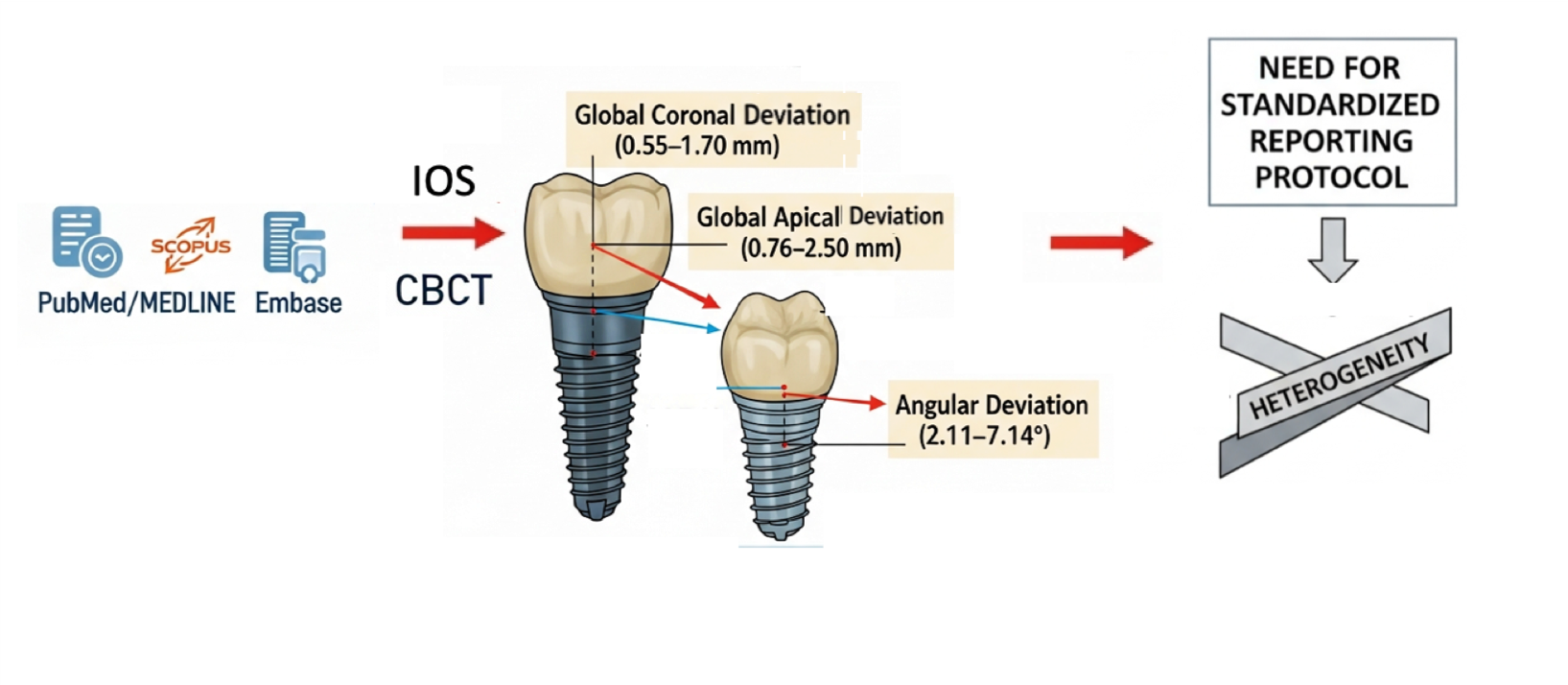
- Should include Core Metrics: Reporting of the following three metrics for every implant, as a minimum:
- Global 3D deviation at the implant platform (coronal);
- Global 3D deviation at the implant apex;
- Three-dimensional angular deviation.
- Standardized Statistical Reporting: Providing both mean ± standard deviation and median with interquartile range (IQR) for all core metrics to accommodate both parametric and non-parametric understanding of the data.
- Adherence to ISO Terminology: Clearly stating that the study is assessing trueness and, where possible, designing studies to also evaluate precision.
- Reporting of Clinical Confounders: Should include reporting of key clinical variables known to affect accuracy, including but not limited to: guide support type, edentulism status (fully vs. partially), surgical protocol (fully vs. partially guided), implant region (anterior/posterior), and use of anchor pins.
4.3.2. For Clinicians: A Critical Lens for Interpreting the Evidence
4.4. Limitations of the Review
5. Conclusions
Supplementary Materials
Author Contributions
Funding
Data Availability Statement
Conflicts of Interest
Abbreviations
| CGSIS | Computer-guided static implant surgery |
| PRISMA-ScR | Preferred Reporting Items for Systematic reviews and Meta-Analyses extension for Scoping Reviews |
| CBCT | Cone-Beam Computed Tomography |
| IOS | Intraoral Scanner |
| STL | Standard Tessellation Language/Stereolithography |
| RCT | Randomized Controlled Trial. |
| JBI | Joanna Briggs Institute |
| PCC | Population, Concept, Context |
| IQR | Interquartile Range |
| s-CAIS | Static computer-assisted implant surgery |
| r-CAIS | Robotic-assisted implant surgery |
References
- Yan, Y.; Lin, Y.; Wei, D.; Di, P. Three-Dimensional Analysis of Implant-Supported Fixed Prosthesis in the Edentulous Maxilla: A Retrospective Study. BMC Oral Health 2025, 25, 1223. [Google Scholar] [CrossRef] [PubMed]
- Vartan, N.; Gath, L.; Olmos, M.; Plewe, K.; Vogl, C.; Kesting, M.R.; Wichmann, M.; Matta, R.E.; Buchbender, M. Accuracy of Three-Dimensional Computer-Aided Implant Surgical Guides: A Prospective In Vivo Study of the Impact of Template Design. Dent. J. 2025, 13, 150. [Google Scholar] [CrossRef] [PubMed]
- Peitsinis, P.R.; Blouchou, A.; Chatzopoulos, G.S.; Vouros, I.D. Optimizing Implant Placement Timing and Loading Protocols for Successful Functional and Esthetic Outcomes: A Narrative Literature Review. J. Clin. Med. 2025, 14, 1442. [Google Scholar] [CrossRef] [PubMed]
- Chen, S.T.; Buser, D.; Sculean, A.; Belser, U.C. Complications and Treatment Errors in Implant Positioning in the Aesthetic Zone: Diagnosis and Possible Solutions. Periodontol. 2000 2023, 92, 220–234. [Google Scholar] [CrossRef]
- Kim, S.-G. Clinical Complications of Dental Implants. In Implant Dentistry—A Rapidly Evolving Practice; Turkyilmaz, I., Ed.; InTech: London, UK, 2011; ISBN 978-9533076584. [Google Scholar]
- Mistry, A.; Ucer, C.; Thompson, J.; Khan, R.; Karahmet, E.; Sher, F. 3D Guided Dental Implant Placement: Impact on Surgical Accuracy and Collateral Damage to the Inferior Alveolar Nerve. Dent. J. 2021, 9, 99. [Google Scholar] [CrossRef]
- Monje, A.; Kan, J.Y.; Borgnakke, W. Impact of Local Predisposing/Precipitating Factors and Systemic Drivers on Peri-Implant Diseases. Clin. Implant Dent. Relat. Res. 2023, 25, 640–660. [Google Scholar] [CrossRef]
- Liu, W.; Zhu, F.; Samal, A.; Wang, H. Suggested Mesiodistal Distance for Multiple Implant Placement Based on the Natural Tooth Crown Dimension with Digital Design. Clin. Implant Dent. Relat. Res. 2022, 24, 801–808. [Google Scholar] [CrossRef]
- Ribas, B.R.; Nascimento, E.H.L.; Freitas, D.Q.; Pontual, A.D.A.; Pontual, M.L.D.A.; Perez, D.E.C.; Ramos-Perez, F.M.M. Positioning Errors of Dental Implants and Their Associations with Adjacent Structures and Anatomical Variations: A CBCT-Based Study. Imaging Sci. Dent. 2020, 50, 281. [Google Scholar] [CrossRef]
- Kheiri, L.; Amid, R.; Kadkhodazadeh, M.; Kheiri, A. What Are the Outcomes of Dental Implant Placement in Sites with Oroantral Communication Using Different Treatment Approaches?: A Systematic Review. BMC Oral Health 2025, 25, 652. [Google Scholar] [CrossRef]
- Wright, E.F. Persistent Dysesthesia Following Dental Implant Placement: A Treatment Report of 2 Cases. Implant Dent. 2011, 20, 20–26. [Google Scholar] [CrossRef]
- Manor, Y.; Anavi, Y.; Gershonovitch, R.; Lorean, A.; Mijiritsky, E. Complications and Management of Implants Migrated into the Maxillary Sinus. Int. J. Periodontics Restor. Dent. 2018, 38, e112–e118. [Google Scholar] [CrossRef] [PubMed]
- D’haese, J.; Ackhurst, J.; Wismeijer, D.; De Bruyn, H.; Tahmaseb, A. Current State of the Art of Computer-guided Implant Surgery. Periodontol. 2000 2017, 73, 121–133. [Google Scholar] [CrossRef]
- Tia, M.; Guerriero, A.T.; Carnevale, A.; Fioretti, I.; Spagnuolo, G.; Sammartino, G.; Gasparro, R. Positional Accuracy of Dental Implants Placed by Means of Fully Guided Technique in Partially Edentulous Patients: A Retrospective Study. Clin. Exp. Dent. Res. 2025, 11, e70144. [Google Scholar] [CrossRef]
- Tricco, A.C.; Lillie, E.; Zarin, W.; O’Brien, K.K.; Colquhoun, H.; Levac, D.; Moher, D.; Peters, M.D.J.; Horsley, T.; Weeks, L.; et al. PRISMA Extension for Scoping Reviews (PRISMA-ScR): Checklist and Explanation. Ann. Intern. Med. 2018, 169, 467–473. [Google Scholar] [CrossRef]
- Peters, M.D.; Godfrey, C.; McInerney, P.; Munn, Z.; Tricco, A.C.; Khalil, H. Scoping Reviews. In JBI Manual for Evidence Synthesis; Aromataris, E., Lockwood, C., Porritt, K., Pilla, B., Jordan, Z., Eds.; JBI: Adelaide, Australia, 2024; ISBN 9780648848820. [Google Scholar]
- Luongo, F.; Lerner, H.; Gesso, C.; Sormani, A.; Kalemaj, Z.; Luongo, G. Accuracy in Static Guided Implant Surgery: Results from a Multicenter Retrospective Clinical Study on 21 Patients Treated in Three Private Practices. J. Dent. 2024, 140, 104795. [Google Scholar] [CrossRef] [PubMed]
- Wang, B.; Yang, J.; Siow, L.; Wang, Y.; Zhang, X.; Zhou, Y.; Yu, M.; Wang, H. Clinical Accuracy of Partially Guided Implant Placement in Edentulous Patients: A Computed Tomography-Based Retrospective Study. Clin. Oral Implants Res. 2024, 35, 31–39. [Google Scholar] [CrossRef]
- Sun, Y.; Ding, Q.; Yuan, F.; Zhang, L.; Sun, Y.; Xie, Q. Accuracy of a Chairside, Fused Deposition Modeling Three-Dimensional-Printed, Single Tooth Surgical Guide for Implant Placement: A Randomized Controlled Clinical Trial. Clin. Oral Implants Res. 2022, 33, 1000–1009. [Google Scholar] [CrossRef]
- Ngamprasertkit, C.; Aunmeungthong, W.; Khongkhunthian, P. The Implant Position Accuracy between Using Only Surgical Drill Guide and Surgical Drill Guide with Implant Guide in Fully Digital Workflow: A Randomized Clinical Trial. Oral Maxillofac. Surg. 2022, 26, 229–237. [Google Scholar] [CrossRef] [PubMed]
- Orban, K.; Varga, E.; Windisch, P.; Braunitzer, G.; Molnar, B. Accuracy of Half-Guided Implant Placement with Machine-Driven or Manual Insertion: A Prospective, Randomized Clinical Study. Clin. Oral Investig. 2022, 26, 1035–1043. [Google Scholar] [CrossRef]
- Schwindling, F.S.; Juerchott, A.; Boehm, S.; Rues, S.; Kronsteiner, D.; Heiland, S.; Bendszus, M.; Rammelsberg, P.; Hilgenfeld, T. Three-Dimensional Accuracy of Partially Guided Implant Surgery Based on Dental Magnetic Resonance Imaging. Clin. Oral Implants Res. 2021, 32, 1218–1227. [Google Scholar] [CrossRef]
- Sarhan, M.M.; Khamis, M.M.; El-Sharkawy, A.M. Evaluation of the Accuracy of Implant Placement by Using Fully Guided versus Partially Guided Tissue-Supported Surgical Guides with Cylindrical versus C-Shaped Guiding Holes: A Split-Mouth Clinical Study. J. Prosthet. Dent. 2021, 125, 620–627. [Google Scholar] [CrossRef]
- Chai, J.; Liu, X.; Schweyen, R.; Setz, J.; Pan, S.; Liu, J.; Zhou, Y. Accuracy of Implant Surgical Guides Fabricated Using Computer Numerical Control Milling for Edentulous Jaws: A Pilot Clinical Trial. BMC Oral Health 2020, 20, 288. [Google Scholar] [CrossRef]
- Monaco, C.; Arena, A.; Corsaletti, L.; Santomauro, V.; Venezia, P.; Cavalcanti, R.; Di Fiore, A.; Zucchelli, G. 2D/3D Accuracies of Implant Position after Guided Surgery Using Different Surgical Protocols: A Retrospective Study. J. Prosthodont. Res. 2020, 64, 424–430. [Google Scholar] [CrossRef]
- Kiatkroekkrai, P.; Takolpuckdee, C.; Subbalekha, K.; Mattheos, N.; Pimkhaokham, A. Accuracy of Implant Position When Placed Using Static Computer-Assisted Implant Surgical Guides Manufactured with Two Different Optical Scanning Techniques: A Randomized Clinical Trial. Int. J. Oral Maxillofac. Surg. 2020, 49, 377–383. [Google Scholar] [CrossRef] [PubMed]
- Smitkarn, P.; Subbalekha, K.; Mattheos, N.; Pimkhaokham, A. The Accuracy of Single-Tooth Implants Placed Using Fully Digital-Guided Surgery and Freehand Implant Surgery. J Clin. Periodontol. 2019, 46, 949–957. [Google Scholar] [CrossRef] [PubMed]
- Younes, F.; Cosyn, J.; De Bruyckere, T.; Cleymaet, R.; Bouckaert, E.; Eghbali, A. A Randomized Controlled Study on the Accuracy of Free-Handed, Pilot-Drill Guided and Fully Guided Implant Surgery in Partially Edentulous Patients. J Clin. Periodontol. 2018, 45, 721–732. [Google Scholar] [CrossRef]
- Schnutenhaus, S.; Edelmann, C.; Rudolph, H.; Luthardt, R.G. Retrospective Study to Determine the Accuracy of Template-Guided Implant Placement Using a Novel Nonradiologic Evaluation Method. Oral Surg. Oral Med. Oral Pathol. Oral Radiol. 2016, 121, e72–e79. [Google Scholar] [CrossRef] [PubMed]
- Vercruyssen, M.; Cox, C.; Coucke, W.; Naert, I.; Jacobs, R.; Quirynen, M. A Randomized Clinical Trial Comparing Guided Implant Surgery (Bone- or Mucosa-Supported) with Mental Navigation or the Use of a Pilot-Drill Template. J. Clin. Periodontol. 2014, 41, 717–723. [Google Scholar] [CrossRef]
- Verhamme, L.M.; Meijer, G.J.; Boumans, T.; Schutyser, F.; Bergé, S.J.; Maal, T.J.J. A Clinically Relevant Validation Method for Implant Placement after Virtual Planning. Clin. Oral Implants Res. 2013, 24, 1265–1272. [Google Scholar] [CrossRef]
- Cassetta, M.; Di Mambro, A.; Giansanti, M.; Stefanelli, L.V.; Barbato, E. How Does an Error in Positioning the Template Affect the Accuracy of Implants Inserted Using a Single Fixed Mucosa-Supported Stereolithographic Surgical Guide? Int. J. Oral Maxillofac. Surg. 2014, 43, 85–92. [Google Scholar] [CrossRef]
- Arısan, V.; Karabuda, Z.C.; Özdemir, T. Accuracy of Two Stereolithographic Guide Systems for Computer-Aided Implant Placement: A Computed Tomography-Based Clinical Comparative Study. J. Periodontol. 2010, 81, 43–51. [Google Scholar] [CrossRef]
- Kraft, B.; Frizzera, F.; De Freitas, R.M.; De Oliveira, G.J.L.P.; Marcantonio Junior, E. Impact of Fully or Partially Guided Surgery on the Position of Single Implants Immediately Placed in Maxillary Incisor Sockets: A Randomized Controlled Clinical Trial. Clin. Implant Dent. Relat. Res. 2020, 22, 631–637. [Google Scholar] [CrossRef]
- Alqutaibi, A.Y.; Al-Gabri, R.S.; Ibrahim, W.I.; Elawady, D. Trueness of Fully Guided versus Partially Guided Implant Placement in Edentulous Maxillary Rehabilitation: A Split-Mouth Randomized Clinical Trial. BMC Oral Health 2025, 25, 1680. [Google Scholar] [CrossRef] [PubMed]
- D’Addazio, G.; Xhajanka, E.; Traini, T.; Santilli, M.; Rexhepi, I.; Murmura, G.; Caputi, S.; Sinjari, B. Accuracy of DICOM–DICOM vs. DICOM–STL Protocols in Computer-Guided Surgery: A Human Clinical Study. J. Clin. Med. 2022, 11, 2336. [Google Scholar] [CrossRef] [PubMed]
- Cassetta, M.; Di Mambro, A.; Giansanti, M.; Stefanelli, L.V.; Cavallini, C. The Intrinsic Error of a Stereolithographic Surgical Template in Implant Guided Surgery. Int. J. Oral Maxillofac. Surg. 2013, 42, 264–275. [Google Scholar] [CrossRef]
- Limones, A.; Cascos, R.; Molinero-Mourelle, P.; Abou-Ayash, S.; De Parga, J.A.M.V.; Celemin, A.; Gómez-Polo, M. Impact of the Superimposition Methods on Accuracy Analyses in Complete-Arch Digital Implant Investigation. J. Dent. 2024, 147, 105081. [Google Scholar] [CrossRef]
- Fang, Y.; An, X.; Jeong, S.-M.; Choi, B.-H. Accuracy of Computer-Guided Implant Placement in Anterior Regions. J. Prosthet. Dent. 2019, 121, 836–842. [Google Scholar] [CrossRef]
- Marquez Bautista, N.; Meniz-García, C.; López-Carriches, C.; Sánchez-Labrador, L.; Cortés-Bretón Brinkmann, J.; Madrigal Martínez-Pereda, C. Accuracy of Different Systems of Guided Implant Surgery and Methods for Quantification: A Systematic Review. Appl. Sci. 2024, 14, 11479. [Google Scholar] [CrossRef]
- Floriani, F.; Jurado, C.A.; Cabrera, A.J.; Duarte, W.; Porto, T.S.; Afrashtehfar, K.I. Depth Distortion and Angular Deviation of a Fully Guided Tooth-Supported Static Surgical Guide in a Partially Edentulous Patient: A Systematic Review and Meta-Analysis. J. Prosthodont. 2024, 33, 10–24. [Google Scholar] [CrossRef]
- Carini, F.; Coppola, G.; Saggese, V. Comparison between CBCT Superimposition Protocol and S.T.A.P. Method to Evaluate the Accuracy in Implant Insertion in Guided Surgery. Minerva Dent. Oral Sci. 2022, 71, 223–232. [Google Scholar] [CrossRef] [PubMed]
- Pellegrino, G.; Lizio, G.; D’Errico, F.; Ferri, A.; Mazzoni, A.; Bianco, F.D.; Stefanelli, L.V.; Felice, P. Relevance of the Operator’s Experience in Conditioning the Static Computer-Assisted Implantology: A Comparative In Vitro Study with Three Different Evaluation Methods. Appl. Sci. 2022, 12, 9561. [Google Scholar] [CrossRef]
- Reyes, A.; Turkyilmaz, I.; Prihoda, T.J. Accuracy of Surgical Guides Made from Conventional and a Combination of Digital Scanning and Rapid Prototyping Techniques. J. Prosthet. Dent. 2015, 113, 295–303. [Google Scholar] [CrossRef]
- Song, W.; Deng, C.; Rao, C.; Luo, Y.; Yang, X.; Wu, Y.; Qu, Y.; Man, Y. Multifactorial Analysis of Trueness in Computer-Assisted Implant Surgery: A Retrospective Study. Clin. Oral Implants Res. 2025, 36, 1095–1105. [Google Scholar] [CrossRef]
- Chen, N.; Wang, Y.; Zou, H.; Chen, Y.; Huang, Y. Comparison of Accuracy and Systematic Precision Between Autonomous Dental Robot and Static Guide: A Retrospective Study. Clin. Implant Dent. Relat. Res. 2025, 27, e70050. [Google Scholar] [CrossRef]
- Mittal, S.; Kaurani, P.; Goyal, R. Comparison of Accuracy between Single Posterior Immediate and Delayed Implants Placed Using Computer Guided Implant Surgery and a Digital Laser Printed Surgical Guide: A Clinical Investigation. J. Prosthet. Dent. 2025, 134, 1133–1139. [Google Scholar] [CrossRef] [PubMed]
- Seidel, A.; Zerrahn, K.; Wichmann, M.; Matta, R.E. Accuracy of Drill Sleeve Housing in 3D-Printed and Milled Implant Surgical Guides: A 3D Analysis Considering Machine Type, Layer Thickness, Sleeve Position, and Steam Sterilization. Bioengineering 2025, 12, 799. [Google Scholar] [CrossRef] [PubMed]
- Miyashita, M.; Leepong, N.; Vichitkunakorn, P.; Suttapreyasri, S. Impact of Cantilever Length on the Accuracy of Static CAIS in Posterior Distal Free-End Regions. Clin. Implant Dent. Relat. Res. 2025, 27, e70020. [Google Scholar] [CrossRef]
- Yu, M.; Luo, Y.; Li, B.; Xu, L.; Yang, X.; Man, Y. A Comparative Prospective Study on the Accuracy and Efficiency of Autonomous Robotic System Versus Dynamic Navigation System in Dental Implant Placement. J. Clin. Periodontol. 2025, 52, 280–288. [Google Scholar] [CrossRef] [PubMed]
- Li, S.; Yi, C.; Yu, Z.; Wu, A.; Zhang, Y.; Lin, Y. Accuracy Assessment of Implant Placement with versus without a CAD/CAM Surgical Guide by Novices versus Specialists via the Digital Registration Method: An in Vitro Randomized Crossover Study. BMC Oral Health 2023, 23, 426. [Google Scholar] [CrossRef]
- Nulty, A. A Literature Review on Prosthetically Designed Guided Implant Placement and the Factors Influencing Dental Implant Success. Br. Dent. J. 2024, 236, 169–180. [Google Scholar] [CrossRef]
- Li, J.; Dai, M.; Wang, S.; Zhang, X.; Fan, Q.; Chen, L. Accuracy of Immediate Anterior Implantation Using Static and Robotic Computer-Assisted Implant Surgery: A Retrospective Study. J. Dent. 2024, 148, 105218. [Google Scholar] [CrossRef] [PubMed]
- Wang, J.; Ge, Y.; Mühlemann, S.; Pan, S.; Jung, R.E. The Accuracy of Dynamic Computer Assisted Implant Surgery in Fully Edentulous Jaws: A Retrospective Case Series. Clin. Oral Implants Res. 2023, 34, 1278–1288. [Google Scholar] [CrossRef] [PubMed]


| PCC Element | Inclusion Criteria | Exclusion Criteria |
|---|---|---|
| Population | Human patients receiving dental implants placed exclusively via computer-guided static implant surgery (CGSIS). | In vitro studies, cadaveric studies, animal studies, and studies involving dynamic navigation or robotic surgery |
| Concept | Primary clinical studies quantitatively comparing the planned versus the achieved 3D implant position. Required detailed description of the assessment methodology, including data acquisition, reference system for superimposition, and measurement software. | Studies where accuracy assessment was not the primary outcome, or where the methodology for measuring deviation was not described. |
| Context | Primary research published in peer-reviewed journals. | Case reports (<5 patients), technical notes, narrative reviews, systematic reviews, meta-analyses, and conference abstracts. |
| Authors (Year) | Study Design | Sample Size (Patients/Implants/Guides) | Guide Support Type | Planning Software |
|---|---|---|---|---|
| Luongo et al. (2024) [17] | Multicenter Retrospective Clinical Study | 21/61/21 (one guide per patient) | Tooth-supported (for partial/single edentulism) and Mucosa-supported (for total edentulism) | RealGUIDE 5.0™, 3Diemme, Cantù, Italy) |
| Wang et al. (2024) [18] | Retrospective Study | 24/120/28 | Mucosa-supported; Mucosa + Tooth-supported | Specialized software from Hangzhou 6D DENTAL, Hangzhou 6D DENTAL Technology Co., Ltd., Hangzhou, China) |
| Sun et al. (2022) [19] | Randomized Controlled Trial (RCT) | 28/30/30 | Tooth-supported (Test: 2 teeth; Control: 3 teeth) | coDiagnostiX 9, Dental Wings GmbH, Chemnitz, Germany) |
| Ngamprasertkit et al. (2022) [20] | Randomized Controlled Trial (RCT) | 30/30/30 (15 Surgical Drill Guide (SDG), 15 Surgical Drill and Implant Guide (SDIG) | Tooth-supported | Planmeca Romexis™, Planmeca Oy, Helsinki, Finland |
| Orban et al. (2022) [21] | Prospective, Randomized Controlled Trial (RCT) | 40/40/40 | Tooth-supported | SMART Guide, dicomLAB Dental, Houten, Netherlands |
| Schwindling et al. (2021) [22] | Prospective Clinical Feasibility Study (Registered: DRKS00014239) | 27/41/27 (34 patients enrolled, 7 dropouts; 41 implants in 27 patients; one guide per patient) | Tooth-supported | CoDiagnostiX 9.12, Dental Wings Inc., Montreal, Canada) |
| Sarhan et al. (2021) [23] | Split-Mouth Clinical Study | 12/48/12 | Mucosa-supported (tissue-supported) | Blue Sky Bio, Blue Sky Bio, LLC, Libertyville, IL, USA |
| Chai et al. (2020) [24] | Prospective Cohort | 9/44/12 | Mucosa-supported | Organical® Dental Implant (ODI 1.1.0.5), Organical Ltd., Tel Aviv, Israel |
| Monaco et al. (2020) [25] | Retrospective Study | 56/120/56 | Tooth-supported (Fully Guided with Adequate support (FGA), Fully Guided with Minimum support (FGM), Partially Guided (PG) groups); Mucosa-supported (MS group) | SMOP software, Swissmeda AG, Zurich, Switzerland) |
| Kiatkroekkrai et al. (2020) [26] | Randomized Controlled Trial (RCT) | 47/60/60 | Tooth-supported (cross-arch stabilization) | coDiagnostiX 9.7 (Dental Wings Inc.), Canada |
| Smitkarn et al. (2019) [27] | Randomized Controlled Trial (RCT) | 52/60/30 (1 guide per CAIS patient) | Tooth-supported | coDiagnostiX® v9.7 (by association with Dental Wings Inc., Montreal, Canada |
| Younes et al. (2018) [28] | Randomized Controlled Trial (RCT) | 32/71/21 (10 FG guides + 11 PG guides) | Tooth-supported | Simplant® 17.0, Materialise Dental, Leuven, Belgium |
| Schnutenhaus et al. (2016) [29] | Retrospective Study | 24/24/24 | Tooth-supported (with a distal gingival contact for DES cases) | SMOP v2.6, Swissmeda AG, Zurich, Switzerland |
| Vercruyssen et al. (2014) [30] | Randomized Controlled Trial (RCT) | 59 patients/311 implants/48 guides (12 jaws per group × 4 guided groups) | Bone-supported; Mucosa-supported | Simplant® 17.0, Materialise Dental, Leuven, Belgium |
| Verhamme et al. (2013) [31] | Prospective Clinical Study | 5/20/5 | Mucosa-supported | Procera Clinical Design, Nobel Biocare Services AG, Zurich, Switzerland |
| Cassetta et al. (2014) [32] | Observational, Retrospective Study | 24/172/18 | Mucosa-supported, fixed with osteosynthesis screws | SimPlant, Materialise Dental, Leuven, Belgium |
| Arısan et al. (2010) [33] | Clinical Comparative Study | 54/294/60 | Bone-supported; Tooth-supported; Mucosa-supported | SimPlant (Materialise) & NobelGuide (Nobel Biocare), Leuven, Belgium & Zurich, Switzerland |
| Kraft et al. (2020) [34] | Randomized Controlled Trial (RCT) | 24/24/24 | Tooth-supported | coDiagnostiX, DentalWings GmbH, Chemnitz, Germany |
| Alqutaibi et al. (2025) [35] | Split-Mouth Randomized Controlled Trial | 16/96/16 | Mucosa-supported | BlueSkyPlan 4, Blue Sky Bio, LLC, Libertyville, IL, USA |
| D’addazio et al. (2022) [36] | Prospective Clinical Study (In Vivo) | 10/48/10 (5 patients per group; 24 implants per group) | Mucosa-supported | Proprietary to Nobel Biocare & GEASS protocols, Nobel Biocare, Zurich, Switzerland & GEASS, Torre San Giorgio, Italy |
| Cassetta et al. (2013) [37] | Retrospective Clinical Study | 12/129/18 | Mucosa-supported (103), Bone-supported (18), Teeth-supported (8) | SimPlant®, Materialise Dental, Leuven, Belgium |
| Authors (Year) | Data Acquisition (Achieved Position) | Reference System (Datasets Superimposed) | Measurement/Superimposition Software |
|---|---|---|---|
| Luongo et al. (2024) [17] | Intraoral Scan (IOS) with scan body (CS 3600® or i500® scanner) | Planned STL (from planning software with scanbody) vs. Post-op IOS STL (with scanbody in place) | GeoMagic Wrap 12® for “Best-fit Alignment” based on anatomical areas (teeth/palate), 3D system, Rock Hill, SC, USA. |
| Wang et al. (2024) [18] | Post-operative CBCT | Pre-op CBCT (DICOM) + Planned STL vs. Post-op CBCT (DICOM) | Mimics 21.0 & 3-Matic 13.0, Materialise, Leuven, Belgium |
| Sun et al. (2022) [19] | Intraoral Scan (IOS) with scan body (TRIOS Standard, 3Shape) | Planned STL vs. Post-op IOS STL | coDiagnostiX software (using point-to-point registration),Dental Wings Inc., Montreal, QC, Canada |
| Ngamprasertkit et al. (2022) [20] | Post-operative CBCT | Planned (from pre-op CBCT) vs. Post-op CBCT | Planmeca Romexis™ (for superimposition) Planmeca, Helsinki, Finland, Image J (for measurement), NIH, Bethesda, MD, USA |
| Orban et al. (2022) [21] | Intraoral Scan (IOS) with scan body (Planmeca PlanScan) | Pre-op CBCT DICOM (with planning) vs. Post-op IOS STL | Amira 5.4.0 with dicomLAB Dental, Thermo Fisher Scientific, Hillsboro, OR, USA |
| Schwindling et al. (2021) [22] | Laboratory Scan of Stone Cast (from high-precision polyether impression with scan bodies) | Planned STL (from dMRI) vs. Post-op STL (from cast scan) | Superimposition & Analysis: Geomagic DesignX, 3D Systems, Rock hill, SC, USA. Scanning: D2000 laboratory scanner, 3Shape, Copenhagen, Denmark. Mesh Deviation (RMS): 337 ± 98 µm. |
| Sarhan et al. (2021) [23] | Post-operative CBCT | Pre-op CBCT (with radiographic guide) vs. Post-op CBCT (with surgical guide in place), aligned using fiducial markers. | Blue Sky Bio, Blue Sky Bio LLC, Libertyville, IL, USA |
| Chai et al. (2020) [24] | Post-operative CBCT | Pre-op CBCT (with virtual plan) vs. Post-op CBCT | Mimics 19.0 for 3D model generation from DICOM, Materialise, Leuven, Belgium Organical® Dental Implant for superimposition and measurement, Organical CAD/CAM GmbH, Berlin, Germany |
| Monaco et al. (2020) [25] | Intraoral Scan (IOS) with scan body | Planned STL vs. Post-op IOS STL | MeshLab software ISTI-CNR, Visual Computing Lab, Pisa, Italy |
| Kiatkroekkrai et al. (2020) [26] | Post-operative CBCT (3D Accuitomo 170 machine) | Planned (from pre-op CBCT & surface scan) vs. Post-op CBCT | coDiagnostiX 9.7 (Treatment evaluation tool function), Canada |
| Smitkarn et al. (2019) [27] | Post-operative CBCT | Planned (from pre-op CBCT) vs. Post-op CBCT | coDiagnostiX® v9.7 Automated surface best fit with iterative closest point algorithm, Dental Wings Inc., Montreal, QC, Canada |
| Younes et al. (2018) [28] | Post-operative CBCT | Pre-op CBCT (with virtual plan) vs. Post-op CBCT | 1. Simplant Pro for initial data processing, bone model creation, and initial registration, Materialise Dental, Leuven, Belgium 2. Magics for extracting planned implant coordinates, Materialise, Leuven, Belgium 3. Mimics for creating 3D models of placed implants and final coordinate extraction, Materialise, Leuven, Belgium |
| Schnutenhaus et al. (2016) [29] | Laboratory Scan of Master Cast (from a polyether open-tray impression with implant analogs) | Planned STL (from SMOP) vs. Achieved STL (from master cast scan) | Superimposition: Geomagic Studio 9 Deviation Analysis: Geomagic Qualify 9 & Surfacer 10.6, 3D Systems, Rock Hill, SC, USA |
| Vercruyssen et al. (2014) [30] | Post-operative Cone Beam CT (CBCT) | Pre-operative MSCT (Planning Data) vs. Post-operative CBCT | Mimics® (Materialise Dental) using an iterative closest point (ICP) algorithm for surface-based registration, Materialise, Leuven, Belgium |
| Verhamme et al. (2013) [31] | Post-operative CBCT | Pre-op CBCT (with planned implants) vs. Post-op CBCT | NobelGuide Validation Software (Medicim NV) + IPOP Method, Medicim NV, Mechelen, Belgium |
| Cassetta et al. (2014) [32] | Post-operative Computed Tomography (CT) |
| Mimics with an Iterative Closest Point (ICP) algorithm, Materialise, Leuven, Belgium |
| Arısan et al. (2010) [33] | Post-operative CBCT | Pre-op Planning vs. Post-op CBCT | Mimics (for image fusion); Planning software (for measurement),Materialise, Leuven, Belgium |
| Kraft et al. (2020) [34] | Post-operative CT Scan | Planned (from pre-op CT & IOS) vs. Post-op CT | coDiagnostiX, Dental Wings Inc., Montreal, QC, Canada |
| Alqutaibi et al. (2025) [35] | Post-operative CBCT (I-CAT) | Planned (from pre-op CBCT) vs. Post-op CBCT | BlueSky Software, BlueSky Bio LLC, Libertyville, IL, USA |
| D’addazio et al. (2022) [36] | Post-operative CBCT | Pre-operative Virtual Planning STL vs. Post-operative CBCT (converted to STL) | Geomagic (Best-fit algorithm for superimposition), 3D Systems, Rock Hill, SC, USA |
| Cassetta et al. (2013) [37] | Post-operative CT | Pre-op CT vs. Post-op CT | SimPlant® using an Iterative Closest Point algorithm, Materialise Dental, Leuven, Belgium |
| Authors (Year) | Key Accuracy Metrics Reported (Mean ± SD, Unless Otherwise Noted) |
|---|---|
| Luongo et al. (2024) [17] | Angular: 2.94° ± 1.84° |
| Coronal 3D (Linear Platform): 0.73 ± 0.30 mm | |
| Apical 3D (Linear Apex): 1.06 ± 0.53 mm | |
| Vertical (Platform): 0.29 ± 0.44 mm | |
| Vertical (Apex): 0.01 ± 0.78 mm | |
| Barycenter Deviation: 0.67 ± 0.47 mm | |
| Wang et al. (2024) [18] | Global Coronal: 1.53 ± 0.65 mm; Global Apical: 1.91 ± 0.68 mm; Angular: 7.14 ± 3.41°; Coronal Lateral: 0.98 ± 0.53 mm; Coronal Vertical: 1.01 ± 0.69 mm; Apical Lateral: 1.47 ± 0.68 mm; Apical Vertical: 1.02 ± 0.69 mm |
| Sun et al. (2022) [19] | Angular: 4.23 ± 2.38° (Test) vs. 4.13 ± 2.42° (Control); Coronal 3D: 0.70 ± 0.44 mm vs. 0.55 ± 0.27 mm; Apical 3D: 1.25 ± 0.61 mm vs. 1.11 ± 0.54 mm; Buccolingual (Apex): 0.94 ± 0.53 mm vs. 0.85 ± 0.42 mm. Median (Q1, Q3) for non-parametric data: Mesiodistal (Shoulder): 0.14 (0.07, 0.28) mm vs. 0.12 (0.02, 0.26) mm; Buccolingual (Shoulder): 0.26 (0.18, 0.35) mm vs. 0.34 (0.14, 0.59) mm; Apicocoronal (Shoulder): 0.31 (0.25, 0.77) mm vs. 0.19 (0.10, 0.40) mm; Mesiodistal (Apex): 0.35 (0.13, 0.74) mm vs. 0.41 (0.12, 0.58) mm; Apicocoronal (Apex): 0.31 (0.24, 0.75) mm vs. 0.16 (0.12, 0.38) mm. |
| Ngamprasertkit et al. (2022) [20] | Global Deviation (Shoulder): 0.74 ± 0.36 mm Surgical Drill Guide (SDG) vs. 0.48 ± 0.22 mm Surgical Drill and Implant Guide (SDIG) |
| Global Deviation (Apex): 1.29 ± 0.61 mm (SDG) vs. 0.71 ± 0.31 mm (SDIG) | |
| Horizontal Deviation (Shoulder): 1.17 ± 0.68 mm (SDG) vs. 0.64 ± 0.37 mm (SDIG) | |
| Vertical Deviation (Shoulder): 0.37 ± 0.27 mm (SDG) vs. 0.20 ± 0.13 mm (SDIG) | |
| Horizontal Deviation (Apex): 1.17 ± 0.68 mm (SDG) vs. 0.64 ± 0.37 mm (SDIG) | |
| Vertical Deviation (Apex): 0.37 ± 0.27 mm (SDG) vs. 0.20 ± 0.13 mm (SDIG) | |
| Angular Deviation: 4.03 ± 1.95° (SDG) vs. 2.45 ± 1.32° (SDIG) | |
| Orban et al. (2022) [21] | Angular Deviation: 4.82 ± 2.07° (Machine) vs. 4.11 ± 1.63° (Manual) |
| Global Coronal Deviation: 1.20 ± 0.46 mm vs. 1.13 ± 0.38 mm | |
| Global Apical Deviation: 1.45 ± 0.79 mm vs. 1.18 ± 0.28 mm | |
| Horizontal Coronal Deviation: 1.06 ± 0.52 mm vs. 0.92 ± 0.40 mm | |
| Horizontal Apical Deviation: 1.28 ± 0.83 mm vs. 0.99 ± 0.28 mm | |
| Vertical Deviation (Apical): 0.55 ± 0.28 mm vs. 0.62 ± 0.21 mm | |
| Schwindling et al. (2021) [22] | For implants placed as initially planned in dMRI (n = 28): |
| Angular Deviation: 7.1 ± 4.8° | |
| Coronal 3D Deviation: 1.7 ± 0.9 mm | |
| Apical 3D Deviation: 2.3 ± 1.1 mm | |
| Sarhan et al. (2021) [23] | Reported as Median (IQR):
|
| Chai et al. (2020) [24] | Global Coronal Deviation: 1.53 ± 0.48 mm |
| Global Apical Deviation: 1.58 ± 0.49 mm | |
| Angular Deviation: 3.96 ± 3.05° | |
| Horizontal Deviation (Coronal): 1.33 ± 0.50 mm | |
| Horizontal Deviation (Apical): 1.37 ± 0.52 mm | |
| Depth Deviation (Coronal): 0.50 ± 0.38 mm | |
| Depth Deviation (Apical): 0.51 ± 0.40 mm | |
| Mean Inter-implant Distance Difference: 0.48 ± 0.51 mm (coronal), 0.50 ± 0.43 mm (apical) | |
| Monaco et al. (2020) [25] | Global 3D Deviation (Head): 0.92 ± 0.52 mm Fully Guided with Adequate support (FGA), 0.91 ± 0.44 mm Fully Guided with Minimum support (FGM), 0.95 ± 0.47 mm Partially Guided (PG), 1.15 ± 0.45 mm (MS) |
| Global 3D Deviation (Apex): 1.14 ± 0.54 mm (FGA), 1.11 ± 0.54 mm (FGM), 1.17 ± 0.49 mm (PG), 1.42 ± 0.45 mm (MS) | |
| Angular Deviation: 2.45 ± 1.24° (FGA), 2.73 ± 1.96° (FGM), 3.71 ± 1.67° (PG), 4.19 ± 2.62° (MS) | |
| 2D Lateral Deviation (Head): 0.57 ± 0.38 mm (FGA), 0.59 ± 0.39 mm (FGM), 0.62 ± 0.42 mm (PG), 0.70 ± 0.46 mm (MS) | |
| 2D Lateral Deviation (Apex): 0.76 ± 0.45 mm (FGA), 0.74 ± 0.44 mm (FGM), 0.78 ± 0.47 mm (PG), 0.94 ± 0.50 mm (MS) | |
| Kiatkroekkrai et al. (2020) [26] | Angular: 2.41° ± 1.47° (IO) vs. 3.23° ± 2.09° (Model); Coronal 3D: 0.87 ± 0.49 mm vs. 1.01 ± 0.56 mm; Apical 3D: 1.10 ± 0.53 mm vs. 1.38 ± 0.68 mm; Mesiodistal (Coronal): 0.35 ± 0.30 mm vs. 0.38 ± 0.37 mm; Buccolingual (Coronal): 0.32 ± 0.35 mm vs. 0.41 ± 0.36 mm; Vertical (Coronal): 0.58 ± 0.47 mm vs. 0.69 ± 0.54 mm; Mesiodistal (Apical): 0.52 ± 0.45 mm vs. 0.63 ± 0.64 mm; Buccolingual (Apical): 0.54 ± 0.41 mm vs. 0.74 ± 0.52 mm; Vertical (Apical): 0.59 ± 0.48 mm vs. 0.69 ± 0.54 mm. |
| Smitkarn et al. (2019) [27] | Median (IQR) for Static CAIS vs. Freehand:
|
| Younes et al. (2018) [28] | Apical Global Deviation (AGD): 0.97 mm (FG) vs. 1.43 mm (PG) vs. 2.11 mm (FH) |
| Coronal Global Deviation (CGD): 0.73 mm (FG) vs. 1.12 mm (PG) vs. 1.45 mm (FH) | |
| Angular Deviation (AD): 2.30° (FG) vs. 5.95° (PG) vs. 6.99° (FH) | |
| Coronal Lateral Deviation (CLD): 0.55 mm (FG) vs. 0.79 mm (PG) vs. 1.27 mm (FH) | |
| Apical Lateral Deviation (ALD): 0.81 mm (FG) vs. 1.14 mm (PG) vs. 1.97 mm (FH) | |
| Coronal Vertical Deviation (CVD): 0.43 mm (FG) vs. 0.68 mm (PG) vs. 0.53 mm (FH) | |
| Apical Vertical Deviation (AVD): 0.43 mm (FG) vs. 0.68 mm (PG) vs. 0.50 mm (FH) | |
| Schnutenhaus et al. (2016) [29] | DES Group (n = 12):
|
| Vercruyssen et al. (2014) [30] | Guided Surgery (Pooled, n = 209 implants):
|
| Verhamme et al. (2013) [31] | 3D Deviations (Mean ± SD):
|
| Cassetta et al. (2014) [32] | Total Error:
|
| Arısan et al. (2010) [33] | System I (Materialise):
|
| Kraft et al. (2020) [34] | Angular Deviation: 3.60° ± 2.84° (PGS) vs. 5.36° ± 4.53° (FGS) Linear Global at Cervix: 1.34 ± 0.99 mm (PGS) vs. 1.26 ± 0.57 mm (FGS) Linear Global at Apex: 1.97 ± 1.04 mm (PGS) vs. 2.50 ± 1.67 mm (FGS) Linear Facial-Palatal at Cervix: 0.53 ± 0.36 mm (PGS) vs. 0.48 ± 0.51 mm (FGS) Linear Facial-Palatal at Apex: 1.09 ± 0.76 mm (PGS) vs. 1.86 ± 1.82 mm (FGS) Linear Mesio-Distal at Cervix: 0.37 ± 0.33 mm (PGS) vs. 0.39 ± 0.36 mm (FGS) Linear Mesio-Distal at Apex: 0.77 ± 0.73 mm (PGS) vs. 0.66 ± 0.71 mm (FGS) Linear Apico-Coronal at Cervix: 1.04 ± 1.05 mm (PGS) vs. 0.90 ± 0.63 mm (FGS) Linear Apico-Coronal at Apex: 1.04 ± 1.05 mm (PGS) vs. 1.01 ± 0.64 mm (FGS) |
| Alqutaibi et al. (2025) [35] | Overall Mean Deviations (FG vs. PG):
|
| D’addazio et al. (2022) [36] | Overall (n = 48):
Mandible vs. Maxilla: Statistically significant differences, with mandibular implants showing greater accuracy. |
| Cassetta et al. (2013) [37] | Global Coronal Deviation: 1.59 ± 0.68 mm (Fixed), 1.55 ± 0.59 mm (Not Fixed) Global Apical Deviation: 2.07 ± 0.88 mm (Fixed), 2.05 ± 0.89 mm (Not Fixed) Angular Deviation: 4.11 ± 2.40° (Fixed), 5.46 ± 3.38° (Not Fixed) Depth Deviation: 0.98 ± 0.74 mm (Fixed), 0.63 ± 0.43 mm (Not Fixed) Lateral Deviation: 1.06 ± 0.63 mm (Fixed), 1.36 ± 0.58 mm (Not Fixed) Calculated Mean Intrinsic Error (Angular): 2.57° |
| Characteristic | CBCT-Based Assessment | IOS/STL-Based Assessment |
|---|---|---|
| Primary Data Source | Post-operative CBCT scan. | Intraoral scan (IOS) with connected scan body (or laboratory scan of a master cast). |
| Reference System | Superimposition of pre-op CBCT (with plan) and post-op CBCT. | Superimposition of planned STL (with virtual scan body) and post-op STL (with actual scan body). |
| Main Advantages | Direct visualization of the implant within the bone. Validates position relative to vital anatomic structures (e.g., inferior alveolar nerve, maxillary sinus). | High surface precision of optical scanning, avoiding CBCT scatter artifacts. Radiation-free. Efficient, chairside workflow. |
| Main Sources of Error | Metal scatter artifacts obscuring implant axis. Voxel size and segmentation accuracy. Error in surface-based registration of pre-/post-op volumes. | Infers apical position from the planned axis; does not detect implant bending/deflection. Dependent on scan body connection precision and scan accuracy. |
| Type of Accuracy Assessed | Bone-level accuracy. Answers: “Was the implant placed correctly in the bone according to the plan?” | Prosthetic-driven (restorative) accuracy. Answers: “Is the implant platform in the correct position to receive the planned prosthesis?” |
| Clinical Question Addressed | Safety related to anatomy; suitability for immediate loading in terms of primary stability. | Restorability; passivity of the final prosthesis; aesthetic emergence profile. |
Disclaimer/Publisher’s Note: The statements, opinions and data contained in all publications are solely those of the individual author(s) and contributor(s) and not of MDPI and/or the editor(s). MDPI and/or the editor(s) disclaim responsibility for any injury to people or property resulting from any ideas, methods, instructions or products referred to in the content. |
© 2026 by the authors. Licensee MDPI, Basel, Switzerland. This article is an open access article distributed under the terms and conditions of the Creative Commons Attribution (CC BY) license.
Share and Cite
Rosu, S.N.; Tatarciuc, M.S.; Vitalariu, A.M.; Vasluianu, R.-I.; Gradinaru, I.; Ioanid, N.; Holban, C.C.; Bobu, L.; Armencia, A.O.; Murariu, A.; et al. Methodologies for Assessing the Dimensional Accuracy of Computer-Guided Static Implant Surgery in Clinical Settings: A Scoping Review. Dent. J. 2026, 14, 43. https://doi.org/10.3390/dj14010043
Rosu SN, Tatarciuc MS, Vitalariu AM, Vasluianu R-I, Gradinaru I, Ioanid N, Holban CC, Bobu L, Armencia AO, Murariu A, et al. Methodologies for Assessing the Dimensional Accuracy of Computer-Guided Static Implant Surgery in Clinical Settings: A Scoping Review. Dentistry Journal. 2026; 14(1):43. https://doi.org/10.3390/dj14010043
Chicago/Turabian StyleRosu, Sorana Nicoleta, Monica Silvia Tatarciuc, Anca Mihaela Vitalariu, Roxana-Ionela Vasluianu, Irina Gradinaru, Nicoleta Ioanid, Catalina Cioloca Holban, Livia Bobu, Adina Oana Armencia, Alice Murariu, and et al. 2026. "Methodologies for Assessing the Dimensional Accuracy of Computer-Guided Static Implant Surgery in Clinical Settings: A Scoping Review" Dentistry Journal 14, no. 1: 43. https://doi.org/10.3390/dj14010043
APA StyleRosu, S. N., Tatarciuc, M. S., Vitalariu, A. M., Vasluianu, R.-I., Gradinaru, I., Ioanid, N., Holban, C. C., Bobu, L., Armencia, A. O., Murariu, A., Luca, E.-O., & Dima, A. M. (2026). Methodologies for Assessing the Dimensional Accuracy of Computer-Guided Static Implant Surgery in Clinical Settings: A Scoping Review. Dentistry Journal, 14(1), 43. https://doi.org/10.3390/dj14010043