


Abstract
Supercapacitors have attracted significant interest as increased energy storage devices due to their high power density, rapid charge/discharge performance, and long cyclability. In this study, NiO, Co3O4, NCO, and NCO/rGO composite electrodes were prepared and evaluated for high-performance supercapacitor applications. The uniform distribution of elements and the effective incorporation of rGO into the composite were confirmed by structural and morphological characterizations. Among the evaluated materials, the NCO/rGO electrode exhibited high electrochemical performance, delivering a specific capacitance of 998 F g−1 in a three-electrode configuration, attributed to the enhanced redox activity of NiCo2O4 coupled with the enhanced electrical conductivity of rGO. Additionally, an asymmetric supercapacitor device with activated carbon as the negative electrode and NCO/rGO as the positive electrode showed a power density of 750 W kg−1, an energy density of 29.2 Wh kg−1, and a specific capacitance of 93.7 F g−1. After 5000 charge/discharge cycles, the device maintained 85% of its initial capacitance and a coulombic efficiency of 99%, demonstrating exceptional cyclability. These results highlight the strong potential of the NiCo2O4/rGO composite as an advanced electrode material for next-generation energy storage systems.
1. Introduction
With the growing global emphasis on clean and sustainable energy, there is a greater demand for energy storage systems that are efficient and reliable. Supercapacitors have become highly popular because they have a high power density, a high specific capacitance, and a long cycle life [1,2]. This makes them great for quickly storing and delivering energy. However, their wider range of uses is restricted by their comparatively poor energy density in comparison to batteries [3]. To address this constraint, researchers have investigated battery-type electrode materials such as metal oxides [4,5,6,7], hydroxides [8,9,10], and sulfides [11,12,13], which can store charge via reversible redox reactions that occur throughout the electrode material. This bulk faradic technique has a substantially larger charge storage capacity than traditional electric double-layer or pseudocapacitive materials.
Among the battery-type materials, mixed transition metal oxides have emerged as especially promising candidates due to their multiple oxidation states, improved electrical conductivity, and enhanced redox activity resulting from the interaction between two or more metal ions. Nickel cobaltite (NiCo2O4) has emerged as a promising electrode material for supercapacitors due to its excellent electrochemical properties, versatile synthesis routes, and enhanced performance when combined with complementary materials, offering significant opportunities for advanced energy storage applications [14,15]. Nickel-cobalt oxides, notably NiCo2O4, stand out for their low cost, natural abundance, and good electrochemical characteristics [16,17]. The unique spinel crystal structure of NiCo2O4 facilitates fast ion diffusion and electron transport by providing well-organized pathways within the lattice [18]. Furthermore, developments in nanostructure engineering, such as the creation of nanosheets, nanotubes, and hierarchical designs, have greatly improved the specific capacitance and cycling stability of NiCo2O4 electrodes. These properties make NiCo2O4 a particularly desirable material for next-generation energy storage systems.
To further enhance the performance of NiCo2O4-based electrodes, incorporating conductive carbon materials has become a widely adopted strategy. Specifically, reduced graphene oxide (rGO) provides outstanding mechanical flexibility, a high surface area, and electrical conductivity. When coupled with NiCo2O4, rGO not only increases overall conductivity but also serves as a flexible scaffold, cushioning volume variations during charge–discharge cycles and providing additional active sites for electrochemical reactions [19]. This synergistic combination produces electrodes with higher capacitance, faster charge transfer, and better cycling stability, making NiCo2O4/rGO composites very promising for high-performance supercapacitor applications.
In this work, NiCo2O4 was hydrothermally synthesized to produce distinct nanostructures with improved electrochemical characteristics. Similar conditions were also used to create pure NiO and Co3O4 for comparison. To determine the benefits of the mixed oxide over the single-component materials, a thorough analysis of their physical and electrochemical properties was conducted. This thorough investigation shows the significant potential of NiCo2O4 as an effective and long-lasting electrode material for cutting-edge supercapacitors and offers insightful information on the connection between material structure and energy storage performance.
2. Results and Discussion
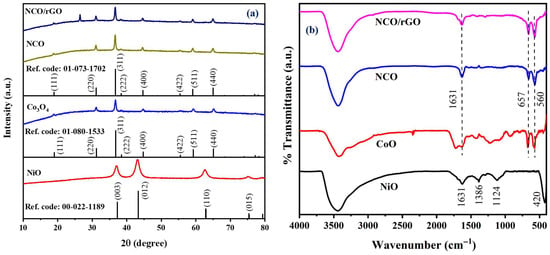
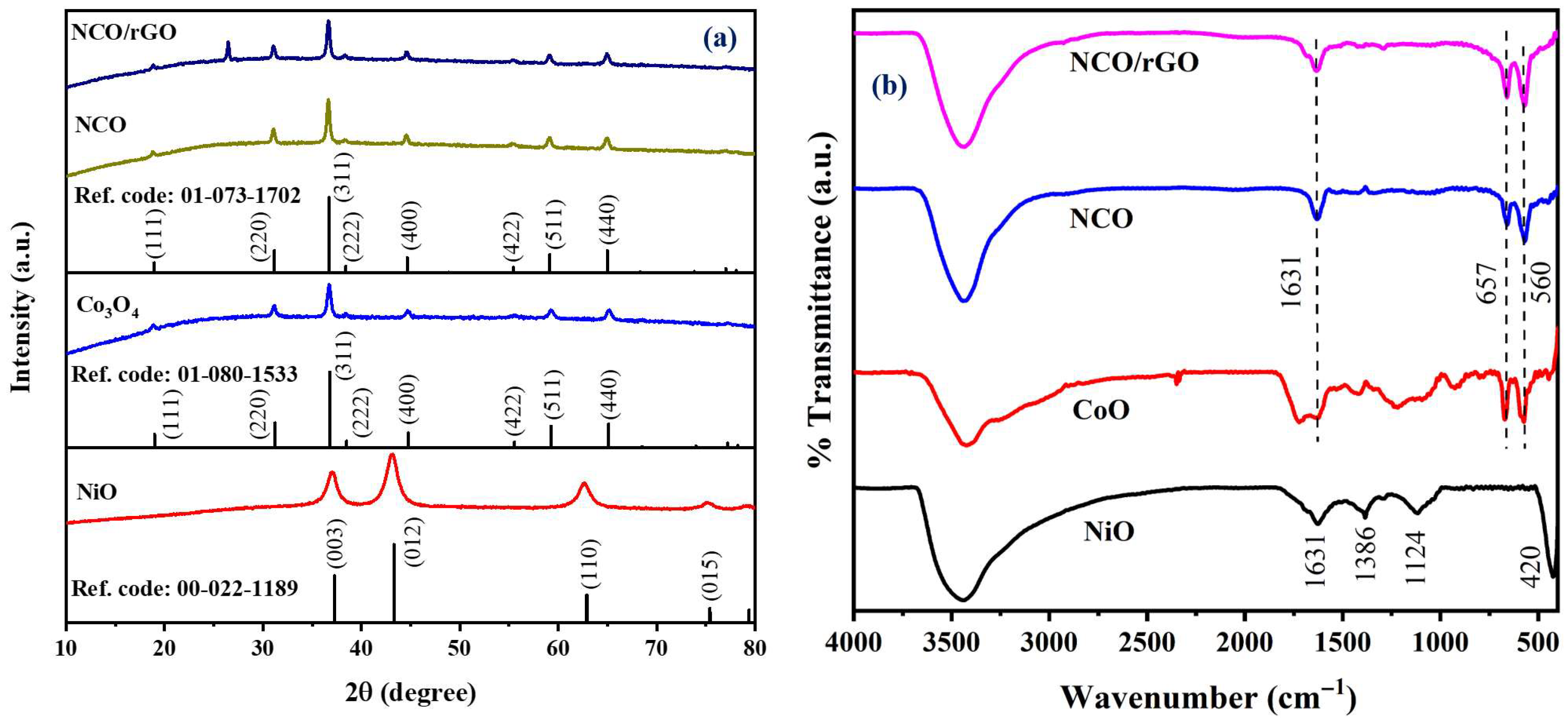
The phase composition and crystallinity of the prepared samples were analyzed using X-ray diffraction (XRD) (Figure 1a). The XRD patterns were recorded with a Cu Kα radiation source (λ = 1.5406 Å). The diffraction pattern of NiO shown in Figure 1 displays distinct peaks at 37.2, 43.2, 62.9, and 75.3 corresponding to (003), (012), (110), and (015) planes, confirming the formation of the rhombohedral phase of NiO (JCPDS no: 00-022-1189) [20]. The absence of impurity peaks confirms the formation of pure NiO. The diffraction peaks observed at 2θ values 18.9, 31.2, 36.7, 38.4, 44.7, 55.5 and 65.1 corresponding to the (111), (220), (311), (222), (400), (422), (511) and (440) planes are in excellent agreement with the spinel cubic phase of Co3O4 (JCPDS No. 01-080-1533) [21]. The X-ray diffraction (XRD) pattern of the synthesized NiCo2O4 (Figure 1a) exhibits well-defined diffraction peaks at 2θ values of 18.9, 31.2, 36.7, 38.4, 44.7, 55.5, and 65.1, which are indexed to the (111), (220), (311), (222), (400), (422), (511), and (440) planes of a cubic spinel structure, respectively, in good agreement with the standard JCPDS card No. 00-042-1467. No additional peaks corresponding to other impurity phases are observed, confirming the formation of a phase-pure NiCo2O4 spinel oxide. The sharp and intense reflections indicate a high degree of crystallinity. The observed diffraction pattern also suggests a well-ordered spinel structure, which is expected to facilitate effective interfacial interaction, beneficial for enhanced charge transfer and redox activity in electrochemical applications. The XRD pattern of the NiCo2O4/rGO composite (Figure 1a) shows all characteristic peaks of the cubic spinel NiCo2O4 phase. The presence of rGO is indicated by a broad, low-intensity diffraction feature at 26.2°, characteristic of few-layer graphene, which is overlapped by the NiCo2O4 reflections due to its low content. The sharp and well-defined NiCo2O4 peaks reflect high crystallinity, while the uniformly incorporated rGO sheets are expected to enhance electron transport and structural stability, promoting improved electrochemical performance. The most intense reflections are observed at 2θ ≈ 35.05°, 56.45°, and 62.01°, which exhibit narrow full-width at half maximum (FWHM) values of 0.2737°, 0.3643°, and 0.3806°, respectively. The sharpness of these peaks indicates good crystallinity of the material.
Figure 1.
(a) XRD and (b) FTIR spectrum of NiO, Co3O4, NCO, and NCO/rGO.
The average crystallite size calculated using the Scherrer equation for the dominant peaks lies in the range of ~30.439 nm, suggesting nanoscale crystallite formation.
where D is the crystallite size, K is the shape factor,
is the X-ray wavelength, β indicates the FWHM of the diffraction peak, and θ is the Bragg angle. Broader peaks observed at lower 2θ values (e.g., ~9.07° and ~20.46°) with larger FWHM values indicate the presence of smaller crystallites or structural disorder, which may arise from lattice strain or the contribution of secondary/low-crystallinity components.
Fourier-transform infrared (FTIR) spectra were collected in the 400–4000 cm−1 range using the KBr pellet method. The FTIR spectra of NiO, Co3O4, NiCo2O4 (NCO), and NCO/rGO were analyzed after calcination at 350 °C. A weak band around 1631 cm−1 observed in all samples is attributed to the bending vibration of physically adsorbed moisture from ambient exposure during measurement. For NiO, the prominent band at ~420 cm−1 corresponds to the characteristic Ni–O stretching vibration, while the weak features at 1386 cm−1 and 1124 cm−1 are attributed to surface-related vibrational modes rather than carbonate or nitrate species, which are excluded due to the high calcination temperature. In Co3O4, NCO, and NCO/rGO, the absorption bands at ~657 cm−1 and ~560 cm−1 are characteristic of spinel-type metal–oxygen vibrations associated with tetrahedral and octahedral sites, arising from overlapping Ni–O and Co–O modes in the NiCo2O4 lattice. The similarity of these bands in NCO and NCO/rGO confirms that the incorporation of rGO does not alter the spinel structure, supporting the formation of phase-pure NiCo2O4-based materials.
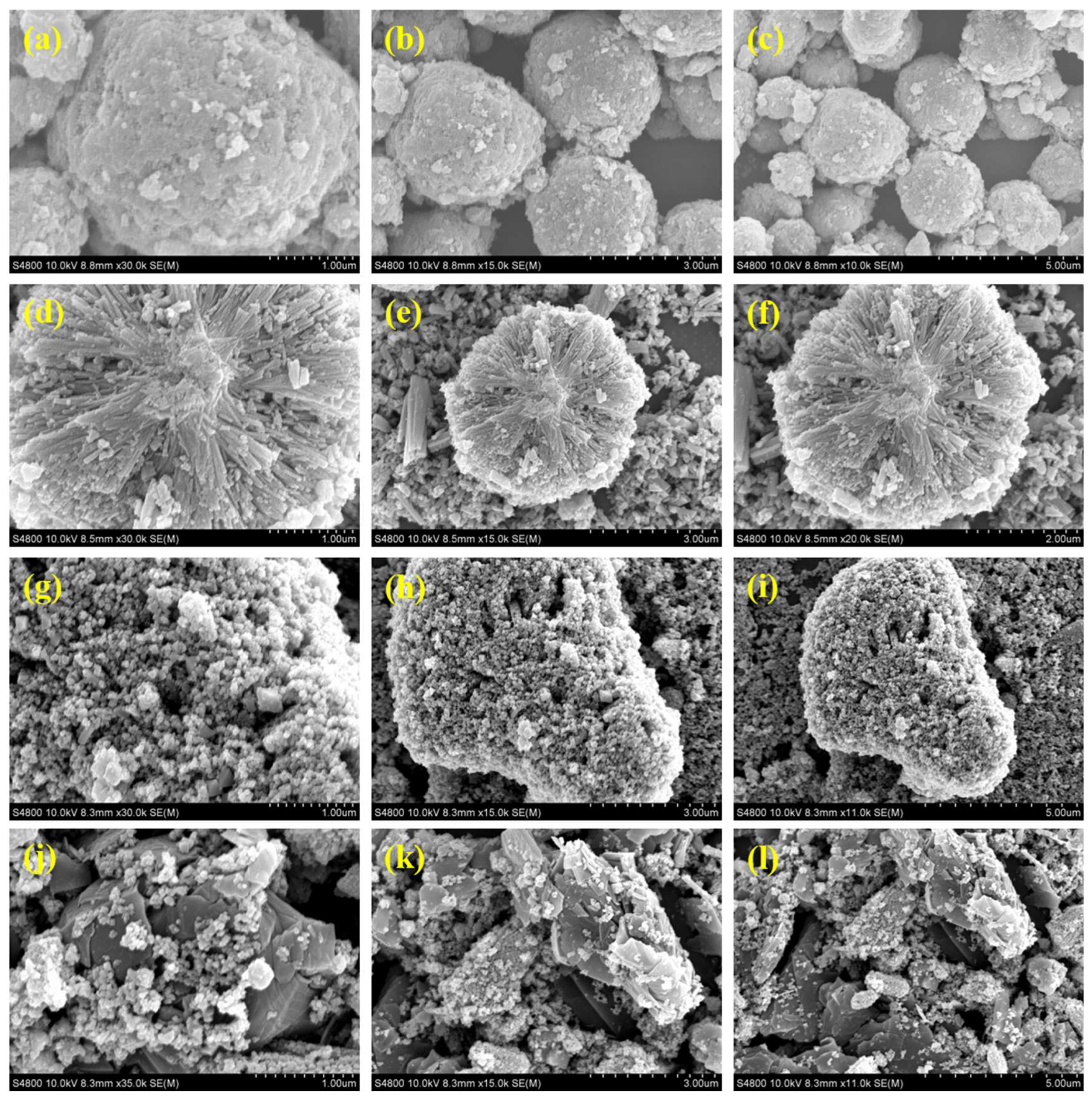
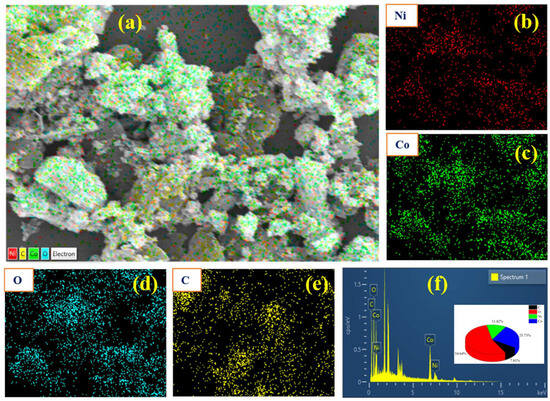
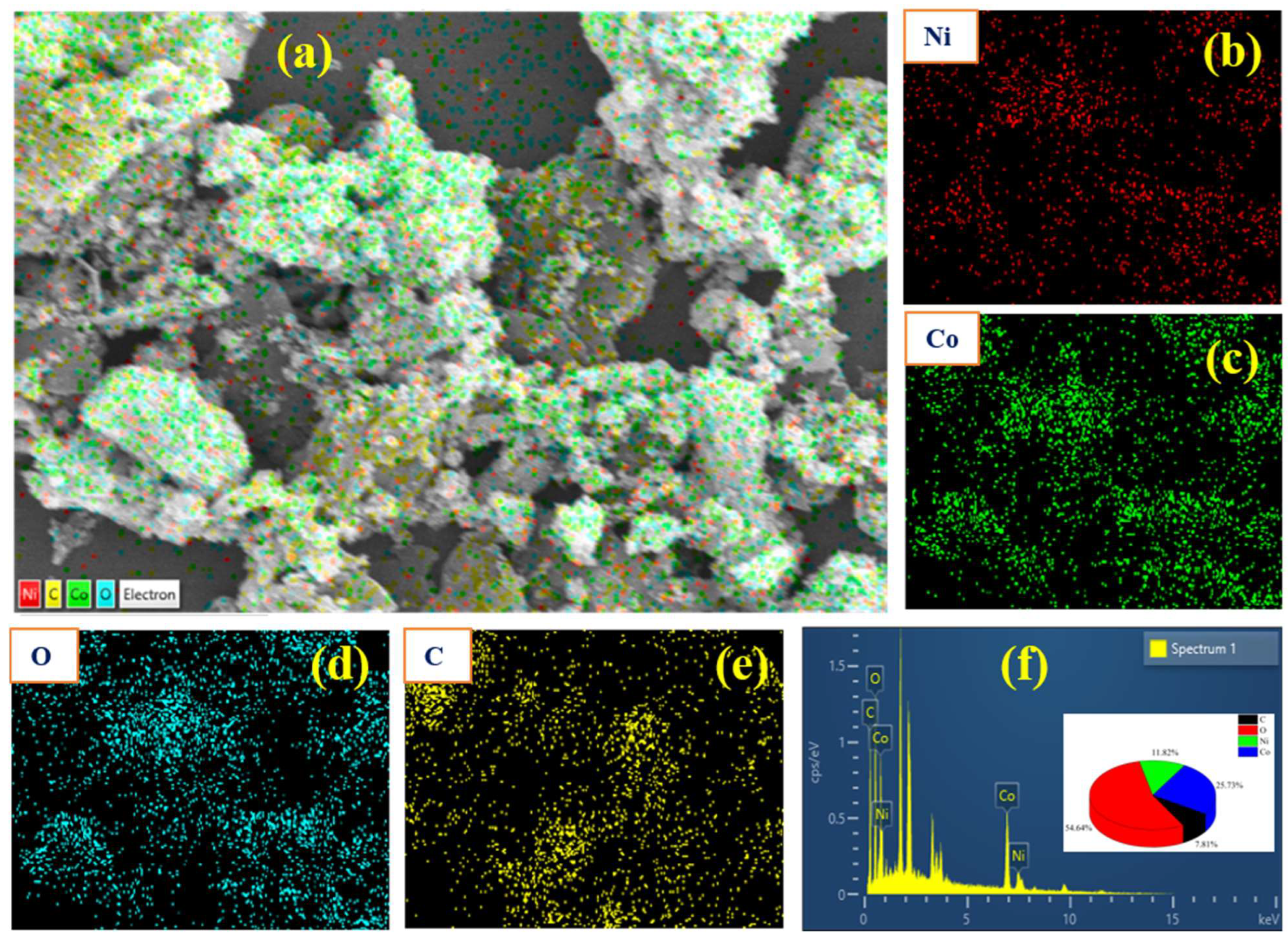
Using a field-emission scanning electron microscopy (SEM) operated at an accelerating voltage of 3–30 kV, SEM images were taken and energy-dispersive X-ray (EDX) analysis was performed. The scanning electron microscope images of the synthesized samples are shown in Figure 2. Figure 2a–c reveal spherical NiO particles with a relatively rough surface and moderate agglomeration, indicating uniform nucleation. The Co3O4 microstructures display a distinct flower-like morphology composed of radially aligned nanorods, suggesting a well-crystallized architecture (Figure 2d–f). The SEM image of NCO is shown in Figure 2g–i, where the formation of densely packed and irregular porous structures indicates strong interfacial interaction between the two oxides. The final composite shown in Figure 2j–l represents the NCO/rGO composite, showing rGO nanosheets uniformly decorated with fine oxide nanoparticles, confirming the successful anchoring of NCO on rGO layers. The elemental mapping of the NCO/rGO composite (Figure 3) further confirms the uniform spatial distribution of Ni, Co, O, and C elements throughout the sample. The homogeneous dispersion of Ni and Co indicates the successful incorporation of both metal oxides within the rGO matrix, while the even carbon signal verifies the continuous presence of rGO sheets. Figure S1 presents the particle size distribution histograms of NiO, Co3O4, and NCO.
Figure 2.
SEM micrographs of NiO (a–c), Co3O4 (d–f), NCO (g–i), and NCO/rGO (j–l).
Figure 3.
(a–e) Elemental mapping and (f) EDX spectrum of NCO/rGO.
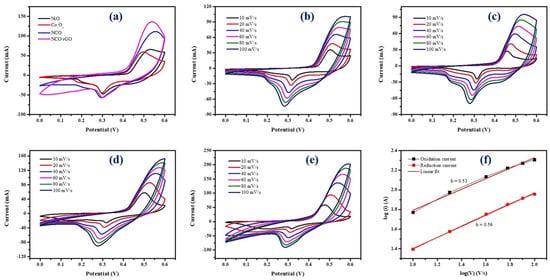
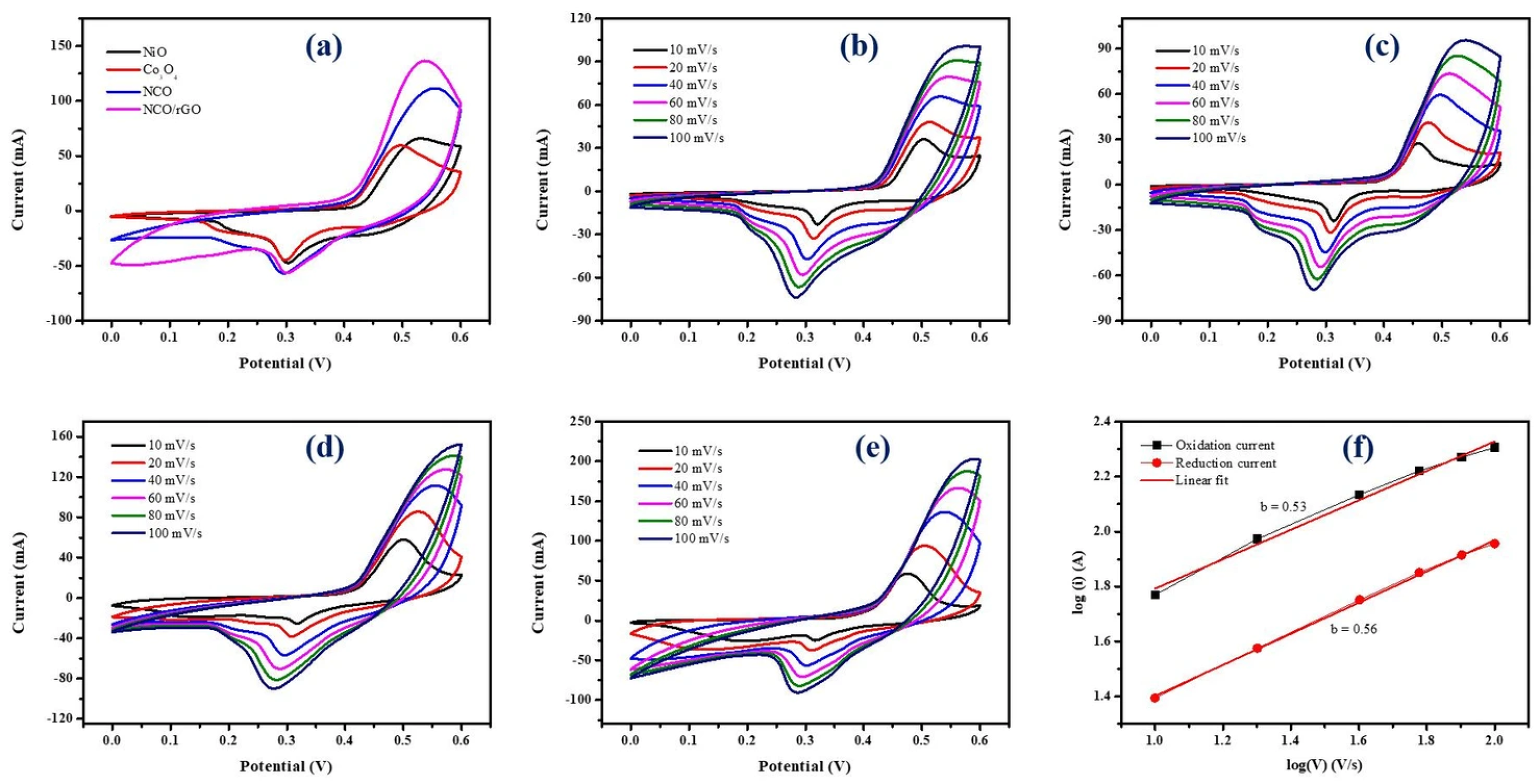
Figure 4a–e illustrate the cyclic voltammetry (CV) curves of the Co3O4, NiO, NCO, and NCO/rGO electrodes, all of which demonstrate distinct pseudocapacitive behavior. The electrode surface undergoes Faradic redox reactions, which are indicated by the presence of distinct redox peaks within the potential window of 0–0.6 V. These reactions are predominantly linked to the reversible redox transitions of nickel and cobalt species, which can be expressed as follows [22]:
Figure 4.
(a) CV curve comparison for all the electrodes at a scan rate of 40 mV/s, (b–e) CV curves of Co3O4, NiO, NCO, and NCO/rGO, respectively, at different scan rates, and (f) linear plot of log v vs. log I.
Figure 4a shows that the NCO/rGO electrode has a much higher current response than the Co3O4, NiO, and NCO electrodes. Moreover, as the scan rate increases, the current of the redox peaks also increases, which indicates that the charge transfer kinetics are fast and efficient. The NCO/rGO electrode has a larger CV area and a greater current density, which shows that it has better electrochemical activity and can store more energy. This enhancement is due to the synergistic interaction between NCO and the rGO matrix. The rGO matrix has superior electrical conductivity, more active sites, and a faster ion transport pathway than the other prepared electrodes. Figure 4f illustrates the linear plot of log v versus log I based on the power law relationship shown below [23]:
where
is the peak current (A), v is the scan rate (V/s), b is the exponent, and a denotes a constant. The obtained b values (~0.5) for both anodic and cathodic peaks confirm that the charge storage process in the sample shows battery-type behavior.
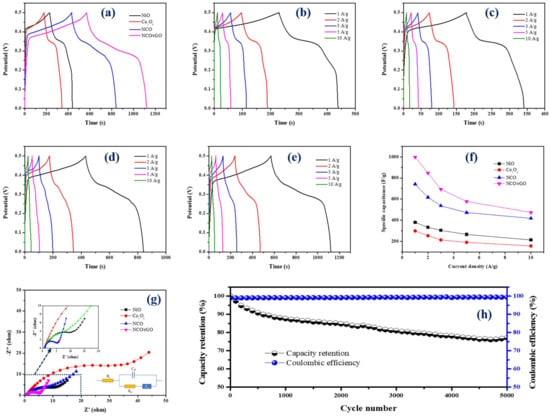
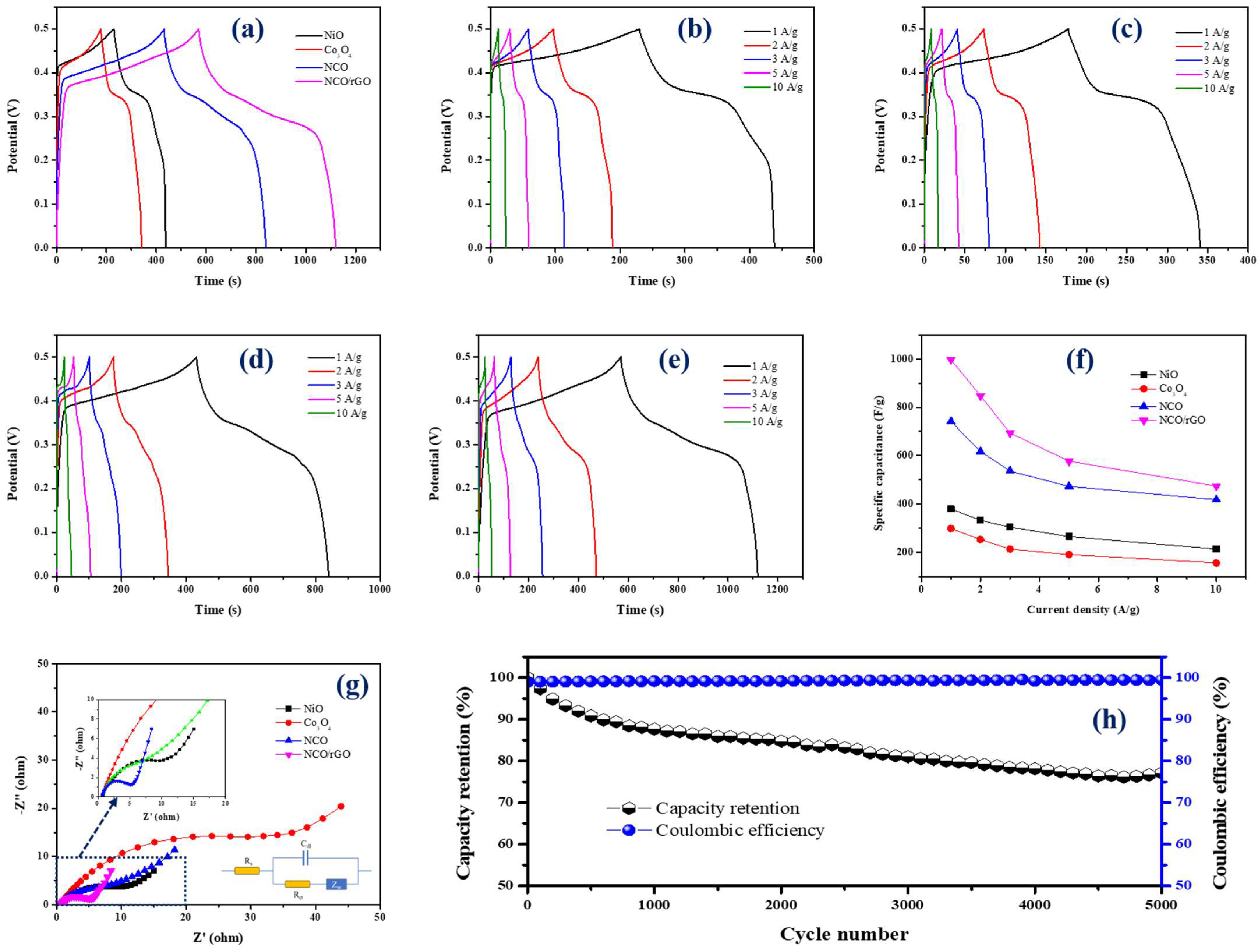
The GCD plot exhibits a slightly distorted triangular shape, indicating that the charge–discharge process involves both electric double-layer capacitance and faradaic redox reactions (Figure 5a–e). This deviation from the ideal triangular profile confirms the pseudocapacitive behavior of the electrode materials, which arises from reversible redox reactions occurring at the electrode–electrolyte interface [24]. The specific capacitance values obtained from the three-electrode GCD measurements were 378, 298, 742, and 998 F g−1 at 1 A g−1 for NiO, Co3O4, NCO, and NCO/rGO, respectively. The NCO/rGO electrode exhibited the highest capacitance, which can be attributed to multiple redox-active sites and the presence of rGO, which enhances electrical conductivity and facilitates efficient ion/electron transport. The significant improvement in capacitance demonstrates that the incorporation of rGO effectively boosts the electrochemical performance of the composite electrode. Figure 5f presents the comparative specific capacitance values of the electrodes, revealing that the NCO/rGO electrode exhibits the highest performance among all samples. Furthermore, the NCO/rGO electrode delivered higher capacitance compared with the earlier reported results, as shown in Table S1. The EIS plot shown in Figure 5g exhibits a semicircle in the high-frequency region and a nearly vertical line in the low-frequency region, indicating low internal resistance, efficient charge transfer, and near-ideal capacitive behavior of the fabricated ASC device. In general, the high-frequency semicircle corresponds to the charge-transfer resistance (Rct), while the low-frequency straight line is associated with capacitive ion diffusion. Notably, the NCO/rGO electrode shows a significantly smaller semicircle diameter, indicating a lower Rct compared to NiO, Co3O4, and NCO, which confirms faster charge-transfer kinetics due to the incorporation of rGO [25]. Moreover, the linear portion of the NCO/rGO spectrum in the low-frequency region shows a steeper inclination toward the x-axis, indicating enhanced ion diffusion and superior conductivity. Figure 5h illustrates the cycling stability of the NCO/rGO electrode over 5000 charge–discharge cycles, retaining 77% of its initial capacitance with a Coulombic efficiency of 99%, confirming its excellent electrochemical stability and reversibility.
Figure 5.
(a) GCD curve comparison for all the electrodes at a current density of 1 A/g, (b–e) GCD curves of Co3O4, NiO, NCO, and NCO/rGO, respectively, at different current densities, (f) comparison profile of current density vs. capacitance, (g) Nyquist plot, and (h) long-term cycling stability of NCO/rGO electrode.
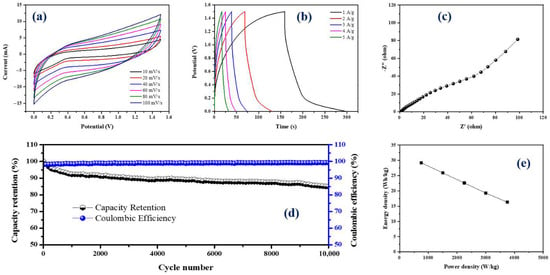
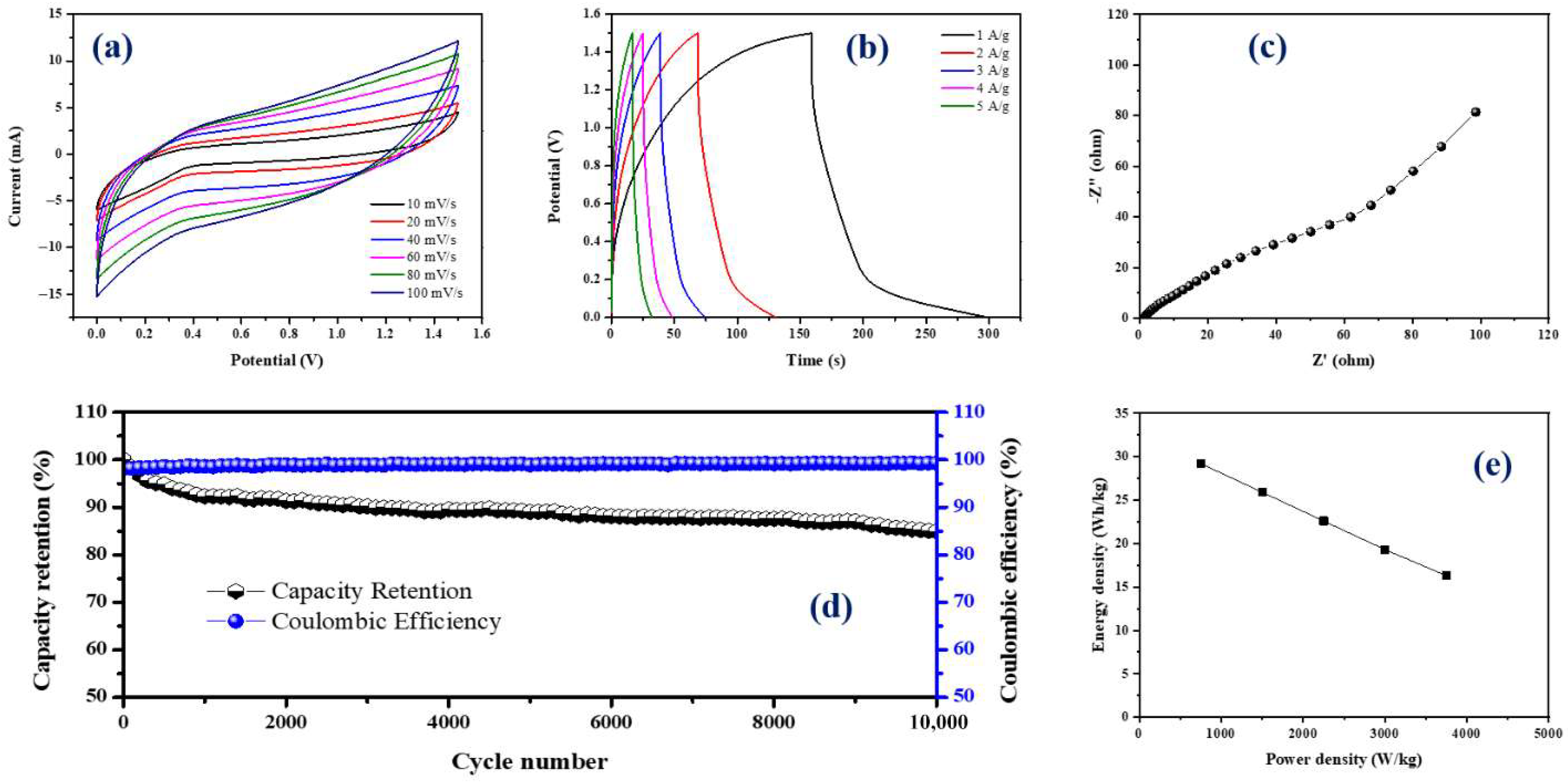
The asymmetric supercapacitor (ASC) device, assembled using NCO/rGO as the positive electrode and activated carbon (AC) as the negative electrode, delivered a specific capacitance of 93.7 F g−1. The device achieved an energy density of 29.2 Wh kg−1 at a corresponding power density of 750 W kg−1, demonstrating an excellent balance between energy and power output. The EIS plot shown in Figure 6c exhibits a semicircle in the high-frequency region and a nearly vertical line in the low-frequency region, indicating low internal resistance, efficient charge transfer, and ideal capacitive behavior of the fabricated ASC device. Figure 6d presents the cycling stability of the NCO/rGO-based asymmetric supercapacitor, showing excellent long-term durability. After 5000 charge–discharge cycles, the device retained 85% of its initial capacitance with a Coulombic efficiency of 99%, indicating outstanding reversibility and stable electrochemical performance during continuous operation. Figure 6e illustrates the plot showing the relationship between energy density and power density of the NCO/rGO-based asymmetric supercapacitor. The device maintains a high energy density even at elevated power densities, demonstrating its excellent rate capability and efficient energy delivery, which are essential characteristics for practical energy storage applications.
Figure 6.
(a) CV curves of NCO/rGO//AC electrode at different scan rates, (b) GCD profile of the NCO/rGO//AC electrode at various current densities, (c) Nyquist plot, (d) long-term cycling stability of NCO/rGO//AC electrode, and (e) Ragone plot of the NCO/rGO//AC electrode.
3. Experimental Work
All chemical reagents used for the synthesis were of analytical grade and were employed without further purification. Nickel chloride (NiCl2·6H2O, ≥99% purity) and cobalt chloride (CoCl2·6H2O, ≥99% purity) were procured from Sigma-Aldrich, India. Urea (CO(NH2)2, ≥99.5% purity) was obtained from Merck, India. Reduced graphene oxide (rGO, ≥98% purity) was purchased from Graphene Supermarket (USA). All reagents were used as received without further purification, and deionized water was used throughout the synthesis.
3.1. Synthesis of NiCo2O4/rGO Composite
To prepare NiCo2O4, 0.1 M nickel chloride (NiCl2.6H2O) (solution A) and 0.2 M cobalt chloride (CoCl2.6H2O) (solution B) were dissolved in deionized water in separate beakers. Then solution B was added gradually to solution A while stirring. Separately, Urea (0.8 M) was dissolved in the deionized water and added dropwise to the above solution under continuous stirring. Urea acts as a slow and homogeneous precipitating agent during the hydrothermal process. Its gradual decomposition releases OH− and CO32− ions, enabling controlled nucleation and growth of nickel–cobalt precursor phases and leading to the formation of phase-pure NiCo2O4. After 1 h of continuous stirring, the resulting solution was transferred to a 100 mL Teflon-lined stainless steel autoclave and heat-treated at 120 °C for 8 h. After cooling down to room temperature, the precipitate was collected and washed with ethanol and deionized water several times. Further, the obtained product was dried at 60 °C for 12 h. The dry product was calcined at 350 °C for 3 h to attain the final product of NiCo2O4.
For the preparation of NiCo2O4/rGO, the same procedure was followed with the addition of 0.06 g of rGO to the mixture solution prior to the hydrothermal treatment. In comparison, NiO and Co3O4 were prepared under similar conditions using only nickel chloride or cobalt chloride, respectively.
3.2. Electrochemical Measurements
The working electrodes (NiO, Co3O4, NCO, and NCO/rGO) were prepared as follows: a slurry was obtained by thoroughly mixing 80 wt% of the active material, 10 wt% carbon black (conductive agent), and 10 wt% poly(vinylidene fluoride) (PVdF, binder). N-methyl-2-pyrrolidone (NMP) was added dropwise to the mixture and ground for 15 min to form a homogeneous slurry. The resulting slurry was uniformly coated onto Ni foam and dried in a vacuum oven at 60 °C for 24 h.
Electrochemical measurements were performed in a three-electrode configuration using the material-coated Ni foam as the working electrode, Ag/AgCl as the reference electrode, and a Pt foil as the counter electrode in 3 M KOH electrolyte. For the fabrication of the asymmetric supercapacitor (ASC) device, the NCO/rGO electrode served as the positive electrode and activated carbon (AC) was used as the negative electrode, with 3 M KOH as the electrolyte and Whatman filter paper as the separator. Cyclic voltammetry (CV), galvanostatic charge–discharge (GCD), and electrochemical impedance spectroscopy (EIS) measurements were conducted using a Biologic SP-150e electrochemical workstation (France).
4. Conclusions
In this study, a series of electrode materials (NiO, Co3O4, NCO, and NCO/rGO) were successfully synthesized and evaluated for their electrochemical performance. Among them, the NCO/rGO composite exhibited the highest specific capacitance of 998 F g−1 in a three-electrode configuration, owing to the enhanced redox activity of NCO and the excellent electrical conductivity of rGO. The EIS analysis confirmed its low charge transfer resistance and superior ion diffusion characteristics. Furthermore, the NCO/rGO-based asymmetric supercapacitor, assembled with activated carbon as the negative electrode, delivered a high specific capacitance of 93.7 F g−1, an energy density of 29.2 Wh kg−1, and a power density of 750 W kg−1, along with 85% capacitance retention after 5000 cycles. These results demonstrate that the NCO/rGO composite is a promising electrode material for high-performance energy storage applications.
Supplementary Materials
The following supporting information can be downloaded at: https://www.mdpi.com/article/10.3390/inorganics14020033/s1, Figure S1: The particle size distribution histogram of (a) NiO, (b) Co3O4 and (c) NCO samples; Table S1: Specific capacitance comparison of present work with earlier reported results. References [26,27,28,29,30,31] are cited in the supplementary materials.
Author Contributions
Conceptualization, N.M.C., V.T. and P.R.; methodology, R.G., N.M.C., V.T. and P.R.; validation, V.T. and P.R.; formal analysis, A.B. and N.M.C.; investigation, R.G. and P.R.; data curation, R.G., A.B. and P.R.; writing—original draft, R.G. and P.R.; writing—review and editing, A.B., N.M.C., V.T. and P.R.; supervision, J.K.; project administration, J.K.; funding acquisition, J.K., R.G. and V.T. equally contributed to this work. All authors have read and agreed to the published version of the manuscript.
Funding
This research was supported by the Regional Innovation System & Education (RISE) program through the Gyeongbuk RISE CENTER, funded by the Ministry of Education (MOE) and the Gyeongsangbuk-do, Republic of Korea (2025-RISE-B0080529002339).
Institutional Review Board Statement
Not applicable.
Informed Consent Statement
Not applicable.
Data Availability Statement
The original contributions presented in this study are included in the article/Supplementary Materials. Further inquiries can be directed to the corresponding authors.
Conflicts of Interest
The authors declare no conflicts of interest.
References
- Yaseen, S.; Wattoo, A.G.; Abbas, S.M.; Arfan, M.; Song, Z. Synthesis of Zn-Cu-Mn ternary metal oxide nanosheets via an integrated approach for high performance hybrid supercapacitors. Chem. Eng. J. 2025, 507, 160337. [Google Scholar] [CrossRef] [Scilit]
- Govindarajan, D.; Sanni, A.; Limphirat, W.; Kirubaharan, K.; Murugadoss, G.; Mohamad, A.A.; Yonezawa, T.; Kheawhom, S. Atomic-level synergy in multi-valent metal oxide-graphene composites for ultra-high-performance supercapacitors. J. Alloys Compd. 2025, 1039, 183022. [Google Scholar] [CrossRef] [Scilit]
- Shoukat, W.; Iqbal, M.Z.; Murtaza, I.; Kanjariya, P.; Rajiv, A.; Shit, D.; Albert, H.M.; Samal, S.K.; Kumar, A.; Wabaidur, S.M. Optimizing hybrid supercapacitor performance through synergistic integration of metal–organic frameworks and metal oxides. RSC Adv. 2025, 15, 25221–25232. [Google Scholar] [CrossRef] [Scilit]
- Asghar, A.; Khan, K.; Hakami, O.; Alamier, W.M.; Ali, S.K.; Zelai, T.; Rashid, M.S.; Tareen, A.K.; Al-Harthi, E.A. Recent progress in metal oxide-based electrode materials for safe and sustainable variants of supercapacitors. Front. Chem. 2024, 12, 1402563. [Google Scholar] [CrossRef] [Scilit]
- Ramesh, J.K.; Rostami, S.; Rajesh, J.; Princess, R.M.B.; Govindaraju, R.; Kim, J.; Adelung, R.; Rajkumar, P.; Abdollahifar, M. ZnMn2O4 applications in batteries and supercapacitors: A comprehensive review. J. Mater. Chem. A 2025, 13, 14540–14579. [Google Scholar] [CrossRef] [Scilit]
- Jiang, H.; Wang, H.; Li, D.; Hong, X.; Wang, X. Electrochemical activation of Zn doped NiCoO for improving the electrochemical performance. J. Alloys Compd. 2025, 1026, 180500. [Google Scholar] [CrossRef] [Scilit]
- Guo, M.; Che, S.; Huang, Z.; Jing, W.; Gao, S. Fe2O3@ Mn2O3 hierarchical core-shell structure: Optimizing energy density for flexible symmetric supercapacitor. J. Energy Storage 2025, 132, 117703. [Google Scholar] [CrossRef] [Scilit]
- You, X.Y.; Lee, P.Y.; Wang, S.C.; Kongvarhodom, C.; Saukani, M.; Yougbaré, S.; Chen, H.M.; Ho, K.C.; Wu, Y.F.; Lin, L.Y. Comparative studies of cobalt hydroxide and nickel hydroxide designed using novel metal tetrafluoroborate as active materials of battery supercapacitor hybrids. J. Energy Storage 2024, 100, 113678. [Google Scholar] [CrossRef] [Scilit]
- Gong, J.; Wang, S.; Yang, F.; Zhao, Y.; Wang, J.; Wu, S.; He, J.; Ma, L.; Dai, Y. Synergistic interface engineering of ZnCo2O4/NiMnCo-layered double hydroxides for boosted reactivity in advanced supercapacitor electrodes. J. Energy Storage 2024, 101, 113817. [Google Scholar]
- Kanimozhi, S.N.; Vasudevan, B.; Al Souwaileh, A.; Subbiah, J.; Anandan, S. Cu-Zn layered double hydroxides as high-performance electrode for supercapacitor applications. Electrochim. Acta 2024, 507, 145106. [Google Scholar] [CrossRef] [Scilit]
- Öztürk, O.; Gür, E. Layered transition metal sulfides for supercapacitor applications. ChemElectroChem 2024, 11, e202300575. [Google Scholar] [CrossRef] [Scilit]
- Wang, S.; Ji, Y.; Zhang, B.; Zhang, S.; Zhang, P.; Zhou, P. Walnut-like high-entropy sulfides via facile route for enhanced supercapacitor performance. J. Energy Storage 2025, 110, 115336. [Google Scholar]
- Naveenkumar, P.; Rajkumar, P.; Maniyazagan, M.; Nithyanandam, K.P.; Yang, H.W.; Kim, J.; Kim, S.J. Nitrogen-doped carbon-coated ZnS-NiS2 nanoparticles as battery-type electrode materials for high-performance supercapacitor applications. J. Electroanal. Chem. 2025, 996, 119328. [Google Scholar] [CrossRef] [Scilit]
- Askari, M.B.; Salarizadeh, P.; Moghadam, M.T.T. Recent progress and perspectives on NiCo2O4-based electrode materials for supercapacitors. J. Energy Storage 2025, 130, 117348. [Google Scholar] [CrossRef] [Scilit]
- Li, Q.; Lu, C.; Chen, C.; Xie, L.; Liu, Y.; Li, Y.; Kong, Q.; Wang, H. Layered NiCo2O4/reduced graphene oxide composite as an advanced electrode for supercapacitor. Energy Storage Mater. 2017, 8, 59–67. [Google Scholar] [CrossRef] [Scilit]
- Kaur, M.; Chand, P.; Anand, H. Fabrication of asymmetric supercapacitor device with NiCo2O4@ reduced graphene oxide nanocomposites. Electrochim. Acta 2024, 507, 145118. [Google Scholar] [CrossRef] [Scilit]
- Vamsikrishna, K.; Usha, P.; Venkatesh, D.; Ramesh, T. Structural, morphological, optical, and magnetic properties of NiO-added NiCo2O4 electrode materials synthesized by sol-gel, Co-precipitation and ultrasonication methods and their electrochemical supercapacitor response. Ceram. Int. 2024, 50, 30869–30878. [Google Scholar] [CrossRef] [Scilit]
- Liang, Q.; Liu, Y.; Yan, D.; Bai, L.; Kang, H.; Wang, C. Morphology evolution of spinel NiCo2O4 catalyst and its crystal plane effect in oxygen evolution reaction. J. Hydrogen Energy 2025, 120, 120–128. [Google Scholar] [CrossRef] [Scilit]
- Thorat, J.P.; Lokhande, V.C.; Patil, U.M.; Lokhande, C.D. NiCo2O4 anchored reduced graphene oxide nanocomposite for energy storage: Impact of rGO thickness. J. Energy Storage 2024, 101, 113729. [Google Scholar] [CrossRef] [Scilit]
- Hussain, M.J.; Ghanem, M.A.; Reddy, Y.V.M.; Madhavi, G.; Joo, S.W.; Reddy, G.R. Dumbbell-shaped nanorod assembly of a NiO/CuO composite for high-performance redox-active battery-type supercapacitor electrodes. CrystEngComm 2025, 27, 4360–4377. [Google Scholar] [CrossRef] [Scilit]
- Abu-Zied, B.M.; Soliman, S.A.; Abdellah, S.E. Role of Cadmium Addition in Promoting the Direct N2O Decomposition of Co3O4 Spinel. Curr. Catal. 2020, 9, 152–162. [Google Scholar] [CrossRef] [Scilit]
- Zhu, Y.; Ji, X.; Wu, Z.; Song, W.; Hou, H.; Wu, Z.; He, X.; Chen, Q.; Banks, C.E. Spinel NiCo2O4 for use as a high-performance supercapacitor electrode material: Understanding of its electrochemical properties. J. Power Sources 2014, 267, 888–900. [Google Scholar] [CrossRef] [Scilit]
- Rajkumar, P.; Thirumal, V.; Rana, M.M.; Xiao, W.; Shim, J.; Yoo, K.; Kim, J. High-performance supercapacitors: Electrochemical insights into CoP/MXene nanomaterial performance. New J. Chem. 2024, 48, 6071–6075. [Google Scholar] [CrossRef] [Scilit]
- Iyer, M.S.; Rajkumar, P.; Aravinth, K.; Asaithambi, S.; Alshgari, R.A.; Mohammad, S.; Sangaraju, S.; Kim, J. Tailoring Bismuth Antimonate nanocomposites with barium and calcium for superior electrochemical properties in supercapacitors. Adv. Powder Technol. 2025, 36, 104917. [Google Scholar] [CrossRef] [Scilit]
- Wu, F.; Zhao, Y.; Hou, Z.; Jiang, M.; He, W.; Su, D.; Wang, M.; Wang, J.G. Lignocellulosic oxidation bridging to modulate pseudographitic domain of hard carbon toward boosted sodium storage. J. Energy Storage 2025, 130, 117496. [Google Scholar] [CrossRef] [Scilit]
- Saravanakumar, B.; Priyadharshini, T.; Ravi, G.; Ganesh, V.; Sakunthala, A.; Yuvakkumar, R. Hydrothermal synthesis of spherical NiCO2O4 nanoparticles as a positive electrode for pseudocapacitor applications. J. Sol-Gel Sci. Technol. 2017, 84, 297–305. [Google Scholar] [CrossRef] [Scilit]
- Zhu, Y.; Pu, X.; Song, W.; Wu, Z.; Zhou, Z.; He, X.; Lu, F.; Jing, M.; Tang, B.; Ji, X. High capacity NiCo2O4 nanorods as electrode materials for supercapacitor. J. Alloys Compd. 2014, 617, 988–993. [Google Scholar] [CrossRef] [Scilit]
- Meng, F.; Zhao, L.; Zhang, Y.; Zhai, J.; Li, Y.; Zhang, W. Facile synthesis of NiCo2O4/rGO microspheres with high-performance for supercapacitor. Ceram. Int. 2019, 45, 23701–23706. [Google Scholar] [CrossRef] [Scilit]
- Yuan, B.; Su, Z.; Chen, K.; Wang, J.; Chen, B.; Jiang, S.; Yan, J.; Zhang, C.; Xie, A.; Luo, S. Design of NiCo2O4 nanoparticles in-situ grown on lignin-derived porous carbon and MWCNTS composites for supercapacitors. Diam. Relat. Mater. 2023, 136, 110079. [Google Scholar] [CrossRef] [Scilit]
- Franklin, J.B.; Priyadharshini, V.; Sundaram, S.J.; Pandi, S.M.; Raj, A.D. Intrinsic pseudocapacitive enhancement of NiCo2O4/activated carbon composites for high-performance supercapacitors. Inorg. Chem. Commun. 2024, 163, 112402. [Google Scholar] [CrossRef] [Scilit]
- Kharangarh, P.R.; Ravindra, N.M.; Rawal, R.; Singh, A.; Gupta, V. Graphene quantum dots decorated on spinel nickel cobaltite nanocomposites for boosting supercapacitor electrode material performance. J. Alloys Compd. 2021, 876, 159990. [Google Scholar] [CrossRef] [Scilit]
Disclaimer/Publisher’s Note: The statements, opinions and data contained in all publications are solely those of the individual author(s) and contributor(s) and not of MDPI and/or the editor(s). MDPI and/or the editor(s) disclaim responsibility for any injury to people or property resulting from any ideas, methods, instructions or products referred to in the content. |
© 2026 by the authors. Licensee MDPI, Basel, Switzerland. This article is an open access article distributed under the terms and conditions of the Creative Commons Attribution (CC BY) license.