1. Introduction
Quantum technology and quantum information have received significant attention and witnessed substantial developments in recent decades [
1,
2]. Quantum metrology, as a part of quantum technology, has drawn much attention and been applied extensively in numerous practical domains [
3,
4,
5,
6]. The purpose of quantum metrology is to enhance measurement precision. Usually, optical interferometers are utilized to improve phase measurement precision [
7]. One typical optical interferometer is the Mach–Zehnder interferometer (MZI), which is a type of linear interferometer described by the SU(2) group [
8]. It consists of two beam splitters (BSs) and a phase shifter. The BSs play an important role in the measurement process. The first BS is used to split the beam, while the other one integrates two beams after propagating on different paths. The phase sensitivity is limited to
, where
is the input photon number in the MZI.
is named as shot noise limit (SNL) or standard quantum limit. In order to obtain the better phase sensitivity, many quantum states have been proposed, such as the N00N state [
9,
10], two-mode squeezed vacuum state [
11], entangled coherent state [
12] and Fock state [
13]. However, these quantum states have many drawbacks. For the N00N state, its photon number is extremely low and it is also very sensitive to losses. Without the boost of the coherent state, the total photon number of the two-mode squeezed vacuum state is also very small. Moreover, the squeezing degree of the current experiment technology cannot surpass 20 dB [
14,
15,
16]. Therefore, to achieve the practical application of quantum metrology, more methods need to be employed.
A useful method is to modify the structure of the optical interferometer. A novel type of interferometer is named as an SU(1,1) interferometer because the transformation relationship is described by the SU(1,1) group, which was first proposed by Yurke et al. in 1986 [
8]. Contrary to MZI, the SU(1,1) interferometer consists of positive nonlinear elements, such as an optical parametric amplifier (OPA) and four-wave mixing (FWM) [
17,
18]. The input beams experience the first OPA, and the photon number inside the SU(1,1) interferometer will be increased due to the amplification of the OPA [
19,
20]. Then, one of the beams undergoes a phase shift and carries the phase information. For the phase sensitivity measurement, Li et al. proposed that the phase sensitivity can approach the Heisenberg limit (HL) with the input of a coherent state and the squeezed vacuum state by balanced homodyne detection (BHD) [
21]. Ou et al. pointed out that with the input of the vacuum state the phase sensitivity can also reach the HL [
22]. The HL is defined as
, where
is the total photon number inside the SU(1,1) interferometer.
Meanwhile, a modified SU(1,1) interferometer is proposed by Zhang et al. [
23]. It has the advantage of a simple structure and high precision phase sensitivity. The modified SU(1,1) interferometer, which is also named as the hybrid interferometer (HI), has been investigated by many groups [
24,
25]. Nevertheless, when the intensities of the two arms are different, it will lead to a decrease in phase sensitivity. And the optimal phase sensitivity can be achieved with different transmissivities of the BS when the squeezing parameter is changed. Therefore, more groups have focused on the SU(1,1) interferometer [
26,
27]. By adjusting the parameter ratio of the two OPAs, super phase sensitivity can still be achieved with detection losses as high as 80% [
26]. By performing non-Gaussian operations in two arms of an SU(1,1) interferometer, the phase sensitivity is further improved, and the photon losses are also effectively reduced [
27].
In addition to a different structure for the optical interferometer, another method to have better phase sensitivity is to employ different detection methods, such as intensity detection (ID), BHD and parity detection. ID has the advantage of a simple structure [
28]. BHD has been widely employed in phase sensitivity measurement, such as in LIGO [
7]. With the employment of parity detection, the phase sensitivity can reach the HL when the input is a two-mode squeezed vacuum state [
11]. Therefore, all possible methods need to be employed to have the optimal phase sensitivity. Nevertheless, considering endless detection methods is impractical. Fortunately, this challenge can be effectively tackled by employing quantum Fisher information (QFI) and quantum Cramér–Rao bounds (QCRB),
[
19,
29,
30]. Jarzyna et al. discussed the QFI of MZI when the phase shifter is placed in two arms [
31]. Lang and Caves also proposed a two-parameter estimation of QFI for MZI [
32]. Ataman and Preda considered single QFI and double QFI with the same input [
33].
Recently, QFI with a two-mode squeezed coherent state based on the HI has been proposed and can be utilized for the improvement of phase sensitivity [
24]. The photon number of the two-mode squeezed coherent state can be large enough due to the boost of the coherent state. However, the transmissivity of the BS in the HI needs to be dynamic when the squeezing parameter of the FWM is different. Additionally, only the degenerate FWM can be applied in the HI. For these reasons, instead of using the HI scheme, in this paper we investigate the phase sensitivity by combining the use of the SU(1,1) interferometer with an input represented by a two-mode squeezed coherent state. Meanwhile, considering that the effect of photon losses is inevitable in the measurement process, we analyze the phase sensitivity in detail under ideal and photon loss conditions.
This paper is structured as follows: In
Section 2, the scheme employing a two-mode squeezed coherent state as the input of an SU(1,1) interferometer is introduced. In
Section 3, we calculate the QFI, SNL and HL. In
Section 4, we analyze the phase sensitivity via BHD and ID. In
Section 5, the effects of photon losses in the scheme are shown. In
Section 6, we have a detailed discussion on the phase sensitivity and robustness. The conclusion is drawn in the last section.
2. Model
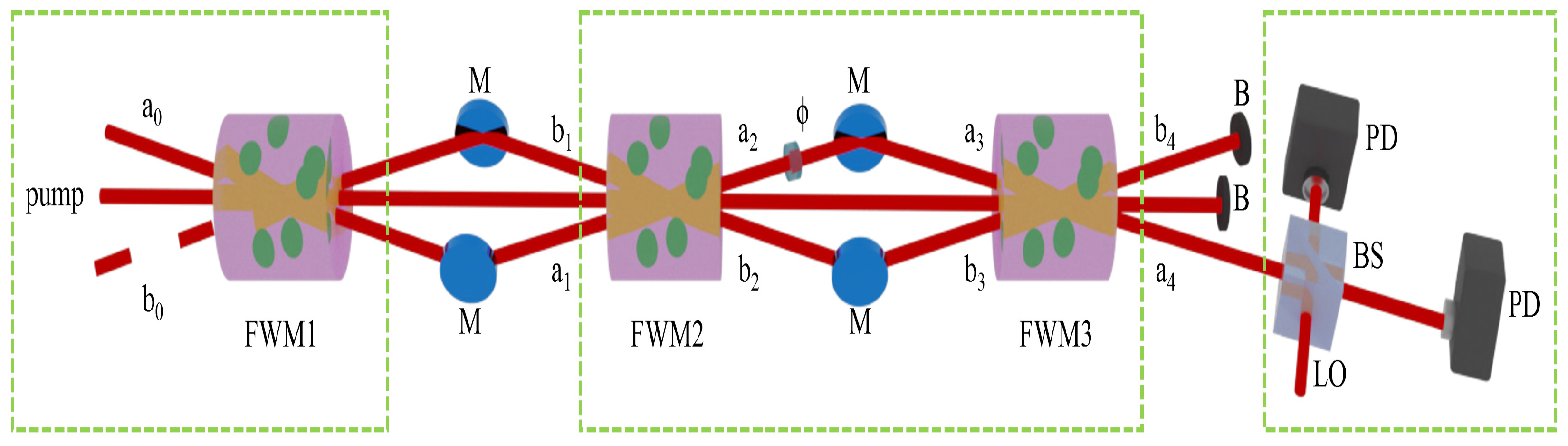
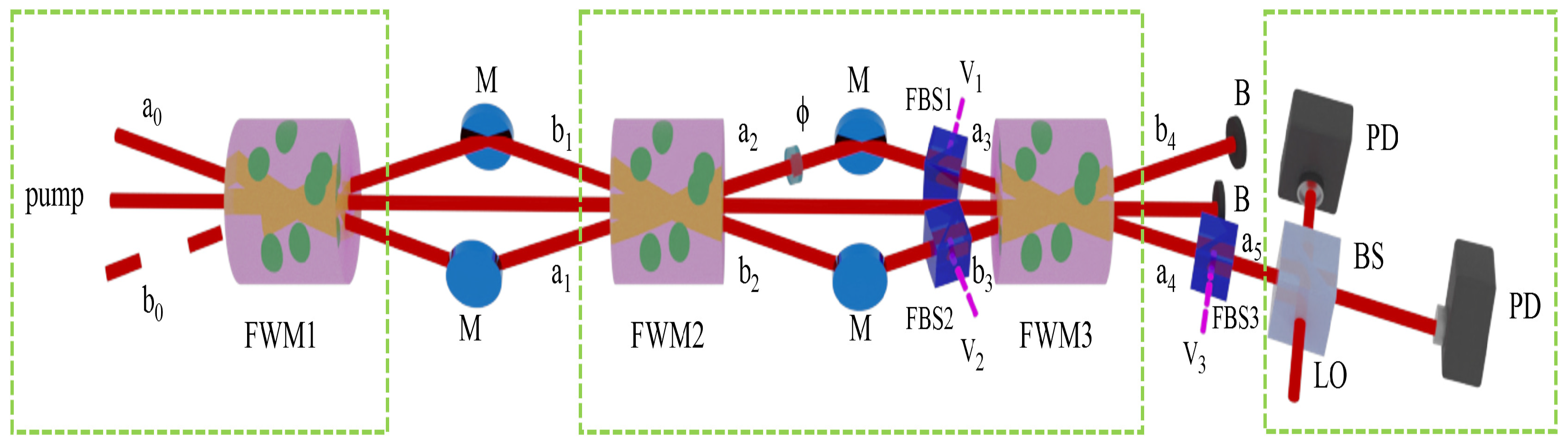
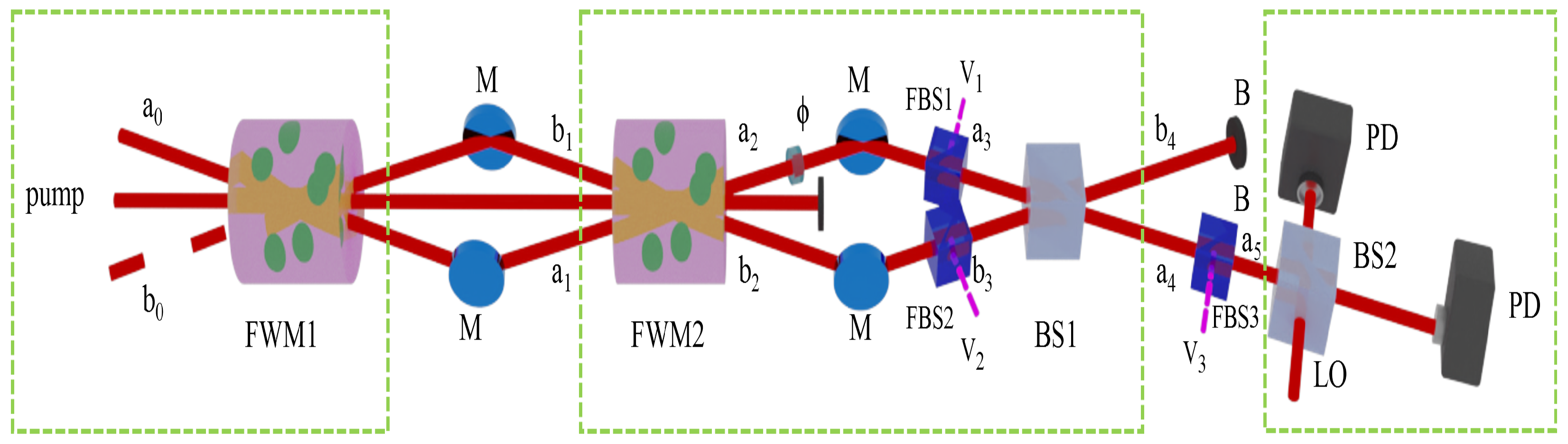
The structure of an SU(1,1) interferometer is shown in the
Figure 1, which contains three FWMs and a phase shifter. A coherent beam and a vacuum beam enter the FWM1, which is used to generate a two-mode squeezed coherent state. It is a phase insensitive process [
34]. Then, the two output beams are injected into the SU(1,1) interferometer, which consists of the FWM2 and the FWM3. Without the FWM1 process, this structure of an SU(1,1) interferometer will reduce to an ordinary SU(1,1) interferometer, which was experimentally realized in 2011 [
35]. The phase sensitivity can reach sub-SNL. After the SU(1,1) interferometer, this beam will enter photon detection. The transformation of the FWM1 can be described as
where
and
are the gain and phase of the FWM1.
,
is the parametric strength of FWM1.
and
(
) are annihilation (creation) operators of the mode A(B), respectively. As illustrated in
Figure 1, the FWM process corresponds to a cyclic sequence: one pump photon is annihilated, a probe photon is generated, a second pump photon is annihilated, and a conjugate photon is subsequently created. The annihilation operators corresponding to the probe and the conjugate fields are designated as
and
, respectively. The interaction Hamiltonian can be written as
, where
denotes the interaction strength, which is proportional to the pump light intensity. Moreover, the parameter
exhibits a strong dependence on both the one-photon detuning
and the two-photon detuning
. Usually,
is about 800 MHz and
is around 4 MHz. Here,
, where
stands for the phase of the pump field [
34]. For the coherent beam, it has
.
is the phase of the coherent state.
is the amplitude.
,
N is the photon number of the coherent state input. For the vacuum state,
,
is the phase of the vacuum state.
.
The transformation relationship of FWM2 process is
where
and
are the gain and phase of the FWM2 and
is the parametric strength. The input photon number of the SU(1,1) interferometer can be expressed as
.
. According to the transformation relationship, the photon number of the upper arm can be expressed as
The photon number of the lower arm can be expressed as
The total photon number inside the SU(1,1) interferometer is
.
Then, the SNL and HL can be defined as
and
. Equation (
5) shows that the larger gains
and
represent a higher photon number.
For our scheme, the total input-output relation after the FWM3 process can be written as
. For simplifying, we assume that
and
. Combining Equations (1) and (2), the total input-output relation is as follows
where
, and
.
3. Quantum Cramér–Rao Bounds
As a powerful tool, QFI is employed to estimate the optimal value of unknown parameters [
36], and it is irrelevant to specific measurement methods [
18]. It contains the maximum amount of information about the unknown phase shift
, indicating the lower bound of the QCRB, that is
. In this section, a single QFI is calculated. Here, the unitary operator
, where
is the photon number operator on mode a. In the absence of losses, for the pure state, the corresponding QFI can be calculated as [
18,
37]
where
, and
.
is the state after passing through the phase shifter. The notation
means the real-part. The state
is the input state of the FWM2, where
.
represents the two-mode vacuum state.
is the displacement operator. The
is the two-mode squeezing operator defined as
, with
. The operator
is expressed as
, with
The QFI is calculated using Equation (
7) and it is
where the coefficient is
, and
. Then, the QCRB is
.
To investigate the impact of the unbalanced input state on QCRB, we introduce the photon number difference
, defined by
(
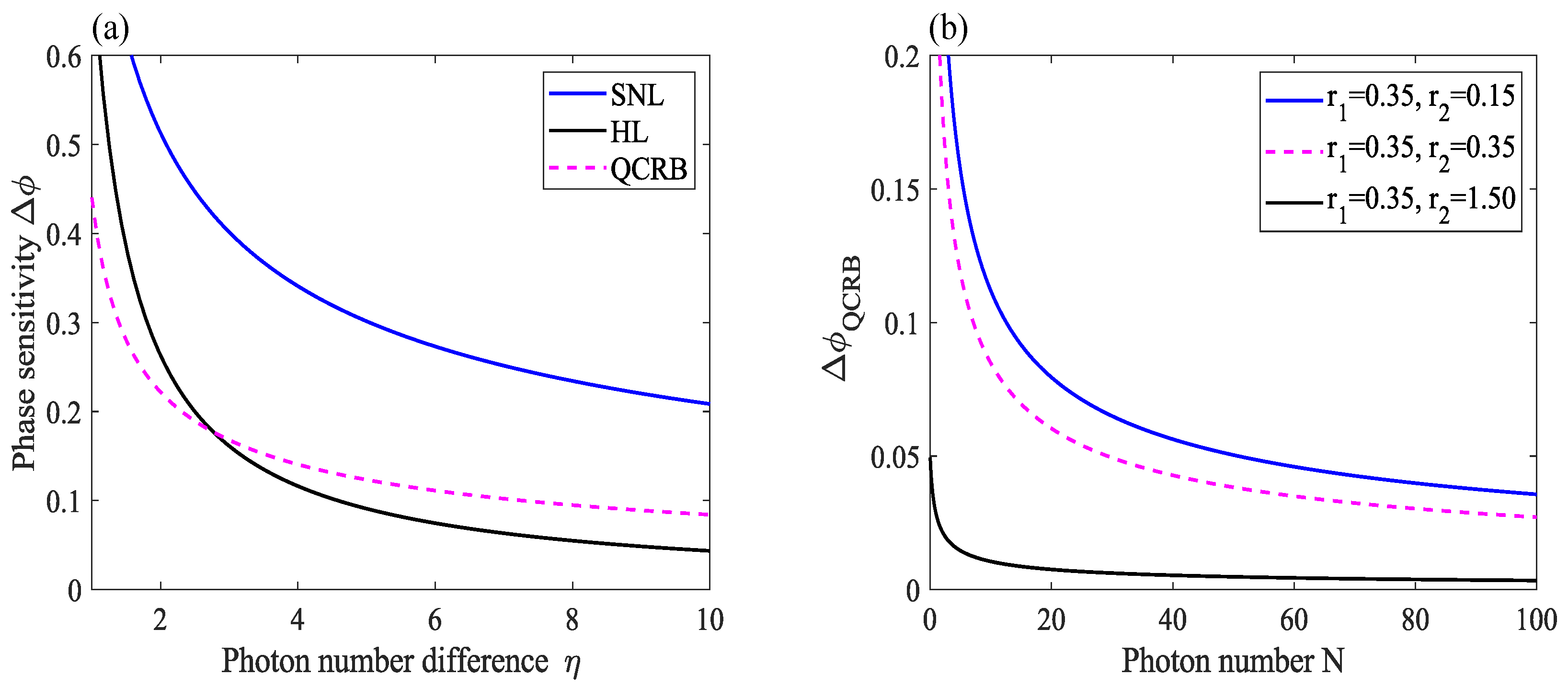
). The total photon number inside the SU(1,1) interferometer is significantly enhanced due to the squeezing effect of the FWM, which leads to a further improvement in the precision bound. We present the photon number difference
to analyze the relationships among the QCRB, the SNL, and the HL. A lower phase value implies superior phase sensitivity. As
Figure 2a shows, the QCRB can surpass the HL when
. With the increase of
, the QCRB, which represents an optimal theoretical precision, can be restricted to the sub-SNL. Additionally, the effects of
,
and
N on phase sensitivity
are also extremely significant. We set
as a fixed value to investigate the variation of
with respect to
and
N. In
Figure 2b, three scenarios are considered where
,
and
. With the increase in
, the phase sensitivity
improves—this is due to the enhancement of the total photon number
. As the photon number
N increases, the
is improved. However, the optimal phase sensitivity is achieved when both
and
N are in the high-value range and
approaches a constant value.
4. Detection Methods
Next, we investigate the phase sensitivity of the SU(1,1) interferometer with different detection methods. The ID, as an ordinary detection method in the measurement process, is applied to measure the signal of the output port
a. The detection operator in the scenario is given by
,
. The slope of
is displayed as
The variance is given by
where
. According to the error-propagation formula, the phase sensitivity with ID can be calculated, which is
Additionally, BHD is applied in the SU(1,1) interferometer with the same input. In this scenario, the detection operator is given by
The slope of
is displayed as
and the variance is given by
The corresponding phase sensitivity can be obtained
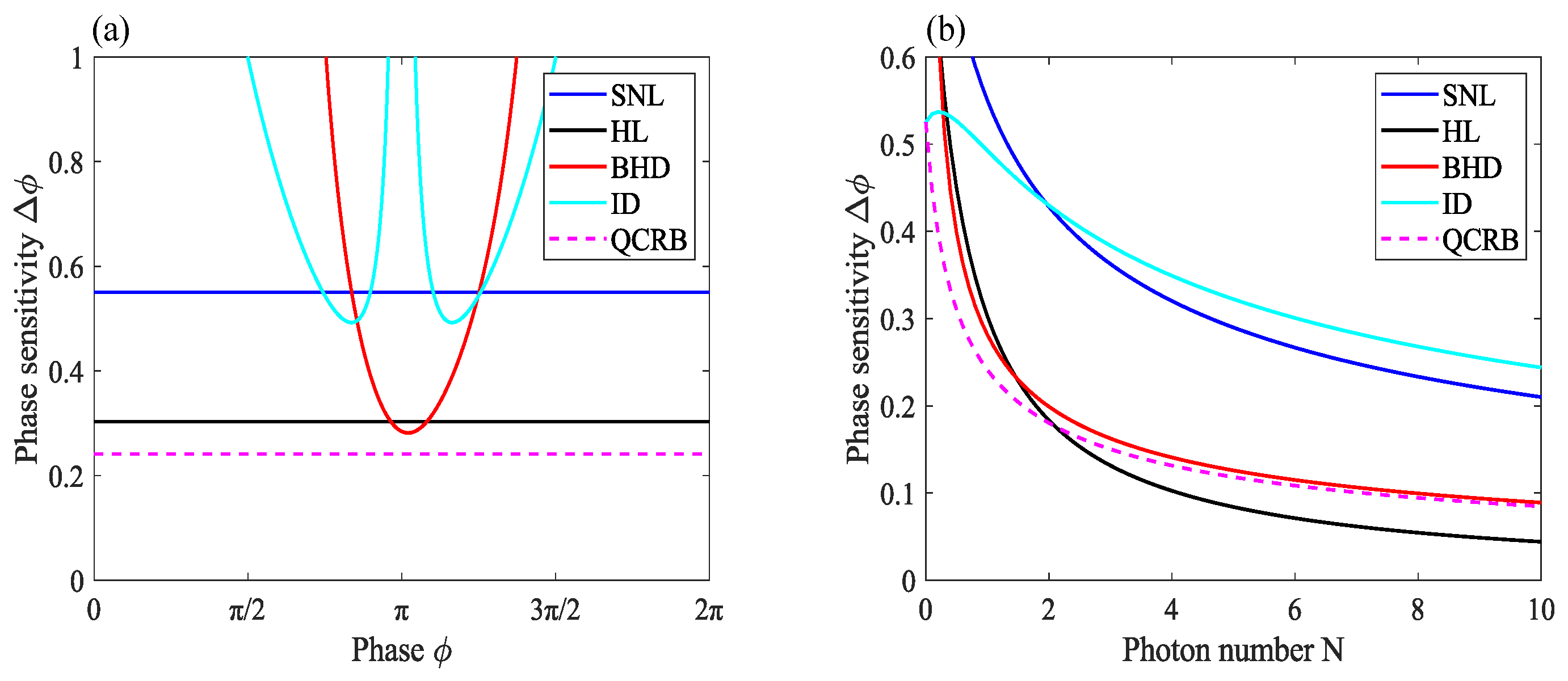
In
Figure 3, we compare the phase sensitivity of ID with that of BHD and consider its variation with the photon number
N. In
Figure 3a, the phase sensitivity with ID can only reach the sub-SNL. In contrast, for BHD, the optimal phase sensitivity can outperform the HL when
is near
.
Figure 3b illustrates the variation of phase sensitivity with photon number
N. As the
N increases, the phase sensitivity gradually improves. In the low-photon number region, both phase sensitivities can surpass the SNL. When
N continues to increase, the phase sensitivity with BHD approaches the QCRB.
Furthermore, the effects of the squeezed parameters
,
and
on sensitivity have been displayed in
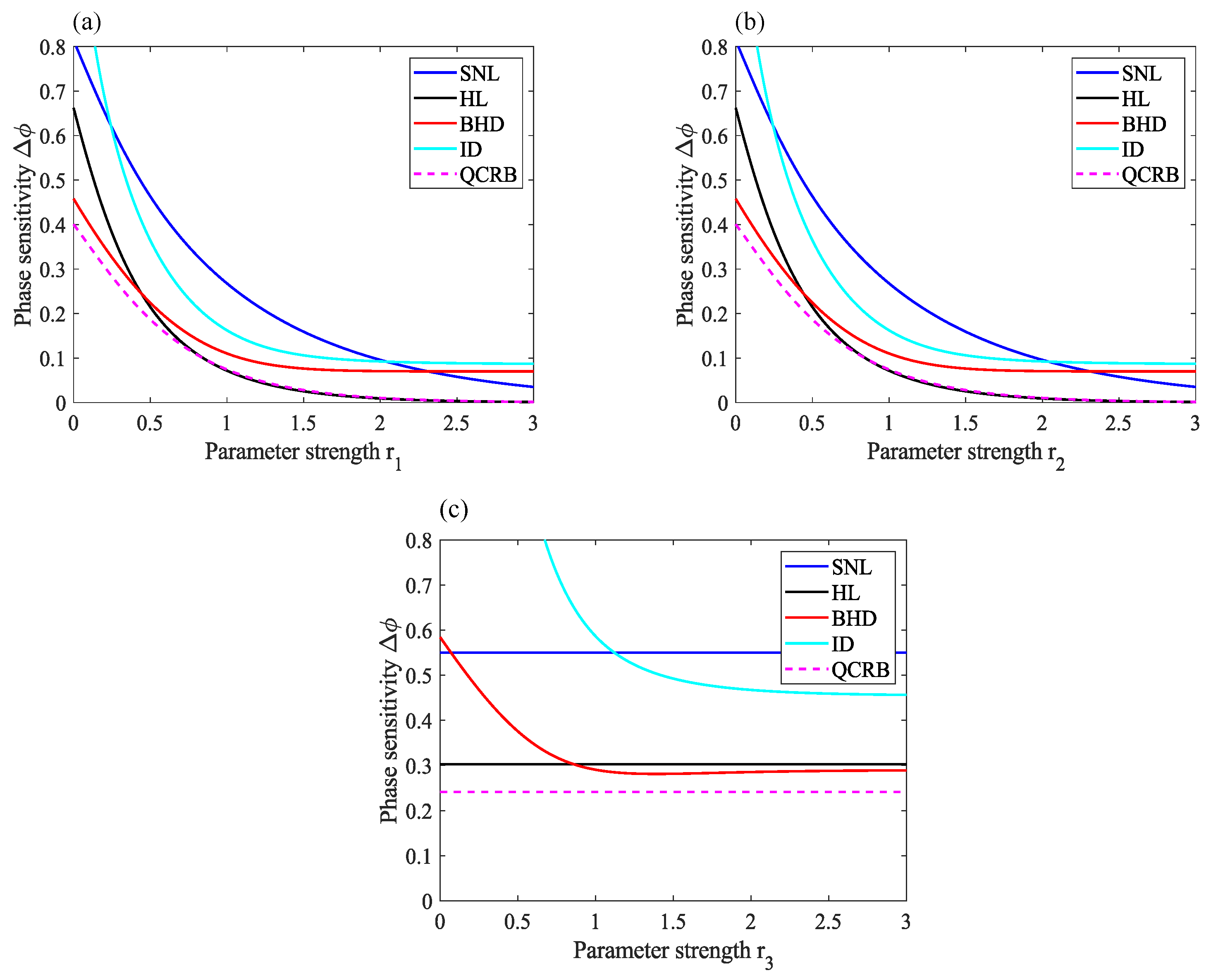
Figure 4. The phase sensitivity with ID can beat the SNL when
, as shown in
Figure 4a. When
, the phase sensitivity with BHD can beat the HL. It is even worse than the SNL when
. With the increase in
, the phase sensitivity with ID gradually approaches the phase sensitivity with BHD. The QCRB also degrades to the HL. In
Figure 4b, we obtain identical results due to the fact that FWM1 and FWM2 play the same role. If
, the SU(1,1) interferometer will become an ordinary SU(1,1) interferometer with the input of the coherent beam plus the vacuum beam [
22]. Meanwhile, it is easy to find that it is also the ordinary SU(1,1) interferometer when
. In
Figure 4c, the total photon number inside the SU(1,1) interferometer is related to the FWM1 and the FWM2. The SNL, HL and QCRB remain unchanged with the increase in
, as displayed in
Figure 4c. The phase sensitivity with ID can reach the sub-SNL region when
and the optimal phase sensitivity with BHD can surpass the HL when
is larger than 0.87.
5. Losses on the Phase Sensitivity
In realistic scenarios, a variety of factors will reduce the phase sensitivity [
22,
38,
39]. We focus on the impact of photon losses on the optimal phase sensitivity. The photon losses can be divided into two types: the internal loss and the external loss. In the experiments, the internal loss can be transmission loss inside the interferometer, and the external loss is due to the imperfect photon detector [
40]. Here, the fictitious beam splitters 1 (FBS1) and FBS2 represent the internal loss and FBS3 represents the external loss in
Figure 5.
The transmission of the FBS
i (i = 1, 2, 3) is
, and the relationship of the FBSs can be shown as
The phase sensitivities with ID and BHD are shown in
Appendix A.
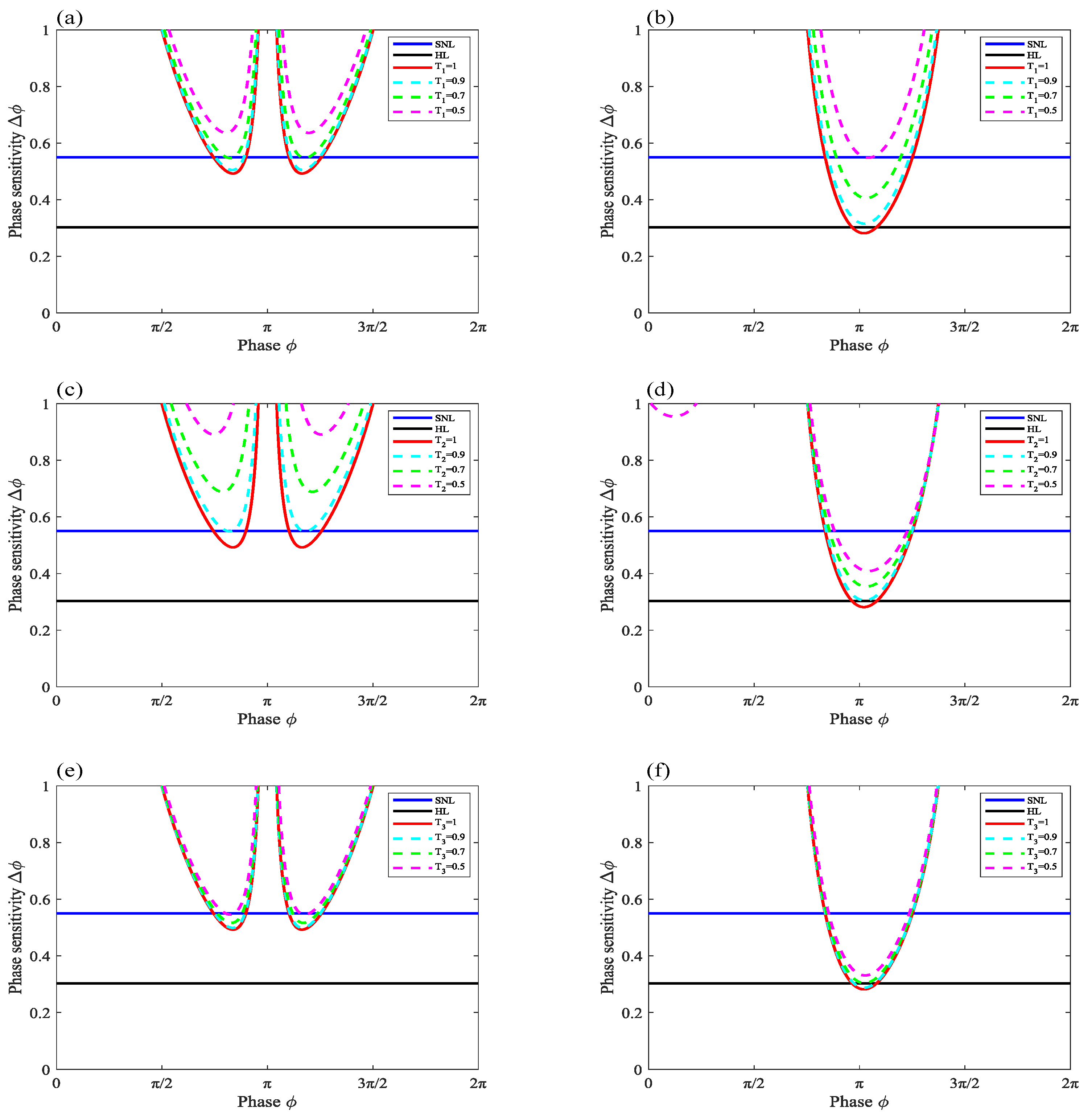
Figure 6 shows the phase sensitivity
with different transmissions
via ID and BHD. In
Figure 6a,c,e, the phase sensitivity via ID is shown. It is not difficult to find that the phase sensitivity can reach the sub-SNL with
,
,
and
.
Figure 6b,d,f show the phase sensitivity via BHD. Without the loss, the optimal phase sensitivity can reach the sub-HL. In
Figure 6a, when
is lower than 0.7, the phase sensitivity with ID is worse than the SNL. According to
Figure 6c, the phase sensitivity is better than the SNL when the transmission
is larger than 0.9. As
Figure 6e shows, the phase sensitivity can reach the sub-SNL when the transmission
is 0.5. In
Figure 6b, we study the effect of
on phase sensitivity with
. The result indicates that the phase sensitivity can reach the SNL when
. In
Figure 6d, we study the effect of
with
. In this situation, the phase sensitivity is improved. It can beat the SNL when the loss is up to
. As
Figure 6f shows, better phase sensitivity can be achieved, and it can surpass the HL when the transmission
reaches
.
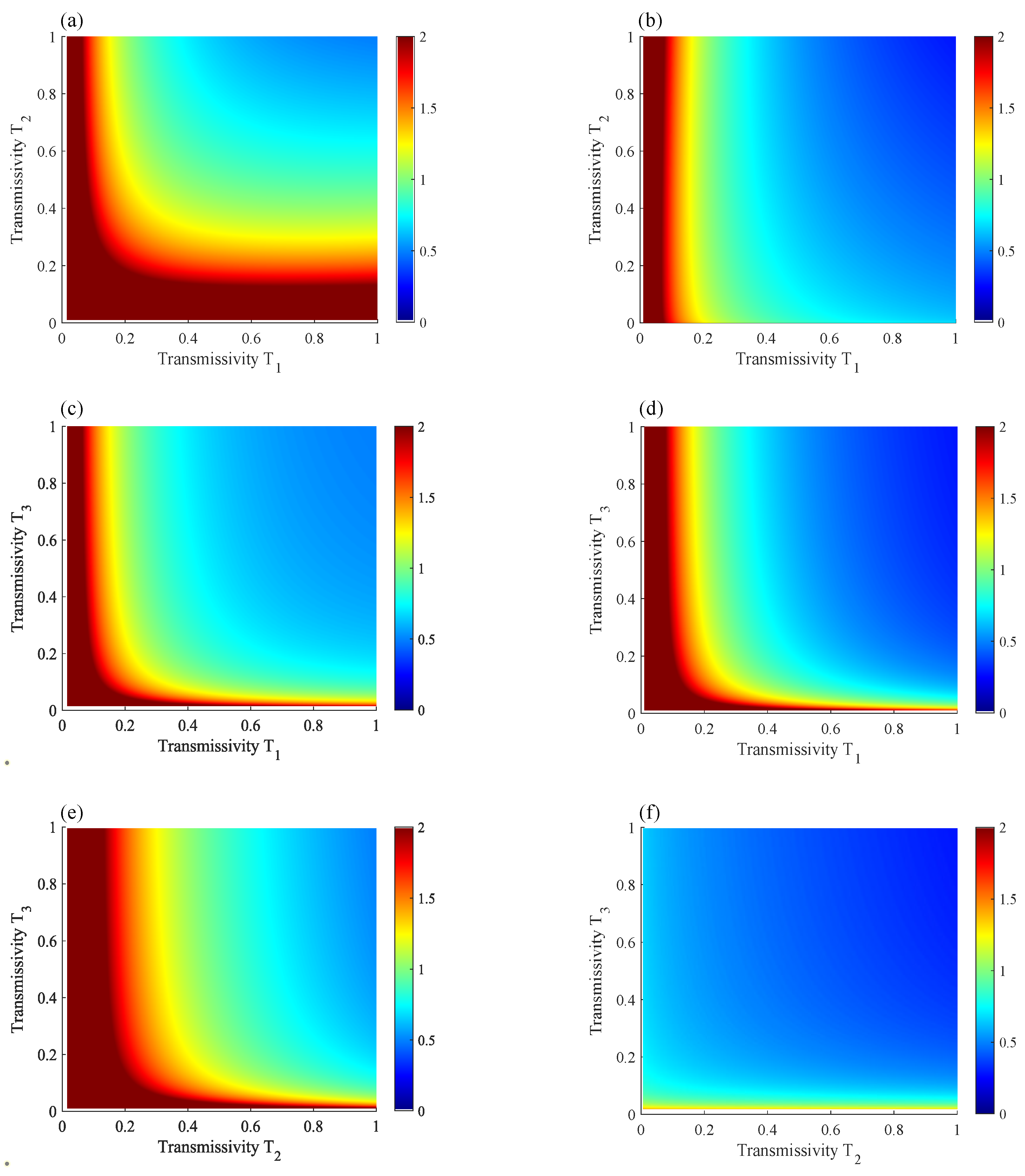
In
Figure 7, we indicate the effects of the internal and external losses on the phase sensitivity. The phase sensitivity with BHD is better than that with ID when the loss is the same. In addition, for the phase sensitivity with BHD and ID, better phase sensitivity can be obtained by the larger transmission. For
Figure 7a, with
or
, increasing the transmission cannot improve the phase sensitivity. In the
Figure 7b, the optimal phase sensitivity can be followed when
is larger than 0.8. In
Figure 7c,d, better phase sensitivity can be realized when
and
are larger. And they have the same trend. In
Figure 7e, when
, increasing the transmission
cannot boost the phase sensitivity. When
is larger, the phase sensitivity is better. In
Figure 7f, with
, increasing
will lead to better phase sensitivity. When the transmissivity
is 0.02, increasing the value of
does not help in improving phase sensitivity.
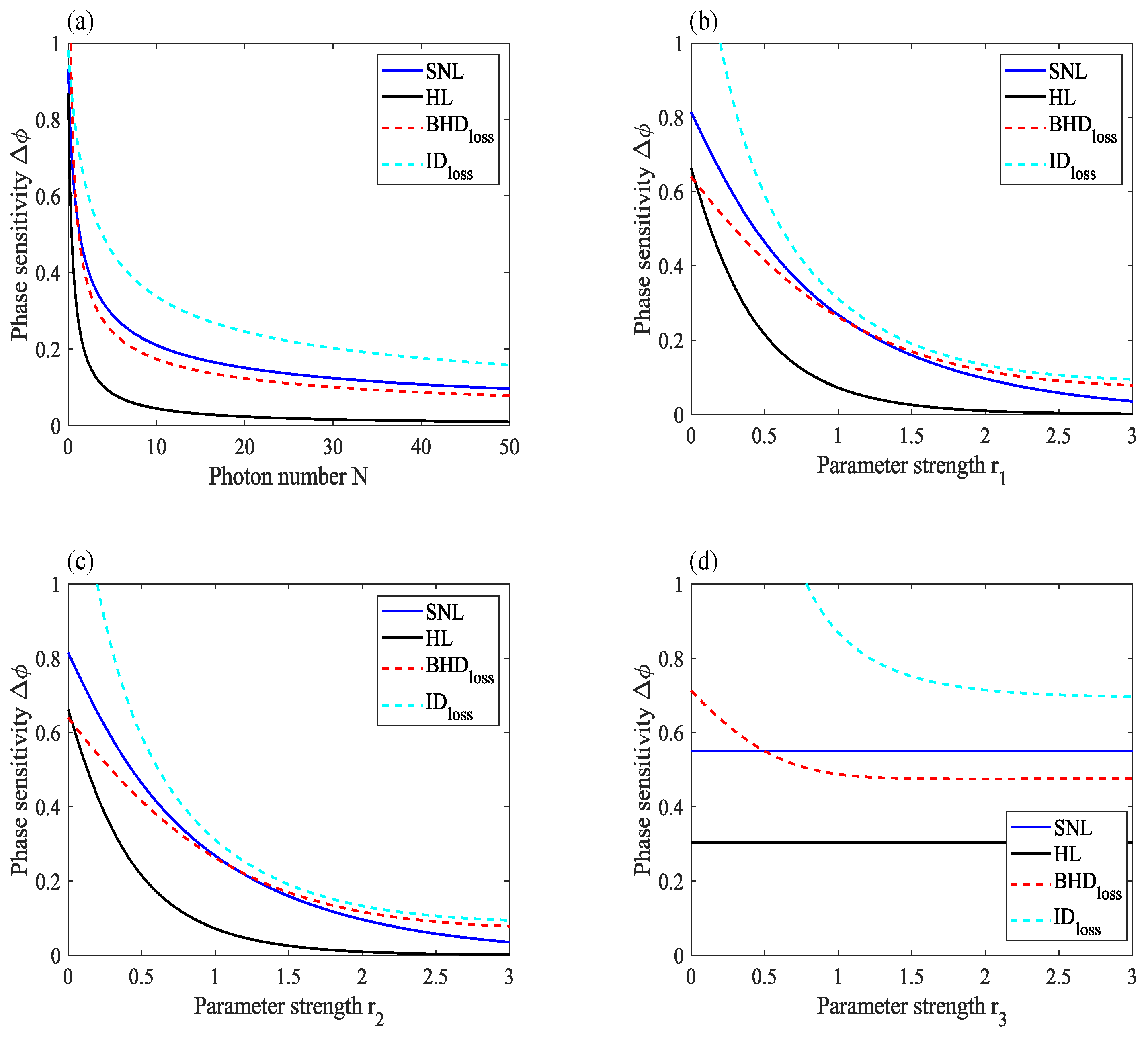
In addition, to compare the robustness of the scheme with ID and BHD,
Figure 8 is displayed. Here, the internal and external losses are the same (
). In
Figure 8a, the phase sensitivities via BHD are always better than the SNL with increasing the photon number. And the phase sensitivity via ID is worse than the SNL. For
Figure 8b,c, with the increase in the squeezing parameters
and
, the phase sensitivity with BHD is better than that with ID. It can beat the SNL when
. Meanwhile, the phase sensitivity with ID cannot surpass the SNL. According to
Figure 8d, the phase sensitivity achieved via BHD can beat the SNL when
is larger than 0.5. The phase sensitivity via ID is always worse than the SNL. In this case, the scheme with BHD has better robustness.
6. Discussion
In this section, we have a detailed discussion that shows the advantage of our scheme. The HIs with the same input (two-mode squeezed coherent state) and the same detection method (BHD) are displayed in
Figure 9 [
24]. The structure in
Figure 9 contains two FWMs and one BS. The total photon number inside the interferometer remains consistent with ours under the same parameters. This implies that the two schemes can obtain the same SNL and HL. According to the error-propagation formula, the phase sensitivity is
the variance is
and the slope becomes
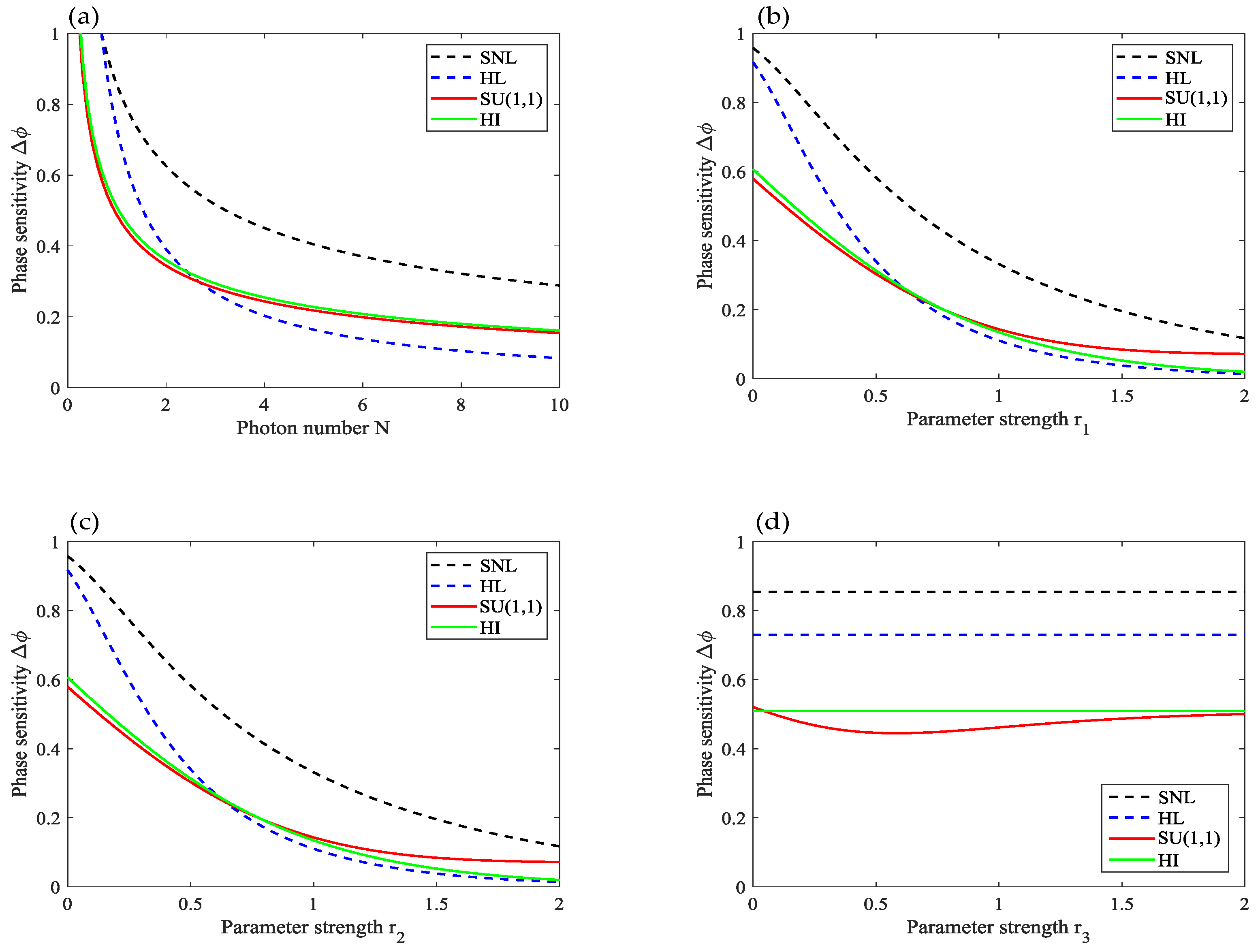
Subsequently, we discuss the phase sensitivity with different parameters. In
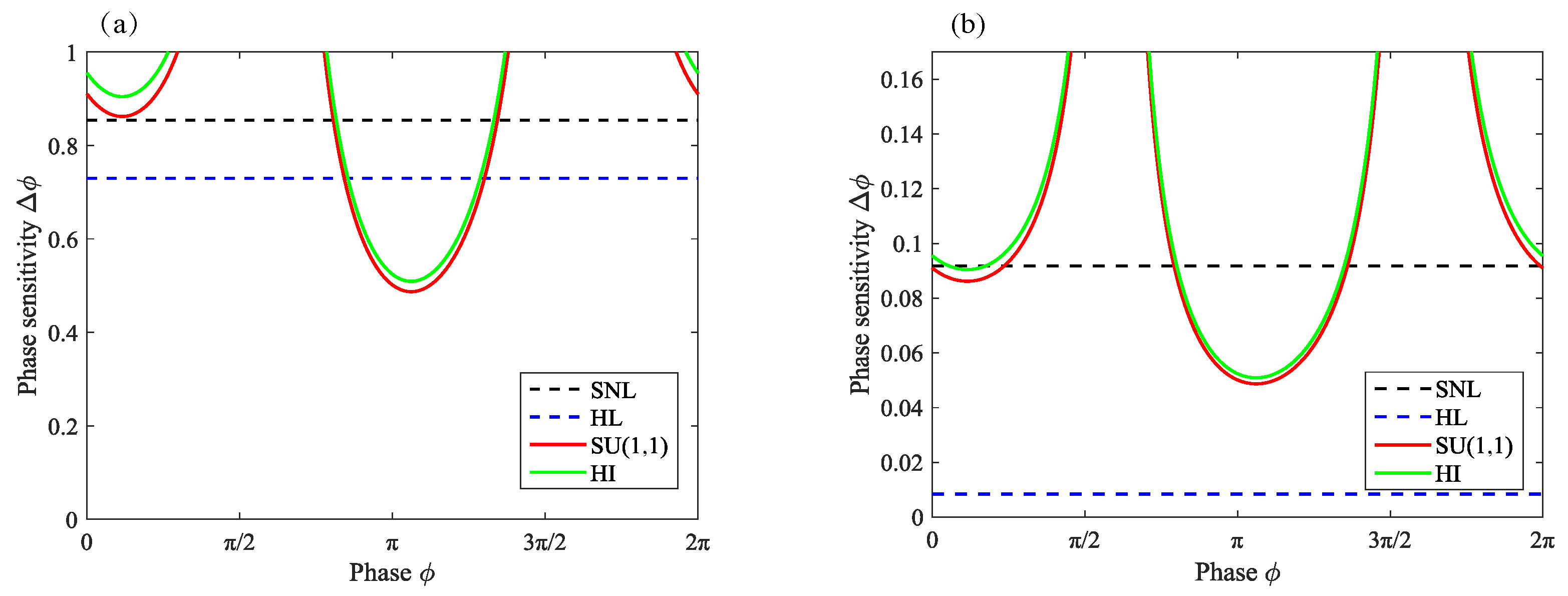
Figure 10, the phase sensitivity versus the phase shift is displayed. In
Figure 10, the HI is used to represent the phase sensitivity with the two-mode squeezed state as input via BHD based on the hybrid interferometer. In addition, the SU(1,1) in the figures represents the phase sensitivity based on the SU(1,1) interferometer with the two-mode squeezed state as input via BHD. In
Figure 10a, the optimal phase sensitivities based on the HI and the SU(1,1) interferometer can beat the HL with
,
and
. Our scheme demonstrates a 4% improvement in phase sensitivity compared with the HI. In
Figure 10b, with
,
and
, the phase sensitivity can reach the sub-SNL.
In
Figure 11a, as the photon number increases, the phase sensitivities based on the HI and SU(1,1) interferometer are further enhanced. In the low-photon-number regime, both schemes can surpass the HL. And the phase sensitivity based on the SU(1,1) interferometer is always better than that of the HI. In
Figure 11b,c, with lower squeezing parameters, the phase sensitivity of the SU(1,1) interferometer has better performance. With larger
and
values, the HI shows better phase sensitivity. According to
Figure 11d, the phase sensitivity of the SU(1,1) interferometer can have the better performance when
is larger than 0.04. The optimal phase sensitivity can be realized when
is 0.58.
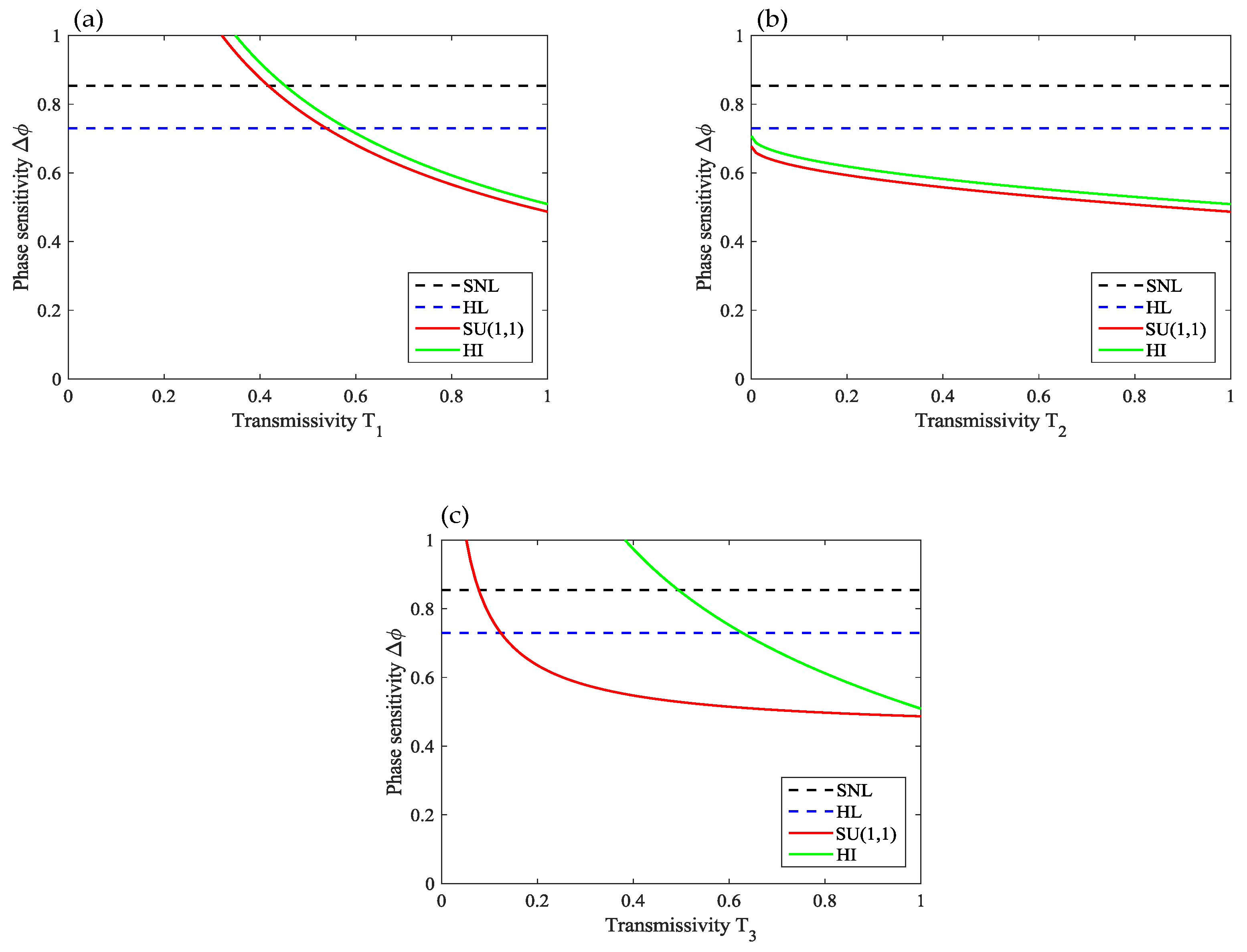
Next, the robustness of the two schemes against losses are indicated. With the increase in the transmission efficiency
, our scheme exhibits stronger robustness compared to the HI scheme, as shown in
Figure 12a. When
is larger than 0.41, our scheme can beat the SNL, and the HI scheme can beat SNL when
. In
Figure 12b, it can be noted that when the transmission efficiency
is higher, the phase sensitivity can always beat the HL. For the external detecting losses, our scheme exhibits stronger robustness, as
Figure 12c shows. When
is larger than 0.08, the phase sensitivity of the SU(1,1) interferometer can reach the sub-SNL. For the HI scheme, the robustness is 0.5.