1. Introduction
Flexural hinges serve as core components in the field of precision mechanics. Due to their characteristics of being friction-free and backlash-free, as well as possessing high resolution, they exhibit significant advantages in micro-displacement mechanisms, optical adjustment platforms, and spectral instruments. Particularly in Fourier Transform Infrared (FTIR) spectrometers, the dynamic performance of the pendulum interferometer directly determines the stability of the Optical Path Difference (OPD), thereby affecting spectral resolution and measurement accuracy. In recent years, with the growing demand for portable spectrometers in industrial inspection, environmental monitoring, and space exploration, achieving high-precision motion control within miniaturized designs has emerged as a research hotspot [
1,
2,
3,
4,
5,
6,
7].
Regarding the optimization of pendulum interferometers, scholars have proposed various improvement schemes. For instance, Shi et al. [
8] developed a compact interferometer using a special optical path design to achieve an OPD four times the moving mirror displacement; Jia et al. [
9] established a mathematical model for the pendulum control system and optimized the control algorithm using Saber simulation software (v2024.12, Synopsys, Inc., Sunnyvale, CA, USA); Li et al. [
10] proposed a “vector analysis + precision instrument micro-adjustment” method, effectively improving the alignment accuracy of corner cubes; Liu et al. [
11] investigated the correction methods and principles for nonlinear OPD, validating them with mercury-argon lamp experiments to significantly enhance accuracy; and Zhang et al. [
12] designed a phase correction method based on an optimal filter using feature filtering during interferogram processing. However, these studies primarily focus on optical path design optimization, control algorithm improvements, or post-processing and correction of interferogram data. Regarding the core component of the pendulum interferometer—the cross-spring flexural hinge—existing research often remains at the level of theoretical qualitative analysis or preliminary calculations. There is a lack of precise quantitative evaluation concerning the normal displacement deviation introduced by its nonlinear elastic deformation during actual motion, as well as its profound impact on the overall performance of the interferometer (especially interference modulation).
In the broader field of precision measurement and sensing, the analysis of multi-physics coupling mechanisms has received extensive attention. Advanced modeling strategies and signal estimation techniques have been widely applied to explore the interaction mechanisms in optomechanical systems. For instance, recent studies have investigated interferometric phenomenologies in nanoelectromechanical interactions [
13] and signal detection strategies in hybrid quantum circuits [
14], providing valuable methodological references for high-precision system analysis. Furthermore, the impact of environmental factors, such as temperature fluctuations and statistical noise, on resonator performance has also been rigorously discussed [
15]. Although these studies focus on micro/nano-scales, their emphasis on coupled field analysis and environmental stability aligns with the design challenges of macroscopic precision instruments, such as the pendulum interferometer discussed in this work.
In fact, the nonlinear deformation of flexural hinges during reciprocating motion inevitably leads to a minute angular difference in the moving mirror. This parasitic tilt not only disrupts the ideal linear variation in the OPD but, more importantly, causes wavefront shearing, leading to a decrease in interference fringe contrast (i.e., modulation attenuation). This has become a bottleneck for further improving the accuracy of portable FTIR spectrometers. Traditional theoretical models often simplify the complex deformation behavior of flexural hinges, making it difficult to accurately predict the impact of these micrometer-level axis drifts on modulation [
16,
17,
18,
19,
20].
Furthermore, existing studies mostly rely on simplified geometric optics models or Gaussian spectrum approximation formulas to estimate the impact of errors on modulation, failing to accurately reflect the wavefront distortion and diffraction effects caused by micrometer-level axis drift. To address these issues, this paper adopts a method combining Finite Element Analysis (FEA) and Physical Optics Field Tracing simulation to conduct a comparative study on two typical topologies: single-pivot and dual-pivot. By establishing a high-fidelity optomechanical coupling model, this study quantitatively analyzes the normal displacement deviation induced by the nonlinear deformation of flexural hinges and reveals the specific laws governing its influence on interference modulation from the perspective of physical optics. Furthermore, existing studies mostly rely on simplified geometric optics models or Gaussian approximations to estimate modulation errors, which fail to accurately reflect diffraction effects caused by wavefront distortion. To address these issues, this paper adopts a method combining ANSYS Workbench 2022 R1 Finite Element Analysis (FEA) and VirtualLab Physical Optics simulation. We conduct a comparative study on two typical topologies: single-pivot and dual-pivot. By establishing a high-fidelity optomechanical coupling model, we quantitatively analyze the normal displacement deviation caused by nonlinear deformation and reveal its specific influence law on interference modulation from the perspective of physical optics.
2. Principle and Modeling of the Optomechanical Coupled System
2.1. Optical Configuration and Differential Scanning Principle
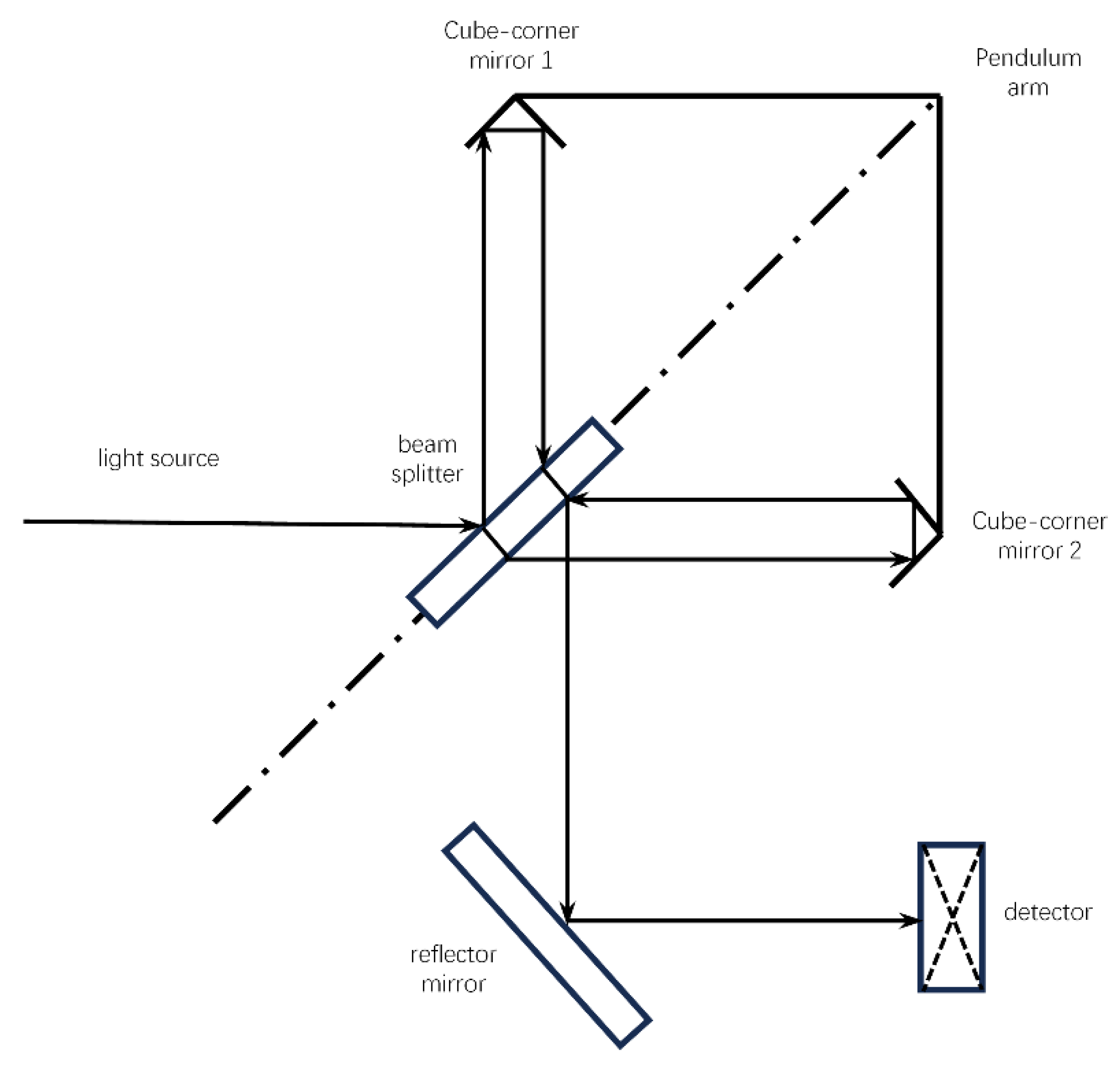
The pendulum interferometer proposed in this study adopts a dual-moving-mirror differential scanning configuration, as shown in
Figure 1. The system is based on the Michelson interference principle, consisting of a beamsplitter, a compensator, and a pair of cube-corner prisms (retroreflectors).
The incident beam is modulated by the beamsplitter into transmitted and reflected coherent beams with equal amplitude, which are projected onto the left and right corner prisms driven synchronously by the pendulum mechanism. Utilizing the inherent retroreflective property of cube-corner prisms, the reflected beam remains strictly parallel to the incident beam after three internal reflections. This optical characteristic provides strong immunity to minute tilts and jitters of the moving mirror, thereby reducing the stringent requirements for mechanical guidance accuracy.
Figure 2 illustrates the geometric kinematics of a single pendulum arm. During the scanning process, the left and right pendulum arms swing synchronously in opposite directions, driven by a Voice Coil Motor (VCM). This dual-moving-mirror differential structure not only facilitates the balancing of the mechanical center of gravity but also significantly enhances scanning efficiency. Specifically, when a single pendulum arm generates a mechanical displacement
d along the optical axis, due to the differential superposition effect and the double optical path folding design, the total variation in the Optical Path Difference (
OPD) of the system is approximately
The system features a fourfold OPD gain, enabling the interferometer to achieve high spectral resolution with a relatively small mechanical stroke, thereby laying the foundation for the miniaturization and lightweight design of the entire instrument.
2.2. Mechanism of Motion Error Induced by Flexure Pivot Nonlinearity
In the pendulum interferometer, the cross-spring flexural pivot serves as the core motion mechanism (as shown in
Figure 3), realizing small-angle precision rotation through the elastic deformation of metal strips. However, in practical operation, the nonlinear characteristics of the pivot material induce minute nonlinear deformations, causing the rotation center to drift from the theoretical position O to O′ (as shown in
Figure 4). This axis drift breaks the symmetry of the motion of the two arms. The normal displacement of the left and right arms can be expressed as
and
, resulting in a net normal displacement deviation:
where
R is the arm length. The angular difference
=
−
caused by structural nonlinearity introduces extra nonlinear terms to the
OPD, causing the actual
OPD expression to deviate from the ideal model:
2.3. Topologies and Physical Modeling
To quantitatively compare the impact of different pivot designs on motion accuracy, this study constructed 3D models for both single-pivot and dual-pivot pendulum interferometers.
Single-Pivot Meshing Model (
Figure 5): Consists of a beamsplitter, cube corners, a single cross-spring pivot (leaf thickness 0.2 mm), a pendulum arm (length 47 mm), and a VCM. The arm is driven by the VCM and swings via the elastic deformation of the single pivot.
Dual-Pivot Model (
Figure 6): Uses four elastic strips (thickness 0.2 mm) to form a parallel parallelogram structure (arm length 37 mm). The VCM pushes the bottom of the parallelogram mechanism to realize motion through bilateral linkage.
To ensure the accuracy of the numerical results, a mesh independence test was conducted. The element size of the critical flexure region was refined from 0.5 mm to 0.15 mm. Simulation results indicated that when the element size is less than 0.3 mm, the variation in maximum stress and displacement is less than 1%. Therefore, a local mesh size of 0.3 mm was selected for the flexure hinges to balance computational efficiency and accuracy. Key dimensional parameters are listed in
Table 1. To ensure rigorous comparison, materials were matched based on physical properties (
Table 2): 6061-T6 Aluminum alloy was selected for the arm to reduce inertia due to its high specific stiffness; 65 Mn spring steel was selected for the flexures to ensure high yield strength.
2.4. Co-Simulation Method for Optomechanical Coupling
Traditional theoretical models typically assume ideal plane waves and ignore wavefront mismatch and diffraction effects caused by mirror attitude changes (tilt). To accurately evaluate the system performance, this study constructed a cross-physics “Structure-Optics” co-simulation framework. The technical route is illustrated in
Figure 7, comprising three core links:
Mechanical Environment Simulation: A parametric finite element model is built in ANSYS Workbench. To capture geometric nonlinear characteristics at large rotation angles, the “Large Deflection” option is enabled, and a transient dynamics module is used to simulate the scanning motion over a 2 s period.
Cross-Platform Data Link: As the critical bridge of the co-simulation, this module extracts the three-dimensional motion trajectories of the finite element nodes. It calculates the normal displacement deviation (Δδ) of the moving mirror vertices and maps nodal displacements from the mechanical domain to the rigid-body position and orientation matrices in the optical domain. To mitigate numerical errors arising from data interpolation during this mapping process, a high-order spline interpolation algorithm was employed, ensuring a seamless and high-precision transmission of multi-physics data.
Optical Performance Evaluation: As illustrated in
Figure 8, a non-sequential field tracing model was constructed within the VirtualLab Fusion platform (v7.5.0, Wyrowski Photonics, Jena, Germany). The optical source was defined as a Gaussian wave with a center wavelength of 1550 nm and a bandwidth of 50 nm to accurately simulate the coherence properties. The system follows a Michelson-type configuration comprising an ideal beam splitter, a fixed reference mirror, and a movable mirror. The dynamic normal displacement deviations (Δδ) and tilt errors calculated from the mechanical simulation were mapped onto the movable mirror as coordinate transformation matrices. By rigorously solving the propagation equations of the electromagnetic field complex amplitude
, the perturbed wavefronts were superimposed, and the resulting 2D interference irradiance distribution was captured at the detector plane.
To ensure the reliability of the results, the spatial sampling resolution of the detector was set to a high density (512 × 512 pixels). This minimizes the uncertainty in modulation calculation, ensuring that intensity peaks () and valleys () are captured with sufficient precision. Consequently, calculation uncertainties remain negligible compared to the macroscopic modulation drop caused by axis drift.
Based on the simulated intensity data, the interference modulation
M is defined as:
where
and
represent the peak intensity of the central bright fringe and the valley intensity of the adjacent dark fringe, respectively. This method comprehensively reflects the coupling effects of normal displacement deviation and tilt error on interference quality.
3. Results and Discussion
3.1. Finite Element Analysis: Quantification of Normal Displacement Deviation
The dynamic responses of the single-pivot and dual-pivot pendulum interferometers under typical operating conditions (25 °C, spectral resolution 1 cm−1 corresponding to a max OPD of 10 mm) were obtained via transient nonlinear dynamic FEA.
Figure 9 clearly illustrates the normal displacement deviations generated by the two structures during the motion of the pendulum arm. The analysis results indicate that the maximum normal displacement deviation produced by the single-pivot flexural hinge structure throughout the entire motion cycle is approximately 0.00165 mm, whereas that of the dual-pivot structure reaches 0.03765 mm under identical conditions. This implies that, compared to the dual-pivot structure, the single-pivot design reduces the normal displacement deviation introduced by the nonlinear elastic deformation of the flexural hinge by approximately 95.6%. This significant discrepancy fully demonstrates the superiority of the single-pivot structure in suppressing parasitic motion and enhancing motion precision.
Further analysis reveals that the fundamental reason for the vast difference in displacement deviation between the two lies in the distinct topological configurations and motion transmission mechanisms of their flexural support mechanisms.
The dual-pivot structure (parallelogram) represents a typical hyperstatic, over-constrained system. During large-angle actuation, the flexure strips inherently undergo axial shortening (the foreshortening effect). However, the rigid connecting links within this closed-loop topology constrain this essential degree of freedom, leading to kinematic incompatibility. To accommodate this geometric conflict and satisfy force equilibrium, the mechanism is forced to compromise its rotation center, causing it to drift significantly. This manifests as the substantial normal displacement deviation (Δδ) observed in the simulations.
In contrast, the single-pivot structure adopts a direct-rotation topology, acting as a statically determinate (or weakly hyperstatic) system. It exhibits superior kinematic compliance, allowing the flexures to deform naturally without “fighting” against rigid geometric constraints. This effectively avoids the accumulation of parasitic motion caused by redundant constraints, resulting in a significantly lower displacement deviation.
Regarding optimization potential, while adjusting geometric parameters—such as increasing the arm length or reducing hinge thickness—can indeed mitigate the error magnitude for the dual-pivot design, it cannot eliminate the inherent parasitic motion dictated by its over-constrained topology. Under the same spatial constraints (e.g., the miniaturization requirements of portable instruments), the single-pivot design offers a theoretically superior and more robust solution for suppressing axis drift.
3.2. Analysis of Modulation Results
Based on the previously established cross-platform data transmission link, the full-stroke nodal displacement data of the moving mirror extracted from the ANSYS transient dynamic analysis (including the normal displacement deviation
and minute tilts) were used as boundary conditions and imported into the optical simulation environment for physical optics field tracing. Unlike traditional geometric ray tracing, this method accurately calculates the two-dimensional interference intensity distribution on the detector plane by solving for the propagation of the complex amplitude of the electromagnetic field. Based on this, the interference modulation
M is calculated as:
Physically, the normal displacement deviation introduces a piston error between the two interfering arms, while the parasitic tilt introduces a wavefront tilt error. According to the principle of wave superposition, these errors reduce the spatial coherence of the overlapping beams on the detector surface. Specifically, the wavefront tilt causes the interference fringes to become denser or shifted, leading to a spatial averaging effect over the detector’s finite aperture, which directly results in the degradation of the modulation index M.
Figure 10 presents the variation curves of the modulation
M for single-pivot and dual-pivot structures over the entire stroke, as well as the simulation results of the interference fringes at the maximum OPD.
Dual-Pivot Structure: Influenced by the accumulated normal displacement deviation ( = 37.65 μm), the wavefronts of the reflected beam and the reference beam are significantly misaligned. The simulation shows that as the OPD increases, the fringe contrast decreases rapidly. The modulation M exhibits a clear nonlinear decay trend (bell-shaped curve), with a maximum relative error reaching 2%, which seriously affects the signal-to-noise ratio of spectrum retrieval.
Single-Pivot Structure: Thanks to its excellent topological symmetry, the motion trajectory closely follows the ideal model. Throughout the scanning cycle, the interference fringes remain clear and sharp. The modulation M remains stable above 0.99.
These results hold significant engineering implications. This study overcomes the limitations of previous approaches that relied solely on geometric optics theoretical formulas to estimate errors. By establishing a comprehensive “structure–physical optics” co-simulation framework, it quantitatively reveals the degradation mechanism of interference modulation induced by the nonlinear parasitic motion of flexural hinges. It should be noted that numerical errors may arise from the discretization of the continuous fields. To minimize this, a high-density sampling grid was used in the optical simulation. Additionally, a preliminary sensitivity analysis suggests that the rotational stiffness is highly sensitive to the thickness of the leaf springs; a manufacturing tolerance of ±0.01 mm could lead to a minor deviation in the OPD curve, though the superiority of the single-pivot topology remains robust. The research demonstrates that although the dual-pivot structure is theoretically designed to achieve translation, the actual nonlinear axis drift it generates is the primary cause of modulation deterioration. In contrast, the single-pivot structure exhibits significant advantages in maintaining high modulation, providing a clear basis for structural selection in the design of high-interference-quality portable FTIR instruments.
3.3. Qualitative Experimental Verification Strategy
To validate the feasibility of the proposed design, a prototype of the single-pivot interferometer was fabricated using wire-EDM to minimize machining stress. A static interference experiment was conducted using a He-Ne laser source. Clear and stable signals were observed (
Figure 11), which qualitatively verify the motion stability of the mechanism. Although quantitative measurement of sub-micron dynamic axis drift requires an ultra-high-precision measuring instrument—which is planned for future work—the high-contrast fringes obtained experimentally are consistent with the high modulation predicted by the simulation. Given that manufacturing tolerances are inevitable in engineering practice, a preliminary sensitivity analysis was conducted regarding the leaf spring thickness (t), which is the most critical geometric parameter affecting rotational stiffness. Simulations with t varying by ±10% (0.2 ± 0.02 mm) showed that while the absolute values of the normal displacement deviation fluctuated slightly due to stiffness changes, the order-of-magnitude difference between the single-pivot and dual-pivot structures remained consistent. The single-pivot topology consistently outperformed the dual-pivot one, demonstrating the robustness of the proposed design choice against geometric uncertainties.
4. Conclusions
This study proposes a comprehensive evaluation method combining transient nonlinear (FEA) and Physical Optics simulation to systematically compare the kinematic performance and optical characteristics of single-pivot and dual-pivot cross-spring flexural hinges in pendulum interferometers. The main conclusions are as follows:
Quantification of Nonlinear Motion Errors: Under the condition of 1 cm−1 (corresponding to a maximum OPD of 10 mm) s and an ambient temperature of 25 °C, the maximum normal displacement deviation Δδ produced by the single-pivot flexural hinge is approximately 0.00165 mm, whereas that of the dual-pivot structure reaches 0.03765 mm. The single-pivot design reduces this deviation by approximately 95.6%, and its motion trajectory conforms more closely to the ideal linear model.
Physical Verification of Optical Performance: The co-simulation based on physical optics confirms that normal displacement deviation is the critical factor leading to the degradation of interference modulation. Due to the significant Δδ in the dual-pivot structure, it suffers from wavefront distortion and rapid modulation decay. In contrast, the single-pivot structure, benefitting from minimal axis drift, maintains a high modulation of over 0.99 throughout the entire stroke, thereby ensuring the high Signal-to-Noise Ratio (SNR) measurement capability of the interferometer.
Methodological Value of Multi-Physics Simulation: A complete simulation link of “Structural Nonlinear Deformation → Rigid Body Mapping → Physical Optics Field Tracing → Modulation Evaluation” was constructed. This method overcomes the limitations of traditional theoretical analyses in accurately describing complex optomechanical coupling effects. It realizes the quantitative prediction from mechanical errors to optical performance, highlighting the significant value of high-fidelity digital simulation technology in the design and optimization of precision instruments.
In summary, the results provide reliable theoretical support and data for the optimization of core components in portable FTIR spectrometers, indicating that the single-pivot cross-spring flexural hinge possesses superior performance potential in applications requiring high precision and stability.