Article

Efficient Multipartite Energy Transfer Based on Strongly Coupled Topological Cavities


1
Hebei Key Laboratory of Photophysics Research and Application, College of Physics, Hebei Normal University, Shijiazhuang 050024, China
2
Science College, Shijiazhuang University, Shijiazhuang 050035, China
3
School of Physics, Changchun University of Science and Technology, Changchun 130022, China
4
Institute of Quantum Information, School of Communication and Information Engineering, Nanjing University of Posts and Telecommunications, Nanjing 210003, China
*
Authors to whom correspondence should be addressed.
Photonics 2026, 13(2), 203; https://doi.org/10.3390/photonics13020203
Submission received: 17 December 2025 / Revised: 9 February 2026 / Accepted: 13 February 2026 / Published: 19 February 2026
(This article belongs to the Special Issue Quantum Optics: Communication, Sensing, Computing, and Simulation)

Abstract

Efficient and robust energy transfer is fundamental to quantum information processing and light-harvesting technologies. However, conventional systems are often limited by short interaction ranges and high susceptibility to environmental disorder. In this study, we propose and theoretically investigate a topologically protected tripartite energy transfer system based on photonic crystal nanocavities. By utilizing topological corner states as localized interaction nodes and edge states as robust transmission channels, we construct a platform that mediates energy exchange among three distinct quantum emitters. Using the Lindblad master equation formalism, we analyze the spectral dependence of coupling strengths and transfer dynamics. Our results demonstrate that coherent coupling between nearest neighbors is the dominant mechanism driving high-efficiency transport, whereas next-nearest-neighbor interactions can induce destructive interference. Furthermore, compared to bipartite systems, the tripartite configuration exhibits an enhanced cumulative probability for charge separation. Crucially, numerical simulations confirm that the energy transfer efficiency and time remain virtually unaffected by random structural disorder or sharp interface bends, unequivocally validating the topological protection of the system. These findings establish a robust blueprint for scalable quantum interconnects and integrated photonic circuitry.

1. Introduction

Resonant energy transfer (RET) lies at the heart of light-matter interactions, serving as a fundamental mechanism in diverse physical and biological processes ranging from photosynthetic light harvesting to photovoltaic energy conversion [1,2]. In quantum information science, the coherent exchange of excitation energy between distinct quantum emitters is a prerequisite for generating entanglement and realizing quantum logic gates [3,4,5]. Traditionally, energy transfer is mediated by dipole-dipole interactions, such as Förster resonance energy transfer (FRET), which is inherently short-ranged and highly sensitive to the spatial arrangement of emitters [6]. To overcome the distance limitations, various nanophotonic platforms, including plasmonic waveguides and dielectric cavities, have been explored to enhance light-matter coupling [7,8]. A persistent challenge for these conventional systems, however, is their susceptibility to fabrication imperfections and environmental disorder. Backscattering induced by structural defects often leads to Anderson localization or significant dissipation, which severely degrades the fidelity and efficiency of energy transport, particularly in complex multi-emitter networks.
Moving beyond simple bipartite (donor-acceptor) systems, the study of multipartite energy transfer is becoming increasingly critical. Practical applications in quantum interconnects and distributed quantum computing require the synchronization of multiple nodes—not just pairs—to form scalable networks [9]. In multi-emitter configurations, collective effects such as superradiance and subradiance emerge, offering new degrees of freedom to control energy flow [10]. Nevertheless, as the system size scales up, controlling the coherent coupling between distant nodes while suppressing crosstalk and disorder-induced losses becomes exponentially difficult in trivial photonic environments.
The advent of topological photonics provides a powerful paradigm to address these robustness issues [11,12,13,14,15,16]. Inspired by the discovery of the quantum Hall effect in condensed matter physics, topological photonic crystals (TPCs) support edge states that are immune to backscattering and robust against smooth structural perturbations [17,18]. Recently, the concept has been extended to higher-order topological insulators (HOTIs). Unlike conventional topological insulators where d-dimensional bulk states support (d − 1)-dimensional edge states, 2D HOTIs can host zero-dimensional (0D) topological corner states [19,20,21]. These highly localized corner states possess high quality factors and small mode volumes, making them ideal candidates for cavity quantum electrodynamics (QED) [22]. Furthermore, the robust edge states connecting these corners can serve as naturally protected waveguides. Recent advances have demonstrated that such topological edge-state coupling can be precisely engineered to control wave propagation and enhance light-matter interactions, enabling robust on-chip functionalities [23]. This unique “corner-edge-corner” architecture offers a promising, yet underexplored, platform for mediating long-range, robust interaction among multiple quantum emitters [24]. Indeed, the potential of topological corner states has recently been explicitly explored in energy transfer contexts, such as wireless power transfer, highlighting their broad applicability for energy management [25]. While significant progress has been made in demonstrating topological protection for single-photon transport and two-body entanglement, the dynamics of multipartite energy transfer within a higher-order topological framework remain less understood. Most existing studies focus on the spectroscopic properties of the modes rather than the time-domain kinetics of population transfer among three or more spatially separated nodes.
In this work, we propose and theoretically investigate a topologically protected tripartite energy transfer system based on a 2D photonic crystal displaying higher-order topology. The system comprises three distinct cavities hosting topological corner states, interconnected by robust edge channels. By employing the Lindblad master equation formalism, we rigorously analyze the excitation dynamics, revealing that the coherent coupling mediated by the topological modes dominates the high-efficiency transfer process in the off-resonant regime. We explicitly demonstrate the collective enhancement of charge separation probability in the tripartite configuration compared to its bipartite counterparts. Crucially, we verify that the energy transfer efficiency and transfer time are immune to structural disorder and sharp waveguide bends, confirming the topological protection of the multipartite logic.
The remainder of this paper is organized as follows. Section 2 introduces the theoretical model, including the design of the topological photonic crystal, the master equation formalism, and the calculation of Green’s tensors. Section 3 presents the numerical results, discussing the spectral characteristics of coupling strengths, the dynamics of energy transfer under various configurations, and the robustness analysis against defects. Finally, Section 4 summarizes our findings and discusses potential applications in robust quantum networks.

2. Materials and Methods

2.1. System Configuration and Topological Modes

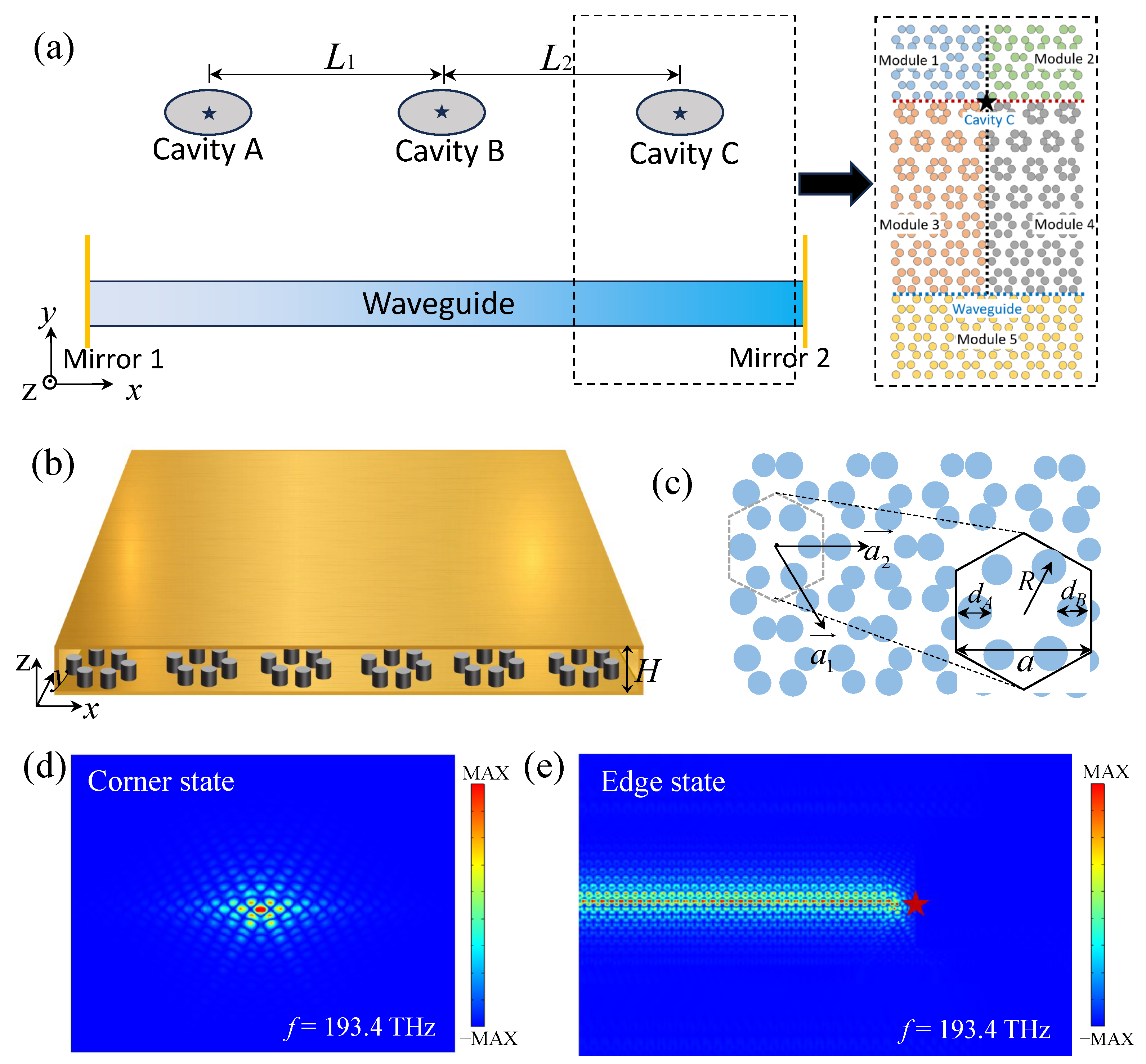
The proposed tripartite energy transfer system is constructed based on a topological photonic crystal platform, as illustrated in Figure 1. The platform consists of three photonic crystal cavities (labeled Cavities A, B, and C) that are spatially separated but optically coupled via a topological waveguide, with the distances between cavities A–B and B–C denoted as L 1 and L 2 , respectively. Here we set L 1 = L 2 = 10a, where a is the lattice constant of the photonic crystal. In addition, the distance between the two corner cavities is critical to define the topological state, and the minimum lengths of L 1 and L 2 are 5a. Figure 1b presents that the entire photonic crystal platform is embedded within a waveguide formed by two pairs of high-reflectivity mirrors: one pair parallel to the yz-plane and the other to the xy-plane. The pairs marked Mirror 1 and 2 constitute a Fabry–Pérot resonator that modulates the density of edge modes. The top and bottom mirrors, with a vertical separation of h = 0.1a, provide vertical confinement for the transverse magnetic mode. The structure is composed of Al 2 O 3 ( ϵ = 7.5 ) cylinders arranged in a triangular lattice with a constant a = 859.4 nm, each unit cell contains six cylinders, as shown in Figure 1c. For clarity, we denote the diameter of the large (small) cylinder in the triangular lattice as d A and d B and the intra-cell displacement as R.
To elucidate the underlying formation mechanism and parametric design, we focus on the representative Cavity C–Waveguide unit shown in the right inset of Figure 1a. This unit comprises five distinct modules (1–5) with deliberately engineered parameters. Two types of domain walls are formed by Modules 1–4, labeled with black and red dashed lines, respectively. When both types of domain walls coexist, topological edge states form at their intersections [21]. Concurrently, the interface marked by dashed blue line between Module 3(4) and Module 5 supports propagating topological edge states. To realize coupling between topological edge and corner states, a sophisticated configuration of the structural parameters across the five modules is required. Notably, Module 1 is mirror-symmetric to Module 2, and a similar symmetry exists between Modules 3 and 4. In Module 1, d A = 220 nm and d B = 192.5 nm, and R = 0.371a. We implement a graded design in Modules 3 and 4, where lattice parameters vary continuously with the row index n (n = 1, …, 7 from top to bottom). Taking Module 3 as an example, in the gradient region (rows n = 1–5), the diameter of the large cylinder d A decreases linearly from 220 nm to 206.256 nm, while the diameter of the small cylinder d B increases linearly from 192.5 nm to 206.265 nm; the displacement R remains 0.243a for rows n = 1, 2 and then increases linearly to 0.3a at row n = 5. In the stabilization region (rows n = 6, 7), all parameters are held constant at the values of row 5: d A = d B = 206.625 nm, and R = 0.3a. In Module 5, the parameters are set to d A = d B = 206.625 nm, and R = 0.36a. The graded design in this work serves as a functional spectral-engineering strategy, aimed solely at fine-tuning the dispersion curve to achieve spectral matching (i.e., resonance) between the corner and edge states, which in turn establishes an efficient coupling channel. Notably, the robustness arising from global topological invariants persists despite the graded design. In topological photonics, the introduction of ordered spatial parameter gradients to enable functionalities such as wavelength division multiplexing [26] and directional waveguiding [27] has been extensively validated and applied theoretically and experimentally.
To understand the physical mechanism underlying the energy transport, we analyzed the eigenmodes of the system. The distribution of the eigen electric field in a calvity and the edge state field emitted from a source, calculated at a frequency of f = 193.4 THz, are presented in Figure 1d and e, respectively. The simulation results reveal two critical topological states: a localized topological corner state confined within the cavity and an extended edge state propagating along the waveguide interface. The corner state acts as a robust interaction node for the emitters, while the edge state serves as a topologically protected channel, facilitating long-range connectivity between the distant cavities. This mode hybridization ensures that energy can be effectively confined at the nodes and faithfully transmitted across the link. The choice of 193.4 THz in this work is motivated primarily by its corresponding wavelength of 1550 nm, which is the standard wavelength for optical communications and photonic integrated circuits. Notably, this design exhibits universality, such that analogous phenomena are observable across diverse wavelength regimes (from near-infrared to microwave) via appropriate scaling of structural parameters. This provides a scalable and versatile platform for developing cross-band applications such as disorder-resilient quantum interconnects, distributed sensing systems, and efficient artificial light-harvesting architectures.

2.2. Methods

The energy transfer in this study is a quantum coherent process, whose core mechanism involves the evolution of quantum states among multiple emitters. Therefore, we take the classical electromagnetic environment (specifically, the Green’s function introduced later) provided by the precisely simulated topological photonic structure via COMSOL Multiphysics 6.1 as input parameters, and introduce the quantum master equation to directly solve the quantum dynamics of the emitter system, thereby revealing the quantum physical mechanism of multipartite energy transfer.
For an N-emitter energy transfer system, the Lindblad master equation can be written as follows after tracing out the environment and applying the Born-Markov and rotating-wave approximations [28,29,30]
ρ t = i ħ [ ρ , H ] + i = 1 m γ D i + 2 γ 0 2 2 σ ^ D i ρ σ ^ D i ρ σ ^ D i σ ^ D i σ ^ D i σ ^ D i ρ + j = 1 n γ A j + 2 κ 2 2 σ ^ A j ρ σ ^ A j ρ σ ^ A j σ ^ A j σ ^ A j σ ^ A j ρ + i j , i = 1 m j = 1 n γ D i A j 2 2 σ ^ D i ρ σ ^ A j ρ σ ^ D i σ ^ A j σ ^ D i σ ^ A j ρ + k = D , A i j , i = 1 m j = 1 n γ k i k j 2 2 σ ^ k i ρ σ ^ k j ρ σ ^ k i σ ^ k j σ ^ k i σ ^ k j ρ .
In Equation (1), Di denotes the i-th donor emitter, and Aj denotes the j-th acceptor emitter; the summation limits m and n represent the total number of donors and acceptors, respectively. The Hamiltonian in Equation (1) is
H = k = D , A i ( ħ ω 0 + δ i ) σ ^ k i σ ^ k i + k , q = D , A i , j g k i q j σ ^ k i σ ^ q j ,
with g k i q j being the coherent coupling between the i-th and j-th emitters and ω 0 being the transition frequency of donors and acceptors (here we assume that the emitters are identical for simplicity). The operators σ ^ k i and σ ^ k i denote the raising and lowering operators of the i-th donor or acceptor, respectively.
The coherent and incoherent couplings between the emitters can be calculated by [8,31]
g k i q j = ω 0 2 ε 0 ħ c 2 Re [ μ k i * · G ( r k i , r q j , ω ) · μ q j ] ,
and
γ k i q j = 2 ω 0 2 ε 0 ħ c 2 Im [ μ k i * · G ( r k i , r q j , ω ) · μ q j ] ,
where μ k i and μ q j are the electric dipole moments of the i-th and j-th sites. The electric dipole has been widely adopted, both in theory and experiment, across various research fields including topological photonics and quantum optics [28,29,30,31,32,33,34,35]. In this work, the dipole moments are assumed to be identical, | μ |   =   | e | r 0 , with r0 = 0.1 nm. The electric dipole moment is oriented along the z-axis. We emphasize that this dipole approximation is applied exclusively to the quantum emitters (e.g., quantum dots or atoms) to describe their interaction with the local field. The Green tensor G ( r k i , r q j , ω ) represents the electric field at position r k i due to a source located at r q j with frequency ω , which can be obtained from our COMSOL full-wave simulations. The dissipation rate of the donor γ 0 and the charge separation rate of the acceptor κ are taken as γ 0   =   1   ns 1 and κ   =   4   ps 1 [32], respectively.
To explicitly apply the general formalism to our tripartite system, we designate the emitters in Cavity A, Cavity B, and Cavity C as indices i = 1, 2, 3, respectively. In the single-excitation subspace, the specific Hamiltonian for this three-node network is given by
H s y s = i = 1 3 ( ħ ω 0 + δ i ) σ ^ i σ ^ i + i , j = 1 i j 3 g i j σ ^ i σ ^ j .
Depending on the configuration (as analyzed in Section 3), the role of each site changes. For example, in the symmetric configuration, the central emitter is the donor (D = 2), and the peripheral emitters are acceptors (A = {1, 3}). Consequently, the incoherent scattering terms in Equation (1) are determined by the specific donor-acceptor assignments, with the self-interaction rates γ i i and cross-interaction rates γ i j extracted directly from the imaginary part of the Green’s tensor.
To describe the dynamics, we consider the system initially prepared with the donor in the excited state | e and all acceptors in the ground state | g . The excitation energy residing in the donor is subject to several competing relaxation pathways: it may be lost via intrinsic dissipation (e.g., radiation into free space) or migrate to an acceptor through the cavity-mediated coupling. Upon reaching an acceptor, the energy is captured via charge separation [32]. Physically, this process corresponds to the excitation of an electron in the acceptor molecule to a higher energy level, followed by its rapid extraction. Thus, the occurrence of charge separation signifies the irreversible and successful completion of the energy transfer.
Based on this physical picture, the energy transfer efficiency η and transfer time τ can be defined as [31]
η = 2 0 κ P A ( t ) d t
and
τ = 0 t P A ( t ) / 0 P A ( t ) d t ,
where P A ( t ) denotes the population dynamics of the acceptor.
Equation (5) provides direct insight into the strategies for optimizing the energy transfer efficiency. The integral form implies that maximizing η can be achieved through two primary avenues: either by increasing the charge separation rate κ , which accelerates the irreversible energy extraction, or by enhancing the accumulated population on the acceptor, represented by the integral term P A ( t ) d t . The latter depends on both the instantaneous magnitude of the population P A ( t ) and the duration the excitation resides at the acceptor site.
Guided by this understanding, we can determine the optimal interplay between coherent and incoherent couplings in the dynamical evolution. Ideally, the system should operate in a spectral regime characterized by suppressed spontaneous emission rates and strong coherent coupling. A low spontaneous emission rate minimizes the dissipation of energy into the non-guided environment, thereby extending the effective lifetime of the excitation. Simultaneously, a strong coherent coupling facilitates the rapid and robust delocalization of energy to the acceptor. This combination ensures that P A ( t ) not only reaches a significant amplitude but also undergoes sustained coherent oscillations, effectively widening the temporal window for the charge separation process to accumulate efficiency.

3. Results and Discussion

3.1. Coupling Strength and Resonance Analysis

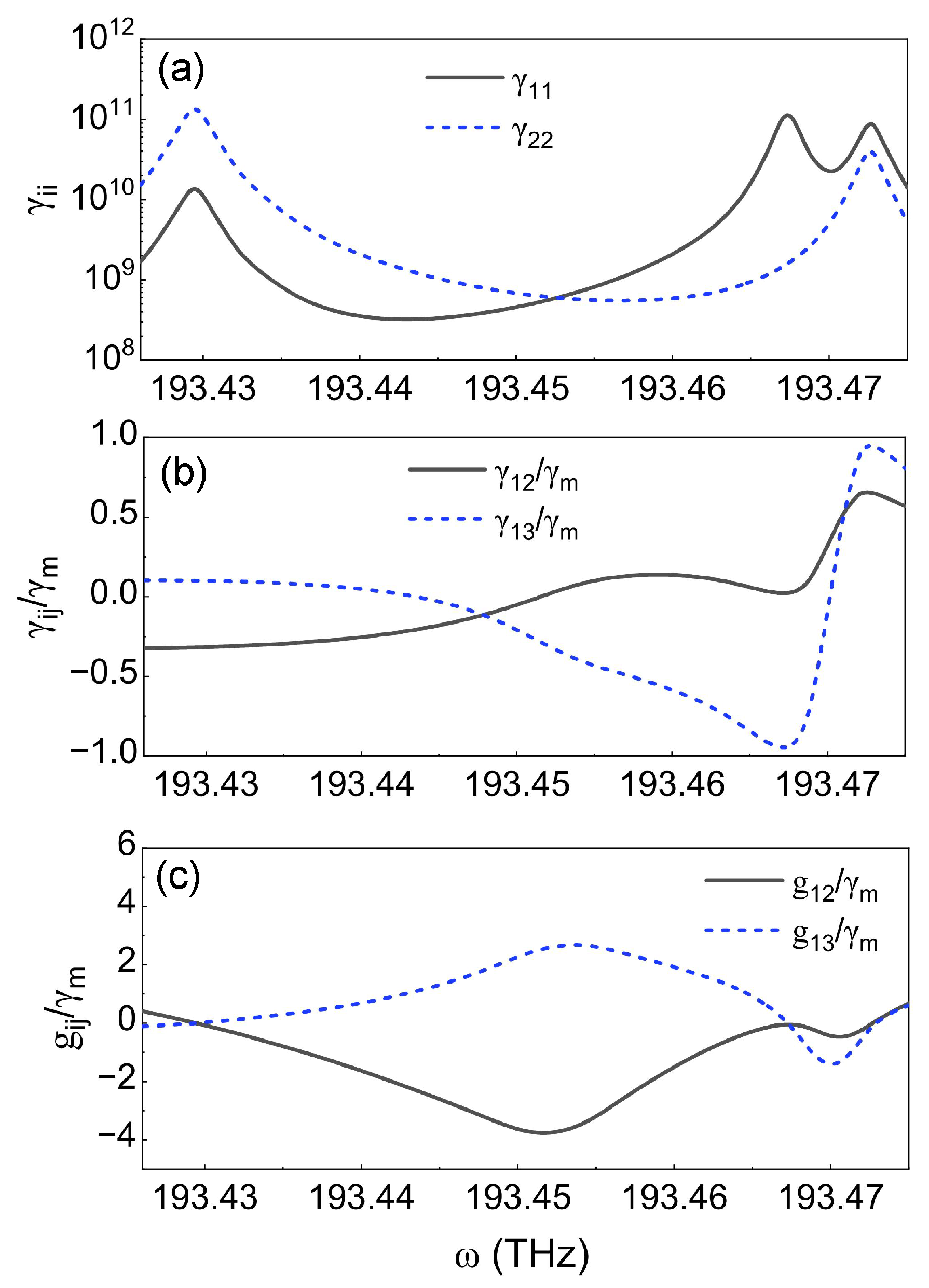
The efficiency of multipartite energy transfer is fundamentally governed by the interplay between the spontaneous emission rates and the inter-emitter coupling strengths. Figure 2 presents the spectral dependence of these parameters for emitters embedded in the three cavities as shown in Figure 1.
First, regarding the spontaneous emission rates shown in Figure 2a, we observe distinct resonance features. Due to the spatial symmetry of the tripartite arrangement, emitter 1 (in Cavity A) and emitter 3 (in Cavity C) exhibit identical spontaneous emission profiles ( γ 11   =   γ 33 ); thus, only γ 11 and the rate for the central emitter γ 22 are plotted. Prominent resonance peaks appear at both boundaries of the frequency range, indicating that all three emitters simultaneously achieve resonance with the cavity modes. Notably, in the high-frequency regime (the right-side peak), the values of γ 11 and γ 22 converge, signifying an optimal resonance condition where the emitters interact sympathetically with the cavity fields.
To ensure a clear visualization and consistent comparison of the interaction strengths, we normalize both the incoherent and coherent coupling terms by the maximal single-emitter decay rate, defined as γ m   =   max { γ 11 ,   γ 22 ,   γ 33 } . Under this normalization scheme, the incoherent coupling ratio γ i j / γ m is intrinsically bounded within the range of [ 1 ,   1 ] . In contrast, the normalized coherent coupling strength | g i j / γ m | exhibits values significantly larger than 2 in specific regions, serving as a distinct signature of strong coherent interaction.
With this scaling established, Figure 2b,c decompose the coupling mechanisms into incoherent ( γ i j ) and coherent ( g i j ) components. A key observation is the complementary behavior of these couplings. The incoherent coupling γ i j is maximized at the resonance peaks, consistent with the dissipative nature of the cavity modes at these frequencies. Conversely, in the frequency window between the two resonance peaks, the incoherent coupling is suppressed, while the coherent coupling g i j remains significantly high. This behavior suggests that the off-resonant regime, dominated by strong coherent interactions and low dissipation, provides the most favorable conditions for realizing high-efficiency quantum state transfer.

3.2. Energy Transfer Quality

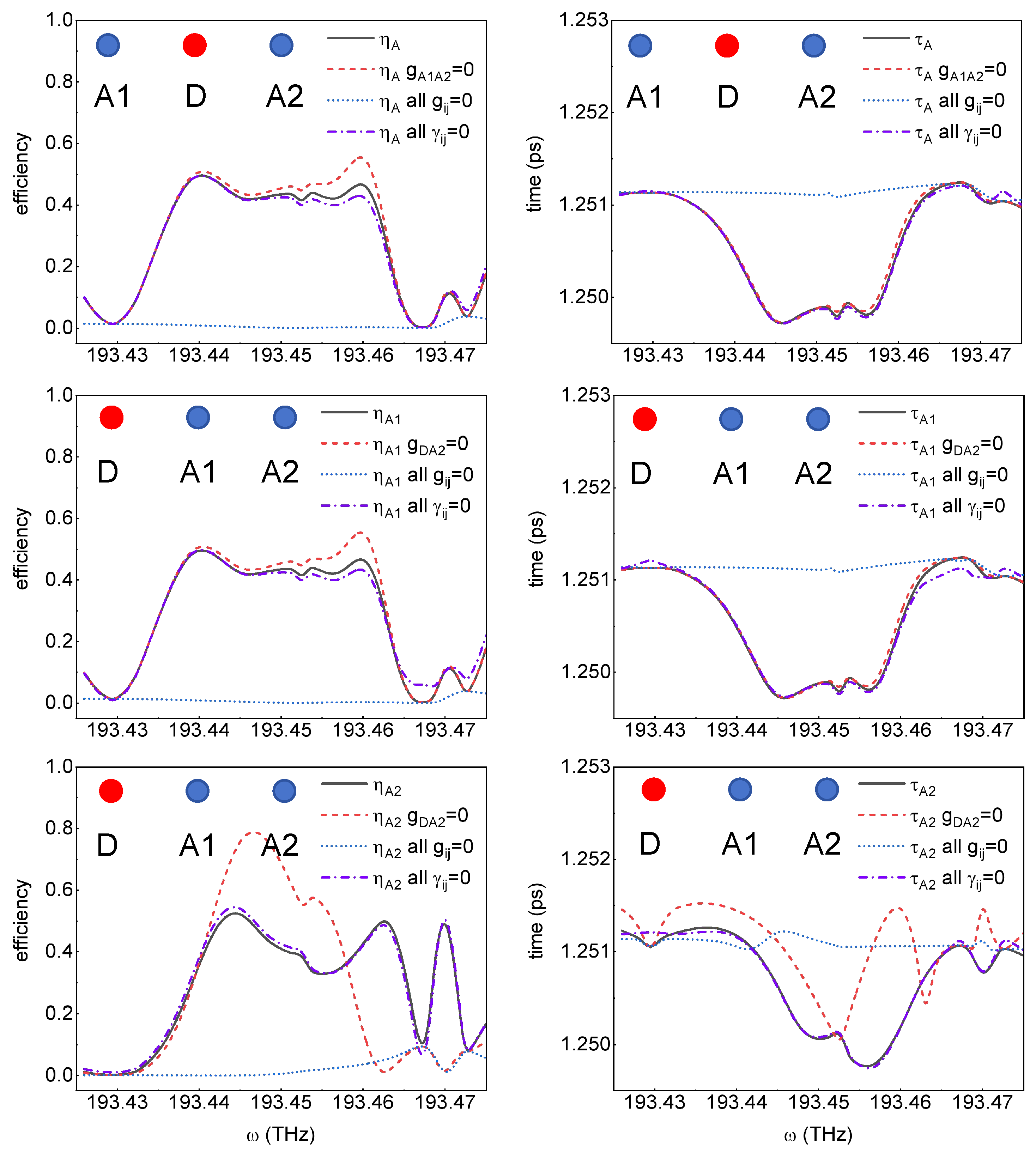
Having determined the spontaneous emission rates and coupling strengths, we employ the multi-emitter master equation given in Equation (1) to investigate the dynamics of energy transfer within this three-body system. We evaluate the transfer efficiency ( η A ) and transfer time ( τ A ) of the acceptor under various initial configurations according to Equations (5) and (6). The results are summarized in Figure 3, which compares the system’s performance with different donor positions and coupling conditions.
In the symmetric configuration where the central emitter acts as the donor (Row 1 of Figure 3), the system demonstrates robust energy redistribution to the peripheral acceptors. To elucidate the driving force behind this process, we performed a comparative analysis by selectively switching off specific coupling terms in the master equation.
The analysis of the coupling mechanisms reveals a nuanced interplay between constructive and destructive pathways. The red dashed lines in Figure 3, which correspond to the scenario where the coherent coupling between the two peripheral acceptors is suppressed ( g A 1 A 2 = 0 ), exhibit an energy transfer efficiency that is, surprisingly, higher than that of the full interaction model. This phenomenon indicates that the next-nearest-neighbor coupling between the acceptors acts as a detrimental channel in this specific symmetric configuration. Physically, this suppression arises from the phase accumulation associated with the long-range interaction mediated by the topological edge state. As the excitation propagates through the waveguide connecting the two outer cavities, it acquires a specific phase shift relative to the driving field from the central donor. In our current geometry, this phase relation leads to destructive interference that suppresses the net population accumulation. It is crucial to note, however, that this interference effect is inherently phase-dependent; theoretically, by engineering the inter-cavity distances or the spectral overlap, the relative phase could be tuned to realize constructive interference, thereby turning this long-range coupling into a beneficial channel. In stark contrast, when all coherent coupling terms are switched off (blue dotted lines), the transfer efficiency precipitously drops to zero for all frequencies, and the transfer time increases drastically. This confirms that coherent interaction is the fundamental engine driving the multipartite transport. Furthermore, the results for the case where all incoherent couplings are removed (purple dot-dashed lines) show no significant deviation from the full model, suggesting that incoherent pumping plays a negligible role in the transfer dynamics within this regime. Similar trends are observed in the asymmetric configurations (Rows 2 and 3), where the donor is located at the edge. The results consistently demonstrate that while nearest-neighbor coherent coupling is essential for maximizing efficiency and minimizing transfer time, the long-range (next-nearest-neighbor) coupling often impedes the process.
It is also worth noting the collective advantage of this tripartite architecture. While adding a second acceptor mathematically increases the number of energy sinks, a key question is whether this expansion introduces deleterious interference or loading effects that could degrade individual channel performance. Our results demonstrate that the topological edge state facilitates robust coherent coupling, ensuring that the introduction of the third emitter does not suppress the energy transfer efficiency of the existing pathways. Instead, the additional node acts cumulatively, effectively enhancing the total probability of charge separation. This confirms that the topological platform is well-suited for constructing scalable energy harvesting networks where the inclusion of multiple nodes makes a strictly positive contribution to the overall system efficiency.
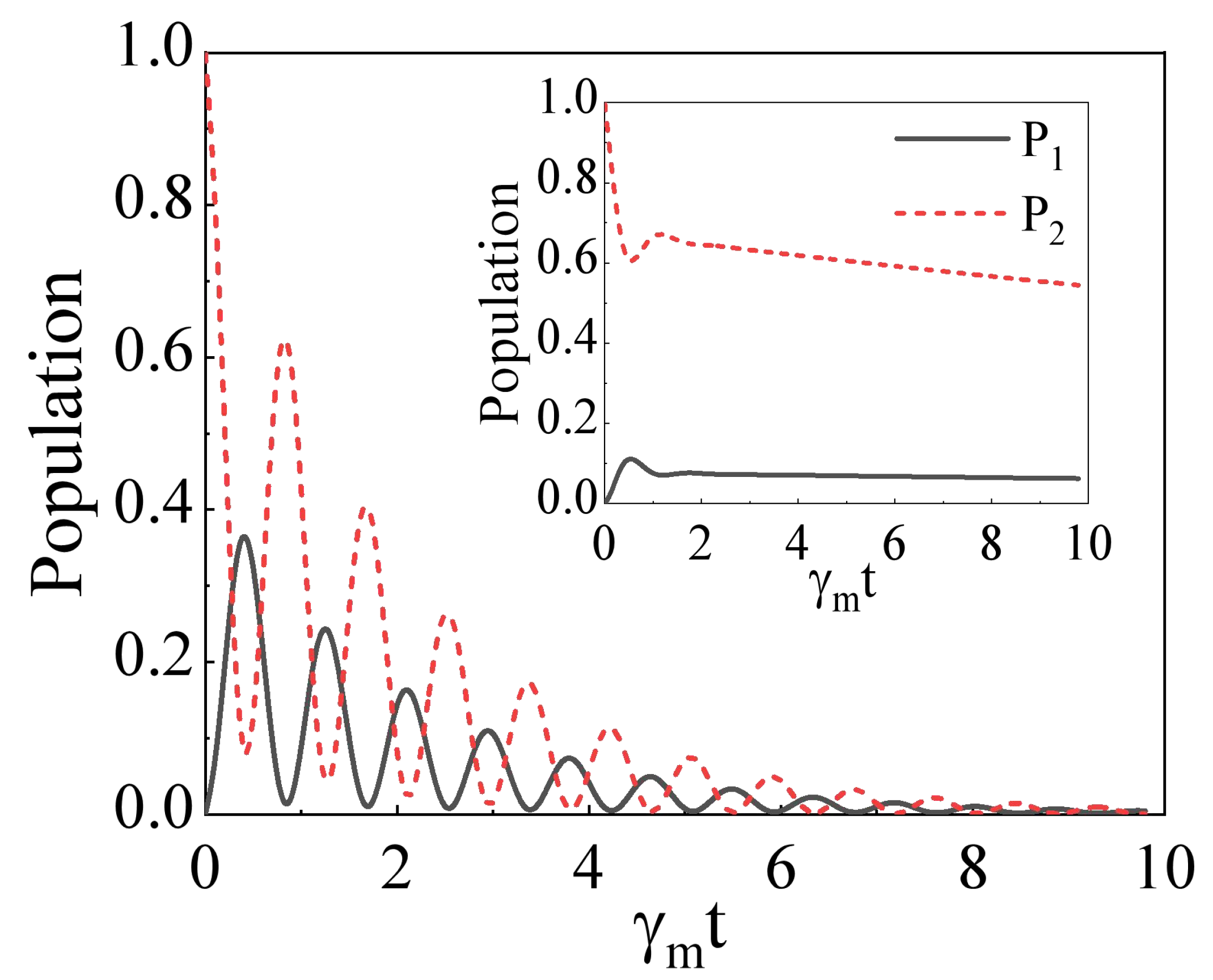
To further elucidate the physical mechanism underlying the high transfer efficiency in the strongly coherent regime, we examine the time-domain population dynamics of the emitters. Figure 4 illustrates the temporal evolution of the donor and acceptor populations. In the frequency regime dominated by strong coherent coupling (main panel), the populations exhibit characteristic Rabi oscillations. Although the acceptor population fluctuates, the suppression of the intrinsic spontaneous emission rate in this spectral window ensures that the excitation remains within the system for an extended duration. Since the energy transfer efficiency is proportional to the time integral of the acceptor population ( η P A ( t ) d t ), this sustained coherent oscillation allows for a significant accumulation of the transfer probability. Conversely, in the regime dominated by large incoherent coupling and spontaneous emission (inset), the dynamics appear overdamped and smooth. However, the significantly larger intrinsic dissipation rate in this regime rapidly depletes the total excitation energy before it can be effectively captured by the acceptor, resulting in a limited integration area and, consequently, a lower overall transfer efficiency.

3.3. Robustness and Topological Protection

A defining characteristic of topological photonic phases is their inherent immunity to structural imperfections and geometric deformations. To rigorously validate this property within our tripartite framework, we systematically introduced non-ideal conditions into the simulation model to mimic realistic experimental challenges. Specifically, we considered two distinct types of perturbations: random structural disorder, where the positions and radii of the dielectric rods are randomly perturbed, and interface bending, representing a sharp geometric turn in the waveguide path.
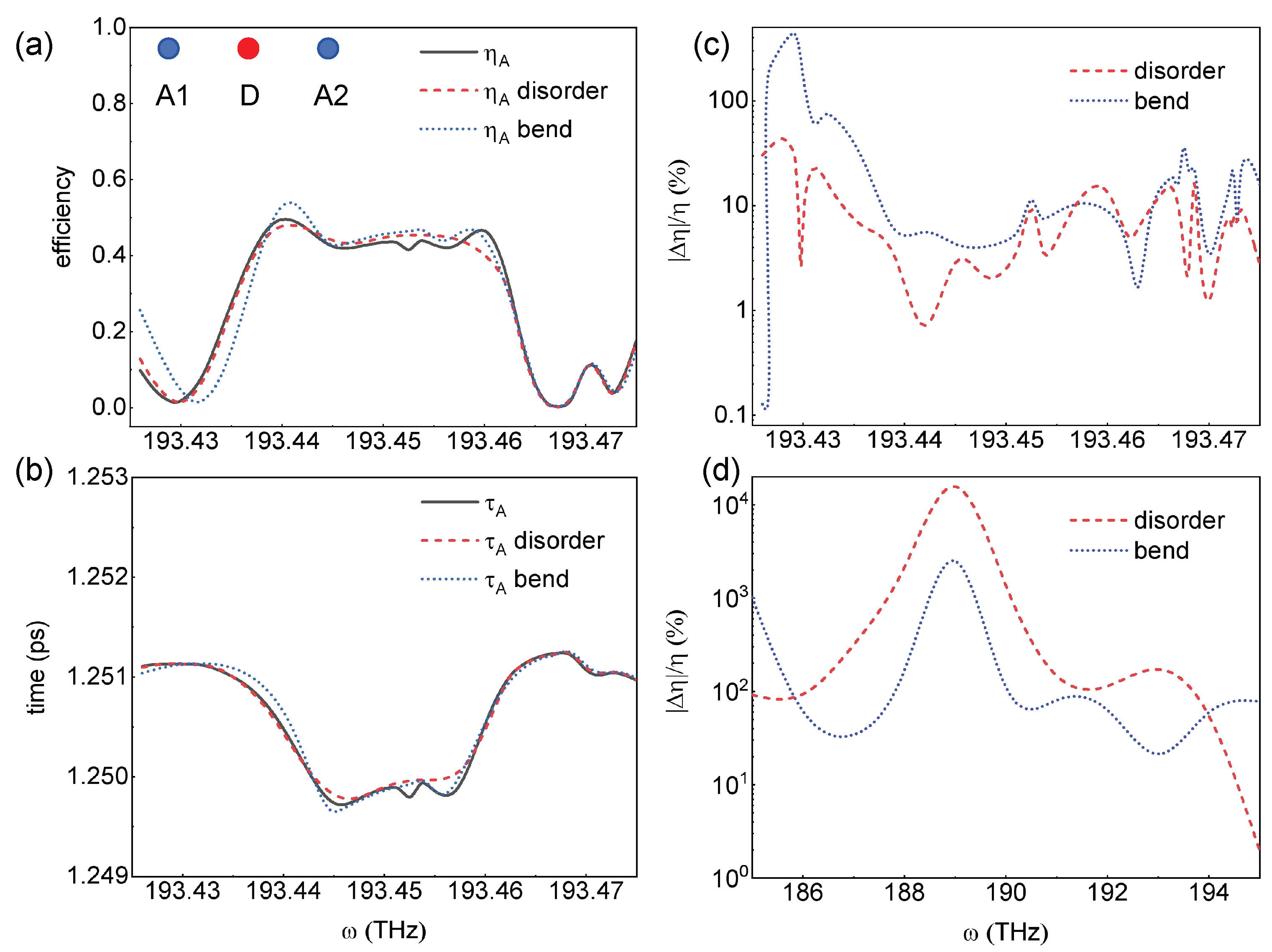
Figure 5 presents the comparative analysis of the energy transfer metrics for the ideal and perturbed systems. Figure 5a,b display the transfer efficiency ( η A ) and transfer time ( τ A ), respectively. As shown in the figure, the spectral curves for both the disordered (red dashed lines) and bent (blue dotted lines) configurations exhibit negligible deviation from the ideal reference case (black solid lines). In conventional trivial waveguides, such defects would typically act as scattering centers, leading to severe backscattering, Anderson localization, and a consequent degradation of transport efficiency. However, the topological edge states utilized here preserve the integrity of the optical channel, effectively bypassing these defects. This minimal impact on the transfer dynamics provides compelling numerical evidence that the proposed tripartite energy transfer is topologically protected, ensuring stable and reliable operation even in the presence of significant fabrication errors and environmental perturbations.
To make the robustness argument quantitative, we introduce the relative deviation in energy transfer efficiency, defined as | Δ η | / η = | ( η pert η ideal ) | / η ideal , where η pert and η ideal represent the efficiency with and without perturbations, respectively. Figure 5c plots this metric for the topological system under the influence of structural disorder and waveguide bends. The results demonstrate remarkable stability: within the high-efficiency spectral window (from 193.44 to 193.46 THz), the efficiency reduction does not exceed 10%. Practically, this implies that for a system with an initial transfer efficiency of 45%, the performance remains above 40% even in the presence of significant fabrication errors or sharp geometric bends.
For comparison, we benchmarked our system against a standard topologically trivial W1 photonic crystal waveguide. The benchmark structure adopts classic parameters ( a = 420 nm, r = 0.275 a , slab index n = 12 , see Ref. [36]), with the emitter dipole orientation perpendicular to the waveguide. While the trivial waveguide supports efficient incoherent coupling, it lacks the stable coherent modes provided by the topological cavities. As shown in Figure 5d, the trivial system exhibits high sensitivity to perturbations; same disorder or bends induce drastic fluctuations in the coupling spectra. Consequently, the energy transfer efficiency suffers severe degradation, with the relative deviation | Δ η | / η significantly exceeding 10% across most of the frequency range. This stark contrast quantitatively confirms the superior robustness of the topological architecture over conventional photonic crystal waveguides.
Finally, we briefly discuss the scalability of the proposed architecture toward larger networks with N   >   3 nodes. While the topological protection ensures robust transport over extended distances, scaling up the system introduces specific challenges related to coherent interaction. As the network size grows, the accumulation of propagation phase along the edge channels (as observed in the tripartite case) can lead to complex multi-path interference patterns, which may unpredictably modulate the effective long-range coupling strengths between distant emitters. Furthermore, the number of supportable nodes is ultimately constrained by the finite linear dispersion bandwidth of the topological edge state; accomodating a high density of resonant modes without significant crosstalk requires rigorous dispersion engineering. Consequently, realizing large-scale quantum interconnects based on this platform may necessitate the integration of dynamic phase control or reconfigurable topological switches to actively manage these collective interference effects.

4. Conclusions

In summary, we have theoretically proposed and numerically validated a robust tripartite energy transfer system mediated by a “corner-edge-corner” topological photonic crystal. The key innovation lies in a fully topology-based design strategy, which integrates highly localized topological corner states with backscattering-immune topological edge states through a graded structural design. This approach enables robust and efficient energy transfer across a multi-node network. Our rigorous analysis of the coupling dynamics reveals that the transfer process is primarily driven by nearest-neighbor coherent interactions in the off-resonant regime, while incoherent pumping plays a negligible role. Notably, we identified that long-range couplings can be detrimental to efficiency due to destructive interference, highlighting the importance of precise topological engineering.
A key advantage of this architecture lies in its exceptional robustness. We demonstrated that the system maintains high transfer fidelity and stable operation speeds even in the presence of significant lattice disorder and sharp waveguide bends, effectively suppressing backscattering losses. This inherent immunity to imperfections, combined with the collective enhancement of charge separation probability in the multi-emitter configuration, positions our design as a promising candidate for next-generation applications. Looking forward, the experimental realization of this architecture is feasible using established semiconductor platforms, such as silicon-on-insulator (SOI) or gallium arsenide (GaAs) slabs, which provide the necessary refractive index contrast for photonic bandgap formation. These systems are well-suited for integration with deterministic solid-state quantum emitters, including InAs/GaAs quantum dots or nitrogen-vacancy (NV) centers in nanodiamonds, serving as the active nodes. Furthermore, expanding this work to incorporate dynamic tuning mechanisms via thermo-optic or electro-optic modulation represents a promising avenue for achieving reconfigurable energy routing in complex topological networks. These results resonate with parallel efforts in utilizing topological states for wave-based energy management [23,25], and pave the way for the development of disorder-resilient quantum information networks, distributed biosensing platforms, and highly efficient artificial light-harvesting devices.

Author Contributions

Conceptualization, J.R. and Y.W.; methodology, J.R. and Y.W.; software, J.R. and Y.W.; validation, Y.L.; formal analysis, J.R. and Y.W.; investigation, J.L.; resources, J.R., Y.W., J.L. and Y.L.; data curation, J.R. and Y.W.; writing—original draft preparation, J.R. and Y.W.; writing—review and editing, J.R. and Y.W.; visualization, J.R. and Y.W.; project administration, Y.W., J.R., J.L. and Y.L.; funding acquisition, Y.W., J.R., J.L. and Y.L. All authors have read and agreed to the published version of the manuscript.

Funding

This work was funded by the National Natural Science Foundation of China (Grant No. 12204247), Natural Science Research Project of Jiangsu Higher Education Institutions (22KJB140013), Natural Science Research Start-up Foundation of Recruiting Talents of Nanjing University of Posts and Telecommunications (NY222009), Hebei NSF (Grant No. A2019205266), Hebei 333 Talent Project (B20231005), Science and Technology Project of Hebei Education Department (QN2022195), and Jilin Provincial Department of Education Scientific Research Project for Excellent Young Scholars (JJKH20250472KJ).

Data Availability Statement

The original contributions presented in this study are included in the article. Further inquiries can be directed to the corresponding authors.

Conflicts of Interest

The authors declare no conflicts of interest.

References

  1. Scholes, G.D.; Fleming, G.R.; Olaya-Castro, A.; van Grondelle, R. Lessons from nature about solar light harvesting. Nat. Chem. 2011, 3, 763–774. [Google Scholar] [CrossRef]
  2. Andrew, P.; Barnes, W.L. Energy transfer across a metal film mediated by surface plasmon polaritons. Science 2004, 306, 1002–1005. [Google Scholar] [CrossRef] [PubMed]
  3. Kimble, H.J. The quantum internet. Nature 2008, 453, 1023–1030. [Google Scholar] [CrossRef]
  4. Cirac, J.I.; Zoller, P.; Kimble, H.J.; Mabuchi, H. Quantum state transfer and entanglement distribution among distant nodes in a quantum network. Phys. Rev. Lett. 1997, 78, 3221. [Google Scholar] [CrossRef]
  5. Chu, M.J.; Ren, J.; Wang, Z.D. Deterministic steady-state subradiance within a single-excitation basis. npj Quantum Inf. 2025, 11, 99. [Google Scholar] [CrossRef]
  6. Förster, T. Zwischenmolekulare energiewanderung und fluoreszenz. Ann. Phys. 1948, 437, 55–75. [Google Scholar] [CrossRef]
  7. Barnes, W.L.; Dereux, A.; Ebbesen, T.W. Surface plasmon subwavelength optics. Nature 2003, 424, 824–830. [Google Scholar] [CrossRef]
  8. Ren, J.; Wu, T.; Yang, B.; Zhang, X. Simultaneously giant enhancement of Förster resonance energy transfer rate and efficiency based on plasmonic excitations. Phys. Rev. B 2016, 94, 125416. [Google Scholar] [CrossRef]
  9. Northup, T.E.; Blatt, R. Quantum information transfer using photons. Nat. Photonics 2014, 8, 356–363. [Google Scholar] [CrossRef]
  10. Dicke, R.H. Coherence in spontaneous radiation processes. Phys. Rev. 1954, 93, 99. [Google Scholar] [CrossRef]
  11. Haldane, F.D.M. Model for a quantum Hall effect without Landau levels: Condensed-matter realization of the “Parity Anomaly”. Phys. Rev. Lett. 1988, 61, 2015. [Google Scholar] [CrossRef]
  12. Raghu, S.; Haldane, F.D.M. Analogs of quantum-Hall-effect edge states in photonic crystals. Phys. Rev. A 2008, 78, 033834. [Google Scholar] [CrossRef]
  13. Lu, L.; Joannopoulos, J.D.; Soljačić, M. Topological photonics. Nat. Photonics 2014, 8, 821–829. [Google Scholar] [CrossRef]
  14. Wu, L.H.; Hu, X. Scheme for achieving a topological photonic crystal by using dielectric material. Phys. Rev. Lett. 2015, 114, 223901. [Google Scholar] [CrossRef] [PubMed]
  15. Wang, Y.; Ren, J.; Zhang, W.; He, L.; Zhang, X. Topologically protected long-range coherent energy transfer in a photonic topological insulator. Photonics Res. 2020, 8, B39–B44. [Google Scholar] [CrossRef]
  16. Wang, Y.; Ren, J.; Zhang, W.; He, L.; Zhang, X. Topologically protected strong coupling and entanglement between distant quantum emitters. Phys. Rev. Appl. 2020, 14, 054007. [Google Scholar] [CrossRef]
  17. Wang, Z.; Chong, Y.; Joannopoulos, J.D.; Soljačić, M. Observation of unidirectional backscattering-immune topological electromagnetic states. Nature 2009, 461, 772–775. [Google Scholar] [CrossRef]
  18. Hafezi, M.; Mittal, S.; Fan, J.; Migdall, A.; Taylor, J.M. Imaging topological edge states in silicon photonics. Nat. Photonics 2013, 7, 1001–1005. [Google Scholar] [CrossRef]
  19. Benalcazar, W.A.; Bernevig, B.A.; Hughes, T.L. Quantized electric multipole insulators. Science 2017, 357, 61–66. [Google Scholar] [CrossRef]
  20. Noh, J.; Benalcazar, W.A.; Huang, S.; Collins, M.J.; Chen, K.P.; Hughes, T.L.; Rechtsman, M.C. Topological protection of photonic mid-gap defect modes. Nat. Photonics 2018, 12, 408–415. [Google Scholar] [CrossRef]
  21. Yang, Y.; Jia, Z.; Wu, Y.; Xiao, R.C.; Hang, Z.H.; Jiang, H.; Xie, X.C. Gapped topological kink states and topological corner states in honeycomb lattice. Sci. Bull. 2020, 65, 531–537. [Google Scholar] [CrossRef]
  22. Ota, Y.; Takata, K.; Ozawa, T.; Amo, A.; Jia, Z.; Kante, B.; Notomi, M.; Arakawa, Y.; Iwamoto, S. Active topological photonics. Nanophotonics 2020, 9, 547–567. [Google Scholar] [CrossRef]
  23. Wang, Y.; Hu, S.; Guo, Z.; Jiang, J.; Yang, Y.; Lu, C.; Chen, H. Topological Singularities and Edge-State Coupling Enable Robust on-Chip Slow Light. Adv. Sci. 2025, 12, e07226. [Google Scholar] [CrossRef]
  24. Barik, S.; Karasahin, A.; Flower, C.; Cai, T.; Miyake, H.; DeGottardi, W.; Hafezi, M.; Waks, E. A topological quantum optics interface. Science 2018, 359, 666–668. [Google Scholar] [CrossRef]
  25. Jiang, J.; Hu, S.; Guo, Z.; Ke, S.; Wu, X.; Wu, Y.; Chen, H. Topological corner states for wireless power transfer. Rev. Phys. 2025, 13, 100112. [Google Scholar] [CrossRef]
  26. Ruan, Y.; Qian, X.; Wang, H.X.; Hu, Z.D.; Yang, Y.; Wang, J.; Shen, X.; Wang, Y. Applications for wavelength division multiplexers based on topological photonic crystals. Photonics Res. 2023, 11, 569–574. [Google Scholar] [CrossRef]
  27. Yu, W.; Liu, S.; Sun, H.; Wang, J.; Yang, Y. Strategies for guiding directional topological waveguides with symmetric regularity. J. Light. Technol. 2025, 43, 205–213. [Google Scholar] [CrossRef]
  28. Dung, H.T.; Knöll, L.; Welsch, D.-G. Resonant dipole-dipole interaction in the presence of dispersing and absorbing surroundings. Phys. Rev. A 2002, 66, 063810. [Google Scholar] [CrossRef]
  29. Gonzalez-Tudela, A.; Martin-Cano, D.; Moreno, E.; Martin-Moreno, L.; Garcia-Vidal, F.J.; Tejedor, C. Entanglement of Two Qubits Mediated by One-Dimensional Plasmonic Waveguides. Phys. Rev. Lett. 2011, 106, 020501. [Google Scholar] [CrossRef]
  30. Ren, J.; Chen, T.; Zhang, X. Long-lived quantum speedup based on plasmonic hot spot systems. New J. Phys. 2019, 21, 053034. [Google Scholar] [CrossRef]
  31. Ren, J.; Chen, T.; Wang, B.; Zhang, X. Ultrafast coherent energy transfer with high efficiency based on plasmonic nanostructures. J. Chem. Phys. 2017, 146, 144101. [Google Scholar] [CrossRef]
  32. Olaya-Castro, A.; Lee, C.F.; Olsen, F.F.; Johnson, N.F. Efficiency of energy transfer in a light-harvesting system under quantum coherence. Phys. Rev. B 2008, 78, 085115. [Google Scholar] [CrossRef]
  33. Rao, M.; Shi, F.; Rao, Z.; Yang, J.; Song, C.; Chen, X.; Yu, S. Single photon emitter deterministically coupled to a topological corner state. Light Sci. Appl. 2024, 13, 19. [Google Scholar] [CrossRef]
  34. Proctor, M.; Huidobro, P.A.; Bradlyn, B.; De Paz, M.B.; Vergniory, M.G.; Bercioux, D.; García-Etxarri, A. Robustness of topological corner modes in photonic crystals. Phys. Rev. Res. 2020, 2, 042038. [Google Scholar] [CrossRef]
  35. Mann, C.-R.; Mariani, E. Topological transitions in arrays of dipoles coupled to a cavity waveguide. Phys. Rev. Res. 2022, 4, 013078. [Google Scholar] [CrossRef]
  36. Manga Rao, V.S.C.; Hughes, S. Single quantum-dot Purcell factor and β factor in a photonic crystal waveguide. Phys. Rev. B 2007, 75, 205437. [Google Scholar] [CrossRef]
Figure 1. Schematic illustration and mode profiles of the tripartite topological photonic crystal system. (a) Schematic configuration of the energy transfer system, where three photonic crystal cavities (Cavity A, B, and C) are coupled via a topological waveguide. The distances between cavities are denoted by L1 and L2. The stars in the cavities represent emitters. (b) Three-dimensional perspective view of the photonic crystal slab. h = 0.1a. (c) Schematic of a triangular photonic crystal composed of six Al2O3 cylinders ( ϵ   =   7.5 ). Right: unit-cell detail with the intra-cell displacements R, cylinder diameter dA (large) and dB (small). (d) Normalized electric field distribution of the localized topological corner state supported by the cavity. (e) Normalized electric field distribution of the extended topological edge state propagating along the waveguide interface. The red star represents the chiral source. The operating frequency for both topological modes is f = 193.4 THz.
Photonics 13 00203 g001
Figure 2. Spectral dependence of the spontaneous emission rates and coupling strengths for emitters embedded in the three cavities. (a) Spontaneous emission rates γ i i on a logarithmic scale. Due to the spatial symmetry of the tripartite system, the rates for the edge emitters are identical ( γ 11   =   γ 33 ); thus, only γ 11 (solid line) and the rate for the central emitter γ 22 (dashed line) are plotted. (b) Incoherent coupling strengths γ i j normalized by the maximal decay rate γ m   =   max { γ 11 ,   γ 22 ,   γ 33 } . (c) Coherent coupling strengths g i j normalized by γ m . The indices 1, 2, and 3 correspond to the emitters located in Cavity A, B, and C, respectively. Note that the coherent coupling is dominant in the frequency window between the resonance peaks.
Photonics 13 00203 g002
Figure 3. Energy transfer efficiency (left column) and transfer time (right column) spectra for the tripartite cavity system. The top row corresponds to the symmetric configuration where the donor is located in the central cavity (Cavity B), acting as the source for the two peripheral acceptors. The middle and bottom rows correspond to the asymmetric configuration with the donor located in the edge cavity (Cavity A). The solid black lines represent the reference results calculated using the full master equation. To identify the dominant transfer mechanisms, three specific cases are compared: (1) suppressing the next-nearest-neighbor coherent coupling between the two acceptors (red dashed lines, gA1A2 = 0); (2) suppressing all coherent coupling terms (blue dotted lines, all gij = 0); and (3) suppressing all incoherent coupling terms (purple dot-dashed lines, all γ i j   =   0 ).
Photonics 13 00203 g003
Figure 4. Time evolution of the excitation population on the acceptor (black solid line) and the donor (red dashed line). The main panel depicts the dynamics in the regime dominated by strong coherent coupling, where the sustained Rabi oscillations and suppressed decay lead to a high cumulative transfer efficiency. The inset displays the dynamics in the regime dominated by large spontaneous emission and incoherent coupling.
Photonics 13 00203 g004
Figure 5. Robustness comparison between the topological energy transfer system and the trivial W1 waveguide. (a) Transfer efficiency ηA and (b) transfer time τA of the topological energy transfer system as functions of frequency. Black solid curves, red dashed curves, and blue dotted curves correspond to the ideal defect-free structure, the system with random structural disorder, and the system with a sharp interface bend, respectively. (c) Relative deviation in energy transfer efficiency | Δ η | / η for the topological energy transfer system. (d) Relative deviation | Δ η | / η for the trivial W1 waveguide. Red dashed and blue dotted curves in (c,d) represent the deviations introduced by random disorder and sharp bending, respectively.
Photonics 13 00203 g005
Disclaimer/Publisher’s Note: The statements, opinions and data contained in all publications are solely those of the individual author(s) and contributor(s) and not of MDPI and/or the editor(s). MDPI and/or the editor(s) disclaim responsibility for any injury to people or property resulting from any ideas, methods, instructions or products referred to in the content.