Article

The Establishment and Optimization of a Multi-Thermodynamic-State Gas Radiation Model Based on Spectral Mapping Using Intervals of Comonotonicity

College of Energy and Power Engineering, Nanjing University of Aeronautics and Astronautics, Nanjing 210016, China
*
Author to whom correspondence should be addressed.
Photonics 2026, 13(2), 164; https://doi.org/10.3390/photonics13020164
Submission received: 9 November 2025 / Revised: 29 January 2026 / Accepted: 3 February 2026 / Published: 8 February 2026
(This article belongs to the Special Issue Electromagnetic Solutions for Thermal Management and Sustainability)

Abstract

In infrared radiation calculations, the k-distribution method effectively improves the computational efficiency of solving the radiative transfer equation for uniform paths and achieves accuracy comparable to the line-by-line method. However, when applied to highly non-uniform scenarios involving multiple thermodynamic states, such as the infrared radiation from aero-engine nozzles, the computational error increases significantly. This paper proposes a spectral mapping method for multiple thermodynamic states, which iteratively partitions the spectral intervals of the target gas into multiple comonotonic sub-intervals using particle swarm and clustering algorithms. This approach eliminates the blurring effect of traditional k-distribution methods in strongly non-uniform scenarios and enhances the computational accuracy. The study examines the impact of sub-interval partitioning strategies on the accuracy of the gas radiation model, explores the mechanism behind constructing comonotonicity within sub-intervals, and reveals how variations in the comonotonic vector and spectral point clustering strengthen sub-interval comonotonicity. The proposed spectral mapping method and optimization techniques are applied to gas radiation models in typical infrared bands, and the performance of the model is evaluated using results from representative one-dimensional test cases. The results demonstrate that the optimized spectral mapping method reduces the overall relative error of the gas radiation model from 63% to 7.3%, achieving a maximum improvement in computational accuracy of 88.5%.

1. Introduction

Extension of approximate models of gas radiation from uniform to non-uniform paths is among the most difficult problems in gas radiation modeling [1]. Although the Line-By-Line (LBL) method is the most accurate approach for solving the radiative transfer equation and demonstrates good compatibility with various problems, its enormous computational demands due to the extremely high-resolution spectral data and numerous repetitive calculations limit its widespread application in complex engineering simulations. Currently, numerous approximate models of gas radiation have been proposed to balance the computational efficiency and accuracy based on the application backgrounds [2,3,4]. However, most of these approximate models only achieve engineering-applicable accuracy when solving radiative transfer equations in uniform or weakly non-uniform gaseous media. Among these models, the k-distribution method reorganizes the absorption coefficients into an artificial spectrum (the cumulative k-distribution function) and significantly improves the computational efficiency by grouping wavenumbers with similar absorption coefficients. While this method has been widely adopted, it introduces the k-correlation assumption [5] during the absorption coefficient reorganization process, leading to a blurring effect. The blurring effect arises from the strong variation in gas absorption coefficients and the spatial non-uniformity of gas temperature and composition, which cause calculation errors in traditional k-distribution methods. These errors stem from both the loss of spectral information due to grouping spectral points with similar absorption coefficients and the incorrect prediction of absorption coefficients caused by weak correlation between gas spectra under different states. Consequently, the k-distribution methods cannot be directly applied to computational scenarios involving multiple thermodynamic states (temperature, pressure and species concentrations).
Researchers have proposed a lot of methods to improve gas radiation models for solving infrared radiation problems in general non-uniform gas paths. The relevant methods can be mainly divided into two categories, i.e., the Multiple Line Group (MLG) method [6,7,8,9] and the Spectral Mapping Method (SMM). In contrast to the MLG method, which explicitly groups spectral lines based on their physical properties (such as line strength and lower-state energy, etc.), the SMM iteratively establishes specific relationships (e.g., scaling and comonotonicity) between spectra under different thermodynamic states within each group. This specific relationship effectively eliminates the blurring effect caused by the introduced k-correlation assumption, resulting in higher computational accuracy in strongly non-uniform infrared calculation scenarios. Regarding the applicability of methods to improve gas radiation models, since the input to the SMM is only the cumulative k-distribution function of the gas spectra, factors related to the approximate models, such as the spectral interval, are already incorporated into the calculation of the cumulative k-distribution function. This allows for direct extension to k-distribution methods covering narrow bands or the full spectrum. However, the MLG method focuses more on narrow-band models. Although the MLG method can also be extended to the full spectrum, the computational process is more complex. The first Spectral Mapping Method was proposed by West and Crisp [10] in 1990, starting from the perspective of constant spectra, they developed k-distribution methods for gas spectra at different spatial locations along strongly non-uniform paths and established relationships between the cumulative k-distribution functions under different states through mapping functions. Ralf et al. [11] introduced a fixed mapping function, which avoided erroneous mapping of spectral positions caused by altitude variations in traditional methods. By incorporating the actual spectral response function of the sensor, they improved the accuracy of atmospheric transmittance calculations for non-uniform paths in the near-infrared band. In 2014, Lionel et al. [12] further extended this method to the thermal infrared band. Currently, the SMM can effectively characterize the absorption capabilities of atmospheric water vapor and oxygen in the near-infrared region. In addition, a Multi-Group (MG) method [13] and multi-spectral techniques [14,15,16] were proposed by Modest et al., aiming at constructing scaling intervals within which the absorption coefficients of spectra exhibit a fixed scaling relationship across different states. The distinction between these two approaches lies in their approaches for constructing sub-intervals. The MG method directly groups spectral lines based on their temperature dependence. This method has been primarily applied to calculate the absorption of single gas (water vapor or carbon dioxide), achieving a favorable balance between computational accuracy and efficiency. In contrast, multi-spectral techniques establish a multi-dimensional k-distribution and construct scaling intervals for gas spectra through functional data analysis and clustering algorithms. This approach offers significant advantages in computational accuracy. However, the computational process is more complex and cannot address the issue of spectral line overlap in gas mixtures. Due to the fact that the absorption coefficient does not maintain a simple scaling relationship across different states, this method also imposes stricter requirements on the selection of gas states within the computational scenario. Hu and Li [17,18,19] improved the grouping schemes in the Multi-Scale Multi-Group (MSMG) model. They replaced the fitted scaling coefficients in the original grouping with k-distribution reordering, which enhanced the computational accuracy of the gas radiation model. However, the frequent k-distribution reordering and complex optimization procedures within the groups significantly increased the computational cost. In terms of establishing the “correlations”, Vladimir P. et al. [20] propose a novel Spectral Gamma Function to address the limitations associated with the “correlated” spectrum assumption in radiative transfer modeling in non-uniform gaseous media. Meanwhile, Johannes et al. [21] adopted a weighting approach to enhance the computational accuracy of the gas radiation model; they introduce two sets of coefficients for a Weighted Sum of Gray Gas (WSGG) model with 5 gray gases, which are calibrated for air and oxyfuel combustion conditions at atmospheric pressure, to improve the accuracy and flexibility of existing models.
It is worth mentioning that Frédéric et al. [22] proposed a spectral mapping method based on intervals of comonotonicity. These so-called intervals of comonotonicity refer to spectral ranges where gas spectra under different states maintain a monotonically increasing relationship with the cumulative k-distribution function, thereby achieving identical k-distribution rankings. Compared to methods that predict absorption coefficients by establishing k-distribution rankings through iterative processes, the approach of uniformly partitioned wavenumbers presented in their study significantly enhances the computational efficiency of constructing comonotonic intervals. However, the spectral mapping method is constrained by the number of thermodynamic states, as the required number of groups increases exponentially with the number of thermodynamic states, leading to a drastic enlargement in computational cost. Therefore, expanding the applicability of the spectral mapping method necessitates a balance between the computational efficiency and accuracy. Furthermore, the optimal partitioning criteria for comonotonic intervals vary across different infrared calculation scenarios, requiring targeted optimization of parameters to ensure the highest computational accuracy of the approximate model.
In summary, the spectral mapping method based on intervals of comonotonicity offers broader applicability and higher computational accuracy. However, its further development and application are constrained by the number of thermodynamic states and the high computational costs associated with the grouping scheme. Building on existing research, this paper further investigates and optimizes the partitioning scheme for intervals of comonotonicity under multiple thermodynamic states, thus enabling the method to partition such intervals across numerous states. A grouping approach-based clustering algorithm is proposed, which iteratively assigns spectra with stronger comonotonic correlations into the same group, thereby enhancing its accuracy in complex scenarios such as nozzle flow fields. Furthermore, a Particle Swarm Optimization (PSO) algorithm is introduced, generating a set of particles with random positions and velocities. By adjusting particle positions and updating model parameters, the criterion for evaluating spectral comonotonicity strength is adjusted. Combined with the clustering algorithm, this approach yields an optimal grouping scheme for intervals of comonotonicity that most effectively eliminates the blurring effect. Finally, sets of one-dimensional radiative transfer test cases are employed to evaluate the computational accuracy of the optimized model, thereby validating the effectiveness of the proposed method.

2. Grouping Strategy and Principle Based on the Intervals of Comonotonicity

2.1. The Grouping Strategy of Wide-Band Model Based on the Intervals of Comonotonicity

Considering the spectral absorption coefficients under N thermodynamic states as k1, …, ki, … & kN, the corresponding wide-band k-distribution functions for the gas spectra in different states are given by the following:
f i T i , ϕ i , k i = 1 I b T i η min η max I b η T i δ k k η i η , ϕ i d η
where kηi is the spectral absorption coefficient of the gas at temperature Ti, Ibη represents the Planck function within the wavenumber intervals, η represents the wavenumber intervals, ϕi represents the thermodynamic states, k represents the shift parameter, and δ(x) is the Dirac function defined as follows:
δ x = lim e 0 0 , | x | > ε 1 2 ε ,       | x | < = ε
where ε is the width. Correspondingly, the wide-band cumulative k-distribution function corresponding to the gas spectra is expressed as follows:
g i T i , ϕ i , k i = 0 k f i T i , ϕ i , k i d k
The cumulative k-distribution function represents the fraction of the Planck function within the wavenumbers corresponding to absorption coefficient values less than k, relative to the blackbody radiation. Therefore, its value ranges between 0 and 1 (0 < g < 1). By solving its inverse function, a monotonic relationship of the absorption coefficient as the cumulative k-distribution function can be obtained.
Based on spectral line parameters from the HITEMP 2010 database, high-resolution absorption coefficients of target thermodynamic states are obtained using the LBL method. The k-distribution methods are then applied to reorder the absorption coefficients for each thermodynamic state. Subsequently, the cumulative k-distribution functions corresponding to the wavenumbers are calculated according to Equations (1) and (3). As an example, the absorption coefficients within the spectral range of 3~5 μm and a wavenumber interval of 0.01 cm−1 for three thermodynamic states are considered, and the target gas considered in k-distribution method is a mixture of H2O and CO2. The specific parameters of these thermodynamic states are listed in Table 1.
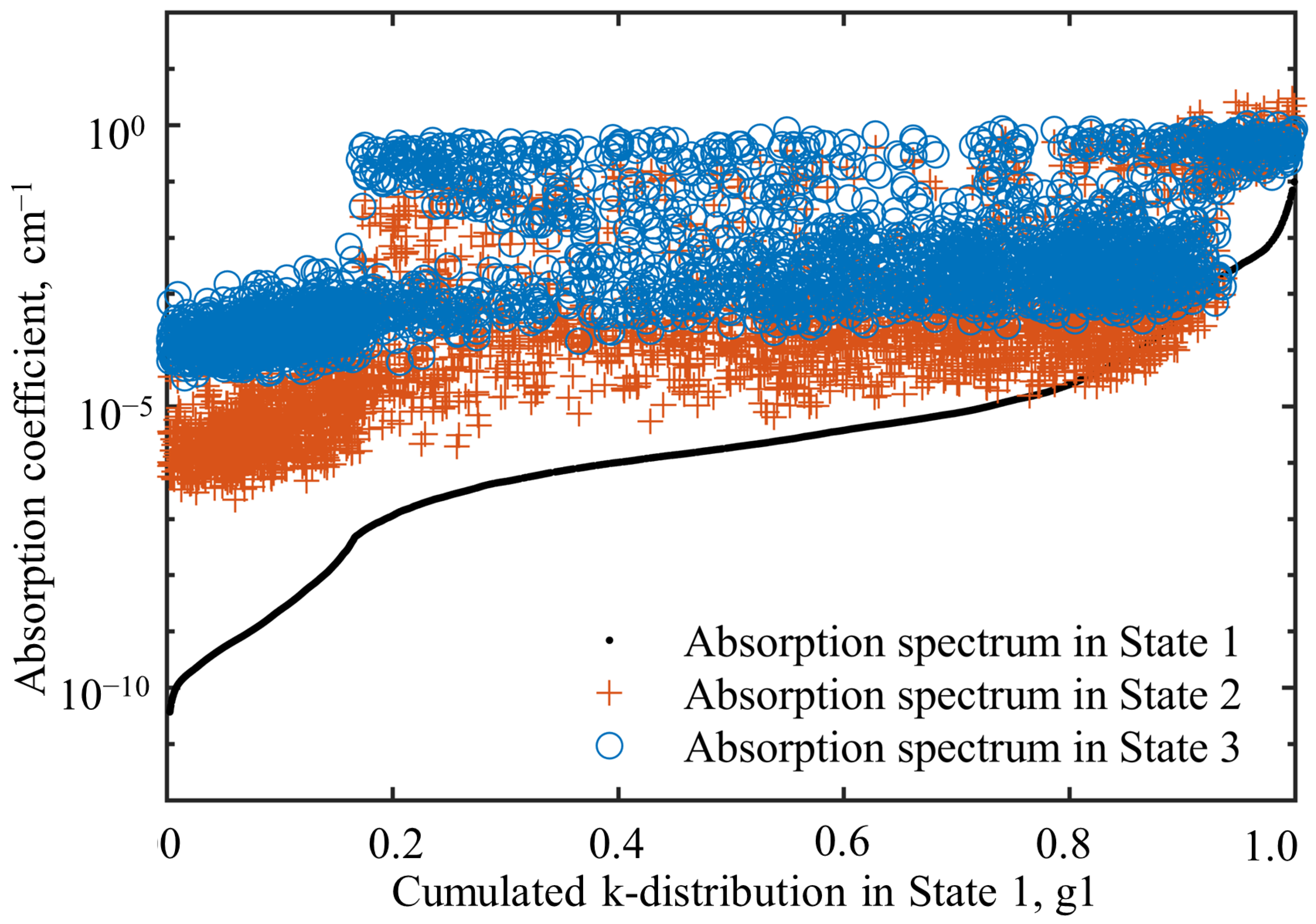
The relationship between the spectral absorption coefficients simplified based on their probability density (a total of 140,000 absorption spectra are included, with a simplified representation shown here based on their spatial density distribution) and the cumulative k-distribution function in state 1 is illustrated in Figure 1. When the gas spectrum in state 1 increases monotonically with its cumulative k-distribution function (this is the main principle of the k-distribution method), the absorption spectra in states 2 and 3 do not always follow the increasing function of the cumulative k-distribution function in state 1. This departure from monotonicity is the main source of error in the k-distribution approaches. It is necessary to construct spectral sub-intervals by extracting subsets of points (the wavenumber corresponding to the cumulative k-distribution function) that do demonstrate a monotonically increasing relationship from the spectral absorption coefficients of states 2 and 3. Within these spectral sub-intervals, the absorption spectrum in three states will maintain a monotonically increasing relationship with the cumulative k-distribution function in state 1. Consequently, the absorption coefficient across different states will share the same k-distribution ranking within these sub-intervals, meaning that the cumulative k-distribution functions for the same wavenumber will be equal across all states.
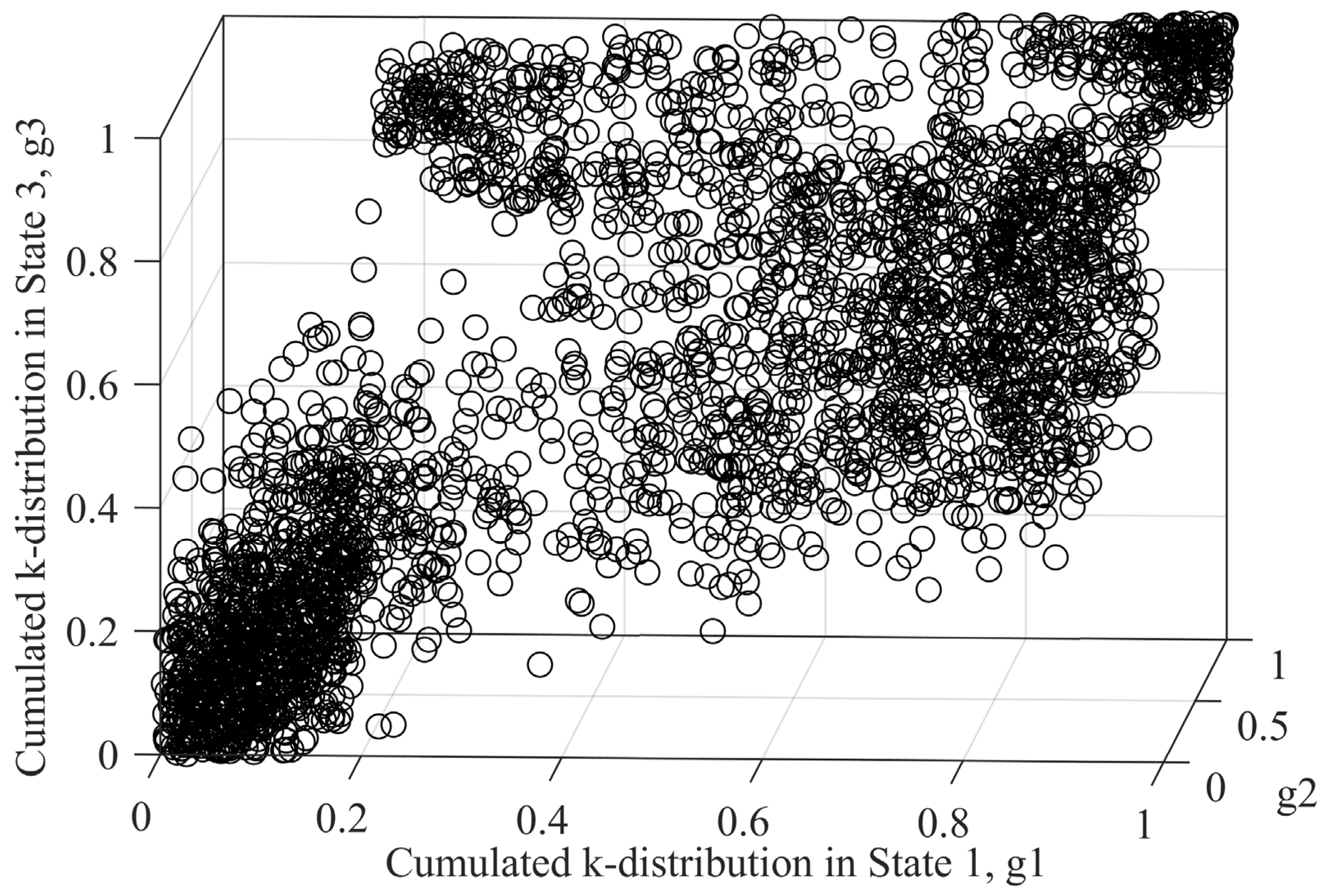
For constructing the spectral sub-intervals, the cumulative k-distribution functions under different thermodynamic states are firstly constructed as column vectors g i k η 1 i , g i k η 2 i , … & g i k η n i , where ηn denotes the n-th wavenumber and i represents the thermodynamic state. Each thermodynamic state is then assigned to a coordinate axis accordingly, such that every wavenumber can be mapped to a specific position along the corresponding coordinate axis based on its cumulative k-distribution value. Through the above processes, all wavenumbers are mapped to positions within a coordinate space constructed from the ranges of all g-values corresponding to the thermodynamic states. This coordinate position is referred to as a spectral point (a wavenumber with cumulative k-distribution functions in all states), and the space spanned by all coordinate axes is termed the g-value space. Thus, the g-value space as well as the distribution of spectral points (corresponding to the wavenumbers shown in Figure 1) under the three thermodynamic states are presented in Figure 2.
The “correlation” of the k-distribution method is defined as that the same k-distribution ranking for absorption coefficients is ensured under different thermodynamic states within a spectral interval. If the gas spectra are “correlated” across all states, then for any wavenumber, the corresponding cumulative k-distribution functions remain identical under any thermodynamic state. For Figure 2, this would mean all spectral points with coordinate positions of g 1 = g 1 k η 1 , g 2 = g 2 k η 2 and g 3 = g 3 k η 3 would align along the straight diagonal line, i.e., the vector [1, 1, 1]. However, since gas spectra are not truly correlated in practical scenarios, the spectral points are distributed across various regions within the unit hypercube (g-value space). Therefore, establishing correlation among gas spectra within sub-intervals requires filtering out the spectral points located on and around the vector [1, 1, 1]. The filtering process is achieved by partitioning the unit hypercube into non-overlapping subspaces formed by lines parallel to the vector [1, 1, 1]. A spectral sub-interval is therefore composed of the wave numbers corresponding to the spectral points within a subspace. The vectors used to partition the g-value space are termed comonotonic vectors.
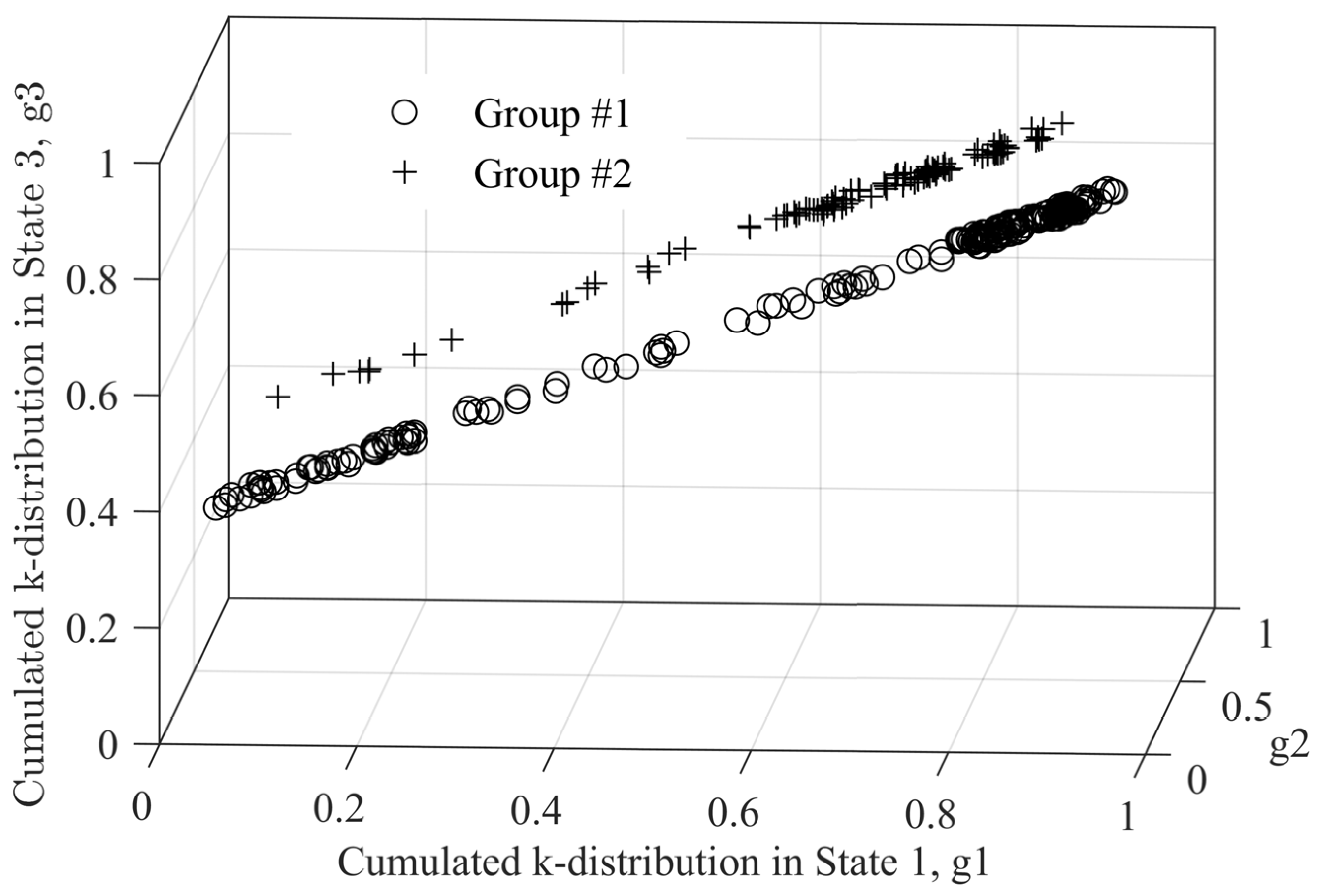
The g-value space shown in Figure 2 is then partitioned to establish sub-intervals. Figure 3 displays the spectral absorption coefficients of selected established sub-intervals. As can be seen, after partitioning the spectral points by segmenting the g-value space, all spectral points within each sub-interval lie on lines parallel to the comonotonic vector. This indicates that these spectral points share an identical k-distribution ranking among three states. However, at this stage, the cumulative k-distribution functions of these spectral points still differ across different states because they are statistical values computed over the entire spectral interval. After re-establishing the k-distribution method within each sub-interval, the spectral points in every sub-interval will be remapped onto the straight diagonal line.
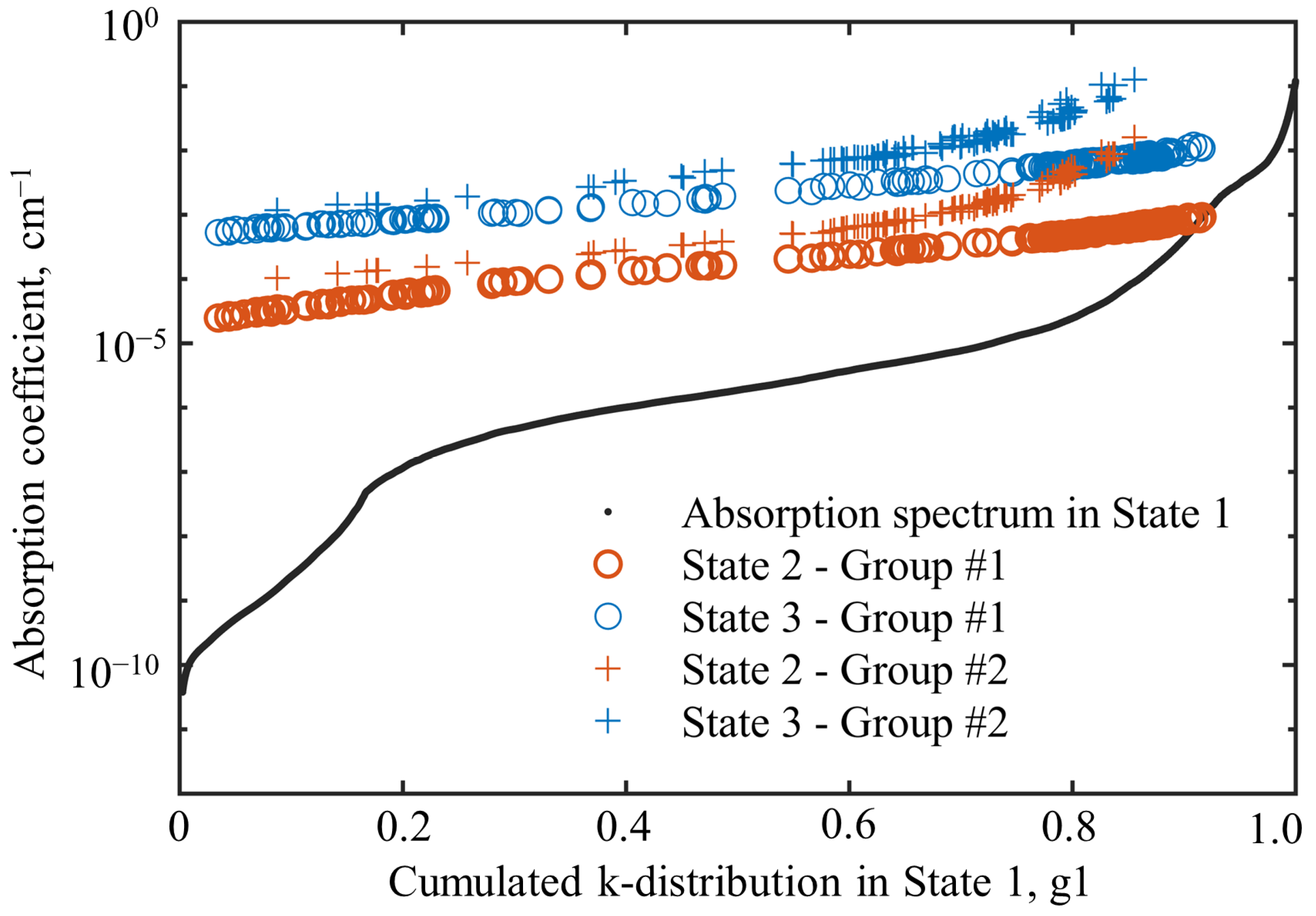
Figure 4 presents the distribution of spectral absorption coefficients within selected intervals (corresponding to the groups shown in Figure 3) of comonotonicity. As observed, the absorption spectra across three states maintain a monotonically increasing relationship with the cumulative k-distribution function, confirming the successful establishment of the intervals of comonotonicity. Consequently, the same wavenumber in different states corresponds to the same cumulative k-distribution function value, effectively resolving the blurring effect of the k-distribution method. It is noteworthy that this monotonically increasing relationship remains valid when using the cumulative k-distribution functions of either state 2 or state 3 as reference. Furthermore, the absorption coefficients corresponding spectral points within a comonotonic interval at each state are not strictly in a scaling relationship. This character preserves the k-distribution correlation while the demand for the number of groups in the gas radiation model is minimized to the greatest and the range of applicable gas state parameter in practical applications is also expanded.
In summary, the procedure for establishing sub-intervals under multiple thermodynamic states is as follows:
Step 1: The cumulative k-distribution functions for all wavenumbers under different thermodynamic states are calculated. These values serve as coordinate locations along their respective coordinate axes, thereby representing all wavenumbers as spectral points within the g-value space.
Step 2: The comonotonic vector for multiple thermodynamic states is defined as [1, 1, …, 1], with its dimensionality matching the number of thermodynamic states. All spectral points from Step 1 are projected along the direction of this comonotonic vector to obtain their positions in the orthogonal space of the comonotonic vector. This orthogonal space refers to the projection of the g-value space along the comonotonic vector direction. The coordinate positions corresponding to all spectral points in the orthogonal space are realigned along each dimension. Based on the required number of spectral points per sub-interval, the bounds of the orthogonal subspaces are determined, thereby partitioning the orthogonal space into non-overlapping subspaces.
Step 3: The spectral points within each subspace are selected. Their corresponding wavenumbers are combined to form a sub-interval, which is treated as an independent spectrum, and a k-distribution method is re-established. An inverse function is constructed for the k-distribution model to enable the calculation of the corresponding absorption coefficient based on the cumulative k-distribution function in the target state.

2.2. Validation of Spectral Correlation Within Comonotonic Intervals Under Multiple Thermodynamic States

Under N thermodynamic states, comonotonic sub-intervals are established by partitioning the orthogonal space as follows. The g-value space and spectral points of N thermodynamic states are projected, while discarding their information along the comonotonic vector direction (since the basis for establishing comonotonicity is whether the spectral points lie on the comonotonic vector, not their specific positions along it), then a (N − 1)-dimensional orthogonal space and sets of projection position corresponding spectral point are obtained. Based on the comonotonic vector [1, 1, …, 1], the orthonormal basis for its orthogonal space can be derived as follows:
1 1 0 0 1 1 0 0 0 0 0 0 0 0 0 0 0 0 1 1 0 0 1 1
The orthogonal space is partitioned into subspaces in N − 1 dimensions, the coordinates of the spectral points within each subspace lie between [u1, …, ui, …, uN−1] and [u1 + ε1, …, ui + εi, …, uN−1 + εN−1]. Here, ui represents the starting position of the subspace in the i-th dimension, taking values between −1 and 1, εi denotes a positive increment. Then, the following relations can be obtained in all established spectral sub-intervals:
u 1 < g 2 k η 2 g 1 k η 1 < u 1 + ε 1 u i < g i + 1 k η i + 1 g i k η i < u i + ε i u N 1 < g N k η N g N 1 k η N 1 < u N 1 + ε N 1
For small increments ε1, …, εi, …, εN−1, the absorption coefficients under N thermodynamic states are related through the following N − 1 equations:
g 2 k η 2 u 1 + g 1 k η 1 , η η 1 u 1 g i + 1 k η i + 1 u i + g i k η i , η η i u i g N k η N u N 1 + g N 1 k η N 1 , η η N 1 u N 1
Let η (u1, …, ui, …, uN−1) denote the set of spectral points in a subspace of the orthogonal space. Equation (6) can be expressed in terms of inverse functions as follows:
k η 2 = g 2 1 u 1 + g 1 k η 1 = φ 1 k η 1 k η i + 1 = g i + 1 1 u i + g i k η i = φ i k η i k η N = g N 1 u N 1 + g N 1 k η N 1 = φ N 1 k η N 1
Equation (7) demonstrates that the absorption coefficients ( k η 1 , k η 2 , …, k η N ) across the N states are interrelated through N − 1 strictly increasing functions (φ1, φ2, …, φN−1). Based on the increasing function φ1, the absorption coefficients of state 1 and state 2 establish an identical k-distribution ranking. Similarly, based on φ2, state 2 and state 3 establish an identical k-distribution ranking, and the like. These increasing functions are related to the parameters ui, with the corresponding wavenumber belonging to ηη (u1, …, ui, …, uN−1) within the sub-interval. Then, the cumulative k-distribution function for the sub-interval η (u1, …, ui, …, uN−1) can be further redefined as follows:
g k i | η ( u 1 , , u i , , u N 1 ) = 1 I b T η ( u 1 , , u i , , u N 1 ) I b η T H k i k η i d η
where H is the Heaviside step function. For any wavenumber within η (u1, …, ui, …, uN−1), the cumulative k-distribution functions take equal values across all states and strictly follow
g 1 k η 1 | η u 1 = g 2 k η 2 | η u 2 , η η 1 u 1 g i k η i | η u i = g i + 1 k η i + 1 | η u i + 1 , η η i + 1 u i + 1 g N 1 k η N 1 | η u N 1 = g N k η N | η u N , η η N 1 u N 1 .
Equation (9) suggests that, within the established sub-interval, the cumulative k-distribution functions for any wavenumber hold equal values among all states, thus, their k-distribution rankings remain identical within the sub-interval.

3. Optimization of Wide-Band k-Distribution Model Based on Comonotonic Intervals

3.1. Optimization of Comonotonic Interval Grouping Scheme Using Clustering Algorithm

The establishment process of spectral sub-intervals in Section 2 is as follows: The coordinate positions of all spectral points in the orthogonal space of the comonotonic vector are calculated, and the spectral points are partitioned according to specific spatial ranges. Those spectral points within the same spatial range compose a candidate spectral sub-interval. However, as the number of thermodynamic states involved in the gas radiation model increases, the g-value space expands accordingly and the distribution of spectral points becomes more dispersed. Consequently, to ensure the strict comonotonicity, a larger number of sub-intervals must be established, leading to reduced computational efficiency of the gas radiation model. To improve the computational efficiency, it is essential to group the spectral points without increasing the number of sub-intervals. The most straightforward approach to achieve this is to uniformly partition the orthogonal space into subspaces based on a fixed number. However, without considering the actual distribution of spectral points, the comonotonicity within each sub-interval cannot be guaranteed. In the ideal scenario, comonotonicity across all states within a sub-interval is strictly maintained only when all spectral points lie exactly on the comonotonic vector. In other words, the closer the spectral points are to the comonotonic vector, the stronger the spectral comonotonicity within the established sub-interval. Moreover, when spectral points are closer to each other in the orthogonal space (i.e., the smaller the within-interval variance), the closer they are to the same comonotonic vector in the g-value space.
Based on the above analysis, this study proposes to group the spectrally proximate points in the orthogonal space to enhance the comonotonicity within the resulting sub-intervals. The k-means clustering algorithm is employed to iteratively optimize the grouping scheme of spectral points in the orthogonal space, aiming to achieve the minimal variance within the group. The variance is calculated as follows:
V a r m = n = 1 M u m n u ¯ m 2 M
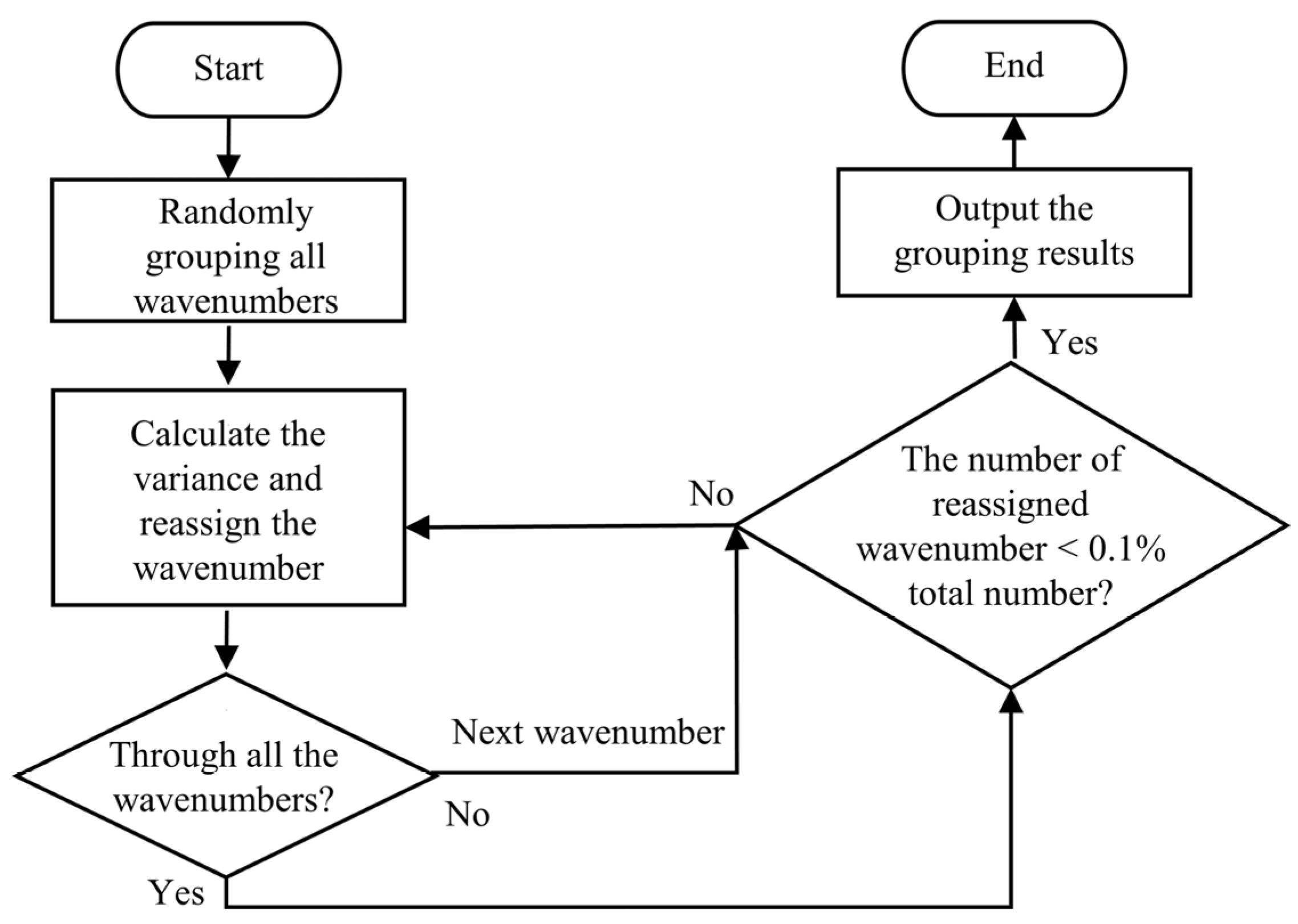
where umn denotes the coordinate vector of the n-th spectral point within the m-th spectral sub-interval in the orthogonal space, u ¯ m represents the centroid coordinates of the m-th sub-interval, and M indicates the number of spectral points within the sub-interval. The specific workflow of the k-means clustering algorithm is illustrated in Figure 5. The grouping procedure consists of the following steps: (1) Randomly partition the spectral intervals of the radiation model into multiple non-overlapping sub-intervals and preliminarily calculate the variance of each sub-interval. (2) For each wavenumber, computing the variance of every sub-interval if this wavenumber was assigned to it, then reassign the wavenumber interval to the sub-interval corresponding to the minimum variance (the wavenumber interval may remain in its original sub-interval). (3) Repeat Step (2) until the wavenumber intervals reassigned to other sub-intervals during the current iteration falls below 0.1% of the total intervals.
Since the initial spectral sub-intervals are randomly generated, the centroid positions of spectral points within each sub-interval vary considerably, leading to the significant influence on the iterative grouping results of spectral points. In this study, multiple initial grouping schemes are simultaneously generated, the clustering algorithm is then applied to iteratively refine the grouping results for each scheme, and the grouping scheme with the smallest total variance is selected. The objective of this procedure is to minimize the total variance across all spectral sub-intervals. When the variance of a sub-interval reaches zero, all spectral points within this sub-interval lie precisely on the comonotonic vector, meaning the comonotonic correlation is maximized.
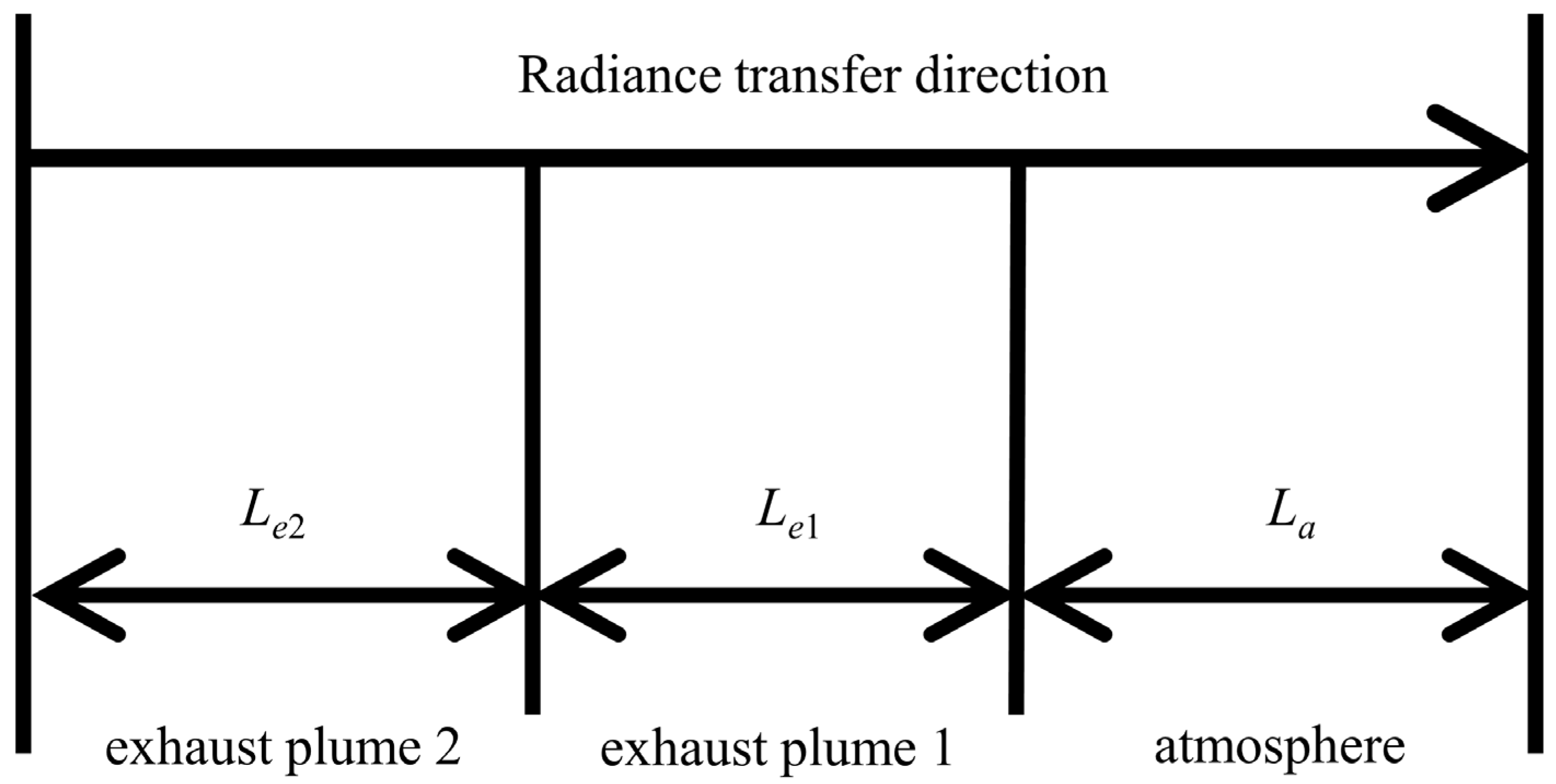
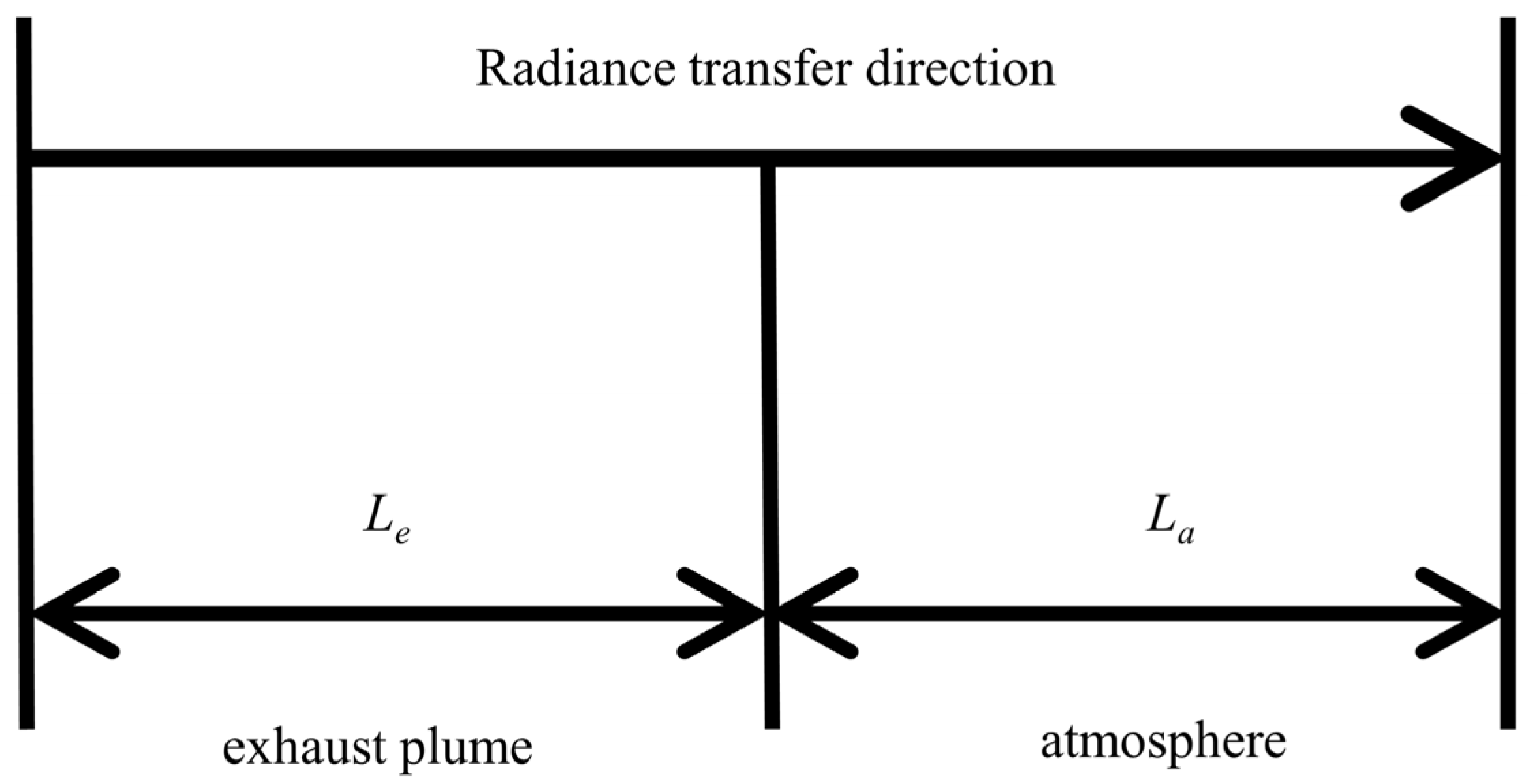
To validate the computational accuracy of the grouping scheme obtained through the k-means clustering algorithm, a one-dimensional radiative transfer test case (0-D case, as shown in Figure 6) is designed according to the infrared radiation characteristics of an aircraft engine nozzle described in Table 1. The 0-D case comprises gases in three states (two aircraft exhaust plume state points and one atmospheric state point) as provided in Table 1, state 1 corresponds to the atmospheric state point, while states 2 and 3 represent exhaust plume state 1 and 2, respectively. The path length of exhaust plume state 1 and 2 is fixed at Le1 = 20 m and Le2 = 0.2 m, respectively. The atmospheric path length La is ranged from 1000 m to 20,000 m. The number of groups remains 25 both before and after the optimization process by the clustering algorithm, and the number of Gaussian quadrature nodes per group is set to 9 (as verified, this number of nodes ensures sufficient accuracy for the test cases in this section).
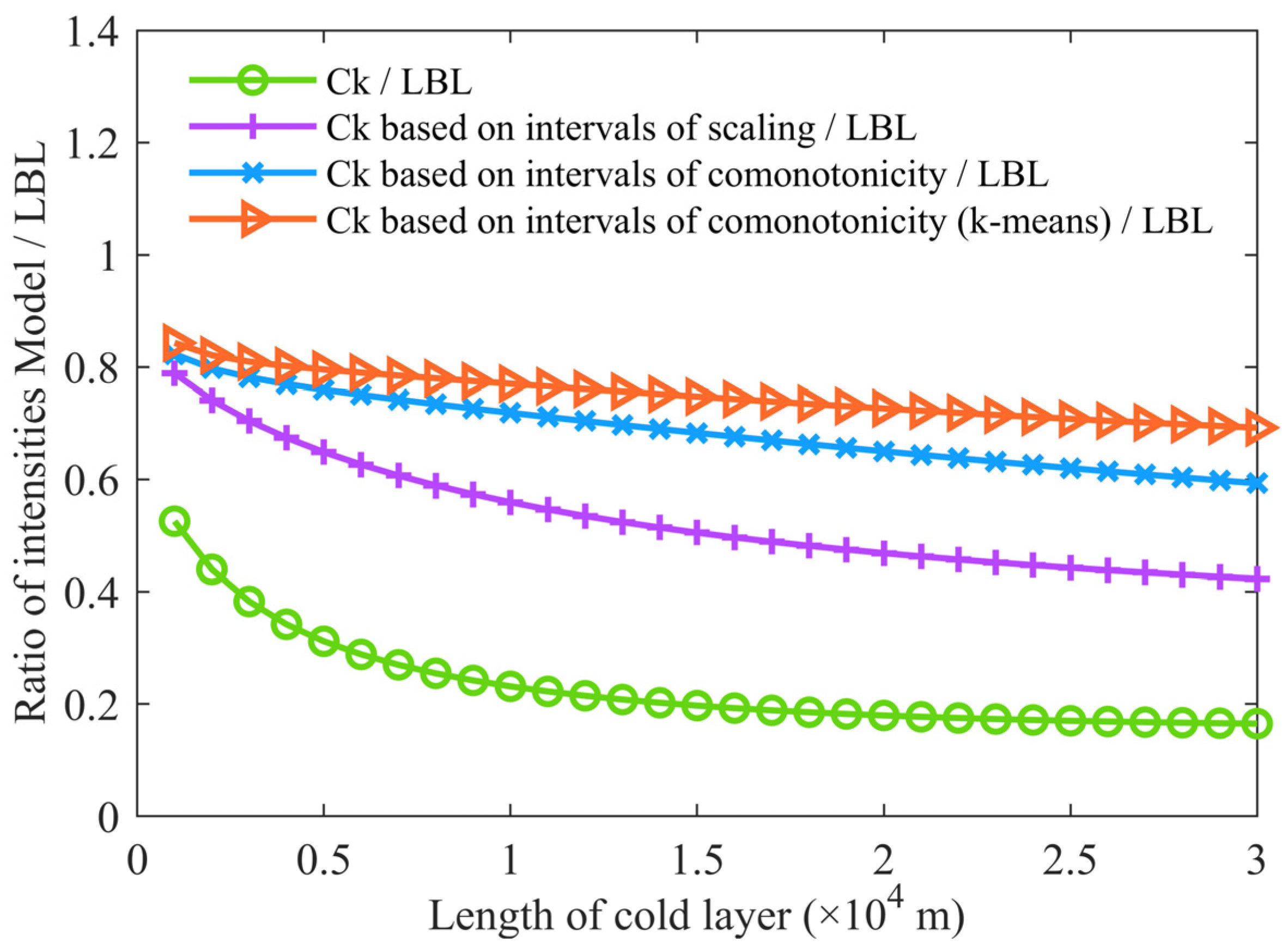
The discrete ordinates method is employed to solve the test cases under different La. The total radiative intensity computed by the Line-By-Line (LBL) method (with a spectral range of 3~5 μm and the wavenumber interval of 0.01 cm−1) is served as the benchmark data. For comparison, four k-distribution methods are established: the traditional k-distribution method, the k-distribution method based on intervals of scaling, the k-distribution method based on intervals of comonotonicity and the k-distribution method based on intervals of comonotonicity optimized by k-means. The traditional k-distribution method constructs the k-distribution directly from the gas spectra without any grouping. The other three models share the same number of groups and the same number of Gaussian quadrature nodes per group. In addition, the partitioning method for scaling intervals is identical to that for comonotonic intervals (as described in Section 2.1), with the distinction that the scaling factors of absorption coefficients between different states are used instead of the original g-values.
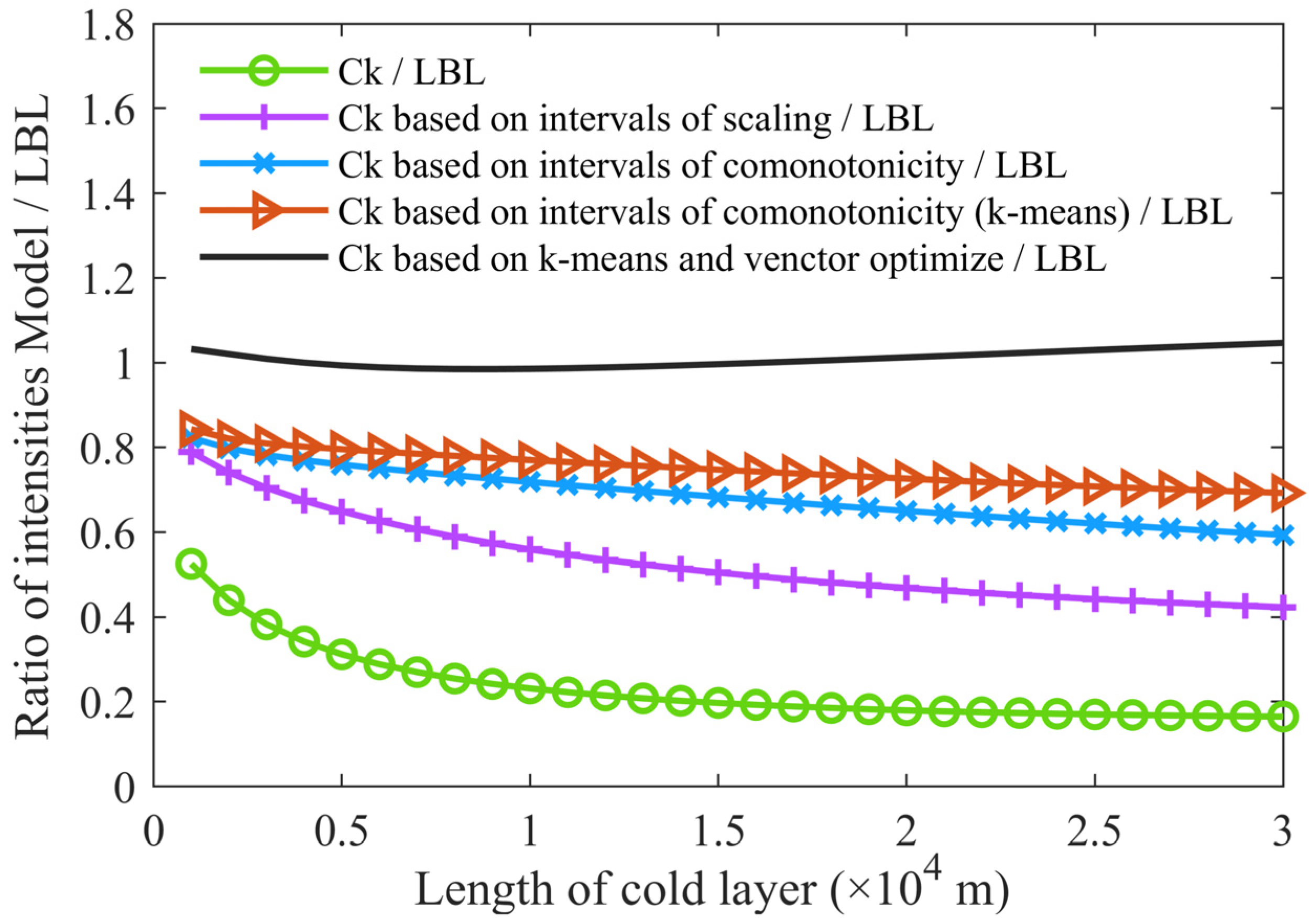
Figure 7 shows the ratio of the results calculated by using the four models to the result obtained by using the LBL method under various atmospheric path lengths La. It can be clearly observed that the traditional k-distribution method exhibits significant errors due to the blurring effect. The k-distribution method based on intervals of scaling enhances the correlation among gas spectra within groups. However, due to the strict requirements of the scaling relationship on gas absorption coefficients and the limited number of groups, the improvement in computational accuracy is modest and the computational error gradually increases with the increased La. The k-distribution method based on intervals of comonotonicity further strengthens the spectral correlation within group, leading to additional improvements in computational accuracy. The k-distribution method based on intervals of comonotonicity optimized by k-means achieves the strongest intra-group spectral correlation among all methods, with computational errors controllable within approximately 20% compared to the LBL method. The error in the k-means-based method is attributed to the fact that the grouping solution obtained by the clustering algorithm cannot be guaranteed as the optimal solution. Specifically, after projecting the spectral points along the current comonotonic vector into the orthogonal space, the grouping scheme optimized by the clustering algorithm does not necessarily minimize the total variance. This is because the relative positions of spectral points in the orthogonal space are entirely determined by the comonotonic vector and the positions of spectral points in the g-value space. Once the thermodynamic states are fixed, the distribution of spectral points in the orthogonal space can only be altered by adjusting the parameters of the comonotonic vector. The k-means clustering algorithm merely optimizes the grouping method for the spectral points, further optimization of the comonotonic vector parameters is still required. The differences arise because the clustering algorithm iteratively minimizes the variance of spectral projection values within each group and leads to a globally consistent ordering of k-distributions. The error stems from the fact that the initial spectral projection values in the algorithm are fixed. Consequently, the variance of projection values cannot be reduced to zero and minor inconsistencies in the ordering of k-distributions persist. When calculating the absorption coefficients corresponding to these inconsistently ordered segments of the k-distribution, a certain level of error is inevitably introduced.
The key to obtaining the optimal grouping scheme then lies in selecting the most suitable comonotonic vector to enhance the correlation of gas spectra within the comonotonic intervals, thereby improving the computational accuracy of the gas radiation model. As mentioned in the definition of correlation in Section 2.1, strictly correlated gas spectra would have spectral points lying precisely on the vector [1, 1, …, 1]. In practice, though most spectral points are distributed around this vector, it is not mandatory to use [1, 1, …, 1] as the comonotonic vector to establish spectral correlation within comonotonic intervals. As long as all dimensions of the comonotonic vector have parameters greater than 0, a monotonically increasing relationship of spectral points across all states can be ensured. The most suitable comonotonic vector should not only establish this increasing relationship but also minimize the variance (Equation (10)) of the projected spectral point distribution after k-means-based grouping. Specifically, the distribution of spectral points should ideally satisfy the following characteristics. Firstly, sufficient separation between spectral points of different groups to exclude uncorrelated points within each sub-interval, thereby preserving comonotonicity. Secondly, the number of spectral points in each group should be balanced as identical as possible to minimize the impact of uncorrelated points on the comonotonicity of the grouping scheme. When the variance reaches zero, the spectral points will strictly lie on lines parallel to the comonotonic vector, ensuring rigorous comonotonicity within the sub-intervals.

3.2. Optimization of Comonotonic Vector Parameters Based on Particle Swarm Optimization Algorithm

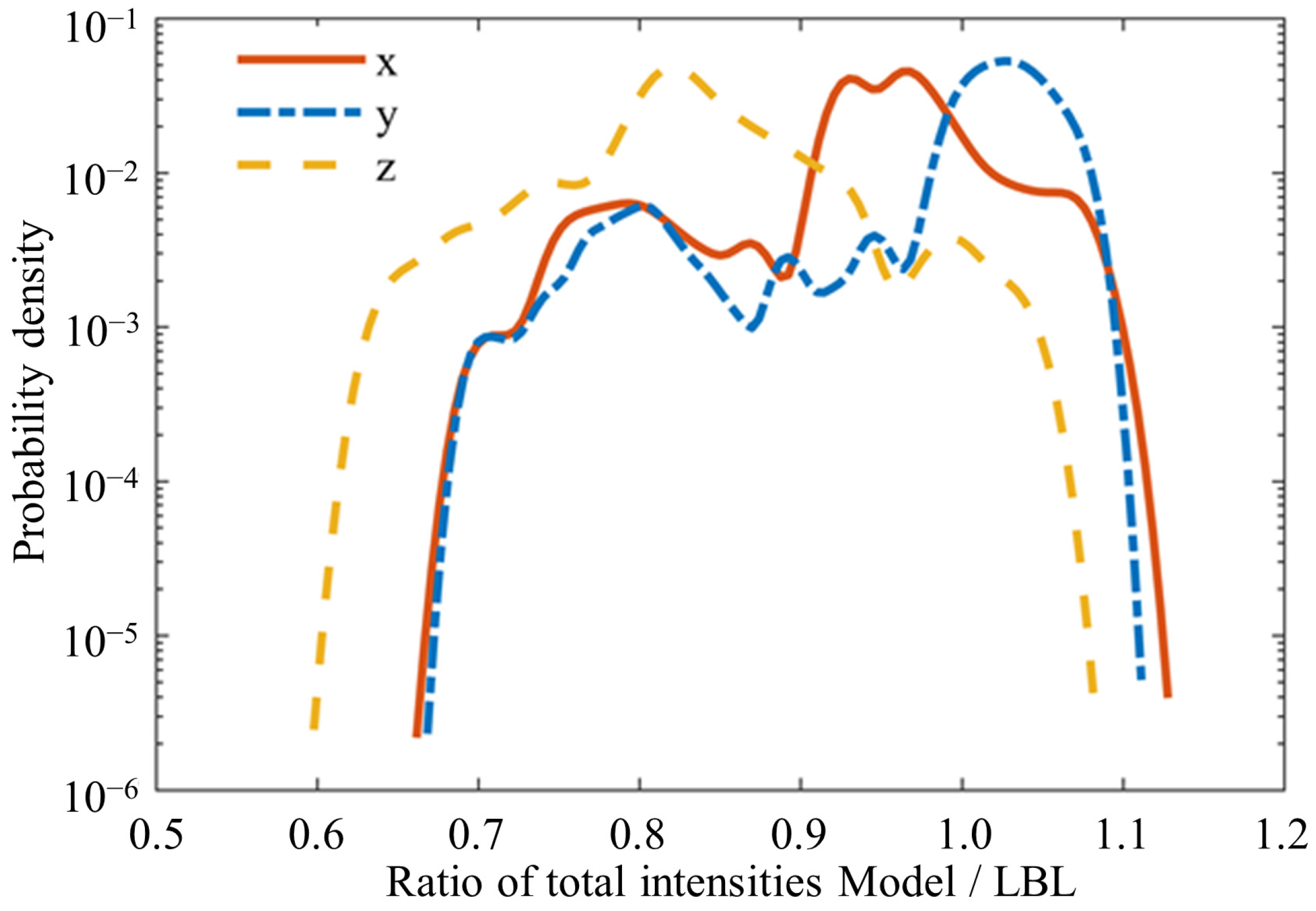
To address the challenge of the k-means clustering algorithm in obtaining the optimal grouping scheme, this section extends the study based on the 0-D case and state sample points designed for the three thermodynamic state parameters (i.e., a 3-dimensional comonotonic vector) outlined in Section 3.1. The impact of comonotonic vector parameter variations on the computational accuracy of the radiation model is then further investigated. We set the comonotonic vector parameters as [x, y, z]; when varying the parameter of one dimension within the range of 0.1 to 10.0, the parameters of the other two dimensions are fixed at 1.0, and the atmospheric path length La remains in the range of 1000 m to 30,000 m. Using the radiative intensity calculated by using the LBL method as the benchmark data, a sample space composed of computational results under different comonotonic vector parameters and atmospheric path lengths La is established. The probability density distribution of the computational performance of the gas model under different comonotonic vector parameters is obtained as shown in Figure 8.
It can be observed that the probability density peak for parameter z occurs near 0.8, while the peaks for parameters x and y are around 1. This phenomenon can be explained that, on the one hand, when a parameter (the one dimension) approaches 0 (while the other dimensions remain at 1), the partitioned comonotonic intervals become more influenced by the g-values of that particular thermodynamic state. As the parameter of this dimension increases gradually, the influence of g-values diminishes accordingly, the related grouping scheme leads to an increasing error in modeling the gas radiation of that specific thermodynamic state. In the designed radiative test case, the temperature of the gas thermodynamic state corresponding to parameter z is highest (the related blackbody radiation is also the strongest), thereby exerting the greatest impact on the computational results. Consequently, when parameter z approaches infinity, the computational accuracy of the gas radiation model decreases. On the other hand, the value of parameter z is greater than 1.0 in most samples, the computational accuracy of the related model is relatively low, which results in the probability density peak appears near 0.8 (z curve in yellow dashed line). In other words, the vector [1, 1, 1] is not the optimal comonotonic vector for the k-means clustering-optimized grouping scheme. Variations in any of the three dimensions of the comonotonic vector will influence the computational results of the 0-D case, indicating that the parameters of the optimal comonotonic vector for the gas radiation model require optimization.
After optimizing the comonotonic vector parameters with the exhaustion method, a further optimized k-distribution method is obtained. Figure 9 presents the ratio of computational results from the joint optimized k-distribution model (optimized through both the k-means clustering algorithm and the exhaustive method for comonotonic vector parameter selection) to those from the line-by-line method under different atmospheric path lengths La (results shown in Figure 7 are also retained). It can be observed that the gas radiation model after joint optimization yields closest results to the LBL method with computational errors less than 5%. The adjusted comonotonic vector effectively balances the grouping criterion of minimizing variance in comonotonic intervals and the influences of blackbody radiation and absorption capacity of gases in different thermodynamic states on computational results. Therefore, the gas radiation model optimized through the comonotonic vector parameter selection produces the closest results to those obtained with the LBL method.
For optimizing the comonotonic vector parameters under the three thermodynamic states (3-dimensional) shown in Section 3.1, the exhaustion method is still enforceable. However, when dealing with higher-dimensional comonotonic vector parameters (i.e., more thermodynamic states), the sample space becomes excessively large and the exhaustion method becomes computationally impractical. Therefore, this study further employs the PSO algorithm [23] to efficiently identify the optimal comonotonic vector parameters. The PSO algorithm iteratively updates the positions (comonotonic vector parameters) and velocities (trends of parameter variations) of randomly generated particles (comonotonic vectors) to search for the most suitable comonotonic vector for the gas radiation model. In high-dimensional parameter spaces, PSO demonstrates strong optimization capability and fast convergence. Simultaneously, to further validate the performance of the gas radiation model jointly optimized by the k-means clustering algorithm and PSO-based comonotonic vector parameter selection in practical scenarios, this study introduces an objective function ferr [19] to evaluate the infrared computational performance of the optimized k-distribution method.
e j , max = max I η , j , Model L a I η , j , LBL L a I η , j , LBL L a f e r r = e j , max , e j , max 0.08 0.08 + 10 e j , max 0.08 ,     0.08 < e j , max < 0.12 0.48 + 100 e j , max 0.12 , e j , max 0.12
where ej,max represents the maximum relative error of the j-th 0-D case compared to the LBL calculation over the range of gas path lengths La. IΔη,j,LBL(La) denotes the result calculated by the LBL method for the j-th 0-D case within the target spectral interval under gas path length La. IΔη,j,Model(La) denotes the result computed by the gas model for the j-th 0-D case within the target spectral interval under gas path length La. ferr denotes the objective function for the PSO algorithm, which also serves as the comprehensive error index across all 0-D cases. It is defined by a piecewise function of ej,max, the larger the value of ej,max, the lower the computational performance of the comonotonic vector parameter-related gas model, and the greater the penalty (slope) imposed by ferr.
To validate the computational performance of the proposed spectral mapping method under multiple thermodynamic states, two gas models for CO2 and H2O (the primary sources of infrared radiation in aircraft nozzle exhaust plumes) are established in this section, using nine thermodynamic states [19] (the dimension of the comonotonic vector is 9), the related parameters for each thermodynamic state are listed in Table 2. Multiple 0-D radiative transfer test cases are then designed for each gas component to simulate the distribution of the nozzle exhaust plume, with the specific cases illustrated in Figure 10. Each 0-D case for a given gas component consists of one exhaust plume state and one atmospheric state. Based on the composition concentration, pressure and temperature of CO2 and H2O in the exhaust plume and atmosphere listed in Table 2, CO2 has five distinct exhaust plume states and three different atmospheric states, corresponding to 15 0-D cases. H2O has five exhaust plume states and four atmospheric states, corresponding to 20 0-D cases. In each 0-D case, the exhaust plume path length is set to either 0.2 m or 20 m. Among them, the gas path at 900 K is assigned a length of 20 m, reflecting the long core flow region in the high-temperature exhaust plume from the engine nozzle. While the remaining gas paths are set to 0.2 m, corresponding to a shorter jet length. The atmospheric path length La is set in the range of 1000 m to 20,000 m to simulate the attenuation of plume infrared radiation in the atmosphere. The radiative intensity calculated by using the LBL method (with spectral ranges of 3~5 μm and 8~14 μm, and a wavenumber interval of 0.01 cm−1) serves as the benchmark data. The number of comonotonic intervals of the gas models before and after clustering algorithm optimization is set to 25, which is a conservative decision. On one hand, 25 groups can ensure the establishment of gas spectral comonotonicity within each group; on the other hand, the associated computational resource consumption remains within an acceptable range (e.g., with the particle count set to 900, the maximum stagnation iteration is 50, and the optimized time is approximately one day). The number of Gaussian quadrature nodes allocated per comonotonic interval is set as 9. The maximum relative error ej,max of the gas radiation model is computed for each 0-D case under different path lengths La. Using the comprehensive error index ferr as the objective function, the PSO algorithm is applied to iteratively determine the gas radiation model parameters suitable for multiple computational scenarios.
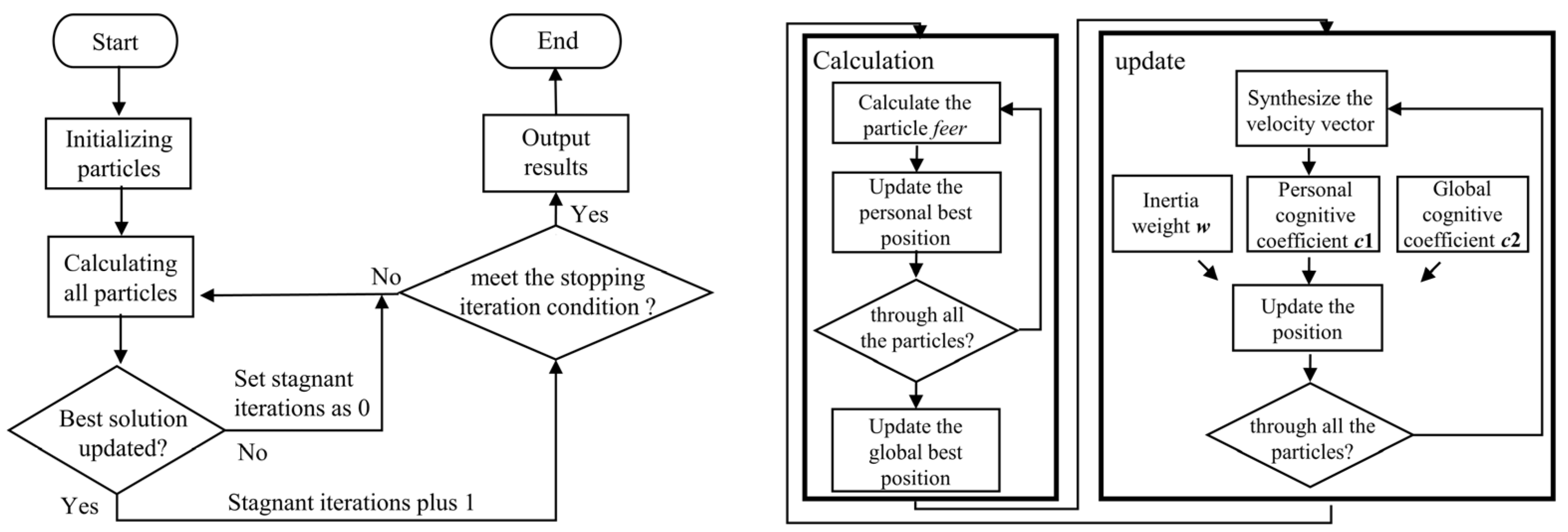
Subsequently, the PSO algorithm based on the ferr objective function is employed to optimize the comonotonic vector parameters of the gas radiation model under multiple thermodynamic states. As shown in Figure 11 (left), the specific optimization procedure consists of three main steps, initialization, iterative particle position updating, and termination. During initialization, each particle is initialized as a comonotonic vector by randomly generating its position within the search space and assigned an initial velocity. The objective function value of each particle is computed, and all particles are reassigned their individual best positions. During the iterative particle position updating process as shown in Figure 11 (right), particle velocities and positions are updated, the objective function values of particles are updated, and both the individual and global best positions are updated. The iteration terminates when the stagnation iteration count exceeds a threshold N or when the maximum iteration number is reached.
In this study, the velocity vector of a particle (comonotonic vector), representing the variation trend of comonotonic vector parameters, is determined by the inertia weight, the cognitive coefficient and the social coefficient as defined below:
v t + 1 = w v t + c 1 r a n d 1 p b e s t x t + c 2 r a n d 2 g b e s t x t x t + 1 = x t + v t + 1
where v(t + 1) represents the velocity vector of the particle at time t + 1, w is the inertia weight indicating the influence of the previous velocity v(t) on the current velocity, c1 is the personal cognitive coefficient representing the weight of the particle’s tendency towards its personal best position, and c2 is the global cognitive coefficient representing the weight of the particle’s tendency towards the global best position. x(t + 1) denotes the position of the particle at time t + 1. pbest corresponds to the position of the current particle where ferr (its fitness function) reaches the minimum value, and gbest corresponds to the position of the particle with the minimum ferr among all particles. rand1 and rand2 denote the random number. In this study, w varies between 0.1 and 1.1, while both c1 and c2 are set to 1.49. The parameters of PSO were set according to the paper of Clerc and Kennedy [24], whose work analyzes the algorithm’s optimization performance. This configuration enables more effective global exploration of the parameter space for locating the optimal solution. Each time the global best position is updated, the stagnation iteration count is reset to 0. The iterative process terminates when either the stagnation iteration count reaches 30 or the maximum iteration number of 200 is achieved. Repeated tests have confirmed that in the scope of this study, a stagnation threshold of 30 iterations and a maximum of 200 iterations are sufficient to ensure the convergence. The number of particles is set to 900; further increasing the particle number does not affect the iteration results of the PSO algorithm in this case.
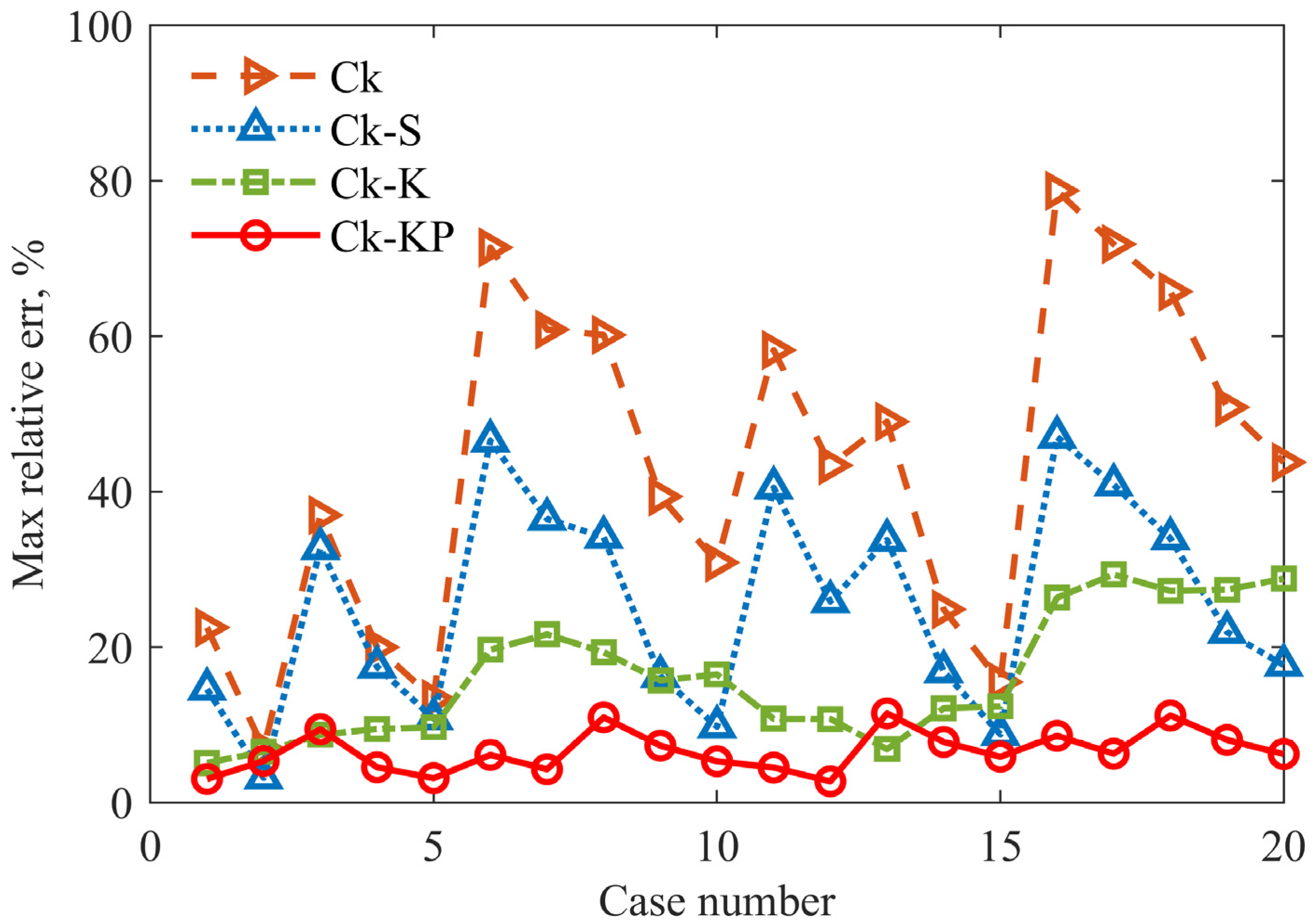
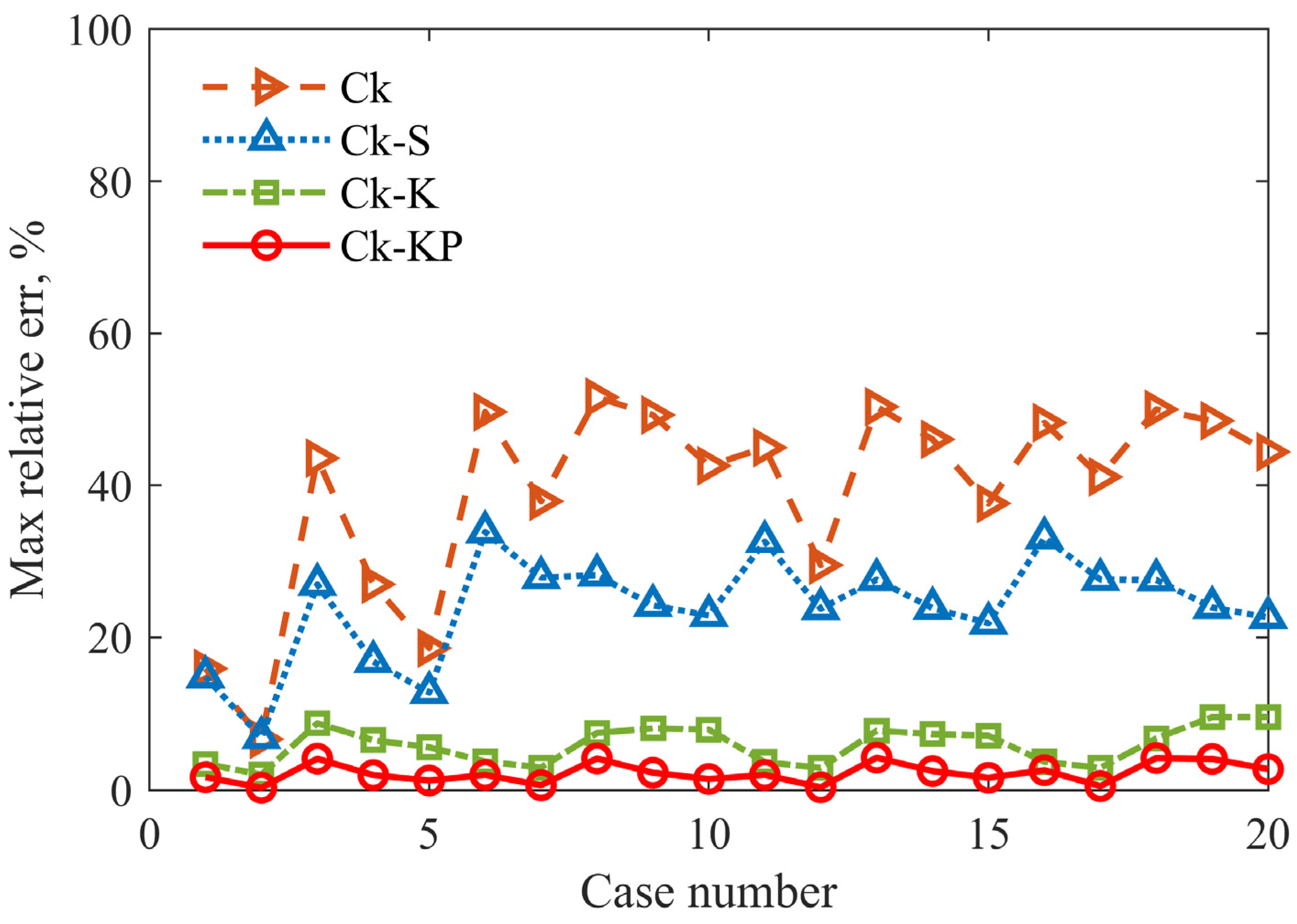
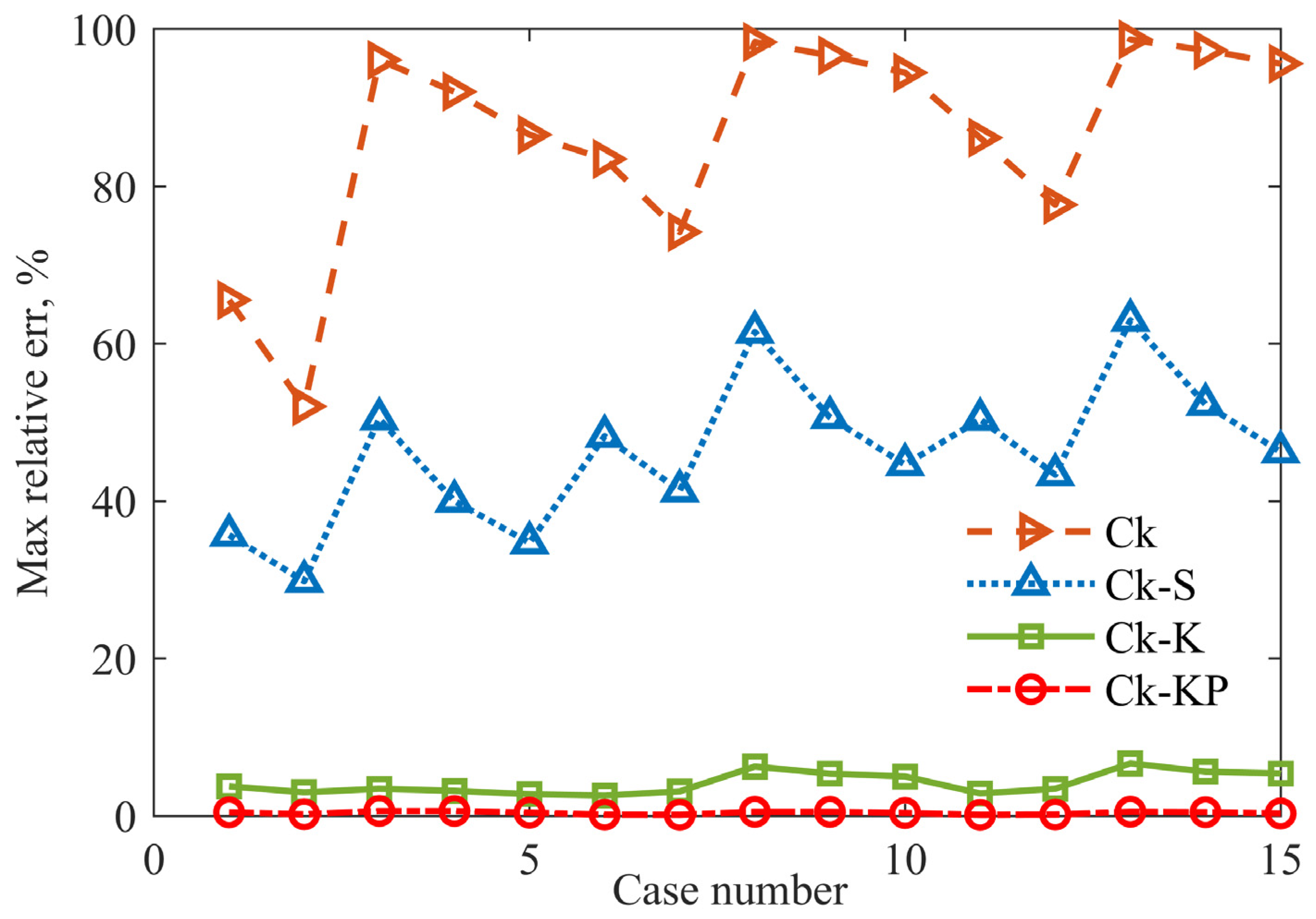
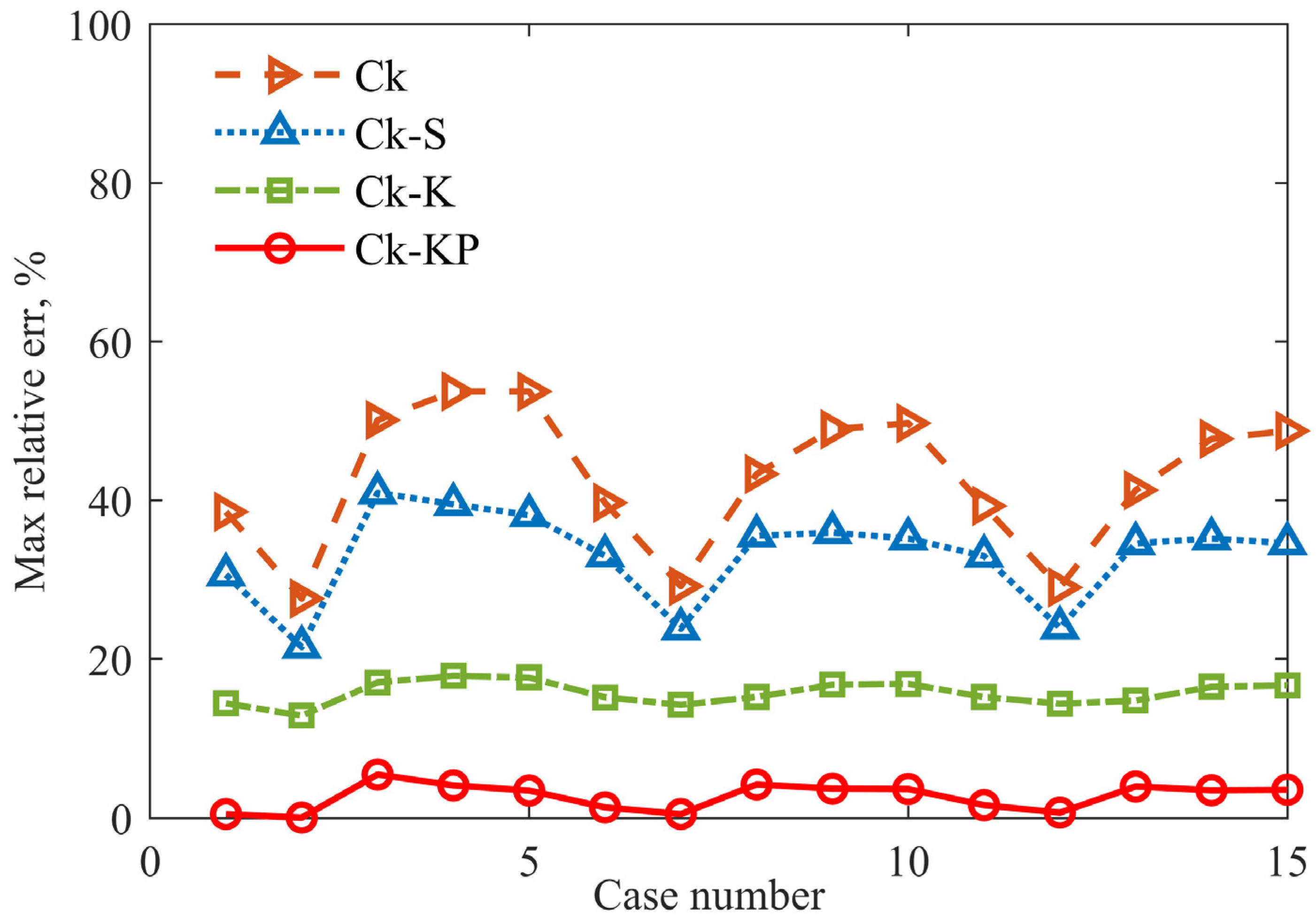
The k-distribution method based on comonotonic intervals is optimized using the PSO and k-means clustering algorithms (Ck-KP). For a better comparison, the results from k-distribution model with k-means-optimized comonotonic interval grouping (Ck-K), the scaling interval-based k-distribution model (Ck-S) and the traditional k-distribution model without grouping (Ck) are also calculated. The computational accuracy of each gas model is evaluated using a set of 0-D cases coupled with the comprehensive error index ferr (Equation (11)), and the “Max relative err” is defined as follows: for the 0-D case, within a specified range of gas path lengths, the maximum ratio of the difference between the gas radiation model result and the LBL result (calculation based on reference state points) to the LBL result itself is obtained. Comparative analyses are conducted for H2O and CO2 in typical atmospheric infrared windows (3~5 μm and 8~14 μm), with the results presented in Figure 12, Figure 13, Figure 14 and Figure 15. Compared to the Ck-K model, the Ck-KP model achieves higher computational accuracy in most cases. The overall relative errors of the Ck-K model for H2O are 3.24 (3~5 μm) and 1.21 (8~14 μm), while those of the Ck-KP model are 1.32 and 0.50, resulting in error reductions of 59.3% and 58.6%, respectively. For CO2, the overall relative errors of the Ck-K model are 0.63 (3~5 μm) and 2.81 (8~14 μm), while those of the Ck-KP model are 0.073 and 0.42, resulting in error reductions of 88.5% and 84.9%, respectively. Differences arise because the PSO algorithm adjusts the parameters of the comonotonicity vector, thereby modifying the initial spectral projection values in the clustering algorithm and enhancing the spectral “correlation” within each group. The error originates from the fact that spectral absorption coefficients vary sharply across different thermodynamic states. As a result, adjusting the comonotonicity vector parameters cannot simultaneously reduce the variance of spectral projection values to zero in all groups.
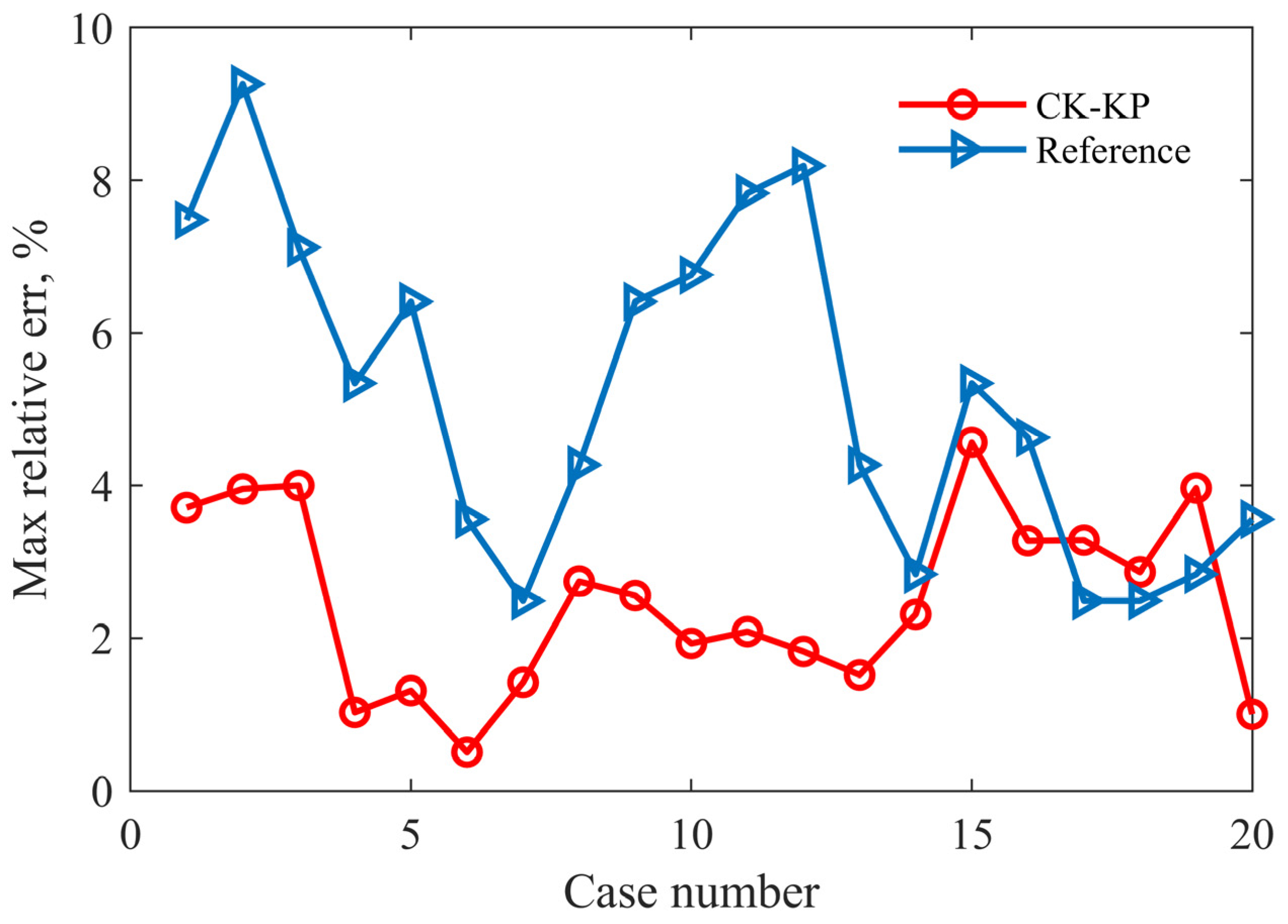
Since some cases in the references are relatively complex, involving factors such as aerosols that may affect the computational results is not within the scope of the current study. This study selected the first 20 0-D cases from [18] for comparison, and the results are presented in Figure 16 and Table 3 below.

4. Conclusions
This study establishes a k-distribution method based on intervals of comonotonicity under multiple thermodynamic states. The influence of k-means clustering algorithms on comonotonic interval grouping results is discussed and the ratio between the computational results from various gas models and the LBL model is elucidated. To further optimize the proposed spectral mapping method, the influence of variations in comonotonic vector parameters on the computational accuracy of the gas model is investigated, and the PSO algorithm is employed to enhance parameter optimization efficiency and global search capability. A set of 0-D cases are established to simulate the infrared calculation scenario of nozzle exhaust plumes; the computational accuracy of the model before and after PSO is evaluated using the sum of the maximum relative errors of the test cases. The main results are shown as follows:
  • Compared to traditional spectral mapping methods based on comonotonic intervals, the approach proposed in this study can be applied to establish and optimize k-distribution methods under multiple thermodynamic states using comonotonic intervals. In constructing comonotonic intervals, this method demonstrates broader applicability and higher computational accuracy.
  • The parameters of the optimal comonotonic vector are determined not only by the grouping of projected spectral points but also by the inherent radiative and absorptive characteristics of gases across different thermodynamic states. By employing the PSO algorithm to find the optimal parameters of the comonotonic vector, high-accuracy radiation models can be developed tailored to specific infrared computational scenarios.
  • The k-means clustering algorithm effectively enhances the computational accuracy of the traditional k-distribution method based on comonotonic interval grouping. In the designed 0-D case with three gas states, the model accuracy is improved from 59% to 69%, achieving an enhancement of 16.9%.
  • Within the 3~5 μm and 8~14 μm bands, through the combined optimization of k-means clustering and PSO algorithms, the computational accuracy of the k-distribution method constructed for water vapor spectra is improved by 59.3% and 58.6%, respectively. The model accuracy for carbon dioxide spectra is improved by 88.5% and 84.9%, respectively.

5. Application

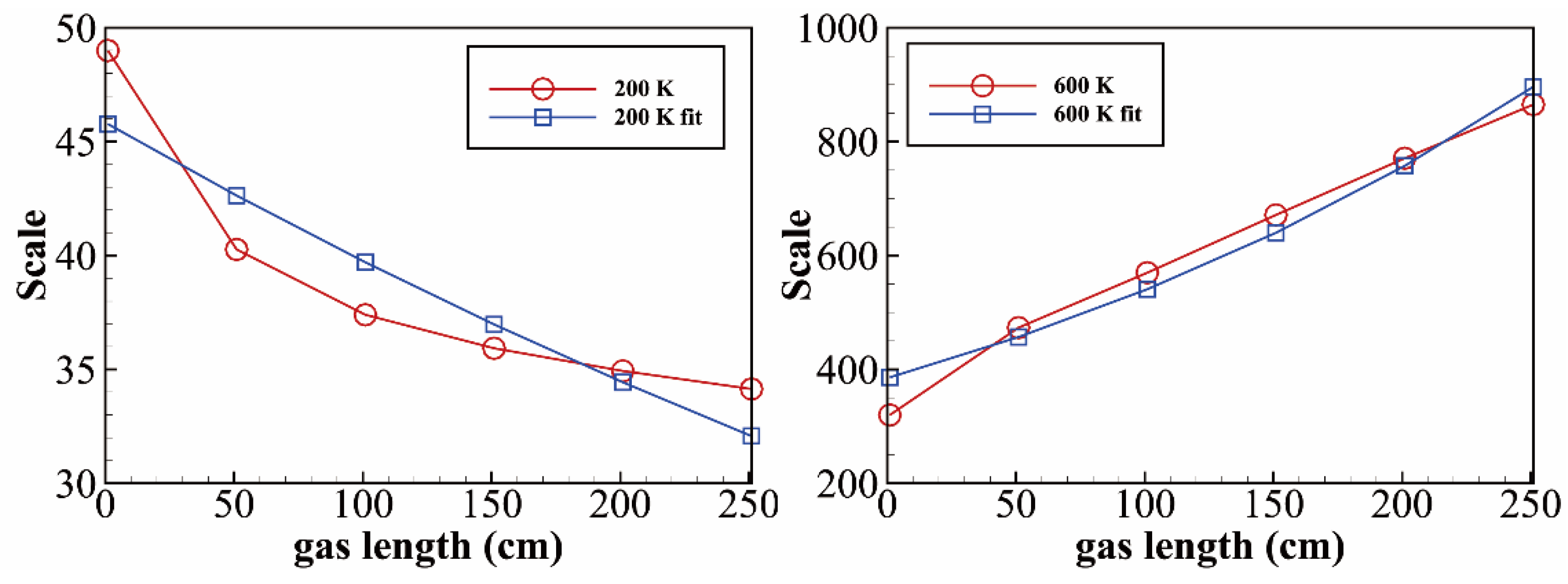
When applying the gas radiation model to actual scenarios, it is necessary to interpolate based on the reference state points established for the gas radiation model to calculate the absorption coefficient under the target gas thermodynamic state in the actual scenario. This interpolation process can be described as follows: compute the scale coefficients in terms of gas radiation characteristics between the absorption coefficients of thousands of gas states (actual scenario) and those of the reference state points (gas radiation model). This paper have currently undertaken some preliminary work using an exponential function to fit the scale coefficient, which can be seen in Figure 17.
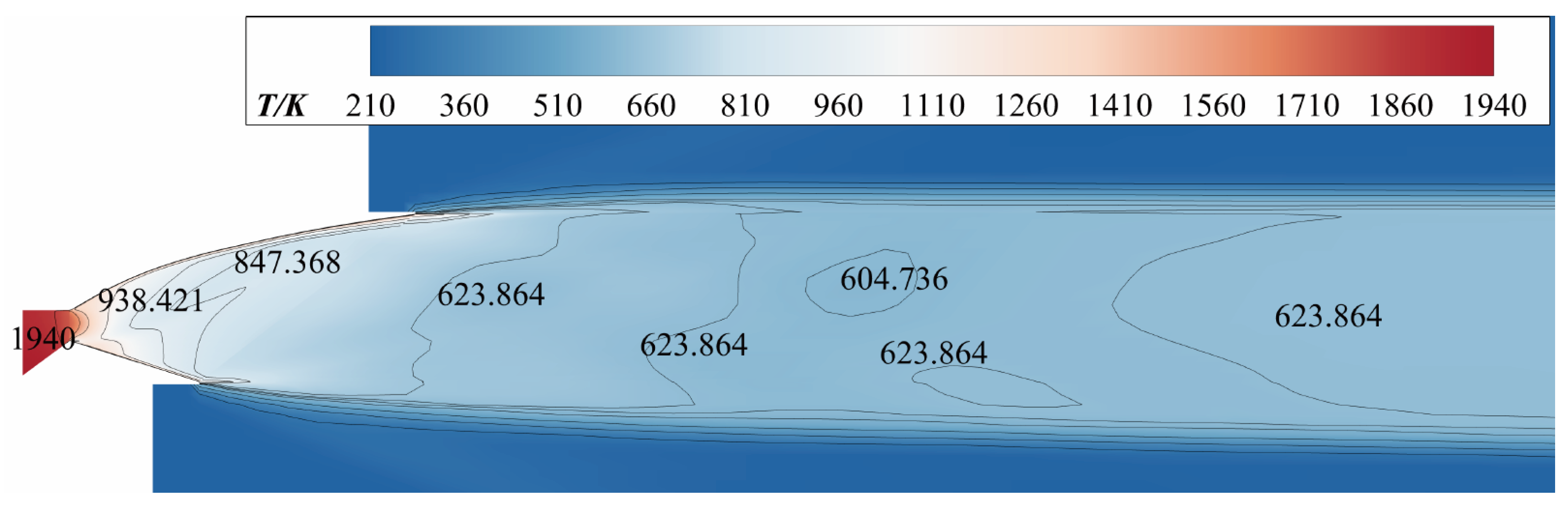
This paper have attempted to apply the gas radiation model to infrared radiation calculations for nozzles and flow fields. To better demonstrate the computational performance of the gas radiation model, the infrared radiation characteristics of the nozzle’s symmetry plane are calculated here. Considering time constraints, this study established the infrared computational grid focusing on the primary region of the jet core. The operating conditions of the nozzle are listed in Table 4, and the temperature contours of the symmetry plane are shown in Figure 18.
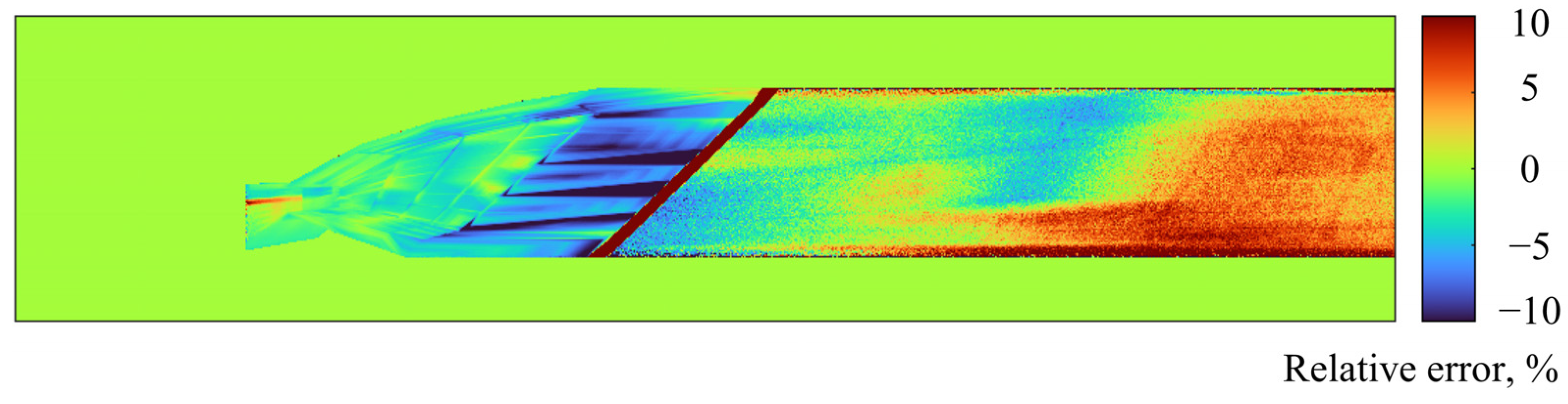
The image pixels are 1000 × 200. By comparing the infrared radiation results of CO2 in the 8~14 μm band from the gas radiation model with those from the LBL method (calculation based on target state points), we obtained the distribution of “Relative error”, which is defined as the ratio of the difference between the gas radiation model result and the LBL result, as shown in Figure 19. As can be seen from Figure 19, the relative error of infrared radiation is within 5% in most areas inside the nozzle, while in the jet core region, the relative errors are mostly within 10%.

6. Discussion

At the beginning of this paper, the cause of computational errors is explained: the g-values are inconsistent across different thermodynamic states. Subsequently, the spectral mapping method is employed to filter gas spectra exhibiting comonotonicity characteristics, thereby ensuring that the selected spectra share identical g-values. Based on this, the comonotonicity between gas spectra within the same group is quantified, and this value is used for screening and grouping via a clustering algorithm. The comonotonicity vector serves as the quantification method, where different vector parameters yield different grouping results. In this regard, the impact of varying vector parameters on the gas radiation model is investigated. When the number of reference state points increases, an exhaustive search algorithm becomes ineffective for optimizing the gas radiation model. Therefore, the PSO algorithm is employed to search for a gas radiation model with improved performance.
Traditional spectral mapping methods quantify projection values using fixed partition intervals according to the ranges of projection values, without accounting for factors such as the distribution density of the spectra. In contrast, the spectral mapping method proposed in this paper employs the PSO algorithm to determine an adaptive quantification scheme suited to the application context, combined with a clustering algorithm to minimize the overall variance of projection values.
Currently, computational errors in practical applications arise from two primary sources: the gas model itself and the interpolation method employed. The gas model error stems from the spectral “correlation” within each group. Meanwhile, the interpolation error occurs due to inaccuracies in calculating scale coefficients under varying gas path lengths and Plank function of k distribution model under varying temperature.
In future work, parameter variations in the PSO and clustering algorithms will be systematically analyzed to understand their impact on the optimization process and results. Furthermore, the PSO algorithm will be employed to identify suitable parameters—such as Planck temperatures—and to optimize the weighting of each interval’s contribution to the overall calculation. This strategy is expected to reduce errors caused by inconsistent ordering of k-distributions within intervals. Additionally, more versatile and accurate fitting functions, such as polynomial expressions characterizing the variation in scaling coefficients, will be developed. These refinements aim to minimize, over varying gas path lengths, the discrepancy between radiative properties derived from reference states and those under real conditions, thus further lowering computational errors in practical applications.

Author Contributions

Conceptualization, J.F. and J.Z. (Junfei Zhou); methodology, J.F.; software, J.F.; validation, J.F. and J.Z. (Junfei Zhou); formal analysis, J.F.; investigation, J.F.; resources, J.F.; data curation, J.F.; writing—original draft preparation, J.Z. (Junfei Zhou); writing—review and editing, J.Z. (Junfei Zhou); visualization, J.Z. (Junsheng Zhang); supervision, J.Z. (Junsheng Zhang); project administration, J.X.; funding acquisition, J.X. All authors have read and agreed to the published version of the manuscript.

Funding

This research was funded by the China Association for Science and Technology youth talent lifting project (Funding No. 2022QNRC001) and by the Key Laboratory of Intake and Exhaust Technology, Ministry of Education (Funding No. CEPE2024013).

Data Availability Statement

The original data presented in the study are not publicly available due to the policies of the supporting institution or project. However, anonymized or processed data supporting the findings are available from the corresponding author (Junfei Zhou) upon reasonable request.

Conflicts of Interest

The authors declare no conflicts of interest.

Abbreviations

The following abbreviations are used in this manuscript:
fik-distribution function
gicumulative k-distribution function
kηispectral absorption coefficient of the gas in i-th state (cm−1)
IbηPlanck function within the wavenumber intervals (w·sr−1·m−2)
Varvariance within group
umncoordinate position corresponding to the wavenumber
u ¯ m mean coordinate in sub-interval
ej,maxmaximum relative error (%)
ferrobjective function for the PSO algorithm
v(t)velocity vector of the particle at time t (s−1)
x(t)position of the particle at time t
winertia weight
c1personal cognitive coefficient
c2global cognitive coefficient
pbestposition of the current particle where ferr reaches the minimum value
gbestposition of the particle with the minimum ferr among all particles
Pstatic pressure (Pa)
Ttemperature (K)
δ(x)Dirac function
ϕgas thermodynamic state

References

  1. Young, S.J. Band Model Theory of Radiation Transport, 1st ed.; American Institute of Aeronautics and Astronautics: Reston, VA, USA, 2013; pp. 2–3. [Google Scholar]
  2. Soufiani, A.; Taine, J. High temperature gas radiative property parameters of statistical narrow-band model for H2O, CO2 and CO, and correlated-K model for H2O and CO2. Int. J. Heat Mass Transf. 1997, 40, 987–991. [Google Scholar] [CrossRef]
  3. André, F. The ℓ-distribution method for modeling non-gray absorption in uniform and non-uniform gaseous media. J. Quant. Spectrosc. Radiat. Transf. 2016, 179, 19–32. [Google Scholar] [CrossRef]
  4. Modest, M.F. Narrow-band and full-spectrum k-distributions for radiative heat transfer: Correlated-k vs. scaling approximation. J. Quant. Spectrosc. Radiat. Transf. 2003, 76, 69–83. [Google Scholar] [CrossRef]
  5. Modest, M.F. Radiative Heat Transfer, 3rd ed.; Academic Press: Cambridge, MA, USA, 2013; pp. 13–14. [Google Scholar]
  6. Wyatt, P.J.; Stull, V.R.; Plass, G.N. Quasi-random model of band absorption. J. Opt. Soc. Am. 1962, 52, 1209–1217. [Google Scholar] [CrossRef]
  7. Di Leon, R.L.; Taine, J. A fictive gas-method for accurate computation of low-resolution IR gas transmissivities: Application to the 4.3 μm CO2 band. Rev. Phys. Appl. 1986, 21, 825–831. [Google Scholar] [CrossRef]
  8. Bharadwaj, S.P.; Modest, M.F. A multiscale Malkmus model for treatment of inhomogeneous gas paths. Int. J. Therm. Sci. 2007, 46, 479–490. [Google Scholar] [CrossRef]
  9. Soufiani, A.; Andre, F.; Taine, J. A fictitious-gas based statistical narrow-band model for IR long-range sensing of H2O at high temperature. J. Quant. Spectrosc. Radiat. Transf. 2002, 73, 339–347. [Google Scholar] [CrossRef]
  10. West, R.; Crisp, D.; Chen, L. Mapping transformations for broadband atmospheric radiation calculations. J. Quant. Spectrosc. Radiat. Transf. 1990, 43, 191–199. [Google Scholar] [CrossRef]
  11. Bennartz, R.; Fischer, J. A modified k-distribution approach applied to narrow band water vapour and oxygen absorption estimates in the near infrared. J. Quant. Spectrosc. Radiat. Transf. 2000, 66, 539–553. [Google Scholar] [CrossRef]
  12. Doppler, L.; Preusker, R.; Bennartz, R.; Fischer, J. k-bin and k-IR: k-distribution methods without correlation approximation for non-fixed instrument response function and extension to the thermal infrared—Applications to satellite remote sensing. J. Quant. Spectrosc. Radiat. Transf. 2014, 133, 382–395. [Google Scholar] [CrossRef]
  13. Zhang, H.M.; Modest, M.F. Multi-group full-spectrum k-distribution database for water vapor mixtures in radiative transfer calculations. In Proceedings of the ASME 2003 Heat Transfer Summer Conference, Las Vegas, NV, USA, 21–23 July 2003. [Google Scholar]
  14. Andre, F.; Hou, L.F.; Roger, M.; Vaillon, R. The multispectral gas radiation modeling: A new theoretical framework based on a multidimensional approach to k-distribution methods. J. Quant. Spectrosc. Radiat. Transf. 2014, 147, 178–195. [Google Scholar] [CrossRef]
  15. Andre, F.; Hou, L.; Solovjov, V.P. An exact formulation of k-distribution methods in non-uniform gaseous media and its approximate treatment within the MultiSpectral framework. In Proceedings of the Eurotherm Conference N°105: Computational Thermal Radiation in Participating Media V, Albi, France, 1–3 April 2015. [Google Scholar]
  16. Andre, F.; Vaillon, R. The multi-spectral reordering (MSR) technique for the narrow band modeling of the radiative properties of non-uniform gaseous paths: The correlated/uncorrelated approximations. J. Phys. Conf. Ser. 2012, 369, 012017. [Google Scholar] [CrossRef]
  17. Wu, Y.; Hu, H.Y.; Wang, Q.; Duan, R.; Xie, Y.; Deng, H. Parameter optimization of multi-scale multi-group wide-band k-distribution models. J. Aerosp. Power 2024, 39, 37–51. [Google Scholar]
  18. Hu, H.Y.; Li, Y.H.; Wei, Z.Y.; Wang, Q. Parameter optimization for MSMGWB model used to calculate infrared remote sensing signals emitted by hot combustion gases of hydrocarbon fuel. J. Quant. Spectrosc. Radiat. Transf. 2020, 249, 107003. [Google Scholar] [CrossRef]
  19. Li, Y.; Hu, H.; Wang, Q. Non-dominated sorting genetic algorithm II (NSGA2)-based parameter optimization of the MSMGWB model used in remote infrared sensing prediction for hot combustion gas plume. Remote Sens. 2024, 16, 3116. [Google Scholar] [CrossRef]
  20. Solovjov, V.P.; André, F.; Webb, B.W.; Compiègne, M.; Dubuisson, P.; Labonnote, L.C. The Spectral Gamma Function of gas absorption coefficient and its application to analysis and enhancement of the correlated spectral modeling of radiative transfer in non-uniform gaseous media. J. Quant. Spectrosc. Radiat. Transf. 2025, 330, 109214. [Google Scholar] [CrossRef]
  21. Losacker, J.; Garcia, A.M.; Schmitz, N.; Wuppermann, C. Full-spectrum k-distribution weighted sum of gray gases model for air and oxyfuel combustion of hydrogen-hydrocarbon blends at atmospheric pressure. Therm. Sci. Eng. Prog. 2025, 61, 2451–9049. [Google Scholar] [CrossRef]
  22. André, F.; Solovjov, V.P.; Webb, B.W.; Galtier, M.; Dubuisson, P. Spectral mapping method based on intervals of comonotonicity for modelling of radiative transfer in non-uniform gaseous media. J. Quant. Spectrosc. Radiat. Transf. 2019, 229, 33–39. [Google Scholar] [CrossRef]
  23. Zhong, H.; Yang, R.; Zheng, A.; Zheng, M.; Mei, Y. Two-Stage Uncertain UAV Combat Mission Assignment Problem Based on Uncertainty Theory. Aerospace 2025, 12, 553. [Google Scholar] [CrossRef]
  24. Clerc, M.; Kennedy, J. The particle swarm-explosion, stability, and convergence in a multidimensional complex space. Trans. Evol. Comput. 2002, 6, 58–73. [Google Scholar] [CrossRef]
Figure 1. Example of three spectra reordered with respect to the same cumulative k-distribution function related to state 1.
Photonics 13 00164 g001
Figure 2. The distribution of spectral points in the g-value space.
Photonics 13 00164 g002
Figure 3. Discretization of the g-value space into diagonal belts.
Photonics 13 00164 g003
Figure 4. Subsets of comonotonic absorption coefficients (groups).
Photonics 13 00164 g004
Figure 5. K-means clustering algorithm process.
Photonics 13 00164 g005
Figure 6. One-dimensional radiative transfer test case (three states).
Photonics 13 00164 g006
Figure 7. Comparison of four k-distribution methods.
Photonics 13 00164 g007
Figure 8. Relationship between comonotonic vector parameters and maximum error in 0-D case.
Photonics 13 00164 g008
Figure 9. Comparison of five k-distribution methods.
Photonics 13 00164 g009
Figure 10. One-dimensional radiative transfer test case (nine states).
Photonics 13 00164 g010
Figure 11. Particle Swarm Optimization algorithm process (left) and particle iterative process (right).
Photonics 13 00164 g011
Figure 12. Comparison of computational results from different gas models in the 3~5 μm band (H2O).
Photonics 13 00164 g012
Figure 13. Comparison of computational results from different gas models in the 8~14 μm band (H2O).
Photonics 13 00164 g013
Figure 14. Comparison of computational results from different gas models in the 3~5 μm band (CO2).
Photonics 13 00164 g014
Figure 15. Comparison of computational results from different gas models in the 8~14 μm band (CO2).
Photonics 13 00164 g015
Figure 16. Comparison of different gas models in the 8~14 μm band (CO2).
Photonics 13 00164 g016
Figure 17. Fitting results of the scale coefficient of 300 K reference state point (CO2) between difference target gas states.
Photonics 13 00164 g017
Figure 18. The temperature contours of the symmetry plane.
Photonics 13 00164 g018
Figure 19. Relative error distribution of the gas radiation model in the 8~14 μm band.
Photonics 13 00164 g019
Table 1. Three thermodynamic state parameters.
Thermodynamic StateP/PaT/Kx (H2O)x (CO2)
State 1 (atmosphere)91,192.53000.0180.00034
State 2 (exhaust plume 1)101,3259000.0750.075
State 3 (exhaust plume 2)202,65019000.10.1
Table 2. Nine thermodynamic state parameters.
StateP/PaT/Kx (H2O)x (CO2)
exhaust plume 1202,65019000.120.12
exhaust plume 2101,32519000.120.12
exhaust plume 350,662.515000.10.1
exhaust plume 4101,3259000.080.08
exhaust plume 550,662.59000.080.08
atmosphere 1101,3253000.0340.00034
atmosphere 2101,3253000.00680.00034
atmosphere 391,192.52930.020.00034
atmosphere 450,662.52630.00020.00034
Table 3. Comparison of different gas radiation models.
ModelGroup Numberferr
Reference101.1663
CK-KP250.4988
Table 4. The operating conditions of the nozzle.
L/mmHout/mmMacP */PaT */KPb/PaTb/K
8403604237,5001937.72549.22221.552
* denotes the total state.
Disclaimer/Publisher’s Note: The statements, opinions and data contained in all publications are solely those of the individual author(s) and contributor(s) and not of MDPI and/or the editor(s). MDPI and/or the editor(s) disclaim responsibility for any injury to people or property resulting from any ideas, methods, instructions or products referred to in the content.