Article

An Adaptive Optical Limiter Based on a VO2/GaN Thin Film for Infrared Lasers


1
Anhui Province Key Laboratory of Electronic Environment Intelligent Perception and Control, College of Electronic Engineering, National University of Defense Technology, Hefei 230037, China
2
State Key Laboratory of Pulsed Power Laser Technology, College of Electronic Engineering, National University of Defense Technology, Hefei 230037, China
3
Advanced Laser Technology Laboratory of Anhui Province, College of Electronic Engineering, National University of Defense Technology, Hefei 230037, China
4
National Synchrotron Radiation Laboratory, University of Science and Technology of China, Hefei 230029, China
*
Authors to whom correspondence should be addressed.
These authors contributed equally to this work.
Photonics 2026, 13(2), 148; https://doi.org/10.3390/photonics13020148

Submission received: 16 January 2026 / Revised: 29 January 2026 / Accepted: 30 January 2026 / Published: 3 February 2026
(This article belongs to the Special Issue Emerging Trends in Photodetector Technologies)

Abstract

Vanadium dioxide (VO2) is a highly promising material for infrared laser protection due to the pronounced optical switching effect during its metal–insulator transition (MIT). However, due to the relatively high MIT temperature of VO2 and the low transmittance contrast before and after the MIT, practical applications face challenges in modulation depth and response time. In this study, we address these issues using a wafer-scale VO2/GaN/Al2O3 heterostructure fabricated by oxide molecular beam epitaxy. The conductive GaN interlayer enables local Joule heating of the VO2 film, permitting direct control of the MIT via an external bias with a threshold of 4.7 V. This structure exhibits a substantial resistance change of four orders of magnitude and enables adaptive limiting of a 3.7 μm laser, reducing transmittance from 60% to 10%. Our work demonstrates a practical, wafer-scale laser-protection device and introduces a pre-excitation strategy via external biasing to enhance response performance.

1. Introduction

As a strongly correlated electron oxide, VO2 undergoes a distinct metal–insulator transition (MIT) upon temperature variation, transitioning from an insulating or semiconducting phase at lower temperatures to a metallic phase at elevated temperatures [1]. In addition, a distinct optical switching effect, especially within the infrared wavelength range, always appears across the MIT process [2,3]. Due to these special electronic and optical properties, VO2 demonstrates tremendous potential applications in many fields, such as smart windows [4], optical switching devices [5], memory materials [6], photoconductive infrared detectors [7], and thermal [8]/chemical sensors [9,10].
The pronounced switching behavior of VO2 within the infrared spectral region renders it highly suitable for application as an infrared photoelectric limiter. The most important performance parameter for the infrared limiter is the switching characteristic of its infrared transmittance. Therefore, many methods have recently been introduced to improve the infrared photoelectric switching properties of VO2 films [11,12,13,14,15,16,17]. Wang et al. [18] developed a tunable infrared optical switch by integrating a VO2 film within an Al nanoarray plasmonic structure, achieving a modulation depth as high as 99.4% and an extinction ratio exceeding −22.16 dB. Wan et al. [19] designed a VO2 inductive transfer filter (ITF) that modulates the response from single-band to multi-band and improves infrared imaging contrast. Besides thermal stimulation, alternative stimuli including electric fields (bias voltage or current) and electromagnetic radiation are also effective in triggering the MIT in VO2 to meet the necessary conditions for its practical application and provide more potential applications [20,21,22,23]. It is noteworthy that for high-speed, linear modulation applications, transparent conductive oxides such as indium tin oxide (ITO) have demonstrated remarkable potential, achieving GHz-rate operation through carrier-plasma dispersion effects [24]. For instance, Qi et al. [25] prepared a VO2/ITO limiter, with a threshold voltage of only 1.4 V, a modulation depth of 35% of the optical switch, and response times of 0.24 ms and 2.1 ms, respectively. Optical limiters, as a class of nonlinear photonic devices, are characterized by a reduction in optical transmittance as the intensity of the incident light increases [26]. Within a silicon photonics platform, Parra et al. [27] implemented an integrated optical limiter employing a miniaturized VO2/Si waveguide configuration that exhibits an activation threshold as minimal as 3.5 mW. It is reported that the phase transition of VO2 can be induced by lasers [28,29], which enables the limiting of infrared lasers. Employing micro-Raman spectroscopy with gradually increasing excitation power, Vilanova-Martínez et al. [30] studied the impact of intense visible laser radiation on VO2 crystals maintained in an ambient air environment, and achieved a laser-induced reversible phase transition of VO2. However, despite the progress achieved in VO2 films in terms of composite films, element doping and other aspects, the synergistic optimization of a reduced phase transition threshold and a high infrared switching ratio remains a significant challenge for VO2 films.
In this work, a VO2/GaN/Al2O3 composite film was fabricated via metal–organic chemical vapor deposition (MOCVD) and molecular beam epitaxy (MBE). A pre-excitation strategy with localized temperature control via an external voltage was proposed. It successfully reduces the threshold power to 330 mW and shortens the response time to 9 s, effectively breaking through the performance bottlenecks of traditional schemes. The conductive GaN interlayer enables local Joule heating of the VO2 film, permitting direct control of the MIT via an external bias with a threshold of 4.7 V. This structure exhibits a substantial resistance change of four orders of magnitude and enables adaptive limiting of a 3.7 μm laser, reducing transmittance from 60% to 10%.

2. Materials and Methods

The core of this device for rapid adaptive optical limiting lies in the adoption of a pre-excitation strategy, and its working principle is illustrated in Figure S5. Prior to laser incidence, a preset fixed DC voltage is first applied to the intermediate GaN layer. At this point, the conductive GaN layer generates Joule heat, heating the VO2 film to a pre-activated state close to the phase transition temperature. In this state, when irradiated by a mid-infrared laser, the film only needs to absorb a very small amount of additional light energy for its temperature to quickly cross the phase transition point, triggering a rapid transition from the high-transmission insulating state to the low-transmission metallic state, thereby achieving effective laser limiting. Once the laser irradiation ceases, the applied voltage is removed, and the device cools naturally through heat conduction, ultimately returning to the initial high-transmission insulating state. This completes an entire working cycle, and the device is ready for the next round of protection.
A commercial conductive n-type GaN epitaxial layer on a c-plane sapphire grown by MOCVD was used in this work. The GaN substrates were ultrasonically cleaned in acetone and isopropanol sequentially for 10 min each, which was followed by a deionized water rinse. Then, the VO2 layer was grown on this n-GaN layer by an rf-plasma-assisted oxide-MBE. And 4 N-purity vanadium evaporated by an e-beam evaporator and 5 N-purity O2 activated by a radio frequency plasma source were used for oxygen flux. Throughout the epitaxial synthesis of the VO2 layer, the substrate temperature was stabilized at 530 °C and the deposition chamber pressure sustained at 3.2 × 10⁻⁵ torr. Concurrently, reflection high-energy electron diffraction (RHEED) was utilized to monitor the structural evolution in situ during the entire growth process.
The microstructural properties of the synthesized epitaxial thin films were probed via Raman spectroscopy employing a 532 nm excitation source. Furthermore, crystallographic phases and epitaxial alignment were determined through X-ray diffraction (XRD) characterization conducted at the BL14B1 beamline of the Shanghai Synchrotron Radiation Facility (SSRF). φ scan XRD was also performed in order to examine the epitaxial growth behavior at the interface. The resistance of the film sample, as a function of temperature, was characterized by employing a customized four-point probe configuration integrated with a precision temperature-regulated sample platform.

3. Results and Discussion

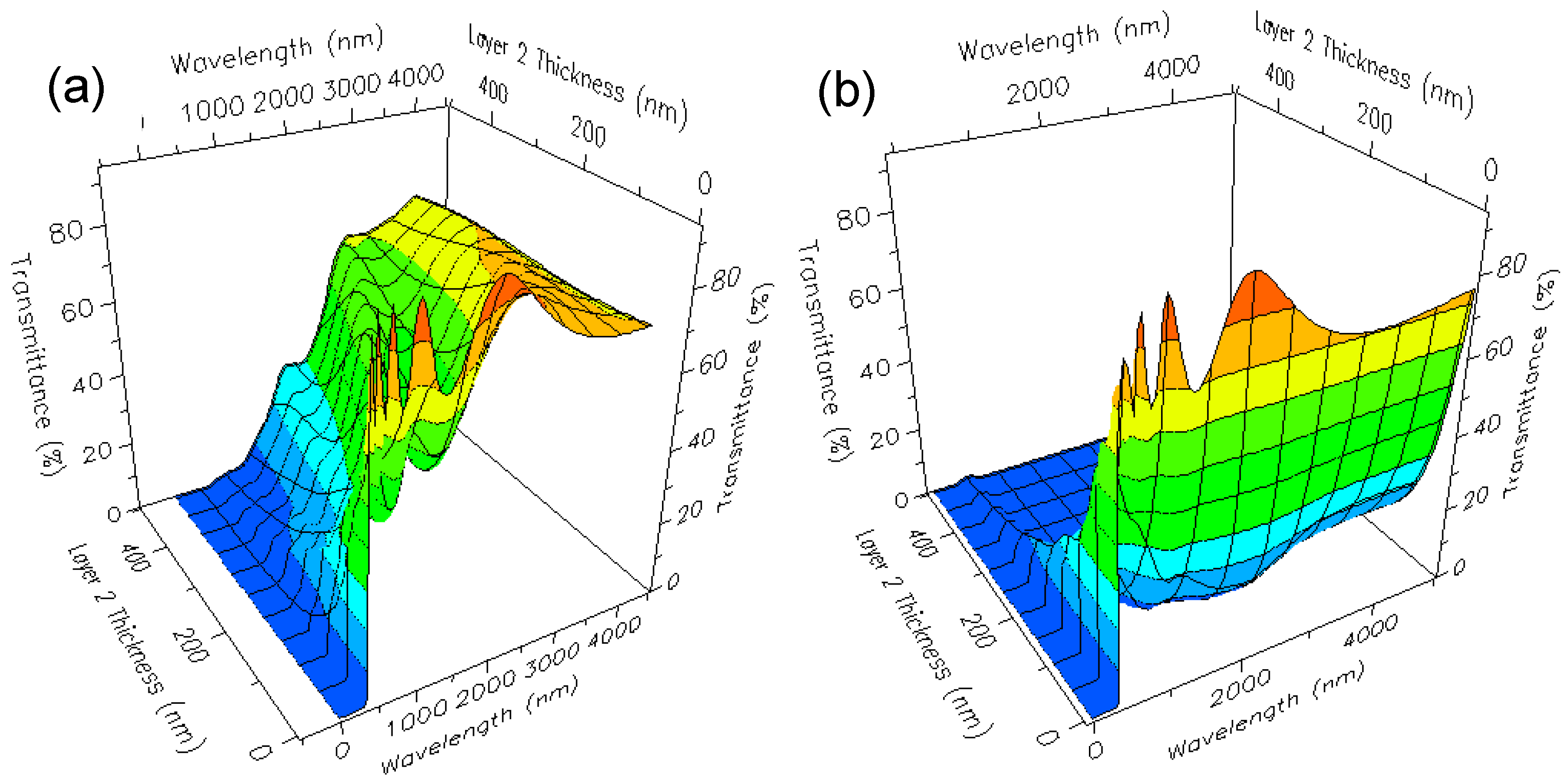
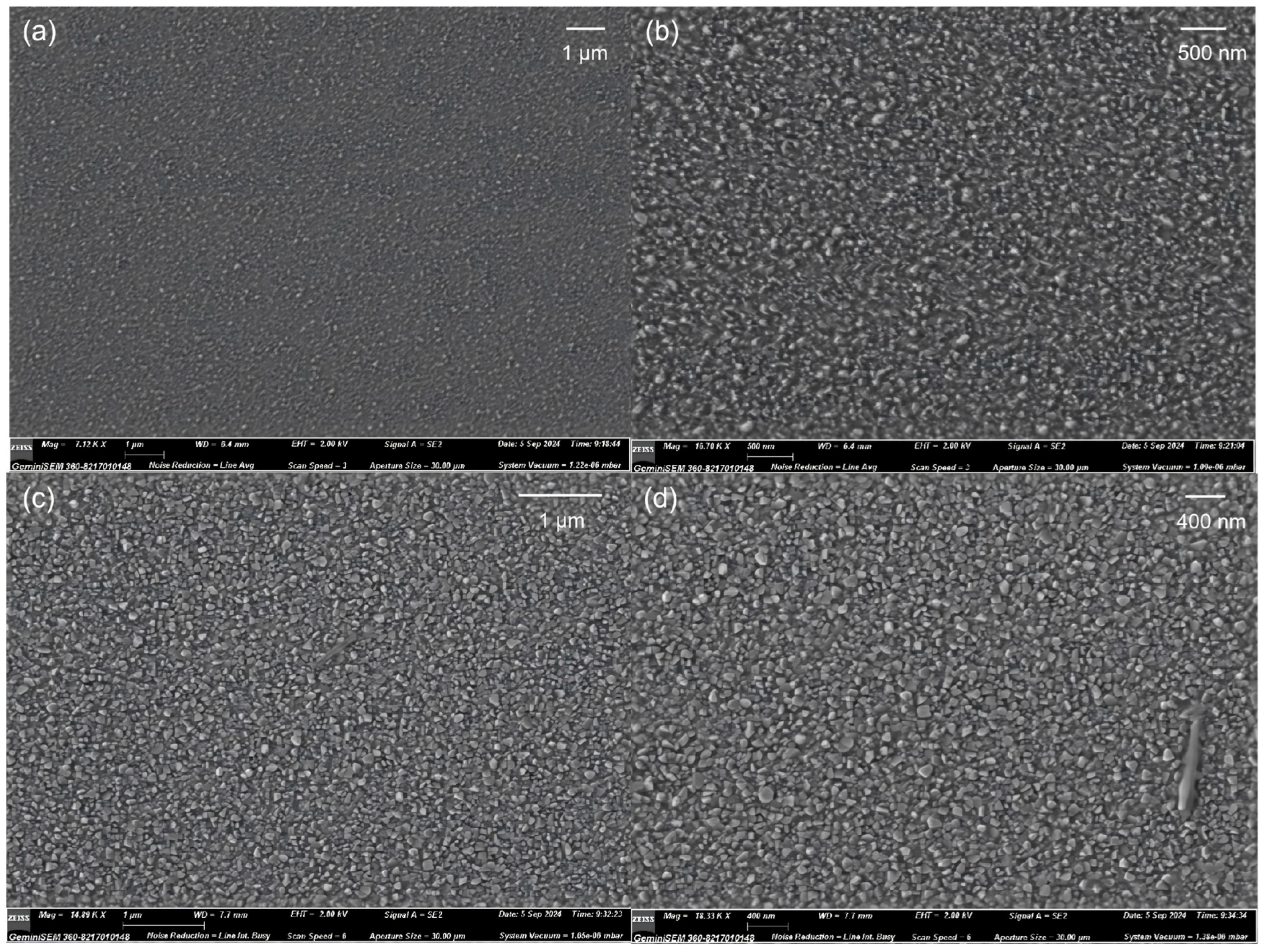
The conventional direct growth of VO2 on thick Al2O3 substrates poses a challenge for laser-induced adaptive limiting, as the substrate absorbs most incident energy, preventing the VO2 from reaching its phase transition temperature. Our solution, depicted in Figure S1, is a multilayer structure incorporating a conductive GaN interlayer. This design serves dual purposes: it ensures epitaxial compatibility for VO2 growth and enables direct Joule heating of the VO2 via an applied bias to the GaN, decoupling the heating from laser absorption. To finalize the design, the VO2 film thickness was optimized through optical simulations. The relationship between transmittance, VO2 film thickness, and wavelength is visualized in the 3D plot in Figure 1, where the transmittance characteristics of VO2 in the low-temperature insulating state and high-temperature metallic state are presented in Figure 1a,b, respectively. It can be seen that no drastic abrupt change in transmittance occurs when VO2 is in the low-temperature insulating state. This phenomenon is consistent with the optical absorption law of semiconductor materials. In the high-temperature metallic state, the transmittance decreases significantly. Particularly in the 2–4 μm band, the transmittance drops rapidly to below 20% when the film thickness exceeds 50 nm. Furthermore, the modulation depth in the mid-infrared region is much larger than that in the near-infrared region. These results not only verify the feasibility of VO2 as an infrared optical limiter but also provide key references for the selection of the device’s operating band and the optimization of film thickness in subsequent work. The measured transmittance spectra for this optimized device before and after phase transition are provided in Figure S2. A VO2 thin film with a flat and dense surface was prepared on a GaN/Al2O3 substrate by MBE, and the details of the epitaxial film preparation have been systematically elaborated on in previously published work [29]. As shown in Figure 2, the surface morphology of the VO2 film was tested with a scanning electron microscope (SEM), from which it can be seen that the VO2 film has flat surfaces, dense and uniform film layers, and obvious and tightly bonded particles. From the energy-dispersive spectrometer (EDS) spectrum (Figure S3), it can be seen that the VO2 film does not contain other elemental impurities, except VO2 and GaN.
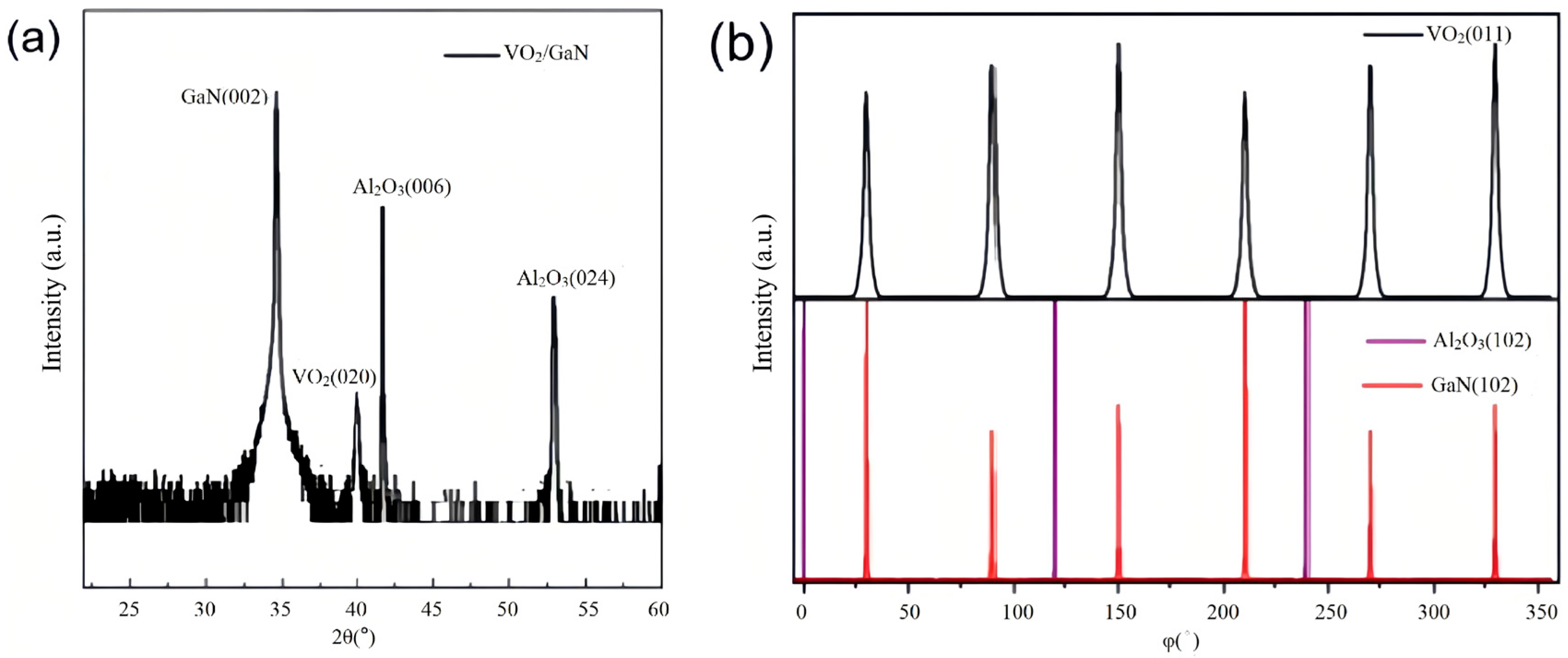
In order to study the crystal structure and epitaxial alignment relationships within the VO2/GaN heterostructure, detailed θ-2θ scanning and φ scanning diffraction tests were carried out. In the θ-2θ scanning mode (shown in Figure 3a), it can be seen that the sample exhibits a strong Al2O3 single crystal substrate diffraction peak, and the micron-thick GaN film also has a strong GaN (002) diffraction peak. The epitaxial VO2 film grown on the GaN/Al2O3 substrate has a single diffraction peak at 2θ = 39.8°, which is the diffraction peak of VO2 (020) after comparison. And in the φ scanning diffraction studies, considering the hexagonal symmetric structure of the Al2O3 (0001) plane, the diffraction signals of the VO2 (011) and GaN/Al2O3 (102) planes were selected in the φ scan mode. It can be seen from Figure 3b that along the (001) direction, the Al2O3 single crystal has triple symmetry, while the GaN film has a sixfold symmetric structure. In addition, it can be seen that there is an in-plane rotation angle of 30° between the GaN (102) diffraction peak and the Al2O3 (102) in the φ scan mode. By comparing the diffraction peaks of VO2 (011), we can see the hexagonal symmetry, and the diffraction peaks of VO2 (011) correspond to the diffraction peaks of GaN (102), indicating that the a-axis direction of VO2 is consistent with the b-axis direction of GaN in the plane. Thus, the lattice orientation match in the plane can be written as Al2O3 (−12–10)/GaN (0–110), Al2O3 (10–10)/GaN (2–1–10) or Al2O3 (11–20)/GaN (0–110), Al2O3 (1–100)/GaN (2–1–10) and VO2 (100)/GaN (–12–10), VO2 (001)/GaN (2–1–10). The in-plane matching relationship of this epitaxial growth is consistent with that reported in the literature, indicating that this sample has very good epitaxial growth behavior.
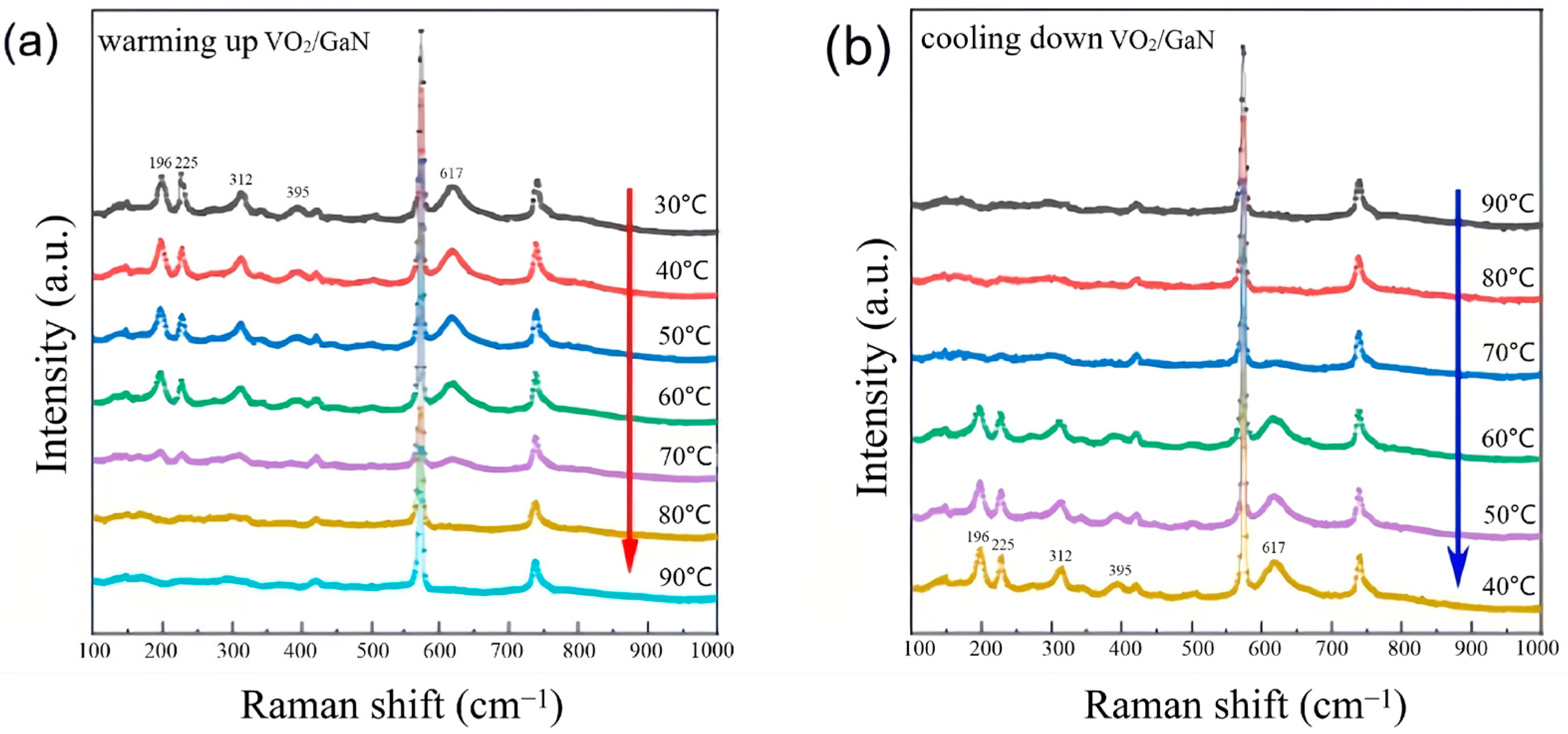
Temperature-variable Raman spectroscopy can directly detect the structural transition of VO2 films from the low-temperature monoclinic phase to the high-temperature rutile phase before and after the MIT. Figure 4a shows the Raman spectrum of the sample during the heating process. It can be seen that at 30 °C, except for the Raman peak from the substrate, the VO2 in the low-temperature insulation phase presents the characteristic Raman peaks of a monoclinic phase structure at 196 cm−1, 225 cm−1, 312 cm−1, 395 cm−1 and 617 cm−1. As the temperature rises, the characteristic Raman peaks of VO2 gradually weaken, and they disappear completely at a temperature of 70 °C or higher, which indicates that VO2 has undergone a complete phase transition and the entire crystal structure has completely changed to the rutile metallic phase. Figure 4b shows the cooling process starting from 90 °C. It can be seen that with the decrease in temperature, the characteristic Raman peak of the low-temperature insulating phase of VO2 gradually begins to appear at 60 °C or lower temperatures. The results show that the low-temperature monoclinic phase begins to appear again during the cooling process, which proves the reversibility of the temperature-modulated metal–insulation phase transition of VO2. At the same time, it can be seen from the Raman spectrum of the variable temperature that the phase transition temperature corresponding to the heating and cooling process is between 60 °C and 70 °C, which is in good agreement with the critical temperature obtained by the variable temperature resistance test.
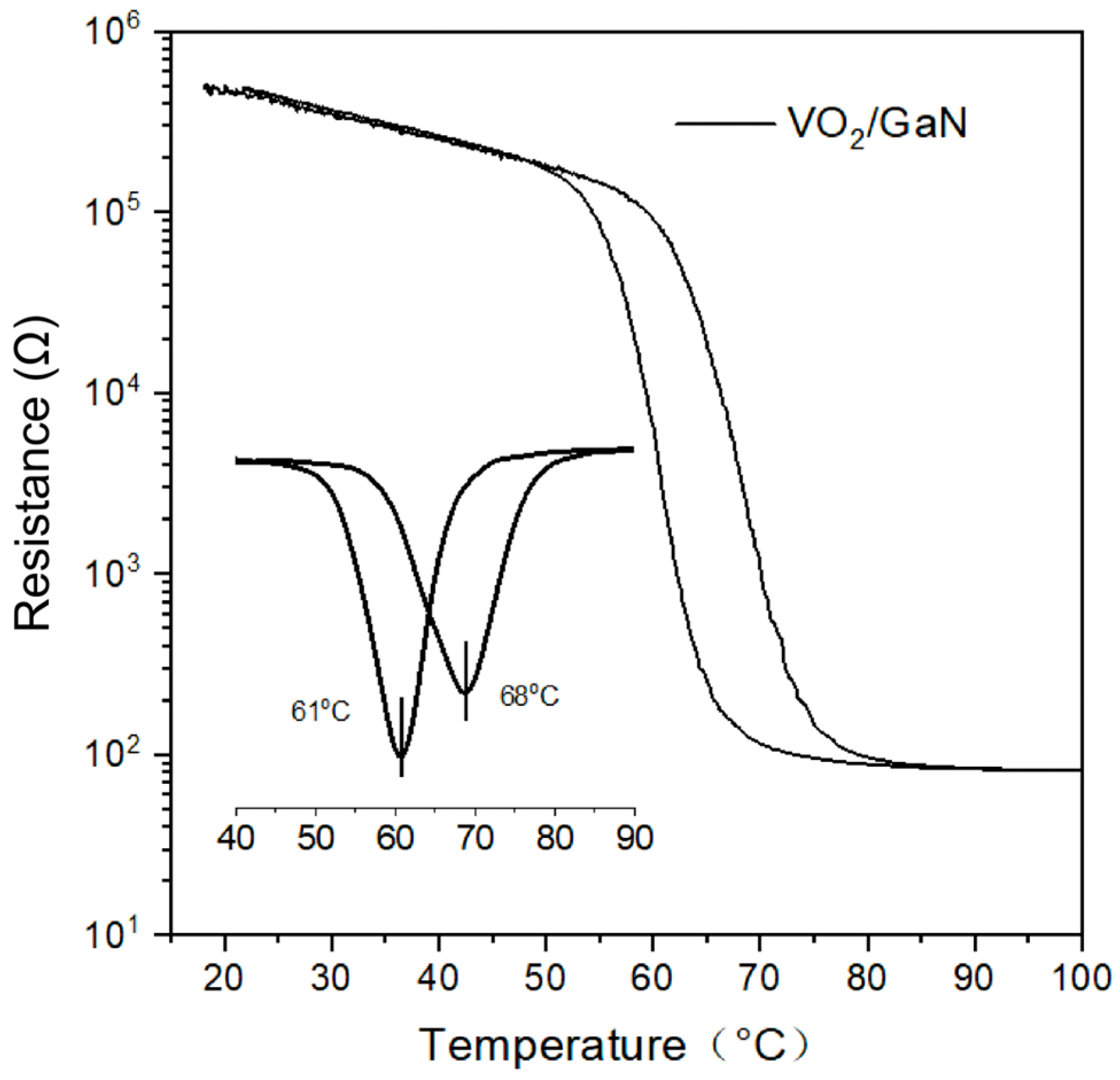
In order to further investigate the influence of VO2 film phase transition on its photoelectric properties, we conducted a temperature variation performance test on the device (as shown in Figure 5). It can be seen from Figure 5 that the sample has a large resistance (~6 × 10⁵ Ω) at room temperature, showing an insulating state. As the temperature increases, the resistance changes by nearly four orders of magnitude, thus showing a metallic state (~80 Ω). During the cooling process, The sample reverts from the high-temperature metallic state to the room-temperature insulating state. The temperature hysteresis effect is obvious in the process of increasing and decreasing temperature, which is a typical phase transition characteristic of vanadium dioxide phase change materials. According to the differential graphs of the heating and cooling curves shown in the inserted figure, the critical phase transition temperatures corresponding to the heating and cooling processes of the prepared VO2/GaN film are 68 °C and 61 °C, respectively, which are in good agreement with the previous literature reports.
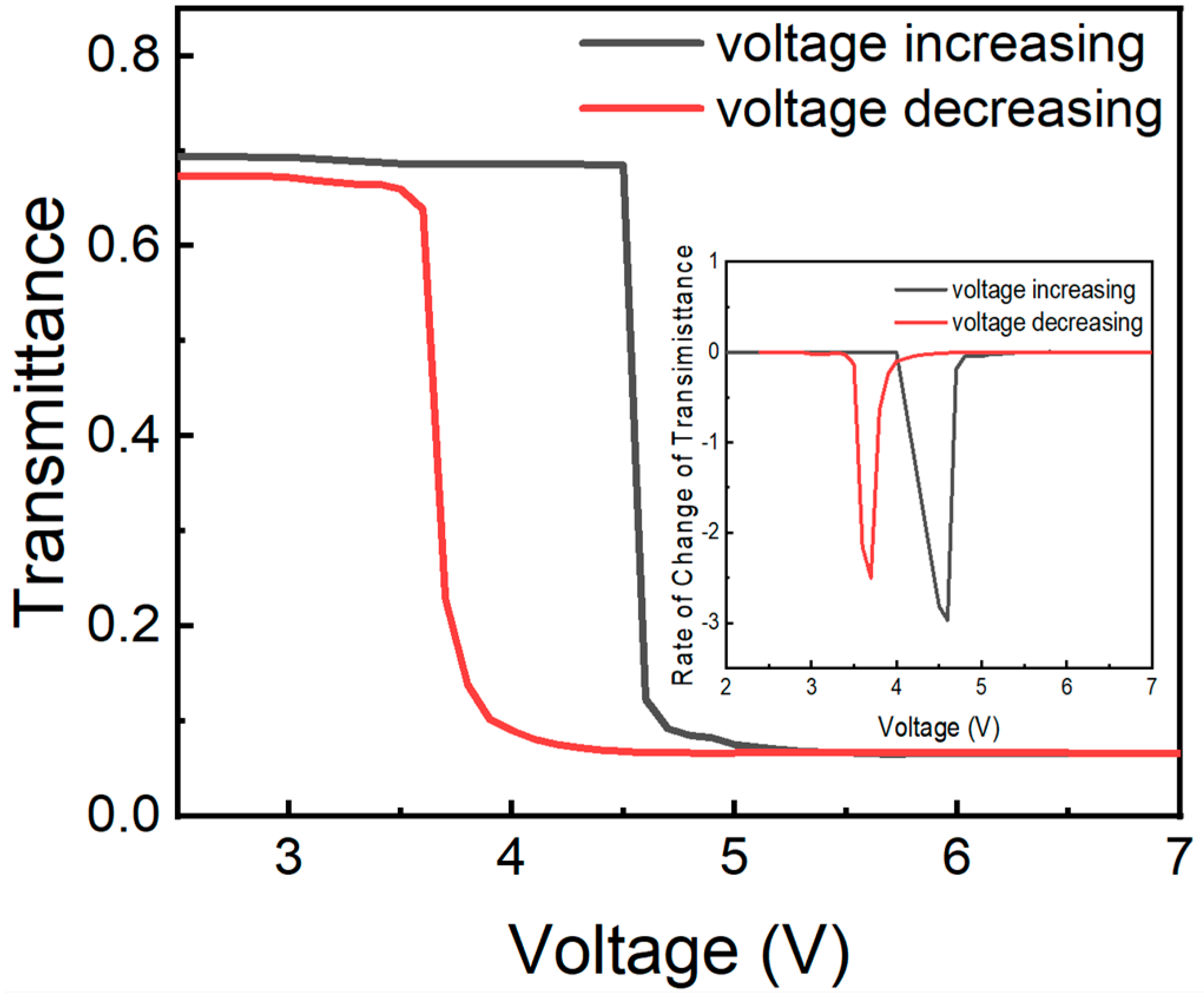
The relationship between the device’s mid-infrared transmittance and the applied bias voltage was characterized using a 3.7 μm laser (setup shown in Figure S4). As shown in Figure 6, the transmittance initially decreased gradually with increasing voltage until reaching approximately 4.7 V, where a sharp drop occurred, indicating a phase transition in the VO2 film. This transition was marked by a substantial increase in reflectance and a concurrent drastic decrease in transmittance, establishing ~4.7 V as the critical phase transition voltage during heating. Conversely, during the downward voltage sweep, the transmittance recovered abruptly at around 3.6 V. To further verify the localized Joule heating effect of the GaN interlayer, we have added supplementary infrared thermal images, as shown in Figure S5.
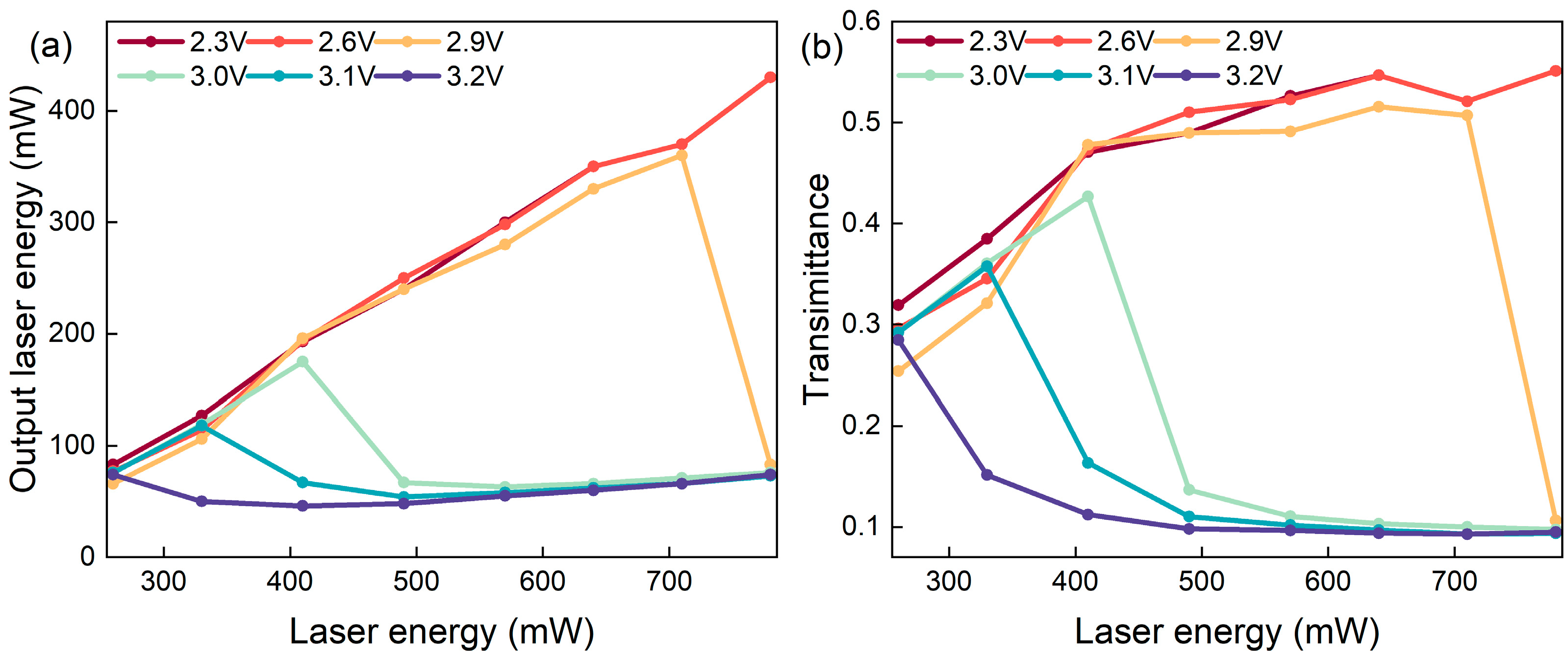
To evaluate the device’s adaptive amplitude-limiting response to mid-infrared lasers, we employed the same optical configuration (Figure S2). As shown in Figure 7a, the output power of the VO2/GaN/Al2O3 composite film is plotted against the incident laser power for various bias voltages. The laser power required to trigger the phase transition decreases with increasing bias. For example, the output power begins to saturate at ~780 mW incident power under 2.9 V bias, while under 4.0 V bias, the transition occurs at a significantly lower incident power of ~260 mW. Figure 7b presents the mid-infrared transmittance as a function of incident laser power under the same conditions, directly showing the sharp transmittance drop from ~50% to ~10% upon phase transition and its shift to lower incident powers at higher bias. The combination of these two results clearly demonstrates that electrical pre-excitation via the GaN layer significantly enhances the sensitivity of the optical limiter.
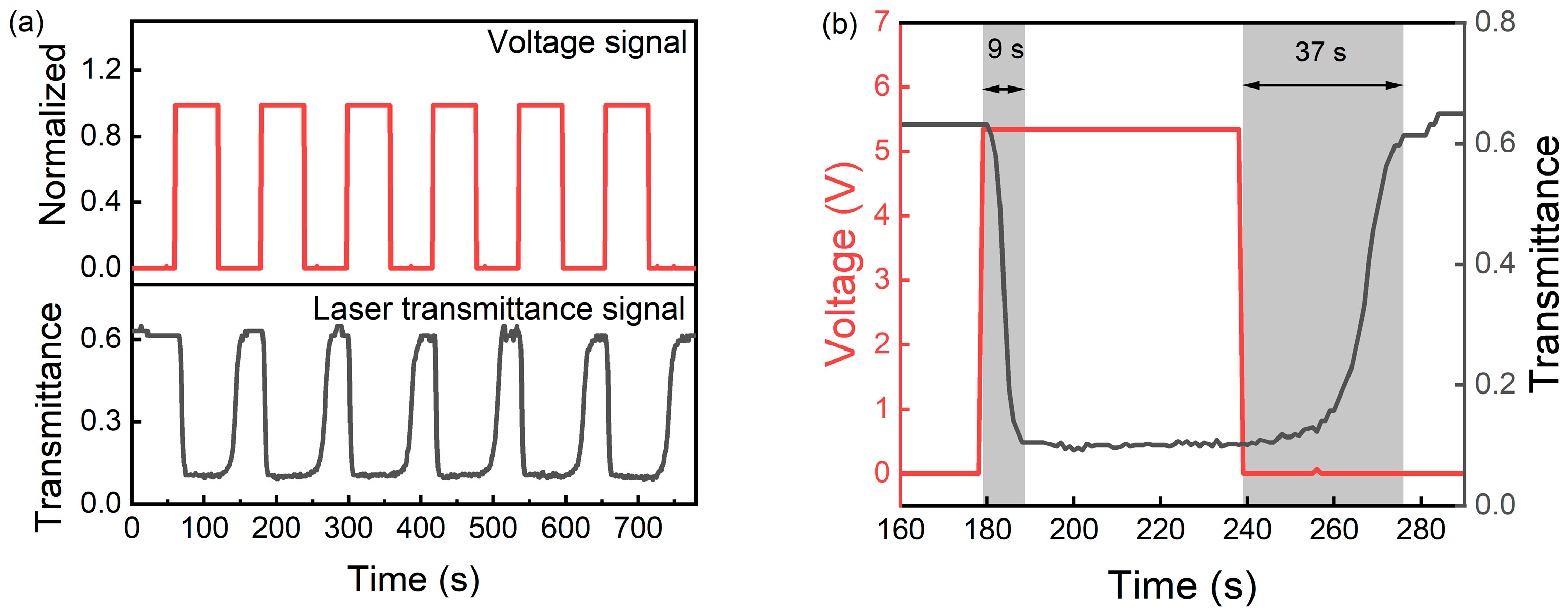
Cycle stability is a critical performance metric for laser limiting devices. Figure 8a presents the film transmittance as a function of the square-wave pulse voltage period, revealing clear repeatability and stability during the phase transition process. Figure 8b shows the transmittance variation over a single voltage pulse cycle. Upon phase transition, the transmittance drops from 60% to 10%, with measured response times of 9 s for the “on” state and 37 s for the “off” state. Although the transmittance decreases shortly after the voltage is applied, the optical switch remains in the “off” state for a certain duration even after the electrical excitation is removed. This behavior can be attributed to the thermal hysteresis effect induced by Joule heating and the heat dissipation limitation of the multilayer heterostructure (as shown in Item 8 of the Supporting Information), suggesting that thermally driven phase transition plays an important role in large-scale VO2-based electro-optic switches, ultimately limiting their “off” response speed.
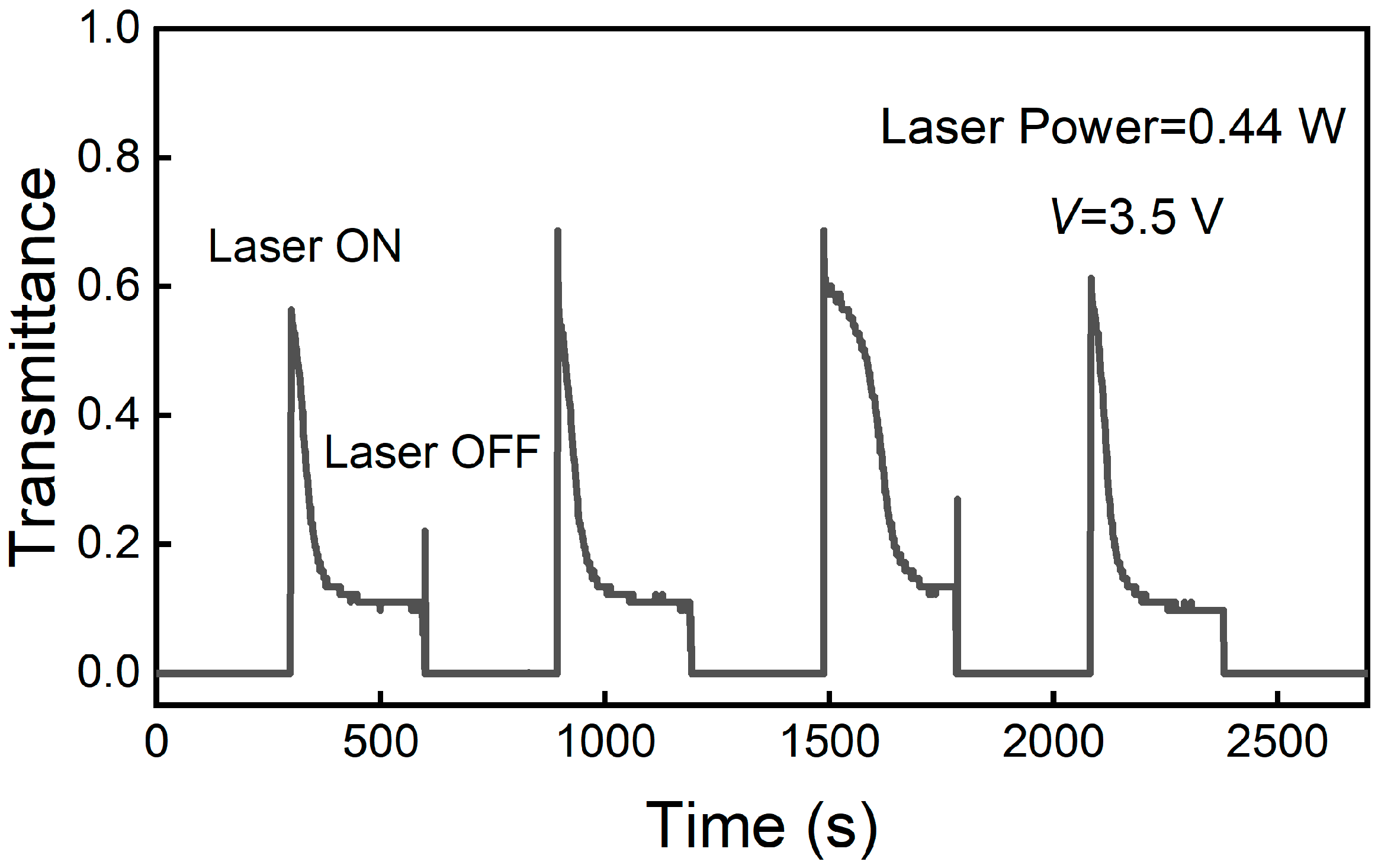
Laser-induced phase transition capability and cycling durability are essential for VO2-based adaptive laser limiters. As shown in Figure 9, the device was subjected to periodic laser switching (300 s intervals) under a 3.5 V bias to evaluate its adaptive phase transition behavior. When the laser is turned on, the transmittance decreases from approximately 60% to 10%, and this transition is reproducibly observed over multiple cycles, demonstrating the excellent repeatability and cycle stability required for adaptive laser limiting applications.
As shown in Table 1, we have summarized and classified the performance indicators of some VO2 laser limiter devices. Compared with other VO2-based tunable systems, this work has for the first time achieved wafer-scale fabrication, laying the foundation for the large-scale integration and industrialization of the devices. In terms of performance, this heterostructure can achieve a modulation depth of up to 50% (from 60% to 10%) with only 330 mW (3.5 V) of electrical driving power. It also has excellent response characteristics (rise/fall times are 9 s and 37 s respectively). Particularly importantly, by integrating VO2 with a high-thermal-conductivity and high-stability GaN epitaxial layer and sapphire substrate, this system demonstrates excellent comprehensive engineering applicability, including high reliability, good thermal management capability, and high compatibility with existing semiconductor processes. These features collectively address the core bottlenecks commonly faced by current VO2-based dynamic photonic devices, such as high driving power consumption, limited modulation amplitude, and difficulty in large-scale production.

4. Conclusions

In summary, a VO2/GaN/Al2O3 multilayer composite film was fabricated by growing a VO2 film on a GaN/Al2O3 substrate via molecular beam epitaxy. Four-point probe measurements revealed that the film’s resistance changes by four orders of magnitude between high and low temperatures. Electrically heating the GaN layer enabled the identification of a critical phase transition voltage of 4.7 V for the VO2 film. Using this, a mid-infrared (3.7 μm) laser adaptive limiter was demonstrated. Upon applying a bias slightly below this threshold and an incident laser energy of 330 mW, the film underwent a phase transition, and its transmittance dropped from 60% to 10%. This result confirms the successful realization of an adaptive infrared laser limiter based on the VO2/GaN/Al2O3 composite film.

Supplementary Materials

The following supporting information can be downloaded at https://www.mdpi.com/article/10.3390/photonics13020148/s1: Figure S1: Schematic diagram of thin film structure; Figure S2: Comparison of VO2 film phase transition optical transmittance before and after phase change; Figure S3: EDS spectrum of VO2 thin film; Figure S4: Optical path of VO2 film’s critical phase transition electric field measurement; Figure S5: Infrared thermal imaging of the VO2/GaN/Al2O3 device under applied voltage; Thermal Analysis and Laser Damage Threshold Evaluation; The Control Logic of the Electrical Pre-Excitation Strategy; Figure S6: Schematic diagram of the working principle for the pre-excitation strategy; Discussion and analysis of the thermal hysteresis and heat dissipation bottlenecks contributing to slow recovery.

Author Contributions

Conceptualization, C.Z. (Changqi Zhou) and J.H.; Methodology, Y.L. and C.Z. (Changqi Zhou); Software, C.Z. (Changqi Zhou); Validation, Y.L., C.Z. (Changqi Zhou), J.Z., S.Z. and C.Z. (Congwen Zou); Formal analysis, S.W. and Y.S.; Investigation, Y.L., S.W., S.Z., J.H. and Y.S.; Resources, C.Z. (Changqi Zhou), W.J. and C.Z. (Congwen Zou); Writing—original draft, Y.L. and C.Z. (Changqi Zhou); Writing—review & editing, Y.L. and C.Z. (Changqi Zhou); Supervision, C.Z. (Changqi Zhou); Project administration, C.Z. (Changqi Zhou), Y.F. and C.Z. (Congwen Zou); Funding acquisition, Y.F., W.J. and C.Z. (Congwen Zou). All authors have read and agreed to the published version of the manuscript.

Funding

This work was supported by the Anhui Province Natural Science Foundation (NO. 1908085MA13) and the Innovation Research Foundation of NUDT.

Institutional Review Board Statement

Not applicable.

Informed Consent Statement

Not applicable.

Data Availability Statement

Data available on request due to restrictions.

Acknowledgments

We are greatly grateful for the support from the Seed Fund Program for Cultivating International Influence of National University of Defense Technology. We also wish to express our sincere thanks to Shuangpeng Wang from the Institute of Applied Physics and Materials Engineering, University of Macau, Macao SAR 999078, China (E-mail: spwang@um.edu.mo) for the valuable collaborative exchanges and constructive guidance provided in the preparation of this manuscript.

Conflicts of Interest

The authors declare no conflicts of interest.

References

  1. Morin, F.J. Oxides which Show a Metal-to-Insulator Transition at the Neel Temperature. Phys. Rev. Lett. 1959, 3, 34–36. [Google Scholar] [CrossRef]
  2. Liu, Z.; Lu, Y.; Feng, Y.; Hu, J.; Liu, R. Phase Transition Characteristics of VO2 Thin Films Irradiated by Multiband Infrared Laser Studied by Using Pump Probe Method. Acta Photonica Sin. 2018, 47, 1231002. [Google Scholar]
  3. Liu, Z.; Lu, Y.; Feng, Y.; Liu, R.; Hu, J. Experiments and Theoretical Calculations of VO2 Thin Films Irradiated by Pulsed Laser. Acta Photonica Sin. 2018, 47, 1031001. [Google Scholar]
  4. Jung, K.H.; Yun, S.J.; Slusar, T.; Kim, H.; Roh, T.M. Highly transparent ultrathin vanadium dioxide films with temperature-dependent infrared reflectance for smart windows. Appl. Surf. Sci. 2022, 589, 152962. [Google Scholar] [CrossRef]
  5. King, J.; Wan, C.; Park, T.J.; Deshpande, S.; Zhang, Z.; Ramanathan, S.; Kats, M.A. Electrically tunable VO2–metal metasurface for mid-infrared switching, limiting and nonlinear isolation. Nat. Photon. 2024, 18, 74–80. [Google Scholar] [CrossRef]
  6. Ma, J.; Ou, W.; Zhao, L.; Shi, W.; Zhu, H.; Liu, J. Effect of SiO2 monocrystalline substrate orientation on the crystal structure properties of VO2 film. J. Alloys Compd. 2025, 1010, 177968. [Google Scholar] [CrossRef]
  7. Chang, T.; Wang, L.; Yang, C.; Cao, X. Strain-Free Vanadium Dioxide Films with Stable Phase-Transition Temperatures for Flexible Phase Change Devices. ACS Appl. Nano Mater. 2014, 7, 12445–12451. [Google Scholar] [CrossRef]
  8. Li, Z.; Hu, Z.; Peng, J.; Wu, C.; Yang, Y.; Feng, F.; Gao, P.; Yang, J.; Xie, Y. Ultrahigh Infrared Photoresponse from Core-Shell Singleomain VO2/V2O5 Heterostructure in Nanobeam. Adv. Funct. Mater. 2014, 24, 1821–1830. [Google Scholar] [CrossRef]
  9. Yang, Z.; Ko, C.; Ramanathan, S. Oxide Electronics Utilizing Ultrafast Metal-Insulator Transitions. Annu. Rev. Mater. Res. 2011, 41, 37–367. [Google Scholar] [CrossRef]
  10. Hofer, J.A.; Basaran, A.C.; Pofelski, A.; Wang, T.D.; Palin, V.; Zhu, Y.; Schuller, I.K. Ultrathin VO2 Films on Functional Substrates. ACS Appl. Mater. Interfaces 2025, 17, 22992–23002. [Google Scholar] [CrossRef] [PubMed]
  11. Bercea, A.I.; Champeaux, C.; Boulle, A.; Constantinescu, C.D.; Cornette, J.; Colas, M.; Vedraine, S.; Dumas-Bouchiat, F. Adaptive gold/vanadium dioxide periodic arrays for infrared optical modulation. Appl. Surf. Sci. 2022, 585, 152592. [Google Scholar] [CrossRef]
  12. Chao, J.; Taylor, S.; Wang, L. Design energy analysis of tunable nanophotonic infrared filter based on thermochromic vanadium dioxide. Int. J. Heat. Mass. Transf. 2022, 186, 122515. [Google Scholar] [CrossRef]
  13. Isobe, K.; Tomioka, M.; Yamada, Y.; Horibe, A. Absorptivity Control Over the Visible to Mid-Infrared Range Using a Multilayered Film Consisting of Thermochromic Vanadium Dioxide. Int. J. Thermophys. 2022, 43, 44. [Google Scholar] [CrossRef]
  14. Kim, J.; Choi, S.; Lee, S.; Han, J.; Lee, Y.W. Dimension Effect of Sapphire Substrate in Current-Switching Device Based on Vanadium Dioxide Thin Film Controlled by Photothermal Effect. J. Nanosci. Nanotechnol. 2021, 21, 4285–4292. [Google Scholar] [CrossRef] [PubMed]
  15. Zhao, W.; Zhu, Z.; Fan, Y.; Xi, W.; Hu, R.; Luo, X. Temporally-adjustable radiative thermal diode based on metal-insulator phase change. Int. J. Heat Mas. Tran. 2022, 185, 122443. [Google Scholar] [CrossRef]
  16. Ma, H.; Xiao, X.; Wang, Y.; Sun, Y.; Wang, B.; Gao, X.; Wang, E.; Jiang, K.; Liu, K.; Zhang, X. Wafer-scale freestanding vanadium dioxide film. Sci. Adv. 2021, 7, eabk3438. [Google Scholar] [CrossRef]
  17. Morrison, V.R.; Chatelain, R.P.; Tiwari, K.L.; Hendaoui, A.; Bruhacs, A.; Chaker, M.; Siwick, B.J. A Photoinduced Metal-like Phase of Monoclinic VO2 Revealed by Ultrafast Electron Diffraction. Science 2014, 346, 445–448. [Google Scholar] [CrossRef]
  18. Wang, Q.; Zhang, S.; Wang, C.; Li, R.; Cai, T.; Zhang, D. Tunable Infrared Optical Switch Based on Vanadium Dioxide. Nanomaterials 2021, 11, 2988. [Google Scholar] [CrossRef]
  19. Wan, C.; Woolf, D.; Hessel, C.M.; Salman, J.; Xiao, Y.; Yao, C.; Wright, A.; Hensley, J.M.; Kats, M.A. Switchable Induced-Transmission Filters Enabled by Vanadium Dioxide. Nano Lett. 2022, 22, 6–13. [Google Scholar] [CrossRef] [PubMed]
  20. Joushaghani, A.; Jeong, J.; Paradis, S.; Alain, D.; Aitchison, J.S.; Poon, J.K.S. Voltage-Controlled Switching and Thermal Effects in VO2 Nano-Gap Junctions. Appl. Phys. Lett. 2014, 104, 221904. [Google Scholar] [CrossRef]
  21. Stefanovich, G.; Pergament, A.; Stefanovich, D. Electrical Switching Mott Transition in VO2. J. Phys. Condens. Matter 2000, 12, 8837–8845. [Google Scholar] [CrossRef]
  22. Rai, A.; Bienz, S.; Hansen, V.F.; Zenobi, R.; Kumar, N. Nanoscale Structural Insights into Thermochromic VO2 Thin Films Using Tip-Enhanced Raman Spectroscopy. ACS Appl. Mater. Interfaces 2025, 17, 32625–32634. [Google Scholar] [CrossRef] [PubMed]
  23. Wan, C.; Zhang, Z.; Salman, J.; King, J.; Xiao, Y.; Yu, Z.; Shahsafi, A.; Wambold, R.; Ramanathan, S.; Kats, M.A. Ultrathin Broadband Reflective Optical Limiter. Laser Photonics Rev. 2021, 15, 2100001. [Google Scholar] [CrossRef]
  24. Lotkov, E.S.; Baburin, A.S.; Ryzhikov, I.A.; Sorokina, O.S.; Ivanov, A.I.; Zverev, A.V.; Ryzhkov, V.V.; Bykov, I.V.; Baryshev, A.V.; Panfilov, Y.V.; et al. ITO film stack engineering for low-loss silicon optical modulators. Sci. Rep. 2022, 12, 6321. [Google Scholar] [CrossRef]
  25. Qi, J.; Zhang, D.; He, Q.; Zeng, L.; Liu, Y.; Wang, Z.; Zhong, A.; Cai, X.; Ye, F.; Fan, P. Independent regulation of electrical properties of VO2 for low threshold voltage electro-optic switch applications. Sens. Actuators A-Phys. 2022, 335, 113394. [Google Scholar] [CrossRef]
  26. Wu, S.; Zhou, L.; Li, B.; Tian, S.; Zhao, X. Enhanced Thermochromic Performance of VO2 Nanoparticles by Quenching Process. Nanomaterials 2023, 13, 2252. [Google Scholar] [CrossRef] [PubMed]
  27. Jorge, P.; Juan, N.A.; Mariela, M.; Maria, P.; Jean-Pierre, L.; Pablo, S. Low-threshold power and tunable integrated optical limiter based on an ultracompact VO2/Si waveguide. APL Photonics 2021, 6, 121301. [Google Scholar]
  28. Zhang, J.; Lei, Y.; Li, Q.; Xie, J.; Yang, J.; Jin, H.; Chen, P.; Li, J. Laser damage mechanism of VO2/Al2O3 films numerical simulation. J. Alloys Compd. 2025, 1010, 178132. [Google Scholar] [CrossRef]
  29. Fan, L.L.; Chen, S.; Wu, Y.F.; Chen, F.H.; Chu, W.S.; Chen, X.; Zou, C.W.; Wu, Z.Y. Growth and Phase Transition Characteristicsof Pure M-phase VO2 epitaxial Film Prepared by Oxide Molecular Beam Epitaxy. Appl. Phys. Lett. 2013, 103, 131914. [Google Scholar] [CrossRef]
  30. Vilanova-Martínez, P.; Hernandez-Velasco, J.; Landa-Canovas, A.R.; Agullo-Rueda, F. Laser heating induced phase changes of VO2 crystals in air monitored by Raman spectroscopy. J. Alloys Compd. 2016, 661, 122–125. [Google Scholar] [CrossRef]
Figure 1. Three-dimensional plot of transmittance versus film thickness. (a) Before VO2 phase transition; (b) after VO2 phase transition.
Photonics 13 00148 g001
Figure 2. (ad) SEM image of VO2 thin film.
Photonics 13 00148 g002
Figure 3. (a) XRD pattern of VO2/GaN sample in θ-2θ scan mode; (b) φ scan mode of sample.
Photonics 13 00148 g003
Figure 4. Raman spectrum of VO2/GaN sample (a) under heating; (b) under cooling.
Photonics 13 00148 g004
Figure 5. Temperature-variable resistance test of the VO2/GaN film samples; the lower left insert is the differential graph of the heating and cooling curves.
Photonics 13 00148 g005
Figure 6. Transmittance as a function of the electric field applied to GaN.
Photonics 13 00148 g006
Figure 7. (a) Relationship between the output power and incident laser energy of the composite film under different voltages; (b) relationship between the infrared transmittance and incident laser energy of the composite film under different voltages.
Photonics 13 00148 g007
Figure 8. (a) The voltage signal and transmittance variation with time in the VO2/GaN bilayer; (b) the change in film transmittance for one periodic square-wave voltage pulse.
Photonics 13 00148 g008
Figure 9. The transmittance changes in the VO2/GaN device with the laser cycling ON and OFF.
Photonics 13 00148 g009
Table 1. Performance comparison between our device and recent electrically controlled VO2/PCM optical limiters.
Material SystemThreshold (Power/Voltage)Response Time (Rise/Fall)Modulation DepthOperating WavelengthKey FeaturesRef.
VO2/ITO film1.4 V (electrical)0.24 ms/2.1 ms35%Not specifiedLow threshold voltage
Fast response
Small-scale device
[25]
VO2-metal metasurfaceNot specifiedNot specifiedNot specifiedMid-IRElectrically tunable
Nanophotonic structure
Limited scalability
[5]
VO2/Si waveguide3.5 mW (optical)Not specifiedNot specifiedNot specifiedUltra-compact
Low optical threshold
On-chip integration only
[26]
Ultrathin VO2-based limiterNot specifiedNot specifiedBroadbandMid-IRBroadband reflection
Plasma-enhanced
Small-area fabrication
[23]
Al nanoarrays/VO2Optical power thresholdNot specified~99.4%1.5 μmPlasmonic resonance-enhanced
High modulation depth
[18]
VO2/GaN/Al2O3 heterostructure330 mW (at 3.5 V)9 s/37 s50% (60%→10%)3.7 μm (mid-IR)Wafer-scale
Electrical control
High compatibility with practical applications
This work
Disclaimer/Publisher’s Note: The statements, opinions and data contained in all publications are solely those of the individual author(s) and contributor(s) and not of MDPI and/or the editor(s). MDPI and/or the editor(s) disclaim responsibility for any injury to people or property resulting from any ideas, methods, instructions or products referred to in the content.