Skip Content
You are currently on the new version of our website. Access the old version .
PhotonicsPhotonics
  • Article
  • Open Access

30 January 2026

A Metasurface Dual-Band Cut-Off Perfect Absorber for Visible and Near-Infrared Bands


,
,
,
,
,
and
1
College of Physical Science and Technology, Yangzhou University, Yangzhou 225009, China
2
School of Optoelectronic Science and Engineering & Collaborative Innovation Center of Suzhou Nano Science and Technology, Soochow University, Suzhou 215006, China
3
Key Lab of Advanced Optical Manufacturing Technologies of Jiangsu Province & Key Lab of Modern Optical Technologies of Education Ministry of China, Soochow University, Suzhou 215006, China
*
Authors to whom correspondence should be addressed.

Abstract

Metasurface cut-off perfect absorbers (MCPAs) are of great significance in technology. Research on MCPAs is extensive, whereas that on metasurface dual-band cut-off absorbers (MDCPAs) remains relatively scarce. An MDCPA operating in the visible and near-infrared (NIR) bands is proposed. This absorber realizes dual-band cut-off perfect absorption by integrating a bottom silver (Ag) layer, a silicon nitride (Si3N4) layer, Ag cylinders embedded with alumina (Al2O3) cylinders, and Al2O3 fan-shaped pillars. Finite-difference time-domain (FDTD) simulation calculation indicates that the absorber achieves polarization-independent high absorption (average 0.956) in the 676 nm–872 nm band and low absorptions (averages: 0.075 and 0.019, respectively) in the 400–600 nm and 980–1400 nm bands. We also use electromagnetic multipole decomposition, which is combined with electromagnetic field diagrams, to explain the origin of the dual-band cut-off absorption. This work proposes an effective strategy for realizing a high-performance MDCPA in the visible and NIR bands. With high cut-off sharpness and absorption contrast, the proposed MDCPA exhibits significant application potential in advanced nanophotonic devices and systems.

1. Introduction

The perfect absorber (PA) is an optical device that eliminates transmission and reflection while absorbing the entire incident light, and its potential applications in optical communications, sensors, electromagnetic stealth, thermal photovoltaic cells, biomedicine, and other fields have long garnered considerable research attention [1,2,3,4,5,6,7,8,9,10,11]. In recent years, metasurface nanostructures, with their outstanding micro- and nano-scale performance, have become a research hotspot [12,13,14,15,16,17,18,19,20,21]. Many applications require that the absorption cuts off sharply between the absorption band (AB) and the non-absorption band (NAB), rendering metasurface cut-off perfect absorbers (MCPAs) a research focus [22,23,24]. Xu et al. proposed a unilateral MCPA consisting of an octagonal prism array, achieving an absorption >0.98 in the AB, with a cut-off slope of ~0.00076 nm−1 [22]. Yu et al. proposed a unilateral MCPA with multi-nanopillar arrays, realizing an average absorption of 0.985 in the AB and a cut-off slope of 0.0047 nm−1 [23]. Then, Liu et al. proposed a unilateral MCPA based on the double Mie resonances, achieving an average absorption of 0.910 in the AB and a cut-off slope of 0.0019 nm−1 [24]. These works present in-depth research on the characteristics of unilateral cut-off absorption.
Ordinary MCPAs only exhibit single-side cut-off performance (either the short- or long-wavelength side of the AB), which cannot meet the requirements for multi-band selective absorption in advanced photonic systems. Thus, metasurface dual-band cut-off perfect absorbers (MDCPAs) with dual-side cut-off performance have attracted increasing attention, but relevant research remains relatively scarce. The performances of MDCPAs are quantified using six key metrics, including three pairs of symmetric parameters for the left and right cut-off bands: left/right cut-off extinction ratio: ERal = 10 × log (Aal/Anl) dB, ERar = 10 × log (Aar/Anr) dB; left/right cut-off extinction difference: EDal = Aal − Anl, EDar = Aar − Anr; left/right cut-off slope: CSal = (Aal − Anl)/(λal − λnl), CSar = (Aar − Anr)/(λnr − λar). Aal is the minimum absorption at the shortest wavelength in the AB (λal), Anl is the maximum absorption in the short-wavelength NAB (at the wavelength of λnl), Aar is the minimum absorption at the longest wavelength in the AB (λar), and Anr is the maximum absorption in the long-wavelength NAB (at the wavelength of λnr). The physical significance of EDal and EDar equations is to quantitatively characterize the absorption difference between the AB and the corresponding NAB at the left and right cut-off boundaries and to directly reflect the absorption contrast between the AB and the two NABs. Larger values of the performance metrics indicate better performance of MDCPAs. Cao et al. proposed an MDCPA consisting of an array of thin Au squares, which realized dual-band cut-off absorption in the wavelength band of 420 nm–1220 nm, with an AB of 545 nm–975 nm, CSal of 0.007 nm−1, and CSar of 0.002 nm−1 [25]. Ji et al. proposed an MDCPA based on hyperbolic metamaterial waveguide taper array, realizing dual-band cut-off absorption in the wavelength band of 2250 nm–8000 nm, with an AB of 3235 nm–4740 nm, CSal of 0.001 nm−1, and CSar of 0.0006 nm−1 [26]. Xu et al. proposed an MDCPA in the visible and near-infrared (NIR) bands and achieved dual-band cut-off absorption with an AB of 760 nm–900 nm and NABs of 500 nm–620 nm and 1060 nm–1500 nm, with a CSal of 0.004 nm−1 and CSar of 0.004 nm−1 [27]. Osgouei et al. proposed a hybrid indium tin oxide-Au metamaterial, realizing dual-band cut-off absorption with an AB of 1530 nm–2720 nm, CSal of 0.003 nm−1, and CSar of 0.001 nm−1 [28]. These studies have conducted in-depth research on MDCPAs, yet their performances still have shortcomings (e.g., relatively low ERa, EDa, and CSa).
In this article, we propose an MDCPA that achieves a high average absorption of 0.956 in the wavelength band from 676 nm to 872 nm. The corresponding performance parameters are ERal = 9.95 dB, ERar = 11.36 dB, EDal = 0.80, EDar = 0.83, CSal = 0.011 nm−1, and CSar = 0.008 nm−1. Our proposed metasurface structure includes a bottom high-reflectivity silver (Ag) layer. This Ag layer forms a cavity together with the upper silicon nitride (Si3N4) layer and the top resonance structures. The Ag-alumina (Al2O3) composite cylinders excite metasurface resonances, and the Al2O3 fan-shaped pillars modulate the local electromagnetic field distribution around the composite cylinders. We also use electromagnetic multipole decomposition to explain the origin of the dual-band cut-off absorption. This is combined with electromagnetic field diagrams for the analysis. The MDCPA proposes an effective strategy for realizing metasurface dual-band cut-off perfect absorption in the visible and NIR bands, with significant application potential in advanced nanophotonic devices and systems, including high-sensitivity optical sensors, integrated photonic circuits, and thermal photovoltaic systems [29,30,31].

2. Design and Simulation

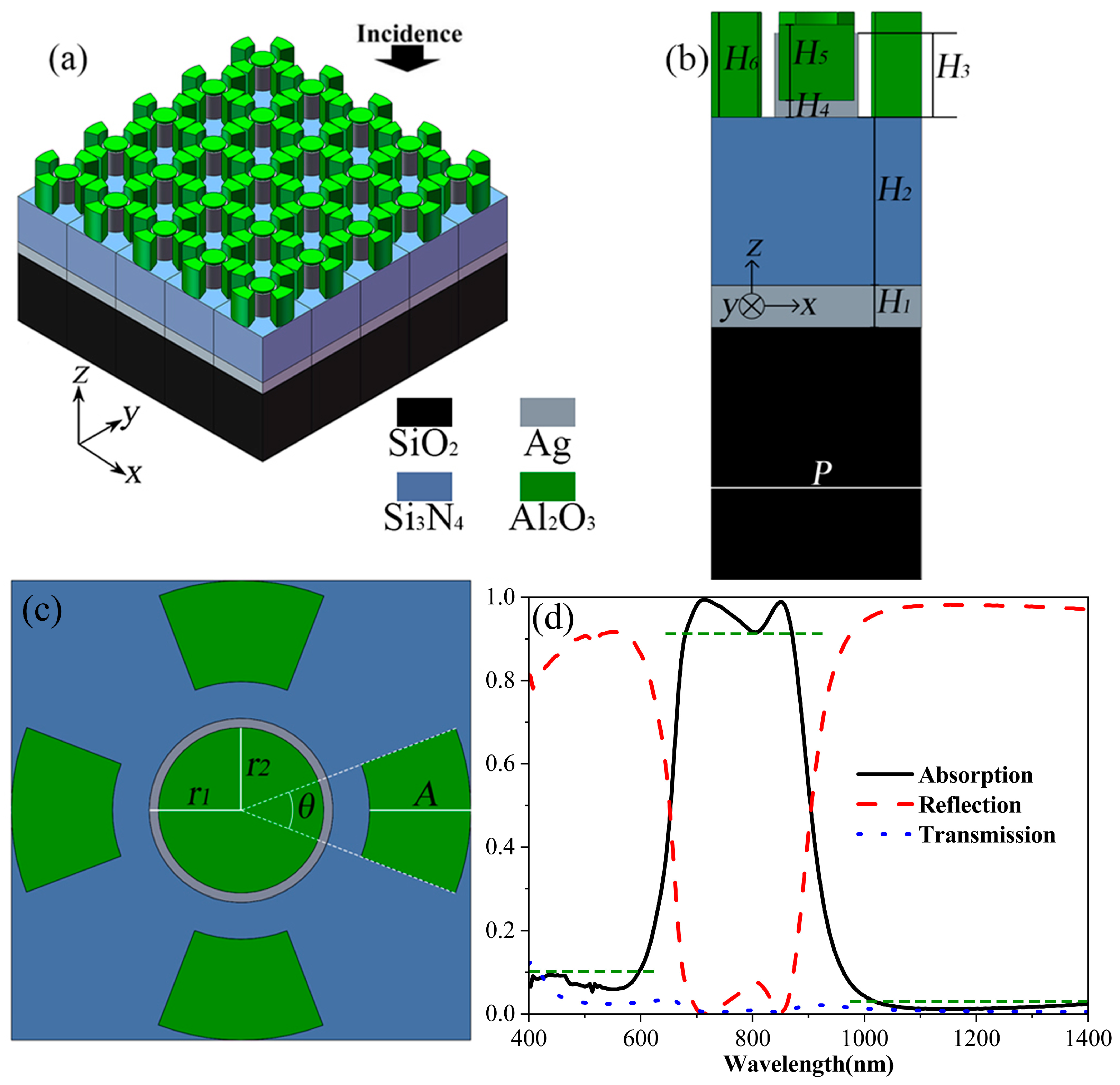
Figure 1a shows the schematic of our proposed MDCPA. An Ag layer with height H1 and a Si3N4 layer with height H2 are sequentially deposited on the silicon dioxide (SiO2) substrate. The lengths and widths of the two layers are consistent with the array period P. As shown in Figure 1b, the Ag cylinders (embedded with Al2O3 cylinders) are patterned on the Si3N4 layer, with height H3 and radius r1. The array of Al2O3 cylinders with height H5 and radius r2 is embedded in the Ag cylinders, where the distance from their bottoms to the Ag cylinders’ bottoms is H4. As shown in Figure 1c, four identical Al2O3 fan-shaped pillars are patterned on the upper surface of the Si3N4 layer in each unit cell, with their side surfaces aligning tangentially with the Si3N4 layer’s side planes. These fan-shaped pillars are characterized by a radial width A (outer radius − inner radius), an opening angle θ, and a height H6. The dual-band cut-off perfect absorption characteristic of the proposed MDCPA is calculated and optimized using the finite-difference time-domain (FDTD) method (Lumerical FDTD Solutions, Richmond, British Columbia, Canada). In the simulation, we set the mesh accuracy to 5 (high accuracy). Periodic boundary conditions are applied in both x and y directions, and a perfectly matched layer (PML) is applied in the z direction. A plane wave source is incident along the –z direction. All refractive indices and extinction coefficients of the materials are taken from Lumerical FDTD Solutions (see Part 1 of the Supplementary Materials).
Figure 1. (a) Schematic of our proposed MDCPA structure (5 × 5 unit cells), with light incident along the –z direction. (b) Side view of one unit cell cut along the diameter of the cylinder (i.e., along the x-axis). (c) Top view of one unit cell. The optimized structural parameters are H1 = 50 nm, H2 = 200 nm, H3 = 100 nm, H4 = 20 nm, H5 = 95 nm, H6 = 125 nm, r1 = 50 nm, r2 = 45 nm, A = 55 nm, θ = 42°, and P = 250 nm. (d) Simulated absorption, reflection, and transmission of our proposed MDCPA in the wavelength band of 400 nm–1400 nm.
The parameters were optimized, with the final values as follows: H1 = 50 nm, H2 = 200 nm, H3 = 100 nm, H4 = 20 nm, H5 = 95 nm, H6 = 125 nm, r1 = 50 nm, r2 = 45 nm, A = 55 nm, θ = 42°, and P = 250 nm. Figure 1d displays the simulated absorption (A), reflection (R), and transmission (T) spectra of the optimized structure, and the absorption is calculated by A = 1 − R − T. The wavelengths used for calculating ER, ED, and CS are the left and right boundary wavelengths of the AB, the right boundary wavelength of the short-wavelength NAB, and the left boundary wavelength of the long-wavelength NAB, which are denoted as λal, λar, λnl, and λnr, respectively. The only requirement for λal and λar is that the absorption at these wavelengths are the minima in the AB. Similarly, the only requirement for λnl and λnr is that the absorption at these wavelengths are the maxima in the corresponding NAB. Therefore, λal, λar, λnl, and λnr can vary within the range between the green dashed lines in Figure 1d. Taking ER, ED, and CS into comprehensive consideration, we manually set λal, λar, λnl, and λnr to 676 nm, 872 nm, 600 nm, and 980 nm, respectively. This is justified because shifting the chosen wavelengths cannot simultaneously increase ER, ED, and CS. The results show that the average absorption is 0.956 in the AB (676 nm–872 nm), with a peak absorption of 0.994 at 712 nm. The average absorption is 0.075 in the short-wavelength NAB (400 nm–600 nm) and is only 0.019 in the long-wavelength NAB (980 nm–1400 nm), where ERal is 9.95 dB, ERar is 11.36 dB, EDal is 0.80, EDar is 0.83, CSal is 0.011 nm−1, and CSar is 0.008 nm−1. Since our proposed MDCPA is symmetric along both x and y directions, its dual-band cut-off perfect absorption is polarization-independent.

3. Theory and Mechanism

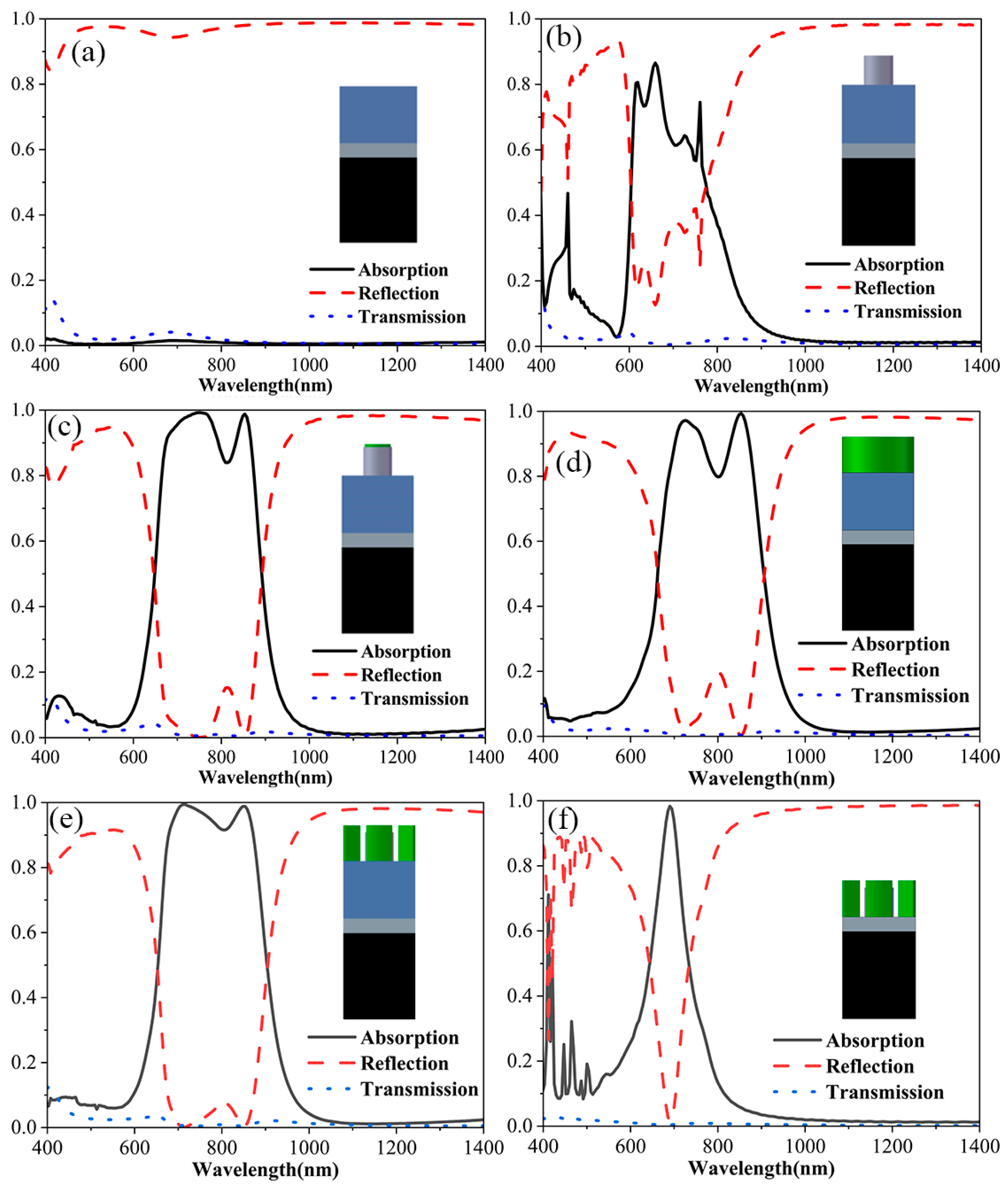
Next, we studied the physical mechanism of the dual-band cut-off perfect absorption in the MDCPA. Figure 2a shows the optical response of the MDCPA with only the bottom Ag layer and Si3N4 layer. It can be observed that the absorption and transmission are very low due to the high reflectivity of the Ag layer. The Ag cylinders added on the Si3N4 layer excite metasurface structure resonances. When light is incident, multiple reflections occur between the bottom Ag layer and the top resonance structures, prolonging the light–matter interaction time and enhancing selective absorption in a specific wavelength band. As shown in Figure 2b, this leads to a significant increase in absorption and decrease in reflection in the resonance wavelength band (~615 nm–760 nm). Outside the resonance wavelengths (i.e., the wavelength bands of ~400 nm–575 nm and ~875 nm–1400 nm), the high reflectivity of the underlying Ag layer dominates, resulting in weak absorption. As shown in Figure 2b,c, the Al2O3 cylinders embedded in the Ag cylinders can further broaden the AB, enhance the absorption in it, and reduce the absorption in the short-wavelength NAB. Dielectric materials such as Al2O3 typically exhibit weak resonances due to their relatively low refractive index contrast with the surrounding medium and poor light-confining ability. However, in our design, through partial metal cladding, specifically by embedding the Al2O3 cylinders into the Ag cylinders, the resonances in the Al2O3 cylinders can be significantly enhanced [32]. Each of the Al2O3 cylinders is in a well in the Ag film. The Ag films provide high-reflection boundaries for the Al2O3 cylinders, enhancing the ability to confine light within the Al2O3 cylinders. At the same time, some open areas are retained (i.e., H4 + H5 > H3 and r1 > r2) to prevent the Al2O3 cylinders from being completely covered, allowing light to easily reach the Al2O3 cylinders instead of being reflected by Ag, thus enhancing the resonances of the Al2O3 cylinders with a relatively low refractive index. Then, we studied the optical response of our proposed MDCPA structure when its Al2O3 fan-shaped pillars were replaced with Al2O3 rings (the inner and outer radii as well as the height of the rings are the same as those of the fan-shaped pillars). As shown in Figure 2d, the dual-band cut-off absorption effect remains, and the response in the long-wavelength NAB is almost identical to that in Figure 2c. Due to the influence of Al2O3 rings on the local electromagnetic field distribution around the composite cylinders, the absorption in the short-wavelength NAB is reduced, accompanied by a decrease in absorption in the AB, which is clearly not our most desired outcome. Ideally, it would be preferable to reduce the absorption in the NAB while increasing the absorption in the AB. As shown in Figure 2e, adding the Al2O3 fan-shaped pillars on the Si3N4 layer of the structure in Figure 2c can also modulate the local electromagnetic field distribution around the composite cylinders, and thus further increase the absorption in the AB (with a minimum absorption ~0.9) and reduce the absorption in the NABs (with a maximum absorption ~0.1), compared with that in Figure 2c, and this is the result we most desire. As shown in Figure 2c–e, the main changes are observed in the absorption in the AB and the short-wavelength NAB, while the absorption in the long-wavelength NAB and the cut-off slopes between the AB and NABs remain nearly unchanged. Corresponding to the performance metrics, the main variations lie in ERal and EDal. Therefore, we calculated the two performance metrics (ERal and EDal) for the structures in Figure 2c–e, with the corresponding values being 8.20 dB, 0.71; 8.35 dB, 0.71; and 9.95 dB, 0.80, respectively. Obviously, the structure with Al2O3 fan-shaped pillars exhibits superior dual-band cut-off absorption characteristic, and the numerical results validate the necessity of designing the structure with Al2O3 fan-shaped pillars. We also studied the optical response of the MDCPA without Si3N4. As shown in Figure 2f, although there is a high absorption peak at ~690 nm, the AB is too narrow, and the absorption in the short-wavelength NAB is no longer stably < 0.1. Therefore, it cannot be regarded as an ideal MDCPA. It is noteworthy that many previously proposed MDCPAs still exhibit relatively high absorption in the short-wavelength NAB [25,26,27,28]. In contrast, our proposed MDCPA demonstrates lower absorption in the short-wavelength NAB compared with many previously reported MDCPAs, which undoubtedly enhances the absorption selectivity of the absorber.
Figure 2. Absorption, reflection, and transmission spectra of our proposed MDCPA (a) with only the bottom Ag layer and Si3N4 layer; (b) without Al2O3; (c) without the Al2O3 fan-shaped pillars; (d) with the Al2O3 fan-shaped pillars replaced by Al2O3 rings (the inner and outer radii as well as the height of the rings are the same as those of the fan-shaped pillars); (e) with the optimized structure and parameters; (f) without the Si3N4 layer.
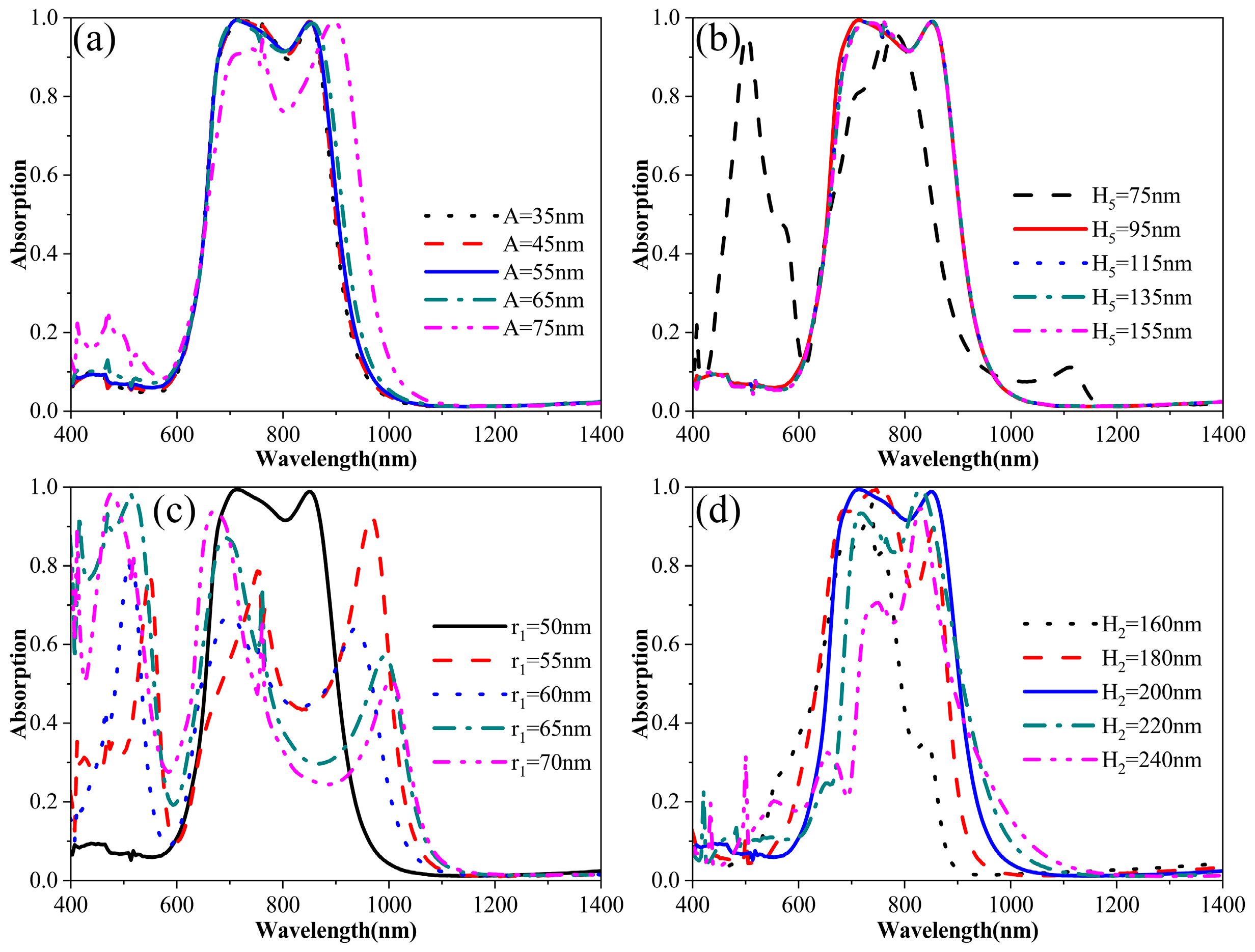
To better understand the influence of different structural parameters on the absorption spectrum, the optimization of some parameters is shown in Figure 3. As shown in Figure 3a, when the fan-shaped pillars radial width A = 75 nm, there is exactly no gap between the Ag cylinders and Al2O3 fan-shaped pillars. In this case, the dual-band cut-off characteristic of the MDCPA deteriorates. The reason for this lies in the inability to confine sufficient electric fields between the composite cylinders and the Al2O3 fan-shaped pillars when light in the AB is incident under this condition. Hence, we must ensure A < 75 nm (i.e., maintain a gap between the Ag cylinders and Al2O3 fan-shaped pillars). When A decreases to below 55 nm, the absorption in the long-wavelength NAB undergoes minimal change, while the minimum absorption in the AB decreases slightly and the maximum absorption in the short-wavelength NAB increases slightly. To ensure high absorption in the AB and low absorption in the NAB, we set A = 55 nm. As shown in Figure 3b, when the Al2O3 cylinders’ height H5 = 75 nm, the Al2O3 cylinders are completely surrounded by the Ag cylinders. This generates a high absorption peak in the short-wavelength NAB, significantly degrading the dual-band cut-off absorption performance of the MDCPA. Hence, we must ensure H5 > 80 nm (i.e., allowing partial exposure of the Al2O3 cylinders). When H5 increases to over 95 nm, there is no significant change in the NABs, while the highest absorption peak redshifts and the absorption decreases, indicating a slight narrowing of the AB and a slight reduction in CSal, EDal, and EDar. Therefore, we set H5 = 95 nm. As shown in Figure 3c, as the Ag cylinders’ radius r1 increases from 50 nm, the AB splits into several absorption peaks. Therefore, we set r1 = 50 nm. Additionally, this also explains the origin of the dual-band cut-off absorption: as r1 approaches 50 nm, several absorption peaks gradually move closer and thus converge into the AB with high absorption intensity, while the absorption intensity of each absorption peak in the NABs remains low. Regarding the influence of Si3N4 thickness, it can be seen from Figure 3d that when H2 deviates from 200 nm, the absorption of the AB gradually decreases. This is mainly due to the corresponding change in the cavity length [33]. When H2 = 200 nm, the ideal spectral characteristics are achieved. Additionally, we observe that as H2 varies within the variation range, there is little variation in the wavelengths of the absorption peaks, while the main change occurs in the absorption intensity in the AB. In other words, adjusting r1 can regulate the wavelengths of the absorption peaks, and adjusting H2 can regulate the intensities of the peaks. It is precisely by accurately regulating the wavelengths and intensities of the absorption peaks that we achieve the goal of dual-band cut-off absorption.
Figure 3. Absorption spectra of the MDCPA varying with (a) A; (b) H5; (c) r1; (d) H2.
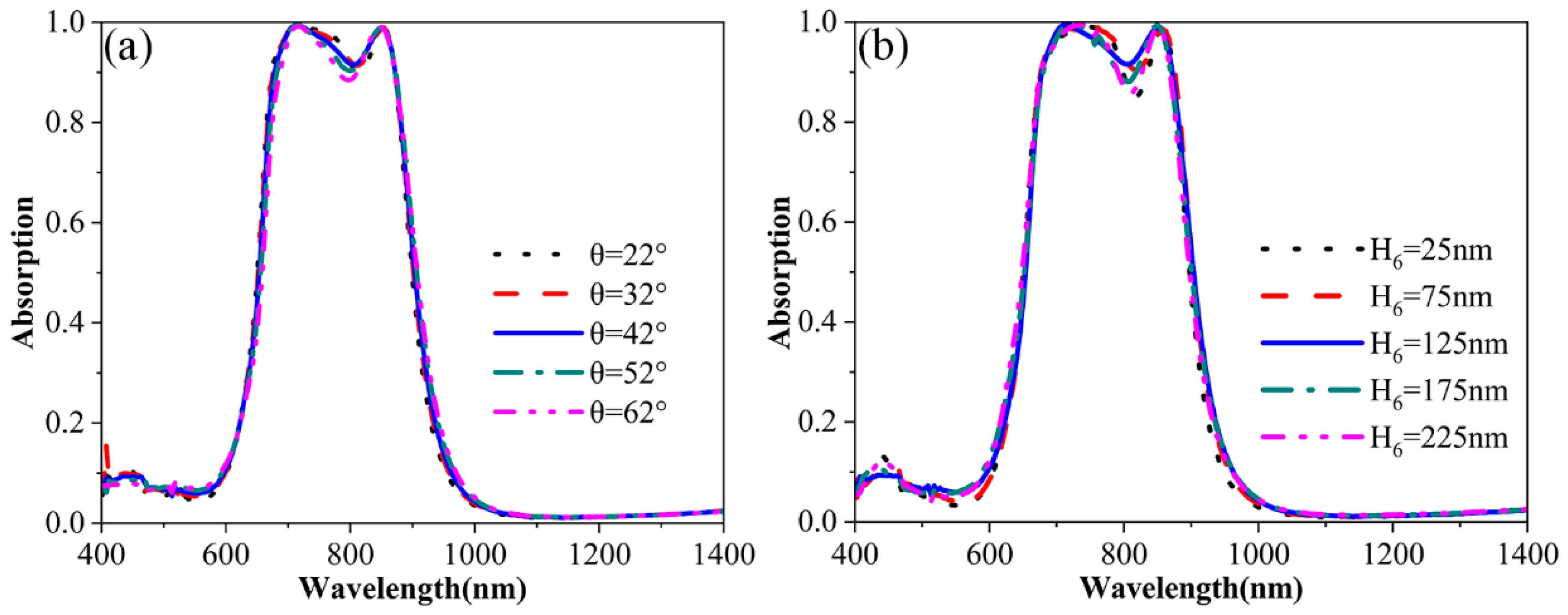
To validate the optimal design and reveal the sensitivity of the structure to certain geometric variations, we further discuss the effects of other structural parameters. Figure 4a,b present the absorption spectra of the MDCPA varying with θ and H6, respectively. It can be clearly observed that the absorption spectra exhibit negligible variations with variations in θ and H6, which are mainly reflected in slight fluctuations in the absorption intensity of the AB. After elaborate optimization, we find that when θ deviates from 42° and H6 deviates from 125 nm, the minimum absorption of the AB only decreases slightly. This also indicates that the structural performance is robust to θ and H6. To comprehensively demonstrate the influence of structural parameters on the absorption spectra of the MDCPA, the analysis of absorption characteristics for varying values of H1, H3, H4, and r2 is presented in Part 2 of the Supplementary Materials.
Figure 4. Absorption spectra of the MDCPA varying with (a) θ; (b) H6.
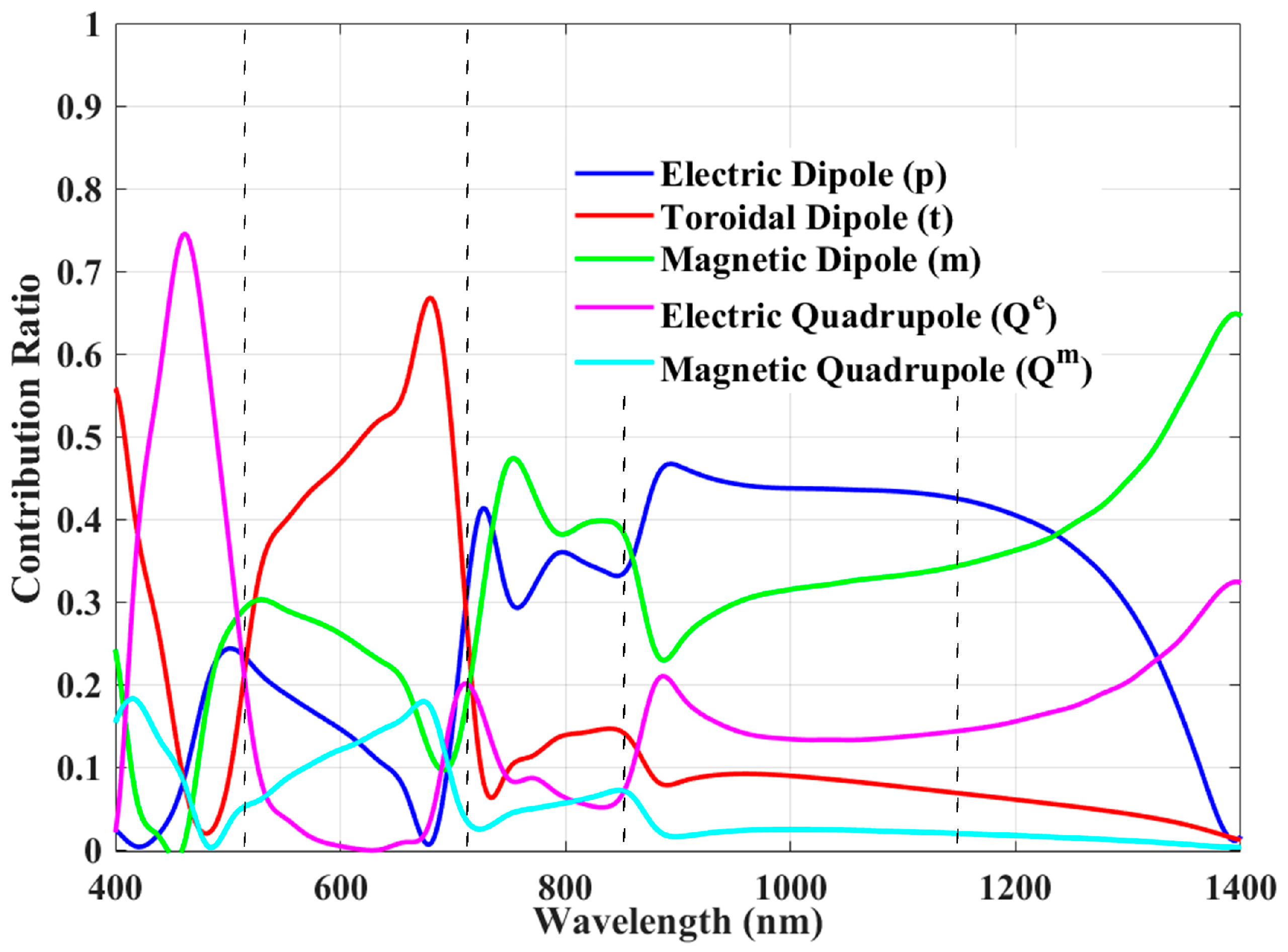
Electromagnetic multipole decomposition is a fundamental and powerful method for understanding the interactions between electromagnetic fields and a metasurface. The key to this method lies in that a generally complex field scattered by a metasurface is replaced by the superposition of fields generated by basic point sources, namely the so-called multipole moments, which correspond to the electric charge and current density distributions in the metasurface. Multipole moments are classified by their orders, including dipoles, quadrupoles, octupoles, etc. Each order includes both electric and magnetic multipolar moments, which are uniquely connected to their corresponding multipolar fields. Similarly to the Taylor series, where the first two terms usually dominate the expansion, the contributions of low-order multipole terms to the total scattered field are dominant in a metasurface, while the contributions of high-order multipole terms are usually negligible. For a metasurface with electromagnetic multipole responses, the total scattering field can be decomposed into the scattering fields of electric and magnetic modes with different orders [34]. Here we only consider the multipole contributions of electric dipole (ED), toroidal dipole (TD), magnetic dipole (MD), electric quadrupole (EQ), and magnetic quadrupole (MQ) moments. To reveal the interference of multipole moments and understand the dual-band cut-off absorption characteristic of our proposed MDCPA, we calculate the contribution ratios of the multipoles to the total scattering, as shown in Figure 5, where p, t, m, Qe, and Qm represent the complex ED, TD, MD, EQ, and MQ moments, respectively. An incoherent total scattering cross section can be calculated as follows:
C s c a i n c ,   t o t a l = C s c a p + C s c a t + C s c a m + C s c a Q e + C s c a Q m ,
Figure 5. Calculated multipole contribution ratios to the total scattering.
The contribution ratio of each scattering component can be calculated as follows:
C R p = C s c a p C s c a i n c ,   t o t a l ,
C R t = C s c a t C s c a i n c ,   t o t a l ,
C R m = C s c a m C s c a i n c ,   t o t a l ,
C R Q e = C s c a Q e C s c a i n c ,   t o t a l ,
C R Q m = C s c a Q m C s c a i n c ,   t o t a l .
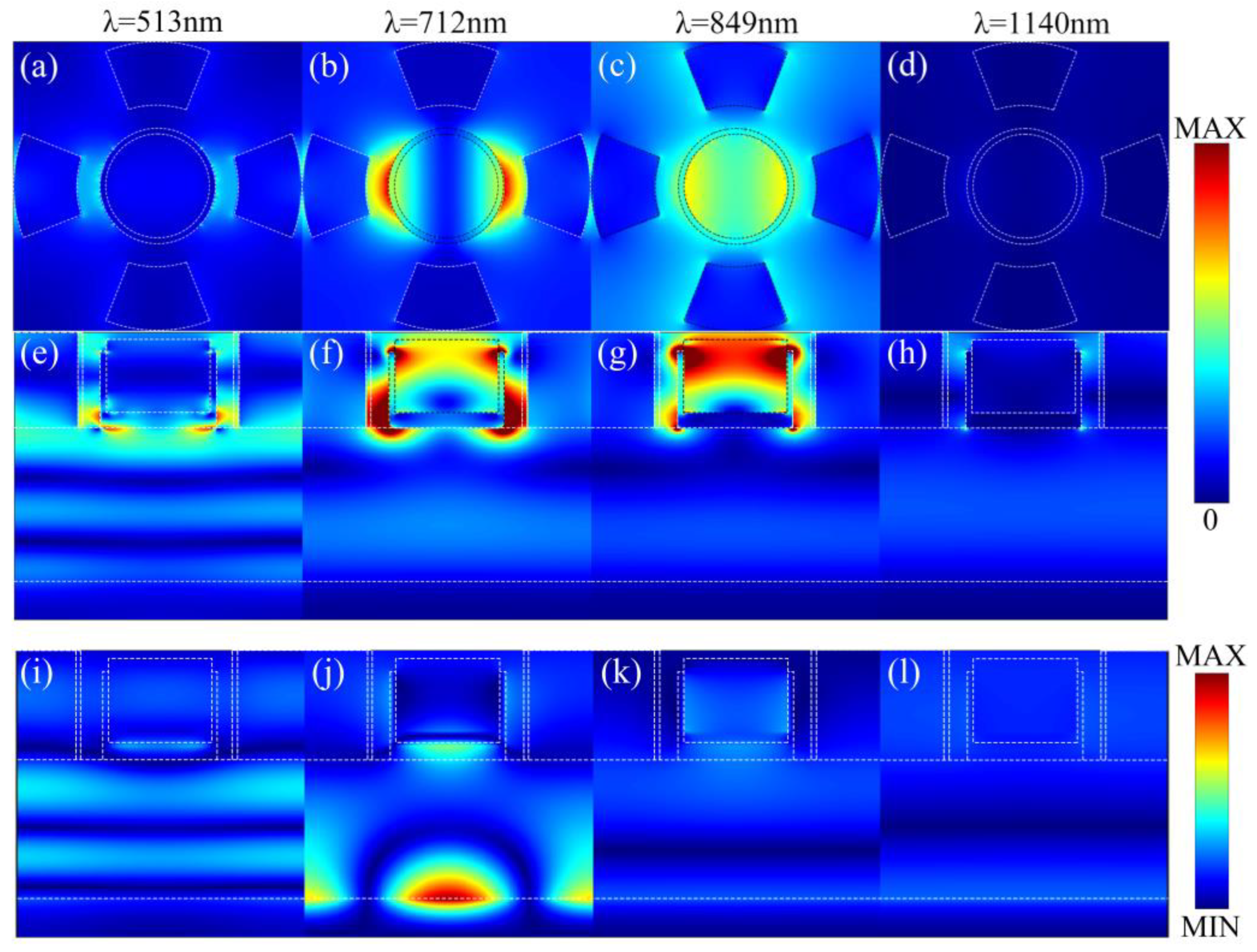
The dashed lines in Figure 5 correspond to wavelengths of 513 nm, 712 nm, 849 nm, and 1140 nm, respectively. Specifically, the four wavelengths represent the minimum absorption in the short-wavelength NAB, the two absorption peaks in the AB, and the minimum absorption in the long-wavelength NAB. It can be observed that the contribution of MQ mode is close to 0 in the whole wavelength band except for the two small peaks at ~415 nm and ~675 nm. In the wavelength band of ~400 nm–700 nm, EQ and TD become the dominant contributing multipole modes successively. In the wavelength band of ~700 nm–900 nm, ED and MD modes make significant contributions, while the other three scattering components contribute relatively weakly. In the wavelength band of ~900 nm–1200 nm, the contribution ratio of ED mode remains stable at ~0.45, making it the main contributing multipole mode in this interval. The contribution ratio of MD mode increases continuously, reaching ~0.36 at 1200 nm and gradually becoming dominant. The contribution ratios of TD and EQ modes remain relatively flat overall, both being relatively weak. In the wavelength band of 1200 nm–1400 nm, MD mode shows a rapid increase in contribution ratio to ~0.65, becoming dominant, and the contribution ratio of EQ rises to ~0.3. The contribution of ED mode drops to ~0 and exits the dominant role. The contribution ratio of TD mode decreases continuously, approaching 0 and becoming negligible.
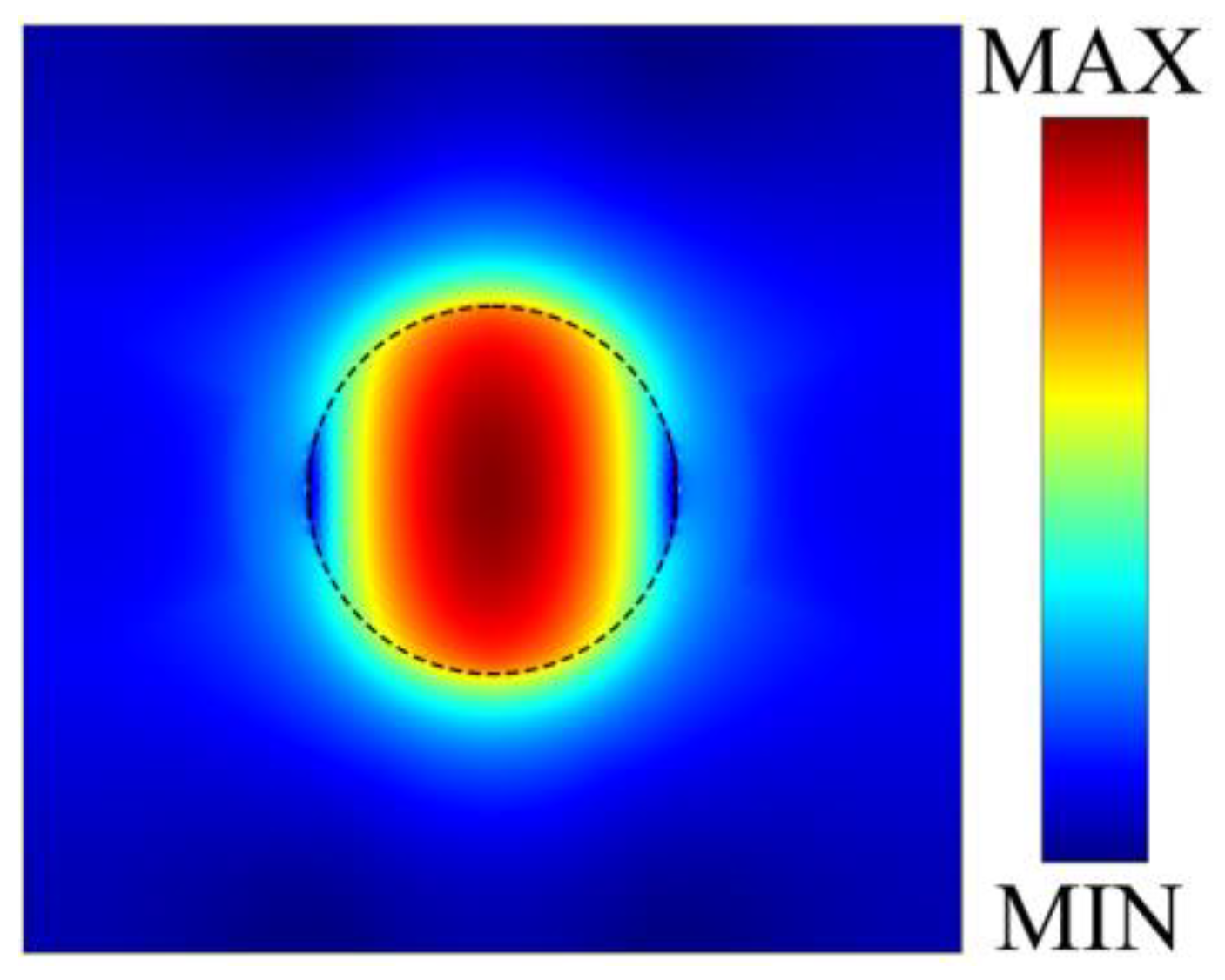
To visually explain the dual-band cut-off absorption characteristic of the MDCPA, Figure 6 shows the electric and magnetic field diagrams of the MDCPA at specific wavelengths of 513 nm, 712 nm, 849 nm, and 1140 nm. It can be clearly seen from Figure 6b,c,f,g that at 712 nm and 849 nm, the intense light is coupled into the air slots and the Al2O3 slots. Figure 6b,f show that the electric field at the wavelength of 712 nm is mainly concentrated at the upper and lower corners of the Ag cylinder, with a stronger electric field at the lower corners, indicating the formation of ED and EQ [34], which is consistent with the results of multipole decomposition. Furthermore, it can be clearly seen from Figure 6i–l that the magnetic field at 712 nm is relatively strong, whereas those at the other three wavelengths is weak. Therefore, the magnetic field at 712 nm plays a significant role in the high absorption, while the contribution of the magnetic field to absorption is negligible at the other three wavelengths. Therefore, we did not conduct an in-depth analysis of the magnetic fields at the other three wavelengths. At 712 nm, the magnetic field is not only strongly confined near the upper surface of the bottom Ag layer, exhibiting MD mode [34,35,36], but also intensively enhanced at the bottom of the top Ag cylinders, exhibiting TD mode [37], as shown in Figure 7. This is consistent with the results of multipole decomposition. The resonances of ED, EQ, TD, and MD collectively contribute to the absorption peak at 712 nm. A strong scattering component does not necessarily imply strong absorption, and vice versa [38,39]. Scattering and absorption are two distinct energy conversion mechanisms: scattering refers to the phenomenon where electromagnetic waves change their propagation direction when encountering obstacles or inhomogeneous media, while absorption is the process by which electromagnetic wave energy is absorbed by materials and converted into other forms of energy [38]. A high intensity of a certain component in the scattering multipole analysis only indicates that this mode dominates the scattering and cannot directly infer its contribution to the absorption. Therefore, the most critical step in the analysis is to conduct a study combined with the electromagnetic field distribution diagrams. Although the contribution ratio of MD scattering component at 849 nm is relatively high, the magnetic field is weak, and thus it does not dominate the absorption at this wavelength. Figure 6c,g show that the electric field distribution at the wavelength of 849 nm is like that at 712 nm, also exhibiting similar ED and EQ modes. The difference is that the electric field near the upper corner of Ag is stronger than that at the lower corner, so the effect of ED dominates the contribution to absorption. The resonances of ED and EQ collectively contribute to the high absorption at 849 nm, with ED playing a dominant role. This clearly explains the high absorption in the AB. As can be seen from Figure 6, at 513 nm and 1140 nm, the electric field distributions are similar to those at 712 nm and 849 nm, still exhibiting ED and EQ modes, but with much weaker intensities. This clearly explains the low absorption in the NABs.
Figure 6. (ad) Top views of the electric field distribution of the MDCPA at the specific wavelengths cut in the x–y plane at z = 300 nm (i.e., at the middle of the Ag cylinder). (eh) Side views of the electric field distribution of the MDCPA at specific wavelengths, cut in the x–z plane at y = 0. (il) Side views of the magnetic field distribution of the MDCPA at specific wavelengths, cut in the x–z plane at y = 0.
Figure 7. Top view of the magnetic field distribution of the MDCPA at the wavelength of 712 nm cut in the x–y plane at z = 250 nm (i.e., at the lower surface of the Ag cylinder).
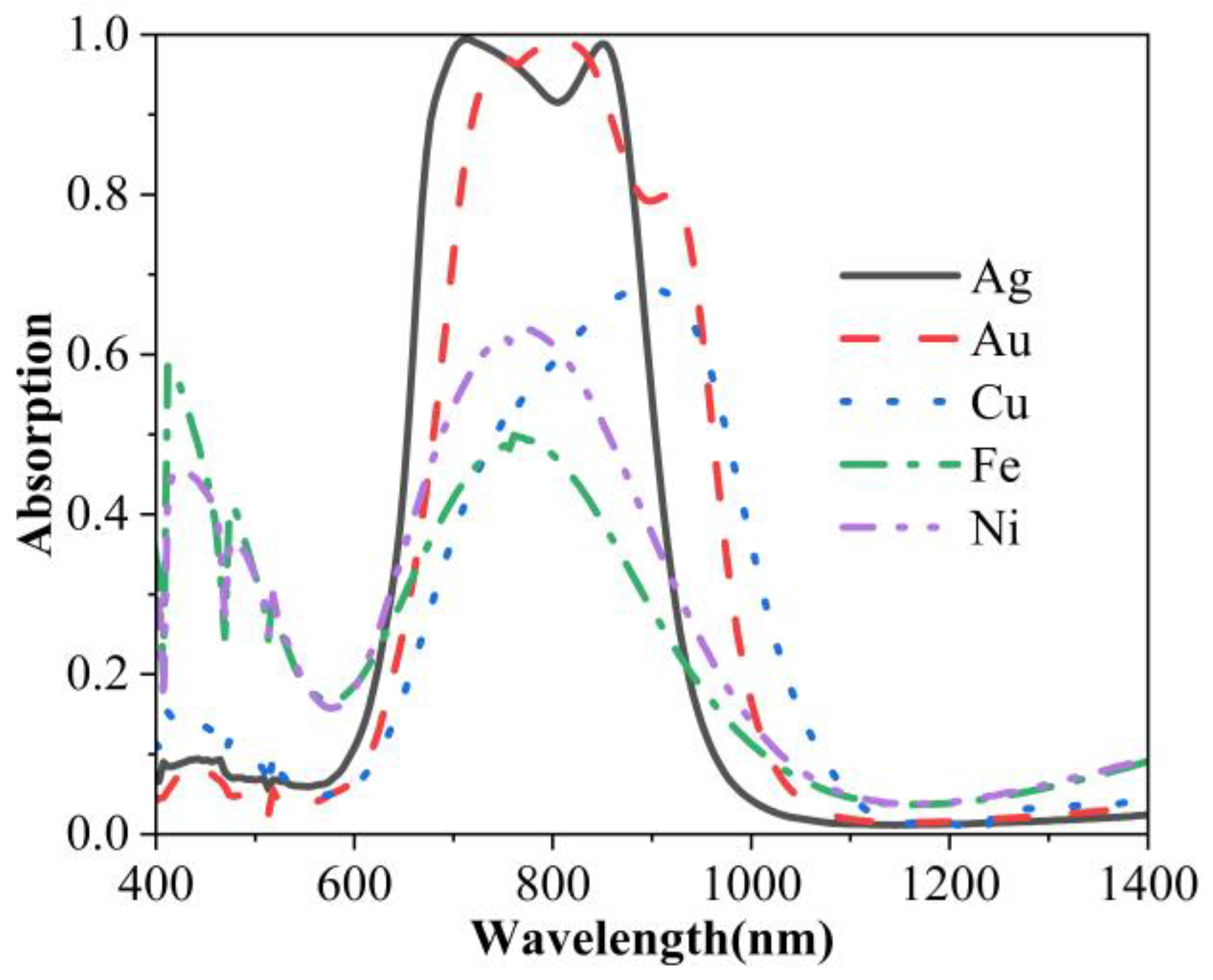
To conduct a thorough study, we analyzed the influence of top-metal materials on the absorption performance of the proposed structure. As shown in Figure 8, while keeping the geometric parameters unchanged, we studied the effect of the top-metal material by replacing the top Ag with several commonly used metals. It can be seen from Figure 8 that the top metal significantly affects the performance of the absorber. Besides Ag, when Au is used as the top metal, the characteristic of dual-band cut-off absorption is well maintained. When Cu, Fe, or Ni is used as the top metal, the AB exhibits a relatively narrow effective high-absorption bandwidth, rendering the structure unsuitable as an ideal MDCPA. A narrow bandwidth implies a relatively high quality factor (Q factor) due to low metal loss, and the absorption in the NAB of the proposed MDCPA is low when Ag is used as the top metal, which depends on the intrinsic dispersion characteristics of the metals [33]. The physical principle behind the absorption sensitivity of the top metal can be explained as follows. The top metal confines the incident wave to the Si3N4 dielectric layer by the evanescent wave propagating through the top metal. When the perfect absorption condition (i.e., critical coupling condition) related to the top metal’s permittivity is satisfied, the incident wave tunnels through the top structure, excites the cavity mode, and is perfectly absorbed, which explains the high absorption in the AB. In the NABs, the perfect absorption condition cannot be satisfied, thus resulting in low absorption. The top metal not only affects the Q factor of the cavity, but also influences the coupling strength between the cavity modes and the incident light [33,40]. Correspondingly, the top metal significantly impacts the absorption bandwidth and absorption intensity, which in turn determines the characteristics of the proposed MDCPA.
Figure 8. Absorption spectra with different top metals.
Ag and Au exhibit similar excellent performance, primarily due to their high electrical conductivity, low optical loss (a small imaginary part of the permittivity), and free-electron-dominated dispersion characteristics in the visible and NIR spectral range of the study. They exhibit weak interband transitions with high onset frequency of interband transitions (ωint) [41]. These properties enable them to stably provide the large negative real part of permittivity required for plasmonic materials, effectively supporting strong resonant coupling between incident light and the structure, fully satisfying the critical coupling condition for perfect absorption, thereby achieving a wide absorption bandwidth, high absorption intensity, and steep cut-off slopes [41,42,43].
However, Cu, Fe, and Ni perform poorly. Cu has a lower ωint than Ag and Au, resulting in a closer interband transition threshold to the AB and higher loss [41,44]. As typical transition metals, Fe and Ni exhibit more intense interband transitions arising from their electronic-energy-level configurations, accompanied by substantially higher imaginary parts of permittivity and enhanced conduction electron scattering loss [45]. High loss and strong interband absorption suppress resonant field enhancement and reduce the coupling efficiency between incident light and cavity modes, ultimately resulting in a narrow effective high-absorption bandwidth, degraded cut-off characteristics, and failure to meet the performance requirements of an ideal MDCPA [46].
The structure with Ag as the top metal demonstrates higher absorption in the AB, low absorption in the NABs, and steep cut-off slopes, thus rendering it an optimal candidate for the MDCPA design.

4. Discussion

Table 1 presents a performance comparison between the proposed MDCPA and previously reported MCPAs and MDCPAs operating in similar bands. Compared with the MCPAs in [23,24], our proposed MDCPA exhibits a dual-band cut-off absorption characteristic that these MCPAs lack. Specifically, compared with the MCPA in [23], although our proposed MDCPA is slightly inferior in ERar and EDar, its CSar is significantly larger. Compared with the MCPA in [24], our proposed MDCPA outperforms it markedly in all three metrics (ERar, EDar, and CSar). Compared with the previous MDCPAs, the proposed MDCPA exhibits significantly higher ERa, EDa, and CSa, which can enhance the absorption selectivity and cut-off steepness of the MDCPA. The core advantage of the proposed MDCPA is its dual-band cut-off absorption characteristic combined with excellent performance.
Table 1. A comparison table between the proposed MDCPA and previously reported MCPAs and MDCPAs operating in similar bands.
However, this work still has certain limitations. The primary limitation of the current device lies in the use of Ag as the material for the top-metal cylinders. Ag is easily oxidized in the air. Over time, a silver oxide layer forms on its surface, which reduces its plasmonic activity. This then leads to worse ERa, EDa, and CSa of the MDCPA. Such performance loss caused by oxidation is a big obstacle for the device’s long-term practical use, especially in open-air applications like environmental sensors. This work only conducts simulation analysis via the FDTD method without actual device fabrication and experimental characterization and all materials used are static materials with non-tunable performance.
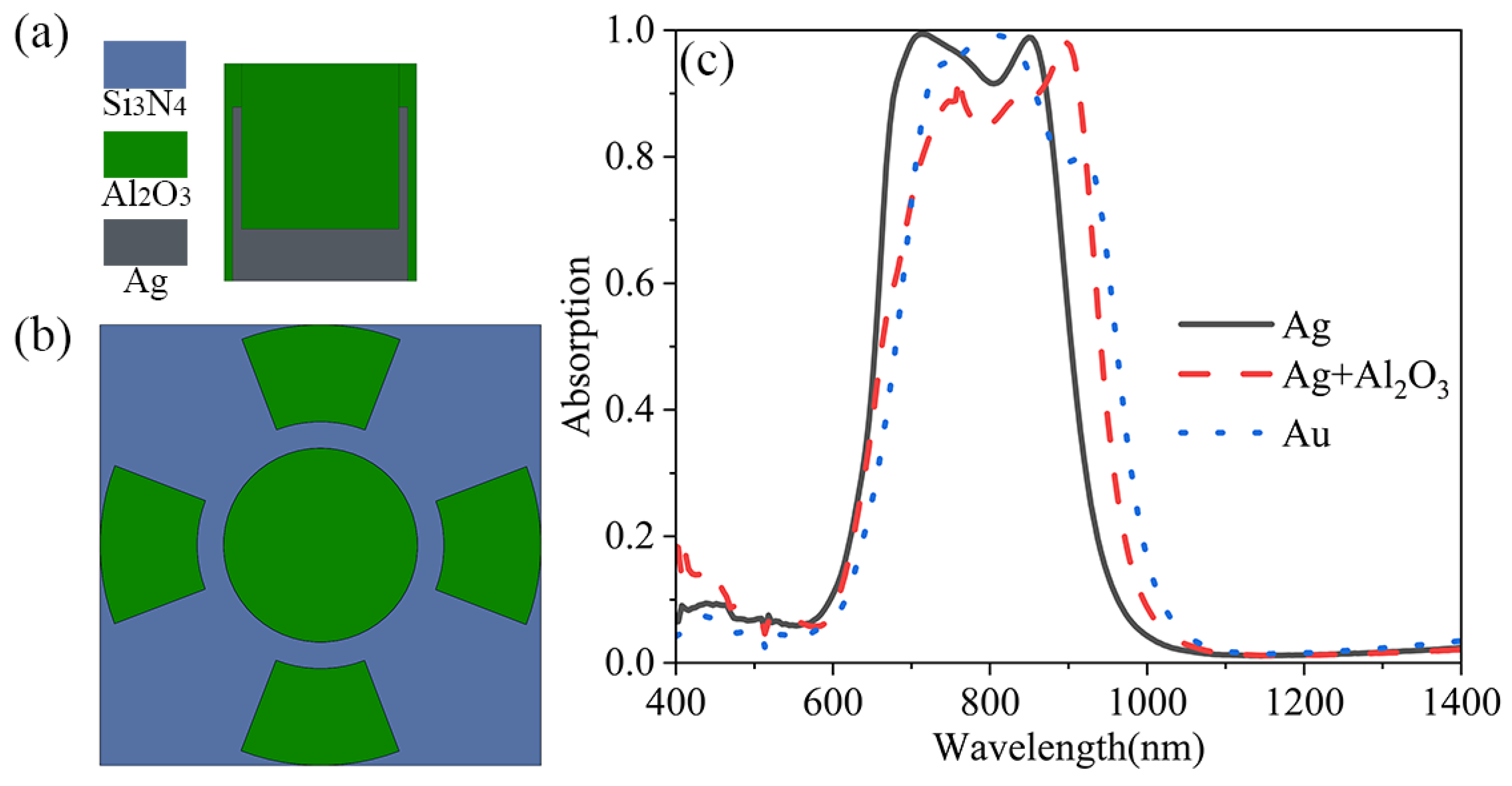
To reduce the oxidation of the top Ag cylinders and improve the long-term stability of the device, two solutions are proposed here: adding protective layers or changing the material. For the protective layer method, Al2O3 cylinders can act as physical barriers against oxygen and moisture, covering the Ag cylinders completely. The Al2O3 cylinders of the protective layers have a radius 5 nm larger than that of the Ag cylinders, and their height is the same as that of the Al2O3 cylinders originally surrounded by the Ag cylinders to facilitate device fabrication. The thin Al2O3 protective layers cause very little optical loss in the visible and NIR bands, so they weaken the plasmonic resonance of Ag only slightly. Figure 9a shows the side view of a single Ag cylinder with the Al2O3 protective layer cut along the diameter of the cylinder. Figure 9b shows the top view of one unit cell with the Al2O3 protective layer. For the material change method, Au is an excellent plasmonic material with strong chemical stability and oxidation resistance. Figure 9c shows that the dual-band cut-off absorption performances of the MDCPA with the two solutions are slightly inferior to that of the MDCPA with Ag top-metal cylinders (no protective layers), yet they are still acceptable.
Figure 9. (a) Side view of a single Ag cylinder with the Al2O3 protective layer cut along the diameter of the cylinder. (b) Top view of one unit cell with the Al2O3 protective layer. (c) Simulated absorption spectra of the MDCPA with Ag top-metal cylinders (no protective layers), with the Al2O3 protective layers, and with the top Ag replaced by Au.

5. Outlook

Future work will focus on the actual fabrication of the device. The bottom Ag and Si3N4 layers can be fabricated via coating methods (sputter coating or vacuum coating). For the top structure, a Ag film can be deposited on the Si3N4 layer and etched into the desired Ag shape via Focused Ion Beam (FIB) etching. An Al2O3 film can then be deposited and etched into the required Al2O3 shape via FIB etching. The main challenge in practical fabrication lies in the Ag-Al2O3 composite cylinders. The metallic properties of Ag lead to ion-beam-induced melting and redeposition during FIB etching, resulting in burrs and blurred contours at the etched edges. Secondary FIB etching of the Al2O3 film can easily damage the already etched Ag structures due to ion beam radiation damage, bringing cross-layer process interference. In addition, to use this structure in industry, we need to solve the problem of expanding production from making single devices in the lab to mass production over large areas.
Future work will also involve the exploration and selection of materials with high performance and excellent stability. Moreover, MDCPAs with broader absorption and non-absorption bands will be designed, and dynamic materials such as phase-change materials (e.g., VO2) and graphene will be introduced to realize dynamically tunable performance.

6. Conclusions

In conclusion, we propose an MDCPA, consisting of a bottom Ag layer, Si3N4 layer, Ag cylinders embedded with Al2O3 cylinders, and Al2O3 fan-shaped pillars, realizing polarization-independent dual-band cut-off perfect absorption in the visible and NIR bands, outperforming existing MDCPAs, and highlighting superior cut-off sharpness and absorption contrast. We use electromagnetic multipole decomposition, combined with electromagnetic field diagrams, to explain the origin of the dual-band cut-off absorption. In addition, we investigate the impact of the top-layer metal material. We also discuss the limitations and outlook of this work. This work provides an effective strategy for developing high-performance MDCPAs in the visible and NIR bands, with significant potential for applications in advanced nanophotonic devices and systems.

Supplementary Materials

The following supporting information can be downloaded at https://www.mdpi.com/article/10.3390/photonics13020131/s1. Figure S1: Absorption spectra of the MDCPA varying with (a) H1; (b) H3; (c) H4; (d) r2.

Author Contributions

Conceptualization, Q.Q.; methodology, Z.M.; software, Z.M. and Q.Q.; resources, C.W.; data curation, Z.M.; writing—original draft preparation, Z.M.; writing—review and editing, Q.Q.; visualization, Z.M.; supervision, Q.Q., H.C., L.C., L.F., L.Z. and C.W.; funding acquisition, H.C. All authors have read and agreed to the published version of the manuscript.

Funding

This research was funded by Education and Industry Collaboration in Joint Training Programs, grant number 2310032210703, and Jiangsu Higher Education Teaching Reform Research Project, grant number 2025JGYB797.

Data Availability Statement

The data of this article are available from the corresponding author upon reasonable request.

Conflicts of Interest

The authors declare no conflicts of interest.

References

  1. Ai, Z.; Liu, H.; Cheng, S.; Zhang, H.; Yi, Z.; Zeng, Q.; Wu, P.; Zhang, J.; Tang, C.; Hao, Z. Four peak and high angle tilted insensitive surface plasmon resonance graphene absorber based on circular etching square window. J. Phys. D Appl. Phys. 2025, 58, 185305. [Google Scholar] [CrossRef]
  2. Huang, S.; Wan, M.; Sun, M.; Lu, L.; Wang, X.; Xu, B. A dual-band mid-infrared polarization-insensitive perfect absorber. Phys. Chem. Chem. Phys. 2025, 27, 10523–10529. [Google Scholar] [CrossRef]
  3. Li, K.; Li, X.; Lin, Y.S. Reconfigurable MEMS-based Perfect Meta-absorber with Ultrahigh-Q and Angle-dependent Characteristics for Sensing Applications. Laser Photonics Rev. 2025, 19, 2500288. [Google Scholar] [CrossRef]
  4. Wang, R.; Guan, X.; Qiao, S.; Jia, Q.; He, Y.; Wang, S.; Ma, Y. Ultrahigh Sensitive LITES Sensor Based on a Trilayer Ultrathin Perfect Absorber Coated T-Head Quartz Tuning Fork. Laser Photonics Rev. 2025, 19, 2402107. [Google Scholar] [CrossRef]
  5. Assad, M.A.; Elbahri, M. Perfect ultraviolet absorbers via disordered polarizonic metasurfaces for multiband camouflage and stealth technologies. Adv. Funct. Mater. 2025, 35, 2418271. [Google Scholar] [CrossRef]
  6. Qin, J.; Shi, Y.; Jiang, S.; Gao, Y.; Yao, S.; Wang, Z.; Cheng, X.; Tsai, D.P.; Zhang, W.; Zhu, W. Ultrabroadband and >93% Microwave Absorption Enabled by “Doped” Water Meta-Atom Lattice with Subwavelength Thickness. Adv. Mater. 2024, 36, 2411153. [Google Scholar] [CrossRef] [PubMed]
  7. Liao, Q.; Zhu, K.; Hao, X.; Wu, C.; Li, J.; Cheng, H.; Yan, J.; Jiang, L.; Qu, L. Bio-Inspired Ultrathin Perfect Absorber for High-Performance Photothermal Conversion. Adv. Mater. 2024, 36, 2313366. [Google Scholar] [CrossRef] [PubMed]
  8. Haque, M.A.; Mohsin, A.S.; Bhuian, M.B.H.; Rahman, M.M. Analysis of an ultra-broadband TiN-based metasurface absorber for solar thermophotovoltaic cell in the visible to near infrared region. Sol. Energy 2024, 284, 113064. [Google Scholar] [CrossRef]
  9. Kim, H.; Yun, H.; Jeong, S.; Lee, S.; Cho, E.; Rho, J. Optical metasurfaces for biomedical imaging and sensing. ACS Nano 2025, 19, 3085–3114. [Google Scholar] [CrossRef]
  10. Grayli, S.V.; Patel, T.; van Kasteren, B.; Kokilathasan, S.; Tekcan, B.; Alan Tam, M.C.; Losin, W.F.; Odinotski, S.; Tsen, A.W.; Wasilewski, Z.R. Near-Unity Absorption in Semiconductor Metasurfaces Using Kerker Interference. Nano Lett. 2025, 25, 9362–9368. [Google Scholar] [CrossRef]
  11. Fosteris, I.S.; Kliros, G.S. Analytical Design of Optically Transparent, Wideband, and Tunable Microwave Absorber Based on Graphene Spiral Resonator Metasurface. Photonics 2025, 12, 1006. [Google Scholar] [CrossRef]
  12. Seong, J.; Yang, Y.; Jeon, Y.; Lee, C.; An, J.; Rho, J. Structurally reordered crystalline atomic layer-dielectric hybrid metasurfaces for near-unity efficiency in the visible. Mater. Today 2025, 88, 137–145. [Google Scholar] [CrossRef]
  13. Lee, B.R.; Chiang, M.F.; Ho, P.Y.; Chen, K.H.; Lee, J.H.; Hsu, P.H.; Peng, Y.C.; Hou, J.Y.; Chen, S.C.; Lee, Q.Y. Deep-UV silicon polaritonic metasurfaces for enhancing biomolecule autofluorescence and two-dimensional material double-resonance raman scattering. Adv. Funct. Mater. 2025, 35, 2420439. [Google Scholar] [CrossRef]
  14. Tan, J.; Pan, R.; Xiang, Y.; Tang, Z.; Wang, B.; Li, J. Unilateral Asymmetric Radiation in Bilayer Metasurfaces. Adv. Funct. Mater. 2025, 35, 2501156. [Google Scholar] [CrossRef]
  15. Chen, Y.; Fleury, R.; Seppecher, P.; Hu, G.; Wegener, M. Nonlocal metamaterials and metasurfaces. Nat. Rev. Phys. 2025, 7, 299–312. [Google Scholar] [CrossRef]
  16. Sikeler, C.; Haslinger, F.; Martynenko, I.V.; Liedl, T. DNA Origami-Directed Self-Assembly of Gold Nanospheres for Plasmonic Metasurfaces. Adv. Funct. Mater. 2024, 34, 2404766. [Google Scholar] [CrossRef]
  17. Choi, E.; Kim, G.; Yun, J.; Jeon, Y.; Rho, J.; Baek, S.-H. 360° structured light with learned metasurfaces. Nat. Photonics 2024, 18, 848–855. [Google Scholar] [CrossRef]
  18. Ma, J.; Ren, J.; Zhang, J.; Meng, J.; McManus-Barrett, C.; Crozier, K.B.; Sukhorukov, A.A. Quantum imaging using spatially entangled photon pairs from a nonlinear metasurface. eLight 2025, 5, 2. [Google Scholar] [CrossRef]
  19. Zaccagnini, F.; De Biase, D.; Bovieri, F.; Perotto, G.; Quagliarini, E.; Bavasso, I.; Mangino, G.; Iuliano, M.; Calogero, A.; Romeo, G. Multifunctional FFP2 face mask for white light disinfection and pathogens detection using hybrid nanostructures and optical metasurfaces. Small 2024, 20, 2400531. [Google Scholar] [CrossRef]
  20. Sharma, V.; Kalra, Y.; Sinha, R.K. Triple-band perovskite based chiral metasurface biosensor with multi-functionalities. J. Comput. Electron. 2025, 24, 97. [Google Scholar] [CrossRef]
  21. Wang, J.; Yang, H.; Yi, Z.; Wang, J.; Cheng, S.; Li, B.; Wu, P. High Absorption Broadband Ultra-Long Infrared Absorption Device Based on Nanoring–Nanowire Metasurface Structure. Photonics 2025, 12, 451. [Google Scholar] [CrossRef]
  22. Xu, M.; Guo, L.; Zhang, P.; Qiu, Y.; Li, Q.; Wang, J. Near-perfect spectrally-selective metasurface solar absorber based on tungsten octagonal prism array. RSC Adv. 2022, 12, 16823–16834. [Google Scholar] [CrossRef]
  23. Yu, Y.; Qian, Q.; Wang, C.; Fan, L.; Cheng, L.; Chen, H.; Zhao, L. An all-dielectric metasurface long-pass cut-off filter based on a multi-nanocircular array perfect cut-off absorber. Microw. Opt. Technol. Lett. 2022, 64, 300–304. [Google Scholar] [CrossRef]
  24. Liu, X.; Qian, Q.; Chen, H.; Fan, L.; Cheng, L.; Zhao, L.; Wang, C. Metasurface cutoff perfect absorber in a solar energy wavelength band. Appl. Opt. 2023, 62, 7766–7772. [Google Scholar] [CrossRef]
  25. Cao, T.; Wei, C.-W.; Simpson, R.E.; Zhang, L.; Cryan, M.J. Broadband polarization-independent perfect absorber using a phase-change metamaterial at visible frequencies. Sci. Rep. 2014, 4, 3955. [Google Scholar] [CrossRef]
  26. Ji, D.; Song, H.; Zeng, X.; Hu, H.; Liu, K.; Zhang, N.; Gan, Q. Broadband absorption engineering of hyperbolic metafilm patterns. Sci. Rep. 2014, 4, 4498. [Google Scholar] [CrossRef]
  27. Xu, H.; Hu, L.; Lu, Y.; Xu, J.; Chen, Y. Dual-band metamaterial absorbers in the visible and near-infrared regions. J. Phys. Chem. C 2019, 123, 10028–10033. [Google Scholar] [CrossRef]
  28. Osgouei, A.K.; Hajian, H.; Serebryannikov, A.E.; Ozbay, E. Hybrid indium tin oxide-Au metamaterial as a multiband bi-functional light absorber in the visible and near-infrared ranges. J. Phys. D Appl. Phys. 2021, 54, 275102. [Google Scholar] [CrossRef]
  29. Singh, R.K.; Binda, P.; Dey, U. Investigations on a Triple-Band Metasurface Absorber as THz-Biomedical Sensor. IEEE Trans. Plasma Sci. 2024, 52, 3051–3060. [Google Scholar] [CrossRef]
  30. Kossifos, K.M.; Petrou, L.; Varnava, G.; Pitilakis, A.; Tsilipakos, O.; Liu, F.; Karousios, P.; Tasolamprou, A.C.; Seckel, M.; Manessis, D. Toward the realization of a programmable metasurface absorber enabled by custom integrated circuit technology. IEEE Access 2020, 8, 92986–92998. [Google Scholar] [CrossRef]
  31. Wekalao, J.; Elsayed, H.A.; Alqhtani, H.A.; Abukhadra, M.R.; Bellucci, S.; Mehaney, A.; Rajakannu, A. High-efficiency graphene-based metasurface absorber with T-shaped resonators for broadband solar energy harvesting in renewable energy applications. Energy Rep. 2025, 14, 2849–2863. [Google Scholar] [CrossRef]
  32. Zhou, J.; Panday, A.; Xu, Y.; Chen, X.; Chen, L.; Ji, C.; Guo, L.J. Visualizing Mie resonances in low-index dielectric nanoparticles. Phys. Rev. Lett. 2018, 120, 253902. [Google Scholar] [CrossRef]
  33. Lei, L.; Li, S.; Huang, H.; Tao, K.; Xu, P. Ultra-broadband absorber from visible to near-infrared using plasmonic metamaterial. Opt. Express 2018, 26, 5686–5693. [Google Scholar] [CrossRef]
  34. Luo, Y.; Huang, L.; Ding, J.; Liu, W.; Sun, B.; Xie, C.; Yang, H.; Wu, J. Flexible and transparent broadband microwave metasurface absorber based on multipolar interference engineering. Opt. Express 2022, 30, 7694–7707. [Google Scholar] [CrossRef]
  35. Huang, Y.; Kaj, K.; Chen, C.; Yang, Z.; Ul Haque, S.R.; Zhang, Y.; Zhao, X.; Averitt, R.D.; Zhang, X. Broadband terahertz silicon membrane metasurface absorber. ACS Photonics 2022, 9, 1150–1156. [Google Scholar] [CrossRef]
  36. Li, Z.; Sun, X.; Ma, C.; Li, J.; Li, X.; Guan, B.-O.; Chen, K. Ultra-narrow-band metamaterial perfect absorber based on surface lattice resonance in a WS2 nanodisk array. Opt. Express 2021, 29, 27084–27091. [Google Scholar] [CrossRef] [PubMed]
  37. Tsilipakos, O.; Tasolamprou, A.C.; Koschny, T.; Kafesaki, M.; Economou, E.N.; Soukoulis, C.M. Pairing toroidal and magnetic dipole resonances in elliptic dielectric rod metasurfaces for reconfigurable wavefront manipulation in reflection. Adv. Opt. Mater. 2018, 6, 1800633. [Google Scholar] [CrossRef]
  38. Rolly, B.; Bebey, B.; Bidault, S.; Stout, B.; Bonod, N. Promoting magnetic dipolar transition in trivalent lanthanide ions with lossless Mie resonances. Phys. Rev. B—Condens. Matter Mater. Phys. 2012, 85, 245432. [Google Scholar] [CrossRef]
  39. Zhang, J.; Chen, J.; Wang, X.; Ma, Y.; Li, Y.; Yang, X.; Li, Y. Multi-electron transfer mechanism and band structures of CNTs in MOF-derived CNTs/Co hybrids for enhanced electromagnetic wave absorption property. Mater. Today Commun. 2024, 39, 108936. [Google Scholar] [CrossRef]
  40. Sun, Z.; Fang, Y. Fabry-Pérot interference cavity length tuned by plasmonic nanoparticle metasurface for nanophotonic device design. ACS Appl. Nano Mater. 2020, 3, 10732–10738. [Google Scholar] [CrossRef]
  41. West, P.R.; Ishii, S.; Naik, G.V.; Emani, N.K.; Shalaev, V.M.; Boltasseva, A. Searching for better plasmonic materials. Laser Photonics Rev. 2010, 4, 795–808. [Google Scholar] [CrossRef]
  42. Dou, S.; He, Y.; Zheng, Y.; Yan, Y.; Dan, Z.; Ma, L.; Yang, M.; Liu, D.; Huang, X.; Zhong, B. Controlled phase and structure engineering-driven unique dielectric behavior enabling tailored electromagnetic attenuation. Adv. Compos. Hybrid Mater. 2025, 8, 416. [Google Scholar] [CrossRef]
  43. Lemasters, R.; Zhang, C.; Manjare, M.; Zhu, W.; Song, J.; Urazhdin, S.; Lezec, H.J.; Agrawal, A.; Harutyunyan, H. Ultrathin wetting layer-free plasmonic gold films. ACS Photonics 2019, 6, 2600–2606. [Google Scholar] [CrossRef]
  44. Indhu, A.; Dharanya, C.; Dharmalingam, G. Plasmonic copper: Ways and means of achieving, directing, and utilizing surface plasmons. Plasmonics 2024, 19, 1303–1357. [Google Scholar] [CrossRef]
  45. Rahmatpour, E.; Rahmani, M. Ab initio investigation of electronic and optical properties of three quaternary types: CuMn2InSe4, CuMn2InTe4 and CuNi2InTe4. Optik 2022, 266, 169663. [Google Scholar] [CrossRef]
  46. Wang, B.X.; Qin, X.; Duan, G.; Yang, G.; Huang, W.Q.; Huang, Z. Dielectric-based metamaterials for near-perfect light absorption. Adv. Funct. Mater. 2024, 34, 2402068. [Google Scholar] [CrossRef]
Disclaimer/Publisher’s Note: The statements, opinions and data contained in all publications are solely those of the individual author(s) and contributor(s) and not of MDPI and/or the editor(s). MDPI and/or the editor(s) disclaim responsibility for any injury to people or property resulting from any ideas, methods, instructions or products referred to in the content.

Article Metrics

Citations

Article Access Statistics

Article metric data becomes available approximately 24 hours after publication online.