Impact Point Localization Method Using Dual-Rectangular-Ring Linear Optical Microphone Array Based on Time-Equivalent Model


Abstract
1. Introduction
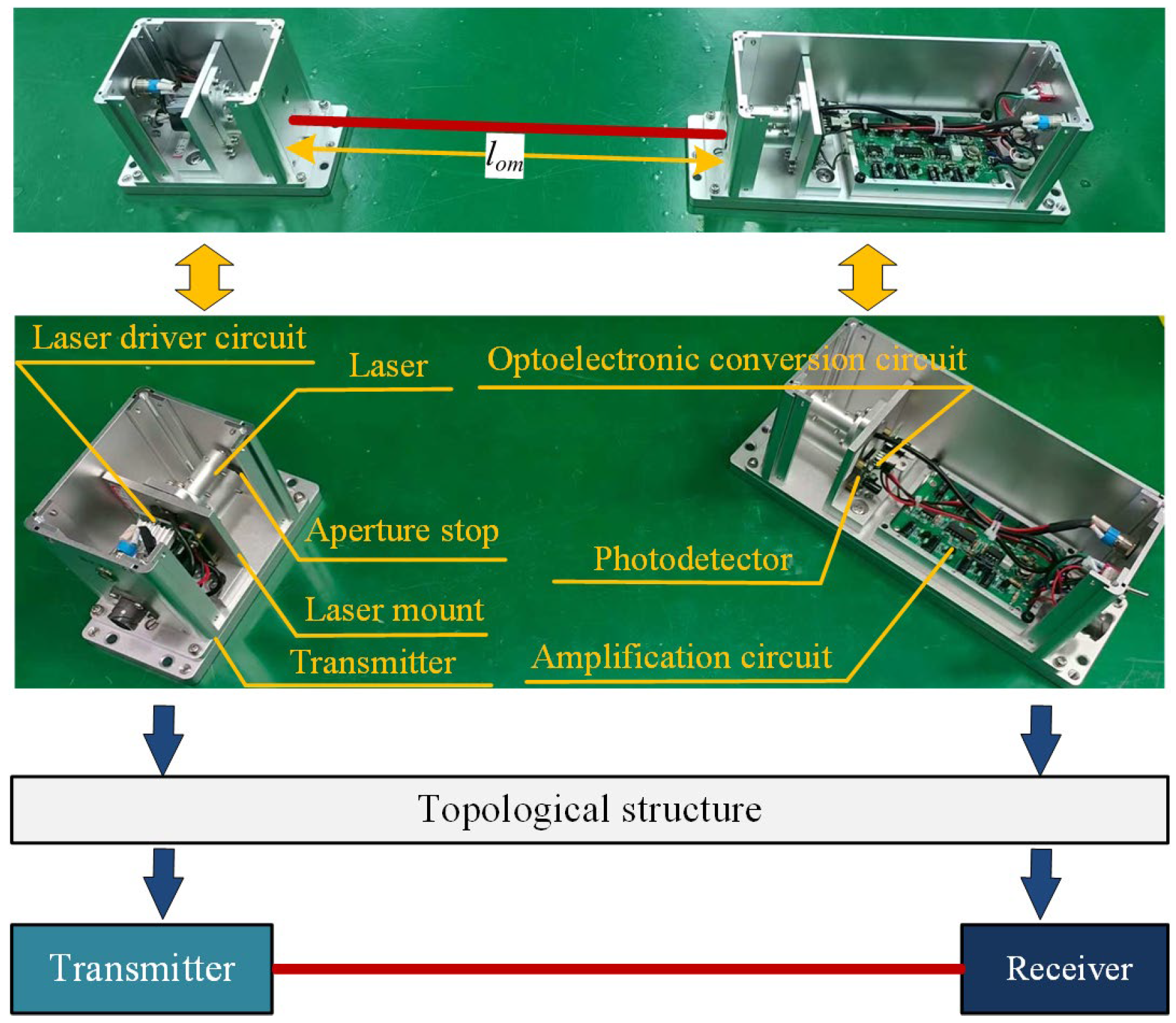
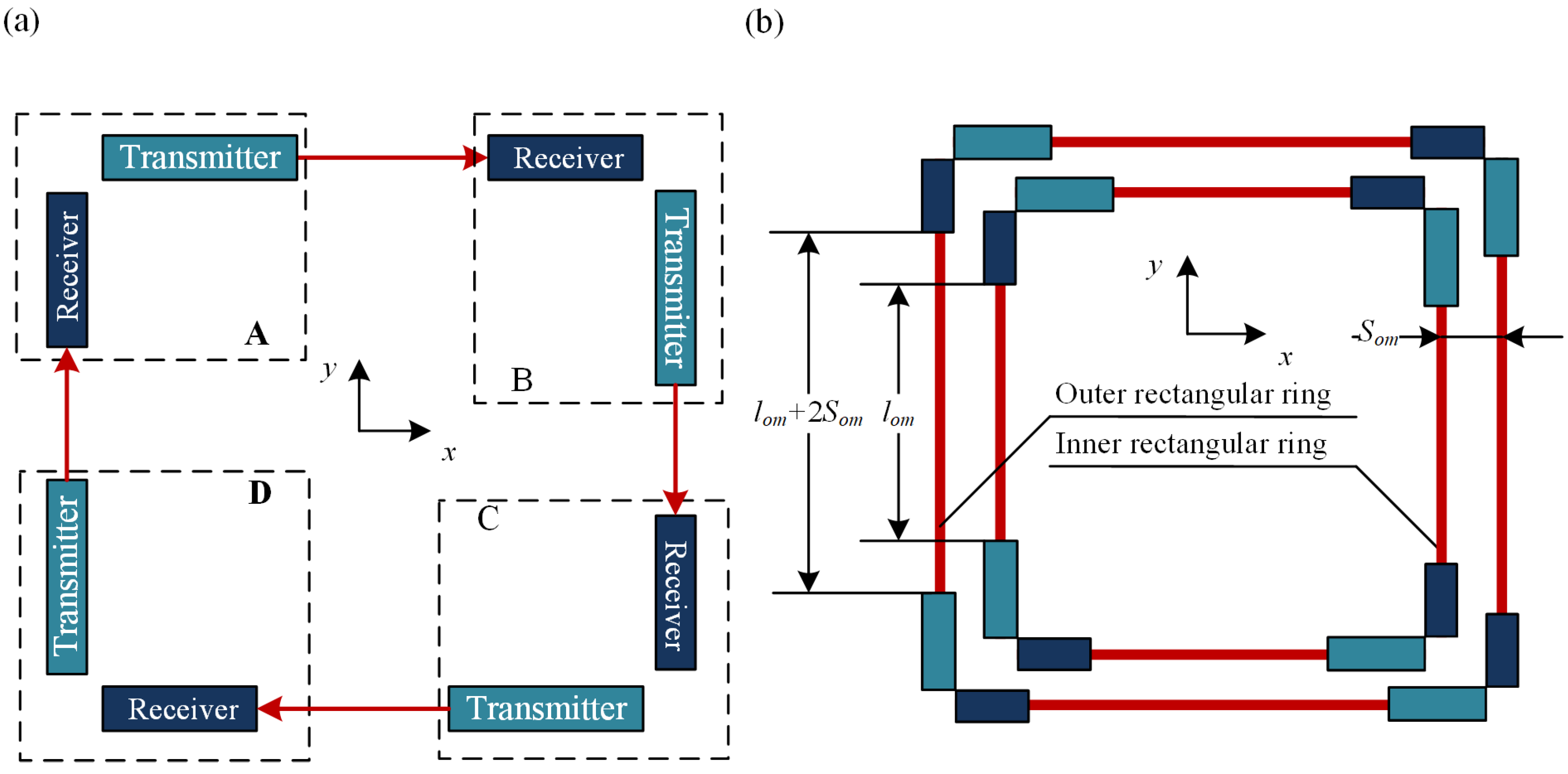
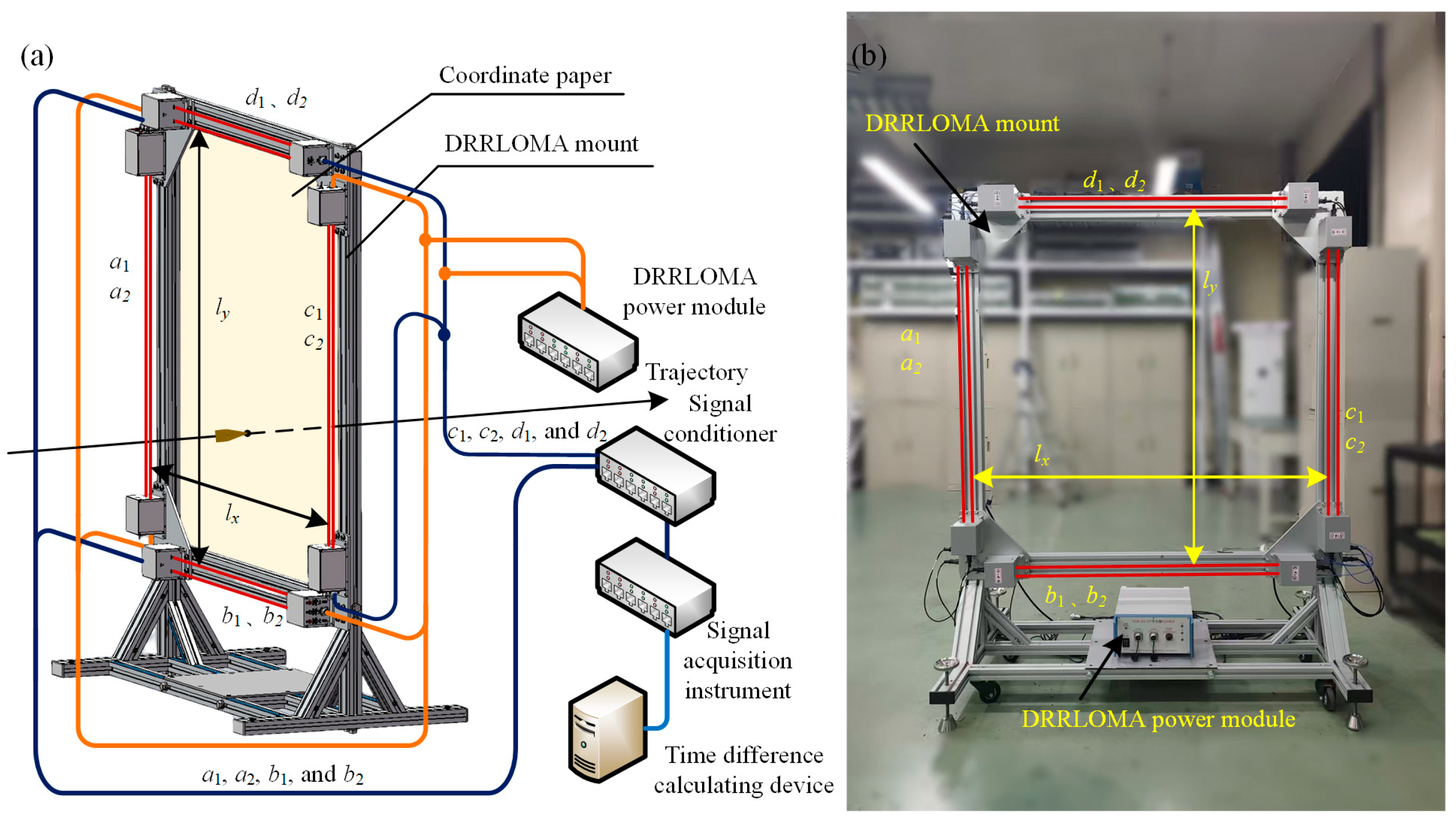
- To achieve large-area SW detection, a DRRLOMA, composed of linear optical microphone arrays, was developed. By leveraging the broad propagation characteristics of SWs [40] and the collimation properties of lasers, an array comprising eight LOMs was designed and arranged in both inner and outer rectangular ring configurations.
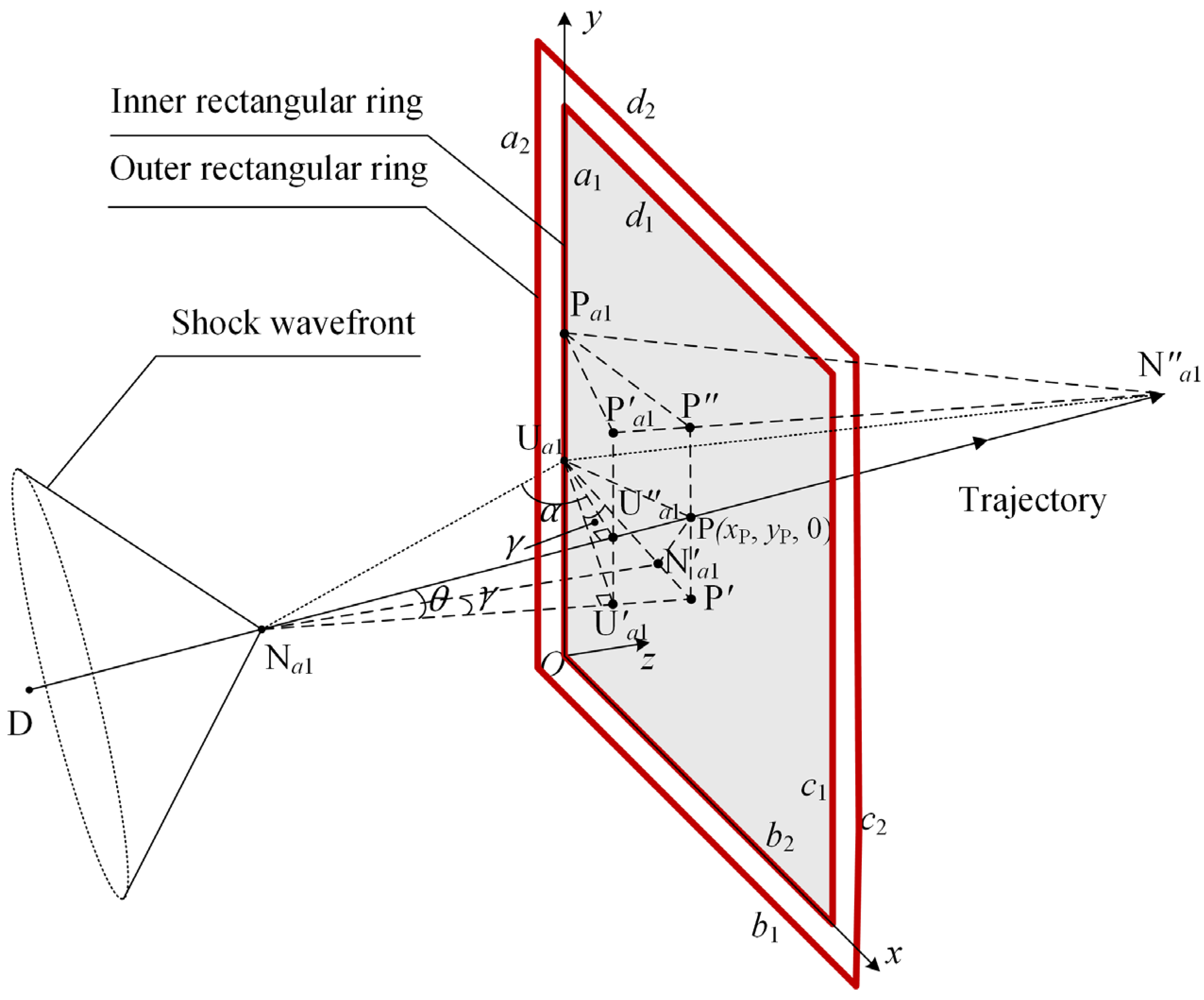
- A time-equivalent model, minimum-time SW path, converts spatial SW propagation into the apparent shock-wave velocity (ASWV) propagation time within the measurement plane by decomposing the path into the FO’s travel time to the interception point (IP) and the ASWV propagation from the IP to a given LOM. Due to the deterministic FO trajectory, the temporal reference shifts to the instant the object reaches the measurement plane, enabling this transformation.
- To determine the IP, in this study, we propose a method for localizing FOs based on a DRRLOMA. By introducing a shock-wave propagation time-equivalent model, the non-uniform propagation characteristics of ASWV within the measurement plane—following the oblique incidence model of the FO—are calculated, enabling high-precision determination of the IP.
2. DRRLOMA Setup and IP Localization Method
2.1. LOM Setup
2.2. DRRLOMA Setup
2.3. Time-Equivalent Model of Shock-Waves
2.4. IP Localization by Time-Equivalent Model
3. Experimental Setup of Localization Method
4. Results and Discussion
4.1. Analysis of Localization Error
4.2. LOM Experimental Results
4.3. DRRLOMA Localization Experimental Results
4.4. Discussion of Experimental Results
4.5. Discussion for Engineering Deployment and Application
- (a)
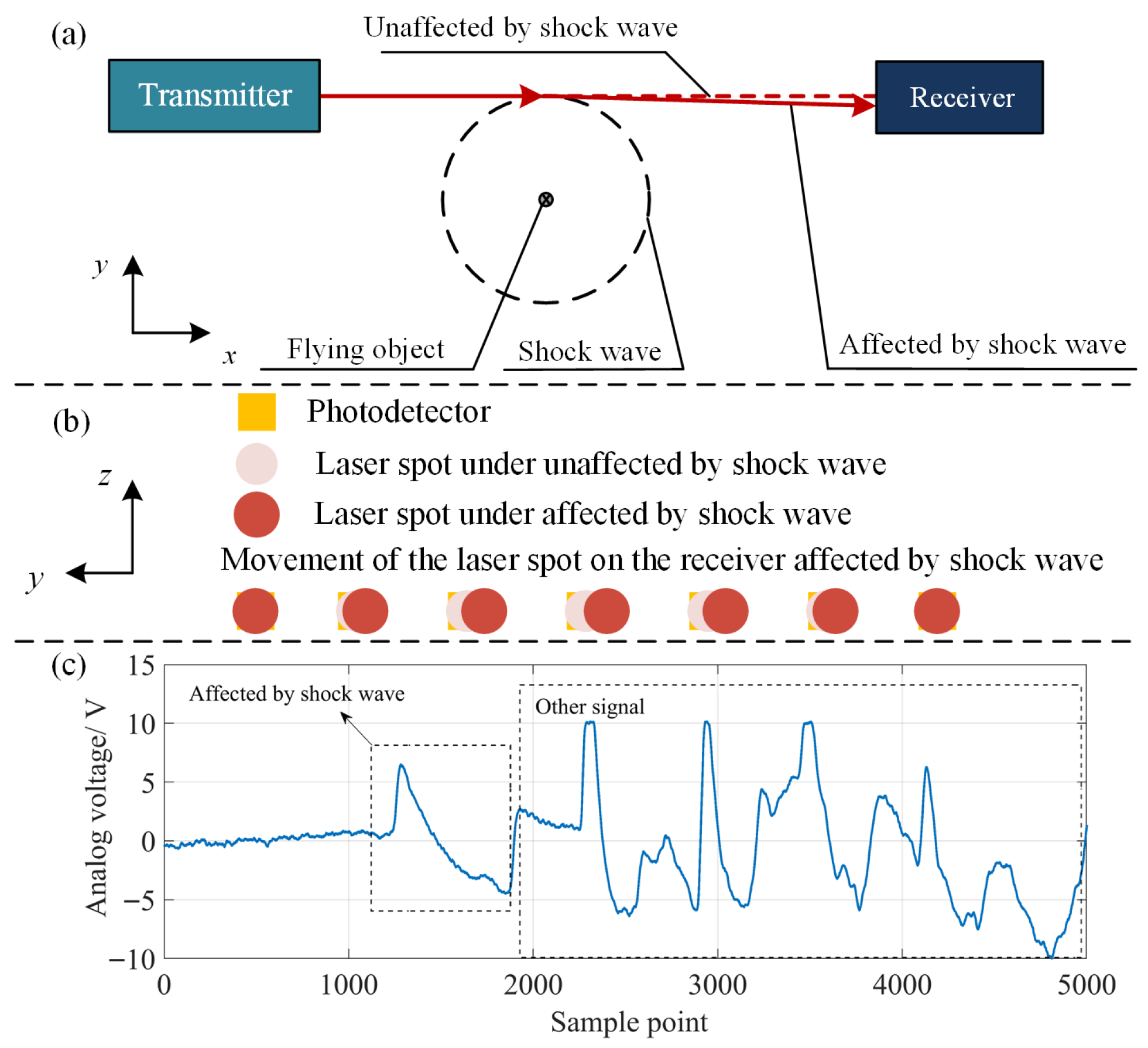
- Robustness to Environmental Factors: In the DRRLOMA, the LOMs make the system unsusceptible to environmental variables. Variations in environmental factors, such as temperature, humidity, and density, affect the propagation of the SW through the medium but do not influence the laser sensing path of the LOM. Once calibrated, the LOM in the DRRLOMA—provided that the transmitter and receiver remain aligned and no shock-wave interference from other FOs is present—generates a transient signal exclusively when a shock-wave arrives at its laser path. Otherwise, the system remains in a ready state. However, extreme turbulent airflow directly impinging on the laser paths could cause signal scintillation, a topic for future investigation in harsh environments.
- (b)
- System Calibration Strategy: The proposed calibration strategy involves three levels. The first addresses the fixed geometric parameters of the DRRLOMA structure, such as side lengths and orthogonality, which are precisely measured using theodolites and auxiliary lasers. Second, the laser beams between the transmitter and receiver of each LOM must be accurately aligned, which is critical for achieving precise FO localization. Third, since the DRRLOMA localization algorithm does not depend on environmental sound speed, no prior sound speed calibration is required. Additionally, the symmetry of the dual-rectangular-ring structure simplifies the calibration process.
- (c)
- Long-Term Stability Considerations: Once the structural frame of the DRRLOMA is fabricated to its specified dimensions, it exhibits excellent mechanical stability suitable for long-term deployment. The hardware circuitry has been tested for electromagnetic interference resistance as well as performance under low-temperature and high-humidity conditions, confirming its long-term stability. Furthermore, solid-state laser diodes (940 nm) and photodetectors (940 nm) integrated into the LOM exhibit long-term stability features with high reliability, long lifetime, and low output drift. As illustrated in Figure 5b, the fully assembled DRRLOMA functions as a single, rigid sensing module with robust resistance to vibration.
5. Conclusions
Author Contributions
Funding
Institutional Review Board Statement
Informed Consent Statement
Data Availability Statement
Conflicts of Interest
Abbreviations
| FO | Flying object |
| IP | Impact point |
| LS | Light screen |
| CCD | Charge-coupled device |
| SW | Shock-wave |
| TDOA | Time difference of arrival |
| DRRLOMA | Dual-rectangular-ring linear optical microphone array |
| LOM | Linear optical microphone |
| ASWV | Apparent shock-wave velocity |
References
- Chinke, S.L.; Berhe, S.; Alegaonkar, P.S. High Speed Flying Object Sensor: Design, Development and System Engineering. IEEE Sens. J. 2021, 21, 27062–27068. [Google Scholar] [CrossRef]
- Li, H.; Lei, Z. Measurement of Flying object Burst Coordinates by Using Multi-Screen Optical Method and Its Error Analysis. Acta Opt. Sin. 2012, 32, 0212003. [Google Scholar] [CrossRef]
- Feng, B.; Shi, X. Studies of acoustic target with two equilateral triangle arrays. Appl. Acoust. 2012, 31, 140–144. [Google Scholar] [CrossRef]
- Lin, Y.; Di, C.; Di, C.; Gong, X.; Ji, H. Location model of oblique incident double triangular array based on shock propagation path. Acta Armamentarii 2019, 40, 251–256. [Google Scholar] [CrossRef]
- Zou, Y.; Zhang, L.; Wang, H. Numerical Simulation of Dispersion of Flying object Jump Caused by Initial Disturbance. J. Ordnance Equip. Eng. 2020, 41, 46–52. [Google Scholar] [CrossRef]
- de Cêa, B.S.A.; Pereira Junio, R.F.; Silva, D.S.; da Costa Garcia Filho, F.; Monteiro, S.N.; Cassiano Nascimento, L.F. An experimental and numerical study of the ballistic behavior of an epoxy matrix hybrid composite reinforced with aramid fabric and fique fabric. J. Mater. Res. Technol. 2025, 35, 2037–2054. [Google Scholar] [CrossRef]
- Shen, Y.Z.; Wen, K.Y.; Shen, Y.L.; Luo, X.H.; Nie, W.X.; Wang, H.C.; Xu, H.R. Dynamic Response and Energy Absorption Characteristics of Auxetic Concave Honeycomb Pad for Ballistic Helmet under Shock Wave and Bullet Impact. Mech. Solids 2025, 59, 3050–3067. [Google Scholar] [CrossRef]
- Tang, E.L.; Liang, Z.Q.; Wang, L.; Han, Y.F. Experimental investigations on location of debris impact source based on acoustic emission. Adv. Space Res. 2019, 64, 2390–2404. [Google Scholar] [CrossRef]
- Liu, M.; Wang, Q.; Zhang, Q.; Long, R.; Su, Z. Characterizing hypervelocity (>2.5 km/s)-impact-engendered damage in shielding structures using in-situ acoustic emission: Simulation and experiment. Int. J. Impact. Eng. 2018, 111, 273–284. [Google Scholar] [CrossRef]
- Tian, H.; Ni, J. Research on measuring method for terminal trajectory of the flying object parameters by nine-light-screens-array. Chin. J. Sci. Instrum. 2018, 39, 17–23. [Google Scholar] [CrossRef]
- Li, H.; Ni, J.; Yang, X.; Chen, D. Research on Attenuation Motion Test Based on Double-N Six-Light-Screen System. Photonics 2022, 9, 516. [Google Scholar] [CrossRef]
- Li, H. An Optical Transformation Design Method of Sky Screen Sensor Based on Lens Convergence. IEEE Sens. J. 2024, 24, 40685–40695. [Google Scholar] [CrossRef]
- Li, H.; Li, X.; Zhang, X.; Lu, L. Design of Photoelectric Detection Sensor Incorporated with Meso-Lens Array and Its Detection Screen Performance Analysis. IEEE Sens. J. 2020, 21, 1444–1452. [Google Scholar] [CrossRef]
- Geng, D.; Chen, L.; Hou, Z.; Zhang, X.; Wei, X. The laser screen imaging measurement system based on arrayed fibers. Opt. Lasers Eng. 2024, 183, 108551. [Google Scholar] [CrossRef]
- Chen, R.; Cai, R.; Ji, B. Flying object flight parameters measurement method based on the spatial distribution of light-screen thickness. Measurement 2022, 195, 111143. [Google Scholar] [CrossRef]
- Li, H.; Zhang, X.; Gao, J. A Design Method of Active Photoelectric Detection Sensor Based on 1-D Multiunit p-i-n Detector and Its Detection Model. IEEE Sens. J. 2022, 22, 21600–21612. [Google Scholar] [CrossRef]
- Li, H.; Zhang, X. Laser Reflection Characteristics Calculation and Detection Ability Analysis of Active Laser Detection Screen Instrument. IEEE Trans. Instrum. Meas. 2021, 71, 7000111. [Google Scholar] [CrossRef]
- Liu, X.; Lei, Z. Measurement method of flying object explosion position based on two area array CCDs intersection and its error analysis. In 2023 9th International Conference on Mechanical and Electronics Engineering (ICMEE); IEEE: New York, NY, USA, 2023; Volume 2023, pp. 17–19. [Google Scholar] [CrossRef]
- Li, H.; Zhang, X.; Miao, W. Spatial Position Measurement of Multiple Targets Using a Line Lasers and a Plane Array Camera. IEEE Sens. J. 2019, 19, 10443–10451. [Google Scholar] [CrossRef]
- Duan, C.; Ni, J.; Li, J.; Chen, R.; Cui, C.; Liu, Y. Spatial distribution of sensitivity of large-area triangular detection light screen. J. Appl. Opt. 2021, 42, 956–962. [Google Scholar] [CrossRef]
- Duan, C.; Sun, Z.; Li, H.; Ni, J.; Wu, Z. Sensitivity distribution of large-area triangular detection light screen with original reflection. J. Appl. Opt. 2023, 44, 113–121. [Google Scholar] [CrossRef]
- Zengin, K.; Yeşildirek, A. A Hybrid Model for 3-D Gunshot Localization Using Muzzle Blast Sound Only. IEEE Trans. Instrum. Meas. 2024, 73, 2533810. [Google Scholar] [CrossRef]
- Chen, H.; Ballal, T.; Muqaibel, A.H.; Zhang, X.; Ai-Naffouri, T.Y. Air writing via receiver array-based ultrasonic source localization. IEEE Trans. Instrum. Meas. 2020, 69, 8088–8101. [Google Scholar] [CrossRef]
- Guo, R.; He, Z.; Wang, W. Review of passive acoustic localization technique and impact point location methods. Elem. Electroacoust. 2010, 34, 48–51. [Google Scholar] [CrossRef]
- Sun, S.; Xv, J.; Wang, W. Shock Wave Measurement and Time Difference of Arrival Analysis for Impact Point Positioning. IEEE Trans. Instrum. Meas. 2021, 71, 9600113. [Google Scholar] [CrossRef]
- Bestagini, P.; Compagnoni, M.; Antonacci, F.; Sarti, A.; Tubaro, S. TDOA-based acoustic source localization in the space–range reference frame. Multidimens. Syst. Signal Process 2014, 25, 337–359. [Google Scholar] [CrossRef]
- Dong, J.; Gao, L. Mathematical model of bullet shooting in any direction based on sensors distributed stereoscopically. In 2014 IEEE International Conference on Progress in Informatics and Computing; IEEE: New York, NY, USA, 2014; Volume 2014, pp. 260–264. [Google Scholar] [CrossRef]
- Bakhoum, E.G.; Cheng, M.H.M. Advanced Optical Microphone. IEEE Sens. J. 2013, 14, 7–14. [Google Scholar] [CrossRef]
- Wang, Z.; Wen, G.; Wu, Z. Fiber optic method for obtaining the peak reflected pressure of shock waves. Opt. Express 2018, 26, 15199–15210. [Google Scholar] [CrossRef]
- Fischer, B. Optical microphone hears ultrasound. Nat. Photonics 2016, 10, 356–358. [Google Scholar] [CrossRef]
- Kim, D.; Hall, N.A. Towards a sub 15-dBA optical micromachined microphone. J. Acoust. Soc. Am. 2014, 135, 2664–2673. [Google Scholar] [CrossRef]
- Milleri, N.; Valli, L.; Fueldner, M.; Wiesbauer, A.; Baschirotto, A. A 22-dBA Digital Optical MEMS Microphone. IEEE J. Solid-State Circuits 2024, 59, 2005–2018. [Google Scholar] [CrossRef]
- Hu, X.; Yue, Y.; Cai, C.; Qi, Z. Temperature-robust optical microphone with a compact grating interferometric module. Appl. Opt. 2023, 62, 6072–6080. [Google Scholar] [CrossRef] [PubMed]
- Xu, K.; Zong, Z.; Liu, D.; Wang, R.; Yu, L. Deep Learning-Based Sound Source Localization: A Review. Appl. Sci. 2025, 15, 7419. [Google Scholar] [CrossRef]
- Jeong, I.; Huh, H.; Park, B.; Lee, A.; Jung, I.; Lee, S. MicGraphNet: Microphone graph network for cross-correlation-based time delay estimation for accurate sound source localization. Measurement 2026, 258, 119552. [Google Scholar] [CrossRef]
- An, I.; An, G.; Kim, T.; Yoon, S.-E. Microphone Pair Training for Robust Sound Source Localization with Diverse Array Configurations. IEEE Robot. Autom. Lett. 2024, 9, 319–326. [Google Scholar] [CrossRef]
- Fu, W.; Zhou, R.; Gao, Y.; Guo, Z.; Yu, Q. Damage Source Localization in Concrete Slabs Based on Acoustic Emission and Machine Learning. IEEE Sens. J. 2025, 25, 11622–11635. [Google Scholar] [CrossRef]
- Cai, R.; Ni, J.; Tian, H. Design and improvement of a light-interference-resistant light curtain target. Opt. Tech. 2006, 5, 790–7922. [Google Scholar] [CrossRef]
- Pouretedal, H.; Sattar, S.; Zare, A. Improved luminosity of a new tracer pyrotechnic of Mg:BaO2:Ba(NO3)2:Viton using response surface methodology. J. Therm. Anal. Calorim. 2023, 148, 5209–5216. [Google Scholar] [CrossRef]
- Lo, K.W. A matched-field processing approach to ranging surface vessels using a single hydrophone and measured replica fields. J. Acoust. Soc. Am. 2021, 49, 1466. [Google Scholar] [CrossRef]
- Duan, C.; Ni, J.; Tian, H.; He, B.; Li, J. The effect of muzzle blast wave on light screen in external ballistic measurement. Front. Phys. 2025, 13, 1517445. [Google Scholar] [CrossRef]
- Noack, J.; Hammer, D.X.; Noojin, G.D.; Rockwell, B.A.; Vogel, A. Influence of pulse duration on mechanical effects after laser-induced breakdown in water. J. Appl. Phys. 1998, 83, 7488–7495. [Google Scholar] [CrossRef]
- Mur, J.; Reuter, F.; Kočica, J.J.; Lokar, Ž.; Petelin, J.; Agrež, V.; Ohl, C.D.; Petkovšek, R. Multi-frame multi-exposure shock wave imaging and pressure measurements. Opt. Express 2022, 30, 37664–37674. [Google Scholar] [CrossRef]
- Li, H.; Zhang, X.; Zhang, X.; Gao, J. Warhead Fragments’ Distribution Measurement Method by a Multiscreen Sensors’ Intersection Test Mechanism and Equivalent Target Damage Probability Calculation. IEEE Trans. Instrum. Meas. 2021, 70, 7004109. [Google Scholar] [CrossRef]



| No. | ∆ta1 | ∆ta2 | ∆tb1 | ∆tb2 | ∆tc1 | ∆tc2 | ∆td1 | ∆td2 |
|---|---|---|---|---|---|---|---|---|
| 1 | 0.079 | 0.271 | 0.084 | 0.304 | 1.398 | 1.544 | 0.165 | 0.182 |
| 2 | 1.311 | 1.448 | 1.656 | 2.057 | 0.146 | 0.471 | 0.795 | 0.930 |
| 3 | 0.858 | 1.073 | 0.732 | 0.875 | 1.003 | 1.170 | 0.969 | 1.166 |
| 4 | 1.014 | 1.217 | 1.132 | 1.358 | 1.695 | 2.034 | 1.359 | 1.631 |
| 5 | 1.872 | 2.244 | 1.438 | 1.588 | 0.748 | 0.899 | 1.993 | 6.717 |
| 6 | 2.136 | 2.358 | 1.998 | 2.205 | 0.098 | 0.375 | 2.208 | 8.291 |
| 7 | 0.212 | 0.317 | 0.349 | 0.520 | 3.235 | 3.641 | 0.776 | 0.874 |
| 8 | 2.852 | 3.209 | 0.661 | 0.995 | 0.252 | 0.377 | 0.201 | 0.226 |
| 9 | 0.742 | 1.128 | 3.389 | 3.810 | 1.069 | 1.202 | 2.572 | 3.882 |
| 10 | 1.763 | 1.982 | 1.090 | 1.229 | 0.529 | 0.802 | 1.621 | 2.388 |
| 11 | 2.772 | 3.119 | 0.3506 | 0.528 | 0.260 | 0.389 | 0.660 | 0.662 |
| 12 | 0.783 | 1.190 | 2.998 | 3.371 | 0.911 | 1.024 | 2.435 | 2.436 |
| 13 | 1.342 | 1.508 | 2.314 | 2.608 | 0.554 | 0.838 | 1.971 | 1.973 |
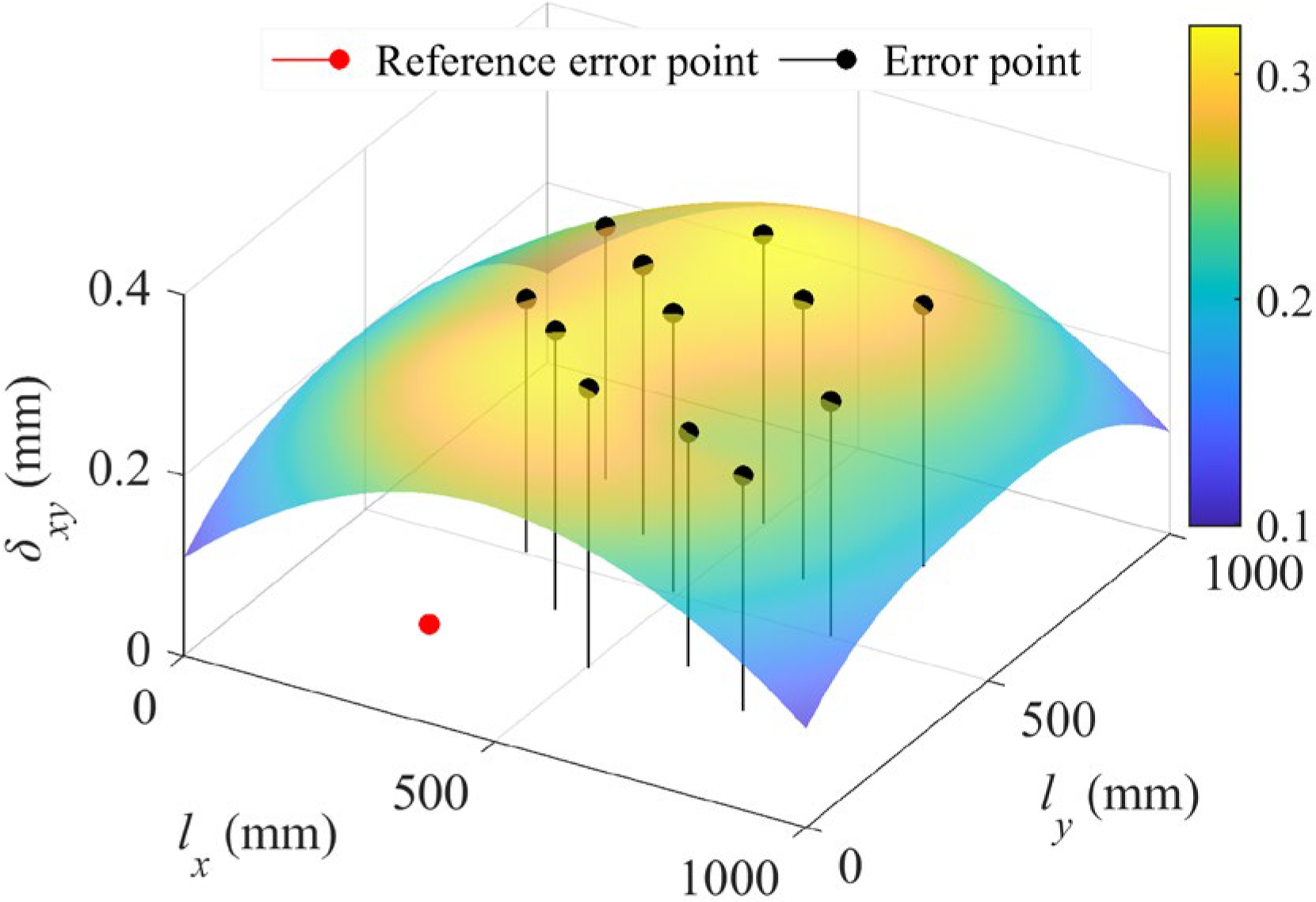
| No. | xs | ys | |xs1| | |ys1| | xP | yP | |xP1| | |yP1| | δxy |
|---|---|---|---|---|---|---|---|---|---|
| 1 | 247.0 | 252.8 | 0.0 | 0.0 | 246.84 | 252.55 | 0.00 | 0.00 | 0.00 |
| 2 | 255.9 | 504.0 | 9.0 | 251.2 | 255.92 | 503.99 | 9.08 | 251.44 | 0.28 |
| 3 | 242.8 | 744.1 | 4.1 | 491.3 | 242.86 | 744.05 | 3.99 | 491.50 | 0.28 |
| 4 | 503.0 | 252.7 | 256.0 | 0.2 | 502.99 | 252.82 | 256.14 | 0.27 | 0.31 |
| 5 | 492.1 | 504.0 | 245.1 | 251.1 | 492.01 | 504.00 | 245.17 | 251.45 | 0.31 |
| 6 | 497.0 | 744.0 | 250.1 | 491.2 | 497.03 | 744.03 | 250.19 | 491.48 | 0.32 |
| 7 | 751.1 | 252.8 | 504.1 | 0.0 | 751.18 | 252.68 | 504.33 | 0.13 | 0.26 |
| 8 | 745.0 | 504.0 | 498.0 | 251.2 | 744.93 | 503.98 | 498.08 | 251.43 | 0.26 |
| 9 | 752.9 | 744.0 | 506.0 | 491.2 | 752.96 | 744.00 | 506.12 | 491.46 | 0.29 |
| 10 | 378.0 | 375.9 | 131.0 | 123.1 | 377.99 | 375.96 | 131.15 | 123.41 | 0.31 |
| 11 | 371.9 | 628.0 | 124.9 | 375.2 | 371.93 | 628.00 | 125.09 | 375.45 | 0.30 |
| 12 | 620.9 | 325.9 | 374.0 | 73.1 | 620.91 | 325.89 | 374.06 | 73.34 | 0.26 |
| 13 | 629.0 | 628.0 | 382.1 | 375.2 | 629.08 | 628.03 | 382.24 | 375.48 | 0.31 |
| Mean | 0.28 | ||||||||
| Standard deviation (SD) | 0.22 | ||||||||
| Sensor Type | DRRLOMA | Acoustic Sensors [25] | Multi-Light-Screen Array [44] |
|---|---|---|---|
| Area | 1.0 m × 1.0 m | 1.0 m × 1.0 m | 2.0 m × 2.0 m |
| Errors | 0.5 mm | 10.0 mm | 3.5 mm |
| Ratio Error | 0.5‰ | 10.0‰ | 1.8‰ |
| Sensing shape | Linear | Dot | Plane |
| Computational Complexity | Multi-channel signal processing; positioning computed via concise formulas | Multi-channel signal processing via modest complexity formulas | Multi-channel signal processing via significant complex formulas |
| Real-Time Capability | Response times of less than 500 ms can be achieved by hardware; good real-time performance | ||
| Cost-Effectiveness Analysis | Moderate initial cost (including the sensor structures and hardware circuitry, etc.) | Low initial cost | High initial cost |
| Primary Advantages | High accuracy, easy scalability (10 m ×10 m), and sound speed calibration-free computation process | Low cost; well-established technology. | Good environmental adaptability; high accuracy; no velocity constraint |
| Primary Limitations | Supersonic FO requirement | Supersonic FO requirement; sound speed calibration requirement | High initial cost; limited scalability of the measurement plane |
Disclaimer/Publisher’s Note: The statements, opinions and data contained in all publications are solely those of the individual author(s) and contributor(s) and not of MDPI and/or the editor(s). MDPI and/or the editor(s) disclaim responsibility for any injury to people or property resulting from any ideas, methods, instructions or products referred to in the content. |
© 2026 by the authors. Licensee MDPI, Basel, Switzerland. This article is an open access article distributed under the terms and conditions of the Creative Commons Attribution (CC BY) license.
Share and Cite
Duan, C.; Ni, J.; Tian, H.; Wang, Y.; Li, J. Impact Point Localization Method Using Dual-Rectangular-Ring Linear Optical Microphone Array Based on Time-Equivalent Model. Photonics 2026, 13, 104. https://doi.org/10.3390/photonics13020104
Duan C, Ni J, Tian H, Wang Y, Li J. Impact Point Localization Method Using Dual-Rectangular-Ring Linear Optical Microphone Array Based on Time-Equivalent Model. Photonics. 2026; 13(2):104. https://doi.org/10.3390/photonics13020104
Chicago/Turabian StyleDuan, Chenxi, Jinping Ni, Hui Tian, Yubo Wang, and Jing Li. 2026. "Impact Point Localization Method Using Dual-Rectangular-Ring Linear Optical Microphone Array Based on Time-Equivalent Model" Photonics 13, no. 2: 104. https://doi.org/10.3390/photonics13020104
APA StyleDuan, C., Ni, J., Tian, H., Wang, Y., & Li, J. (2026). Impact Point Localization Method Using Dual-Rectangular-Ring Linear Optical Microphone Array Based on Time-Equivalent Model. Photonics, 13(2), 104. https://doi.org/10.3390/photonics13020104