Article

A Miniature Large-Depth-of-Field Camera Using a Long-Wavelength Infrared Metalens

1
Engineering Research Center of Optical Instrument and System, The Ministry of Education, Shanghai Key Laboratory of Modern Optical System, University of Shanghai for Science and Technology, Shanghai 200093, China
2
National Key Laboratory of Advanced Micro and Nano Manufacture Technology, Shanghai Jiao Tong University, Shanghai 200030, China
*
Authors to whom correspondence should be addressed.
Photonics 2025, 12(12), 1193; https://doi.org/10.3390/photonics12121193
Submission received: 10 November 2025 / Revised: 28 November 2025 / Accepted: 1 December 2025 / Published: 4 December 2025
(This article belongs to the Special Issue Principle and Application of Optical Metasurfaces)

Abstract

Miniaturized long-wavelength infrared (LWIR) imaging systems are highly desirable for applications such as portable thermal sensing, unmanned surveillance, and medical diagnostics. Conventional refractive optics in the LWIR regime often require multiple lens configurations to extend depth of field (DoF), leading to increased size, weight, and cost. Although existing LWIR metalenses demonstrate competent capabilities, comprehensive approaches to DoF engineering have yet to be explored. Here, we demonstrate a miniature large-DoF camera using a metalens. The designed metalens features a 14 mm diameter aperture and weighs only 0.8 g while maintaining sharp focus over a working distance ranging from 1 m to 22 m. By leveraging subwavelength phase engineering, the metalens achieves high-resolution imaging with low aberration. The integrated camera exhibits an ultra-compact form factor, i.e., 2.3 cm × 2.3 cm × 1.2 cm (length × width × height) and weighs just 25 g. Experimental results confirm the superior DoF performance, enabling clear imaging across varying distances without mechanical refocusing. The advance provides a promising pathway toward ultra-compact, large-DoF LWIR imaging systems for applications ranging from autonomous vehicles to portable medical diagnostics and miniature surveillance devices.

1. Introduction

Long-wavelength infrared (LWIR) imaging (8–12 μm) is a vital technology with broad applications in medical diagnostics, industrial monitoring and remote sensing [1,2,3,4]. Leveraging the transparency window in this spectral range, LWIR enables non-contact long-range temperature measurements and high-contrast thermal imaging, even in challenging environmental conditions [5,6,7]. In smoky and foggy conditions where traditional vision systems are blinded, LWIR cameras maintain functionality due to their long-wavelength superior penetration capability that is a critical feature for firefighting operations and maritime navigation [8,9,10]. Its ability to capture thermal radiation signatures makes it indispensable for non-contact thermography, target identification, and surveillance. However, conventional LWIR imaging systems rely on bulky refractive optics, typically made from materials like germanium, zinc selenide (ZnSe), or zinc sulfide (ZnS). In addition, the lenses require precisely curved surfaces and complex designs for good focusing and low aberration performances [11,12]. To achieve high numerical apertures and maintain large DoF, systems typically require multiple lens elements stacked together, leading to significant size and weight penalties [12,13,14]. The substantial size and weight of conventional LWIR lenses present significant barriers to developing miniature systems, limiting their adoption in applications requiring compact form factors, such as unmanned aerial vehicles (UAVs), wearable devices, and autonomous vehicles [15,16].
Long-wavelength infrared (LWIR) metalenses have emerged as promising alternatives to conventional refractive optics, offering ultrathin, lightweight designs with precise wavefront control through subwavelength meta-atoms. A critical technique in designing metalenses is to link a given phase distribution to a meta-atom array. Usually, inverse design methods, e.g., gradient-based optimization, genetic algorithm, and multi-scale optimization, are adopted to explore the shape and dimension of meta-atoms [17,18,19]. Manufacturing limits, such as minimum feature size and maximum aspect ratio, should be incorporated in the design. LWIR metalenses operating in the long-wavelength regime allows their constituent meta-atoms to be larger than those designed for visible or near-infrared wavelengths. The relaxed fabrication tolerance eliminates the need for complex, time-consuming nanofabrication techniques, like electron-beam lithography or focused ion beam milling, to pattern subwavelength nanostructures. Instead, LWIR metalenses can be produced using the mature photolithography technique [20,21]. Recent advancements demonstrate potential for high-numerical-aperture focusing and large-aperture designs of LWIR metalenses [22,23,24,25]. Imaging with a large angle-of-view (AOV) and broad bandwidth has been explored, as listed in Table S1 [22,23,26,27,28]. However, existing designs prioritize aberration correction but lack tailored strategies for extended focal ranges. The imaging performance of the reported LWIR metalenses has not been adequately characterized across varying object distances in real-world scenarios, leaving their practical DoF capabilities unverified.
This work demonstrates a large depth-of-field LWIR camera. A customized aberration-optimized, polarization-insensitive metalens is used in the camera. The design advances large depth-of-field [29,30,31,32] and large-aperture meta-optics without compromising fabrication difficulty and scalability. The metalens is fabricated as a single-layered all-silicon structure with a square lattice of cylindrical meta-atoms. The metalens is integrated with an LWIR image sensor into a highly miniaturized imaging system. The camera can be seamlessly connected with smartphones or computing devices, offering a low-cost, mass-producible solution for portable thermal imaging. In the demonstration, wide-range LWIR imaging is validated through real-world tests, where the camera captures high-contrast thermal images. This work paves the way for ultra-compact, large-depth-of-field LWIR cameras in security, night vision, and autonomous sensing.

2. Methods

2.1. Design Principle of LWIR Metalens

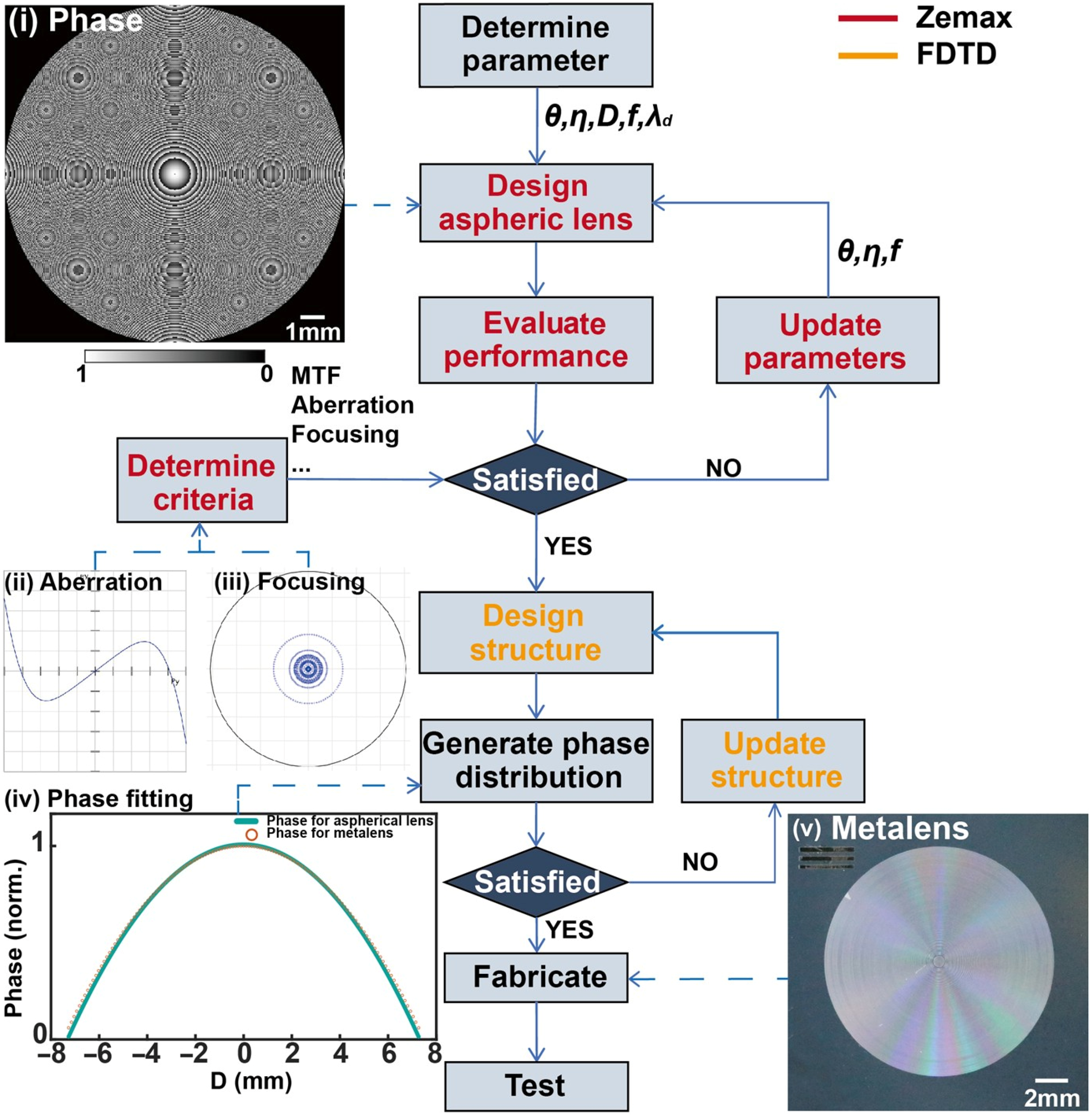
The design of the metalens is based on a prototype of an aspheric lens, because the design methods of conventional refractive lenses are mature and several powerful optical design tools can be implemented. As shown in Figure S1, the image distance of a conventional lens varies with the object distance. Once the lens is mounted to the camera with a fixed image distance, a clear image can only be obtained at a distance around the corresponding object distance. In this work, a finite conjugate optical system with multiple conjugate planes (1 m, 5 m, and 20 m) and a single image distance was employed in the ANSYS Zemax OpticStudio 2024 vR1 to design an LWIR metalens. The design effectively broadens the range of the object distance of the metalens, thereby extending the imaging distance. The flowchart of the LWIR metalens design is plotted in Figure 1. An aspherical lens with good imaging performance, such as low chromatic aberration and the initial focusing phase distribution, is firstly designed according to a group of desired parameters, e.g., acceptance angle, θ, magnification, η, diameter of entrance pupil, D, and back focal length, f, and design wavelength, λd. The profile design of the aspheric lens is shown in Figure S2 and the coefficients of the Zernike polynomial are listed in Table S2. Specifically, the feature of large DoF is considered in the design. A finite conjugate imaging system with variable object distances ranging from 1 m to 22 m is adopted to evaluate the imaging quality. Modulation transfer function, ray aberration, and focusing spot are calculated. The imaging performances are compared with the pre-defined criteria, i.e., spatial resolution, aberration, and focusing capability. The design of the aspheric lens iteratively continues until the criteria of the imaging quality are perfectly fulfilled. Some parameters of the lens are updated to offer a compromise solution.
The image quality is determined by evaluating the modulation transfer function (MTF) curve and the focusing spot. The resolution of the imaging system is set as 20 LP/mm. MTF = 0.15 with resolution of 20 LP/mm is used as a benchmark for the metalens design. On one hand, according to the simulation conducted in the ANSYS Zemax OpticStudio 2024 vR1, the increase in the aperture leads to aberration. On the other hand, the aperture size is also related to the luminous flux that is an especially important factor in the long-distance imaging. Therefore, the entrance pupil is fixed as 14 mm to compromise the light exposure and aberration. In the optimized design of the aspheric lens, the focal length is 22 mm and the acceptance angle is 10.8°.
This work focuses on the long-distance and large-DoF imaging. The lens with low NA is sufficient to satisfy the imaging requirements. The LWIR metalens developed for demonstration has an NA of 0.3. Figure S3 shows the surface profile of the aspheric lens with the optimized design.
After the design of the aspheric lens, the phase distribution is used as a target in the design of the metalens. A design method based on phase regulation is adopted [33,34]. Cylindrical meta-atoms are adopted as unit cells of the metalens. The radial symmetry of the meta-atoms makes the metalens insensitive to light polarization. The structure of the meta-atoms is optimized by evaluating the transmittance and phase shift in the meta-atoms for the incidence with a wavelength of 10.6 μm. In addition, the meta-atoms are arranged according to the phase distribution of the aspheric lens. The discrepancy between the phase distributions of the aspheric lens and the constructed metalens is also taken into account for the optimization of the meta-atoms. The height, H, and lattice constant, P, of the optimized meta-atoms are 6.6 μm and 5 μm, respectively. When the diameter of the meta-atoms is 1 μm to 3.5 μm, high transmittance (>80%) and 0-to-2π phase shifts can be realized. However, the meta-atoms with a diameter between 3100 μm and 3200 μm are excluded due to the irregular phase shifts and low transmittance, as depicted in Figure 2b. The phase distribution of the metalens has a good agreement with that of the aspheric lens. Furthermore, the transmittance and the phase shift for the incidence of the entire LWIR-band (8 μm to 14 μm) are analyzed (Figure 2c,d).
The meta-atoms exhibit high transmittance over the bandwidth of 10.5 μm to 11 μm. Furthermore, the focusing of the metalens with the incident light at 10.5 μm, 10.6 μm, and 11 μm is calculated in the finite-difference time-domain (FDTD) solutions software (Lumerical FDTD Solutions v2020a) to evaluate the chromatic dispersion. However, it is difficult to perform the calculation if the diameter of the metalens is 14 mm, due to the extremely high computation complexity. Alternatively, a 1.4 mm diameter metalens is designed using the same meta-atom library. The metalens has the identical NA as that presented in the demonstration. It should be noted that a 1.4 mm diameter metalens is equivalent to a 14 mm diameter metalens. Therefore, we choose to use the simulation results of this metalens to predict the results of the 14 mm diameter metalens. As shown in Figure S4, chromatic dispersion of the metalens over 10.5 μm to 11 μm occurs. The focused beam shifts about 0.11 mm along the Z-axis. Thus, the metalens with the bandwidth of 0.5 μm can be designed using the optimized meta-atoms.
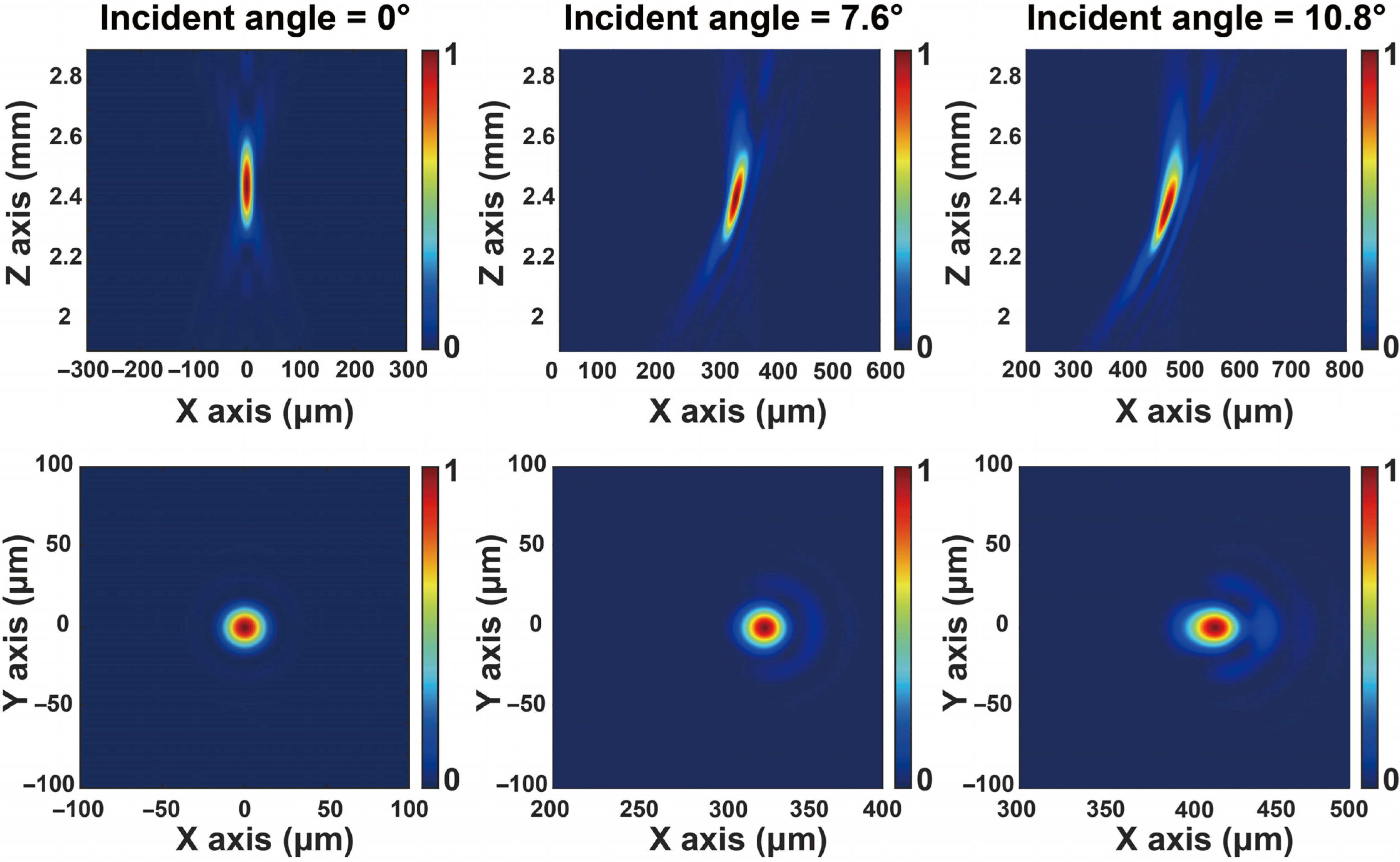
The beam profiles around the focusing are calculated in the FDTD solutions software (Lumerical FDTD Solutions v2020a). The 1.4 mm diameter metalens is used for simulation. The beam profiles in the focal region are calculated for the incidence angles from 0° to 10.8°. As shown in Figure 3, the focusing performance remains stable within a small angular range. Specifically, the results show that, at an oblique incidence of 10.8°, the focal spot slightly elongates and the size (FWHM) increases by a factor of approximately 1.3 compared to the normal incidence. The degradation is moderate and demonstrates that the design maintains robust performance within the AOV of 21.6°. In addition, the beam profiles along the optical axis around the focusing are illustrated in Figure S5. It is worth noting that the focus range is not extremely large because the long-distance imaging is realized by setting multiple conjugate planes and a single focal plane. It means that the images of the targets placed at different object distances would be formed on an identical focusing plane. Thus, a large focus range is not expected.

2.2. Characterization of LWIR Metalens

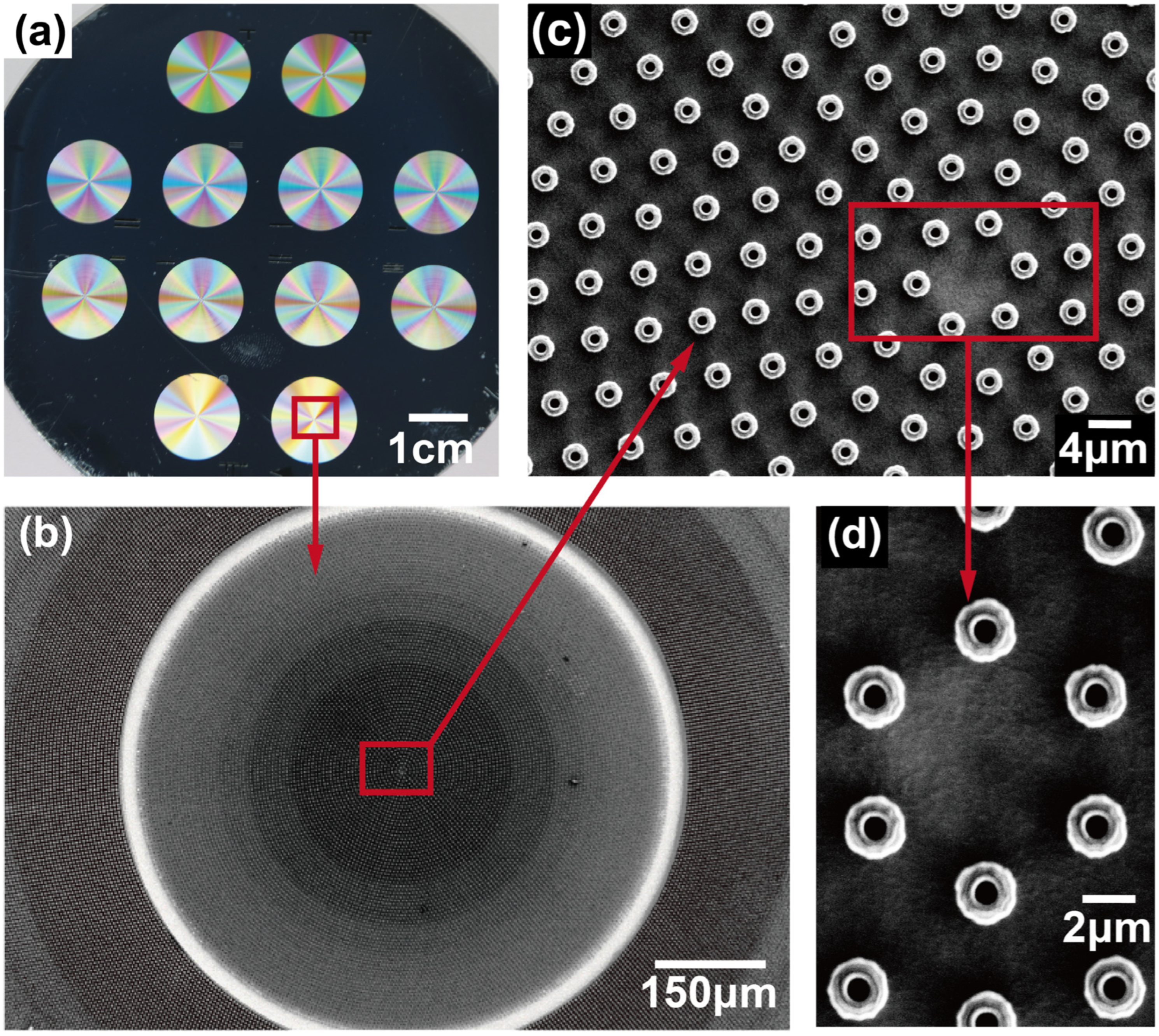
Silicon-based platforms dominate LWIR metalenses due to their compatibility with mature wafer-scale fabrication [34,35,36], enabling fast, scalable, and cost-effective manufacturing. A dozen LWIR metalenses were simultaneously fabricated on a silicon wafer using photolithography and deep reactive ion etching (DRIE) processing [37,38] (Figure S6). Notably, the production yield, defined as the number of metalenses per wafer, can be significantly increased by implementing large-wafer manufacturing capabilities. The structure of the LWIR metalens is measured by scanning electron microscopy (SEM). Figure 4 shows the photo of the metalenses on the wafer and the micro-structure of the metalens. The meta-atoms were well organized according to the design. The side-view SEM image is captured to verify the geometry and vertical profile of the structures, as shown in Figure S7. The diameter of the meta-atoms in the central and peripheral areas of the 12 metalenses is measured. The difference in the meta-atoms at the same positions in the 12 metalenses is less than 4.7%, verifying a good uniformity of the fabrication. In addition, the deviation between the diameter of the designed and the fabricated meta-atoms is no more than 40 nm. High manufacturing precision can be realized if high-resolution photolithography is adopted.
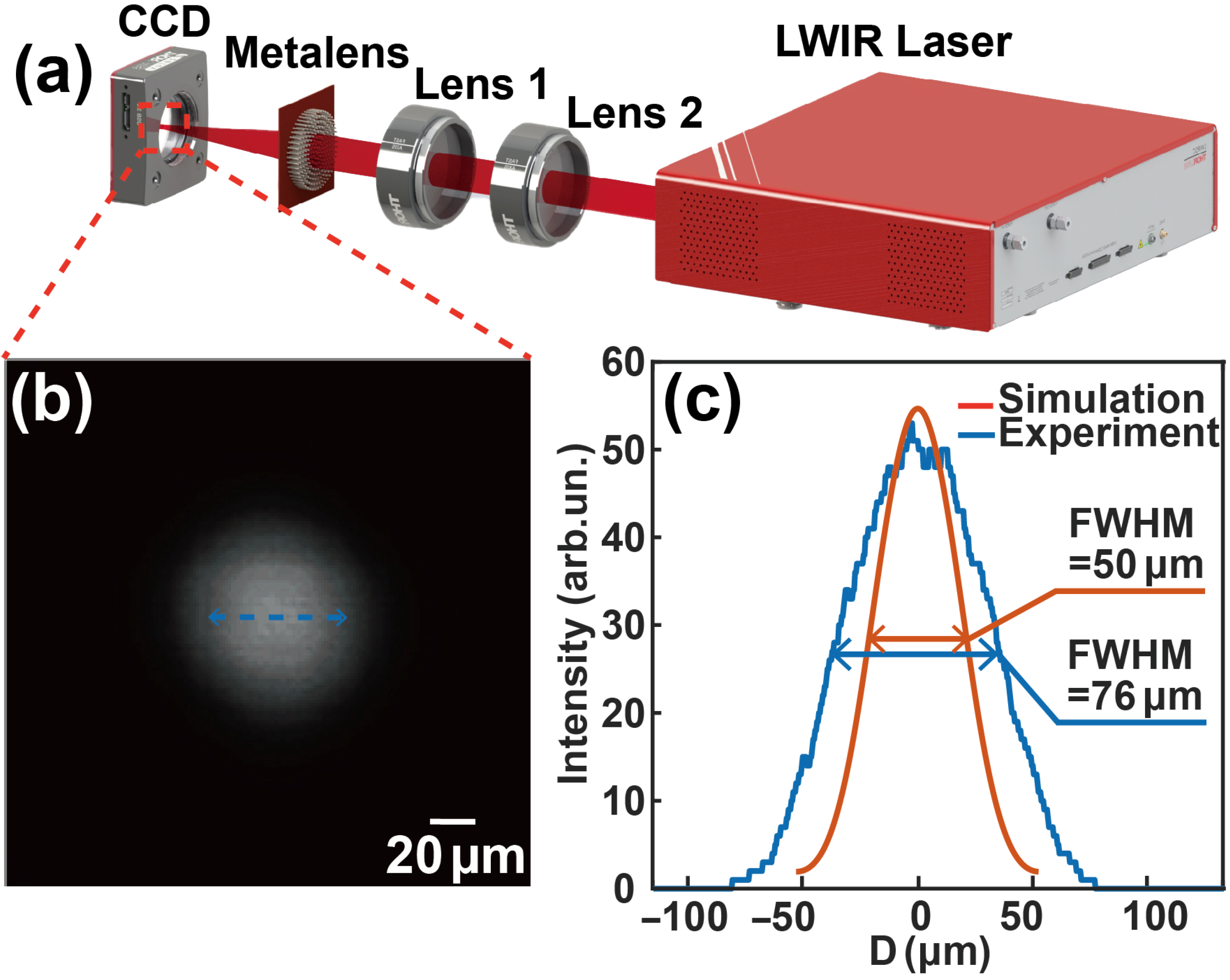
The focusing of the fabricated LWIR metalens is measured. An optical system is established for the measurement, as shown in Figure 5a. A 10.6 μm laser is used as the light source. Two ZnSe lenses with focal lengths of 50 mm and 100 mm, forming a 4f optical system, are used to collimate the light. Then, the collimated light is incident onto the designed LWIR metalens. Finally, a LWIR CCD with a resolution of 256 × 192 pixels is employed to capture the focusing spot. The measured focal spot is shown in Figure 5b. The light spot is radially symmetrical, indicating the symmetrical manner of the metalens. The spot size (full width at half maximum) is 76 μm, which is slightly larger than the calculated result (Figure S8). The good agreement between the measured and the calculated results hints that the fabricated metalens matches well with the design.
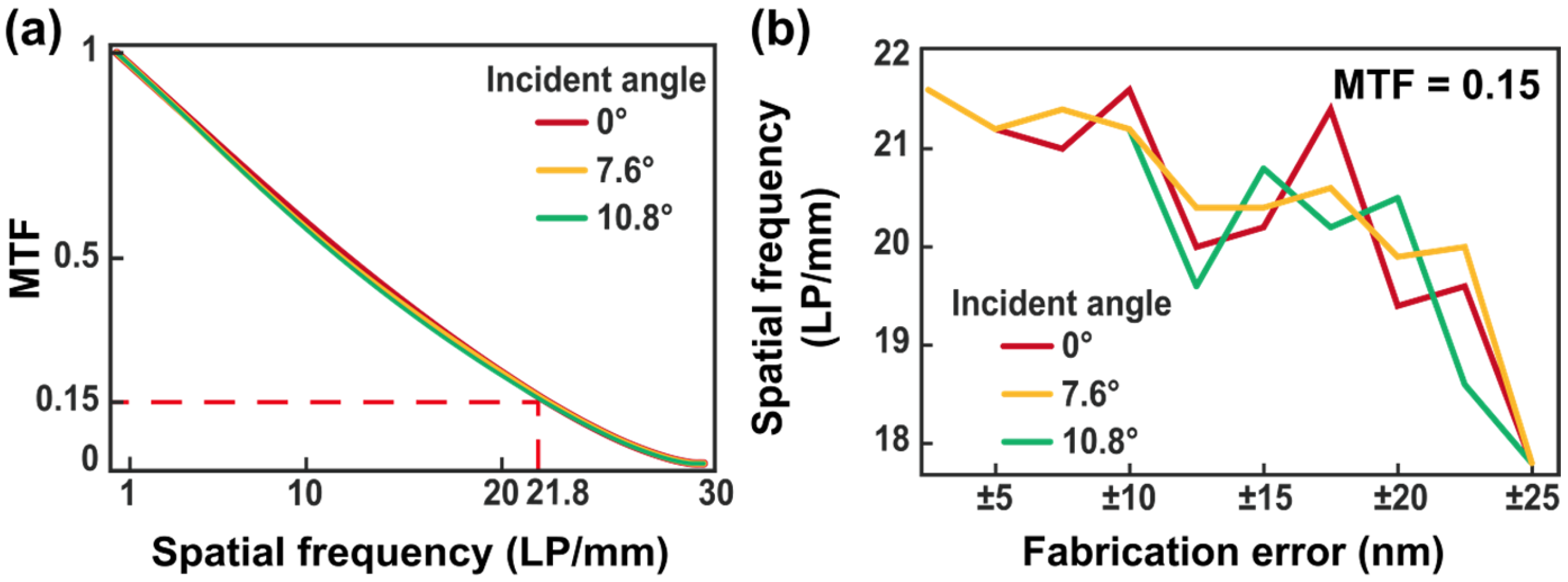
Next, the imaging performance of the metalens is investigated. The resolving power of the metalens is calculated by ANSYS Zemax OpticStudio 2024 vR1. See Figure 6a MTF for the incidence ranging from 0° to 10.8°. The spatial frequency of 21.8 line pairs (LP/mm) can be realized when MTF drops to 0.15. The influence of the fabrication error over the resolving power is investigated. In the calculation, the diameters of the cylindrical meta-atoms are randomly changed within an error range. The spatial frequency gradually decreases when the error range is up to ±18 nm, as depicted in Figure 6b. To evaluate the manufacturing error, the SEM images of the metalens are captured. The diameters of the meta-atoms in the first and second inner rings are measured, as shown in Figure S7. The designed diameters of meta-atoms on the first ring and the second ring are 2100 and 2000 nm, respectively. According to the measurement results, the manufacturing error is less than 20 nm. Thus, the degradation of the resolving power and transmittance resulted from the fabrication error is tolerable.

3. Results

3.1. Demonstration of LWIR Imaging

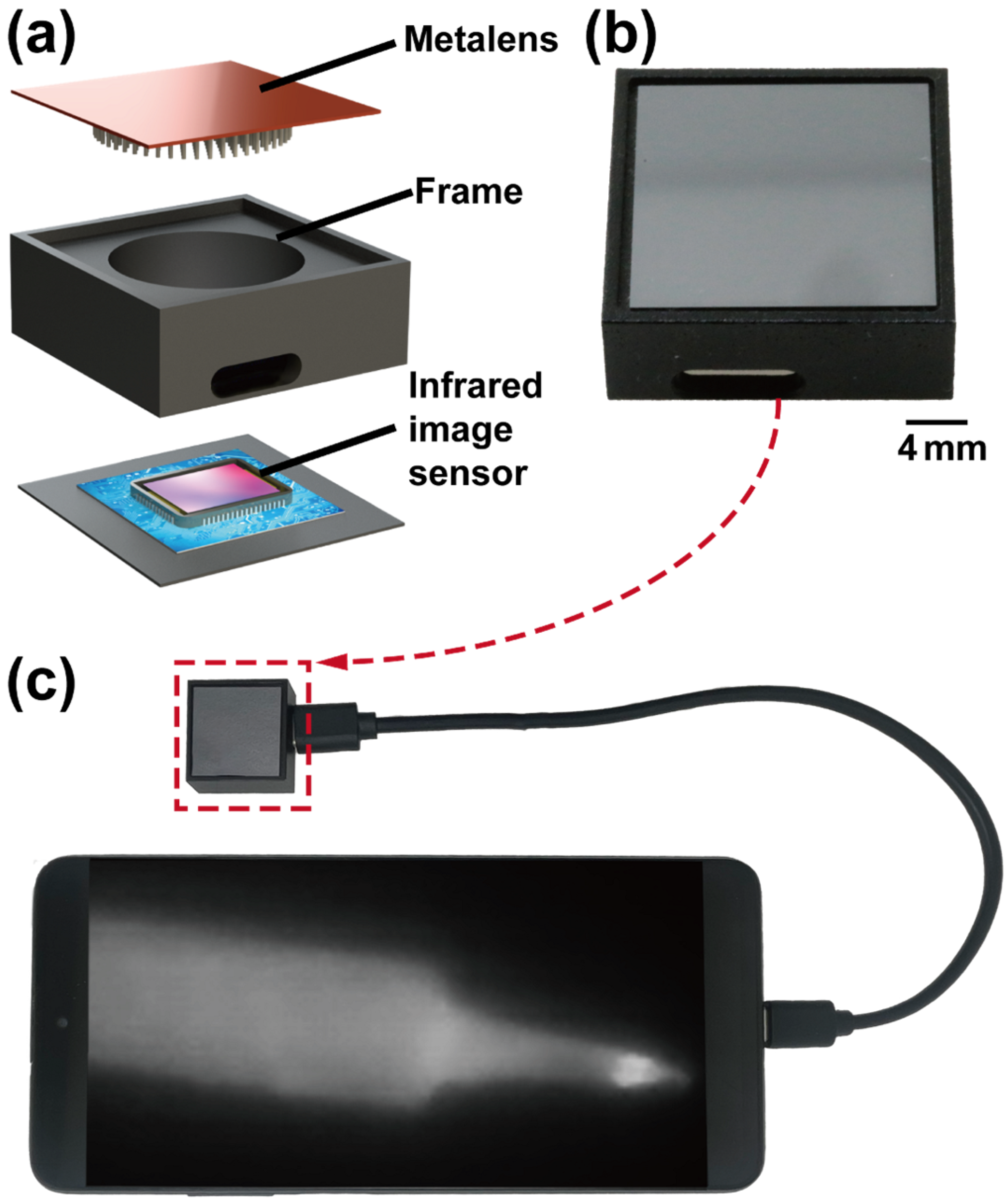
A miniature LWIR camera was customized by assembling the metalens with an image sensor in an aluminum frame. Figure 7a shows an exploded view of the camera. The metalens was placed in front of the image sensor with the flat side facing outwards for the protection of the metasurface. The separation between the metalens and the image sensor was 8 mm. The size of the camera was 2.3 cm × 2.3 cm × 1.2 cm (length × width × height), as shown in Figure 7b. The weights of the metalens and the camera were 0.8 g and 25 g, respectively. The lightweight, portable LWIR camera can be operated by a smartphone via a type-C cable. Figure 7c demonstrates the imaging of the LWIR camera for a soldering iron. It is easy to measure the difference in temperature. The tip of the soldering iron can be clearly observed in the high-contrast image.
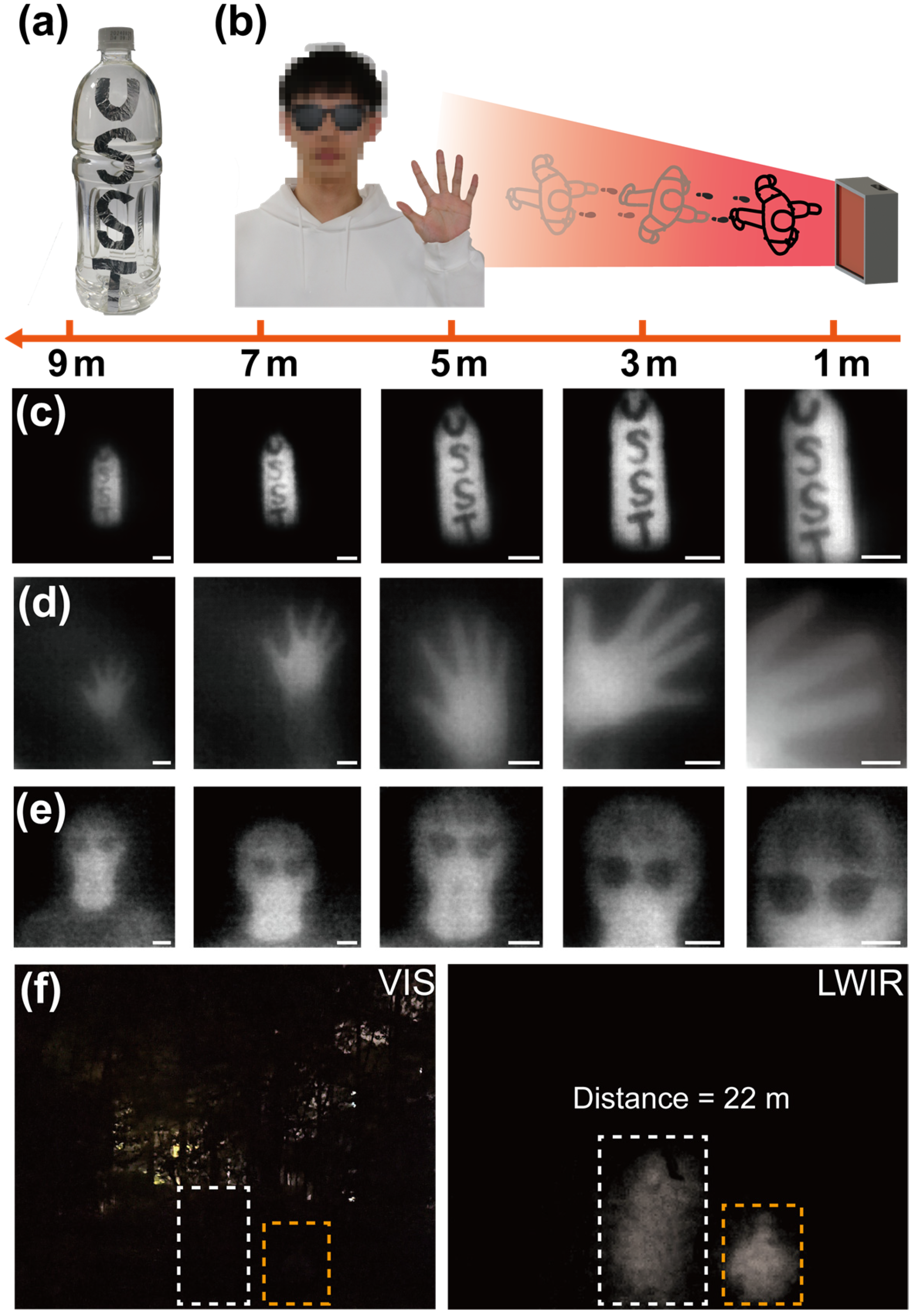
In addition, the LWIR camera was used to capture images of a bottle of 60 °C hot water (Figure 8a) and a person wearing sunglasses (Figure 8b). The imaging distance changed from 1 m to 9 m. The bottle was covered with aluminum foils with the pattern of ‘USST’. The linewidth of the pattern was about 10 mm. The bottle could be easily found in the dark background, as shown in Figure 8c. The size of the bottle enlarged with the decrement in the imaging distance. The pattern could be recognized even though the bottle was placed 9 m away from the LWIR camera. Figure 8d,e shows the left-hand palm and the face of the person walking toward the camera. The temperatures of the palm and the face were about 33 °C and 34 °C, respectively. The images were captured outdoors in daylight with an environmental temperature of 24 °C. The details, such as fingers, hair, and sunglasses, could be clearly distinguished. Optical aberration was not found in the images. Figure 8f presents the imaging of two people standing and crouching in the woods at night. The imaging distance was about 22 m. The visible (VIS) camera cannot capture the image of the two people under low illumination conditions, while the LWIR camera can clearly find the human figures. The demonstration validates the design of the metalens for large depth-of-view imaging.

3.2. Design of LWIR Metalens

The phase distribution of the metalens was designed by ANSYS Zemax OpticStudio 2024 vR1 [39,40]. The imaging system was designed to capture the images at distance with a given range (1 m to 20 m). Thus, a finite conjugate optical system was employed as the optical model in the ANSYS Zemax OpticStudio 2024 vR1 for designing the LWIR metalens. Different object distances (1 m, 5 m, and 20 m) and an identical image distance were considered in the design. A finite conjugate system has a simple structure and can be easily assembled. The size of the image sensor, corresponding to the acceptable image height, was 3.1 mm × 2.3 mm. The designed wavelength of the metalens was 10.6 μm. The phase distribution of the metalens was optimized to realize low chromatic aberration and high spatial resolution under the conditions of focusing distance ranging from 10 mm to 30 mm, acceptance angle ranging from 0° to 10.8°, and entrance pupil ranging from 7 mm to 14 mm. MTF, ray aberration (Figure S9), and focusing of the lens were calculated to analyze the imaging quality. Then, a library of meta-atoms with the diameter of sub-micrometers was designed and evaluated by using the finite-difference time-domain (FDTD) method to ensure high transmittance and 0 to 2π phase shift for the incidence with the wavelength of 10.6 μm. Lastly, a metalens was designed by arranging the meta-atoms with diameters ranging from 1 μm to 3.5 μm and a separation of 5 μm according to the designed phase distribution. The separation minimizes multi-level diffraction within the metalens, thereby ensuring high focusing efficiency, while the negligible inter-particle coupling is disregarded.

3.3. Fabrication of LWIR Metalens

Figure S6 illustrates the fabrication procedure of the LWIR metalens. According to the design of the LWIR metalens, the pattern of the meta-atom array was plotted using AutoCAD v24.3 2024 (Autodesk, San Francisco, CA, USA). Then, a chromium photomask with the pattern was prepared. The substrate material for the metalens was a silicon wafer with a thickness of 500 μm and a diameter of four inches. Initially, a photoresist (AZ1518, Merck, Darmstadt, Germany) was spin-coated onto a clean four-inch silicon wafer at a speed of 4000 rpm, resulting in a photoresist thickness of approximately 2 μm. Subsequently, the pattern from the chromium mask was transferred onto the photoresist using a lithography machine (EVG®610, EV Group, St. Florian am Inn, Austria), and the exposed regions were developed to reveal the areas to be etched. The unexposed portions of the photoresist served as a protective layer for subsequent processes. Following this, deep reactive ion etching (DRIE) was performed using a gas mixture of SF6 and C4F8 to etch the silicon wafer. The C4F8 gas inhibits the lateral etching by SF6, thereby achieving more vertical sidewalls. After the etching process, the photoresist on the wafer surface was removed using acetone. Finally, the wafer was diced into 12 pieces of 20 mm × 20 mm using a dicing machine (DISCO DAD3650, DISCO Corporation, Tokyo, Japan), with each piece containing a single metalens. The diameter of the metalens was 14 mm. Evaluation results confirm that the fabricated metalens retains its functionality after six months of storage at room temperature.

4. Conclusions

In conclusion, a large-depth-of-field camera with a compact form factor was demonstrated using a customized LWIR metalens. The optimization of the metalens structure in the design enables high-quality focusing and high imaging resolution (21.8 LP/mm). The batch fabrication scheme allows concurrent manufacturing of a dozen metalenses per 4-inch silicon wafer, exhibiting exceptional production efficiency. Each metalens has an aperture diameter of 14 mm, a focused spot of approximately 76 µm (FWHM diameter), and an ultra-light weight of merely 0.8 g. The camera achieves a working distance exceeding 22 m for thermal imaging with the temperature ranging from 33 °C to 200 °C, while maintaining high contrast and high resolving power. According to Wien’s displacement law, the corresponding thermal radiation has peak wavelengths ranging from 9.5 μm to 6.1 μm. It is worth noting that the thermal radiation has broad bandwidth, covering the high transmittance range of the metalens. In addition, the camera used in the demonstration has high sensitivity, around 10.6 μm. Although the metalens is not particularly designed for the abovementioned peak response of the thermal radiation, the LWIR camera mounted with the metalens can still detect thermal radiation. The remarkably compact (2.3 × 2.3 × 1.2 cm) and lightweight (25 g) design is suitable for various applications in portable and airborne infrared imaging where conventional bulky optics are impractical. The combination of scalable fabrication, high imaging performance, and exceptional depth-of-field positions makes this metalens-based camera a promising solution for applications requiring portable, wide-range infrared imaging, such as surveillance, autonomous navigation, and industrial inspection.
In subsequent research, the performance boundaries and application scenarios of this metalens can be further expanded along two major dimensions: material innovation and structural optimization. On the one hand, low-loss media with broad infrared transparency windows, such as chalcogenide glasses (e.g., As2Se3) [41], germanium-based composites, or transition metal dichalcogenides (TMDs), can be employed. These materials not only exhibit excellent optical transmittance across the long-wave infrared (LWIR) to mid-wave infrared (MWIR) bands, but also offer a widely tunable refractive index range. This approach is expected to overcome the spectral limitations of existing materials and enable efficient wavefront control within the 8–14 μm spectral range and beyond. On the other hand, the structural design of meta-atoms can serve as a key breakthrough for improving diffraction efficiency. By introducing specialized configurations such as asymmetric meta-atoms [42], streamlined subwavelength structures, or multi-level cell clusters, it is possible to optimize the local coupling of the light field and suppress parasitic diffraction orders. Furthermore, through the coordinated modulation of geometric and propagation phases, such designs can reduce polarization sensitivity and scattering losses.

Supplementary Materials

The following supporting information can be downloaded at https://www.mdpi.com/article/10.3390/photonics12121193/s1, Figure S1. The principle of (a) a conventional metalens and (b) the proposed metalens; Figure S2. The ray tracing of the LWIR metalens whose phase-distribution design is equivalent to that of an aspheric lens; Figure S3. Surface profile of the aspheric lens; Figure S4. Focused beams along Z-axis for different operating wavelengths; Figure S5. The beam profiles in the focal region; Figure S6. Fabrication process of the silicon LWIR metalens; Figure S7. SEM image of the LWIR metalens; Figure S8. Fabrication process of the silicon LWIR metalens. Calculated focusing spot of the LWIR metalens; Figure S9. Calculation of the aberration of the lens design using Zemax software; Table S1. Summary of the metalens based LWIR imaging system; Table S2. Coefficients in the Zernike polynomial defining the profile of the aspheric lens.

Author Contributions

Conceptualization, Y.L., T.T., L.W. and B.D.; Methodology, Y.L. and B.D.; Software, Y.L. and X.Z.; Validation, Y.L., X.Z., J.H. and Z.Y.; Formal analysis, X.Z. and Z.Y.; Investigation, T.T. and L.W.; Resources, L.W.; Data curation, J.H.; Writing—original draft, Y.L.; Writing—review & editing, B.D.; Visualization, D.Z.; Supervision, B.D., S.Z. and D.Z.; Project administration, B.D., S.Z. and D.Z.; Funding acquisition, B.D., S.Z. and D.Z. All authors have read and agreed to the published version of the manuscript.

Funding

This research was funded by National Natural Science Foundation of China (62205017, 62475157).

Data Availability Statement

Presented data are available from the corresponding author upon reasonable request.

Conflicts of Interest

The authors declare no conflicts of interest.

References

  1. Liu, M.; Zhao, W.; Wang, Y.; Huo, P.; Zhang, H.; Lu, Y.; Xu, T. Achromatic and Coma-Corrected Hybrid Meta-Optics for High-Performance Thermal Imaging. Nano Lett. 2024, 24, 7609–7615. [Google Scholar] [CrossRef]
  2. Meem, M.; Banerji, S.; Majumder, A.; Vasquez, F.G.; Sensale-Rodriguez, B.; Menon, R. Broadband Lightweight Flat Lenses for Long-Wave Infrared Imaging. Proc. Natl. Acad. Sci. USA 2019, 116, 21375–21378. [Google Scholar] [CrossRef] [PubMed]
  3. Yakunin, S.; Benin, B.M.; Shynkarenko, Y.; Nazarenko, O.; Bodnarchuk, M.I.; Dirin, D.N.; Hofer, C.; Cattaneo, S.; Kovalenko, M.V. High-Resolution Remote Thermometry and Thermography Using Luminescent Low-Dimensional Tin-Halide Perovskites. Nat. Mater. 2019, 18, 846–852. [Google Scholar] [CrossRef]
  4. Hou, M.; Chen, Y.; Li, J.; Yi, F. Single 5-Centimeter-Aperture Metalens Enabled Intelligent Lightweight Mid-Infrared Thermographic Camera. Sci. Adv. 2024, 10, eado4847. [Google Scholar] [CrossRef]
  5. Wei, J.; Huang, H.; Zhang, X.; Ye, D.; Li, Y.; Wang, L.; Ma, Y.; Li, Y. Neural-Network-Enhanced Metalens Camera for High-Definition, Dynamic Imaging in the Long-Wave Infrared Spectrum. ACS Photonics 2025, 12, 140–151. [Google Scholar] [CrossRef]
  6. Goswami, S.; Singh, S.K. An Image Information Fusion Based Simple Diffusion Network Leveraging the Segment Anything Model for Guided Attention on Thermal Images Producing Colorized Pedestrian Masks. Inf. Fusion 2025, 113, 102618. [Google Scholar] [CrossRef]
  7. Smeelen, M.A.; Schwering, P.B.W.; Toet, A.; Loog, M. Semi-Hidden Target Recognition in Gated Viewer Images Fused with Thermal IR Images. Inf. Fusion 2014, 18, 131–147. [Google Scholar] [CrossRef]
  8. Li, Y.; Zhou, P.; Zhou, G.; Wang, H.; Lu, Y.; Peng, Y. A Comprehensive Survey of Visible and Infrared Imaging in Complex Environments: Principle, Degradation and Enhancement. Inf. Fusion 2025, 119, 103036. [Google Scholar] [CrossRef]
  9. Lai, Y.; Liu, X.; Pan, M.; Davies, M.; Fisk, C.; King, D.; Zhang, Y.; Willmott, J. Advanced Visualisation of Biomass Charcoal Combustion Dynamics Using MWIR Hyperspectral and LWIR Thermal Imaging under Varied Airflow Conditions. Fuel 2024, 378, 132901. [Google Scholar] [CrossRef]
  10. Usmani, K.; O’Connor, T.; Wani, P.; Javidi, B. 3D Object Detection through Fog and Occlusion: Passive Integral Imaging vs Active (LiDAR) Sensing. Opt. Express 2023, 31, 479. [Google Scholar] [CrossRef] [PubMed]
  11. Fischer, R.F., Jr.; Tadic-Galeb, B. Optical System Design; McGraw-Hill: New York, NY, USA, 2000. [Google Scholar]
  12. Jia, P.; Tian, D.; Wang, Y.; Yao, D.; Xu, R.; Sun, J.; Sun, H.; Zhang, B. Airborne Optical Imaging Technology: A Road Map in CIOMP. Light. Sci. Appl. 2025, 14, 119. [Google Scholar] [CrossRef]
  13. Geary, J.M. Chapter 31. Strehl Ratio. In Introduction to Lens Design: With Practical Zemax Examples; Willmann-Bell: Richmond, VA, USA, 2002; pp. 355–364. [Google Scholar]
  14. Nie, Y.; Zhang, J.; Su, R.; Ottevaere, H. Freeform Optical System Design with Differentiable Three-Dimensional Ray Tracing and Unsupervised Learning. Opt. Express 2023, 31, 7450. [Google Scholar] [CrossRef]
  15. Birk, A. Seeing through the Forest and the Trees with Drones. Sci. Robot. 2021, 6, eabj3947. [Google Scholar] [CrossRef]
  16. Chen, Y.; Huang, F.-Y.; Liu, B.-Q.; Zhang, S.; Wang, Z.; Zhao, B. Significant Obstacle Location with Ultra-Wide FOV LWIR Stereo Vision System. Opt. Lasers Eng. 2020, 129, 106076. [Google Scholar] [CrossRef]
  17. Lin, Z.; Roques-Carmes, C.; Pestourie, R.; Soljačić, M.; Majumdar, A.; Johnson, S.G. End-to-End Nanophotonic Inverse Design for Imaging and Polarimetry. Nanophotonics 2021, 10, 1177–1187. [Google Scholar]
  18. Wang, Y.; Wang, Y.; Yu, A.; Hu, M.; Wang, Q.; Pang, C.; Xiong, H.; Cheng, Y.; Qi, J. Non-Interleaved Shared-Aperture Full-Stokes Metalens via Prior-Knowledge-Driven Inverse Design. Adv. Mater. 2025, 37, 2408978. [Google Scholar]
  19. Campbell, S.D.; Sell, D.; Jenkins, R.P.; Whiting, E.B.; Fan, J.A.; Werner, D.H. Review of Numerical Optimization Techniques for Meta-Device Design [Invited]. Opt. Mater. Express 2019, 9, 1842. [Google Scholar] [CrossRef]
  20. Luo, Z.; Zhang, P.; Hou, H.; Li, Y.; Li, B.; Yi, Y.; Xu, L.; Meng, T.; Geng, Z.; Chen, M.K.; et al. Colorimetric Thermography by a Long-Infrared Dual-Band Metalens. Adv. Sci. 2025, 12, 2408683. [Google Scholar] [CrossRef] [PubMed]
  21. Kigner, O.; Meem, M.; Baker, B.; Banerji, S.; Hon, P.W.C.; Sensale-Rodriguez, B.; Menon, R. Monolithic All-Silicon Flat Lens for Broadband LWIR Imaging. Opt. Lett. 2021, 46, 4069. [Google Scholar] [CrossRef]
  22. Huang, L.; Han, Z.; Wirth-Singh, A.; Saragadam, V.; Mukherjee, S.; Fröch, J.E.; Tanguy, Q.A.A.; Rollag, J.; Gibson, R.; Hendrickson, J.R.; et al. Broadband Thermal Imaging Using Meta-Optics. Nat. Commun. 2024, 15, 1662. [Google Scholar] [CrossRef]
  23. Li, J.; Wang, Y.; Liu, S.; Xu, T.; Wei, K.; Zhang, Y.; Cui, H. Largest Aperture Metalens of High Numerical Aperture and Polarization Independence for Long-Wavelength Infrared Imaging. Opt. Express 2022, 30, 28882. [Google Scholar] [CrossRef]
  24. Zhao, F.; Zhao, C.; Zhang, Y.; Chen, J.; Li, S.; Zhou, W.; Ran, C.; Zeng, Y.; Chen, H.; He, X.; et al. Centimeter-Size Achromatic Metalens in Long-Wave Infrared. Nanophotonics 2025, 14, 589–599. [Google Scholar] [CrossRef]
  25. Saragadam, V.; Han, Z.; Boominathan, V.; Huang, L.; Tan, S.; Fröch, J.E.; Böhringer, K.F.; Baraniuk, R.G.; Majumdar, A.; Veeraraghavan, A. Foveated Thermal Computational Imaging Prototype Using All-Silicon Meta-Optics. Optica 2024, 11, 18. [Google Scholar] [CrossRef]
  26. Lin, H.-I.; Geldmeier, J.; Baleine, E.; Yang, F.; An, S.; Pan, Y.; Rivero-Baleine, C.; Gu, T.; Hu, J. Wide-Field-of-View, Large-Area Long-Wave Infrared Silicon Metalenses. ACS Photonics 2024, 11, 1943–1949. [Google Scholar] [CrossRef]
  27. Zang, G.; Ren, J.; Shi, Y.; Peng, D.; Zheng, P.; Zheng, K.; Liu, Z.; Wang, Z.; Cheng, X.; Liu, A.-Q.; et al. Inverse Design of Aberration-Corrected Hybrid Metalenses for Large Field of View Thermal Imaging Across the Entire Longwave Infrared Atmospheric Window. ACS Nano 2024, 18, 33653–33663. [Google Scholar] [CrossRef] [PubMed]
  28. Wang, Y.; Zhang, S.; Liu, M.; Huo, P.; Tan, L.; Xu, T. Compact Meta-Optics Infrared Camera Based on a Polarization-Insensitive Metalens with a Large Field of View. Opt. Lett. 2023, 48, 4709. [Google Scholar] [CrossRef]
  29. Ye, X.; Qian, X.; Chen, Y.; Yuan, R.; Xiao, X.; Chen, C.; Hu, W.; Huang, C.; Zhu, S.; Li, T. Chip-Scale Metalens Microscope for Wide-Field and Depth-of-Field Imaging. Adv. Photonics 2022, 4, 046006. [Google Scholar]
  30. Peng, X.; Kong, L. Design of a Real-Time Fiber-Optic Infrared Imaging System with Wide-Angle and Large Depth of Field. Chin. Opt. Lett. 2022, 20, 011201. [Google Scholar] [CrossRef]
  31. Zammit, P.; Harvey, A.R.; Carles, G. Extended Depth-of-Field Imaging and Ranging in a Snapshot. Optica 2014, 1, 209. [Google Scholar] [CrossRef]
  32. Li, Y.; Wang, J.; Zhang, X.; Hu, K.; Ye, L.; Gao, M.; Cao, Y.; Xu, M. Extended Depth-of-Field Infrared Imaging with Deeply Learned Wavefront Coding. Opt. Express 2022, 30, 40018. [Google Scholar] [CrossRef] [PubMed]
  33. Tang, T.; Kanwal, S.; Lu, Y.; Li, Y.; Wu, S.; Chen, L.; Qian, Z.; Xie, Z.; Wen, J.; Zhang, D. 3D Nano-Printed Geometric Phase Metasurfaces for Generating Accelerating Beams with Complex Amplitude Manipulation. Sci. China Phys. Mech. Astron. 2024, 67, 264211. [Google Scholar] [CrossRef]
  34. Wen, J.; Chen, L.; Yu, B.; Nieder, J.B.; Zhuang, S.; Zhang, D.; Lei, D. All-Dielectric Synthetic-Phase Metasurfaces Generating Practical Airy Beams. ACS Nano 2021, 15, 1030–1038. [Google Scholar] [CrossRef]
  35. Chantakit, T.; Schlickriede, C.; Sain, B.; Meyer, F.; Weiss, T.; Chattham, N.; Zentgraf, T. All-Dielectric Silicon Metalens for Two-Dimensional Particle Manipulation in Optical Tweezers. Photonics Res. 2020, 8, 1435. [Google Scholar] [CrossRef]
  36. Qin, J.; Jiang, S.; Wang, Z.; Cheng, X.; Li, B.; Shi, Y.; Tsai, D.P.; Liu, A.Q.; Huang, W.; Zhu, W. Metasurface Micro/Nano-Optical Sensors: Principles and Applications. ACS Nano 2022, 16, 11598–11618. [Google Scholar] [CrossRef]
  37. Xu, Q.; Yang, Z.; Fu, B.; Li, J.; Wu, H.; Zhang, Q.; Sun, Y.; Ding, G.; Zhao, X. A Surface-Micromachining-Based Inertial Micro-Switch with Compliant Cantilever Beam as Movable Electrode for Enduring High Shock and Prolonging Contact Time. Appl. Surf. Sci. 2016, 387, 569–580. [Google Scholar] [CrossRef]
  38. Liu, S.; Yang, Z.; Zhang, Y.; Xue, F.; Pan, S.; Miao, J.; Norford, L.K. Micro Triple-Hot-Wire Anemometer on Small Sized Glass Tube Fabricated in 5DOF UV Lithography System. In Proceedings of the 2015 28th IEEE International Conference on Micro Electro Mechanical Systems (MEMS), Estoril, Portugal, 18–22 January 2015; IEEE: Estoril, Portugal, 2015; pp. 714–717. [Google Scholar]
  39. Park, Y.; Kim, Y.; Kim, C.; Lee, G.; Choi, H.; Choi, T.; Jeong, Y.; Lee, B. End-to-End Optimization of Metalens for Broadband and Wide-Angle Imaging. Adv. Opt. Mater. 2025, 13, 2402853. [Google Scholar] [CrossRef]
  40. Shalaginov, M.Y.; An, S.; Yang, F.; Su, P.; Lyzwa, D.; Agarwal, A.M.; Zhang, H.; Hu, J.; Gu, T. Single-Element Diffraction-Limited Fisheye Metalens. Nano Lett. 2020, 20, 7429–7437. [Google Scholar] [CrossRef]
  41. Gu, Z.; Gao, Y.; Zhou, K.; Ge, J.; Xu, C.; Xu, L.; Rahmani, M.; Jiang, R.; Chen, Y.; Liu, Z.; et al. Surface-patterned chalcogenide glasses with high-aspect-ratio microstructures for long-wave infrared metalenses. Opto-Electron. Sci. 2024, 3, 240017. [Google Scholar] [CrossRef]
  42. Zhang, F.; Pu, M.; Li, X.; Ma, X.; Guo, Y.; Gao, P.; Yu, H.; Gu, M.; Luo, X. Extreme-angle silicon infrared optics enabled by streamlined surfaces. Adv. Mater. 2021, 33, 2008157. [Google Scholar] [CrossRef] [PubMed]
Figure 1. Design procedure of the LWIR Metalens. (i) Designed phase distribution of the metalens. (ii,iii) Criteria of the designed metalens. (iv) Comparison of the deigned and generated phases. (v) Photo of the fabricated LWIR metalens.
Photonics 12 01193 g001
Figure 2. Influence of the structural design of the meta-atom over phase shift and transmittance. (a) The structure of the meta-atom used in the LWIR metalens. Length of the meta-atom, P, is 5 μm and column height H is 6.6 μm for the designed wavelength, λ, of 10.6 μm. (b) Relation among the diameter, Dm, of the meta-atom, phase shift, and transmittance for 10.6 μm incidence. Phase shift from 0 to 2π can be realized by designing the meta-atom with the diameter of 1 μm to 3.5 μm. High transmittance (>0.8) can be achieved for most meta-atoms. (c,d) The transmittance and phase shift for LWIR (8 μm to 11 μm) incidence with the change in the meta-atom diameter, Dm.
Photonics 12 01193 g002
Figure 3. Simulation of a scaled-down metalens at different incident angles.
Photonics 12 01193 g003
Figure 4. The photo and SEM images of the LWIR metalens. (a) Twelve metalenses were fabricated on a 4-inch silicon wafer. (b) SEM image of a single metalens. (c) The partial SEM image of the metalens. (d) The meta-atoms in the metalens.
Photonics 12 01193 g004
Figure 5. Focusing of the metalens. (a) Experimental setup to measure the focusing of the metalens. (b) The focusing point of the metalens. (c) The pulse width is about 76 μm (FWHM).
Photonics 12 01193 g005
Figure 6. Spatial resolution of LWIR metalens. (a) MTF curves of the metalens for the incident angle of 0°, 7.6°, and 10.8°. The spatial frequency reaches 21.8 LP/mm at MTF = 0.15. (b) The influence of the fabrication error over the spatial frequency.
Photonics 12 01193 g006
Figure 7. The miniature LWIR camera. (a) The design of the LWIR camera. (b) Photo of the LWIR camera. (c) Demonstration of the LWIR camera using a smartphone for a soldering iron operating at 200 °C.
Photonics 12 01193 g007
Figure 8. Demonstration of imaging over large object distances using the LWIR camera. (a) A bottle covered by a tinfoil with the ‘USST’ pattern contains hot water with a temperature of 60 °C. (b) A person with sunglasses. (ce) The images of the bottle, the left hand, and the head. Scale bar is 5 cm. (f) The images of two people in the woods captured by the visible camera and the LWIR camera.
Photonics 12 01193 g008
Disclaimer/Publisher’s Note: The statements, opinions and data contained in all publications are solely those of the individual author(s) and contributor(s) and not of MDPI and/or the editor(s). MDPI and/or the editor(s) disclaim responsibility for any injury to people or property resulting from any ideas, methods, instructions or products referred to in the content.