Communication

High-Modulation-Efficiency Lithium Niobate Electro-Optic Modulator Based on Sunken Dual-Layer Electrode


by
Yicheng Huang
1,
Qing Liao
1,
Yihui Yin
2,
Zanhui Chen
1,
Fabi Zhang
1,
Tangyou Sun
1,
Haiou Li
1,* and
Meihua Shou
1,*
1
Guangxi Key Laboratory of Precision Navigation Technology and Application, Guilin University of Electronic Technology, Guilin 541004, China
2
The 34th Research Institute of China Electronics Technology Group Corporation, Guilin 541004, China
*
Authors to whom correspondence should be addressed.
Photonics 2025, 12(11), 1129; https://doi.org/10.3390/photonics12111129
Submission received: 16 October 2025 / Revised: 5 November 2025 / Accepted: 13 November 2025 / Published: 14 November 2025
(This article belongs to the Section Optical Communication and Network)

Abstract

Electro-optic modulators with high bandwidth, high modulation efficiency, and low loss play a crucial role in many fields, such as artificial intelligence, analog communications, and satellite data links. The modulation efficiency and loss, which are related to the chip size and integration, are important parameters for modulators. However, the modulation efficiency and optical loss of electro-optic modulators are interrelated in general. In this study, an improved scheme combining sunken electrodes and dual-layer capacitance-loaded electrodes is exhibited, improving the constraint between the modulation efficiency and optical loss of thin-film lithium niobate electro-optic modulators by enhancing the electric field effect. An electro-optic modulator with a high bandwidth (>60 GHz), low optical loss (0.14 dB/cm), and low half-wave voltage–length product (1.52 V·cm) has been realized using finite element analysis software.

1. Introduction

Electro-optic (EO) modulators, which convert incoming electrical signals into optical signals, are critical components of fiber-optic communication systems [1,2,3]. With the rapid advancement of artificial intelligence, analog communication and satellite data links, higher requirements have been put forward for the performance of electro-optic modulators, such as wider electro-optic bandwidth, higher modulation efficiency and lower loss. Various materials, including lithium niobate, silicon, and gallium arsenide, have been explored to achieve high-performance electro-optic modulators. Among them, lithium niobate has become an ideal material for building electro-optical modulators due to its wide transparent window and high electro-optical coefficient. In recent years, the development of thin-film lithium niobate (TFLN) has brought new opportunities to the development of electro-optic modulators. Specifically, TFLN Mach–Zehnder modulators (MZMs), with the advantages of simple structure, high bandwidth, and high modulation efficiency, have been extensively studied and applied in various fields [4,5,6]. The central challenge in Mach–Zehnder modulator (MZM) research is enhancing modulation efficiency while maintaining low optical loss [7]. To address this issue, researchers have made numerous efforts in recent years. In 2021, P. Kharel et al. designed a T-shaped electrode structure, which effectively overcame the problem of increased microwave loss when the electrode spacing is reduced and improved the performance of the electro-optic modulator at high frequencies [8]. In 2022, to compensate for the slow-wave effect caused by the T-shaped electrode and achieve velocity matching, G. Chen et al. adopted undercut etching technology on a silicon substrate, achieving a 2.2 V·cm VπL [9]. In 2023, H. Li et al. proposed a folded modulator based on lithium niobate thin film, which reduced the device length with little impact on modulation efficiency, obtaining a 1.85 V·cm VπL [10]. In 2024, G. Yue et al. proposed a dual-layer capacitance-loaded electrode structure to improve the modulation efficiency while maintaining a low absorption loss, achieving a half-wave voltage of 3.2 V [11]. High modulation efficiency contributes to saving chip area, thereby lowering manufacturing costs and promoting chip integration [12,13]. A common approach to reducing the VπL in thin-film lithium niobate modulators is to decrease the electrode spacing. However, the reduction in the electrode spacing leads to a substantial increase in metal absorption loss. To solve the above scientific problems, several methods have been reported to enhance the modulation efficiency, including silica-LN hybrid waveguides, dual-capacitor electrodes, and T-shaped electrodes [14,15,16,17,18,19]. In this work, we introduce a dual-layer electrode structure with sunken electrodes that strengthens the electric field intensity within the waveguide region, maintaining low optical loss while improving modulation efficiency and achieving good overall performance.

2. Device Design

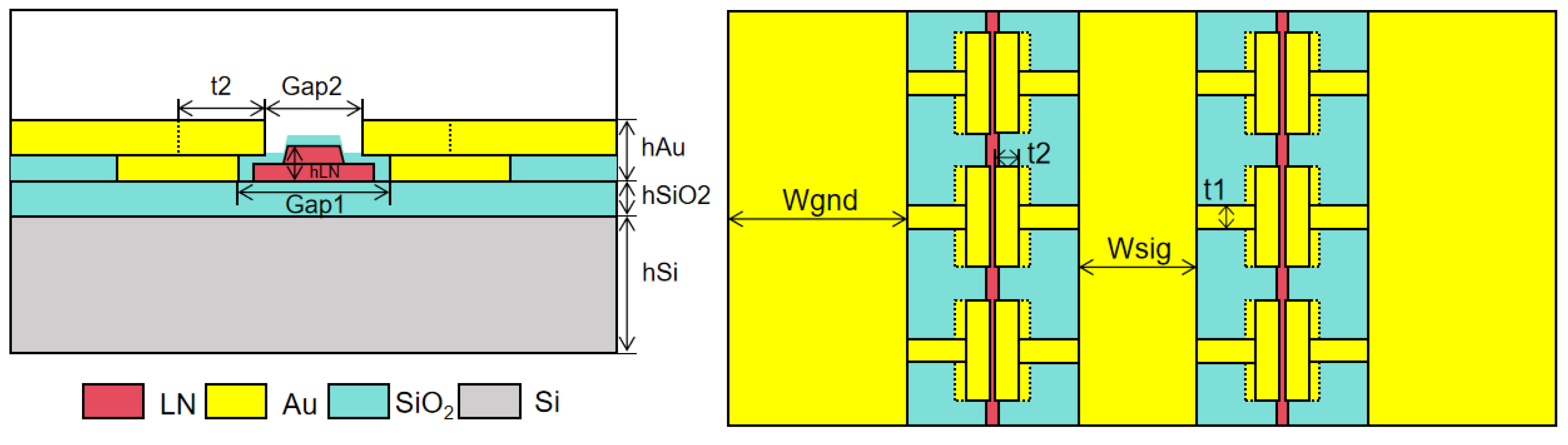
To reduce the half-wave voltage–length product of the modulator, a Mach–Zehnder push–pull structure is employed [20,21,22]. Figure 1 shows a schematic diagram of the designed electro-optic modulator. In this structure, the input optical signal is split into two beams of equal intensity through a multimode interferometer (MMI) and transmitted through two lithium niobate waveguides. Electric fields of equal magnitude but opposite directions are applied to the left and right electrodes. The light waves in the lithium niobate waveguides generate phase differences of equal magnitude but opposite directions since the effective refractive index of the lithium niobate material is affected by the electric field intensity. The MMI combines the two beams and mediates the conversion of their relative phase difference into intensity changes through interference.
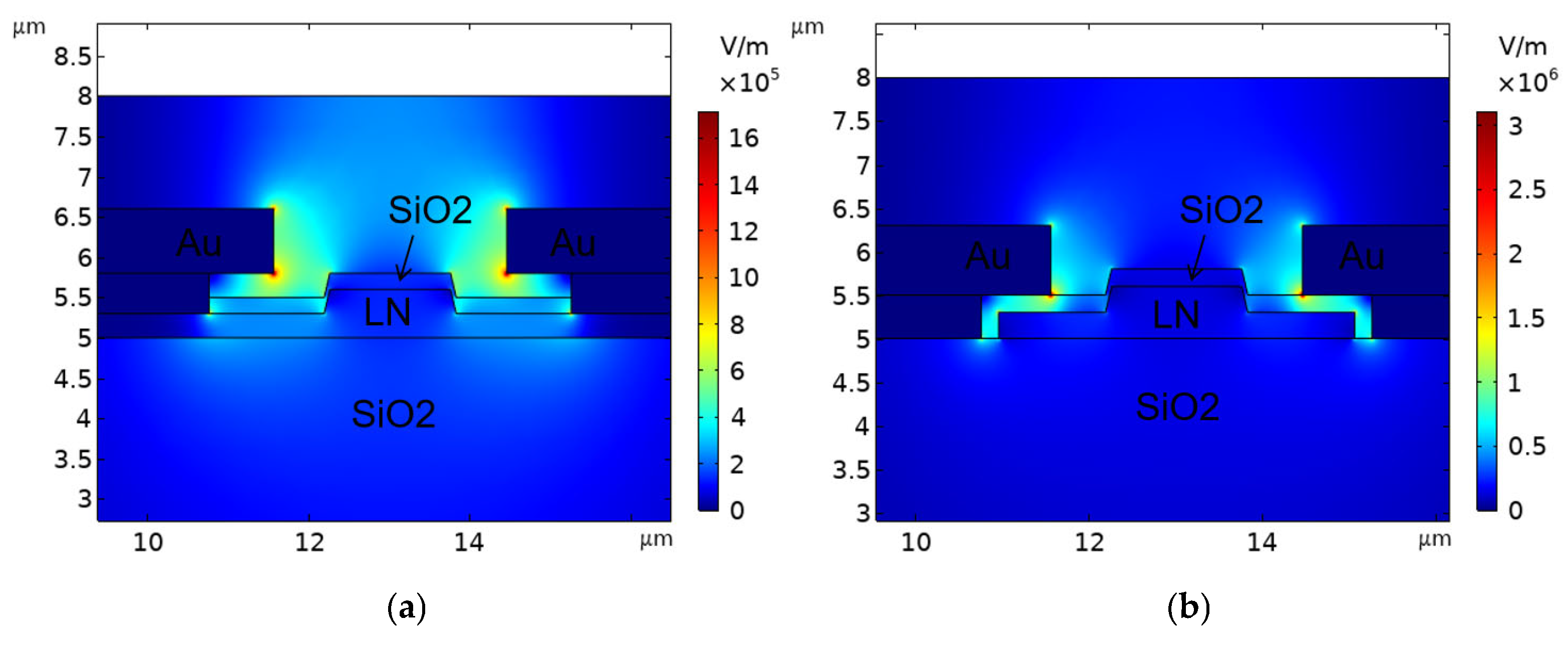
We proposed a sunken dual-layer electrode structure based on electromagnetic theory; the electric field intensity reaches its maximum at the center between two electrodes. By sinking the electrodes, the ridge waveguide can be positioned precisely at this central location, thereby enhancing the interaction between the electric field and the waveguide. Simulations of the electric field distribution for both non-sunken and sunken electrodes were conducted (Figure 2). The results indicate that the sunken configuration yields a stronger average electric field within the waveguide region. In this design, only the central modulating section of the thin-film lithium niobate is retained, while the remaining parts are etched away. This approach effectively reduces unnecessary optical loss in non-modulating regions and successfully mitigates the trade-off between efficiency and loss. Additionally, the sunken electrodes provide greater flexibility in electrode design. A dual-layer electrode enables simultaneous modulation from both layers, leading to a further improvement in modulation efficiency. With the key parameters established in Table 1, the following sections will delve into the design rationale and simulation approach.
Modulation efficiency is typically represented by the half-wave voltage–length product parameter VπL, which reflects the phase change capability of the modulator per unit length. In the x-cut lithium niobate crystal, the refractive index change induced by the electric field is given by [4]:
Δ n e = 1 2 n e 3 r 33 E Z ( x , z )
where ne is the refractive index of light polarization along the z direction, Ez(x,z) is the electric field along the z direction, and r33 is the largest electro-optic coefficient of the lithium niobate crystal. According to the definition of the effective refractive index, its change Δneff under the electric field can be expressed as:
Δ n eff = n e 3 r 33 2 · L N e ( x , z ) 2 E Z ( x , z ) dxdz e ( x , z ) 2 dxdz
where e(x,z) represents the electric field strength of the TE mode, when light propagates in the waveguide over a length of L, the corresponding phase change ΔΦ can be expressed as:
Δ ϕ = 2 π λ Δ n e f f L
where V is the modulation voltage and L is the modulation length. The half-wave voltage Vπ is defined as the voltage required to achieve a 180° phase change in the light. Due to the adoption of the push–pull structure, the calculation formula for VπL can be obtained as:
V π L = λ n eff n e 4 r 33 e ( x , z ) 2 dxdz L N e ( x , z ) 2 E Z ( x , z ) dxdz
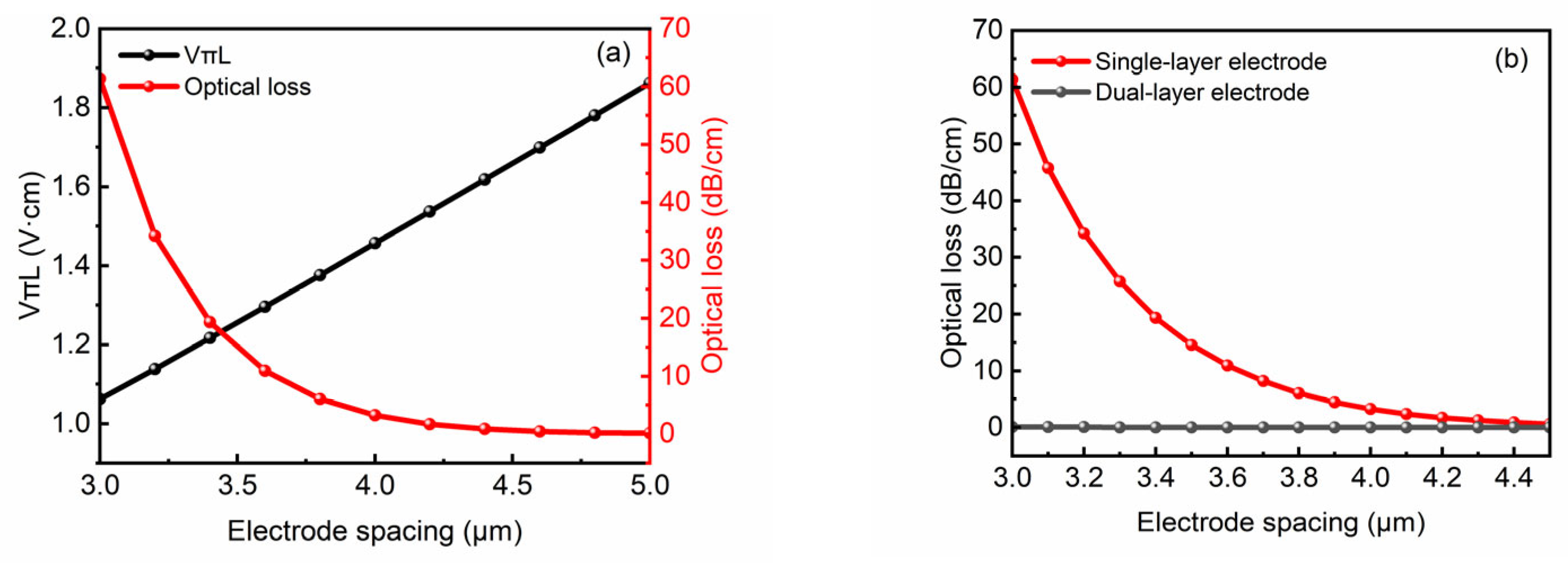
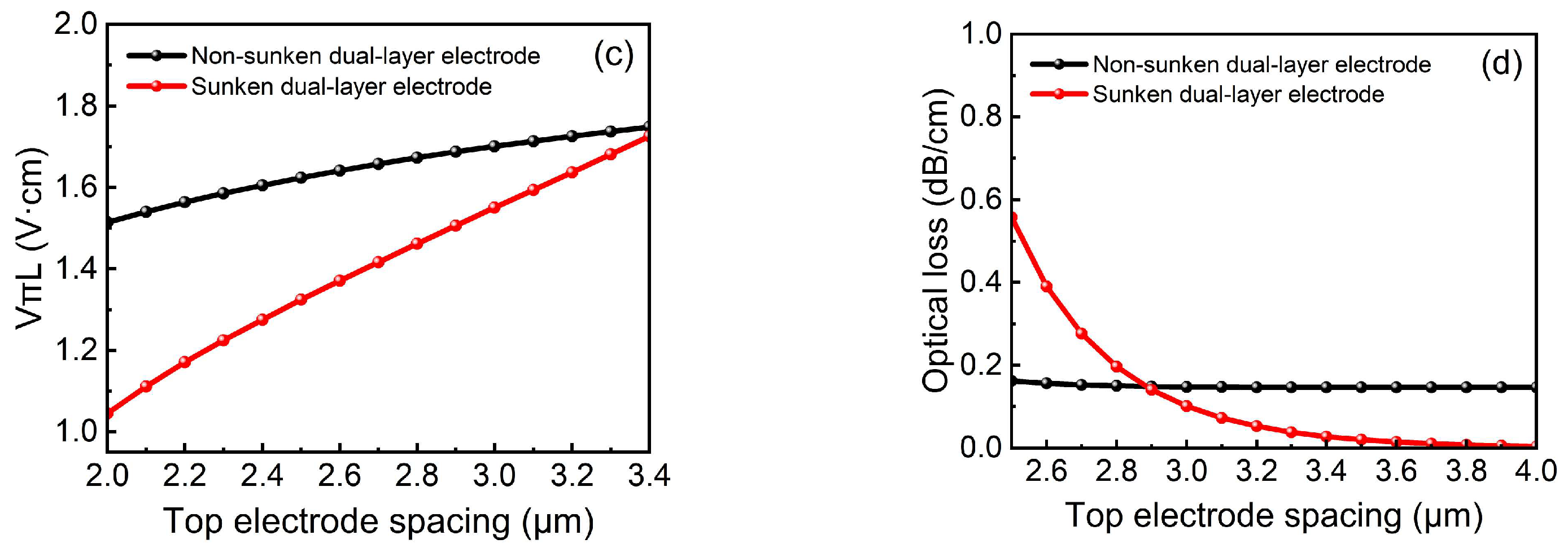
Simulations were conducted to evaluate the modulation efficiency(VπL) and optical loss of the conventional single-layer electrode structure with the same parameters as the proposed structure (Figure 3a). The results indicate that although reducing electrode spacing improves modulation efficiency, it also leads to excessively high optical loss, which is detrimental to modulator chip integration. Compared to the conventional single-layer design, the dual-layer electrode consists of a top T-shaped electrode and a bottom traveling-wave electrode. This unique geometry enables the dual-layer structure to achieve significantly lower optical loss than the single-layer counterpart. Furthermore, by sinking the bottom electrode, the structure further enhances the electric field. By setting the bottom electrode spacing to 5 μm and changing the top electrode spacing, a comparison of the optical loss between the conventional single-layer electrode structure and the dual-layer electrode structure reveals that the dual-layer configuration offers a significant advantage in terms of loss reduction (Figure 3b). Comparisons of modulation efficiency and optical loss for non-sunken dual-layer electrode versus sunken dual-layer electrode configurations demonstrate that the sunken design achieves a lower VπL while maintaining low optical loss (Figure 3c,d).

3. Simulation and Analysis

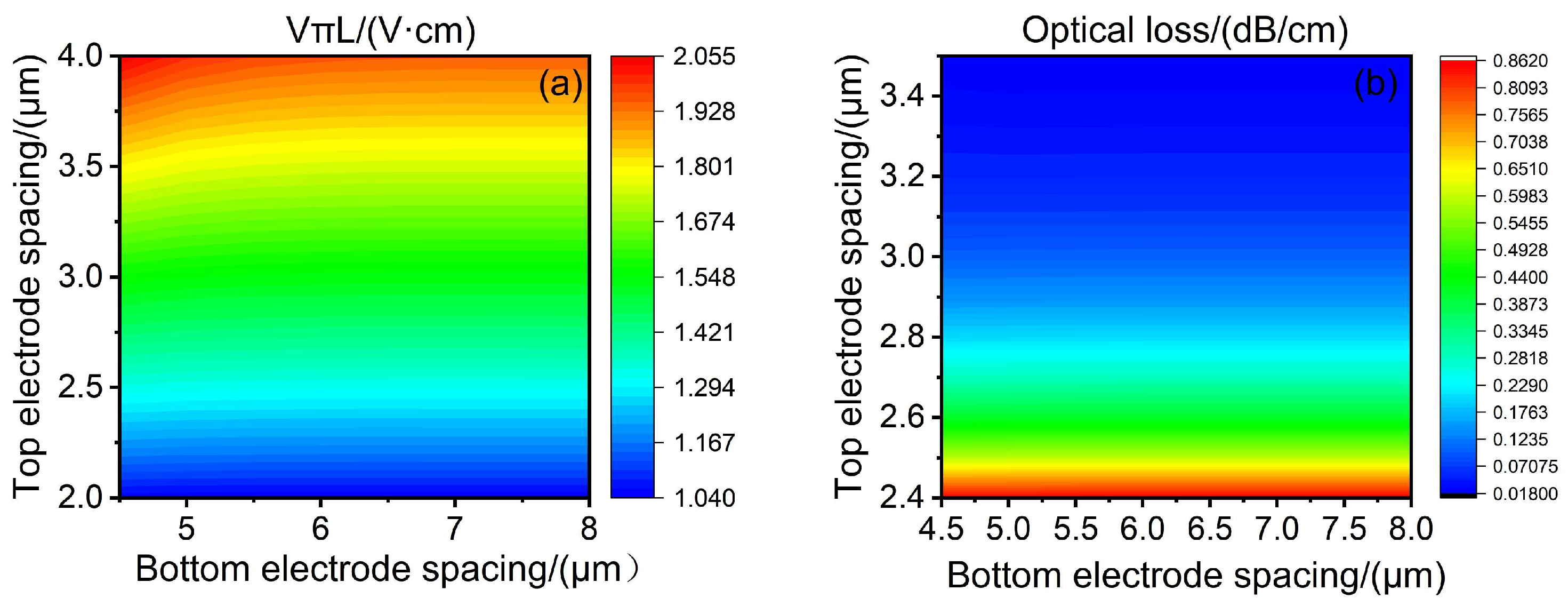
The spacing between metal electrodes is a critical parameter in modulator design, significantly influencing both the half-wave voltage and optical loss [23,24,25]. As derived from Equation (4), reducing the electrode spacing strengthens the electric field under a given voltage, which lowers the half-wave voltage but also increases optical loss. A two-dimensional analysis of half-wave voltage and optical loss across different upper and lower electrode spacings shows that as the upper electrode spacing decreases, the half-wave voltage declines progressively, whereas optical loss rises (Figure 4). With a lower electrode spacing of 4.5 μm and an upper spacing of 2.9 μm, the modulator achieves a half-wave voltage of 1.52 V·cm and an optical loss of 0.14 dB/cm, indicating well-balanced performance. Compared to a conventional single-layer electrode design with equivalent spacing, the proposed structure offers both a lower half-wave voltage and reduced optical loss.
The expression of the electro-optic modulation response is derived from the optical wave equation and transmission line theory as follows [4]:
M ( f ) = 20 log 10 e α L 2 sinh 2 ( α L 2 ) + sin 2 ( b L 2 ) ( α L 2 ) 2 + ( b L 2 ) 2 1 2
b = 2 π f c ( n m n g )
where α denotes the loss of the transmission line, b represents the dispersion parameter between optical waves and microwaves, and L is the length of the modulator. It can be inferred from the formula that the electro-optic response is associated with velocity matching and impedance matching.
The expression for the characteristic impedance is given as follows:
Z O = L 0 C 0 + C T
where L0 represents the inductance per unit length, C0 denotes the capacitance per unit length, and CT refers to the parasitic capacitance per unit length of the T-shaped electrode. A complete transmission line structure includes both input and output ports, and its characteristic impedance must be matched to the input and output impedance of the external system. Impedance mismatch causes reflection of radio frequency signals, leading to a decreased transmission coefficient and reduced power transfer efficiency. In this design, impedance matching is implemented based on a 50 Ω reference.
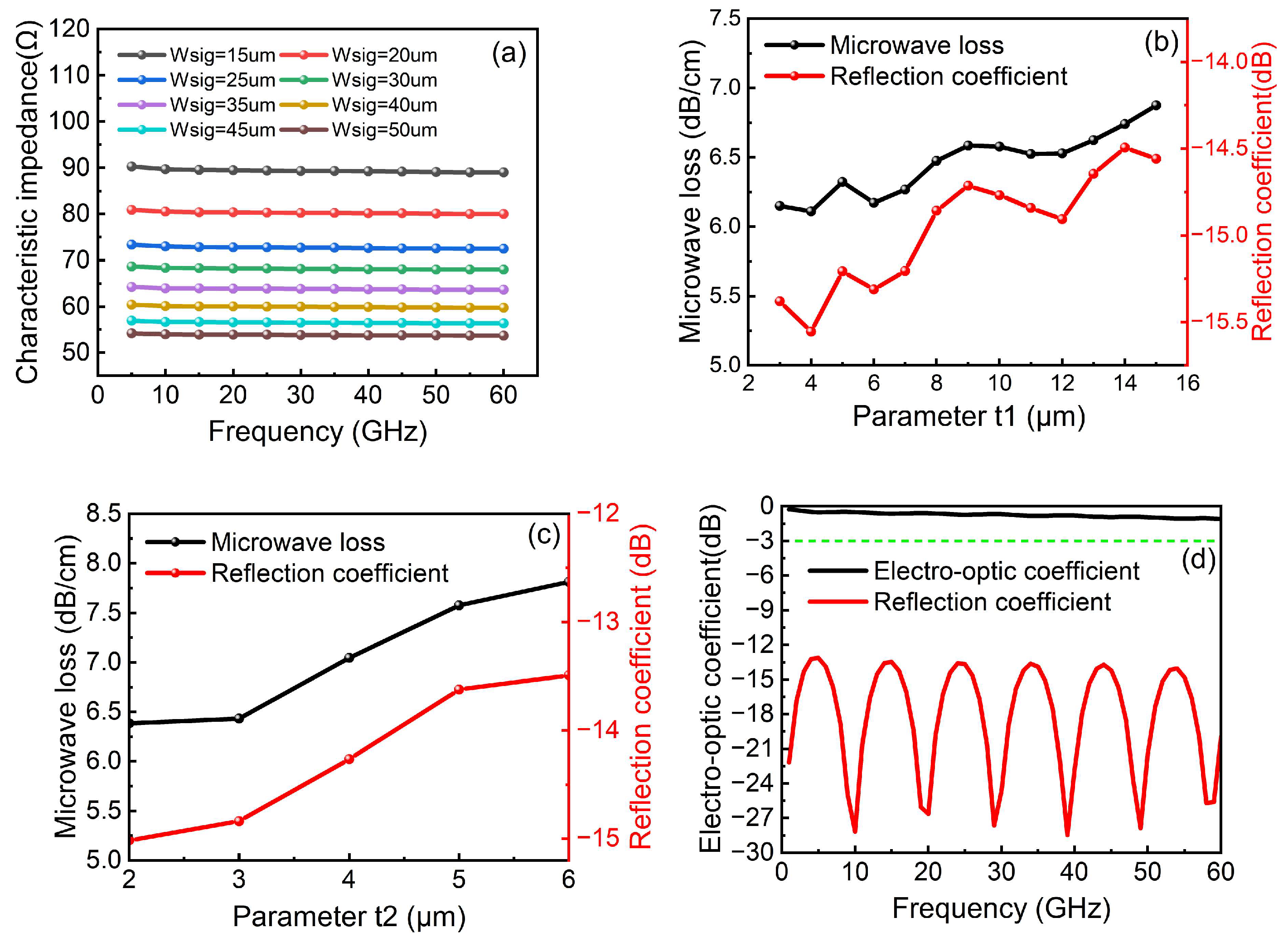
The electro-optic modulation curve of the modulator is affected by the characteristic impedance of the electrode [26,27]. An impedance mismatch with the external circuit can cause reflection of radio frequency signals, resulting in degraded transmission performance and limited electro-optic modulation bandwidth [28,29]. Since the width of the signal electrode is directly proportional to the capacitance per unit length and inversely proportional to the inductance, the characteristic impedance decreases as the electrode width increases (Figure 5a). A signal electrode width of 50 μm was selected to achieve impedance matching to 50 Ω. Our simulation results confirm that this optimized width yields a characteristic impedance of approximately 53 Ω, which is considered well-matched to the standard 50 Ω system in high-frequency applications. The minor deviation stems from the comprehensive optimization of other electrode parameters for overall electro-optic performance, and its impact on RF signal reflection is negligible, as evidenced by the achieved broad EO bandwidth.
The electro-optic modulation bandwidth of the modulator is also influenced by microwave loss and the microwave reflection coefficient [30]. Parameters t1 and t2 significantly affect the microwave performance of the T-shaped electrode. Through a parameter sweep of t1 and t2, the corresponding reflection coefficients and microwave losses were obtained (Figure 5b,c). It was observed that as t1 and t2 increase, both microwave loss and reflection coefficient gradually rise. To ensure system stability and sufficient bandwidth, t1 was set to 5 μm and t2 to 2 μm to achieve a lower reflection coefficient and reduced microwave loss.
Balancing modulation efficiency with modulation bandwidth, the following key parameters were selected for full-device simulation: an upper electrode spacing of 2.9 μm, a lower electrode spacing of 4.5 μm, t1 = 5 μm, t2 = 2 μm, and a modulator length of 0.5 cm. The simulation results were substituted into Equation (5) to derive the overall electro-optic response curve of the modulator, as shown in Figure 5d. At 60 GHz, the electro-optic response dropped to −1.4 dB, while the reflection coefficient remained below −10 dB across the frequency range from 1 to 60 GHz. These results indicate that the electro-optic bandwidth of the device substantially exceeds 60 GHz.

4. Discussion

To objectively assess the merits of our design, we benchmarked its simulated performance against recent Mach–Zehnder modulators. As summarized in Table 2, which compiles key metrics for Mach–Zehnder electro-optic modulators, our simulation results demonstrate that the sunken dual-layer electrode design achieves a highly competitive profile. It exhibits an electro-optic bandwidth exceeding 60 GHz, a low VπL of 1.52 V·cm, and a minimal optical loss of 0.14 dB/cm. This combination successfully addresses the typical trade-off between high modulation efficiency and low propagation loss observed in conventional designs. The enhanced electric field confinement and reduced optical absorption intrinsic to our structure are key to achieving this balanced performance. The simulated results indicate that our design presents a promising approach for developing high-speed, energy-efficient integrated photonic devices, with potential applications in future optical interconnects and communication systems.
Although the proposed device demonstrates competitive performance based on simulation results, we acknowledge that there remains room for improvement, particularly in reducing microwave loss and further enhancing modulation efficiency. Consequently, our immediate focus will be on bridging the gap from simulation to reality through experimental fabrication and characterization, which is crucial for validating the practical potential of our design.

5. Conclusions

In conclusion, to improve the mutual constraints between modulation efficiency and optical loss, we designed a novel sunken dual-layer electrode structure. The novel sunken dual-layer electrode structure redistributes the electric field intensity of lithium niobate electro-optic modulators, resulting in high modulation efficiency, low loss, and broad electro-optic bandwidth, achieving a good overall performance. Additionally, the sunken electrode design offers greater flexibility in electrode layout. The proposed structure demonstrates the feasibility of the sunken electrode concept and provides a new direction for the design of electro-optic modulators.

Author Contributions

Conceptualization, Y.H.; methodology, Y.H.; software, Y.H.; validation, Y.H., M.S. and Q.L.; formal analysis, Y.H.; investigation, F.Z. and T.S.; resources, H.L. and Y.Y.; data curation, M.S.; writing—original draft preparation, Y.H.; writing—review and editing, M.S. and H.L.; visualization, Y.H.; supervision, H.L.; project administration, H.L. and Z.C.; funding acquisition, H.L. All authors have read and agreed to the published version of the manuscript.

Funding

This work was supported by the Natural Science Foundation of Guangxi Zhuang Autonomous Region (2024GXNSFBA010179), the National Natural Science Foundation of China (52363022), the Guangxi Science and Technology Planning Project (AD22035103), and the Guangxi Science and Technology Base and Talent Special Project: Research and Application of Key Technologies for Precise Navigation (Gui Ke AD25069103).

Data Availability Statement

Data underlying the results presented in this paper are not publicly available at this time but may be obtained from the authors upon reasonable request.

Conflicts of Interest

Author Yihui Yin is employed by the 34th Research Institute of China Electronics Technology Group Corporation. The remaining authors declare no conflicts of interest.

References

  1. Hao, Y.X.; Li, H.O.; Li, Y.; Li, H.S.; Liu, Y.B.; Yang, J.Y.; Qin, L.P. A Large-Bandwidth Electro-Optic Modulator with U-T Double-Layer Traveling-Wave Electrode Structure Based on Thin-Film Lithium Niobate. Photonics 2025, 12, 648. [Google Scholar] [CrossRef]
  2. Yan, Y.X.; Zhang, H.R.; Liu, X.L.; Peng, L.X.; Zhang, Q.; Yu, G.B.; Wu, Q.; Li, H.T. Recent Progress in Electro-Optic Modulators: Physical Phenomenon, Structures Properties, and Integration Strategy. Laser Photonics Rev. 2025, 19, 2400624. [Google Scholar] [CrossRef]
  3. Liu, H.; She, X.; Chen, M.; Bi, R.; Chen, K.; Wang, L.; Shu, X. MMI waveguide reflector based on lithium niobate thin film. Opt. Commun. 2024, 566, 130706. [Google Scholar] [CrossRef]
  4. Liu, Y.; Li, H.; Liu, J.; Tan, S.; Lu, Q.; Guo, W. Low Vπ thin-film lithium niobate modulator fabricated with photolithography. Opt. Express 2021, 29, 6320–6329. [Google Scholar] [CrossRef]
  5. Tang, Y.; Li, H.; Chen, Q.; Dai, X.; Xia, J.; Lu, Q.; Huang, L.; Guo, W. High Performance Thin-Film Lithium Niobate Modulator with Suppressed Slot-Line Mode on Quartz Substrate Fabricated by Photolithography. J. Light. Technol. 2025, 43, 636–647. [Google Scholar] [CrossRef]
  6. Tao, J.; Yang, Y.; Li, X.; Wang, P.; Li, J.; Liu, J. Broadband Thin-Film Lithium Niobate Electro-Optic Modulator. Photonics 2024, 11, 325. [Google Scholar] [CrossRef]
  7. Li, Y.; Lan, T.; Yang, D.; Bao, J.; Xiang, M.; Yang, F.; Wang, Z. High-Performance Mach-Zehnder Modulator Based on Thin-Film Lithium Niobate with Low Voltage-Length Product. Acs Omega 2023, 8, 9644–9651. [Google Scholar] [CrossRef]
  8. Kharel, P.; Reimer, C.; Luke, K.; He, L.; Zhang, M. Breaking voltage-bandwidth limits in integrated lithium niobate modulators using micro-structured electrodes. Optica 2021, 8, 357–363. [Google Scholar] [CrossRef]
  9. Chen, G.; Chen, K.; Gan, R.; Ruan, Z.; Wang, Z.; Huang, P.; Lu, C.; Lau, A.P.T.; Dai, D.; Guo, C.; et al. High performance thin-film lithium niobate modulator on a silicon substrate using periodic capacitively loaded traveling-wave electrode. APL Photonics 2022, 7, 026103. [Google Scholar] [CrossRef]
  10. Li, H.; Tang, Y.; Chen, Q.; Dai, X.; Li, X.; Lu, M.; Lu, Q.; Guo, W. Compact thin-film lithium niobate modulators using slotted coplanar waveguide electrode suitable for high-volume fabrication. J. Phys. D Appl. Phys. 2023, 56, 154001. [Google Scholar] [CrossRef]
  11. Yue, G.; Yang, H.; Zhang, Z.; Hao, T.; Xiao, L.; Li, Y. Dual-layer capacitance-loaded thin-film lithium niobate electro-optic modulator with high modulation efficiency. Opt. Express 2024, 32, 23161–23170. [Google Scholar] [CrossRef]
  12. Chen, N.; Yu, Y.; Lou, K.; Mi, Q.; Chu, T. High-efficiency thin-film lithium niobate modulator with highly confined optical modes. Opt. Lett. 2023, 48, 1602–1605. [Google Scholar] [CrossRef]
  13. Li, C.; Chen, B.; Uan, Z.; Wu, H.; Zhou, Y.; Liu, J.; Chen, P.; Chen, K.; Guo, C.; Liu, L. High modulation efficiency and large bandwidth thin-film lithium niobate modulator for visible light. Opt. Express 2022, 30, 36394–36402. [Google Scholar] [CrossRef]
  14. Tang, Y.; Chen, Q.; Ma, X.; Liu, G.; Dai, X.; Lu, Q.; Guo, W. High performance thin-film lithium niobate modulator on silicon substrate with a thick silica buffer layer. Opt. Express 2025, 33, 20334–20344. [Google Scholar] [CrossRef]
  15. Liu, J.; Qu, L.; Wu, W.; Jin, C.; Chen, Z.; Gu, Z.; Liu, W.; Wang, C.; Zheng, D.; Liu, H.; et al. Lithium niobate thin film electro-optic modulator. Nanophotonics 2024, 13, 1503–1508. [Google Scholar] [CrossRef]
  16. Wang, P.; Li, D.; Zhang, T.; Tao, J.; Wang, X.; Liu, J.; Li, J. A Broadband Thin-Film Lithium Niobate Modulator Using an Electrode with Dual Slow-Wave Structures. Photonics 2025, 12, 452. [Google Scholar] [CrossRef]
  17. Wang, Y.; Fei, H.; Lin, H.; Bai, J.; Zhang, M.; Liu, X.; Cao, B.; Tian, Y.; Xiao, L. Ultra-compact electro-optic phase modulator based on a lithium niobate topological slow light waveguide. Opt. Express 2024, 32, 3980–3988. [Google Scholar] [CrossRef] [PubMed]
  18. Yin, Y.; Yang, J.; Li, H.; Yang, W.; Li, Y.; Li, H. Design of High-Speed Thin-Film Lithium Niobate Modulator Utilizing Flip-Chip Bonding with Bump Contacts. Electronics 2024, 13, 4463. [Google Scholar] [CrossRef]
  19. Wang, C.; Zhang, M.; Chen, X.; Bertrand, M.; Shams-Ansari, A.; Chandrasekhar, S.; Winzer, P.; Loncar, M. Integrated lithium niobate electro-optic modulators operating at CMOS-compatible voltages. Nature 2018, 562, 101–104. [Google Scholar] [CrossRef]
  20. Han, H.; Xu, H.; Xiong, J.; Huang, J.; Yuan, P.; Yu, H.; Wang, S.; Li, L.; Liu, X.; Li, H.; et al. Thermo-optic characterization of thin-film lithium niobate asymmetric Mach-Zehnder interferometer from 290 to 10 K. Chin. Opt. Lett. 2025, 23, 051302. [Google Scholar] [CrossRef]
  21. Hu, J.; Li, C.; Guo, C.; Lu, C.; Liu, L. Folded thin-film lithium niobate modulator based on a poled Mach-Zehnder interferometer structure. Opt. Lett. 2021, 46, 2940–2943. [Google Scholar] [CrossRef] [PubMed]
  22. Hou, S.Y.; Hu, H.; Liu, Z.H.; Xing, W.C.; Zhang, J.C.; Hao, Y. High-Speed Electro-Optic Modulators Based on Thin-Film Lithium Niobate. Nanomaterials 2024, 14, 867. [Google Scholar] [CrossRef] [PubMed]
  23. Pan, B.C.; Cao, H.Y.; Huang, Y.S.; Wang, Z.; Chen, K.X.; Li, H.; Yu, Z.J.; Dai, D.X. Compact electro-optic modulator on lithium niobate. Photonics Res. 2022, 10, 697–702. [Google Scholar] [CrossRef]
  24. Chen, G.; Chen, K.; Zhang, J.; Gan, R.; Qi, L.; Fan, X.; Ruan, Z.; Lin, Z.; Liu, J.; Lu, C.; et al. Compact 100GBaud driverless thin-film lithium niobate modulator on a silicon substrate. Opt. Express 2022, 30, 25308–25317. [Google Scholar] [CrossRef]
  25. Wang, C.; Zhang, M.; Stern, B.; Lipson, M.; Loncar, M. Nanophotonic lithium niobate electro-optic modulators. Opt. Express 2018, 26, 1547–1555. [Google Scholar] [CrossRef]
  26. Wang, J.; Xiong, N.; Zou, W. Loss compensation of an ultra-wideband electro-optic modulator in heterogeneous silicon/erbium-doped lithium niobate. Opt. Lett. 2023, 48, 3399–3402. [Google Scholar] [CrossRef]
  27. Yan, H.; Wang, Z.; Wang, S.; Li, Z.; Xie, Y.; Hong, S.; Liu, L.; Wang, K.; Yu, Z.; Dai, D. Thin-Film-Lithium-Niobate Photonic Chip for Ultra-Wideband and High-Precision Microwave Frequency Measurement. Laser Photonics Rev. 2025, 19, 2401273. [Google Scholar] [CrossRef]
  28. Zhu, X.; de Freitas, M.M.; Shi, S.; Xue, R.; Yao, P.; Prather, D.W. Capacitive-loaded traveling wave electrodes on thin film lithium niobate for sub-terahertz operation. Opt. Mater. Express 2025, 15, 513–521. [Google Scholar] [CrossRef]
  29. Xu, H.; Pan, B.; Wang, S.; Liu, H.; Xie, Y.; Yu, Z.; Dai, D. High-Frequency and High-Linearity Lithium Niobate Electro-optic Modulator. ACS Photonics 2024, 11, 3232–3238. [Google Scholar] [CrossRef]
  30. Valdez, F.; Mere, V.; Wang, X.; Boynton, N.; Friedmann, T.A.; Arterburn, S.; Dallo, C.; Pomerene, A.T.; Starbuck, A.L.; Trotter, D.C.; et al. 110 GHz, 110 mW hybrid silicon-lithium niobate Mach-Zehnder modulator. Sci. Rep. 2022, 12, 18611. [Google Scholar] [CrossRef] [PubMed]
  31. Liu, X.; Xiong, B.; Sun, C.; Wang, J.; Hao, Z.; Wang, L.; Han, Y.; Li, H.; Yu, J.; Luo, Y. Wideband thin-film lithium niobate modulator with low half-wave-voltage length product. Chin. Opt. Lett. 2021, 19, 060016. [Google Scholar] [CrossRef]
  32. Sun, S.; Xu, M.; He, M.; Gao, S.; Zhang, X.; Zhou, L.; Liu, L.; Yu, S.; Cai, X. Folded Heterogeneous Silicon and Lithium Niobate Mach-Zehnder Modulators with Low Drive Voltage. Micromachines 2021, 12, 823. [Google Scholar] [CrossRef] [PubMed]
Figure 1. Cross-sectional view and top view of the lithium niobate electro-optic modulator.
Photonics 12 01129 g001
Figure 2. Electric field distribution of non-sunken electrode (a) and sunken electrode (b).
Photonics 12 01129 g002
Figure 3. (a) Simulated modulation efficiency and optical loss of single-layer electrode modulator versus the electrode spacing. (b) Loss comparison between conventional single-layer electrode and dual-layer electrode. (c) Comparison of modulation efficiency between non-sunken dual-layer electrode modulator and sunken dual-layer electrode modulator. (d) Loss comparison between non-sunken dual-layer electrode modulator and sunken dual-layer electrode modulator.
Photonics 12 01129 g003aPhotonics 12 01129 g003b
Figure 4. (a) VπL of the sunken dual-layer electrode modulator versus the electrode spacing. (b) Optical loss of the sunken dual-layer electrode modulator versus the electrode spacing.
Photonics 12 01129 g004
Figure 5. (a) Curve of the modulator’s characteristic impedance versus the width of the signal electrode; (b) Curves of the modulator’s microwave loss and reflection coefficient versus parameter t1; (c) Curves of the modulator’s microwave loss and reflection coefficient versus parameter t2; (d) Electro-optic coefficient and reflection coefficient of the sunken dual-layer electrode modulator. The green line indicates the −3 dB point of the electro-optic response curve.
Photonics 12 01129 g005
Table 1. The key parameters of the structures designed in this work.
ParameterLength (μm)
Gap14.5
Gap22.9
Wsig50
Wgnd140
t15
t22
hAu1.3
hLN0.6
hSiO25
hSi500
Etching Depth0.3
Table 2. Performance comparison of thin-film lithium niobate electro-optic modulators.
VπL (V·cm)OE Bandwidth (GHz)Optical Loss (dB/cm)
[4]1.75400.7
[7]1.29>40-
[9]2.2>600.2
[10]1.85652.5
[11]1.6>670.1
[30]3.1>1001.8
[31]1.7670.1
[32]2.6561.5
[19]2.21000.1
This work1.52>600.14
Disclaimer/Publisher’s Note: The statements, opinions and data contained in all publications are solely those of the individual author(s) and contributor(s) and not of MDPI and/or the editor(s). MDPI and/or the editor(s) disclaim responsibility for any injury to people or property resulting from any ideas, methods, instructions or products referred to in the content.