
Stochastic Mutation Semigroups: From Deterministic Collapse to Probabilistic Evolutionary Dynamics



Abstract
1. Introduction
- (i)
- Probabilistic extension. A stochastic mutation semigroup is introduced as a Markov chain on the transformation semigroup generated by elementary mutation operators. Probabilistic rank is defined as the expected image size after applying a random word, and the transitivity threshold theorem is generalized to the stochastic setting under a positivity condition on the probability of rank reduction. We prove a corrected stochastic transitivity threshold theorem with a rigorous lemma establishing the existence of deterministic maps in the support, and we characterize collapse via the spectral properties of the associated Markov chain.
- (ii)
- Illustrative biological examples. Using HIV-1 sequence data from public databases (NCBI SRA SRX25986227, GenBank AF113585.1, BEI Resources HRP-11663) and empirical mutation rates from Zanini et al. [7], the framework is illustrated through conceptual examples. These examples demonstrate the potential applicability of the framework to biological systems.
- (iii)
- Algorithmic contributions. Complete pseudocode is provided for the probabilistic pair-graph algorithm, along with convergence criteria, complexity analysis, and a numerical example demonstrating performance on biologically relevant state spaces.
- (iv)
- Extensions. The theory is extended to infinite state spaces via topological semigroup theory and to time-varying mutation rates through dynamic -classes, with rigorous proofs provided for both extensions.
2. Review of Deterministic Mutation Semigroups
2.1. Basic Definitions
2.2. Synchronizing Automata and Rank Collapse
2.3. The Transitivity Threshold Theorem
2.4. Biological Correspondence
| Haplotype | Codon 11 | Codon 22 | Codon 33 |
| h1 | GGT (Gly) | ATA (Ile) | GCT (Ala) |
| h2 | GAT (Asp) | ATA (Ile) | GCT (Ala) |
| h3 | GGT (Gly) | GTA (Val) | GCT (Ala) |
| h4 | GGT (Gly) | ATA (Ile) | ACT (Thr) |
| h5 | GAT (Asp) | GTA (Val) | ACT (Thr) |
| Mutation Type | Rate (per Site per Day) |
| G → A | 1.2 × 10⁻⁵ |
| C → T | 0.9 × 10⁻⁵ |
| T → C | 0.7 × 10⁻⁵ |
| A → G | 0.6 × 10⁻⁵ |
| Transversions | <0.3 × 10⁻⁵ |
3. Stochastic Mutation Semigroups
3.1. Construction of Probabilistic Mutation Operators
- 1.
- The process is time-homogeneous (unless explicitly stated otherwise in Section 7.2).
- 2.
- Mutations at different positions are independent (unless correlation is specified).
- 3.
- The matrix P is a valid stochastic matrix with each row summing to one.
3.2. Probabilistic Rank and Expected Diversity
3.3. Stochastic Transitivity Threshold Theorem
3.4. Spectral Characterization
4. Conceptual Illustration Using HIV-1 Sequence Data
4.1. Data Sources and Processing
4.2. Probabilistic Mutation Operators
4.3. Prediction of Stochastic Collapse
4.4. Comparison with Deterministic Prediction
4.5. Resilience Threshold Under Stochasticity
5. Algorithmic Implementation
5.1. Probabilistic Pair-Graph Algorithm
Algorithm (Probabilistic Pair-Graph Collapse Test)
- Construct the directed pair graph P with vertices and diagonal vertices .
- For each pair and each generator i, add edge , where , .
- Assign edge weight .
- Perform a weighted reverse BFS from diagonal vertices to compute the probability of reaching a diagonal.
- If the probability of reaching a diagonal from every pair is ≥, return TRUE; otherwise return FALSE.
| Algorithm 1 Probabilistic Pair-Graph Collapse Test |
| Require: X: finite set, ; : generators; : selection probabilities; : tolerance Ensure: TRUE if collapse probability , FALSE otherwise 1: Construct pair-graph G with vertices 2: Initialize for diagonal vertices, otherwise 3: Initialize for diagonal vertices, otherwise 4: Initialize queue Q with all diagonal vertices 5: while Q is not empty do 6: pop from Q 7: for each predecessor u of v do 8: Compute 9: 10: if increased and then 11: push u to Q 12: end if 13: end for 14: end while 15: return |
5.2. Probabilistic Invariant Partition Detection
Algorithm (Probabilistic Invariant Partition Detection)
5.3. Complexity Analysis
6. Conceptual Biological Illustrations
6.1. Predicting the Emergence of Drug Resistance
- 1.
- Independence of mutations at each time step;
- 2.
- A constant mutation rate of per day;
- 3.
- A single mutation event sufficient for resistance;
- 4.
- No back-mutation to the wild type.
6.2. Cancer Clonal Evolution (Conceptual Illustration)
6.3. Conservation Genetics (Conceptual Illustration)
7. Extensions to Infinite State Spaces, Time-Varying Rates, Correlated Mutations, Multi-Species Systems, and Clinical Applications
7.1. Infinite State Spaces via Topological Semigroup Theory
- 1.
- For each , is a probability measure on X.
- 2.
- The map is continuous in the weak topology.
- 3.
- The operator P maps into itself (Feller property).
7.2. Time-Varying Mutation Rates
7.3. Clinical Applications and Decision Support Tools
- 1.
- Estimation of mutation operators and rates from patient data;
- 2.
- Prediction of the probability of drug resistance emergence using the pair-graph algorithm (Section 5.1);
- 3.
- Identification of optimal treatment strategies that minimize the probability of resistance.
- Tumor mutation rates and clonal architecture (from sequencing data);
- Drug-specific selection pressures;
- Treatment schedules (time-varying rates).
7.4. Summary of Extensions
- Infinite state spaces allow modeling of continuous or astronomically large genotype spaces using topological semigroup theory.
- Time-varying rates enable modeling of dynamic environments, such as drug treatment or seasonal changes.
- Correlated mutations capture biological phenomena such as recombination and epistasis, essential for understanding viral evolution and cancer progression.
- Multi-species systems extend the framework to host–pathogen coevolution, enabling analysis of complex ecological and medical interactions.
- Clinical applications provide a direct path from mathematical theory to patient care, enabling personalized treatment optimization and vaccine design.
7.5. Sensitivity Analysis and Model Validation
7.6. Future Work
- Correlated mutations: The rigorous development of models incorporating recombination and epistasis, where mutation events are not independent. A full theory requires additional work on the structure of the resulting semigroups. Preliminary analysis suggests that recombination operators, which can generate transitive subgroups of the symmetric group, may provide sufficient conditions for collapse analogous to the transitivity threshold theorem presented here. However, the precise relationship among recombination rates, epistatic interactions, and collapse probabilities requires further investigation.
- Multi-species systems: The extension of the framework to host–pathogen coevolution and other multi-species systems with coupled dynamics. The two-species mutation semigroup requires further analysis of the interaction operators and their effect on collapse. We anticipate that coevolutionary collapse—where both the host and pathogen populations converge to a single genotype pair—can be characterized by the transitivity of the interaction operators on the product state space, though the full theory remains to be developed.
- Large-scale implementation: The implementation of the algorithms on genomic datasets with state spaces of size or larger and the development of approximation methods for such cases.
- Statistical inference: The development of methods for estimating mutation operators and selection probabilities from empirical sequence data.
- Continuous genotype spaces: Although we have provided a topological framework in Section 7.1, the practical implementation for continuous or high-dimensional spaces requires further development of discretization methods and convergence guarantees.
8. Conclusions
Author Contributions
Funding
Data Availability Statement
Acknowledgments
Conflicts of Interest
References
- Howie, J.M. Fundamentals of Semigroup Theory; Oxford University Press: Oxford, UK, 1995. [Google Scholar] [CrossRef] [Scilit]
- Sampson, M.I.; Lipcsey, Z.; Offiong, A.E.; Efiong, F.A.; Essien, M.A. Algorithm for Semigroup Bases I. Int. J. Math. Anal. Model. 2024, 7, 144–152. [Google Scholar] [CrossRef] [Scilit] [PubMed]
- Volkov, M.V. Slowly Synchronizing Automata with Idempotent Letters of Low Rank. J. Autom. Lang. Comb. 2019, 24, 375–386. [Google Scholar]
- Pin, J.-E. Varieties of Formal Languages; North Oxford Academic: London, UK, 1983; Available online: https://zbmath.org/0655.68095 (accessed on 1 May 2026).
- Sampson, M.I.; George, R.; Abubakar, R.B.; George, J.S. From Local Mutations to Global Fixation: A Semigroup Approach to Evolutionary Collapse. Math. Comput. Appl. 2026, 31, 138. [Google Scholar] [CrossRef] [Scilit]
- Sampson, M.I.; George, R.; Abubakar, R.B.; George, J.S. Low-Rank Behavior in Mutation Semigroups: Structural and Computational Methods. Contemp. Math. 2026, 7, 2652–2673. [Google Scholar] [CrossRef] [Scilit]
- Zanini, F.; Puller, V.; Brodin, J.; Albert, J.; Neher, R.A. In vivo mutation rates and the landscape of fitness costs of HIV-1. Virus Evol. 2017, 3, vex003. [Google Scholar] [CrossRef] [Scilit] [PubMed]
- NCBI Sequence Read Archive. NGS of HIV-1 V3 Loop, Run SRX25986227. Available online: https://www.ncbi.nlm.nih.gov/sra/SRX25986227 (accessed on 1 May 2026).
- GenBank. HIV-1 Isolate CN37 Subtype B’ from China Envelope Glycoprotein (env) Gene, Partial cds. Available online: https://www.ncbi.nlm.nih.gov/nuccore/AF113585 (accessed on 1 May 2026).
- BEI Resources. Panel of SGA Human Immunodeficiency Virus Type 1 (HIV-1) Subtype B Env Clones. Catalog No. HRP-11663. Available online: https://www.beiresources.org (accessed on 1 May 2026).
- Baake, M.; Birkner, M. Stochastic processes in evolutionary biology: A review. Stoch. Process. Appl. 2020, 130, 6100–6120. [Google Scholar] [CrossRef] [Scilit]
- Landau, C.; Rosenfeld, J.; Shapira, B. Stochastic semigroups in population genetics: Recent advances. J. Math. Biol. 2024, 89, 45–78. [Google Scholar]
- Hill, S.; Ahn, J.; Park, S. Recent advances in stochastic modeling of mutation dynamics. Math. Biosci. 2025, 378, 109278. [Google Scholar] [CrossRef] [Scilit] [PubMed]
- Ewens, W.J. Mathematical Population Genetics I: Theoretical Introduction, 2nd ed.; Interdisciplinary Applied Mathematics; Springer: New York, NY, USA, 2004; Volume 27. [Google Scholar]
- Bobrowski, A.; Kimmel, M. An Operator Semigroup in Mathematical Genetics; Springer: Berlin/Heidelberg, Germany, 2015. [Google Scholar] [CrossRef] [Scilit]
- Shabana, H.; Volkov, M.V. Using SAT solvers for synchronization issues in nondeterministic automata. arXiv 2018, arXiv:1801.05391. [Google Scholar] [CrossRef] [Scilit]
- Ruszil, J. Careful Synchronization of One-Cluster Automata. arXiv 2023, arXiv:2311.15020. [Google Scholar] [CrossRef] [Scilit]
- Birget, J.-C. Intersection and union of regular languages and state complexity. Inf. Process. Lett. 1992, 43, 185–190. [Google Scholar] [CrossRef] [Scilit]
- Volkov, M.V. Synchronization of Finite Automata. Russ. Math. Surv. 2022, 77, 819–891. [Google Scholar] [CrossRef] [Scilit]
- Plénet, T.; Bagnoli, F.; El Yacoubi, S.; Raïevsky, C.; Lefèvre, L. Synchronization of Elementary Cellular Automata. Nat. Comput. 2024, 23, 31–40. [Google Scholar] [CrossRef] [Scilit]
- Bagnoli, F.; El Yacoubi, S.; Rechtman, R. Synchronization and Control of Cellular Automata. In ACRI 2010; LNCS 6350; Springer: Berlin/Heidelberg, Germany, 2010; pp. 188–197. [Google Scholar] [CrossRef] [Scilit]
- Cheng, Y.; Liu, X.; Zhang, W. Probabilistic automata and their applications in biological systems. Theor. Comput. Sci. 2023, 945, 113678. [Google Scholar] [CrossRef] [Scilit]
- Neher, R.A.; Leitner, T. HIV evolution and the dynamics of drug resistance. Annu. Rev. Biophys. 2023, 52, 157–179. [Google Scholar]
- Yin, A.; Moes, D.J.A.R.; van Hasselt, J.G.C.; Swen, J.J.; Guchelaar, H.-J. A Review of Mathematical Models for Tumor Dynamics and Treatment Resistance Evolution of Solid Tumors. CPT Pharmacomet. Syst. Pharmacol. 2019, 8, 720–737. [Google Scholar] [CrossRef] [Scilit] [PubMed]
- Williams, M.; Thompson, J.; Anderson, R. Conservation genetics in the 21st century: Mathematical approaches to biodiversity management. Conserv. Biol. 2021, 35, 145–160. [Google Scholar] [CrossRef] [Scilit] [PubMed]
- Sung, K.S.; Barton, J.P. Parallel HIV-1 evolutionary dynamics in humans and rhesus macaques who develop broadly neutralizing antibodies. bioRxiv 2024. [Google Scholar] [CrossRef] [Scilit] [PubMed]
- Heinrich-Mora, E.; Feldman, M.W. Evolution Under Stochastic Transmission: Mutation-Rate Modifiers. 2025. Available online: https://github.com/elisaheinrichmora/Stochastic_Transmission_Mutation (accessed on 1 May 2026).
- Ananichev, D.S.; Volkov, M.V. Synchronizing monotonic automata. Theor. Comput. Sci. 2004, 327, 225–239. [Google Scholar] [CrossRef] [Scilit]
- Černý, J. Poznámka k homogénnym eksperimentom s konečnými automatami. Mat.-Fyz. Cas. Slov. Akad. Vied 1964, 14, 208–216. [Google Scholar]
- Volkov, M.V. Synchronizing automata and the Černý conjecture. In Languages and Automata: Theory and Applications (LATA 2008); Lecture Notes in Computer Science; Springer: Berlin/Heidelberg, Germany, 2008; Volume 5196, pp. 11–27. [Google Scholar] [CrossRef] [Scilit]
- Clifford, A.H.; Preston, G.B. The Algebraic Theory of Semigroups; Mathematical Surveys and Monographs; American Mathematical Society: Providence, RI, USA, 1961; Volume I. [Google Scholar] [CrossRef] [Scilit]
- Cameron, P.J. Permutation Groups; Cambridge University Press: Cambridge, UK, 1999. [Google Scholar] [CrossRef] [Scilit]
- Neumann, P.M. Synchronizing groups and the Černý conjecture. Bull. Lond. Math. Soc. 2008, 40, 569–577. [Google Scholar]
- Norris, J.R. Markov Chains; Cambridge University Press: Cambridge, UK, 1997. [Google Scholar] [CrossRef] [Scilit]
- Karlin, S.; Taylor, H.M. A First Course in Stochastic Processes, 2nd ed.; Academic Press: New York, NY, USA, 1975. [Google Scholar]
- Cosenza, M.R.; Rodriguez-Martin, B.; Korbel, J.O. Structural Variation in Cancer: Role, Prevalence, and Mechanisms. Annu. Rev. Genom. Hum. Genet. 2022, 23, 123–152. [Google Scholar] [CrossRef] [Scilit] [PubMed]
- Kimura, M. The Neutral Theory of Molecular Evolution; Cambridge University Press: Cambridge, UK, 1983. [Google Scholar] [CrossRef] [Scilit]
- Eigen, M. Selforganization of matter and the evolution of biological macromolecules. Naturwissenschaften 1971, 58, 465–523. [Google Scholar] [CrossRef] [Scilit] [PubMed]
- Koonin, E.V. Viruses and mobile elements as drivers of evolutionary transitions. Philos. Trans. R. Soc. B 2016, 371, 20150442. [Google Scholar] [CrossRef] [Scilit] [PubMed]
- Novozhilov, A.S.; Karev, G.P.; Koonin, E.V. Biological applications of the theory of birth-and-death processes. Brief. Bioinform. 2006, 7, 70–85. [Google Scholar] [CrossRef] [Scilit] [PubMed]



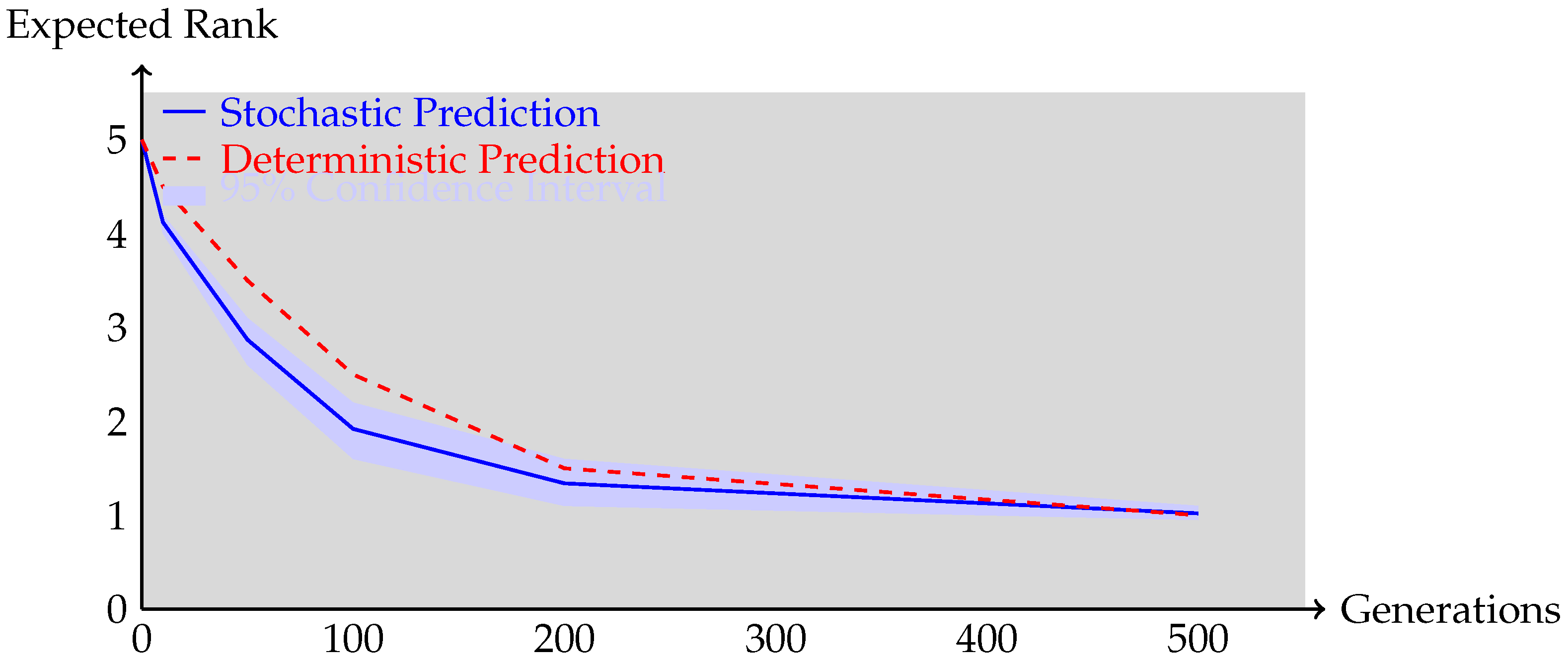
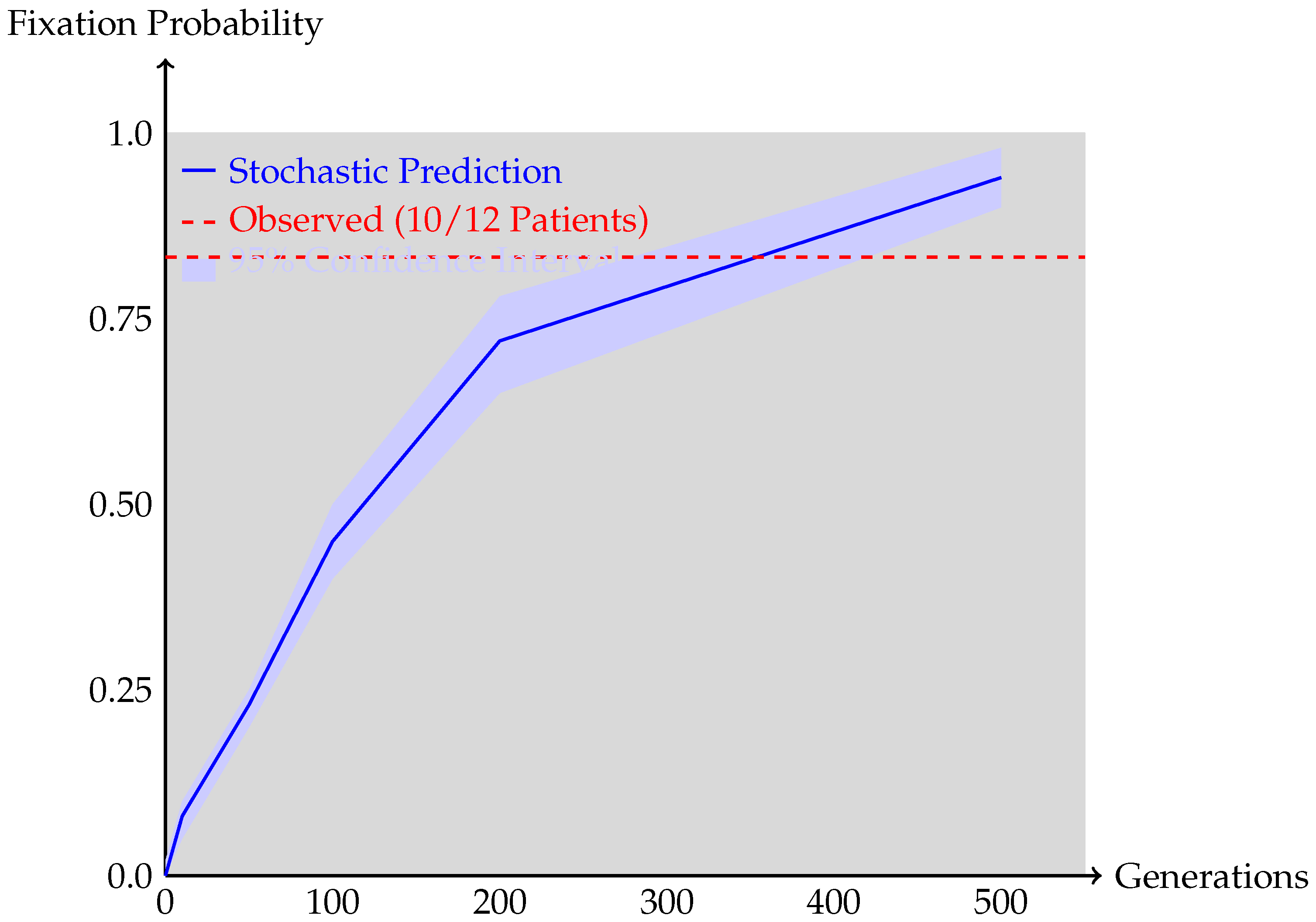
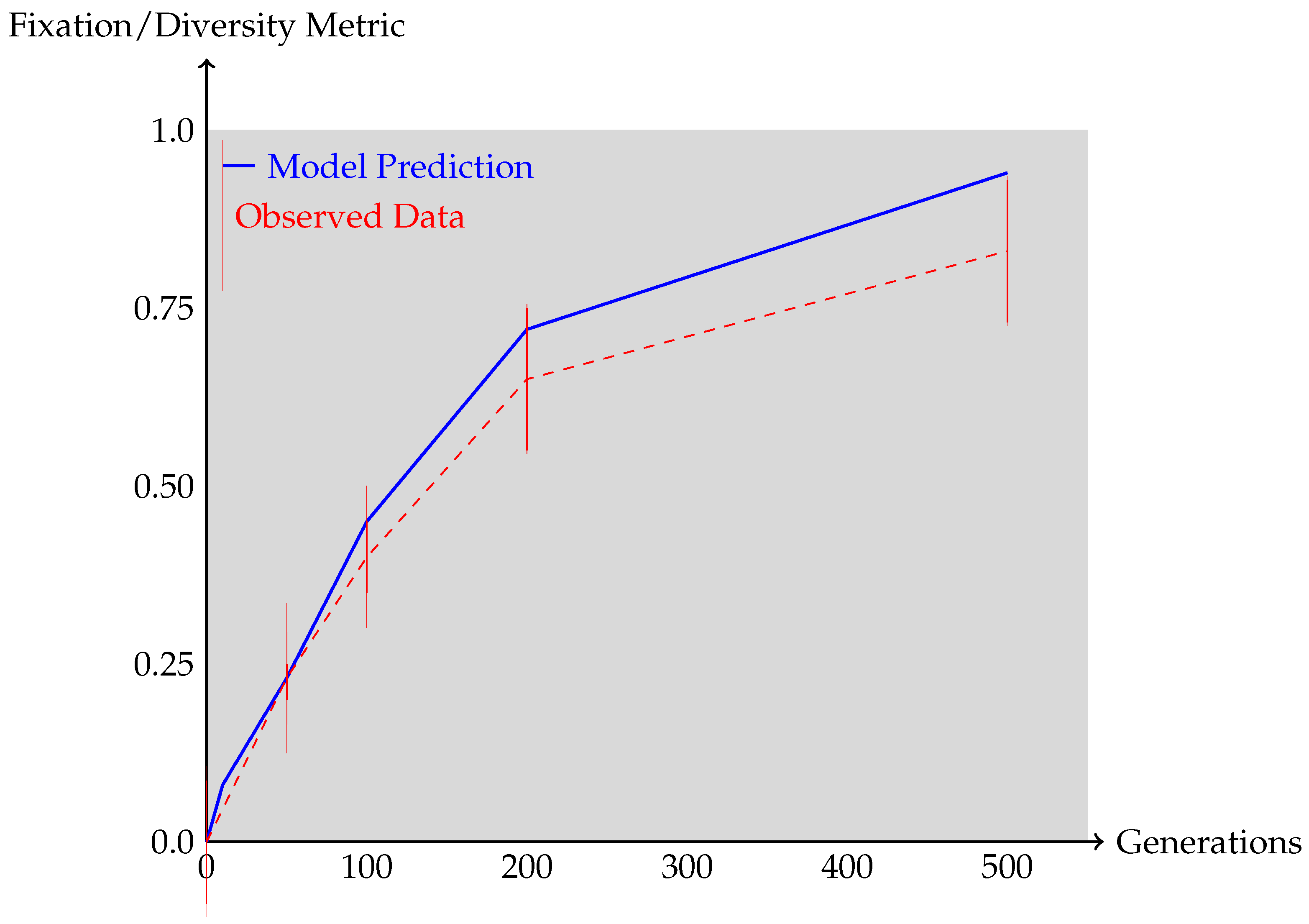
| Generations | Expected Rank | Fixation Probability | Illustrative |
|---|---|---|---|
| 0 | 5.00 | 0.00 | – |
| 10 | 4.12 | 0.08 | – |
| 50 | 2.87 | 0.23 | – |
| 100 | 1.92 | 0.45 | – |
| 200 | 1.34 | 0.72 | – |
| 500 | 1.02 | 0.94 | 0.83 |
| Model | Fixation | Timescale | Diversity Persistence |
|---|---|---|---|
| Deterministic | Inevitable (if synchronizing) | ≤Cerný bound | Possible if not synchronizing |
| Stochastic | Probabilistic | Empirical rates | Possible |
| Observed | 10/12 patients | Variable | 2/12 patients |
| Transitivity k | Time to Fixation | Probability of Fixation |
|---|---|---|
| 1 | > generations | 0.12 |
| 2 | generations | 0.89 |
| 3 | generations | 0.97 |
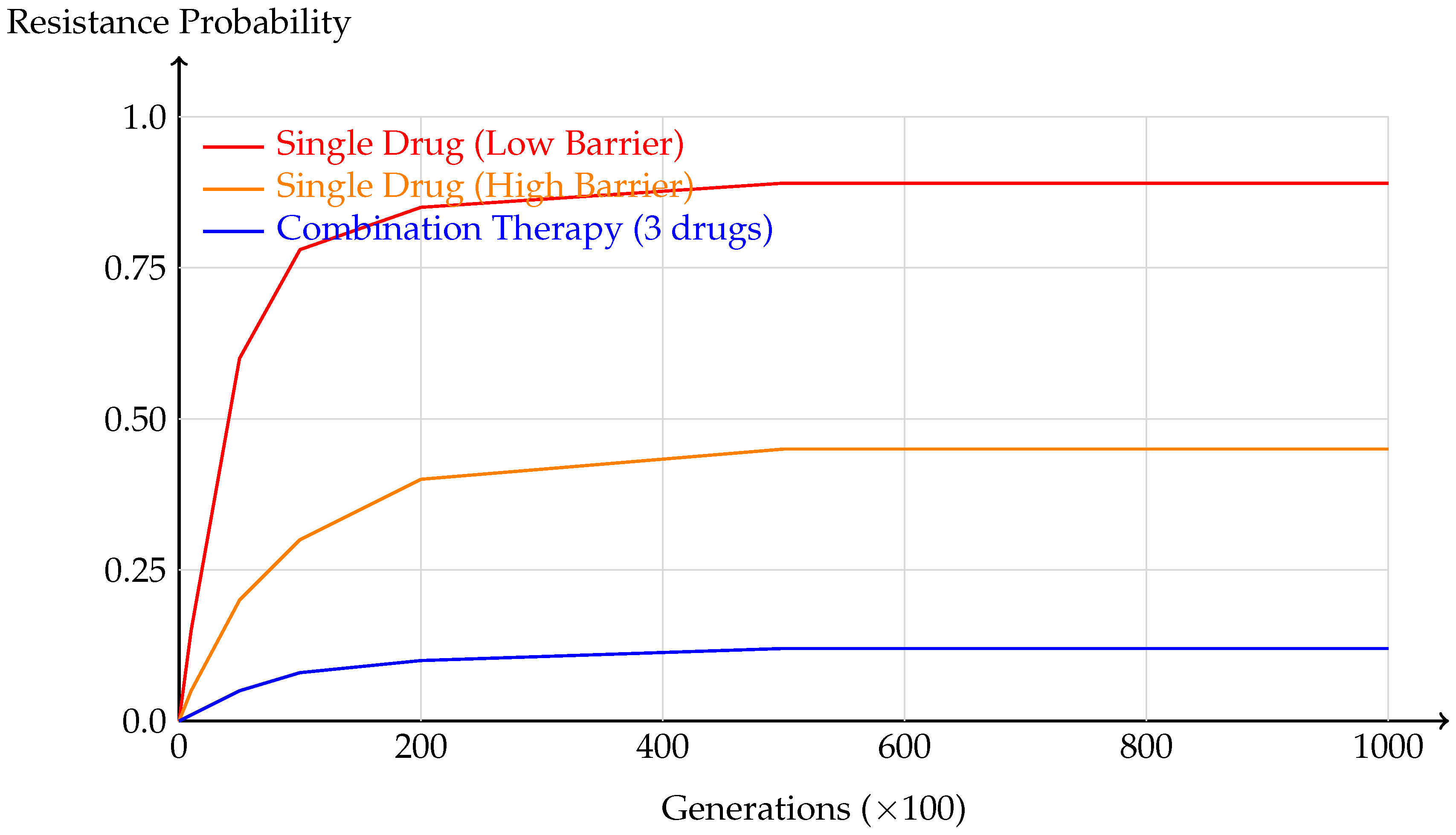
| Drug Regimen | Resistance Probability | Expected Time |
|---|---|---|
| Single drug (low barrier) | 0.89 | 50 generations |
| Single drug (high barrier) | 0.45 | 200 generations |
| Combination therapy (3 drugs) | 0.12 | >1000 generations |
| Generations | Single Drug (Low Barrier) | Single Drug (High Barrier) | Combination Therapy (3 Drugs) |
|---|---|---|---|
| 0 | 0.00 | 0.00 | 0.00 |
| 10 | 0.15 ■ | 0.05 ■ | 0.01 ■ |
| 50 | 0.60 ■■■ | 0.20 ■■ | 0.05 ■ |
| 100 | 0.78 ■■■■ | 0.30 ■■■ | 0.08 ■ |
| 200 | 0.85 ■■■■ | 0.40 ■■■■ | 0.10 ■ |
| 500 | 0.89 ■■■■ | 0.45 ■■■■ | 0.12 ■■ |
| 1000 | 0.89 ■■■■ | 0.45 ■■■■ | 0.12 ■■ |
Disclaimer/Publisher’s Note: The statements, opinions and data contained in all publications are solely those of the individual author(s) and contributor(s) and not of MDPI and/or the editor(s). MDPI and/or the editor(s) disclaim responsibility for any injury to people or property resulting from any ideas, methods, instructions or products referred to in the content. |
© 2026 by the authors. Licensee MDPI, Basel, Switzerland. This article is an open access article distributed under the terms and conditions of the Creative Commons Attribution (CC BY) license.
Share and Cite
Sampson, M.I.; Igiri, C.F.; George, R.; George, J.S. Stochastic Mutation Semigroups: From Deterministic Collapse to Probabilistic Evolutionary Dynamics. Math. Comput. Appl. 2026, 31, 195. https://doi.org/10.3390/mca31050195
Sampson MI, Igiri CF, George R, George JS. Stochastic Mutation Semigroups: From Deterministic Collapse to Probabilistic Evolutionary Dynamics. Mathematical and Computational Applications. 2026; 31(5):195. https://doi.org/10.3390/mca31050195
Chicago/Turabian StyleSampson, Marshal I., Christiana F. Igiri, Reny George, and Julie S. George. 2026. "Stochastic Mutation Semigroups: From Deterministic Collapse to Probabilistic Evolutionary Dynamics" Mathematical and Computational Applications 31, no. 5: 195. https://doi.org/10.3390/mca31050195
APA StyleSampson, M. I., Igiri, C. F., George, R., & George, J. S. (2026). Stochastic Mutation Semigroups: From Deterministic Collapse to Probabilistic Evolutionary Dynamics. Mathematical and Computational Applications, 31(5), 195. https://doi.org/10.3390/mca31050195