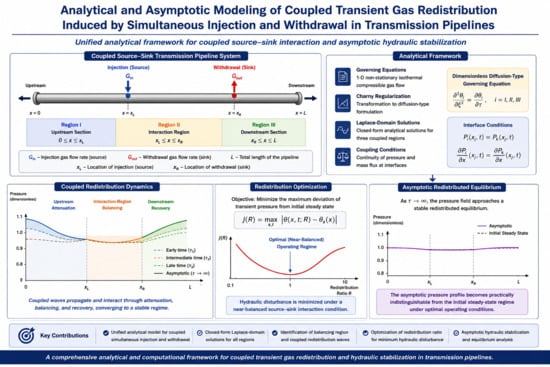
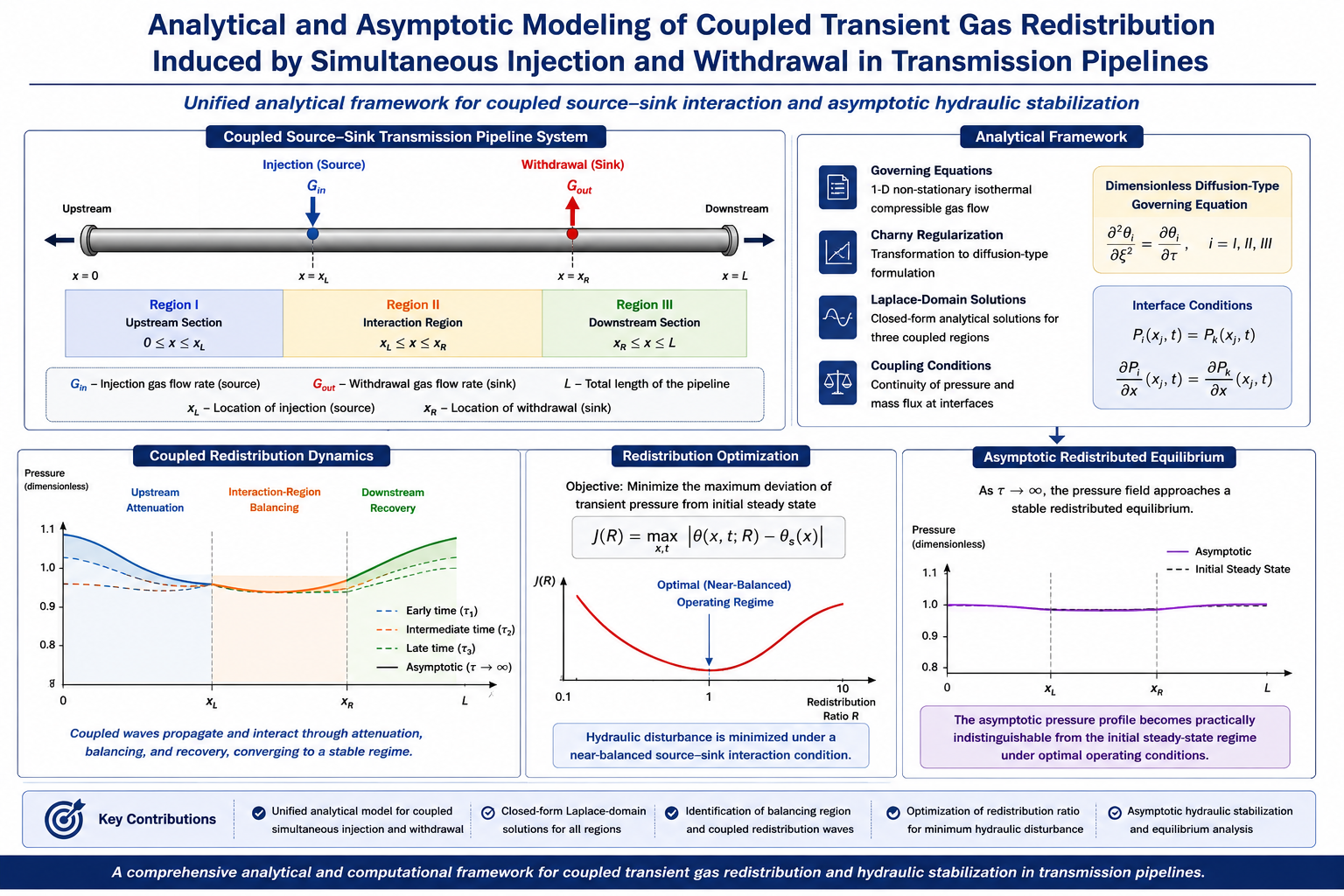
1. Introduction
The reliable operation of high-pressure gas transmission pipelines is of fundamental importance for ensuring the stability, safety, and efficiency of modern energy transportation systems. Owing to the continuously increasing complexity of gas transportation networks, transient operating conditions have become one of the most important research areas in pipeline engineering. In practical transmission systems, non-stationary processes frequently arise due to compressor station regulation, valve switching, emergency isolation, redistribution of gas supply, network reconfiguration, repair operations, interaction of auxiliary feeder pipelines with the main transmission line, and transient balancing between supply and demand nodes. Under such conditions, transient pressure redistribution may significantly affect hydraulic stability, operational reliability, energy efficiency, and structural integrity of the pipeline system.
The mathematical modeling of transient gas flow in pipelines has therefore attracted considerable attention over the past decades. Classical investigations established the theoretical foundations for the analysis of non-stationary compressible gas transport in long-distance pipelines, particularly through the analytical treatment of transient fluid dynamics and gas-network simulation theory [
1,
2]. Charny’s regularization approach [
2] provided one of the earliest analytical frameworks for transforming nonlinear gas-flow equations into diffusion-type systems suitable for transient analysis, while Osiadacz [
1] established important mathematical and operational foundations for simulation and analysis of complex gas networks.
Subsequent developments focused on transient numerical simulation, operational optimization, dynamic state estimation, pressure-wave propagation, and transient hydraulic control in gas transmission systems. Behbahani-Nejad and Shekari [
3] investigated analytical and numerical approaches for transient flow analysis in natural gas pipelines, demonstrating the importance of accurate transient prediction for engineering applications. Madoliat et al. [
4] proposed intelligent methods for transient simulation of gas pipeline networks, whereas Quintela et al. [
5] employed finite-volume formulations for transient gas-flow modeling in transmission systems. Osiadacz and Gburzyńska [
6] further reviewed mathematical models describing gas flow in transmission pipelines and discussed their applicability to modern gas-network analysis.
Recent studies have increasingly focused on optimization and control of transient gas-network operation. Ríos-Mercado and Borraz-Sánchez [
7] presented a comprehensive review of optimization problems in natural gas transportation systems, while Üster and Dilaveroğlu [
8] investigated optimization strategies for the design and operation of transmission networks. Hari et al. [
9] analyzed the operation of natural gas pipeline networks with storage under transient conditions using advanced control-system approaches, and Liu et al. [
10] investigated transient operational optimization technologies for large-scale gas transmission systems. Sundar and Zlotnik [
11] developed transient-state estimation techniques for gas pipeline networks using dynamic pressure-flow data, thereby significantly advancing monitoring and operational control methodologies. More recently, Baker et al. [
12] investigated reduced-order dynamic formulations and optimal control strategies for transient gas-network behavior.
In parallel with these developments, increasing attention has been devoted to transient gas dynamics associated with hydrogen blending, multiphase interaction, pressure-wave propagation, and fluid–structure coupling phenomena. Tan et al. [
13] investigated computational fluid dynamic modeling of methane–hydrogen transportation in pipelines considering roughness and geometric effects, while Tian et al. [
14] analyzed hydrogen–methane mixing processes in T-junction transmission pipelines. Li et al. [
15] studied pressure-wave propagation and attenuation mechanisms in gas–liquid systems, whereas Xu et al. [
16] recently investigated pneumatic hammer effects and transient structural responses in natural gas pipelines based on coupled fluid–structure interaction simulations.
Another important research direction concerns analytical transient modeling and operational analysis of complex gas transmission systems. Aliyev et al. [
17] developed analytical models for leakage detection in parallel transmission pipelines under transient operating conditions, while Aliyev [
18] investigated exploitation processes and operating-mode interactions in complex gas pipeline systems. Guo et al. [
19] further proposed a transient simulation method for gas pipeline networks based on fracture-dimension-reduction algorithms, thereby improving computational efficiency for large-scale transmission systems.
Despite these significant developments, most existing investigations primarily analyze transient processes associated with a single localized disturbance, such as gas injection, gas withdrawal, leakage, valve closure, compressor shutdown, or emergency depressurization. In many practical transmission systems, however, transient disturbances may occur simultaneously at different locations of the same pipeline. Examples include gas redistribution between interconnected transmission corridors, balancing operations between supply and demand nodes, activation of feeder and discharge branches, emergency rerouting procedures, and transient interaction between auxiliary inflow and outflow pipelines.
Under such conditions, localized source–sink interaction generates coupled pressure-redistribution mechanisms that cannot be accurately represented using independent transient-flow models or simple linear superposition principles. Gas injection introduces local compression and increased hydraulic resistance in the upstream section of the pipeline, whereas gas withdrawal induces downstream unloading and pressure-recovery effects. The interaction of these competing mechanisms creates a complex non-equilibrium redistribution process whose analytical description is complicated by discontinuous interface conditions, multiple interacting spatial regions, time-dependent pressure and mass-flux redistribution, and coupled source–sink hydraulic interaction. Consequently, analytical investigations of simultaneous source–sink redistribution in gas transmission pipelines remain limited.
Most existing studies addressing redistribution phenomena rely on numerical simulation or operational approximations. Although such approaches provide valuable engineering predictions, they often do not fully reveal the underlying physical mechanisms governing coupled redistribution processes. In contrast, analytical solutions offer deeper insight into transient redistribution dynamics, interface-coupling behavior, attenuation mechanisms, downstream recovery effects, asymptotic stabilization, and the formation of new hydraulic equilibrium regimes. However, obtaining analytical solutions remains challenging because the governing equations of compressible gas flow constitute a nonlinear hyperbolic–parabolic system with coupled boundary and continuity conditions.
Motivated by these considerations, the present study develops a unified analytical framework for coupled transient gas redistribution induced by simultaneous localized injection and withdrawal in transmission pipelines. The governing equations of one-dimensional non-stationary isothermal compressible gas flow are transformed into a diffusion-type system using the Charny regularization approach [
2]. The transmission pipeline is decomposed into three dynamically interacting regions connected through continuity-based pressure and mass-flux interface conditions.
Using Laplace-transform techniques, closed-form analytical solutions are derived for the transient pressure field under coupled source–sink interaction. The resulting formulation enables investigation of transient redistribution dynamics, asymptotic hydraulic equilibrium, and redistribution-induced stabilization behavior within a single analytical framework. Furthermore, a pressure-profile-based optimization methodology is introduced to evaluate the influence of the injection–withdrawal redistribution ratio on hydraulic stability. The developed framework therefore provides a mathematically interpretable and computationally applicable basis for analyzing coupled redistribution phenomena in gas transmission systems.
Scientific Novelty and Main Contributions
The principal contributions of this study are as follows. First, a unified analytical framework is developed for coupled transient gas redistribution induced by simultaneous localized injection and withdrawal. Second, the proposed formulation provides analytical characterization of attenuation, balancing, and recovery mechanisms arising from source–sink interaction. Third, a generalized dimensionless framework is established to identify the governing parameters controlling redistribution behavior. Fourth, a pressure-profile-based optimization methodology is introduced to evaluate redistribution-induced hydraulic disturbance. Finally, asymptotic analytical solutions are derived to describe the long-time equilibrium state of the coupled redistribution system.
Table 1 demonstrates the principal literature gap addressed in the present study. Existing investigations primarily focus on transient disturbances generated by a single localized hydraulic event, such as injection, withdrawal, leakage, valve closure, or compressor shutdown. In contrast, the present work develops a unified analytical framework for simultaneous localized gas injection and withdrawal within the same transmission pipeline. Unlike previous studies, the proposed formulation integrates:
Coupled source–sink redistribution interaction;
Analytical transient redistribution theory;
Redistribution-ratio optimization;
Asymptotic redistributed equilibrium analysis within a single physically consistent analytical framework.
The comparison further shows that the simultaneous coexistence of upstream attenuation, interaction-region balancing, downstream recovery and hydraulic redistribution optimization has not previously been analytically investigated in the context of coupled transient gas redistribution in transmission pipelines. Consequently, the present study addresses an important theoretical and engineering gap in the analytical modeling of non-stationary gas-transport systems.
2. Physical Model and Governing Equations
2.1. Physical Configuration of the Coupled Source–Sink System
The physical configuration considered in this study consists of a high-pressure gas transmission pipeline subjected simultaneously to localized gas injection and localized gas withdrawal at different spatial locations along the transmission line.
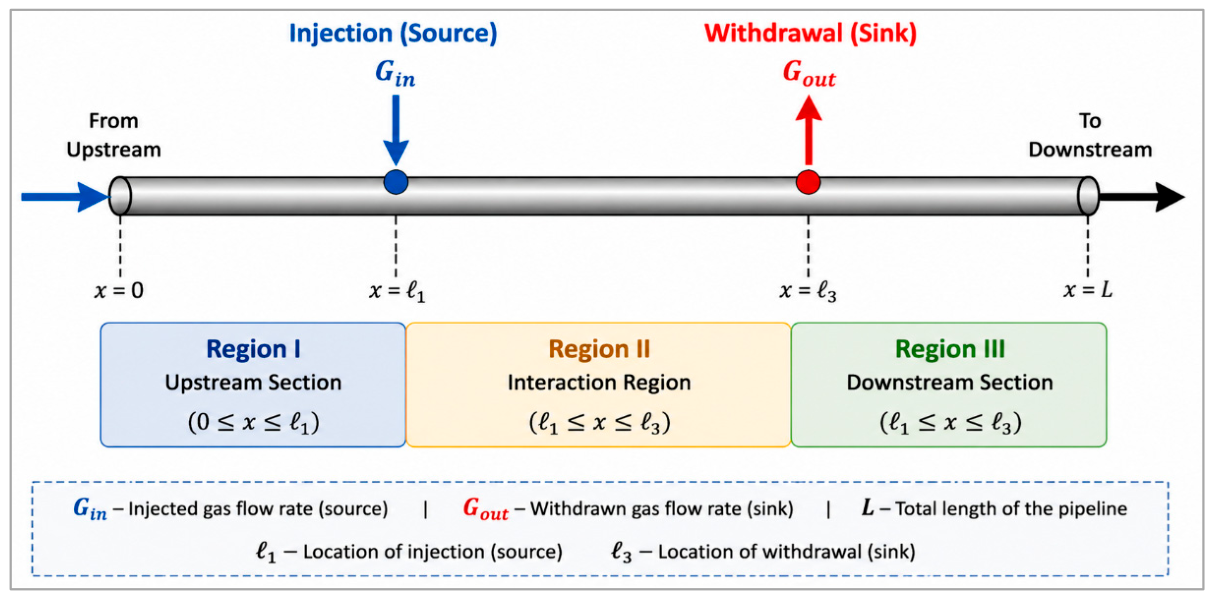
To facilitate the analytical development of the model, the physical pipeline configuration shown in
Figure 1 is transformed into the dimensionless representation presented in
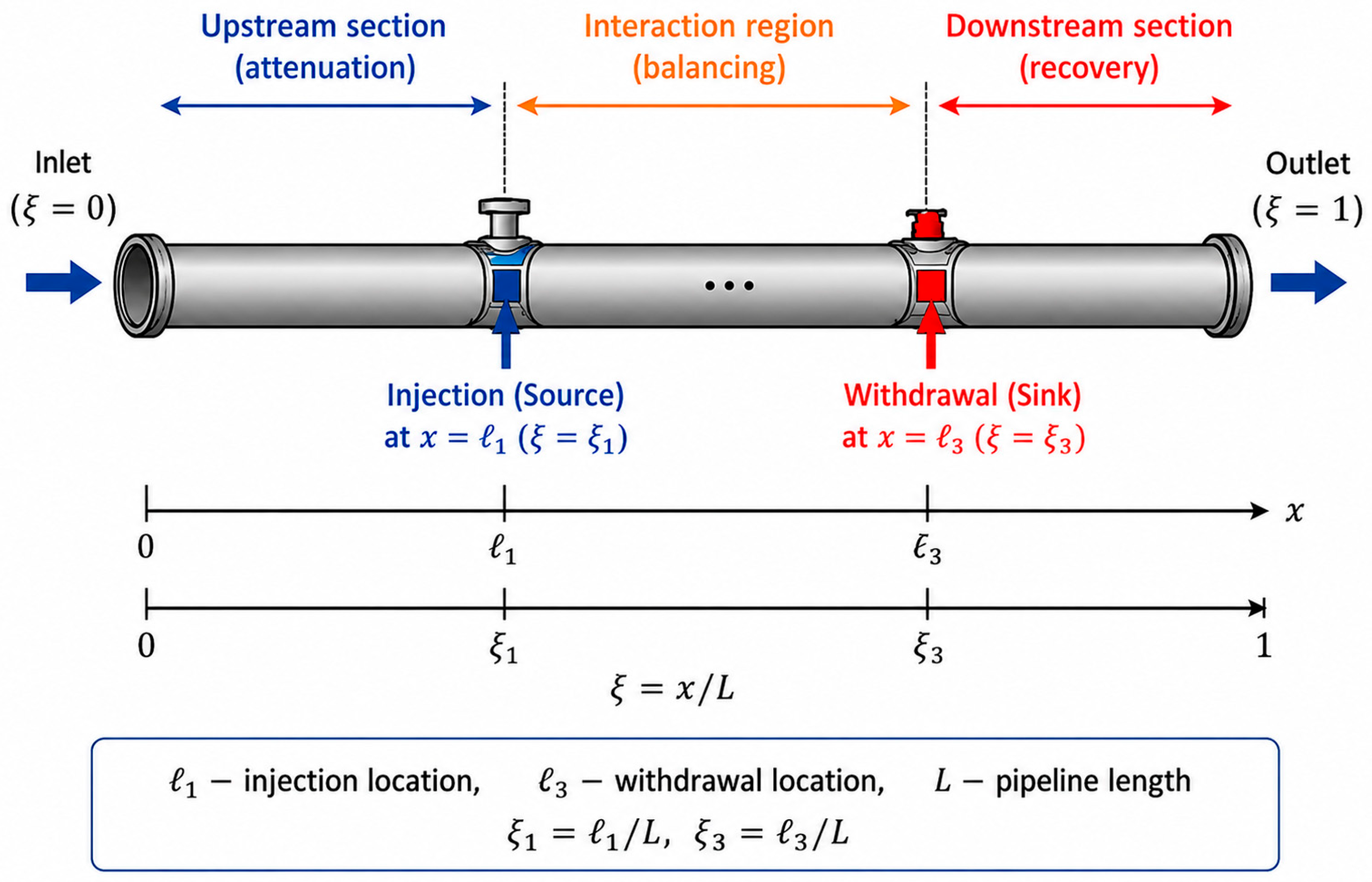
Figure 2. This transformation provides the basis for the generalized Laplace-domain formulation and the subsequent redistribution analysis.
The investigated configuration represents a coupled transient redistribution process generated by the interaction between an auxiliary feeder pipeline supplying gas into the main transmission line and a discharge branch extracting gas from another section of the same system (
Figure 1).
The pipeline is divided into three interacting regions separated by the localized injection and withdrawal locations. This figure represents the physical and engineering configuration of the problem and illustrates the spatial arrangement of the source–sink interaction mechanism in the transmission system. The corresponding dimensionless representation used for the analytical formulation is introduced in
Figure 2.
Unlike conventional transient-flow models involving a single localized disturbance, the present configuration generates simultaneous interacting redistribution waves originating from both source and sink nodes.
Consequently, the resulting transient dynamics cannot be interpreted using simple superposition principles.
Instead, simultaneous injection and withdrawal generate a coupled non-equilibrium redistribution mechanism characterized by localized upstream attenuation, interaction-region balancing, and downstream pressure recovery.
The transmission pipeline of total length
L is decomposed into three dynamically interacting spatial regions separated by the injection and withdrawal nodes located at:
Accordingly, the transmission pipeline is partitioned into three coupled regions:
The first section represents the upstream attenuation region preceding gas injection.
The second section corresponds to the interaction region between the source and sink nodes.
The third section describes the downstream redistribution region influenced by gas withdrawal.
The model is developed under the assumptions of one-dimensional compressible gas flow, isothermal transient behavior, constant pipeline diameter, cross-sectionally averaged gas properties, negligible gravitational effects, and distributed hydraulic resistance represented through the Charny regularization approach. Under these assumptions, the proposed formulation provides an analytically tractable representation of coupled transient gas redistribution in long-distance transmission pipelines.
2.2. Governing Equations of Transient Gas Flow
The transient behavior of compressible gas flow in the transmission pipeline is described using the one-dimensional conservation equations of momentum and mass continuity.
For each coupled pipeline region, the governing equations are written as:
where
Pi(
x,
t) denotes gas pressure,
Gi(
x,
t) =
ρv is the mass-flow rate,
c denotes the characteristic acoustic wave speed,
d is the pipe diameter,
λ is the hydraulic resistance coefficient,
ρ is gas density, and
v is the average gas velocity. The subscript
i = I, II, III denotes the corresponding spatial region of the coupled transmission pipeline.
2.3. Diffusion-Type Formulation Using Charny Regularization
Direct analytical treatment of the governing nonlinear equations under coupled transient interface conditions is difficult because the hydraulic resistance term introduces nonlinear momentum coupling.
To obtain closed-form analytical solutions, the Charny regularization approach is employed.
Following the Charny approximation,
where
a denotes the equivalent linearized hydraulic resistance parameter.
Substitution into the governing equations transforms the nonlinear gas-dynamic system into a diffusion-type pressure equation:
The resulting equations govern transient redistribution propagation throughout the coupled source–sink system.
2.4. Initial and Interface Coupling Conditions
Initially, the transmission pipeline operates under a stationary hydraulic regime described by:
where
P0 is the inlet pressure, and
G0 is the initial stationary mass-flow rate.
At the injection node
x =
ℓ1, pressure continuity requires:
while mass-flux conservation gives:
Similarly, at the withdrawal node
x =
ℓ3,
and the coupled mass conservation condition becomes
These interface conditions establish the mathematical coupling between the three pipeline regions and ensure conservation of pressure and mass flux across the source–sink system. Consequently, the resulting transient redistribution problem forms a coupled multi-domain diffusion system with interacting source–sink dynamics.
3. Dimensionless Formulation
To generalize the analytical model and identify the governing similarity parameters of the coupled redistribution process, the dimensional variables are transformed into nondimensional form.
The following dimensionless variables are introduced:
where
ξ is the dimensionless spatial coordinate and
τ is the dimensionless time. The dimensionless source and sink locations are defined as:
The dimensionless pressure function is introduced as:
where
P0 is the inlet pressure, and
PL is the outlet pressure of the initial steady-state regime.
Substitution into the diffusion-type governing equations yields the standard dimensionless diffusion equation:
For the initial stationary regime
Pi(
x,0) =
P0 − 2
aG0x, and using
x =
Lξ together with
P0 −
PL = 2
aG0L, the nondimensional initial condition becomes:
The source–sink interaction is governed by the following dimensionless parameters:
and
Here, Πin represents the dimensionless injection intensity, while Πout represents the dimensionless withdrawal intensity.
The parameter Δξ denotes the dimensionless distance between the source and sink nodes and governs the interaction strength of the redistribution process.
The resulting dimensionless formulation provides a generalized framework for investigating coupled redistribution dynamics and facilitates comparison of source–sink interaction regimes across different transmission-pipeline configurations.
4. Analytical Derivation
The analytical solution of the coupled transient redistribution problem is obtained by applying the Laplace transform to the nondimensional diffusion-type governing equations. For each coupled pipeline region,
Applying the Laplace transform with respect to dimensionless time
τ,
yields:
The general transformed solution in each region can therefore be expressed as:
where
is the Laplace-domain propagation parameter governing transient redistribution diffusion, and
Ai and
Bi are unknown coefficients determined from boundary and interface coupling conditions.
Accordingly, the transformed solutions for the three coupled pipeline regions are obtained as:
The unknown coefficients are evaluated by imposing the inlet and outlet boundary conditions together with the pressure-continuity and mass-flux coupling conditions at the source and sink locations. Substitution of these conditions into the transformed solutions yields a coupled linear algebraic system of the form
M(p) is the coupling matrix,
C(p) contains the unknown Laplace-domain coefficients,
and R(p) represents forcing contributions associated with the initial state and source–sink interaction.
The complete analytical structure of the solution, including the coupling coefficients, auxiliary transformed functions, and piecewise Laplace-domain expressions, is provided in
Appendix A. The transformed pressure field may therefore be written compactly as:
where the vector function
represents the corresponding hyperbolic basis functions governing the transient redistribution structure in each coupled region. Because the transformed solution contains transcendental hyperbolic functions, direct inversion generally leads to infinite-series or contour-integral representations.
For practical engineering applications, the asymptotic steady-state redistribution regime is obtained using the final-value theorem:
which yields closed-form analytical expressions for the long-time pressure distribution in all coupled pipeline regions. The resulting asymptotic solution demonstrates that the source–sink interaction evolves toward a hydraulically stabilized redistribution regime.
The derived formulation establishes the mathematical basis for analyzing transient redistribution dynamics, asymptotic equilibrium behavior, and redistribution-induced stabilization within a unified Laplace-domain framework. These results form the foundation for the physical interpretation and optimization studies presented in
Section 5.
5. Results and Discussion
This section presents the analytical interpretation of coupled transient gas redistribution induced by simultaneous injection and withdrawal. The derived solutions are used to investigate redistribution dynamics, source–sink interaction, hydraulic stabilization, asymptotic equilibrium formation, and redistribution-oriented optimization. Particular emphasis is placed on the physical interpretation of attenuation, balancing, and recovery mechanisms governing the redistribution process.
The baseline operating parameters used throughout the analysis are summarized in
Table 2.
The selected parameter ranges are not intended to represent a specific pipeline network but rather a representative benchmark configuration suitable for investigating the fundamental physics of coupled transient redistribution.
5.1. Coupled Redistribution Dynamics and Physical Interpretation
The conceptual redistribution mechanism generated by simultaneous source–sink interaction is illustrated in
Figure 2.
The dimensional coordinates shown in
Figure 1 are transformed into the normalized spatial variable (
ξ =
x/
L), resulting in a generalized dimensionless framework suitable for regional decomposition, Laplace-domain solution development, and asymptotic redistribution analysis. Unlike
Figure 1, which illustrates the physical pipeline configuration, this figure provides the mathematical representation required for the subsequent analytical formulation.
Unlike conventional transient-flow problems involving a single localized hydraulic disturbance, the present configuration generates dynamically interacting redistribution waves originating simultaneously from the injection and withdrawal nodes. Consequently, the resulting transient behavior cannot be interpreted using independent transient disturbances or simple superposition principles.
The obtained analytical solutions demonstrate that simultaneous injection and withdrawal generate a coupled redistribution structure characterized by localized upstream attenuation, interaction-region balancing and downstream recovery.
The injection node produces localized compression and increased hydraulic resistance in the upstream section of the transmission pipeline, thereby generating pressure attenuation before the source location. Simultaneously, the withdrawal branch induces unloading effects that modify the downstream pressure-gradient structure and generate moderate downstream recovery near the outlet section of the pipeline.
The interaction region located between the source and sink nodes behaves as a transient balancing zone where source-induced compression and sink-induced unloading partially compensate each other dynamically. Consequently, redistribution gradients progressively decrease within the interaction region, indicating gradual hydraulic stabilization of the coupled source–sink system.
The nondimensional formulation further demonstrates that the redistribution process is governed primarily by source location, sink location, source–sink interaction distance and the relative injection and withdrawal intensities.
In particular, the interaction-distance parameter controls the coupling scale between redistribution waves. Smaller interaction distances produce stronger local redistribution gradients, whereas larger distances generate smoother diffusion-dominated redistribution behavior.
To investigate transient redistribution behavior quantitatively, the analytical expressions derived in
Appendix A were evaluated using the engineering approximation:
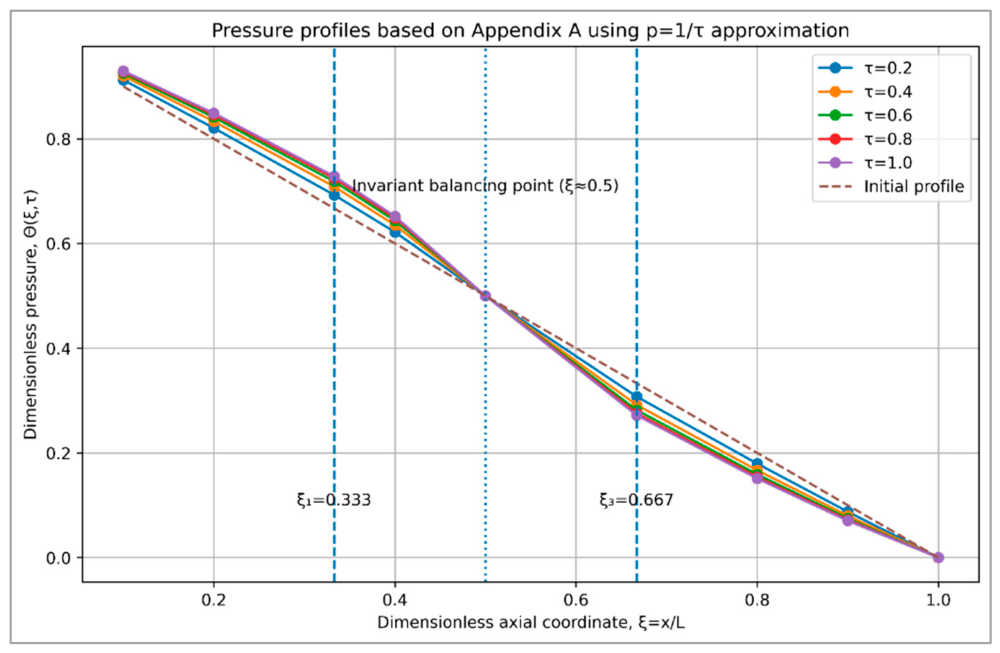
The resulting pressure distributions are presented in
Figure 3 for symmetric redistribution conditions:
The obtained pressure profiles reveal the existence of a quasi-invariant balancing point near ξ ≈ 0.5, where the dimensionless pressure remains nearly insensitive to redistribution time. This behavior confirms the dynamically compensating nature of the coupled source–sink interaction.
The pressure distributions shown in
Figure 3 further indicate that:
The upstream section remains injection-dominated;
The interaction region exhibits gradual redistribution balancing;
The downstream section becomes withdrawal-dominated.
An important observation is that the pressure profiles exhibit only weak dependence on redistribution time, thereby demonstrating rapid convergence toward a quasi-steady redistribution regime.
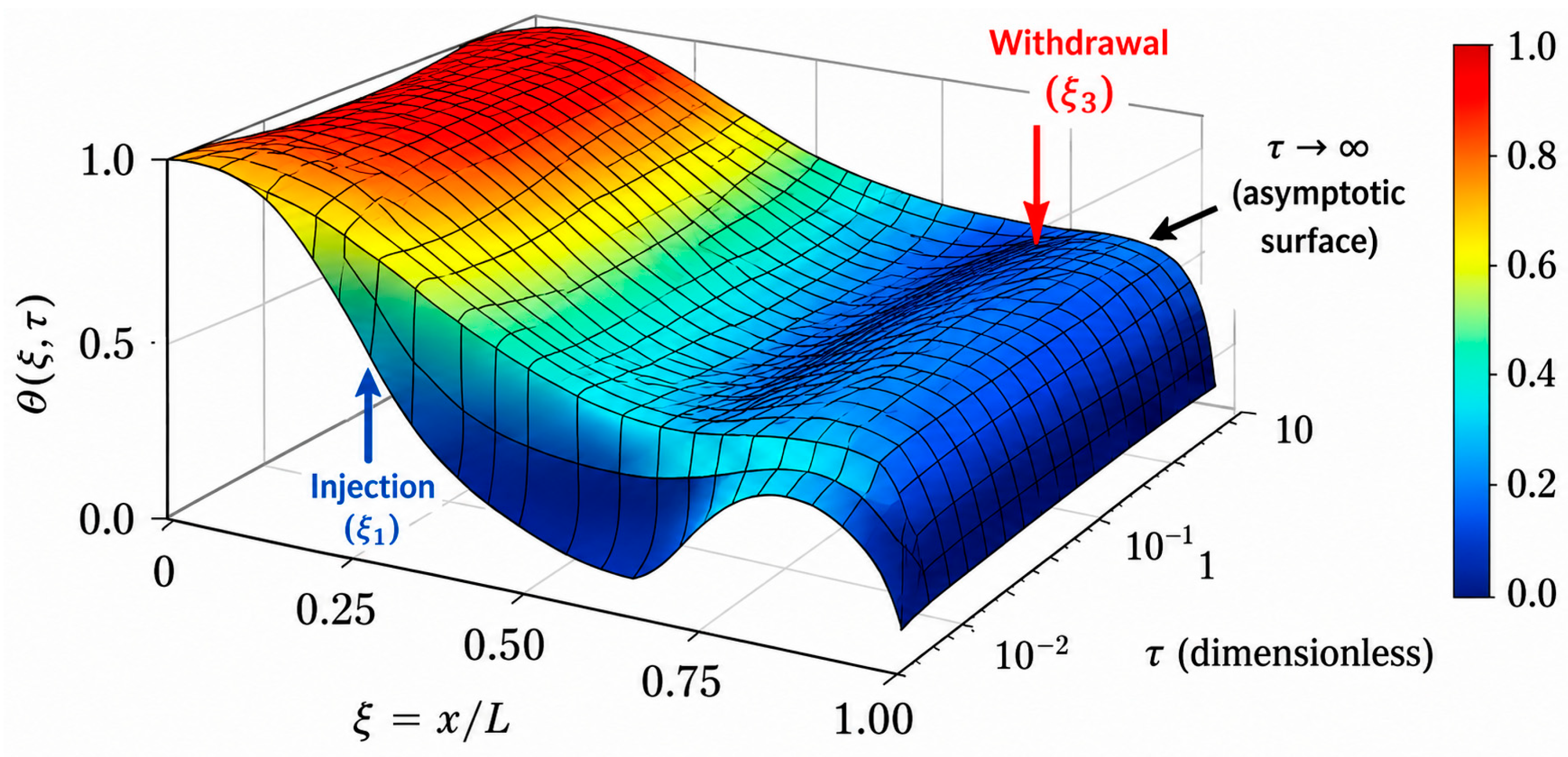
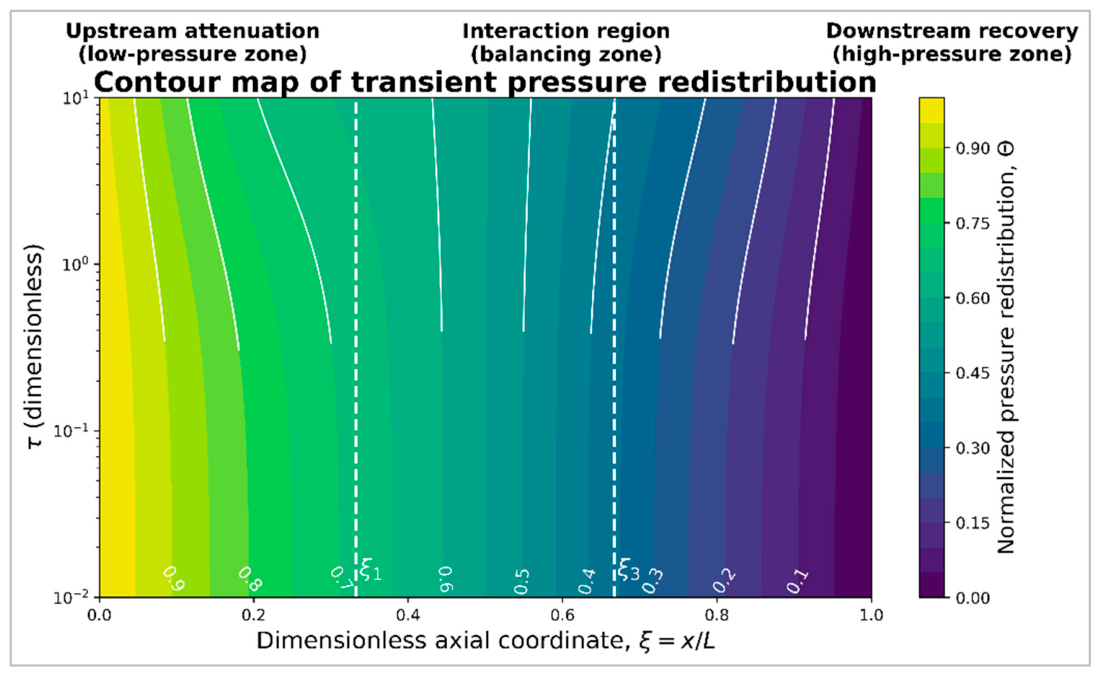
The three-dimensional and contour visualizations presented in
Figure 4 and
Figure 5 further confirm the diffusion-type spatial-temporal structure of the redistribution process. The strongest redistribution gradients occur immediately after activation of the source–sink interaction and progressively decrease as the system evolves toward hydraulic equilibrium. The contour structure clearly identifies upstream attenuation, interaction balancing, and downstream recovery zones. Consequently, the obtained results confirm that simultaneous injection and withdrawal generate coupled redistribution waves fundamentally different from conventional independent transient disturbances.
5.2. Redistribution Stability and Optimization Analysis
The investigated parametric cases used for redistribution-stability analysis are summarized in
Table 3.
The parametric cases summarized in
Table 3 were introduced to establish a representative framework for investigating the influence of interaction distance and source–sink intensity on redistribution behavior. Cases 1–8 define physically meaningful source–sink configurations covering local, intermediate, and distributed interaction regimes, as well as balanced and unbalanced redistribution conditions. Detailed graphical results are presented for the reference configuration and the optimization case because these scenarios capture the principal redistribution mechanisms observed throughout the parametric study. The remaining cases were used to verify the robustness of the analytical framework and to identify the general trends governing redistribution-induced hydraulic stabilization. The graphical results presented below correspond to the representative baseline and optimization cases because these configurations most clearly illustrate the principal redistribution mechanisms predicted by the analytical model.
The redistribution ratio governs the relative dominance of source-induced compression and sink-induced unloading throughout the transmission system. The parametric analysis demonstrates that hydraulic disturbance is minimized near the balanced redistribution regime (R ≈ 1), whereas strongly injection-dominated and withdrawal-dominated operating conditions increase redistribution-induced pressure imbalance.
The developed analytical framework enables investigation of how the injection–withdrawal redistribution ratio:
affects hydraulic stability throughout the transmission system.
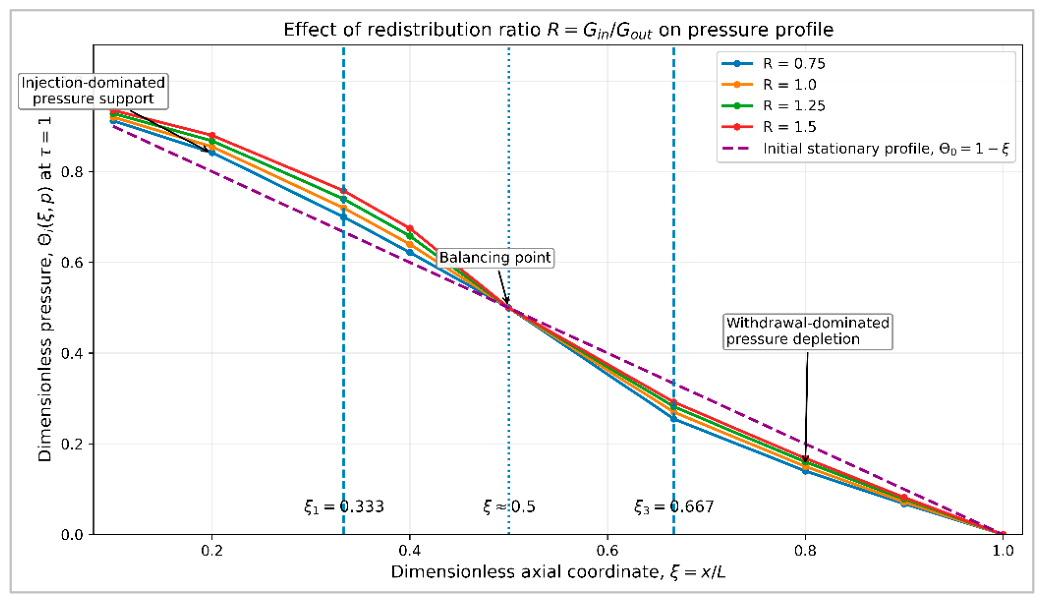
The pressure distributions for different values of
R at
τ = 1 are shown in
Figure 6, where the dimensionless pressure field
is evaluated using the engineering approximation
p = 1/
τ applied to Equations (A8), (A12), and (A17).
The pressure distributions corresponding to different redistribution ratios are presented in
Figure 6. The results demonstrate that:
Withdrawal-dominated regimes (R < 1) increase downstream pressure depletion;
Injection-dominated regimes (R > 1) amplify upstream hydraulic imbalance;
Near-balanced operating conditions produce the smallest redistribution-induced disturbance.
All redistribution curves intersect near the balancing point:
thereby confirming that the central interaction region behaves as a dynamically compensating hydraulic zone separating injection- and withdrawal-dominated behavior.
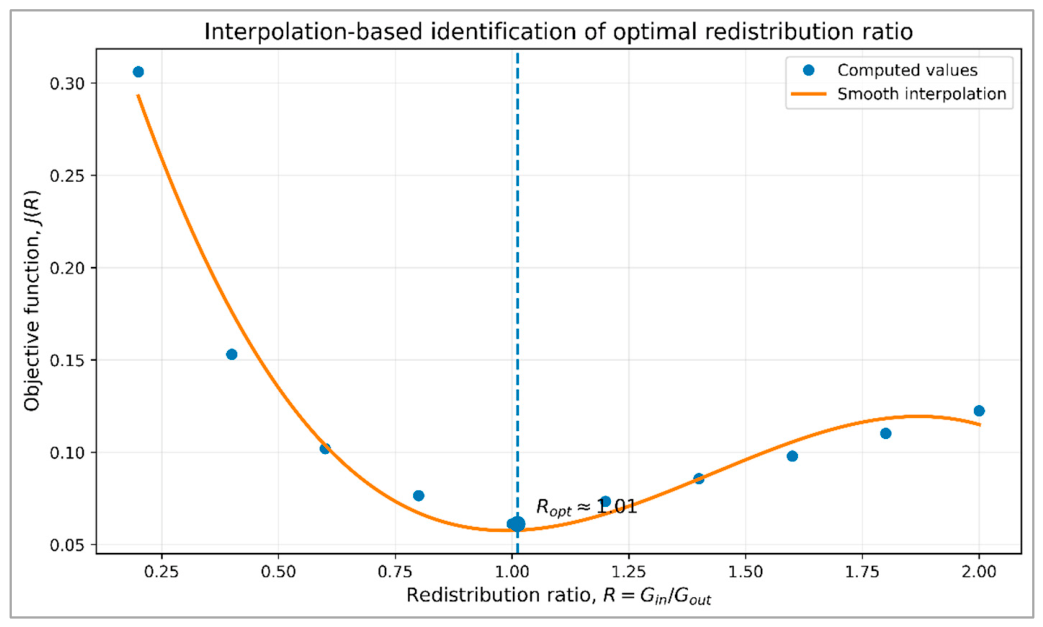
To quantify redistribution-induced hydraulic disturbance, the deviation of the transient pressure field from the initial stationary distribution was evaluated using the objective function:
Using the pressure profiles obtained from the analytical solution, the objective function was evaluated for discrete redistribution ratios, and the resulting optimization curve is presented in
Figure 7.
The obtained curve demonstrates that:
hydraulic disturbance decreases as R ⟶ 1 from the withdrawal-dominated regime,
reaches a minimum near the balanced redistribution condition,
and increases again under strongly injection-dominated operating conditions.
Quadratic interpolation of the computed data yields the continuous approximation:
The optimal redistribution ratio is obtained from:
This result demonstrates that the hydraulically most stable redistribution regime corresponds to a nearly balanced operating condition in which source-induced and sink-induced redistribution effects almost compensate each other dynamically.
From an engineering viewpoint, the proposed optimization framework establishes a physically interpretable criterion for minimizing redistribution-induced hydraulic disturbance in gas transmission systems involving simultaneous injection and withdrawal.
5.3. Asymptotic Redistribution Regime and Engineering Validation
The developed analytical framework enables investigation not only of transient redistribution dynamics but also of the asymptotic hydraulic regime established after a sufficiently long redistribution time.
By applying the asymptotic limit
p ⟶ 0 to the analytical expressions derived in
Appendix A [Equations (A8), (A12), and (A17)], closed-form analytical solutions were obtained for the redistributed steady-state pressure distribution in all coupled pipeline regions. The resulting asymptotic redistribution structure therefore represents the final hydraulic equilibrium generated by simultaneous source–sink interaction.
The obtained asymptotic analytical expressions for the three pipeline sections are summarized below.
where the redistribution parameter is defined as
and the optimized redistribution regime corresponds to a near-balanced source–sink operating condition (
α ≈ 0.99).
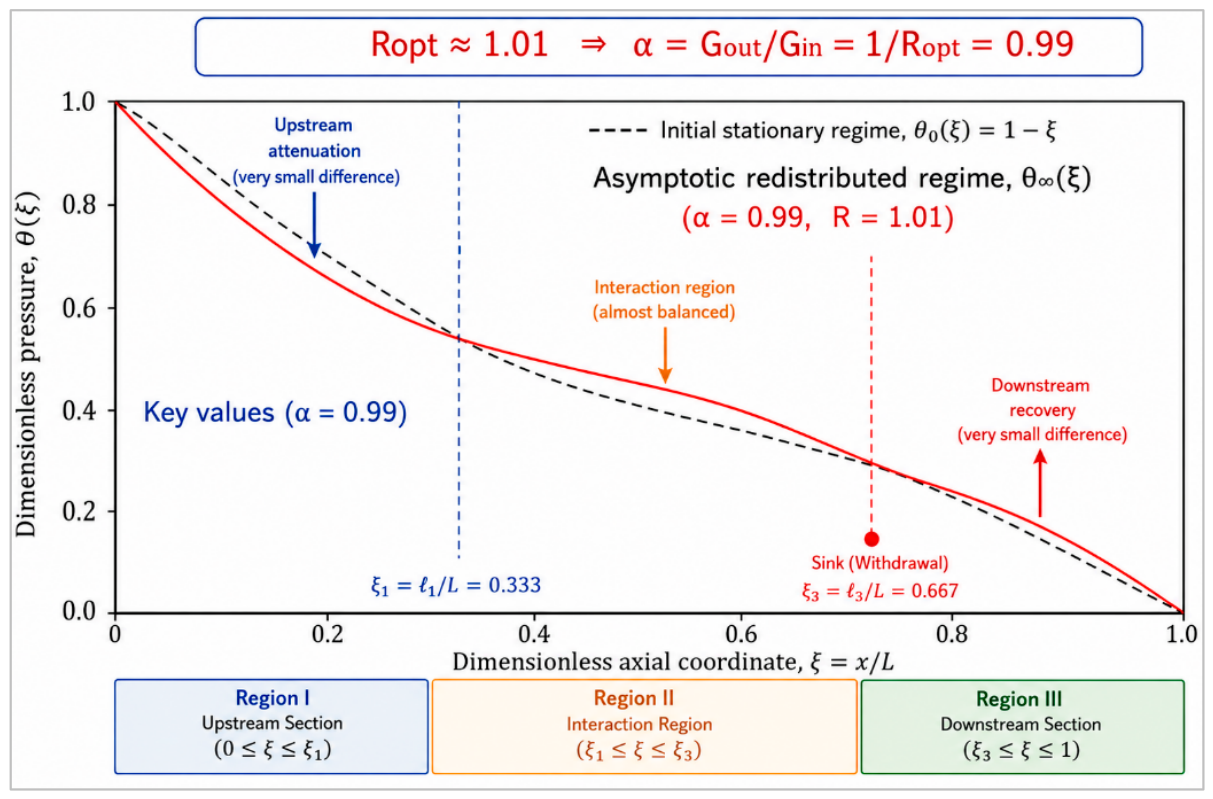
The comparison between the initial stationary hydraulic regime and the redistributed asymptotic equilibrium profile is presented in
Figure 8.
Figure 8 demonstrates that simultaneous injection and withdrawal fundamentally modify the original stationary hydraulic structure while still converging toward a hydraulically stabilized redistribution equilibrium configuration.
An important observation is that the redistributed asymptotic pressure profile remains remarkably close to the original stationary-state distribution throughout the transmission pipeline. The obtained results indicate that upstream attenuation remains relatively weak, redistribution gradients progressively stabilize within the interaction region and downstream recovery remains moderate under optimized operating conditions.
The maximum redistribution deviation remains relatively small throughout the pipeline, thereby confirming that injection-induced and withdrawal-induced effects largely compensate each other under the optimized operating condition. Consequently, the resulting redistributed equilibrium regime becomes practically indistinguishable from the original stationary hydraulic configuration.
The physical consistency of the proposed framework is supported by the continuous propagation of redistribution waves across all coupled regions, the existence of a quasi-invariant balancing point, and the smooth convergence toward a hydraulically stabilized equilibrium regime.
These features are fully consistent with the expected physics of non-stationary compressible gas transport under coupled source–sink interaction conditions.
The regional hydraulic interpretation of the asymptotic redistributed equilibrium regime is summarized in
Table 4.
Table 4 demonstrates that simultaneous source–sink interaction generates a spatially organized coupled redistribution structure characterized by upstream attenuation, interaction-region balancing and downstream recovery.
The upstream section behaves as an attenuation-dominated region due to source-induced hydraulic resistance, whereas the interaction region progressively approaches redistribution equilibrium through partial compensation of source- and sink-induced effects. In the downstream section, moderate pressure recovery associated with withdrawal-induced unloading produces a weak redistribution-enhancement effect near the outlet section of the transmission pipeline.
The asymptotic redistribution structure demonstrates that source-induced compression and sink-induced unloading remain dynamically coupled throughout the redistribution process. As redistribution gradients progressively decrease, the system converges toward a hydraulically stabilized equilibrium configuration that differs from conventional independent transient disturbances.
The present study is based on an analytical solution methodology rather than a finite-volume, finite-element, or computational-fluid-dynamics discretization approach. Closed-form solutions were first derived in the Laplace domain for the three coupled redistribution regions. Subsequently, the transient pressure distributions and redistribution characteristics were obtained through numerical evaluation of the derived analytical expressions for the selected dimensionless parameter sets. Therefore, the computational component of the study consists of evaluating the analytical solution rather than solving the governing equations using spatial discretization techniques.
5.4. Physical Consistency and Literature-Based Validation
To assess the physical credibility of the proposed analytical framework, the obtained redistribution behavior was compared with the fundamental characteristics of transient gas-flow dynamics reported in previous analytical and computational studies of gas transmission systems.
The developed model predicts that simultaneous localized injection and withdrawal generate coupled redistribution patterns characterized by upstream attenuation, interaction-region balancing, and downstream recovery. This behavior is physically consistent with the established understanding of transient compressible gas flow, where localized disturbances induce pressure-wave propagation accompanied by gradual attenuation due to hydraulic resistance and dissipative effects. Similar attenuation, pressure-relaxation, and stabilization mechanisms have been reported in previous analytical and computational investigations of transient gas-flow dynamics in transmission pipelines [
1,
3,
11,
19].
It should be emphasized that the diffusion-type equation employed in the present study does not represent molecular diffusion. Rather, it originates from the Charny regularization of the governing gas-dynamic equations and describes large-scale pressure redistribution under the combined influence of gas compressibility and hydraulic resistance. Consequently, the predicted attenuation and stabilization effects correspond to dissipative pressure-wave dynamics rather than physical mass diffusion.
The characteristic Reynolds number associated with typical gas-transmission-pipeline operation may be estimated as
where λ is the Darcy–Weisbach friction factor, ν is the mean flow velocity, and d is the pipeline diameter. Consequently, the model inherently incorporates turbulent friction effects through the hydraulic resistance term. For typical gas-transmission operating conditions, the corresponding Reynolds numbers are generally of the order of (10
6–10
7), indicating fully turbulent flow. Therefore, the hydraulic-resistance term incorporated into the analytical formulation effectively accounts for turbulent momentum dissipation during transient redistribution processes.
Although the present work is based on an analytical Laplace-domain methodology rather than finite-volume or finite-element discretization, the predicted redistribution trends, attenuation behavior, and asymptotic stabilization characteristics remain consistent with the physical behavior reported in the transient gas-flow literature [
1,
3,
11,
19]. The agreement between the present results and previously reported transient-flow observations provides literature-based validation and supports the applicability of the proposed framework for analyzing coupled source–sink redistribution phenomena in transmission pipelines.
6. Conclusions
This study presents an analytical and computational framework for investigating coupled transient gas redistribution induced by simultaneous localized injection and withdrawal in transmission pipelines. Unlike conventional transient-flow analyses that primarily consider isolated hydraulic disturbances, the proposed formulation describes source–sink interaction within a single dynamically coupled transmission system.
Using the Charny regularization approach, the governing nonlinear gas-dynamic equations were transformed into a diffusion-type analytical formulation suitable for transient-flow analysis. The transmission pipeline was decomposed into three interacting regions connected through pressure-continuity and mass-flux coupling conditions, and closed-form solutions were derived in the Laplace domain.
The results demonstrate that simultaneous injection and withdrawal generate coupled transient redistribution waves rather than independent hydraulic disturbances. These interactions produce three characteristic hydraulic zones: upstream attenuation, interaction-region balancing, and downstream recovery. A balancing region separating injection-dominated and withdrawal-dominated behavior was identified, while the progressive reduction in redistribution gradients indicates gradual hydraulic stabilization of the coupled system.
A pressure-profile-based optimization methodology was further developed to evaluate redistribution-induced hydraulic disturbance. The analysis showed that the minimum disturbance condition corresponds to a near-balanced source–sink operating regime, where injection-induced and withdrawal-induced effects largely compensate each other. The framework also enabled analytical investigation of the asymptotic hydraulic equilibrium established after sufficiently long operating times, demonstrating that the final pressure distribution remains close to the original stationary-state regime under near-balanced operating conditions.
The study contributes to the literature through the development of a unified source–sink analytical framework, the identification of coupled redistribution waves and balancing-region behavior, the formulation of a pressure-profile-based optimization methodology, and the derivation of asymptotic equilibrium solutions within a generalized dimensionless framework.
Overall, the proposed methodology extends the analytical theory of non-stationary gas dynamics by integrating coupled source–sink interaction, asymptotic stabilization behavior, and redistribution-oriented optimization within a unified Laplace-domain framework. The developed framework provides a mathematically interpretable and computationally applicable basis for analyzing transient redistribution dynamics and hydraulic equilibrium in gas transmission systems.