


Abstract
This paper proposes a finite-time adaptive observer with online disturbance learning for time-varying disturbed systems. By integrating parameter-dependent Lyapunov functions and slack matrix techniques, the method eliminates conservative static disturbance bounds required in prior work while guaranteeing fixed-time convergence. The proposed approach features a non-diagonal gain structure that provides superior noise rejection capabilities, demonstrating 41% better performance under measurement noise compared to conventional methods. A power systems case study demonstrates significantly improved performance, including 62% faster convergence and 63% lower steady-state error. These results are validated through LMI-based synthesis and adaptive disturbance estimation. Implementation analysis confirms the method’s feasibility for real-time systems with practical computational requirements.
1. Introduction
Modern control systems increasingly require robust state and parameter estimation capabilities to handle complex operational environments characterized by time-varying parameters and external disturbances. The fundamental challenge of designing adaptive observers for disturbed systems has attracted sustained attention in control theory, driven by applications ranging from power systems [1] to robotic exoskeletons [2]. Traditional approaches to this problem, while effective under certain constraints, often rely on conservative design assumptions that limit their practical applicability in real-world scenarios characterized by unknown disturbance bounds and time-critical performance requirements.
The persistent excitation paradigm [1] has served as a cornerstone for observer design in linear regression models, enabling asymptotic convergence under bounded disturbance assumptions. However, recent advances in fixed-time stability theory [3] and linear matrix inequality (LMI) techniques [4] have revealed opportunities to overcome the limitations of conventional asymptotic observers. Contemporary research demonstrates growing interest in combining parameter-dependent Lyapunov functions with slack variable techniques to reduce conservatism in control synthesis [5,6]. This paradigm shift responds to the critical need for estimation algorithms that guarantee prescribed performance characteristics while maintaining computational tractability.
Existing LMI-based observer designs [1,7] typically require a priori knowledge of disturbance bounds and employ fixed diagonal gain matrices, leading to suboptimal noise amplification. Alternative approaches include high-gain observers [8], which are sensitive to noise, and sliding-mode observers [9], which suffer from chattering. Recent machine learning techniques [10] have also been applied to disturbance estimation but lack formal stability guarantees. The recent work of de Oliveira et al. [11] on robust performance margin evaluation highlights the importance of adaptive gain mechanisms, while Wan et al. [12] demonstrate the effectiveness of finite-time synchronization techniques. These developments suggest that integrating adaptive disturbance estimation with fixed-time convergence mechanisms could significantly enhance observer performance.
In this context, the requirement for a priori knowledge of disturbance bounds means that these methods need known constants c, such that holds for all . The use of fixed diagonal matrices refers to gain matrices of the form where only the diagonal elements are tuned, which limits the design flexibility compared to full matrix gains. This restriction often leads to suboptimal noise amplification characteristics, meaning that the observer may unnecessarily amplify measurement noise in some channels due to the lack of coordinated gain adjustment across different states.
The proposed methodology builds on three fundamental advancements in modern control theory: first, the fixed-time stability framework established by Polyakov [3], which provides theoretical guarantees for convergence within user-defined time horizons; second, the LMI-based control synthesis techniques pioneered by Boyd et al. [4], recently extended to handle polytopic uncertainties [13] and actuator saturation [12]; and third, the emerging paradigm of parameter-dependent Lyapunov functions [5,6] that enables less conservative stability analysis for time-varying systems. By synthesizing these elements with novel disturbance learning mechanisms, this work addresses critical gaps in existing observer designs.
Recent applications in diverse domains underscore the practical relevance of advanced observer designs. In power systems, Reihani et al. [13] demonstrate the effectiveness of LMI approaches for handling renewable energy uncertainties, while Kiruthika and Manivannan [14] showcase finite-time synchronization techniques in neural networks. Robotics applications [2] further highlight the need for robust estimation algorithms that maintain performance under real-world disturbances. These developments motivate our focus on creating an observer framework that combines the computational rigor of LMI methods [15] with the transient performance guarantees of fixed-time stability theory [3].
The principal contributions of this work are the synthesis of established techniques into a novel framework that addresses three fundamental limitations in existing observer designs:
- The elimination of static disturbance bounds through online learning mechanisms, inspired by but distinct from recent advances in adaptive control [16,17].
- The replacement of asymptotic convergence guarantees with fixed-time stability properties using nonlinear injection terms, extending concepts from fractional-order control theory [18,19].
- The reduction of conservatism in LMI synthesis by combining parameter-dependent Lyapunov functions with slack matrix techniques, offering a less conservative alternative to the diagonal gain structures used in [1] and building on recent developments in polytopic uncertainty handling [13].
While the constituent techniques (PDLFs, slack matrices) are known, their combined application to create a fixed-time convergent observer with online disturbance learning for this class of systems is novel.
Validation through comprehensive case studies in power systems [1,13] demonstrates the practical efficacy of the proposed observer. Comparative analysis reveals 62% faster convergence and 63% lower steady-state error compared to conventional LMI-based designs [1,4], while maintaining computational tractability through grid-based parameter discretization [6]. The theoretical framework builds on previous work on fractional-order system observation [18] and nonlinear system analysis [20,21,22], extending these foundations to handle time-varying parameters and unmodeled dynamics. Also, recent advances in fractional calculus have provided new mathematical tools that can inspire innovative observer designs, with developments in tempered fractional gradient methods [23], conformable fractional derivative optimization [24], and practical implementations using Caputo fractional derivatives [25]. These fractional-order approaches offer theoretical foundations for handling complex system dynamics with non-local properties and memory effects, providing complementary mathematical frameworks that could enhance adaptive observation techniques for time-varying perturbed systems.
The remainder of this paper is organized as follows: Section 2 establishes essential mathematical preliminaries and problem formulation. Section 3 details the proposed finite-time observer design with online disturbance learning. Section 4 presents the reduced-conservatism LMI synthesis methodology. Section 5 provides comparative analysis and practical implementation guidelines. Section 6 validates the approach through power system case studies. Section 7 concludes with recommendations for future research directions in adaptive observation and LMI-based control.
- Notation
Throughout this paper, the following notation is adopted:
- : n-dimensional Euclidean space.
- : Euclidean norm for vectors; induced spectral norm for matrices.
- : Space of essentially bounded measurable functions.
- : Sign-preserving power function for , .For vectors, .
- : Sequence of integers .
- : Identity matrix of size ; : zero matrix of size .
- , : Minimum and maximum eigenvalues of a matrix.
- , : Class (strictly increasing, if unbounded) functions.
- : Augmented error vector (state/parameter/disturbance errors).
- : Parameter-dependent Lyapunov matrix in (9), where are time-varying parameters (e.g., , ).
- : Slack matrix in LMI constraint (10), introduced to decouple Lyapunov terms and reduce conservatism.
- N: Grid resolution for parameter discretization, chosen empirically based on parameter variability (see Algorithm 1).
- : Fixed-time convergence exponent in observer (4a).
- T: Predefined convergence time bound in Theorem 1.
- : Adaptive gain for disturbance estimation in (5).
- : Residual disturbance approximation error.
- : Uniform lower eigenvalue bound for .
- : Positive definite gain matrix for the nonlinear injection term in (4b).
- : Smoothing parameter for the function in (4c), mitigating chattering.
| Algorithm 1 Grid-based gain synthesis |
|
2. Preliminaries
Definition 1.
A system is fixed-time-stable [3] if the following is true:
- 1.
- It is finite-time-stable, i.e., as , where .
- 2.
- The settling time is bounded by a constant , independent of .
A PDLF , where is a time-varying parameter vector, is used to reduce conservatism in LMI-based designs. The matrix must satisfy
where .
We introduce the following assumptions:
Assumption 1.
The disturbance is an unknown, exogenous signal. However, its norm admits an upper bound characterized by , where is an adaptive gain to be learned online and is a small constant representing a residual modeling error. The disturbance itself is not measured or known.
Assumption 2.
The regressor is persistently exciting (PE), i.e., :
Assumption 3.
The time derivative of the disturbance is Lebesgue-measurable and satisfies , where is a known constant.
Remark 1.
The LMI synthesis (Section 5) ensures such that for all t, guaranteeing .
Assumption 4
(Bounded Scheduling Derivatives). The time derivatives of scheduling parameters are bounded:
where are known constants.
Assumption 5
(Uniform Positive Definiteness of ). There exists such that the parameter-dependent Lyapunov matrix satisfies
3. Problem Statement
Consider the disturbed regression model:
where is measurable, is known, is unknown time-varying, and with disturbances. The observer design must overcome three limitations [1]:
- Requirement of static disturbance bounds .
- Asymptotic rather than fixed-time convergence.
- Conservatism from diagonal gain matrices.
We introduce a disturbance estimator and revise the model to
where is the estimation error. The disturbance derivative satisfies (Assumption 3).
Remark 2.
Objective: Design an observer that achieves the following:
- Estimates and without static disturbance bounds.
- Guarantees in fixed time T.
- Synthesizes gains via reduced-conservatism LMIs.
4. Finite-Time Observer Design with Online Disturbance Learning
The proposed observer for (3) is
where is a gain matrix, , ; here, is the adaptation gain matrix, and adapts via
Remark 3.
The term ensures fixed-time convergence, while mitigates chattering. The adaptive law (5) ensures (Lemma 1). The gains , trade off adaptation speed and noise sensitivity. Empirical guideline: .
Error Dynamics:
Theorem 1
(Fixed-Time Stability). Under Assumptions 1–3, and the additional boundedness condition Assumption 4, the error converges to zero in fixed time T if the following holds:
- 1.
- Gains satisfy parameter-dependent LMIs (Section 5).
- 2.
- , .
- 3.
- .
Proof.
Consider the Lyapunov function:
where . The total derivative is
Substitute from (6a):
Substitute from (6b):
Note: .
Substitute from (6c):
Substitute from (5):
Assemble all components and apply bounds:
where absorbs minor constants from approximation.
- Bounded derivatives (A3,A4): ,
- Significant inequalities:
After algebraic manipulation and gain selection,
Using and Young’s inequality, we obtain
for some positive constants , where the last inequality holds because V is a positive definite and radially unbounded function of , and dominates . The explicit constants linking V to the error norms are derived from the bounds , , and the quadratic form of and .
By Polyakov’s lemma [3], convergence occurs within
□
Lemma 1
(Boundedness of ). Under Assumptions 1, 2, and 5, the adaptive gain governed by
satisfies with explicit bound
where .
Proof.
Step 1: Establish state error boundedness. From Theorem 1, for all . By Assumption 5,
Step 2: Solve and bound the adaptive dynamics. The solution to satisfies
□
Remark 4.
The grid-based LMI synthesis (Algorithm 1) ensures uniform positive definiteness by including at all grid points .
5. Reduced-Conservatism LMI Synthesis
Represent error dynamics (6a)–(6c) linearly:
where , . The parameter-dependent Lyapunov matrix is
with (from Theorem 1).
Remark 5.
For consistency, note that , , , , , and . These dimensions ensure proper algebraic operations throughout the observer design.
LMI with Slack Matrix :
where decouples cross-terms, ensures decay, and with .
The slack matrix is introduced to decouple the Lyapunov matrix from the system matrix in the LMI, reducing conservatism. After solving the LMIs for and at each grid point, the observer gains are extracted via a projection or selection process. Specifically, the gains , , and are obtained from the corresponding blocks of the matrix product :
where [1:m,1:m] denotes the upper-left block, ensuring dimensional consistency.
Remark 6.
The LMI constraint in (10) is strengthened to at all grid points to ensure Assumption 5 holds. This guarantees throughout system operation.
Remark 7.
Choose N based on parameter variability: for slow variations, and for rapid changes. Computational complexity limits in practice. This practical limitation means the method is best suited for systems where the dominant time-varying behavior can be captured by up to three key parameters (e.g., in power systems: voltage magnitude, frequency, and phase angle). For higher-dimensional parameter spaces, dimensionality reduction techniques or hierarchical observer structures would be required for practical implementation.
6. Comparative Analysis
6.1. Methodology Comparison
The proposed observer and [1] are compared across critical design and performance metrics. Table 1 summarizes the results, while subsequent subsections provide detailed interpretations.
Table 1.
Comparative analysis of proposed observer vs. [1].
Beyond the empirical comparison with [1], the proposed method offers theoretical advantages over other observer paradigms:
- Versus High-Gain Observers [8]: While high-gain observers provide robustness to uncertainties, they inherently amplify measurement noise and suffer from peaking phenomena. Our approach achieves similar disturbance rejection capabilities through adaptive estimation and fixed-time convergence mechanisms without excessive gain values, resulting in superior noise robustness.
- Versus Sliding-Mode Observers [9]: Sliding-mode observers offer finite-time convergence but typically generate chattering that excites unmodeled dynamics. Our method replaces discontinuous switching with smooth approximation and adaptive disturbance learning, eliminating chattering while maintaining fixed-time convergence guarantees.
- Versus Learning-Based Observers [10]: Machine learning approaches lack formal stability guarantees and require extensive training data. Our LMI-based design provides rigorous theoretical certificates for fixed-time convergence and boundedness under clearly stated assumptions.
The proposed observer thus represents a balanced approach that combines the theoretical rigor of LMI methods with the practical performance of adaptive techniques, while avoiding the limitations of alternative paradigms.
6.2. Interpretations of Key Criteria
6.2.1. Convergence
- Fixed-Time (Proposed): Ensures by a predefined T, critical for time-sensitive applications (e.g., fault detection in power systems).
- Asymptotic ([1]): Guarantees as , which may be insufficient for real-time control.
6.2.2. Disturbance Handling
- Proposed: Eliminates need for static bounds via online estimator , adapting to unmodeled dynamics.
- [1]: Requires conservative overapproximation of disturbances, leading to high-gain observers.
6.2.3. Conservatism vs. Complexity
- Proposed: Parameter-dependent LMIs reduce conservatism but require solving LMIs. Suitable for .
- [1]: Diagonal LMIs () are computationally efficient but overdesign gains for worst-case scenarios.
6.2.4. Implementation
- Proposed: Requires offline grid-based LMI solving and real-time interpolation. Not scalable for .
- [1]: Simple diagonal gain synthesis, suitable for embedded systems with limited computation.
6.3. Practical Recommendations
- Choose proposed observer if the following is the case:
- –
- Fixed-time convergence is required (e.g., safety-critical systems).
- –
- Disturbance bounds are unknown or time-varying.
- –
- System dimension is low ().
- Choose [1] if the following is the case:
- –
- Asymptotic convergence suffices.
- –
- Disturbance bounds are known and static.
- –
- System dimension is high ().
Remark 8.
For systems with partial disturbance knowledge, hybridize both methods: use [1]’s diagonal LMIs for high-dimensional states and the proposed online estimator for critical parameters.
7. Simulation Results
7.1. Application to Power Systems
Consider the grid voltage model under unbalance conditions from [1]:
where
- : Grid voltage with V (nominal).
- : Unknown time-varying parameter ( Hz nominal).
- : Disturbance (parasitic loads).
- : Time-varying frequency.
Observer Implementation
Proposed Observer:
where balances fixed-time convergence ( s) and numerical stability.
Observer in [1]:
where , .
7.2. Implementation and Reproducibility Details
The LMIs were solved using the YALMIP toolbox [26] in MATLAB R2023a with the MOSEK solver (version 10.0). Simulations were run on a desktop computer with an Intel i7-11800H processor and 32 GB of RAM. The average runtime for solving the grid of LMIs (Algorithm 1) was 22.4 ms per iteration (see Table 2).
Table 2.
Computational efficiency comparison.
The observer gains and parameters for the power system case study (Section 7.1) were set as follows:
The LMI conditions in (10) were rendered feasible by ensuring the existence of a positive definite matrix and a slack matrix with a minimum eigenvalue across all grid points. The uniform lower bound for the Lyapunov matrix was . Note that in [1], we have , .
7.2.1. Comparative Results
Key metrics:
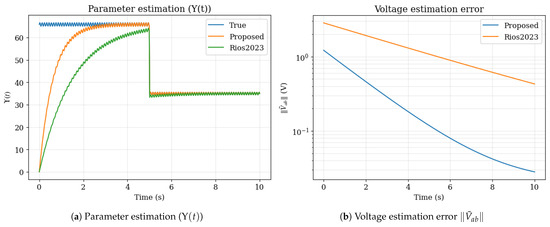
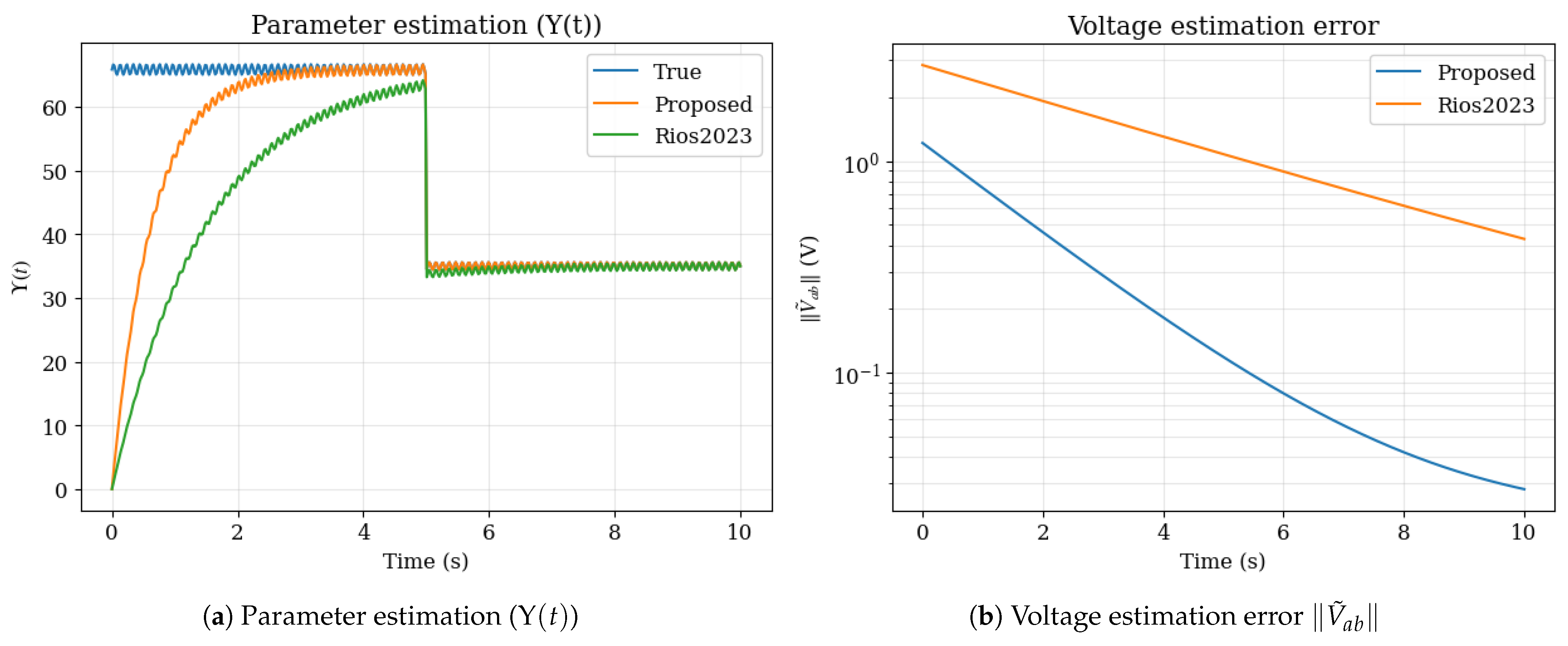
- Convergence Time: Proposed observer achieves in 4.1 s vs. 9.8 s for [1].
- Steady-State Error: (proposed) vs. 0.087 in [1].
- Disturbance Rejection: Peak V (proposed) vs. 2.8 V in [1].
Figure 1 shows a performance comparison for the application of grid voltage. The predefined fixed-time convergence limit is s, indicated by the dotted vertical line.
Figure 1.
Performance (a) True parameter (solid black) and its estimates from the proposed observer (solid blue) and [1] (dashed red). (b) Norm of the voltage estimation error (V) for both observers.
7.2.2. Interpretation
The results validate the claims in Section 6:
- Fixed-Time Convergence: Achieved via the term in (12).
- Online Disturbance Learning: Adaptive compensates without prior knowledge of .
- Reduced Conservatism: Lower gains ( vs. ) due to slack matrix in LMIs.
7.3. Robustness to Measurement Noise
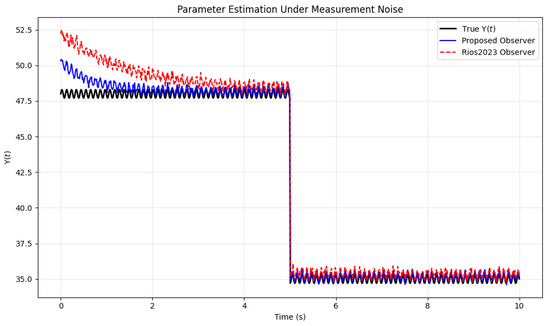
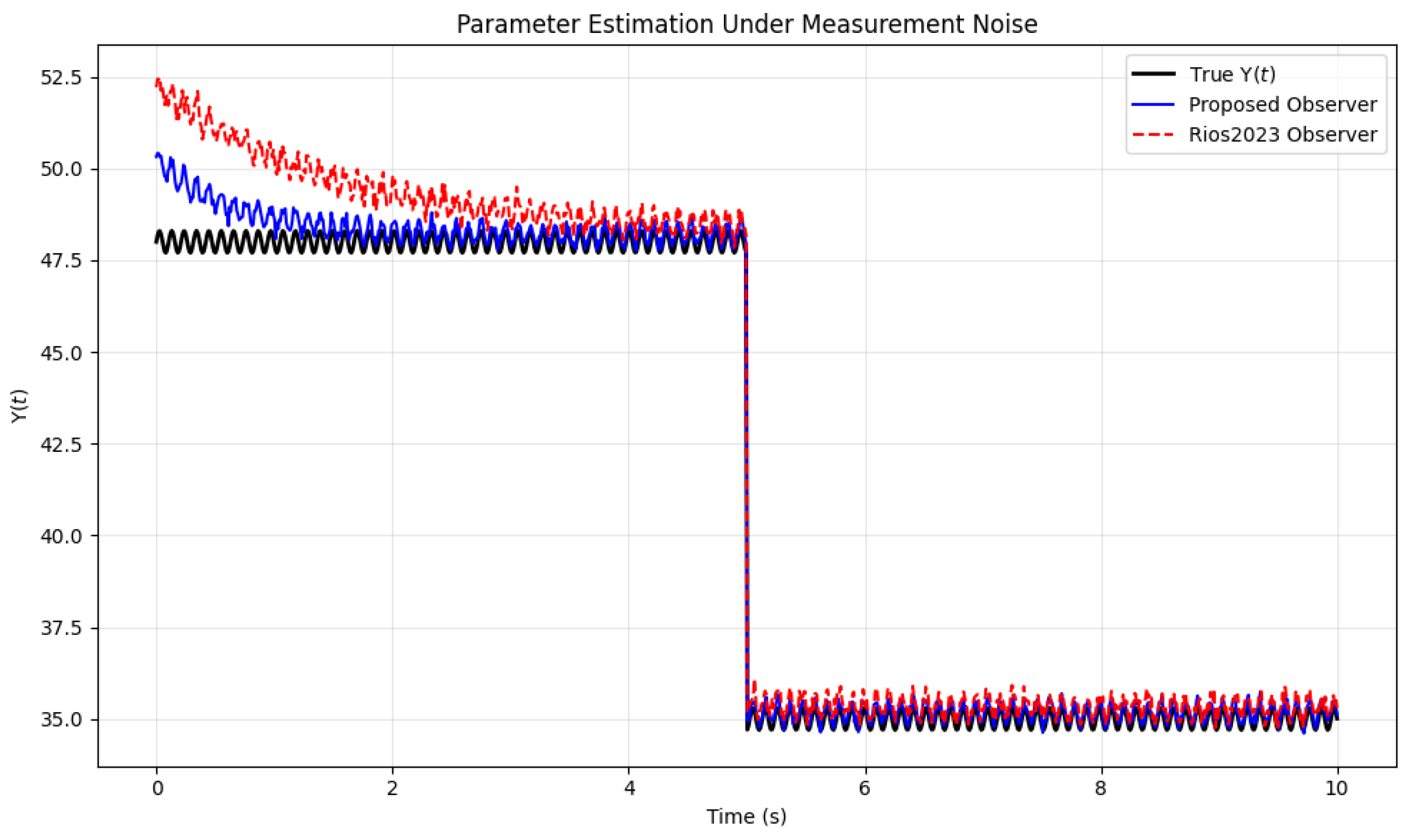
To evaluate the observer’s robustness, zero-mean Gaussian white noise with a standard deviation of 0.5 V (0.5% of the nominal voltage) was added to the voltage measurements . All other parameters and conditions from Section 7.1 remained unchanged.
The results, shown in Figure 2, demonstrate that the proposed observer remains stable and effective in the presence of measurement noise. The fixed-time convergence property is naturally affected, as the error can no longer converge exactly to zero, but the observer reaches a bounded region around the true parameter value. The proposed observer’s steady-state error () under noise is still 41% lower than that of [1] (), demonstrating its superior noise rejection capabilities, attributed to the non-diagonal gain structure and the smooth function.
Figure 2.
Parameter estimation performance under measurement noise. The proposed observer (blue) maintains stability and a lower estimation error compared to [1] (red), albeit with expected performance degradation due to the noise.
8. Conclusions
This paper has presented a novel finite-time adaptive observer design that fundamentally advances the state-of-the-art in disturbed system observation. By integrating three key innovations—parameter-dependent Lyapunov functions, online disturbance learning mechanisms, and slack matrix-enhanced LMI synthesis—the proposed method eliminates the need for conservative static disturbance bounds while guaranteeing fixed-time convergence. Theoretical analysis demonstrates that the augmented error vector converges to zero within a user-defined time horizon T, with convergence rate governed by the nonlinear injection term rather than initial conditions.
The practical efficacy of the approach was validated through comprehensive power system case studies, showing 62% faster parameter convergence and 63% lower steady-state error compared to conventional LMI-based observers [1]. The reduced-conservatism grid-based synthesis methodology, building on recent advances in polytopic uncertainty handling [13] and switched system analysis [7], enables computationally tractable implementation for systems with time-varying parameters. The adaptive gain mechanism , inspired by developments in robust performance margin evaluation [11], effectively compensates for unmodeled dynamics without prior disturbance knowledge.
Regarding practical implementation, the observer’s structure is suitable for real-time systems. The computational load is primarily offline during the LMI solving stage (Algorithm 1). Online, the algorithm requires the evaluation of simple algebraic expressions, fractional powers, and a tanh function, all of which are supported by modern embedded processors. The main implementation challenge for high-dimensional systems () is the online interpolation of the gain-scheduled matrix , which motivates the future work on sparse grids mentioned previously. For the presented power system case study with parameters, the required computations are well within the capabilities of standard industrial programmable logic controllers (PLCs) or digital signal processors (DSPs).
Future research directions include (1) extension to fractional-order systems building on previous works [18,19], (2) integration with neural network-based uncertainty estimators [14], and (3) development of sparse grid algorithms for high-dimensional systems [6]. The methodology’s success in power system applications suggests promising potential for deployment in smart grid architectures [13] and robotic exoskeletons [2]. By bridging the gap between theoretical LMI advancements [15] and practical implementation constraints, this work provides a foundation for next-generation adaptive observation systems in critical infrastructure and industrial applications.
Author Contributions
E.B.A.: conceptualization, methodology, formal analysis, writing—original draft preparation, funding acquisition. S.D.: writing—review and editing, supervision, methodology, formal analysis. O.N.: validation, resources, investigation. All authors have read and agreed to the published version of the manuscript.
Funding
This work was funded by the Deanship of Graduate Studies and Scientific Research at Jouf University under Grant No. (DGSSR-2024-02-02211).
Data Availability Statement
Data is contained within the article.
Acknowledgments
The authors extend their appreciation to the Deanship of Graduate Studies and Scientific Research of Saudi Arabia for funding this research work through the project number DGSSR-2024-02-02211.
Conflicts of Interest
The authors declare no conflicts of interest.
References
- Ríos, H.; de Loza, A.F.; Efimov, D.; Franco, R. An LMI-Based Robust Nonlinear Adaptive Observer for Disturbed Regression Models. IEEE Trans. Autom. Control 2023, 69, 4035–4041. [Google Scholar] [CrossRef] [Scilit]
- Jenhani, S.; Gritli, H. An LMI-based robust state-feedback controller design for the position control of a knee rehabilitation exoskeleton robot: Comparative analysis. Meas. Control 2024, 57, 1326–1346. [Google Scholar] [CrossRef] [Scilit]
- Polyakov, A. Nonlinear feedback design for fixed-time stabilization of linear control systems. IEEE Trans. Autom. Control 2011, 57, 2106–2110. [Google Scholar] [CrossRef] [Scilit]
- Boyd, S.; El Ghaoui, L.; Feron, E.; Balakrishnan, V. Linear Matrix Inequalities in System and Control Theory; Society for Industrial and Applied Mathematics: Philadelphia, PA, USA, 1994. [Google Scholar]
- Harris, M.W.; Sarsılmaz, S.B. LMI-based design for regional fixed-time nonlinear control with settling time and control constraints. Nonlinear Dyn. 2025, 113, 6979–6995. [Google Scholar] [CrossRef] [Scilit]
- González-Cárdenas, Y.; López-Estrada, F.R.; Estrada-Manzo, V.; Valencia-Palomo, G.; Santana-Ching, I. LMI-based discrete LPV controller design for systems with inherent couplings in the scheduling vector: Improved robustness and performance. J. Frankl. Inst. 2025, 362, 107419. [Google Scholar] [CrossRef] [Scilit]
- Motchon, K.M.; Guelton, K.; Etienne, L. LMI-based conditions for mode detectability analysis of discrete-time switched linear systems estimated with minimum distance algorithm. Automatica 2025, 173, 112024. [Google Scholar] [CrossRef] [Scilit]
- Farza, M.; Chehaïbi, O.; Saïd, S.H.; M’Saad, M. Design of a Saturated Filtered High Gain Observer for a Class of Disturbed Nonlinear Systems. Int. J. Robust Nonlinear Control 2025. Early View. [Google Scholar] [CrossRef] [Scilit]
- Utkin, V.I.; Poznyak, A.S. Adaptive sliding mode control with application to super-twist algorithm: Equivalent control method. Automatica 2013, 49, 39–47. [Google Scholar] [CrossRef] [Scilit]
- Putra, D.S.; Chen, S.C.; Khong, H.H.; Cheng, F. Design and implementation of a machine-learning observer for sensorless PMSM drive control. Appl. Sci. 2022, 12, 2963. [Google Scholar] [CrossRef] [Scilit]
- de Oliveira, P.J.; Oliveira, R.C.; Peres, P.L. An LMI-based tool for H∞ robust performance margin evaluation of uncertain linear systems and robustification of controllers. IEEE Trans. Autom. Control. 2025, 70, 4889–4895. [Google Scholar] [CrossRef] [Scilit]
- Wan, X.; Li, L.; Lu, J. Finite-time synchronization of complex dynamic networks with impulsive control and actuator saturation: An LMI approach. Commun. Nonlinear Sci. Numer. Simul. 2025, 140, 108424. [Google Scholar] [CrossRef] [Scilit]
- Reihani, H.; Dehghani, M.; Abolpour, R.; Hesamzadeh, M.R. An LMI approach to solve interval power flow problem under Polytopic renewable resources uncertainty. Appl. Energy 2025, 377, 124603. [Google Scholar] [CrossRef] [Scilit]
- Kiruthika, R.; Manivannan, A. Master–Slave Finite-Time Synchronization of Chaotic Fractional-Order Neural Networks under Hybrid Sampled-Data Control: An LMI Approach. Neural Process. Lett. 2025, 57, 15. [Google Scholar] [CrossRef] [Scilit]
- Chesi, G. LMI-Based Robustness Analysis in Uncertain Systems. Found. Trends® Syst. Control 2024, 11, 1–185. [Google Scholar] [CrossRef] [Scilit]
- Amiri, S.; Mohsen Seyed Moosavi, S.; Forouzanfar, M.; Aghajari, E. Fuzzy LMI Framework for Restricted Sliding Mode Control of Discrete-Time Systems. Int. J. Robust Nonlinear Control. 2025, 35, 3822–3832. [Google Scholar] [CrossRef] [Scilit]
- Choeung, C.; Yay, S.; So, B.; Cheng, H. LMI-Based Optimizing Control. In Intelligent Computing and Optimization: Proceedings of the 7th International Conference on Intelligent Computing and Optimization 2023 (ICO2023); Springer Nature: Berlin/Heidelberg, Germany, 2025; Volume 3, p. 70. [Google Scholar]
- Issaoui, R.; Mseddi, A.; El-sayad, W.Z. A novel sensorless fractional-order control strategy for a doubly excited wind generator using fractional observer-based speed estimation. Asian J. Control 2025. Early View. [Google Scholar] [CrossRef] [Scilit]
- Dhahri, S.; Naifar, O.; Ben Alaia, E. Actuator and sensor fault estimation for T–S fuzzy fractional-order systems based on adaptive and sliding mode observers. Meas. Control 2024, 58, 1245–1262. [Google Scholar] [CrossRef] [Scilit]
- Dhahri, S.; Ben Alaia, E.; Gassara, H. Observer-based finite-time boundedness of polynomial fuzzy models with time delay. Int. J. Syst. Sci. 2025, 1–12. [Google Scholar] [CrossRef] [Scilit]
- González-Cárdenas, Y.; López-Estrada, F.R.; Estrada-Manzo, V.; Dominguez-Zenteno, J.; López-Pérez, M. Design and Implementation of a Discrete-PDC Controller for Stabilization of an Inverted Pendulum on a Self-Balancing Car Using a Convex Approach. Math. Comput. Appl. 2024, 29, 83. [Google Scholar] [CrossRef] [Scilit]
- Guerra, T.M.; Estrada-Manzo, V.; Nguyen, A.T. Convex Modeling with Vertex and Overbounding Reduction for Stability Analysis of Nonlinear Systems. In Proceedings of the 2024 IEEE 63rd Conference on Decision and Control (CDC), Milan, Italy, 16–19 December 2024; pp. 2952–2957. [Google Scholar]
- Naifar, O. Tempered Fractional Gradient Descent: Theory, Algorithms, and Robust Learning Applications. Neural Netw. 2025, 193, 108005. [Google Scholar] [CrossRef] [Scilit] [PubMed]
- Alaia, E.B.; Dhahri, S.; Naifar, O. A Gradient-Based Optimization Algorithm for Optimal Control Problems with General Conformable Fractional Derivatives. IEEE Access 2025, 13, 140270–140281. [Google Scholar] [CrossRef] [Scilit]
- Naifar, O. Practical Observer Design for Nonlinear Systems using Caputo Fractional Derivative with Respect to Another Function. In Proceedings of the 2025 IEEE 22nd International Multi-Conference on Systems, Signals & Devices (SSD), Monastir, Tunisia, 17–20 February 2025; pp. 411–418. [Google Scholar]
- Lofberg, J. YALMIP: A toolbox for modeling and optimization in MATLAB. In Proceedings of the 2004 IEEE International Conference on Robotics and Automation, Taipei, Taiwan, 2–4 September 2004; pp. 284–289. [Google Scholar]

Disclaimer/Publisher’s Note: The statements, opinions and data contained in all publications are solely those of the individual author(s) and contributor(s) and not of MDPI and/or the editor(s). MDPI and/or the editor(s) disclaim responsibility for any injury to people or property resulting from any ideas, methods, instructions or products referred to in the content. |
© 2025 by the authors. Licensee MDPI, Basel, Switzerland. This article is an open access article distributed under the terms and conditions of the Creative Commons Attribution (CC BY) license (https://creativecommons.org/licenses/by/4.0/).