


Abstract
This paper solves the stabilization problem of the continuous-time switched systems with partly unstabilizable subsystems subject to actuator saturation and data quantization. The static quantizer is designed by properly restraining the density of the finite partition. The relationship between an ellipse and a polyhedral is established and a suitable expression for the controller suffered by data quantization and actuator saturation is obtained. By defining the attraction domain and the invariant set based on the union or intersection of ellipses, we guarantee the decrement of the Lyapunov function in the optimal case if the state is within a given annular area. On this basis, if average dwell time and activation time of stabilizable subsystems meet some constraints, we derive that every trajectory whose initial state is within the given region will fall into a small ellipsoid and stay in a slightly larger ellipsoid. An illustrative example is given to verify the validity of the theoretical analysis.
1. Introduction
Switched systems have received extensive attention since many actual systems are essentially multi-modal, such as servo mechanism systems, manipulator robots, power electronics systems, flight control systems, etc. [1,2,3,4]. The research motivation of this paper stems from three key engineering challenges in the switched systems: (1) partially unstabilizable subsystems: practical switched systems often contain subsystems that cannot be stabilized inherently, necessitating specialized control approaches; (2) networked constraints: bandwidth limitations in networked systems require quantized control methods to handle data transmission efficiently [5]; (3) actuator saturation: widespread saturation nonlinearities due to physical constraints demand stability-preserving controller designs. By addressing the mode mismatch caused by sampling, the study aims to develop a unified control algorithm that ensures system stability despite quantization, sampling, and saturation in continuous-time switched systems with unstabilizable subsystems.
For the switched systems with unstabilizable subsystems, many studies exist. An et al. [6] proposed a dwell-time-based control algorithm for a class of switched positive systems with all unstabilizable subsystems. Li et al. [7] developed a sampled data stabilization scheme for switched nonlinear systems where every subsystem could be unstabilizable. For switched linear systems containing both stabilizable and unstabilizable subsystems under slow- and fast-switching constraints, Wang et al. [8] constructed a time-varying mode controller to guarantee the system stability. For continuous-time switched systems with partially unstabilizable subsystems experiencing quantization and denial-of-service (DoS) attacks, Yan et al. [9] designed a stability-guaranteeing framework. Li et al. [10] investigated the stability of switched linear systems with input saturation and time-varying delays, where delay-dependent switching combines stabilizable and unstabilizable subsystems.
The quantized control of the switched system is also worthy of our attention. Ahmadzadeh et al. [11] studied robust control and event-triggered sampling co-design for uncertain switched singular systems with output quantization. Parivallal et al. [12] investigated the guaranteed-cost consensus control problem for nonlinear systems under switching topologies considering data quantization effects. A quantized sliding mode controller for nonlinear stochastic switched systems was developed by Qi et al. [13]. In [14], Qi et al. proposed decentralized quantized control combined with two-terminal event-triggered communication to enhance resilience against network-induced attacks. The stability of switched linear systems under quantization and event-triggered communication was studied by Zhao et al. [15]. Ahmadzadeh et al. [16] investigated event-triggered variable structure control for nonlinear switched descriptor systems with matched and mismatched disturbances. An adaptive neural network observer utilizing quantized output data was designed by Chen et al. [17] for switched systems. Cheng et al. [18] presented a static output feedback strategy for fuzzy Markov switched singular perturbation systems with spoofing attacks and quantized measured outputs. Zou et al. [19] addressed finite-time bipartite synchronization of coupled competitive neural networks subject to switching parameters and delays. Cheng et al. [20,21] and Zhao et al. [22] further investigated non-stationary filtering switched systems and fuzzy Markov switched affinity systems under the combined effects of deception attacks and data quantization. In Maity et al. [23], the authors proposed the joint selection method of the quantizers and the controller. Yan et al. [24] proposed quantized controller designs for switched systems affected by delay and disturbance.
Actuator saturation is another key factor that can degrade performance and even compromise system stability. Chen et al. [25] studied the aperiodic sampled data control problem of the switched network affected by actuator saturation. Zhao et al. [26] addressed exponential stabilization for networked cascade control systems constrained by actuator saturation. In Ahmadzadeh et al. [27], a two-layer supervisory control scheme is proposed for discrete-time linear systems with state/input constraints. In Kumar et al. [28], the linear system affected by actuator saturation is experimentally studied. Wang et al. [29] developed a continuous dynamic gain scheduling control strategy for switched systems experiencing input saturation. Actuator failures including saturation, partial failure, interruption, and offset were considered in Yin et al. [30]. Through the application of a multi-time-varying Lyapunov function, sufficient conditions for exponential stabilization of the switched systems were established in Ma et al. [31]. This paper mainly refers to the method in [31] for handling saturated nonlinearity. Due to the lack of discussion of sampling and quantization issues in [31], how to describe the saturation controller as a linear combination of sampled states as in [31] is a difficult problem in this paper.
This paper integrates the influences of unstabilizable subsystems, data quantization, and actuator saturation into the analysis of switched systems. For switched systems subject to quantization and actuator saturation, an output feedback controller based on a sector-bounded quantizer was designed by Wu et al. [32]. In stability analysis, the attenuation of the quantization error plays a key role. Because of the advantages of simple design and easy implementation, this paper will adopt a static quantizer. Table 1 provides a detailed comparison between the quantizer, quantization level, sampling situations, and saturation handling methods used in this paper and reference [32]. Considering that finite-level quantizers have more practical value and sampling is an indispensable key step in signal transmission, the linearized saturation function can simplify the system analysis process. Therefore, the results of this paper are superior to those in [32] both from a practical perspective and in terms of processing methods.
Table 1.
Comparison between this paper and [32].
The key research challenges in this paper include (1) designing a static quantizer with fixed error bounds that accounts for the polyhedral constraints imposed by actuator saturation; (2) precisely defining the attraction domain and the invariant set under inherent quantization errors to ensure system performance analysis; and (3) guaranteeing that the Lyapunov function decreases in the optimal case under multiple factors (quantization, saturation, etc.) for stability verification.
In light of the challenges discussed above, the following methodologies are introduced: (1) By restricting the initial state (see Condition 1) and the relationship between an ellipse and a polyhedral (see Condition 2), we claim that the system states at sampling times are always located within a polyhedron (see Claim 1, which is proven in Section 4.3). Then, the saturated controller can be expressed as a linear combination relating to sampled quantized states (see (5)). (2) For the designed quantization rules, if the state is within a given annular area , we can guarantee the decrement rate of the Lyapunov function in the optimal case (see (18)). (3) We pursue an attraction domain (see Condition 1, which is smaller than the outer ring of the annular area) and an invariant set (see Lemma 5, which is larger than the inner ring of the annular area) based on the union or intersection of ellipses to guarantee the system stability (see Theorem 1).
The remainder of this paper is structured as follows: In Section 2, we introduce the problem under consideration, including the plant definition, description of stabilizable and unstabilizable subintervals, quantization and control rules, and the primary objective of the study. By analyzing the rate of increase or decrease rate of the Lyapunov function in Section 3, the stability of the system can be established in Section 4. Furthermore, the controller design method and optimization problem for attractive regions are also discussed in Section 5 and Section 6, respectively. Section 7 presents simulation studies that validate the effectiveness of the obtained results. The conclusions in Section 8 summarize the results of this paper and directions for future research.
Notation: Let denote the set of all real numbers, and means . represents the n-dimensional Euclidean space. The set of all positive integers is denoted by , and is defined as . The symbol “T” refers to the transposition of a matrix. Unless otherwise indicated, denotes the Euclidean 2-norm, where . The norm induced by the specified vector norm is adopted for matrices. The notation stands for the left-hand limit of x at time . The sampling period is denoted by . For , we set and whenever , . For a set , the symbols Cl , Int , and denote its closure, interior, and boundary, respectively. The maximum and minimum eigenvalues of a matrix P are denoted by and , respectively.
2. Methodology
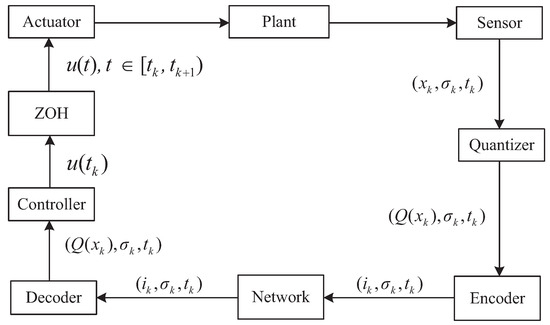
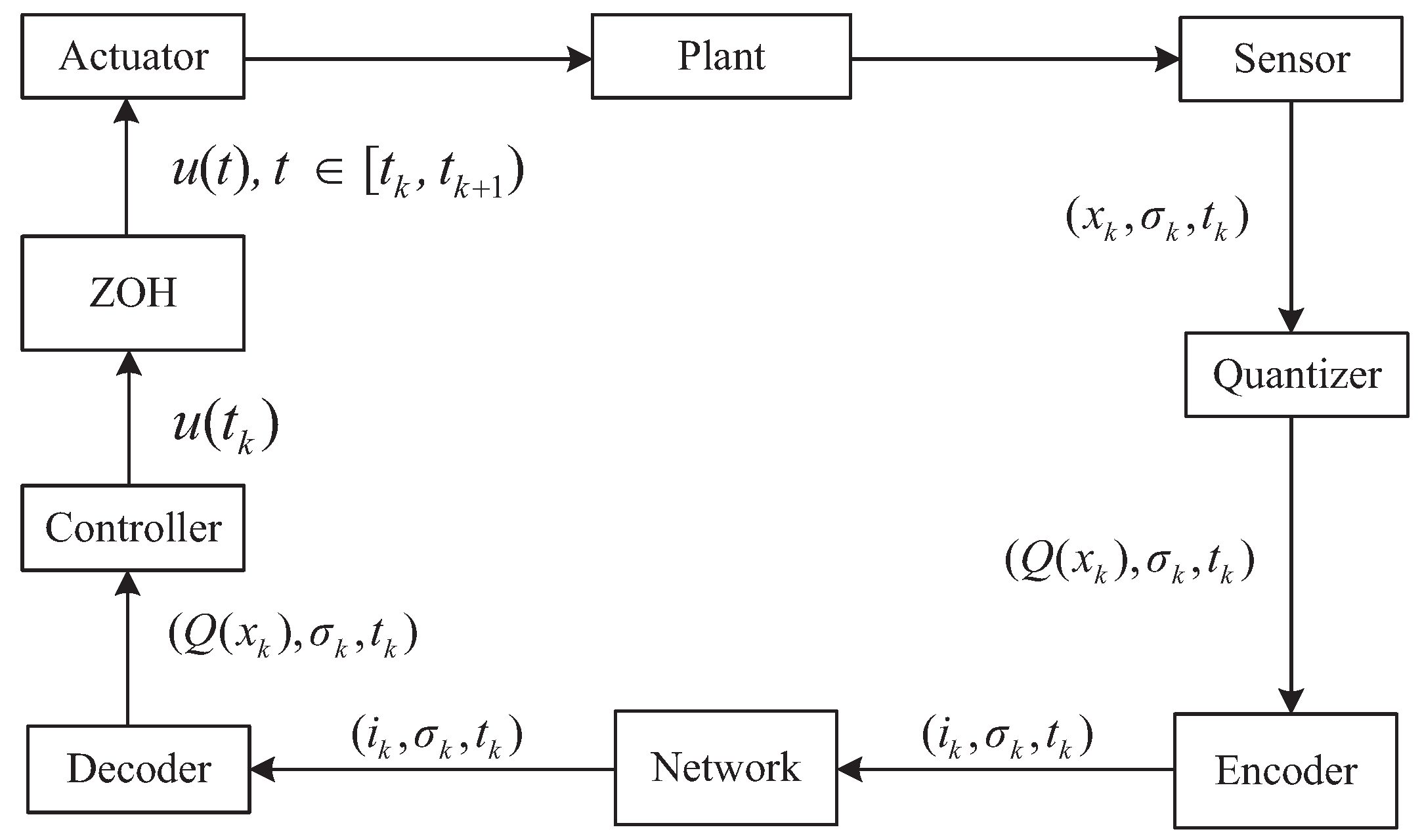
The system configuration discussed in this paper is presented in Figure 1. For a given sampling period , the sensor acquires the plant state along with the mode information at sampling times . Due to limited network bandwidth, the state is quantized as by the quantizer according to the special quantization rules (see Section 2.3). Subsequently, the encoder encodes into an integer and transmits and to the controller through the network. We assume that the network is delay-free and transmission-reliable. Then, the controller can receive the transmitted signals at under the role of the decoder and updates the control algorithm by using a zero-order holder (ZOH). Unless otherwise specified, we set .
Figure 1.
System configuration, where indicates that signals a and b are obtained at time c.
2.1. Plant Definition
The plant shown in Figure 1 is modeled by the following switched systems:
where is the system state and is the control input. The signal denotes the system mode at time t, where is a finite index set. We call discontinuities of “switching times” or “switches”. denotes the total count of switches occurring over the time interval , where . The saturation function is defined as with , where is the m-th component of u, and denotes a generic symbolic function.
Assumption 1.
The index set Π is partitioned into two subsets, and , corresponding to stabilizable and unstabilizable index sets, respectively. That is, if the system mode , there exists a feedback matrix such that is Hurwitz. Otherwise, if , there is no feedback matrix to guarantee that is Hurwitz.
Assumption 2
(slow switching [6]).
- 1.
- There exists a dwell time satisfying and .
- 2.
- For a constant , there exists an average dwell time satisfying .
2.2. Description of Stabilizable and Unstabilizable Subintervals
If we let and denote and as the intervals during which stabilizable and unstabilizable subsystems are, respectively, active, then the signal is adopted to represent the total time during which the stabilizable and unstabilizable subsystems are active in the interval . Moreover, and denote, respectively, the activation times of the stabilizable and unstabilizable subsystems in .
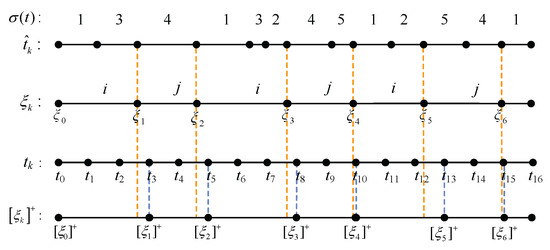
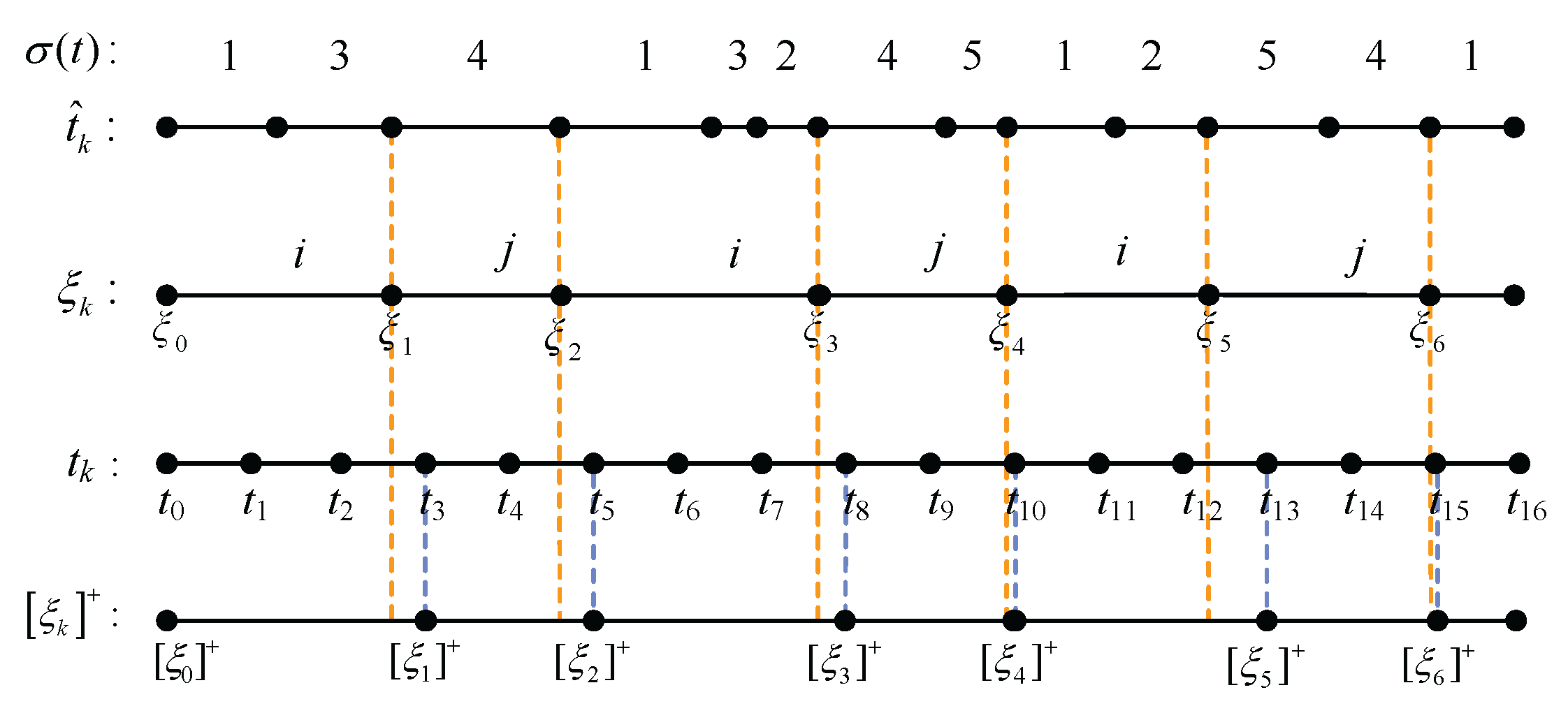
An illustration is provided in Figure 2 to aid in understanding the variables used in this paper, where modes and modes . The signal is used to establish the global bound for sampling times in Section 3. Obviously, may not necessarily be a sampling time, while and are included in the set of sampling times, i.e., .
Figure 2.
An illustration of variables used in this paper, where denotes the system mode, for any , denotes the switching instant of the system mode, is the switching instant between stabilizable subsystems and unstabilizable subsystems, is the sampling time, and is the first sampling time after .
2.3. Quantization and Control Rules
The memoryless quantizer proposed in Wakaiki et al. [33] is adopted here. Let be the finite partition of . Given an arbitrary bounded region , one can find a finite subset of an index set so that . The quantizer is formulated as follows:
Moreover, we assume that if Cl contains the origin. Obviously, a sufficiently large constant can be found such that , where ellipsoid and matrix are defined in (4) and (6), respectively.
For the quantization function defined in (2), the control input is set as
under the role of ZOH, where is the feedback matrix to be designed. Obviously, must not be Hurwitz if by Assumption 1.
The following definition and conditions are useful to establish Claim 1, which is instrumental in proving the main results and will be verified in Section 4.3.
Definition 1.
Considering a positive-definite matrix and a matrix that is designed, we respectively define an ellipsoid and a polyhedron as follows:
where denotes the lth row of the matrix G.
Condition 1.
For the given arbitrary constants and , the initial state satisfies .
Condition 2.
For the given μ and , there exists a matrix such that with .
Claim 1.
For the ellipsoid and the polyhedron defined in (4), if Conditions 1 and 2 hold, then .
Remark 1.
Since μ and are arbitrary constants, if we set μ to be sufficiently large compared to , then Condition 1 can always hold. Moreover, at the beginning of the proof of Theorem 2, we verified that if Condition 5 holds, then shown in Condition 2 is equivalent to (36). Therefore, we can obtain and by solving (36) and then obtain the matrix that guarantees Condition 2 by .
Lemma 1
([31]). For any and such that , one has
where denotes the convex hull. is a diagonal matrix with 1 or 0 elements, and .
Remark 2.
From Lemma 1, it can be seen that the difficulty in obtaining the expression (5) lies in determining how to ensure that the moduli of all elements of are less than 1, that is, . To solve this problem, we introduce Claim 1 and prove it in Section 4.3.
The following lemma obviously holds by using the properties of the static quantizer proposed in Ma et al. [31].
Lemma 2.
If , there exist positive numbers and such that the quantizer defined in (2) satisfies
for all , and , in which
and , , and with and .
2.4. Main Purpose
The purpose of this paper is to determine a switching condition (7) that guarantees that all trajectories of the switched system (5) enter a certain neighborhood around the origin and stay confined within a larger neighborhood .
If we let , the stability results of the closed-loop system can be established by discussing the following four situations:
Case 1: , and no switching occurs in .
Case 2: , and a switch occurs in .
Case 3: , and no switching occurs in .
Case 4: , and a switch occurs in .
For the positive-definite matrix and the constants and given in Claim 1, we consider the Lyapunov function to be defined as
where the piecewise continuous function satisfies and . It is obvious that . Thus, we have
In the following, we will obtain the stability results (see Theorem 1 in Section 4.2) in four steps by using the Lyapunov function defined above. First, for any , we pursue the increasing/decreasing rate of the Lyapunov function for the four cases above. On this basis, the relationship between and is established (see Lemma 3). Second, we testify that all trajectories with an initial state in fall into (see Lemma 4). Next, it will show that the trajectory stays in a slightly larger ellipsoid, i.e., , after it enters into (see Lemma 5). Finally, we obtain Theorem 1 by using Lemmas 3–5.
3. Increasing/Decreasing Rate of the Lyapunov Function
To obtain the increasing/decreasing rate of the Lyapunov function, the parameters should meet the following conditions:
Condition 3.
Condition 4.
is sufficiently large compared with such that
for a given constant with and defined in (21) and (22), respectively.
Condition 5.
The partition is dense enough such that the quantization error satisfies
for any and , where and is the lth row of matrix defined in Condition 2. Furthermore, it is assumed that is small enough and the partition is dense enough so that
holds for any , where are defined in (11), and are given in Lemma 2, and the ellipsoids and are described by (4) with ϕ given in Condition 2.
Remark 3.
For the given variables and , sampling period meeting Condition 3 always exists. Considering , for the given and Z, if is sufficiently large compared with , then the left side of (8) is small enough such that Condition 4 holds. Condition 4 limits the length of the stabilizable interval, which is reasonable. In fact, when the system is unstabilizable, it must be divergent. So, the stability of the entire system can only be guaranteed if the stabilizable interval is long enough. Regarding Condition 5, if the partition is dense enough (at the cost of occupying more bandwidth), the quantization value and the state x can be arbitrarily close, so (9) can be satisfied. Moreover, if is selected to be small enough and the partition is dense enough, then and can be set arbitrarily small which guarantees (10).
Lemma 3.
Let Assumptions 1–2 and Conditions 1–5 hold. For the given , if there exist constants and matrices , such that
hold for any , , and , then Lyapunov function (6) satisfies
for all , where , , Γ, and are defined in (23) and (25), respectively.
Proof.
If we let , one gets
due to the fact that .
Next, we will establish the upper bound of the Lyapunov function for four cases.
Case 1: In such a case, a mode exists such that . Then, the temporal derivative of meets
due to . Then, (11) gives
If , then must be true. According to Lemma 2 and (10), one has
Then, we get
Remark 4.
In order to ensure (16) with , the Lyapunov function must monotonically decrease in the optimal case (that is, Case 1). To achieve this goal, we ensure that (10) holds by limiting the sampling interval and the density of the quantization partition, thus obtaining inequality (18), which guarantees the monotonic decreasing property.
Case 2: Let , , and the switching instant over the interval be denoted by . Based on the analysis of Case 1, it follows that . If , we have
by considering (12). Let
This implies that . Therefore, one gets
Case 3: Let . By analogy with the analysis in Case 2, it follows that by using (13), where
Thus, it yields .
Case 4: Let , , and the switching instant in be denoted by . It is obvious that by (14), where
This induces
due to .
and are denoted, and by considering (17), we now derive the upper bound of based on (18)–(20).
(1) Stabilizable subintervals: The below analysis focuses on the increasing/decreasing rate of the Lyapunov function from to represented by . If we recall that , then (18) and (19) yield
with and . According to Condition 3, one has .
(2) Unstabilizable subintervals: is defined as the increasing/decreasing rate of the Lyapunov function between and . Similar to the analysis of (21), we can easily get
by using , where and .
(3) Combined bound at sampling times: If lies within a stabilizable subinterval, i.e., for some , we can obtain that
by recalling and , where . If Condition 4 holds, one gets
due to and .
Otherwise, if lies within an unstabilizable subinterval, i.e. for some , we have
by recalling .
Summarized above, it is obvious that
always holds. If we let and , one has
for all . The lemma is proved. □
4. Stability Analysis
4.1. State Trajectory Analysis
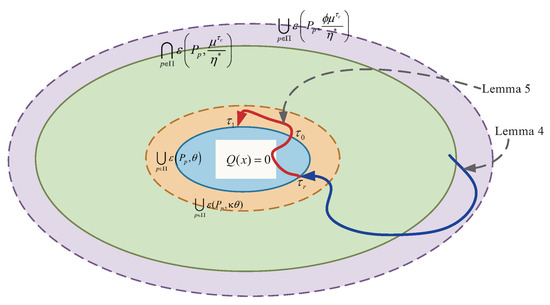
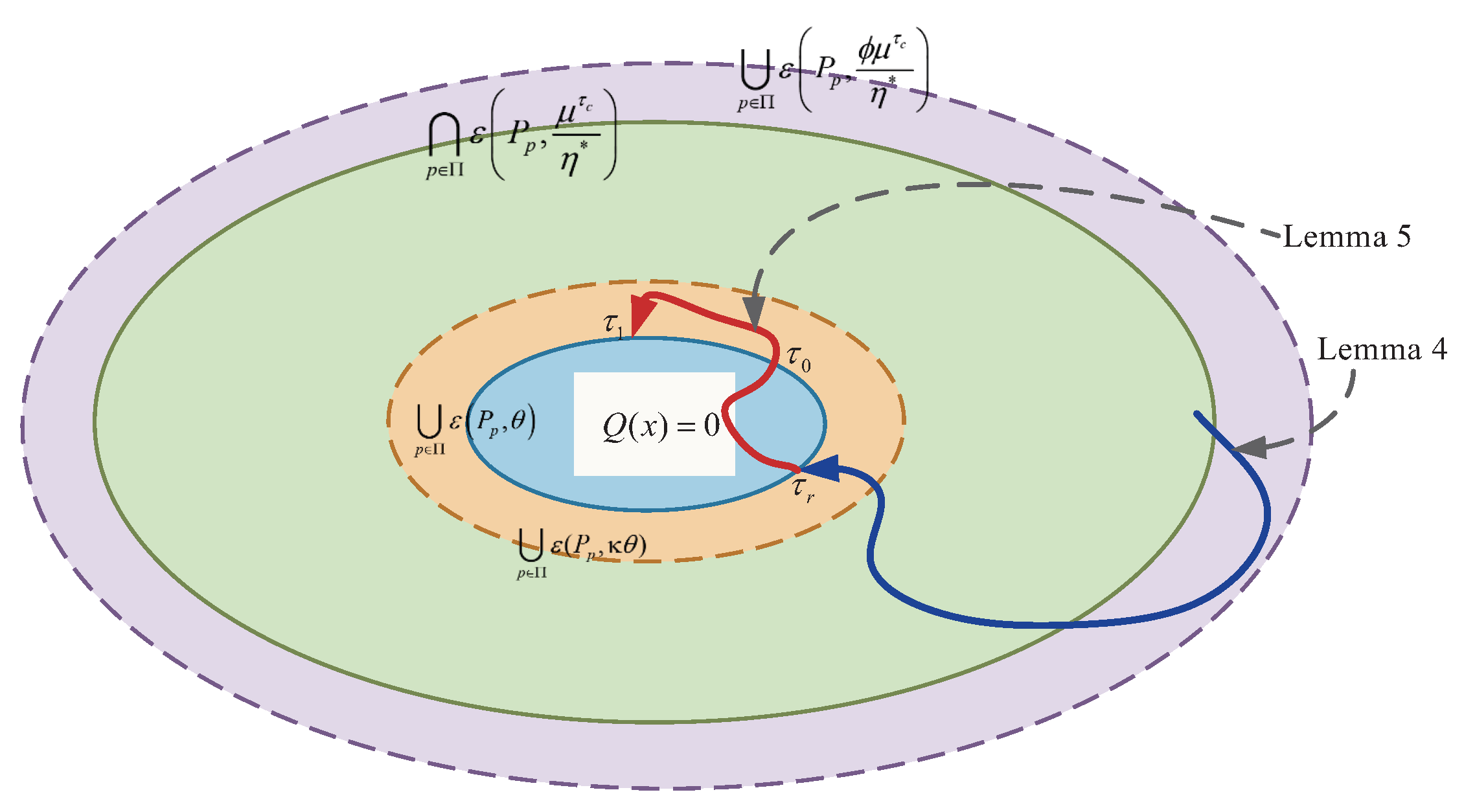
First, we analyze the state behavior outside of . The following lemma demonstrates that every trajectory with an initial state satisfying Condition 1 will never leave a larger intersection and fall into at a finite time (see Figure 3). In such a figure, , and are not necessarily ellipses, and is not necessarily a rectangle. Such a drawing is just for ease of understanding.
Figure 3.
Behavior of state trajectory.
Remark 5.
Under the influence of multiple factors (quantization, saturation, sampling, and unstabilizable subsystems), it is particularly important to define the attraction domain and the invariant set reasonably to analyze the evolution trend in the state trajectory. This paper defines an attractor domain and an invariant set based on the intersection and union of ellipses, respectively, which lays the foundation for system stability analysis.
Lemma 4.
If we let Assumptions 1–2 and Conditions 1–5 hold, one can find a finite time such that for any . Moreover, it holds that .
Proof.
Suppose that there exists a time instant such that , and furthermore
This means that for any . If we recall that , one gets .
However, due to
by considering Condition 1, (16) tells us that
Then, we have a contradiction. Hence, holds for any .
Now, let us prove . Assuming that , one has
According to Lemma 3, (16) always holds for all . Hence, . If we recall that , it yields . However, this contradicts , i.e., , which results in
Thus, one can find such that . This concludes the proof. □
The following lemma demonstrates that the state trajectory remains within an ellipsoid slightly larger than after it enters into (see Figure 3).
Lemma 5.
Let Assumptions 1–2 and Conditions 1–2 hold. Assume that
satisfies . If we suppose that denotes a time instant at which exits , then there exists such that , and moreover, for any .
Proof.
If trajectory leaves at time , it is obvious that belongs to Cases 2, 3, or 4. Hence, holds with defined in (25). Combined with (16), this yields
for any satisfying and , .
Considering that yields , one has by recalling that . Combined with (28), this induces
indicating that
This implies that Similar to the analysis of Lemma 4, it must be a time such that , which completes the proof. □
4.2. Main Results
Theorem 1.
Provided that Assumptions 1–2 and Conditions 1–5 are fulfilled, for the constants Γ and given in (23) and (25), respectively, if in (27) satisfies , then one can find a finite time ensuring that , and furthermore, , with .
Proof.
First, Lemma 4 guarantees that
Second, Lemma 4 also induces that there is finite time such that . If , it is obvious that holds due to . Otherwise, if there exists a such that leaves , then Lemma 5 guarantees the existence of satisfying and . Therefore, no matter how many times the state escapes from the ellipse , we can always get . Then, Theorem 1 is established. □
4.3. Establishment of Claim 1
Based on Theorem 1, if Assumptions 1–2, Conditions 1–2, and hold, one has
by using Condition 2. But this does not mean that . Next, we will verify that Claim 1, i.e., , holds for two cases.
If , by Theorem 1, one has
Otherwise, if , then (24) yields . Due to and given in (26), it is obvious that
Hence, implies that , i.e., . If we recall Condition 2, one has
By summarizing (29) and (30), the claim is established.
5. Controller Design
The design method of the controller (3) is formulated in the following theorem.
Theorem 2.
Proof.
, , and are defined. Pre-multiplying and post-multiplying (31) and (32) by yield (11) and (12), respectively. Similarly, pre-multiplying and post-multiplying (33) and (34) by imply that (13) and (14) hold, respectively. Moreover, by using Schur complement, (35) is obviously equal to (15).
Next, the Lagrangian method is used to verify if Condition 5 holds; then, shown in Condition 2 is equivalent to (36).
It should be noted that if and only if all the hyperplanes lie completely outside of the ellipsoid
For any , i.e., at each point x on the hyperplanes , we have . Hence, is equivalent to
The solution of can be regarded as a quadratic programming problem:
where . The Lagrangian function is defined as . If we let and , then we have
The above equations in matrix block form can be rewritten as follows:
We get the solution of as
where
Then, it is obvious that
and thus, . Hence, (37) is equal to
Assuming that a constant exists, satisfying and , then (38) is obviously guaranteed. On the one hand, can be obtained by Condition 5. Furthermore, according to Schur complement, (36) can be rewritten as , which is obviously equal to . Therefore, if Condition 5 and (36) hold, then can be guaranteed, which completes the proof. □
6. Optimizing the Domain of Attraction
If the solutions of Theorem 2 exist, we subsequently discuss the amplification of the attraction domain . In fact, such a problem can be transformed into the constrained optimization problems: minimizing z satisfies the inequalities . If we recall that , then can be rewritten as
by using Schur complement. Hence, the optimization problem of the attractive region is given by
7. Simulation
The effectiveness of the proposed control strategy is validated by using a borrowed two-tank system, which can be modeled as system (1) with and [33]. To analyze the effect of unstabilizable subsystems on closed-loop system performance, we set and . Obviously, subsystems 1 and 2 belong to and , respectively.
For any , the static quantizer is defined as with
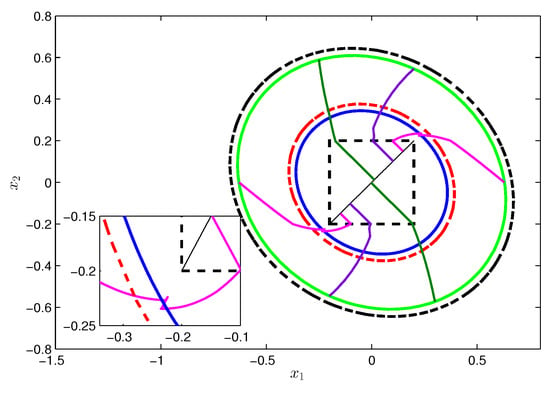
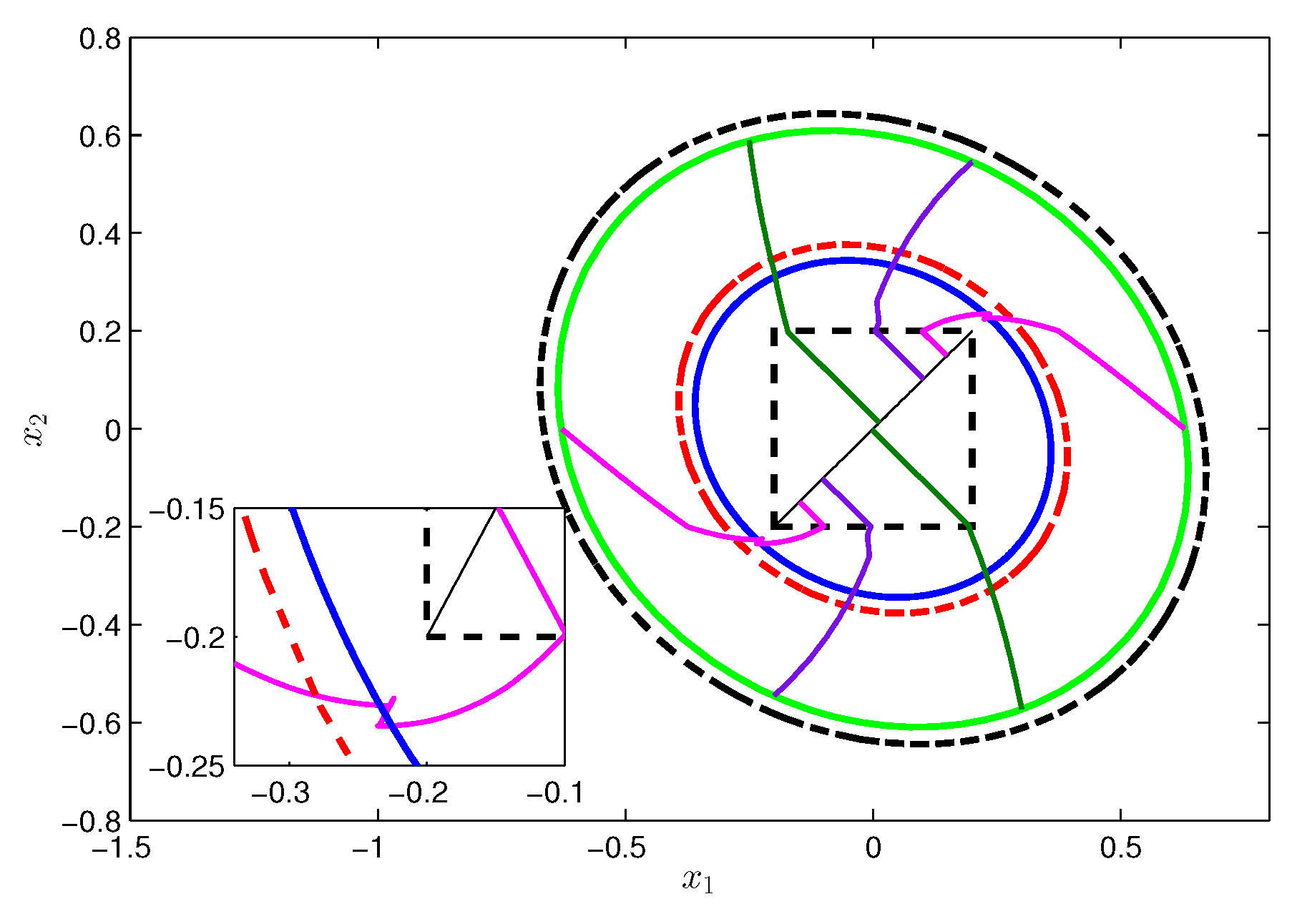
where and . Obviously, the area is a square with the origin as the center and 0.4 as the side length, shown as the dotted square in Figure 4.
Figure 4.
State trajectories of two-tank system when .
The variable design procedure is summarized as follows:
Step 1: Let , z defined in (39) as , and the variables in Lemma 3 as and .
Step 2: By solving the LMIs (31)–(35) and (39) by using matlab’s LMI toolbox, we get , . Then, we can easily get
Step 3: By a simple calculation, one knows that , and thus, , which guarantees the establishment of (10). Similarly, we can get and , yielding . Moreover, and hold. Assuming that and , it is easy to see that , and , and thus, .
Step 4: To ensure (36), we need to pursue a suitable . For the quantizer defined in (40), it is not hard to see that . Then, in (9) can be chosen as . If we let , we have , and thus, (36) holds.
Step 5: If we let , by using the values of and , then the ellipses (blue solid line), (red dotted line), (green solid line), and (black dotted line) are shown in Figure 4.
Step 6: We set to meet Condition 4. For the initial states located at with , the state trajectories of the closed-loop two-tank system are shown as colored polylines in Figure 4.
Analysis: From Figure 4, it can be observed that (1) , if satisfies Condition 1 and that (2) one can find a finite time satisfying . Then, Theorem 1 is testified. Moreover, from the subfigure in Figure 4, we know that the state trajectories will never leave a slightly larger intersection rather than upon entering .
Since and when the control input , the state trajectories will eventually approach the dotted line instead of the origin once they reach the region , in which , and thus, .
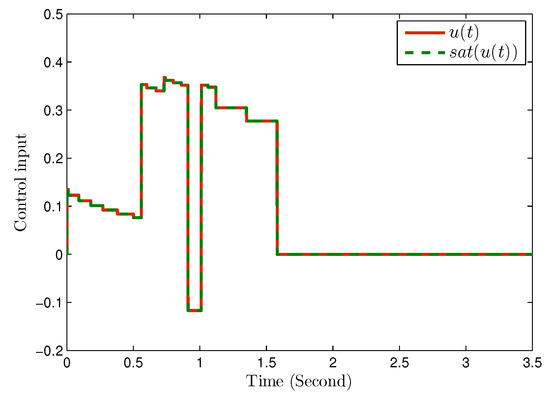
Step 7: Figure 5 presents the control input and the saturated control input. Obviously, saturation has no influence on the value of control input under the above variables, i.e., .
Figure 5.
Control input and saturated control input when .
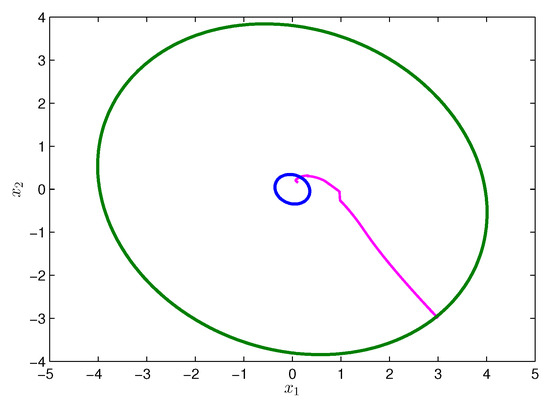
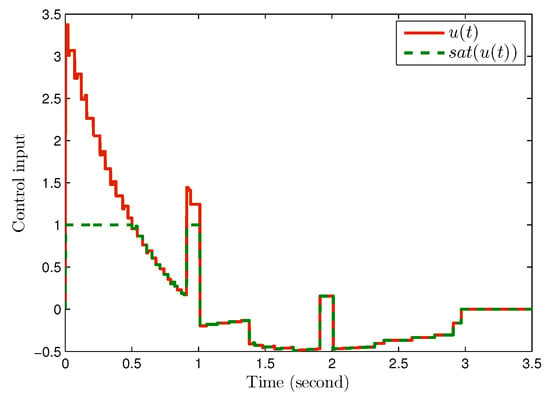
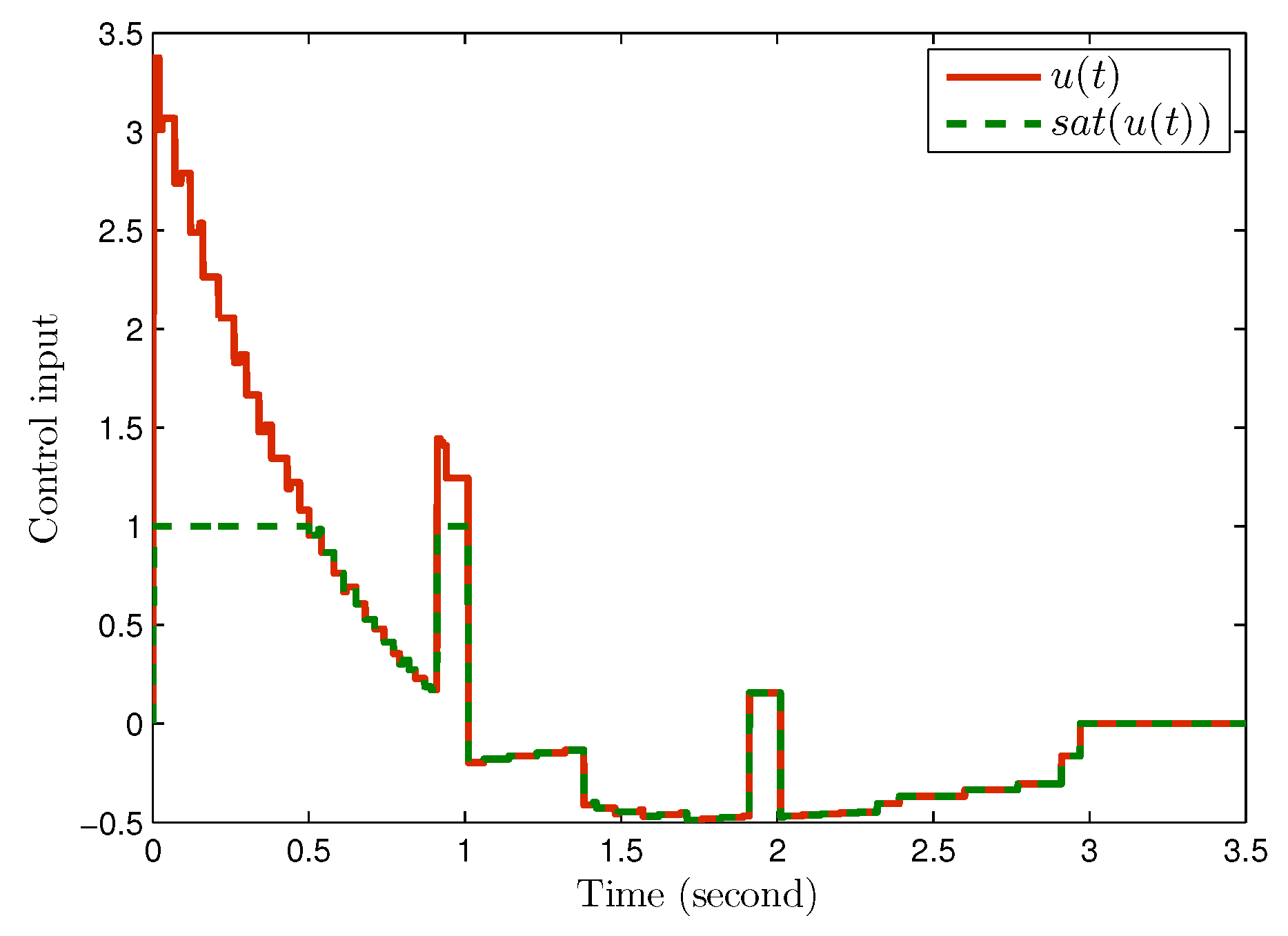
Step 8: To demonstrate the effect of saturation, for the initial state located at with , the state trajectory of the closed-loop two-tank system is shown as a pink polyline in Figure 6, in which the ellipses are denoted by the blue solid line and is denoted by the green solid line. The corresponding control input and the saturated control input are shown in Figure 7. We can see that under the influence of saturation (i.e. ), the closed-loop system is still stable.
Figure 6.
State trajectory of a two-tank system when .
Figure 7.
Control input and saturated control input when .
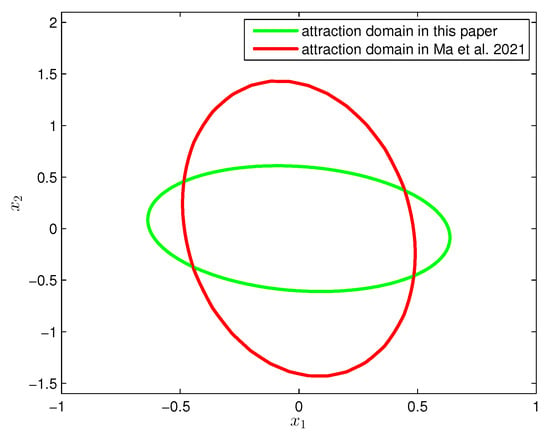
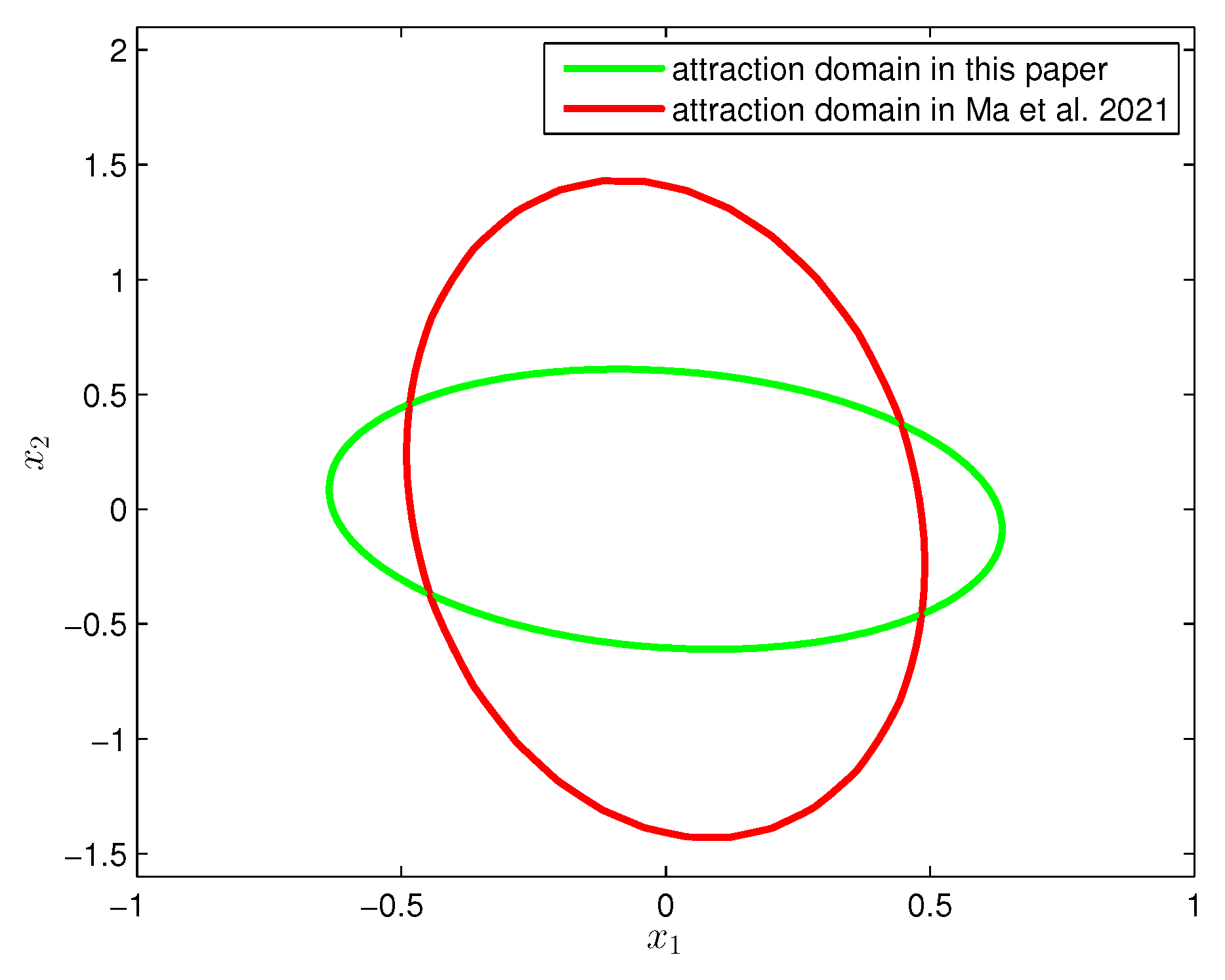
Comparison: To compare the results obtained in Ma et al. [31], the attraction domain obtained in our paper (green solid ellipse) and that (red dotted ellipse) obtained in Ma et al. [31] are given in Figure 8. From such a figure, we can see that the attraction domain obtained in this paper is smaller than the one in Ma et al. [31] due to the extra effects of sampling and data quantization. However, compared to the continuous data transmission adopted in Ma et al. [31], sampling can significantly reduce the volume of data transmission. In addition, the introduction of data quantization ensures that the algorithm proposed here can be used in the networked switched systems. It is worth mentioning that the domain attraction in this paper is not much smaller than the one in Ma et al. [31] due to the suitable design of quantization rules and in the Lyapunov function.
Figure 8.
Comparing the attraction domains of this paper and Ma et al. [31].
8. Conclusions
The stabilization problem of the switched systems with partly unstabilizable subsystems with actuator saturation and data quantization was discussed in this paper. First, the saturated controller was rewritten as a linear combination of a sampling quantized feedback controller by setting a claim. Second, the increasing/decreasing rate of the Lyapunov function was obtained for different cases. On this basis, the sufficient conditions ensuring the stability of the closed-loop system were obtained, and the feedback matrices were designed by using the LMI method. Third, the predefined claim was established. Finally, the optimization problem for attractive regions was studied.
Future work may involve the joint design of controller and switching law to obtain better system performance. Some other network-induced factors, such as event-triggered transmission, packet loss, and time delay may be discussed. Moreover, given the underdeveloped experimental conditions, we were not able to experimentally verify the theoretical results obtained. We will strive to build relevant experimental platforms in the future and further conduct experimental verification on the basis of simulation.
Author Contributions
Conceptualization, J.Y.; methodology, J.Y.; writing—original draft preparation, Y.G.; writing—review and editing, S.S.; software, Y.Z. All authors have read and agreed to the published version of the manuscript.
Funding
This research was funded by the Henan University Science and Technology Innovation Talent Support Program (24HASTIT039), the National Natural Science Foundation of China (62441305 and 61773154), and the National Natural Science Foundation of China Cultivation Project (31490146).
Data Availability Statement
The original contributions presented in this study are included in the article.
Conflicts of Interest
The authors declare no conflicts of interest.
References
- Liu, S.; Russo, A.; Liberzon, D.; Cavallo, A. Integral-input-to-state stability of switched nonlinear systems under slow switching. IEEE Trans. Autom. Control 2021, 67, 5841–5855. [Google Scholar] [CrossRef] [Scilit]
- Taousser, F.Z.; Djouadi, S.M.; Tomsovic, K. A dwell time approach for the stabilization of mixed continuous/discrete switched systems. Automatica 2022, 142, 110386. [Google Scholar] [CrossRef] [Scilit]
- Cao, L.; Feng, G.; Cheng, X. Configuration of smart phase-swapping switches in low-voltage distribution systems based on sequenced participation indices. Meas. Control 2020, 53, 1159–1170. [Google Scholar] [CrossRef] [Scilit]
- Liu, S.; Pang, H.; Li, C. Incremental passivity-based H∞ output tracking control for switched nonlinear systems. Trans. Inst. Meas. Control 2019, 41, 3600–3611. [Google Scholar] [CrossRef] [Scilit]
- Li, Y.; Jia, L.; Ji, Y.; Li, R. Event-triggered guaranteed cost control of time-varying delayed fuzzy systems with limited communication. Meas. Control 2020, 53, 2129–2136. [Google Scholar] [CrossRef] [Scilit]
- An, S.; Ma, R.; Fu, J. Dwell-time-based control synthesis of switched positive systems with all unstabilizable subsystems. Int. J. Robust Nonlinear Control 2022, 32, 2420–2441. [Google Scholar] [CrossRef] [Scilit]
- Li, S.; Wu, Y.; Xiang, Z. Sampled-data stabilization for switched nonlinear systems under state-dependent switching signal. Int. J. Robust Nonlinear Control 2022, 32, 3788–3800. [Google Scholar] [CrossRef] [Scilit]
- Wang, R.; Hou, L.; Zong, G.; Fei, S.; Yang, D. Stability and stabilization of continuous-time switched systems: A multiple discontinuous convex Lyapunov function approach. Int. J. Robust Nonlinear Control 2019, 29, 1499–1514. [Google Scholar] [CrossRef] [Scilit]
- Yan, J.; Xia, Y.; Wang, X.; Feng, X. Quantized stabilization of switched systems with partly unstabilizable subsystems and denial-of-service attacks. Int. J. Robust Nonlinear Control 2022, 32, 4574–4593. [Google Scholar] [CrossRef] [Scilit]
- Li, P.; Sun, X.; Zhao, X. Stabilization of linear systems with input saturation and large delay. IEEE Trans. Syst. Man Cybern.-Syst. 2018, 50, 4482–4491. [Google Scholar] [CrossRef] [Scilit]
- Ahmadzadeh, H.R.; Shafiee, M. Event-triggered output quantized H∞ control for uncertain switched singular systems. IEEE Trans. Circuits Syst. II-Express Briefs 2023, 70, 3484–3488. [Google Scholar] [CrossRef] [Scilit]
- Parivallal, A.; Sakthivel, R.; Alzahrani, F.; Leelamani, A. Quantized guaranteed cost memory consensus for nonlinear multi-agent systems with switching topology and actuator faults. Phys. A 2020, 539, 122946. [Google Scholar] [CrossRef] [Scilit]
- Qi, W.; Yang, X.; Park, J.H.; Cao, J.; Cheng, J. Fuzzy SMC for quantized nonlinear stochastic switching systems with Semi-Markovian process and application. IEEE T. Cybern. 2021, 52, 9316–9325. [Google Scholar] [CrossRef] [Scilit]
- Qi, Y.; Tang, Y.; Ke, Z.; Liu, Y.; Xu, X.; Yuan, S. Dual-terminal decentralized event-triggered control for switched systems with cyber attacks and quantization. ISA Trans. 2020, 110, 15–27. [Google Scholar] [CrossRef] [Scilit]
- Zhao, R.; Zuo, Z.; Wang, Y. Event-Triggered control for networked switched systems with quantization. IEEE Trans. Syst. Man Cybern.-Syst. 2021, 52, 6120–6128. [Google Scholar] [CrossRef] [Scilit]
- Ahmadzadeh, H.R.; Shafiee, M. Event-triggered variable structure control of nonlinear switched descriptor systems subjected to matched/mismatched disturbances. Iran. J. Sci. Technol.-Trans. Electr. Eng. 2024, 48, 1711–1727. [Google Scholar] [CrossRef] [Scilit]
- Chen, L.; Zhu, Y.; Ahn, C.K. Adaptive neural network-based observer design for switched systems with quantized measurements. IEEE Trans. Neural Netw. Learn. Syst. 2021, 34, 5897–5910. [Google Scholar] [CrossRef] [Scilit]
- Cheng, J.; Wang, Y.; Park, J.H.; Cao, J.; Shi, K. Static output feedback quantized control for fuzzy Markovian switching singularly perturbed systems with deception attacks. IEEE Trans. Fuzzy Syst. 2021, 30, 1036–1047. [Google Scholar] [CrossRef] [Scilit]
- Zou, Y.; Su, H.; Tang, R.; Yang, X. Finite-time bipartite synchronization of switched competitive neural networks with time delay via quantized control. ISA Trans. 2021, 125, 156–165. [Google Scholar] [CrossRef] [Scilit]
- Cheng, J.; Wu, Y.; Wu, Z.; Yan, H. Nonstationary filtering for fuzzy Markov switching affine systems with quantization effects and deception attacks. IEEE Trans. Syst. Man Cybern.-Syst. 2022, 52, 6545–6554. [Google Scholar] [CrossRef] [Scilit]
- Cheng, J.; Huang, W.; Park, J.H.; Cao, J. A hierarchical structure approach to finite-time filter design for fuzzy Markov switching systems with deception attacks. IEEE T. Cybern. 2021, 52, 7254–7264. [Google Scholar] [CrossRef] [Scilit]
- Zhao, L.; Li, Z.; Li, H.; Liu, B. Backstepping integral sliding mode control for pneumatic manipulators via adaptive extended state observers. ISA Trans. 2024, 144, 374–384. [Google Scholar] [CrossRef] [Scilit]
- Maity, D.; Tsiotras, P. Optimal controller synthesis and dynamic quantizer switching for linear-quadratic-gaussian systems. IEEE Trans. Autom. Control 2021, 67, 382–389. [Google Scholar] [CrossRef] [Scilit]
- Yan, J.; Xia, Y.; Wang, X.; Li, L. Quantized stabilization of continuous-time switched systems with delay and disturbance. IEEE Trans. Syst. Man Cybern.-Syst. 2022, 52, 4530–4543. [Google Scholar] [CrossRef] [Scilit]
- Chen, G.; Xia, J.; Park, J.H.; Shen, H.; Zhuang, G. Robust sampled-data control for switched complex dynamical networks with actuators saturation. IEEE T. Cybern. 2021, 52, 10909–10923. [Google Scholar] [CrossRef] [Scilit]
- Zhao, N.; Shi, P.; Xing, W. Agarwal RK. Resilient event-triggered control for networked cascade control systems under denial-of-service attacks and actuator saturation. IEEE Syst. J. 2021, 16, 1114–1122. [Google Scholar] [CrossRef] [Scilit]
- Ahmadzadeh, H.R.; Aghaei, S.; Puig, V. A supervisory control scheme for uncertain constrained time-delay discrete-time linear systems. J. Frankl. Inst. 2023, 360, 10337–10364. [Google Scholar] [CrossRef] [Scilit]
- Kumar, A.R.; Ramadge, P.J. DiffLoop: Tuning PID controllers by differentiating through the feedback loop. In Proceedings of the 55th Annual Conference on Information Sciences and Systems, Baltimore, MD, USA, 24–26 March 2021. [Google Scholar]
- Wang, Q.; Lin, Q.; Yang, Y. Continuous dynamic gain scheduling control for input-saturated switched systems. Int. J. Syst. Sci. 2022, 53, 40–53. [Google Scholar] [CrossRef] [Scilit]
- Yin, Y.; Wang, F.; Liu, Z.; Chen, Z. Fault-tolerant consensus for switched multiagent systems with input saturation. Int. J. Robust Nonlinear Control 2021, 31, 5047–5068. [Google Scholar] [CrossRef] [Scilit]
- Ma, R.; Zhang, H.; Zhao, S. Exponential stabilization of switched linear systems subject to actuator saturation with stabilizable and unstabilizable subsystems. J. Frankl. Inst. 2021, 358, 268–295. [Google Scholar] [CrossRef] [Scilit]
- Wu, T.; Yang, Y.; Li, S.; Yu, Z. Command-filter-based adaptive output feedback quantized tracking control for switched stochastic nonlinear time-delay systems with actuator saturation. Int. J. Robust Nonlinear Control 2022, 32, 6866–6887. [Google Scholar] [CrossRef] [Scilit]
- Wakaiki, M.; Yamamoto, Y. Stability analysis of sampled-data switched systems with quantization. Automatica 2016, 69, 157–168. [Google Scholar] [CrossRef] [Scilit]

Disclaimer/Publisher’s Note: The statements, opinions and data contained in all publications are solely those of the individual author(s) and contributor(s) and not of MDPI and/or the editor(s). MDPI and/or the editor(s) disclaim responsibility for any injury to people or property resulting from any ideas, methods, instructions or products referred to in the content. |
© 2025 by the authors. Licensee MDPI, Basel, Switzerland. This article is an open access article distributed under the terms and conditions of the Creative Commons Attribution (CC BY) license (https://creativecommons.org/licenses/by/4.0/).