
Abstract
In this paper, the generalized Jacobi elliptic functions expansion method with computerized symbolic computation are employed to investigate explicitly analytic solutions of the (N + 1)-dimensional generalized Boussinesq equation. The exact solutions to the equation are constructed analytically under certain circumstances, some of these solutions are degenerated to soliton-like solutions and trigonometric function solutions in the limit cases when the modulus of the Jacobi elliptic function solutions tends to 0 and 1, which shows that the applied method is more powerful and will be used in further works to establish more entirely new exact solutions for other kinds of higher-dimensional nonlinear partial differential equations in mathematical physics.
1. Introduction
In recent years, due to the wide applications of soliton theory in natural science, searching for exact soliton solutions of nonlinear evolution equations plays an important and significant role in the study on the dynamics of those phenomena [1,2]. Particularly, various powerful methods have been presented, such as inverse scattering transformation, Cole-Hopf transformation, sinecosine method, Painlevé method, Lie group analysis, similarity reduced method, Hirota bilinear method, homogeneous balance method, Bäcklund transformation, Darboux transformation, the extended tanh-function method, the extended F-expansion method, projective Riccati equations method, the Jacobi elliptic function expansion method and so on. In this paper, we would like to discuss an (N + 1)-dimensional generalized Boussinesq equation by our generalized Jacobi elliptic functions expansion method [3] proposed recently. As a result, more new exact solutions are obtained. The character feature of our method is that, without much extra effort, we can get series of exact solutions using a uniform way. Another advantage of our method is that it also applies to general higher-dimensional nonlinear partial differential equations.
2. Summary of the Generalized Jacobi Elliptic Functions Expansion Method
For a given partial differential equation in N + 1 variables x,t and yj (j = 1,…,N − 1)
We seek the following formal solutions of the given system by a new intermediate transfoumation:
Where A0, Ai, Bi, Ci, Di, (i = 1,2,…,k) are time-dependent functions to be determined later. are arbitary functions with the variables x,t and yj (j = 1,…,N − 1). The parameter k can be determined by balancing the highest order derivative terms with the nonlinear terms in Equation (2). And are an arbitrary array of the four functions and , the selection obey the principle which makes the calculation more simple. Here we ansatz
where p, q, r, l are arbitrary constants, the four function e, f, g, h satisfy the following restricted relation:
where “′” denotes is the modulus of the Jacobi elliptic function(0 ≤ m ≤ 1), and e, f, g, h satisfy one of the following relation at the same time.
Family 1: when p = 0, we can select or , using the following iterative restrictions
Family 2: when q = 0, we can select or , using the following iterative restrictions
Family 3: when r = 0, we can select or , using the following iterative restrictions
Family 4: when l = 0, we can select or , using the following iterative restrictions
Substituting (4) along with (5a–5d) into Equation (1) separately yields four families of polynomial equations for . Setting the coefficients of to zero yields a set of over-determined differential equations(ODEs) in (i = 1,2,…,k) and ξ, solving the ODEs by Mathematica and Wu elimination, we can obtain many exact solutions of Equation (1) accroding to (2)–(3) and (5a)–(5d).
3. Exact Solutions of the Equation
Let us consider the following (N + 1)-dimensional generalized Boussinesq equation
where , is a real number and N > 1 is an integer. The semi-travelling wave similarity transformation was used in [4] to investigate Equation (6) with α = β = γ = 1 and acquired many types of its exact solutions. The auxiliary differential equation approach is employed in [5] to investigate some new exact solutions of Equation (6) under the same circumstance. Equation (6) includes a class of (1 + 1)-dimensional and (2 + 1)-dimensional modified Boussinesq equations.
In fact, if one takes β = γ = λ = 1, α = 0, n = 2, Equation (6) represents the well-known Boussinesq equation [6]
which describes the propagation of long waves on the surface of water with a small amplitude and plays an important role in fluid mechanics [7].
In fact, if one takes β = γ = λ = 1, α = 0, n = 3, Equation (6) represents the modified Boussinesq equation
which can be regarded as the continuous limit of a FPU dynamical system with cubic nonlinearity [8] and some similarity reductions of (8) were obtained [9].
If one takes β = γ = λ = 1, α = 1, n = 2, N = 2, Equation (6) represents the classical (2 + 1)-dimensional Boussinesq equation [10,11]
El-Sayed and Kaya [12] considered the approximate solution of Equation (9) with initial value. If one takes λ = 8, α = β = γ = 1, n = 3, N = 2, Equation (6) represents (2 + 1)-dimensional generalized Boussinesq equation
Matsukawa and Watanabe [13] used the bilinear method to obtained several N-soliton solutions of Equation (10). Some other research about Equation (6) can be seen in [14,15,16,17,18]. In the following, we construct exact solutions of Equation (6).
Making the gauge transformation
where are constants to be determined later
We have
Integrating (12) about ξ and ignoring the constant of integration give rise to
Using transformation yield
where .
By balancing the term and in (14), we obtain N = 2, thus we assume that the solutions of Equation (14) is expressed in the form
where are constants to be determined later and e, f, g, h satisfy (4) and (5a–5d) .
Substituting (4) and (5a–5d) separately along with (11) into (14) and setting the coefficients of to zero yields an ODEs with respect to the unknowns . After solving the ODEs by Mathematica and Wu elimination we could determine the following solutions:
State 1 n = 2
Case 1
Case 2
Case 3
Case 4
Case 5
Case 6
Case 7
Case 8
Case 9
Case 10
Case 11
Case 12
Case 13
Case 14
where c ≠ 0, τ ≠ 0, lj are arbitrary constants in Case 1–Case 14. ci, dj don’t mention in all above cases is zero. So do the following situations. Therefore, from (3), (11), (15), Cases 1–14 and , we obtain the Jacobi elliptic wave-like solutions to Equation (6):
Remark 1:
If we let , is equivalent to the solution given in [5]. If we select the corresponding parameter, we can get the solutions from to given in [5]. Solutions are degenerated to soliton-like solutions when the modulus m → 1, and solutions are degenerated to trigonometric functions solutions when the modulus m → 0.
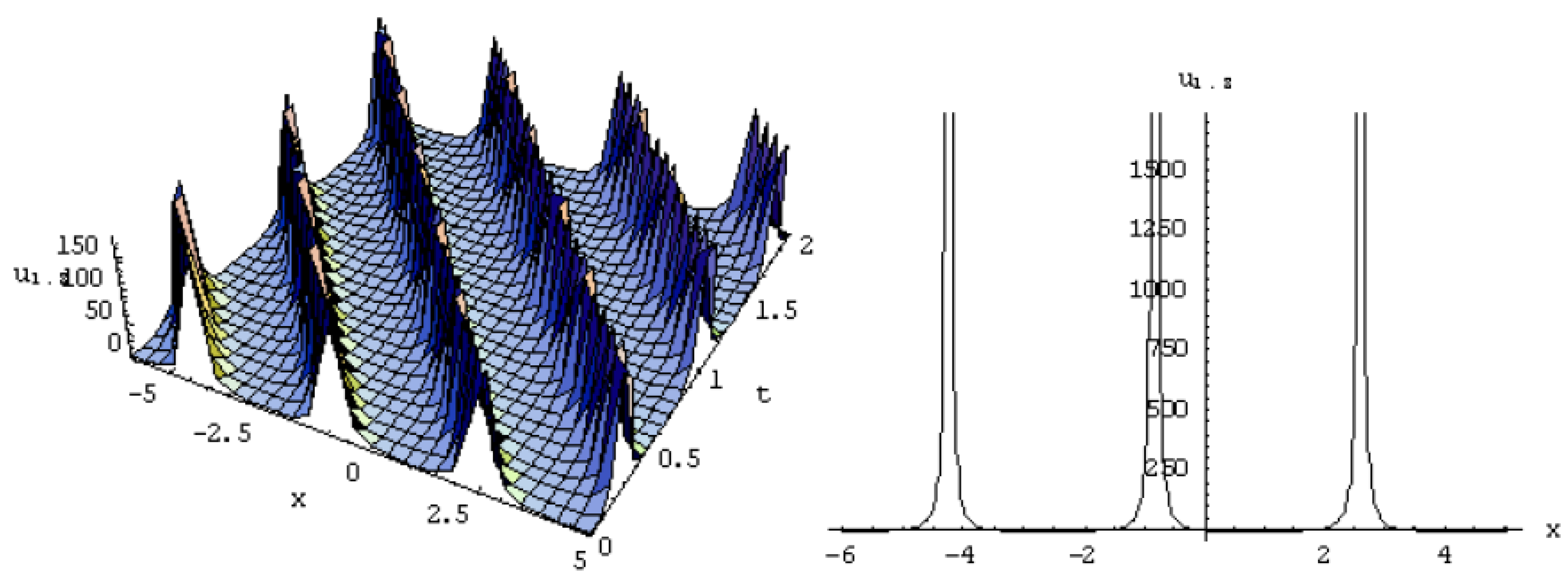
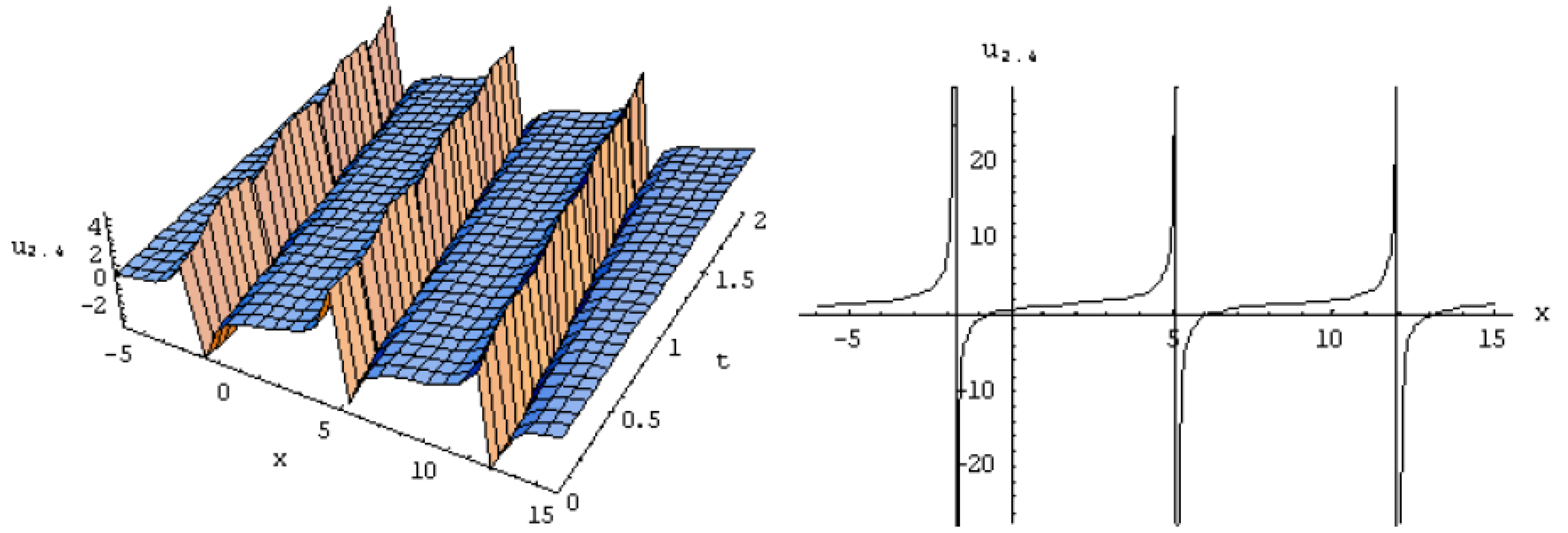
Here, provides us with a compound Jacobi wave solution whose structure are shown in Figure 1. The typical structure of new Jacobi elliptic wave-like solution is shown in Figure 2.
Figure 1.
Solution when and t = 0.
Figure 2.
Solution when and t = 0.
State 2 n = 3
Case 1
Case 2
Case 3
Case 4
Case 5
Case 6
Therefore from (3), (11), (15), Cases 1–6 and , we obtain the Jacobi elliptic wave-like solutions to Equation (6):
Remark 2:
If we let , is equivalent to the solution given in [5]. If we let , is equivalent to the solution given in [5]. If we select the corresponding parameter, we can get the solutions from to given in [5]. Solutions are degenerated to soliton-like solutions when the modulus m → 1, and solutions are degenerated to trigonometric functions solutions when the modulus m → 0.
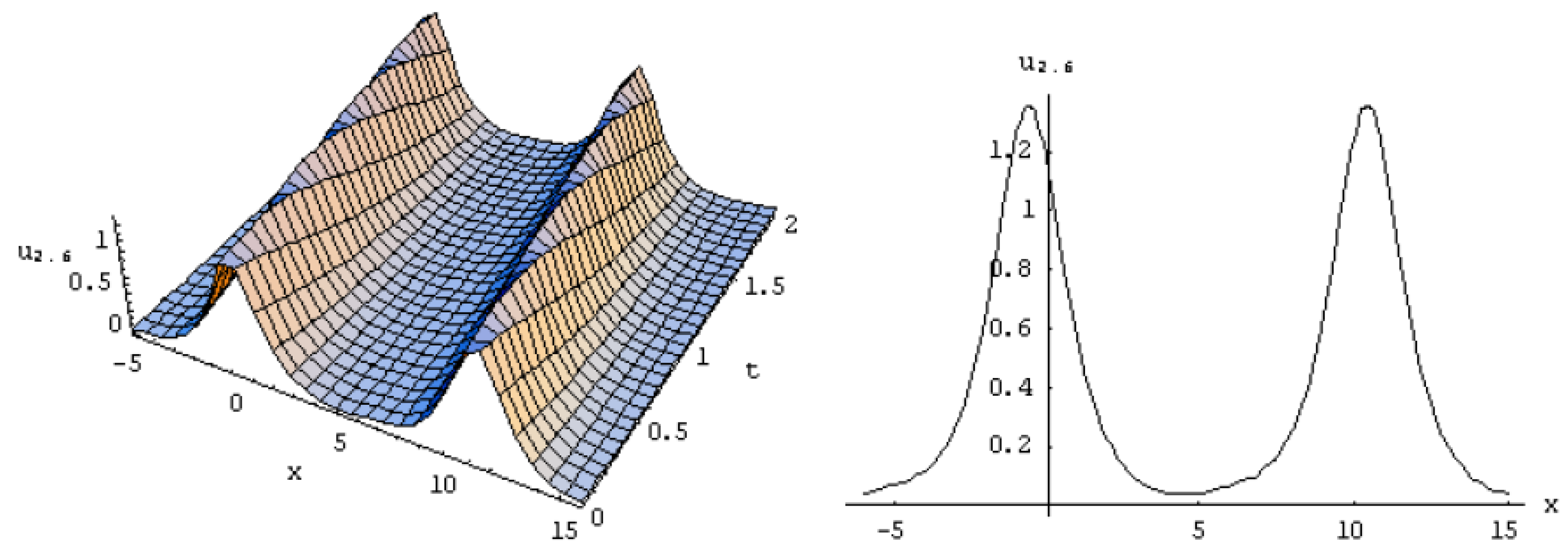
Figure 3.
Solution when and t = 0.
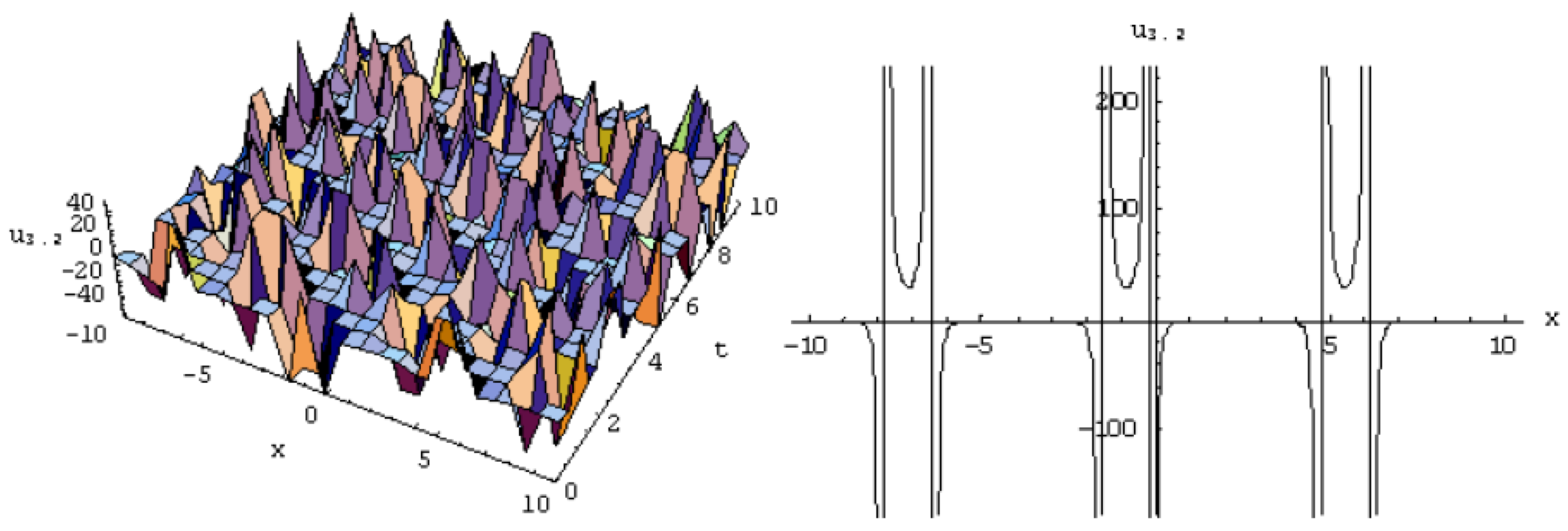
Figure 4.
Solution when and t = 0.
State 3 n > 3
Case 1
Case 2
Case 3
Case 4
Therefore from (3), (11), (15), Cases 1–4 and , we obtain the following soliton-like and trigonometric function solutions for Equation (6) are expressed by
where
Remark 3:
All the solutions obtained in this paper for Equation (6) have been checked by Mathematica software.
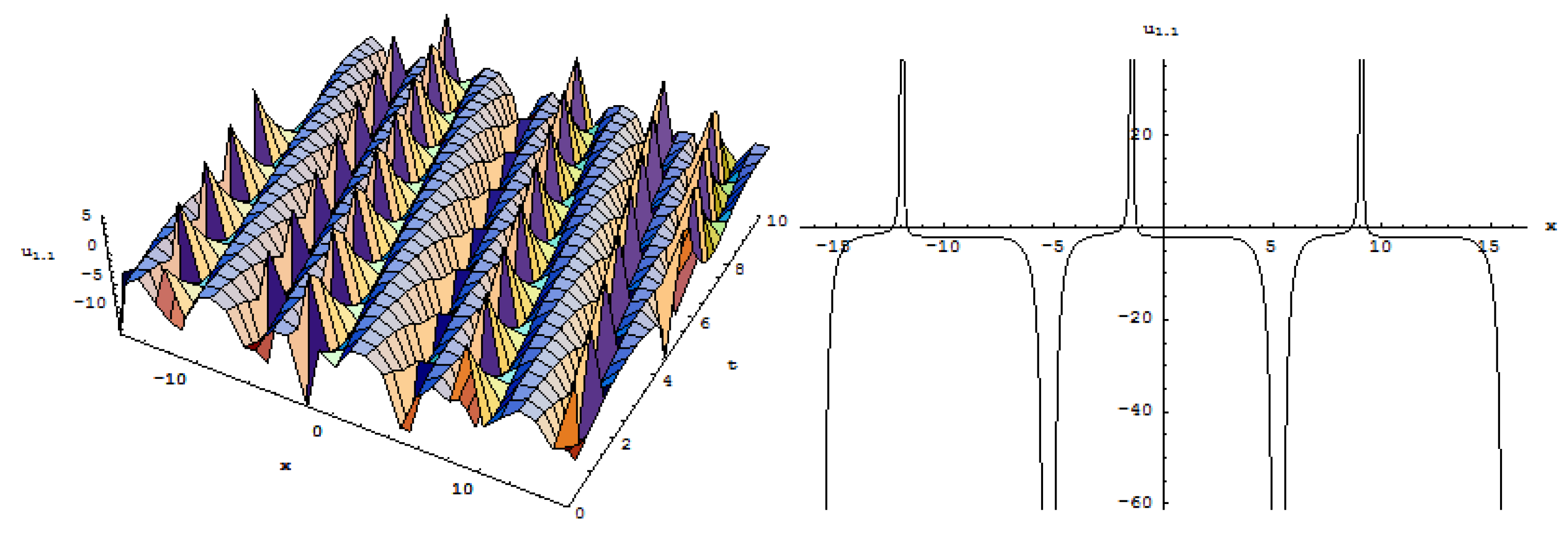
The properties of the new soliton-like wave solutions and periodic-like solutions is shown in Figure 5 and Figure 6.
Remark 4:
To our knowledge, the explicit solutions except () we obtained here to Equation (6) are not shown in the previous literature. They are new exact solutions of Equation (6). Our method contains all the results mentioned by the G’/G method [19], the improved sub-ODE method [20] and auxiliary equation technique [21], etc., which were discussed in [22].
Figure 5.
Solution when and t = 0.
Figure 6.
Solution when and t = 0.
4. Conclusions
In this paper, we have found abundant new types of exact solutions for the (N + 1)-dimensional generalized Boussinesq equation by using the generalized Jacobi elliptic functions expansion method and computerized symbolic computation. More importantly, our method is very simple and powerful at finding new solutions to various kinds of nonlinear evolution equations, such as Schrödinger equation, Boussinesq equation, etc. We believe that this method should play an important role for finding exact solutions in mathematical physics.
Acknowledgments
The authors express their sincere thanks to the editor and referees for their careful reading of the manuscript and constructive suggestion. The work is supported by the National Nature Science Foundation of China (Grant No. 61070231), the Natural Science Foundation of Jiangsu Province of China (Grant No. BK20130736) and the Scientific Research Foundation of NanJing Institute of Technology (Grant No. ZKJ201513).
Author Contributions
Baojian Hong obtained the data, drawn the figures and wrote the paper. Dianchen Lu conceived theoretical background and analyzed the data. All authors discussed the results and commented on the manuscript.
Conflicts of Interest
The authors declare no conflict of interest.
References
- Ablowitz, M.J.; Clarkson, P.A. Soliton, Nonlinear Evolution Equations and Inverse Scattering; Cambridge University Press: New York, NY, USA, 1991. [Google Scholar]
- Matveev, V.A.; Salle, M.A. Darboux Transformations and Solitons; Springer-Verlag: Berlin, Heidelberg, Germany, 1991. [Google Scholar]
- Hong, B.J. New Jacobi elliptic functions solutions for the variable-coefficient mKdV equation. Appl. Math. Comput. 2009, 215, 2908–2913. [Google Scholar] [CrossRef]
- Yan, Z.Y. Similarity transformations and exact solutions for a family of higher-dimensional generalized Boussninesq equations. Phys. Lett. A 2007, 361, 223–230. [Google Scholar]
- Guo, Y.X.; Lai, S.Y. New exact solutions for an (N+1)-dimensional generalized Boussinesq equation. Nonlinear Anal. Theor. Methods Appl. 2010, 72, 2863–2873. [Google Scholar] [CrossRef]
- Boussinesq, J. Théorie des ondes et des remous qui se propagent le long d’un canal rectangulaire horizontal, en communiquant au liquide contenu dans ce canal des vitesses sensiblement pareilles de la surface au fond. Journal de Mathématiques Pures et Appliquées, Deuxième Série 1872, 17, 55–108. [Google Scholar]
- Whitham, G.B. Linear and Nonlinear Waves; Wiley: New York, NY, USA, 1974. [Google Scholar]
- Dodd, R.K.; Eilbeck, J.C.; Gibbon, J.D.; Morries, H.C. Soliton and Nonlinear Waves; Academic Press: London, UK, 1982. [Google Scholar]
- Yan, Z.Y.; Xie, F.D.; Zhang, H.Q. Symmetry Reductions, Integrability and Solitary Wave Solutions to High-Order Modified Boussinesq Equations with Damping Term. Commun. Theor. Phys. 2001, 36, 1–6. [Google Scholar]
- Chen, Y.; Yan, Z.Y.; Zhang, H.Q. New explicit solitary wave solutions for (2+1)-dimensionalBoussinesq equation and (3+1)-dimensional KP equation. Phys. Lett. A 2003, 307, 107–113. [Google Scholar] [CrossRef]
- Allen, M.A.; Rowlands, G. On the transverse instabilities of solitary waves. Phys. Lett. A 1997, 235, 145–146. [Google Scholar] [CrossRef]
- El-Sayed, S.M.; Kaya, D. The decomposition method for solving (2 + 1)-dimensional Boussinesq equation and (3 + 1)-dimensional KP equation. Appl. Math. Comput. 2004, 157, 523–534. [Google Scholar] [CrossRef]
- Matsukawa, M.; Watanabe, S. N-Soliton solution of two dimensional modified boussinesq equation. J. Phys. Soc. Jpn. 1988, 57, 2936–2940. [Google Scholar] [CrossRef]
- Wazwaz, A.M. Construction of soliton solutions and periodic solutions of the Boussinesq equation by the modified decomposition method. Chaos Solitons Fract. 2001, 12, 1549–1556. [Google Scholar] [CrossRef]
- Feng, D.H.; Li, J.B.; Lue, J.L.; He, T.L. The improved Fan sub-equation method and its application to the Boussinseq wave equation. Appl. Math. Comput. 2007, 194, 309–320. [Google Scholar] [CrossRef]
- Wang, D.; Sun, W.W.; Kong, C.C.; Zhang, H.Q. New extended rational expansion method and exact solutions of Boussinesq equation and Jimbo-Miwa equations. Appl. Math. Comput. 2007, 189, 878–886. [Google Scholar] [CrossRef]
- Lai, S.Y. Different physical structures of solutions for a generalized Boussinesqwave equation. J. Comput. Appl. Math. 2009, 231, 311–318. [Google Scholar] [CrossRef] [Green Version]
- Abd-el-Malek, M.B.; Badran, N.A.; Hassan, H.S.; Abbas, H.H. New solutions for solving Boussinesq equation via potential symmetries method. Appl. Math. Comput. 2015, 251, 225–232. [Google Scholar] [CrossRef]
- Hubert, M.B.; Betchewe, G.; Doka, S.Y.; Crepin, K.T. Soliton wave solutions for the nonlinear transmission line using the Kudryashov method and the (G’/G)-expansion method. Appl. Math. Comput. 2014, 239, 299–309. [Google Scholar] [CrossRef]
- Zhang, S.; Wang, W.; Tong, J.L. The improved sub-ODE method for a generalized KdV-mKdVequation with nonlinear terms of any order. Phys. Lett. A 2008, 372, 3808–3813. [Google Scholar] [CrossRef]
- Zhang, Y.; Lai, S.Y.; Yin, J.; Wu, Y.H. The application of the auxiliary equation technique to ageneralized mKdV equation with variable coefficients. J. Comput. Appl. Math. 2009, 223, 75–85. [Google Scholar] [CrossRef]
- Hong, B.J. New exact Jacobi elliptic functions solutions for the generalized coupled Hirota-Satsuma KdV system. Appl. Math. Comput. 2010, 217, 472–479. [Google Scholar] [CrossRef]
© 2016 by the authors; licensee MDPI, Basel, Switzerland. This article is an open access article distributed under the terms and conditions of the Creative Commons by Attribution (CC-BY) license (http://creativecommons.org/licenses/by/4.0/).