
Abstract
In this study, we present a numerical scheme to solve the telegraph equation by using Fibonacci polynomials. This method is based on the Fibonacci collocation method which transforms the equation into a matrix equation, and the unknown of this equation is a Fibonacci coefficients matrix. Some numerical examples with comparisons are included to demonstrate the validity and applicability of the proposed method. The results show the efficiency and accuracy of this paper.
1. Introduction
Linear partial differential equations play an important role in the modelling of engineering problems and in many areas of science. Especially, hyperbolic type partial differential equations (PDEs) is a significant class of the PDEs because of a wide range of applications in many fields.
The hyperbolic type PDEs model atomic physics, aerospace, industry, biology and engineering problems such as vibrations of structures, beams and buildings [1,2].
In this paper, we show a new algorithm for the numerical solutions of the Telegraph equation which is a typical example of the hyperbolic type PDEs. This equation is commonly used in signal analysis for transmission and propagation of electrical signals and also has applications in other fields. Telegraph equation models mix diffusion and wave propagation by introducing a term that accounts for effects of finite velocity to standard heat or mass transport equation [2,3,4,5,6].
In recent years, some authors have shown interest in the numerical solution of telegraph type PDEs, using various methods such as: Radial basis function approximation [1], Chebyshev Tau method [2], He’s variational iteration method [7], Laguerre-Legendre spectral collocation method [8], differential quadrature method [9] and differential transform method [10].
We consider the second-order linear hyperbolic partial differential Telegraph equation.
with the initial conditions.
and Dirichlet boundary conditions.
where are known constant coefficients, and are known functions and the function is unknown.
In this study, we introduce Fibonacci collocation method based on matrix relations which has been used to find the approximate solutions of differential, integral and integro-differential equations, differential- difference equations, Fredholm integro differential-difference equations, Pantograph-type functional differential equations and linear Volterra integro differential equations [11,12,13,14,15]. Because Fibonacci polynomials are orthogonal polynomials and the collocation method is easily programmable by symbolic computation programs, this method is preferable [15]. Also, recently, several researchers have used other collocation methods to solve different types of the partial differential equations by using various special polynomials without Fibonacci polynomials [16,17,18,19,20]. On the other hand, these matrix methods were used for the numerical analysis of the longitudinal vibration of rods [21]. In addition to this, Shaban et al. [22] use the homotopy analysis method based on the operational matrix with Chebyshev polynomials.
In this paper, by developing the Fibonacci collocation method studied in [11,12,13,14,15], we will obtain the approximate solution of Equation (1) in the truncated Fibonacci series form.
where are the unknown Fibonacci coefficients and are the Fibonacci functions defined by,
2. Fundamental Relations
To obtain the numerical solution of hyperbolic partial differential Telegraph equation with Fibonacci Collocation Method, we first evaluate the Fibonacci coefficients of the unknown function. For convenience, the solution function Equation (4) can be written in the matrix form
where
such that and
In there, the matrix form can be written as
So that
If is even,
If is odd,
is the characteristic matrix of the matrix relations [11].
where
3. Method of Solution
We can compute the matrix forms of the terms . of Equation (1) now. From the relations Equations (5)–(7) we obtain the matrix forms.
where
where all matrix is .
By substituting the expressions Equations (5)–(12) into Equation (1), we have the matrix equation.
Shortly, Equation (13) can be written as
where
By using in Equation (14) the collocation points defined by
So, the system of the matrix equations can be written as
Or, in summary, the fundamental matrix equation is
By means of the relation Equations (8) and (10) for the conditions Equation (2), we can obtain the matrix forms.
By substituting the collocation points Equation (15) into Equations (17) and (18), we have the fundamental matrix equations of the initial conditions.
Similarly, by using Equation (8) for the conditions Equation (3), we can have the matrix forms as follow
On the other hand, by substituting the collocation points Equation (16) into Equations (19) and (20), we obtain the fundamental matrix equations of the Dirichlet boundary conditions
To obtain the approximate solution of Equation (1) under conditions Equations (2) and (3), the augmented matrix is formed as follows
So, the unknown Fibonacci coefficients are obtained as
where is generated by using the Gauss elimination method and then removing zero rows of the augmented matrix .
4. Error Estimation Algorithm
In this section, we introduce an error estimation algorithm for obtaining the Fibonacci polynomial solution giving last sections and use this technique to obtain the corrected solution of the problem. This algorithm is based on residual function [23,24,25], so we define residual function as follows:
where
From Equations (21) and (22),
with the initial conditions
and Dirichlet boundary conditions
Also, the error function is defined as follows:
Because of the fact that is linear operator, error problem can be defined by using error function as
with homogenous conditions
The problem (27) under conditions (28) was solved by Fibonacci collocation method given by Section 3. When we solve the Equation (28) for which is a truncated number, we get the approximation to even if the exact solution of the problem is unknown.
Consequently, by means of the error estimation function , we obtain the corrected Fibonacci polynomial solution.
5. Numerical Examples
In this section, we will give several examples to illustrate the applicability of the Fibonacci matrix method and all of them are performed on the computer. Maximum absolute error is defined as
Example 1.
First, let us consider the hyperbolic Telegraph Equation [2]
with the initial conditions
and Dirichlet boundary conditions
Here ,
By using the solution algorithm in given Section 3, we find the Fibonacci polynomial solution of the problem is , which is the exact solution of the problem. Further, we can obtain the exact solution of the problem for the any value of
Example 2.
Consider the following Telegraph Equation [5]
with the initial conditions
and Dirichlet boundary conditions
The exact solution is given by
Note that ,
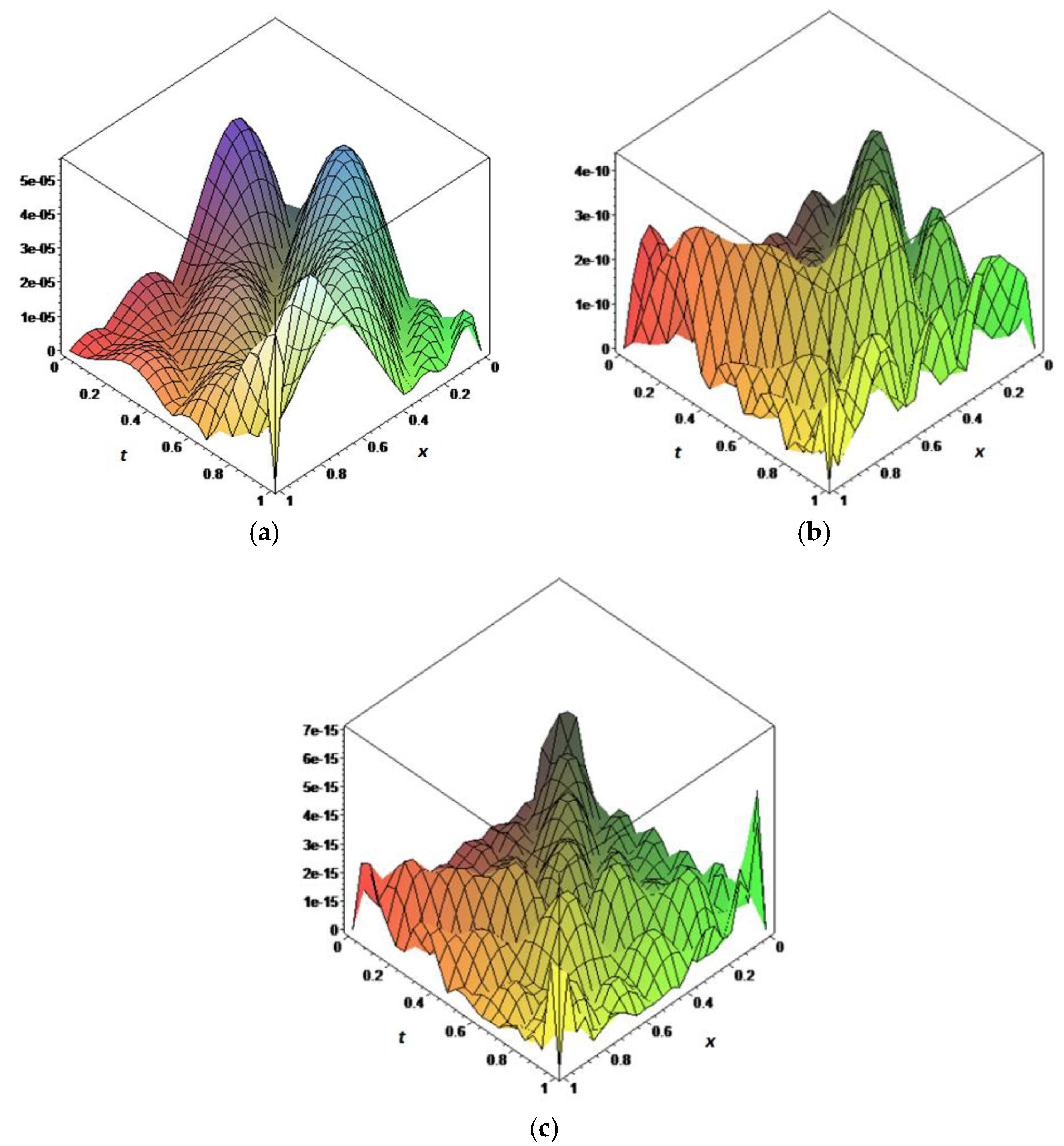
In Table 1 shows a comparison of the absolute errors values of Fibonacci polynomial solution and corrected Fibonacci polynomial solution with Taylor Matrix Method and Legendre Multiwavelet Method. Also, Figure 1 clearly shows when the values increase, and when the absolute error function values rapidly decrease.
Table 1.
Comparison of the absolute errors values of Fibonacci polynomial solution and corrected Fibonacci polynomial solution with Taylor Matrix Method and Legendre Multiwavelet Method for Example 1 and.
Figure 1.
Graphs of the absolute error functions of Exp. 2 for and . (a) The absolute error function for ; (b) The absolute error function for ; (c) The absolute error function for
Example 3.
[1] As a final example, we solve the hyperbolic Telegraph Equation
with the initial conditions
and Dirichlet boundary conditions
The exact solution of this problem is
where ,
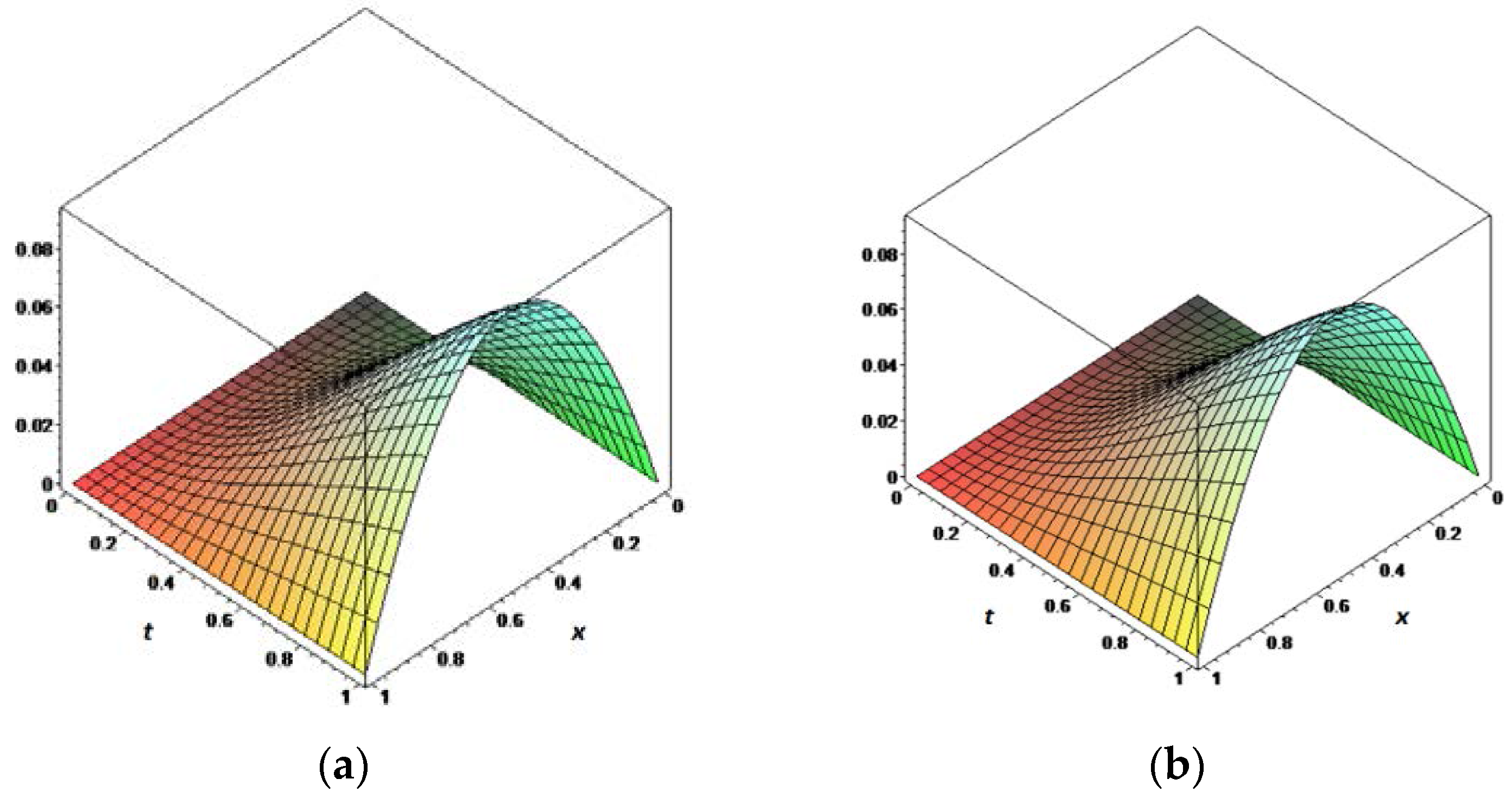
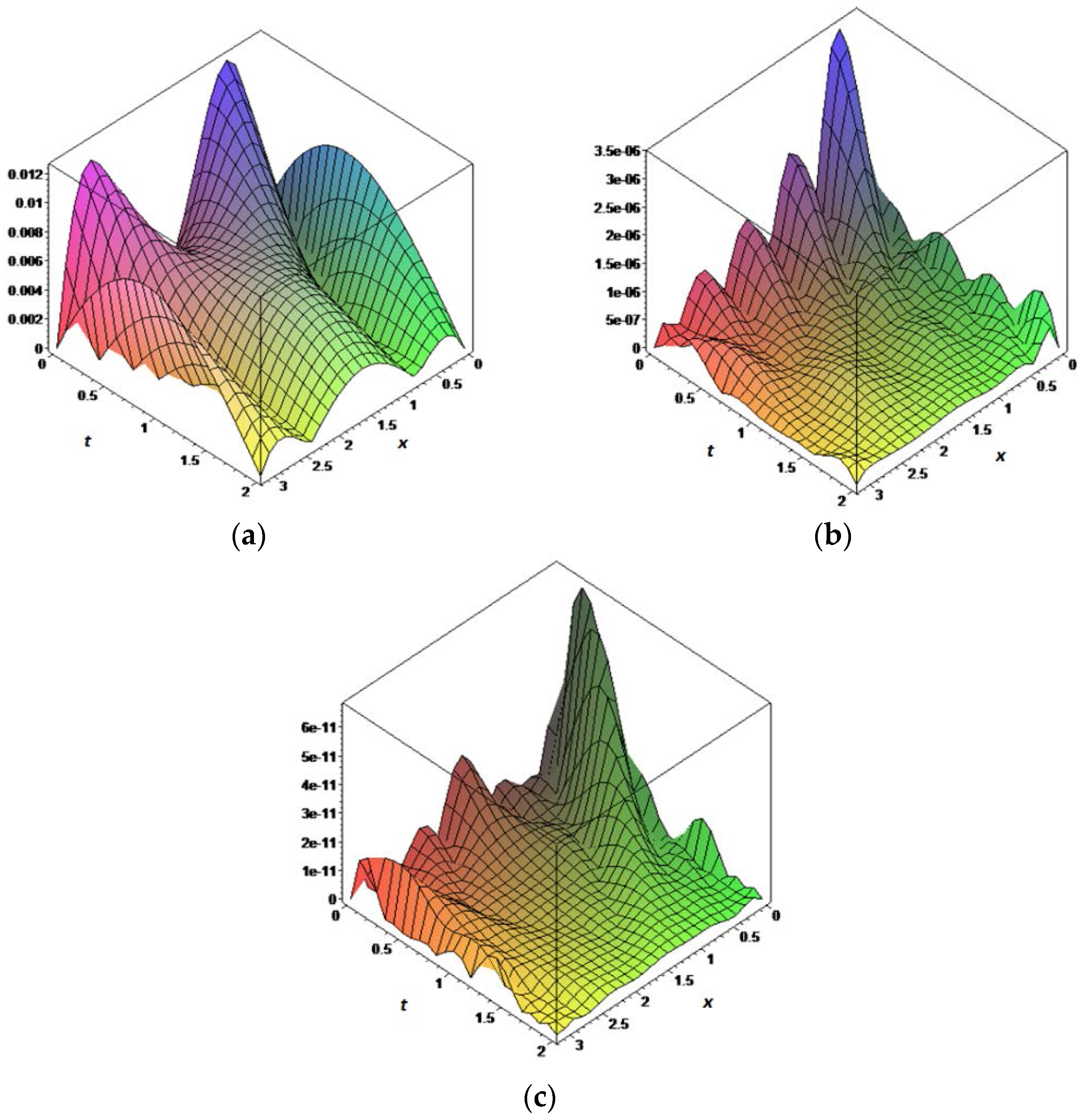
Exact solution and numerical solution for are plotted in Figure 2. On the other hand, taking , we compared the absolute error functions in Figure 3 and Table 2.
Figure 2.
Exact solution and Fibonacci polynomial solution of Example 3 for . (a) Exact solution; (b) Present method for
Figure 3.
Graphs of the absolute errors functions of Example 3 for . (a) The absolute error function for N = 7; (b) The absolute error function for N = 11; (c) The absolute error function for N = 14.
Table 2.
Comparison of the absolute error values of Example 3 for .
Table 3 shows a comparison of the values of Fibonacci polynomial solution and corrected Fibonacci polynomial solution with B-spline Collocation Method and Tau Method for Example 3.
Table 3.
Comparison of the values of Fibonacci polynomial solution and corrected Fibonacci polynomial solution with B-spline Collocation Method and Tau Method for Example 3.
6. Conclusions
In this article, we have presented a new approach using the Fibonacci polynomials to solve the Telegraph equation which is a typical example of the hyperbolic type PDEs. The solution of this equation is expressed as a truncated series of Fibonacci polynomials, which are then transformed from algebraic form to matrix form. The new method has been applied to three illustrative examples. Illustrated examples are contained to demonstrate the applicability and the validity of the method and the obtained results are compared with the different methods in literature. The results show the efficiently and the accuracy of the present work. Moreover, it is well seen from these examples that the method yields either the exact solution or a high accuracy approximate solution for the telegraph equations. Also, as N increases, the errors decrease more rapidly. One of the considerable advantages of this technique is that the approximate solutions are found very easily by using the computer programs. As seen from this study, the new approach with Fibonacci polynomial is a good approximation for solving the Telegraph equations.
Acknowledgments
The research was supported by the Scientific Research Project Administration of Celal Bayar University.
Author Contributions
A.K.B and S.Y. collectively carried out this study, improved method, and writing software them. A.K.B. wrote the manuscript. S.Y. helped to revise the manuscript. All authors read and approved the final manuscript.
Conflicts of Interest
The authors declare no conflict of interest.
References
- Saadatmandi, A.; Dehghan, M. Numerical solution of hyperbolic telegraph equation using the Chebyshev tau method. Numer. Methods Part. Differ. Equ. 2010, 26, 239–252. [Google Scholar] [CrossRef]
- Dehghan, M.; Shokri, A. A numerical method for solving the hyperbolic telegraph equation. Numer. Methods Part. Differ. Equ. 2008, 24, 1080–1093. [Google Scholar] [CrossRef]
- El-Azab, M.S.; El-Gamel, M. A numerical algorithm for the solution of telegraph equations. Appl. Math. Comput. 2007, 109, 757–764. [Google Scholar] [CrossRef]
- Georges, R.; Pearce, J.A. Foundations and Industrial Applications of Microwave and Radio Frequency Fields Physical and Chemical Processes; Wiley: Chichester, UK, 1995. [Google Scholar]
- Feng, G.; Chi, C. Unconditionally stable difference schemes for a one-space-dimensional linear hyperbolic equation. Appl. Math. Comput. 2007, 187, 1272–1276. [Google Scholar]
- Mohanty, R.K.; Jain, M.K.; George, K. On the use of high order difference methods for the system of one space second order nonlinear hyperbolic equations with variable coefficients. J. Comput. Appl. Math. 1996, 72, 421–431. [Google Scholar] [CrossRef]
- Dehghan, M.; Yousefi, S.A.; Lotfi, A. The use of He’s variational iteration method for solving the telegraph and fractional telegraph equations. Int. J. Numer. Methods Biomed. Eng. 2011, 27, 219–231. [Google Scholar] [CrossRef]
- Tatari, M.; Haghighi, M. A generalized Laguerre–Legendre spectral collocation method for solving initial-boundary value problems. Appl. Math. Model. 2014, 38, 1351–1364. [Google Scholar] [CrossRef]
- Jiwari, R.; Pandit, S.; Mittal, R.C. A differential quadrature algorithm to solve the two dimensional linear hyperbolic telegraph equation with Dirichlet and Neumann boundary conditions. Appl. Math. Comput. 2012, 218, 7279–7294. [Google Scholar] [CrossRef]
- Srivastava, V.K.; Mukesh, K.A.; Chaurasia, R.K. Reduced differential transform method to solve two and three dimensional second order hyperbolic telegraphic equations. J. King Saud Univ. Eng. Sci. 2014, 17. [Google Scholar] [CrossRef]
- Kurt, A. Fibonacci Polynomial Solutions of Linear Diferential, Integral and Integro-Diferential Equations. Master’s Thesis, Graduate School of Natural and Applied Sciences, Mugla, Mugla University, Merkez, Muğla, Turkey, 2012. [Google Scholar]
- Kurt, A.; Yalçınbaş, S.; Sezer, M. Fibonacci Collocation Method For Solving Linear Differential-Difference Equations. Math. Comput. Appl. 2013, 18, 448–458. [Google Scholar]
- Kurt, A.; Yalçınbaş, S.; Sezer, M. Fibonacci Collocation Method for Solving High-Order Linear Fredholm Integro-Differential-Difference Equations. Int. J. Math. Math. Sci. 2013, 2013. [Google Scholar] [CrossRef]
- Kurt Bahşı, A.; Şahin, N.; Sezer, M. A numerical algorithm with residual error estimation for solution of high-order Pantograph-type functional differential equations using Fibonacci polynomials. New Trends Math. Sci. 2015, 3, 90–102. [Google Scholar]
- Kurt Bahşı, A.; Yalçınbaş, S. Fibonacci collocation method with a residual error function to solve linear Volterra integro differential equations. New Trends Math. Sci. 2016, 4, 1–14. [Google Scholar] [CrossRef]
- Bülbül, B.; Sezer, M. Taylor polynomial solution of hyperbolic type partial differential equations with constant coefficients. Int. J. Comput. Math. 2011, 88, 533–544. [Google Scholar] [CrossRef]
- Yüzbaşı, Ş.; Şahin, N. Numerical solutions of singularly perturbed one-dimensional parabolic convection–diffusion problems by the Bessel collocation method. Appl. Math. Comput. 2013, 220, 305–315. [Google Scholar] [CrossRef]
- Bülbül, B.; Sezer, M. A Taylor matrix method for the solution of a two-dimensional linear hyperbolic equation. Appl. Math. Lett. 2011, 24, 1716–1720. [Google Scholar] [CrossRef]
- Yüksel, G.; Sezer, M. A Chebyshev Series Approximation for Linear Second-Order Partial Differential Equations with Complicated Conditions. Gazi Univ. J. Sci. 2014, 26, 515–525. [Google Scholar]
- Isik, O.R.; Sezer, M.; Güney, Z. Bernstein series solution of linear second-order partial differential equations with mixed conditions. Math. Methods Appl. Sci. 2014, 37, 609–619. [Google Scholar] [CrossRef]
- Çevik, M. Application of Taylor Matrix Method to the Solution of Longitudinal Vibration of Rods. Math. Comput. Appl. 2010, 15, 334–343. [Google Scholar]
- Shaban, M.; Kazem, S.; Rad, J.A. A modification of the homotopy analysis method based on Chebyshev operational matrices. Math. Comput. Model. 2013, 57, 1227–1239. [Google Scholar] [CrossRef]
- Oliveira, F.A. Collacation and residual correction. Numer. Math. 1980, 36, 27–31. [Google Scholar] [CrossRef]
- Shahmorad, S. Numerical solution of general form linear Fredholm. Volterra integro differantial equations by the tau method with an error estimation. Appl. Math. Comput. 2005, 167, 1418–1429. [Google Scholar]
- Çelik, İ. Collacation method and residual correction using Chebyshev series. Appl. Math. Comput. 2006, 174, 910–920. [Google Scholar]
- Yousefi, S.A. Legendre multiwavelet Galerkin method for solving the hyperbolic telegraph equation. Numer. Methods Part. Differ. Equ. 2010, 26, 535–543. [Google Scholar] [CrossRef]
- Mittal, R.C.; Bhatia, R. Numerical solution of second order one dimensional hyperbolic telegraph equation by cubic B-spline collocation method. Appl. Math. Comput. 2013, 220, 496–506. [Google Scholar] [CrossRef]
© 2016 by the authors; licensee MDPI, Basel, Switzerland. This article is an open access article distributed under the terms and conditions of the Creative Commons Attribution (CC-BY) license (http://creativecommons.org/licenses/by/4.0/).