Introduction
Since the advent of the modern internet in the European Organization for Nuclear Research by Tim Berners-Lee in 1989, it has become ubiquitous in a span of 25 years and one of our daily essentials [1,2]. India had nearly 700 million users across the country in 2020. This figure was projected to grow to over 974 million users by 2025. India was ranked as the second largest online market worldwide in 2019, coming second to China. The number of internet users was estimated to increase both in urban and rural population [3].
In this rapidly evolving society, exposure to the internet begins in childhood when individuals begin to use different electronic gadgets. Emerging adults and adolescents are among the most avid users of digital communication technologies, including texting, instant messaging (IM) and video chatting [1]. These adolescents are often described as “digital natives” because they have grown up using these technologies, utilising text-based tools to develop existing friendships during adolescence, a sensitive period for socio-emotional development [4–6].
The rapid proliferation of the internet has brought its own unique advantages, but also affects health in a myriad of ways and may even lead to pathologies including internet addiction and other psychiatric comorbidities [1] A metanalysis revealed that the prevalence of internet addiction among medical students is 30.1%, which was five times higher than in the general population [4].
Cross-sectional studies conducted in several cultural settings have depicted co-morbidity of internet addiction with psychiatric disorders, especially affective disorders (including depression), anxiety disorders (generalised anxiety disorder, social anxiety disorder) and attention deficit hyperactivity disorder (ADHD) [7,8] However, there are very few studies on the correlation of internet addiction with ADHD and sleep quality in India, which need to be replicated.
Increased time spent on the internet in addition to being associated with psychiatric disorders also disrupts the sleep–wake schedule significantly, and a higher rate of insomnia was found among heavy internet users [9]. Adolescents with internet addiction were generally more severely depressed and reported increased suicidal thoughts [9].
The present study was designed to assess the prevalence of internet usage and addiction among medical students, associated psychiatric co-morbidities and its relationship with the sleep quality. Its aims were:
To estimate the extent of internet usage, patterns of usage and addiction to internet in medical students.
To describe the association of internet addiction with socio-demographic characteristics, sleep quality, depression, stress, anxiety and attention deficit hyperactivity disorder (ADHD)
Material and Methods
A cross sectional, descriptive study was conducted among medical students, both undergraduates and postgraduates enrolled in this medical college. Permission was obtained from the requisite authorities and ethics committee clearance was obtained prior to the start of the study. Subjects were recruited from a sample frame of around 750 undergraduate students and 150 postgraduate students, among whom 340 students gave informed consent to participate in the study in written form. Following a brief presentation with instructions on completing the questionnaire, students were divided into groups of 20 for interview. Each interview session with a group of 20 students was mentored by a guide to clarify any doubts while filling out the questionnaire. The sessions were conducted over a period of three months from March 2014 to May 2014. Any student aged less than 18, suffering from any major physical illness or taking an examination within a month were excluded from the study.
Among the 340 students, 39 returned questionnaires with incomplete or missing responses and thus a total of 301 students were included in the final analysis.
The self-administered questionnaire consisted of five parts, as follows:
Sociodemographic information: Study variables evaluated included the age and sex of the respondent, year of study in the undergraduate or postgraduate course, education and occupation of the head of the family, and residence (whether urban or rural). Internet-related characteristics such as the age at which they began surfing the internet, whether they accessed the internet from home or institution or both, money spent on internet per month and type of device used to access the internet were obtained. The number of hours spent on the internet per week by the respondent was obtained. The websites visited were divided into six groups which are general information news, e-mail, social networking, entertainment (YouTube, series, podcasts, movies, music, novels, comics), games, and educational; the diurnal pattern of usage was evaluated.
Young’s internet addiction scale (IAT): A widely utilised diagnostic instrument for internet addiction, it consists of a 20-item questionnaire designed by Kimberly Young. The respondents are instructed to answer on a five-point Likert scale. The total is calculated and respondents are graded into normal users of the internet, and mild, moderate or severely addicted, depending on the score. The scale has good psychometric properties in terms of internal consistency and factorial validity [10,11].
DASS 21: This is a 21-item questionnaire designed to quantitatively measure three subscales of depression, anxiety, and stress. Respondents answer the questions on a four-point Likert scale and each subscale is graded into normal, mild, moderate, severe and extremely severe based on the final score. The instrument has good validity and reliability [12].
World Health Organization (WHO) adult ADHD self-report scale v1.1 Symptom Checklist (ASRS): This is an 18-item questionnaire with two parts, part A for screening of ADHD and part B to assess the frequency and severity of symptoms of ADHD. Part A comprises six questions with darkly shaded boxes. If the student marks four or more replies in those shaded boxes, then they may be suffering from ADHD. The instrument has reasonably good validity and reliability in college students [13].
Pittsburgh sleep quality index: This is a self-rated questionnaire assessing the sleep quality over one month and generating seven components, which are duration of sleep, sleep disturbance, sleep latency, days dysfunction, sleep efficiency, overall sleep quality, and use of medication. The sum of the obtained scores assesses whether the individual is good sleeper or not. The scale has been demonstrated to have good reliability and validity [14].
Statistical analysis
Data were analysed using Statistical Package for Social Sciences (SPSS) version 20. Statistical measures obtained include descriptive statistics (percentages, proportions, mean and standard deviation), tests of significance such as the chi-square test and analysis of variance (ANOVA/F test).
Results
A sample size of 340 was obtained, of whom 301 had valid responses. Among them, 55% were normal internet users, 30% were mildly addicted to the internet and 15% were moderately to severely addicted to internet (
Table 1).
The sample consisted of 99 (32.9%) male students and 202 (67.1%) female students, among whom 5.3% of males and 9.3% of females were moderately or severely addicted to the internet (
Table 1). There was no statistically significant association between gender and internet addiction. Most of the respondents in the age group of 19–22 years, among whom about 26 (8.6%) were moderately or severely addicted to the internet. A majority of the subjects 244 (81.1%) hailed from an urban background (
Table 1) and there was no statistically significant association between location and internet addiction. A total of 117 (38.9%) students accessed the internet from home, 171 (56.8%) from both home and institution, and very few only in the institution (
Table 1). There was no statistically significant association between the place of access and internet addiction (
Table 1).
Among the 301 subjects, 271 (90.0%) were undergraduates and 30 (10.0%) were postgraduates. The majority of the subjects were undergraduates, among whom 42 (14%) were moderate or severe addicts. Among the 30 postgraduates, 2 (0.7%) were moderate or severe addicts (
Table 2). This had no statistically significant association with internet addiction (
p = 0.19). The heads of the family of the respondents were mainly graduates with 209 (69.4%) out of 301 being graduates. Among these, only 30 offspring (10%) had moderate or severe addiction to internet and the association was not statistically significant (
p = 0.9). Of the 301 subjects, 169 (56.1%) subjects were children of professionals among whom 24 (8%) were moderate or severe addicts of internet (
Table 2). The association was not statistically significant (
p = 0.27).
More time was spent on the internet per week among moderate and severe internet addicts (57.48 ± 33.26) than by mild addicts (34.36 ± 27.41) and normal users (14.33 ± 15.28). The majority of the time was spent on social networking (33.32 ± 24.40) followed by entertainment (7.89 ± 8.10) among moderate and severe internet addicts. Even in mild internet users most of the time was spent on social networking (13.68 ± 13.51) followed by entertainment (6.19 ± 8.88) and games (5.29 ± 7.40) but the mean amount of time spent was much higher among moderate and severe addicts (
Table 3
). The difference in the mean time spent across the three groups was statistically significant on an ANOVA test. Money spent on internet access was comparatively higher in moderate and severe internet addicts (325.25 ± 337.54) than normal users (212.69 ± 313.22) (
Table 3
). The difference was statistically significant with a
p value of 0.03.
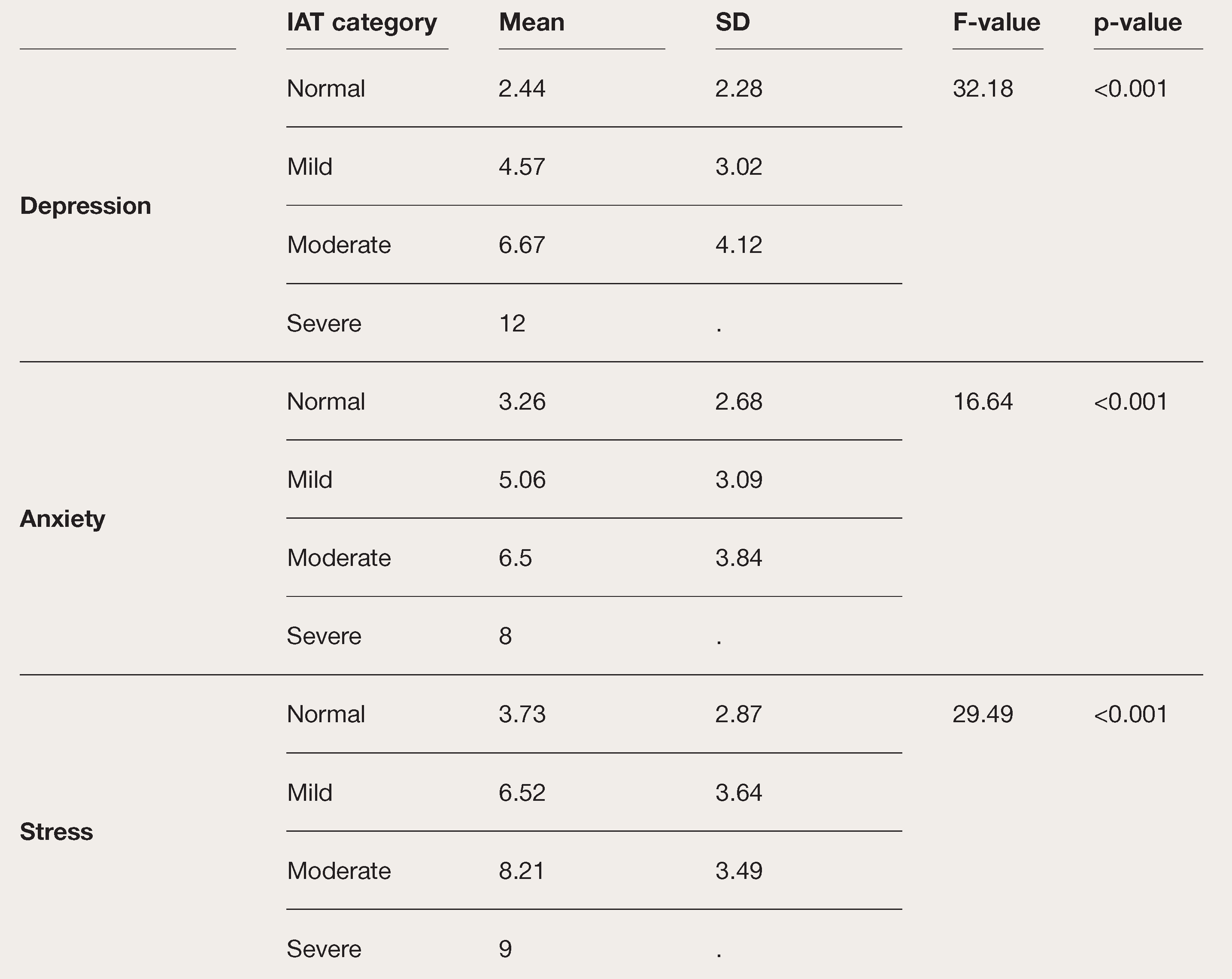
The mean score for depression in normal internet usage subjects was 2.44 ± 2.28, with mild internet addiction 4.57 ± 3.02, moderate internet addiction 6.67 ± 4.12, and severe internet addiction 12 (
Table 4). There was a statistically significant association (
p < 0.001) between depression and internet addiction.
The mean score for anxiety in normal internet usage subjects was 3.26 ± 2.68, with mild internet addiction 5.06 ± 3.09, moderate internet addiction 6.5 ± 3.84, and severe internet addiction 8 (
Table 4
). There was a statistically significant association (
p < 0.001) between anxiety and internet addiction.
The mean score for stress in normal internet usage subjects was 3.73 ± 2.87, with mild internet addiction 6.52 ± 3.64, moderate internet addiction 8.21 ± 3.49, and severe internet addiction 9 (
Table 4
). There was a statistically significant association (
p < 0.001) between stress and internet addiction.
Pittsburgh sleep quality score ranged from zero to 21; a score of ≤5 was considered as good sleep quality and above 5 as poor sleep quality. In the present study, the mean score for internet addiction in good sleepers was 28.17 ± 8.58 and in poor sleepers was 44.75 ± 14.63 (
Table 5). There was a statistically significant association (
p < 0.0001) between internet addiction and poor sleep quality.
In the WHO adult ADHD self-report scale v1.1 symptom checklist, a score of ≥4 answers in dark shaded boxes in part A of the questionnaire is considered to indicate having ADHD symptoms. In the present study, the mean score of internet addiction in subjects found to have ADHD was 49.4 ± 15.37 and in subjects screened and not having ADHD was 31.1 ± 11.38 (
Table 5). The association between ADHD and internet addiction was statistically significant with a
p value of <0.0001.
Discussion
The current study was conducted among undergraduate and postgraduate medical students of whom 44 (14.6%) were moderately or severely addicted to the internet. Prevalence rates of internet addiction ranged from 0 to 26.3% in a review of 18 studies in US [15]. This range of prevalence in the systematic review could be due to differences in the scales used. In a study by Ghamari et al. on 429 medical students by using the IAT, the overall prevalence of internet addiction was 10.8%, with moderate and severe internet addiction of 8% and 2.8%, respectively [16]. In West Bengal a study of 201 respondents in a medical college, found that 15% of students scored in the moderately addicted range on the IAT [17]. A study with sample size of 846 subjects in a medical college of Maharashtra, the IAT scale showed a prevalence of internet addiction of 19.85%, with males being more effected and mean age was 19.6 years [8]. These differences in the prevalence of internet addiction and sociodemographic characteristics such as age can be attributed to internet penetrance, which differs across regions.
According to National Family Health Survey-5 data (from 2019–2021), one in three women in India (33%) have ever used the internet, compared with more than half (57%) of men [18]. Another review study on usage and pattern of internet use based on gender found that among college students, 60% of males and only 55% of females accessed internet [19]; they also described a considerable gap in women accessing social networks and internet gaming when compared with men in India. In our study, there were more female users than male as more than half of the students recruited into the medical college were females [20]. A study in India to assess gender differences on internet addiction has shown that males significantly outnumbered females in terms of internet addiction, whereas in our study there was no significant difference [21].
In a study in India, published in 2018, internet addiction was not associated with parents’ education, occupation of father, place of residence, per capita income, years of internet use, or access to the internet. But it was associated with duration of internet use per day, money spent on the internet and social networking [22]. In another study in central India, there was no association between internet addiction, access to the internet, years of internet use, or type of connection [8]. In yet another study in India, 64.69% of the users predominantly used the internet for accessing social networking sites [23]. These findings have been replicated in the current study.
A study in Mumbai observed that those with excessive use of the internet had high scores for anxiety and depression [24]. Results of a study in central India showed high scores for anxiety, depression, loss of emotional control, psychological distress in students with internet addiction when compared with normal users [8]. A study on adolescents in Assam and another study in cities across India have shown a significant association between Young’s IAT score and DASS, with moderate to severe addiction scoring high on depression, anxiety and stress [25,26]. A study in Delhi showed significant positive correlation between social anxiety and internet addiction scores [27]. These findings are similar to those of the present study where stress, anxiety and depression were significantly associated with moderate and severe internet addiction.
An online survey of professionals in India found that sleep disturbances, reduced duration of sleep and lack of freshness after sleep were significantly higher among those with higher levels of internet addiction [28]. A study conducted on medical students in Gujarat obtained results similar to our study, with high score on the IAT correlating significantly with poor sleep quality on PSQI [29].
A study in medical students of Karnataka has shown a prevalence rate of 20.2% on selfreported ADHD symptoms using the ASRS screener; 31.45% of ADHD suspects had moderate internet addiction, and this association was found to be statistically significant [30]. Research done in Gujarat in two medical colleges also gave results similar to our study with 35.71% of subjects from the adult ADHD-positive group scoring high on the IAT [2].
A longitudinal study has shown that there is a bidirectional relationship between psychopathology and the incidence of Internet addiction [31]. Another follow-up study in India showed that depression and social anxiety worsened the severity of internet use disorder [32]. This was a cross-sectional study conducted in one medical college, so a temporal relationship could not be established. Sociodemographic data and usage pattern may vary between different groups. So, this cannot be generalised to all the communities and societies. Hence, there is a need for longitudinal studies taking into consideration subjects of all age groups and communities.
Conclusions
Participants who are moderately or severely addicted to internet also suffer from psychiatric disorders such as stress, depression, anxiety, ADHD and sleep disorders. The problem demands more attention as the largest portion of the sample affected in the study was between the ages 18 and 26 years, emerging adults with a productive life ahead of them and who are already coping with the demands and emotional upheavals of adolescence and adulthood. This study emphasises the need to formulate specialised programmes at various institutions to address the psychiatric problems associated with excessive internet usage and addiction.