The new classification of epilepsy and seizures of the International League Against Epilepsy (ILAE) 2017

Summary
- −
- The ILAE presents a revised classification of the epilepsies, complemented by a classification of the different forms of seizures.
- −
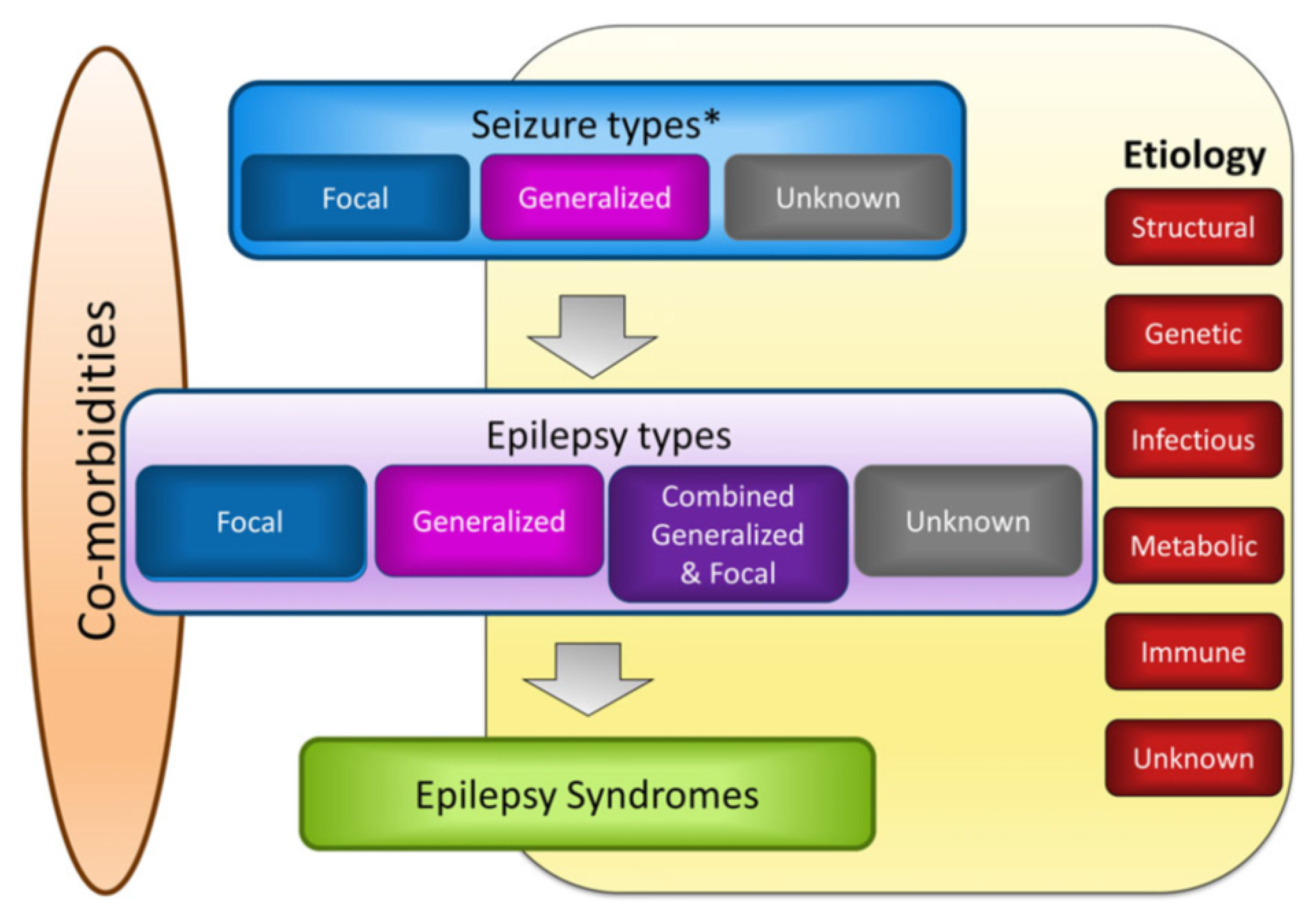
- Diagnosis of epilepsy includes a definition of the seizure form, type of epilepsy (focal, generalised, combined focal and generalised, unclassified) and epilepsy syndrome.
- −
- The aetiology of epilepsy should be established at the first neurological assessment and further refined with each diagnostic step. Epilepsy can be based on more than one aetiological category.
- −
- The term “benign” is replaced by the terms “self-limiting” and “pharmaco-responsive”, each to be used when appropriate.
- −
- The term “developmental and epileptic encephalopathy” can be used to describe both entities occurring together, or can be adapted to describe either of the two entities separately.
- −
- Several terms describing seizures have been eliminated or replaced (see Table 1).
Acknowledgments
Conflicts of Interest
Appendix 1
References
- Scheffer, I.E.; Berkovic, S.; Capovilla, G.; Connolly, M.B.; French, J.; Guilhoto, L.; et al. ILAE classification of the epilepsies: Position paper of the ILAE Commission for Classification and Terminology. Epilepsia 2017, 58, 512–521. [Google Scholar] [CrossRef] [PubMed]
- Fisher, R.S.; Cross, J.H.; French, J.A.; Higurashi, N.; Hirsch, E.; Jansen, F.E.; et al. Operational classification of seizure types by the International League Against Epilepsy: Position Paper of the ILAE Commission for Classification and Terminology. Epilepsia 2017, 58, 522–530. [Google Scholar] [CrossRef] [PubMed]
- Fisher, R.S.; Cross, J.H.; D’Souza, C.; French, J.A.; Haut, S.R.; Higurashi, N.; et al. Instruction manual for the ILAE 2017 operational classification of seizure types. Epilepsia 2017, 58, 531–542. [Google Scholar] [CrossRef] [PubMed]
- Fisher, R.S.; van Emde Boas, W.; Blume, W.; Elger, C.; Genton, P.; Lee, P.; et al. Epileptic seizures and epilepsy: Definitions proposed by the International League Against Epilepsy (ILAE) and the International Bureau for Epilepsy (IBE). Epilepsia 2005, 46, 470–472. [Google Scholar] [CrossRef] [PubMed]
- Beghi, E.; Sander, J.W. The ILAE classification of seizures and epilepsies: Implications for the clinic. Expert Rev Neurother. 2018, 18, 179–183. [Google Scholar] [CrossRef] [PubMed]
- Brodie, M.J.; Zuberi, S.M.; Scheffer, I.E.; Fisher, R.S. The 2017 ILAE classification of seizure types and the epilepsies: What do people with epilepsy and their caregivers need to know? Epileptic Disord. 2018, 20, 77–87. [Google Scholar] [CrossRef] [PubMed]
- Pack, A.M. Epilepsy Overview and Revised Classification of Seizures and Epilepsies. Continuum (Minneap Minn). 2019, 25, 306–321. [Google Scholar] [CrossRef] [PubMed]
- Liyanagedera, S.; Williams, R.P.; Bracewell, R.M. The new classification of seizures: An overview for the general physician. J R Coll Physicians Edinb. 2017, 47, 336–338. [Google Scholar] [CrossRef] [PubMed]
- Zuberi, S.M.; Brunklaus, A. Epilepsy in 2017: Precision medicine drives epilepsy classification and therapy. Nat Rev Neurol. 2018, 14, 67–68. [Google Scholar] [CrossRef] [PubMed]
- Aaberg, K.M.; Surén, P.; Søraas, C.L.; Bakken, I.J.; Lossius, M.I.; Stoltenberg, C.; et al. Seizures, syndromes, and etiologies in childhood epilepsy: The International League Against Epilepsy 1981, 1989, and 2017 classifications used in a population-based cohort. Epilepsia 2017, 58, 1880–1891. [Google Scholar] [CrossRef] [PubMed]
- Bosak, M.; Słowik, A.; Kacorzyk, R.; Turaj, W. Implementation of the new ILAE classification of epilepsies into clinical practice—A cohort study. Epilepsy Behav. 2019, 96, 28–32. [Google Scholar] [CrossRef] [PubMed]
- Beghi, E. New classification of seizures and epilepsies—An advance? Nat Rev Neurol. 2017, 13, 324–325. [Google Scholar] [CrossRef] [PubMed]


| Epilepsy | Eliminated terms | Malignant/catastrophic epilepsy | |
| Symptomatic generalised epilepsy | |||
| New terms | Combined focal and generalised epilepsy | ||
| Epileptic encephalopathy (seizure burden by itself leads to encephalopathy) | |||
| Developmental and epileptic encephalopathy (both seizure burden AND metabolic, structural or genetic alterations lead to encephalopathy) | |||
| Changed terms | Old | New | |
| Genetic generalised epilepsy (GGE) may be still used when a genetic background is suspected or evident) | “New-old” term: idiopathic generalised epilepsies (IGE) | ||
| Benign | Self-limiting (spontaneously resolving) | ||
| Pharmacoresponsive (easily controlled by appropriate medica- tion) | |||
| Seizures | Eliminated terms | Dyscognitive | |
| Convulsion | |||
| New term | Emotional (fear, joy, orgasmic, specific individual emotions) | ||
| New seizure types | Focal | Automatisms | |
| Autonomic | |||
| With behaviour arrest | |||
| Sensory | |||
| Atonic | |||
| Clonic | |||
| Epileptic spasms | |||
| Myoclonic | |||
| Tonic | |||
| Generalised | Absence with eyelid myoclonia (Jeavons syndrome) | ||
| Myoclonic absence | |||
| Myoclonic-tonic-clonic | |||
| Myoclonic-atonic (Doose syndrome) | |||
| Epileptic spasms (West syndrome, infantile spasms, Blitz-Nick- Salaam seizures) | |||
| Changed terms | Old | New | |
| Partial seizure | Focal (onset) seizure | ||
| Secondarily generalised clonic | Focal to bilateral tonic-clonic | ||
| Simple | Aware | ||
| Complex | Impaired awareness | ||
| Hypermotor | Hyperkinetic | ||
| Psychic/experiential | Cognitive | ||
This is an open-access article distributed under the terms of the Creative Commons Attribution Non-Commercial No Derivatives (CC BY-NC-ND) 4.0 License.
Share and Cite
Rüegg, S. The new classification of epilepsy and seizures of the International League Against Epilepsy (ILAE) 2017. Swiss Arch. Neurol. Psychiatry Psychother. 2019, 170, 1-4. https://doi.org/10.4414/snap.2019.03059
Rüegg S. The new classification of epilepsy and seizures of the International League Against Epilepsy (ILAE) 2017. Swiss Archives of Neurology, Psychiatry and Psychotherapy. 2019; 170(5):1-4. https://doi.org/10.4414/snap.2019.03059
Chicago/Turabian StyleRüegg, Stephan. 2019. "The new classification of epilepsy and seizures of the International League Against Epilepsy (ILAE) 2017" Swiss Archives of Neurology, Psychiatry and Psychotherapy 170, no. 5: 1-4. https://doi.org/10.4414/snap.2019.03059
APA StyleRüegg, S. (2019). The new classification of epilepsy and seizures of the International League Against Epilepsy (ILAE) 2017. Swiss Archives of Neurology, Psychiatry and Psychotherapy, 170(5), 1-4. https://doi.org/10.4414/snap.2019.03059