


Summary
With the present review we aim to summarise current diagnostic criteria and treatment options of Rasmussen’s encephalitis, a chronic inflammatory disease which affects mainly children, but also young adults, and is characterised by unilateral hemispheric progressive atrophy, consecutive neurological deficits and severe focal epilepsy. Pharmacoresistance against antiepileptic drugs is noted early in the course of the disease. Current approaches of immuno-modulatory and surgical techniques are discussed. Up to now only surgery is able to provide complete seizure control, but it is usually offered to patients with established neurological deficits, such as hemiparesis. The choice of therapy needs to be reviewed for each patient and also conjointly with the treating physician, neurologist or neuro-paediatrician, in order to provide an individually tailored therapy.
Clinical features
Rasmussen’s encephalitis (RE), originally described by Theodore Rasmussen in 1958, is an infrequent, progressive and inflammatory disease of the brain affecting one hemisphere. Rasmussen’s encephalitis is typically associated with intractable focal epilepsy, cognitive decline and hemiparesis.
The age at onset is in childhood, between 6 and 8 years [1] (range: 1–13 years) and affects children who were previously healthy. Sometimes, an infectious or inflammatory disease has been noted during the 6 months before the first seizure [2]. Cases with a later onset are also known and will be discussed below since they differ in their clinical presentation. Both sexes are equally affected. The disease starts with focal seizures and in up to 20% as status epilepticus, for example epilepsia partialis continua (EPC), which is a purely motor status epilepticus. Rasmussen’s encephalitis is characterised by polymorphous seizures, therefore including somatosensory, motor, visual or psychomotor seizures, which become rapidly resistant to antiepileptic treatment [1,3]. The frequency of seizures may be as much as 100 per day. The pathology is usually not lethal, but leads to cognitive, motor and visual defects. Typically, the central cortex is implicated early in the disease, leading to subsequent spastic hemiparesis. However, other primary and associative cortical areas are also concerned, and the frontal, parietal, temporal, the hippocampus and the amygdala are the most common sites affected [4]. Therefore, cognitive deterioration, visual field deficits, buccofacial apraxia, aphasia when the dominant lobe is affected [3,5], or neglect (non-dominant hemisphere) may be also part of the clinical picture.
The relationship between the seizures’ frequency and neurological deterioration is complex and not linear. Seizures may predominate the clinical picture in a patient, but they may be less dominant in another patient. Consequently, seizure frequency and neurological status – hemiparesis in particular [3] – are the two main clinical features to survey.
Oguni et al. [2,6] divided the course of the disease into 3 stages on the basis of a review of 48 patients with Rasmussen’s encephalitis admitted to the Montreal Neurological Institute between 1945 and 1987. In this model, stage 1 correlates to the development of seizures until the hemiparesis is established (3 months – 10 years, mean: 3 years). During this stage, the seizures frequency and intensity progressively increase. Seizures are essentially simple partial and affect mainly central areas, such as the pre-central (motor cortex) and post-central (somatosensory cortex) cortex. Epileptic seizures may transiently improve during this stage, but they tend to re-occur and become soon pharmacoresistant. Stage 2 is characterised by a fixed hemiparesis and additional neurological deficits including intellectual decline (2 months – 10 years, mean: 3.7 years). Moreover, there is an increase in seizure frequency and intensity; seizures may even be continuously present. The epileptic activity appears to propagate to other sites within the same hemisphere leading to new symptoms and polymorphous seizures (motor, somatosensory, visual symptoms). Stage 3 is marked by the stabilisation of the disease and a decrease of seizure activity. The neurological deficit is established, such as spastic hemiparesis, visual field and sensory deficits. There may be additional intellectual disability which can range from mild to severe grades.
Bien et al. proposed a similar 3-stage model [7] on the basis of long-term observation of 13 Rasmussen’s encephalitis patients. The first stage, called the prodromal stage (0–8.1 years, median: 7.1 months), has a low frequency of seizures and a moderate hemiparesis, if present. This stage seems to be briefer in children, compared to what is observed in adults and adolescents. The second phase, called the acute stage (4–8 months, median: 8 months), is characterised by an augmentation in the frequency of seizures, often as EPC, and an increase in the degree of hemiparesis. During the final, residual phase the patient presents a fixed but irreversible, mostly severe hemiparesis, and a decreased frequency of seizures. Sometimes he/she even becomes seizure-free.
An inverse correlation between the intensity of the inflammatory markers (T lymphocytes and microglial nodules) and disease duration has been observed [8]. The longer the duration of the disease, the less that these inflammatory markers were found in the histopathological analysis [8]. The seizure reduction can be explained, at least partially, by the loss of neurons due to the inflammatory process. The neuronal loss, one of the cornerstones of RE [4], also explains the worsening and irreversibility of the neurological status.
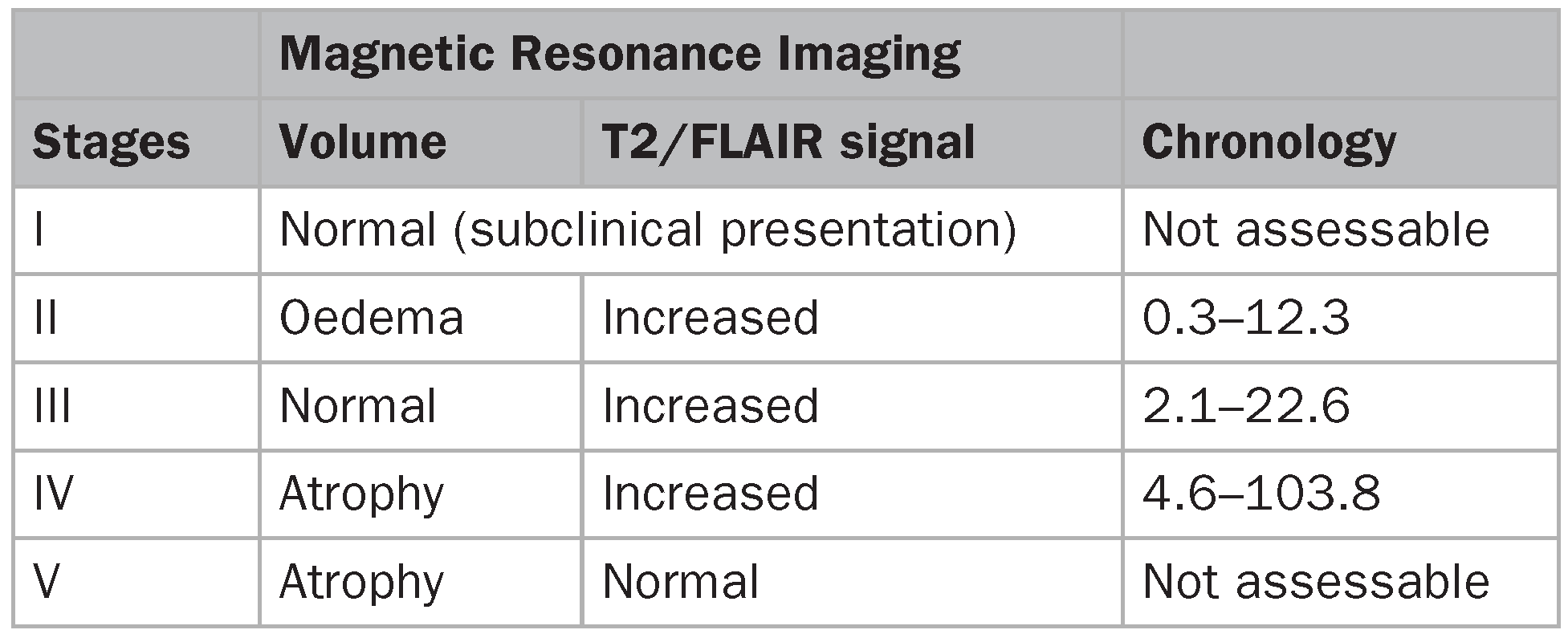
Bien et al. [8] have also proposed a 5-stage model based on magnetic resonance imaging (MRI) (see table 1). Stage 1 shows no abnormality, stage 2 shows oedema and increased signals, stage 3 reveals increased signals with normal hemispheric volume, stage 4 shows increased signals with hemispheric atrophy, and in stage 5 there is a disappearance of the increased signal, leaving a markedly atrophied cerebral hemisphere (cortical and subcortical) [9]. Again, it is hypothesised that the different stages represent the successive steps of an inflammatory reaction, in that earlier MRIs with the hyper-intensity signals reflect the activated T cells and astrocytes which gradually disappear at later stages.
Table 1.
MRI stages according to Bien et al. [8]. Chronology: the median of the minimal and maximal duration of each stage is expressed in months.
Clinical variants
Late onset of Rasmussen’s encephalitis
In around 10% of cases of Rasmussen’s encephalitis, the disease starts after the age of 12–13 years, with onsets occurring as late as 37 years [10,11,12]. The evolution is more variable with a more insidious onset and cerebral hemiatrophy at a later stage [13,14]. Moreover, the occipital lobes seem to be more frequently involved during the initial phase [3]. Compared to the early form, late presentation (mean age = 18.9 years old) is characterised by a more discrete hemiparesis in the prodromal phase, and a longer prodromal phase [7]. Hemiparesis, as well as hemispheric atrophy, is less pronounced in patients with the late form. As lesions occur more frequently in posterior areas, the patient may suffer from visual field defects, neglect or aphasia. For example, Kashihara et al. [15] have reported the case of a woman who had, besides convulsions, visual fields deficits and aphasia for up to 8 years. Only then did motor symptoms appear as mild right upper limb monoplegia. This constellation of adult symptoms plays an important role when therapeutic strategies are considered, in particular, when it comes to surgical versus medical treatment. In these patients, surgery may be difficult to propose if the neurological deficits do not include hemiparesis or hemianopia.
Bilateral hemispheric involvement
Typically Rasmussen’s encephalitis only concerns one hemisphere. However, in very young children (<2 years), bilateral involvement has been described leading to a more fatal outcome [16]. It usually starts within a few months in the other hemisphere. Bilateral Rasmussen’s encephalitis is extremely rare; no more than 12–15 cases have been described up to now, and it may well be that it is a different disease. A bilateral presentation has also been noted in adolescents and adults, but the evolution is less severe.
Rasmussen’s encephalitis with basal ganglia involvement
In a subset of patients, dystonia, choreiform movements or other hyperkinetic movements have been described, although they are mostly overshadowed by severe epilepsy and hemiparesis. In two paediatric series, 70% of all patients also had basal ganglia involvement [17,18]. This can be mild to severe. In a few case reports, hemidyskinesia dominated the clinical picture [19,20]. Major MRI changes are seen in the caudate nucleus or putamen, which remain static or show progressive atrophy. Secondary volume loss due to Wallerian degeneration through loss of overlying cortex is suspected, as the histopathological studies correlate.
Other variants include Rasmussen’s encephalitis forms with a delayed onset of epilepsy, 6–7 months after the onset of neurological symptoms and progressive hemispheric atrophy [21], or involvement of the brain stem encephalitis (and death) [22].
Histology
The aetiology and pathogenesis of Rasmussen’s encephalitis still remain unknown. Three hypotheses have been forwarded: (a) a direct viral insult, (b) an autoimmune process triggered through a viral agent, (c) a primary autoimmune process [1,3,4]. The first and second hypotheses are supported by patients’ reports of some minor infection before disease onset [2]. In biopsies, surgical or autopsy specimens, cortical inflammation with perivascular lymphocytic cuffing, gliosis with microglial activation and microglial nodules, as well as astrocytes and neurons loss have been observed [4]. Lesions tend to become confluent, in that they do not remain multifocal. The intensity of histopathological lesions becomes less with the duration of the disease, resulting in some sort of “burn-out” picture [3].
A large body of research has been devoted to identifying autoantibodies, implicated in the development of Rasmussen’s encephalitis. In 1994, Rogers et al. proposed a central role of GluR3 antibodies after they successfully immunised rabbits, which then showed seizures and similar brain histopathology as Rasmussen’s encephalitis patients [23]. However, neither GluR3 nor any other antibody (e.g., anti-munc 18 [24] or anti-acetylcholine-receptor a 7 subunit [25], GluR e2 [26]) has been regularly retrieved in most patients, which is why the role of GluR3 is questioned today. Moreover, they are also found in other types of severe epilepsies, and therefore they are less specific than previously thought. It is therefore concluded that GluR3 are not required to diagnose Rasmussen’s encephalitis. A predominance of cytotoxic T lymphocytes (CD8+) supports their role as the main mediator for damage and apoptotic neuronal death [27,28]. Today, the autoimmune hypothesis is more and more accepted [1], at least in part, because of the (transient) efficacy of plasmapheresis [29] and other immunomodulatory medications in the treatment of Rasmussen’s encephalitis (see below).
Diagnosis
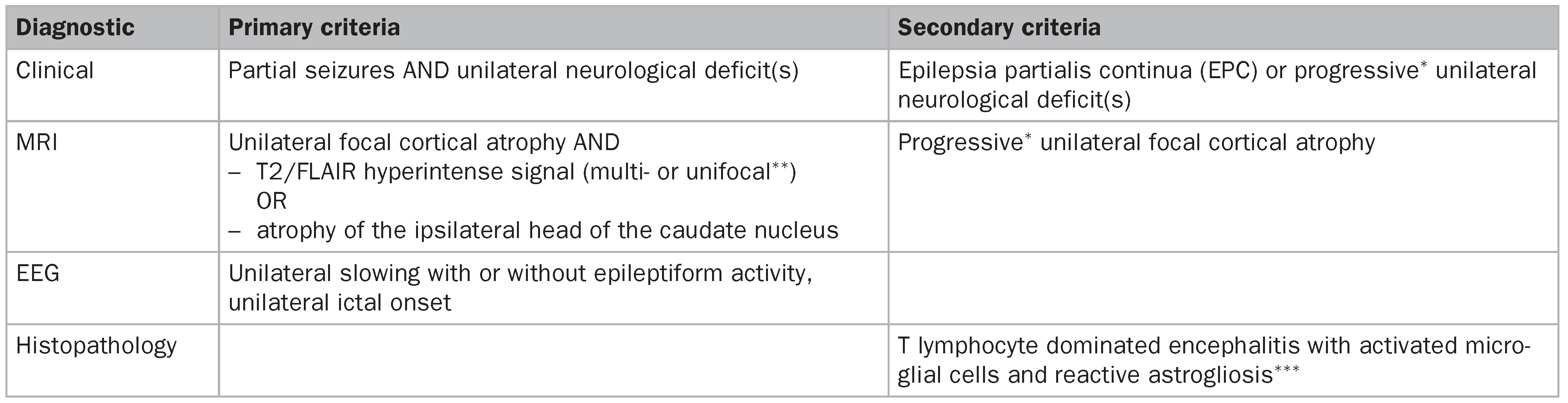
Diagnosis is based on features from the electroencephalogram (EEG), MRI and clinical and/or histological characteristics. The European consensus group proposed the diagnostic criteria, which can be found in table 2 [3].
Table 2.
Diagnosis criteria according to Bien et al. [3]. If all primary criteria are present, the diagnosis is very likely. If that is not the case, two out of three secondary criteria must be present.
Among the radiological, EEG and clinical criteria, the major finding is its monohemispherical aspect. In the beginning, the EEG shows slowing and multiple epileptogenic anomalies, always in the same hemisphere. Episodes of EPC are not necessarily associated with synchronised, rhythmic spike activity. Later in the disease, the epileptogenic abnormalities over the affected size diminish and become more apparent over the healthy hemisphere, therefore erroneously indicating that the unaffected hemisphere becomes epileptogenic. However, this is actually due to a propagation phenomenon, which is supported by the finding that epileptogenic discharges become confined to the affected hemisphere after surgical deconnection.
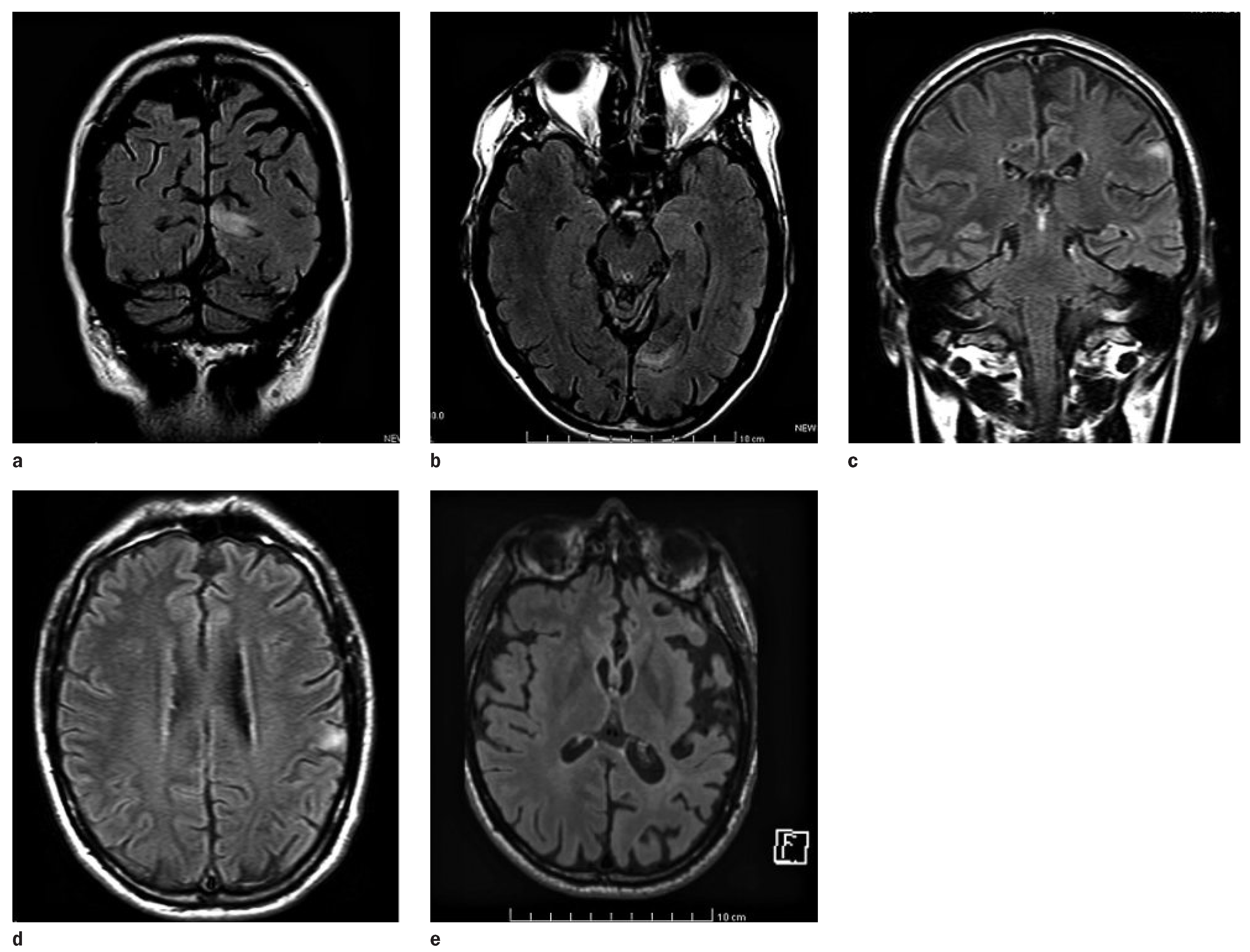
In the MRI, hyperintense signals in the white matter of the affected hemisphere and cortical swelling are seen, followed by cortical atrophy, which most often starts in the perisylvian and central area (see fig. 1), or in the late-onset cases in the posterior cortices (see fig. 2). However, the first MRIs can still be normal despite the presence of clinical EPC or active focal epileptogenic discharges. Thus, repetitive MRIs (e.g., every 6 months) in the beginning of the disease are necessary to visualise the progression and consolidate the diagnosis. Occasionally, a biopsy is required to confirm the hypothesis. The patient may also benefit from a gadolinium-MRI, MRI angiography or angiography to exclude a differential diagnosis of vasculitis, which occasionally presents in only one hemisphere. Other brain imaging techniques include positron emission tomography (PET) or single photon emission computed tomography (SPECT) which also show changes confined to only one hemisphere. MR spectroscopy usually shows decreased N-acetylaspartate, a marker for neuronal integrity. If targeted on central regions related to EPC or other areas of seizure onset, the presence of lactate is often found indicating ongoing seizure activity. Cerebrospinal fluid (CSF) analysis is unrevealing in 50% of all patients; the remainder shows inconsistent findings of elevated cell count, protein and oligoclonal bands [3]. Thus, CSF is not a diagnostic requirement for the diagnosis of Rasmussen’s encephalitis.
Usually, the lack of progression to contralateral sites allows the correct identification of RE. Other differential diagnoses, at least at some point in the clinical evolution, include vasculitis, cortical dysplasia, mitochondrial encephalopathy or cerebral tumour [1] which can also be reasonably excluded by the clinical evolution, follow-up brain imaging or, at times, brain biopsy.
Treatment
Antiepileptic treatment
Rasmussen’s encephalitis is highly pharmacoresistant in more than 80% of cases and up to now, no antiepileptic drug or combination is known to be superior over the others. RE patients risk being over-treated due to the sequential addition of antiepileptic drugs (AEDs) in order to control the very frequent seizures. This leads to increased toxicity but not necessarily to better seizure control. Restricted polytherapy (of 2–3 drugs) or even monotherapy is often equally effective as a large regimen. Although AEDs have little or even no effect on partial seizures and EPC [3], they reduce the risk of generalised seizures, and in that sense, antiepileptic therapy is recommended throughout the disease.
Figure 1.
Early-onset Resmussen’s encephalitis in a 8-year-old patient, affecting the right hemisphere (right is on the left of the MRI). a: Hyperintensity in the right basal temporal lobe and hippocampus. The brain appears otherwise of normal volume. b: One year later, atrophy of the right hemisphere appeared, best seen by the widened sylvian fissure. c: Despite a persistent seizure disorder, surgery was postponed and 2 years later, the unilateral atrophy is marked. Some atrophy is now also noted contralaterally. Eventually, the patient was operated and is seizure free since more than 8 years.
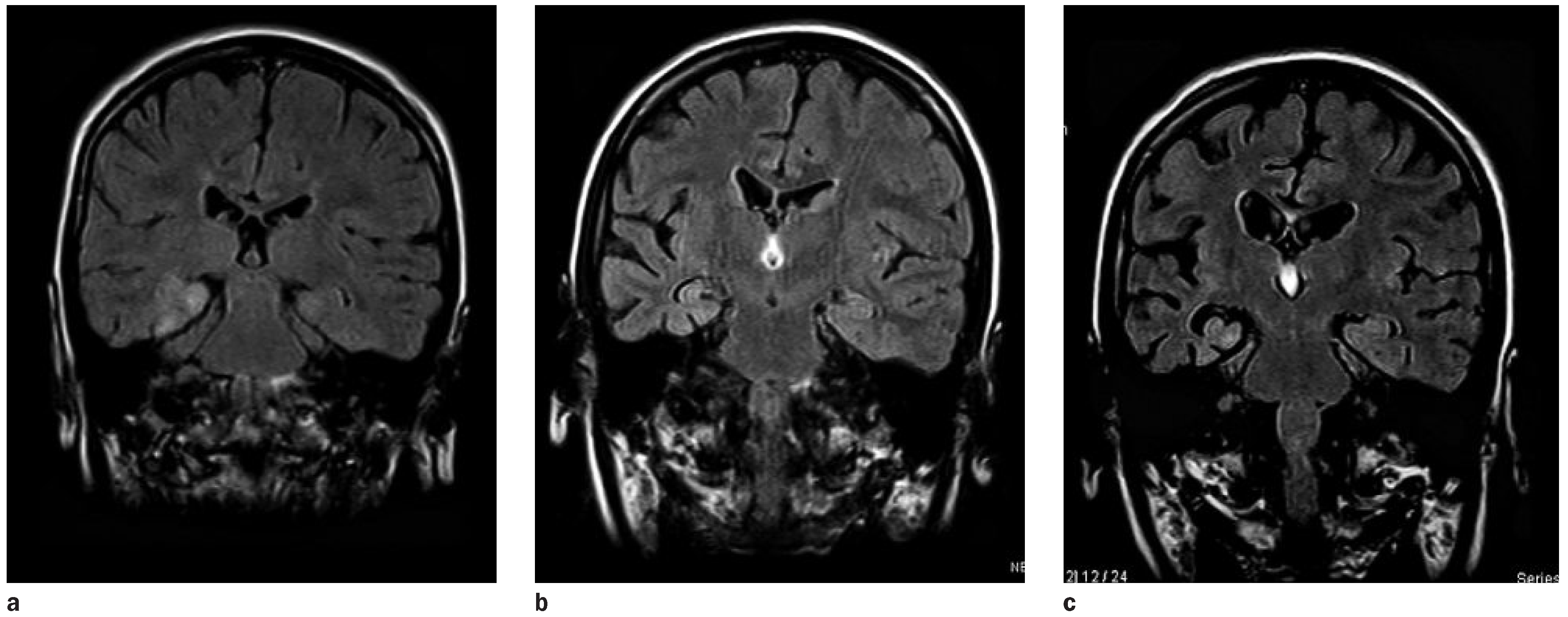
Figure 2.
Late-onset Rasmussen’s encephalitis in a 40-year-old patient (onset with 31 years old), beginning in the left occipital lobe and presenting as hyperintensity. a: coronal view; b: axial view. Clinically visual and aphasic seizures were recorded frequently, but no motor deficits appeared. c, d: 6 years later. Another hyperintense lesion in the same hemisphere appeared in the left inferior frontal lobe. There is a slight decrease of the left hemispheric volume, but unilateral atrophy is much less evident than in the case shown in figure 1. e: Almost 10 years later, there is marked left-sided atrophy and disappearance of hyperintense lesions. In the EEG, frequent seizures or even electrical status is found. Several medical and immunological treatments were tried but without consistent success. Surgery is declined, and motor functions are still intact.
Immunomodulatory treatment
This treatment line includes steroids, immunoglobulins (IG), plasmapheresis (PE) and immunosuppressive therapy.
Several studies used high steroid pulse therapy and reported encouraging, albeit only transient, results [30,31]. Corticosteroids, such as plasmapheresis, are useful in the treatment of status epilepticus [32]. The best results with steroids were obtained when the treatment was started early after the onset of the disease, and with high dosages [30].
IG are better tolerated overall than long-term steroids, which motivated several treatment studies of Rasmussen’s encephalitis. Variable results were reported [31,33,34] ranging between no effect and more or less improvement. The rationale of this therapy is the introduction of natural antibodies that counteract the patient’s own autoantibodies.
Plasmapheresis aims to remove circulating antibodies or other inflammatory factors which damage the brain [32]. Transient and sometimes quite significant responses have been noted, but no persistent long-term effects have been reported [29]. Like steroids and IG, it may be a promising and valuable option in the acute worsening of RE.
Immunosuppressive therapy comes in many facets. Cyclophosphamide was tried in a study of four patients but no major effect was found [32]. Granata et al. [32] compared the efficacy of different immunomodulating treatments and proposed an algorithm. It was felt that steroids have a better efficacy when they are used early in the course of the disease with childhood-onset and during acute aggravations. In contrast, IG, alone or in combination with corticosteroids, may be more useful in patients who have late-onset RE.
Gancyclovir [35], IFN-a, cyclophosphamide or zidovudine (a nucleoside reverse transcriptase inhibitor) have been used in isolated cases, but no consistent picture in terms of efficacy has emerged.
In 2004, Bien et al. presented a more systematic study on the efficacy of Tacrolimus [36]. Tacrolimus is a bacterial macrolide. By inhibiting calcineurin, it prevents the synthesis of interleukine 2 (IL-2), which inhibits the activation of T lymphocytes. Compared to a historical control group (i.e. patients followed until they received medical or surgical treatment), the patients on Tacrolimus showed less cerebral hemiatrophy and less hemiparesis. However, the authors did not find any significant effect on the seizures frequency.
In 2009, a 20 year old woman affected by RE had been suffering from EPC for 8 years and was successfully treated by Rituximab [37]. Rituximab is a monoclonal antibody directed against the glycoprotein CD20 of B lymphocytes. Its link to the CD20 leads to the destruction of the B lymphocyte by the immune system. The good tolerance of Rituximab is due, at least in part, to the fact that plasmocytes are not affected by the drug. In this case report, the administration of Rituximab allowed the reduction of EPC. Rituximab had no effect on the hemiparesis and, at best, prevented further deterioration. During 12 months, the patient was first seizure-free and then presented only very few and nondisabling seizures. It will be shown by prospective studies if Rituximab is an efficient immunomodulator in other or even in most RE patients. Up to now, only surgery allows seizure control and remains the most efficient treatment.
Surgical treatment
The principal surgical approach consists of disconnection of the affected hemisphere from the contralateral functioning hemisphere, but with minimal intra-operative haemorrhage in order to avoid contamination of the blood with cerebrospinal fluid (CSF) and possible early or late adhesions and hydrocephalus.
There are several ways to achieve isolation of one hemisphere [38]. In the early days of surgical Rasmussen’s encephalitis treatment, anatomical hemispherectomy was carried out. It consists of the complete removal of one hemisphere with or without basal ganglia. A variant of that approach aims at reducing the postoperative cavity and eliminating the communication of the CSF with the hemispherectomy cavity by obstructing the ipsilateral foramen of Monro with muscle tissue. Hemidecortication consists of the removal of the cortex of the affected hemisphere, including a resection of the temporal lobe in order to reach mesial temporal lobe structures. The maximum amount of white matter is preserved with the aim to minimise neurological deficits. Hemicorticectomy is a similar procedure, but leaves only the white matter around the ventricle.
Currently, functional hemispherectomy and its variants are proposed most frequently, in which a large part of central and parasagittal tissue is removed, providing a window to the lateral ventricle. Through this window, disconnection of the affected hemisphere from the healthy hemisphere is carried out by cutting all fibres of the corpus callosum. Moreover, the temporal lobe, including the mesial structures, is also resected. A modified, less invasive type of functional hemispherectomy, transsylvian keyhole functional hemispherectomy, is the latest variant of surgical RE techniques [39,40]. The aim of this surgery is to interrupt the connection of the cortex with the basal ganglia and with the contralateral hemisphere [41]. Described initially by Schramm et al. in 2000, the procedure requires a small craniotomy (of about 4 per 4–5 per 6 centimetres), with the lower border about 2.5 cm below the Sylvian fissure. In the keyhole technique, the size of the incision is mainly defined by the size of the lateral fissure. The Sylvian fissure is opened allowing the identification of the middle cerebral artery and its branches, which is essential as these arteries have to be preserved during the procedure. Through the inferior part of the circular sulcus, the surgeon is then able to reach the temporal horn of the lateral ventricle. Temporomesial structures, such as the amygdala, uncus and hippocampus, are then removed. Through the upper circular sulcus, the surgeon can reach the body of the lateral ventricle. From the inside of the ventricular system, a callosotomy and a white matter disconnection can eventually be accomplished from the frontal horn to the temporal horn of the lateral ventricle. The callosotomy is completed (still from the inside of the lateral ventricle) by following the anterior cerebral artery, then the pericallosal artery, and beyond the bifurcation of the pericallosal artery to the splenium of the corpus callosum. During the procedure, the insular cortex is removed. Through this technique, complete isolation of the affected hemisphere from the healthy hemisphere is given, with minimal brain removal.
Post-operative fever and, rarely, focal or generalised seizures may be observed during the early phase without any effect on the prognosis. Hydrocephalus is a feared complication, due to abnormal CSF circulation and absorption through blood contamination and also due to a decreased surface of the subarachnoidal space for CSF resorption. Both complications are less likely to occur with limited brain removal but complete disconnection. There is also the possibility of a later hydrocephalus (in the context of superficial cerebral haemosiderosis), which has been reported to be fatal in some cases, but is most often described in anatomical hemispherectomy.
Concerning the post-operative outcome, there is a high chance of postoperative seizure freedom or major seizure improvement. A recent study [42] evaluated the outcomes of children (mean follow-up duration: 4.5 years) who benefited from hemispherotomy. Among children with Rasmussen syndrome, 65% were seizure free and 26% had minor seizures, leaving only 9% without significant benefit. Overall the peri-operative mortality rate was low (2.7%). In another review of 153 operated children, 1 patient (0.7%) died during the in-patient period [43].
There are of course concerns that such an extensive tissue removal can lead to profound and persistent neurological and cognitive deficits. In all cases, a spastic arm and leg paresis (with good recovery of the leg, but basically no recovery of the distal hand function) is expected as an inevitable postoperative consequence as well as hemianopia. Thus the timing of the intervention, or even its overall indication, depends on the deficits that the patient already has. In some cases, postponing the operation is motivated by the presence of only subtle neurological deficits, and the decision to significantly increase only subtle deficits is not easily taken. However, if the seizure frequency becomes very disabling, and/or the use of immunomodulating treatment is ineffective, and/or the hand function for targeted movements is already compromised, surgery should be discussed and carried out at specialised centres.
Pulsifer et al. [44] studied the cognitive outcome in a larger population of Rasmussen’s encephalitis patients. Among the 71 patients undergoing hemispherectomy, 37 were suffering from RE. Among the RE patients, 27 (73%) were seizure free after surgical treatment (mean follow-up duration: 5.4 years). A total of 19 (51%) still needed medication. The only significant post-operative decrease in RE patients was noted for expressive language in both left and right sided RE. Other data [45,46] present similar results. It has been found that behavioural difficulties tend to improve. Language performances remained preserved in the majority of cases due to the brain’s plasticity, operational already prior to surgery.
Thus, overall surgery preserves the cognitive abilities, as the procedure seems to halt the decline in cognitive status. Consequently, hemispherotomy should be carried out when the deterioration of cognitive functions continues, and there remains “something to save”. Therefore, surgical treatment should not be considered as a “last resort” in typical RE.
Funding/potential competing interests
The work was supported by the Swiss National Science Foundation (No. 3200-113766, No 320030-122073 and SPUM 33CM30-124089 [M.S.]).
References
- Mastrangelo, M; Mariani, R; Menichella, A. Eponym Rasmussen syndrome. Eur J Pediatr. 2010, 169(8), 919–24. [Google Scholar] [CrossRef] [Scilit]
- Oguni, H; Andermann, F; Rasmussen, TB. The Syndrome of Chronic Ence- phalitis and Epilepsy. Adv Neurol. 1992, 57, 419–33. [Google Scholar] [PubMed]
- Bien, CG; Granata, T; Antozzi, C; Cross, JH; Dulac, O; Kurthen, M; et al. Pathogenesis, diagnosis and treatment of Rasmussen encephalitis A European consensus statement. Brain 2005, 128, 454–71. [Google Scholar] [CrossRef] [Scilit]
- Bauer, J; Bien, CG. Encephalitis and epilepsy. Semin Immunopathol. 2009, 31(4), 537–44, Epub 2009 Sep 11. [Google Scholar] [CrossRef] [Scilit] [PubMed]
- Pardo, CA; Vining, EPG; Guo, L; Skolasky, RL; Carson, BS; Freeman, JM. The Pathology of Rasmussen Syndrome: Stages of Cortical Involvement and Neuropathological Studies in 45 Hemispherectomies. Epilepsia 2004, 45(5), 516–26. [Google Scholar] [CrossRef] [Scilit]
- Oguni, H; Andermann, F; Rasmussen, TB. The natural history of the syndrome of chronic encephalitis and epilepsy: a study of the MNI series of forty-eight cases. In Chronic encephalitis and epilepsy-Rasmussen’s syndrome; Andermann, F, Ed.; Butterworth-Heinemann: Boston, 1991. [Google Scholar]
- Bien, CG; Widman, G; Urbach, H; Sassen, R; Kuczaty, S; Wiestler, OD; Schramm, J; Elger, CE. The natural history of Rasmussen’s encephalitis. Brain 2002, 125, 1751–9. [Google Scholar] [CrossRef] [Scilit] [PubMed]
- Bien, CG; Urbach, H; Deckert, M; Schramm, J; Wiestler, OD; Lassmann, H; et al. Diagnosis and staging of Rasmussen’s encephalitis by serial MRI and histopathology. Neurology 2002, 22;58(2), 250–7. [Google Scholar] [CrossRef] [Scilit]
- Millichap, JJ; Goldstein, JL. Teaching NeuroImages: Long-term outcome of untreated Rasmussen syndrome. Neurology 2010, 75(20), e85. [Google Scholar] [CrossRef] [Scilit]
- Cheong, JY; Wong, C; Bleasel, A; Varikatt, W; Ng, T; Dexter, MA. Late onset Rasmussen’s encephalitis with triple pathology. J Clin Neurosci. 2009, 16(12), 1677–81. [Google Scholar] [CrossRef] [Scilit]
- Gambardella, A; Andermann, F; Shorvon, S; Le Piane, E; Aguglia, U. Limited chronic focal encephalitis: another variant of Rasmussen syndrome? Neurology 2008, 70(5), 374–7. [Google Scholar] [CrossRef] [Scilit]
- McLachlan, RS; Girvin, JP; Blume, WT; Reichman, H. Rasmussen’s chronic encephalitis in adults. Arch Neurol. 1993, 50(3), 269–74. [Google Scholar] [CrossRef] [Scilit]
- De Leva, MF; Varrone, A; Filla, A; Quarantelli, M; Bilo, L; Piscitelli, V; et al. Neuroimaging Follow-Up in a Case of Rasmussen’s Encephalitis with Dyskinesias. Mov Disord. 2007, 31;22(14), 2117–21. [Google Scholar] [CrossRef] [Scilit]
- Hart, YM; Andermann, F; Fish, DR; Dubeau, F; Robitaille, Y; Rasmussen, T; et al. Chronic encephalitis and epilepsy in adults and adolescents –A variant of Rasmussen’s syndrome. Neurology 1997, 48(2), 418–24. [Google Scholar] [CrossRef] [Scilit]
- Kashihara, K; Ohno, M; Takahashi, Y. Twenty-one-year course of adult-onset Rasmussen’s encephalitis and bilateral uveitis: case report. J Neurol Sci. 2010, 294(1-2), 127–30. [Google Scholar] [CrossRef] [Scilit] [PubMed]
- Tobias, SM; Robitaille, Y; Hickey, WF; Rhodes, CH; Nordgren, R; Andermann, F. Bilateral Rasmussen encephalitis: postmortem documentation in a five-year-old. Epilepsia 2003, 44, 127–30. [Google Scholar] [CrossRef] [Scilit] [PubMed]
- Bhatjiwale, MG; Polkey, C; Cox, TC; Dean, A; Deasy, N. Rasmussen’s encephalitis: neuroimaging findings in 21 patients with a closer look at the basal ganglia. Pediatr Neurosurg. 1998, 29, 142–8. [Google Scholar] [CrossRef] [Scilit] [PubMed]
- Chiapparini, L; Granata, T; Farina, L; Ciceri, E; Erbetta, A; Ragona, F; et al. Diagnostic imaging in 13 cases of Rasmussen’s encephalitis: can early MRI suggest the diagnosis? Neuroradiology 2003, 45, 171–83. [Google Scholar] [CrossRef] [Scilit]
- Ben-Zeev, B; Nass, D; Polack, S; et al. Progressive unilateral basal ganglia atrophy and hemidystonia: a new form of chronic focal viral encephalitis. Neurology 1999, S2, A42. [Google Scholar]
- Koehn, MA; Zupanc, ML. Unusual presentation and MRI findings in Rasmussen’s syndrome. Pediatr Neurol. 1999, 21, 839–42. [Google Scholar] [CrossRef] [Scilit]
- Korn-Lubetzki, I; Bien, CG; Bauer, J; Gomori, M; Wiendl, H; Trajo, L; et al. Rasmussen encephalitis with active inflammation and delayed seizures onset. Neurology 2004, 62, 984–6. [Google Scholar] [CrossRef] [Scilit]
- McDonald, D; Farrell, MA; McMenamin, J. Rasmussen’s syndrome associated with chronic brain stem encephalitis. Eur J Paediatr Neurol. 2001, 5, 203–6. [Google Scholar] [CrossRef] [Scilit] [PubMed]
- Rogers, SW; Andrews, PI; Gahring, LC; Whisenand, T; Cauley, K; Crain, B; et al. Autoantibodies to glutamate receptor GluR3 in Rasmussen’s encephalitis. Science 1994, 265, 648–51. [Google Scholar] [CrossRef] [Scilit]
- Yang, R; Puranam, RS; Butler, LS; Qian, WH; He, XP; Moyer, MB; et al. Auto- immunity to munc-18 in Rasmussen’s encephalitis. Neuron 2000, 28, 375–83. [Google Scholar] [CrossRef] [Scilit] [PubMed]
- Watson, R; Lang, B; Bermudez, I; et al. Autoantibodies in Rasmussen’s encephalitis. J Neuroimmunol. 2001, 118, 148. [Google Scholar]
- Takahashi, Y; Mori, H; Mishina, M; Watanabe, M; Fujiwara, T; Shimomura, J; et al. Autoantibodies to NMDA receptor in patients with chronic forms of epilepsia partialis continua. Neurology 2003, 14;61, 891–6. [Google Scholar] [CrossRef] [Scilit]
- Schwab, N; Bien, CG; Waschbisch, A; Becker, A; Vince, GH; Dornmair, K; et al. CD8+ T-cell clones dominate brain infiltrates in Rasmussen encephalitis and persist in the periphery. Brain 2009, 132 Pt 5, 1236–46, Epub 2009 Jan 29. [Google Scholar] [CrossRef] [Scilit]
- Li, Y; Uccelli, A; Laxer, KD; Jeong, MC; Vinters, HV; Tourtelotte, WW; et al. Local-clonal expansion of infiltrating T lymphocytes in chronic encephalitis of Rasmussen. J Immunol. 1997, 158, 1428–37. [Google Scholar] [CrossRef] [Scilit]
- Andrews, PI; Dichter, MA; Berkovic, SF; Newton, MR; McNamara, JO. Plasma- pheresis in Rasmussen’s encephalitis. Neurology 1996, 46(1), 242–6. [Google Scholar] [CrossRef] [Scilit]
- Chinchilla, D; Dulac, O; Robain, O; Plouin, P; Ponsot, G; Pinel, JF; Graber, D. Reappraisal of Rasmussen’s syndrome with special emphasis on treatment with high doses of steroids. J Neurol Neurosurg Psychiatry 1994, 57, 1325–33. [Google Scholar] [CrossRef] [Scilit]
- Hart, YM; Cortez, M; Andermann, F; Hwang, P; Fish, DR; Dulac, O; et al. Medical treatment of Rasmussen’s syndrome (chronic encephalitis and epilepsy): effect of high-dose steroids or immunoglobulins in 19 patients. Neurology 1994, 44, 1030–6. [Google Scholar] [CrossRef] [Scilit] [PubMed]
- Granata, T; Fusco, L; Gobbi, G; Freri, E; Ragona, F; Broggi, G; et al. Experience with immunomodulatory treatments in Rasmussen’s encephalitis. Neurology 2003, 61(12), 1807–10. [Google Scholar] [CrossRef] [Scilit]
- Leach, JP; Chadwick, DW; Miles, JB; Hart, IK. Improvement in adult-onset Rasmussen’s encephalitis with long-term immunomodulatory therapy. Neurology 1999, 52(4), 738–42. [Google Scholar] [CrossRef] [Scilit] [PubMed]
- Wise, MS; Rutledge, SL; Kuzniecky, RI. Rasmussen syndrome and long-term response to gamma globulin. Pediatr Neurol. 1996, 14, 149–52. [Google Scholar] [CrossRef] [Scilit]
- McLachlan, RS; Levin, S; Blume, WT. Treatment of Rasmussen’s syndrome with Gancyclovir. Neurology 1996, 47(4), 925–8. [Google Scholar] [CrossRef] [Scilit]
- Bien, CG; Gleissner, U; Sassen, R; Widman, G; Urbach, H; Elger, CE. An open study of tacrolimus therapy in Rasmussen encephalitis. Neurology 2004, 62(11), 2106–9. [Google Scholar] [CrossRef] [Scilit]
- Thilo, B; Stingele, R; Knudsen, K; Boor, R; Bien, CG; Deuschl, G; Lang, N. A case of Rasmussen encephalitis treated with rituximab. Nat Rev Neurol. 2009, 5(8), 458–62. [Google Scholar] [CrossRef] [Scilit]
- De Almeida, AN; Marino, R, Jr.; Aguiar, PH; Jacobsen Teixeira, M. Hemi- spherectomy: a schematic review of the current techniques. Neurosurg Rev. 2006, 29(2), 97–102. [Google Scholar] [CrossRef] [Scilit]
- Schramm, J. Hemispherectomy techniques. Neurosurg Clin N Am. 2002, 13(1), 113–34. [Google Scholar] [CrossRef] [Scilit] [PubMed]
- Schramm, J; Kral, T; Clusmann, H. Transsylvian keyhole functional hemi- spherectomy. Neurosurgery 2001, 49(4), 891–900. [Google Scholar] [PubMed]
- Schramm, J; Behrens, E; Entzian, W. Hemispherical deafferentation: an alternative to functional hemispherectomy. Neurosurgery 1995, 36(3), 509–15. [Google Scholar] [CrossRef] [Scilit]
- Kossoff, EH; Vining, EPG; Pillas, DJ; Pyzik, PL; Avellino, AM; Carson, BS; Freeman, JM. Hemispherectomy for intractable unihemispheric epilepsy etiology vs outcome. Neurology 2003, 61, 887–90. [Google Scholar] [CrossRef] [Scilit]
- Koubeissi, MZ; Syed, TU; Syed, I; Jordan, J; Alshekhlee, A; Kossoff, EH. Hemispherectomy-associated complications from the Kids’ Inpatient Database. Epilepsy Res. 2009, 87(1), 47–53. [Google Scholar] [CrossRef] [Scilit] [PubMed]
- Pulsifer, MB; Brandt, J; Salorio, CF; Vining, EP; Carson, BS; Freeman, JM. The cognitive outcome of hemispherectomy in 71 children. Epilepsia 2004, 45, 243–54. [Google Scholar] [CrossRef] [Scilit] [PubMed]
- Devlin, AM; Cross, JH; Harkness, W; Chong, WK; Harding, B; Vargha-Khadem, F; et al. Clinical outcomes of hemispherectomy for epilepsy in childhood and adolescence. Brain 2003, 126 Pt 3, 556–66. [Google Scholar] [CrossRef] [Scilit] [PubMed]
- Thomas, SG; Daniel, RT; Chacko, AG; Thomas, M; Russell, PS. Cognitive changes following surgery in intractable hemispheric and sub-hemispheric pediatric epilepsy. Childs Nerv Syst. 2010, 26(8), 1067–73. [Google Scholar] [CrossRef] [Scilit]

This is an open-access article distributed under the terms of the Creative Commons Attribution Non-Commercial No Derivatives (CC BY-NC-ND) 4.0 License.