Introduction
The central vestibular pathways (CVP) interconnect a network of the brainstem, cerebellar, thalamic and cortical areas involved in the processing, integration, and perception of “graviceptive” input [
1,
2]. Otolith and semicircular canal (SCC) inputs converge at the vestibular nuclei [
3], project via bilateral ascending pathways through the medial lateral fascile (MLF) to the interstitial nucleus of Cajal (INC) and to the posterolateral thalamus [
4], and end in the temporo-peri-Sylvian vestibular cortex (TPSVC). The TPSVC is considered to be the human analogue of the parieto-insular vestibular cortex (PIVC) in non-human primates [
5], where the vestibular input converges with other sensory signals and sub-serves perception of spatial orientation and navigation [
6]. In the upright position, the internal representation of gravity and spontaneous head orientation aligns with gravity, while the torsional orientation of the eyes is symmetric (binocular fundoscopic torsion = 0°). Depending on the exact topography of the lesion, vestibular toneimbalances lead to roll tilts of perception, head, and body as well as to misalignments of the visual axes (skew deviation) [
7,
8] and binocular torsion [
1].
Perception of self orientation relative to gravity can be assessed by aligning an illuminated line with the perceived vertical, termed the “subjective visual vertical” (SVV) [
9]. Under static conditions in darkness, the SVV is mainly influenced by otolith signals. Estimates of SVV in upright positions are accurate (i.e., within a range of ± 2°, [
9,
10]). Aligning a luminous line to the perceived vertical while roll-tilted requires the subject to compensate for body roll. Body roll leads to errors towards over-estimation (E-effect) at moderate roll angles up to 60° [
11,
12,
13], whereas at roll angles larger than 60° perceived body roll is biased towards under-estimation (A-effect) [
12,
14]. It was suggested that A- and E-effects are a consequence of how various sensory signals are integrated into a unified perception of vertical [
14]. While Mittelstaedt put a focus on an imbalanced otolith input to cause the A- and E-effects [
14], more recent modelling of perceived vertical underlined the role of a noisy but accurate otolith signal [
13,
15]. To maximise the precision of verticality estimates, this noisy otolith estimate is combined with a bias that represents prior knowledge about where vertical is located. This bias refers to the body-longitudinal axis and is based on the assumption that small rolltilt angles are more likely than large angles. Using this modelling approach, verticality estimates at small roll angles are accurate and precise, however, at larger roll angles, both A- and E-effects arise, reflecting the experimental data well [
13,
15].
Figure 1.
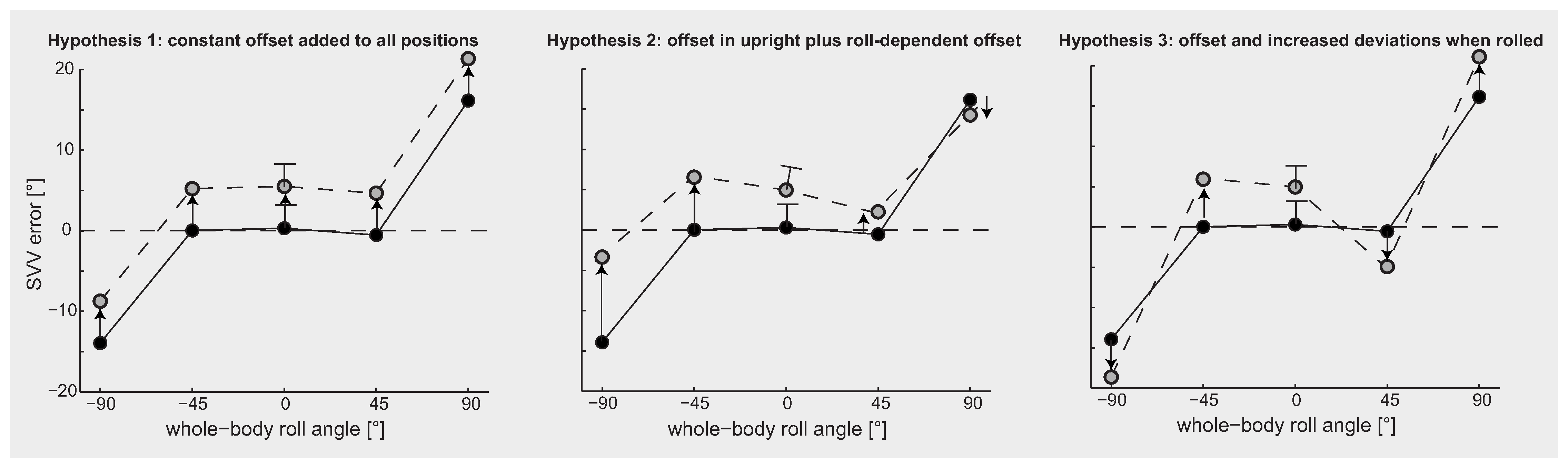
In this figure, distinct hypothetical changes in perceived vertical in both upright and roll-tilted positions are illustrated (grey circles). For comparison, average SVV adjustments from healthy normal subjects (in black) are shown. Whereas hypothesis 1 suggests a constant offset of SVV over the entire roll plane, hypothesis 2 proposes body-position-dependent SVV errors in roll-tilted positions that are in the same direction (shown) or in the opposite direction (not shown) as the offset of SVV in the upright position. Alternatively, lesions along the CVP may increase the noise in the sensory estimate and cause not only a shift of SVV in upright but increase the error signal, so that both established A- and E-effects would become larger (hypothesis 3).
Figure 1.
In this figure, distinct hypothetical changes in perceived vertical in both upright and roll-tilted positions are illustrated (grey circles). For comparison, average SVV adjustments from healthy normal subjects (in black) are shown. Whereas hypothesis 1 suggests a constant offset of SVV over the entire roll plane, hypothesis 2 proposes body-position-dependent SVV errors in roll-tilted positions that are in the same direction (shown) or in the opposite direction (not shown) as the offset of SVV in the upright position. Alternatively, lesions along the CVP may increase the noise in the sensory estimate and cause not only a shift of SVV in upright but increase the error signal, so that both established A- and E-effects would become larger (hypothesis 3).
Following unilateral or bilateral lesions along the CVP, the SVV becomes biased and increased noise levels of the centrally obtained estimate of vertical will interfere with the A- and E-effect. However, little is known about the interaction between the A- and E-effect and shifts caused by lesions along the CVP. Hypothetically, various changes in the pattern of A- and E-effects may emerge. The most straight forward hypothesis is that an imbalance of the graviceptive input is combined additively with the physiological deviations when roll-tilted, resulting in a constant offset of the A- and E-effect over the entire roll plane (hypothesis 1). Alternatively, shifts in SVV in an upright position may be accompanied by body-position-dependent errors in the direction or in opposite direction of the SVV offset in an upright position. Thereby E-effects would become more pronounced and A-effects would decrease (hypothesis 2), or vice versa (not shown). Overall, shifts in the SVV may result in larger A- and E-effects as the noise level of the graviceptive signal is likely to be larger. Under these circumstances, the brain might put more weight on prior knowledge at the cost of increased SVV errors at larger roll angles (hypothesis 3).
In patients with acute lesions along the CVP, verticality perception has been studied in upright positions only. Whereas peripheral vestibular [
16,
17,
18,
19] and caudal brainstem lesions resulted in ipsiversive tilts of SVV, more rostral brainstem lesions yield contraversive SVV deviations [
20]. Contraversive SVV tilts and contraversive signs of ocular tilt reaction (OTR; consisting of ocular torsion, skew deviation and head-tilt) in patients with acute cerebellar stroke have been related to either nodular [
21] or dentate nucleus lesions [
22], whereas in patients with ipsiversive SVV tilts and ipsiversive OTR the dentate nucleus was spared and lesions were located in the biventer lobule, the middle cerebellar peduncle, the tonsil and the inferior semilunar lobule [
22]. Acute lesions within the territory of the middle cerebral artery including the posterior part of the insula, the insular gyrus, and the middle and superior temporal gyrus yielded mostly contraversive SVV tilts and imbalance of gait [
23]. Ipsiversive SVV tilts and impaired postural stability were reported in a patient with a metastasis extending from the superior temporal gyrus to the first long insular gyrus [
24], suggesting involvement of the superior temporal gyrus in estimating gravity. Here we evaluated both the accuracy and precision of SVV adjustments in patients with lesions along the CVP in various roll-tilted positions, both in the sub-acute and the chronic state, to further characterise 1) the pattern of A- and E-effects when the graviceptive input is imbalanced and 2) recovery of verticality perception, both in terms of accuracy and precision. Based on the literature, it was hypothesised that both the pattern of roll over- and under-estimation and precision are altered in the patients.
Discussion
The found changes of SVV deviations in the sub-acute stage of patients with lesions along the CVP suggest that body-position-dependent changes of SVV errors, when rolltilted, occur on top of an SVV error in an upright position. This result is most consistent with hypothesis 2 (see
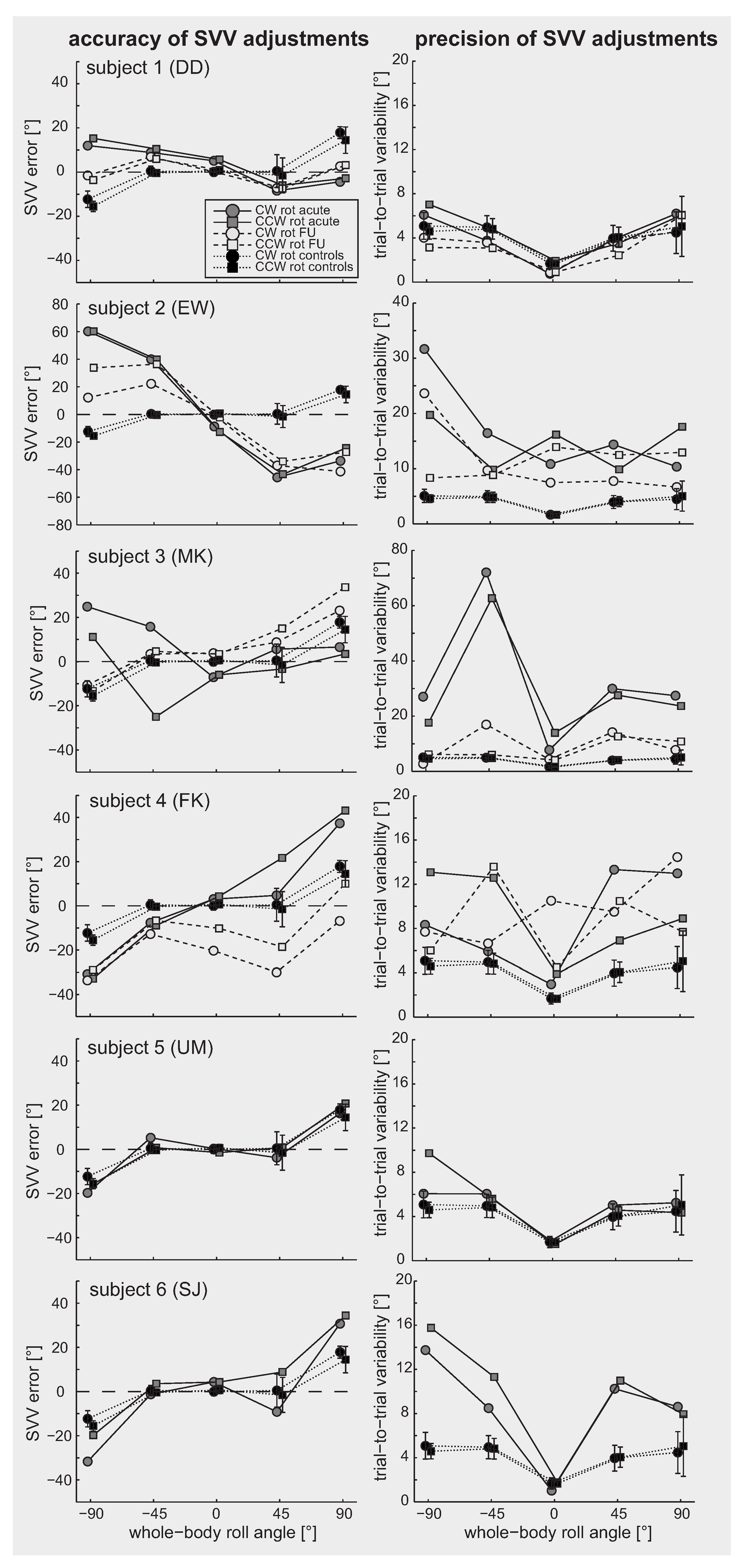
fig. 1). Whereas in patients with cerebellar and mesencephalic lesions deviations were shifted towards roll over-compensation (E-effect), increasing roll under-compensation (Aeffect) was noted in one patient with a ponto-mesencephalic (FK) and in one patient with a unilateral posterolateral and paramedian thalamic (SJ) lesion. Such increases or decreases of A-effects and shifts towards E-effects over the entire roll plane are likely to be related to the lesioned CVP and suggest altered central processing of graviceptive input. Considering the often inhibitory function of vestibulo-cerebellar structures, the observed E-effects in patients with cerebellar lesions could be interpreted as loss of cerebellar inhibition. In the patient with a paramedian mesencephalic lesion (MK), the increased E-effects could be related to impaired processing of inhibitory cerebellar input. In the two patients with increased A-effects, a stronger impact of inhibitory cerebellar input could hypothetically provide an explanation.
We observed both ipsi- and contralesional deviations of the SVV in the upright position. Similarly, the direction of the deviations (ipsilesional vs. contralesional) also varied in the two patients with unilateral cerebellar lesions and likely depended upon the location of the cerebellar lesion. Whereas a contralesional shift was noted when the dentate nucleus was affected (EW), an ipsilesional shift was observed when this structure was spared (DD). Previously, contraversive SVV tilts in patients with acute cerebellar stroke have been related to lesions of dentate nucleus [
22] or the cerebellar nodulus [
21], whereas in patients with ipsiversive SVV tilts lesions of the biventer lobe, the inferior semilunar lobe, the tonsils and the middle cerebellar peduncle were noted, with the dentate nucleus being spared [
22]. These descriptions match our observations well.
Within the brainstem, it was proposed that more caudal (ponto-medullary) lesions yield ipsiversive SVV deviations whereas more cranial (ponto-mesencephalic) lesions result in contraversive SVV tilts [
1,
20]. In the current study, ipsilesional SVV shifts were noted in a patient with a mesencephalic lesion including the MLF and the INC in the sub-acute stage (MK), which is opposite to previous observations. Noteworthy, in this subject, SVV deviations shifted over time, being contralesional at follow-up. Pos-sibly the direction of SVV deviations in mesencephalic lesions varies over time and may be ipsilesional in earlier stages. In another patient (FK) with a ponto-mesencephalic haemorrhage, we observed an ipsilesional shift in the subacute stage, which would be in agreement with the findings from Brandt and Dieterich.
Whereas posterolateral thalamic lesions presented with deviations of SVV in a majority of cases in a study reported by Dieterich and Brandt, deviations in perceived direction of gravity in patients with anterior paramedian thalamic lesions were linked to additional midbrain tegmental involvement [
4]. In the two patients with paramedian thalamic lesions studied here, one (SJ) showed a contralesional shift, which was associated with posterolateral thalamic involvement (including the Vim and Vce) with MR-imaging. Both the Vim and Vce have been reported to process graviceptive signals, yielding ipsi- or contraversive SVV tilts without concomitant OTR [
4]. The other patient (UM) initially had signs of a midbrain involvement (vertical diplopia on lateral gaze, possibly associated with a nuclear trochlear nerve palsy), however, when recording the SVV in this patient (with a delay of 33 days after symptom onset) we noted intact perception of verticality along with diminished vertical diplopia. In this subject, it is hypothesised that the thalamic lesion transiently compressed midbrain structures, leading to a nuclear fourth nerve palsy and explaining the vertical diplopia. With MR-imaging this patient presented with no involvement of midbrain structures that belonged to the CVP (such as the MLF and the INC).
The decreased precision of adjustments noted in four patients reflects more uncertainty about self-orientation in space due to impaired central processing of bilateral vestibular input. Improvements of accuracy and precision of verticality perception within four months after lesions along the CVP demonstrate that the body-position-dependent SVV errors observed in the sub-acute stage are readjusted, most likely as a result of central compensation. However, as shown in a patient with a dorsal ponto-mesencephalic haemorrhage and hypertrophic degeneration of the right inferior olive (Mollaret degeneration) at follow-up (see [
26] for review), interruption of the rubro-dentato-olivary tract (termed ‘Guillain-Mollaret triangle’ [
27]) can interfere with recovery.
Evaluation of internal estimates of direction of gravity both in terms of accuracy and precision is a sensitive means to quantify the integrity of the CVP. During rehabilitation, patients with lesions along the CVP may first regain their ability to estimate direction of gravity when upright. However, they may still demonstrate difficulties (as reflected in increased A- or E-effects and larger trial-to-trial variability) in the same task when roll-tilted. When assessing the patient’s behavioural skills with regards to perceived direction of gravity, restriction to an upright position may under-estimate residual symptoms and may therefore lead to premature cessation of rehabilitative efforts. Based on our data, we propose assessing the integrity of the CVP in various rolltilted positions also.