Apart from the available published material on Jules Déjerine’s and Augusta Klumpke’s life and career, I interviewed their grandson Jean-Claude Sorrel-Déjerine, the last living person of the family to have known Augusta, while Jules Déjerine had already died when Jean-Claude was born. I also obtained from the Sorrel-Déjerine family the text of a private speech made by the 1941 president of the Swiss Society of Neurology Dr. Brunnschweiler on the adolescent years of Augusta in Lausanne, including her membership of the “Perseveranza” society. I made systematic searches in the local archives, including Archives de la Ville de Lausanne, Archives Cantonales Vaudoises, Archives du Service de l’Enseignement Secondaire du Canton de Vaud, Archives de l’École Vinet, Archives de l’École Brillantmont, Archives de l’Université de Lausanne, Archives de l’Université de Genève, and Société Vaudoise de Médecine (which unfortunately destroyed most of its own archives for the years in question, for “space reasons”).
From San Francisco to the Swiss Riviera
Augusta Klumpke was a US citizen (before becoming French by marriage), born in San Francisco, where her father John Gerard Klumpke is still acknowledged as a territorial pioneer of California and one of the main realtors of the town, where he arrived in 1850 after participating in the gold rush. He had Danish origins and was born in Europe, in Suttrup near Hannover, which at the time (1815) was a British province (Augusta’s grand-father was proud to have fought against Napoleon at Waterloo), while Augusta’s mother, Dorothea Tolle, was German-born in Göttingen (not in New York, as her daughter Augusta reported [
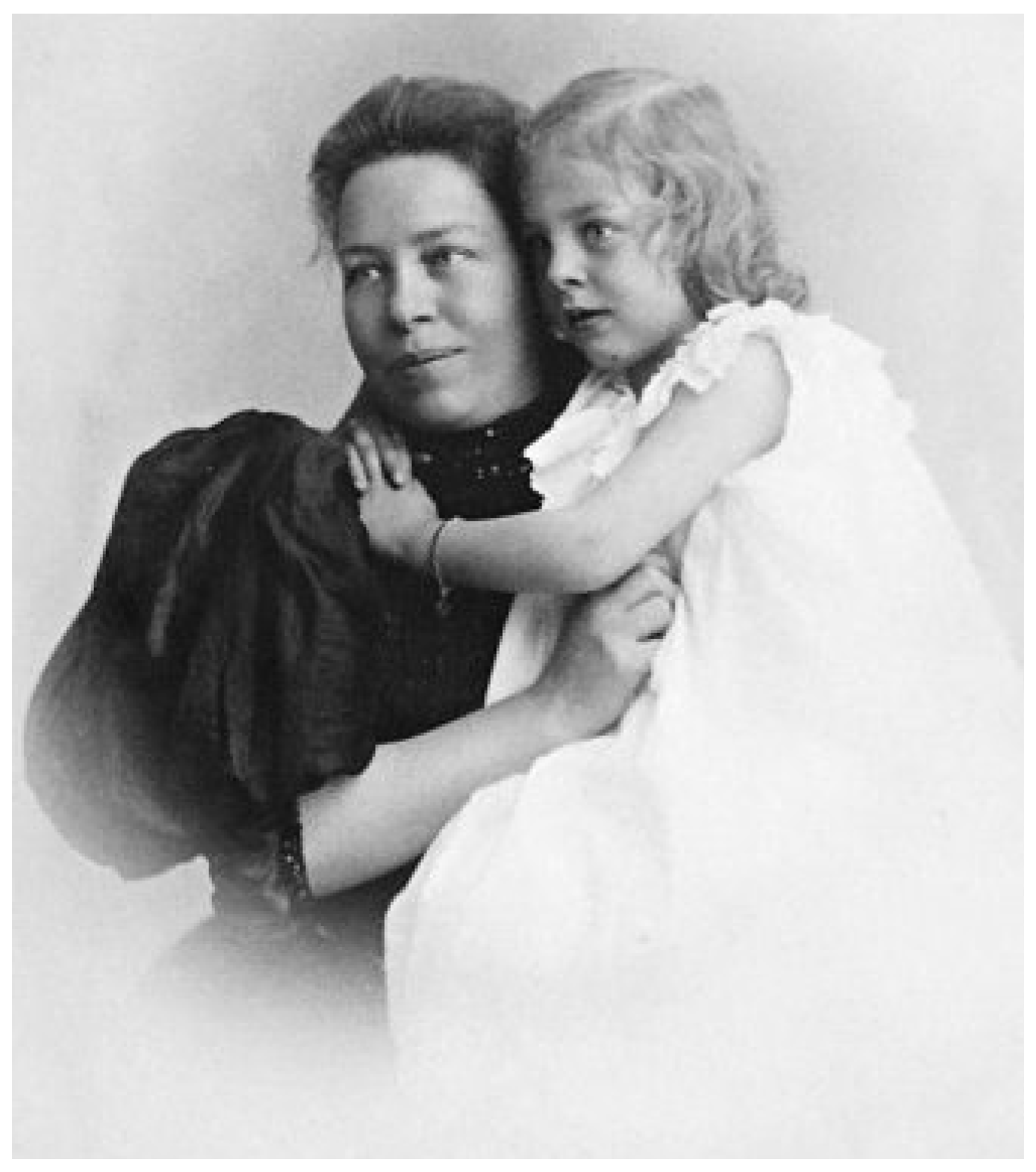
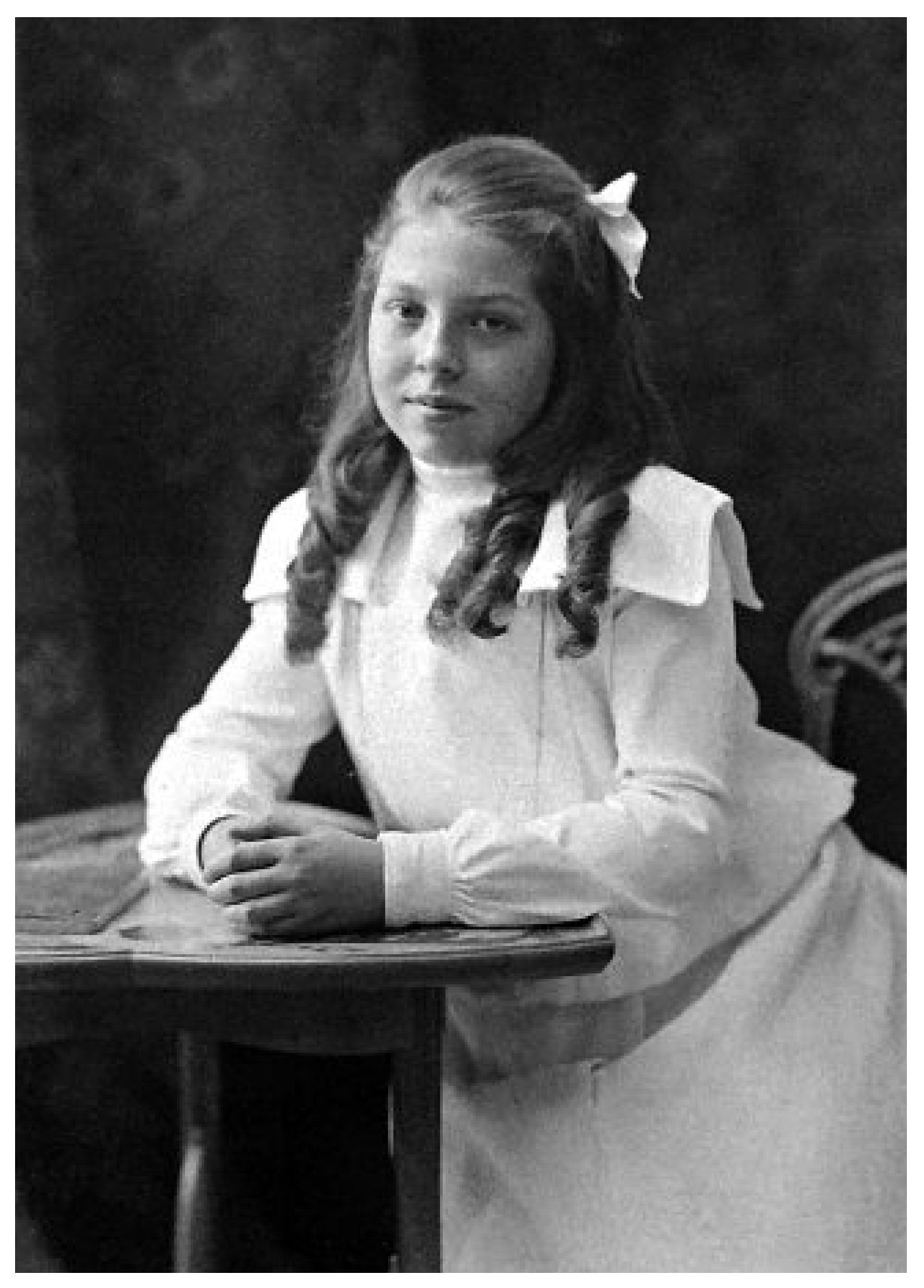
10]) in 1835, but she moved with her family to New York in 1844. John and Dorothea married in 1855, and between 1856 and 1870, they had six children, including five daughters. In 1866, Dorothea made a first trip to Europe with her children (four daughters at the time). The elder daughter had a femoral bone problem and expert medical advice was sought in Germany and France. This was Augusta’s first trip to Europe, but it was the second one, which would be definitive. Indeed, her parents’ marriage deteriorated and in 1871, Dorothea embarked for Europe with her children after legal separation. This move was critical for the 12-year-old Augusta (
fig. 5), who first studied in a boarding school in Cannstatt near Stuttgart, and was to stay in Europe for the rest of her life. At the same time, the 22-year-old Jules Déjerine was leaving his birthplace Geneva, Switzerland, for Paris, where he intended to start his medical studies [
11]. Two years later, Mrs Klumpke and her family moved to Clarens by Montreux, on Lake Geneva, Switzerland. A few months later, Augusta moved to Lausanne, in order to follow courses at the secondary school, while the rest of the family remained in Montreux.
Adolescence years in Lausanne
A thorough search in the archives of secondary school and inhabitant registries in Lausanne showed that Augusta obtained her permit to stay in Lausanne on 23rd September 1873 and that she started her studies at
École Vinet, which was the secondary school for girls (
École supérieure de jeunes filles), in August 1873 [
10]. She lived at a pension for girls held by Sophie Nicole (who was a teacher at
École Vinet) at 3,
escaliers du Marché, which later became a police station [
12]. She was based in Clarens/Montreux, where her mother stayed for another year, before also settling in Lausanne on 3rd September 1874, with Augusta and two other siblings. It is interesting that Mrs Klumpke declared herself to the authorities as a widow, while she was separated from her husband, probably because this would not have been well accepted among the conservative protestant
Vaudois (herself a protestant, her daughter Augusta became catholic by marriage to Jules Déjerine). They first lived in an apartment at 13,
Pré-du-Marché, then
avenue Davel (at Maison Guinand), and finally at 8,
rue Beau-Séjour, on the fourth floor [
13]. They left Lausanne for Paris on 2nd September 1876, so that Augusta could start medical studies. At this time there was no medical school in Geneva or Lausanne (also the reason why Jules Déjerine had left for Paris), and Augusta’s mother was afraid of Russian nihilist students who were active in Zurich, and did not want Augusta to study there [
10]. Augusta’s previous application to attend physics, chemistry and botany courses as an extern at the Lausanne Academy (now the
Gymnase) was turned down, on 27th April 1876, because she was a girl [
14]. This appears to be another reason why Augusta and her mother left Lausanne a few months later. Indeed, Augusta felt desperate that her application was rejected. She immediately announced that since women could not obtain the
baccalauréat in Lausanne, she would just go elsewhere, and after studying for a few months in Geneva, she left for Paris [
10]. It must also be emphasised that the archives of the University of Lausanne show no record whatsoever of any connection either with Jules Déjerine or his wife [
15], and in contrast to the University of Geneva, where Jules Déjerine obtained the
honoris causa grade in 1909, they never received any honourable academic distinction in Lausanne.
During her time in Lausanne, Augusta was very active. Her school marks, which I have been able to trace at the Lausanne archives, show that she was best in behaviour, holy history, geography, German, literature, botany, physics and astronomy, while her poorest marks were in dictation and composition [
16]. But it remains little known that Augusta also became the president of an association of schoolgirls called “La Perseveranza”. This was drawn attention to in a special lecture held on 8th June 1941, by Dr Hermann Brunnschweiler from Lausanne [
17], at the time the president of the Swiss Society of Neurology, during its 49th meeting [
18]. Dr Brunnschweiler is now forgotten, but he was the neurologist who took care of the painter Francis Picabia during his nervous breakdown in 1917, when Picabia was in Lausanne during the 1st World War. In his talk, Dr Brunnschweiler highlighted the role of the young Augusta, aged 15 years, in organising lectures and artistic activities while she was president of “La Perseveranza”. He also mentioned that Augusta and her sister Dorothea looked much more advanced than their local schoolmates, and that the Lausanne bourgeoisie were “talking” because they were going out without a chaperon or went out dancing, or sometimes could be seen smoking a cigarette! Augusta would definitely be better off in Paris, where she would live for the rest of her life.
Back to Switzerland
Jules Déjerine was a French citizen born and raised in Geneva, while the US-born Augusta Klumpke, who was of German origin, had vivid memories of the Swiss Riviera from her adolescence. It is thus logical that the couple spent some time in Switzerland during the summer holiday every year, and in the early 1890s, they selected the Thalgut on the river Aar, near Wichtrach in Canton Berne [
19], a German-speaking area, which had the advantage of being close to the residence of Déjerine’s classmate (at
Collège Calvin in Geneva) and friend Paul Dubois, who now was a prominent neuropsychiatrist in Berne, who wrote a famous book on the management of psychoneuroses with a preface by Jules Déjerine [
20], and also became the second president of the Swiss Society of Neurology the year after it was founded, in 1910–1916, after Konstantin von Monakow [
18].
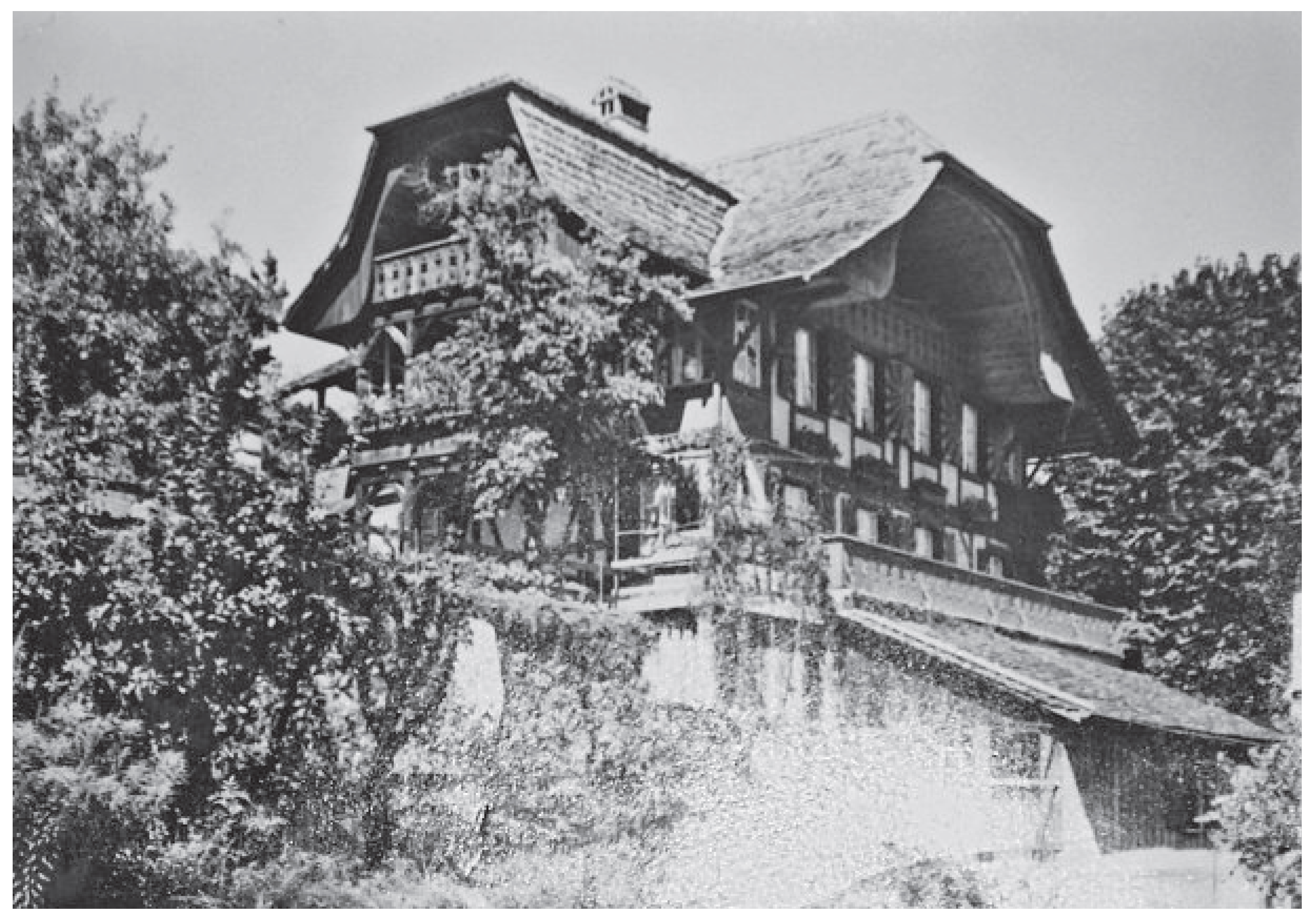
The Thalgut had been a hunting meeting place in the seventeenth century, with a farm, a hotel and a chalet (
fig. 6), the latter being initially let to the Déjerine’s by the owner Mr Grossglauser, before acquiring it and naming it
Le Neurone (the neuron). In Gauckler’s biography of Jules Déjerine [
11], an episode is related when a young girl nearly drowned in the Aar. In his attempt to rescue her, Jules Déjerine also nearly drowned, before his wife could intervene and save them both, allegedly gripping the girl by her hair. The girl was in fact Mr Grossglauser’s daughter [
19], who was slightly younger than the Déjerines’ daughter, and the Déjerines subsequently received a laurel crown and a memorial bronze plaque from the Rescue Society in the nearby hotel a few weeks later [
20]. The inner wooden parts of the chalet were re-painted by Augusta and her daughter with typical Bernese designs [
19]. The Sorrel-Déjerine family sold the chalet in 1992 [
19]. The Déjerines became well accepted in the area and developed friendly contacts with inhabitants, including local nobility, such as the von Graffenried and the von Erlach families.
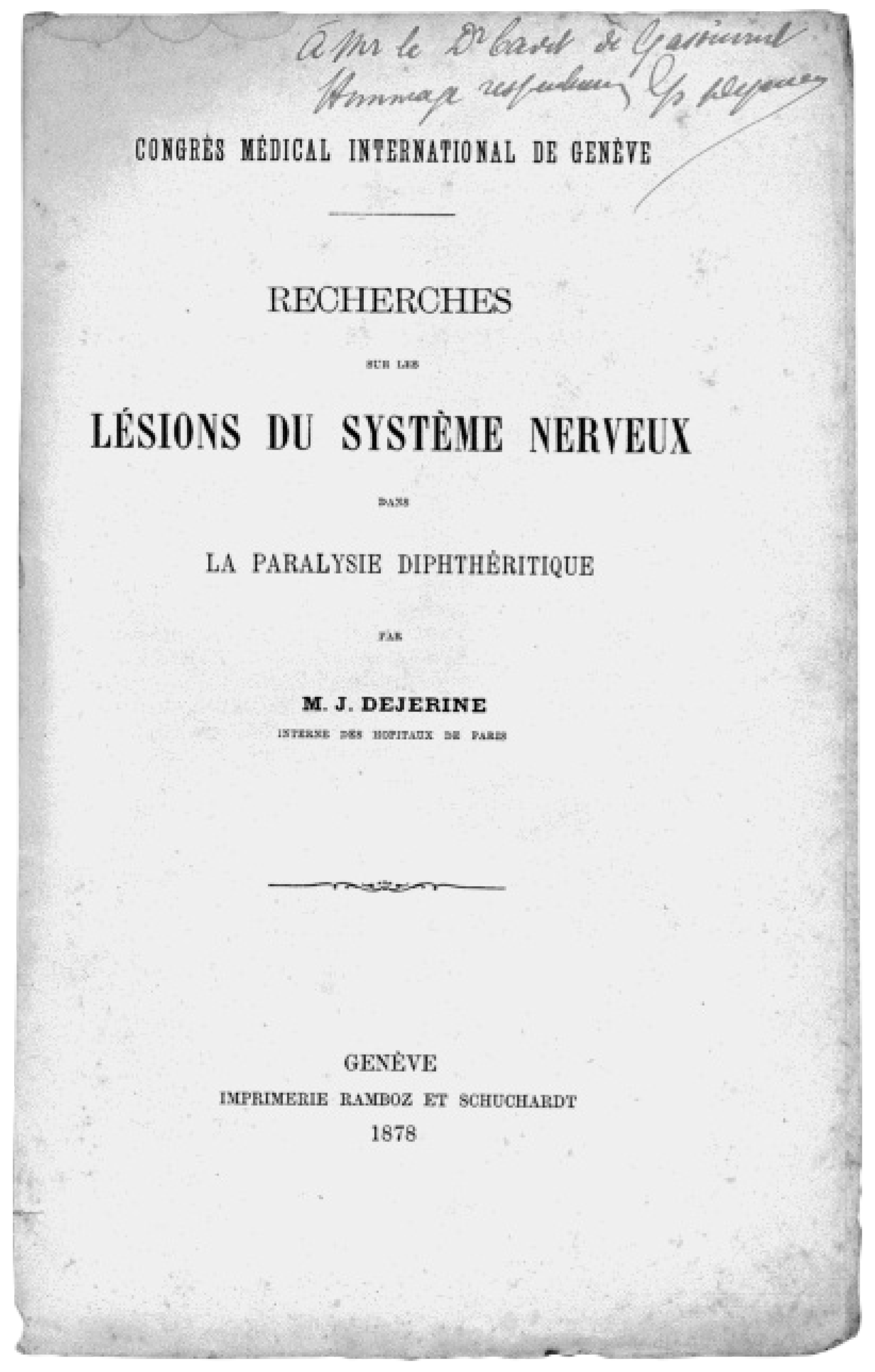
This was in contrast with the striking lack of contact with Swiss neurologists, except Paul Dubois, who was of course more psychiatrist than neurologist. Indeed, after Déjerine presented one of his very first papers at the 1878 International Medical Congress in Geneva [
21], while an
interne with Vulpian (
fig. 7), Déjerine very rarely went to Switzerland for scientific meetings. On one occasion, however, Jules and Augusta came for the official professional reason, to receive the
honoris causa doctorate given by the University of Geneva to Jules Déjerine at the Victoria Hall, on 9th July 1909. The year 1909 was exceptional for the University of Geneva, which celebrated its 350-year
Jubilé, so that no fewer than 23
honoris causa doctors were appointed just for the Faculty of Medicine, among whom other prestigious names can be identified, including Marie Curie, Camillo Golgi, Yvan Pavlov, L. von Recklinghausen, and Auguste-Désiré Waller, as well as another clinical neurologist, Konstantin von Monakow from Zurich [
22]. But interestingly enough, a specific search at the archives of the Universities of Geneva and of Lausanne did not lead to any further information on the Déjerine couple, except that in 1912 in Geneva, Jules Déjerine was associated with Édouard Long in two works on spinal cord lesions [
23], which were subsequently published in
La Revue Neurologique.
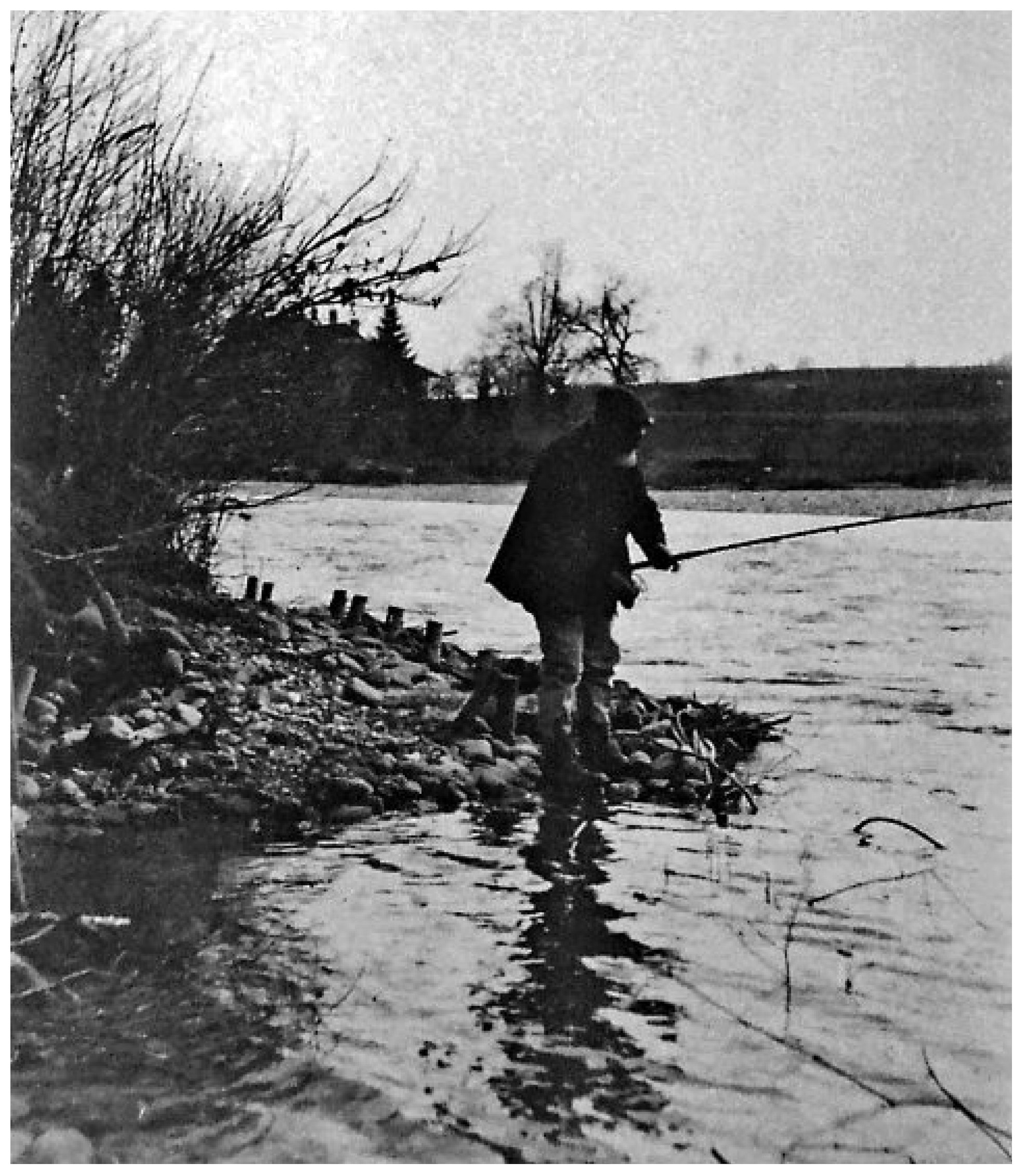
Nevertheless, Jules Déjerine used to go to the Thalgut every year for 6 weeks, between the end of July and the beginning of September, with fishing the main activity (
fig. 8), while Augusta and Yvonne stayed for two and a half months and also at Easter, with the exception of World War I [
19]. After her husband’s death in 1917 and her dismissal from
La Salpêtrière by Pierre Marie, Augusta continued to go to the Thalgut regularly with her daughter and grand-children, keeping contacts with Switzerland, so that when she died on 5th November 1927, at her Paris apartment, 179, boulevard Saint-Germain, an obituary appeared in the 14th November issue of the
Journal de Genève [
24], mentioning that “she had many friends in Geneva, where her husband had been brought up and where she came regularly“.
After Augusta’s death, two Swiss neurologists contributed to her obituary. Édouard Long, from Geneva, who had worked with Jules Déjerine, underlined her private contacts with Switzerland, emphasising that in neurology, she was particularly fond of the anatomical studies of Auguste Forel and of the work of Konstantin von Monakow, both from Zurich [
25]. He also reported that in 1919, as she had done previously with the
Société de Neurologie de Paris, she established with the Swiss Society of Neurology a “Déjerine Fund”, which still exists today. She was particularly interested in the works by the young M. Minkowski, H. Steck and I. Mahaim, which were made possible by the Fund during her life. The second Swiss neurologist was Gustave Roussy, a native of Vevey nearby Lausanne, who had become French citizen before World War I. He was a favourite pupil of Jules Déjerine, who was president of his doctorate thesis on the thalamic syndrome in 1906, and which appeared as a monograph the following year [
26]. At the time of Augusta’s death, Roussy was the president of the
Société de Neurologie de Paris, and he retraced her career in two speeches, one at her burial on 8th November 1927, and the other at the Society’s session of 1st December [
1].
Augusta Klumpke became the first externe and the first interne in French hospitals, shortly after she left Lausanne, because the place would not accept girls for the baccalauréat. This seems to have been a good move: Two decades later, she also became the first woman to be elected president of the Société de Neurologie de Paris, the predecessor of the French Society of Neurology, while today, a century later, the Swiss Society of Neurology is still waiting to have a woman as president.