Next Article in Journal
Neurologische Vielfalt
Previous Article in Journal
Book review: Die Psychoanalyse im Pluralismus der Wissenschaften
 
 
Swiss Archives of Neurology, Psychiatry and Psychotherapy is published by MDPI from Volume 176 Issue 1 (2026). Previous articles were published by another publisher in Open Access under a CC-BY (or CC-BY-NC-ND) licence, and they are hosted by MDPI on mdpi.com as a courtesy and upon agreement with EMH Editores Medicorum Helveticorum.
Case Report

Neurologist-in-training †

by
Andrea O. Rossetti
Service de Neurologie, BH-07, CHUV, CH-1011, Lausanne
The aim of this section is to prepare the neurologist-in-training for the FMH examination, to confront her or him with specific problems of ever yday neurological practice and to give him or her updates on recent controversies in clinical neurology.
Swiss Arch. Neurol. Psychiatry Psychother. 2011, 162(1), 35-36; https://doi.org/10.4414/sanp.2011.02229
Published: 1 January 2011

Neuroimaging

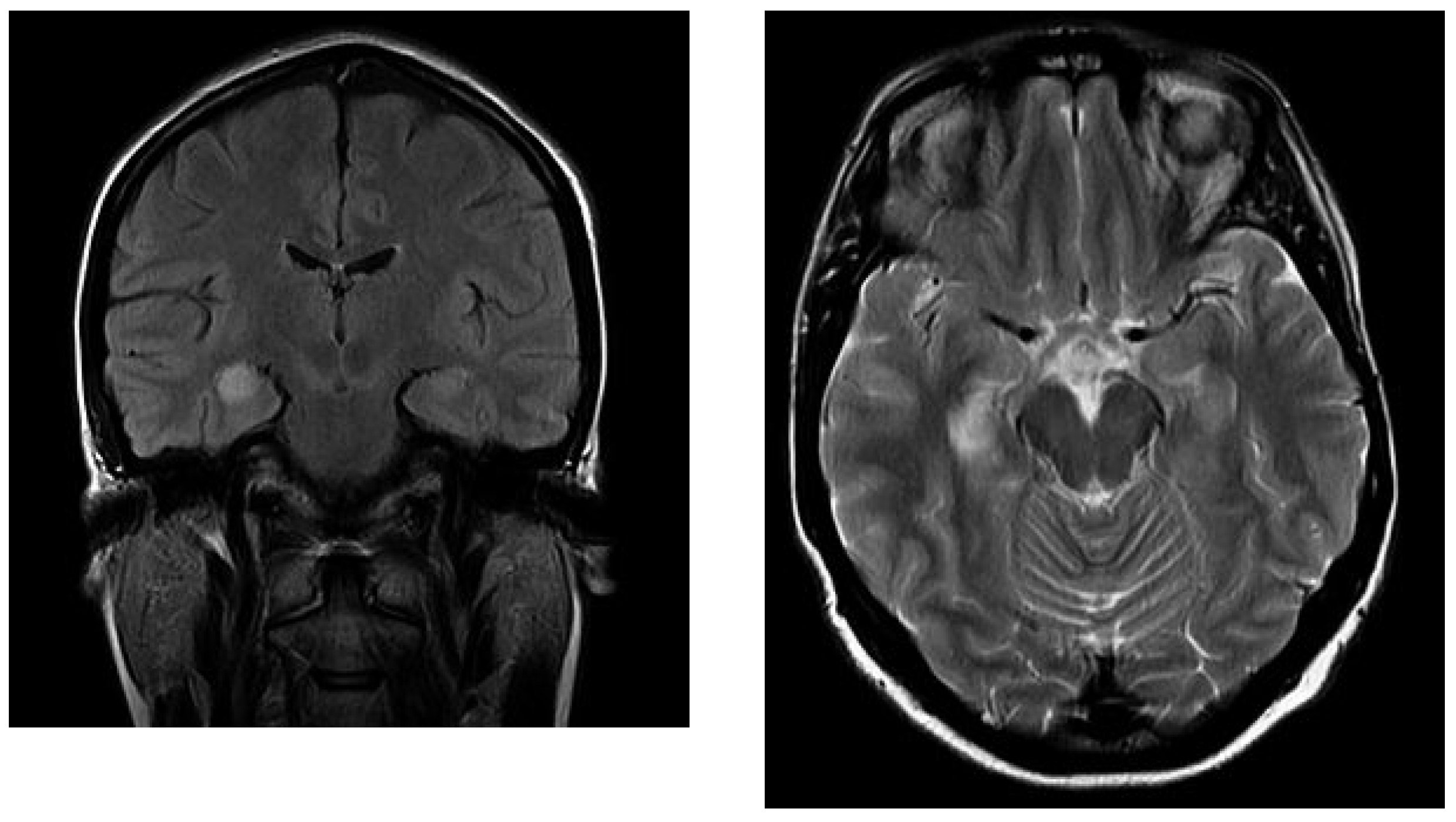
A 33-year-old, previously healthy woman began to show a slowly progressive short-term memory impairment affecting both verbal and non-verbal domains, with little subjective concern. She also had increasing difficulty with her retrograde memory, especially related to the months preceding the onset of illness. Three weeks later, she experienced her first generalised tonic-clonic convulsion. No obvious aetiology (including infection, recent vaccination, medication, drug abuse) was evident. Her brain MRI (Figure 1, upper image: coronal FLAIR; lower image: axial T2) is shown below. What are your diagnostic thoughts after looking at it?
MCQ
Andrea O. Rossetti, CHUV, Lausanne

1. Which of the following statements regarding coma is correct?

A
it is defined by the absence of brainstem reflexes
B
its evolution towards a minimal conscious state may herald a favourable prognosis
C
it is an almost obligate presentation of status epilepticus
D
vegetative state is a synonym of it
E
it is impossible to differentiate it clinically from a lockedin state

2. Please indicate the right sentence regarding severe cerebral trauma

A
short-term seizure prophylaxis with antiepileptic drugs is not recommended
B
the extent of imaging abnormalities does not correlate with prognosis
C
somatosensory-evoked potentials have a better predictive value than after cerebral anoxia
D
a vegetative state may start to improve later as compared to cerebral anoxia
E
unilateral mydriasis on admission is an invariably dismal prognostic factor

3. Please identify the correct statement related to ICU neuromuscular complications

A
polyneuropathy is mostly evident on short nerves
B
administration of steroids may facilitate myopathy
C
generalised hyperreflexia rules out myopathy
D
propofol classically triggers neuropathy
E
these complications have invariably a good prognosis

4. Which of the following statements is false in the context of post-anoxic encephalopathy?

A
consequent antiepileptic treatment may improve prognosis in selected cases
B
elevated NSE (neuron-specific enolase) is a reliable predictor of death
C
bilaterally normal somatosensory-evoked potentials are not always correlated with recovery
D
postanoxic myoclonus (Lance-Adams) should be approached with broad-spectrum antiepileptic agents
E
an isolectric EEG within 6 hours of the event is invariably correlated with death

5. Which sentence on posterior reversible encephalopathy syndrome (PRES) is incorrect?

A
its prognosis is mostly benign
B
a Balint sydrome is described in the acute phase
C
ADC-weighted MRI classically shows hyperintense lesions
D
renal insufficency and cytostatic agents represent wellknown risk factors
E
seizures are part of the clinical spectrum

Read for you

Antiepileptic drugs in brain tumour patients: what’s new?

Seizures in patients with brain tumours represent a frequent problem in clinical practice; in this setting, anticonvulsant treatment significantly reduces the rate of seizure generalisation, contributing to limitation of morbidity. Since inferior survival has been observed in subjects treated with enzyme-inducing anticonvulsants while receiving chemotherapy for acute leukaemia [1], there is an increasing tendency for prescription of non-enzyme-inducing AEDs for cancer patients. Although the most frequently used chemotherapy drugs for brain tumors like temozolomide or nitrosoureas (BCNU, CCNU, ACNU, fotemustine) are not significantly affected by CYP450 enzymes, salvage treatment includes agents like irinotecan, etoposide or tyrosine-kinase inhibitors (e.g., erlotinib, imatinib or cediranib), having an hepatic catabolism that may be enhanced by enzyme inductors.
A recent large retrospective US study on 620 patients with glioblastoma came to a surprising and counterintuitive conclusion, as acknowledged by the authors: after a careful statistical adjustment for prognostic factors such as age, performance status, extent of surgical resection, steroid use, and baseline neurocognitive function, overall and progression-free survival was higher in the 432 patients using enzyme-inducing antiepileptic drugs (AED) as compared to the 173 who did not [2]. However, several limitations prevent to draw any definitive conclusion from this observation [3,4]. It is unclear what type of enzyme-inducing AED was used (given the study period, probably phenytoin and carbamazepine), but phenytoin bioavailability may be lowered by dexamethasone, which is frequently administered in this setting. Furthermore, it seems that several patients received AED as primary prophylaxis, but this does not correspond to current practice. Lack of data regarding longitudinal seizure history and tumour volume and location may also limit data interpretation.
Unfortunately, available literature comparing AED effectiveness in patients with brain tumours is extremely scarce. In glioma patients who had a previous seizure, a post-surgical switch from phenytoin to levetiracetam was addressed in a randomised phase II study. The trial closed early because of insufficient accrual after enrollment of 29 subjects. In the 23 patients with follow-up data at 6 months (15 on levetiracetam, 8 on phenytoin), seizure control was comparable, while side effects were less pronounced in the levetiracetam group [5]. Other recent studies on this topic are limited to patients series receiving a single compound, such as levetiracetam [6], pregabalin [7], topiramate [8,9], zonisamide [10], or oxcarbazepine [11], and suggest that efficacy and tolerability seem reasonable. Intriguingly, lamotrigine is virtually not reported in this setting.
Awaiting prospective comparative studies it seems reasonable to prescribe AED devoid of pharmacological interactions in patients with brain tumours. In this context, levetiracetam and pregabalin have the advantage of a rapid titration, while lamotrigine needs several weeks to reach a therapeutic serum level. On the other side, topiramate, zonisamide, and oxcarbazepine have the theoretical disadvantage of exerting mixed (albeit modest) actions on the cytochrome system.

Answers to MCQ

1. B   2. D   3. B   4. E   5. C

Neuroimage answer

A right-sided hippocampal hyperintense enlargement is seen.
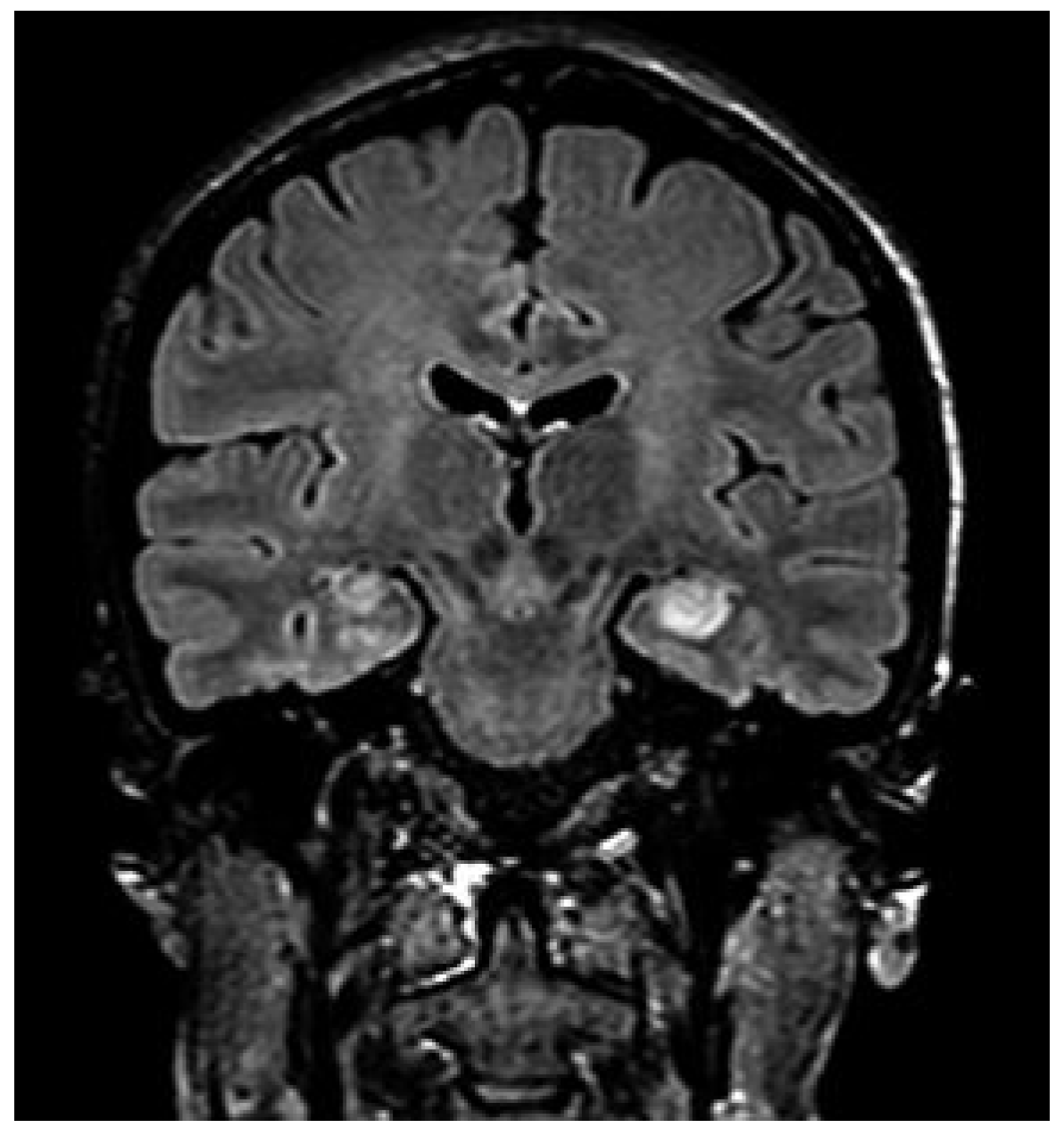
Although the image resolution does not allow judging the integrity of the hippocampal layers, hippocampal sclerosis would not produce a mass effect (apart from in ongoing status epilepticus, which was not the case here). The differential diagnosis may include a tumour or inflammatory lesions. A follow-up MRI 2 months later (Figure 2, coronal FLAIR) showed a “switch” of the hyperintensity on the contralateral side, rendering a primary brain tumour very unlikely.
The clinical constellation of progressive memory impairment together with seizures is indeed strongly suggestive of limbic encephalitis. Its aetiological palette is currently expanding at a great pace: besides paraneoplastic, intracellular neuronal antibodies (e.g., anti-HU), several, surface-targeted antibodies are being indentified (especially anti-VGKC, anti-AMPA, anti-GABAb), whose production does not necessarily imply a tumour-related process. This patient did not have any identifiable neoplasia. However, autoantibodies against the AMPA receptor were found in her serum and CSF.

References

  1. Relling MV, Pui CH, Sandlund JT, et al. Adverse effect of anticonvulsants on efficacy of chemotherapy for acute lymphoblastic leukaemia. Lancet. 2000;356:285–90.
  2. Jaeckle KA, Ballman K, Furth A, Buckner JC. Correlation of enzyme-inducing anticonvulsant use with outcome of patients with glioblastoma. Neurology. 2009;73:1207–13.
  3. Rosenow F, Reif PS, Haag A, et al. Correlation of enzyme-inducing anticonvulsant use with outcome of patients with glioblastoma. Neurology. 2010;74:1330–1.
  4. Rossetti AO, Stupp R. Correlation of enzyme-inducing anticonvulsant use with outcome of patients with glioblastoma. Neurology. 2010;74:1329.
  5. Lim DA, Tarapore P, Chang E, et al. Safety and feasibility of switching from phenytoin to levetiracetam monotherapy for glioma-related seizure control following craniotomy: a randomized phase II pilot study. J Neurooncol. 2009;93:349–54.
  6. Rosati A, Buttolo L, Stefini R, et al. Efficacy and safety of levetiracetam in patients with glioma: a clinical prospective study. Arch Neurol. 2010; 67:343–6.
  7. Novy J, Stupp R, Rossetti AO. Pregabalin in patients with primary brain tumors and seizures: a preliminary observation. Clin Neurol Neurosurg. 2009;111:171–3.
  8. Maschio M, Dinapoli L, Zarabla A, et al. Outcome and tolerability of topiramate in brain tumor associated epilepsy. J Neurooncol. 2008;86: 61–70.
  9. Lu Y, Yu W, Wang X. Efficacy of topiramate in adult patients with symptomatic epilepsy: an open-label, long-term, retrospective observation. CNS Drugs. 2009;23:351–9.
  10. Maschio M, Dinapoli L, Saveriano F, et al. Efficacy and tolerability of zonisamide as add-on in brain tumor-related epilepsy: preliminary report. Acta Neurol Scand. 2009;120:210–2.
  11. Maschio M, Dinapoli L, Vidiri A, et al. The role side effects play in the choice of antiepileptic therapy in brain tumor-related epilepsy: a comparative study on traditional antiepileptic drugs versus oxcarbazepine. J Exp Clin Cancer Res. 2009;28:60.
Figure 1.
Figure 1.
Sanpp 162 00035 g001
Figure 2.
Figure 2.
Sanpp 162 00035 g002