Psychotherapeutic competence is an important notion, both from a clinical and an empirical standpoint. Methods of evaluating competence have been developed to better control the quality the psychological treatments provided [
1]. These newly developed scales have also paved the way for studies in unexplored areas, including the link between treatment adherence and treatment competence [
2], the impact of treatment competence on therapeutic results, the distinction between effects related to the therapist him- or herself (e.g. sex or relational style) and effects related to specific therapeutic techniques [
3], and the role of experience and training in the acquisition of competence.
This last issue is often overlooked within research designs [
4]. In fact, studies sometimes include therapists with little training, even though clinicians, particularly psychoanalytic clinicians, seem to attribute great importance to years of training. This concern may also be of interest to training institutions as well as professional societies. In the political realm, professional recognition seems very much linked to a clinician’s presumed competence. In terms of public security as well as medical authority, the demands for the specification of reimbursed treatments and qualifications of the therapist dispensing the treatment are increasing. It is consequently necessary to study in more details how psychotherapists acquire their competencies and the time frame required to obtain these competencies.
Competencies have been evaluated empirically following the development of psychotherapeutic treatment manuals [
5] which define the manner in which a therapist should apply the technical principles prescribed by a specific form of psychotherapy. Adherence and competence scales are used to examine the quality of a therapist’s interventions, looking at the therapist’s formulation and its adequacy to the client’s characteristics and the clinical situation. Following the recommendations of Waltz et al. [
2], adherence refers to the extent to which a therapist uses interventions and approaches prescribed by the treatment manual and avoids the use of intervention procedures prohibited by the manual; competence refers to the level of skill shown by the therapist in delivering the treatment, i.e. the extent to which the therapist conducting the interventions takes the relevant aspects of the therapeutic context into account (in particular: stage of therapy, client difficulty and client presenting problems) and responds to these contextual variables appropriately. The scales developed over the past fifteen years are all founded on the concept of a continuum: on the one side, descriptive and quantitative elements (the adherence dimension), and on the other side, prescriptive and qualitative elements (the competence dimension).
When studying competence, therapist variables are often confounded [
6]. Even if well-trained therapists demonstrate a good global competence, there are differences between therapists [
7]. Some differences are related to personal characteristics, including sex, age, personality, relational style and personal psychotherapy [
8]; while others are related to a therapist’s training and professional path: profession and professional tasks, general training in psychotherapy, years of experience in psychotherapy and individual supervision [
1,
9,
10]. Nevertheless, intensity, duration and quality of the specific training have received little attention in empirical studies [
11]. To our knowledge only one study has been carried out in which independent judges examined therapist competence [
12]. This study showed that competence is significantly higher after a 40-day training period in cognitivebehavioural therapy and has a positive effect on patient adaptation abilities. However, training that leads to an overly strict adherence to a treatment manual has a negative effect on therapist competence [
13].
The aim of the study is to compare the competence of junior therapists with various amounts of training to expert therapists in the delivery of a very brief psychodynamic psychotherapy, using a valid scale rated by independent judges. More specifically, the following questions will be documented: How do junior therapists differ from trained and experienced therapists? Does competence increase with experience? Is this evolution linear, asymptotic or in bursts? How many years of training are needed for a therapist to achieve an optimal level of competence?
Method
The study was carried out at the Lausanne University Adult Psychiatry Department. It took place in an outpatient consultation centre which treats patients in crisis by appointment. Every year approximately 750 new patients access this centre’s services. Roughly half of these patients are treated with Brief Psychodynamic Intervention (BPI).
Treatment
Developed in Lausanne, BPI is a formalised 4-session psychodynamic psychotherapy assessment technique, which focuses on the patient’s reasons for consultation and the early interaction between patient and therapist [
14,
15]. The main objectives of the BPI are to establish a diagnosis and develop an optimal plan to resolve any crisis situation. The therapist helps patients understand their difficulties to facilitate choosing the best treatment relative to their disorder and expectations. At the end of the first interview, or at the beginning of the second, the therapist offers the patient an initial interpretation built on a hypothesis about the crisis. The therapist then proposes three more sessions to discuss this interpretation, as well as an evaluation after the fourth interview. The interviews are nondirective, encouraging free association. In short, BPI is a form of very brief psychotherapy, similar to those developed by Barkham et al. [
16], used as a dynamic psychotherapeutic assessment. BPI has been shown to produce positive effects on patients’ symptoms [
17].
Sample
Therapists
Twelve therapists (6 men and 6 women) with varying levels of training and experience were selected. Three were very experienced therapists or senior therapists: two IPA psychoanalysts and one psychoanalytic psychotherapist in the European Federation for Psychoanalytical Psychotherapy (EFPP). All three participated in the development of BPI and have been teaching the method since 1988. Their respective levels of training were considered identical. However, their level of experience in psychotherapy did differ, with the three therapists respectively having 16, 19 and 36 years of experience. There were also significant age differences (M = 51.8; SD = 9.4) between the senior therapists.
Amongst the therapists-in-training, or trainees, eight were MDs in psychiatric and psychotherapeutic training, and one was a PhD psychologist. Their levels of training in BPI were as follows: two were beginners, three had completed one year of training, two therapists had completed two years of training, and two therapists had completed three years of training. All treatments were carried out within the first two months of the year of training. And the trainees had no previous experience or training in another form of psychotherapy.
The trainees’ experience in psychiatry at the beginning of their BPI training was variable, and they were younger than the senior therapists (M = 35.8; SD = 5.8). The neophyte psychotherapists having only one year of training were free to consult the clinic director in case of difficulty during the first session or in the course of the BPI. They also received formal supervision at the end of the brief psychodynamic intervention. It was planned that patients for whom it was later found that BPI was contraindicated or who manifested symptoms judged too complex for beginning therapists would be excluded. Ultimately, it was not necessary to exclude patients on this basis.
Patients
Eighty-seven consecutive patients were included (41 men and 46 women).Their ages varied between 19 and 49 years (M = 29.2; SD = 8.5). Axis-I and -II DSM-IV disorders were evaluated by the therapist at the end of the four sessions using a semi-structured method. A mood disorder was diagnosed in 71% of the cases, an anxiety disorder in 46% of cases and personality disorder in 50% of cases. We had no information about possible past experiences concerning psychotherapy.The inclusion lasted two months.
At the end of the first meeting, patients were asked to fill in the SCL-90R [
18].This questionnaire was used to determine the degree of severity of the patients’ disorders. The severity scores of the patients treated by the 12 therapists were very homogeneous (M = 0.92; SD = 0.56; Kruskall-Wallis Chi2 [
11] = 6.88; p = 0.86). Exclusion criteria were: psycho-organic or delirium disorder, out-of-control alcohol or drug dependence, schizophrenia and other psychotic disorders, bipolar disorders, mental retardation and antisocial personality disorders.
The therapists were haphazardly assigned their patients. In order to ensure the smooth running of the consultation centre, it was not possible to assign the same number of patients to therapists. Included in the study were patients coming to the centre during a certain time period and fitting the inclusion/exclusion criteria.The patients selected to take part in the study were duly notified of all information pertaining to the study and were asked to sign an informed consent form.
Training
BPI training involves:
- –
theoretical training, which includes approximately 44 hours of mandatory lectures and 44 hours of group teaching, half of which is dedicated to psychiatric aspects and diagnostic investigation, and the other half to the psychodynamic aspects of the intervention;
- –
clinical practice, which includes the treatment of at least 50 patients using the BPI;
- –
supervision – considered of primary importance – involves 44 sessions of individual supervision, half of which concentrate on the case file and the other half on videotaped sessions, as well as 44 sessions of group supervision, half of which concentrate on videotaped sessions and the other half on role-play.
One year of training is thus comprised of between 200 and 240 treatment sessions, 88 hours of theoretical training (seminars and personal reading) and 88 hours of supervision (individual and group).
Instrument
The BPI competence scale (BPICS) assesses skills that are shown by therapists who practise BPI in a given context. BPICS does not assess therapist performance. The scale is composed of 30 items, distributed over four subscales: General Attitude (GA), Psychoanalytic Attitude (PA), Competence in Investigation (CInv) and Competence in Interpretation (CInt). Therapist global competence, creativity and client difficulty are assessed separately. The coding system is based on a scale of 1 to 5: a score of 5 indicates a high competence; a score of 3, no more than sufficient competence; a score of 1, a lack of competence. The Global Competence Score (GCS) is the mean of the scores of the 30 items. There are also four mean subscale scores. In the validation study [
19], interrater reliability ranged from 0.54 to 0.84, and internal consistency Cronbach’s alpha ranged from 0.81 to 0.89.
Ratings
Six judges were trained in the use of the BPICS by the author of the scale. The judges were independent experienced psychotherapists.Two were MDs in psychiatry and psychotherapy, and four were PhD psychologists.
The training consisted of one session dedicated to the description of the instrument and of six reference session ratings. The reliability of each judge was calculated based on the fourth rating. The judges were considered trained once they reached a reliability above 0.60 on three ratings. Competence was evaluated on the videotape and the interview transcript of the first session.The first session is considered a decisive moment which allows to most accurately evaluate therapist competence.
Sessions were randomly assigned to the six judges. The judges were blind to the levels of experience and training of the therapists, and the therapeutic outcomes. Nevertheless, it was not possible to assure a strict independence from these variables, as therapists-in-training were between 25 and 40 years old, while senior therapists were between 40 and 65. The interrater reliability of the BPICS was evaluated on 16% of cases with intraclass correlations (N = 14; ICC [2, 1] = 0.75). The values are satisfactory and similar to those found in the pilot study (N = 16; ICC [2, 1] = 0.71) [
19] as well as in other studies [
20].
Data analysis
The competence score was the dependent variable; level of training, level of experience and therapist were the independent variables. We used the average competence scores of each of the 12 therapists. To evaluate therapist inconsistency, calculations have been carried out on minimal and maximal values and the typical difference of the therapists’ competence scores. Pearson’s correlation coefficient was used to study the link between the variables. An analysis of variance was used to compare junior and senior therapists. Finally, a regression analysis was used to predict the training period needed for junior therapists to attain the mean competence score of the senior therapists.
Results
The Global Competence Scores (GCS) are distributed between 1.8 and 4.9 (M = 3.8; SD = 1.8). Concerning the four subscales, scores are ranged between 1.3 and 5.0. The highest mean score is found in the General Attitude (GA) subscale (M = 4.1; SD = 0.7), and the lowest mean score in the Psychoanalytic Attitude (PA) (M = 3.5; SD = 0.8) and Competence in Interpretation (CInt) subscales (M = 3.5; SD = 0.9). The four subscales are highly correlated (range = 0.61 to 0.82).
Competence and training
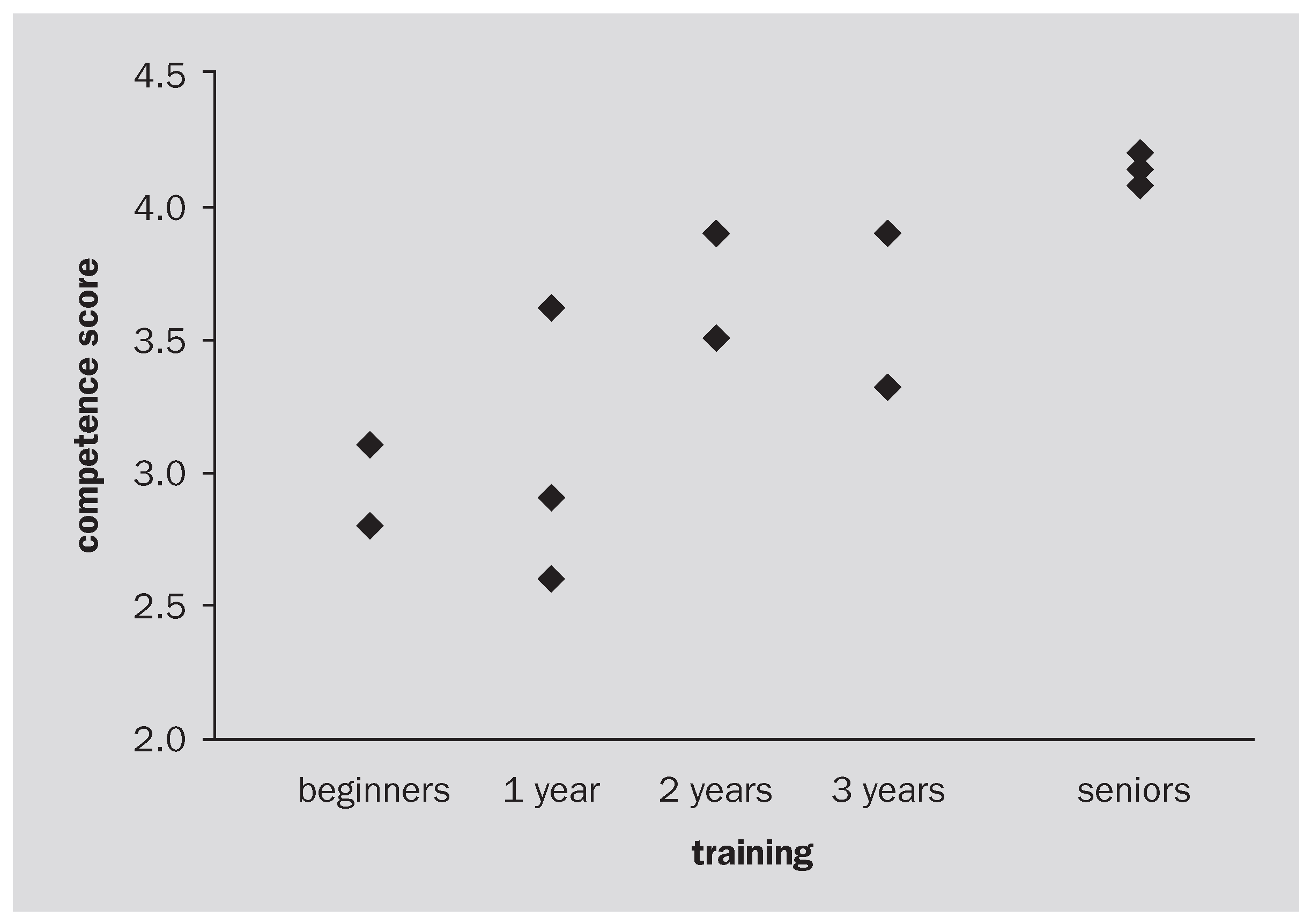
Figure 1 shows the 12 therapists’ mean GCS. The senior therapists obtained homogeneous GCS around a mean of 4.1 (SD = 0.1), whereas trainees’ GCS are lower (M = 3.3) and less homogeneous (SD = 0.5). The three senior therapists obtained significantly higher scores than the trainees (F [4, 82] = 9.1; p <0.0001). On the basis of the regression equation, a theoretical length of training of 4.7 years was estimated as the training period needed for junior therapists to attain the mean competence score of the senior therapists. Yearly competence score increase is 0.27, which corresponds to an effect-size of d = 0.39 per year of training.
Figure 1.
Competence score and training for each therapist.
Figure 1.
Competence score and training for each therapist.
Table 1 shows the correlations between the competence, BPI training and psychiatric experience. The correlations between psychiatric experience and the competence scores are significant for the GCS, the maximum scores, the General Attitude (GA) and the Competence in Interpretation (CInt). This is also the case for the BPI training. Partial correlations show that BPI training plays a more significant role than psychiatric experience in therapist competence. In this case, it is not the maximum score elevation which is significantly correlated, but that of the minimum score.
Table 1.
Correlations between competence, training and experience.
Table 1.
Correlations between competence, training and experience.
As the judges were aware of who were the senior therapists, we made the same analysis with the junior therapist only. ANOVA shows an effect of the number of years of training on the GCS (F [3, 45] = 5.03; p = 0.004), the GA (F [3, 45] = 3.57; p = 0.021), the CInv (F [3, 45] = 4.80; p = 0.006) and the CInt (F [3, 45] = 5.90; p = 0.002). The same pattern of correlations as for the entire sample was found between competence, BPI training and psychiatric experience, but with lower correlations (varying between 0.40 and 0.70).
Differences among therapists
The variance linked to the therapists can only be studied in the sample containing all cases treated by each therapist (n = 87) and indicates a clear relationship between competence and therapists (
χ2 [
11] = 43.26, p <0.001). Comparing therapists at the same training level, non parametric tests show differences between the second-year therapists (U = 8.00; p <0.01) and between the third-year therapists (U = 1.00; p <0.05).
Discussion
As hypothesised, there is a correlation between competence and the level of training. Mean competence scores of the junior therapists are just above the mean of the scale (3.3), whereas the senior therapists received higher mean scores that are all around 4.1. Moreover, competence is not correlated with the level of experience. It follows that 4.1 may be considered as a standard score in terms of competence with BPI and as a goal to reach for each trainee.
The large variations observed in the GCS scores may be linked to the patient difficulty, with the most difficult patients hindering the therapists from obtaining higher levels on the competence scale, and the more collaborative and resourceful patients permitting the therapists to develop their competence maximally [
8]. It should also be noted that neither of the three senior therapists scored significantly below the minimum competence level, which corresponds to the mean score of the scale (3). In short, minimum, maximum and average competence scores could be seen as guides to help neophyte therapists set goals.
Results showed a striking homogeneity between the senior therapists when considering their differences in their professional paths, their personal trajectories, their age or even their styles. They have been working in the same institution for many years and have developed the BPI in close collaboration. They all have extensive experience in psychodynamic psychotherapy and are very involved in training. Thus BPICS measures technical competencies independently of personal therapeutic style.
The nine therapists in training obtained lower scores than the senior therapists. Three of them scored below 3 (i.e. a score of inadequate competency). One had received virtually no training, while the other two had completed one year of training. These neophyte therapists score particularly low on two subscales: Competence in Interpretation and Psychoanalytic Attitude. Their competence progresses specifically and significantly in conjunction with the number of years of training in BPI, while their degree of psychiatric experience appears to be of lesser importance. In general, these results are in line with those of Butler et al. [
7,
13] who found that there is a link between competence and experience in psychotherapy, but contradict those of Høglend [
6], who found that there are no competence-predicting variables clearly linked to the therapist. The progression in general attitude and the competence in interpretation appear more obviously linked to training. It is possible that the development of a psychoanalytic attitude, especially psychoanalytic listening skills, requires more time to develop. Competence in interpretation may be more easily acquired.
Although the sample contained no therapist with training beyond three years, we estimated that between four and five years of training are necessary to achieve competence. This is a purely theoretical figure as a slowing down of competence growth cannot be ruled out. Nonetheless, a linear model does appear more relevant than a quadratic model according to the calculations carried out. Two years of training could be assumed to correspond to a minimum for therapists to be adequately competent (score equal or above 3) whoever the patient.
This observation highlights the importance of therapists’ personal characteristics. Unfortunately, it is impossible to test this variable with the methodology used and the number of therapists included in the study. The only hypotheses we were able to test showed that significant differences can be found between the two second- and the two third-year therapists. Therefore, it remains unclear whether the variability of neophyte therapists impedes all difference from being brought out, or on the contrary, whether a certain number of years of training are needed to differentiate more competent therapists from less competent therapists. We found these results provide arguments to defend long and specific training in psychotherapy. Certain political or professional groups, who tend to minimise the investments necessary in training therapists, would have preferred a competence acquired more quickly. And therapists may also underestimate the amount of necessary training.
Some limitations of the study are noticeable. The most substantial one concerns the heterogeneity within the sample in terms of patient load: certain therapists saw only three patients. The number of therapists included was rather low. And the exact nature of competence assessed by the instrument is another point of importance. As other similar instruments, BPICS does not only take the competence dimension into account, but also some descriptive and quantitative elements relating to the adherence dimension. Research can only study parts of relational competence. Yet, the therapeutic context is clearly considered when quoting the different items of the scale, following the recommendations of Waltz et al. [
2], particularly in terms of the stage of therapy and presenting problems. Client difficulty is also taken into account with a separate global assessment, but some multidimensional measures would be useful to determine the possible differences between therapists in term of the degree of difficulty. However, what is described here is not competent performance, i.e. aptitudes related to outcome, but the reflection of a set of skills expected by the theoretical approach of BPI and described in its manual.
Research on psychotherapeutic process and competence necessary for the construction of therapeutic alliance will assist in clarifying some of the questions posed in this study. It also appears important to explore the role played by therapists’ personal characteristics. In the next study, we will investigate the links between competence, the development of the therapeutic alliance and the outcome.