Psychotherapy in general aims at discovering and mobilising latent resources; one specific characteristic of dynamic psychotherapy can be seen in its uncovering and working with the unconscious conflicts that interfere with the access to and activation of such latent resources.
A psychodynamic interpretation should therefore satisfy two conditions: it should accurately tap into a focal dysfunctional issue to be acknowledged by the patient as relevant, and it should help the patient understand the conflict that makes that issue dysfunctional. With regard to the first aim, studies by Crits-Christoph, Cooper and Luborsky [
1], Piper and colleagues [
2], and Norville, Sampson and Weiss [
3] have found associations between the quality of interpretations as defined by accuracy or correspondence with a central relational focus, and outcome. However, concerning the second aim, no measure for conflict addressing has come to our awareness yet.The problem we see when there is no conflict component in an interpretation is that accuracy alone might measure only a therapist’s capacity to grasp a patient’s central problem focus. This may be more than empathy, as would suggest Crits-Christoph [
4], but still not enough to introduce elements of change.
The main impact of interventions revealing conflicts may be expected for psychotherapies that go beyond the goal of symptom relief and aim at changes in basic relational and emotional schemes, like in treatments for personality disorders, or for anxiety and affective disorders after the first treatment phase centred on symptomatic priorities. To study an association of the accuracy and conflictuality proportion with outcome, long-term dynamic psychotherapy would therefore offer the most appropriate material. However, the scope of the present paper is mainly to introduce a new procedure for the conjoint rating of accuracy and conflictuality of interpretations, and to sketch some of its potential.We will demonstrate the procedure with material from a very early phase of therapy, precisely, from psychodynamic investigation sessions. Instead of being interested at this stage in outcome, we want to find out how the proportion between accuracy and conflictuality is associated with the early alliance appearing during psychodynamic investigation.
Contrary to most of the existing studies on the subject, we do not limit our investigation to the only subgroup of transference interpretations that are extremely rare in the investigation phase. The possibly deleterious use of too frequent transference interpretations, especially in patients with lower quality of object relations, has been consistently shown [
5,
6]. We subscribe to the broader term of relational interpretations coined by CritsChristoph and Connolly Gibbons [
7], defining interpretations that address relationships in general, with transference interpretations being one possible subset. The term of relational interpretation appears to fit well with the CCRT method [
8] used here as the basic rating instrument for accuracy and conflictuality.
Early alliance has been shown to be a robust predictor of outcome in psychotherapy [
9,
10]. A more complex relation has been found between interventions and alliance. While Piper and colleagues [
2,
5] were interested in the relation of concentration and correspondence of transference interpretations to alliance and outcome, only the study by Crits-Christoph et al. [
1] evaluated nonspecific interpretations for the relation of accuracy (as the match between content of therapist intervention and content of patient CCRT components) to alliance, finding that accuracy on the wish plus response from other component as rated early in treatment (sessions 3 and 5) was highly related to late-in-treatment alliance (
r = 0.52;
p <0.005).
Our hypothesis is that a balanced proportion of relatively high, but not unilaterally maximal values of both accuracy and conflictuality in interpretations will be associated with high alliance and probably, later in psychotherapy, with better outcome. Besides, as adequate addressing of conflicts needs a certain amount of therapeutic experience, we expect younger therapists to achieve only a lower rate of conflict-oriented interpretations.
Method
Sample
Subjects were 29 patients (16 females, 13 males) aged between 19 and 57 (
M = 29.4,
SD = 10.1) from an ongoing dynamic investigation and psychotherapy process and outcome project including 60 outpatients (described in Despland et al. [
11]). The selection of the cases was made on the basis of the number of cases per therapist (6 cases) and the therapeutic alliance (3 cases with high alliance and 3 with low alliance for each therapist) to control for potential bias.
DSM-IV diagnosis was established by an independent researcher using the Guided Clinical Interview (GCI, Perry [
12]), a semi-structured interview for identifying relevant material from a chronological narrative of the patient’s life as a whole and in more detail from daily life, significant others, traumatic events and social roles. The diagnoses found were mood disorders (55.2%), anxiety disorders (34.5%), eating disorders (6.9%) and substance-abuse disorders (6.9%). Some comorbidity was detected as the mean number of axis-I diagnoses was 1.6 disorders. Finally, 31.0% presented a Cluster-C personality disorder on axis II.
Therapist
Among the 6 participating psychotherapists, experience was based on 2 and 4 years of dynamic psychotherapy practice in the 2 junior therapists (both female), and 8–38 years in the 4 older therapists (all male).
Treatment
Four sessions per patient were performed following the model of Brief Psychodynamic Investigation (BPI, Gilliéron [
13]), a formalised, manualbased investigation procedure guided by psychodynamic principles and focusing on the motives for consultation as well as on the early interaction between patient and therapist.
Procedure
All sessions were videotaped and transcribed verbatim following standard rules (Mergenthaler and Stinson [
14]). The CCRT of each of the 29 patients was identified following the rules defined in Luborsky and Crits-Christoph [
8].
The coding of accuracy and conflictuality was done in four steps: (1) all therapist interventions of the four therapy sessions were coded using the PIRS
(Psychodynamic Intervention Rating Scales, Cooper and Bond [
15]
); (2) each intervention categorised as a defence or transference interpretation was coded for relational contents addressed using the CCRT (Core Conflictual Relationship Theme) method. The mean number of interpretations per session was 6.4 (range = 1 to 12); (3) the patient’s CCRT and the CCRT derived from the therapist’s interpretations were calculated for congruence to arrive at the accuracy measure; (4) CCRT-rated interpretations were rated for presence or absence of conflict addressing to arrive at the conflictuality ratio.
Measures
Alliance: Patients completed the Helping Alliance questionnaire (HAq-I, Alexander and Luborsky [
16]) after each session. Alliance at the 3rd session was used to categorise patients in high alliance (HAq-I >17) and low alliance (HAq-I ≤17). As early alliance is best measured after the 3rd session of treatment [
9], the BPI is well designed to study early alliance building (see de Roten et al. [
17] for more details).
Symptoms: Patient symptomatic characteristics were measured by using the Symptom Check-List (SCL-90, Derogatis [
18]), the Social Adjustment Scale (SAS, Weissman and Bothwell [
19]) and the Inventory of Interpersonal Problems questionnaire (IIP, Horowitz et al. [
20]). For this last instrument we used only the two global dimensions of control (domination vs submission) and affiliation (love vs hate).
Patient satisfaction: Our outcome evaluation questionnaire (QER) assessing the level of a patient’s satisfaction after BPI includes five questions: Do you consider these sessions to have been helpful? Do you consider that you have reached the goals you had set? Do you feel satisfied about the sessions? Do you feel that you have changed thanks to these sessions? Do you feel that these sessions have improved your symptoms? Each question is to be answered using a 7-point Likert scale ranging from 0 (not at all) to 7 (very much). The unidimensionality of the scale was confirmed by a factor analysis (N = 80) which revealed one factor explaining 64.5% of the variance.
Defence mechanisms: We used the Defense Mechanisms Rating Scale (DMRS, Perry [
21]) with its Overall Defensive Functioning index (ODF) as an indicator of the level of a subject’s psychodynamic functioning. ODF is calculated by multiplying each defence by a weight according to its place in the overall seven-point hierarchy of defences (from “action level”, 1 point, to “high adaptive level”, 7 points) and taking the weighted average of all the defences rated in the session. Studies have shown that the defensive functioning of a patient is not independent from the therapeutic context in which it occurs [
22,
23]. For this reason we used the mean ODF score over four sessions in order to get a better estimate of the overall trait level of the patients’ defensive functioning. Reliability was considered to be good, with a median Intra-Class Coefficient of 0.79 (Mean
ICC [2.1] = 0.75).
Therapist interventions: The Psychodynamic Intervention Rating Scales (PIRS, Cooper and Bond [
15]) were applied for identifying therapists’ interpretive interventions (as opposed to supportive and therapy-defining interventions). Interpretive interventions include (1) defence interpretations which refer to “therapist remarks that point out, refer to, or attempt to explain the motives for processes that (a) mitigate or diminish affect or (b) reflect shifts in the content of topics or representations of persons”, and (2) transference interpretations which refer to “therapist remarks that point out, refer to, wonder about, or explain the patient’s experience of the therapeutic relationship”(Bond et al. [
24], p. 318). Reliability of the scale was fairly good, with all kappas above 0.75.
Patient’s CCRT: The most and second most frequent CCRTs were extracted for each patient from the first two sessions. In no case more than two sessions were necessary to obtain the minimum of 10–15 relationship episodes required for establishing a patient’s core conflictual theme (mean of relationship episodes per patient = 22.4, SD = 4.1). Raters were not the same for coding of patients’ relationship episodes and therapists’ interpretations. Reliability calculated on the cluster categories for each session was acceptable, with Cohen’s Kappas ranging from k = 0.42 to k = 0.85 (M = 0.67).
Measure for accuracy of interpretations (ACU): While Crits-Christoph and colleagues [
1] had the concrete verbal content of each interpretation directly rated for congruency with the patient’s CCRT, we decided to compare the CCRT from the patient with the CCRT from the therapist interpretations to obtain an accuracy rating based on identically organised material on both sides. Two different raters applied the CCRT method to each of the therapists’ interpretive interventions from all four investigation sessions to define the two most frequent central relational themes focused on by the therapist for each patient. Incomplete statements (comprising only one or two components out of the three possible, W [wish], RO [response from others] and RS [response from the self]) were admitted, as interpretations frequently did not contain a whole relationship episode. In a final step, an accuracy factor (ranging from 0 to 1) was calculated as the degree of congruence between CCRTs A and B (most and second most frequent) from the patient and CCRTs A and B from the therapist’s interventions. In detail, congruence between therapist and patient A components (A-A congruence) was attributed 3 points, B-B as well as two crossed A-B congruences obtained 2 points and one crossed A-B congruence 1 point; the resulting sum was divided by the maximum amount of points (15). All calculations were done at the CCRT cluster category level.
Measure of conflictuality of interpretations (CFL): Conflictuality is defined here as the relative amount of interpretations containing an opposition between two components of the W-RO-RS structure, for example, a conflict between wishes 1 and 2, between wish and RO, between RO and RS, between two RS and so on (see a list of conflict interventions with examples for each in the appendix). Interpretations corresponding to these criteria but whose contents having already been evoked by the patient in the immediate context of the same session were to be considered as purely echoing interventions and therefore to be excluded by the raters. A conflictuality factor (ranging from 0 to 1) was calculated as the number of conflict interpretations divided by the total number of interpretations in the four sessions.
Data analysis
Depending on the HAq-I scores at the end of the 3rd session, we divided the sample into two groups: “high alliance” (HAq-I >17, N = 15), with a mean alliance score of M = 21.30 (SD = 4.36), and “low alliance” (HAq-I ≤17, N = 14) group, with a mean alliance score of M = 9.99 (SD = 7.15). Both groups were significantly distinct (t [27] = 5.30, p <0.001). We report the link between the variables using the correlation coefficient. For the alliance we used dichotomised scores (1 for “high alliance” and 0 for “low alliance”).
Results
Reliability
Coding was done by the first two authors (MS and YdR). Interrater reliability was estimated for 20% of the sample (6 cases). Reliability of the CCRT rating of therapist interventions is to be considered as moderate (Landis and Koch [
25]), with Cohen’s Kappa (unweighted) ranging from
k = 0.285 to
k = 0.714 (
M = 0.562). Reliability of the conflictuality rating was substantial, with kappas from
k = 0.754 to
k = 0.888 (
M = 0.799).
Therapist interpretations and therapeutic alliance
Table 1 shows that alliance (dichotomised score) is only correlated with the sum of the two intervention criteria [ACU + CFL]. When taking the HAq-I score, none of the correlations are significant (
r = 0.129 for ACU, 0.030 for CFL and 0.164 for [ACU + CFL]).
ACU and CFL are negatively correlated (r = –0.502**). Hierarchical logistic regressions with alliance as the dependant variable and ACU (step 1), CFL (step 2) and the interaction aspect [ACU X CFL] (step 3) as independent variables lead to significant results for the step 2 (ACU and CLF) (Nagelkerke R2 = 0.297; β ACU = 8.3, p <0.05; β CFL = 8.4, p <0.05).All other regressions (including linear regressions using HAq-I scores) showed no relation with alliance (R2 <0.10).
Table 1.
Correlation between accuracy and conflictuality of therapist interpretations and therapeutic alliance (n = 29).
Table 1.
Correlation between accuracy and conflictuality of therapist interpretations and therapeutic alliance (n = 29).
Table 2.
Correlations between accuracy and conflictuality of therapist interpretations, alliance and patient pre-investigation characteristics (n = 29).
Table 2.
Correlations between accuracy and conflictuality of therapist interpretations, alliance and patient pre-investigation characteristics (n = 29).
Table 3.
Correlations between accuracy and conflictuality of therapist interpretations, alliance and outcome (n = 29).
Table 3.
Correlations between accuracy and conflictuality of therapist interpretations, alliance and outcome (n = 29).
Therapist interpretations and patient characteristics
Table 2 shows that the quality of therapist interpretations is correlated neither to symptomatic distress (GSI) or social adjustment (SAS) nor to level of defences (ODF). However, ACU shows a relative high correlation with ODF (r = –0.387), that is, therapist interpretations are more accurate with patients with lower defensive functioning.
A stepwise multiple regression with [ACU + CFL] as independent variable showed that only the control dimension of the IIP predicts somewhat the quality of therapist interpretations (R2 = 0.211). The more a patient is interpersonally controlling, the less the therapist makes good interpretations in terms of accuracy or conflictuality. Additional simple regressions showed that it is mainly the conflictualisation (R2 = 0.288) and not the accuracy (R2 = 0.021) of interpretation that is affected. The interaction [ACU X CFL] shows also a correlation with the IIP control dimension (r = –0.595), but no correlation with the other patient characteristics.
Therapist interpretations and outcome
The quality of therapist interpretations is not related to the outcome (table 3). Even if they are not significant, the correlations between outcome and [ACU + CFL] are higher than the correlations with ACU or CFL alone, indicating that interpretations are more accurate and conflictualised when patients are less distressed (symptomatically or socially).
Conflict types
The number of conflict addressing interpretations was 1.34 per session.
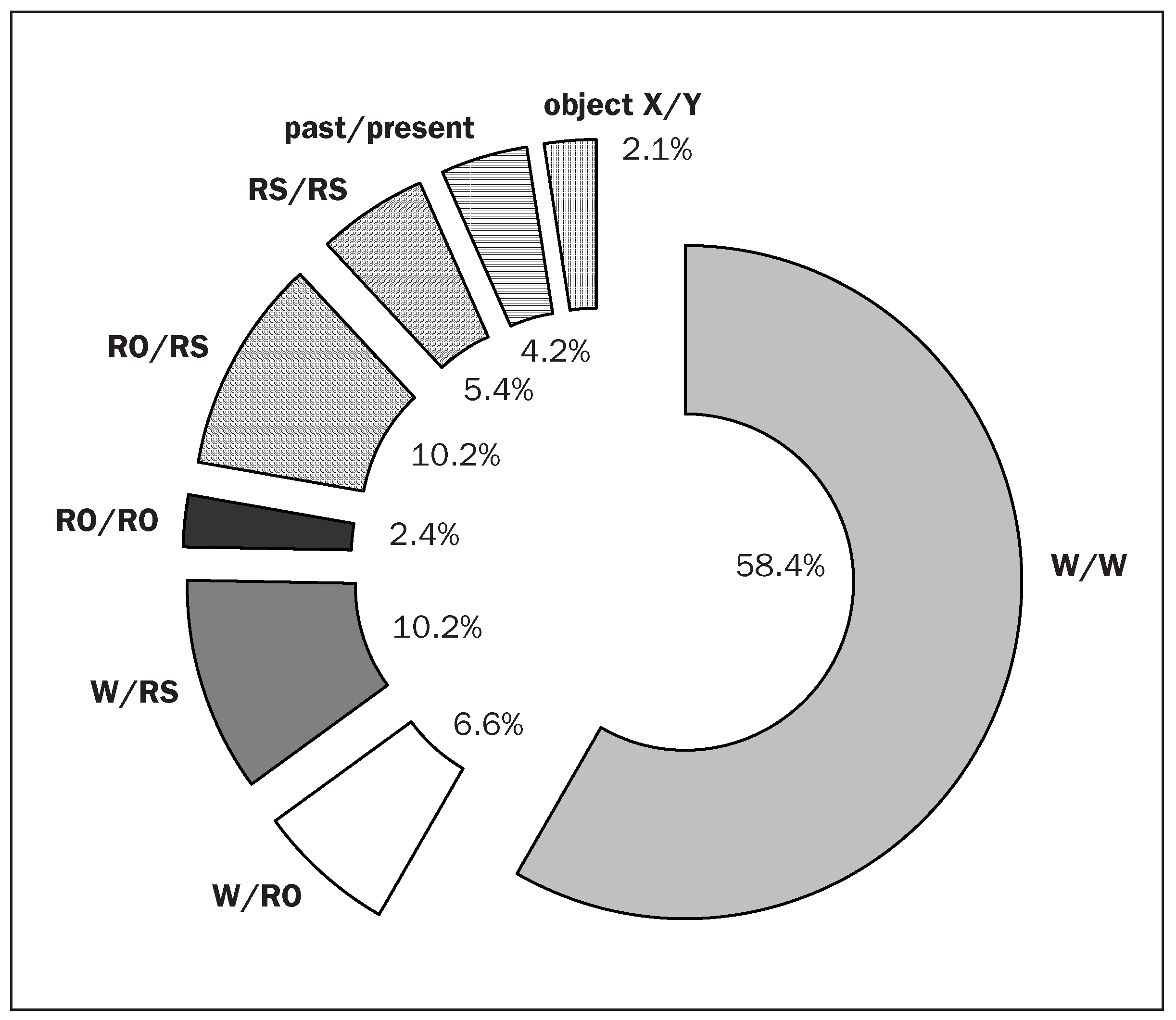
Figure 1 shows the frequency distribution of the different types of conflicts (see appendix I for examples). The great majority (58.4%) of conflict addressing interpretations aims at a conflict between two wishes (W–W). Largely behind (10.2%) we find conflicts between wish and reaction of subject (W–RS) and between response from object and reaction of subject (RO–RS).
Discussion
In order to refine the quality analysis of therapist interpretations in dynamic psychotherapy, we propose, in addition to the already existing measures of accuracy, a measure for amount and type of conflict addressing on the basis of the CCRT method.
Figure 1.
Frequency of conflict types (W = wish, RO = response from others; RS = response from the self).
Figure 1.
Frequency of conflict types (W = wish, RO = response from others; RS = response from the self).
Results confirmed our basic hypothesis concerning the link between the accuracy/conflictuality proportion in interpretations and early alliance that accuracy alone might not be sufficient for interpretations to have a substantial therapeutic impact in dynamic psychotherapies. Neither accuracy nor conflictuality alone achieves a significantly different association with one of the alliance groups. Moreover, we found an additive feature between these two measures. Accuracy and conflictuality measures tap at two distinct dimensions of the quality of interpretations. They are negatively correlated (–0.502) because accurately expressing the different components of the relational conflict of the patient or pointing to the conflict between two specific components are different tasks that the therapist should fulfil but could hardly combine. Future studies might investigate what kind of patients do better with high accuracy, and what kind of them do better with high conflictuality.
Conflictuality measure might be of interest not only for theoretical research, but also in psychotherapist training, as each therapist can establish and work on her or his interpretive profile with regard to the accuracy/conflictuality profile of his or her interpretations. By far the most frequent conflict category addressed has turned out to be the wish-wish type (almost two out of three), followed by W-RS and RO-RS conflicts; thus, conflicting wishes and subject’s response (in the CCRT language) seem to dominate over the object’s presumed or known reaction, which would corroborate the notion of conflict as a predominantly intrapsychic affair and still permit taking into account the internalised other. As for the frequency of conflict-addressing interpretations in this sample, it should be remembered that there are no more than one to two (mean 1.34) such interpretations per session, which places them in the range of frequencies reported in the literature for transference interpretations during psychotherapies.
Concerning the other measures used in the larger sample, neither accuracy nor conflictuality, either separately or combined, made any difference with regard to symptoms (SCL-90R) or social adaptation (SAS) at the beginning. Surprisingly, a relative high albeit not significant level of defences (ODF) in the DMRS was associated with lower accuracy. The higher ODF in these patients was mostly caused by intellectualisation [
22], a defence classified in the upper range of maturity in the DMRS but nevertheless obviously compromising at least part of the empathic qualities of our therapists.
The other significant result with our additional measures was a lower ratio of conflict-addressing interpretations and a lower sum [ACU + CFL] for patients scoring higher in the control dimension of the IIP (patients seeing themselves as more domineering and intrusive). This could be seen as a complementary attitude of the therapists, being more confronting with submissive patients and withholding from confrontation with controlling, domineering patients. While such a complementary attitude seems, at a first glance, understandable for the investigation phase of psychotherapy, it might become a problem, if maintained, in the psychotherapeutic phase proper [
26].
This study was limited in several ways. First of all, the sample size was very low, which seriously limited the accuracy and the reliability of the statistical analysis. Then the reliability of CCRT ratings of the therapists’ accuracy was relatively low, although satisfactory. This could be due to our material, because during the first sessions the interpretations of the therapist are rather tentative and may be shorter than during later sessions. With longer lasting material reliability might be higher and should be comparable to what was found by Luborsky [
8]. Finally, the BPI is a very brief psychodynamic intervention that may affect the depth and the quality of the therapist’s interpretations.
To confirm the relevance of a conflictuality measure for assessing the quality of therapeutic interventions, the present findings need, however, further confirmation by studies treating data from later phases of psychotherapy when more conflictaddressing interpretations can be supposed to occur and when an association with outcome can be examined.