Ocular motor disorders
If vertical diplopia is binocular [
4,
5,
6], the neurologist first searches for typical oculomotor (III) or trochlear nerve (IV) palsies. While III-palsy is mostly due to ischaemia (pupil typically spared) or compression (pupil typically affected) of the nerve, IV-palsy is mostly due to head trauma. If the trauma was rather weak, one should always consider the possibility of decompensating congenital trochlear nerve palsy. In this case, old photographic portraits would show a head tilt opposite to the side of the trochlear nerve palsy. Brown’s syndrome (limited movement of the SO tendon through the trochlear pully) can mimic a IV-palsy. The forced duction test, which should be left to the ophthalmologist, is diagnostic for this syndrome. III- and IV-palsies that go together with retroorbital pain should lead to a careful evaluation for neoplasm, thrombosis, and inflammation (Tolosa-Hunt syndrome) of the cavernous sinus.
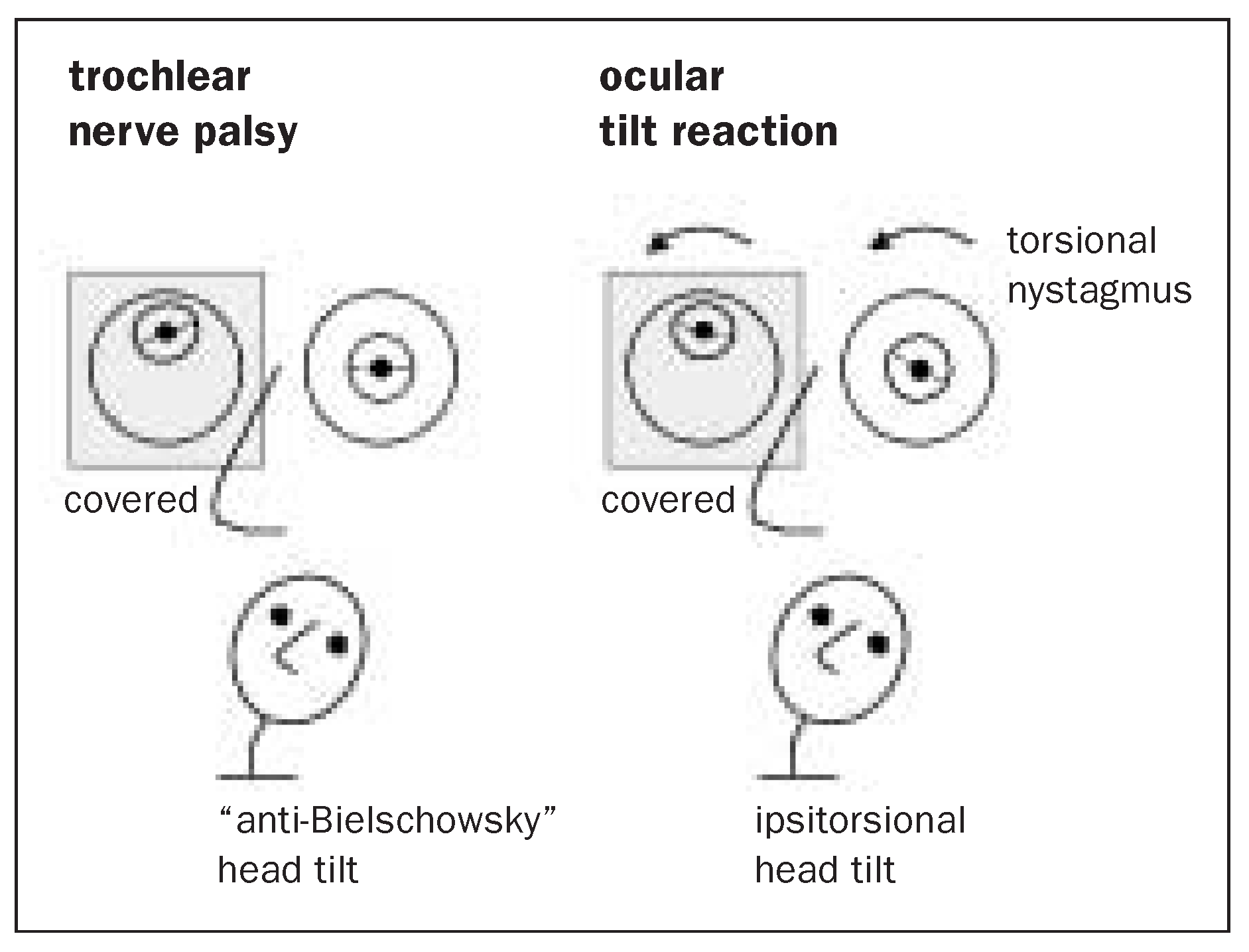
Distinguishing between IV-palsy and ocular tilt reaction is sometimes difficult. In both conditions the head tilts away from the eye showing hyperdeviation (
fig. 1). While the upper eye in IV-palsy is extorted, the upper eye in ocular tilt reaction is intorted. Furthermore, the lower eye in ocular tilt reaction is extorted and both eyes may show a torsional spontaneous nystagmus that beats opposite to the static ocular torsion [
7].
Figure 1.
Similar and dissimilar clinical features of trochlear nerve palsy and ocular tilt reaction.
Figure 1.
Similar and dissimilar clinical features of trochlear nerve palsy and ocular tilt reaction.
One can never be absolutely sure whether a typical III- or IV-palsy is due to a problem along the nerve or within the brainstem, except if other signs clearly indicate a lesion within the ipsilateral orbit or cavernous sinus. Thus neuro-imaging should always include MR-images of the midbrain to detect lesions in the nuclei and fascicles of the oculomotor and trochlear nerves. If a suspected III-palsy does not include all of the four corresponding extraocular muscles (superior, inferior, and medial recti; inferior oblique), one should also consider myasthenia gravis, which can mimic any neural extraocular muscle palsy. Myasthenia gravis without ptosis, however, is rare. A typical III-palsy that involves the pupil cannot be due to myasthenia gravis.
Isolated lesions of the oculomotor nucleus are rare. They should be considered if ptosis (levator palpebrae neurons originate from the unpaired central caudal nucleus) and SR-palsy (SR-neurons cross to the other side) are present on the contralateral side. Fascicular III-lesions are usually combined with other signs, such as contralateral hemiparesis (cerebral peduncle: Weber’s syndrome), contralateral tremor (red nucleus: Benedikt’s syndrome), or ipsilateral ataxia (superior cerebellar peduncle: Nothnagel’s syndrome). Lesions of the nucleus or fascicle of the trochlear nerve result in contralateral IV-palsy. More often than not, they are associated with other signs such as ipsilateral internuclear ophthalmoplegia (medial longitudinal fascicle), ipsilateral Horner’s syndrome (descending sympathetic fibres in the periaqueductal gray), or contralateral afferent defect of the pupil (pretectal fibres).
Wernicke’s disease is always a valid differential diagnosis of binocular vertical diplopia, especially in the presence of pathological nystagmus and ataxia. If binocular vertical diplopia is associated with deficits of multiple cranial nerves, one should consider a demyelinating disease such as Miller-Fisher and Guillain-Barré syndrome.
Restrictive processes can also lead to binocular vertical diplopia, most of all Graves’ disease, which is usually identified by other signs such as lid retraction, lid lag, and proptosis. If there is any suspicion of a restrictive orbital process, the patient should be referred to the ophthalmologist.
Vestibular disorders
Skew deviation is a vertical misalignment of the two eyes resulting from disturbance of supranuclear inputs to the ocular motor neurons of the vertical-torsional eye muscles. If skew deviation goes together with ocular torsion towards the lower eye, so-called skew torsion, an imbalance in the vestibular system, mainly a unilateral lesion of “graviceptive” pathways, which combine otolith and vertical semicircular canal signals, is likely [
7]. Skew torsion combined with head roll towards the lower eye forms the triad of ocular tilt reaction.
To understand skew torsion or ocular tilt reaction, one must consider certain properties of the otolith-ocular reflex. Normally, rolling the head from the upright position leads to binocular torsion in the opposite direction (ocular counterroll) and minor skew deviation (extorting eye lower) to partially align the retina of both eyes with the horizon. Thus, skew torsion and ocular tilt reaction represent a fundamental pattern of eye-head synergy upon utricular and vertical semicircular canal inputs [
8]. Hence, peripheral or central lesions disrupting these graviceptive pathways result in skew torsion or ocular tilt reaction.
A topologic diagnosis of skew torsion and ocular tilt reaction requires exact knowledge of the anatomy of the otolith-ocular reflex pathways. The vestibular nerve, containing axons from the otolith and semicircular canal organs, enters the medulla near the caudal end of the pons. In the vestibular nuclei, which are located below the floor of the fourth ventricle, otolith and vertical semicircular canals signals converge to form the graviceptive pathways.These pathways cross to the other side of the brainstem approximately in the middle of the pons and further ascend in the medial longitudinal fascicle to the ocular motor nuclei (nuclei III and IV) and the premotor gaze centres in the rostral midbrain. From there further connections reach multiple cortical areas through thalamic projections.
Consistent with the anatomy of the graviceptive pathways, ipsiversive skew torsion (ipsilateral eye lower, and ipsilateral binocular torsion) and ipsilateral ocular tilt reaction (ipsiversive skew torsion, and ipsilateral head tilt) will occur as a result of unilateral peripheral or pontomedullary lesions below the pontine crossing of the graviceptive pathways. In contrast, a unilateral pontomesencephalic brainstem lesion leads to contraversive skew deviation (contralateral eye lower) and contralateral ocular tilt reaction (contraversive skew deviation, contralateral binocular torsion, and contralateral head tilt). Lesions of cerebellar structures inhibiting the otolith-ocular reflex may also lead to skew torsion [
9].
Common causes of ocular tilt reaction are brainstem ischaemia, especially Wallenberg’s syndrome, and unilateral paramedian thalamic infarction with involvement of the midbrain. Thalamic lesions without damage to the midbrain do not lead to skew torsion or ocular tilt reaction. Since both graviceptive pathways and internuclear connection between ocular motor nuclei travel along the medial longitudinal fascicle, skew torsion due to pontomesencephalic lesions is frequently associated with internuclear ophthalmoplegia.
Vertical diplopia due to peripheral or central vestibular lesions always includes binocular torsion towards the lower eye. Hence the direction of fundoscopic cyclorotation distinguishes between hypertropia due to trochlear palsy (excyclorotation) and hypertropia due to skew torsion (incyclorotation) (fig. 1). Vertical deviations in both trochlear nerve palsy and skew torsion may be concomitant or non concomitant, thus concomitance is not a criterion to discriminate between the two conditions. Likewise, additional signs of midbrain lesions do not speak in favour of skew torsion, since trochlear nerve palsy can also occur as a result of a lesion within the brainstem.