Next Article in Journal
Bovine spongiforme Enzephalopathie (BSE): Auftreten und Entwicklung in Europa
Previous Article in Journal
Spongiforme Enzephalopathien: eine Gruppe besorgniserregender Krankheiten
 
 
Swiss Archives of Neurology, Psychiatry and Psychotherapy is published by MDPI from Volume 176 Issue 1 (2026). Previous articles were published by another publisher in Open Access under a CC-BY (or CC-BY-NC-ND) licence, and they are hosted by MDPI on mdpi.com as a courtesy and upon agreement with the previous journal publisher.
Article

Prion diseases and neuroinvasion

Institute of Pathology, Kantonsspital, CH-4003 Basel
Swiss Arch. Neurol. Psychiatry Psychother. 2001, 152(2), 50-54; https://doi.org/10.4414/sanp.2001.01208
Published: 1 January 2001

Summary

Prion diseases are lethal neurodegenerative disorders affecting animals and humans. Although human prion diseases are generally rare, the incidence of a “new variant” Creutzfeldt-Jakob disease in young patients in the United Kingdom is increasing. Considerable evidence suggests that this novel disease is the sequelae of exposure to BSE-contaminated food products. Recently several clues have been identified regarding the mechanisms of prion spread in an infected host following peripheral infection. In this article the involvement of the immune system in the mechanism of prion spread from peripheral sites to the central nervous system will be discussed. These studies will help to establish strategies aimed at therapy for iatrogenic prion disease and new variant Creutzfeldt-Jakob disease (vCJD) in humans.

Zusammenfassung

Prionenerkrankungen oder übertragbare spongiforme Enzephalopathien sind letale neurodegenerative Erkrankungen, welche histopathologisch durch schwammartige («spongiforme») Veränderungen im Gehirn charakterisiert sind. Obwohl Prionenerkrankungen selten sind, hat das Auftreten einer neuen Variante der Creutzfeldt-Jakob-Krankheit (vCJD), zuerst bei jungen Patienten in Grossbritannien beobachtet und wahrscheinlich auf eine Infektion mit dem BSE-Erreger über die Nahrungskette zurückzuführen, zu grossem gesellschaftlichen und wissenschaftlichen Interesse geführt. Dieser Artikel beschäftigt sich besonders mit der Ausbreitung des Erregers, der Rolle des Immunsystems bei Prionenerkrankungen und fasst die bisherigen experimentellen und epidemiologischen Daten zusammen, die belegen, dass die BSE und vCJD auf denselben Erreger zurückzuführen sind. Aus diesen Studien ergeben sich Grundlagen, um die Ausbreitung von Prionen im infizierten Organismus zu verstehen und möglicherweise Erkenntnisse, um therapeutische Strategien zu entwickeln.
Schlüsselwörter: übertragbare spongiforme Enzephalopathien; Prion; PrP; Immunzellen; Neuroinvasion

Introduction

Prion diseases or transmissible spongiform encephalopathies (TSEs) belong to a group of fatal neurodegenerative illnesses which include Creutzfeldt-Jakob disease (CJD) in humans, scrapie in sheep and bovine spongiform encephalopathy (BSE) in cattle [1,2]. Human prion diseases comprise three manifestations in general, namely the sporadic forms of the disease (85% of all CJD cases), the inherited forms linked to mutations in the human PrnP gene and the infectious forms which are acquired by transplantation, injection or ingestion of prion-contaminated tissue-derived products (iatrogenic CJD, vCJD and kuru). Experimental and epidemiological investigations of prion diseases have greatly been promoted by the recognition of “new variant” Creutzfeldt-Jakob disease (vCJD) in the United Kingdom and in France, which is most likely the result of the consumption of beef products contaminated with BSE. Subsequently the infectious potential of bovine prions has been demonstrated by transmission of the BSE agent to a variety of species [3].

The molecular biology of prion diseases

Although the exact physical nature of the transmissible agent is still in question, a wealth of experimental data supports the “protein only” hypothesis which postulates that the agent is devoid of nucleic acid and consists solely of an abnormal folded form (PrPSc) of a normal host-encoded cellular prion protein (PrPC or PrP-sen). The hallmark of prion diseases is the deposition of the abnormal isomer (PrPSc or PrP-res) in the brain. Prion infectivity copurifies with the partially protease-resistant and detergent insoluble PrPSc, which suggests that the abnormal isomer is a component of the infectious agent. Furthermore, agent propagation is thought to occur by a PrPScmediated conformational conversion of PrPC into new PrPSc molecules [2].
Mice lacking the gene that encodes the cellular prion protein (Prnpo/o mice) are fertile and develop quite normally but fail to develop the disease and do not propagate the infectious agent demonstrating that host cells must express PrPC in order to sustain the disease [4]. Whilst PrPC is expressed at high levels in the central nervous system (CNS) it is not confined to this site and can be detected on a variety of cells in peripheral tissues including cells of the lymphoid system [5].

Human prion diseases and BSE

Among the human prion diseases most attention currently focuses on vCJD and its relationship to BSE [6]. New variant CJD was first reported in March 1996 affecting unusually young people in the UK and was shown to be different from sporadic CJD in regard to its clinical and neuropathological features [7]. So far, 85 cases of vCJD in the UK, one in Ireland and 3 cases in France have been confirmed. All these cases share a unique histopathological phenotype consisting of numerous “florid” amyloid plaques, which are composed of PrP.
There are several lines of evidence arguing for a causal relationship between BSE and vCJD: all cases of vCJD were initially reported 10 years after the BSE outbreak and no obvious risk factors could be identified. Therefore a causal link to the exposure of BSE-contaminated food products seems likely. Furthermore, it has been shown that primates (cynomolgus macaque) inoculated intracerebrally with brain extracts from BSEaffected cows develop a CJD-like disease with multiple florid amyloid plaques, which have been observed in all cases of vCJD [8]. In addition, classical strain typing experiments have demonstrated that transmission of vCJD or BSE prions into a panel of inbred mouse strains produced incubation times and brain lesion profiles which were indistinguishable, thereby establishing a single prion strain causing vCJD and BSE [3]. Even more strikingly, comparison of incubation times and lesion patterns produced by prions derived from sporadic CJD, vCJD or BSE revealed that vCJD prions are closer related to BSE prions than to sporadic CJD prions.

Spread of prions from peripheral sites to the central nervous system

Whilst the pathology of prion diseases is confined mainly to the brain and can occur following iatrogenic intracerebral inoculation, the most common occurrence of disease results from exposure via peripheral routes such as intraperitoneal, intravenous or oral exposure to infectious material. Epidemiologically more relevant than the intracerebral transmission is the oral uptake of prions which is thought to be responsible for the BSE epidemic and for transmission of BSE to a variety of species including humans. Prions can find their way through the body to the brain of their host, yet histopathological changes have not been identified in organs other than the central nervous system. But prions may multiply or accumulate silently in “reservoirs” during the incubation phase of the disease. One such reservoir might be the immune system and many studies point to the importance of prion replication in lymphoid organs [9]. Following either intracerebral (i.c.) or intraperitoneal (i.p.) experimental inoculation, prions accumulate in secondary lymphoid organs such as spleen and lymph nodes [10]. This appears to be a strain-dependent phenomenon as different prion strains exhibit different affinities for lymphoid tissues. For example, BSE appears to have low affinity for bovine lymphoid tissue, and is confined to the nervous system of experimentally infected cattle, although very limited amounts of infectivity have been detected in other sites such as terminal ileum and bone marrow. In contrast, during the human disease vCJD, which is most probably derived from BSE, PrPSc accumulates in tonsils, spleen and appendix of infected individuals [11,12].
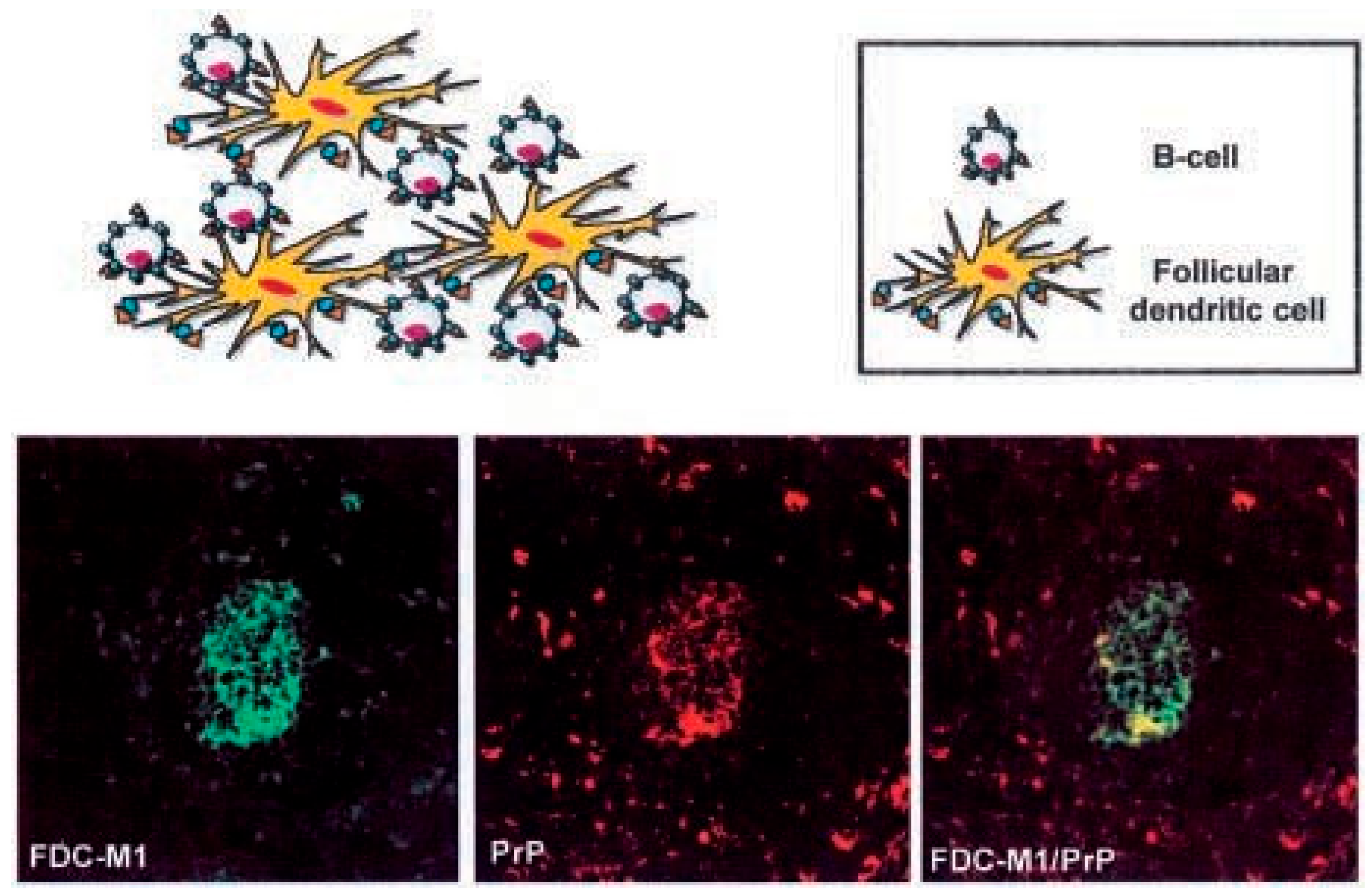
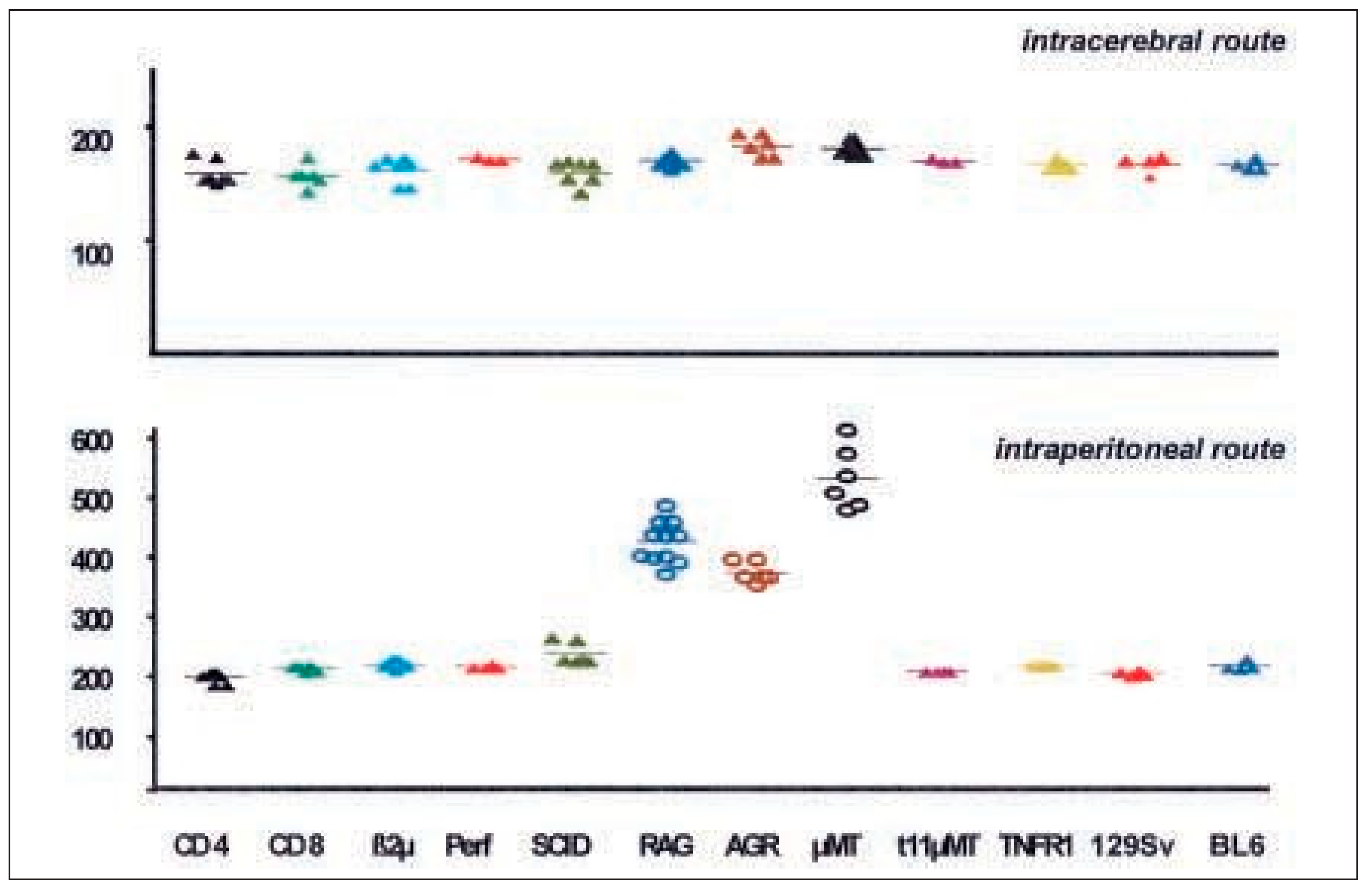
Despite considerable evidence implicating the role of the immune system in peripheral prion pathogenesis, there have been few studies on identity of cells involved in this process. Early studies showed that whole-body gamma irradiation of mice failed to influence prion pathogenesis or scrapie incubation time [13]. This has argued against a significant involvement by proliferating cells in the lymphoreticular phase of prion propagation. Follicular dendritic cells (FDC), which are radio-resistant, have been considered as the prime cell type for prion replication within lymphoid tissue since PrPSc accumulates in the follicular dendritic network of scrapie-infected mice (Figure 1) [14]. In addition, severe combined immunodeficient mice (SCID), which lack mature B and T cells, and which do not appear to have functional FDCs, are highly resistant to scrapie after intraperitoneal inoculation and fail to replicate prions in the spleen. Interestingly, bonemarrow reconstitution of SCID mice with wildtype spleen cells restores their susceptibility to scrapie disease after peripheral infection [15]. These findings suggest that an intact or partially intact immune system, comprising lymphocytes and FDCs, is required for efficient neuroinvasion by prions from the site of peripheral infection. To identify the lymphoid cells responsible for accumulation of the infectious agent in secondary lymphoid organs, a panel of immunodeficient mice with various defects has been tested for their susceptibility to scrapie. Mice deficient for T cells developed scrapie similar to wildtype controls following intraperitoneal (i.p.) inoculation with a mouse-adapted scrapie isolate. In contrast, no clinical disease was observed in mice with either a B-cell defect or with a combined B- and T-cell deficiency ((Figure 2)). Importantly, no prion infectivity was detectable in the spleens of disease-free mice. These data implicate B cells as a crucial cell type involved in peripheral scrapie pathogenesis. However, in the absence of B cells mice fail to produce antibodies and FDCs fail to develop [16]. Since the replication of prions [4] and their transport from the periphery to the central nervous system [17] is dependent upon expression of PrPC, the requirement of PrPC expression by B cells was tested. Mice were repopulated by adoptive transfer of haematopoieticstem cells, which expressed or lacked expression of PrPC.
Adoptive transfer induced the formation of a follicular dendritic cell network in spleens of recipient mice. Reconstituted mice were challenged i.p. with scrapie prions. Surprisingly, all mice that received haematopoietic stem cells of either genotype, Prnp+/+ or Prnpo/o, from immunocompetent donors, succumbed to scrapie after inoculation, arguing that an intact immune system is required for neuroinvasion and that the expression of PrPC on B-lymphocytes is dispensible [18].
Whilst B cells are clearly a cofactor in peripheral prion pathogenesis, the identity of those cells in which prions actually multiply or accumulate within lymphatic organs is uncertain. Recent results showed that a transient therapeutic depletion of FDCs with an inhibitor of FDC development leads to a prolonged incubation time and to decreased titres of the infectious agent in spleen [19]. Collectively, the current findings are compatible with the hypothesis that cells whose maturation depends on B cells are responsible for accumulation of prions in lymphoid tissue such as the spleen. FDCs, although their origin remains rather obscure, are a likely candidate for the site of prion replication because their maturation correlates with the presence of B cells and their products. However, it is still possible that the follicular dendritic network serves merely as a reservoir for the accumulation of prions and that other processes are involved in the transport of the infectious agent. Prions may be transported on or within B cells directly as they cross peripheral lymphoid tissue to localise in autonomic nerve terminals. Indeed, recent investigations have demonstrated that prion infectivity is rather associated with B- and T-lymphocytes than with a stromal fraction containing FDCs [20]. Alternatively, there might be other components derived from lymphoid cells, which are responsible for binding and transport of prions.

Conclusion

A little more than a decade ago, prion diseases were regarded as rare neurodegenerative disorders with no serious impact on public health issues and no immediate need for the development of diagnostic or therapeutic measures. This has drastically changed with the appearance of BSE epidemic and its human counterpart vCJD. Because of the long incubation time and other unknown factors such as genetic predisposition and exposure criteria, it is difficult to predict whether the incidence of vCJD will increase, and to what extent [21,22].
Peripheral prion pathogenesis and ultimately neuroinvasion is dependent upon components of the host immune system. Collectively, these processes require either B cells per se or their products. The follicular dendritic network composed of FDCs and B cells comprises a major site of extraneuronal PrPC expression and of PrPSc accumulation. The mechanism by which prions accumulate within lymphoid tissue remains to be established. An attractive hypothesis is that prions bind directly via a receptor or indirectly via other soluble extracellular molecules onto the surface of FDC as a prion complex. The second phase of neuroinvasion appears to be the progression of prions from reservoirs of infectivity associated with lymphoid tissue to nerve terminals. It is worthwhile noting that the innervation of lymphoid tissue is at least in part controlled by lymphocytes themselves as both T and B cells secrete nerve growth factor and vice versa nerve endings secrete a variety of factors to stimulate the immune system. A thorough understanding of the role of the immune system in peripheral prion pathogenesis is of immediate importance in assessing the risk of iatrogenic transmission of prions via exposure to blood or tissues from individuals suffering from preclinical prion disease.

Abbreviations

BSEbovine spongiform encephalopathy
CJDCreutzfeldt-Jakob disease
FDCfollicular dendritic cell
PrPprion protein
PrPCnormal cellular form of PrP
PrPScscrapie-associated form of PrP
TSEtransmissible spongiform encephalopathy
vCJDvariant CJD

References

  1. Aguzzi, A.; Weissmann, C. Prion research: the next frontiers. Nature 1997, 389, 795–798. [Google Scholar] [CrossRef] [PubMed]
  2. Prusiner, S.B. Prion diseases and the BSE crisis. Science 1997, 278, 245–51. [Google Scholar] [CrossRef] [PubMed]
  3. Bruce, M.E.; Will, R.G.; Ironside, J.W.; McConnell, I.; Drummond, D.; Suttie, A.; McCardle, L.; Chree, A.; Hope, J.; Birkett, C.; et al. Transmissions to mice indicate that “new variant” CJD is caused by the BSE agent. Nature 1997, 389, 498–501. [Google Scholar] [CrossRef]
  4. Büeler, H.; Aguzzi, A.; Sailer, A.; Greiner, R.-A.; Autenried, P.; Aguet, M.; Weissmann, C. Mice devoid of PrP are resistant to scrapie. Cell 1993, 73, 1339–1347. [Google Scholar] [CrossRef]
  5. Cashman, N.R.; Loertscher, R.; Nalbantoglu, J.; Shaw, I.; Kascsak, R.J.; Bolton, D.C.; Bendheim, P.E. Cellular isoform of the scrapie agent protein participates in lymphocyte activation. Cell 1990, 61, 185–192. [Google Scholar] [CrossRef]
  6. Weissmann, C.; Aguzzi, A. Bovine spongiform encephalopathy and early onset variant Creutzfeldt-Jakob disease. Curr. Opin. Neurobiol. 1997, 7, 695–700. [Google Scholar] [CrossRef]
  7. Will, R.; Ironside, J.; Zeidler, M.; Estibeiro, K.; Cousens, S.; Smith, P.; Alperovitch, A.; Poser, S.; Pocchiari, M.; Hofman, A. A new variant of Creutzfeldt-Jakob disease in the UK. Lancet 1996, 347, 921–925. [Google Scholar] [CrossRef] [PubMed]
  8. Lasmézas, C.I.; Deslys, J.-P.; Robain, O.; Jaegly, A.; Beringue, V.; Peyrin, J.-M.; Fournier, J.-G.; Hauw, J.-J.; Rossier, J.; Dormont, D. Transmission of the BSE agent to mice in the absence of detectable abnormal prion protein. Science 1997, 275, 402–405. [Google Scholar] [CrossRef]
  9. Eklund, C.M.; Kennedy, R.C.; Hadlow, W.J. Pathogenesis of scrapie virus infection in the mouse. J. Infect. Dis. 1967, 117, 15–22. [Google Scholar] [CrossRef]
  10. Kimberlin, R.H.; Walker, C.A. The role of the spleen in the neuroinvasion of scrapie in mice. Virus Res. 1989, 12, 201–211. [Google Scholar] [CrossRef]
  11. Hill, A.F.; Zeidler, M.; Ironside, J.; Collinge, J. Diagnosis of new variant Creutzfeldt-Jakob disease by tonsil biopsy. Lancet 1997, 349, 99–100. [Google Scholar] [CrossRef]
  12. Hilton, D.A.; Fathers, E.; Edwards, P.; Ironside, J.W.; Zajicek, J. Prion immunoreactivity in appendix before clinical onset of variant Creutzfeldt-Jakob disease. Lancet 1998, 352, 703–704. [Google Scholar] [CrossRef] [PubMed]
  13. Fraser, H.; Farquhar, C.F.; McConnell, I.; Davies, D. The scrapie disease process is unaffected by ionising radiation. Prog. Clin. Biol. Res. 1989, 317, 653–658. [Google Scholar] [CrossRef]
  14. Kitamoto, T.; Muramoto, T.; Mohri, S.; Doh-Ura, K.; Tateishi, J. Abnormal isoform of prion protein accumulates in follicular dendritic cells in mice with Creutzfeldt-Jakob disease. J. Virol. 1991, 65, 6292–6295. [Google Scholar] [CrossRef] [PubMed]
  15. Lasmézas, C.; Cesbron, J.Y.; Deslys, J.P.; Demaimay, R.; Adjou, K.T.; Rioux, R.; Lemaire, C.; Locht, C.; Dormont, D. Immune system-dependent and-independent replication of the scrapie agent. J. Virol. 1996, 70, 1292–1295. [Google Scholar] [CrossRef]
  16. Klein, M.A.; Frigg, R.; Flechsig, E.; Raeber, A.J.; Kalinke, U.; Bluethmann, H.; Bootz, F.; Suter, M.; Zinkernagel, R.M.; Aguzzi, A. A crucial role for B cells in neuroinvasive scrapie. Nature 1997, 390, 687–690. [Google Scholar] [CrossRef]
  17. Blättler, T.; Brandner, S.; Raeber, A.J.; Klein, M.A.; Voigtländer, T.; Weissmann, C.; Aguzzi, A. PrP-expressing tissue required for transfer of scrapie infectivity from spleen to brain. Nature 1997, 389, 69–73. [Google Scholar] [CrossRef] [PubMed]
  18. Klein, M.A.; Frigg, R.; Raeber, A.J.; Flechsig, E.; Hegyi, I.; Zinkernagel, R.M.; Weissmann, C.; Aguzzi, A. PrP expression in B-lymphocytes is not required for prion neuroinvasion. Nat. Med. 1998, 4, 1429–1433. [Google Scholar] [CrossRef]
  19. Montrasio, F.; Frigg, R.; Glatzel, M.; Klein, M.A.; Mackay, F.; Aguzzi, A.; Weissmann, C. Impaired prion replication in spleens of mice lacking functional follicular dendritic cells. Science 2000, 288, 1257–1259. [Google Scholar] [CrossRef]
  20. Raeber, A.J.; Klein, M.A.; Frigg, R.; Flechsig, E.; Aguzzi, A.; Weissmann, C. PrP-dependent association of prions with splenic but not circulating lymphocytes of scrapieinfected mice. EMBO J. 1999, 18, 2702–2706. [Google Scholar] [CrossRef]
  21. Cousens, S.N.; Vynnycky, E.; Zeidler, M.; Will, R.G.; Smith, P.G. Predicting the CJD epidemic in humans. Nature 1997, 385, 197–198. [Google Scholar] [CrossRef] [PubMed]
  22. Ghani, A.C.; Ferguson, N.M.; Donnelly, C.A.; Anderson, R.M. Predicted vCJD mortality in Great Britain. Nature 2000, 406, 583–584. [Google Scholar] [CrossRef] [PubMed]
Figure 1. Schematic representation of cells involved in peripheral prion pathogenesis in the white pulp module of secondary lymphoid organs (upper panel). Confocal double-colour immunofluorescence analysis shows localisation of PrP (red) and FDCs (green) in the follicular dendritic network of germinal centres in spleen. Most of the PrP signal appears to colocalise with FDCs (lower panel).
Sanpp 152 00050 g001
Figure 2. Latency of scrapie in different immunodeficient mice. All mice developed spongiform encephalopathy after intracerebral inoculation (closed triangles, upper panel). In contrast, B-cell deficient mice stayed healthy after intraperitoneal inoculation with mouse scrapie prions (open circles, lower panel).
Sanpp 152 00050 g002