

Increased Expression of Angiopoietin 2 and Tie2 in Rosacea




Simple Summary
Abstract
1. Introduction
- (i)
- Chronic inflammation: In response to various triggers, such as UV irradiation, microorganisms, and environmental factors, the immune system becomes overactive, leading to the release of inflammatory mediators. These mediators, such as interleukin-1 (IL-1) and tumor necrosis factor-alpha (TNF-α), promote angiogenesis by stimulating the production of proangiogenic factors. In addition, pattern recognition receptors, including Toll-like receptors (TLRs) and antimicrobial peptides (mainly cathelicidin in the skin), are activated.
- (ii)
- Vascular Endothelial Growth Factor (VEGF): VEGF is a potent proangiogenic factor that plays a pivotal role in the formation of new blood vessels. Elevated levels of VEGF have been detected in the skin of individuals with rosacea. This increase in VEGF contributes to the enlargement and dilation of blood vessels, leading to the visible erythema associated with the condition.
- (iii)
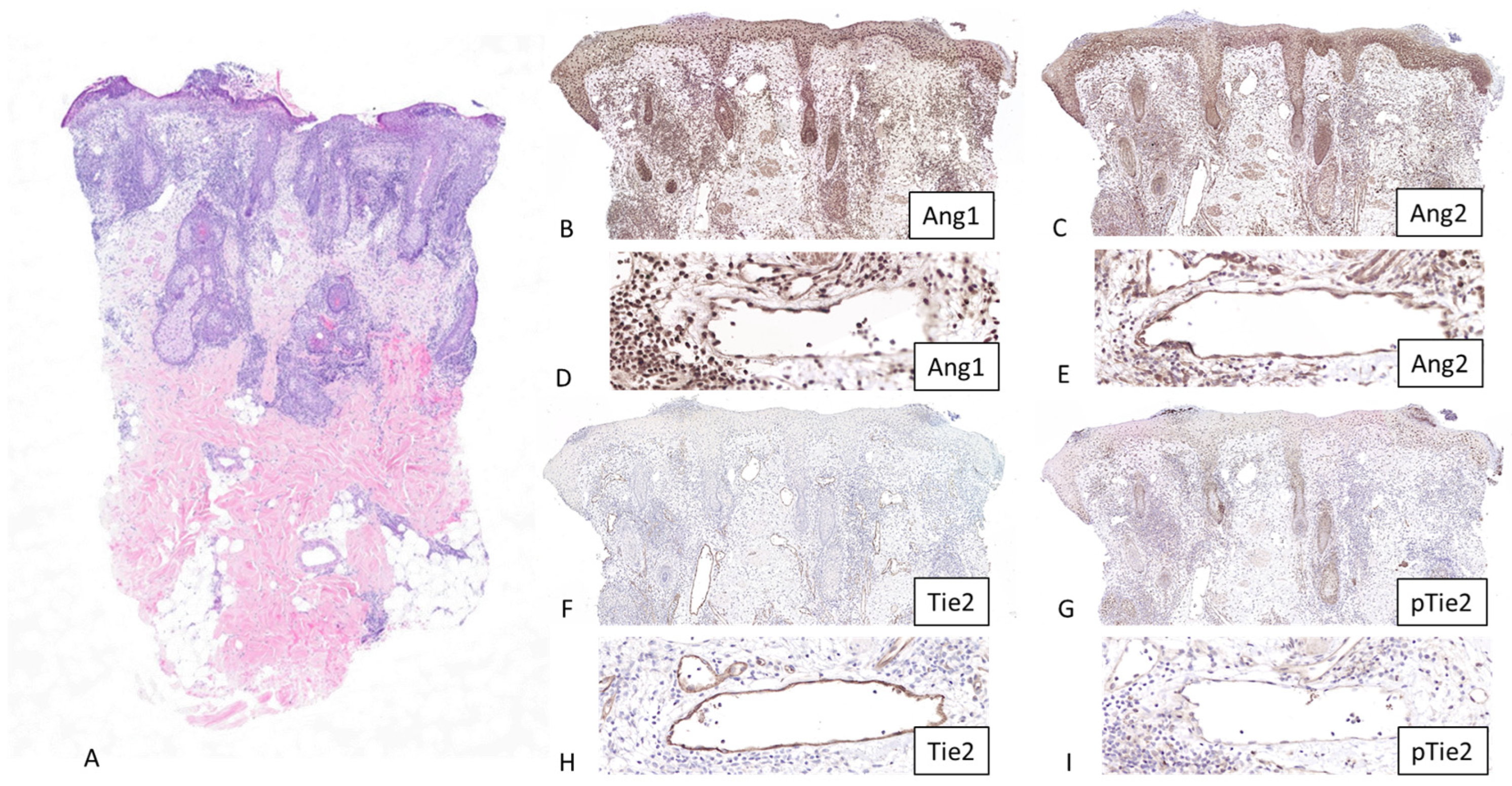
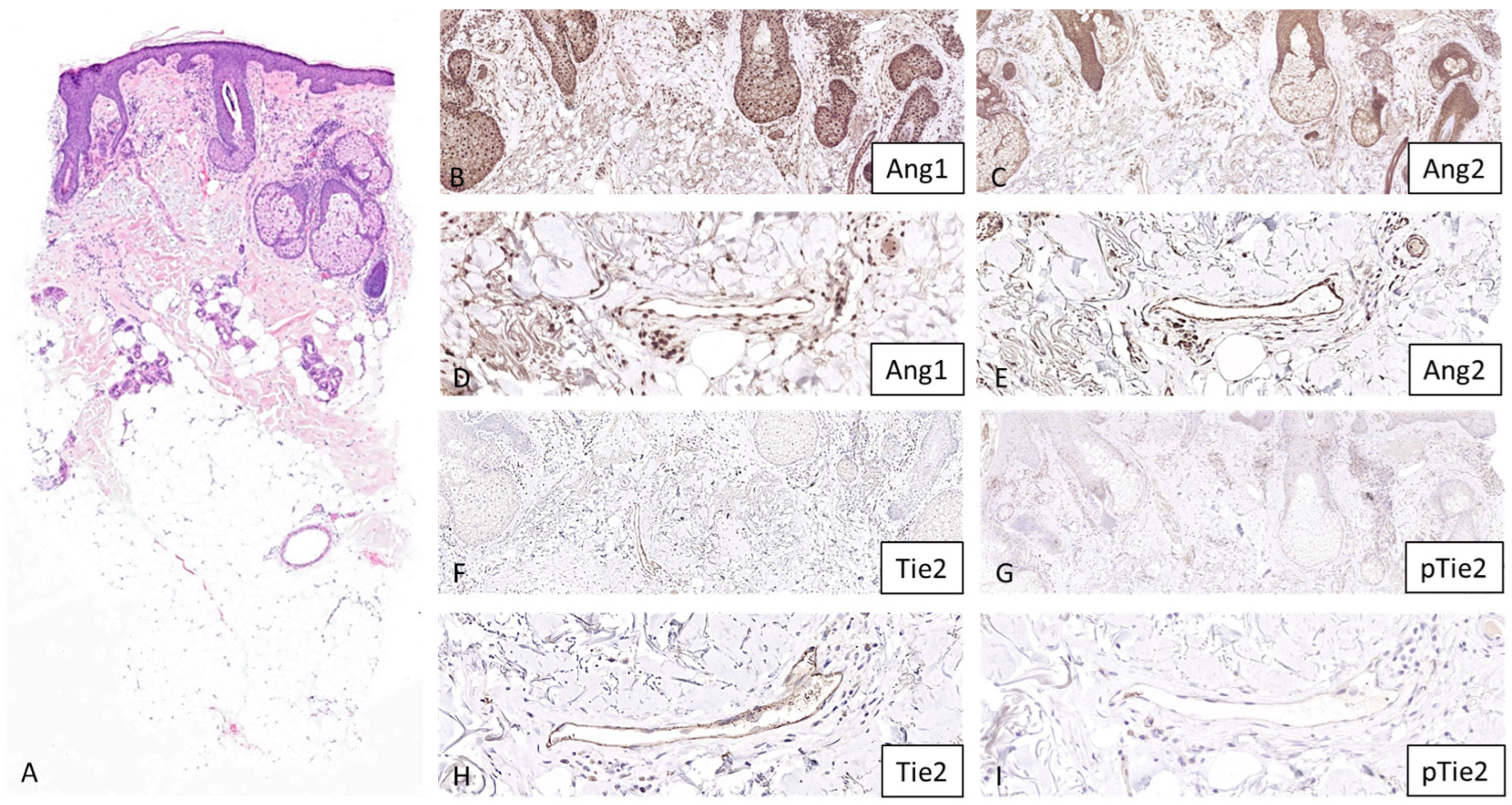
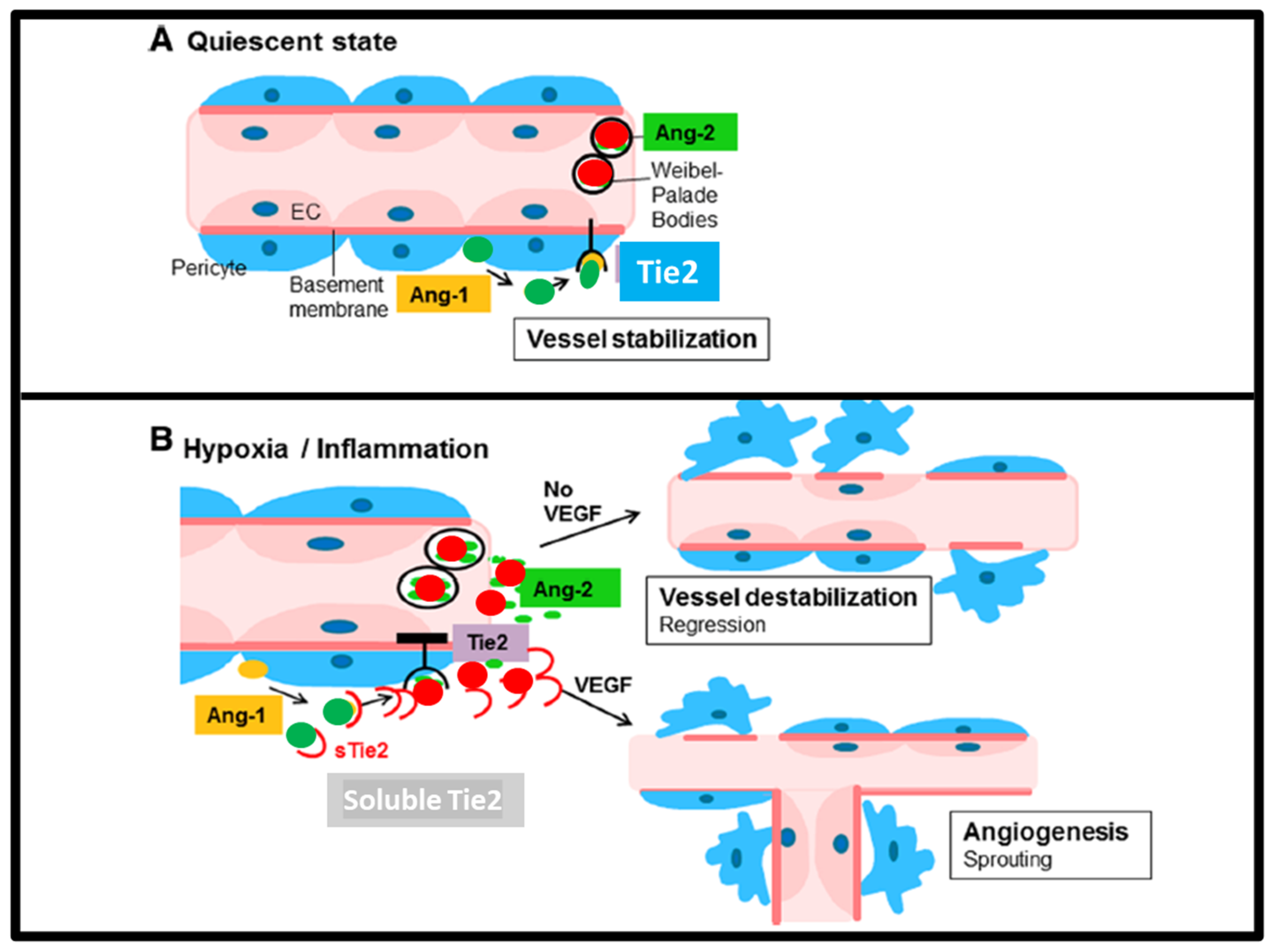
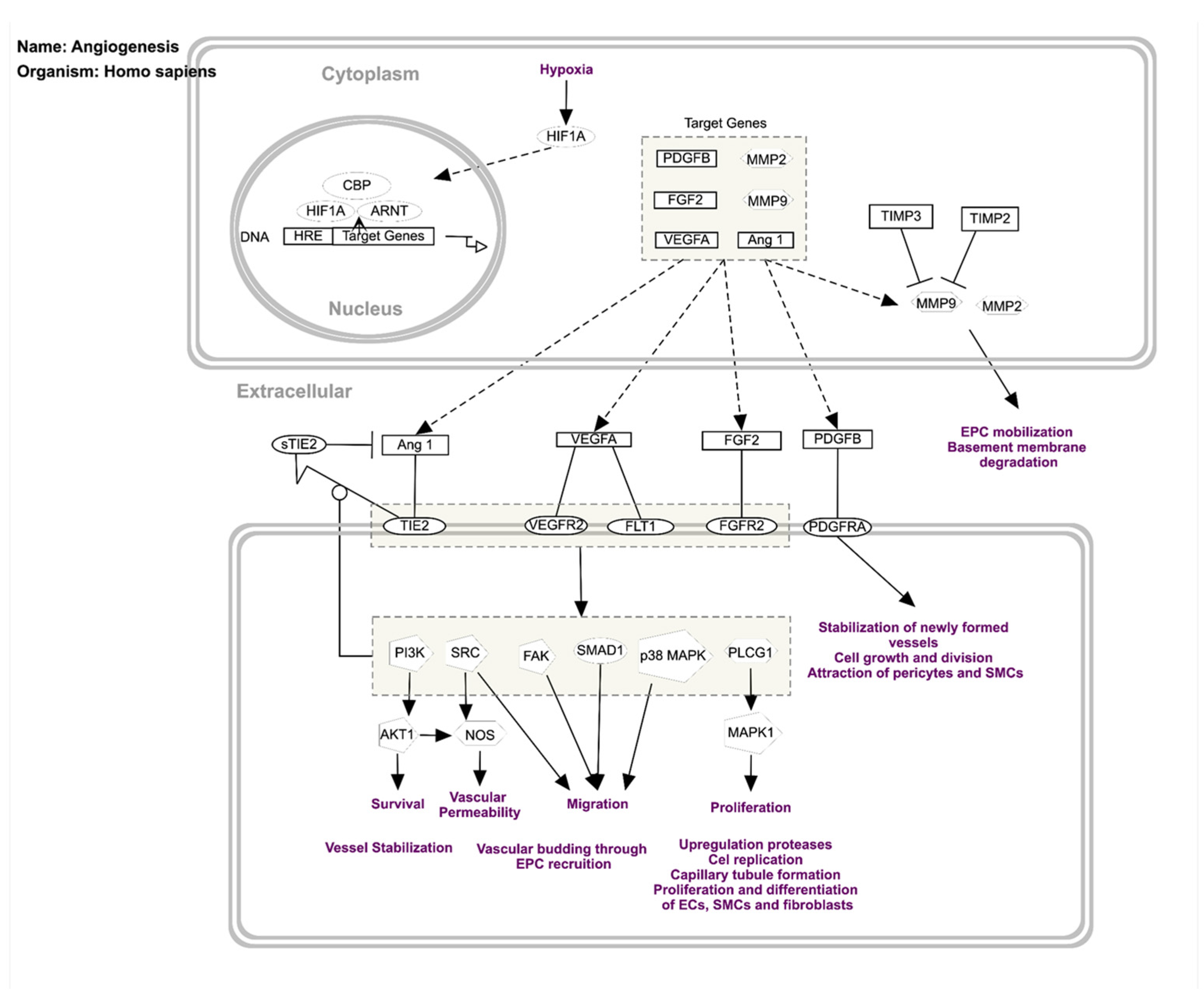
- The Angiopoietins and Tie2 signaling pathway: Angiopoietin 1 (Ang1, produced by the pericytes) and Angiopoietin 2 (Ang2, produced by the endothelial cells and stored in Weibel–Palade bodies) are proteins that competitively bind to the Tie2 receptor expressed on endothelial cells.
2. Subjects and Methods
3. Results
4. Discussion
5. Conclusions
Author Contributions
Funding
Institutional Review Board Statement
Informed Consent Statement
Data Availability Statement
Conflicts of Interest
References
- Crawford, G.H.; Pelle, M.T.; James, W.D. Rosacea: I. Etiology, pathogenesis, and subtype classification. J. Am. Acad. Dermatol. 2004, 51, 327–341. [Google Scholar] [CrossRef]
- Wilkin, J.; Dahl, M.; Detmar, M.; Drake, L.; Feinstein, A.; Odom, R.; Powell, F. Standard classification of rosacea: Report of the National Rosacea Society Expert Committee on the classification and staging of rosacea. J. Am. Acad. Dermatol. 2002, 46, 584–587. [Google Scholar] [PubMed]
- Aroni, K.; Tsagroni, E.; Lazaris, A.C.; Patsouris, E.; Agapitos, E. Rosacea: A clinicopathological approach. Dermatology 2004, 209, 177–182. [Google Scholar] [CrossRef] [PubMed]
- Jang, Y.J.; Hong, E.H.; Park, E.J.; Kim, K.J.; Kim, K.H. Immunohistochemical Analysis of Differences of Toll-Like Receptor 2, Mast Cells, and Neurofilaments between Granulomatous Rosacea and Non-Granulomatous Rosacea. Indian J. Dermatol. 2021, 66, 343–346. [Google Scholar] [PubMed]
- Lee, W.J.; Jung, J.M.; Lee, Y.J.; Won, C.H.; Chang, S.E.; Choi, J.H.; Moon, K.C.; Lee, M.W. Histopathological Analysis of 226 Patients with Rosacea According to Rosacea Subtype and Severity. Am. J. Dermatopathol. 2016, 38, 347–352. [Google Scholar] [CrossRef]
- Weedon, D. Skin Pathology, 2nd ed.; Churchill Livingstone: London, UK, 2002; pp. 484–485. [Google Scholar]
- Arnaout, R.; Sorg, O.; Satta, N.; Seilaz, C.; von Englebrechten, M.; Saurat, J.H. Angiopausin® and Angiopoietin: Unveiling New Mechanisms in Rosacea Treatment through Kinetic Erythema Analysis with the AAREA® Algorithm. Dermatology 2025. [Google Scholar] [CrossRef]
- Fiedler, U.; Augustin, H.G. Angiopoietins: A link between angiogenesis and inflammation. Trends Immunol. 2006, 27, 552–558. [Google Scholar] [CrossRef]
- Lee, H.J.; Hong, Y.J.; Kim, M. Angiogenesis in Chronic Inflammatory Skin Disorders. Int. J. Mol. Sci. 2021, 22, 12035. [Google Scholar] [CrossRef]
- Fagiani, E.; Christofori, G. Angiopoietins in angiogenesis. Cancer Lett. 2013, 328, 18–26. [Google Scholar] [CrossRef]
- Augustin, H.G.; Koh, G.Y.; Thurston, G.; Alitalo, K. Control of vascular morphogenesis and homeostasis through the angiopoietin-Tie system. Nat. Rev. Mol. Cell Biol. 2009, 10, 165–177. [Google Scholar] [CrossRef]
- Ricard, N.; Bailly, S.; Guignabert, C.; Simons, M. The quiescent endothelium: Signalling pathways regulating organ-specific endothelial normalcy. Nat. Rev. Cardiol. 2021, 18, 565–580. [Google Scholar] [CrossRef]
- S, L.; Hanspers, K.; Pico, A.; Bjork, J.; Iersel, M.V.; Willighagen, E.; Roudbari, Z.; Kalafati, M.; Summer-Kutmon, M. Angiogenesis (WP1539). Available online: https://www.wikipathways.org/instance/WP1539 (accessed on 1 September 2025).
- Shyu, K.G. Enhancement of new vessel formation by angiopoietin-2/Tie2 signaling in endothelial progenitor cells: A new hope for future therapy? Cardiovasc. Res. 2006, 72, 359–360. [Google Scholar] [CrossRef] [PubMed]
- Thurston, G.; Daly, C. The complex role of angiopoietin-2 in the angiopoietin-tie signaling pathway. Cold Spring Harb. Perspect. Med. 2012, 2, a006550. [Google Scholar] [CrossRef] [PubMed]
- Alawo, D.O.A.; Tahir, T.A.; Fischer, M.; Bates, D.G.; Amirova, S.R.; Brindle, N.P.J. Regulation of Angiopoietin Signalling by Soluble Tie2 Ectodomain and Engineered Ligand Trap. Sci. Rep. 2017, 7, 3658. [Google Scholar] [CrossRef] [PubMed]
- Yuan, H.T.; Venkatesha, S.; Chan, B.; Deutsch, U.; Mammoto, T.; Sukhatme, V.P.; Woolf, A.S.; Karumanchi, S.A. Activation of the orphan endothelial receptor Tie1 modifies Tie2-mediated intracellular signaling and cell survival. FASEB J. 2007, 21, 3171–3183. [Google Scholar] [CrossRef]
- Dumont, D.J.; Gradwohl, G.; Fong, G.H.; Puri, M.C.; Gertsenstein, M.; Auerbach, A.; Breitman, M.L. Dominant-negative and targeted null mutations in the endothelial receptor tyrosine kinase, tek, reveal a critical role in vasculogenesis of the embryo. Genes Dev. 1994, 8, 1897–1909. [Google Scholar] [CrossRef]
- Puri, M.C.; Rossant, J.; Alitalo, K.; Bernstein, A.; Partanen, J. The receptor tyrosine kinase TIE is required for integrity and survival of vascular endothelial cells. EMBO J. 1995, 14, 5884–5891. [Google Scholar] [CrossRef]
- Vikkula, M.; Boon, L.M.; Carraway, K.L., 3rd; Calvert, J.T.; Diamonti, A.J.; Goumnerov, B.; Pasyk, K.A.; Marchuk, D.A.; Warman, M.L.; Cantley, L.C.; et al. Vascular dysmorphogenesis caused by an activating mutation in the receptor tyrosine kinase TIE2. Cell 1996, 87, 1181–1190. [Google Scholar] [CrossRef]
- Hellenthal, K.E.M.; Brabenec, L.; Wagner, N.M. Regulation and Dysregulation of Endothelial Permeability during Systemic Inflammation. Cells 2022, 11, 1935. [Google Scholar] [CrossRef]
- Kuroda, K.; Sapadin, A.; Shoji, T.; Fleischmajer, R.; Lebwohl, M. Altered expression of angiopoietins and Tie2 endothelium receptor in psoriasis. J. Investig. Dermatol. 2001, 116, 713–720. [Google Scholar] [CrossRef]
- Navid, F.; Kolbe, L.; Stäb, F.; Korff, T.; Neufang, G. UV radiation induces the release of angiopoietin-2 from dermal microvascular endothelial cells. Exp. Dermatol. 2012, 21, 147–153. [Google Scholar] [CrossRef]
- Schwab, V.D.; Sulk, M.; Seeliger, S.; Nowak, P.; Aubert, J.; Mess, C.; Rivier, M.; Carlavan, I.; Rossio, P.; Metze, D.; et al. Neurovascular and neuroimmune aspects in the pathophysiology of rosacea. J. Investig. Dermatol. Symp. Proc. 2011, 15, 53–62. [Google Scholar] [CrossRef] [PubMed]
- Yuan, X.; Li, J.; Li, Y.; Deng, Z.; Zhou, L.; Long, J.; Tang, Y.; Zuo, Z.; Zhang, Y.; Xie, H. Artemisinin, a potential option to inhibit inflammation and angiogenesis in rosacea. Biomed. Pharmacother. 2019, 117, 109181. [Google Scholar] [CrossRef] [PubMed]
- Wang, G.J.; Gao, X.Y.; Wu, Y.; He, H.Q.; Yu, Y.; Qin, H.H.; Shen, W.T. Evaluation of the efficacy and tolerance of artemether emulsion for the treatment of papulopustular rosacea: A randomized pilot study. J. Dermatol. Treat. 2019, 30, 809–812. [Google Scholar] [CrossRef] [PubMed]
- Joukov, V.; Pajusola, K.; Kaipainen, A.; Chilov, D.; Lahtinen, I.; Kukk, E.; Saksela, O.; Kalkkinen, N.; Alitalo, K. A novel vascular endothelial growth factor, VEGF-C, is a ligand for the Flt4 (VEGFR-3) and KDR (VEGFR-2) receptor tyrosine kinases. EMBO J. 1996, 15, 290–298. [Google Scholar] [CrossRef]
- Gomaa, A.H.; Yaar, M.; Eyada, M.M.; Bhawan, J. Lymphangiogenesis and angiogenesis in non-phymatous rosacea. J. Cutan. Pathol. 2007, 34, 748–753. [Google Scholar] [CrossRef]
- Smith, J.R.; Lanier, V.B.; Braziel, R.M.; Falkenhagen, K.M.; White, C.; Rosenbaum, J.T. Expression of vascular endothelial growth factor and its receptors in rosacea. Br. J. Ophthalmol. 2007, 91, 226–229. [Google Scholar] [CrossRef]
- Jang, Y.H.; Sim, J.H.; Kang, H.Y.; Kim, Y.C.; Lee, E.S. Immunohistochemical expression of matrix metalloproteinases in the granulomatous rosacea compared with the non-granulomatous rosacea. J. Eur. Acad. Dermatol. Venereol. 2011, 25, 544–548. [Google Scholar] [CrossRef]
- Deng, Z.; Chen, M.; Liu, Y.; Xu, S.; Ouyang, Y.; Shi, W.; Jian, D.; Wang, B.; Liu, F.; Li, J.; et al. A positive feedback loop between mTORC1 and cathelicidin promotes skin inflammation in rosacea. EMBO Mol. Med. 2021, 13, e13560. [Google Scholar] [CrossRef]
- Yamasaki, K.; Kanada, K.; Macleod, D.T.; Borkowski, A.W.; Morizane, S.; Nakatsuji, T.; Cogen, A.L.; Gallo, R.L. TLR2 expression is increased in rosacea and stimulates enhanced serine protease production by keratinocytes. J. Investig. Dermatol. 2011, 131, 688–697. [Google Scholar] [CrossRef]



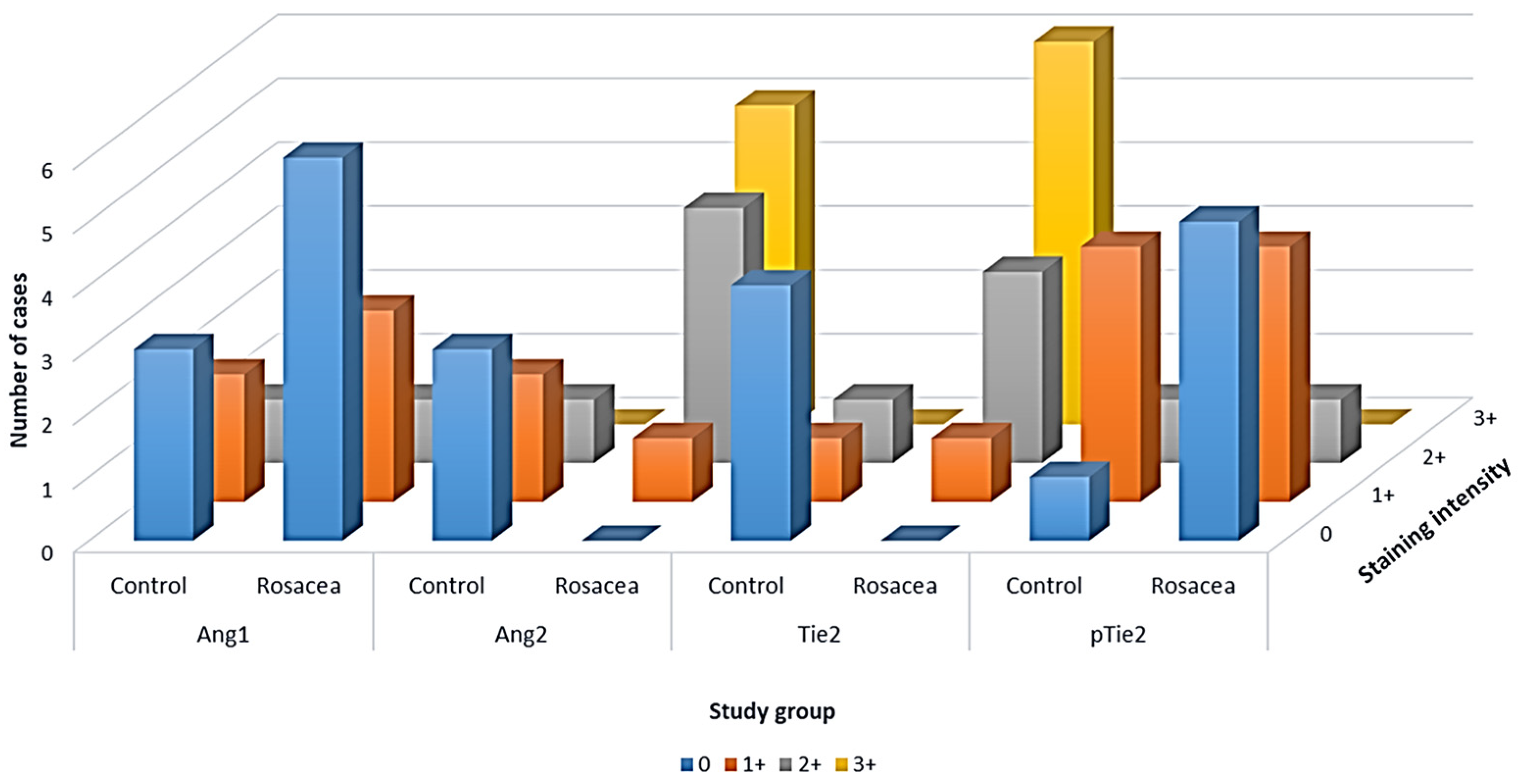
| Group | ||||
|---|---|---|---|---|
| Control Skin | Rosacea Skin | |||
| Marker | Count | % | Count | % |
| Angiopoietin 1 | ||||
| 0 | 3 | 50 | 6 | 60 |
| 1+ | 2 | 33.3 | 3 | 30 |
| 2+ | 1 | 16.7 | 1 | 10 |
| 3+ | 0 | 0 | 0 | 0 |
| Total | 6 | 100 | 10 | 100 |
| Angiopoietin 2 | ||||
| 0 | 3 | 50 | 0 | 0 |
| 1+ | 2 | 33.3 | 1 | 10 |
| 2+ | 1 | 16.7 | 4 | 40 |
| 3+ | 0 | 0 | 5 | 50 |
| Total | 6 | 100 | 10 | 100 |
| Tie2 | ||||
| 0 | 4 | 66.7 | 0 | 0 |
| 1+ | 1 | 16.65 | 1 | 10 |
| 2+ | 1 | 16.65 | 3 | 30 |
| 3+ | 0 | 0 | 6 | 60 |
| Total | 6 | 100 | 10 | 100 |
| pTie2 | ||||
| 0 | 1 | 16.65 | 5 | 50 |
| 1+ | 4 | 66.7 | 4 | 40 |
| 2+ | 1 | 16.65 | 1 | 10 |
| 3+ | 0 | 0 | 0 | 0 |
| Total | 6 | 100 | 10 | 100 |
Disclaimer/Publisher’s Note: The statements, opinions and data contained in all publications are solely those of the individual author(s) and contributor(s) and not of MDPI and/or the editor(s). MDPI and/or the editor(s) disclaim responsibility for any injury to people or property resulting from any ideas, methods, instructions or products referred to in the content. |
© 2025 by the authors. Published by MDPI on behalf of the European Society of Dermatopathology. Licensee MDPI, Basel, Switzerland. This article is an open access article distributed under the terms and conditions of the Creative Commons Attribution (CC BY) license.
Share and Cite
Kaya, A.; Saurat, J.-H.; Satta, N.; Kaya, G. Increased Expression of Angiopoietin 2 and Tie2 in Rosacea. Dermatopathology 2026, 13, 2. https://doi.org/10.3390/dermatopathology13010002
Kaya A, Saurat J-H, Satta N, Kaya G. Increased Expression of Angiopoietin 2 and Tie2 in Rosacea. Dermatopathology. 2026; 13(1):2. https://doi.org/10.3390/dermatopathology13010002
Chicago/Turabian StyleKaya, Aysin, Jean-Hilaire Saurat, Nathalie Satta, and Gürkan Kaya. 2026. "Increased Expression of Angiopoietin 2 and Tie2 in Rosacea" Dermatopathology 13, no. 1: 2. https://doi.org/10.3390/dermatopathology13010002
APA StyleKaya, A., Saurat, J.-H., Satta, N., & Kaya, G. (2026). Increased Expression of Angiopoietin 2 and Tie2 in Rosacea. Dermatopathology, 13(1), 2. https://doi.org/10.3390/dermatopathology13010002