





Facilitators and Barriers Perceived by German Teachers Considering Basic Life Support Education in School—A Qualitative Study

Abstract
1. Introduction
2. Background: Educational Systems and Innovations
2.1. Strategies to Transfer Innovations
2.2. What Influences Transfer?
2.3. Experts of Practice: The Role of Change Agents
- spread (i.e., quantitative dissemination),
- depth (shift of persuasion and pedagogical attitudes),
3. Research Objectives
Research Question 1: What attitudes and values do teachers assign to BLS education?
Research Question 2: How do teachers evaluate the required competencies to implement and/or teach BLS to students?
Research Question 3: How can teachers imagine the process of implementation and what do they need to fulfil this (e.g., financially, materially, in terms of professionalisation, etc.)?
4. Study Design and Methods
4.1. Semi-Structured Interview
4.2. Qualitative Analysis
5. Results
5.1. Participants
5.2. Coding System
5.3. Intercoder Reliability
5.4. Teachers’ Relation towards BLS and Teaching BLS
I haven’t had to perform CPR to anyone yet. (coh. 2, resp. 1, par. 4)
I have not been involved in this (i.e., bystander resuscitation) yet, not even in my private life. (coh. 5, resp. 3, par. 3)
As a physical education teacher (I am) also required to keep this first aid training up to date, so to say, every two years. (coh. 2, resp. 3, par. 2)
In biology class, I know at least that in grade six one topic is the cardiovascular system. However, I myself have not yet taught it. (coh. 4, resp. 3, par. 2)
Three interviewed teachers successfully taught BLS or established programs at their schools (e.g., coh. 1, resp. 1, par. 41).
Basically, I would like it to be part of the school education. (coh. 1, resp. 1, par. 69)
Yes! I think it’s a good idea to teach that across the entire population. And the school, of course, is the best place to do it. (coh. 5, resp. 1, par. 35)
If you have the long-term vision that there are many people in the public who are reasonably competent with bystander resuscitation, who also have the confidence to do it in an emergency situation. Then (.) it is important to practice regularly with the students in class. (coh. 5, resp. 1, par. 25)
…I don’t know if I would incorporate it into the lessons. So, I see pros and cons. With the younger students, no way! (coh. 1, resp. 3, par. 18)
But I think it’s much more important (…) from as young as possible, to have a relaxed approach, so that they have already done something like this before, (…) feel confident enough to be able to do it. I think it’s more a matter of an attitude that you can create at an early stage (…) (coh. 4, resp. 1, par. 22)
So, the sooner you start, the better. And you don’t have to start in grade 9, you can do it earlier. (coh. 2, resp. 1, par. 22)
5.5. The Role of Competencies and Skills for Teaching BLS
But I can do that because I have acquired a couple of experiences. (coh. 1, resp. 2, par. 5)
But with the level of training I have right now in this field, I wouldn’t be comfortable teaching it to my students. (…) and then it would certainly be fair if my students say, “Yeah, if you can’t even do that right, how are we supposed to learn it?” (coh. 5, resp. 1, par. 33)
Well, I think to get confident in your acting, you need a deepened knowledge and not just a glimpse. (coh. 1, resp. 2, par. 5)
And I want to practice and, to try out on the manikins, so that I can teach that appropriately. (…) and a little medical background you should know as well: How does the cardiovascular system work? Why do we have to keep pumping? (coh. 2, resp. 2, par. 18)
…as an absolute necessity, however, I clearly believe in advanced training courses to ensure that people are properly trained in this respect. (coh. 4, resp. 3, par. 18)
Yes, you could offer further training for teachers (…) That you get informed for educational practice: what kind of task assignments can be used, what kind of group exercises can be done. What details you have to pay attention to. It is, yes/the devil usually is in the details. (coh. 4, resp. 2, par. 23; 25)
The training, where you get something like: “This is a series of lessons, you can use it, it’s been tested, you can use it like this”. (coh. 3, resp. 1, par. 82)
That’s always a story with teachers, because it’s always taken for granted that they simply do things on the side in addition to their teaching duties. (coh. 1, resp. 1, par. 45)
5.6. Factors Influencing Implementation of BLS Education
5.6.1. Staff
Professionals! Definitely, professionals! (coh 1, resp. 1, par. 24)
Basically, anyone with a proper training could teach it. (coh. 2, resp. 2, par. 16)
For practical reasons, I can imagine it most likely to happen with physical education teachers. (coh. 5, resp. 1, par. 29)
5.6.2. Equipment
- Copy templates that you can already use. Pictures, a PowerPoint… (coh. 1, resp. 1, par. 49)
- A short script with a tutorial. (coh. 1, resp. 2, par. 21)
- I would like to have a manual (…) Which topics have to be done in which order…? (coh. 4, resp. 3, par. 34)
- Provided teaching materials at different levels (…) which can be used for all types of schools, i.e., appropriately differentiated. (coh. 1, resp. 3, par. 36; 48)
- A handout, with information about statistics. (coh. 3, resp. 1, par. 80)
- Informative material, maybe also worksheets, practical tasks, maybe something like that. (coh. 4, resp. 3, par. 34)
- Ready-made teaching models. (coh. 5, resp. 1, par. 45)
- Ready-made course plan, simply designed. (ibid., par. 47)
Well, the good material is decisive for the colleagues to really implement it reasonably, otherwise they don’t have any interest. (coh. 1, resp. 2, par. 27)
5.6.3. Organisation
- Room capacity and availability: Many teachers criticised that normal classrooms do not provide enough space for appropriate training with manikins. For the preparation (e.g., moving heavy tables), the daily time is missing. Therefore, good planning of rooms must be prepared and reviewed (sports hall, assembly hall, etc.) at the school level.
A very simple practical reason: if now the students are supposed to do their BLS exercise with their partner, how is that supposed to work in a class of 30? (coh. 5, resp. 1, par. 29)
- 2.
- Shortage of time: Some teachers assumed about 3–4 lessons (e.g., coh. 4, resp. 2, par. 40) or 6–8 lessons within four weeks (coh. 4, sep. 3, par. 48) for BLS education. Predominantly, participants felt they “never have enough time” (coh. 5, resp. 1, par. 27) and that “the school year [is] very tight with time” (coh. 1, resp. 1, par. 43) for regular responsibilities, and even less so for additional BLS lessons. It was not clear what content should be shortened without regulations.
- 3.
- Unique framework regulations, which subsidise the process of implementation in each school, as illustrated by one participant (coh. 5, resp. 1, par. 67): discussing the issue of BLS and relevant grades in teams, including the principal, and initiating a pilot program followed by decision-making at a school conference. Finally, the school program or an internal curriculum must be updated and communicated to all of the colleagues and responsibilities have to be assigned. Some teachers predicted problems regarding cooperation—agreements between different subjects, etc.—or the integration at the classroom level by single teachers:
(laughs) cooperation with colleagues can always be very difficult. (coh. 2, resp. 1, par. 68)
Of course there are the internal school curricula, but what is really done is another story. (coh. 4, resp. 1, par. 34)
5.6.4. Obligatory Thoughts
[I mean,] that the colleagues get the credit accordingly. Either through hours of compensation or through overtime payment or opportunities for job promotion. (coh. 1, resp. 1, par. 45)
[It is] basically just difficult to insert that “just like that” into the lesson if you don’t frame it appropriately in the core curriculum beforehand. (coh. 2, resp. 3, par. 14)
Clearly needs an obligation. (…) (Smiling) I’m not that idealistic. (coh. 5, resp. 3, par. 105)
And you can already see how tightly packed the contents are in the different grades, and there are certainly many colleagues who complain directly […]. (coh. 4, resp. 3, par. 46)
5.6.5. Emotional Concerns
They are children, and adults should take responsibility for children. (coh. 1, resp. 3, par. 22)
As soon as you have to deal with the subject of death and so on, then you have to keep an eye out. (coh. 2 resp. 1, par. 58)
I’m just not sure, grade 6, to what extent they’re already able to do that there. (coh. 1, resp. 2, par. 23)
5.6.6. Implementation and Subjects
- The organisation during biology class. The main reasons for this were the closeness to some of the curricular contents, such as circulation, human heart cycle, respiration and circulatory diseases in humans, etc., in grade 6. Another reason was the expertise of the subject teachers in human biology (cf. coh. 1, resp. 1; 2; 3; coh. 2, resp. 1; 2; coh. 3, resp. 1; coh. 4, resp. 2; 3).
Biology sixth grade: the human biology. (cf. coh. 1, resp. 3, par. 38)
- 2.
- Secondly, many teachers favoured physical education (P.E.) lessons for implementation. In addition to the fact that physical education teachers are believed to have high first aid skills, practical considerations were mentioned: Indoor sports facilities offer space without moving tables (coh 5, resp. 1, par. 73) and there are usually no exams to be conducted in this subject. However, some teachers would rather welcome a cross-curricular conjunction of these two subjects for a repetitive BLS curriculum, although they noted at the same time that cooperation is difficult (cf. chapter 5.6.3).
In physical education, you also deal with “health education”, so you could make another excursion (…). You could repeat the basic content from the sixth grade [in biology]. That besides is a little more flexible in which grade you have to repeat that [BLS] again. (coh. 4, resp. 2, par. 29)
So this combination of subjects [biology/P.E.] is ideal for this, I believe. (coh. 1, resp. 1 par. 35)
- 3.
- The third, more common (and often used) but more detached proposal, was an integration of BLS content into project teaching: as part of a “health awareness day”, with BLS included, or as a fixed “theme week” for several grades at the same time (coh. 1, resp. 2, par. 25; coh. 4, resp. 1, par. 34). The main advantage of this approach seems to be the availability of extra staff or the easy invitation of external organisations or BLS experts when the regular schedule is paused.
And I think with each grade, as I mentioned, from the sixth grade on, they’ve done the heart structure. Then you can build on that. (coh. 3, resp. 1., par. 60)
But that maybe you say sixth and eighth or again in upper grades [note: grades 11–13]. (coh. 4, resp. 3, par. 40)
6. Conclusions and Implications
6.1. Perceived Relevance Is Paired with Uncertainties
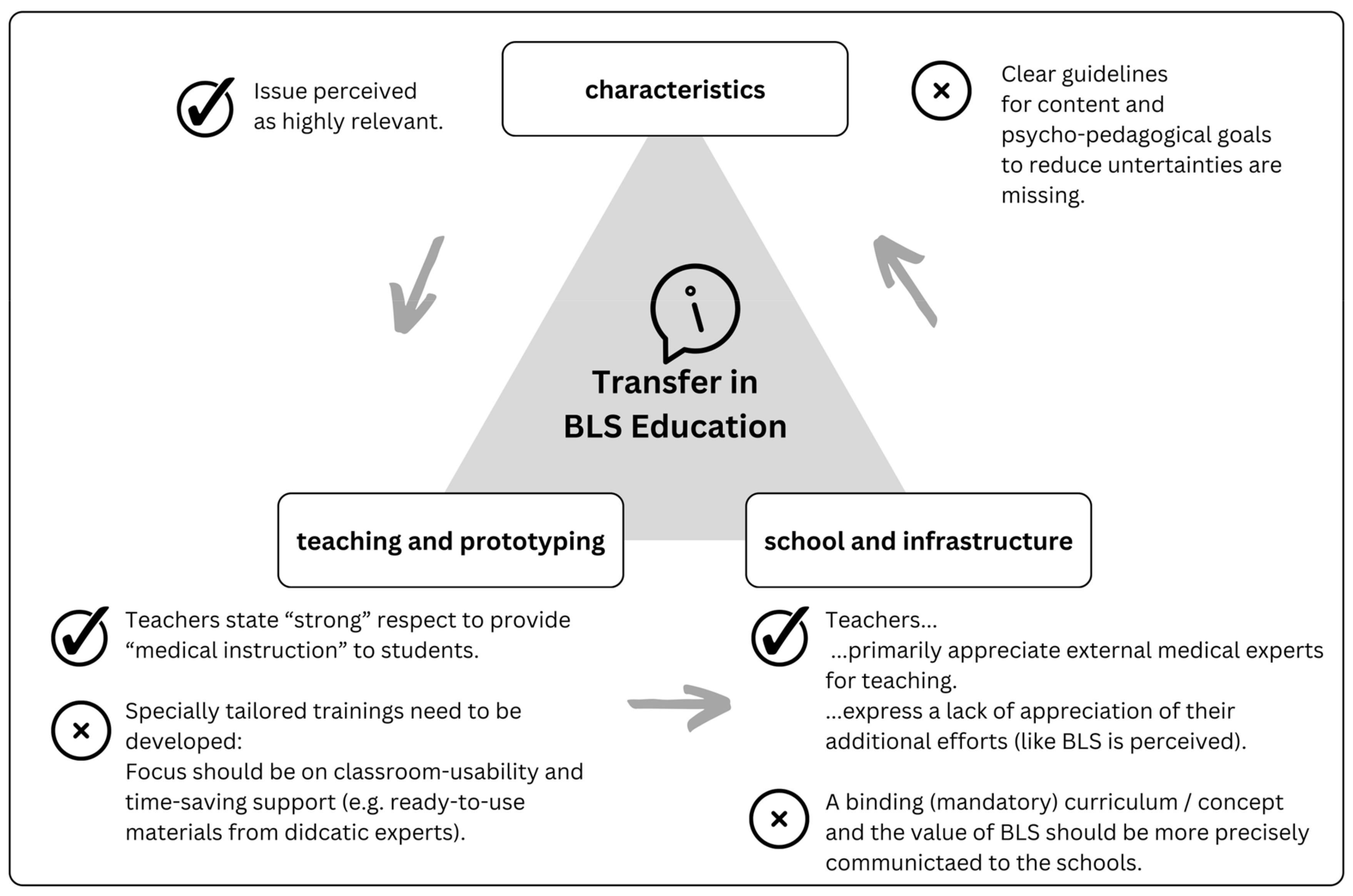
6.2. Need for Qualifying and Time-Saving Resources
- providing instructions and feedback constructively,
- creating (hands-on, creative, reflective, etc.) tasks,
- balancing methods (role play, simulation, discussion, etc.).
6.3. A Matter of Appreciation
- Strong backing by the school management [14],
- Reduction of the weekly time schedule,
- Remuneration for coordination and responsibility,
Supplementary Materials
Author Contributions
Funding
Institutional Review Board Statement
Informed Consent Statement
Data Availability Statement
Acknowledgments
Conflicts of Interest
References
- Böttiger, B.W.; Lockey, A.; Georgiou, M.; Greif, R.; Monsieurs, K.G.; Mpotos, N.; Nikolaou, N.; Nolan, J.; Perkins, G.; Semeraro, F.; et al. KIDS SAVE LIVES: ERC Position statement on schoolteachers’ education and qualification in resuscitation. Resuscitation 2020, 151, 87–90. [Google Scholar] [CrossRef] [PubMed]
- Wingen, S.; Rott, N.; Dirks, B.; Greif, R.; Papaspyrou, H.; Eckstein, A.; Lambertz, P.; Koch-Schultze, R.; Böttiger, B.W. Die Ausbildung von Lehrerinnen und Lehrern als Multiplikatoren für den Wiederbelebungsunterricht an Schulen. Notf. + Rettungsmedizin 2022, 25, 245–251. [Google Scholar] [CrossRef]
- Rücker, G.; Wingen, S.; Rott, N.; Böttiger, B.W. Der aktuelle Umsetzungsstand von Wiederbelebungsunterricht in Schulen in Deutschland—Umfrageergebnisse einer Abfrage der Ministerien aller Bundesländer. Notf. + Rettungsmedizin 2024, 27, 143–148. [Google Scholar] [CrossRef]
- Malta Hansen, C.; Zinckernagel, L.; Ersboll, A.K.; Tjornhoj-Thomsen, T.; Wissenberg, M.; Lippert, F.K.; Weeke, P.; Gislason, G.H.; Kober, L.; Torp-Pedersen, C.; et al. Cardiopulmonary Resuscitation Training in Schools Following 8 Years of Mandating Legislation in Denmark: A Nationwide Survey. J. Am. Heart Assoc. 2017, 6, e004128. [Google Scholar] [CrossRef] [PubMed]
- Mpotos, N.; Vekeman, E.; Monsieurs, K.; Derese, A.; Valcke, M. Knowledge and willingness to teach cardiopulmonary resuscitation: A survey amongst 4273 teachers. Resuscitation 2013, 84, 496–500. [Google Scholar] [CrossRef] [PubMed]
- Lukas, R.-P.; van Aken, H.K.; Molhoff, T.; Weber, T.; Rammert, M.; Wild, E.; Bohn, A. Kids save lives: A six-year longitudinal study of schoolchildren learning cardiopulmonary resuscitation: Who should do the teaching and will the effects last? Resuscitation 2016, 101, 35–40. [Google Scholar] [CrossRef] [PubMed]
- Felzen, M.; Schröder, H.; Beckers, S.K.; Böttiger, B.W.; Rott, N.; Koch-Schultze, R.; Wingen, S.; Meißner, A.; Santowski, I.; Picker, O.; et al. Evaluation des Projekts zur Einführung von Laienreanimation an Schulen in Nordrhein-Westfalen. Anaesthesist 2021, 70, 383–391. [Google Scholar] [CrossRef] [PubMed]
- Beck, S.; Issleib, M.; Daubmann, A.; Zollner, C. Peer education for BLS-training in schools? Results of a randomized-controlled, noninferiority trial. Resuscitation 2015, 94, 85–90. [Google Scholar] [CrossRef] [PubMed]
- Nord, A. Bystander CPR: New Aspects of CPR Training among Students and the Importance of Bystander Education Level on Survival; Linköping University Electronic Press: Linköping, Sweden, 2017; ISBN 9789176854778. [Google Scholar]
- Dumcke, R.; Rahe-Meyer, N.; Wegner, C. Does age still matter? An age-group comparison of self-efficacy, initial interest and performance when learning bystander resuscitation in secondary schools. Int. J. First Aid Educ. 2021, 4, 5–22. [Google Scholar] [CrossRef]
- Dumcke, R.; Wegner, C.; Böttiger, B.W.; Kucknat, L.; Rahe-Meyer, N. The process of implementing cardiopulmonary resuscitation training in schools: A review of current research. J. Innov. Psychol. Educ. Didact. (JIPED) 2019, 23, 141–166. [Google Scholar]
- Zinckernagel, L.; Malta Hansen, C.; Rod, M.H.; Folke, F.; Torp-Pedersen, C.; Tjornhoj-Thomsen, T. What are the barriers to implementation of cardiopulmonary resuscitation training in secondary schools? A qualitative study. BMJ Open 2016, 6, e010481. [Google Scholar] [CrossRef] [PubMed]
- Wingen, S.; Jeck, J.; Schroeder, D.C.; Wingen-Heimann, S.M.; Drost, R.M.W.A.; Böttiger, B.W. Facilitators and barriers for the implementation of resuscitation training programmes for schoolchildren: A systematic review. Eur. J. Anaesthesiol. 2022, 39, 711–719. [Google Scholar] [CrossRef] [PubMed]
- Bakke, H.K.; Bakke, H.K.; Schwebs, R. First-aid training in school: Amount, content and hindrances. Acta Anaesthesiol. Scand. 2017, 61, 1361–1370. [Google Scholar] [CrossRef] [PubMed]
- The DBR Collective. Design-Based Research: An Emerging Paradigm for Educational Inquiry. Educ. Res. 2003, 32, 5–8. [Google Scholar] [CrossRef]
- Gräsel, C.; Parchmann, I. Implementationsforschung-oder: Der steinige Weg, Unterricht zu verändern. Unterrichtswissenschaft 2004, 32, 196–214. [Google Scholar]
- Altrichter, H.; Das Eder, F. “Autonomie-Paritätsmuster” als Innovationsbarriere? In Schulprogramme—Instrumente der Schulentwicklung: Eine Veröffentlichung des Instituts für Schulentwicklungsforschung der Universität Dortmund; Holtappels, H.G., Ed.; Juventa: Weinheim, Germany, 2004; pp. 195–221. [Google Scholar]
- Holtappels, H.G. Transfer in der Schulentwicklung. DDS 2019, 111, 274–293. [Google Scholar] [CrossRef]
- Teerling, A.; Köller, O. Stichwort: Implementationsprozesse in Schulen. Herausforderungen und Perspektiven. Psychol. Erzieh. Unterr. 2019, 66, 3–5. [Google Scholar] [CrossRef]
- Gräsel, C. Stichwort: Transfer und Transferforschung im Bildungsbereich. Z. Erzieh. 2010, 13, 7–20. [Google Scholar] [CrossRef]
- Desimone, L. How Can Comprehensive School Reform Models Be Successfully Implemented? Rev. Educ. Res. 2002, 72, 433–479. [Google Scholar] [CrossRef]
- Fischer, F.; Waibel, M.; Wecker, C. Nutzenorientierte Grundlagenforschung im Bildungsbereich. Z. Erzieh. 2005, 8, 427–442. [Google Scholar] [CrossRef]
- Schmiedebach, M.; Wegner, C. Design-Based Research als Ansatz zur Lösung praxisrelevanter Probleme in der fachdidaktischen Forschung. Bildungsforschung 2021, 19, 11. [Google Scholar]
- Rogers, E.M. Diffusion of Innovations, 5th ed; Free Press Trade Paperback Edition; Free Press: New York, NY, USA; London, UK; Toronto, ON, Canada; Sydney, Australia, 2003; ISBN 9780743222099. [Google Scholar]
- Coburn, C.E. Rethinking Scale: Moving Beyond Numbers to Deep and Lasting Change. Educ. Res. 2003, 32, 3–12. [Google Scholar] [CrossRef]
- Lipowsky, F.; Rzejak, D. Fortbildungen für Lehrkräfte wirksam gestalten—Erfolgsverprechende Wege und Konzepte aus Sicht der empirischen Bildungsforschung. Bild. Erzieh. 2017, 70, 379–400. [Google Scholar]
- Goldenbaum, A. Innovationsmanagement in Schulen: Eine empirische Untersuchung zur Implementation eines Sozialen Lernprogramms; VS Verlag für Sozialwissenschaften: Wiesbaden, Germany, 2012; ISBN 978-3-531-19425-7. [Google Scholar]
- Böse, S.; Neumann, M.; Becker, M.; Maaz, K.; Baumert, J. Empirische Arbeit: Bereit für Veränderungen? Zum Zusammenhang von Akzeptanz und handlungsbezogener Auseinandersetzung von Schulleiterinnen und Schulleitern in Reformprozessen. Psychol. Erzieh. Unterr. 2019, 66, 51–68. [Google Scholar] [CrossRef]
- Schroeder, D.C.; Ecker, H.; Wingen, S.; Semeraro, F.; Böttiger, B.W. “Kids Save Lives”—Wiederbelebungstrainings für Schulkinder: Systematische Übersichtsarbeit. Anaesthesist 2017, 66, 589–597. [Google Scholar] [CrossRef] [PubMed]
- Helfferich, C. Leitfaden- und Experteninterviews. In Handbuch Methoden der Empirischen Sozialforschung; Baur, N., Blasius, J., Eds.; Springer: Wiesbaden, Germany, 2019; pp. 669–686. ISBN 978-3-658-21307-7. [Google Scholar]
- Altrichter, H.; Wiesinger, S. Der Beitrag der Innovationsforschung im Bildungswesen zum Implementierungsproblem. In Psychologie des Wissensmanagements: Perspektiven, Theorien und Methoden; Mandl, H., Reinmann-Rothmeier, G., Eds.; Hogrefe: Göttingen, Germany, 2004; pp. 220–233. ISBN 3840918154. [Google Scholar]
- Trempler, K.; Schellenbach-Zell, J.; Gräsel, C. Der Einfluss von Motivation von Lehrpersonen auf den Transfer von Innovationen. In Innovationen im Bildungswesen: Analytische Zugänge und empirische Befunde; Rürup, M., Bormann, I., Eds.; Springer: Wiesbaden, Germany, 2013; pp. 229–347. ISBN 978-3-531-19701-2. [Google Scholar]
- Mpotos, N.; Iserbyt, P. Children saving lives: Training towards CPR excellence levels in chest compression based on age and physical characteristics. Resuscitation 2017, 121, 135–140. [Google Scholar] [CrossRef] [PubMed]
- Dumcke, R.; Wegner, C.; Rahe-Meyer, N. Die Implementierung von Reanimationsunterricht: Eine Befragung von Biologielehrkräften zu Einflussfaktoren und Gelingensbedingungen. heiEDUCATION J. 2021, 7, 143–175. [Google Scholar] [CrossRef]
- Iserbyt, P.; Theys, L.; Ward, P.; Charlier, N. The effect of a specialized content knowledge workshop on teaching and learning Basic Life Support in elementary school: A cluster randomized controlled trial. Resuscitation 2017, 112, 17–21. [Google Scholar] [CrossRef]
- Plomp, T. Educational Design Research: An Introduction. In Educational Design Research: An Introduction; Plomp, T., Nieveen, N., Eds.; SLO: Enschede, The Netherlands, 2013; pp. 10–51. ISBN 9789032923341. [Google Scholar]
- Plant, N.; Taylor, K. How best to teach CPR to schoolchildren: A systematic review. Resuscitation 2013, 84, 415–421. [Google Scholar] [CrossRef]
- Mayring, P. Qualitative Inhaltsanalyse: Grundlagen und Techniken, 12., überarb. Aufl.; Beltz: Weinheim, Germany, 2015; ISBN 3407257309. [Google Scholar]
- Kuckartz, U. Einführung in Die Computergestützte Analyse Qualitativer Daten, 3., aktualisierte Auflage; VS Verlag für Sozialwissenschaften/GWV Fachverlage GmbH: Wiesbaden, Germany, 2010; ISBN 9783531921266. [Google Scholar]
- Kuckartz, U. Qualitative Inhaltsanalyse: Methoden Praxis Computerunterstützung, 3., überarbeitete Auflage; Beltz Juventa: Weinheim, Germany; Basel, Switzerland, 2016; ISBN 9783779933441. [Google Scholar]
- Tracy, S.J. Qualitative Quality: Eight “Big-Tent” Criteria for Excellent Qualitative Research. Qual. Inq. 2010, 16, 837–851. [Google Scholar] [CrossRef]
- Tong, A.; Sainsbury, P.; Craig, J. Consolidated criteria for reporting qualitative research (COREQ): A 32-item checklist for interviews and focus groups. Int. J. Qual. Health Care 2007, 19, 349–357. [Google Scholar] [CrossRef]
- Gläser-Zikuda, M. Qualitative Auswertungsverfahren. In Empirische Bildungsforschung: Strukturen und Methoden; Reinders, H., Ditton, H., Gräsel, C., Gniewosz, B., Eds.; VS Verlag für Sozialwissenschaften: Wiesbaden, Germany, 2011; pp. 109–119. ISBN 978-3-531-93015-2. [Google Scholar]
- Cohen, J. A coefficient of agreement for nominal scales. Educ. Psychol. Meas. 1960, 20, 37–46. [Google Scholar] [CrossRef]
- Brennan, R.L.; Prediger, D.J. Coefficient Kappa: Some uses, misuses, and alternatives. Educ. Psychol. Meas. 1981, 41, 687–699. [Google Scholar] [CrossRef]
- Landis, J.R.; Koch, G.G. The Measurement of Observer Agreement for Categorical Data. Biometrics 1977, 33, 159. [Google Scholar] [CrossRef]
- Altman, D.G. Practical Statistics for Medical Research; Chapman and Hall/CRC: Boca Raton, FL, USA, 1990; ISBN 9780429258589. [Google Scholar]
- de Smedt, L.; Depuydt, C.; Vekeman, E.; de Paepe, P.; Monsieurs, K.G.; Valcke, M.; Mpotos, N. Awareness and willingness to perform CPR: A survey amongst Flemish schoolchildren, teachers and principals. Acta Clin. Belg. 2019, 74, 297–316. [Google Scholar] [CrossRef] [PubMed]
- Abelairas-Gómez, C.; Schroeder, D.C.; Carballo-Fazanes, A.; Böttiger, B.W.; López-García, S.; Martínez-Isasi, S.; Rodríguez-Núñez, A. KIDS SAVE LIVES in schools: Cross-sectional survey of schoolteachers. Eur. J. Pediatr. 2021, 180, 2213–2221. [Google Scholar] [CrossRef] [PubMed]
- Schroeder, D.C.; Semeraro, F.; Greif, R.; Bray, J.; Morley, P.; Parr, M.; Kondo Nakagawa, N.; Iwami, T.; Finke, S.-R.; Malta Hansen, C.; et al. KIDS SAVE LIVES: Basic Life Support Education for Schoolchildren: A Narrative Review and Scientific Statement From the International Liaison Committee on Resuscitation. Resuscitation 2023, 147, 109772. [Google Scholar] [CrossRef] [PubMed]
- Madou, T.; Depaepe, F.; Ward, P.; Iserbyt, P. The role of specialised content knowledge in teaching basic life support. Health Educ. J. 2023, 82, 555–568. [Google Scholar] [CrossRef]
- Dirks, B.; Wingen, S.; Rücker, G.; Greif, R.; Papaspyrou, H.; Böttiger, B.W. Modularer Lehrerausbildungskurs des Deutschen Rates für Wiederbelebung (GRC) für den Wiederbelebungsunterricht in Schulen. Notf. + Rettungsmedizin 2019, 22, 334–338. [Google Scholar] [CrossRef]
- Felzen, M.; Lambrecht, L.; Beckers, S.K.; Biermann, H.; Heussen, N.; Rossaint, R.; Lenssen, N. Konzept und Evaluation eines 45-minütigen BLS-Trainings an Schulen. Notfall + Rettungsmedizin 2018, 83, 619. [Google Scholar] [CrossRef]
- Frenzel, A.C.; Götz, T.; Pekrun, R. Ursachen und Wirkungen von Lehreremotionen: Ein Modell zur reziproken Beeinflussung von Lehrkräften und Klassenmerkmalen. In Analyse und Bedeutung unterrichtlichen Handelns; Gläser-Zikuda, M., Ed.; Waxmann: Münster, Germany, 2008; pp. 187–209. [Google Scholar]
- Baumert, J.; Kunter, M. Stichwort: Professionelle Kompetenz von Lehrkräften: Parallelti-tel: Keyword: Professional competencies of teachers. Z. Erzieh.-Schaft 2006, 9, 469–520. [Google Scholar] [CrossRef]
- Fussangel, K.; Rürup, M.; Gräsel, C. Lehrerfortbildung als Unterstützungssystem. In Handbuch Neue Steuerung in Schulsystem; Altrichter, H., Maag Merki, K., Eds.; VS Ver-lag für Sozialwissenschaften: Wiesbaden, Germany, 2019; pp. 327–354. [Google Scholar]
- Helmke, A. Unterrichtsqualität und Lehrerprofessionalität: Diagnose, Evaluation, und Verbesserung des Unterrichts; Kallmeyer: Seelze, Germany, 2012. [Google Scholar]
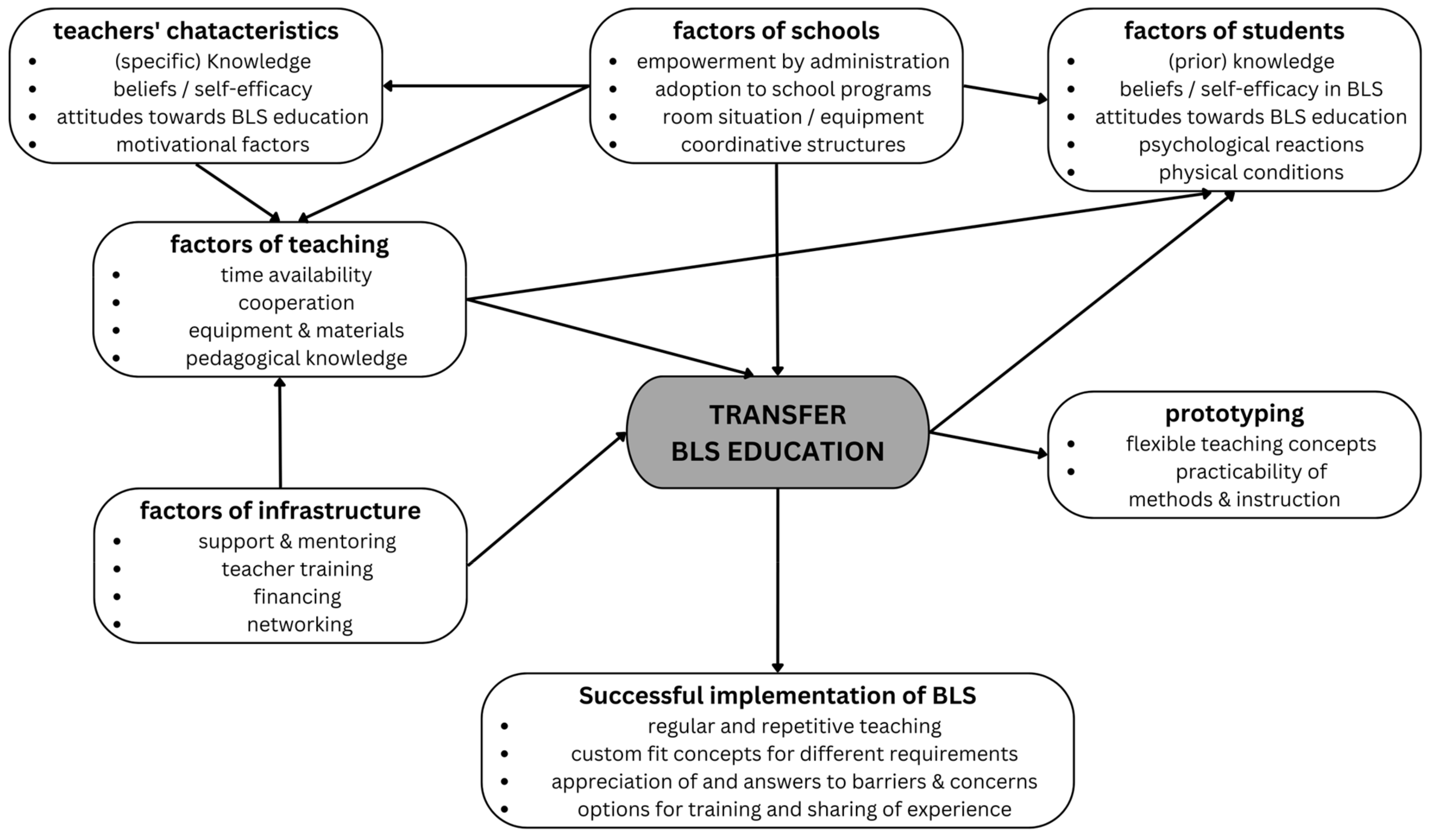

| Semi-Structured Interview: Guiding Questions (See Also Supplementary Materials S1) | Keywords (cf. Figure 1) | |
|---|---|---|
| 1.1 | Why don’t you describe to me what private or school experiences you personally have with bystander resuscitation? | Teachers’ characteristics |
| 1.2 | How do you value non-professional bystander resuscitation… (a) personally? (b) as a teaching objective? | Teachers’ characteristics Factors of teaching Factors of students |
| 2.1 | Who do you think should teach bystander resuscitation in schools? | Factors of teaching Factors of schools |
| 2.2 | Would you be confident in teaching this yourself, and would you attach conditions to it to make it work? | Teachers’ characteristics Factors of infrastructure Factors of schools |
| 3.1 | How can you imagine an implementation at your school so that all secondary students receive instruction in bystander resuscitation on a regular basis? | Factors of infrastructure Factors of schools Factors of students Prototyping |
| 3.2 | (If not already mentioned): Can you also imagine the issue being included in subject-matter classes or being taught in certain grades? | Factors of teaching Factors of students Prototyping |
| No. | ID 1 | Gender | Professional Experience (Years) | Subjects/Expertise | Duration (min) |
|---|---|---|---|---|---|
| 1 | coh. 1, resp. 1 | female | 23 | Biology/Phys. Edu. | 33 |
| 2 | coh. 1, resp. 2 | male | 21 | Biology/Music | 30 |
| 3 | coh. 1, resp. 3 | female | 20 | Biology/Maths | 43 |
| 4 | coh. 2, resp. 1 | female | 12 | Biology/Chemistry | 26 |
| 5 | coh. 2, resp. 2 | female | 3 | Biology/Maths | 19 |
| 6 | coh. 2, resp. 3 | male | 1 | Biology/Phys. Edu. | 29 |
| 7 | coh. 3, resp. 1 | female | 20 | Biology/Religion | 59 |
| 8 | coh. 4, resp. 1 | male | 26 | Biology/Latin | 23 |
| 9 | coh. 4, resp. 1 | male | 0.8 | Biology/Phys. Edu. | 23 |
| 10 | coh. 4, resp. 3 | female | 0.2 | Biology/Phys. Edu. | 33 |
| 11 | coh. 5, resp. 1 | female | 6.5 | English/Music | 63 |
| 12 | coh. 5, resp. 2 | female | 28 | Biology/Phys. Edu. | 68 |
| 13 | coh. 5, resp. 3 | female | 39 | German/Religion | 52 |
| MW (SD) | 14.2 (12.6) | 39.8 (17.1) |
| Categories | Subcategories | Short Description | Ncodes (%) | Keywords |
|---|---|---|---|---|
| Personal Experience | Level of training | Statements on the (previous) experiences of the teachers regarding first aid, cardiac arrest and BLS | 60 (10.4) | Teachers’ characteristics Factors of infrastructure |
| Awareness/emotions/attitude | Expressed attitudes, beliefs and emotional perceptions towards BLS | 55 (9.5) | Teachers’ characteristics Factors of students | |
| Professional development | Analysis of competencies | Reported perceptions regarding own skills and knowledge of BLS and teaching BLS | 34 (5.9) | Teachers’ characteristics Factors of teaching |
| Conditions for personal professionalisation | Statements on individual assumptions to gain more confidence and efficacy as a BLS instructor | 79 (13.7) | Teachers’ characteristics Factors of teaching Factors of infrastructure Prototyping | |
| Implementation | Personnel needs/educators | Information on personnel conditions and characteristics of BLS instructors | 42 (7.3) | Teachers’ characteristics Factors of infrastructure |
| Need for equipment/learning materials | Assessments regarding the required materials, information and technical support for teaching BLS in schools | 62 (10.7) | Factors of infrastructure Factors of teaching Prototyping | |
| Organisational efforts | Perceptions on how a framework for implementing innovative BLS lessons in the context of the school conditions could be organised | 92 (15.9) | Factors of infrastructure Factors of schools Factors of teaching Prototyping | |
| Idealistic/mandatory conditions | Reported opinions about organisational problems connected to extrinsic forces or conditions (colleagues, administration, government, etc.) | 43 (7.5) | Teachers’ characteristics Factors of infrastructure Factors of schools | |
| Emotional–social challenges | Reported considerations on students’ OR teachers’ anxieties/concerns in the context of BLS. | 35 (6.1) | Teachers’ characteristics Factors of teaching Factors of students | |
| Implementation in classroom practice and subject teaching | Ideas regarding implementation of the innovation of BLS according to structures, curricula and practice at the classroom level | 75 (13.0) | Factors of teaching Factors of students Prototyping |
Disclaimer/Publisher’s Note: The statements, opinions and data contained in all publications are solely those of the individual author(s) and contributor(s) and not of MDPI and/or the editor(s). MDPI and/or the editor(s) disclaim responsibility for any injury to people or property resulting from any ideas, methods, instructions or products referred to in the content. |
© 2024 by the authors. Licensee MDPI, Basel, Switzerland. This article is an open access article distributed under the terms and conditions of the Creative Commons Attribution (CC BY) license (https://creativecommons.org/licenses/by/4.0/).
Share and Cite
Dumcke, R.; Wegner, C.; Wingen, S.; Rahe-Meyer, N. Facilitators and Barriers Perceived by German Teachers Considering Basic Life Support Education in School—A Qualitative Study. Eur. J. Investig. Health Psychol. Educ. 2024, 14, 1769-1785. https://doi.org/10.3390/ejihpe14060117
Dumcke R, Wegner C, Wingen S, Rahe-Meyer N. Facilitators and Barriers Perceived by German Teachers Considering Basic Life Support Education in School—A Qualitative Study. European Journal of Investigation in Health, Psychology and Education. 2024; 14(6):1769-1785. https://doi.org/10.3390/ejihpe14060117
Chicago/Turabian StyleDumcke, Rico, Claas Wegner, Sabine Wingen, and Niels Rahe-Meyer. 2024. "Facilitators and Barriers Perceived by German Teachers Considering Basic Life Support Education in School—A Qualitative Study" European Journal of Investigation in Health, Psychology and Education 14, no. 6: 1769-1785. https://doi.org/10.3390/ejihpe14060117
APA StyleDumcke, R., Wegner, C., Wingen, S., & Rahe-Meyer, N. (2024). Facilitators and Barriers Perceived by German Teachers Considering Basic Life Support Education in School—A Qualitative Study. European Journal of Investigation in Health, Psychology and Education, 14(6), 1769-1785. https://doi.org/10.3390/ejihpe14060117


