Enhancing Hydrogen Production Efficiency Through Magnetic Field Application in Water Electrolysis



Abstract
1. Introduction
2. Materials and Methods
2.1. Experimental Configuration and Electrolytic System
2.2. Characterization and Parametric Analysis
3. Results and Discussion
3.1. Selection of Optimal Electrode Material
3.2. Effects of Electrolyte Circulation and Operating
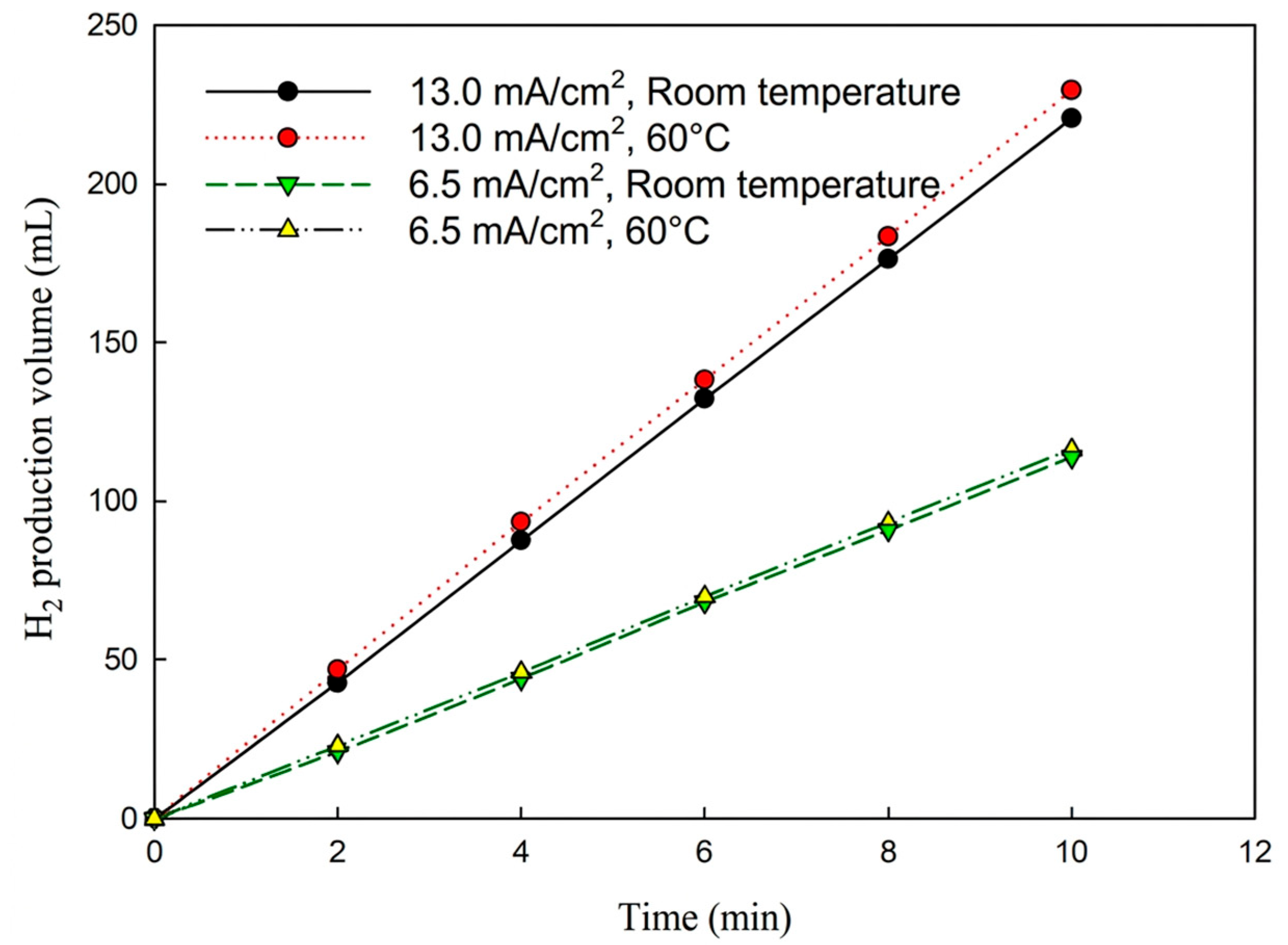
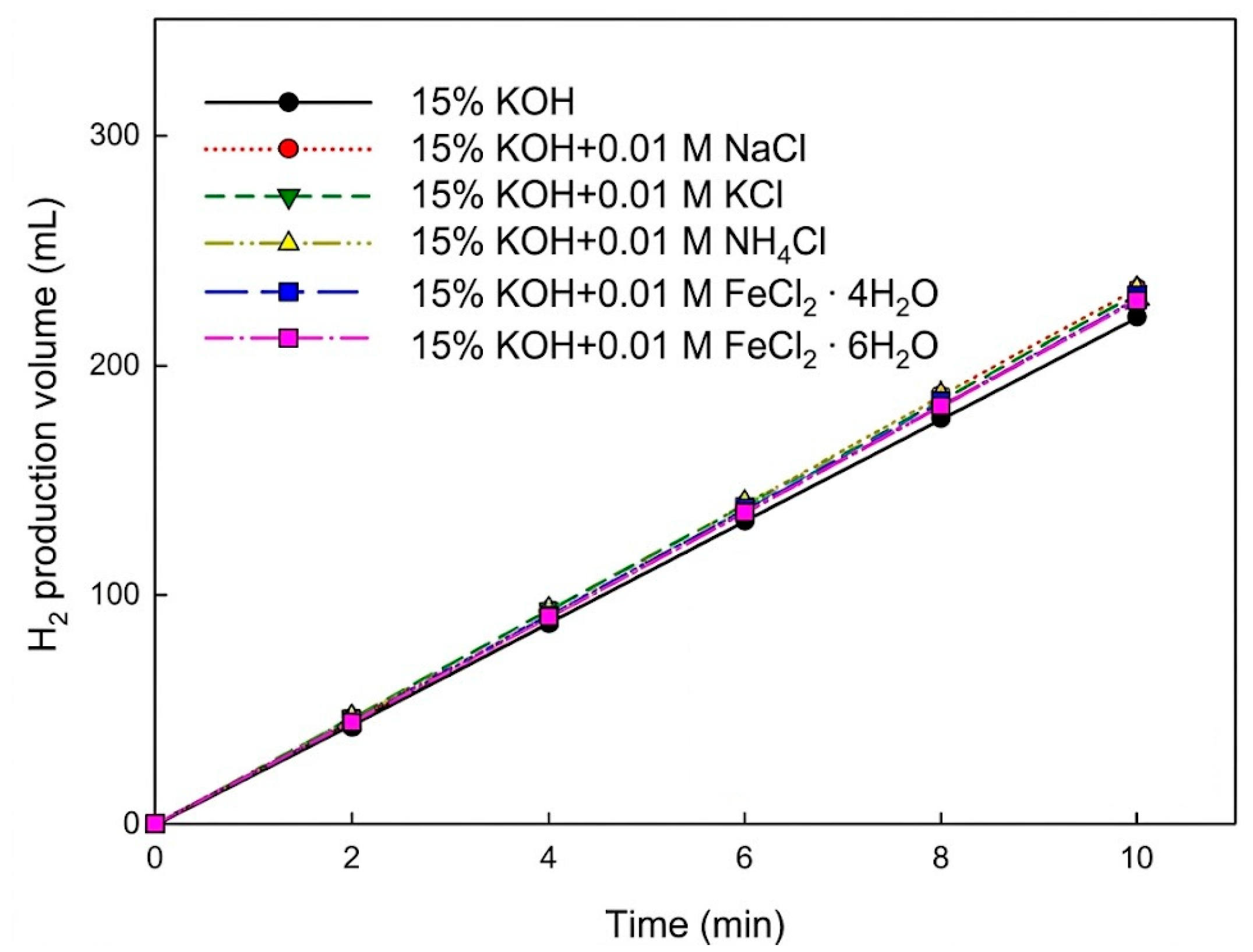
3.3. Evaluation of Current Density, Electrolyte Concentration, and Additive Effects
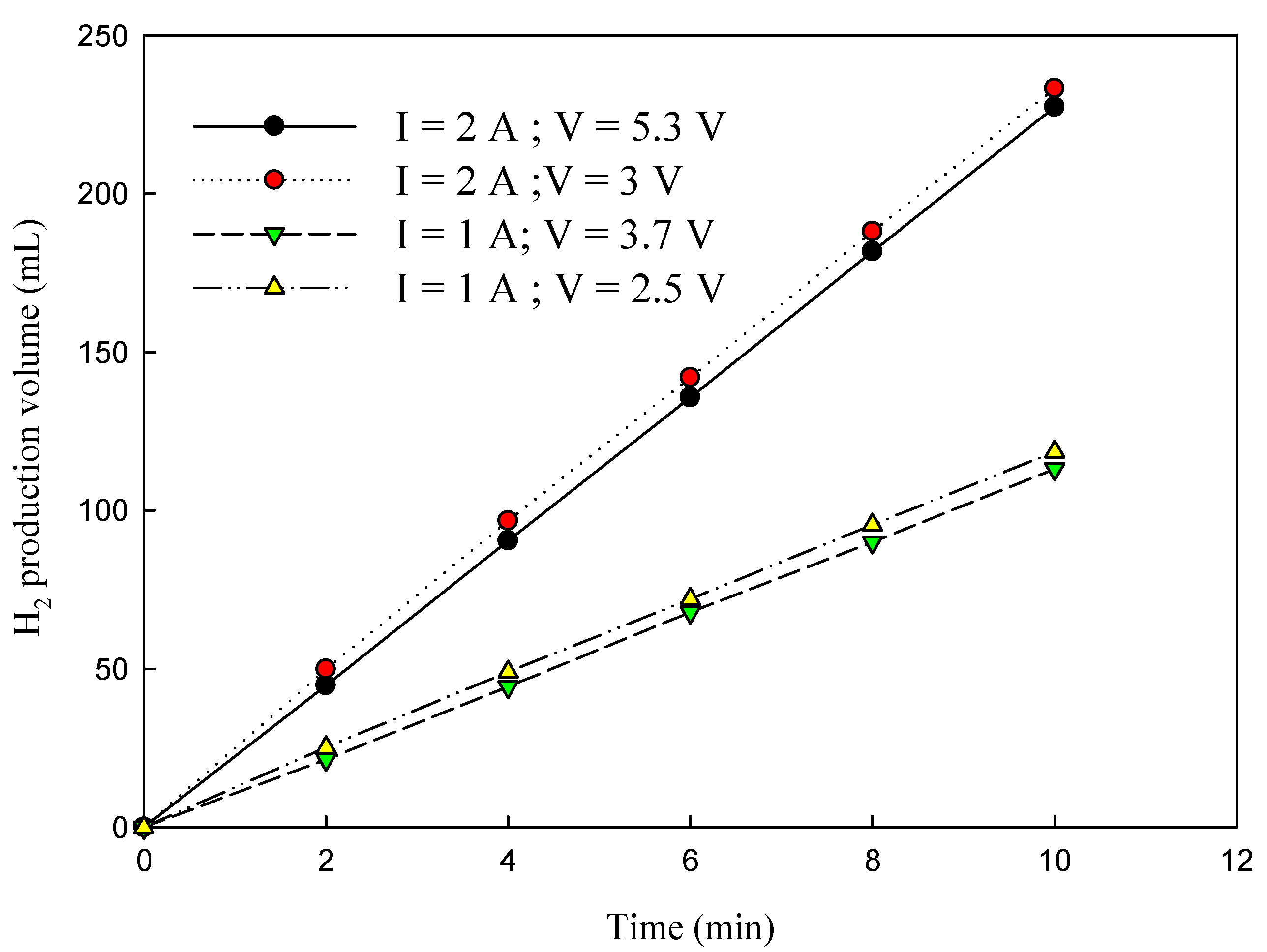
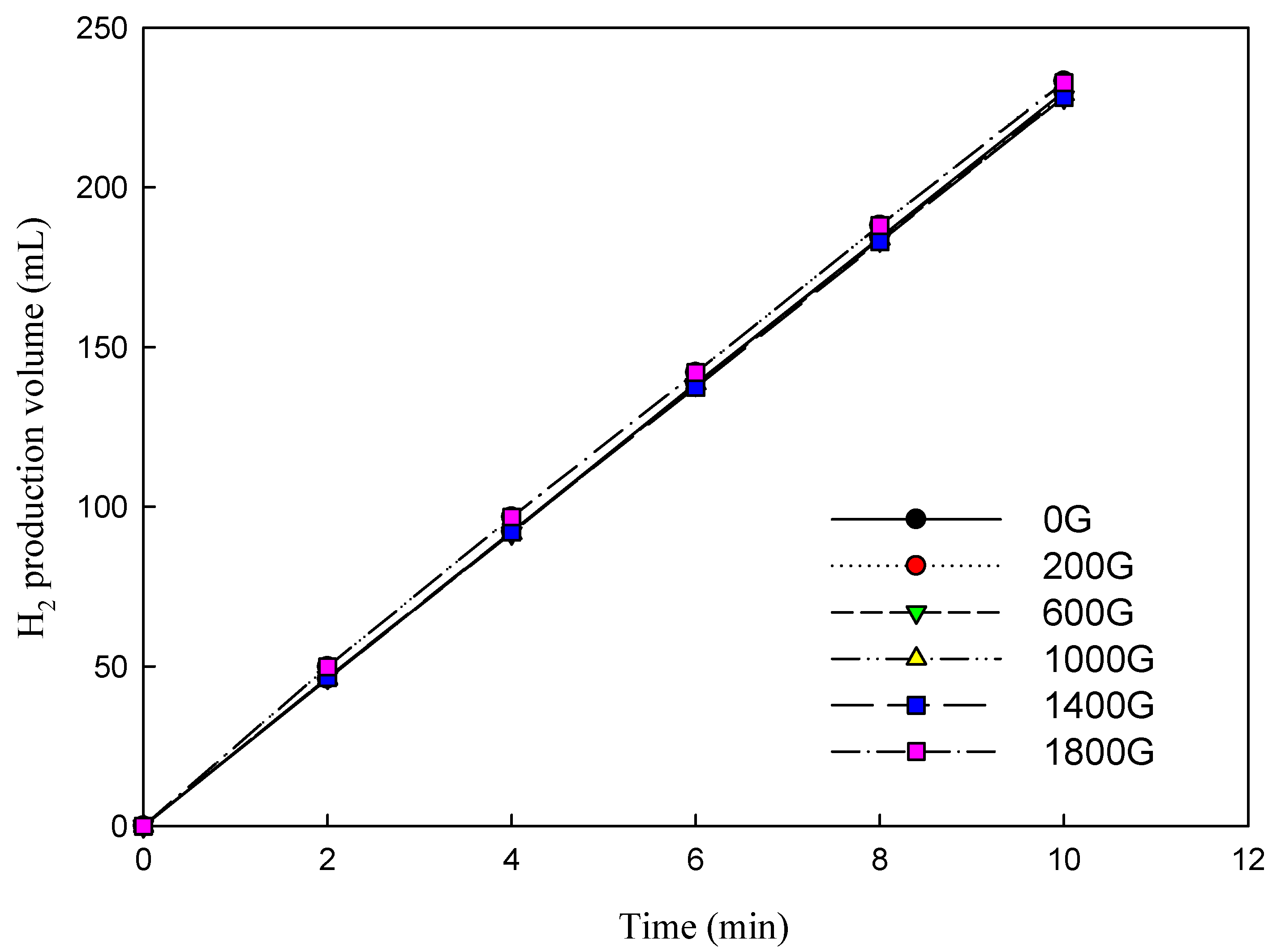
3.4. Influence of Magnetic Field Intensity and Orientation on Electrolytic Efficiency
3.5. Electrolytic Solution for the Electrolytic Pre-Magnetizing Effect
3.6. Analysis of the Concentration of Electrolytic Hydrogen Production
4. Conclusions
Author Contributions
Funding
Data Availability Statement
Conflicts of Interest
References
- Kothari, R.; Buddhi, D.; Sawhney, R. Comparison of Environmental and Economic Aspects of Various Hydrogen Production Methods. Renew. Sustain. Energy Rev. 2008, 12, 553–563. [Google Scholar] [CrossRef]
- Kapdan, I.K.; Kargi, F. Bio-Hydrogen Production from Waste Materials. Enzym. Microb. Technol. 2006, 38, 569–582. [Google Scholar] [CrossRef]
- Bartels, J.R.; Pate, M.B.; Olson, N.K. An Economic Survey of Hydrogen Production from Conventional and Alternative Energy Sources. Int. J. Hydrogen Energy 2010, 35, 8371–8384. [Google Scholar] [CrossRef]
- Peppley, B.A. Biomass for Fuel Cells: A Technical and Economic Assessment. Int. J. Green Energy 2006, 3, 201–218. [Google Scholar] [CrossRef]
- Seol, E.; Manimaran, A.; Jang, Y.; Kim, S.; Oh, Y.-K.; Park, S. Sustained Hydrogen Production from Formate Using Immobilized Recombinant Escherichia Coli SH5. Int. J. Hydrogen Energy 2011, 36, 8681–8686. [Google Scholar] [CrossRef]
- Fakhru’l-Razi, A.; Yassin, A.; Lyuke, S.; Ngan, M.; Morimoto, M. Bio-Hydrogen Synthesis from Wastewater by Anaerobic Fermentation Using Microflora. Int. J. Green Energy 2005, 2, 387–396. [Google Scholar] [CrossRef]
- Saunders, J.; Benfield, D.; Moussa, W.; Amirfazli, A. Nanotechnology’s Implications for Select Systems of Renewable Energy. Int. J. Green Energy 2007, 4, 483–503. [Google Scholar] [CrossRef]
- Xie, L.J.; Jiang, J.C.; Huang, A.C.; Tang, Y.; Liu, Y.C.; Zhou, H.L.; Xing, Z.X. Calorimetric Evaluation of Thermal Stability of Organic Liquid Hydrogen Storage Materials and Metal Oxide Additives. Energies 2022, 15, 2236. [Google Scholar] [CrossRef]
- Chen, Y.H.; Chen, C.Y.; Lee, S.C. Technology Forecasting and Patent Strategy of Hydrogen Energy and Fuel Cell Technologies. Int. J. Hydrogen Energy 2011, 36, 6957–6969. [Google Scholar] [CrossRef]
- Matsushima, H.; Nishida, T.; Konishi, Y.; Fukunaka, Y.; Ito, Y.; Kuribayashi, K. Water Electrolysis under Microgravity: Part 1. Experimental Technique. Electrochim. Acta 2003, 48, 4119–4125. [Google Scholar] [CrossRef]
- Tanaka, Y.; Kikuchi, K.; Saihara, Y.; Ogumi, Z. Bubble Visualization and Electrolyte Dependency of Dissolving Hydrogen in Electrolyzed Water Using Solid-Polymer-Electrolyte. Electrochim. Acta 2005, 50, 5229–5236. [Google Scholar] [CrossRef]
- De Souza, R.F.; Padilha, J.C.; Gonçalves, R.S.; De Souza, M.O.; Rault-Berthelot, J. Electrochemical Hydrogen Production from Water Electrolysis Using Ionic Liquid as Electrolytes: Towards the Best Device. J. Power Sources 2007, 164, 792–798. [Google Scholar] [CrossRef]
- Nagai, N.; Takeuchi, M.; Kimura, T.; Oka, T. Existence of Optimum Space Between Electrodes on Hydrogen Production by Water Electrolysis. Int. J. Hydrogen Energy 2003, 28, 35–41. [Google Scholar] [CrossRef]
- Kothari, R.; Buddhi, D.; Sawhney, R. Studies on the Effect of Temperature of the Electrolytes on the Rate of Production of Hydrogen. Int. J. Hydrogen Energy 2005, 30, 261–263. [Google Scholar] [CrossRef]
- Kaninski, M.P.M.; Stojić, D.L.; Šaponjić, Đ.P.; Potkonjak, N.I.; Miljanić, Š.S. Comparison of Different Electrode Materials—Energy Requirements in The Electrolytic Hydrogen Evolution Process. J. Power Sources 2006, 157, 758–764. [Google Scholar] [CrossRef]
- Yang, Y.P.; Huang, A.C.; Tang, Y.; Liu, Y.C.; Wu, Z.H.; Zhou, H.L.; Li, Z.P.; Shu, C.M.; Jiang, J.C.; Xing, Z.X. Thermal Stability Analysis of Lithium-Ion Battery Electrolytes Based on Lithium Bis(trifluoromethanesulfonyl)imide-Lithium Difluoro(oxalato)Borate Dual-Salt. Polymers 2021, 13, 707. [Google Scholar] [CrossRef] [PubMed]
- Li, H.; Fang, J.; Huang, D.; Zhong, Z.; Wen, Q.; Liu, Y.; Hu, K.; Yang, Z.; Lu, A.; Ai, X.; et al. Magnetic field-enhanced alkaline water electrolysis from laboratory to industry. Proc. Natl. Acad. Sci. USA 2026, 123, 758–764. [Google Scholar] [CrossRef]
- Ross, B.; Skidmore, K.; Haussener, S.; Brinkert, K. Transient Simulation of Gas Bubble Evolution and Overpotential Dynamics for the Hydrogen Evolution Reaction. ACS Electrochem. 2025, 2, 113–123. [Google Scholar] [CrossRef]
- Deng, L.; Jin, L.; Yang, L.; Feng, C.; Tao, A.; Jia, X.; Geng, Z.; Zhang, C.; Cui, X.; Shi, J. Bubble evolution dynamics in alkaline water electrolysis. eScience 2024, 4, 100353. [Google Scholar] [CrossRef]
- Karimi-Sibaki, E.; Vakhrushev, A.; Wu, M.; Boháček, J.; Kharicha, A. A numerical study on effects of current density distribution, turbulence, and magnetohydrodynamics on electrolytic gas flow with application to alkaline water electrolysis. Chem. Eng. Res. Des. 2024, 208, 731–739. [Google Scholar] [CrossRef]
- Chen, Y.J.; Li, Y.H.; Chen, C.Y. Effect of Electrode–Normal Magnetic Field on the Motion of Hydrogen Bubbles. Magnetochemistry 2023, 9, 233. [Google Scholar] [CrossRef]
- Stojić, D.L.; Marčeta, M.P.; Sovilj, S.P.; Miljanić, Š.S. Hydrogen Generation from Water Electrolysis—Possibilities of Energy Saving. J. Power Sources 2003, 118, 315–319. [Google Scholar] [CrossRef]
- Ando, Y.; Tanaka, T. Proposal for A New System for Simultaneous Production of Hydrogen and Hydrogen Peroxide by Water Electrolysis. Int. J. Hydrogen Energy 2004, 29, 1349–1354. [Google Scholar] [CrossRef]
- Tanaka, Y.; Uchinashi, S.; Saihara, Y.; Kikuchi, K.; Okaya, T.; Ogumi, Z. Dissolution of Hydrogen and The Ratio of The Dissolved Hydrogen Content to the Produced Hydrogen in electrolyzed Water Using SPE Water Electrolyzer. Electrochim. Acta 2003, 48, 4013–4019. [Google Scholar] [CrossRef]
- Licht, S.; Wang, B.; Mukerji, S.; Soga, T.; Umeno, M.; Tributsch, H. Over 18% solar Energy Conversion to Generation of hydrogen Fuel; Theory and Experiment for Efficient Solar Water Splitting. Int. J. Hydrogen Energy 2001, 26, 653–659. [Google Scholar] [CrossRef]
- Tsai, Y.T.; Yang, Y.; Pan, Y.; Shu, C.M. Catalytic Effects of Magnesium-Transition Metal (Fe and Ni) Hydrides on Oxygen and Nitrogen Reduction: A Case Study of Explosive Characteristics and Their Environmental Contaminants. Energy 2023, 280, 128222. [Google Scholar] [CrossRef]
- Wang, Y.Q.; Xie, L.J.; Sun, H.Q.; Wang, X.; Zhou, H.L.; Tang, Y.; Jiang, J.C.; Huang, A.C. 4,5-Difluoro-1,3-dioxolan-2-one as A Film-Forming Additive Improves the Cycling and Thermal Stability of SiO/C Anode Li-Ion Batteries. Process Saf. Environ. Prot. 2024, 183, 496–504. [Google Scholar] [CrossRef]




| Current (A) | Magnetic Field (G) | Operating Voltage (V) | Power Consumption (W) | Gas Production (mL) |
|---|---|---|---|---|
| 1 A | 0 G | 3.7 V | 3.7 W | ~113.0 |
| 1 A | 200 G | 2.5 V | 2.5 W | ~118.5 |
| 2 A | 0 G | 5.3 V | 10.6 W | ~227.8 |
| 2 A | 200 G | 3.0 V | 6.0 W | ~233.1 |
| H2 Production Volume (mL) | Operation Time | |||||
|---|---|---|---|---|---|---|
| Magnetizing Strength | 0 min | 2 min | 4 min | 6 min | 10 min | |
| 0 G | 229.8 | – | – | – | – | |
| 200 G | – | 227.8 | 227.8 | 227.8 | 227.8 | |
| 1800 G | – | 227.8 | 224.0 | 229.0 | 226.5 | |
| Operating Condition | Gas Kinds | H2 and O2 Concentration (mL) | Gas Production Rate (%) | |
|---|---|---|---|---|
| Without Membrane | 2 A, 1 h 2 A, 1 h | H2 O2 | 67.4 32.6 | 0.15 |
| With Membrane | MC-3470 MC-3470 | H2 O2 | 100 100 | 0.15 |
| N-117 N-117 | H2 O2 | 100 100 | 0.15 | |
Disclaimer/Publisher’s Note: The statements, opinions and data contained in all publications are solely those of the individual author(s) and contributor(s) and not of MDPI and/or the editor(s). MDPI and/or the editor(s) disclaim responsibility for any injury to people or property resulting from any ideas, methods, instructions or products referred to in the content. |
© 2026 by the authors. Licensee MDPI, Basel, Switzerland. This article is an open access article distributed under the terms and conditions of the Creative Commons Attribution (CC BY) license.
Share and Cite
Huang, C.-F.; Lin, C.-P.; Lin, Y.-H.; Wan, T.-J.; Huang, A.-C. Enhancing Hydrogen Production Efficiency Through Magnetic Field Application in Water Electrolysis. Processes 2026, 14, 1466. https://doi.org/10.3390/pr14091466
Huang C-F, Lin C-P, Lin Y-H, Wan T-J, Huang A-C. Enhancing Hydrogen Production Efficiency Through Magnetic Field Application in Water Electrolysis. Processes. 2026; 14(9):1466. https://doi.org/10.3390/pr14091466
Chicago/Turabian StyleHuang, Chung-Fu, Chih-Peng Lin, Yi-Hsiung Lin, Terng-Jou Wan, and An-Chi Huang. 2026. "Enhancing Hydrogen Production Efficiency Through Magnetic Field Application in Water Electrolysis" Processes 14, no. 9: 1466. https://doi.org/10.3390/pr14091466
APA StyleHuang, C.-F., Lin, C.-P., Lin, Y.-H., Wan, T.-J., & Huang, A.-C. (2026). Enhancing Hydrogen Production Efficiency Through Magnetic Field Application in Water Electrolysis. Processes, 14(9), 1466. https://doi.org/10.3390/pr14091466