Article

Graphene Oxide as Valuable Additive for Improving ZnO Electrochemical Properties: Zn/xGO (x = 0, 0.1, and 0.5 wt.%) as Photoelectrocatalysts for Water Splitting and Electrochemical Sensor for Diclofenac


by
Ana Nastasić
1,
Katarina Aleksić
2,
Marija Kratovac
3,
Ljiljana Veselinović
2,
Ana Stanković
2,
Marijana Kraljić Roković
4,
Srečo Škapin
5,
Valentin N. Ivanovski
1,
Jelena Belošević-Čavor
1,
Ana Umićević
1,
Ivana Stojković Simatović
3 and
Smilja Marković
2,*
1
“Vinča” Institute of Nuclear Sciences-National Institute of the Republic of Serbia, University of Belgrade, P.O. Box 522, 11001 Belgrade, Serbia
2
Institute of Technical Sciences of SASA, 11000 Belgrade, Serbia
3
Faculty of Physical Chemistry, University of Belgrade, 11000 Belgrade, Serbia
4
Department of Electrochemistry, Faculty of Chemical Engineering and Technology, University of Zagreb, 10000 Zagreb, Croatia
5
Advanced Materials Department, “Jožef Stefan” Institute, Jamova Cesta 39, 1000 Ljubljana, Slovenia
*
Author to whom correspondence should be addressed.
Processes 2026, 14(9), 1453; https://doi.org/10.3390/pr14091453
Submission received: 20 February 2026 / Revised: 4 April 2026 / Accepted: 21 April 2026 / Published: 30 April 2026
(This article belongs to the Special Issue Graphene Oxide: From Synthesis to Applications)

Abstract

Graphene oxide (GO) was employed as an additive to improve the electrochemical activity of zinc oxide (ZnO) used as both a photoelectrocatalyst for water splitting and an electrochemical sensor for detection of diclofenac. To comprehend the influence of a small amount of GO on the electrochemical activity of ZnO, a series of ZnO/xGO (x = 0, 0.1, and 0.5) particles was synthesized by microwave processing of Zn(OH)2 precipitate in the presence of 0.1 and 0.5 wt.% of previously prepared GO. The phase composition and crystal structure ordering of ZnO/xGO particles were investigated by XRD and Raman spectroscopy. The optical properties were studied by UV–Vis DRS and PL spectroscopy. The particle morphology was inspected by FE–SEM while the textural properties were analyzed by the low-temperature nitrogen adsorption–desorption method. The (photo)electrocatalytic and electrochemical sensing activities were examined on the ZnO/rxGO modified glassy carbon electrodes (GCEs) prepared by in situ reduction of the ZnO/xGO modified GCEs for 120 s. The electro- and photoelectrocatalytic activity of ZnO/rxGO modified GCEs for water splitting was tested in dark conditions and after 60 min under illumination, respectively, employing linear sweep voltammetry in 0.1 M NaOH and 0.1 M H2SO4 as electrolytes. The electrochemical sensing activity of ZnO/rxGO modified GCEs was tested for detection of diclofenac in aqueous solution. The improvement in the electrochemical activity of ZnO was correlated with the added amount of GO, structural defects, and particle morphology.

1. Introduction

Contemporary society is facing parallel challenges related to the ever-growing demand for energy and the increasing severity of environmental pollution, with water contamination holding a particularly important position. Population growth, inadequate management of water and energy resources, climate change, and increased industrial activity have made clean water and zero-carbon energy critical global resources [1,2]. In this context, the development of multifunctional materials is drawing more attention from researchers, as they enable simultaneous addressing of issues associated with sustainable energy production and the efficient removal/detection of pollutants in aquatic systems [3].
One promising approach to fulfill the global energy demand is photoelectrochemical water splitting for producing green hydrogen, an energy carrier with high energy density and zero emission of harmful byproducts [4,5,6]. It involves the splitting of water into hydrogen and oxygen through two half-reactions: the hydrogen evolution reaction (HER) and the oxygen evolution reaction (OER), which are driven by absorbed solar energy using photoelectrocatalysts [7,8,9]. Pt/C is recognized as the most efficient electrocatalyst for HER, while IrO2 and RuO2 are the benchmark catalysts for OER. However, their scantiness, high price, and poor chemical stability motivate the search for alternative HER/OER electrocatalysts. Among these, wide-bandgap metal oxides, such as ZnO and TiO2, have attracted particular attention due to their chemical stability, low price, and suitability for photoelectrochemical applications [10,11,12,13].
In addition to energy-related considerations, growing concern about drinking, surface, and groundwater quality has accelerated research in the field of electrochemical pollutant detection. Electrochemical sensors offer high sensitivity and selectivity, and rapid, facile, and low-priced analysis, which make them suitable for on-site monitoring of chemical and biological pollutants, and their degradation products in aqueous matrices [14]. An interest in on-site analyte detection inspired many electrochemical investigations to be focused on pesticide and fertilizer sensing, especially because their residues are frequently present in water sources and could deteriorate human health by being cytotoxic, carcinogenic, and mutagenic [15,16,17]. Due to detrimental effects on human health and the environment, there is also growing interest in developing electrochemical sensors for detection of per- and polyfluoroalkyl substances (PFASs, known as “forever chemicals”) [18,19,20]. Until now, electrochemical sensors have been tested for quantification of pharmaceutical components in herbal medicine; this is especially important since some, e.g., flavonoid compounds, often exhibit good antioxidant, anti-inflammatory, and anticancer properties, offering great benefits to human health, while excessive intake may cause many adverse heathy risks such as convulsions, dizziness, and coma [21]. It has been shown that electrochemical sensors can be successfully used for monitoring heavy metal ions which are particularly hazardous due to their high toxicity, environmental persistence, and bioaccumulation [22,23]. The development of electrochemical sensors for dyes has been triggered by the necessity for quick and effective quantifying of some synthetic azo colors utilized in food production, especially since they may be extremely poisonous, resulting in DNA alterations [24]. A significant part of the investigations is devoted to the development of biosensors for detection of infectious diseases, cancer cells [25,26,27], etc. Among present-day pollutants, pharmaceuticals have also been recognized as particularly concerning due to their widespread use, environmental persistence, as well as potential unpredictable and long-term effects on ecosystems and human health [28]. Non-steroidal anti-inflammatory drugs, such as diclofenac, are widely used and frequently detected in natural waters, thus requiring the development of reliable and efficient detection and quantification methods [28,29,30].
Considering the increasing demand for zero-carbon energy sources and effective water pollution controls, further research should therefore focus on the development of novel, stable, and efficient multifunctional materials that could integrate catalytic activity for HER and OER with electrochemical pollutant detection capabilities. To the best of the authors’ knowledge, no material has been reported in the literature that has been investigated for both HER/OER photoelectrocatalysis and diclofenac detection in the water environment. This gap in the literature highlights a potential research opportunity for developing multifunctional catalysts for energy and environmental monitoring applications. In this respect, graphene oxide represents an attractive material due to its structural, electronic, and surface properties, as well as its ability to form composites with transition metal oxides, such as ZnO, making it a viable framework for the development of multifunctional materials in photoelectrochemical and electrochemical applications [1,31].
Transition metal oxides have been extensively investigated in photocatalysis and energy-related applications due to their semiconducting properties and ability to easily change oxidation states [3]. Among transition metal oxides, ZnO is one of the most studied n-type semiconductors owing to its wide band gap, chemical stability, low cost, biocompatibility, non-toxicity, and well-established applications in electronics and optical devices [3,5,32]. Its ability to form various nanostructures (such as nanowires, nanorods, nanoplates, etc.), which provides a high surface-to-volume ratio, and enhanced reactivity make it a promising material for photoelectrocatalysis, as well as environmental applications like pollutant detection [3,32]. However, despite research efforts, the practical performance of ZnO is limited by low electrical conductivity, high charge recombination rates, and a tendency toward photodegradation under UV irradiation [3]. Consequently, composite formation with other functional materials is commonly employed to improve charge transfer, stability, and overall catalytic performance.
Graphene oxide (GO) is widely used as a material to improve charge transfer, particularly in composites and hybrid materials for energy, catalytic, and sensing applications. GO is a two-dimensional carbon material featuring rich oxygen-containing functional groups (such as hydroxyl, epoxy, and carboxyl groups) distributed across its basal plane and edges [33]. It possesses a large specific surface area (SSA), excellent thermal and mechanical stability, and tunable electronic properties, which make it a convenient material for various applications [1,22,34,35]. While GO itself exhibits limited intrinsic photocatalytic activity, it has been successfully combined with semiconductor oxides, such as TiO2 and ZnO, to enhance photocatalytic performance [1]. Moreover, its large SSA contributes to better exposure of active sites, which is beneficial for both water splitting and sensing applications [4,36]. However, the high sheet resistance of pristine GO and potential structural defects can limit its conductivity, which is typically addressed by reduction and/or composite formation [1]. Owing to these versatile characteristics, GO could serve as a robust platform for designing multifunctional materials.
Having in mind previously published results about GO nanocomposites with transition metal oxides, which demonstrated improved catalytic, photocatalytic, and sensing properties [31,37,38,39], we were intrigued by the possibility of developing a cost-effective and green procedure for processing ZnO/GO composites, where GO can be employed to control the morphology, bulk and surface defect states, and photoresponse of ZnO nanocrystals (where the migration efficiency of photo-induced electrons can be promoted, while electron–hole recombination in carrier transfer processes can be inhibited). Thus, the purpose of this research was to improve the electrochemical properties of ZnO by employing a small amount of graphene oxide, i.e., 0.1 and 0.5 wt.% (relative to ZnCl2). As an innovation compared to up-to-date published procedures for ZnO/GO composite processing, GO particles were dispersed in ZnCl2 solution before the process of Zn(OH)2 precipitation by NaOH. In this way, GO particles served as seeds for Zn(OH)2 precipitation, influencing further ZnO particle crystallization in the MW field. We examined how the relative content of GO affects phase composition, crystal structure ordering—especially surface and bulk oxygen vacancies—optical properties, morphology, and the textural properties of prepared ZnO/xGO (x = 0, 0.1, and 0.5) particles. To comprehend the influence of GO on the functional properties of ZnO/xGO particles, we estimated their (1) photoelectrocatalytic activity towards HER and OER, in both acidic and alkaline electrolytes, and (2) electrochemical performance for detection of diclofenac in a neutral aqueous electrolyte. Both sets of experiments were completed on GCEs modified by ZnO/xGO after in situ reduction for 60 s, twice in a row. An improvement in the functional properties of ZnO/xGO compared to bare ZnO was correlated with physicochemical properties influenced by the addition of GO, highlighting the role of charge transfer and oxygen vacancies.

2. Materials and Methods

2.1. Materials

Zinc chloride (ZnCl2, >99.5%, Lach-Ner, Neratovice, Czech Republic), sodium hydroxide (NaOH, >98%, CARLO ERBA Reagents, Cornerado (MI), Italy), and graphene oxide (GO, prepared in our laboratory according to the procedure described in a previous publication [40]) were used in synthesis procedures. Distilled water and absolute ethanol (Zorka, Šabac, Serbia) were used as the solvents for initial rinsing to remove salt residues and the final rinsing of the synthesized powders, respectively.

2.2. Synthesis of ZnO/xGO (x = 0, 0.1, and 0.5) Particles

The ZnO/xGO (x = 0, 0.1, and 0.5) particles were synthesized using the microwave processing of a precipitate method. For the synthesis of zinc oxide (x = 0), 0.8977 g of ZnCl2 was dissolved in 100 mL of distilled water under magnetic stirring. After 5 min, 20 mL of 1.75 M NaOH solution was added dropwise, resulting in the formation of an off-white precipitate. The suspension was stirred at 50 °C for 90 min. The precipitate was then transferred into a microwave oven (2.45 GHz, 130 W) and treated for 5 min, after which it was cooled to room temperature under ambient conditions. The sample was collected by centrifugation at 7000 rpm for 5 min at 22 °C and rinsed five times with distilled water and five times with ethanol. The obtained particles were dried at 80 °C for 24 h and powdered in an agate mortar. For the synthesis of ZnO/xGO particles with x = 0.1 and 0.5, a selected volume of graphene oxide dispersion (8.5 mg mL−1) was added to 100 mL of distilled water to obtain graphene oxide contents of 0.1 wt% and 0.5 wt% relative to ZnCl2. After 5 min of stirring, 0.8977 g of ZnCl2 was added, and the procedure was continued as described for zinc oxide.
The synthesized particles were denoted as ZnO, ZnO/0.1GO, and ZnO/0.5GO, where the numbers 0.1 and 0.5 indicate the wt.% of GO used for the synthesis relative to the mass of ZnCl2.

2.3. Characterization of ZnO/xGO (x = 0, 0.1, and 0.5) Particles

X-ray diffraction (XRD) data were collected on a Philips PW 1050 diffractometer with CuKα1,2 (λ = 1.54178 Å) Ni-filtrated radiation, operating at 40 kV and 20 mA. The XRD scans were conducted over the angular range from 10 to 70° 2θ, with a step size of 0.05° and a dwell time of 5 s per step. The crystal phases were identified using Match!3 database software (Version 3.5) [41], with reference to the Crystallography Open Database (COD) patterns [42]. The XRD microstructural analysis was performed by the Rietveld refinement method using the FullProf computing program [43,44]. In order to subtract instrumental broadening, the XRD pattern of a LaB6 standard was fitted. μ-Raman spectra were recorded on a Thermo Scientific DXR Raman microscope (Waltham, MA, USA), equipped with an optical microscope and a CCD detector, using the 532 nm diode-pumped solid-state high-brightness laser as the excitation source, at a power of 2 mW. The spectra were recorded in the frequency interval of 50–3500 cm−1 with a resolution of 4 cm−1, exposition time 10 s, number of expositions 10. Photoluminescence (PL) spectra were recorded in the 350–700 nm range, using a Horiba Jobin Yvon Fluorolog FL3–22 spectrofluorometer equipped with a xenon (Xe) lamp as the excitation source. Excitation was performed at a wavelength of 280 nm. The UV–Vis DRS was measured in the range from 800 to 200 nm using an Agilent Cary 5000 spectrophotometer equipped with a diffuse reflectance accessory. A commercial PTFE standard was used for baseline correction. The morphology and particle size of the prepared samples were examined using field-emission scanning electron microscopy (FE-SEM, Ultra Plus Carl Zeiss, Jena, Germany), before analysis samples were dispersed in water for 5 min and immediately filtered through a polycarbonate membrane. The membrane was fixed on carbon tape on an aluminum stub, and to ensure good electrical conductivity during FE-SEM investigation, the samples were carbon coated using a PECS (Gatan GmbH, Model 682, Munich, Germany). The specific surface area (SSA) and the total pore volume were determined based on a N2 adsorption–desorption isotherm at −195.8 °C using an ASAP 2020 (Micromeritics Instrument Corporation, Norcross, GA, USA). Prior to analysis samples were degassed under reduced pressure at 120 °C for 10 h. The SSA was calculated according to the Brunauer–Emmett–Teller (BET) method from the linear part of the N2 adsorption isotherm. The total pore volume (Vtotal) was estimated from the adsorbed amount at a relative pressure p/p0 = 0.998.

2.4. Electrochemical Measurements

All electrochemical measurements were accomplished using an Ivium VertexOne potentiostat/galvanostat in a standard three-electrode setup consisting of the modified glassy carbon electrode (GCE) as a working electrode, a platinum (Pt) foil as the counter electrode, and a saturated calomel electrode (SCE) as the reference electrode. Prior to each electrochemical measurement, in situ electrochemical reduction of GO of each ZnO/GO modified electrode was performed by chronoamperometry in 0.1 M KCl (E = −1.4 V vs. SCE) for 1 min, repeated twice. (In the text, the reduced electrodes are denoted as ZnO/rxGO.) Following the reduction step, ZnO/r0.1GO and ZnO/r0.5GO were subjected to electrochemical evaluation, together with the ZnO.
For photoelectrocatalytic activities of the ZnO particles, the working electrodes were prepared by coating 5 μL of catalytic ink onto a glassy carbon, followed by drying under an IR lamp for 60 s to enable solvent evaporation. The catalytic inks were prepared by dispersing 10 mg of ZnO/xGO particles into a mixture of 10 μL of 5% Nafion solution (Sigma-Aldrich, Saint Louis, MO 63103, USA), 50 μL of water, and 50 μL of ethanol in an ultrasonic bath for 1 h.
Both acidic (0.1 M H2SO4) and alkaline (0.1 M NaOH) electrolytes were used for photoelectrocatalytic measurements using linear sweep voltammetry (LSV) at a scan rate of 20 mV s−1. For OER measurements, LSV was performed in the potential range of 0.2 to 1.9 V vs. SCE in both media. For HER measurements, the applied potential ranges were 0.2 to −1.9 V vs. SCE in alkaline medium and 0.2 to −1.0 V vs. SCE in acidic medium.
All potentials were measured against the SCE and converted to a reversible hydrogen electrode (RHE) scale using the Nernst Equation (1) [45]:
ERHE = ESCE + 0.059 pH + 0.244
The measurements were accomplished in the dark and under illumination. For the illuminated measurements, the electrodes were exposed to light produced by Spectromaster 250 W 6400 K CFL bulb (wavelength 400–700 nm, with peak around 450–500 nm) at an irradiance of 100 mW cm−2 (the light intensity was measured by a PeakTech 5165 Digital-Lux-Meter, Ahrensburg, Germany) for 60 min. The distance between the electrochemical cell and the light source was 10 cm.
The inks for electrochemical detection of diclofenac were prepared by combining 10 mg of ZnO/xGO particles, 1.5 mg of a Vulcan carbon additive (CABOT VULCAN Carbon Black XC72R), 40 μL of a 5% Nafion solution, 225 μL of distilled water, and 225 μL of ethanol. The resulting mixture was briefly vortexed and then ultrasonically treated for 1 h to ensure homogenization. The prepared ink was deposited as a thin film onto a GCE, and then dried under an infrared lamp (Avide, 250 W). This procedure resulted in modified GCEs.
Cyclic voltammetry (CV) was employed to evaluate materials’ electrochemically active surface area (EASA) and heterogeneous electron transfer rate constant (k0). The voltammograms were recorded within a potential window of −0.4 to 1.0 V vs. SCE, using a potential step of 2 mV and a polarization rate of 20 mV s−1. Measurements were carried out in a 5 mM K4[Fe(CN)6] solution prepared in 0.1 M KCl, which served as the supporting electrolyte. EASA and k0 values were calculated based on the Randles–Ševčik equation and Nicholson’s method, respectively, following the previously reported methodology [46].
Overpotential (η) was determined as the difference between the applied potential at a fixed current density and the thermodynamic equilibrium potential of the corresponding reaction. Overpotential at 10 mA cm−210) was calculated for HER and OER in both acidic and alkaline media using Equations (2) and (3), respectively [45]:
ηOER = ERHE − 1.23 V
ηHER = ERHE − 0 V
The turnover frequency (TOF) was calculated for all samples under both dark and illuminated conditions in alkaline and acidic electrolytes, using Equation (4) [47]:
TOF = (j·NA)/(n·F·Γ)
where j is the current density (A cm−2), NA is the Avogadro number, n is the number of electrons transferred (2 for HER, 4 for OER), F is the Faraday constant (96,485 C mol−1), and Γ is the surface concentration of active sites (sites cm−2) determined using Equation (5) [48]:
Γ = EASA/Ageom⋅ΓZnObalk
where EASA is electrochemically active surface area, Ageom = 0.3 cm2 and ΓZnObalk is 0.05·1015 sites cm−2 [49]. The current density values used for TOF calculation were determined from the LSV curves at the fixed potentials: −0.25 V vs. RHE for HER in acidic medium, −0.30 V vs. RHE for HER in alkaline medium, and 1.73 V vs. RHE for OER in both acidic and alkaline media.
Linear sweep voltammograms (LSVs) were recorded to investigate the electroanalytical response of the materials in the potential range from 0.2 V to 0.8 V vs. SCE, using a potential step of 2 mV and at a scan rate of 20 mV s−1. Electroanalytical measurements were performed in 0.1 M phosphate buffer (pH~7). Diclofenac (Diclofenac HF, injection solution, 75 mg/3 mL, Hemofarm STADA, Vršac, Serbia) was added to the electrolyte in successive 1 μL additions, with the solution being stirred for 5 min after each addition, i.e., prior to electrochemical measurements. The limit of detection (LOD) and the limit of quantification (LOQ) were determined according to Equations (6) and (7), where σ represents the standard deviation of y-intercept of the calibration plot and b denotes the slope of the same calibration line [50]. Additionally, b represents the sensitivity of the analytical method.
LOD = 3 σ b
LOQ = 10 σ b

2.5. Computational Procedure

To comprehend the electrochemical activity of the ZnO/xGO systems, density functional theory (DFT)-based calculations were performed utilizing the projector augmented wave (PAW) method within the Vienna ab initio simulation package (VASP) [51,52]. In the performed calculations, the surfaces were modeled as periodically repeated slabs consisting of several atomic layers and separated by a vacuum region. For the ZnO (000-1) surface of 16 layers, the top 8 layers were allowed to relax pending the Hellmann–Feynman forces being reduced below 0.02 eV/Å, whereas the rest of the layers were held fixed, representing the bulk crystal. For the graphene supercell of 128 carbon atoms, the borderline atoms were kept fixed. The Perdew–Burke–Ernzerhof (PBE) generalized gradient approximation (GGA) [53] was used for the exchange-correlation functional and the plane-wave basis set cutoff of 500 eV. Self-Consistent Field (SCF) energy convergence threshold was 10−6 eV. Due to a large number of atoms and faster energy convergence, the k-point mash with only the gamma point of the Brillouin zone was chosen. For the graphene lattice constant, the literature value of 2.46 Å was used [54]. After the surface optimization, the molecule of diclofenac was put above the surface of both ZnO and graphene and the equilibrium adsorption configuration, as well as the adsorption energy, were calculated. Bader’s atoms-in-molecules theory [55] was used to calculate the charge redistribution between the atoms in the investigated systems. For the Bader’s charges calculations, the energy convergence criterion was set to 10−8 eV. The bond orders and the overlap populations between orbitals were calculated by the DDEC6 method for atomic population analysis in periodic and non-periodic materials implemented in the Chargemol program [56].
Adsorption binding energy of a molecule to the surface was calculated using Equation (8) [57]:
Eads = Ecomplex − Esurface − Emolecule
where Ecomplex is the energy of the optimized complex consisting of the ZnO surface (or graphene) and diclofenac molecule on top of it, Esurface is the energy of the ideal ZnO surface (or graphene), and Emolecule is the energy of the diclofenac molecule.

3. Results and Discussion

3.1. Physicochemical Characteristics of ZnO/xGO Particles

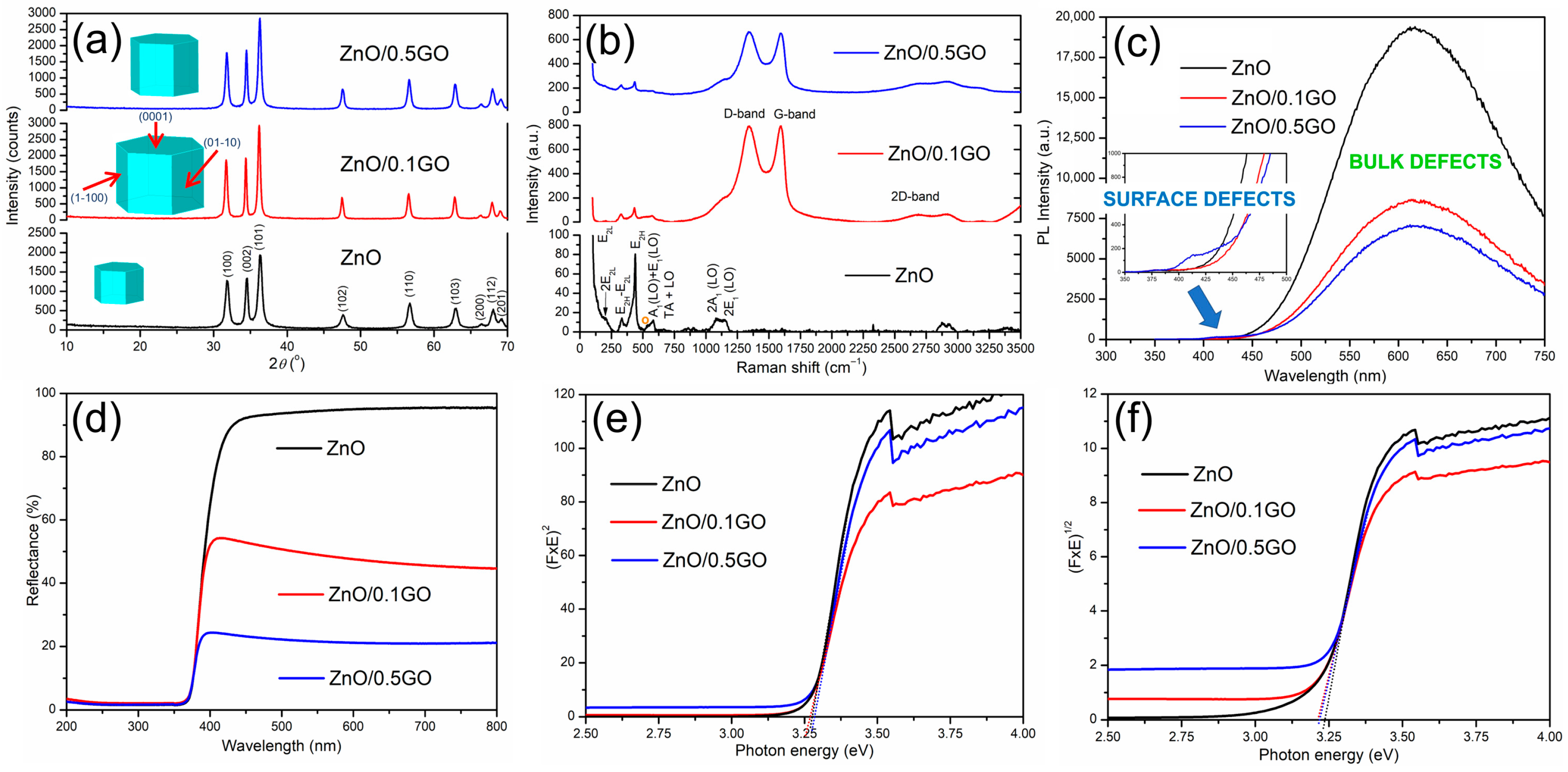
The influence of GO particles on the phase composition and crystal structure ordering of ZnO/xGO particles was investigated using XRD and Raman spectroscopy analyses; the diffraction patterns and Raman spectra are presented in Figure 1a,b. The diffraction patterns indicate highly crystalline ZnO particles with a Wurtzite-type hexagonal symmetry (P63mc space group; COD no. 96-230-0113); Figure 1a [42]. The XRD patterns show that ZnO/0.1GO and ZnO/0.5GO possess the same phase compositions as bare ZnO, which is expected since a small amount of GO used for the synthesis cannot be detected by X-ray diffraction. However, structural analysis performed by the Rietveld refinement full pattern method confirm that even a small amount of GO influenced crystal growth, particularly the unit cell parameters, crystallite size (calculated for three specific crystallographic directions [100], [002] and [101], and average), average strain and crystallinity; the calculated values are listed in Table 1. The unit cell parameters calculated for bare ZnO particles were found to be a = b = 3.2497(3) Å, c = 5.2103(6) Å, V = 47.643(2) Å3, matching the standard COD parameters for the hexagonal ZnO crystals with a Wurtzite-type structure (COD no. 96-230-0113). The crystallite sizes in three specific crystallographic directions, [100], [002], and [101], were found to be 15.2, 14 and 13.3 nm, respectively. As can be noticed from data listed in Table 1, the presence of GO in ZnO/0.1GO influenced the lattice parameters; the unit cell parameters slightly decreased while the crystallite size in [100], [002], and [101] directions increased to 26.0, 23.4, and 22.2, respectively. A further increase in the GO amount in ZnO/0.5GO provoked slight changes in both unite cell parameters and the crystallite size. Variation in the crystallite sizes and the crystallinity degree in ZnO/xGO compared with the bare ZnO can be explained by the fact that a small amount of GO acts as a substrate which promotes the crystallization of ZnO [58,59]. However, an increase in GO concentration in a mixture with ZnO induces a chemical reaction between the functional GO groups which contain oxygen and ZnO, acting subsequently as an inhibitor of crystallite growth [60]. The calculated average lattice strain varied from 6.1 × 10⁻³ for the bare ZnO via 3.9 × 10⁻³ for ZnO/0.1GO to 5.5 × 10⁻³ for ZnO/0.1GO, implying the largest concentration of lattice defects in ZnO and the most ordered crystal structure of ZnO/0.1GO [61]. In addition, the calculated polarity values I(002)/I(100) were found to be 1.045, 1.026, and 1.045 for ZnO, ZnO/0.1GO, and ZnO/0.5GO, respectively, indicating an almost isotropic nano-crystallite growth [10]. The values of the polarity I(002)/I(100) around 1, for all examined ZnO/xGO particles, indicate a well-developed polar (0001) plane (inset in Figure 1a) with a hexagonal platelike morphology, implying that synthesized nanoparticles could be very electrochemically active. Considering the polarity and the calculated crystallite size in [100], [002], and [101] directions, a more profound electrochemical activity can be expected for ZnO/0.1GO which has the most developed crystallites.
Since XRD did not confirm the presence of GO in ZnO/xGO particles, we used Raman spectroscopy as a powerful tool for inspecting the presence of a small amount of GO in composites; Raman spectra are presented in Figure 1b. All bands in the Raman spectrum of bare ZnO are distinctive for the Wurtzite crystal structure [10]. The most intense peak at 98 cm−1, labeled as E2L, is due to vibrations of the zinc sublattice in ZnO [10,62,63]. The shoulder at 200 cm−1, a sharp peak at 333 cm−1 and the weak shoulder near 380 cm−1 are assigned to the second-order phonon mode 2E2L, the multi phonon mode E2HE2L, and to A1 (TO) vibrations, respectively. The weak shoulder at 410 cm−1 corresponds to the E1 (TO) mode. The existence of E1 (TO) vibrational mode indicates the growth of ZnO crystallites in a direction different than the c-axis typical of ZnO particles [10]; this is in agreement with the almost isotropic crystallite geometry estimated from the XRD data for the [100], [002], and [101] crystallographic directions (Table 1). The peak at 434 cm−1 is due to the E2H mode and it is assigned to oxygen vibrations [64]. The asymmetry of the E2H peak points to lattice disorder while its intensity indicates crystallinity; thus, a high intensity of the E2H peak indicates a good crystallinity of ZnO particles which is in accordance with the crystallinity of about 70% calculated from the XRD data (Table 1) [65,66]. A wide band in the 510−740 cm−1 region consists of two peaks; the one at 570 cm−1 represents A1 (LO) and E1 (LO) modes, whereas the other, at 635 cm−1, represents a combination of acoustic and optical modes (TA + LO). The A1 (LO) mode is associated with bulk defects such as oxygen vacancies, zinc interstitials or defect complexes containing both [64]. It has been shown that the presence of defects strongly influences these modes, especially E1 (LO) [66]. The relatively high intensity of the A1 (LO) + E1 (LO) modes in the Raman spectrum of the ZnO sample, Figure 1b, points to a relatively large amount of oxygen vacancies and zinc interstitials as intrinsic bulk defects. As we previously reported, these bulk defects were provoked by fast crystallization induced by microwave irradiation [10,63]. A weak peak at 483 cm−1 (marked with an orange circle) is attributed to the interfacial surface phonon mode 2LA [64]. The wide band in the wavenumber region 1090∓1150 cm−1 is attributed to the optical overtone 2LO, explicitly to 2A1 (LO) and 2E1 (LO). The Raman spectra of ZnO/xGO look very similar, with bands typical for ZnO appearing in the 100 to 750 cm−1 spectral range and two intense bands centered near 1340 and 1595 cm−1, denoted as the D- and G-band, respectively [67]. The D- and G-bands confirm the presence of GO in ZnO/xGO particles, where the D-band is related to a structural disorder in graphene, whereas the G-band is assigned to the sp2 hybridized carbon atoms (C=C stretching), confirming the presence of carbon in the materials [67]. In the spectrum of ZnO/0.1GO the D- and G-bands are centered at 1341 and 1593 cm−1, respectively, while in the spectrum of ZnO/0.5GO the bands are negligibly shifted to 1343 and 1594 cm−1. We calculated the intensity ratio of the D- and G-bands as a useful indicator of the structural defects in graphitic materials [68]. The obtained values for ID/IG of 1.004 and 1.01 for ZnO/0.1GO and ZnO/0.5GO, respectively, confirm an almost identical concentration of structural defects in GO as a compositional part of ZnO/xGO.
The type and relative number of defects in the crystal structure of the ZnO/xGO particles, especially their dependence on the GO amount, were studied by employing photoluminescence (PL) spectroscopy. PL spectra of the ZnO/xGO particles, displayed in Figure 1c, have the same shape but with different intensities depending on the amount of GO. A broad emission band of high intensity centered at approximately 630 nm is associated with bulk defects, while the low-intensity band observed near 420 nm indicates a negligible amount of surface defects, inset in Figure 1c [10,63]. PL spectra indicate that even a small amount of GO (0.1 wt.%) added to ZnCl2 solution before the precipitation procedure leads to a significant reduction in bulk defects in the ZnO crystal structure without an impact on surface defects. An additional increase in the GO amount (to 0.5 wt.%) further decreases the number of bulk defects in the ZnO crystal structure with a slight increase in surface defects. These results imply that ZnO/0.5GO possesses the most ordered crystal structure, which is in accordance with the highest crystallinity (76%) calculated from XRD data.
To investigate the influence of the GO amount on the optical properties of the ZnO/xGO particles, UV-Vis DRS was recorded. UV−Vis DRS plots show characteristic reflectance curves with the adsorption edge near 380 nm but with significantly different absorption capacity, Figure 1d. As can be seen, ZnO particles reflect about 93% of visible light, i.e., they absorb only 7%; ZnO/0.1GO absorbs between 45 and 55% of VIS in the range from 380 to 780 nm; while ZnO/0.5GO absorbs about 75%. As is known, GO exhibits strong absorption in the UV spectral region, with a peak at 230 nm and a weak absorption tail that extends up to 400 nm; thus, the significant enhancement in the visible light absorption of ZnO/xGO particles cannot be attributed to the simple presence of GO particles. The different absorption capacity in the visible spectral region could be attributed to different morphologies of ZnO particles (see Figure 2). As we previously stated, particles with a larger diameter or thickness have an enhanced absorption capacity due to a longer optical path for light transport, while surface defects can additionally enhance visible light absorption [63]. To estimate direct and indirect band gap energies (Ebg) of ZnO/xGO particles, we employed the Kubelka–Munk method [63]. Tauc plots were constructed by plotting [F(R) × E]2 and [F(R) × E]1/2 vs. photon energy E (eV), and the band gap energies were estimated by extrapolation of the linear part of the curves to [F(R) × E]2, i.e., [F(R) × E]1/2 to 0, Figure 1e,f. The estimated values for the direct band gaps were between 3.26 and 3.28 eV. The estimated values for the indirect bandgaps were 3.21 eV for all examined samples. Thus, GO in ZnO/xGO particles caused a negligible shift in the band gap energy toward the visible light region. The fact that, even after the introduction of GO to the ZnO, the band gap energy of ZnO/xGO is negligibly adjusted can be explained by the XRD results, which confirmed that ZnO particles retain the original Wurtzite structure within the composite, thus keeping their intrinsic band gap.
The presented results imply that the amount of GO in ZnO/xGO particles has no direct influence on structural and optical characteristics but an indirect one by influencing crystallization and particle growth. Here, particle size influenced the capacity of visible light absorption even without affecting the band gap energy.
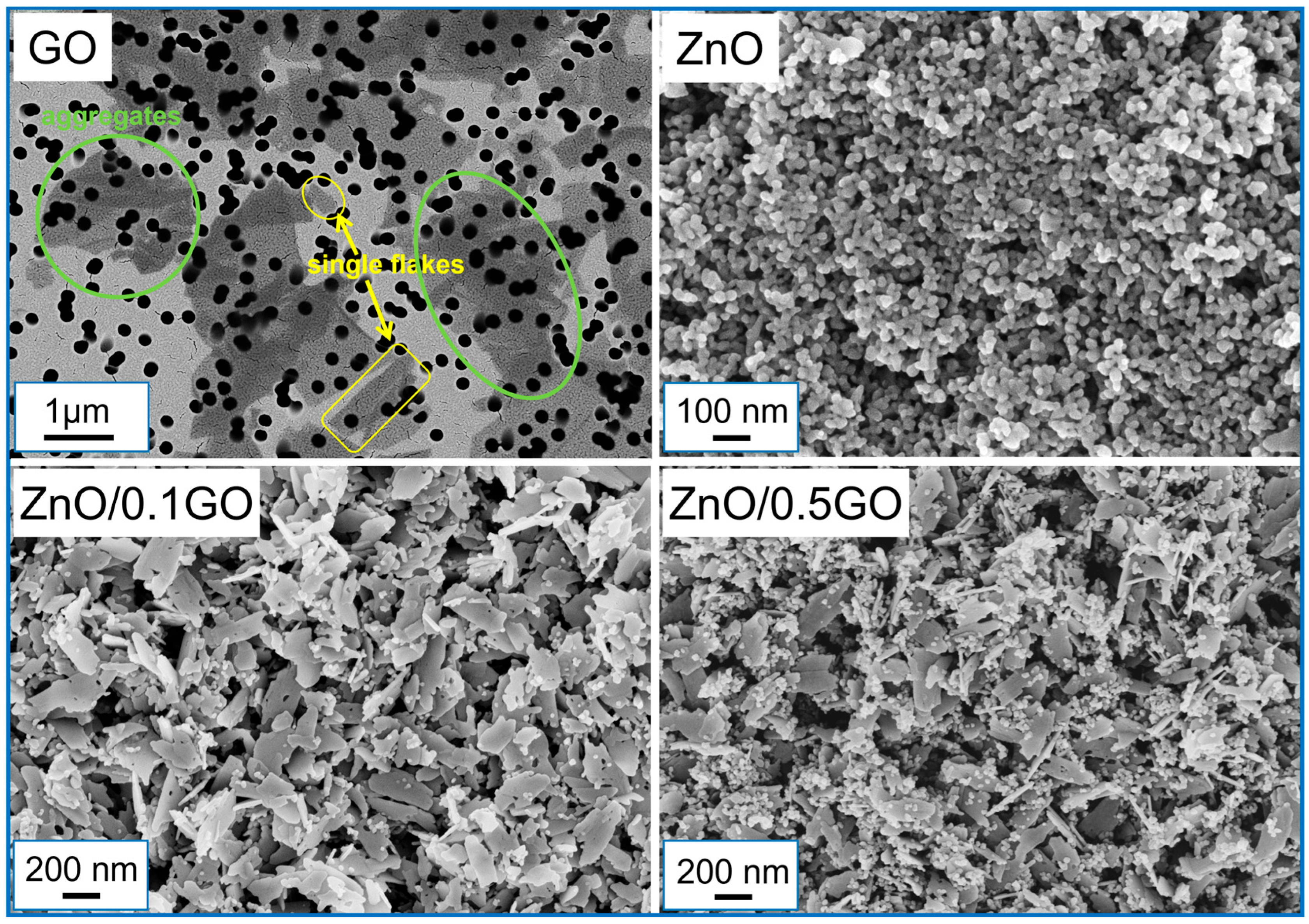
Figure 2 shows the FE-SEM micrograph of graphene oxide (GO) flakes on a filter membrane, taken at a 2.0 kV voltage. Graphene oxide flakes, prepared in our laboratory according to the previously published procedure [40], are of sizes up to approximately 1 µm. Aggregates, which can be observed on the filter membrane, are due to the filtration procedure. FE-SEM images of ZnO confirm that under the applied experimental conditions, nearly spherical, monodisperse nanostructured particles with an estimated average size of 30 nm are formed. The addition of 0.1 wt% of GO to the initial ZnCl2 reagent mixture before precipitation with NaOH resulted in the formation of platelike ZnO particles alongside nanosized, nearly spherical particles with similar morphology to those observed in the system without GO. The lateral size of the irregularly shaped platelets is estimated to be up to 500 nm, with a thickness of up to 30 nm in both samples. The estimated proportion of platelike particles in the sample containing 0.1 wt. % of GO is approximately 90%, while in the sample with 0.5 wt.% of GO the proportion of these particles is slightly lower, at approximately 80%.
FE-SEM analysis of the composite morphology confirms that even a small amount of GO, added to the initial ZnCl2 reagent solution before starting precipitation with NaOH, influences the growth of Zn(OH)2 particles on GO as seeds, which further impacts the crystallization in the MW field. Having in mind the results of the FE-SEM analysis together with XRD and UV-Vis DRS, we suppose that ZnO nanoparticles are formed on the surface of the GO sheets rather than being incorporated within the crystal lattice.
The results of BET analysis show that the addition of GO to ZnO has no influence on SSA while having a slight influence on the total pore volume, which increase from 0.298 cm3/g for ZnO via 0.348 cm3/g for ZnO/0.1GO to 0.353 cm3/g for ZnO/0.5GO, Table 1.

3.2. Photoelectrocatalytic Activity of ZnO/rxGO Particles

ZnO/rxGO modified GCEs were tested as both anode and cathode depending on the applied potential interval. The overall water splitting reaction mechanism depends on the nature of the electrolyte—whether it is acidic or alkaline—and may be expressed by two half-reactions [69]:
In acidic electrolytes:
(HER on) cathode: 4H+ + 4e ⟶ 2H2
(OER on) anode: 2H2O ⟶ O2 + 4H+ + 4e
Total: 2H2O ⟶ 2O2 + 2H2
In alkaline electrolytes:
(HER on) cathode: 4H2O + 4e ⟶ 2H2 + 4OH
(OER on) anode: 4OH ⟶ O2 + 2H2O + 4e
Total: 2H2O ⟶ 2O2 + 2H2
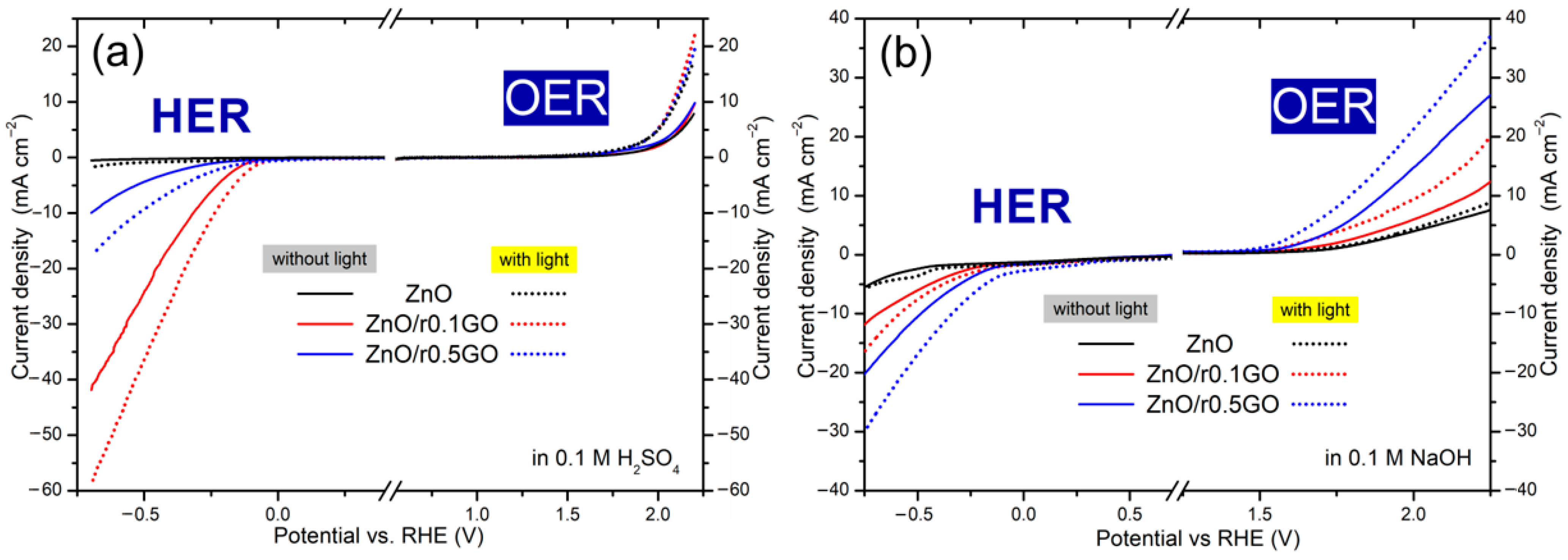
The catalytic activity of the microwave-processed ZnO/rxGO particles toward HER and OER in 0.1 M NaOH and 0.1 M H2SO4 was examined in the dark, i.e., as electrocatalysts, and under illumination, i.e., as photoelectrocatalysts, using linear sweep voltammetry (LSV), Figure 3. The representative values for OER activity, the current densities at 2.2 V vs. RHE and the onset potentials (vs. RHE) at 2 mA cm−2 are listed in Table 2. We found that in the alkaline medium, the ZnO/r0.5GO composite showed the highest current density of 37.68 mA cm−2 under illumination, compared to 26.81 mA cm−2 measured in the dark. Simultaneously, the onset potential decreased from 1.636 V to 1.561 V vs. RHE under illumination, indicating enhanced OER kinetics for ZnO/r0.5GO. The ZnO/r0.1GO composite showed somewhat lower activity, reflected in a smaller increase in current density from 11.91 to 19.98 mA cm−2 and a shift in onset potential from 1.751 to 1.63 V vs. RHE. ZnO showed the lowest PEC response, with current density increasing from 7.52 to 9.11 mA cm−2 and a minimal reduction in onset potential from 1.847 to 1.828 V vs. RHE.
In the acidic medium, all samples exhibited significantly lower OER activity compared to the alkaline solution. Specifically, higher onset potentials were observed both in the dark and under illumination, while the current densities were consistently lower. The ZnO/r0.1GO composite achieved the highest current density under illumination (21.23 mA cm−2), compared to 9.36 mA cm−2 in the dark. The onset potential decreased to 1.724 V vs. RHE under illumination, corresponding to a cathodic shift of 158 mV relative to the dark. The ZnO/r0.5GO composite showed a similar trend, with the current density approximately redoubling from 9.36 to 18.75 mA cm−2 under illumination, accompanied by a similar shift in onset potential. In contrast, ZnO showed the most significant reduction in onset potential of 190 mV, while the current density had the lowest value of all samples, both in the dark and under illumination.
The LSVs of ZnO/rxGO materials and the representative values for HER activity, the current densities at −0.8 V vs. RHE and the onset potentials (vs. RHE) at 2 mA cm−2 in acidic (H2SO4) and 3 mA cm−2 in alkaline media (NaOH), in dark conditions and under illumination, are presented in Figure 3 and Table 2.
In the acidic medium, the ZnO/r0.1GO composite shows excellent catalytic activity for HER, exhibiting the highest current density and the lowest onset potential. Precisely, the current density was 58.59 mA cm−2 V vs. RHE under illumination, compared to 41.13 mA cm−2 in the dark at the same potential. The onset potential shifted from −0.113 to −0.066 V vs. RHE, indicating improved reaction kinetics under illumination. The ZnO/r0.5GO composite showed an increase in current density from 9.96 to 17.31 mA g−1 with an onset potential shift from −0.247 to −0.113 V vs. RHE. Pure ZnO showed low current density and adverse onset potentials of −0.702 V in the dark and −0.595 V after illumination vs. RHE in acidic medium, indicating poor HER activity.
In the alkaline medium, the ZnO/r0.5GO composite achieved the highest current density of 27.17 mA cm−2 under illumination compared to 18.18 mA cm−2 in the dark, accompanied by a remarkable onset potential shift from −0.201 to −0.067 V vs. RHE. The ZnO/r0.1GO composite showed an increase in current density from 10.27 to 14.28 mA cm−2 with an onset potential shift from −0.307 to −0.241 V vs. RHE. Pure ZnO showed no photoresponse under alkaline HER conditions, maintaining the same current density of 4.32 mA cm−2 with a negligible onset potential change from −0.580 to −0.458 V vs. RHE.
In acidic medium, the HER proceeds via direct H+ reduction and primarily depends on active sites and the efficiency of electron transport. A larger particle surface of ZnO/r0.1GO, due to the platelike morphology and more developed (0001) plane, provides a larger number of active sites, which directly influences its enhanced HER performance compared to ZnO and ZnO/r0.5GO. The OER mechanism in acidic medium is a multi-step process and is more complex. Surface defects promote an earlier onset of the reaction, as observed for ZnO/r0.5GO, whereas a larger particle surface results in higher current densities once the reaction is started, as in the case of ZnO/r0.1GO.
In alkaline medium, water dissociation is the main step in both HER and OER. The presence of surface defects enhances the adsorption and activation of water molecules. Therefore, the ZnO/r0.5GO composite, characterized by the highest defect density, exhibits superior catalytic activity for both reactions in an alkaline electrolyte.
Moreover, the presence of even a small concentration of rGO in the composite significantly improves charge transfer for HER and OER in both electrolytes [70]. By providing a highly conductive network, rGO enables faster electron transport, reduces Ohmic losses, and thus enhances the overall catalytic performance of the composite materials.
Previously, it has been shown that the photoelectrocatalytic activity of ZnO for overall water splitting extensively depends on the crystallinity, crystallite size and polarity, along with the particle size [10,71,72,73]. In particular, for metal oxide-based photocatalysts, it has been verified that hexagonal platelike crystals exhibit 5-fold better photocatalytic activity than rodlike ones, where the improved activity of platelike crystals has been explained by ZnO’s crystalline structure [71,72,73]. Actually, ZnO has a Wurtzite crystalline structure with layers containing either all positive Zn2+ ions or all negative O2 ions stacked alternatively along the [0001] direction, resulting in the Zn-terminated (0001) and O-terminated (000-1) polar planes [73]. The terminal polar planes (0001) and (000-1) were reported to be much more active in photocatalysis as compared to the nonpolar facets perpendicular to them (for example 1-100, or 01-10), mainly due to a higher density of defects such as oxygen vacancies. The addition of graphene oxide significantly affects the crystallite polarity and morphology of ZnO particles prepared by the microwave processing of the precipitate.
Table 2. Current density and onset potential of ZnO/rxGO materials for HER and OER in alkaline and acidic electrolytes recorded before and after 60 min under illumination, along with literature-reported data.
MaterialsCurrent Density (mAcm−2)Onset Potential vs. RHE (V)Reference
DarkIlluminationDarkIllumination
OER in 0.1 M NaOH
ZnO7.529.111.8471.828This paper
ZnO/r0.1GO11.9119.981.7511.630
ZnO/r0.5GO26.8137.681.6361.561
2ZnO/1RuO2N/AN/A1.7371.566[13]
10ZnO@RuO2N/AN/A2.061.96[12]
OER in 0.1 M KOH
RGO-ZnON/AN/A1.614N/A[74]
ZnO@rGON/AN/A1.700N/A[75]
CuO/ZnO@rGON/AN/A1.678N/A[5]
OER in 0.5 M KOH
RGO/CuWO4/Ti3C2Tx7.08.50.50.6[76]
OER in 0.1 M H2SO4
ZnO7.6717.341.8821.692This paper
ZnO/r0.1GO9.3621.231.8821.724
ZnO/r0.5GO9.3618.751.7521.724
10ZnO@RuO22.152.01N/AN/A[12]
HER in 0.1 M NaOH
ZnO4.324.32−0.580−0.458This paper
ZnO/r0.1GO10.2714.28−0.307−0.241
ZnO/r0.5GO18.1827.17−0.201−0.067
2ZnO/1RuO2N/AN/A−0.238−0.164[13]
10ZnO@RuO2N/AN/A−0.348−0.376[12]
HER in 1 M KOH
CuO/ZnO@rGON/AN/A−0.358N/A[5]
HER in 0.5 M KOH
ZnO/rGON/AN/A−0.755N/A[77]
RGO/CuWO4/Ti3C2Tx1.72.0−0.100−0.100[76]
ZG0.51015−0.659−0.600[77]
HER in 0.1 M H2SO4
ZnO0.341.68−0.702−0.595This paper
ZnO/r0.1GO41.1358.59−0.113−0.066
ZnO/r0.5GO9.9617.31−0.247−0.113
10ZnO@RuO2N/AN/A−0.714−0.526[12]
WS2/ZnON/AN/A−0.201−0.182[78]
HER in 0.5 H2SO4
rGON/AN/A−0.1N/A[79]
Au/rGON/AN/A−0.05N/A
PtAu/rGON/AN/A−0.005N/A
RGO-ZnON/AN/A−0.348N/A[74]
For additional insight into the catalytic activity of the ZnO/rxGO materials, the overpotential at 10 mA cm−210) and the turnover frequency (TOF) were determined for HER and OER in both electrolytes under dark and illuminated conditions; the calculated η10 and TOF values are displayed in Table 3. The calculated η10 and TOF values are consistent with the trends observed for the onset potential and current density, i.e., ZnO/r0.5GO demonstrates the lowest overpotential and highest TOF for both HER and OER in alkaline medium, while ZnO/r0.1GO shows superior activity for HER in acidic medium.
For OER in both alkaline and acidic media, ZnO/r0.5GO showed the lowest overpotential among the investigated samples, with η10 values of 0.661 V and 0.572 V in the dark and under illumination in alkaline medium, and 0.972 and 0.851 V in the dark and under illumination in acidic medium, respectively. Bare ZnO did not reach the current density of 10 mA cm−2 within the investigated potential window in either medium in the dark and under illumination in alkaline medium, while ZnO/rGO_0.1 did not reach this value in acidic medium in the dark, indicating poor OER activity under these conditions. ZnO and ZnO/r0.1GO showed η10 values of 0.862 V under illumination in acidic medium, similar to ZnO/r0.5GO. The TOF values increased in the order ZnO < ZnO/r0.1GO < ZnO/r0.5GO under both conditions in alkaline medium, with ZnO/r0.5GO achieving the highest values of 28.82 and 51.74 s−1 in the dark and under illumination, respectively. The TOF values were significantly lower for all samples in acidic medium compared to alkaline, consistent with the overpotential, onset potential, and current density values obtained for OER under these conditions.
For HER in alkaline medium, ZnO/r0.5GO exhibited the lowest overpotential and the highest TOF among the investigated samples, with η10 values of −0.478 and −0.333 V, and TOF of 53.81 and 95.52 s−1 in the dark and under illumination, respectively. ZnO/r0.1GO showed η10 of −0.685 and −0.585 V, and TOF of 40.45 and 49.71 s−1 in the dark and under illumination, respectively, while pure ZnO did not achieve 10 mA cm−2 in alkaline medium. In acidic medium, ZnO/r0.1GO showed the lowest overpotential with η10 of −0.315 and −0.230 V, and the highest TOF of 106.62 and 186.85 s−1 in the dark and under illumination, respectively, significantly exceeding those of ZnO/r0.5GO (13.38 and 35.45 s−1) and bare ZnO (0.14 and 9.13 s−1). The same trend was observed upon comparison of the onset potential and current density values.

3.3. Electroanalytical Measurements of Microwave-Processed ZnO/rxGO Particles

3.3.1. Determination of EASA and k0

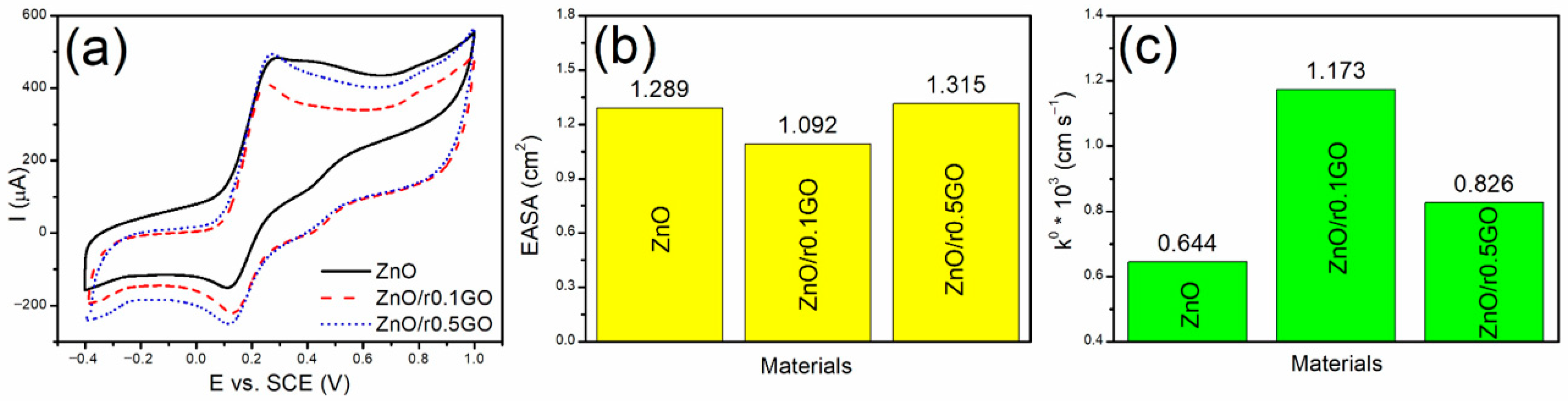
Figure 4a shows CVs of GCEs modified with ZnO/rxGO materials, recorded in 5 mM K4[Fe(CN)6] with 0.1 M KCl as the supporting electrolyte. Based on these measurements, two important electrochemical parameters—EASA (Figure 4b) and k0 (Figure 4c)—were estimated for all three investigated materials. EASA values decrease in the following order: ZnO/r0.5GO (1.315 cm2) > ZnO (1.289 cm2) > ZnO/r0.1GO (1.092 cm2). The k0 values indicate that the addition of GO to ZnO increases the heterogenous electron transfer rate constant of ZnO/r0.5GO (0.826·10−3 cm s−1) and ZnO/r0.1GO (1.173·10−3 cm s−1) for 28 and 82%, respectively, compared to ZnO (0.644·10−3 cm s−1). Overall, the improved k0 values suggest enhanced charge transfer kinetics for the ZnO/rxGO composites compared to pure ZnO.

3.3.2. Electroanalytical Measurements

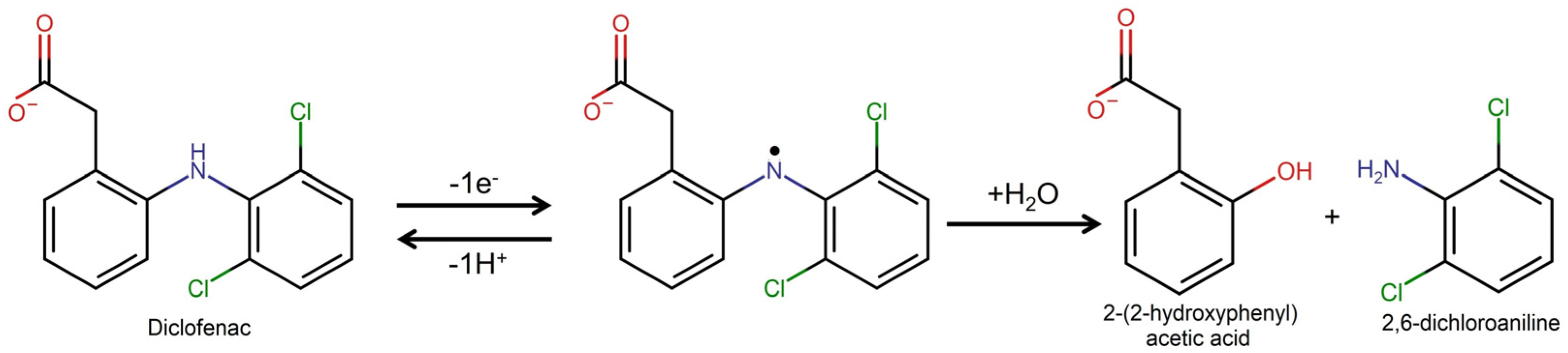
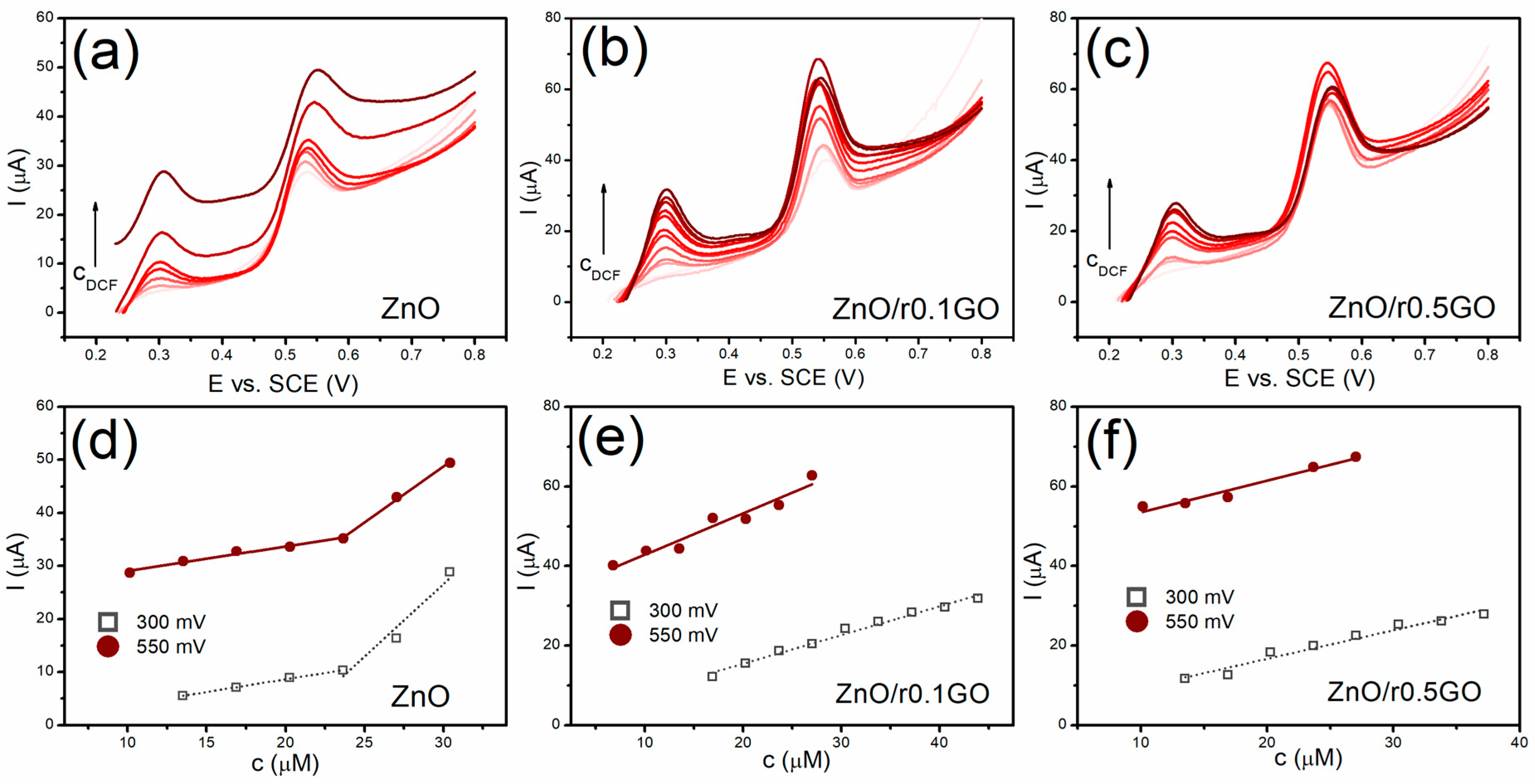
Figure 5 presents the electrochemical response of the investigated materials for different diclofenac concentrations. As shown in Figure 5a–c, two well-defined characteristic anodic peaks were observed. The anodic peak located at around 550 mV vs. SCE is assigned to the direct electrochemical oxidation of diclofenac, and the products obtained are 2,6-dichloroaniline and 2-(2-hydroxyphenyl) acetic acid. The second anodic peak, appearing at approximately 300 mV vs. SCE, is attributed to the oxidation of 1-hydroxy-2-(hydroxyphenyl)ethanolate, a product of the electrochemical transformation of diclofenac [80]. This oxidation process of diclofenac is shown in Scheme 1. In accordance with the literature reports, diclofenac can therefore be determined both directly and indirectly through the anodic peaks at 550 mV and 300 mV, respectively [81].
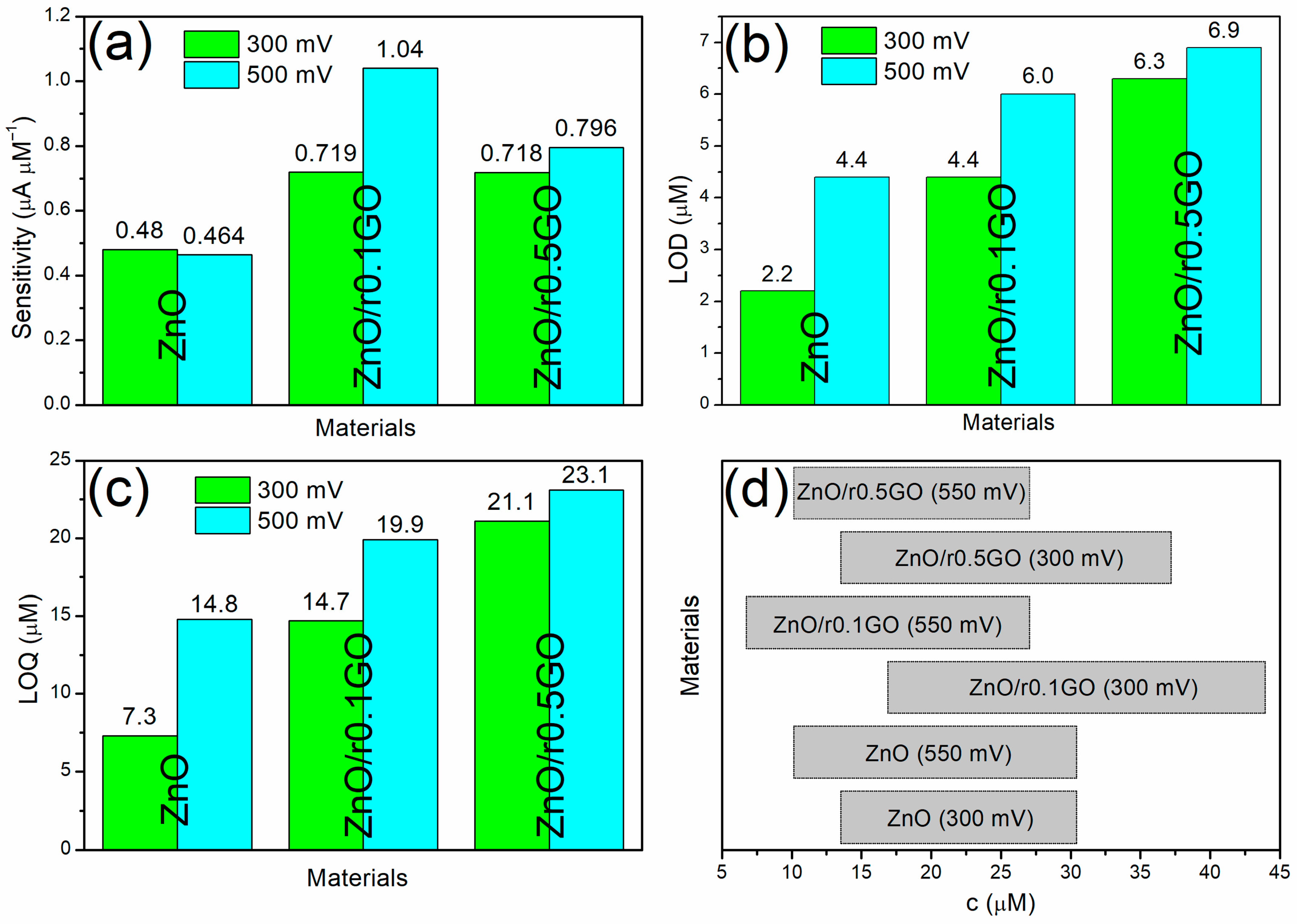
Based on the anodic peak current responses obtained by LSV, calibration curves were constructed for both direct and indirect determination of diclofenac. The corresponding calibration plots for each investigated material are presented in Figure 5d–f, while the calculated relevant statistical and electroanalytical parameters are summarized in Figure 6 and Table 4. ZnO displays two linear fitting ranges for diclofenac detection, whereas ZnO/rGO composites exhibit a single linear region described by one calibration line, for both direct and indirect approaches. ZnO exhibited the closest agreement with the linear fit showing the correlation coefficient (R2) of 0.998 for the second calibration line at 550 mV. The lowest R2 value observed is 0.944 (ZnO/r0.1GO at 550 mV), indicating strong agreement for all measurements.
As presented in Table 4, pure ZnO showed the highest sensitivities for diclofenac detection, reaching 2.728 µAµM−1 (300 mV) and 2.108 µAµM−1 (550 mV); however, these enhanced sensitivities are achieved only within very narrow concentration intervals defined by the second linear regions. In contrast, ZnO/rGO composites display moderate but uniform sensitivities described by a single calibration line, with ZnO/r0.1GO showing the highest sensitivity among the composites (1.040 µAµM−1 at 550 mV) (Figure 6a). Lochab et al. investigated an indium tin oxide electrode with asparagine-functionalized multi-walled carbon nanotubes and ionic liquid (Asp-MWCNTs/IL/ITO) for electrochemical detection of diclofenac in neutral media by the CV method [82]. All tested ZnO/rxGO materials showed comparable or higher sensitivity values than those reported for Asp-MWCNTs/IL/ITO (0.4657 µAµM−1) and significantly higher than was found for glassy carbon electrodes modified with copper nanoparticles and reduced graphene oxide (Cu NPs/rGO/GCE) by the amperometry method in 0.1 M Na2SO4 (pH = 7.0) proposed by Yu et al. (0.0356 µAµM−1) [83] (Table 4). The lowest LOD/LOQ values (Figure 6b,c) were obtained for ZnO, 2.2/7.3 µM at 300 mV and 4.4/14.8 µM (at 550 mV), followed by ZnO/r0.1GO which showed values of 4.4/14.7 µM with detection at 300 mV. ZnO/rGO composites exhibit slightly higher but comparable detection and quantification limits. Additionally, it should be noted that for the same material, lower LOD/LOQ values are obtained for indirect determination at 300 mV. Comparison with the literature data (Table 4) reveals that previously reported studies typically exhibit comparable or lower detection limits than those obtained in this study. In contrast to pure ZnO, which shows narrow and separated dynamic ranges, ZnO/rGO composites offer a single, broader dynamic range, making them more suitable for practical sensing applications. The widest dynamic range of 16.9–43.9 µM is obtained for the ZnO/r0.1GO composite at 300 mV (Figure 6d). Aidli et al. proposed an electrochemical sensor that features a benzoquinone-modified vertically aligned mesoporous silica film on a carbon screen-printed electrode (BQ/VMSF/aSPCE) for diclofenac detection in neutral phosphate buffer by the DPV method [84]. BQ/VMSF/aSPCE, as well as the aforementioned Asp-MWCNTs/IL/ITO, exhibited narrower linearity ranges (1–10 µM and 0.0675–0.54 µM, respectively) than presented herein, while oxygen plasma-treated ZnO nanoflowers on a screen-printed electrode proposed in the work of Zhang et al. [29] showed a linearity region as wide as 0.01–40 µM (Table 4). These findings indicate that the ZnO/r0.1GO composite demonstrates the most balanced electroanalytical performance for diclofenac detection, offering an extended dynamic range while still preserving sufficiently low LOD at 300 mV. The superior sensing behavior of ZnO/r0.1GO compared to ZnO and ZnO/r0.5GO correlates with its highest k0 value and relatively high EASA, indicating that the synergistic interaction between ZnO and rGO facilitates more efficient electron transfer, as well as promoting an active surface of the electrochemical sensor.
Table 4. Statistical and electroanalytical parameters for diclofenac detection obtained for ZnO/rxGO, along with literature-reported materials.
ElectrodeMethodPeak Potential (mV)R2Sensitivity (µAµM−1)LOD
(µM)
LOQ (µM)Dynamic Range (µM)References
Electrolyte 0.1 M phosphate buffer (pH = 7.0)
ZnOLSV300
(first line)
0.9970.4802.2
(0.6 ppm)
7.3
(2.2 ppm)
13.5–30.4This paper
300
(second line)
0.9612.728//
550
(first line)
0.9790.4644.4
(1.3 ppm)
14.8
(4.4 ppm)
10.1–30.4
550
(second line)
0.9982.108//
ZnO/r0.1GOLSV3000.9850.7194.4
(1.3 ppm)
14.7
(4.4 ppm)
16.9–43.9This paper
5500.9441.0406.0
(1.8 ppm)
19.9
(5.9 ppm)
6.8–27.0
ZnO/r0.5GOLSV3000.9630.7186.3
(1.9 ppm)
21.1
(6.2 ppm)
13.5–37.2This paper
5500.9590.7966.9
(2.0 ppm)
23.1
(6.8 ppm)
10.1–27.0
BQ/VMSF/aSPCEDPV/0.996/0.73/1–10[84]
Asp-MWCNTs/IL/ITOCV/0.98850.46570.0094/0.0675–0.54[82]
Gd2O3/GrapheneDPV///0.0280.0865.89–66.7[85]
Electrolyte 0.1 M Na2SO4 (pH = 7.0)
Cu NPs/rGO/GCEA*//0.03560.008/20–400[83]
A*—amperometry.

3.4. DFT Calculations

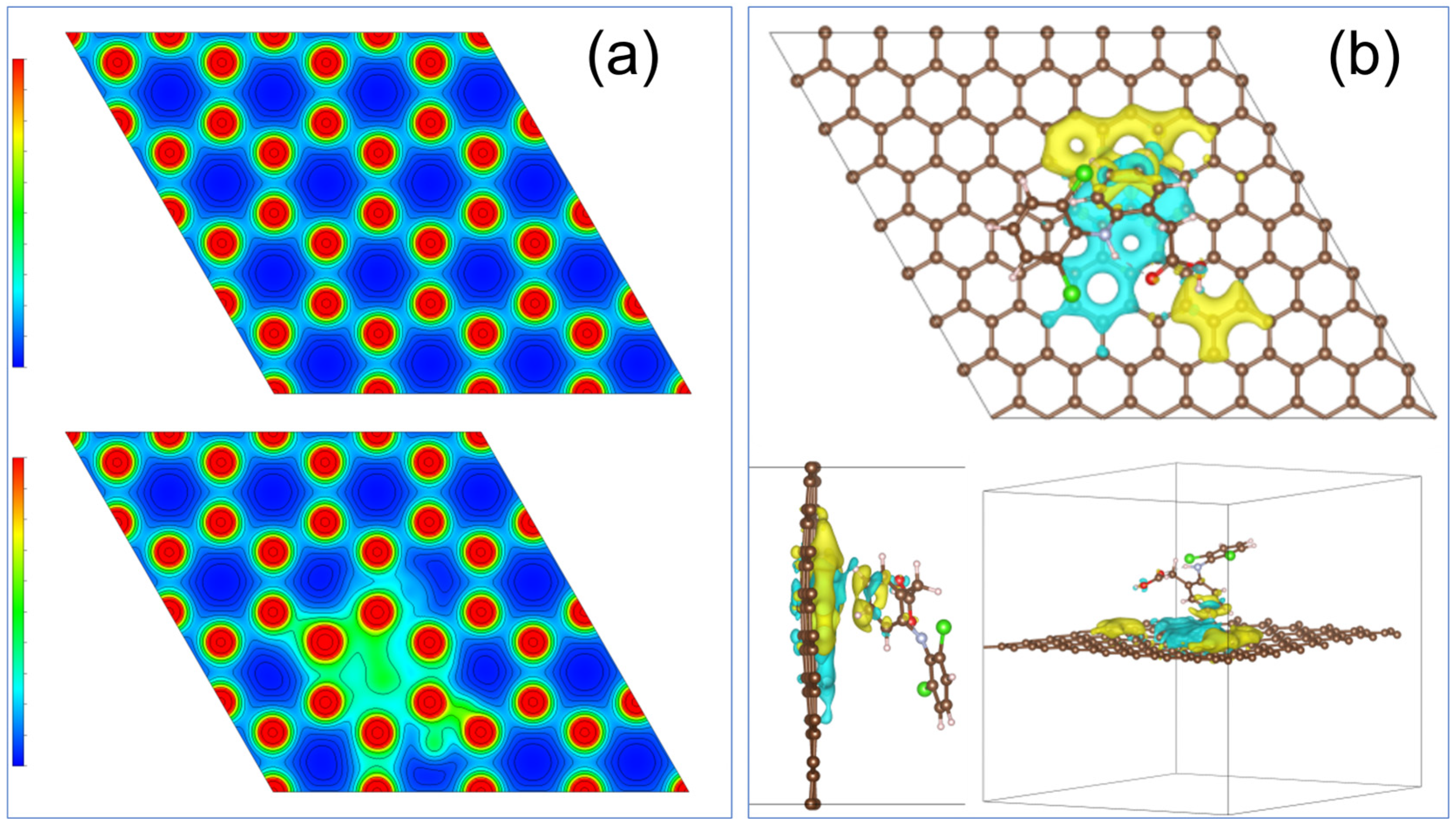
Initially, the diclofenac molecule was bonded on the (000-1) ZnO surface via a hydrogen atom from the 2,6-dichlorophenyl ring, but after the relaxation, the molecule was slightly shifted and relaxed in the vicinity of the surface. This resulted in interatomic H-O distances between hydrogen ions from the molecule and oxygen ions from the surface of 2.18 and 2.21 Å, respectively. Bond orders and charge overlap analyses by the DDEC6 method [56] shows that these bonds have orders of 0.382 and 0.336 while mutual overlaps cover 0.335 and 0.312 e. According to the Bader analysis, zinc ions in the highest Zn-layer of the (000-1) ZnO surface mainly lose an average of 0.02 to 0.06 e while oxygen ions from the highest O-layer received more electrons on average, mostly from 0.07 to 0.15 e in interaction with the molecule relative to the e transfer on the pure (000-1) ZnO’s surface, Figure 7a.
After the relaxation of the system consisted of a diclofenac molecule and reduced graphene, the distances between the hydrogen ions (H) in the phenyl ring of the diclofenac molecule and the nearest carbon (C) atoms in the graphene slab are 2.76, 2.87, and 2.97 Å. These increased distances are partly due to a descent of the carbon atoms under the molecule from the initial plane up to 0.55 Å as a consequence of the interaction between the diclofenac molecule and the graphene. The DDEC6 analysis shows that the mentioned C-H bonds have bond orders of 0.023, 0.047, and 0.045 overlapping up to 0.038 e. The results obtained by the DDEC6 calculation suggest that the possibility of the diclofenac molecule chemically bonding to the graphene slab is negligible.
The carbon atoms under the molecule lose up to 0.09 e. The electric dipole moment of the molecule calculated relative to the molecule mass center has a direction almost parallel with the x–y plane (theta = 89.93 degrees), and an azimuth angle phi = −54.75 degrees. This direction matches the negative–positive charge areas of graphene (see Figure 7b). Such a position of the molecule relative to the surface may indicate the existence of long-range electromagnetic interactions that hold the molecule near the graphene slab.
In this case the calculated adsorption binding energy of the diclofenac–graphene complex is +0.092 eV whereas for the diclofenac-(000-1) ZnO it is −3.60 eV. Results of the DFT calculations show that diclofenac exhibits a weak chemical interaction/chemisorption with the (000-1) ZnO surface, while it does not bond to the graphene layer. This result suggests that in the composite, ZnO contributes to the binding with the pollutant molecule, while the reduced graphene oxide predominantly affects the charge redistribution and electron mobility.
Results of the ab initio calculations support experimental results which we presented in this paper and our conclusion that the improved electrochemical activity of ZnO/xGO compared with bare ZnO is due to platelike particles consisting of well-developed crystallites with a displayed (000-1) surface.

4. Conclusions

We established that a relatively small amount of GO used as seeds for precipitation of Zn(OH)2 influenced crystallite growth and polarity in spite of the short period of microwave irradiation. The presented results show that the addition of GO to ZnO influences the crystal structure ordering, particle morphology, the amount of surface and bulk defects and visible light absorption capacity. The synergy of these properties significantly enhanced the electrochemical properties of ZnO/rxGO particles.
We reveal that in alkaline medium, the ZnO/r0.5GO composite exhibits the highest catalytic activity for HER and OER in the dark as well as under illumination. Precisely, with ZnO/r0.5GO as the photoelectrocatalyst under illumination, the current density attained was 37.68 mA cm−2 and the onset potential was 1.561 V vs. RHE for OER, and the current density was 27.17 mA cm−2 and the onset potential was −0.067 V vs. RHE for HER. In acidic medium, all samples exhibited similar activity for OER but ZnO/r0.1GO composite demonstrated the highest activity for HER in the dark and under illumination; i.e., under illumination the current density attained was 58.59 mA cm−2 V vs. RHE and the onset potential was −0.066 V vs. RHE.
Due to having the fastest charge transfer rate (k0 = 1.173 × 10⁻³ cm s−1) and favorable electrochemically active surface area, the composite exhibited the best analytical performance as the electrochemical sensor for diclofenac in a neutral environment. ZnO/r0.1GO showed the broadest dynamic range of 16.9–43.9 µM at 300 mV and a sufficiently low LOD of 4.4 µM.
This study demonstrates that the addition of small amounts of GO to ZnO represents an effective strategy for tailoring the surface properties and charge transfer characteristics of the ZnO/xGO composites, enabling their application as a multifunctional material for photoelectrocatalytic water splitting and electrochemical detection of diclofenac as a water pollutant. The results highlight the importance of rGO content as a key parameter in controlling the balance between surface area and defect density, which is significant for specific applications such as water splitting or the detection of pollutants.

Author Contributions

A.N.: investigation, methodology, and writing—reviewing and editing; M.K.: investigation; K.A.: investigation, methodology, and writing—reviewing and editing; A.S.: investigation; L.V.: investigation; S.Š.: investigation and writing—reviewing and editing; M.K.R.: investigation; V.N.I.: investigation and writing—original draft; J.B.-Č.: investigation and writing—original draft; A.U.: investigation; I.S.S.: conceptualization, methodology, investigation, writing—reviewing and editing, and supervision; S.M.: conceptualization, methodology, investigation, writing—reviewing and editing, and supervision. All authors have read and agreed to the published version of the manuscript.

Funding

This research was supported by the Science Fund of the Republic of Serbia (The Program PRISMA, #7377, Water pollutants detection by ZnO-modified electrochemical sensors: From computational modeling via electrochemical testing to real system application—WaPoDe) and by the Ministry of Science, Technological Development and Innovation of the Republic of Serbia (Contract Nos. 451-03-33/2026-03/200175, 451-03-34/2026-03/200146, and 451-03-33/2026-03/200017).

Data Availability Statement

The data presented in this study are available on request from the corresponding author. The data supporting the findings of this study will be deposited in the repository of the Institute of Technical Sciences of SASA following publication.

Acknowledgments

This paper is dedicated to our colleague Vasil Koteski who suddenly passed away in November 2025. Koteski was the WaPoDe project team member and his results on DFT calculations are included in this paper.

Conflicts of Interest

The authors declare no conflicts of interest.

References

  1. Badoni, A.; Thakur, S.; Vijayan, N.; Swart, H.C.; Bechelany, M.; Chen, Z.; Sun, S.; Cai, Q.; Chen, Y.; Prakash, J. Recent Progress in Understanding the Role of Graphene Oxide, TiO2 and Graphene Oxide-TiO2 Nanocomposites as Multidisciplinary Photocatalysts in Energy and Environmental Applications. Catal. Sci. Technol. 2025, 15, 1702–1770. [Google Scholar] [CrossRef]
  2. Kumar, K.R.; Sri, N.D.; Kale, V.N.; Maiyalagan, T. Surface Reconstruction of Mo-Doped NiFe-LDH Nanosheets Decorated on Nitrogen and Sulfur Dual-Doped Reduced Graphene Oxide as a Bifunctional Electrocatalyst for Overall Water Splitting. Int. J. Hydrogen Energy 2025, 101, 837–847. [Google Scholar] [CrossRef]
  3. Pasindu, V.; Yapa, P.; Dabare, S.; Munaweera, I. Multifunctional Transition Metal Oxide/Graphene Oxide Nanocomposites for Catalytic Dye Degradation, Renewable Energy, and Energy Storage Applications. RSC Adv. 2025, 15, 33162–33186. [Google Scholar] [CrossRef]
  4. Nastasić, A.; Radinović, K.; Rakočević, L.; Stojadinović, S.; Stanković, D.; Šljukić, B.; Milikić, J. Efficient Cobalt-Based Bimetallic Nanocatalysts with Iron, Manganese, Molybdenum, and Nickel on Reduced Graphene Oxide for Oxygen Evolution Reaction. J. Power Sources 2026, 666, 239116. [Google Scholar] [CrossRef]
  5. Younas, U.; Mobeen, F.; Saleem, A.; Ali, F.; Al Huwayz, M.; Ashraf, A.; Ahmad, A.; Alwadai, N.; Pervaiz, M.; Iqbal, M. Efficient Hydrogen Production via Overall Water Splitting Using CuO/ZnO Decorated Reduced Graphene Oxide as Bifunctional Electrocatalyst. Ceram. Int. 2024, 50, 30570–30578. [Google Scholar] [CrossRef]
  6. Al Mahmud, A.; Thalji, M.R.; Dhakal, G.; Haldorai, Y.; Kim, W.K.; Shim, J.J. Bifunctional MoC/NiC@N-Doped Reduced Graphene Oxide Nano Electrocatalyst for Simultaneous Production of Hydrogen and Oxygen through Efficient Overall Electrochemical Water Splitting. Mater. Today Nano 2024, 27, 100489. [Google Scholar] [CrossRef]
  7. Marlinda, A.R.; Yusoff, N.; Sagadevan, S.; Johan, M.R. Recent Developments in Reduced Graphene Oxide Nanocomposites for Photoelectrochemical Water-Splitting Applications. Int. J. Hydrogen Energy 2020, 45, 11976–11994. [Google Scholar] [CrossRef]
  8. Yeh, T.F.; Cihlář, J.; Chang, C.Y.; Cheng, C.; Teng, H. Roles of Graphene Oxide in Photocatalytic Water Splitting. Mater. Today 2013, 16, 78–84. [Google Scholar] [CrossRef]
  9. Saleem, Z.; Pervaiz, E.; Yousaf, M.U.; Niazi, M.B.K. Two-Dimensional Materials and Composites as Potential Water Splitting Photocatalysts: A Review. Catalysts 2020, 10, 464. [Google Scholar] [CrossRef]
  10. Marković, S.; Stojković Simatović, I.; Ahmetović, S.; Veselinović, L.; Stojadinović, S.; Rac, V.; Škapin, S.D.; Bajuk Bogdanović, D.; Janković Častvan, I.; Uskoković, D. Surfactant-Assisted Microwave Processing of ZnO Particles: A Simple Way for Designing the Surface-to-Bulk Defect Ratio and Improving Photo(Electro)Catalytic Properties. RSC Adv. 2019, 9, 17165–17178. [Google Scholar] [CrossRef]
  11. Rajić, V.; Stojković Simatović, I.; Veselinović, L.; Čavor, J.B.; Novaković, M.; Popović, M.; Škapin, S.D.; Mojović, M.; Stojadinović, S.; Rac, V.; et al. Bifunctional Catalytic Activity of Zn1−xFexO toward the OER/ORR: Seeking an Optimal Stoichiometry. Phys. Chem. Chem. Phys. 2020, 22, 22078–22095. [Google Scholar] [CrossRef]
  12. Aleksić, K.; Stojković Simatović, I.; Stanković, A.; Veselinović, L.; Stojadinović, S.; Rac, V.; Radmilović, N.; Rajić, V.; Škapin, S.D.; Mančić, L.; et al. Enhancement of ZnO@RuO2 Bifunctional Photo-Electro Catalytic Activity toward Water Splitting. Front. Chem. 2023, 11, 1173910. [Google Scholar] [CrossRef]
  13. Aleksić, K.; Stojković Simatović, I.; Popović, M.; Belošević-Čavor, J.N.; Mančić, L.; Marković, S. Photoelectrocatalytic Activity of ZnO/RuO2 Composites Toward HER and OER Reactions: The Importance of Surface and Bulk Oxygen Vacancies. Processes 2025, 13, 2943. [Google Scholar] [CrossRef]
  14. Bounegru, A.V.; Dinu Iacob, A.; Iticescu, C.; Georgescu, P.L. Electrochemical Sensors and Biosensors for the Detection of Pharmaceutical Contaminants in Natural Waters—A Comprehensive Review. Chemosensors 2025, 13, 65. [Google Scholar] [CrossRef]
  15. Guo, H.; Fan, X.; Chen, J.; Lv, M.; Li, L.; Guo, H.; Ma, M. A synergistic interfacial engineering of NH2-MIL-125(Ti)/Ti3C2Tx heterojunction for sensing methyl parathion. Microchem. J. 2026, 221, 116985. [Google Scholar] [CrossRef]
  16. Li, J.; Li, L.; Fei, J.; Zhao, P.; Zhao, J.; Xie, Y. Ultrasensitive electrochemical sensor for fenitrothion based on MIL-125 derived iron/titanium bimetallic oxides doped porous carbon composite. Microchem. J. 2024, 200, 110426. [Google Scholar] [CrossRef]
  17. Dube, A.; Malode, S.J.; Alshehri, M.A.; Shetti, N.P. Recent advances in the development of electrochemical sensors for detecting pesticides. J. Ind. Eng. Chem. 2025, 144, 77–99. [Google Scholar] [CrossRef]
  18. Gavran, A.; Uskoković-Marković, S.; Nedić Vasiljević, B.; Janošević Ležaić, A.; Gavrilov, N.; Milojević-Rakić, M.; Bajuk-Bogdanović, D. Tracking PFAS Using Nanomaterial-Based Sensors: Limitations, Advances, and Challenges. Chemosensors 2025, 13, 421. [Google Scholar] [CrossRef]
  19. Lee, A.; Orr, R.; Sanchez-Almirola, J.; Casals-Terré, J.; Kaushik, A. Can Smart Electrochemical Sensors Sustainably Tackle PFAS-@Microplastics? ECS Sens. Plus 2025, 4, 033402. [Google Scholar] [CrossRef]
  20. Khadka, M.; Pasternak, Y.M.; Sheinenzon, O.; Snezhko, A.; Ronen, A.; Amiram, M.; Ben-Yoav, H. Detection of perfluorooctance sulphonic acid in groundwater using an intelligent array of electrochemical sensors. J. Hazard. Mater. 2025, 495, 138844. [Google Scholar] [CrossRef]
  21. Wu, J.; Yue, X.; Wang, T.; Zhang, Y.; Jin, Y.; Li, G. A cost-effective and sensitive voltammetric sensor for determination of baicalein in herbal medicine based on shuttle-shape α-Fe2O3 nanoparticle decorated multi-walled carbon nanotubes. Colloids Surf. A Physicochem. Eng. Asp. 2025, 717, 136850. [Google Scholar] [CrossRef]
  22. Radinović, K.; Milikić, J.; Gavrilov, N.; Stanković, D.; Basak, A.; Metin, Ö.; Šljukić, B. Facile synthesis of Co/rGO, Au/rGO, and CoAu/rGO Nanocomposites for Precise Determination of Arsenic(III) in Water Systems. Electrochim. Acta 2024, 507, 145147. [Google Scholar] [CrossRef]
  23. Saisree, S.; Arya, S.; Nair, E.D.; Sandhya, K.Y. Electrochemical sensors for monitoring water quality: Recent advances in graphene quantum dot-based materials for the detection of toxic heavy metal ions Cd(II), Pb(II) and Hg(II) with their mechanistic aspects. J. Environ. Chem. Eng. 2025, 13, 116545. [Google Scholar] [CrossRef]
  24. Zhang, Z.; Liu, H.; Wang, Z.; Majdi, A.; Wang, G.; Salameh, A.A.; AL-Huqail, A.A.; Elhosiny Ali, H. Electrochemical monitoring sensors of water pollution systems. Food Chem. Toxicol. 2022, 166, 113196. [Google Scholar] [CrossRef]
  25. Nakhjavani, S.A.; Mirzajani, H.; Carrara, S.; Onbaşlı, M.C. Advances in biosensor technologies for infectious diseases detection. Trends Anal. Chem. 2024, 180, 117979. [Google Scholar] [CrossRef]
  26. Sajjan, A.C.; Jha, H.; Borulkar, T.; Regalla, S.; Yadav, R. Systematic Review: Biosensors for Early Detection of Infectious Diseases. J. Contemp. Clin. Pract. 2025, 11, 195–202. [Google Scholar] [CrossRef]
  27. Noreen, S.; Ishaq, I.; Saleem, M.H.; Muhammad Ali, S.; Iqbal, J. Electrochemical biosensing in oncology: A review advancements and prospects for cancer diagnosis. Cancer Biol. Ther. 2025, 26, 2475581. [Google Scholar] [CrossRef]
  28. Minta, D.; González, Z.; Menéndez, R.; Gryglewicz, G. Metal-Free Thermally Reduced Graphene Oxide Modified Glassy Carbon Electrode as an Effective Diclofenac Sensor. Carbon 2026, 247, 120987. [Google Scholar] [CrossRef]
  29. Zhang, C.; Cao, Z.; Zhang, G.; Yan, Y.; Yang, X.; Chang, J.; Song, Y.; Jia, Y.; Pan, P.; Mi, W.; et al. An electrochemical sensor based on plasma-treated zinc oxide nanoflowers for the simultaneous detection of dopamine and diclofenac sodium. Microchem. J. 2020, 158, 105237. [Google Scholar] [CrossRef]
  30. Boumya, W.; Taoufik, N.; Achak, M.; Bessbousse, H.; Elhalil, A.; Barka, N. Electrochemical sensors and biosensors for the determination of diclofenac in pharmaceutical, biological and water samples. Talanta Open 2021, 3, 100026. [Google Scholar] [CrossRef]
  31. Kachere, A.R.; Kakade, P.M.; Kanwade, A.R.; Dani, P.; Mandlik, N.T.; Rondiya, S.R.; Dzade, N.Y.; Jadkar, S.R.; Bhosale, S.V. Zinc Oxide/Graphene Oxide Nanocomposites: Synthesis, Characterization and Their Optical Properties. ES Mater. Manuf. 2022, 16, 19–29. [Google Scholar] [CrossRef]
  32. Alkhuzai, K.A.; Ahmed, A.T.; Ridha, M.; Hannah Jessie Rani, R.; Dash, B.; Al-Hetty, H.R.A.K.; Dariyabi, S.; Vashisht, A.; Hamoodah, Z.J.; Saadi, B.M. Metal Oxides in Drug Detection: Material Innovations in Electrochemical Sensor Development. J. Chin. Chem. Soc. 2025, 72, 1449–1476. [Google Scholar] [CrossRef]
  33. Jiříčková, A.; Jankovský, O.; Sofer, Z.; Sedmidubský, D. Synthesis and Applications of Graphene Oxide. Materials 2022, 15, 920. [Google Scholar] [CrossRef]
  34. Măghinici, A.R.; Bounegru, A.V.; Apetrei, C. Electrochemical Detection of Diclofenac Using a Screen-Printed Electrode Modified with Graphene Oxide and Phenanthroline. Chemosensors 2025, 13, 55. [Google Scholar] [CrossRef]
  35. Kumar, V.; Singh, A.K.; Tiwari, I.; Mishra, L. Novel BN-COOH@ZrO2/GO Composite for Enhanced Electrical Conductivity and Electrochemical Detection of Diclofenac. ACS Omega 2025, 10, 1373–1387. [Google Scholar] [CrossRef]
  36. Alamro, F.S.; Medany, S.S.; Al-Kadhi, N.S.; Ahmed, H.A.; Hefnawy, M.A. Modified NiFe2O4-Supported Graphene Oxide for Effective Urea Electrochemical Oxidation and Water Splitting Applications. Molecules 2024, 29, 1215. [Google Scholar] [CrossRef]
  37. Chatterjee, S.G.; Chatterjee, S.; Ray, A.K.; Chakraborty, A.K. Graphene–metal oxide nanohybrids for toxic gas sensor: A review. Sens. Actuators B Chem. 2015, 221, 1170–1181. [Google Scholar] [CrossRef]
  38. Liu, X.; Liu, W.; Ko, M.; Park, M.; Kim, M.G.; Oh, P.; Chae, S.; Park, S.; Casimir, A.; Wu, G.; et al. Metal (Ni, Co)-Metal Oxides/Graphene Nanocomposites as Multifunctional Electrocatalysts. Adv. Funct. Mater. 2015, 25, 5799–5808. [Google Scholar] [CrossRef]
  39. Khan, M.; Tahir, M.N.; Adil, S.F.; Khan, H.U.; Siddiqui, M.R.H.; Al-warthan, A.A.; Tremel, W. Graphene based metal and metal oxide nanocomposites: Synthesis, properties and their applications. J. Mater. Chem. A 2015, 3, 18753–18808. [Google Scholar] [CrossRef]
  40. Radić, G.; Šajnović, I.; Petrović, Ž.; Roković, M.K. Reduced Graphene Oxide/α-Fe2O3 Fibres as Active Material for Supercapacitor Application. Croat. Chem. Acta 2018, 91, 481–490. [Google Scholar] [CrossRef]
  41. Putz, H.; Brandenburg, K. Match!—Phase Analysis Using Powder Diffraction. Cryst. Impact GbR Kreuzherrenstr 2023, 102, 53227. [Google Scholar]
  42. Crystallography Open Database. Open-Access Collection of Crystal Structures of Organic, Inorganic, Metal-Organic Compounds and Minerals, Excluding Biopolymers. Available online: http://www.crystallography.net/cod/ (accessed on 17 August 2024).
  43. McCusker, B.L.; Dreele, R.B.; Cox, D.E.; Louer, D.; Scardi, P.J. Rietveld refinement guidelines. J. Appl. Crystallogr. 1999, 32, 36–50. [Google Scholar] [CrossRef]
  44. Rodrigez-Carvajal, J. FULLPROF: A Program for Rietveld Refinement and Pattern Matching Analysis; Abstracts of the Satellite Meeting on Powder Diffraction of the XV Congress of the IUCr; ILL Neutrons for Society: Toulouse, France, 1990; p. 127. [Google Scholar]
  45. Bard, A.J.; Faulkner, L.R. Electrochemical Methods: Fundamentals and Applications, 2nd ed.; Wiley: Hoboken, NJ, USA, 2001. [Google Scholar]
  46. de Carvalho, R.C.; Betts, A.J.; Cassidy, J.F. Diclofenac Determination Using CeO2 Nanoparticle Modified Screen-Printed Electrodes—A Study of Background Correction. Microchem. J. 2020, 158, 105258. [Google Scholar] [CrossRef]
  47. Anantharaj, S.; Kundu, S. Do the Evaluation Parameters Reflect Intrinsic Activity of Electrocatalysts in Electrochemical Water Splitting? ACS Energy Lett. 2019, 4, 1260–1264. [Google Scholar] [CrossRef]
  48. Wu, C.; Tang, Y.; Zou, A.; Li, J.; Meng, H.; Gao, F.; Wu, J.; Wang, X. Recommended electrochemical measurement protocol for oxygen evolution reaction. DeCarbon 2025, 8, 100108. [Google Scholar] [CrossRef]
  49. Wachs, I.E. Number of surface sites and turnover frequencies for oxide catalysts. J. Catal. 2022, 405, 462–472. [Google Scholar] [CrossRef]
  50. Benedito Da Silva, O.; MacHado, S.A.S. Evaluation of the Detection and Quantification Limits in Electroanalysis Using Two Popular Methods: Application in the Case Study of Paraquat Determination. Anal. Methods 2012, 4, 2348–2354. [Google Scholar] [CrossRef]
  51. Kresse, G.; Furthmuller, J. Efficient Iterative Schemes for Ab Initio Total-Energy Calculations Using a Plane-Wave Basis Set. Phys. Rev. B 1996, 54, 11169. [Google Scholar] [CrossRef]
  52. Joubert, D. From Ultrasoft Pseudopotentials to the Projector Augmented-Wave Method. Phys. Rev. B-Condens. Matter Mater. Phys. 1999, 59, 1758–1775. [Google Scholar] [CrossRef]
  53. Perdew, J.P.; Burke, K.; Ernzerhof, M. Generalized Gradient Approximation Made Simple. Phys. Rev. Lett. 1996, 77, 3865–3868. [Google Scholar] [CrossRef]
  54. Yang, G.; Li, L.; Lee, W.B.; Ng, M.C. Structure of Graphene and Its Disorders: A Review. Sci. Technol. Adv. Mater. 2018, 19, 613–648. [Google Scholar] [CrossRef]
  55. Bader, R.F.W. Atoms in Molecules: A Quantum Theory; Oxford University Press: Oxford, UK, 1990. [Google Scholar]
  56. Manz, T.A. Introducing DDEC6 Atomic Population Analysis: Part 3. Comprehensive Method to Compute Bond Orders. RSC Adv. 2017, 7, 45552–45581. [Google Scholar] [CrossRef]
  57. Jauris, I.M.; Matos, C.F.; Saucier, C.; Lima, E.C.; Zarbin, A.J.G.; Fagan, S.B.; Machado, F.M.; Zanella, I. Adsorption of sodium diclofenac on graphene: A combined experimental and theoretical study. Phys. Chem. Chem. Phys. 2016, 18, 1526–1536. [Google Scholar] [CrossRef] [PubMed]
  58. Yakub, T.; Asthana, A.; Sanwaria, S.; Singh, A.K.; Carabineiro, A.C. Highly Efficient Graphene Oxide/Zinc Oxide/Lignin Catalyst for Photocatalytic Degradation of Methylene Blue and Gentian Violet. Nanomaterials 2025, 15, 1342. [Google Scholar] [CrossRef]
  59. Tanveer, A.; Arham, S.A. Influence of graphene oxide on the dielectric properties of biogenically synthesized ZnO nanoparticles. Hybrid Adv. 2023, 3, 100059. [Google Scholar] [CrossRef]
  60. Bingjie, W.; Yiguo, L.; Gengsheng, W.; Zhiqiang, J.; Peng, C.; Zongbao, W.; Qun, G. Reduced graphene oxide enhances the crystallization and orientation of poly(ε-caprolactone). Compos. Sci. Technol. 2014, 96, 63–70. [Google Scholar] [CrossRef]
  61. Karmakar, K.; Sarkar, A.; Mandal, K.; Khan, G.G. Investigating the Role of Oxygen Vacancies and Lattice Strain Defects on the Enhanced Photoelectrochemical Property of Alkali Metal (Li, Na, and K) Doped ZnO Nanorod Photoanodes. ChemElectroChem 2018, 5, 1147. [Google Scholar] [CrossRef]
  62. Cuscó, R.; Alarcón-Lladó, E.; Ibáñez, J.; Artús, L.; Jiménez, J.; Wang, B.; Callahan, M.J. Temperature Dependence of Raman Scattering in ZnO. Phys. Rev. B-Condens. Matter Mater. Phys. 2007, 75, 165202. [Google Scholar] [CrossRef]
  63. Marković, S.; Rajić, V.; Stanković, A.; Veselinović, L.; Belošević-Čavor, J.; Batalović, K.; Abazović, N.; Škapin, S.D.; Uskoković, D. Effect of PEO Molecular Weight on Sunlight Induced Photocatalytic Activity of ZnO/PEO Composites. Sol. Energy 2016, 127, 124–135. [Google Scholar] [CrossRef]
  64. Lin, K.F.; Cheng, H.M.; Hsu, H.C.; Hsieh, W.F. Band Gap Engineering and Spatial Confinement of Optical Phonon in ZnO Quantum Dots. Appl. Phys. Lett. 2006, 88, 263117. [Google Scholar] [CrossRef]
  65. Li, Y.; Dai, G.; Zhou, C.; Zhang, Q.; Wan, Q.; Fu, L.; Zhang, J.; Liu, R.; Cao, C.; Pan, A.; et al. Formation and Optical Properties of ZnO:ZnFe2O4 Superlattice Microwires. Nano Res. 2010, 3, 326–338. [Google Scholar] [CrossRef]
  66. Jothilakshmi, R.; Ramakrishnan, V.; Thangavel, R.; Kumar, J.; Sarua, A.; Kuball, M. Micro-Raman Scattering Spectroscopy Study of Li-Doped and Undoped ZnO Needle Crystals. J. Raman Spectrosc. 2009, 40, 556–561. [Google Scholar] [CrossRef]
  67. Boukhoubza, I.; Khenfouch, M.; Achehboune, M.; Leontie, L.; Galca, A.C.; Enculescu, M.; Carlescu, A.; Guerboub, M.; Mothudi, B.M.; Jorio, A.; et al. Graphene Oxide Concentration Effect on the Optoelectronic Properties of ZnO/GO Nanocomposites. Nanomaterials 2020, 10, 1532. [Google Scholar] [CrossRef]
  68. Azarang, M.; Shuhaimi, A.; Yousefi, R.; Sookhakian, M. Effects of Graphene Oxide Concentration on Optical Properties of ZnO/RGO Nanocomposites and Their Application to Photocurrent Generation. J. Appl. Phys. 2014, 116, 084307. [Google Scholar] [CrossRef]
  69. Wan, X.; Song, Y.; Zhou, H.; Shao, M. Layered double hydroxides for oxygen evolution reaction towards efficient hydrogen generation. Energy Mater. Adv. 2022, 2022, 9842610. [Google Scholar] [CrossRef]
  70. Perović, K.; Kovačić, M.; Kraljić Roković, M.; Kušić, H.; Genorio, B.; Lavrenčić Štangar, U.; Lončarić Božić, A. The Development of Ternary-Based TiO2-SnS2/GO-RGO Composite Material for Photocatalytic H2 Production under Solar Light Irradiation. Mater. Res. Bull. 2023, 167, 112418. [Google Scholar] [CrossRef]
  71. Silva, H.; Mateos-Pedrero, C.; Magén, C.; Pacheco Tanaka, D.A.; Mendes, A. Simple Hydrothermal Synthesis Method for Tailoring the Physicochemical Properties of ZnO: Morphology, Surface Area and Polarity. RSC Adv. 2014, 4, 31166–31176. [Google Scholar] [CrossRef]
  72. Li, G.R.; Hu, T.; Pan, G.L.; Yan, T.Y.; Gao, X.P.; Zhu, H.Y. Morphology-Function Relationship of ZnO: Polar Planes, Oxygen Vacancies, and Activity. J. Phys. Chem. C 2008, 112, 11859–11864. [Google Scholar] [CrossRef]
  73. Mclaren, A.; Valdes-Solis, T.; Li, G.; Tsang, S.C. Shape and Size Effects of ZnO Nanocrystals on Photocatalytic Activity. J. Am. Chem. Soc. 2009, 131, 12540–12541. [Google Scholar] [CrossRef]
  74. Anjana, V.N.; Joseph, M.; Francis, S.; Koshy, E.P.; Mathew, B. ZnO decorated reduced graphene oxide (RGO-ZnO) nanocomposites synthesized via green Benedict’s route for efficient water splitting applications and photocatalytic activity. J. Electroanal. Chem. 2025, 998, 119528. [Google Scholar] [CrossRef]
  75. Ali, F.; Ali, A.; Mooin, G.D.U.; Younas, U.; Nazir, A.; Akyürekli, S.; Iqbal, M.; Mnif, W.; Algarni, Z. Silver and zinc oxide decorated rGO nanocomposites as efficient electrocatalysts towards oxygen evolution reactions under alkaline conditions. Diam. Relat. Mater. 2024, 148, 111378. [Google Scholar] [CrossRef]
  76. Rostami, M.; Badiei, A.; Rezvaninia, P.; Amiri, A.; Mohammadi Ziarani, G. A Ternary Schottky Heterojunction of RGO/CuWO4/Ti3C2Tx in a 2D/0D/2D Nano-Architecture for Dual-Functional Photoelectrochemical Water Splitting and Supercapacitors. Int. J. Hydrogen Energy 2026, 205, 153309. [Google Scholar] [CrossRef]
  77. Louis, J.; Padmanabhan, N.T.; Jayaraj, M.K.; John, H. Exploring Enhanced Interfacial Charge Separation in ZnO/Reduced Graphene Oxide Hybrids on Alkaline Photoelectrochemical Water Splitting and Photocatalytic Pollutant Degradation. Mater. Res. Bull. 2024, 169, 112542. [Google Scholar] [CrossRef]
  78. Pataniya, P.M.; Late, D.; Sumesh, C.K. Photosensitive WS2/ZnO Nano-Heterostructure-Based Electrocatalysts for Hydrogen Evolution Reaction. ACS Appl. Energy Mater. 2021, 4, 755–762. [Google Scholar] [CrossRef]
  79. Rakočević, L.; Simatović, I.S.; Maksić, A.; Rajić, V.; Štrbac, S.; Srejić, I. Ptau Nanoparticles Supported by Reduced Graphene Oxide as a Highly Active Catalyst for Hydrogen Evolution. Catalysts 2022, 12, 43. [Google Scholar] [CrossRef]
  80. Aguilar-Lira, G.Y.; Álvarez-Romero, G.A.; Zamora-Suárez, A.; Palomar-Pardavé, M.; Rojas-Hernández, A.; Rodríguez-Ávila, J.A.; Páez-Hernández, M.E. New Insights on Diclofenac Electrochemistry Using Graphite as Working Electrode. J. Electroanal. Chem. 2017, 794, 182–188. [Google Scholar] [CrossRef]
  81. Dodevska, T.; Shterev, I. Nanomaterials as Catalysts for the Sensitive and Selective Determination of Diclofenac. ADMET DMPK 2024, 12, 151–165. [Google Scholar] [CrossRef]
  82. Lochab, A.; Baweja, S.; Jindal, K.; Chowdhuri, A.; Tomar, M.; Saxena, R. Experimental and Computational Insights on the Electrochemical Detection of Diclofenac in the Presence of Paracetamol Using Asparagine-Modified MWCNTs. Microchem. J. 2025, 208, 112430. [Google Scholar] [CrossRef]
  83. Yu, H.; Jiao, J.; Li, Q.; Li, Y. Electrochemical Determination of Diclofenac Sodium in Pharmaceutical Sample Using Copper Nanoparticles/Reduced Graphene Oxide Modified Glassy Carbon Electrode. Int. J. Electrochem. Sci. 2021, 16, 211024. [Google Scholar] [CrossRef]
  84. Aidli, W.; Comis, S.; Falciola, L.; Pifferi, V. Benzoquinone-Modified Vertically Aligned Mesoporous Silica for Ratiometric Electrochemical Detection of Diclofenac. Talanta 2025, 288, 127711. [Google Scholar] [CrossRef]
  85. Das, S.; Chakravorty, A.; Luktuke, S.; Raj, A.; Mini, A.A.; Ramesh, K.; Grace, A.N.; Pandey, S.K.; Raghavan, V. Graphene/Gadolinium Oxide Composite Modified Screen-Printed Electrochemical Sensor for Detection of Diclofenac Sodium. Results Chem. 2023, 6, 101189. [Google Scholar] [CrossRef]
  86. Momma, K.; Izumi, F. VESTA 3 for Three-Dimensional Visualization of Crystal, Volumetric and Morphology Data. J. Appl. Crystallogr. 2011, 44, 1272–1276. [Google Scholar] [CrossRef]
  87. Wang, V.; Xu, N.; Liu, J.C.; Tang, G.; Geng, W.T. VASPKIT: A User-Friendly Interface Facilitating High-Throughput Computing and Analysis Using VASP Code. Comput. Phys. Commun. 2021, 267, 108033. [Google Scholar] [CrossRef]
Figure 1. (a) XRD patterns with scheme of ZnO crystallites, (b) Raman, (c) PL, and (d) UV-Vis DRS spectra, and Kubelka–Munk plots for (e) direct, and (f) indirect bandgap of ZnO/xGO particles.
Processes 14 01453 g001
Figure 2. FE-SEM micrographs of graphene oxide (GO) flakes on a filter membrane, taken at 2.0 kV, and ZnO/xGO particles taken at 3 kV.
Processes 14 01453 g002
Figure 3. LSVs of ZnO/rxGO materials in: (a) 0.1 M H2SO4, and (b) 0.1 M NaOH electrolyte recorded before and after 60 min under illumination.
Processes 14 01453 g003
Figure 4. (a) Cyclic voltammograms of ZnO/rxGO materials, recorded in 5 mM K4[Fe(CN)6] with 0.1 M KCl as supporting electrolyte, at a scan rate of 20 mV s−1, with the corresponding (b) EASA, and (c) k0 values.
Processes 14 01453 g004
Figure 5. (ac) LSVs of ZnO/rxGO materials recorded in the neutral 0.1 M phosphate buffer, with the addition of diclofenac and at scan rate of 20 mV s−1, and (df) the corresponding calibration plots.
Processes 14 01453 g005
Scheme 1. Electrochemical oxidation of diclofenac (the freeware ChemSketch computing program was used to draw the molecules).
Processes 14 01453 sch001
Figure 6. (a) Sensitivity, (b) limits of detection, (c) limits of quantification, and (d) dynamic ranges of ZnO/rxGO materials for direct and indirect determination of diclofenac in neutral phosphate buffer.
Processes 14 01453 g006
Figure 7. (a) The view of charge density of ZnO (000-1) surface along (00-1) direction without (top) and with (bottom) diclofenac molecule (DCF) in its vicinity. Colors depict e density from the lowest (blue) to the highest (red) [86]. (b) The charge difference of the diclofenac–graphene system Δρ = ρZnO+DCF − ρZnO − ρDCF is obtained by applying the VASPKIT software (Version 1.5.1) [87] on self-consistently converged charge densities, where ρZnO+DCF,, ρZnO, and ρDCF, are the charge densities of the complex consisting of the ZnO surface and diclofenac molecule on top of it, ideal ZnO surface, and the diclofenac molecule, respectively. The electron redistribution is depicted by VESTA software (Version 3.90.0a) [86]; yellow (electron-enriched area) represents the positive and cyan represents the negative charge difference. The view from the top of the c-axis (top), from the top of the b-axis (bottom left) and a general view (bottom right).
Processes 14 01453 g007
Table 1. Unit cell parameters (with standard deviations), crystallite sizes (in specific crystallographic directions and on average), average strain, polarity, crystallinity degree and textural (SSA and total volume of pores) properties of ZnO/xGO particles.
Sample NotationUnit Cell ParametersCrystallite Sizes, D (nm)Average StrainPolarity *Crystallinity Degree (%)SSA ** (m2/g)Vtot *** (cm3/g)
a = b (Å)c (Å)V (Å3)D100D002D101DavεI(002)/I(100)Xc
ZnO3.2497 (3)5.2103 (6)47.643 (2)15.214.013.314.56.1 × 10−31.04570350.298
ZnO/0.1GO3.2487 (7)5.2042 (2)47.568 (3)26.023.422.228.63.9 × 10−31.02671340.348
ZnO/0.5GO3.2494 (4)5.2054 (8)47.597 (3)20.518.317.117.25.5 × 10−31.04576350.353
* Calculated from XRD intensity for (002) and (100) planes. ** Standard, p/p0 = 0.05–0.25. *** at p/p0 = 0.99.
Table 3. TOF and η10 of ZnO/rxGO materials for HER and OER in alkaline and acidic electrolytes recorded before and after 60 min under illumination.
TOF (s−1)η10 (V vs. RHE)
DarkIlluminationDarkIllumination
OER in 0.1 M NaOH
ZnO6.0210.24N/AN/A
ZnO/r0.1GO17.1432.220.9610.790
ZnO/r0.5GO28.8251.740.6610.572
OER in 0.1 M H2SO4
ZnO1.688.46N/A0.862
ZnO/r0.1GO1.989.98N/A0.862
ZnO/r0.5GO1.658.290.9720.851
HER in 0.1 M NaOH
ZnO20.9129.33N/AN/A
ZnO/r0.1GO40.4549.71−0.685−0.585
ZnO/r0.5GO53.8195.52−0.478−0.333
HER in 0.1 M H2SO4
ZnO0.149.13N/AN/A
ZnO/r0.1GO106.62186.85−0.315−0.230
ZnO/r0.5GO13.3835.45−0.690−0.510
Disclaimer/Publisher’s Note: The statements, opinions and data contained in all publications are solely those of the individual author(s) and contributor(s) and not of MDPI and/or the editor(s). MDPI and/or the editor(s) disclaim responsibility for any injury to people or property resulting from any ideas, methods, instructions or products referred to in the content.