


Learning from Disturbances, Not Timestamps: A Dynamic Event-Driven Transformer for Rock Burst Forecasting



Abstract
1. Introduction
2. Prediction Model
2.1. Subsection
2.2. Relative Event Encoding Module
2.3. Dynamic Sparse Attention Module
3. Dataset Construction and Risk Quantification
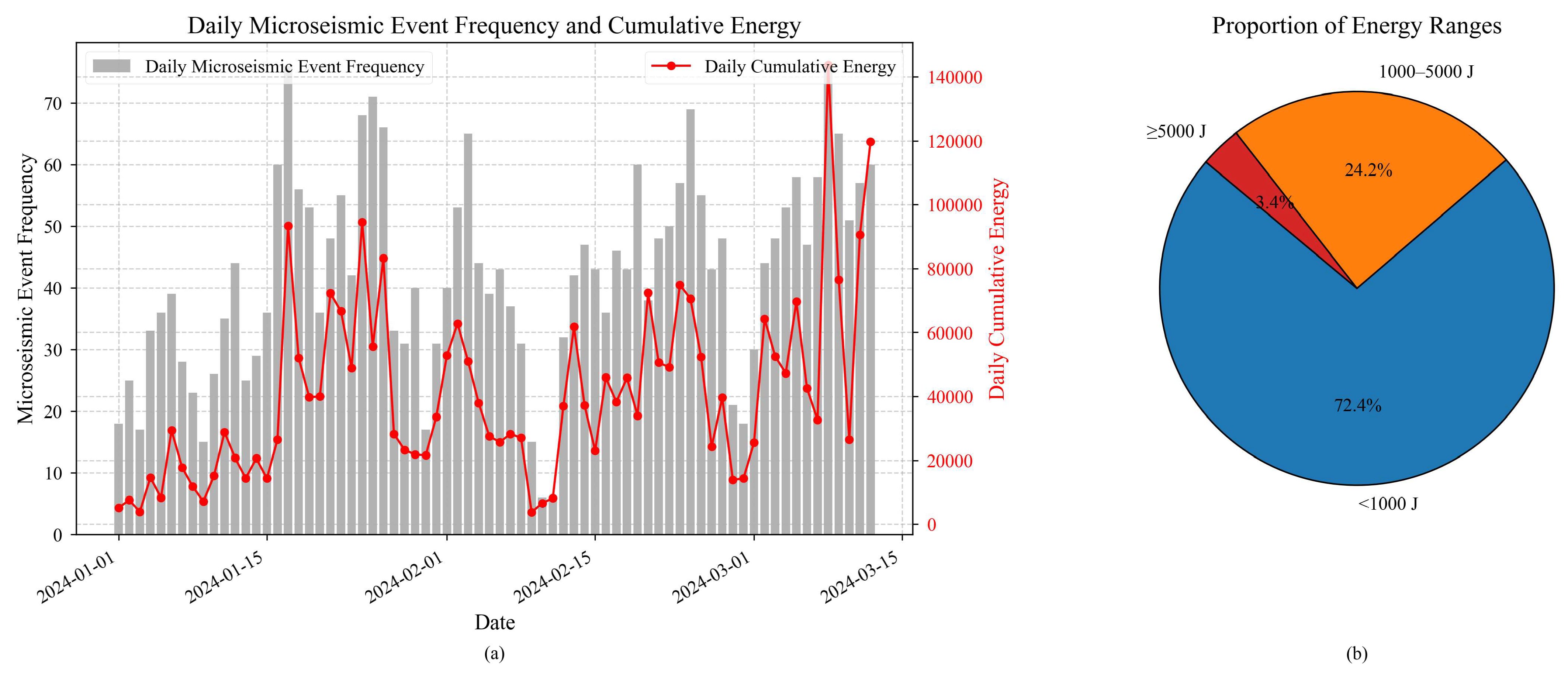
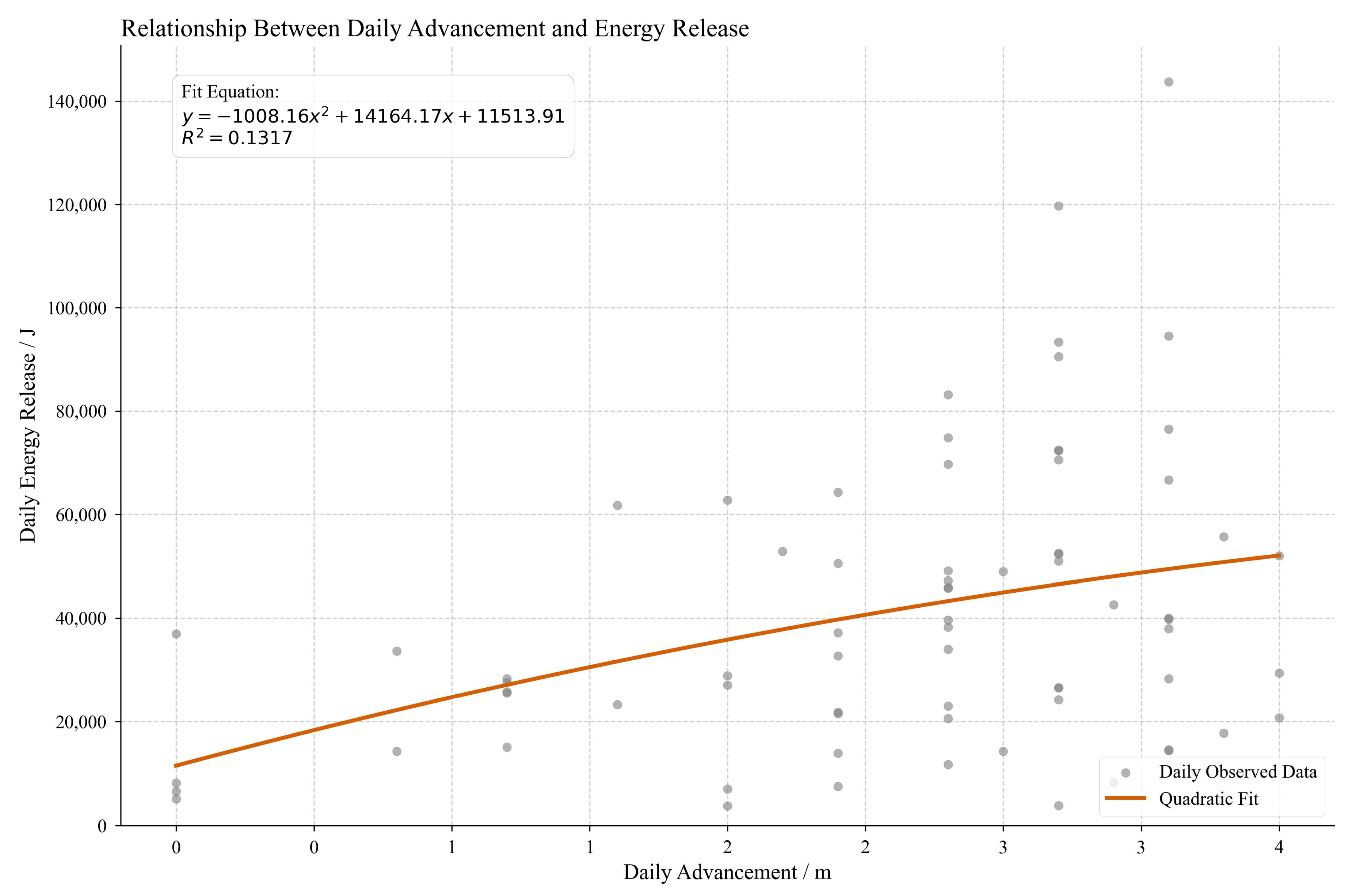
3.1. Dataset Overview and Disturbance Correlation Analysis
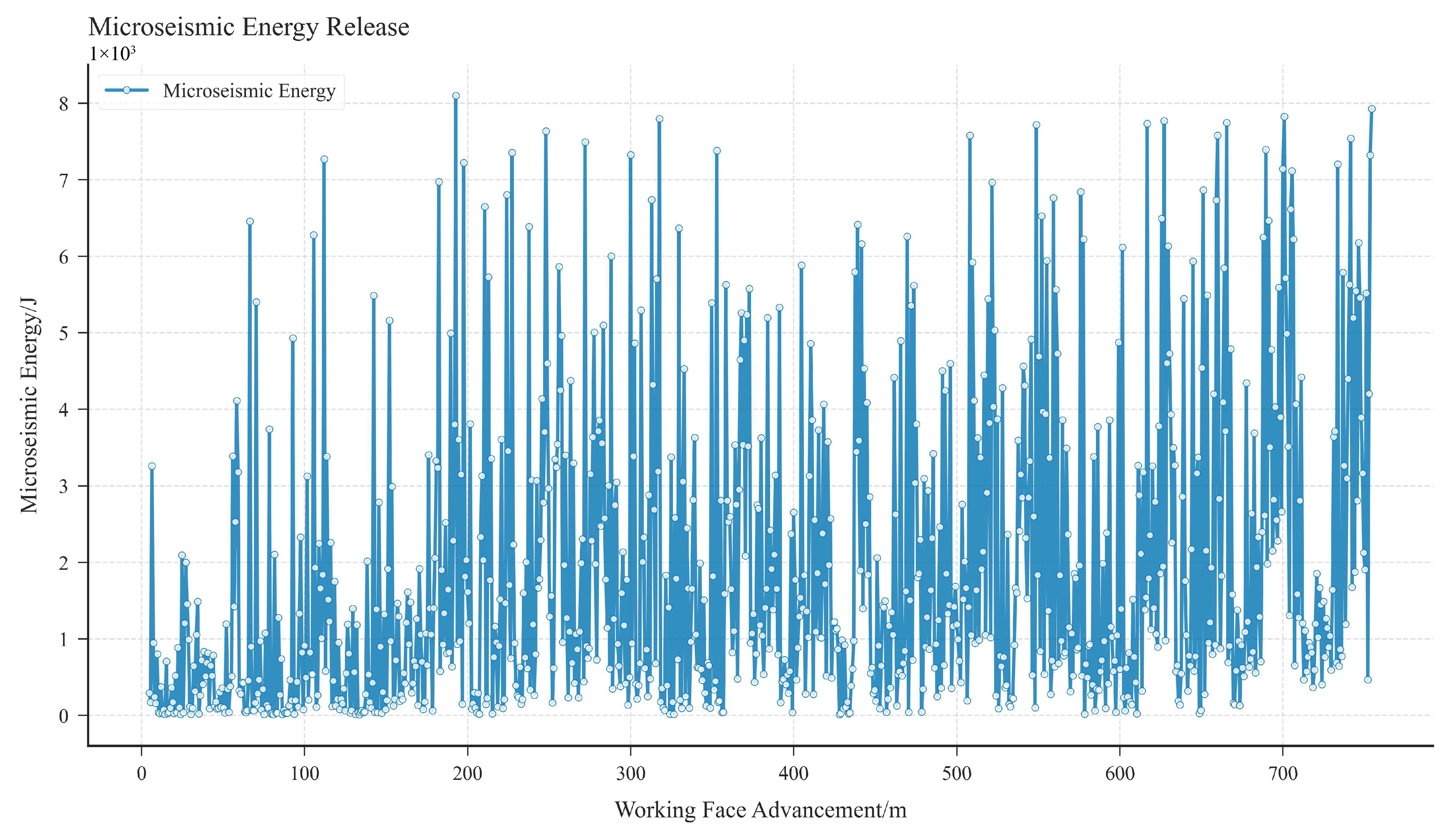
3.2. Reconstruction of the Prediction Benchmark from a Disturbance-Driven Perspective
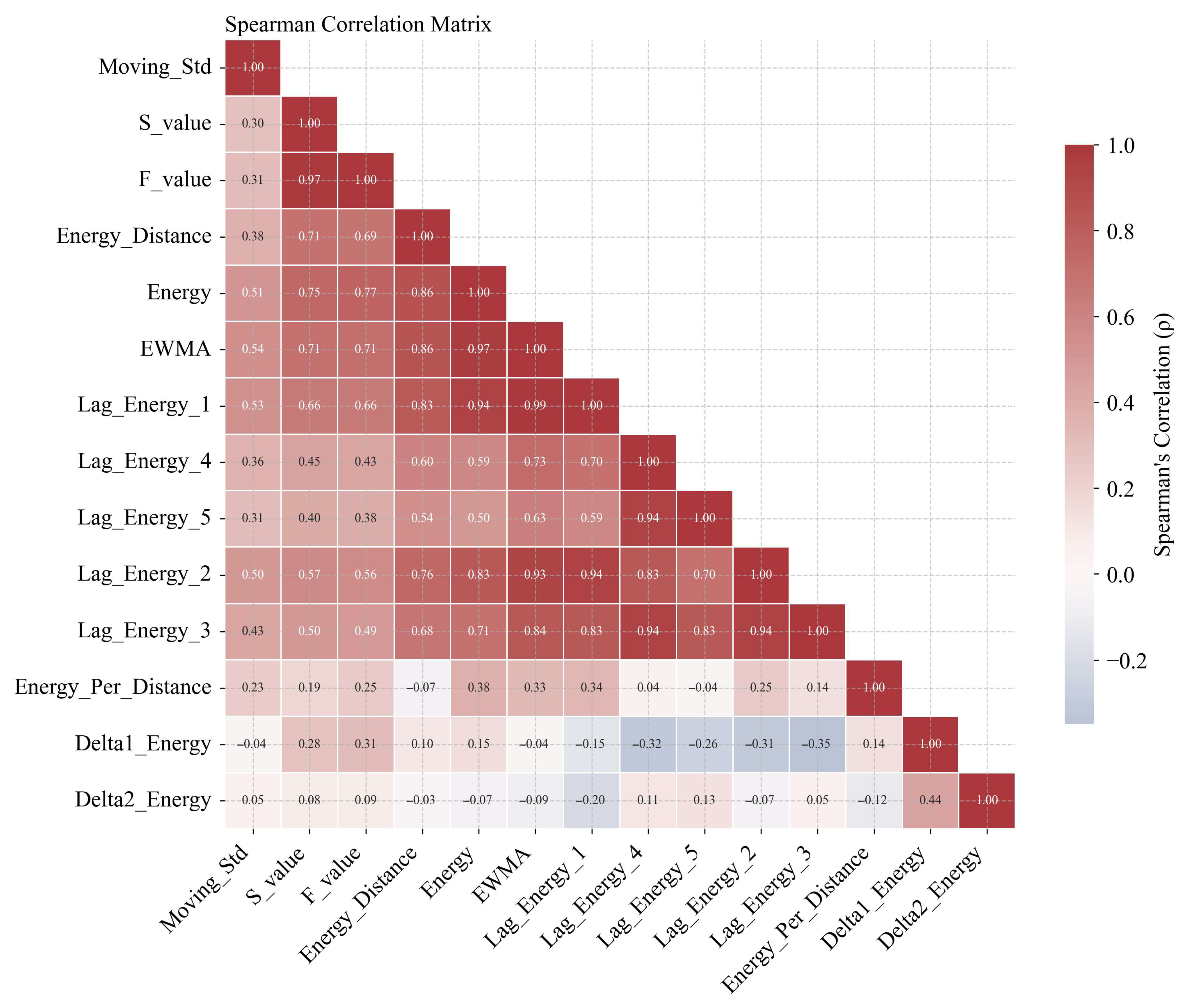
3.3. Feature Engineering by Integrating Statistical Metrics and Physical Parameters
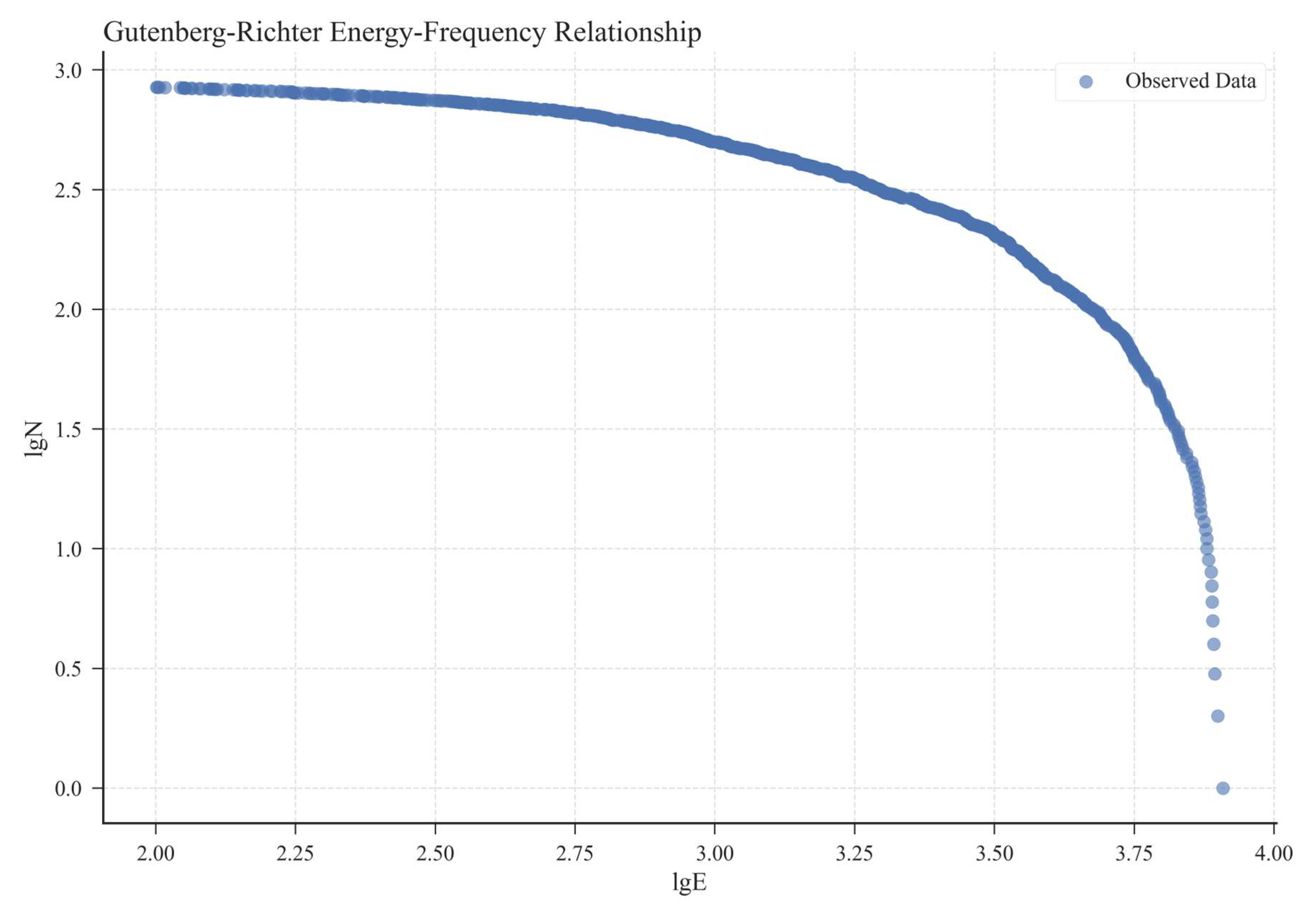
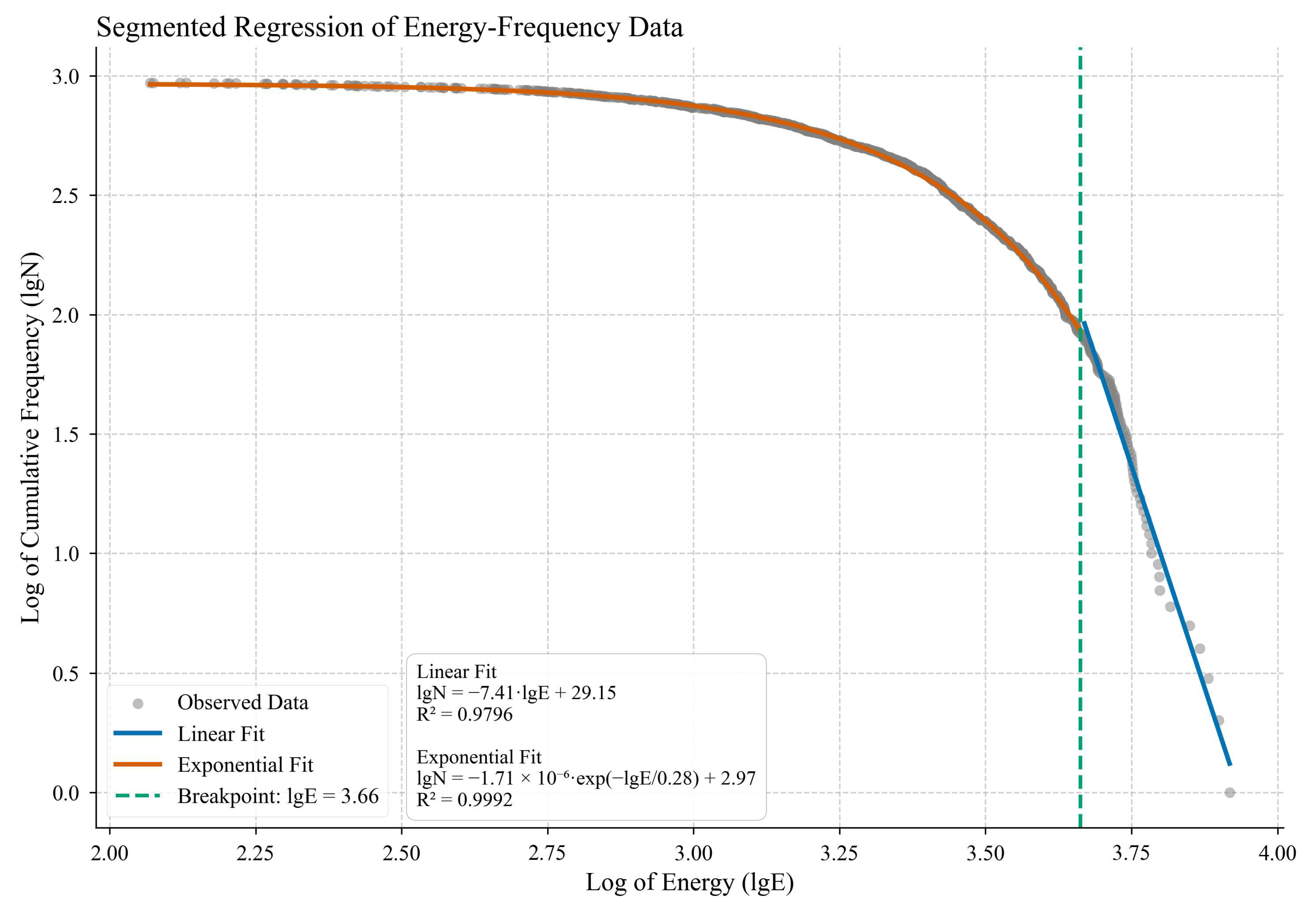
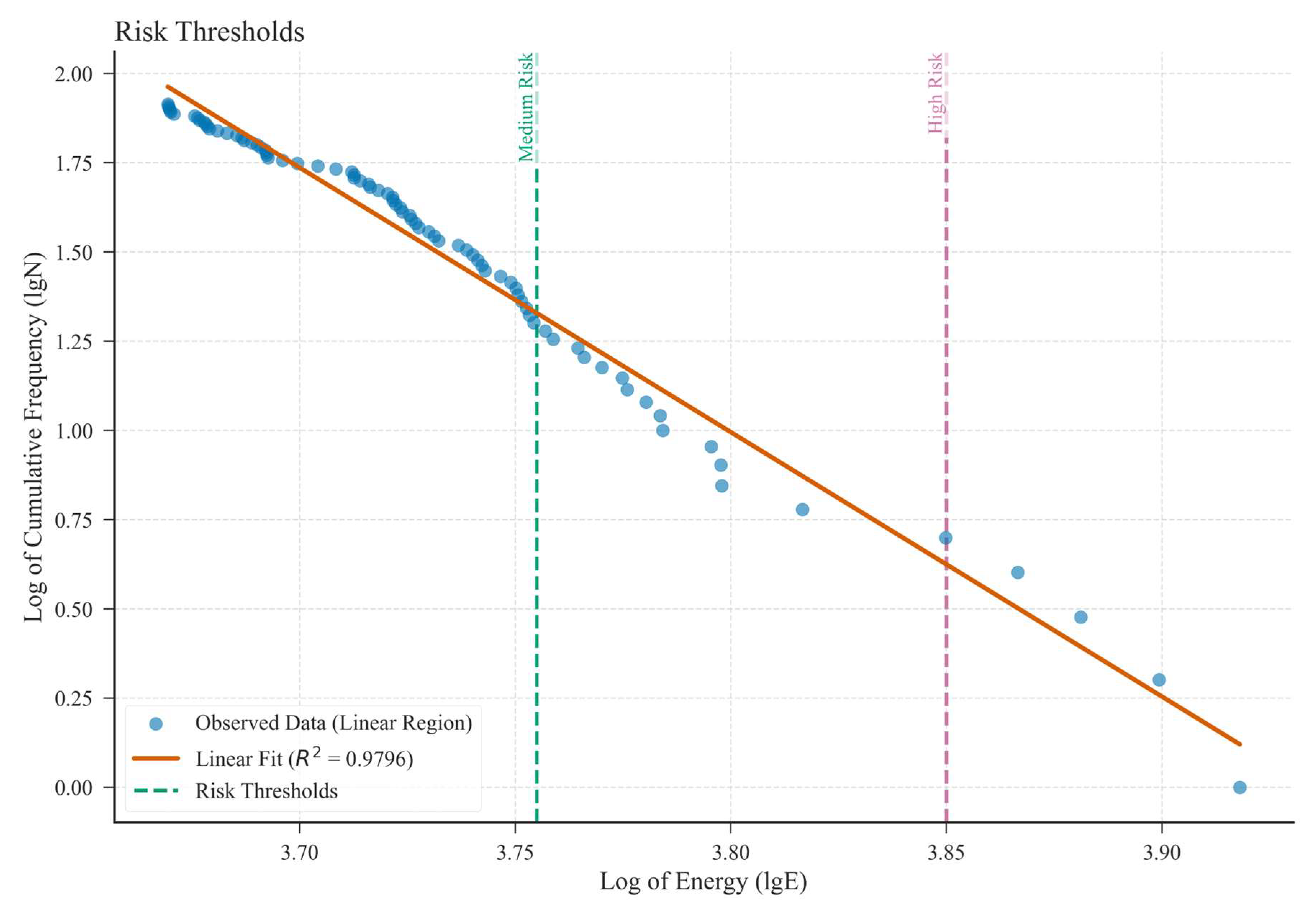
3.4. Quantification of Risk Levels
4. Experiments and Result Analysis
4.1. Experimental Setup
4.2. Evaluation Metrics
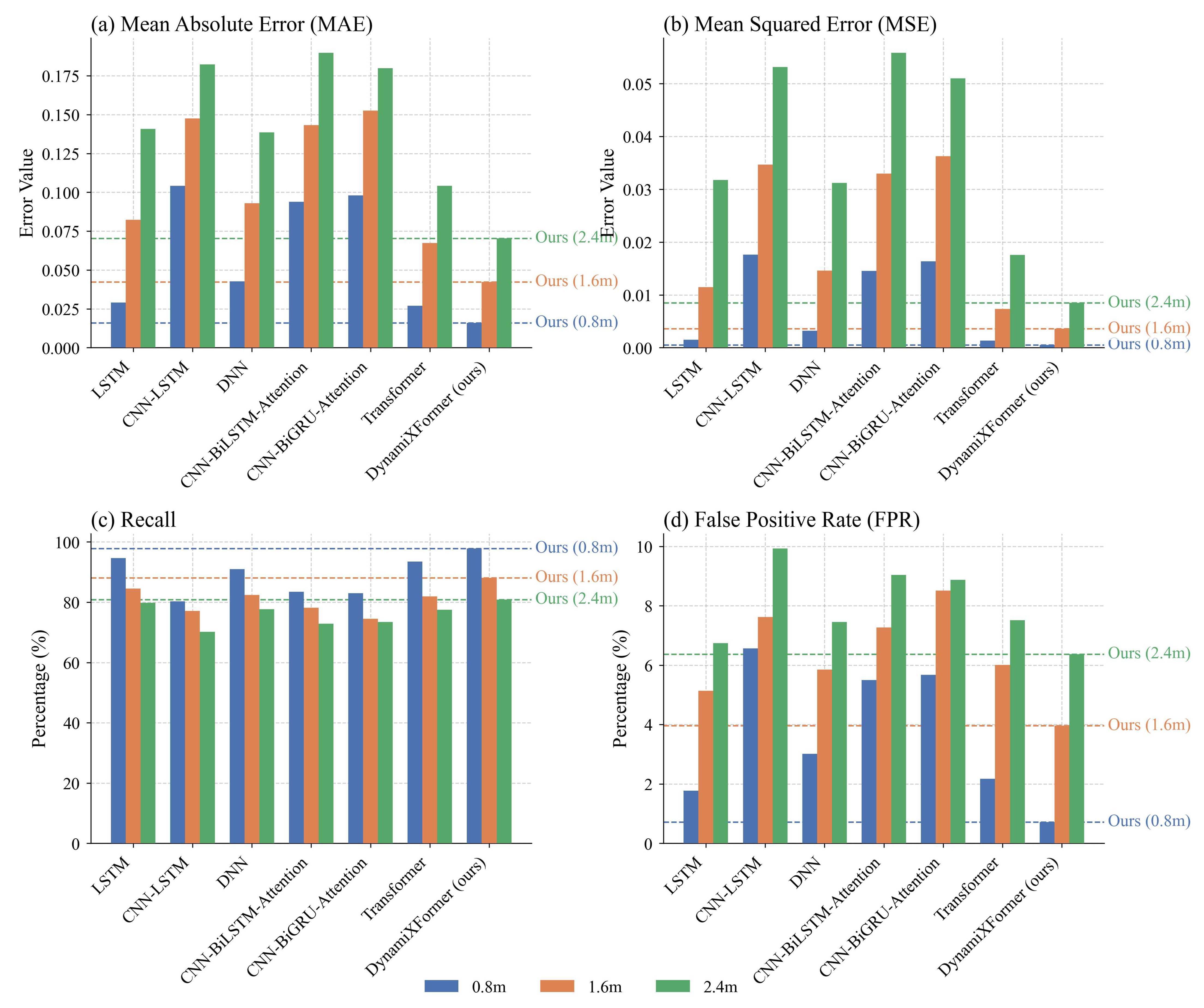
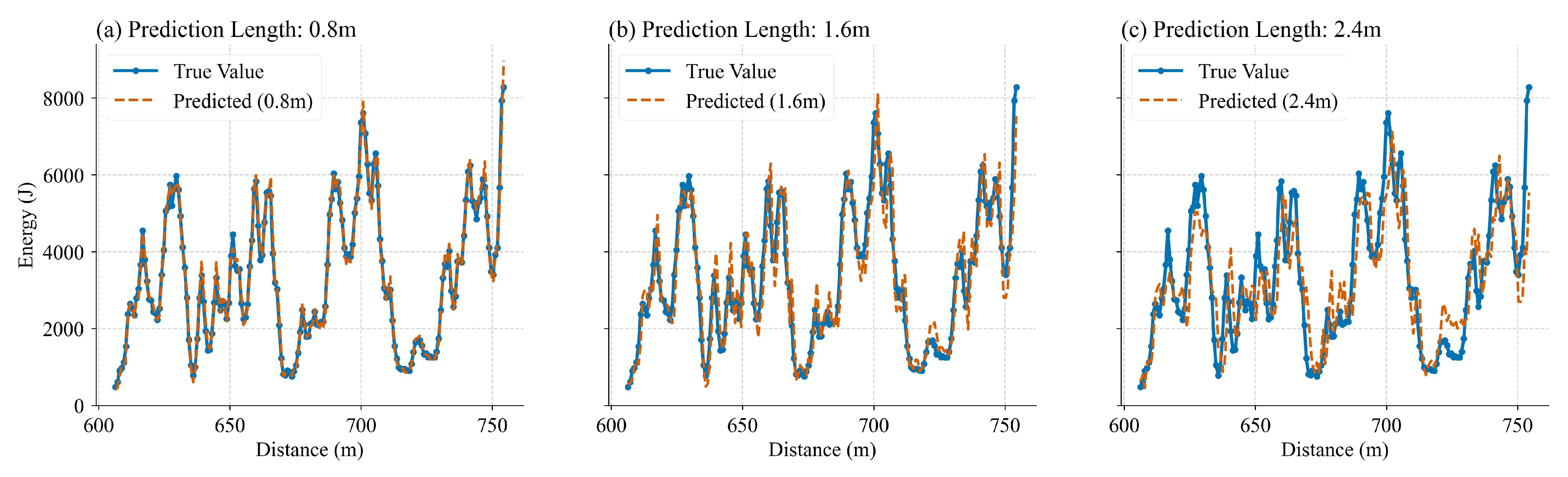
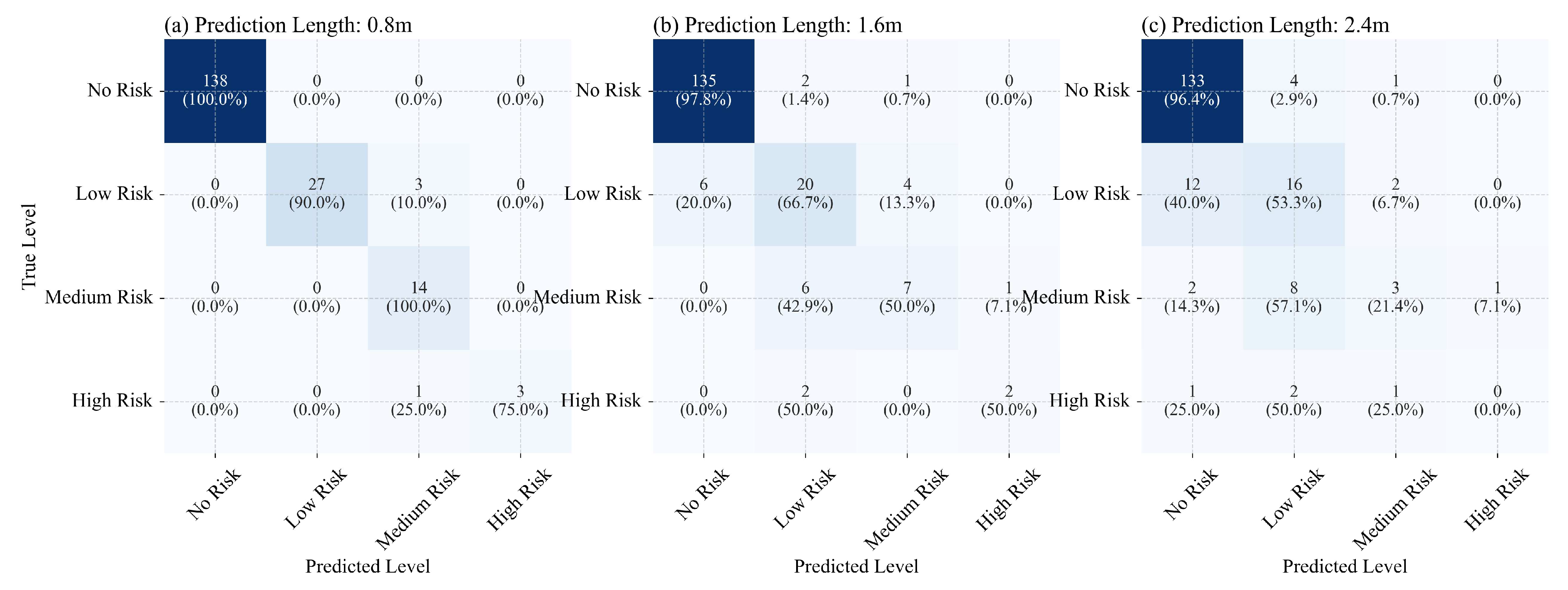
4.3. Comparison of Model Performance
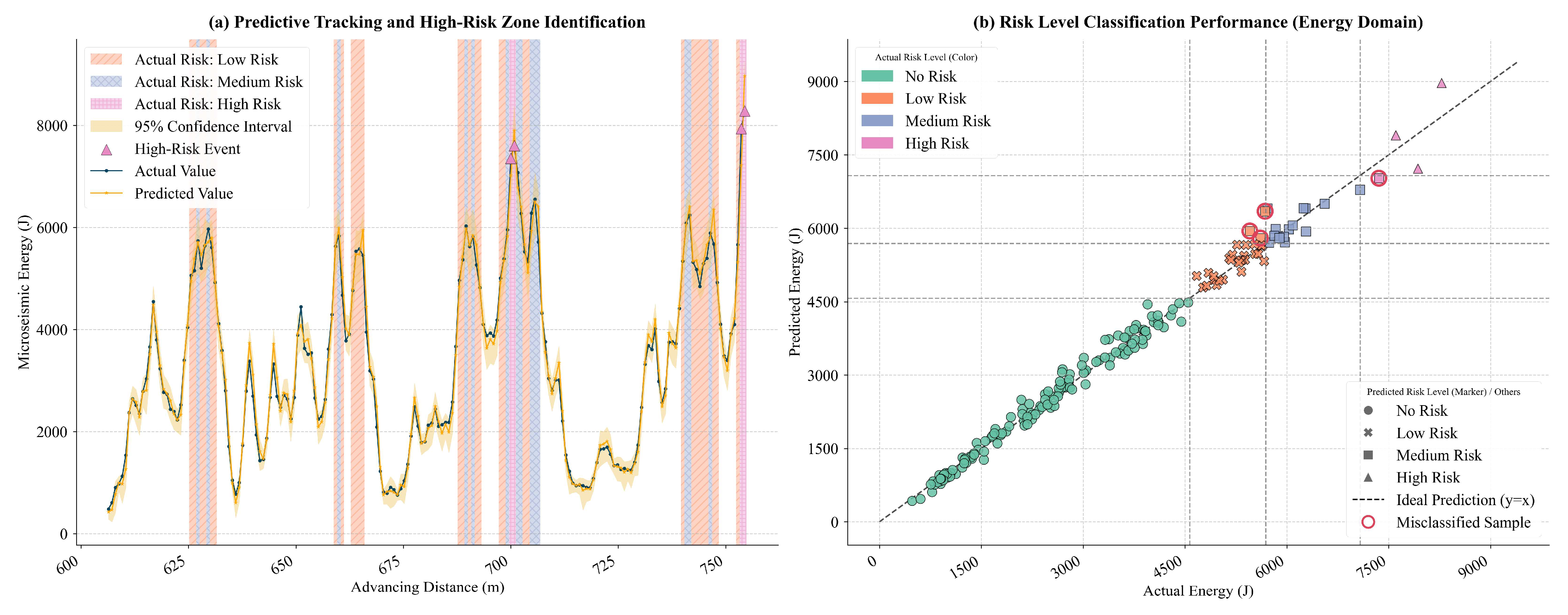
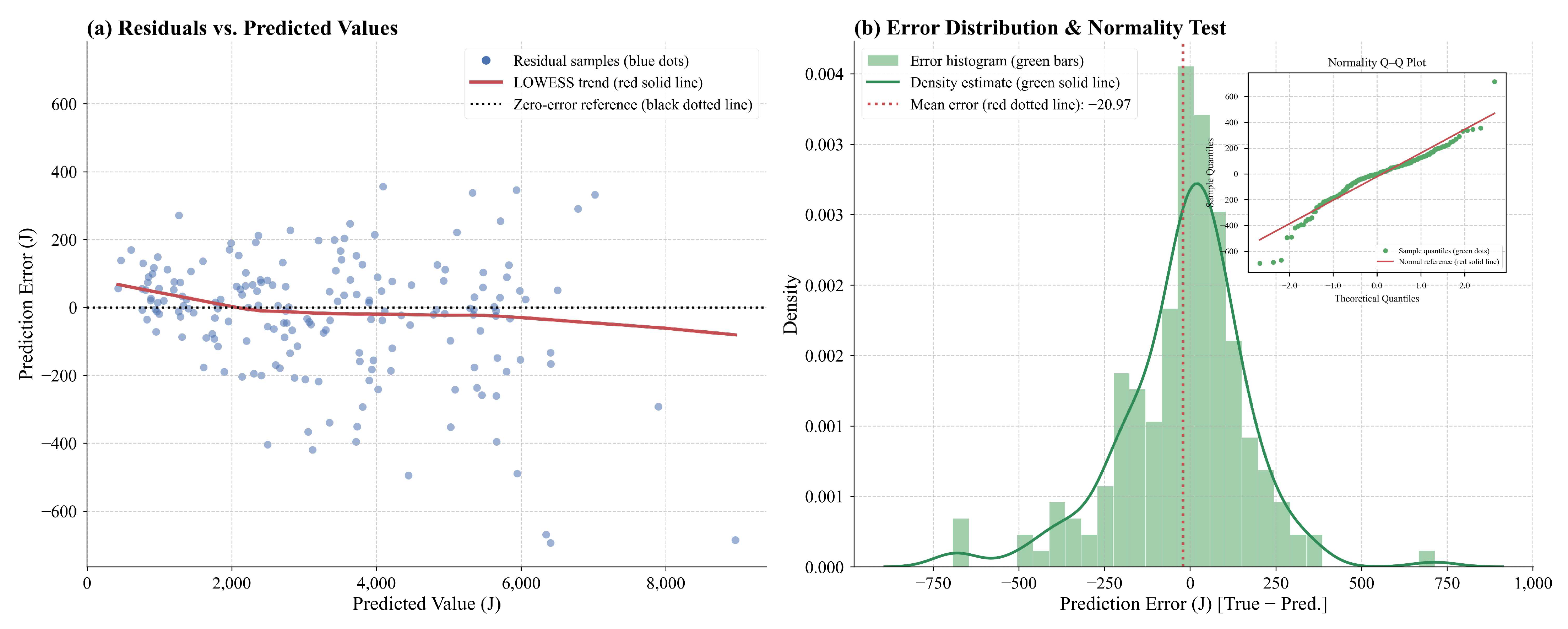
4.4. Analysis of Experimental Results
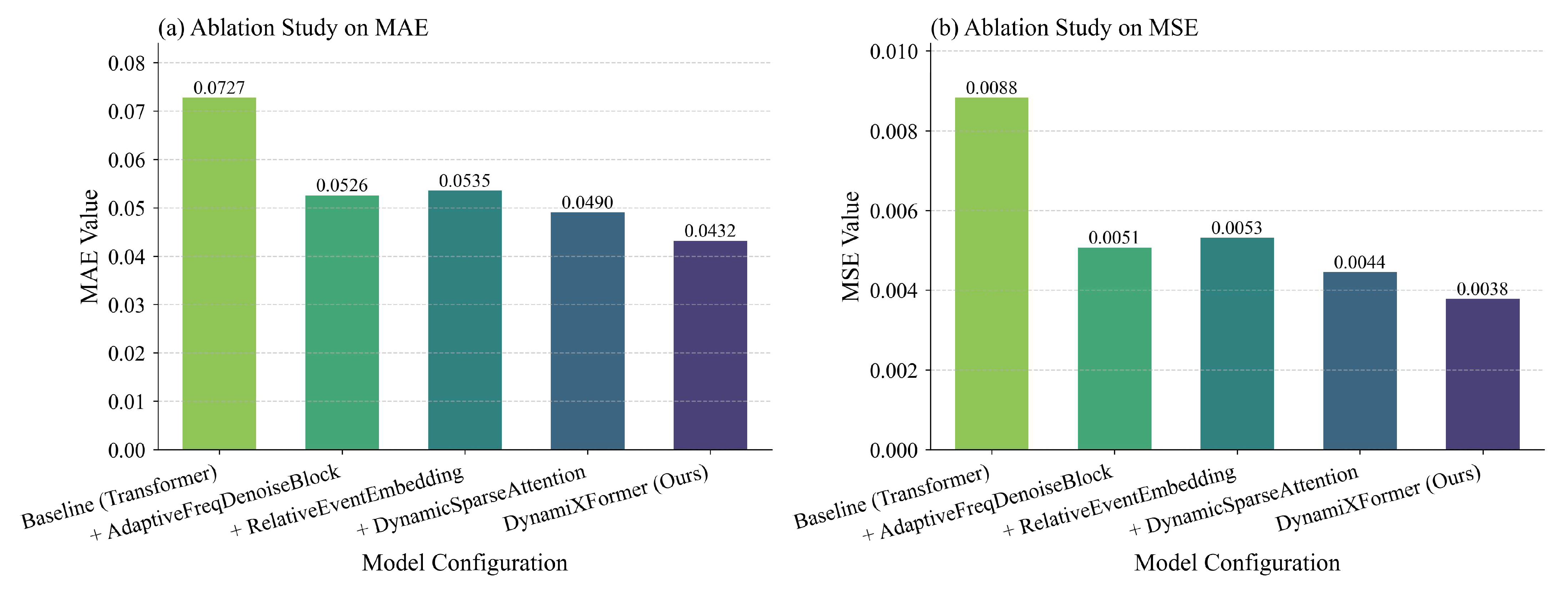
4.5. Ablation Study
- Baseline: The standard Transformer model without any of our proposed modifications.
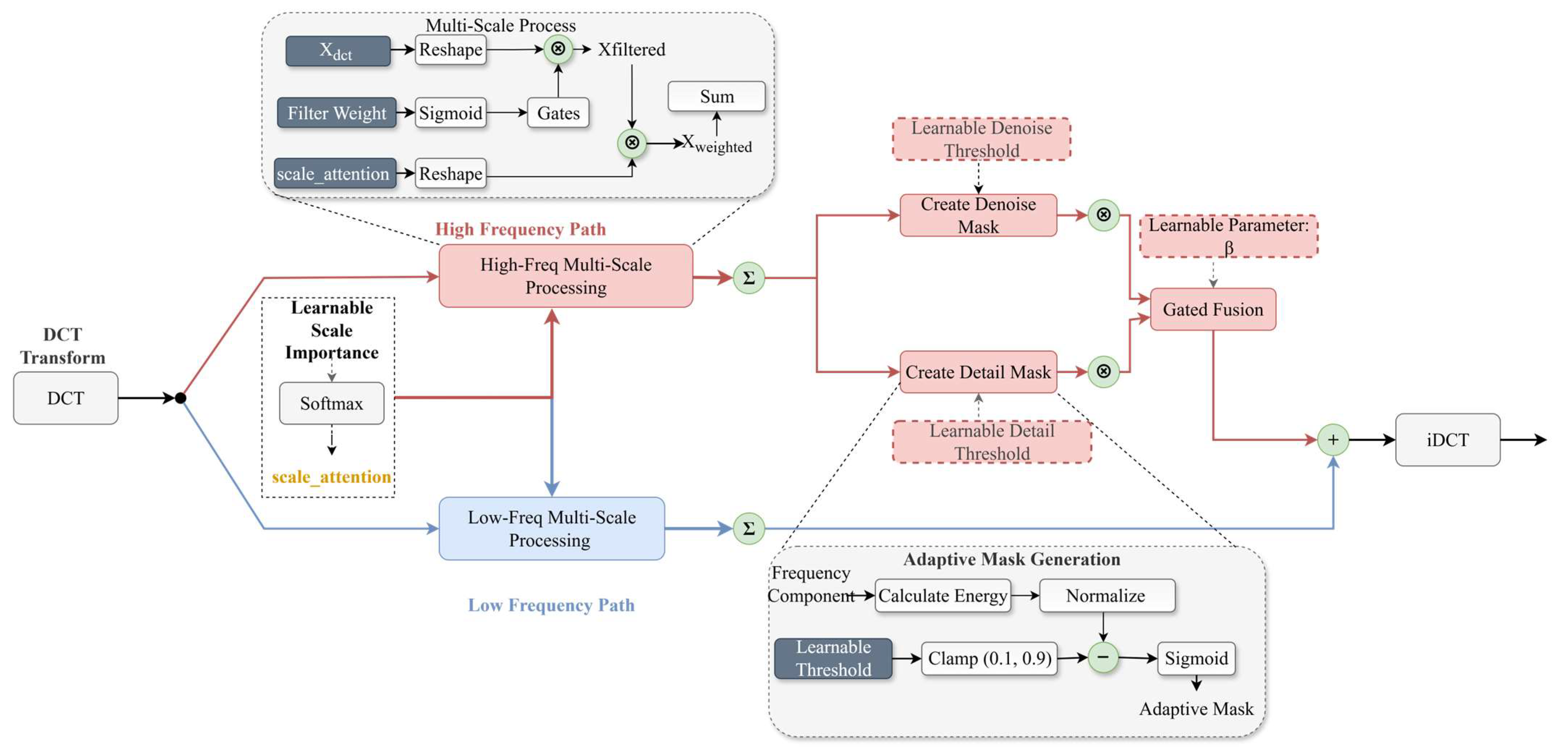
- Baseline + AFDB: The baseline model augmented with our Adaptive Frequency Denoise Block.
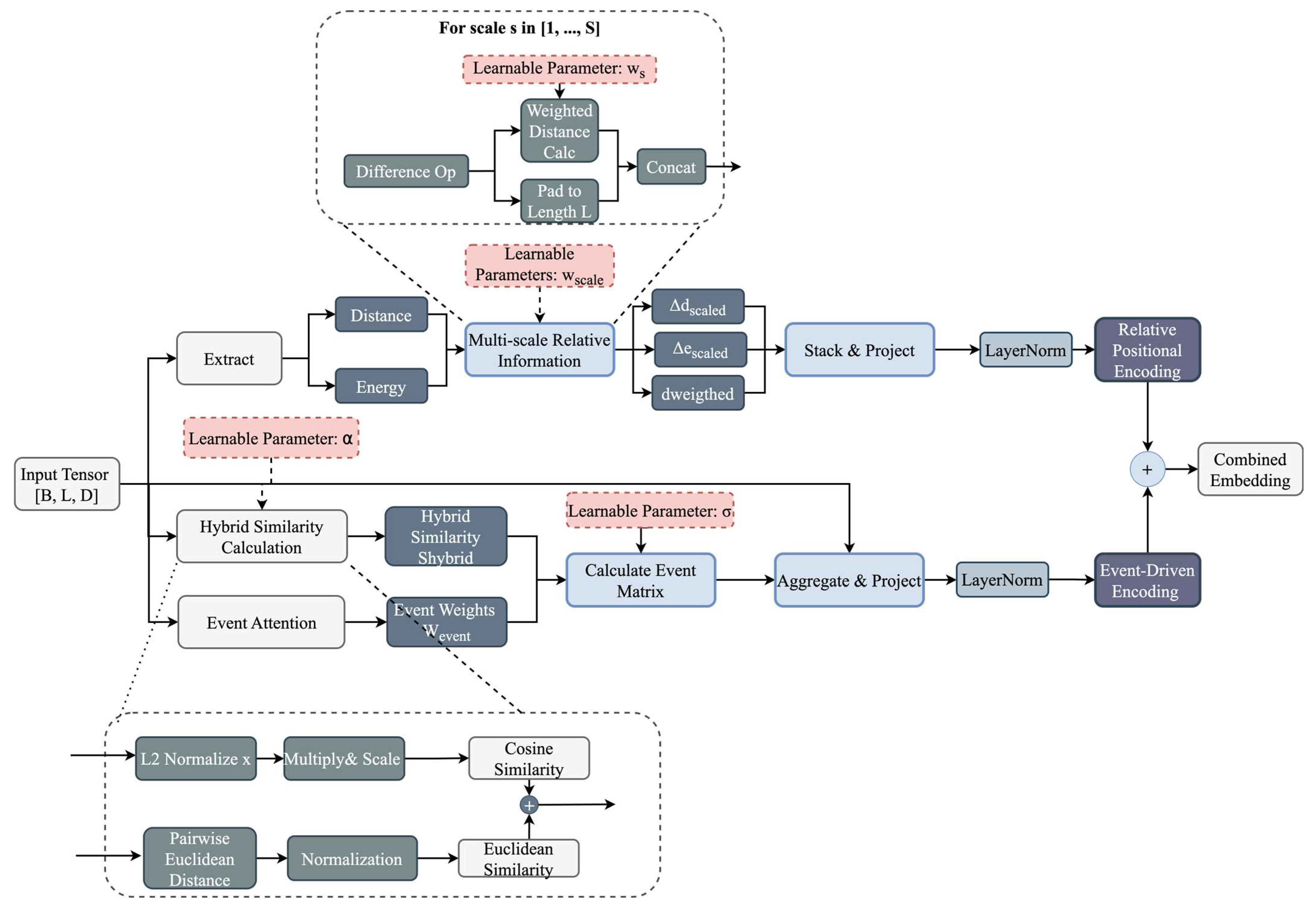
- Baseline + REE: The baseline model augmented with our Relative Event Embedding module.
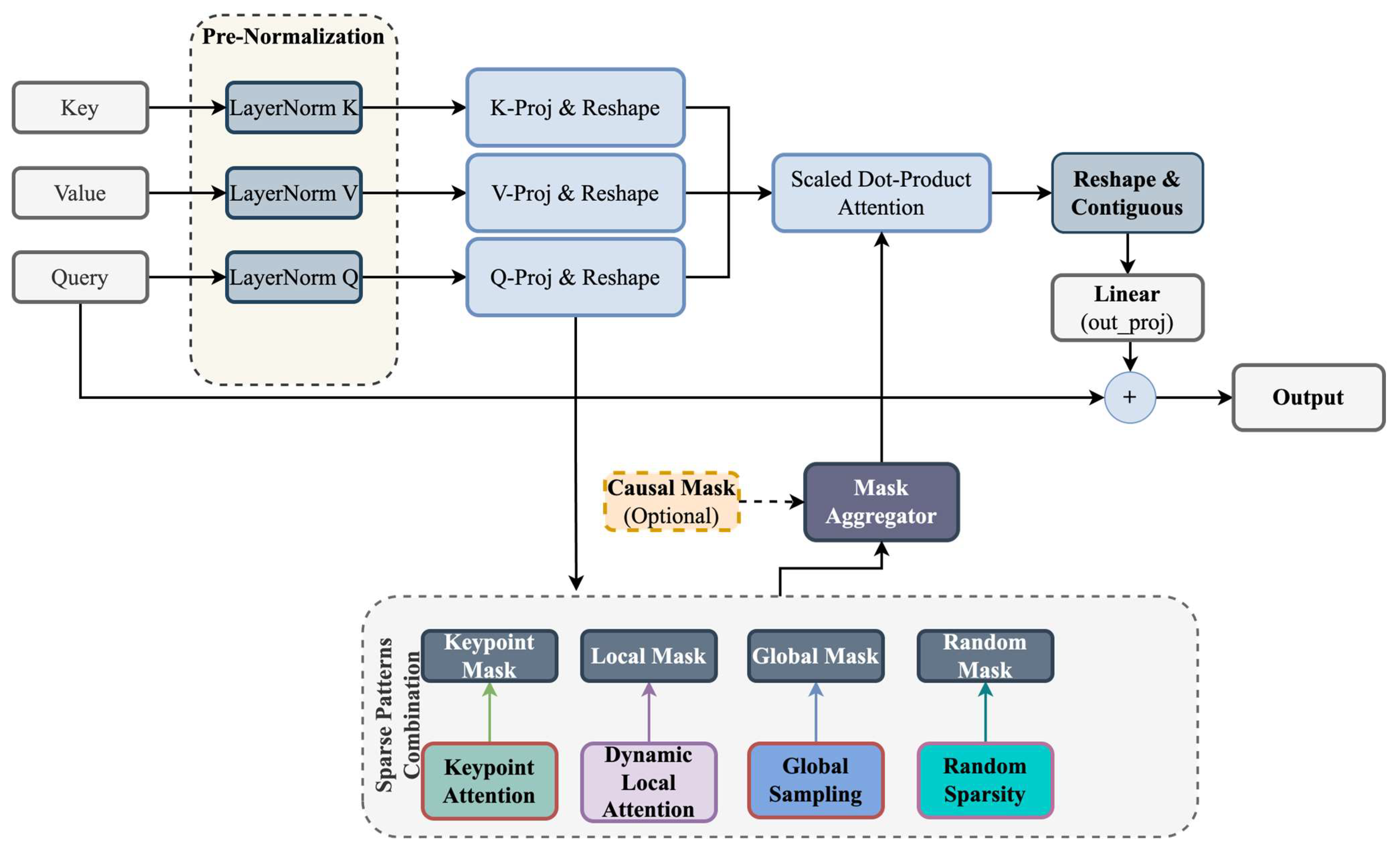
- Baseline + DSA: The baseline model with its standard full attention mechanism replaced by our Dynamic Sparse Attention mechanism.
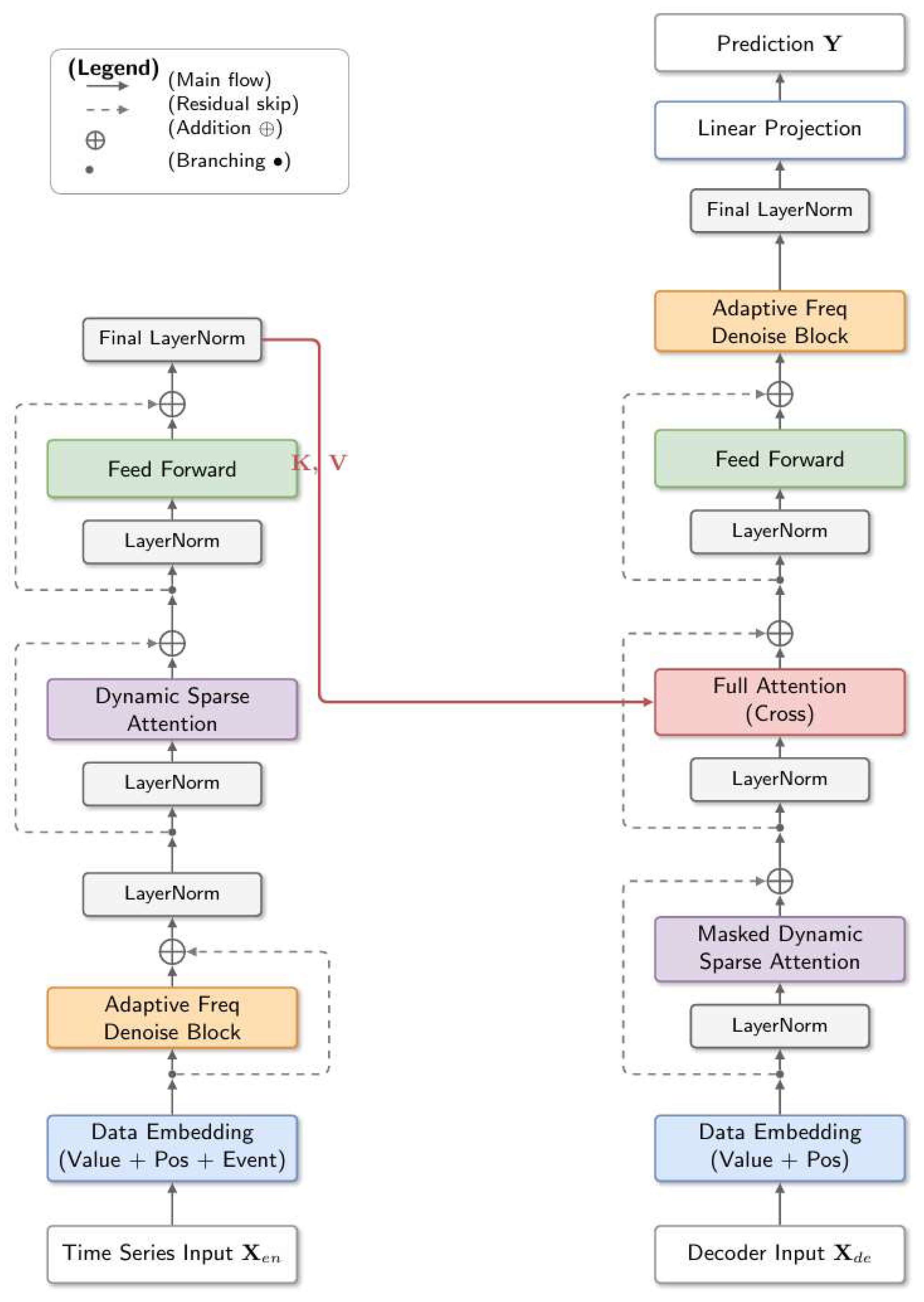
- DynamiXFormer (Full Model): The complete proposed model incorporating all three innovative modules (AFDB, REE, and DSA).
4.6. Analysis of Model Complexity and Inference Speed
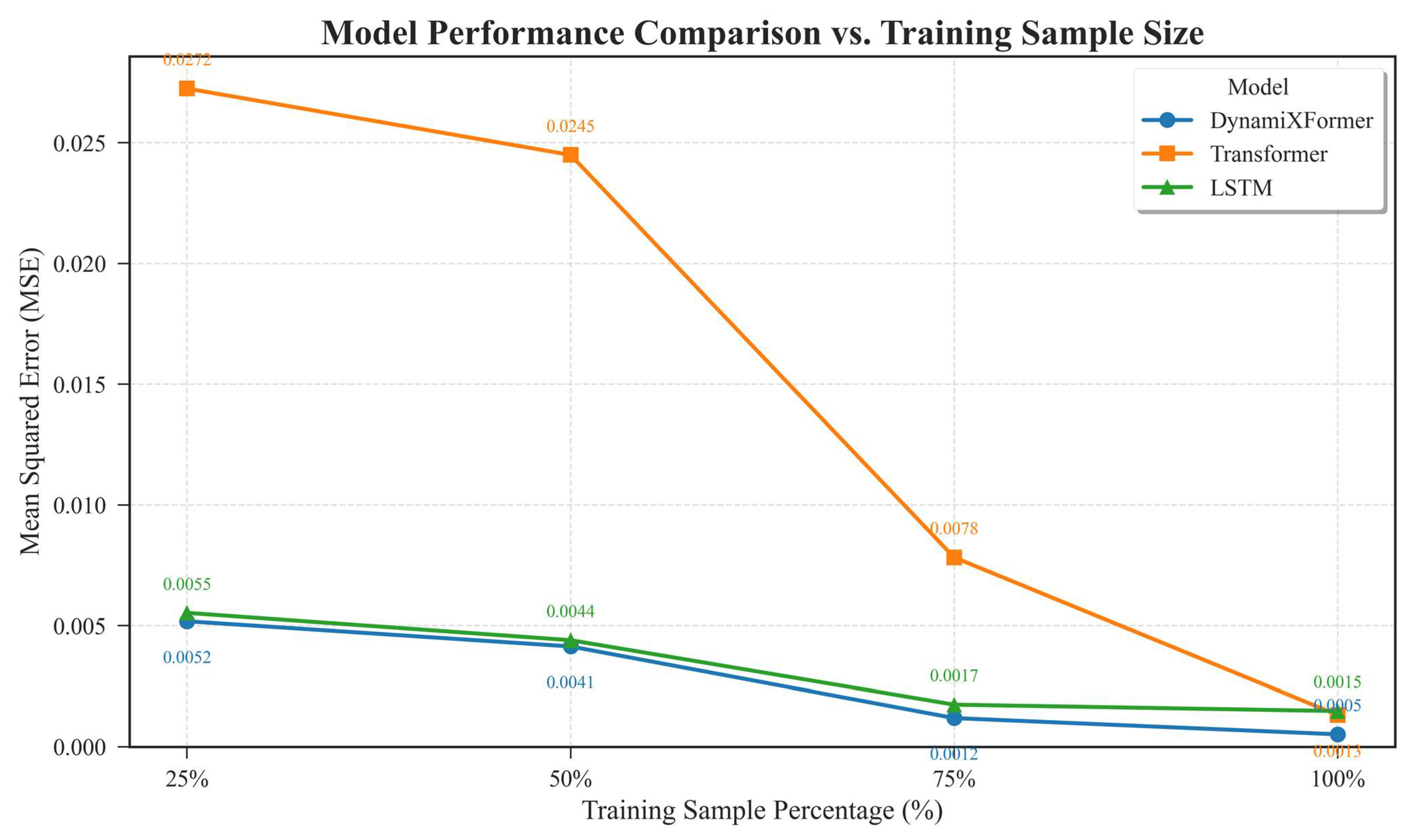
4.7. Analysis of Model Performance with Varying Training Sample Sizes
4.8. Sensitivity Analysis of the Key Risk Classification Threshold
5. Discussion
5.1. Innovative Forecasting Paradigm and Model Architecture
5.2. Module Contributions and Synergy
5.3. Comprehensive Performance Advantages
5.4. Limitations
5.5. Future Work
Author Contributions
Funding
Data Availability Statement
Conflicts of Interest
References
- Jiang, F.; Wei, Q.; Yao, S.; Wang, C. Key theory and technical analysis on mine pressure bumping prevention and control. Coal Sci. Technol. 2013, 41, 6–9. [Google Scholar]
- Pan, J.; Mao, D.; Lan, H.; Wang, S.; Qi, Q. Study status and prospects of mine pressure bumping control technology in China. Coal Sci. Technol. 2013, 41, 21–25. [Google Scholar]
- Ma, T.; Tang, C.; Liu, F.; Zhang, S.-C.; Feng, Z.-Q. Microseismic monitoring, analysis and early warning of rockburst. Geomat. Nat. Hazards Risk 2021, 12, 2956–2983. [Google Scholar]
- Yin, X.; Liu, Q.; Pan, Y.; Huang, X. A novel tree-based algorithm for real-time prediction of rockburst risk using field microseismic monitoring. Environ. Earth Sci. 2021, 80, 504. [Google Scholar] [CrossRef]
- Dong, L.; Yan, X.; Wang, J.; Tang, Z.; Wang, H.; Wu, W. Case study on pre-warning and protective measures against rockbursts utilizing the microseismic method in deep underground mining. J. Appl. Geophys. 2025, 237, 105687. [Google Scholar] [CrossRef]
- Jiang, R.; Dai, F.; Liu, Y.; Li, A. Fast marching method for microseismic source location in cavern-containing rockmass: Performance analysis and engineering application. Engineering 2021, 7, 1023–1034. [Google Scholar] [CrossRef]
- Liu, Y.; Dai, F.; Liu, K.; Wei, M. Continuum analysis of the structurally controlled displacements for large-scale underground caverns in bedded rock masses. Tunn. Undergr. Space Technol. 2020, 97, 103288. [Google Scholar] [CrossRef]
- Ma, K.; Shen, Q.; Sun, X.; Ma, T.-H.; Hu, J.; Tang, C.-A. Rockburst prediction model using machine learning based on microseismic parameters of Qinling water conveyance tunnel. J. Cent. South Univ. 2023, 30, 289–305. [Google Scholar] [CrossRef]
- Qin, C.; Zhao, W.; Chen, W.; Zhang, X.; Xie, P. Prediction of rockburst risk induced by mine tremor using ensemble learning techniques. J. Rock Mech. Geotech. Eng. 2025, 18, 1937–1953. [Google Scholar]
- Li, D.; Liu, Z.; Xiao, P.; Zhou, J.; Armaghani, D.J. Intelligent rockburst prediction model with sample category balance using feedforward neural network and Bayesian optimization. Undergr. Space 2022, 7, 833–846. [Google Scholar] [CrossRef]
- Wojtecki, Ł.; Iwaszenko, S.; Apel, D.B.; Bukowska, M.; Makówka, J. Use of machine learning algorithms to assess the state of rockburst hazard in underground coal mine openings. J. Rock Mech. Geotech. Eng. 2022, 14, 703–713. [Google Scholar] [CrossRef]
- Ma, K.; Xie, H.; Ren, F.; Chang, Y. Rockburst early-warning method based on time series prediction of multiple acoustic emission parameters. Tunn. Undergr. Space Technol. 2024, 153, 106060. [Google Scholar] [CrossRef]
- Yin, X.; Liu, Q.; Huang, X.; Pan, Y. Real-time prediction of rockburst intensity using an integrated CNN-Adam-BO algorithm based on microseismic data and its engineering application. Tunn. Undergr. Space Technol. 2021, 117, 104133. [Google Scholar] [CrossRef]
- Liu, H.; Ma, T.; Lin, Y.; Peng, K.; Hu, X.; Xie, S.; Luo, K. Deep learning in rockburst intensity level prediction: Performance evaluation and comparison of the NGO-CNN-BiGRU-attention model. Appl. Sci. 2024, 14, 5719. [Google Scholar] [CrossRef]
- Cui, F.; He, S.F.; Luo, Z.; Zong, C.; Li, H.; Ma, L.; Zhao, Z.; Yang, X. Research on multi-index early warning of rock burst based on bayesian optimization algorithm and machine learning. J. China Coal Soc. 2025, 50, 297–313. [Google Scholar]
- Qiao, M.; Shi, Y. Prediction of rock burst risk level based on combination of physical indexes and deep learning. J. Saf. Sci. Technol. 2024, 20, 56–63. [Google Scholar]
- Cao, A.; Liu, Y.; Yang, X.; Li, S.; Wang, C.; Bai, X.; Liu, Y. Physical index and data fusion-driven method for coal burst prediction in time sequence. J. China Coal Soc. 2023, 48, 3659–3673. [Google Scholar]
- Vaswani, A.; Shazeer, N.; Parmar, N.; Uszkoreit, J.; Jones, L.; Gomez, A.N.; Kaiser, Ł.; Polosukhin, I. Attention is all you need. arXiv 2017. [Google Scholar] [CrossRef]
- Zhang, Z.; Ye, Y.; Luo, B.; Chen, G.; Wu, M. Investigation of microseismic signal denoising using an improved wavelet adaptive thresholding method. Sci. Rep. 2022, 12, 22186. [Google Scholar] [CrossRef]
- Ahmed, N.; Natarajan, T.; Rao, K.R. Discrete cosine transform. IEEE Trans. Comput. 2006, 100, 90–93. [Google Scholar] [CrossRef]
- Maxwell, S. Microseismic Imaging of Hydraulic Fracturing: Improved Engineering of Unconventional Shale Reservoirs; Society of Exploration Geophysicists: Tulsa, OK, USA, 2014. [Google Scholar]
- Roy, A.; Saffar, M.; Vaswani, A.; Grangier, D. Efficient content-based sparse attention with routing transformers. Trans. Assoc. Comput. Linguist. 2021, 9, 53–68. [Google Scholar] [CrossRef]
- Liu, L.; Qu, Z.; Chen, Z.; Ding, Y.; Xie, Y. Transformer acceleration with dynamic sparse attention. arXiv 2021, arXiv:2110.11299. [Google Scholar] [CrossRef]
- Zhao, G.; Lin, J.; Zhang, Z.; Ren, X.; Su, Q.; Sun, X. Explicit sparse transformer: Concentrated attention through explicit selection. arXiv 2019, arXiv:1912.11637. [Google Scholar] [CrossRef]
- Cao, A.; Dou, L.; Wang, C.; Yao, X.X.; Dong, J.Y.; Gu, Y. Microseismic precursory characteristics of rock burst hazard in mining areas near a large residual coal pillar: A case study from Xuzhuang coal mine, Xuzhou, China. Rock Mech. Rock Eng. 2016, 49, 4407–4422. [Google Scholar] [CrossRef]
- Tang, C. Numerical simulation of progressive rock failure and associated seismicity. Int. J. Rock Mech. Min. Sci. 1997, 34, 249–261. [Google Scholar]
- Anikiev, D.; Birnie, C.; Waheed, U.; Alkhalifah, T.; Gu, C.; Verschuur, D.J.; Eisner, L. Machine learning in microseismic monitoring. Earth-Sci. Rev. 2023, 239, 104371. [Google Scholar] [CrossRef]
- Zhang, X.; Hou, D.; Mao, Q.; Wang, Z. Predicting microseismic sensitive feature data using variational mode decomposition and transformer. J. Seismol. 2024, 28, 229–250. [Google Scholar] [CrossRef]
- Fei, Y.; Yang, X.; Chuan, J.; Wu, X.S.; Cheng, H.M.; Lü, X.F. Time series prediction of microseismic energy level based on feature extraction of one-dimensional convolutional neural network. Chin. J. Eng. 2021, 43, 1003–1009. [Google Scholar]
- Zorn, E.; Kumar, A.; Harbert, W.; Hammack, R. Geomechanical analysis of microseismicity in an organic shale: A West Virginia Marcellus Shale example. Interpretation 2019, 7, T231–T239. [Google Scholar] [CrossRef]
- Gu, J.; Wei, F. On the quantification of seismic activity: Seismic activity rate. Earthq. Res. China 1987, 3, 14–24. [Google Scholar]
- Luo, L.; Hou, J. Scaling of seismic activity. Earthquake 1987, 40–45. [Google Scholar]
- Gutenberg, B.; Richter, C.F. Frequency of earthquakes in California. Bull. Seismol. Soc. Am. 1944, 34, 185–188. [Google Scholar] [CrossRef]
- Scholz, H. The frequency-magnitude relation of microfracturing in rock and its relation to earthquakes. Bull. Seismol. Soc. Am. 1968, 58, 399–415. [Google Scholar]
- Kijko, A.; Funk, C.W. The assessment of seismic hazards in mines. J. South. Afr. Inst. Min. Metall. 1994, 94, 179–185. [Google Scholar]
- Cui, F.; Zong, C.; Lai, X.; He, S.; Zhang, S.; Jia, C. Intelligent prediction of time series and grade of rock burst in steeply inclined ultrathick coal seam excavation roadway. J. China Coal Soc. 2025, 50, 845–861. [Google Scholar]
- Xie, J.; Zhang, Y.; Zhang, Y.; Ding, G.L.; Shi, C.H.; Yao, R. Optimization of microseismic energy early-warning index based on energy level and frequency analysis. Coal Eng. 2021, 53, 67–72. [Google Scholar]
- Liu, H.; Xu, F.; Liu, B.; Deng, M. Time-series prediction method for risk level of rockburst disaster based on CNN-LSTM. J. Cent. South Univ. (Sci. Technol.) 2021, 52, 659–670. [Google Scholar]
- Shuang, G.; Yi, T.; Wen, W. Prediction and evaluation of coal mine coal bump based on improved deep neural network. Geofluids 2021, 2021, 5594019. [Google Scholar] [CrossRef]
- Shu, P.; Yang, Z.; Lai, X.; Xu, H.; Hu, Q.; Guo, Z. An analytical methodology of rock burst with fully mechanized top-coal caving mining in steeply inclined thick coal seam. Sci. Rep. 2024, 14, 651. [Google Scholar] [CrossRef]
- Hochreiter, S.; Schmidhuber, J.; Computation, N. Long short-term memory. Neural Comput. 1997, 9, 1735–1780. [Google Scholar] [CrossRef]

| Research Gaps | Our Solutions and Contributions |
|---|---|
| Weak correlation between conventional time-based predictions and the non-uniform nature of mining activities. | Aligning predictions with engineering practices by using the mining face advance distance as the primary benchmark instead of time. |
| Difficulty for time-series models in handling ambient noise in mines, which often masks critical precursory information. | Introducing a frequency-domain perspective to suppress noise and adaptively amplify signals in key frequency bands. |
| The inherent spatio-temporal relationships among individual microseismic events are typically underutilized. | Constructing an event relationship graph to explicitly model the complex dependencies between microseismic events. |
| Inability of standard sequential models to simultaneously capture both local, abrupt precursors and long-term, cumulative trends. | Incorporating a specific inductive bias that enables the model to dynamically focus on both local key patterns and global evolutionary trends. |
| Energy Level | Risk Level |
|---|---|
| ≤4570.8818 J | No Risk |
| 4570.8818~5688.5293 J | Low Risk |
| 5688.5293~7079.4578 J | Medium Risk |
| ≥7079.4578 J | High Risk |
| Model | Prediction Length (m) | MAE | MSE | Recall | FPR |
|---|---|---|---|---|---|
| LSTM | 0.8 | 0.029067 | 0.001481 | 94.68% | 1.77% |
| 1.6 | 0.082305 | 0.011483 | 84.57% | 5.14% | |
| 2.4 | 0.140787 | 0.031744 | 79.79% | 6.74% | |
| CNN-LSTM | 0.8 | 0.104130 | 0.017624 | 80.32% | 6.56% |
| 1.6 | 0.147498 | 0.034646 | 77.13% | 7.62% | |
| 2.4 | 0.182309 | 0.053158 | 70.21% | 9.93% | |
| DNN | 0.8 | 0.042605 | 0.003223 | 90.96% | 3.01% |
| 1.6 | 0.092905 | 0.014607 | 82.45% | 5.85% | |
| 2.4 | 0.138497 | 0.031189 | 77.66% | 7.45% | |
| CNN-BiLSTM-Attention | 0.8 | 0.093933 | 0.014566 | 83.51% | 5.50% |
| 1.6 | 0.143154 | 0.032984 | 78.19% | 7.27% | |
| 2.4 | 0.189802 | 0.055854 | 72.87% | 9.04% | |
| CNN-BiGRU-Attention | 0.8 | 0.098066 | 0.016346 | 82.98% | 5.67% |
| 1.6 | 0.152611 | 0.036255 | 74.47% | 8.51% | |
| 2.4 | 0.179881 | 0.051004 | 73.40% | 8.87% | |
| Transformer | 0.8 | 0.027019 | 0.001318 | 93.48% | 2.17% |
| 1.6 | 0.067383 | 0.007320 | 81.97% | 6.01% | |
| 2.4 | 0.104134 | 0.017592 | 77.47% | 7.51% | |
| DynamiXFormer (ours) | 0.8 | 0.015936 | 0.000518 | 97.85% | 0.72% |
| 1.6 | 0.042359 | 0.003567 | 88.11% | 3.96% | |
| 2.4 | 0.070380 | 0.008479 | 80.90% | 6.37% |
| Model | MAE | MSE |
|---|---|---|
| Baseline (Transformer) | 0.072749 | 0.008827 |
| Baseline + AdaptiveFreqDenoiseBlock | 0.052566 | 0.005065 |
| Baseline + RelativeEventEmbedding | 0.053546 | 0.005313 |
| Baseline + DynamicSparseAttention | 0.049045 | 0.004447 |
| Model | Total Parameters | Average Latency (ms, CPU) | Inference Speed (FPS, CPU) |
|---|---|---|---|
| LSTM | 204,417 | 0.3119 | 3206.58 |
| DynamiXFormer | 68,117 | 0.7724 | 1294.73 |
| Transformer | 293,601 | 0.8625 | 1159.46 |
| LSTM | 204,417 | 0.3119 | 3206.58 |
| Threshold Variation | Energy Threshold (J) | Recall (%) | FPR (%) |
|---|---|---|---|
| −10% | 4113.8 | 94.09 | 1.97 |
| −5% | 4342.3 | 96.24 | 1.25 |
| 0.0% (Optimal) | 4570.9 | 97.85 | 0.72 |
| + 5% | 4799.4 | 97.31 | 0.90 |
Disclaimer/Publisher’s Note: The statements, opinions and data contained in all publications are solely those of the individual author(s) and contributor(s) and not of MDPI and/or the editor(s). MDPI and/or the editor(s) disclaim responsibility for any injury to people or property resulting from any ideas, methods, instructions or products referred to in the content. |
© 2026 by the authors. Licensee MDPI, Basel, Switzerland. This article is an open access article distributed under the terms and conditions of the Creative Commons Attribution (CC BY) license.
Share and Cite
Zhang, J.; Wu, H.; Wu, Q.; Xia, Q.; Wei, S.; Ling, T. Learning from Disturbances, Not Timestamps: A Dynamic Event-Driven Transformer for Rock Burst Forecasting. Processes 2026, 14, 1413. https://doi.org/10.3390/pr14091413
Zhang J, Wu H, Wu Q, Xia Q, Wei S, Ling T. Learning from Disturbances, Not Timestamps: A Dynamic Event-Driven Transformer for Rock Burst Forecasting. Processes. 2026; 14(9):1413. https://doi.org/10.3390/pr14091413
Chicago/Turabian StyleZhang, Junming, Hai Wu, Qiang Wu, Qiyuan Xia, Sailei Wei, and Tao Ling. 2026. "Learning from Disturbances, Not Timestamps: A Dynamic Event-Driven Transformer for Rock Burst Forecasting" Processes 14, no. 9: 1413. https://doi.org/10.3390/pr14091413
APA StyleZhang, J., Wu, H., Wu, Q., Xia, Q., Wei, S., & Ling, T. (2026). Learning from Disturbances, Not Timestamps: A Dynamic Event-Driven Transformer for Rock Burst Forecasting. Processes, 14(9), 1413. https://doi.org/10.3390/pr14091413

