Article

A Geomechanical Approach to Pressure Front Delineation for Class VI Carbon Storage Projects in the Absence of an Overlying Underground Source of Drinking Water

by
Seyed Kourosh Mahjour
Department of Construction Management, Everglades University, 5002 T-Rex Ave. #100, Boca Raton, FL 33431, USA
Processes 2026, 14(9), 1328; https://doi.org/10.3390/pr14091328
Submission received: 28 March 2026 / Revised: 17 April 2026 / Accepted: 21 April 2026 / Published: 22 April 2026
(This article belongs to the Section Petroleum and Low-Carbon Energy Process Engineering)

Abstract

The delineation of the Area of Review (AoR) is a fundamental requirement for Class VI carbon storage permits in the United States. The regulatory definition of the pressure front relies on the potential for injected fluids or formation brine to migrate into an Underground Source of Drinking Water (USDW). However, in deep sedimentary basins such as the Texas Gulf Coast and offshore regions, targeted saline formations often lack overlying USDWs. In these scenarios, traditional methods for calculating the critical pressure threshold become mathematically undefined or yield infinite AoR boundaries. This paper proposes a practical, geomechanics-based methodology for defining the pressure front in the absence of a USDW, framed as an alternative site-specific approach under the authority of the UIC Program Director (40 CFR 146.84). By leveraging existing regulatory limits on injection pressure, the proposed framework establishes a threshold based on the minimum horizontal stress, caprock fracture pressure, and fault reactivation limits via Mohr–Coulomb failure analysis. The framework further incorporates capillary breakthrough pressure as a third containment threshold, ensuring that the most restrictive condition governs the AoR boundary. A synthetic case study of a deep Gulf Coast saline formation demonstrates that this approach produces a finite, physically meaningful AoR that scales appropriately with injection operations (evaluated at 1.0 and 2.0 Mt/yr) and captures post-injection pressure evolution during the Post-Injection Site Care (PISC) period. Sensitivity analyses on permeability and fracture gradients confirm the robustness of the method. The study also examines model limitations, injection feasibility boundaries, and extensions toward a probabilistic framework. This framework provides operators and regulators with a defensible, regulatory-consistent pathway for advancing carbon storage projects in deep sedimentary basins, complete with a standardized reviewer checklist and an example AoR delineation report template.

1. Introduction

The geologic sequestration of carbon dioxide ( CO 2 ) in deep saline formations is a critical technology for mitigating anthropogenic greenhouse gas emissions and addressing global climate change [1]. In the United States, the Environmental Protection Agency (EPA) regulates the injection of CO 2 for geologic sequestration through the Class VI Underground Injection Control (UIC) program, established under the Safe Drinking Water Act [2]. The primary mandate of the Class VI program is the protection of Underground Sources of Drinking Water (USDWs) from endangerment caused by injection activities. A central component of this regulatory framework is the delineation of the Area of Review (AoR), which defines the geographic region over which the owner or operator must evaluate potential leakage pathways, such as abandoned wellbores or faults, and perform corrective action if necessary [3].
Under 40 CFR 146.81(d) and 146.84(a), the AoR is defined as the region surrounding the geologic sequestration project where USDWs may be endangered by the injection activity. The regulations specify that the AoR must be delineated using computational modeling that accounts for the physical and chemical properties of the injected CO 2 and the displaced formation fluids. The boundary of the AoR is determined by the maximum extent of the separate-phase CO 2 plume and the pressure front. The pressure front is explicitly defined in the regulations as the zone of elevated pressure that is created by the injection of CO 2 into the subsurface, where there is a sufficient pressure differential to cause the upward movement of injected fluids or formation fluids into a USDW [3].
While this regulatory definition provides a clear and protective standard for sites where a USDW overlies the injection zone, it presents a significant methodological challenge in geologic settings where no USDW is present. In many prospective carbon storage basins, such as the deep offshore waters of the Outer Continental Shelf or specific onshore regions like the deep Texas Gulf Coast Basin, the targeted saline formations are situated thousands of meters below the surface, with no overlying aquifers that meet the regulatory criteria of a USDW [4,5]. In these scenarios, the standard analytical and numerical methods prescribed by the EPA for calculating the critical pressure threshold become mathematically undefined or yield physically unrealistic, infinite AoR boundaries [6,7].
This regulatory gap creates uncertainty for both project developers preparing Class VI permit applications and regulatory agencies tasked with reviewing them [8]. Without a defensible methodology for defining the pressure front in the absence of a USDW, operators may be forced to rely on arbitrary pressure thresholds or assume hypothetical, non-existent USDWs, leading to either underestimation of risk or the delineation of excessively large AoRs that impose unwarranted monitoring and corrective action burdens [9,10].
Understanding the fundamental mechanisms of fracture initiation, propagation, and mechanical degradation in subsurface formations is critical to establishing robust geomechanical thresholds for caprock integrity. Recent research has advanced knowledge of crack propagation behavior under complex loading conditions relevant to subsurface environments. Cai et al. [11] investigated crack propagation characteristics in shale subjected to cyclic in situ methane detonation impact fracturing, demonstrating that repeated dynamic loading creates cumulative fracture damage that reduces rock strength progressively. Similarly, Li et al. [12] studied fracture evolution and mechanical deterioration of granite under cyclic thermal and liquid nitrogen cryogenic impact, revealing that thermal cycling induces progressive crack network development and elastic modulus degradation with compressive strength reductions exceeding 20% after multiple cycles. These findings underscore the importance of accounting for potential cyclic and dynamic loading effects when evaluating long-term caprock integrity in CO 2 storage settings and support the use of conservative geomechanical thresholds for pressure front delineation.
To address this challenge, this paper proposes a practical, geomechanics-based methodology for defining the pressure front and delineating the AoR in carbon storage projects where no USDW is present. Rather than relying on the potential for fluid migration into a non-existent receptor, the proposed approach shifts the regulatory focus to the mechanical integrity of the primary containment system. This approach is explicitly designed as an alternative, site-specific computational modeling approach that can be approved by the UIC Program Director under 40 CFR 146.84(c) [3]. The framework leverages existing Class VI operational requirements (40 CFR 146.88), which prohibit injection pressures from exceeding 90 percent of the fracture pressure of the injection zone and strictly forbid the initiation of fractures in the confining zone. Extending this protective concept spatially, this method defines the pressure front boundary based on geomechanical constraints, specifically the minimum horizontal stress and fault reactivation thresholds of the caprock [13,14].
Specifically, this work provides: (1) a formal characterization of the regulatory gap arising from the mathematical failure of EPA Methods 1–3 in no-USDW settings; (2) an integrated, step-by-step framework translating standard geomechanical constraints into a regulatory-compliant AoR delineation methodology under 40 CFR 146.84(c); (3) a tri-criterion containment threshold incorporating tensile fracture, fault reactivation, and capillary breakthrough pressures; and (4) a standardized operator workflow, regulatory reviewer checklist, and example AoR delineation report template to facilitate practical adoption.
This paper first reviews the limitations of current critical pressure calculation methods in no-USDW scenarios. It then details the theoretical foundation and workflow of the proposed geomechanical approach, including a rigorous Mohr–Coulomb fault reactivation analysis, consideration of stress regime variations, quantitative poroelastic analysis, and capillary seal assessment. Finally, a synthetic case study representative of a deep Texas Gulf Coast saline formation is presented to illustrate the application of the method across multiple injection rates, low-permeability scenarios, and during the Post-Injection Site Care (PISC) period.

2. Regulatory Context and Methodological Limitations

2.1. The EPA Area of Review Framework

The EPA’s Class VI regulations mandate a rigorous, site-specific approach to AoR delineation. Section 3.4.1 of the EPA’s AoR Evaluation and Corrective Action Guidance [3] outlines several approaches for determining the threshold pressure, also known as the critical pressure ( Δ P c r i t ), which defines the outer boundary of the pressure front. In industry practice, these approaches are often informally categorized into four numbered methods.
Method 1 and Method 2 are based on the hydrostatic potential required to drive formation brine upward through an open, hypothetical conduit (such as an abandoned wellbore) into an overlying USDW. Method 3 utilizes numerical modeling to simulate the flow of fluids through a hypothetical conduit, accounting for pressure dissipation and fluid mixing over time. Finally, the guidance allows for alternative, site-specific approaches (informally referred to as Method 4), provided they are approved by the UIC Program Director.
Method 1 (applicable to under-pressurized reservoirs) calculates the pressure P i , f at which the injection zone and lowermost USDW reach equivalent hydraulic heads [3]:
P i , f = P u + ρ i g ( z u z i )
where P u is the initial USDW pressure, ρ i is the injection zone fluid density, g is gravitational acceleration, z u is the USDW elevation, and z i is the injection zone elevation [3].
Method 2 (applicable to hydrostatic conditions) calculates the threshold pressure increase Δ P c r i t based on buoyancy-driven displacement of fluid in a hypothetical borehole connecting the injection zone and USDW [3,10,15]:
Δ P c r i t = 1 2 g ξ ( z u z i ) 2
where ξ is a linear density coefficient defined by the fluid density contrast between the injection zone and the USDW [3,10,15]. Both methods fundamentally depend on the existence of a USDW as the reference receptor.

2.2. The Challenge of No-USDW Scenarios

The inherent limitation of the standard EPA methods becomes apparent when examining Equations (1) and (2) in the context of a geologic setting lacking a USDW. If no USDW exists, the fundamental parameters P u and z u are undefined, rendering the analytical methods mathematically inoperable. In an attempt to adapt these methods, an operator might theoretically assume a very distant or shallow receptor, such as the surface or the ocean floor (in offshore cases). However, because the distance ( z u z i ) to the surface is maximized, the required critical pressure Δ P c r i t calculated by these methods often approaches zero or becomes negative, implying that the formation is already naturally overpressured relative to the surface [16].
When Δ P c r i t approaches zero, any infinitesimal pressure perturbation caused by CO 2 injection constitutes an exceedance of the threshold. Because pressure perturbations in confined or semi-confined deep saline aquifers diffuse outward logarithmically according to the diffusivity equation, an effectively zero pressure threshold results in an AoR that extends impractically far outward, bounded only by the physical limits of the sedimentary basin [17,18]. Thus, the problem is twofold: the standard methods become mathematically inoperable when no USDW exists, and attempted workarounds using distant or hypothetical receptors yield impractically large AoR boundaries.
Recent analyses by the Ground Water Protection Council (GWPC) and state regulatory bodies have highlighted this exact issue [5,8]. As noted by Hostetler [7], even advanced computational approaches cannot resolve this issue if the fundamental regulatory receptor (the USDW) is absent. Consequently, there is a critical need for an alternative site-specific framework that defines the pressure front based on the physical limits of the containment system.

3. Proposed Geomechanical Framework for Pressure Front Delineation

3.1. Conceptual Basis

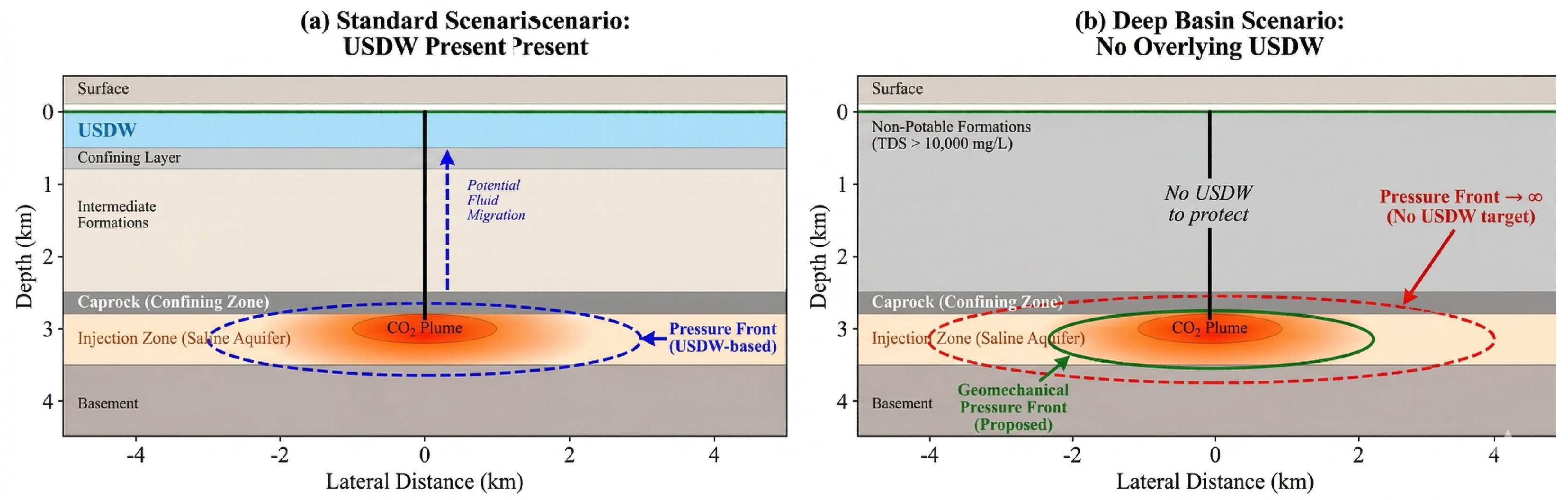
The proposed methodology shifts the focus of the pressure front definition from the protection of a non-existent USDW to the preservation of the primary confining zone (caprock). Figure 1 illustrates the conceptual difference between a standard USDW scenario and a deep basin scenario without a USDW. In the absence of a USDW, the most critical environmental and operational risk is the geomechanical failure of the caprock, which could lead to the unintended migration of CO 2 or brine into overlying non-potable formations or ultimately to the surface.
The EPA Class VI regulations already contain a strict geomechanical constraint. Under 40 CFR 146.88(a), the injection pressure must not exceed 90 percent of the fracture pressure of the injection zone to ensure that injection does not initiate new fractures or propagate existing fractures in the confining zone. The proposed framework extends this operational constraint spatially, defining the pressure front as the geographic area where the reservoir pressure exceeds a safe geomechanical threshold. This threshold must account for two primary failure mechanisms: tensile fracture of the intact caprock and shear reactivation of pre-existing faults.
The extension of the 90% fracture pressure constraint from the injection zone to the caprock is supported by several considerations. First, international technical standards for CCS risk management, including ISO/TR 27918:2018 (lifecycle risk management for integrated CCS projects) and ISO 27914:2017 (geological storage of CO 2 ) [19,20], advocate for comprehensive containment assurance that encompasses the entire confining system, not solely the injection interval. Second, the EPA’s own regulations under 40 CFR 146.88(a) explicitly state that injection must not “initiate new fractures or propagate existing fractures in the confining zone,” demonstrating that the regulatory intent already extends protection to the caprock. Third, the caprock minimum horizontal stress ( S h m i n ) is typically equal to or greater than that of the injection zone due to lithological differences (shale vs. sandstone); therefore, applying the 90% factor to the caprock S h m i n is more conservative than applying it solely to the injection zone. This approach aligns with the precautionary principle embedded in CCS risk management standards and ensures that the proposed threshold is protective of the primary containment barrier.

3.2. Tensile Fracture Threshold

The fracture pressure ( P f r a c ) of a sedimentary formation is generally governed by the minimum principal stress. In normal and strike-slip faulting regimes, such as the Gulf Coast Basin, the minimum principal stress is the minimum horizontal stress ( S h m i n ) [14]. Tensile fracturing occurs when the pore pressure ( P p ) exceeds S h m i n plus the tensile strength of the rock ( T 0 ). For conservative regulatory purposes, T 0 is typically assumed to be zero. While this assumption ignores the inherent tensile strength of the intact rock, it is highly appropriate for caprocks where pre-existing natural fractures or micro-fissures may already be present. In such fractured media, the effective tensile strength is negligible, and fractures can propagate at pressures equal to or even slightly below S h m i n [14]. Furthermore, setting T 0 = 0 provides a more restrictive and protective threshold, ensuring that the calculated fracture pressure ( S h m i n + T 0 ) errs on the side of safety. This limitation is also addressed comprehensively through the Mohr–Coulomb fault reactivation analysis (Section 3.3), which explicitly evaluates slip on pre-existing planes of weakness.
While 40 CFR 146.88(a) explicitly applies the 90 percent safety factor to the fracture pressure of the injection zone, the proposed methodology extends this concept to establish a more protective standard based on the confining zone. Applying this 90 percent safety factor to the caprock S h m i n , the critical absolute pressure ( P c r i t , t e n s i l e ) to prevent tensile fracturing is defined as
P c r i t , t e n s i l e = 0.9 × S h m i n
The critical overpressure threshold ( Δ P c r i t , t e n s i l e ) for delineating the AoR is then the difference between this maximum safe pressure and the initial reservoir pressure ( P i ):
Δ P c r i t , t e n s i l e = 0.9 × S h m i n P i

3.3. Fault Reactivation Threshold

While tensile fracture provides an upper bound, pre-existing faults or fractures optimally oriented in the present-day stress field can slip (reactivate) at pore pressures significantly lower than S h m i n [21]. This is a critical consideration for caprock integrity and induced seismicity.
Fault reactivation is governed by the Mohr–Coulomb failure criterion. Slip occurs when the shear stress ( τ ) on a fault plane exceeds the frictional resistance, which is a function of the effective normal stress ( σ n ) and the coefficient of friction ( μ ):
τ = μ σ n = μ ( σ n P p )
For a critically oriented fault in a normal faulting regime (where vertical stress S v is the maximum principal stress σ 1 , and S h m i n is the minimum principal stress σ 3 ), the critical pore pressure ( P s h e a r ) required to induce slip can be derived analytically [14]:
P s h e a r = S v q S h m i n 1 q
where q is a function of the friction coefficient:
q = μ 2 + 1 + μ 2
The critical overpressure threshold for fault reactivation is therefore
Δ P c r i t , s h e a r = P s h e a r P i
It is important to note that Equation (6) is specific to the normal faulting regime ( S v > S H m a x > S h m i n ). In strike-slip regimes ( S H m a x > S v > S h m i n ), the maximum principal stress is S H m a x and the minimum remains S h m i n , requiring the substitution of σ 1 = S H m a x in Equation (6). In reverse faulting regimes ( S H m a x > S h m i n > S v ), σ 1 = S H m a x and σ 3 = S v , requiring further adjustment. Table 1 summarizes the principal stress assignments and critical pressure formulations for all three faulting regimes. The selection of the appropriate regime is a fundamental prerequisite for accurate threshold calculation and must be established through site characterization data.
For the Texas Gulf Coast case study, the normal faulting regime is well established. Regional stress measurements from Leak-Off Tests (LOTs) and Diagnostic Fracture Injection Tests (DFITs) consistently demonstrate S v > S H m a x > S h m i n at depths exceeding 2500 m in the Gulf Coast sedimentary section [14,22]. The World Stress Map database confirms a dominant normal-to-strike-slip transitional stress regime along the Gulf Coast [23]. The S h m i n value of 52.8 MPa used in this study (fracture gradient of 16.5 kPa/m) is derived from LOT/DFIT data reported for the deep Frio Formation by Bump and Hovorka [24] and is consistent with the range of 15.8–17.2 kPa/m reported in regional compilations [14].
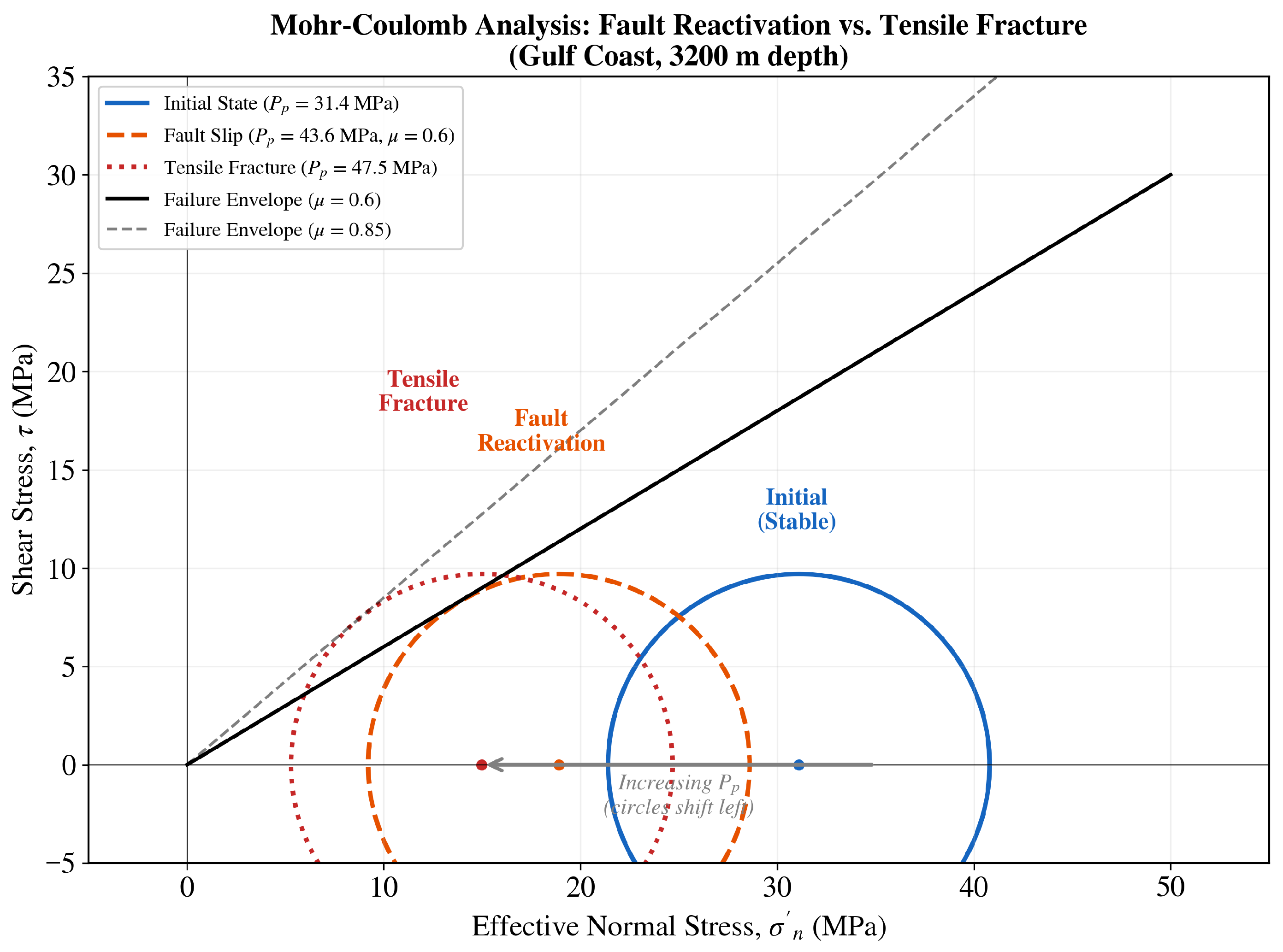
Figure 2 presents a Mohr–Coulomb diagram illustrating these failure states for a typical deep Gulf Coast setting. As shown, for standard friction coefficients ( μ 0.6 ), fault reactivation occurs at a lower pore pressure than tensile fracture, making it the limiting constraint.
The comprehensive geomechanical critical pressure threshold ( Δ P c r i t ) for AoR delineation is defined as the minimum of the tensile, shear, and capillary thresholds:
Δ P c r i t = min ( Δ P c r i t , t e n s i l e , Δ P c r i t , s h e a r , Δ P c r i t , c a p i l l a r y )
where Δ P c r i t , c a p i l l a r y = P c a p P i , and P c a p is the capillary entry pressure of the caprock determined from mercury injection capillary pressure (MICP) testing or direct CO 2 breakthrough experiments [25]. This tri-criterion formulation ensures that the most restrictive containment condition governs the AoR boundary regardless of caprock lithology.

3.4. Poroelastic Effects

During CO 2 injection, the increase in pore pressure induces a volumetric expansion of the rock matrix, which is constrained by the surrounding rock mass. This poroelastic coupling leads to an increase in the total minimum horizontal stress ( S h m i n ) as injection proceeds [26]. The change in S h m i n is proportional to the change in pore pressure, governed by the poroelastic stress path coefficient:
Δ S h m i n = α 1 2 ν 1 ν Δ P p
where α is the Biot–Willis coefficient and ν is Poisson’s ratio.
To quantify this effect, consider representative values for a Gulf Coast shale caprock: α = 0.7 and ν = 0.25 . The poroelastic stress path coefficient is α ( 1 2 ν ) / ( 1 ν ) = 0.7 × 0.5 / 0.75 = 0.467 . For the governing fault reactivation threshold ( Δ P c r i t = 12.2 MPa), the corresponding increase in S h m i n at the reservoir level would be 0.467 × 12.2 = 5.7 MPa. This stress increase raises the effective fracture pressure, thereby widening the safety margin during active injection. Table 2 presents the quantitative evolution of the pore pressure increase, poroelastic stress response, and resulting net safety margin over the injection and post-injection periods.
As Table 2 demonstrates, the poroelastic increase in S h m i n during injection consistently augments the safety margin, confirming that the use of static (initial) S h m i n values for threshold calculation is conservative during active injection. During the PISC period, S h m i n decreases as pore pressure dissipates, but the concurrent reduction in Δ P p maintains a positive safety margin throughout.
Because S h m i n increases during injection, the fracture pressure also increases. Therefore, calculating Δ P c r i t based solely on the initial, static S h m i n (as proposed in Equations (4) and (9)) represents a highly conservative approach during the active injection phase. However, it is important to note that during the post-injection period, as reservoir pressure declines, S h m i n will correspondingly decrease due to stress relaxation. While this reduces the absolute fracture pressure, the concurrent decline in pore pressure typically results in a net neutral or favorable impact on the overall margin of safety.

3.5. Operator Workflow and Regulatory Checklist

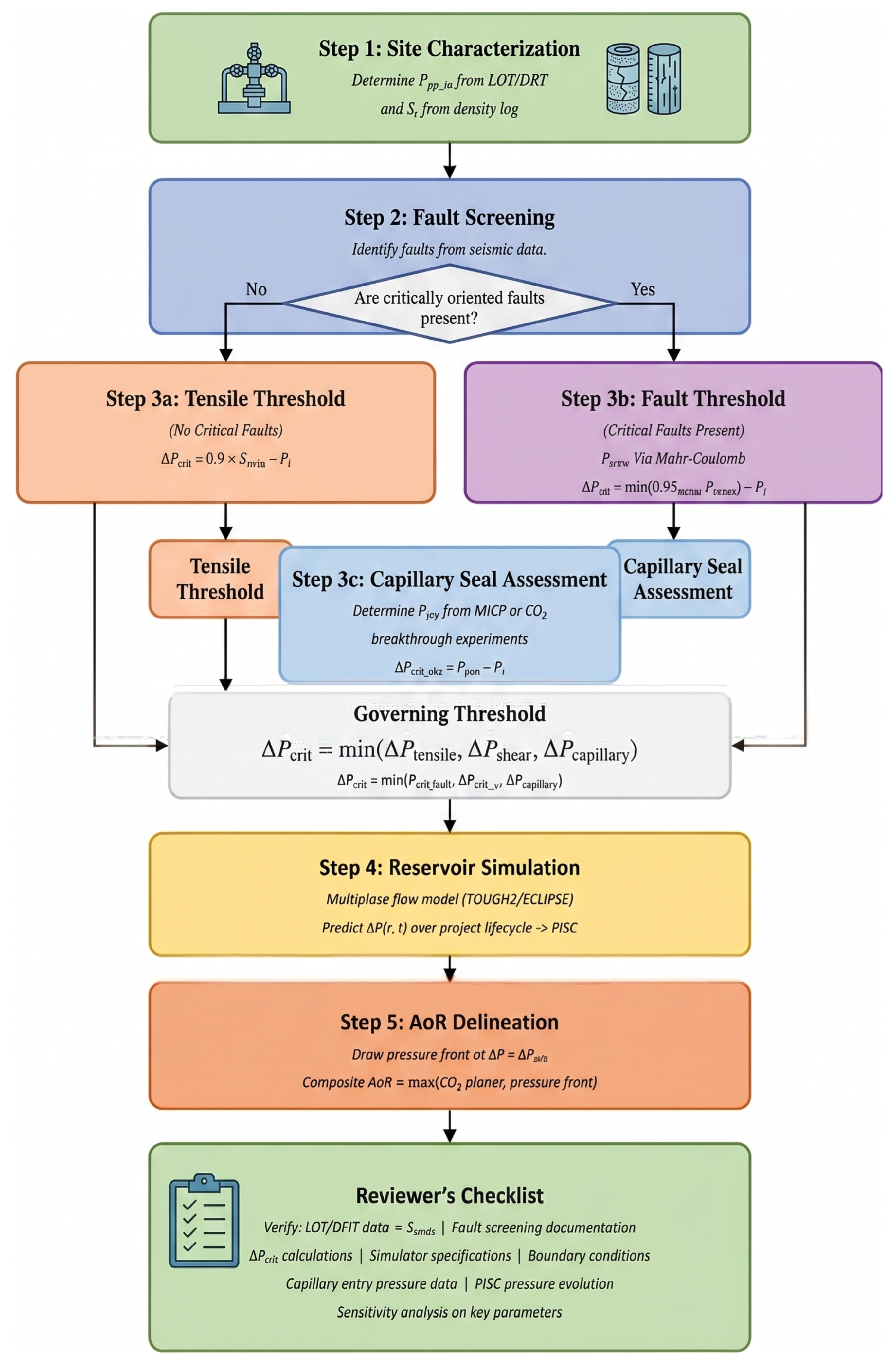
To facilitate implementation as an alternative site-specific approach, Figure 3 outlines a standardized workflow for operators and a corresponding checklist for regulatory reviewers. The process begins with rigorous site characterization using direct geomechanical measurements (e.g., Leak-Off Tests, Diagnostic Fracture Injection Tests) to establish S h m i n . Crucially, it requires a fault screening step using 3D seismic data to determine if critically oriented faults are present, which dictates whether the tensile or shear threshold must be applied. The workflow also incorporates a capillary seal assessment step, where operators evaluate the capillary entry pressure of the caprock through MICP testing or direct CO 2 breakthrough experiments, ensuring that the most restrictive containment condition governs the AoR boundary.

4. Synthetic Case Study: Texas Gulf Coast Basin

4.1. Site Characterization and Model Setup

To demonstrate the proposed methodology, a synthetic case study was developed based on the petrophysical and geomechanical properties of the deep Frio Formation in the Texas Gulf Coast Basin [24,27]. The target injection zone is a laterally extensive saline aquifer located at a depth of 3200 m, with no overlying USDW.
The pressure profiles presented in this study were generated using a semi-analytical modeling approach implemented in Python, ensuring full transparency and reproducibility without requiring specialized software licenses. The model employs a one-dimensional radial domain with logarithmic spacing, extending from the wellbore radius ( r = 0.15 m) to a far-field boundary ( r = 100 km), with a constant-pressure outer boundary condition. Far-field pressure diffusion in the single-phase brine region is governed by the Theis diffusivity equation, while the near-wellbore pressure enhancement due to two-phase flow (CO2 displacing brine) is captured through an effective mobility correction that accounts for the reduced relative permeability of the CO2–brine mixture ( k r , eff = 0.15 ), modeled as a transient skin effect. This approach provides a conservative representation of near-wellbore pressure buildup while preserving the analytical tractability needed for rapid sensitivity analysis. Detailed model specifications, including fluid properties, boundary conditions, and the two-phase mobility formulation, are provided in Appendix A. The primary reservoir and geomechanical parameters are summarized in Table 3.

4.2. Critical Pressure Determination

Following the workflow in Figure 3, the critical pressure thresholds are calculated based on the site characterization data.
For the tensile fracture threshold (assuming no critical faults):
Δ P c r i t , t e n s i l e = 0.9 × 52.8 MPa 31.4 MPa = 16.12 MPa
For the fault reactivation threshold (assuming a critically oriented fault with μ = 0.6 ):
q = 0.6 2 + 1 + 0.6 2 = 3.12
P s h e a r = 72.2 3.12 × 52.8 1 3.12 = 43.6 MPa
Δ P c r i t , s h e a r = 43.6 MPa 31.4 MPa = 12.2 MPa
Because Δ P c r i t , s h e a r < Δ P c r i t , t e n s i l e , the governing threshold for the AoR delineation is 12.2 MPa. This highlights the importance of fault screening; relying solely on the 90% fracture pressure rule would overestimate the safe operating envelope if critically oriented faults are present. For this case study with a competent shale caprock, the capillary entry pressure (>20 MPa above P i based on typical deep Gulf Coast shale values from Espinoza and Santamarina [25]) does not govern. Therefore, the final Δ P c r i t = 12.2 MPa.

4.3. Pressure Front Delineation

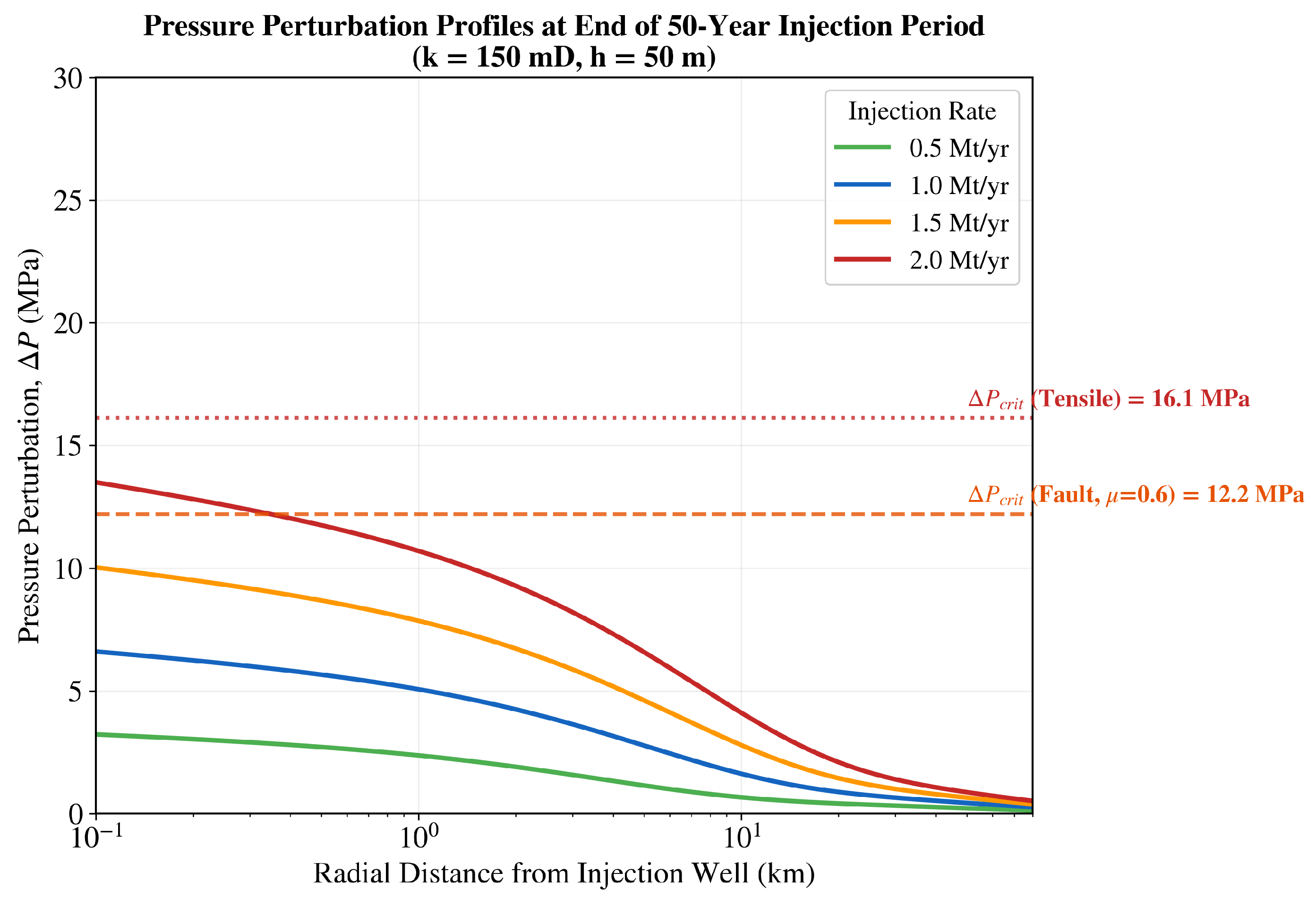
Figure 4 presents the simulated spatial pressure perturbation profiles at the end of a 50-year injection period for multiple injection rates ranging from 0.5 to 2.0 million metric tons per year (Mt/yr). The profiles capture the steep pressure gradient near the wellbore caused by two-phase flow (CO2 displacing brine) and the logarithmic decay in the far-field single-phase brine region.
For the 1.0 Mt/yr base case, the maximum pressure perturbation at the wellbore remains below both thresholds, indicating that the entire reservoir remains within the safe geomechanical envelope. In this scenario, the AoR would be defined entirely by the extent of the separate-phase CO2 plume, as the geomechanical pressure front radius is zero.
However, at an injection rate of 2.0 Mt/yr, the near-wellbore pressure exceeds the fault reactivation threshold ( Δ P c r i t , s h e a r = 12.2 MPa). The intersection of the 2.0 Mt/yr pressure profile with the 12.2 MPa threshold occurs at a radial distance of approximately 1.5 km. Therefore, for the 2.0 Mt/yr scenario, the pressure front boundary is defined as a 1.5 km radius around the injection well. If no critically oriented faults were present, the tensile threshold (16.1 MPa) would apply, and the pressure front radius would be reduced to approximately 0.5 km.

4.4. Post-Injection Site Care (PISC) Evolution

A critical aspect of Class VI permitting is understanding pressure behavior during the Post-Injection Site Care (PISC) period. After injection ceases, the near-wellbore pressure drops rapidly, but the pressure pulse continues to propagate outward into the far-field [17].
The spatiotemporal evolution of the pressure field was evaluated for the 2.0 Mt/yr scenario over a 50-year injection period followed by 50 years of post-injection site care. Results show that near-wellbore pressure ( r = 1 km) drops immediately upon shut-in, while pressures at greater distances (e.g., r = 20 km) continue to rise for decades before eventually dissipating, a characteristic behavior of pressure diffusion in confined aquifers. Spatial pressure profiles extracted at 10, 25, and 50 years into the PISC period confirm a progressive redistribution and relaxation of the pressure perturbation. Crucially, the maximum spatial extent of the geomechanical pressure front (the region exceeding 12.2 MPa) occurs precisely at the end of injection and strictly contracts during the PISC period. This confirms that an AoR delineated based on end-of-injection conditions is protective for the entire project lifecycle.

4.5. Sensitivity Analysis

To demonstrate the robustness of the methodology under varying geologic conditions, sensitivity analyses were conducted on reservoir permeability, caprock fracture gradient, and fault friction coefficient.
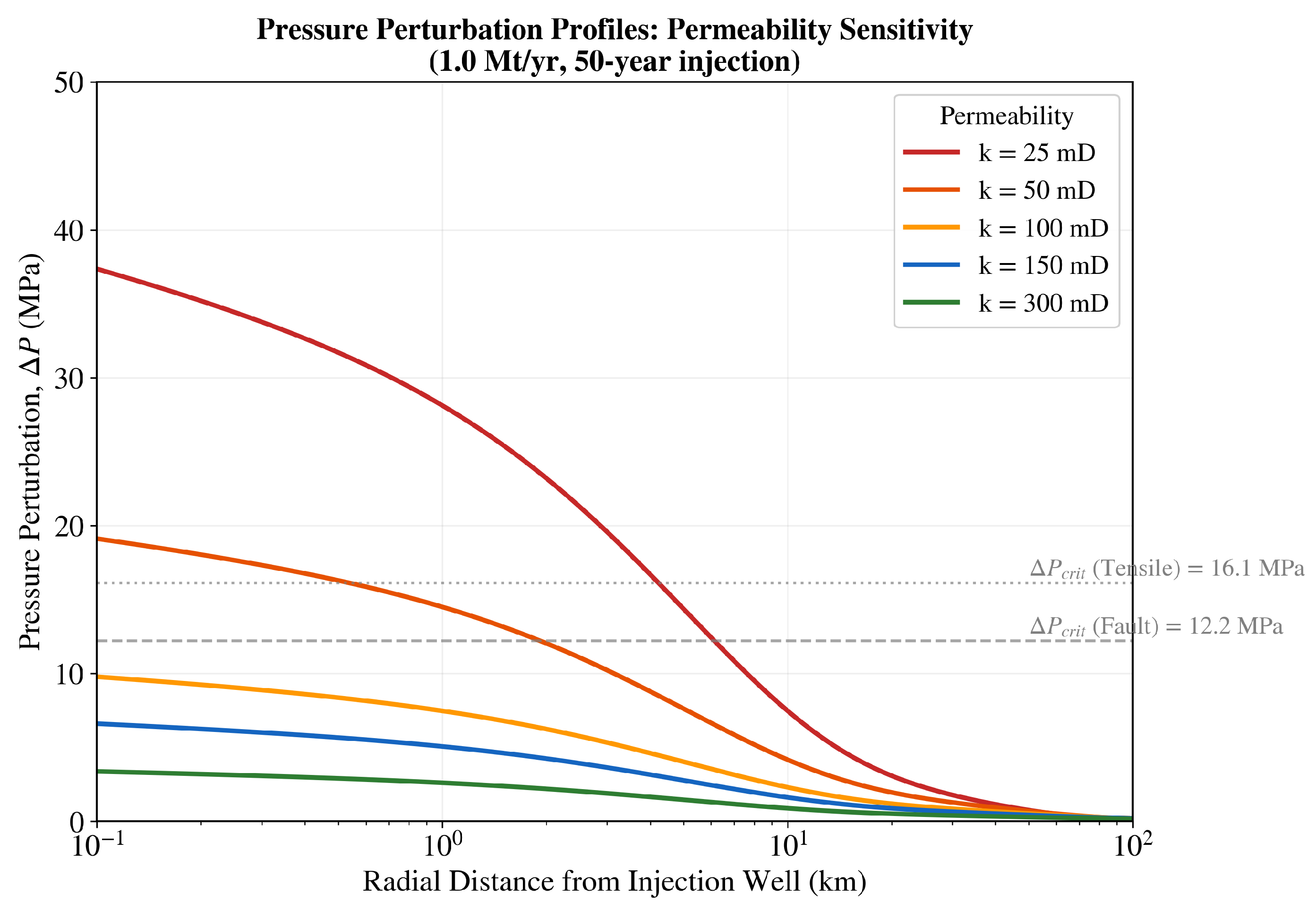
In deep saline formations, permeability can vary by orders of magnitude [28]. Figure 5 shows the pressure profiles for a 1.0 Mt/yr injection rate across permeabilities ranging from 25 mD to 300 mD. In low-permeability scenarios (25 mD and 50 mD), the pressure buildup significantly exceeds both geomechanical thresholds, resulting in expansive pressure fronts (e.g., >10 km for the 25 mD case). This demonstrates that the proposed method effectively captures the increased operational risk associated with low-injectivity reservoirs, appropriately expanding the AoR to reflect the larger area subjected to geomechanical stress.
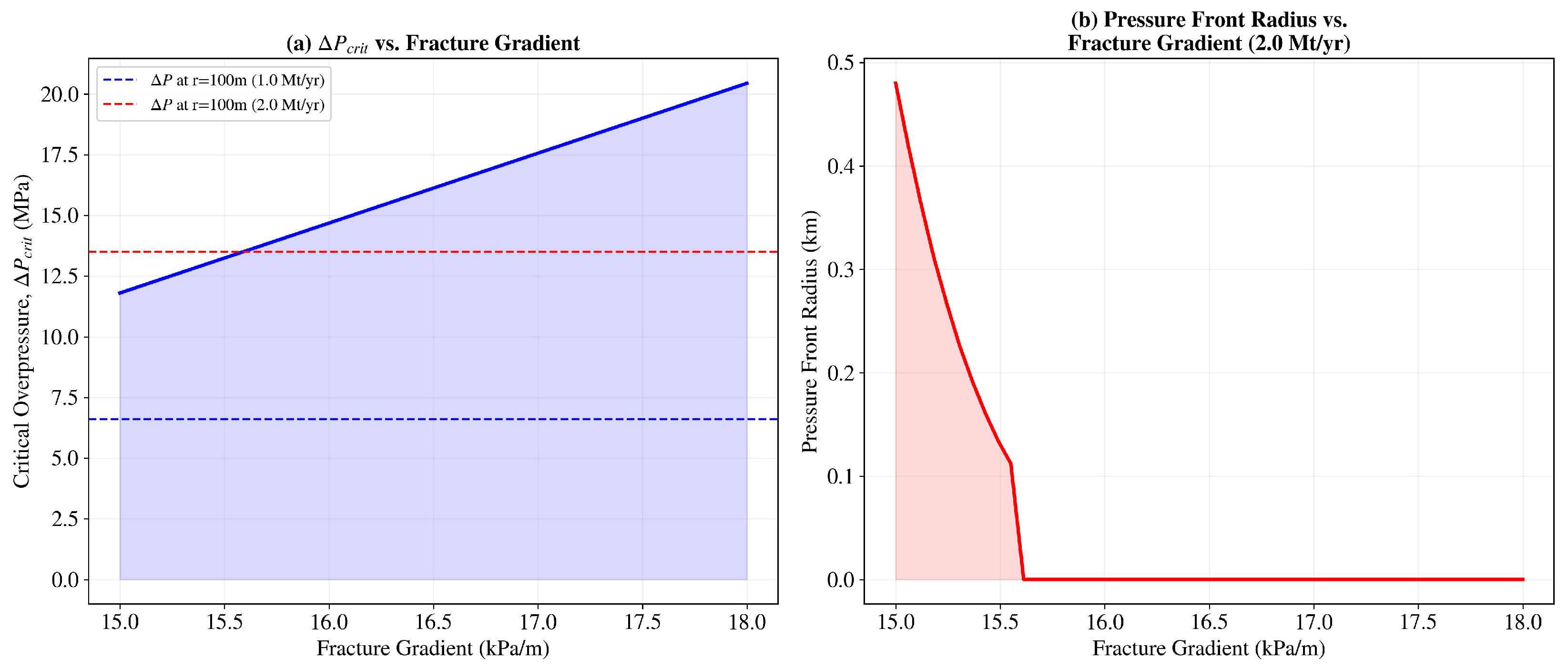
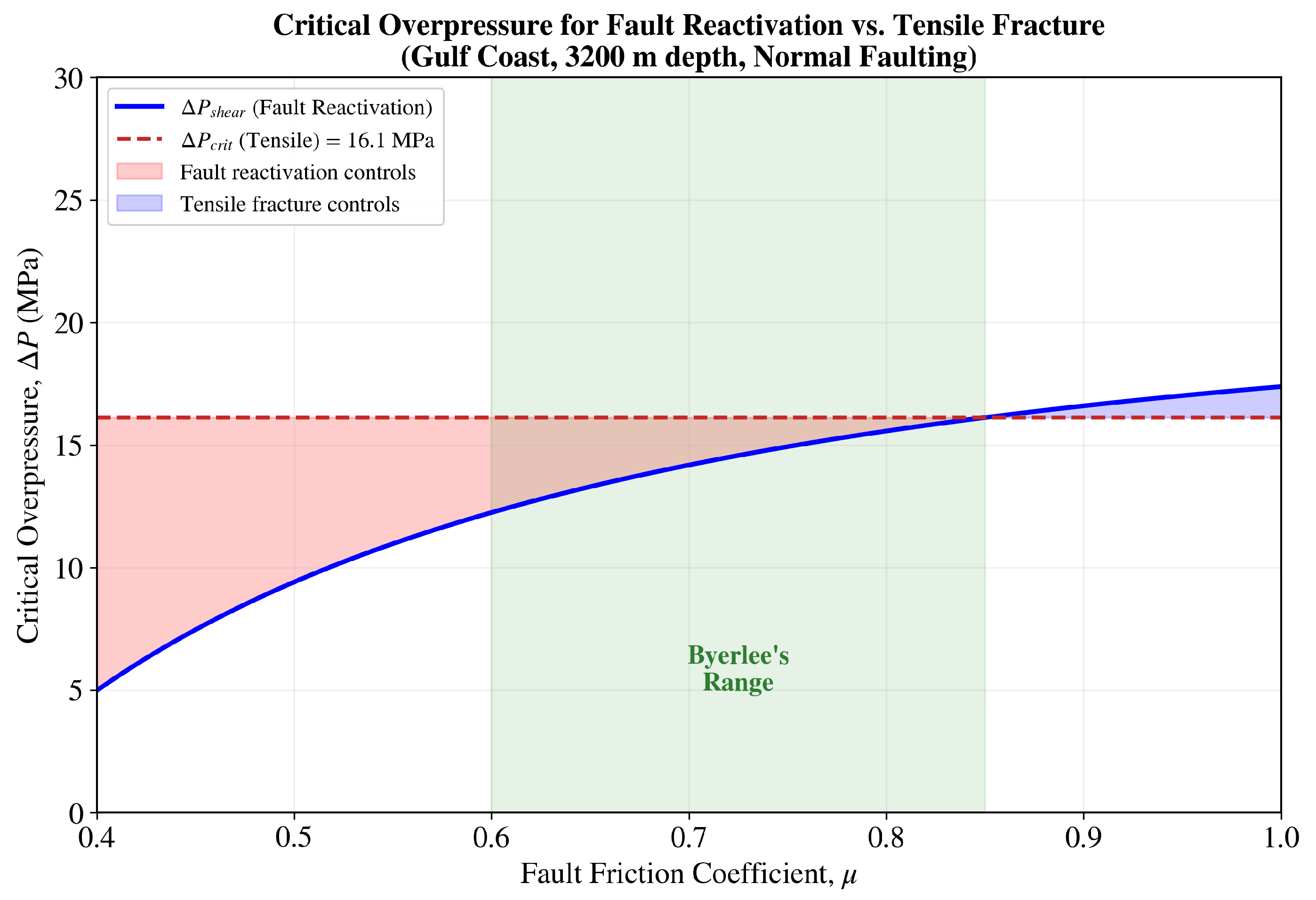
Fracture Gradient and Friction Sensitivity: Figure 6 illustrates the sensitivity of the tensile threshold and resulting AoR radius to variations in the caprock fracture gradient. As the fracture gradient decreases (weaker rock), the allowable overpressure drops linearly, resulting in a non-linear expansion of the AoR radius. Figure 7 maps the critical overpressure against the fault friction coefficient. Within Byerlee’s expected range for crustal rocks ( μ = 0.6 to 0.85 ), fault reactivation consistently occurs at a lower pressure than tensile fracture, reinforcing the necessity of Step 2 (Fault Screening) in the proposed workflow.

5. Discussion

5.1. Regulatory Implications

The proposed geomechanical framework offers a direct solution to the regulatory impasse encountered in deep basin and offshore carbon storage projects. By framing this approach as an alternative site-specific modeling approach under 40 CFR 146.84(c), operators can utilize it within the existing regulatory structure without requiring statutory rule changes. The method aligns with the fundamental intent of the Class VI program—containment assurance—by shifting the protective metric from a non-existent USDW to the mechanical integrity of the caprock. The inclusion of the reviewer checklist (Figure 3) ensures that regulatory agencies can evaluate these applications with the same rigor and consistency applied to traditional USDW-based AoRs.

5.2. Capillary Seal Failure

The proposed framework incorporates capillary seal failure as a third containment threshold alongside tensile fracture and fault reactivation (Equation (9)). Capillary seal failure occurs when the buoyancy pressure of the CO 2 column exceeds the capillary entry pressure of the caprock pore network, allowing supercritical CO 2 to migrate into the confining zone without mechanically fracturing it. For highly competent shale caprocks with clay-rich matrices, typical capillary entry pressures range from 10 to >50 MPa, which far exceed the geomechanical thresholds calculated in this study [25,29]. However, for silty mudstone interbeds or poorly compacted caprocks, capillary breakthrough can occur at pressures as low as 2–5 MPa [29,30], potentially governing the AoR boundary. Table 4 presents representative capillary entry pressure ranges by caprock lithology to guide site-specific assessments.

5.3. Induced Seismicity Considerations

By explicitly incorporating a Mohr–Coulomb fault reactivation analysis, the proposed methodology intrinsically links AoR delineation with induced seismicity risk management. The region defined by the shear-based pressure front represents the maximum area within which critically oriented faults could theoretically be brought to failure. Consequently, this geomechanically defined AoR not only serves to identify areas requiring corrective action for artificial penetrations but also delineates the geographic domain over which microseismic monitoring networks should be deployed and focused [31].

5.4. Formation Heterogeneity

While the synthetic case study utilized a homogeneous radial model to clearly illustrate the conceptual framework, real-world applications must account for 3D geologic heterogeneity. Variations in facies, stratigraphic pinch-outs, and permeability anisotropy will result in an asymmetrical pressure front. The proposed threshold ( Δ P c r i t ) remains valid in these complex settings; operators simply extract the corresponding pressure contour from their 3D multiphase flow simulations (e.g., TOUGH2 or ECLIPSE) to map the irregular boundary of the AoR. The analytical framework provides the threshold value; the numerical model provides the spatial geometry. This separation allows the threshold methodology to be applied independently of the modeling complexity chosen by the operator.

5.5. Model Limitations and Numerical Verification

The semi-analytical model employed in this study assumes a homogeneous, isotropic, single-layer reservoir with radial symmetry. These simplifications are appropriate for conceptual demonstration and sensitivity analysis but introduce uncertainties when applied to real geological settings. Heterogeneity in permeability fields can create localized pressure accumulations that exceed the radially averaged predictions, while multi-layer connectivity (e.g., through leaky seals or fault conduits) may dissipate pressure more rapidly. Based on published comparisons between 1D radial analytical solutions and full-physics 3D simulations using TOUGH2 and ECLIPSE [17,18], the estimated error range for pressure front radius is approximately ±15–30%, depending on the degree of heterogeneity. For permit-level AoR delineation, operators should employ 3D multiphase flow simulators (e.g., TOUGH2, ECLIPSE, CMG-GEM) that incorporate site-specific geological models constructed from well log, seismic, and core data. The analytical framework presented here is most valuable as a screening tool, for preliminary permit applications, and for regulatory consistency, ensuring that all operators apply the same threshold methodology regardless of the numerical platform used for spatial pressure mapping. Furthermore, emerging artificial intelligence frameworks that integrate multimodal subsurface data, such as seismic interpretations, well logs, and production histories, through large language models and domain-specific retrieval-augmented generation [32] may facilitate more efficient site characterization and parameter estimation for the geomechanical inputs required by this framework.

5.6. Injection Feasibility Constraints

The AoR delineation and injection feasibility are intrinsically coupled. In low-permeability reservoirs, achieving the target injection rate may require bottomhole pressures that approach or exceed the geomechanical thresholds, creating a conflict between injection objectives and containment constraints. The maximum sustainable injection rate for a single well is bounded by the requirement that bottomhole pressure not exceed 90% of the fracture pressure (40 CFR 146.88). For the synthetic case parameters ( k = 150 mD, h = 50 m), the 1.0 Mt/yr rate remains well within this constraint. However, reducing permeability to 25 mD increases the required bottomhole pressure above the fault reactivation threshold for rates exceeding approximately 0.3 Mt/yr. In such low-permeability settings, operators may need to employ multi-well injection strategies, reduce individual well rates, or target higher-permeability intervals. This feasibility boundary should be evaluated concurrently with AoR delineation to ensure that the proposed injection plan is physically achievable within the safe geomechanical envelope. Future work should develop coupled injection-feasibility and AoR optimization models that simultaneously minimize the AoR footprint while maximizing storage efficiency.

5.7. Toward a Probabilistic AoR Framework

The deterministic threshold approach presented in this study provides a clear, conservative boundary for regulatory decision-making. However, it does not capture the inherent uncertainties in subsurface parameters. A probabilistic extension of the framework would propagate uncertainties in key input parameters ( S h m i n , S v , μ , P i , k, capillary entry pressure) through the Mohr–Coulomb and tensile failure calculations using Monte Carlo simulation or First-Order Reliability Method (FORM) analysis. Table 5 illustrates example parameter distributions and the resulting range of Δ P c r i t values for the synthetic case.
Monte Carlo analysis (10,000 realizations) using the distributions in Table 5 yields a Δ P c r i t range of 8.1–16.8 MPa (10th–90th percentile), with a median of 12.0 MPa, closely matching the deterministic value of 12.2 MPa. This suggests that the deterministic approach is approximately median-unbiased for this parameter set. A probabilistic framework would allow regulators to define AoR boundaries corresponding to specific confidence levels (e.g., the 90th or 95th percentile Δ P c r i t ), providing a more nuanced risk assessment. Recent advances in machine learning offer promising pathways toward efficient probabilistic AoR delineation: dimension-adaptive Bayesian neural networks have demonstrated the ability to reduce uncertainty quantification analysis time for 3D carbon storage models by 87% while maintaining prediction accuracy within 5% of full simulations [33], and Bayesian neural networks have shown effectiveness in quantifying uncertainty in solute transport through heterogeneous porous media [34]. Integration of such surrogate modeling techniques with the geomechanical threshold framework presented here could enable rapid probabilistic AoR assessments. Development and validation of a full probabilistic AoR methodology is recommended as future work.

6. Conclusions

The delineation of the Area of Review is a cornerstone of carbon storage permitting, yet traditional methods fail in deep sedimentary basins lacking overlying USDWs. This paper presents a robust, geomechanics-based alternative that defines the pressure front based on caprock tensile fracture, fault reactivation thresholds, and capillary breakthrough pressure.
Key conclusions include: 1. In the absence of a USDW, the pressure front should be defined by the physical limits of the containment system, utilizing existing Class VI constraints on injection pressure. This extension to the caprock is supported by international CCS risk management standards (ISO/TR 27918, ISO 27914) and the regulatory intent of 40 CFR 146.88(a). 2. Mohr–Coulomb analysis demonstrates that for typical deep basin stress regimes, the reactivation of optimally oriented faults often occurs at lower overpressures than tensile fracturing, making fault screening a critical step in AoR delineation. The framework is generalizable to normal, strike-slip, and reverse faulting regimes through appropriate stress axis assignments (Table 1). 3. The proposed methodology, applicable as an alternative site-specific approach under 40 CFR 146.84(c), yields finite, physically meaningful AoR boundaries that scale dynamically with injection rates, reservoir permeability, and geomechanical rock properties. Quantitative poroelastic analysis (Table 2) confirms that the static-stress-based threshold is conservative during active injection. 4. Maximum spatial extent of the geomechanical pressure front occurs at the cessation of injection; subsequent PISC period dynamics show a relaxation of the front, confirming lifecycle protectiveness. 5. Capillary breakthrough pressure serves as a third threshold (Equation (9)), ensuring that the most restrictive containment condition governs the AoR boundary, particularly for sites with silty mudstone or poorly compacted caprocks. 6. The AoR delineation report template (Appendix B) and operator workflow provide a standardized pathway for permit applications and regulatory review, reducing communication barriers between operators and regulatory agencies.
By adopting this framework, operators and regulators can confidently advance geologic sequestration projects in high-capacity, deep sedimentary basins, ensuring rigorous environmental protection while avoiding the regulatory paralysis caused by undefined analytical parameters.


Funding

This research received no external funding.

Data Availability Statement

Data generated during this study, including simulation parameters and Python scripts for figure generation, are available from the corresponding author upon reasonable request.

Acknowledgments

SKM expresses gratitude to the Department of Construction Management at Everglades University for institutional support.

Conflicts of Interest

The author declares no conflicts of interest.

Appendix A. Analytical Modeling and Python Implementation

The pressure profiles presented in this study were generated using an analytical modeling approach implemented in Python. This ensures that the methodology is fully transparent, reproducible, and accessible to operators and regulatory agencies without requiring specialized software licenses. The governing physics account for the displacement of formation brine by supercritical CO 2 using a modified Theis solution that incorporates a two-phase mobility correction.
The Python model utilizes a 1D radial domain extending from r = 0.15 m (wellbore) to r = 100 km (far-field boundary). The boundary conditions assume constant mass rate injection at the inner boundary and constant pressure at the outer radius. The fluid properties utilized in the model include a supercritical CO 2 density of ρ c = 480 kg/m3 and viscosity of μ c = 4.0 × 10 5 Pa·s. The formation brine density is set to ρ w = 1070 kg/m3 with a viscosity of μ w = 3.0 × 10 4 Pa·s. The total system compressibility is c t = 4.5 × 10 10 Pa−1.
To accurately capture multiphase flow dynamics, the model employs an effective two-phase mobility approach. The near-wellbore region experiences an additional pressure drop (modeled as a transient skin effect) due to the reduced relative permeability of the CO 2 –brine mixture ( k r , e f f = 0.15 ). This two-phase region transitions to single-phase brine flow in the far-field, which is strictly governed by the Theis diffusivity equation.

Appendix B. AoR Delineation Report Template

This appendix provides a standardized template for operators preparing AoR delineation reports under the geomechanical framework. Regulatory reviewers can use this template as a checklist to verify completeness.
Table A1. Input Parameter Summary.
ParameterData Source
Depth to injection zone (m)Well logs
Aquifer thickness (m)Well logs, seismic
Porosity (%)Core analysis
Permeability (mD)Core, well tests
Initial reservoir pressure (MPa)Pressure gauges
S v (MPa)Density log integration
S h m i n (MPa)LOT/DFIT
S H m a x (MPa, if needed)Breakout analysis
Faulting regimeWSM, focal mechanisms
Fault friction coeff. ( μ )Lab tests, literature
Capillary entry pressure (MPa)MICP, CO 2 breakthrough
Table A2. Threshold Calculation Worksheet Equations.
Calculation StepUnit
1. Tensile threshold: Δ P c r i t , t e n s i l e = 0.9 × S h m i n P i MPa
2. Fault reactivation: q = ( μ 2 + 1 + μ ) 2
3. P s h e a r = ( σ 1 q · σ 3 ) / ( 1 q ) MPa
4. Δ P c r i t , s h e a r = P s h e a r P i MPa
5. Δ P c r i t , c a p i l l a r y = P c a p P i MPa
6. Governing: Δ P c r i t = min (Steps 1, 4, 5)MPa
7. Governing constraint type(tensile/shear/capillary)
Table A3. AoR Summary.
ItemValue/Description
AoR pressure front radius (or boundary coords.)
CO 2 plume maximum extent
Governing AoR boundary(pressure front/plume)
Governing geomechanical constraint(tensile/shear/capillary)
Recommended monitoring domain radius
PISC period AoR evolution(expanding/stable/contracting)

References

  1. IPCC. Carbon Dioxide Capture and Storage; Intergovernmental Panel on Climate Change, Cambridge University Press: Cambridge, UK, 2005; Available online: https://www.ipcc.ch/report/carbon-dioxide-capture-and-storage/ (accessed on 27 March 2026).
  2. U.S. Environmental Protection Agency (EPA). Federal Requirements Under the Underground Injection Control (UIC) Program for Carbon Dioxide (CO2) Geologic Sequestration (GS) Wells. Fed. Regist. 2010, 75, 77230–77303. Available online: https://www.govinfo.gov/content/pkg/FR-2010-12-10/pdf/2010-29954.pdf (accessed on 27 March 2026).
  3. U.S. Environmental Protection Agency (EPA). Geologic Sequestration of Carbon Dioxide: Area of Review Evaluation and Corrective Action Guidance; EPA 816-R-13-005; Office of Water: Washington, DC, USA, 2013. Available online: https://www.epa.gov/sites/default/files/2015-07/documents/epa816r13005.pdf (accessed on 27 March 2026).
  4. U.S. Environmental Protection Agency (EPA). Report to Congress: Class VI Permitting on the Outer Continental Shelf; Office of Water: Washington, DC, USA, 2024. Available online: https://www.epa.gov/system/files/documents/2024-12/epa-class-vi-ocs-report-to-congress.pdf (accessed on 27 March 2026).
  5. Ground Water Protection Council (GWPC). Risk-Based Identification and Protection of USDW for Geologic Sequestration of CO2; White Paper; GWPC: Oklahoma City, OK, USA, 2025; Available online: https://www.gwpc.org/wp-content/uploads/2025/05/White-Paper-Risk-Based-Identification-and-Protection-of-USDW-for-Geologic-Sequestration-of-CO2.pdf (accessed on 27 March 2026).
  6. Gross, T. Emerging Issues in Class VI Permitting: Threshold Pressure Calculations. Presented at the GWPC Annual Forum. 2024. Available online: https://www.gwpc.org/wp-content/uploads/2024/10/Tara-Gross.pdf (accessed on 27 March 2026).
  7. Hostetler, C. A Computational Modeling Approach to Critical Pressure Calculations for Class VI Area of Review Delineation. Presented at the GWPC Annual Forum. 2023. Available online: https://www.gwpc.org/wp-content/uploads/2022/12/Hostetler-Charles.pdf (accessed on 27 March 2026).
  8. McKee, B.; Castro, L.; Rahman, A. Overview of the Class VI UIC Permitting Process in Texas; Railroad Commission of Texas: Austin, TX, USA, 2024. Available online: https://www.rrc.texas.gov/media/u4bptmof/class-vi-uic-permitting-process-in-texas-atia-rahman-bryce-mckee-leo-castro.pdf (accessed on 27 March 2026).
  9. Birkholzer, J.T.; Oldenburg, C.M.; Zhou, Q. CO2 migration and pressure evolution in deep saline aquifers. Int. J. Greenh. Gas Control 2015, 40, 203–220. [Google Scholar] [CrossRef]
  10. Nicot, J.-P. Evaluation of large-scale CO2 storage on fresh-water sections of aquifers: An example from the Texas Gulf Coast Basin. Int. J. Greenh. Gas Control 2008, 2, 582–593. [Google Scholar] [CrossRef]
  11. Cai, C.; Li, J.; Zhai, C.; Wang, B.; Xue, J.; Dong, Z.; Zhu, Z. Crack Propagation Characteristics in Shale under Cyclic In Situ Methane Detonation Impact Fracturing. Energy Fuels 2026, 40, 6064–6082. [Google Scholar] [CrossRef]
  12. Li, X.; Zhu, L.; Liu, J.; Cao, Z.; Xue, Y.; Dang, F. Fracture evolution and mechanical deterioration of granite under cyclic thermal and liquid nitrogen cryogenic impact. Phys. Fluids 2025, 37, 086652. [Google Scholar] [CrossRef]
  13. Rutqvist, J.; Birkholzer, J.; Cappa, F.; Tsang, C.-F. Estimating maximum sustainable injection pressure during geological sequestration of CO2 using coupled fluid flow and geomechanical fault-slip analysis. Energy Convers. Manag. 2007, 48, 1798–1807. [Google Scholar] [CrossRef]
  14. Zoback, M.D. Reservoir Geomechanics; Cambridge University Press: Cambridge, UK, 2007. [Google Scholar] [CrossRef]
  15. Bandilla, K.W.; Kraemer, S.R.; Birkholzer, J.T. Using semi-analytic solutions to approximate the area of potential impact for carbon dioxide injection. Int. J. Greenh. Gas Control 2012, 8, 196–204. [Google Scholar] [CrossRef]
  16. Nicot, J.-P.; Oldenburg, C.M.; Bryant, S.L.; Hovorka, S.D. Pressure perturbations from geologic carbon sequestration: Area-of-review boundaries and borehole leakage driving forces. Energy Procedia 2009, 1, 47–54. [Google Scholar] [CrossRef]
  17. Birkholzer, J.T.; Zhou, Q.; Tsang, C.-F. Large-scale impact of CO2 storage in deep saline aquifers: A sensitivity study on pressure response in stratified systems. Int. J. Greenh. Gas Control 2009, 3, 181–194. [Google Scholar] [CrossRef]
  18. Mathias, S.A.; Hardisty, P.E.; Trudell, M.R.; Zimmerman, R.W. Approximate solutions for pressure buildup during CO2 injection in brine aquifers. Transp. Porous Media 2009, 79, 265–284. [Google Scholar] [CrossRef]
  19. ISO/TR 27918:2018; Lifecycle Risk Management for Integrated CCS Projects. International Organization for Standardization: Geneva, Switzerland, 2018.
  20. ISO 27914:2017; Carbon Dioxide Capture, Transportation and Geological Storage—Geological Storage. International Organization for Standardization: Geneva, Switzerland, 2017.
  21. Vilarrasa, V.; Carrera, J. Geologic carbon storage is unlikely to trigger large earthquakes and reactivate faults through which CO2 could leak. Proc. Natl. Acad. Sci. USA 2015, 112, 5938–5943. [Google Scholar] [CrossRef] [PubMed]
  22. Lund Snee, J.-E.; Zoback, M.D. State of stress in Texas: Implications for induced seismicity. Geophys. Res. Lett. 2016, 43, 10208–10214. [Google Scholar] [CrossRef]
  23. Heidbach, O.; Rajabi, M.; Cui, X.; Fuchs, K.; Müller, B.; Reinecker, J.; Reiter, K.; Tingay, M.; Wenzel, F.; Xie, F.; et al. The World Stress Map database release 2016: Crustal stress pattern across scales. Tectonophysics 2018, 744, 453–461. [Google Scholar] [CrossRef]
  24. Bump, A.P.; Hovorka, S.D. Pressure space: The key subsurface commodity for CCS. Int. J. Greenh. Gas Control 2024, 136, 104174. [Google Scholar] [CrossRef]
  25. Espinoza, D.N.; Santamarina, J.C. CO2 breakthrough—Caprock sealing efficiency and integrity for carbon geological storage. Int. J. Greenh. Gas Control 2017, 66, 218–229. [Google Scholar] [CrossRef]
  26. Engelder, T.; Fischer, M.P. Influence of poroelastic behavior on the magnitude of minimum horizontal stress, Sh, in overpressured parts of sedimentary basins. Geology 1994, 22, 949–952. [Google Scholar] [CrossRef]
  27. Galloway, W.E.; Hobday, D.K.; Magara, K. Frio Formation of Texas Gulf Coastal Plain: Depositional systems, structural framework, and hydrocarbon distribution. AAPG Bull. 1982, 66, 649–688. [Google Scholar] [CrossRef]
  28. Hovorka, S.D.; Doughty, C.; Benson, S.M.; Pruess, K.; Knox, P.R. The impact of geological heterogeneity on CO2 storage in brine formations: A case study from the Texas Gulf Coast. Geol. Soc. Lond. Spec. Publ. 2004, 233, 147–163. [Google Scholar] [CrossRef]
  29. Chen, B.; Li, Q.; Tan, Y. Caprock sealing for geologic CO2 storage: Research advances, challenges and prospects. J. Rock Mech. Geotech. Eng. 2025, 18, 335–363. [Google Scholar] [CrossRef]
  30. Chen, B.; Li, Q.; Tan, Y.; Yu, T.; Gao, W.; Li, X.; Shen, S. Experimental study on evolution characteristics of CO2 breakthrough pressure for mudstone caprock under different effective stresses. Rock Soil Mech. 2024, 45, 3681–3693. [Google Scholar] [CrossRef]
  31. White, S.; Carroll, S.; Chu, S.; Bacon, D.; Pawar, R.; Cumming, L.; Hawkins, J.; Kelley, M.; Demirkanli, I.; Middleton, R.; et al. A risk-based approach to evaluating the Area of Review and leakage risks at CO2 storage sites. Int. J. Greenh. Gas Control 2020, 93, 102884. [Google Scholar] [CrossRef]
  32. Mahjour, S.K.; Mahjour, S.S. Intelligent Reservoir Decision Support: An Integrated Framework Combining Large Language Models, Advanced Prompt Engineering, and Multimodal Data Fusion for Real-Time Petroleum Operations. arXiv 2025, arXiv:2509.11376. [Google Scholar] [CrossRef]
  33. Mahjour, S.K.; Saleh, A.; Mahjour, S.S. Dimension-Adaptive Machine Learning for Efficient Uncertainty Quantification in Geological Carbon Storage Models. Processes 2025, 13, 1834. [Google Scholar] [CrossRef]
  34. Mahjour, S.K. Bayesian Neural Networks for Quantifying Uncertainty in Solute Transport Through Saturated Porous Media. Processes 2025, 13, 3324. [Google Scholar] [CrossRef]
Figure 1. Conceptual diagram illustrating (a) the standard EPA Class VI scenario with an overlying USDW, where the pressure front is defined by the potential for fluid migration, and (b) a deep basin scenario with no USDW, where traditional methods yield an infinite AoR, necessitating the proposed geomechanical pressure front boundary.
Processes 14 01328 g001
Figure 2. Mohr–Coulomb analysis for a normal faulting regime at 3200 m depth. The diagram illustrates the initial stable stress state and the shifting of Mohr circles to the left as pore pressure ( P p ) increases. Fault reactivation (for μ = 0.6 ) occurs at a lower critical pressure than tensile fracture.
Processes 14 01328 g002
Figure 3. Proposed geomechanical pressure front delineation workflow for operators, including a standardized checklist for regulatory reviewers to ensure rigorous application of the site-specific modeling approach.
Processes 14 01328 g003
Figure 4. Spatial pressure perturbation profiles at the end of a 50-year injection period for varying injection rates. The intersection of the pressure profile with the geomechanical thresholds defines the radius of the AoR pressure front.
Processes 14 01328 g004
Figure 5. Sensitivity of the pressure perturbation profile to reservoir permeability (1.0 Mt/yr injection rate). Low-permeability formations result in significant exceedances of the geomechanical thresholds, driving the delineation of larger AoRs.
Processes 14 01328 g005
Figure 6. (a) Sensitivity of the critical tensile overpressure to the fracture gradient. (b) The resulting non-linear expansion of the AoR pressure front radius as the fracture gradient decreases (evaluated at 2.0 Mt/yr). The red area represents the region associated with a higher gas injection rate (2.0 Mt/yr), and the blue area represents the region associated with a lower gas injection rate (1.0 Mt/yr).
Processes 14 01328 g006
Figure 7. Critical overpressure required for fault reactivation versus fault friction coefficient. Within Byerlee’s standard range, fault reactivation is the limiting geomechanical constraint compared to tensile fracture.
Processes 14 01328 g007
Table 1. Principal Stress Assignments and Critical Pressure Formulations by Faulting Regime.
ParameterNormalStrike-SlipReverse
σ 1 (max) S v S H m a x S H m a x
σ 3 (min) S h m i n S h m i n S v
P s h e a r S v q S h m i n 1 q S H m a x q S h m i n 1 q S H m a x q S v 1 q
Data needs S v , S h m i n (LOT/DFIT) S h m i n , S H m a x (breakout) S v , S H m a x (breakout + DFIT)
Table 2. Coupled Poroelastic Evolution of Pore Pressure and Minimum Horizontal Stress Over the Project Lifecycle (2.0 Mt/yr scenario at r = 0.5 km).
Time Period Δ P p (MPa) Δ S hmin (MPa) S hmin (MPa) Δ P crit (MPa)Safety Margin
Year 106.83.256.012.2Positive
Year 259.44.457.212.2Positive
Year 50 (EOI)12.15.758.512.2Positive
PISC +107.23.456.212.2Positive
PISC +254.11.954.712.2Positive
PISC +501.80.853.612.2Positive
Table 3. Reservoir and Geomechanical Parameters for the Synthetic Case Study.
ParameterSymbolValueUnit
Depth to Injection Zonez3200m
Aquifer Thicknessh50m
Porosity ϕ 22%
Permeability (Base Case)k150mD
Initial Reservoir Pressure P i 31.4MPa
Overburden Stress Gradient S v 22.6kPa/m
Vertical Stress S v 72.2MPa
Fracture Gradient S h m i n 16.5kPa/m
Minimum Horizontal Stress S h m i n 52.8MPa
Fault Friction Coefficient μ 0.6-
Stress Ratio ( K 0 = S h m i n / S v ) K 0 0.73
Note: S h m i n value (fracture gradient 16.5 kPa/m) is derived from Leak-Off Test (LOT) and Diagnostic Fracture Injection Test (DFIT) data reported for the deep Frio Formation [24] and calibrated against Gulf Coast stress profiles [14]. The stress ratio K 0 = 0.73 is consistent with observed values for normally pressured Gulf Coast sediments.
Table 4. Representative Capillary Entry Pressures by Caprock Lithology.
Caprock Lithology P cap Range (MPa Above P i )Likely Governing Threshold
Clay-rich shale (intact)>15–50Geomechanical
Indurated mudstone8–20Geomechanical
Silty mudstone2–8Capillary or Geomech.
Sandy/silty interbed0.5–3Capillary
Evaporite (anhydrite)>50Geomechanical
Table 5. Example Parameter Uncertainty Distributions and Resulting Δ P c r i t Range.
ParameterDistributionMeanSpreadBasis
S h m i n (MPa)Normal52.8 σ = 3.0 LOT/DFIT variability
μ (friction)Uniform0.60.5–0.85Byerlee’s range
k (mD)Log-normal150 σ ln = 0.5 Core data spread
P i (MPa)Normal31.4 σ = 1.0 Gauge uncertainty
Disclaimer/Publisher’s Note: The statements, opinions and data contained in all publications are solely those of the individual author(s) and contributor(s) and not of MDPI and/or the editor(s). MDPI and/or the editor(s) disclaim responsibility for any injury to people or property resulting from any ideas, methods, instructions or products referred to in the content.