1. Introduction
Fires and other emergency incidents occurring in waste treatment and storage facilities can result in serious environmental, social, and economic impacts, as reported in several previous studies [
1,
2,
3]. Fires in waste management facilities have been repeatedly reported to cause large-scale environmental impacts, including the release of hazardous pollutants such as dioxins, particulate matter, and toxic gases, as well as long-term soil and groundwater contamination [
2,
3]. In addition to direct property damage, such events may result in air pollution, soil and water contamination, interruptions in waste management operations, and increased risks for emergency responders and populations living in the vicinity of affected facilities, as demonstrated by fire incidents at municipal solid waste landfills. In several documented cases, such incidents have also resulted in prolonged disruptions to waste management operations and significant economic losses due to facility shutdowns, remediation measures, and emergency response activities. From a process engineering perspective, such incidents can be interpreted as failures of operational control within waste handling, storage, and treatment processes. Statistical analysis of fire incidents conducted by national fire authorities is commonly used as a basis for preventive activities in many countries. Their main contribution lies in identifying recurring patterns and trends that can subsequently be applied to fire prevention, surveillance, personnel training, and the optimization of firefighting procedures. In this context, fire statistics represent an important decision-support tool for process monitoring, risk control, and operational decision-making in waste management systems.
Nevertheless, detailed analyses of specific economic sectors are often constrained by resource availability and the effort required for data processing. Therefore, sector-specific fire analyses are not always carried out systematically. Municipal waste treatment and storage facilities exemplify this situation, including composting plants characterized by large volumes of biologically active material stored in open piles. In several cases, more targeted analyses in this field have therefore been undertaken by academic institutions rather than by national fire authorities [
1,
4,
5,
6]. Previous studies differ considerably in scope, data sources, and level of detail. For instance, study [
5] addresses waste management facilities without distinguishing between municipal and hazardous waste and is based on data obtained from national authorities, questionnaires, and interviews. Study [
7] focuses exclusively on municipal solid waste landfills and relies on publicly available sources. A broader range of waste treatment facilities is considered in [
8]; however, the paper does not clearly specify the types of facilities included, nor does it provide sufficient information on the number of facilities in the analyzed area or on the exact origin of the data used. These limitations complicate both the interpretation of the results and their comparison with findings from other studies [
1,
5].
Despite the growing body of literature [
1,
3,
5], fire incidents in waste management facilities are rarely analyzed explicitly as dynamic operational processes involving interacting material flows, storage conditions, and human interventions. Existing studies typically emphasize statistical descriptions of incidents or isolated technical causes, while process-level representations of fire development and escalation remain limited. As a result, the translation of incident data into actionable process-oriented prevention and control measures is often insufficiently addressed. The present paper builds on the above-mentioned research, particularly studies [
1,
5,
7], and further develops this topic by focusing solely on municipal waste management facilities. These facilities exhibit specific operational conditions and safety-related characteristics that differ from those associated with hazardous waste management. A notable limitation of several existing studies, particularly [
1], is their reliance on publicly available data sources, which may contain incomplete records or uncertainties in reported parameters. Moreover, previous research [
6,
9] has often concentrated primarily on municipal solid waste landfills and has not addressed safety aspects across the full spectrum of municipal waste management facilities.
To reduce these limitations, the present study makes use of incident records obtained from a non-public database of the Fire Rescue Service of the Czech Republic. These data are supplemented by information from industrial accident databases and by operational experience reported by municipal waste management facility operators. This combination of sources allows a more detailed examination of fire incidents and their characteristics across different types of municipal waste management facilities. The primary contribution of this study lies not in the introduction of new data sources but in the systematic, process-oriented evaluation of non-public fire incident records and their comparison with publicly available datasets, enabling an assessment of data consistency, uncertainty, and process-level risk relevance. Unlike previous studies [
1,
5,
7], this work integrates non-public incident data with process-oriented scenario modelling, enabling a transition from descriptive fire statistics to scenario-based risk control and operational decision-making. This study aims to evaluate fire incidents in municipal waste management facilities using non-public fire service records, with a focus on their applicability for process-based risk assessment and prevention. Particular attention is given to identifying potential differences between publicly available fire statistics and non-public fire service records in order to assess their consistency and applicability for risk-oriented analysis. The study examines fire incident patterns across facility types, compares results derived from non-public and publicly available data sources, and evaluates the reliability of selected quantitative incident parameters. In this study, the term “risk” is used in a process-oriented context to support scenario-based interpretation and risk management. It does not represent a quantitative measure combining probability and consequences, but rather a qualitative framework for understanding incident development and identifying preventive and mitigation measures. Accordingly, the term “risk assessment” is used in a qualitative and process-oriented sense throughout the paper and does not imply a formal quantitative evaluation based on probability or consequence metrics. Based on these objectives, the study addresses the following research questions:
RQ1: What is the proportion and frequency of fires in municipal solid waste landfills compared to other types of municipal waste management facilities?
RQ2: To what extent do results derived from non-public fire incident records differ from those reported in publicly available sources?
RQ3: How are quantitative parameters selected (e.g., extinguishing water consumption, affected area) recorded and usable for process-level comparative evaluation and preventive planning?
2. Materials and Methods
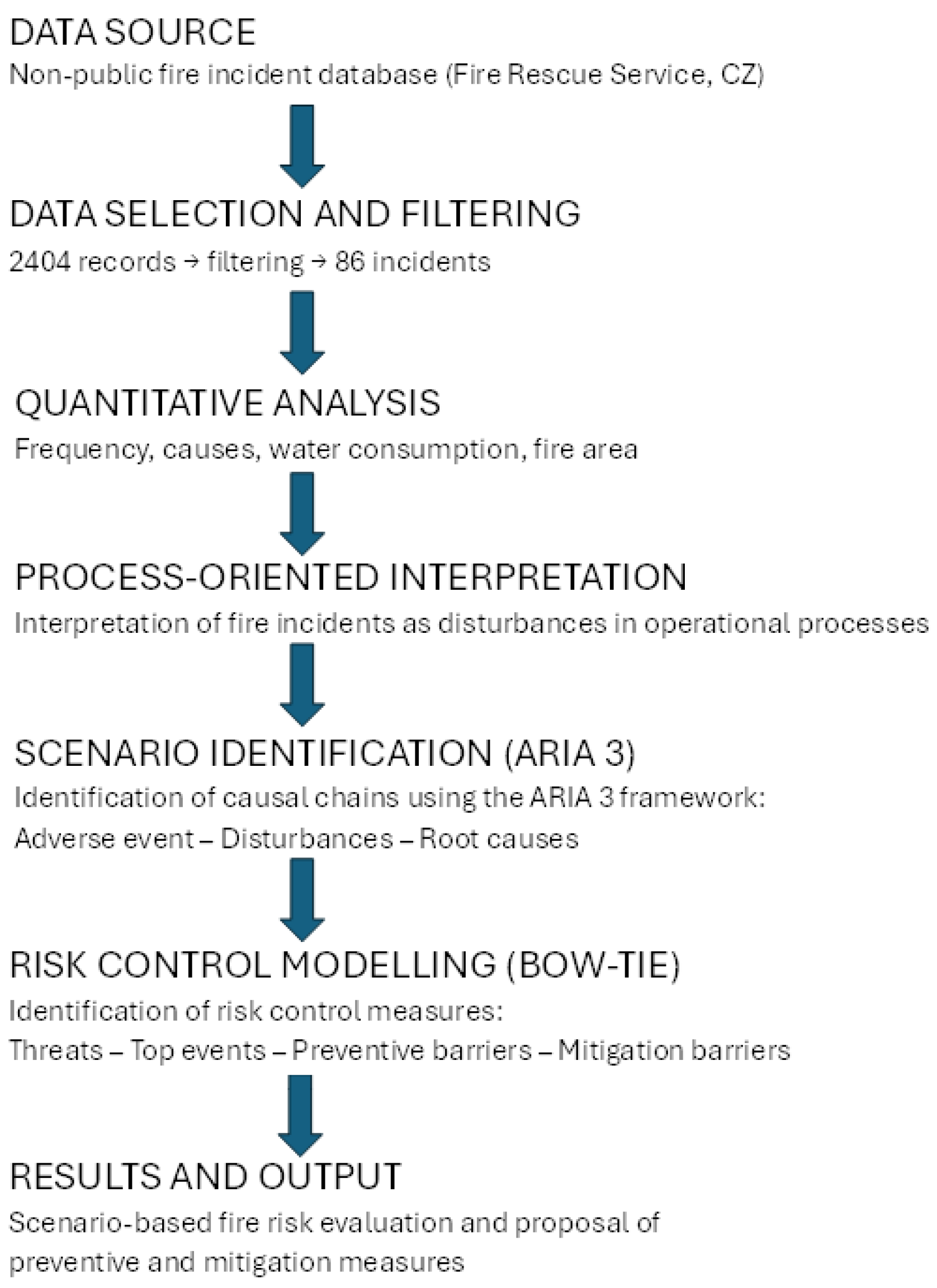
This study does not perform a quantitative risk assessment in a strict sense; instead, it supports qualitative, scenario-based risk interpretation. Therefore, the results should be interpreted as supporting qualitative, scenario-based risk understanding rather than providing a quantitative risk assessment in a strict engineering sense. The overall methodological procedure applied in this study is summarized in
Figure 1.
2.1. Analysis of Available Information from the Non-Public Database of the Fire Rescue Service
An analysis of fire incidents in municipal waste management facilities was conducted in the South Moravian Region of the Czech Republic over the period 2013–2022. The selected time period (2013–2022) reflects the availability of consistent and sufficiently detailed incident records within the non-public database. Earlier records were either incomplete or not directly comparable due to differences in reporting structure and data quality. The region covers an area of approximately 7200 km2 and has a population of about 1.2 million inhabitants. It comprises a diverse portfolio of municipal waste management infrastructure, including 14 landfills (of which 4 are hazardous waste landfills), one municipal solid waste incineration plant, 28 composting facilities (data from 2021), and 145 household waste recycling centers (data from 2019).
The South Moravian Region was selected as a representative case study due to the diversity of facility types, operational practices, and waste streams, as well as the availability of consistent long-term incident records. This diversity allows the evaluation of fire incident patterns across a broad spectrum of municipal waste management processes.
The data used for the analysis were obtained from the non-public fire incident database of the Fire Rescue Service of the Czech Republic. This database is compiled within the framework of legally mandated incident reporting and post-incident investigation procedures. Data entries are created by trained fire service personnel and are subject to internal verification processes, supporting their authenticity and analytical reliability.
At present, the Fire Rescue Service does not classify incidents directly according to waste management facility types. Fires are instead assigned to general building categories for statistical purposes (e.g., “storage buildings other than agricultural”). To identify relevant records, the keyword “waste” was used in the database search, resulting in 2404 entries. These records were subsequently filtered based on whether the incident occurred in a waste storage or processing facility. Following this selection, a total of 86 fire incidents were identified and included in the detailed analysis. Excluded records primarily involved fires in municipal waste containers or waste collection vehicles and were therefore outside the scope of this study. At the time of analysis, complete and validated incident records were available only for the period 2013–2022. More recent data were not included due to ongoing validation and reporting procedures, which could affect data consistency. It should be noted that some quantitative parameters recorded in the database, such as extinguishing water consumption or affected fire area, are in certain cases based on post-incident estimates rather than direct measurements. The completeness of these parameters varies across individual records and missing or uncertain values were not subject to additional imputation. Instead, the analysis relies exclusively on available data and interprets the results with respect to their inherent uncertainty. This approach reflects the operational nature of the dataset and its primary purpose for incident reporting rather than detailed quantitative analysis.
2.2. Identifying Possible Emergency Scenarios
The ARIA 3 graphical model [
10,
11] was applied to identify and structure the causal mechanisms of fire incidents in the selected facilities. ARIA 3 is a process-oriented causal analysis framework designed to decompose incidents into three hierarchical levels: the adverse event, disturbances, and root causes. The selection of representative emergency scenarios was based on a combination of criteria, including the frequency of occurrence of specific incident types, their escalation potential, representativeness for individual facility categories, and the availability and quality of data for causal reconstruction. This multi-criteria approach ensures that the selected scenarios capture both typical and high-consequence fire development pathways relevant for process-oriented risk evaluation. A similar multi-criteria approach to scenario selection is discussed in process safety literature, where factors such as frequency, escalation potential, and representativeness are considered in the development of credible accident scenarios [
12,
13].
In this framework, a disturbance is defined as a deviation from normal operational conditions that alters system behavior and may initiate an adverse event under specific circumstances. Disturbances are observable process deviations, such as abnormal material conditions, equipment malfunction, or operational errors. Root causes precede these disturbances and represent underlying organizational, technical, or procedural deficiencies. The model allows multiple disturbances and root causes to be combined using logical AND/OR operators, reflecting the complex interaction of process failures leading to fire initiation and escalation.
The graphical scenarios presented in
Section 4 illustrate representative fire development pathways in municipal waste management facilities. These scenarios are interpreted as process failure chains, supporting the identification of critical threats, control gaps, and intervention points discussed in
Section 4. The final selection of scenarios reflects a balance between typical incident patterns and high-consequence events, ensuring both practical relevance and analytical representativeness.
2.3. Identification of Measures and Their Discussion
Preventive and mitigation measures were identified using the Bow-Tie methodology, based on the conceptual framework developed by the Centre for Chemical Process Safety (CCPS) of the American Institute of Chemical Engineers and the Energy Institute [
14]. The Bow-Tie methodology is a widely used risk analysis tool that integrates elements of fault tree and event tree analysis. It provides a graphical representation of the pathways leading to a top event and the corresponding preventive and mitigation barriers. In this study, the Bow-Tie approach is applied to structure fire risk control measures along the process timeline, linking identified threats with specific barriers and operational control mechanisms. The following key elements were used in the analysis:
Top Event
Preventive Barriers
Mitigation Barriers
Threat
The “Top Event” represents the point at which control over a hazardous condition is lost, resulting in fire initiation. “Preventive Barriers” are operational or technical controls implemented upstream of the Top Event to prevent its occurrence, while “Mitigation Barriers” are measures applied after the Top Event to limit fire propagation, reduce consequences, and restore process control. In the context of municipal waste management facilities, these barriers are interpreted as process-level control mechanisms associated with specific operational stages, such as waste acceptance, storage, monitoring, and emergency response [
13].
3. Quantitative Analysis of Fire Incidents
The results are presented not only in the form of statistical evaluations but also through selected scenario-based representations, which are further analyzed in
Section 4.
3.1. Frequency of Fires
A total of five facility types were identified where fires occurred between 2013 and 2022: landfills, composting plants, a waste-to-energy facility (WEF), metal waste processing facilities (MWPF), and civic amenity sites. The frequency of fire incidents is summarized in
Table 1. The results show that the majority of fire incidents occurred at landfills, with a total of 65 recorded events.
A pronounced concentration of fires was observed in 2017 and 2018, during which 41 incidents occurred, representing nearly half of all recorded fires over the entire observation period. From an analytical perspective, this temporal clustering indicates periods of elevated systemic risk rather than random variability. From a process perspective, this concentration reflects recurring vulnerabilities in landfill operational stages, particularly during waste deposition, compaction, and long-term storage.
3.2. Causes of the Fire
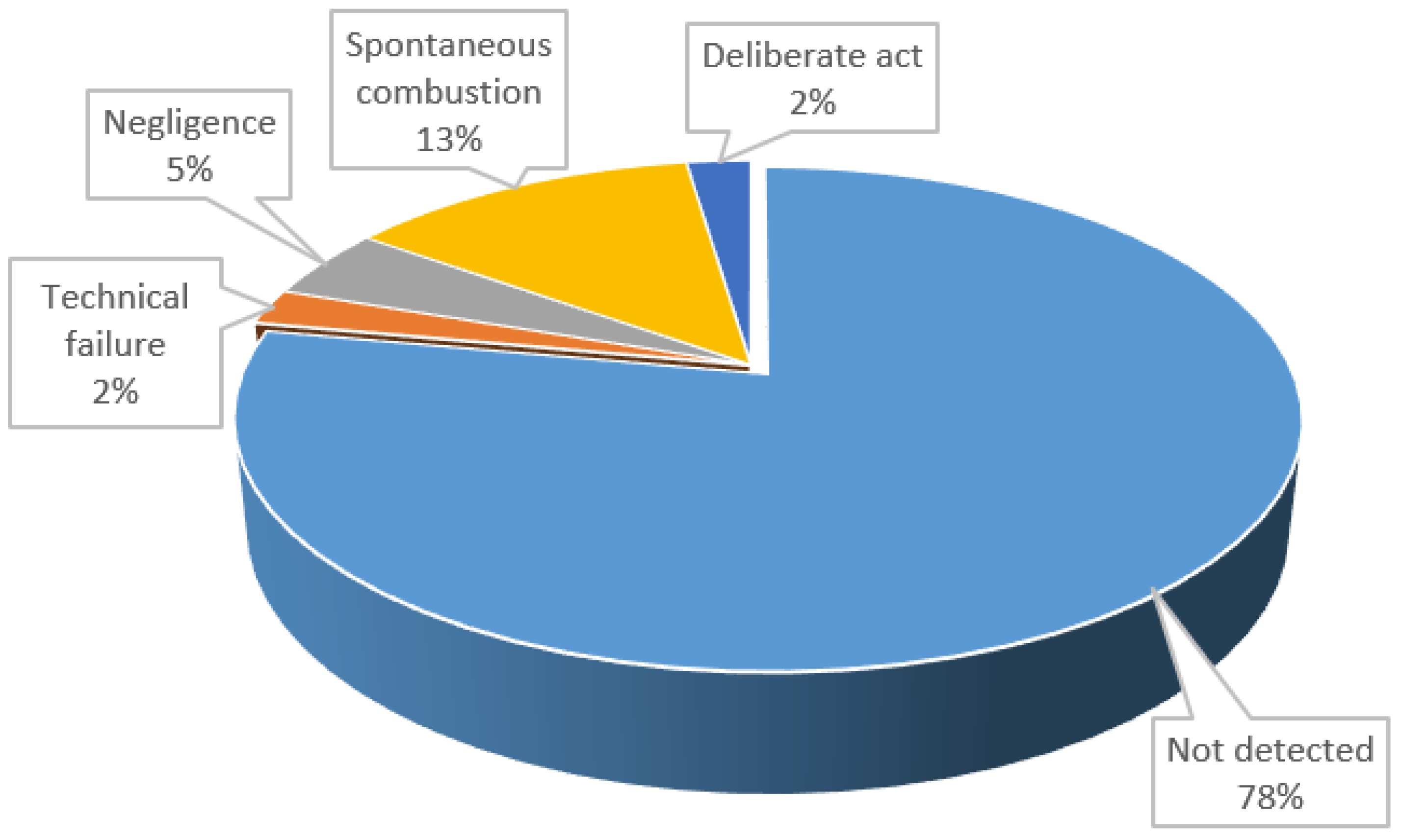
Five categories of initiating fire mechanisms were identified in municipal waste management facilities: spontaneous combustion, negligence, technical failure, deliberate act, and undetected cause. As shown in
Figure 2, the largest proportion of incidents was classified as “not detected,” indicating that the ignition mechanism could not be clearly determined.
In many cases, multiple potential initiating mechanisms were considered by investigators, preventing definitive attribution. For example, in a waste shredder fire, both mechanical sparking during shredding and an unspecified electrical fault were identified as possible causes, leading to classification as undetected.
Spontaneous combustion accounted for 11 incidents, predominantly related to biological processes at landfills and composting plants. Negligence was identified in four cases, primarily associated with improper handling of hot materials. Technical failures were recorded in two incidents, while deliberate ignition was identified in two cases at civic amenity sites. The distribution of initiating mechanisms corresponds well with findings reported in previous studies [
5,
14].
From a process safety perspective, the high proportion of undetermined ignition mechanisms indicates that preventive strategies should not rely solely on precise cause identification but rather on robust process control, early detection, and scenario-based barrier implementation capable of addressing multiple potential ignition pathways.
3.3. Extinguishing Water Consumption
Extinguishing water consumption exhibited substantial variability across incidents and facility types. The average consumption was approximately 32 m
3, while the median value was 10 m
3. The maximum recorded consumption reached approximately 660 m
3.
Table 2 summarizes the observed values by facility type.
In the case of the waste-to-energy facility, extinguishing water consumption was not recorded, as the fire was suppressed by an installed sprinkler system, and corresponding data were not available. From an evaluative standpoint, the wide dispersion of values limits the applicability of average consumption as a reliable planning parameter. In process terms, extinguishing water demand reflects both fire growth dynamics and the effectiveness of early detection and intervention stages. Consequently, this parameter should be interpreted primarily as a contextual indicator rather than a precise quantitative metric.
3.4. Fire Area
The area affected by fire also varied considerably and was strongly influenced by facility layout, storage configuration, and detection timing. In landfill fires, the affected area ranged from small, localized units to a maximum of 6400 m2.
The observed variability confirms that the affected fire area serves as an indicator of fire escalation potential rather than a standalone measure of incident severity. Larger affected areas typically indicate delayed disturbance detection or insufficient containment within early process stages.
3.5. Damages
Compared to other building categories monitored by the Fire Rescue Service of the Czech Republic, both direct and indirect damages associated with fires in municipal waste management facilities were relatively low. For the analyzed period, direct damage was estimated at approximately €20,000, while indirect damage was estimated at €560,000. Importantly, no fatalities or injuries were recorded.
This outcome suggests a relatively high level of emergency response effectiveness and process resilience despite the frequent occurrence of fire incidents in municipal waste management facilities. The statistical findings presented in this section serve as a basis for the identification and development of representative emergency scenarios discussed in the following section. No substantial discrepancies in overall fire patterns were identified when comparing these findings with publicly available statistics reported in previous studies, supporting the consistency of both data sources at an aggregate level.
4. Identification of Selected Emergency Scenarios
This section presents scenario-based results and their interpretation. To better understand the sequence of events leading to fire incidents, causal models were developed for selected representative scenarios [
13], as illustrated in
Figure 3,
Figure 4,
Figure 5 and
Figure 6. These models were constructed based on investigation reports from the Czech Fire Rescue Service and represent simplified reconstructions of disturbed operational processes. In all scenario diagrams (
Figure 3,
Figure 4,
Figure 5 and
Figure 6), solid arrows represent causal relationships supported by investigation data, while dashed arrows indicate hypothesized links based on expert judgment. This approach reflects the inherent uncertainty in post-incident investigations, where multiple plausible causal pathways are often considered rather than a single confirmed cause.
The following sections describe selected emergency scenarios for individual facility types. The presented descriptions are based on edited investigation reports and are not intended to provide exhaustive accounts of individual incidents. Instead, they illustrate typical fire development pathways in municipal waste management facilities. In this context, the scenarios serve as an analytical bridge between the statistical findings presented in
Section 3 and the identification of preventive and mitigation measures discussed in
Section 5. Each scenario represents a simplified model of operational process disturbance, demonstrating how deviations in material handling, storage, or monitoring may escalate into fire events. It should be noted that the identification of initiating mechanisms is subject to uncertainty, as investigation reports often contain multiple plausible hypotheses rather than a single confirmed cause. The presented scenarios should therefore be understood as generalized representations of typical fire development pathways, combining available incident data with expert interpretation.
4.1. Metal Waste Processing Facility
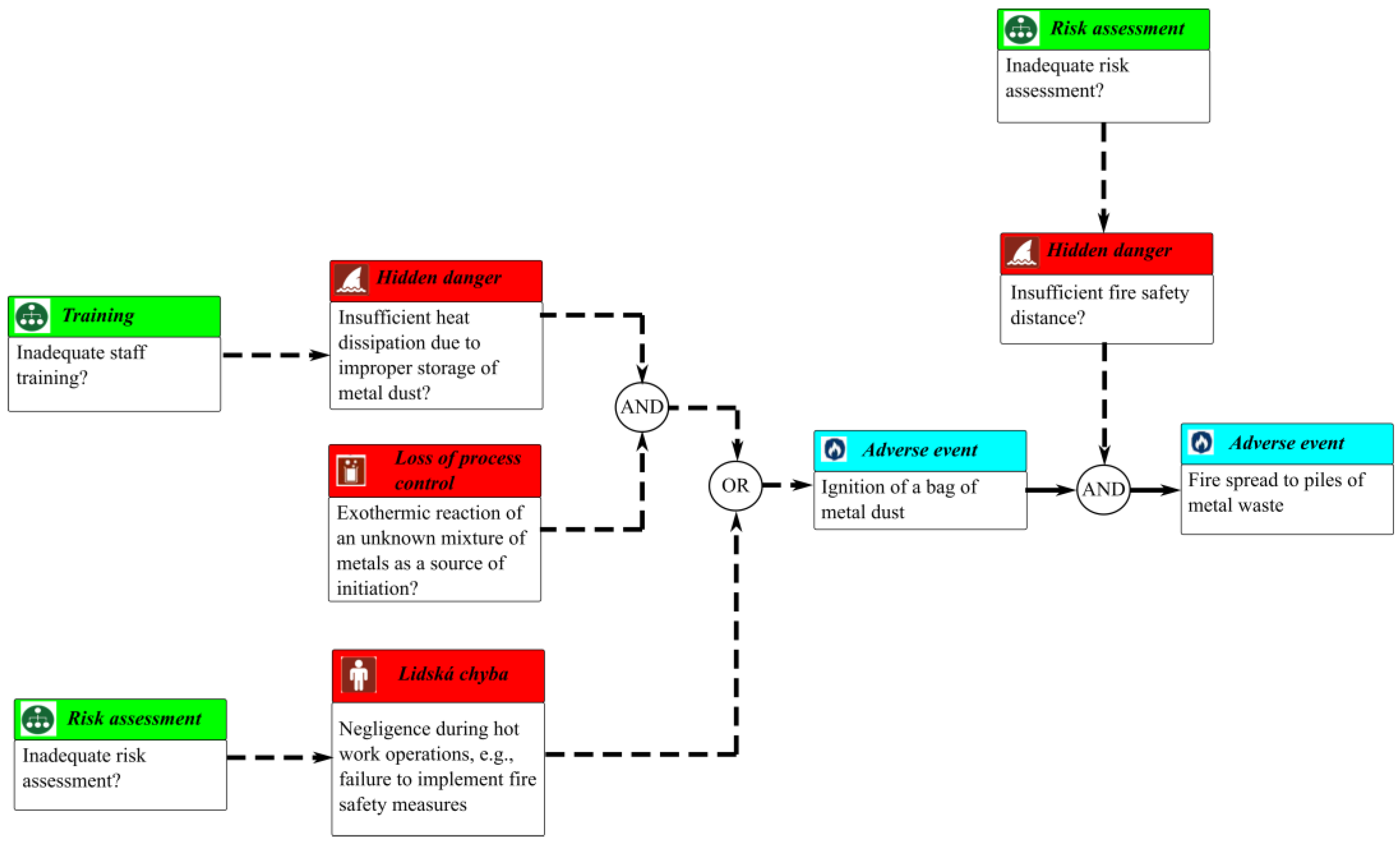
The fire occurred in an outdoor storage area where bags containing metal dust were temporarily stored before further processing. The bags were made of textile fabric. The fire originated at this location and gradually spread to the surrounding area, affecting an estimated area of approximately 5 × 10 m. Low-expansion foam was used for fire suppression.
According to the investigation report, it was not possible to determine the initiating mechanism based on the available evidence. The following variants were identified as plausible initiating mechanisms, including a technical failure associated with an unforeseen change in processing parameters and negligence by an unidentified person during metal waste handling. The corresponding causal sequences are illustrated in
Figure 3. In the diagram, solid arrows represent causal relationships supported by available evidence, while dashed arrows indicate links inferred based on expert judgment where direct evidence was not available.
From a process perspective, the scenario highlights vulnerabilities associated with the temporary storage of fine metal residues and insufficient control of material properties and handling conditions.
4.2. Civic Amenity Site with Waste Shredder
The event originated in an industrial shredder used for processing mixed municipal waste, located inside a hall with approximate dimensions of 40 × 30 m and a height of 10 m. The hall consisted of a steel frame with steel panel walls and roofing and constituted a single fire compartment.
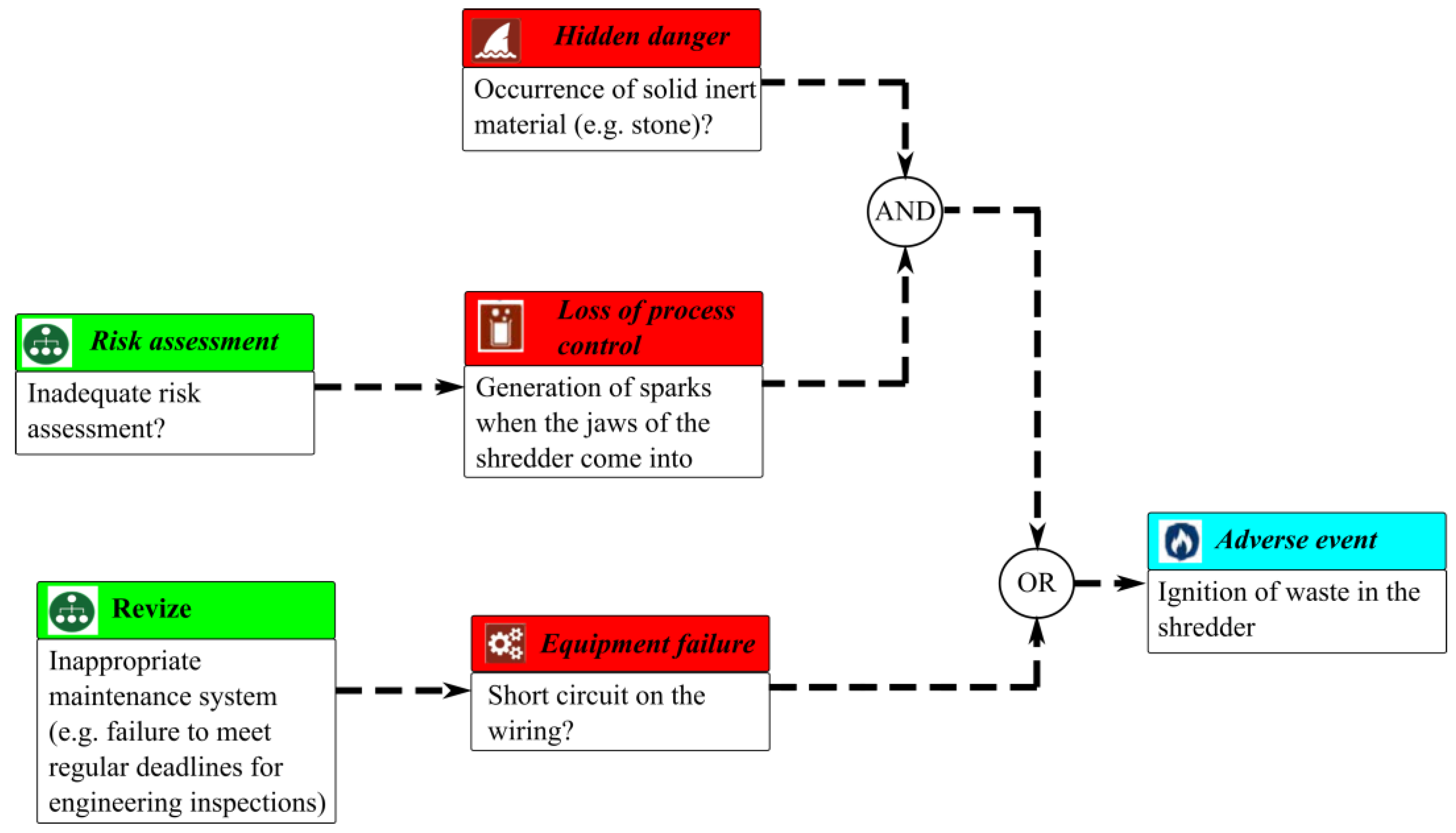
The ignition occurred inside the shredder. Following fire suppression and an on-site investigation, two probable initiating mechanisms were identified: mechanical sparking during shredding caused by contact between the rotating steel jaws and foreign objects of equal or greater hardness, and an unspecified electrical fault in the shredder wiring.
The point of fire origin was identified within the shredder. Mechanical sparking during shredding of heterogeneous waste, including stones or metallic objects, represents a known disturbance mechanism. At the same time, an electrical short circuit could not be excluded. The corresponding causal structure is presented in
Figure 4.
From a process control perspective, the scenario illustrates the combined effect of material heterogeneity and equipment-related disturbances within a critical operational unit.
4.3. Composting Plant
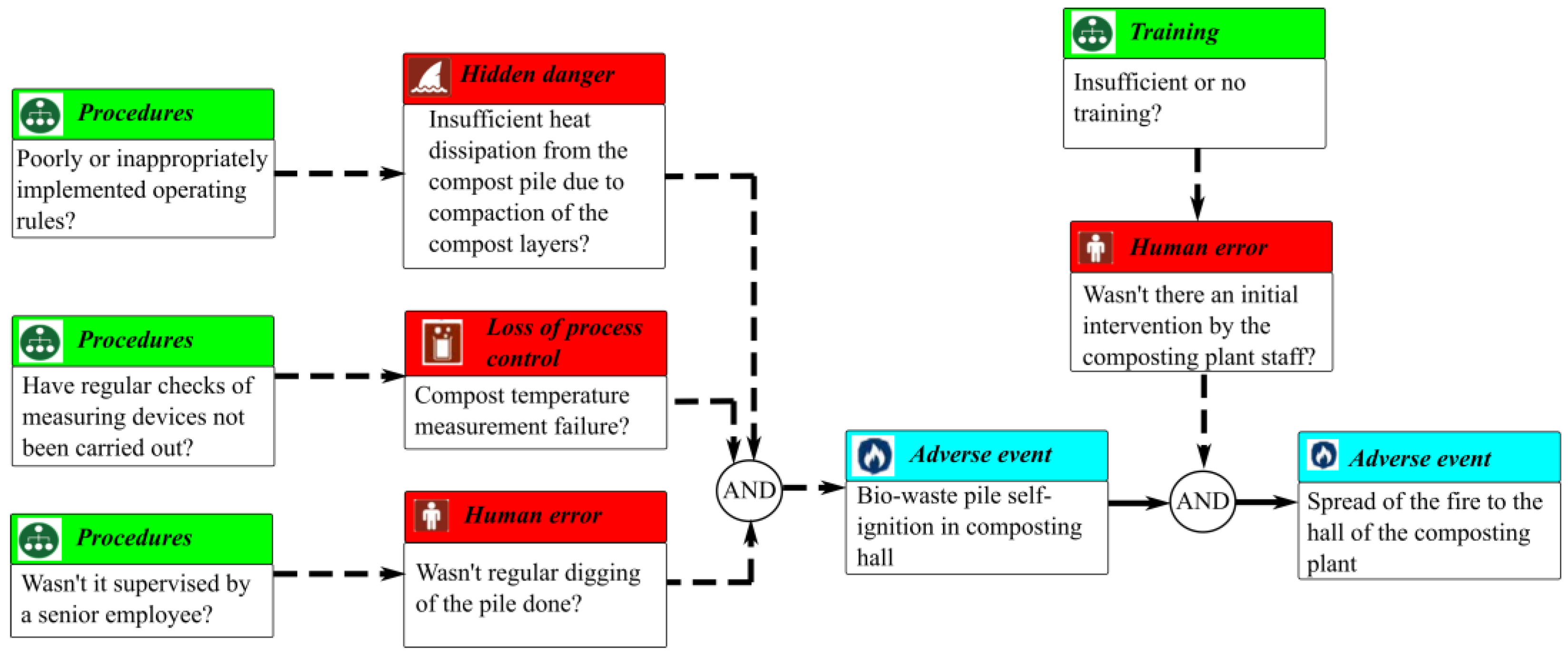
The incident took place in a covered composting facility housed in a hall approximately 140 × 50 m in size. The structure consisted of steel beams, fiberglass walls and roof panels, and wooden cladding. The hall formed a single fire compartment.
The fire origin was identified inside the composting hall. Based on the location of the ignition source and subsequent fire development, technical failure was conclusively ruled out by the investigator. The initiating mechanism was classified as heat generated by biological decomposition of compost material, leading to spontaneous combustion. The corresponding scenario is shown in
Figure 5.
From a process perspective, this scenario reflects a loss of control over biological heat generation during material storage and insufficient monitoring of internal temperature conditions.
4.4. Municipal Landfill
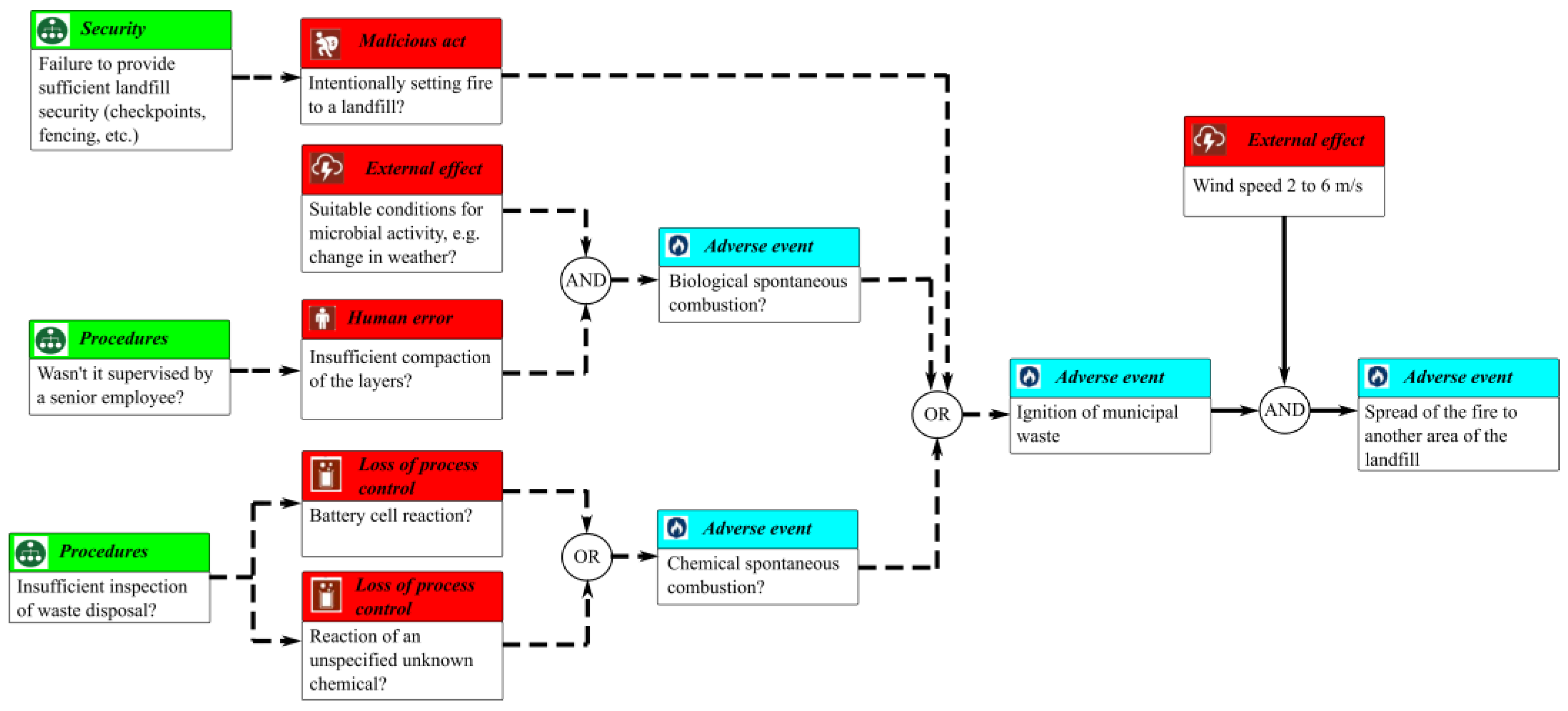
The fire occurred at a controlled municipal solid waste landfill with approximate dimensions of 155 × 130 m. The landfill was divided into sections equipped with gas collection pipes for landfill gas recovery, which was utilized in a combined heat and power plant. A fuel station for site vehicles was also present.
According to the investigation report, a technical failure was ruled out, but the exact initiating mechanism could not be conclusively determined. Several potential spontaneous ignition mechanisms were considered plausible, including short electrical circuits in batteries disposed of in the waste stream, biological spontaneous combustion, and chemical reactions involving unknown substances. Ignition of landfill gas could not be excluded.
The trigger mechanism remained uncertain and may have involved internal heat generation within the landfill body or surface-level ignition sources. At the time of the fire brigade’s arrival, approximately one-third of the landfill area was already affected. Due to extensive smoke production, environmental monitoring was initiated, and protective measures were communicated to nearby residents.
From an operational perspective, this scenario illustrates large-scale escalation resulting from delayed detection and the inherent complexity of controlling heterogeneous waste bodies under long-term storage conditions, as illustrated by the causal structure shown in
Figure 6.
5. Discussion
From a risk perspective, the results should be interpreted as indicative of patterns in incident occurrence and escalation potential rather than as a quantitative evaluation of risk. This supports the use of scenario-based approaches, where preventive and mitigation measures are designed to remain effective under conditions of incomplete causal knowledge.
5.1. Municipal Landfills
The results clearly show that municipal solid waste landfills have the highest frequency of fires among the monitored waste management facilities. Fires in municipal solid waste landfills accounted for 76% of all incidents recorded between 2013 and 2022. The highest frequency of fires was observed in 2017 and 2018, which coincided with periods of significant drought in the Czech Republic. This observation is consistent with findings reported in previous studies [
1,
14,
15].
In contrast, study [
8] reports a significantly lower number of landfill fires. This discrepancy may be related to differences in waste management systems and the number of facilities considered. However, since the number of facilities in the analyzed area is not specified in [
8,
16], a direct comparison is not reliable.
Landfills also exhibit the highest average fire frequency, with approximately 6.5 fires per year. For other facility types, the frequency is considerably lower. Composting plants reached an average of approximately 0.3 fires per year, while other facilities showed only isolated incidents during the analyzed period, corresponding to very low average annual frequencies (
Table 1).
The results show that spontaneous combustion is the most common cause of fires in municipal waste landfills. This finding is consistent with practitioner insights reported by landfill operators in the Czech Republic, who identify spontaneous combustion as the dominant ignition mechanism, particularly under conditions of mixed waste composition and adverse weather.
According to operators’ experience, contamination of municipal waste with unsuitable materials—such as batteries, electronic devices, or packaging containing chemical residues (e.g., paints or solvents)—occurs most frequently during seasonal collection periods, particularly in autumn in smaller municipalities. Another relevant issue reported by operators is the increasing presence of non-recyclable two-component plastics in municipal waste streams. These materials are bulky, difficult to compact, and cannot be thermally treated within the existing waste management infrastructure due to their elevated chlorine and sulfur content.
Landfill operators are also increasingly confronted with the effects of alternating extreme weather conditions, particularly heavy rainfall followed by high temperatures. Operational observations suggest that significant amounts of rainwater infiltrate the landfill body during intense precipitation events, increasing the moisture content of biodegradable waste and promoting microbial activity and heat generation. When such conditions are followed by elevated temperatures, cracks may form in the compacted waste layers, allowing oxygen to penetrate deeper into the landfill body. This process can lead to spontaneous combustion. Based on operator experience, fire initiation under such conditions may occur within approximately two days after the end of precipitation. With ongoing climate change, such abrupt weather fluctuations are expected to occur more frequently, increasing the relevance of this risk factor.
The extinguishing water consumption reported in the study [
1,
16] for municipal landfills (513 m
3) is significantly higher than the values presented in
Table 2. However, median values are comparable, suggesting that the discrepancy in mean values is likely caused by outliers and the use of estimated data in incident reporting.
Taken together, the results indicate that landfill fires are not driven by a single dominant ignition mechanism, but rather by the interaction of waste composition, meteorological conditions, and operational practices [
17]. This interaction explains both the temporal clustering of incidents and the difficulty in identifying a single root cause in post-incident investigations. From a process safety perspective, this finding highlights the importance of early detection, continuous monitoring, and operational preparedness rather than focusing solely on eliminating individual ignition sources.
The high proportion of incidents with undetermined causes further supports the application of a scenario-based and process-oriented approach, where preventive and mitigation measures are designed to remain effective despite significant uncertainty regarding ignition mechanisms. These observations are consistent with broader findings on the influence of climate variability on fire occurrence in waste management systems.
5.2. Measures Against Fire in Municipal Waste Landfills
In the following tables, the top events are formulated to reflect the dominant failure mode of operational control, which may manifest as uncontrolled self-heating, loss of thermal stability, or direct ignition, depending on facility type.
In general, measures can be divided into those that directly prevent an emergency from occurring (known as preventive barriers) and those that prevent the spread of an event once it has already occurred (known as mitigation barriers).
The full range of possible measures is presented in the study [
1], which contains a summarized table based on the authors’ findings and other expert studies. The table is broken down by landfill operation activities, but it is quite general. However, it is more useful to define measures for specific identified emergency scenarios within the operation, such as the scenarios presented in
Section 4.
From the model in
Figure 7 and the experience of landfill operators, five top events associated with the occurrence of fires can be selected. For these top events to occur, the conditions must be fulfilled, i.e., the threats must be realized. The realization of the threats can be prevented by the successful activation of preventive measures. The identified top events, threats, and preventive measures are listed in
Table 3.
The table also includes measures that can potentially be applied at a municipal solid waste landfill to prevent a top event. Important measures include a properly conducted and controlled compaction process. This means that there should be sufficient inert material on the site that can be used for this purpose. However, as mentioned above, despite proper compaction, undesirable cracks can occur due to unpredictable conditions.
Other measures relate to the avoidance of certain types of waste in a municipal waste landfill. However, it is very difficult to prevent the occurrence of such waste. Despite a strong awareness campaign, hazardous waste such as chemicals or batteries is present in municipal waste and is likely to continue to be present. Employees can reduce the risk by checking the waste they deliver, but it is not realistic to check every truck in detail. Employee training is also an issue. For example, determining whether two chemicals can already react with each other requires a higher level of knowledge that employees at these facilities do not have.
From the above, it can be deduced that there will always be a risk of fire at a municipal waste landfill. However, a crucial aspect of preventing fire damage is the emergency preparedness of employees when a fire is detected and their ability to respond to such an event. A timely response by operators will prevent the fire from spreading and causing greater damage. The combination of effective monitoring, trained personnel, and sufficient firefighting resources, especially inert material, appears to be the essential mitigation barrier to limiting damage.
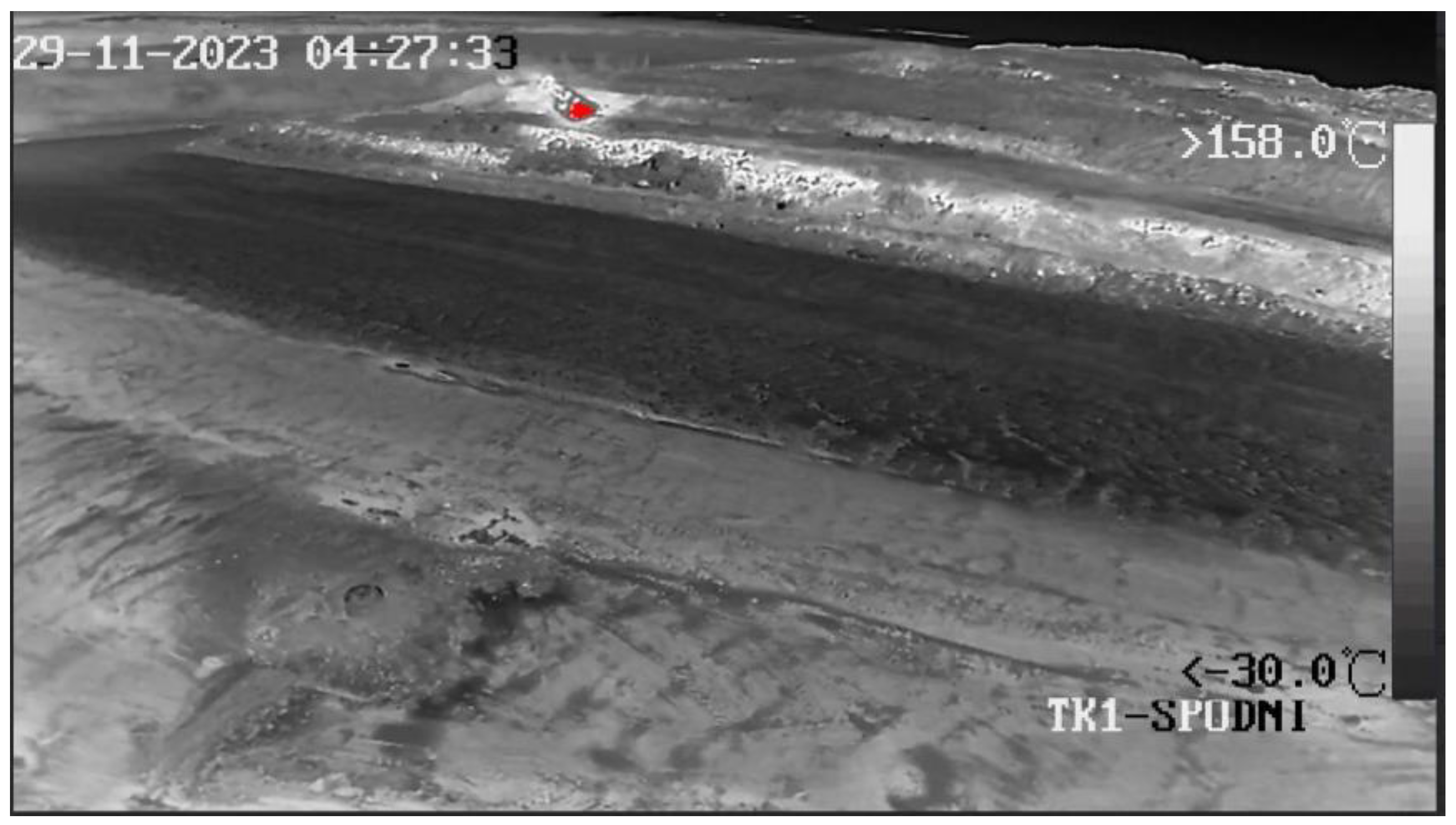
In addition to video surveillance, thermal imaging systems are also an important element of the landfill monitoring system. Thermal imaging systems equipped with alarms allow early localization of a fire in the landfill. In the Czech Republic, there is no obligation to equip landfills with thermal imaging systems, but many landfills are already equipped with such systems. An example of the output of a thermal imaging system can be found in
Figure 7, where the occurrence of a fire on the landfill body has already been localized.
Figure 7 demonstrates the practical application of thermal imaging for early fire detection on the landfill body. Although the thermogram itself provides limited quantitative information, it illustrates the capability of such systems to localize temperature anomalies at an early stage, which is critical for timely intervention and damage mitigation.
For effective intervention, however, employees must be present in the facility not only during the operation of the landfill to ensure intervention. The site should have 24/7 security guards on duty. This service, together with fences and checkpoints, is also a measure against the intrusion of unauthorized people who could cause either intentional or unintentional fires.
Considering that most investigation reports show little or no damage, the above measures may appear to be very costly. However, there is other damage to the operators that is not normally included in the investigation reports. These include, for example, damage to the operator’s reputation, the cost of firefighting, or the financial losses caused by the facility not being in operation.
The proposed measures are not intended as an exhaustive checklist, but as scenario-specific barrier sets derived from real incident data. Their primary value lies in supporting operational decision-making and emergency planning under conditions of uncertainty.
5.3. Composting Plants
Table 1 shows that there were a total of three incidents in composting plants during the reporting period that required the intervention of the Fire Rescue Service. The frequency of fires in composting plants averaged 0.3 fires per year.
By comparison, there were a total of 61 similar incidents in France between 2013 and 2017, including 27 in the last reporting year, around half of which were caused by self-heating of organic waste [
14,
18].
Firefighting in composting plants is characterized by a relatively high consumption of extinguishing water.
Table 2 shows that the average consumption of extinguishing water is 63 m
3. This is the highest value of all the facilities analyzed. This value should be interpreted with caution, as it is based on only three observations. However, the significant consumption of extinguishing water when fighting fires in compost bins is also emphasized in other studies, e.g., [
14,
19].
5.4. Measures Against Fire in Composting Plants
Selected scenarios, including fire prevention measures for composting plants, are shown in
Table 4. These scenarios and preventive measures were determined based on analyses of records of the Fire Rescue Service of the Czech Republic, the ARIA database, and the experience of plant operators.
Compost formation is accompanied by microbial activity, an integral part of which is a gradual increase in temperature. In extreme cases, if heat dissipation is not ensured due to various factors (e.g., insufficient height of the landfill, compaction of layers, etc.), the organic waste in the landfill may spontaneously ignite (see
Table 4, scenario 1).
The risk of spontaneous combustion depends on the chemical composition of the substrates (possible impurities acting as catalysts), humidity, storage size, ambient temperature, the intensity of air diffusion in the pile (related to waste granulometry), the oxygen content of the pile, storage time, etc. [
14,
18].
One possible technical measure is to continuously monitor the temperature in the pile with an alarm. If this temperature is exceeded, the operator must intervene and lower the temperature in the pile (e.g., open the pile). Temperature monitoring can be carried out using rod thermometers. However, the temperature inside the pile may not be evenly distributed, and in some cases, hot cores may form (see scenario 4). This is a local temperature increase in the pile. “A ‘hot core’ can occur, for example, because the pile is not evenly homogenized. In the case of such a core, the rod thermometer may not detect the core, and therefore, the measurement results may be significantly distorted.
Another option is thermal imaging technology. However, thermographic systems record the surface temperature. A thermographic system, together with the rapid response of the plant operator, is therefore more of a measure to minimize the consequences of a top event. As with municipal waste landfills, these measures should include emergency preparedness and a timely response by the operator. This requires trained and practiced operators.
These findings highlight that, in composting plants, fire prevention relies primarily on process control and operator competence rather than on structural fire protection measures.
5.5. Fire Risk and Operational Characteristics of Metal Waste Processing Facilities
Based on information from the Fire Rescue Service database, the second-highest average fire frequency for metal waste processing facilities after municipal solid waste landfills was found to be 0.2 fires per year. Fires in these facilities are specific mainly because the processed metal waste may contain undesirable impurities such as packaging made of flammable aerosols, the presence of reactive metals such as aluminum or magnesium in different fraction sizes stored, camping propane-butane cartridges, etc. In the combustion of aluminum dust, it is also difficult to identify the specificity of the fire by eyewitnesses [
20].
5.6. Measures Against Fire in a Metal Waste Processing Facility
The scenarios presented in
Table 5, including the measures, are based on information from the Fire Rescue Service’s fire database, the ARIA database for industrial accidents, and the experience of the operators. From the point of view of fire incidents, the contamination of metal waste with various oils, batteries, packaging made of flammable aerosols, reactive powdered metals, etc., is a particular problem (see
Table 5, scenario 1).
The handling and processing of metallic waste can damage the packaging and release flammable gases or damage the battery and trigger an exothermic reaction. The initiation of flammable gases can be caused, for example, by mechanical sparks generated during handling. Aerosols are also released during the processing of metal waste, e.g., by crushing or pressing [
15,
21].
The most effective preventive approach is to minimize the presence of these materials in the waste. However, complete avoidance is highly problematic. Citizens throw packaging from camping cartridges or flammable aerosol cans into metal collection bins because they are not aware of the risk. In the Czech Republic, there is also no take-back system for used small-volume cylinders and cartridges containing flammable gas residues.
If a metal waste treatment facility receives waste from a major customer, the acceptance of waste from such a customer may be prohibited in the event of repeated incidents.
Contact of some metals (such as aluminum) with water can pose a risk of ignition (see scenario 2). Examples of such events are given, for example, in [
15,
17]. Such material must not be stored in open areas where there is a risk of contact with atmospheric precipitation. It is also advisable to pack this metal in big watertight bags and store it in shelters in this way. However, contamination of other metal waste with powdered aluminum can be a major problem. This can be very difficult for the operator to recognize when accepting the waste.
Another circumstance that increases the risk of fire is the unwanted accumulation of metal waste, which can be caused, for example, by a shutdown or failure of the processing equipment or by a customer breakdown. An example of an event where the accumulation of metal waste contributed to the fire is the 2015 event in France [
22].
5.7. Civic Amenity Sites
According to the Fire Rescue Service database, the lowest frequency of fires was recorded in household waste recycling centers, corresponding to an average frequency of approximately 0.1 fires per year. From a construction point of view, recycling centers can be made differently. Household waste recycling centers are usually equipped with concrete or bituminous roads. The municipal waste is placed into metal skips or into a concrete retaining wall system. Waste disposal sites may be covered (most often) by a lightweight steel shelter. However, waste can also be stored in an open area. Waste sorting or shredding facilities can be in the household waste recycling centers. A particular feature is that these facilities are often located within or close to residential areas. If they are equipped with waste treatment machianery, they are often located outside residential areas, for example, in industrial zones.
5.8. Measures Against Fire in Civic Amenity Sites
During the operation of a household waste recycling center, waste that has the potential to heat may be unknowingly received (see scenario 1). The corresponding preventive measures and identified threats are summarized in
Table 6. This includes batteries [
17,
23], but also reactive chemicals (incompatible products, acids, bases, solvents) that may be unknowingly stored next to each other. For example, a similar event occurred in France in 2016 [
22,
23] where incompatible products, acids, bases, and solvents were stored together. Although this is a facility for the treatment of industrial waste, it can also serve as a source of lessons for household waste recycling centers.
The basic preventive measure is strict control during waste acceptance. However, as in the previous case, it is to be expected that, despite all efforts, it will often be impossible to control all waste due to the high frequency of visits. Therefore, despite all precautionary measures, contaminated waste will continue to be stored.
The handling of the waste itself can also lead to damage to the integrity of the waste and an increased risk of fire [
18,
20,
24]. The increased risk of fire arises primarily from the handling of waste electrical and electronic equipment, which may contain batteries that can self-heat if mechanically damaged (see scenario 2). However, it is difficult to prevent damage to the integrity during waste treatment. Some e-waste always falls during unloading or loading, creating pressure as the waste is moved or dumped, and thus, there is a risk of compromising integrity.
In the Fire Rescue Service database, there is a case where one of the versions is the occurrence of a fire due to a mechanical spark that occurred during the shredding of waste. A similar event is also recorded in the ARIA database [
25,
26]. The household waste recycling center is the point in the waste collection and treatment chain that precedes the metal waste treatment facility. For this reason, similar scenarios to those mentioned above can occur here. This includes the occurrence of containers with flammable aerosols.
Given the possibility of a fire or other emergency, the focus must again be on the operator’s emergency preparedness. Emergency equipment such as sorbents, manhole covers, and, of course, emergency dams must be prepared if hazardous chemicals are released into the sewer system. Plant operators should be regularly instructed in emergency procedures.
Although the recorded fire frequency in civic amenity sites is low, the proximity to residential areas amplifies the potential consequences, justifying a precautionary, consequence-oriented approach focused on strict acceptance control and emergency preparedness.
6. Conclusions
This paper presents a set of representative emergency scenarios and corresponding preventive and mitigation measures derived from the systematic analysis of real fire incident records in municipal waste management facilities. The analysis showed that approximately 76% of all recorded fire incidents occurred at municipal solid waste landfills, while in nearly 78% of cases, the exact ignition mechanism could not be conclusively determined. Key quantitative parameters, such as extinguishing water consumption (mean 32 m3, median 10 m3), exhibited significant variability. As fire risk in such facilities cannot be fully eliminated and may be further intensified by climate-related factors such as heat waves, prolonged droughts, and abrupt weather changes, the results underline the critical importance of emergency preparedness, early detection, and rapid response capabilities of facility operators. The key quantitative findings can be summarized as follows:
Approximately 76% of all fire incidents occurred at municipal solid waste landfills
In nearly 78% of cases, the ignition mechanism could not be conclusively determined
Extinguishing water consumption showed high variability, with a mean value of 32 m3 and a median of 10 m3
The comparison of publicly available fire statistics with non-public fire service records indicates that, despite differences in selected quantitative parameters, both data sources lead to consistent conclusions regarding dominant ignition mechanisms, facility-specific fire frequencies, and characteristic risk patterns. This finding supports the usability of public fire statistics for indicative risk assessment, while simultaneously highlighting their inherent uncertainty and the need for cautious interpretation.
Consistent with the evaluative focus of the study, municipal solid waste landfills were identified as the facility type with the highest fire frequency among the analyzed waste management facilities. At the same time, selected quantitative parameters, such as extinguishing water consumption and affected area, exhibited substantial variability, primarily due to reporting uncertainty and the use of estimated values during incident documentation.
In a significant proportion of analyzed records, the exact cause of the fire could not be conclusively identified, and investigation reports often contained multiple plausible causal hypotheses. Nevertheless, this uncertainty does not diminish the analytical value of the data. On the contrary, the presence of alternative causal explanations provides insight into a broader range of potential emergency scenarios and highlights the complex interaction between waste composition, environmental conditions, and operational practices.
Although several representative emergency scenarios were identified based on the synthesis of available information, the presented set cannot be regarded as exhaustive. However, the results provide a robust analytical basis for further investigation of fire risk in municipal waste management systems and for the development of scenario-based prevention and mitigation strategies.
The main contribution of this study lies in the integration of non-public incident data with process-oriented scenario modelling, enabling the transition from descriptive statistics to actionable, scenario-based fire risk management. Unlike previous studies [
1,
2] that focused primarily on descriptive statistics or individual facility types, this work integrates quantitative fire statistics with scenario-based interpretation of incident causes and emergency development. This integrated approach enables a more critical assessment of data consistency, parameter uncertainty, and the practical relevance of fire statistics for risk prevention and emergency preparedness.
Several limitations of the present study must be explicitly acknowledged. The analysis is restricted to a single region of the Czech Republic, which may limit the direct transferability of the results to other national or regulatory contexts. The analysis is limited to a ten-year period, which may not fully capture long-term trends or variability in fire incident patterns. A key limitation of the study lies in the uncertainty associated with the identification of fire initiation mechanisms, as incident records often do not allow for definitive causal attribution. These limitations should be considered when interpreting the results and their applicability to other operational or regulatory contexts. Future research should therefore focus on improving data collection practices and enhancing collaboration with facility operators and investigation authorities to obtain more detailed and reliable information on fire initiation processes, but also on extending the analysis to multiple regions or countries, improving the harmonization of fire incident databases, and developing standardized procedures for data recording to support more robust quantitative evaluations.
From a process engineering perspective, fire incidents in municipal waste management facilities can be interpreted as operational disturbances that propagate through interconnected stages of waste handling, storage, and treatment. The identified scenarios and barrier sets thus provide actionable inputs for process safety management, continuous monitoring, and adaptive risk control strategies. Overall, the findings emphasize that the systematic integration of incident data into process monitoring frameworks represents a key prerequisite for enhancing operational resilience and improving fire risk management in municipal waste management facilities.
The practical applicability of the proposed approach is supported by the identification of representative fire scenarios and corresponding barrier sets derived from real incident data, which can be directly utilized by facility operators and fire safety practitioners. Future research should also focus on improving the identification of ignition mechanisms through enhanced incident reporting and on validating the proposed scenario-based approach across different regulatory and operational contexts.



 ,
,