Numerical Simulation Study on the Main Controlling Factors of Water Cut Rise in Thick Carbonate Reservoirs Based on Multi-Scale Hierarchical Analysis

Abstract
1. Introduction
1.1. Geological Characteristics of the Target Reservoir
1.2. Development Characteristics of the Target Reservoir
1.3. Development Challenges of the Target Reservoir
2. Methodology
2.1. Research Method of Multi-Scale Hierarchical Dominant Controlling Factors
2.2. Reservoir Division and Modelling Study of Typical Blocks
2.3. Multi-Sequence Grey Relational Analysis
2.4. Method Comparison and Justification
2.5. Application of Multi-Sequence Grey Relational Analysis in Typical Blocks
2.6. Innovations and Methodological Contributions
3. Case Study
3.1. Block Dynamic Analysis
3.2. Water Cut Rising Types of Well Groups
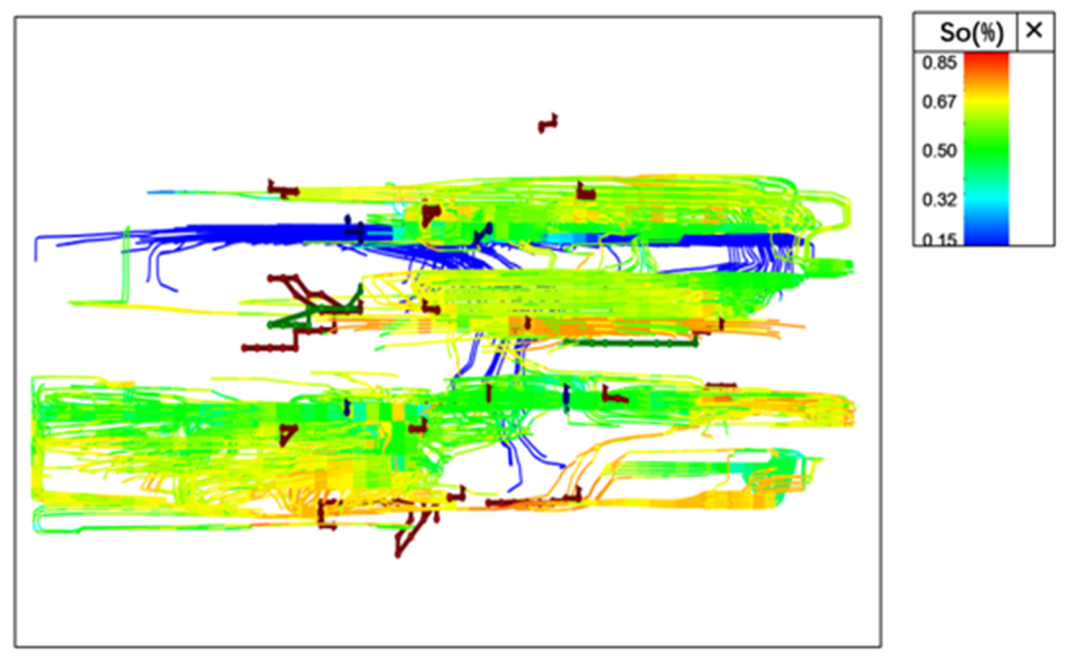
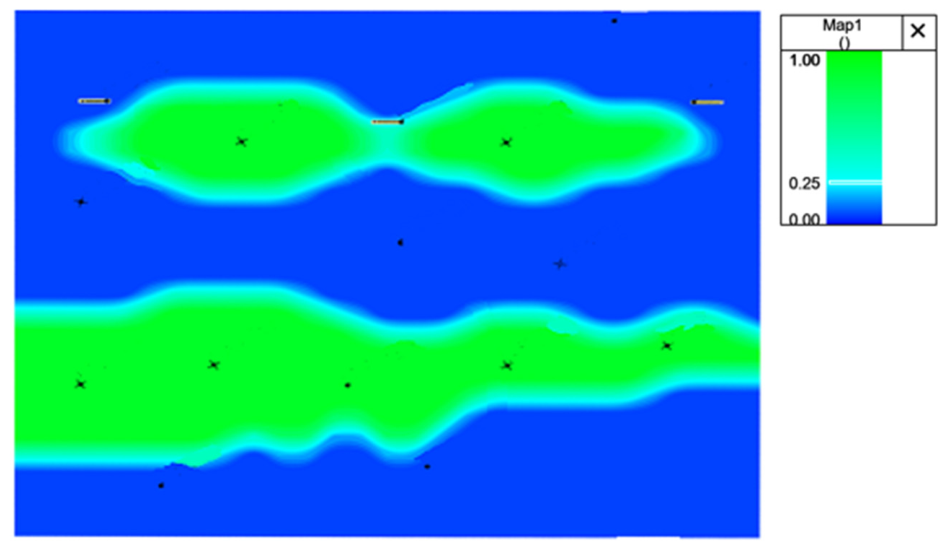
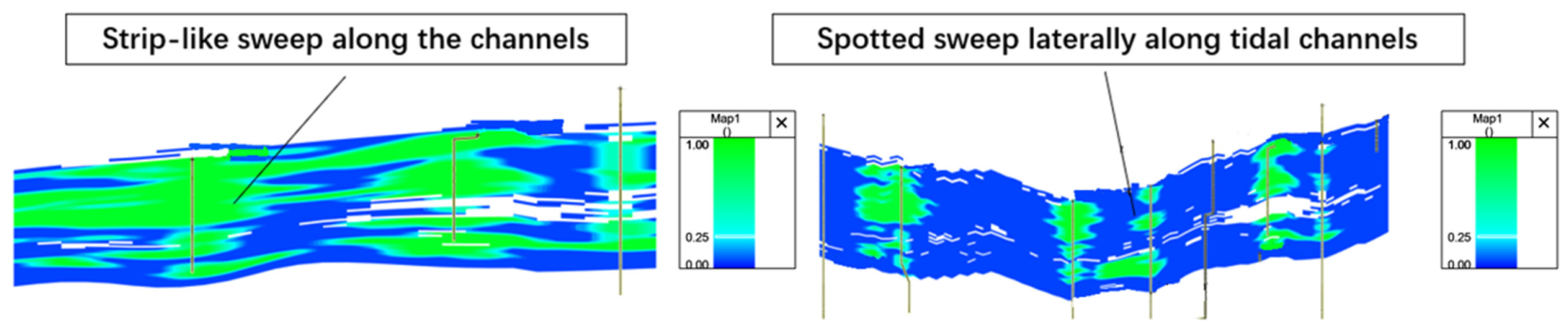
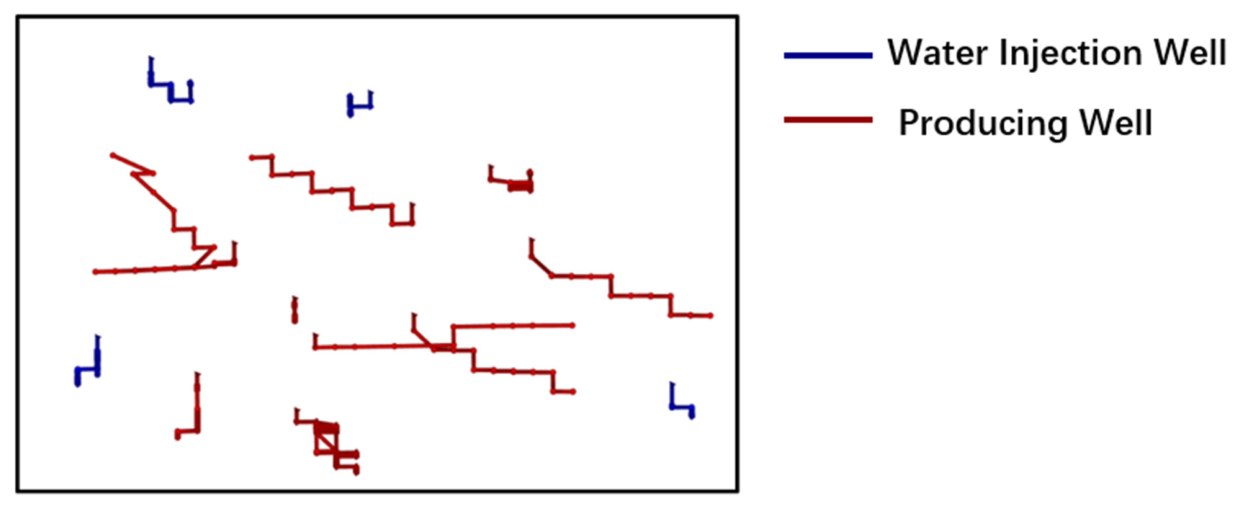
3.3. Study on Water Flooding Sweep Channels
4. Study on the Main Controlling Factors of Water Cut Rising
4.1. Calculation Steps of the Grey Correlation Method
4.2. Study on Main Controlling Factors at Reservoir Scale
4.3. Study on Main Controlling Factors at Block Scale
4.4. Study on Main Controlling Factors at Well Group Scale
4.5. Results of Correlation Degree Calculation
4.6. Integrated Analysis of Dominant Controlling Factors at Multiple Scales
5. Sensitivity Analysis of Dominant Factors Based on Numerical Simulation
5.1. Establishment of a Simplified Model
5.1.1. Principles and Contents of Model Simplification
5.1.2. Core Parameter Settings
5.1.3. Criteria for Eliminating Secondary Factors
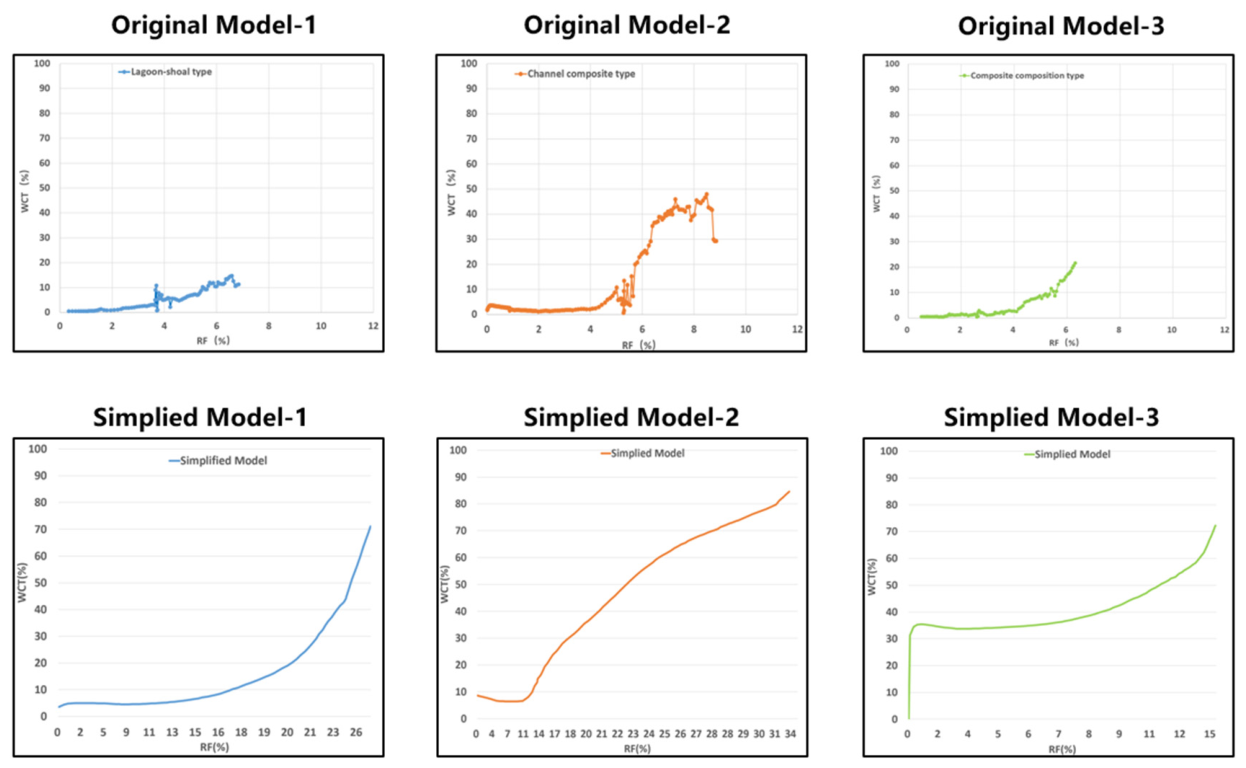
5.1.4. Validation of Simplification
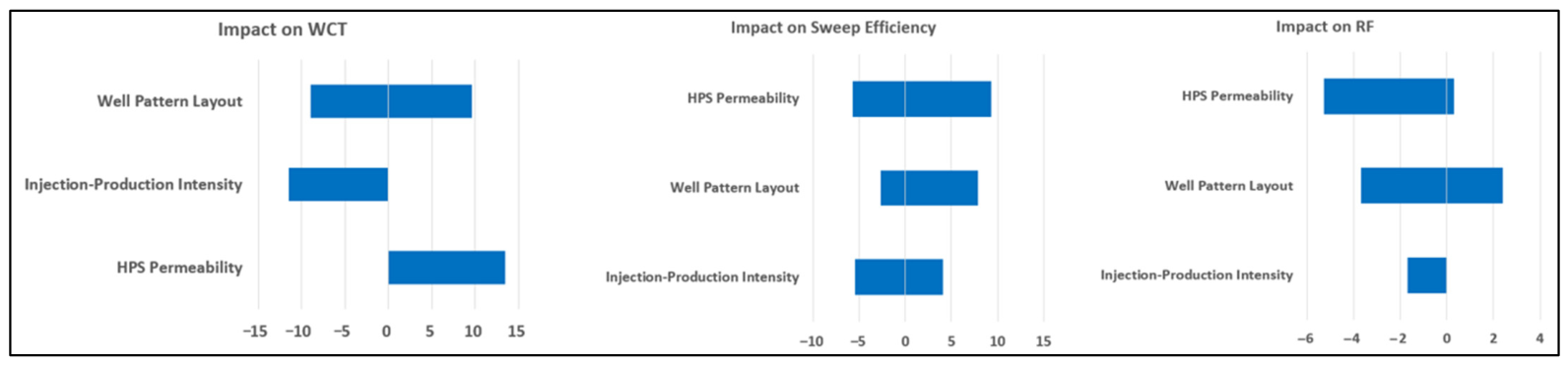
5.2. Sensitivity Analysis of Dominant Factors in the Lagoon-Shoal Block
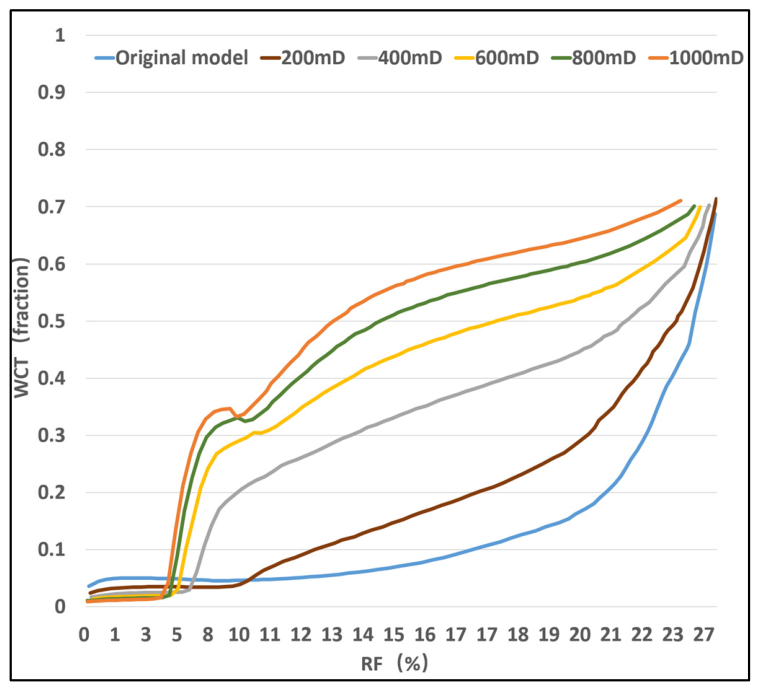
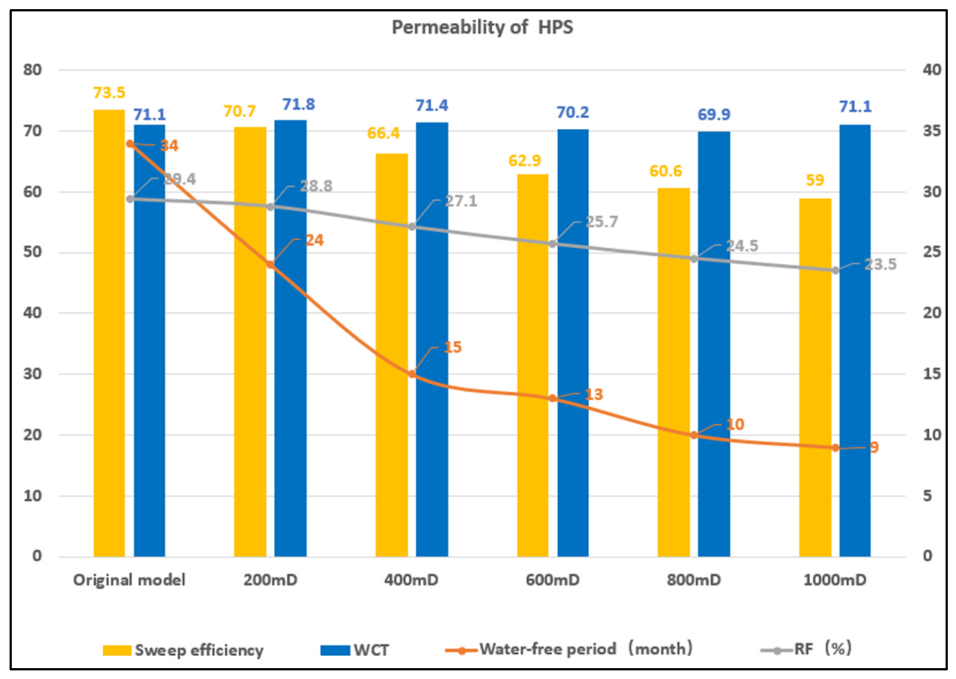
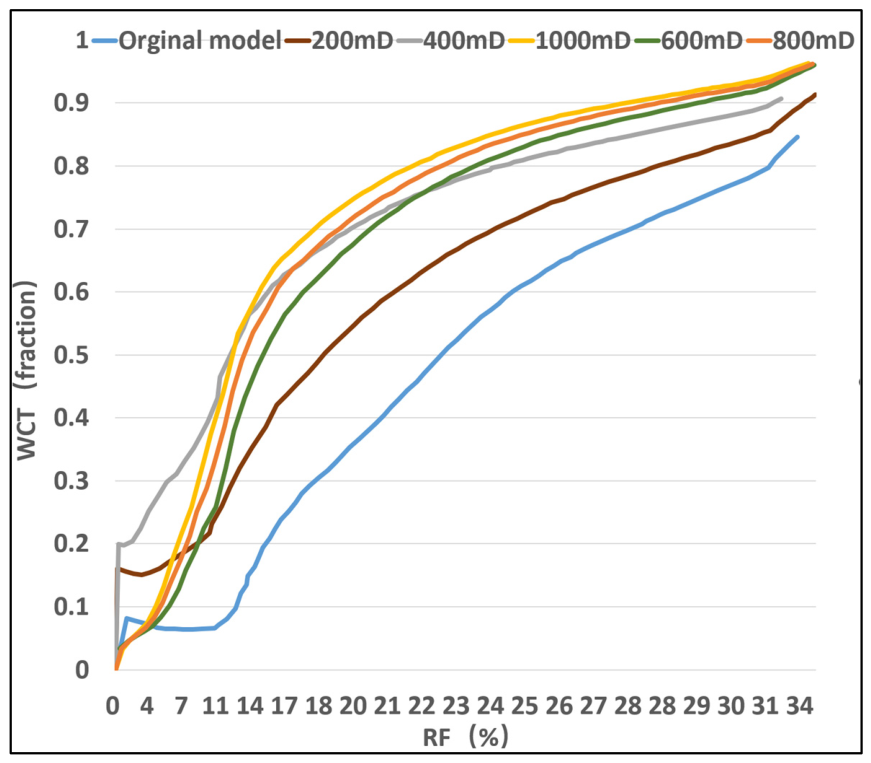
5.2.1. Effect of HPS Permeability
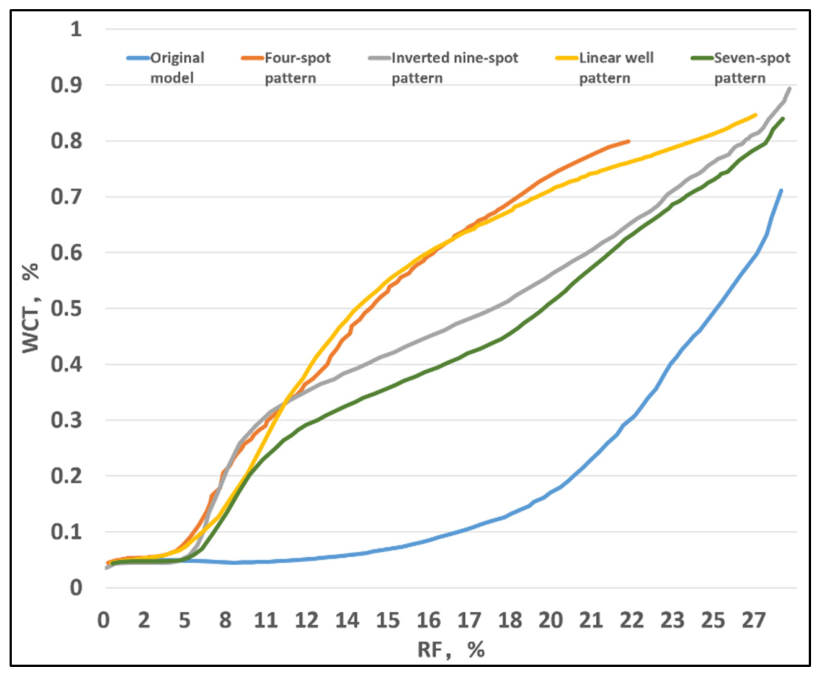
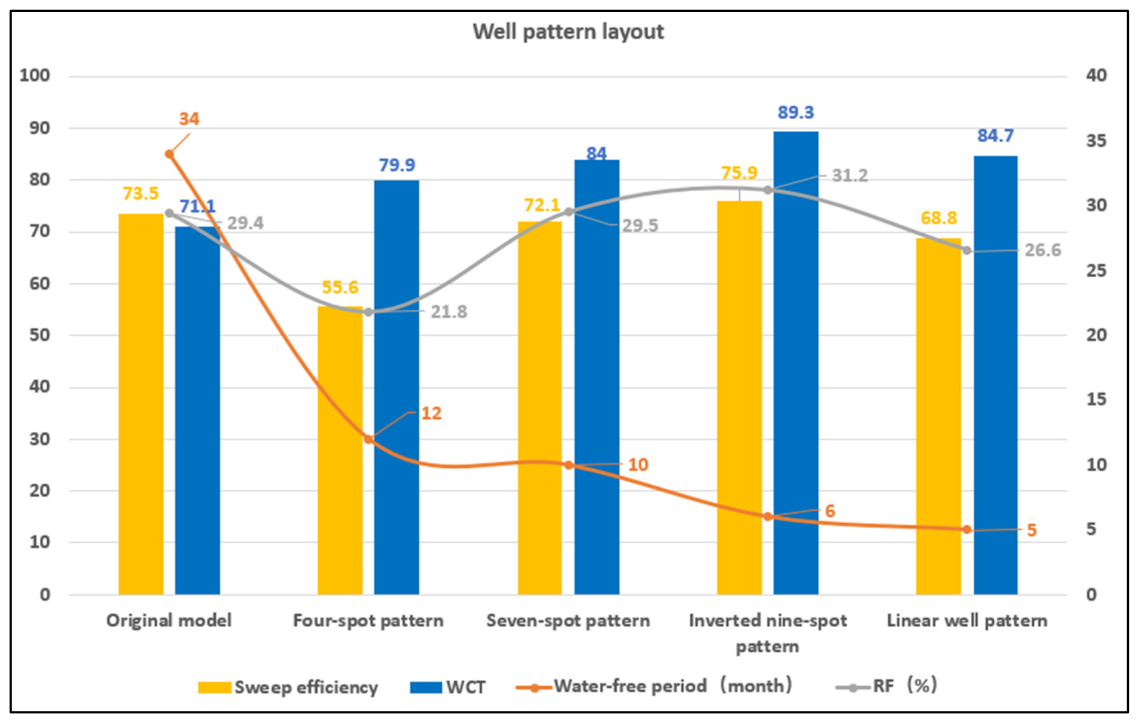
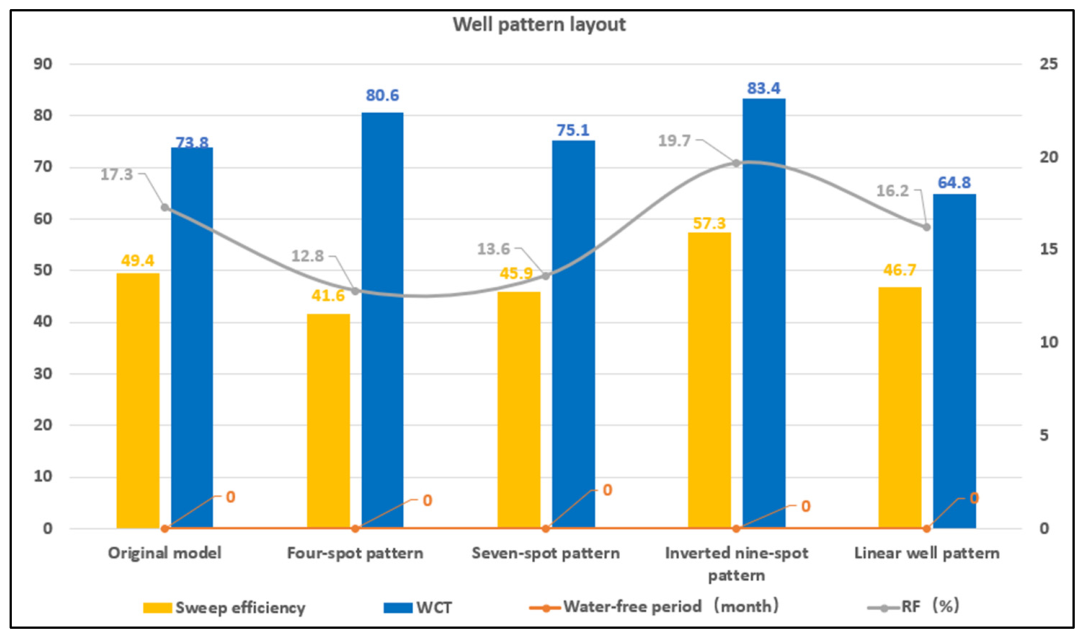
5.2.2. Effect of Well Pattern Layout
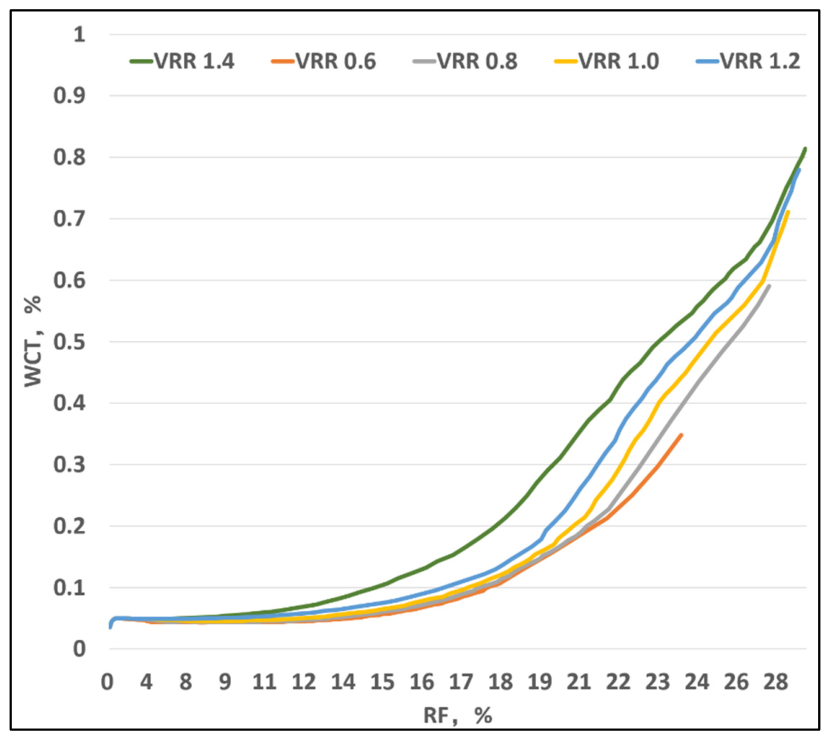
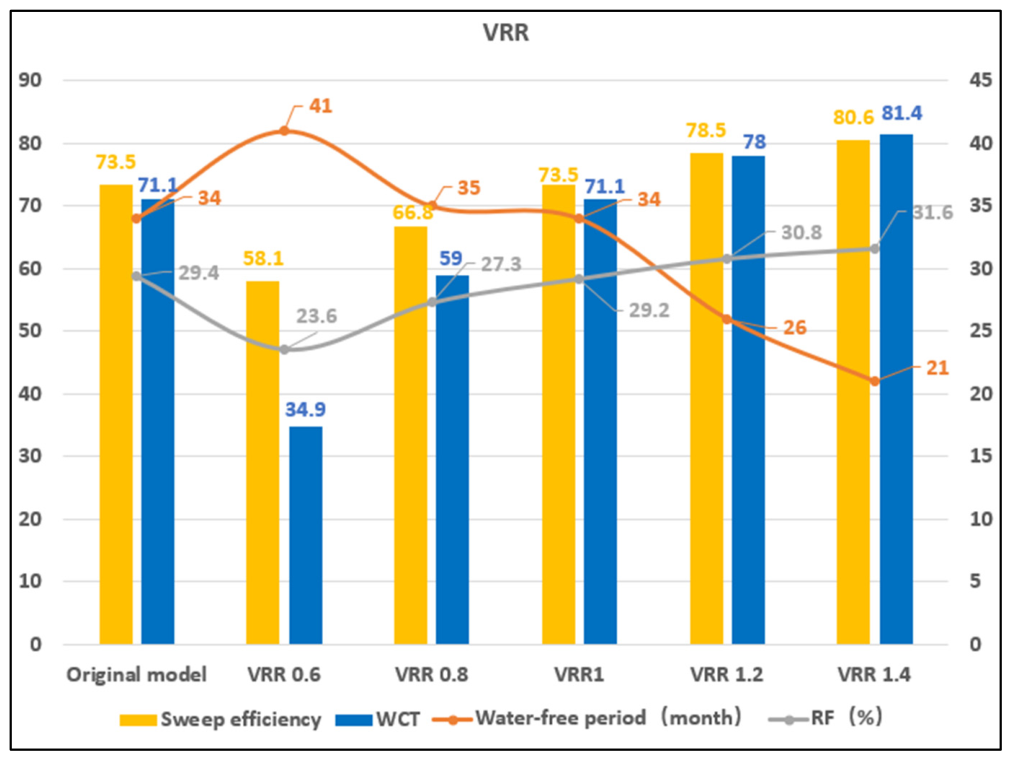
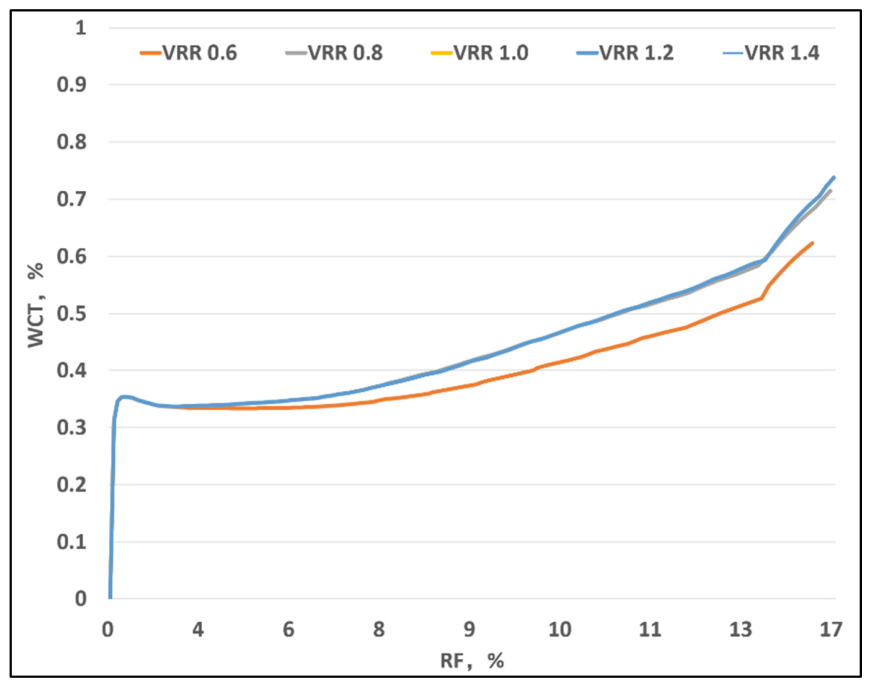
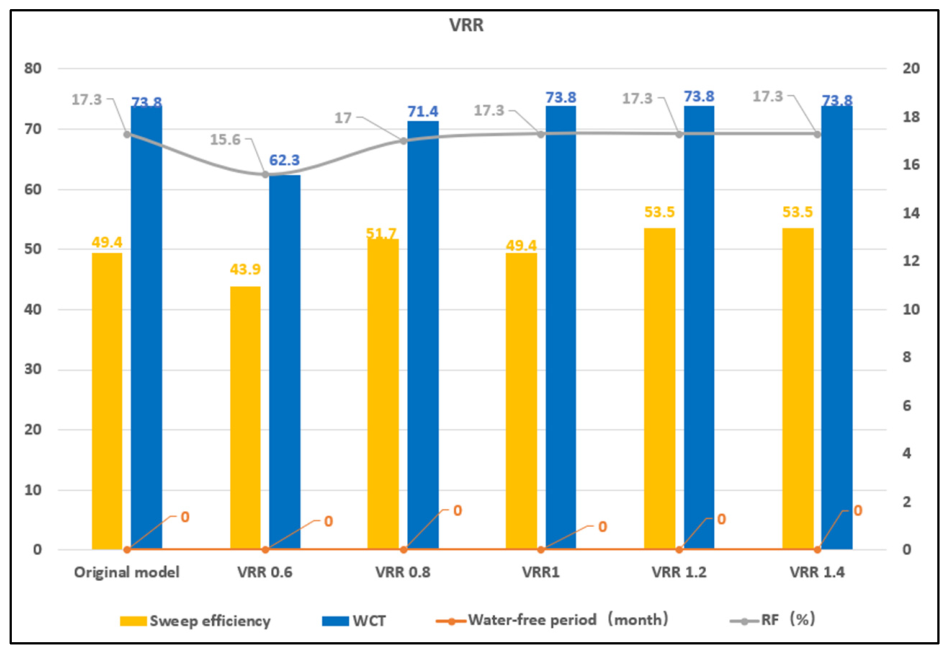
5.2.3. Effect of Injection–Production Intensity
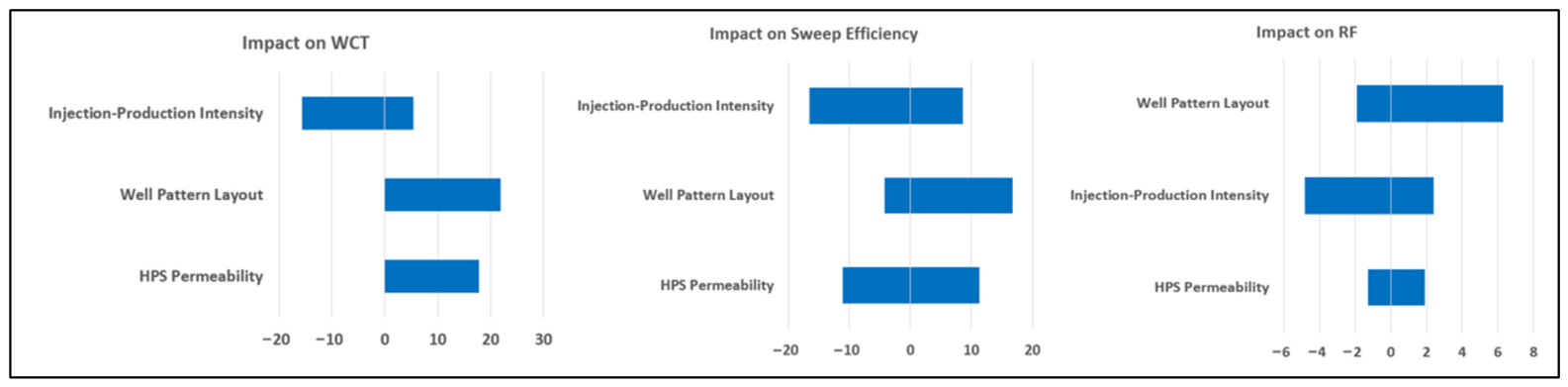
5.3. Sensitivity Analysis of Dominant Factors in the Channel Composite Block
5.3.1. Effect of HPS Permeability
5.3.2. Effect of Well Pattern Layout
5.3.3. Effect of Injection–Production Intensity
5.4. Sensitivity Analysis of Dominant Factors in the Composite Composition Block
5.4.1. Effect of HPS Permeability
5.4.2. Effect of Well Pattern Layout
5.4.3. Effect of Injection–Production Intensity
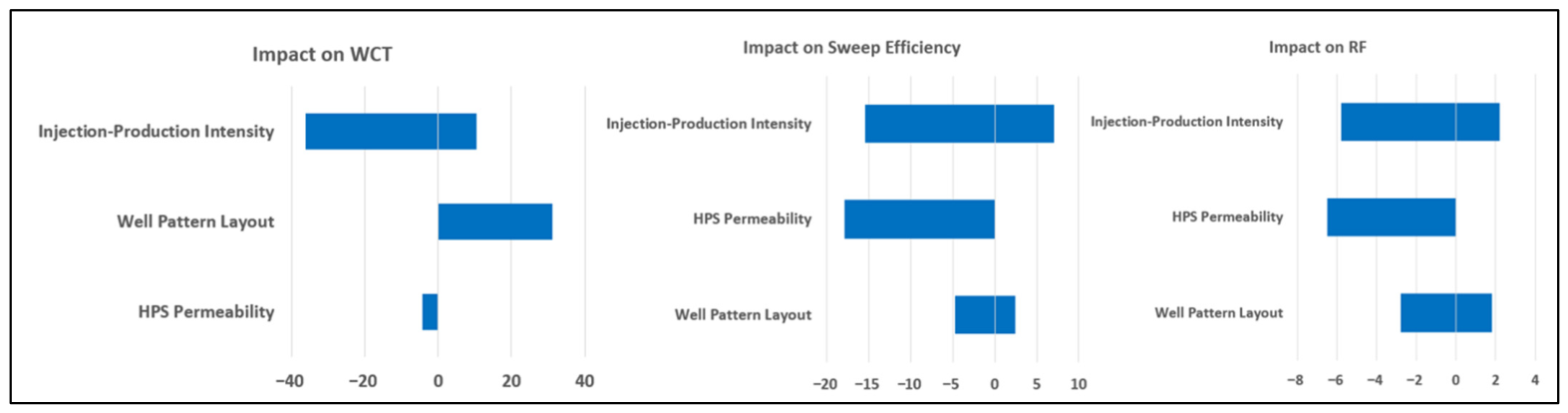
5.5. Analysis Results and Adjustment Suggestions
5.6. Development Recommendations Based on Dominant Controlling Factors
6. Conclusions
Author Contributions
Funding
Data Availability Statement
Conflicts of Interest
Abbreviations
| WCT | Water cut |
| HPS | High Permeability Stratum |
| BBS | Baffle and Barrier Stratum |
References
- Energy Institute. Statistical Review of World Energy 2024 [R/OL]; Energy Institute: London, UK, 2024. [Google Scholar]
- Wang, Y.L.; Song, X.; Wang, G.; Wang, H.; Li, Z.M.; Zhang, H.; Nie, Z. Key technologies and practices for rapid and large-scale production increase in cooperation oil and gas fields of the Middle East. Acta Pet. Sin. 2020, 41, 1633–1642. [Google Scholar]
- Al-Jawad, S.N.A.; Ahmed, M.A.; Saleh, A.H. Integrated reservoir characterization and quality analysis of the carbonate rock types, case study, southern Iraq. J. Pet. Explor. Prod. Technol. 2020, 10, 3157–3177. [Google Scholar] [CrossRef]
- Al-Jawad, S.N.; Saleh, A.H. Flow units and rock type for reservoir characterization in carbonate reservoir: Case study, south of Iraq. J. Pet. Explor. Prod. Technol. 2020, 10, 1–20. [Google Scholar] [CrossRef]
- Kargarpour, M.A. Carbonate reservoir characterization: An integrated approach. J. Pet. Explor. Prod. Technol. 2020, 10, 2655–2667. [Google Scholar] [CrossRef]
- Zhang, Q.; Li, Y.; Li, B.Z.; Liu, Z.; Wei, J.C.; Zhou, J.S. Identification methods and development strategy study of thief zone in reef-bank carbonate reservoirs: A case study of the Mishrif reservoir in Rumaila oilfield. Pet. Geol. Recovery Effic. 2016, 23, 29–34. [Google Scholar] [CrossRef]
- Song, X.; Li, Y. Optimum development options and strategies for water injection development of carbonate reservoirs in the Middle East. Pet. Explor. Dev. 2018, 45, 723–734. [Google Scholar] [CrossRef]
- Li, H. Prediction Method of Oilfield Index for Water Flooding Development Based on Fuzzy Comprehensive Evaluation Algorithm. In 2021 3rd International Conference on Artificial Intelligence and Advanced Manufacture; Association for Computing Machinery: New York, NY, USA, 2022. [Google Scholar] [CrossRef]
- Feng, Q.H.; Lu, A.M.; Yu, H.J.; Ma, R.G. A new method for evaluating waterflooding development effectiveness. J.-Univ. Pet. China Nat. Sci. Ed. 2004, 28, 58–60. [Google Scholar]
- Li, J.J.; Jiang, H.Q.; Xu, H.; Qin, J.S.; Chen, M.F. Experiment on production laws for single well in vuggy carbonate reservoir. China Univ. Pet. (Nat. Sci. Ed.) 2009, 33, 85–89. [Google Scholar]
- Li, S.; Liu, Y.; Xue, L.; Yang, L.; Yuan, Z.; Jian, C. An investigation on water flooding performance and pattern of porous carbonate reservoirs with bottom water. J. Pet. Sci. Eng. 2021, 200, 108353. [Google Scholar] [CrossRef]
- Zhong, Y.; Tan, X.; Zhao, L.; Guo, R.; Li, F.; Jin, Z.; Chen, Y.; Xiao, D. Identification of facies-controlled eogenetic karstification in the Upper Cretaceous of the Halfaya oilfield and its impact on reservoir capacity. Geol. J. 2018, 54, 450–465. [Google Scholar] [CrossRef]
- Tadayoni, M.; Khalilbeyg, M.; Bin Junin, R. A new approach to heterogeneity analysis in a highly complex carbonate reservoir by using borehole image and conventional log data. J. Pet. Explor. Prod. Technol. 2020, 10, 2613–2629. [Google Scholar] [CrossRef]
- Liu, X.L.; Zhu, G.Y.; Xiong, H.L.; Liu, B.; Dong, Z.W.; Li, X.Y. Effect of injected water properties on oil displacement effect in Middle East carbonate reservoirs. Pet. Geol. Recovery Effic. 2017, 24, 116–120. [Google Scholar] [CrossRef]
- Teng, T.; Wang, Y.; Chen, Y.; Li, Y.; Liu, X. Permeability and Energy Evolution of Coal under Unloading Confining Pressure. Int. J. Geomech. 2026, 26, 04025341. [Google Scholar] [CrossRef]
- Wu, P.; Wu, A.; Ruan, Z.; Wang, Z.; Huang, T. Multi-objective optimization of tailings flocculation performance in DCT feedwell using Taguchi–Grey relational analysis: Geometry parameters and feed hydrodynamics. Sep. Purif. Technol. 2026, 394, 137415. [Google Scholar] [CrossRef]
- Yang, J.; Liu, H.; Ning, C.Z. Adaptability and optimal design of stimulation measures of low permeability carbonate reservoirs. Pet. Sci. Bull. 2022, 7, 204–212. [Google Scholar]
- Li, F.; Song, X.; Guo, R.; Liu, L.; Song, S. Characteristics and genesis of interlayers in thick bioclastic limestone reservoirs: A case study of Cretaceous Mishrif Formation of the M oilfield in the Middle East. Acta Pet. Sin. 2021, 42, 853–864. [Google Scholar]
- Deng, L. Control problems of grey systems. Syst. Control Lett. 1982, 1, 288–294. [Google Scholar]
- Liu, S.F.; Yang, Y.J.; Cao, Y.; Xie, N. A summary on the research of GRA models. Grey Syst. Theory Appl. 2013, 3, 7–15. [Google Scholar] [CrossRef]
- Deng, J.L. Introduction to grey system theory. J. Grey Syst. 1989, 1, 1–24. [Google Scholar]



| Architecture Zoning | Northwestern Part | Core Part | Southeastern Part |
|---|---|---|---|
| Reservoir type |  |  |  |
| Well pattern layout |  |  |  |
| HPS distribution pattern |  Continuous distribution of HPS in the shoal |  Banded distribution of HPS in channels |  Mosaic distribution of HPS in shoals and channels |
| BBS distribution pattern |  |  |  |
| Production dynamics of each region |  |  |  |
| Architecture Zoning | Lagoon-Shoal Type | Channel Composite Type | Composite Composition Type | |||
|---|---|---|---|---|---|---|
| Basic model information | Number of grids | 29,676 | Number of grids | 39,334 | Number of grids | 40,684 |
| Average porosity | 14.7% | Average porosity | 13.1% | Average porosity | 14.6% | |
| Average Permeability | 37.8 mD | Average Permeability | 55.4 mD | Average Permeability | 48.7 mD | |
| Oil saturation | 57.1% | Oil saturation | 48.7% | Oil saturation | 59.2% | |
| Sedimentary facies stacking pattern |  |  |  | |||
| Plane distribution pattern |  |  |  | |||
| Reservoir model |  |  |  | |||
| Sedimentary rhythm |  Fluctuating composite rhythm |  “K-Type” composite rhythm |  “>-Type” composite rhythm | |||
| Figure legend |  | |||||
| Grey Relational Analysis | Numerical Simulation Analysis | ||
|---|---|---|---|
| Research object | Horizontal comparison of the three blocks | In-depth analysis of a single block | |
| Research goal | Searching for cross-block common factors | Discovering Intra-block Individual Factors | |
| Advantages and disadvantages | Fast and efficient, suitable for preliminary diagnosis; only reveals correlation with weak prediction ability | Reliable analysis and reveals causal relationships; multi-factor analysis requires massive simulations | |
| Comparison Aspect | Traditional Single-Sequence Grey Relational Analysis | Multi-Sequence Grey Relational Analysis (This Study) |
|---|---|---|
| Research object | Single block or single development stage | Comparative analysis across multiple blocks |
| Reference sequence | Single indicator (e.g., water cut) | Multiple indicators (e.g., water cut, production rate, recovery factor) |
| Analysis capability | Reflects partial relationships with certain limitations | Integrates multiple development dynamics with more comprehensive results |
| Cross-block comparability | Difficult to achieve a unified comparison across different blocks | Enables unified evaluation and comparison across different blocks |
| Applicability | Suitable for single-block analysis | Suitable for complex reservoirs and multi-block comparative analysis |
| Lagoon-Shoal Block—Channel Composite Block—Composite Composition Block | ||||
|---|---|---|---|---|
| Reservoir scale | Heterogeneity | Stacked architecture | HPS permeability | |
| Block scale | Well pattern layout | Oil production rate | Injection–production corresponding relation | |
| Well group scale | Injection–production intensity | Injection–production connectivity | Well spacing | |
| Sample Number | Reference Sequences X1 (WCT) | Reference Sequences X2 (Cum. Prod.) | Reference Sequences X3 (RF) | Comparison Sequences 1 | Comparison Sequences 2 | Comparison Sequences 3 |
|---|---|---|---|---|---|---|
| Heterogeneity | Stacked Architecture | HPS Permeability | ||||
| 1- Lagoon-shoal block | 11% | 15.36 MMstb | 6.80% | 1.73 | 2.18 | 9% |
| 2- Channel composite block | 54% | 45.80 MMstb | 9.15% | 2.9 | 3.54 | 15% |
| 3- Composite composition block | 8.2% | 13.50 MMstb | 4.55% | 2.36 | 3.08 | 8% |
| Sample Number | Lagoon-Shoal Block | 2- Channel Composite Block | 3- Composite Composition Block | |
|---|---|---|---|---|
| Reference sequences X1 (WCT) | 11% | 54% | 8.2% | |
| Reference sequences X2 (Cum. Prod.) | 15.36 MMstb | 45.80 MMstb | 13.50 MMstb | |
| Reference sequences X3 (RF) | 6.80% | 9.15% | 4.55% | |
| Comparison sequences 1—well pattern layout | Receiving efficiency | 70% | 58.3% | 62.5% |
| Sweep degree | 64.5% | 49.6% | 39.1% | |
| Comprehensive calculation | 67.25% | 53.9% | 50.8% | |
| Comparison sequences 2—oil production rate | 1.06% | 0.71% | 0.65% | |
| Comparison sequences 3—injection–production corresponding relation | Upper-layer sweep degree | 68.3% | 54.6% | 11.8% |
| Middle-layer sweep degree | 77.5% | 57.1% | 42.5% | |
| Lower-layer sweep degree | 50.8% | 54.3% | 51.8% | |
| Comprehensive Calculation | 20.7% | 2.8% | 59.2% | |
| Well Group | Reference Sequences X1 (WCT) | Reference Sequences X2 (Cum. Prod.) | Reference Sequences X3 (RF) | Comparison Sequences 1 | Comparison Sequences 2 | Comparison Sequences 3 |
|---|---|---|---|---|---|---|
| Injection–Production Intensity | Injection–Production Connectivity | Well Spacing | ||||
| Group-1 | 22% | 6.71 MMstb | 0.11% | 1.02 | 75% | 1873.5 ft |
| Group-2 | 65% | 5.12 MMstb | 2.6% | 2.6 | 50% | 1869.2 ft |
| Group-3 | 14% | 4.74 MMstb | 0.66% | 0.66 | 75% | 2615.7 ft |
| Reservoir Scale | Correlation Degree | Rank | Block Scale | Correlation Degree | Rank | Well Group Scale | Correlation Degree | Rank |
|---|---|---|---|---|---|---|---|---|
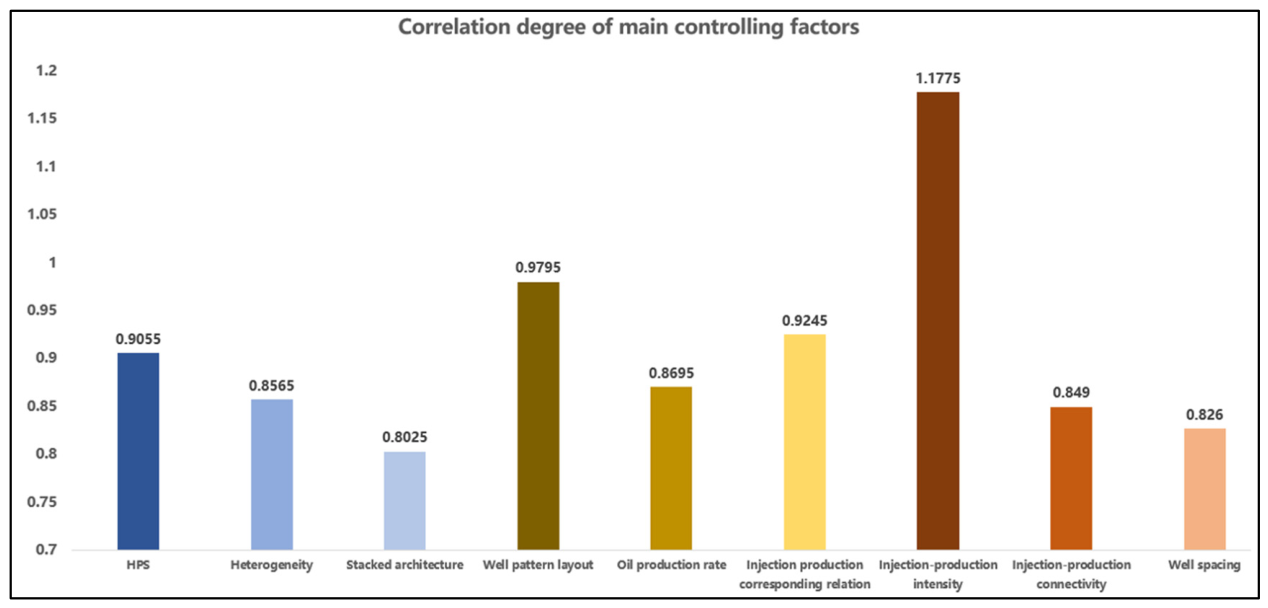
| HPS distribution | 0.9055 | 1 | Well pattern layout | 0.9795 | 1 | Injection–production intensity | 1.1775 | 1 |
| Heterogeneity | 0.8565 | 2 | Injection–production corresponding relation | 0.9245 | 2 | Injection–production connectivity | 0.849 | 2 |
| Stacked architecture | 0.8025 | 3 | Oil production rate | 0.8695 | 3 | Well spacing | 0.826 | 3 |
| 1- Lagoon-Shoal Block | 2- Channel Composite Block | 3- Composite Composition Block | ||||
|---|---|---|---|---|---|---|
 |  |  | ||||
| Basic information | Number of grids | 30 × 18 × 20 | Number of grids | 30 × 30 × 20 | Number of grids | 30 × 30 × 20 |
| Model size | 4500 × 2700 × 328 | Model size | 2250 × 2250 × 328 | Model size | 5292 × 6900 × 328 | |
| Average porosity | 16.8% | Average porosity | 16.4% | Average porosity | 16.2% | |
| Average permeability | 37.6 mD | Average permeability | 59.2 mD | Average permeability | 47.4 mD | |
| Oil saturation | 60% | Oil saturation | 66.1% | Oil saturation | 58% | |
| Permeability distribution |  |  | 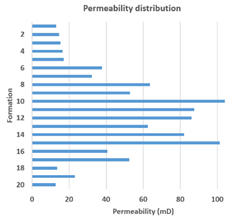 | |||
| Water saturation distribution |  |  |  | |||
| Relative permeability characteristics |  |  |  |  | ||
Disclaimer/Publisher’s Note: The statements, opinions and data contained in all publications are solely those of the individual author(s) and contributor(s) and not of MDPI and/or the editor(s). MDPI and/or the editor(s) disclaim responsibility for any injury to people or property resulting from any ideas, methods, instructions or products referred to in the content. |
© 2026 by the authors. Licensee MDPI, Basel, Switzerland. This article is an open access article distributed under the terms and conditions of the Creative Commons Attribution (CC BY) license.
Share and Cite
Liang, Y.; Shao, L.; Sun, H.; Wang, Z.; Zhang, H. Numerical Simulation Study on the Main Controlling Factors of Water Cut Rise in Thick Carbonate Reservoirs Based on Multi-Scale Hierarchical Analysis. Processes 2026, 14, 1272. https://doi.org/10.3390/pr14081272
Liang Y, Shao L, Sun H, Wang Z, Zhang H. Numerical Simulation Study on the Main Controlling Factors of Water Cut Rise in Thick Carbonate Reservoirs Based on Multi-Scale Hierarchical Analysis. Processes. 2026; 14(8):1272. https://doi.org/10.3390/pr14081272
Chicago/Turabian StyleLiang, Yanhao, Lei Shao, Hao Sun, Ze Wang, and Han Zhang. 2026. "Numerical Simulation Study on the Main Controlling Factors of Water Cut Rise in Thick Carbonate Reservoirs Based on Multi-Scale Hierarchical Analysis" Processes 14, no. 8: 1272. https://doi.org/10.3390/pr14081272
APA StyleLiang, Y., Shao, L., Sun, H., Wang, Z., & Zhang, H. (2026). Numerical Simulation Study on the Main Controlling Factors of Water Cut Rise in Thick Carbonate Reservoirs Based on Multi-Scale Hierarchical Analysis. Processes, 14(8), 1272. https://doi.org/10.3390/pr14081272