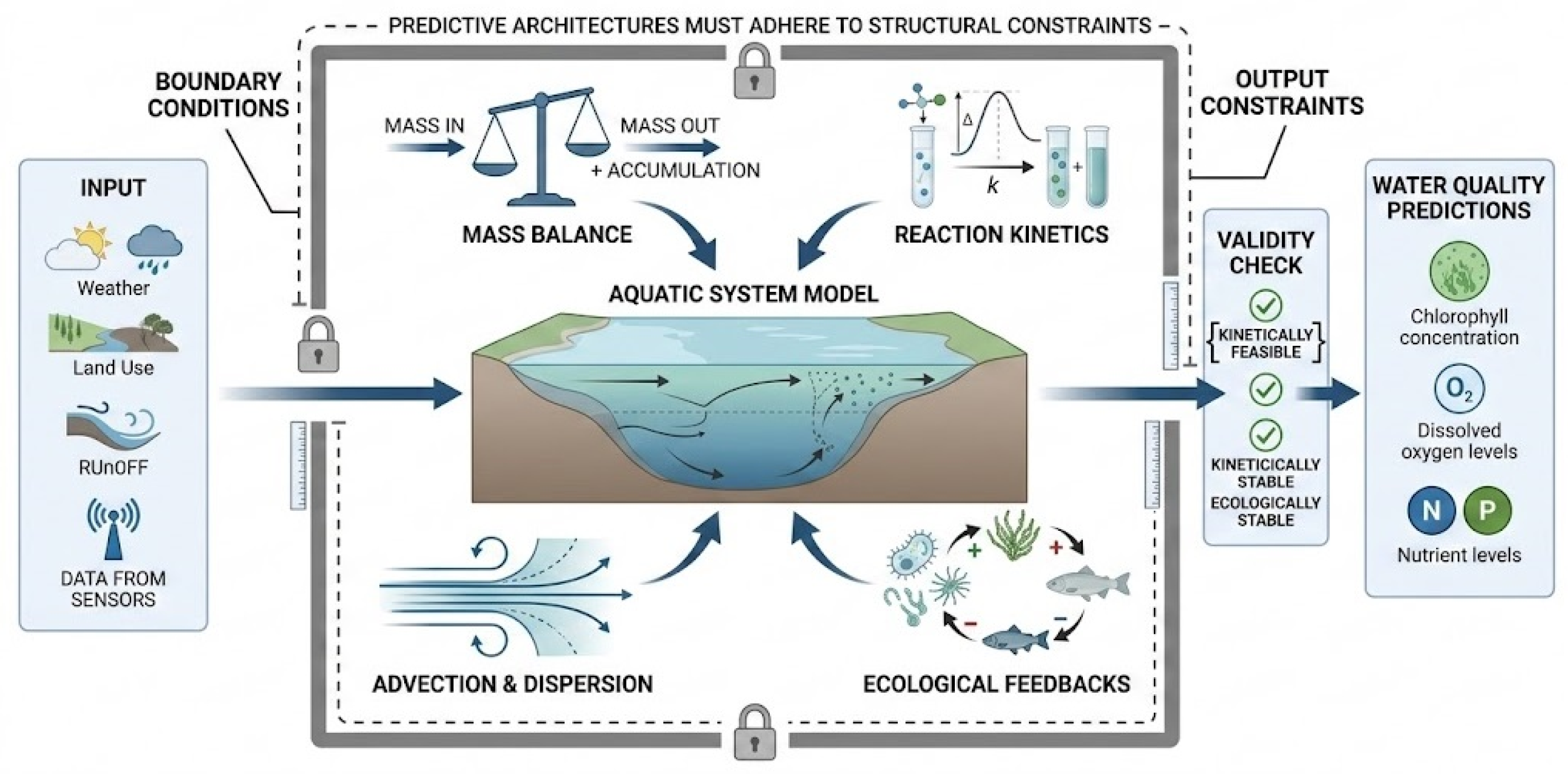
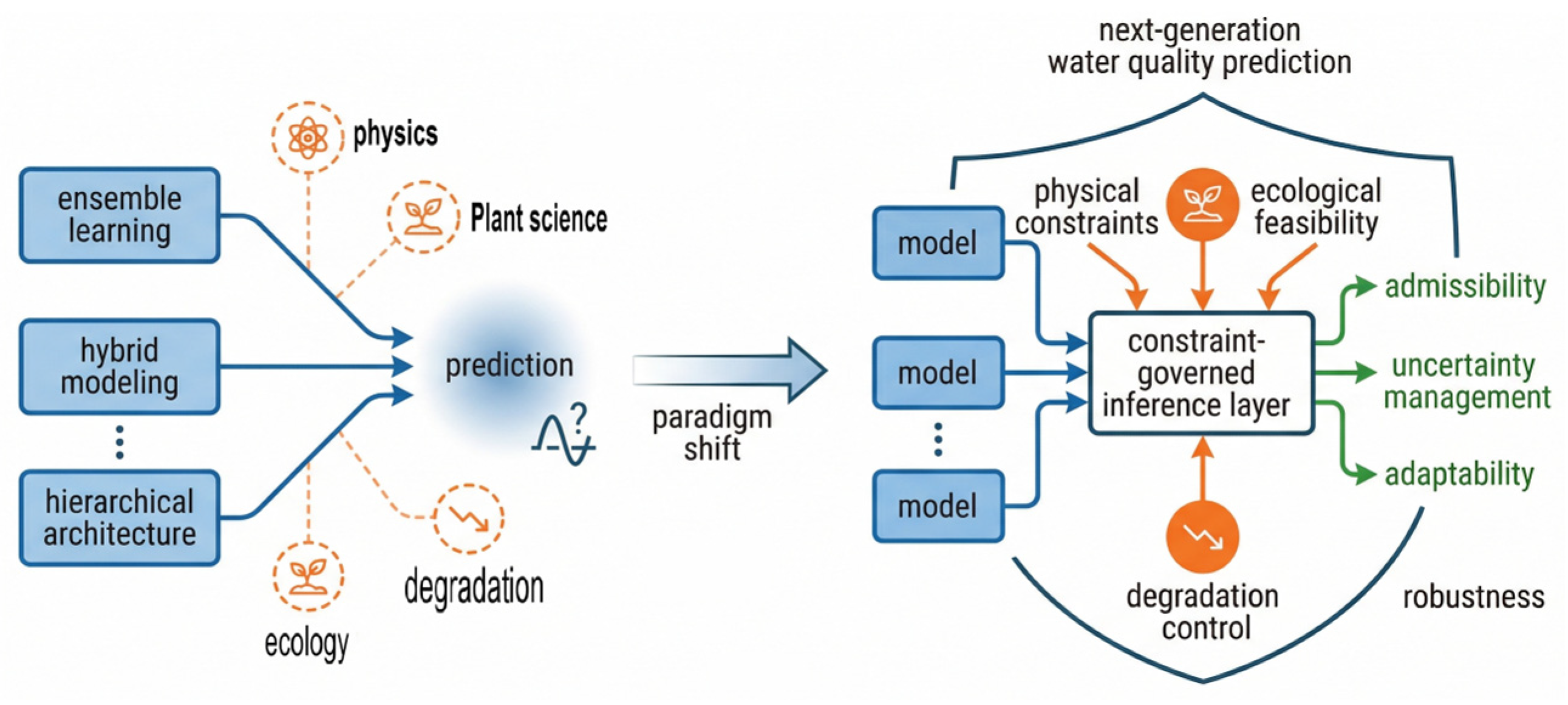
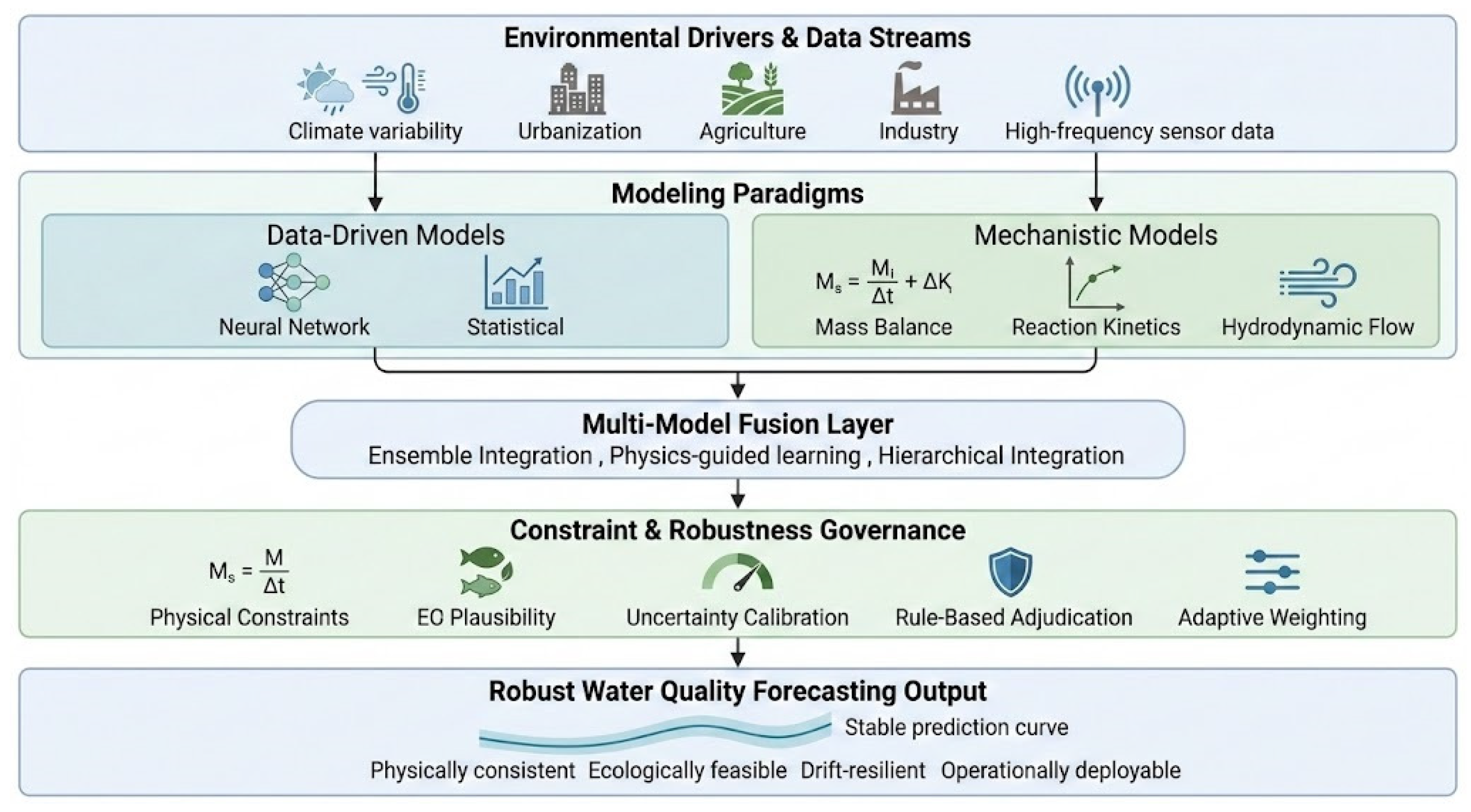
Water Quality Prediction Based on Physical and Ecological Constraints Using Multi-Model Fusion: A Robust End-to-End Mechanism from Rule-Based Adjudication to Online Backoff



Abstract
1. Introduction
2. Statistical Profile of Reviewed Research
3. Physical and Ecological Constraint System for Water Quality Prediction
3.1. Mass Balance and Conservation Constraints
3.2. Kinetic and Process-Level Constraints
3.3. Transport and Hydrodynamic Constraints
3.4. Ecological Threshold and Regime Constraints
3.5. Constraint Taxonomy and Formalization
4. Multi-Model Fusion Paradigms in Water Quality Prediction and Their Structural Limitations
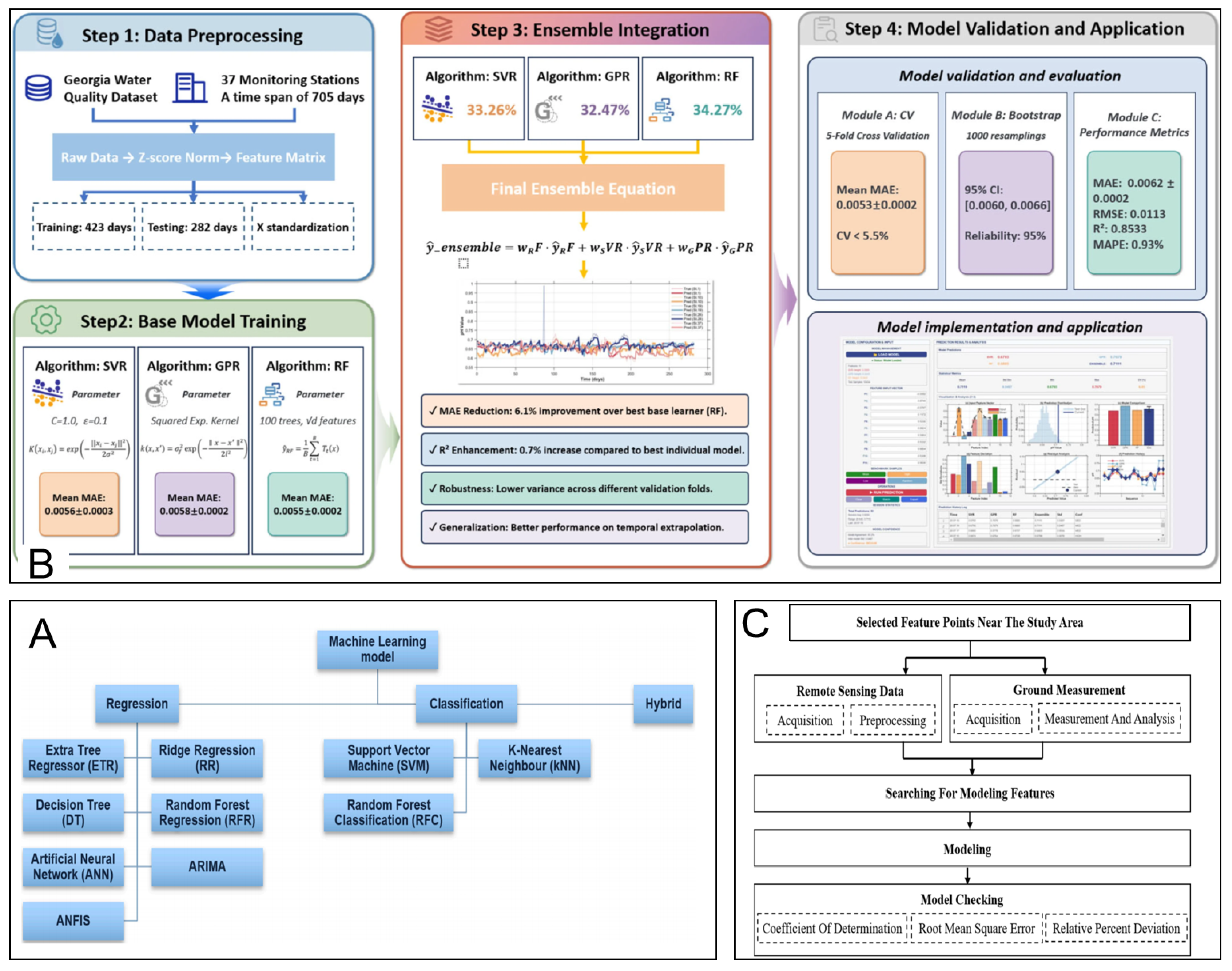
4.1. Statistical Ensemble Learning
4.2. Hybrid Physics-Data Models
4.3. Hierarchical and Multi-Stage Fusion Architectures
4.4. Bayesian Model Averaging and Probabilistic Fusion
4.5. Emerging Deep Integration Frameworks
4.6. Structural Limitations Across Fusion Paradigms
5. End-to-End Robust Architecture for Constraint-Governed Multi-Model Fusion
5.1. From Model Aggregation to Structured Decision Pipelines
5.2. Role of Rule-Based Adjudication in Fusion Systems
5.3. Reliability-Aware Fusion and Uncertainty Integration
5.4. Constraint Enforcement Through Post-Fusion Projection
5.5. Dual-Track Adaptation: Online Adjustment and Offline Recalibration
5.6. Hierarchical Backoff and Graceful Degradation
5.7. Toward an Integrated Robustness Standard
6. Synthesis of Evidence and Robustness Evaluation Framework
6.1. Empirical Patterns in Multi-Model Water Quality Prediction
6.2. Dimensions of Robustness Beyond Predictive Accuracy
6.3. Evidence Supporting Constraint Integration and Adaptive Fusion
6.4. A Structured Robustness Evaluation Matrix
6.5. Comparative Robustness Profiles Across Paradigms
6.6. Implications for Deployment and Governance
7. Conclusions and Perspectives
Author Contributions
Funding
Data Availability Statement
Conflicts of Interest
References
- Yi, X.-H.; Chu, H.-Y.; Wang, C.-Y.; Ren, H.; Zhou, L.-h.; Zhao, Y.; Wang, F.-X.; Du, H.; Zhai, Y.; Xia, T.; et al. Metal-organic frameworks for clean water. Chin. Chem. Lett. 2026, 37, 112243. [Google Scholar] [CrossRef]
- Liu, C.; Bolan, N.; Rajapaksha, A.U.; Wang, H.; Balasubramanian, P.; Zhang, P.; Nguyen, X.C.; Li, F. Critical review of biochar for the removal of emerging inorganic pollutants from wastewater. Chin. Chem. Lett. 2025, 36, 109960. [Google Scholar] [CrossRef]
- Kacaribu, A.A.; Aisyah, Y.; Febriani; Darwin. Development of wastewater treatment methods for palm oil mill effluent (POME): A comprehensive review. Resour. Chem. Mater. 2025, 4, 100130. [Google Scholar] [CrossRef]
- Li, L.; Xu, H.; Zhang, Q.; Zhan, Z.; Liang, X.; Xing, J. Estimation methods of wetland carbon sink and factors influencing wetland carbon cycle: A review. Carbon Res. 2024, 3, 50. [Google Scholar] [CrossRef]
- Ren, Y.; Liu, S.; Liu, L.; Suo, C.; Fu, R.; Zhang, Y.; Qiu, Y.; Wu, F. Deciphering the molecular composition and sources of dissolved organic matter in urban rivers based on optical spectroscopy and FT-ICR-MS analyses. Carbon Res. 2024, 3, 67. [Google Scholar] [CrossRef]
- Zahoor, A.; Liu, X.; Liu, Y.; Liu, S.; Yi, W.; Sajnani, S.; Tai, L.; Tahir, N.; Abdoulaye, B.; Mahaveer; et al. Agricultural lignocellulose biochar material in wastewater treatment: A critical review and sustainability assessment. Environ. Funct. Mater. 2025, 4, 117–137. [Google Scholar] [CrossRef]
- Dasgupta, T.; Rajput, H.; Perera, P.; Sun, X.; He, Q. Sustainable carbon materials for magnetic adsorbent-based pentachlorophenol removal from wastewater. Sustain. Carbon Mater. 2025, 1, e003. [Google Scholar] [CrossRef]
- Zhang, K.; Li, Z.; Chen, X.; Zheng, Q.; Wang, X.; Li, X.; Hou, D.; Li, X.; Yan, X.; Li, W. Gas emission prediction of intelligent mines based on PCA-HPO-ELM. J. Min. Sci. Technol. 2025, 10, 879–889. [Google Scholar] [CrossRef]
- Lokman, A.; Ismail, W.Z.W.; Aziz, N.A.A. A Review of Water Quality Forecasting and Classification Using Machine Learning Models and Statistical Analysis. Water 2025, 17, 2243. [Google Scholar] [CrossRef]
- Yuan, Z.; Wang, Y.; Zhu, L.; Zhang, C.; Sun, Y. Machine-learning-aided biochar production from aquatic biomass. Carbon Res. 2024, 3, 77. [Google Scholar] [CrossRef]
- Guo, Y.; Liu, X.; Gao, Y.; Wang, X.; Ding, L.; Pan, W.; Hua, C.; He, Y.; Chen, X.; Dai, Z.; et al. AutoML for calorific value prediction using a large database from the coal gasification practices in China. Int. J. Coal Sci. Technol. 2025, 12, 63. [Google Scholar] [CrossRef]
- Du, F.; Li, K.; Wang, K.; Dai, L.; Zhao, M.; Wang, C.; Jiang, L.; Wang, L. Coal and gas outburst risk prediction based on improved DBO optimized CNN. J. Min. Sci. Technol. 2025, 10, 912–922. [Google Scholar] [CrossRef]
- Li, L.; Han, J.; Huang, L.; Liu, L.; Qiu, S.; Ding, J.; Liu, X.; Zhang, J. Activation of PMS by MIL-53(Fe)@AC composites contributes to tetracycline degradation: Properties and mechanisms. Surf. Interfaces 2024, 51, 104521. [Google Scholar] [CrossRef]
- Song, Y.; Wang, W.; Wu, Y.; Fan, Y.; Zhao, X. Unsupervised anomaly detection in shearers via autoencoder networks and multi-scale correlation matrix reconstruction. Int. J. Coal Sci. Technol. 2024, 11, 79. [Google Scholar] [CrossRef]
- Wang, S.; Liu, Y.; Li, X.; Lin, P.; Gao, L. Random noise suppression of seismic data based on CEEMD-MSSA. J. Min. Sci. Technol. 2026, 11, 103–113. [Google Scholar] [CrossRef]
- Jia, J.; Fan, Q.; Wang, L.; Li, D. Prediction of post-refracture production of low-productivity wells using deep time series models: A critical review. J. Green Mine 2025, 3, 14–36. [Google Scholar] [CrossRef]
- Arzhangi, A.; Partani, S. Water quality index prediction via a robust machine learning model using oxygen-related indices for river water quality monitoring. Sci. Rep. 2026, 16, 6102. [Google Scholar] [CrossRef]
- Frankel, M.; De Florio, M.; Schiassi, E.; Katz, L.E.; Kinney, K.; Werth, C.J.; Zigler, C.; Sela, L. Enhancing drinking water quality modeling: Leveraging physics informed neural networks for learning with imperfect reaction models and partial data. Environ. Sci. Water Res. Technol. 2025, 11, 2684–2697. [Google Scholar] [CrossRef]
- Du, Y.; Pechlivanidis, I.G. Hybrid approaches enhance hydrological model usability for local streamflow prediction. Commun. Earth Environ. 2025, 6, 334. [Google Scholar] [CrossRef]
- Jiang, S.; Sweet, L.-b.; Blougouras, G.; Brenning, A.; Li, W.; Reichstein, M.; Denzler, J.; Shangguan, W.; Yu, G.; Huang, F.; et al. How Interpretable Machine Learning Can Benefit Process Understanding in the Geosciences. Earth’s Future 2024, 12, e2024EF004540. [Google Scholar] [CrossRef]
- Rabbi, M.F. Unified artificial intelligence framework for modeling pollution dynamics and sustainable remediation in environmental chemistry. Sci. Rep. 2025, 15, 36196. [Google Scholar] [CrossRef] [PubMed]
- Wang, X.; Sha, H.; Yu, S.; Xie, J.; Deng, G.; Hao, X.; Zhang, Y. Progress of prediction and detection methods for the height of fractured water-conducting zone in coal mines. J. Green Mine 2025, 3, 1–13. [Google Scholar] [CrossRef]
- Li, L.; Liang, T.; Zhao, M.; Lv, Y.; Song, Z.; Sheng, T.; Ma, F. A review on mycelial pellets as biological carriers: Wastewater treatment and recovery for resource and energy. Bioresour. Technol. 2022, 355, 127200. [Google Scholar] [CrossRef]
- Duo, L.; Wang, J.; Zhong, Y.; Jiang, C.; Chen, Y.; Guo, X. Ecological environment quality assessment of coal mining cities based on GEE platform: A case study of Shuozhou, China. Int. J. Coal Sci. Technol. 2024, 11, 75. [Google Scholar] [CrossRef]
- Chapra, S.C. Surface Water-Quality Modeling; McGraw-Hill Publisher: New York, NY, USA, 1997; p. 1. [Google Scholar]
- Feng, D.; Tan, Z.; Lin, Z.; Xu, D.; Yu, C.-W.; He, Q. A Comparative Study of Physics-Informed and Data-Driven Neural Networks for Compound Flood Simulation at River-Ocean Interfaces: A Case Study of Hurricane Irene. J. Geophys. Res. Mach. Learn. Comput. 2025, 2, e2025JH000758. [Google Scholar] [CrossRef]
- Xia, X.; Liu, X.; Liu, J.; Fang, K.; Lu, L.; Oymak, S.; Currie, W.S.; Liu, T. Identifying trustworthiness challenges in deep learning models for continental-scale water quality prediction. Nexus 2025, 2, 100104. [Google Scholar] [CrossRef]
- Bella, A.D.; Raissi, M.; Santoro, D.; Roccaro, P. Physics-informed neural networks in water and wastewater systems: A critical review. Water Res. 2026, 293, 125449. [Google Scholar] [CrossRef]
- Li, L.; Liu, S.; Ke, X.; Dong, Z.; Huang, L. Anammox in treatment of coal chemical wastewater: A review. J. Min. Sci. Technol. 2025, 10, 351–362. [Google Scholar] [CrossRef]
- Li, L.; Zhao, X.; Sheng, T.; Feng, X. Microalgae-fungi co-cultivation for swine wastewater treatment: Insights into EPS-mediated aggregation mechanism. Environ. Res. 2026, 295, 123943. [Google Scholar] [CrossRef]
- Xu, B.; Pooi, C.K.; Yeap, T.S.; Leong, K.Y.; Soh, X.Y.; Huang, S.; Shi, X.; Mannina, G.; Ng, H.Y. Hybrid model composed of machine learning and ASM3 predicts performance of industrial wastewater treatment. J. Water Process Eng. 2024, 65, 105888. [Google Scholar] [CrossRef]
- Valladares-Castellanos, M.; de Jesús Crespo, R.; Douthat, T. Using machine learning for long-term calibration and validation of water quality ecosystem service models in data-scarce regions. Sci. Total Environ. 2025, 1000, 180388. [Google Scholar] [CrossRef] [PubMed]
- Li, L.; Yan, P.; Huang, L.; Zhan, Z.; Zhang, J.; Li, X.; Chai, W.; Tang, Q.; Shen, Z. Preparation and application of ceramic membranes incorporating graphite tailings for oil wastewater treatment. Chem. Eng. J. 2026, 527, 171733. [Google Scholar] [CrossRef]
- Yang, X.; Zhao, R.; Zhan, H.; Zhao, H.; Duan, Y.; Shen, Z. Modified Titanium dioxide-based photocatalysts for water treatment: Mini review. Environ. Funct. Mater. 2024, 3, 1–12. [Google Scholar] [CrossRef]
- Lu, X.; Su, P. Design and application of metal-organic frameworks derivatives as 3-electron ORR electrocatalysts for •OH generation in wastewater treatment: A review. Chin. Chem. Lett. 2025, 36, 110909. [Google Scholar] [CrossRef]
- Sun, Z.; Liao, Y.; Zhang, Y.; Sun, S.; Kan, Q.; Wu, Z.; Yu, L.; Dong, Z.; Wang, Z.; He, R.; et al. Sustainable carbon materials in environmental and energy applications. Sustain. Carbon Mater. 2025, 1, e007. [Google Scholar] [CrossRef]
- Tang, Y.; Tang, X.; Zhu, Z.; Gao, C.; Liu, L.; Zhao, F.; Zhang, S. Enhancing Hydrological Extremes Forecasting Capabilities in Data-Scarce Regions Through Transfer Learning With Data Augmentation. Earth’s Future 2025, 13, e2025EF006060. [Google Scholar] [CrossRef]
- Jia, L.; Yen, N.; Pei, Y. Spatiotemporal Water Quality Prediction Using Graph Neural Networks Based on Diffusion Decay Partial Differential Equations. In Proceedings of the 2024 IEEE/ACIS 9th International Conference on Big Data, Cloud Computing, and Data Science (BCD), Kitakyushu, Japan, 16–18 July 2024; pp. 73–78. [Google Scholar]
- Liu, Q.; Li, Y.; Yang, J.; Deng, M.; Li, J.; An, K. Physics-guided spatio–temporal neural network for predicting dissolved oxygen concentration in rivers. Int. J. Geogr. Inf. Sci. 2024, 38, 1207–1231. [Google Scholar] [CrossRef]
- Liu, X.; Yang, W.; Fu, X.; Li, X. Determination of the ecological water levels in shallow lakes based on regime shifts: A case study of China’s Baiyangdian Lake. Ecohydrol. Hydrobiol. 2024, 24, 931–943. [Google Scholar] [CrossRef]
- Roman, M.R.; Altieri, A.H.; Breitburg, D.; Ferrer, E.M.; Gallo, N.D.; Ito, S.; Limburg, K.; Rose, K.; Yasuhara, M.; Levin, L.A. Reviews and syntheses: Biological indicators of low-oxygen stress in marine water-breathing animals. Biogeosciences 2024, 21, 4975–5004. [Google Scholar] [CrossRef]
- O’Brien, D.A.; Deb, S.; Gal, G.; Thackeray, S.J.; Dutta, P.S.; Matsuzaki, S.-i.S.; May, L.; Clements, C.F. Early warning signals have limited applicability to empirical lake data. Nat. Commun. 2023, 14, 7942. [Google Scholar] [CrossRef]
- Ma, Y.; Wang, J.; Huo, S.; Wang, D.; Wang, Y.; Li, J.; Chen, J.; Feng, L. Explainable machine learning reveals climate warming increases risk of algal blooms in lakes and reservoirs. Water Res. 2025, 287, 124460. [Google Scholar] [CrossRef]
- Dakos, V.; Boulton, C.A.; Buxton, J.E.; Abrams, J.F.; Arellano-Nava, B.; Armstrong McKay, D.I.; Bathiany, S.; Blaschke, L.; Boers, N.; Dylewsky, D.; et al. Tipping point detection and early warnings in climate, ecological, and human systems. Earth Syst. Dynam. 2024, 15, 1117–1135. [Google Scholar] [CrossRef]
- Desai, A.; Rifai, H.S.; Petersen, T.M.; Stein, R. Mass balance and water quality modeling for load allocation of Escherichia coli in an urban watershed. J. Water Resour. Plan. Manag. 2011, 137, 412–427. [Google Scholar] [CrossRef]
- Plattes, M.; Lahore, H.M.F. Perspectives on the Monod model in biological wastewater treatment. J. Chem. Technol. Biotechnol. 2023, 98, 833–837. [Google Scholar] [CrossRef]
- Li, Z.; Buchberger, S.G.; Tzatchkov, V. Importance of dispersion in network water quality modeling. In Impacts of Global Climate Change; ASCE: Reston, VA, USA, 2005; pp. 1–12. [Google Scholar] [CrossRef]
- Carpenter, S.R.; Lathrop, R.C. Probabilistic estimate of a threshold for eutrophication. Ecosystems 2008, 11, 601–613. [Google Scholar] [CrossRef]
- Malbasa, V.; Zheng, C.; Chen, P.C.; Popovic, T.; Kezunovic, M. Voltage stability prediction using active machine learning. IEEE Trans. Smart Grid 2017, 8, 3117–3124. [Google Scholar] [CrossRef]
- Karniadakis, G.E.; Kevrekidis, I.G.; Lu, L.; Perdikaris, P.; Wang, S.; Yang, L. Physics-informed machine learning. Nat. Rev. Phys. 2021, 3, 422–440. [Google Scholar] [CrossRef]
- Reichstein, M.; Camps-Valls, G.; Stevens, B.; Jung, M.; Denzler, J.; Carvalhais, N.; Prabhat, F. Deep learning and process understanding for data-driven Earth system science. Nature 2019, 566, 195–204. [Google Scholar] [CrossRef]
- Read, J.S.; Jia, X.; Willard, J.; Appling, A.P.; Zwart, J.A.; Oliver, S.K.; Karpatne, A.; Hansen, G.J.A.; Hanson, P.C.; Watkins, W.; et al. Process-Guided Deep Learning Predictions of Lake Water Temperature. Water Resour. Res. 2019, 55, 9173–9190. [Google Scholar] [CrossRef]
- Liu, C.; Balasubramanian, P.; Nguyen, X.C.; An, J.; Praneeth, S.; Zhang, P.; Huang, H. Enhanced machine learning prediction of biochar adsorption for dyes: Parameter optimization and experimental validation. Carbon Res. 2025, 4, 46. [Google Scholar] [CrossRef]
- Zhao, S.; Wang, J.; Ma, R.; Lv, H.; Jiang, X.; Zhang, J.; Kong, L.; Shen, Y. The ultra efficient magnetic recyclable photocatalyst CoFe2O4/TiO2 based on kaolinite for mineral processing wastewater treatment. Environ. Funct. Mater. 2025, 4, 147–159. [Google Scholar] [CrossRef]
- Yin, S.; Wei, C.; Liu, Y.; Zhu, D. Spatial distribution of composition and chemodiversity of surface water dissolved organic matter (DOM) over the upper reach of the Changjiang River. Carbon Res. 2025, 4, 58. [Google Scholar] [CrossRef]
- Abba, S.I.; Pham, Q.B.; Saini, G.; Linh, N.T.T.; Ahmed, A.N.; Mohajane, M.; Bach, Q.V. Implementation of data intelligence models coupled with ensemble machine learning for prediction of water quality index. Environ. Sci. Pollut. Res. 2020, 27, 41524–41539. [Google Scholar] [CrossRef] [PubMed]
- Shi, Y.; Sun, H.; Cui, X.; Jiang, J.; Wu, R.; Wang, C. Ecological risk assessment of mining area based on pressure-state-response model and multi-source remote sensing data: A case study of Gaotouyao Coal Mining area. J. Green Mine 2025, 3, 51–62. [Google Scholar] [CrossRef]
- Daniel, I.; Abhijith, G.R.; Kutz, J.N.; Ostfeld, A.; Cominola, A. Physics-Informed Machine Learning for Universal Surrogate Modelling of Water Quality Parameters in Water Distribution Networks. Eng. Proc. 2024, 69, 205. [Google Scholar]
- Mu, T.; Duan, F.; Ning, B.; Zhou, B.; Liu, J.; Huang, M. ST-GPINN: A spatio-temporal graph physics-informed neural network for enhanced water quality prediction in water distribution systems. npj Clean Water 2025, 8, 74. [Google Scholar] [CrossRef]
- Wang, Z. Development analysis of mining subsidence research based on knowledge graph. J. Min. Sci. Technol. 2025, 10, 399–407. [Google Scholar] [CrossRef]
- Zhou, J.; Wei, K.; Huang, J.; Yang, L.; Shi, J. Research on Water Quality Prediction Model Based on Spatiotemporal Weighted Fusion and Hierarchical Cross-Attention Mechanisms. Water 2025, 17, 1244. [Google Scholar] [CrossRef]
- Jahangir, M.S.; Quilty, J. Hierarchical Deep Learning for Consistent Multi-Timescale Hydrological Forecasting. Water Resour. Res. 2025, 61, e2024WR038105. [Google Scholar] [CrossRef]
- Alizamir, M.; Moradveisi, K.; Othman Ahmed, K.; Bahrami, J.; Kim, S.; Heddam, S. An efficient data fusion model based on Bayesian model averaging for robust water quality prediction using deep learning strategies. Expert Syst. Appl. 2025, 261, 125499. [Google Scholar] [CrossRef]
- Sabzipour, B.; Arsenault, R.; Troin, M.; Martel, J.-L.; Brissette, F. Sensitivity analysis of the hyperparameters of an ensemble Kalman filter application on a semi-distributed hydrological model for streamflow forecasting. J. Hydrol. 2023, 626, 130251. [Google Scholar] [CrossRef]
- Cheng, K.-S.; Yu, G.H.; Tai, Y.-L.; Huang, K.-C.; Tsai, S.F.; Wu, D.H.; Lin, Y.-C.; Lee, C.-T.; Lo, T.-T. Hypothesis testing for performance evaluation of probabilistic seasonal rainfall forecasts. Geosci. Lett. 2024, 11, 27. [Google Scholar] [CrossRef]
- Yang, X.; Liu, Y.; Cao, A.; Liu, Y.; Wang, C.; Zhao, W.; Niu, Q. Coal burst spatio-temporal prediction method based on bidirectional long short-term memory network. Int. J. Coal Sci. Technol. 2025, 12, 11. [Google Scholar] [CrossRef]
- Mengistu, T.D.; Chung, I.-M.; Chang, S.W. Machine learning for water quality prediction and uncertainty assessment. Phys. Chem. Earth Parts A/B/C 2026, 143, 104319. [Google Scholar] [CrossRef]
- Torres González, M.A.; Ceballos Pérez, S.G.; Lara Figueroa, H.N.; Ávila Camacho, F.J.; Moreno Villalba, L.M.; Carrillo, J.M.S.; Meléndez Ramírez, A. Machine learning and predictive models for water management: A systematic review. Front. Water 2026, 8, 1756052. [Google Scholar] [CrossRef]
- Luo, T.; Hu, Y.; Zhang, M.; Jia, P.; Zhou, Y. Recent advances of sustainable and recyclable polymer materials from renewable resources. Resour. Chem. Mater. 2025, 4, 100085. [Google Scholar] [CrossRef]
- Chen, W.; Shao, Y.; Xu, Z.; Zhou, B.; Cui, S.; Dai, Z.; Yin, S.; Gao, Y.; Liu, L. Ensemble Machine Learning for Operational Water Quality Monitoring Using Weighted Model Fusion for pH Forecasting. Sustainability 2026, 18, 1200. [Google Scholar] [CrossRef]
- Yan, X.; Zhang, T.; Du, W.; Meng, Q.; Xu, X.; Zhao, X. A Comprehensive Review of Machine Learning for Water Quality Prediction over the Past Five Years. J. Mar. Sci. Eng. 2024, 12, 159. [Google Scholar] [CrossRef]
- Bagheri, A.; Patrignani, A.; Ghanbarian, B.; Pourkargar, D.B. A hybrid time series and physics-informed machine learning framework to predict soil water content. Eng. Appl. Artif. Intell. 2025, 144, 110105. [Google Scholar] [CrossRef]
- Yan, T.; Xing, X.; Wang, D.; Tsui, K.-L.; Xia, M. A unified threshold-constrained optimization framework for consistent and interpretable cross-machine condition monitoring. Reliab. Eng. Syst. Saf. 2026, 267, 111829. [Google Scholar] [CrossRef]
- Ncube, M.M.; Ngulube, P. Enhancing environmental decision-making: A systematic review of data analytics applications in monitoring and management. Discov. Sustain. 2024, 5, 290. [Google Scholar] [CrossRef]
- Zhang, C.; Nong, X.; Behzadian, K.; Campos, L.C.; Chen, L.; Shao, D. A new framework for water quality forecasting coupling causal inference, time-frequency analysis and uncertainty quantification. J. Environ. Manag. 2024, 350, 119613. [Google Scholar] [CrossRef]
- Olawade, D.B.; Wada, O.Z.; Ige, A.O.; Egbewole, B.I.; Olojo, A.; Oladapo, B.I. Artificial intelligence in environmental monitoring: Advancements, challenges, and future directions. Hyg. Environ. Health Adv. 2024, 12, 100114. [Google Scholar] [CrossRef]
- Domingues, N.S. A hybrid decision support system using rule-based and AI methods: The OnCATs knowledge-based framework. Int. J. Med. Inform. 2026, 206, 106144. [Google Scholar] [CrossRef] [PubMed]
- Santos, M.R.; Cagica Carvalho, L. AI-driven participatory environmental management: Innovations, applications, and future prospects. J. Environ. Manag. 2025, 373, 123864. [Google Scholar] [CrossRef]
- Willard, J.D.; Varadharajan, C. Machine Learning Ensembles Can Enhance Hydrologic Predictions and Uncertainty Quantification. J. Geophys. Res. Mach. Learn. Comput. 2025, 2, e2025JH000732. [Google Scholar] [CrossRef]
- Singh, G.; Moncrieff, G.; Venter, Z.; Cawse-Nicholson, K.; Slingsby, J.; Robinson, T.B. Uncertainty quantification for probabilistic machine learning in earth observation using conformal prediction. Sci. Rep. 2024, 14, 16166. [Google Scholar] [CrossRef]
- Zhu, B.; Willems, P. Ensembles of machine learning and hydrodynamic numerical modeling for salinity simulations in a tidal estuary. J. Hydroinform. 2025, 27, 1876–1892. [Google Scholar] [CrossRef]
- Yang, R.; Liu, H.; Li, Y. Quantifying uncertainty of marine water quality forecasts for environmental management using a dynamic multi-factor analysis and multi-resolution ensemble approach. Chemosphere 2023, 331, 138831. [Google Scholar] [CrossRef]
- Li, T.; Jiang, Z.; Treut, H.L.; Li, L.; Zhao, L.; Ge, L. Machine learning to optimize climate projection over China with multi-model ensemble simulations. Environ. Res. Lett. 2021, 16, 094028. [Google Scholar] [CrossRef]
- Wang, Y.-G.; Wu, J. Foreword: Machine Learning in Environmental Modelling. Environ. Model. Assess. 2024, 29, 425–426. [Google Scholar] [CrossRef]
- Lughofer, E.; Sayed-Mouchaweh, M. Adaptive and on-line learning in non-stationary environments. Evol. Syst. 2015, 6, 75–77. [Google Scholar] [CrossRef]
- Sun, X.; Zhong, X.; Xu, X.; Huang, Y.; Li, H.; Neelin, J.D.; Chen, D.; Feng, J.; Han, W.; Wu, L.; et al. A data-to-forecast machine learning system for global weather. Nat. Commun. 2025, 16, 6658. [Google Scholar] [CrossRef]
- Yamagata, T.; Santos-Rodríguez, R.; Flach, P. Continuous Adaptation with Online Meta-Learning for Non-Stationary Target Regression Tasks. Signals 2022, 3, 66–85. [Google Scholar] [CrossRef]
- Wang, C.; Tan, G.; Roy, S.B.; Ooi, B.C. Distribution-aware online learning for urban spatiotemporal forecasting on streaming data. In Proceedings of the Thirty-Fourth International Joint Conference on Artificial Intelligence, Montreal, QC, Canada, 16–22 August 2025; p. 372. [Google Scholar]
- Yan, H.; Ran, Q.; Hu, R.; Xue, K.; Zhang, B.; Zhou, S.; Zhang, Z.; Tang, L.; Che, R.; Pang, Z.; et al. Machine learning-based prediction for grassland degradation using geographic, meteorological, plant and microbial data. Ecol. Indic. 2022, 137, 108738. [Google Scholar] [CrossRef]
- Alotaibi, B. A Review of Resilient IoT Systems: Trends, Challenges, and Future Directions. Appl. Sci. 2026, 16, 2079. [Google Scholar] [CrossRef]
- Jeong, H.; Jun, B.-M.; Kim, H.G.; Yoon, Y.; Cho, K.H. Hierarchical machine learning-based prediction for ultrasonic degradation of organic pollutants using sonocatalysts. Environ. Res. 2025, 285, 122500. [Google Scholar] [CrossRef]
- Costa, J.; Silva, C.; Antunes, M.; Ribeiro, B. Adaptive learning for dynamic environments: A comparative approach. Eng. Appl. Artif. Intell. 2024, 65, 336–345. [Google Scholar] [CrossRef]
- Sugiyama, T.; Kutsuzawa, K.; Owaki, D.; Almanzor, E.; Iida, F.; Hayashibe, M. Versatile graceful degradation framework for bio-inspired proprioception with redundant soft sensors. Front. Robot. AI 2025, 11, 1504651. [Google Scholar] [CrossRef]
- Holzinger, A.; Longo, L.; Cangelosi, A.; Ser, J.D. Research Frontiers in Machine Learning & Knowledge Extraction. Mach. Learn. Knowl. Extr. 2026, 8, 6. [Google Scholar]
- Hartig, F. Towards a robust framework for data assimilation and uncertainty quantification in environmental forecasting. ARPHA Conf. Abstr. 2025, 8, e150308. [Google Scholar] [CrossRef]
- Mohammed, Z.; Anas, C.; El Hammoumi, M. A hybrid learning framework for forecasting uncertainty and adaptive inventory planning in retail supply chains. Supply Chain Anal. 2026, 13, 100180. [Google Scholar] [CrossRef]
- Weekaew, J.; Ditthakit, P.; Kittiphattanabawon, N.; Pham, Q.B. Quartile Regression and Ensemble Models for Extreme Events of Multi-Time Step-Ahead Monthly Reservoir Inflow Forecasting. Water 2024, 16, 3388. [Google Scholar] [CrossRef]
- Yin, H.; Bao, Y.; Huang, T.; Zhang, Y.; Sun, T.; Tao, P.; Sun, Q.; Chen, K. Effects of cyanobacterial growth and decline on dissolved organic matter and endogenous nutrients release at the sediment–water interface. Carbon Res. 2025, 4, 40. [Google Scholar] [CrossRef]
- Glingasorn, B.; Ummartyotin, S. Synthesis and characterization of carbonaceous materials for lead adsorption. Resour. Chem. Mater. 2025, 4, 100103. [Google Scholar] [CrossRef]
- Tu, H.; Moura, S.; Wang, Y.; Fang, H. Integrating physics-based modeling with machine learning for lithium-ion batteries. Appl. Energy 2023, 329, 120289. [Google Scholar] [CrossRef]
- Chen, Y.; Lei, Y.; Li, Y.; Yu, Y.; Cai, J.; Chiu, M.H.; Rao, R.; Gu, Y.; Wang, C.; Choi, W.; et al. Strain engineering and epitaxial stabilization of halide perovskites. Nature 2020, 577, 209–215. [Google Scholar] [CrossRef]
- Niu, L.; Liu, Z.; Liu, G.; Li, M.; Zong, X.; Wang, D.; An, L.; Qu, D.; Sun, X.; Wang, X.; et al. Surface hydrophobic modification enhanced catalytic performance of electrochemical nitrogen reduction reaction. Nano Res. 2022, 15, 3886–3893. [Google Scholar] [CrossRef]
- Gama, J.; Žliobaitė, I.; Bifet, A.; Pechenizkiy, M.; Bouchachia, A. A survey on concept drift adaptation. ACM Comput. Surv. 2014, 46, 44. [Google Scholar] [CrossRef]
- Rueden, L.v.; Mayer, S.; Beckh, K.; Georgiev, B.; Giesselbach, S.; Heese, R.; Kirsch, B.; Pfrommer, J.; Pick, A.; Ramamurthy, R.; et al. Informed Machine Learning—A Taxonomy and Survey of Integrating Prior Knowledge into Learning Systems. IEEE Trans. Knowl. Data Eng. 2023, 35, 614–633. [Google Scholar] [CrossRef]
- Khoshvaght, H.; Permala, R.R.; Razmjou, A.; Khiadani, M. A critical review on selecting performance evaluation metrics for supervised machine learning models in wastewater quality prediction. J. Environ. Chem. Eng. 2025, 13, 119675. [Google Scholar] [CrossRef]
- Haines, H.; Planque, B.; Buttay, L. Poor performance of regime shift detection methods in marine ecosystems. ICES J. Mar. Sci. 2024, 82, fsae103. [Google Scholar] [CrossRef]
- Tom, G.; Hickman, R.J.; Zinzuwadia, A.; Mohajeri, A.; Sanchez-Lengeling, B.; Aspuru-Guzik, A. Calibration and generalizability of probabilistic models on low-data chemical datasets with DIONYSUS. Digit. Discov. 2023, 2, 759–774. [Google Scholar] [CrossRef]
- Chen, H.; Flores, G.E.C.; Li, C. Physics-informed neural networks with hard linear equality constraints. Comput. Chem. Eng. 2024, 189, 108764. [Google Scholar] [CrossRef]
- Sadler, J.M.; Koenig, L.; Gorski, G.; Carter, A.; Hall, R.O., Jr. Evaluating a process-guided deep learning approach for predicting dissolved oxygen in streams. Hydrol. Process. 2024, 38, e15270. [Google Scholar] [CrossRef]
- Piadeh, F.; Behzadian, K.; Chen, A.S.; Kapelan, Z.; Rizzuto, J.P.; Campos, L.C. Enhancing urban flood forecasting in drainage systems using dynamic ensemble-based data mining. Water Res. 2023, 247, 120791. [Google Scholar] [CrossRef]
- Sheikh, M.R.; Coulibaly, P. Introducing time series features based dynamic weights estimation framework for hydrologic forecast merging. J. Hydrol. 2025, 654, 132872. [Google Scholar] [CrossRef]
- Kratzert, F.; Klotz, D.; Shalev, G.; Klambauer, G.; Hochreiter, S.; Nearing, G. Towards learning universal, regional, and local hydrological behaviors via machine learning applied to large-sample datasets. Hydrol. Earth Syst. Sci. 2019, 23, 5089–5110. [Google Scholar] [CrossRef]
- Beven, K.J.; Binley, A. The future of distributed models: Model calibration and uncertainty prediction. Hydrol. Process. 1992, 6, 279–298. [Google Scholar] [CrossRef]
- Ovadia, Y.; Fertig, E.; Ren, J.; Nado, Z.; Sculley, D.; Nowozin, S.; Dillon, J.V.; Lakshminarayanan, B.; Snoek, J. Can you trust your model’s uncertainty? evaluating predictive uncertainty under dataset shift. In Proceedings of the 33rd International Conference on Neural Information Processing Systems; Curran Associates Inc.: New York, NY, USA, 2019; p. 1254. [Google Scholar]



| Framework Type | Typical Models | RMSE (Range) | MAE (Range) | R2 (Range) | Robustness Under Distribution Shift |
|---|---|---|---|---|---|
| Statistical Models | RF, SVR, XGBoost | 0.2–1.5 | 0.1–1.0 | 0.70–0.95 | Low |
| Deep Learning Models | LSTM, GNN | 0.15–1.2 | 0.08–0.9 | 0.75–0.97 | Moderate |
| Mechanistic Models | ASM, hydrodynamic models | 0.3–2.0 | 0.2–1.5 | 0.60–0.90 | High (within calibrated conditions) |
| Hybrid Models | Physics-guided ML | 0.1–1.0 | 0.05–0.8 | 0.80–0.97 | Moderate to High |
| Ensemble Models | RF + GBM + NN | 0.1–0.9 | 0.05–0.7 | 0.85–0.98 | Moderate |
| Constraint-Aware Framework | Proposed architecture | — | — | — | High |
| Constraint Class | Conceptual Definition | Representative Formalization | Operational Implication | Key Findings | Representative References |
|---|---|---|---|---|---|
| Conservation Constraints | Ensures mass and elemental balance in the system | Mass balance equations; non-negativity | Prevents impossible accumulation or negative values | Violations produce unrealistic spikes and negative concentrations in data-driven predictions | [45] |
| Kinetic Constraints | Governs reaction rates and stoichiometric balance | Rate laws; Monod kinetics | Ensures realistic pollutant dynamics and growth | Reaction coupling constrains feasible temporal evolution and inter-variable consistency | [46] |
| Transport Constraints | Respects hydrodynamic continuity and dispersion | Advection-dispersion; flow continuity | Stabilizes forecasts during flow disturbances | Ignoring transport leads to spatial inconsistency and timing mismatch | [47] |
| Ecological Boundary Constraints | Keeps predictions within ecological and regulatory limits | Carrying capacity; toxicity thresholds | Enhances compliance and prevents ecologically infeasible values | Threshold effects define admissible ecological states and regime transitions | [48] |
| Stability and Feasibility Constraints | Ensures system stability under perturbations | Lyapunov checks; monotonicity | Prevents cascading failures under sensor faults or extreme events | Stability constraints improve robustness under uncertainty and distribution shift | [49] |
| Robustness Dimension | Key Indicators | Evaluation Focus | Deployment Signal |
|---|---|---|---|
| Constraint Consistency | Violation rate; mass balance error [50] | Physical and ecological plausibility | High violation rate triggers rule-based correction |
| Predictive Stability | Output variance under perturbation; sensitivity index [54] | Response to extreme inflow or sensor drift | Excess fluctuation activates fallback mechanism |
| Uncertainty Calibration | ECE; prediction interval coverage [104] | Reliability of confidence estimation | Miscalibration initiates recalibration |
| Distribution Adaptation | Performance under shift; degradation slope [103] | Behavior under non-stationary conditions | Rapid performance drop enables adaptive reweighting |
| Recovery Capability | Recovery time after disturbance [57] | System resilience after shock events | Slow recovery prompts model backoff |
Disclaimer/Publisher’s Note: The statements, opinions and data contained in all publications are solely those of the individual author(s) and contributor(s) and not of MDPI and/or the editor(s). MDPI and/or the editor(s) disclaim responsibility for any injury to people or property resulting from any ideas, methods, instructions or products referred to in the content. |
© 2026 by the authors. Licensee MDPI, Basel, Switzerland. This article is an open access article distributed under the terms and conditions of the Creative Commons Attribution (CC BY) license.
Share and Cite
Ma, L.; Yan, Q.; Hu, H.; Xu, Z.; Fan, L.; Jia, H.; Li, L. Water Quality Prediction Based on Physical and Ecological Constraints Using Multi-Model Fusion: A Robust End-to-End Mechanism from Rule-Based Adjudication to Online Backoff. Processes 2026, 14, 1246. https://doi.org/10.3390/pr14081246
Ma L, Yan Q, Hu H, Xu Z, Fan L, Jia H, Li L. Water Quality Prediction Based on Physical and Ecological Constraints Using Multi-Model Fusion: A Robust End-to-End Mechanism from Rule-Based Adjudication to Online Backoff. Processes. 2026; 14(8):1246. https://doi.org/10.3390/pr14081246
Chicago/Turabian StyleMa, Li, Qinian Yan, Hao Hu, Zihe Xu, Lina Fan, Hongxia Jia, and Lixin Li. 2026. "Water Quality Prediction Based on Physical and Ecological Constraints Using Multi-Model Fusion: A Robust End-to-End Mechanism from Rule-Based Adjudication to Online Backoff" Processes 14, no. 8: 1246. https://doi.org/10.3390/pr14081246
APA StyleMa, L., Yan, Q., Hu, H., Xu, Z., Fan, L., Jia, H., & Li, L. (2026). Water Quality Prediction Based on Physical and Ecological Constraints Using Multi-Model Fusion: A Robust End-to-End Mechanism from Rule-Based Adjudication to Online Backoff. Processes, 14(8), 1246. https://doi.org/10.3390/pr14081246