Article

Robust Model Predictive Control for the Beam-Pumping Unit Dynamic Liquid Level Stabilization

1
Shandong Key Laboratory of Hydrogen Energy Equipment and Safety, College of New Energy, China University of Petroleum (East China), Qingdao 266580, China
2
School of Intelligent Manufacturing, Qingdao Engineering Vocational College, Qingdao 266112, China
*
Author to whom correspondence should be addressed.
Processes 2026, 14(8), 1232; https://doi.org/10.3390/pr14081232 (registering DOI)
Submission received: 10 March 2026 / Revised: 1 April 2026 / Accepted: 10 April 2026 / Published: 12 April 2026
(This article belongs to the Special Issue Process Engineering: Process Design, Control, and Optimization)

Abstract

As reservoir development enters the middle and late stages, variations in formation pressure and water cut lead to significant changes in liquid supply capacity. Under conventional fixed stroke-per-minute (SPM) operation, the production capacity of beam pumping wells often fails to match the dynamically varying inflow, resulting in severe dynamic fluid level fluctuations and subsequent pump-off, gas locking, and abnormal rod string loading. To address these issues, this paper develops a dynamic fluid level model based on the operating mechanism of beam pumping wells, explicitly incorporating system uncertainties and reservoir disturbances. On this basis, a tube-based robust model predictive control (Tube-RMPC) strategy is proposed, in which nominal predictions are combined with local feedback compensation to effectively mitigate model uncertainties and external disturbances. Simulation results demonstrate that, compared with conventional PID control and traditional MPC methods, the proposed approach achieves superior performance in dynamic fluid level tracking accuracy, disturbance rejection, and closed-loop stability.

1. Introduction

Beam-pumping units are widely employed in onshore oilfield development owing to their simple mechanical structure, stable operation, and strong adaptability to diverse production conditions [1,2]. However, as reservoirs enter the mid-to-late stages of development, declining formation pressure, increasing water cut, and variations in fluid properties give rise to pronounced time-varying inflow characteristics [3,4]. Under such conditions, mismatches between reservoir inflow and pump production capacity frequently occur, leading to significant fluctuations in the dynamic fluid level (DFL).
The dynamic fluid level is a critical state variable that reflects the balance between reservoir inflow and pumping capacity and directly affects well productivity, operational stability, and production safety [5]. Excessively low DFL may result in pump-off or gas locking, causing effective stroke loss and reduced production efficiency, whereas excessively high DFL increases the pump load, accelerates rod-string fatigue, and may even induce subsurface impacts [6]. Consequently, achieving stable and accurate regulation of the dynamic fluid level under complex and time-varying operating conditions has become a key engineering requirement for beam-pumping wells.
Automatic regulation of the fluid level requires real-time adjustment of pump operating parameters, particularly the stroke per minute (SPM), based on the dynamic behavior of the pumping system. However, beam-pumping wells exhibit strong nonlinearity, multi-physics coupling, and multi-source uncertainties, involving interacting processes such as surface four-bar linkage motion, downhole rod-string dynamics, pump load variation, and reservoir inflow behavior [7,8]. Moreover, these dynamics are continuously affected by changing downhole temperature and pressure, water cut, and friction conditions, rendering traditional experience-based control strategies inadequate in terms of accuracy, robustness, and responsiveness [9,10]. Therefore, there is an urgent need in oilfield operations to develop an advanced control algorithm suitable for well fluid level systems, capable of effectively handling system uncertainties, external disturbances, and system constraints.
Existing studies on fluid level regulation can be broadly categorized into empirical regulation, proportional–integral–derivative (PID) control, model predictive control (MPC), and data-driven approaches. Empirical regulation is straightforward to implement but heavily relies on operator experience, lacks sensitivity to downhole dynamics, and is unable to respond effectively to rapid variations in reservoir pressure or pump efficiency [11]. PID control, despite its simplicity, suffers from parameter sensitivity and limited adaptability under nonlinear and time-varying conditions, often resulting in large steady-state errors, overshoot, and degraded dynamic performance during long-term operation [12,13].
Model predictive control has attracted increasing attention due to its capability to explicitly handle multivariable interactions and operational constraints through online optimization [14]. Nevertheless, in beam-pumping well applications, uncertainties arising from fluctuating effective pump strokes, production-dependent pump efficiency, and time-varying reservoir inflow pose significant challenges to accurate model prediction [15,16]. Under strong disturbances or large modeling uncertainties, conventional MPC may suffer from constraint infeasibility, prediction mismatch, or even closed-loop instability, limiting its robustness and practical applicability in field operations [17]. Robust MPC variants, such as tube-based MPC, have been developed to address these issues by incorporating uncertainty sets and ensuring constraint satisfaction under bounded disturbances. However, existing applications of robust MPC in pumping systems typically treat uncertainty as an aggregate additive disturbance and rely on simplified or black-box models, lacking a systematic integration of physical insights into the uncertainty structure. In contrast, the present work embeds a physically derived classification of uncertainty—distinguishing parametric uncertainty in effective pump stroke from external reservoir disturbances—directly into the tube-based MPC framework, thereby enhancing both model fidelity and control robustness.
Data-driven methods, including BP neural networks, fuzzy control, adaptive neural control, and recent deep learning techniques, have also been explored for fluid level prediction and regulation [4,18]. Although these methods can capture certain nonlinear characteristics and provide short-term predictive capability, their performance strongly depends on the quality and representativeness of training data and generally lacks explicit physical constraints [19]. As a result, their generalization ability and engineering reliability under abnormal or untrained operating conditions remain limited [20]. Therefore, robust and high-precision automatic regulation of the dynamic fluid level continues to be an open and challenging problem.
In response to the aforementioned issues, this paper constructs and summarizes a coupled dynamic fluid level model, based on the surface and downhole mechanical mechanisms of pumping well systems. The model incorporates a four-bar linkage mechanism model, a sucker rod string wave equation, a pump load model, and a reservoir inflow model. Variations in reservoir inflow and effective pump stroke are explicitly characterized as bounded system uncertainties, and the nonlinear model is linearized to obtain a discrete-time predictive model suitable for control design. On this basis, a tube-based robust model predictive control (Tube-RMPC) strategy is proposed for dynamic fluid level regulation. By combining nominal trajectory prediction with local state-feedback compensation, the proposed approach effectively suppresses the impact of modeling errors and external disturbances. Furthermore, robust positively invariant sets and terminal constraints are incorporated to guarantee recursive feasibility and closed-loop stability in the presence of uncertainties.
The main contributions of this work are summarized as follows:
  • A physically consistent and control-oriented coupled “surface–downhole–reservoir” dynamic fluid level model for beam-pumping wells is established. Different from existing models that treat uncertainty as a lumped disturbance, the proposed model explicitly distinguishes between parametric uncertainty (effective pump stroke) and external disturbances (reservoir inflow variations), providing a more faithful representation of the underlying physical mechanisms.
  • Based on this model structure, a unified uncertainty characterization framework is developed, which enables the separation of nominal dynamics from uncertain components. This framework serves as the foundation for applying tube-based robust control, where the parametric uncertainty and external disturbances are systematically handled through robust positively invariant sets.
  • A tube-RMPC strategy for dynamic fluid level regulation is designed, ensuring constraint satisfaction and closed-loop stability under uncertainties. To the best of the authors’ knowledge, this is the first work that applies tube-based robust MPC to beam-pumping unit dynamic fluid level stabilization by explicitly incorporating both parametric uncertainty and external disturbances into a coupled mechanistic model, achieving superior control accuracy and robustness compared with conventional PID and MPC methods.
The remainder of this paper is organized as follows. Section 2 presents the beam-pumping well modeling framework and problem formulation. Section 3 details the tube-based robust MPC design for dynamic fluid level control. Section 4 provides simulation studies to validate the proposed approach, and Section 5 concludes the paper.

2. Coupled Modeling of the Beam Pumping Well

The beam pumping well system can be conceptually divided into a surface subsystem and a downhole subsystem. The surface subsystem mainly consists of the beam pumping unit and the driving motor, while the subsurface subsystem includes the sucker rod string and the downhole pump. Through the four-bar linkage mechanism of the beam pumping unit, the rotary motion of the motor is converted into reciprocating vertical motion at the polished rod, which drives the up-and-down movement of the sucker rod string and subsequently actuates the reciprocating operation of the downhole pump, enabling crude oil to be lifted from the reservoir.
Due to the strong dynamic coupling between the surface and subsurface subsystems, variations in operating conditions or reservoir inflow can significantly affect the load transmission, pumping efficiency, and dynamic fluid level behavior. To accurately characterize the dynamic interactions and power transmission during the oil production process, this study develops mathematical models for both the surface and subsurface subsystems and establishes their coupling relationships. By integrating the mechanical dynamics of the beam pumping unit, the rod-string motion, the pump performance, and the reservoir inflow behavior, a control-oriented dynamic fluid level model of the beam pumping well is constructed.
The resulting coupled model explicitly captures the key dynamics and uncertainties relevant to fluid level regulation and serves as the predictive model for the subsequent design of the tube-based robust model predictive control strategy.

2.1. Modeling of the Surface Subsystem of the Beam Pumping Well

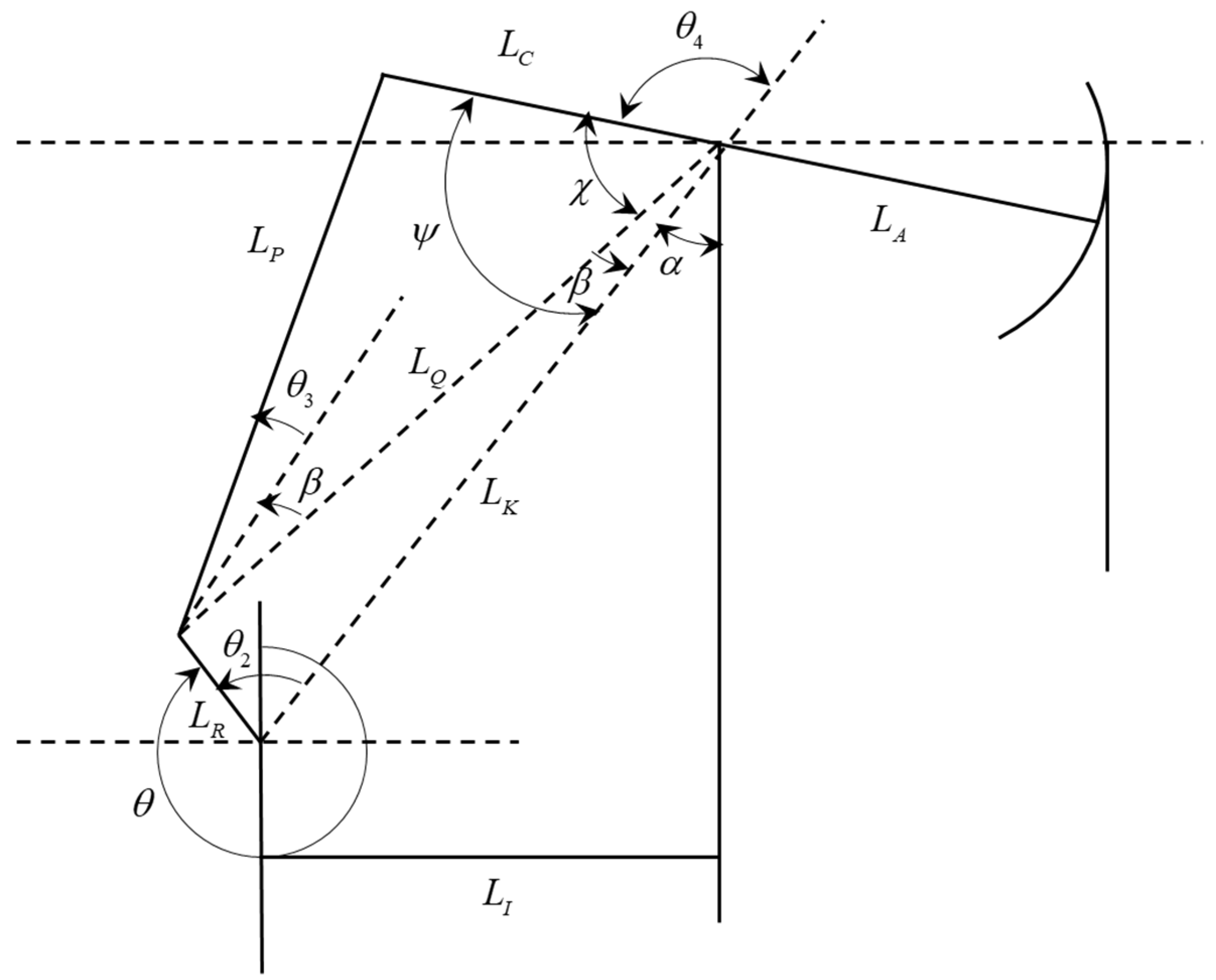
By reasonably simplifying the mechanical movement mechanism of the beam pumping unit, a schematic diagram of the movement mechanism of the beam pumping unit as shown in Figure 1 can be obtained. Based on this, the following four-bar linkage model of the pumping unit can be derived according to the geometric and dynamic relationships between the various rods [21].
θ = 2 π n / 60 α = arcsin L I L K θ 2 = 2 π θ + α L Q = L R 2 + L K 2 2 L K L R cos θ 2 β = arcsin L R L Q sin θ 2 χ = arccos L C 2 + L Q 2 L P 2 2 L C L Q ψ = χ + β ψ min = arccos L C 2 + L K 2 L P L R 2 2 L C L K
where n is the pumping speed of the pumping unit, θ is the crank angle, α is the angle between the line connecting the crank center and the walking beam rotation axis and the vertical direction, L K is the length of the line connecting the crank center and the walking beam rotation axis, L I is the horizontal distance from the center of the reducer output shaft to the center of the support shaft, θ 2 is the angle between the crank and the line connecting the crank center and the walking beam rotation axis, L R is the crank radius, L P is the connecting rod length, L Q is the distance from the crank top to the walking beam rotation axis, β is the angle between the line connecting the crank top and the walking beam rotation axis and the line connecting the crank center and the walking beam rotation axis, L C is the length of the rear arm of the walking beam, χ is the angle between the walking beam and the line connecting the crank top and the walking beam rotation axis, ψ is the angle between the walking beam and the line connecting the crank center and the walking beam rotation axis, and ψ min is the minimum value of ψ .
Based on the geometric relationship of the four-bar linkage mechanism, taking the upper dead center of the pumping unit operation as the zero displacement point and the downward displacement as the positive direction, the polished rod displacement model can be derived.
S A t = L A ψ ψ min
where S A represents the polished rod displacement, and L A is the length of the front arm of the walking beam.

2.2. Modeling of the Downhole Subsystem of the Beam Pumping Well

Taking the downward direction of the sucker rod string along the rod as the positive direction, when the beam pumping well system operates in a vertical well, the longitudinal vibration equation (i.e., wave equation) of the sucker rod string can be obtained according to the mechanical equilibrium conditions and the upper and lower boundary conditions of the sucker rod string vibration [22].
u 1 2 t 2 c 2 u 1 2 x 2 + υ u 1 t = d u t d t 2 υ d u t d t + g u 1 x , t x = 0 = u t E r A r u 1 x x = L = P p t
where u 1 ( x , t ) is the displacement of the cross-section x of the sucker rod string at time t , c is the speed of sound in the sucker rod, g is the gravitational acceleration, υ is the rod-liquid damping coefficient, E r is the elastic modulus of the sucker rod string, A r is the cross-sectional area of the sucker rod string, L is the length of the sucker rod string, and P p ( t ) is the pump load.
To solve the wave equation of the sucker rod string, the following pump load model is constructed [23]:
P P ( t ) = u ( t ) L E r A r u ( t ) L E r A r < W 0 W 0 u ( t ) L E r A r W 0 W 0 + u ( t ) S L E r A r W 0 + u ( t ) S L E r A r > 0 0 W 0 + u ( t ) S L E r A r 0
where W 0 = A p p o p c ω 0 ρ w + 1 ω 0 ρ o g H , p o is the wellhead oil pressure, p c is the wellhead casing pressure, ω 0 is the crude oil water cut, ρ w is the water density, ρ o is the crude oil density, H is the dynamic liquid level of the well; S is the pumping unit stroke, i.e., the maximum polished rod displacement.
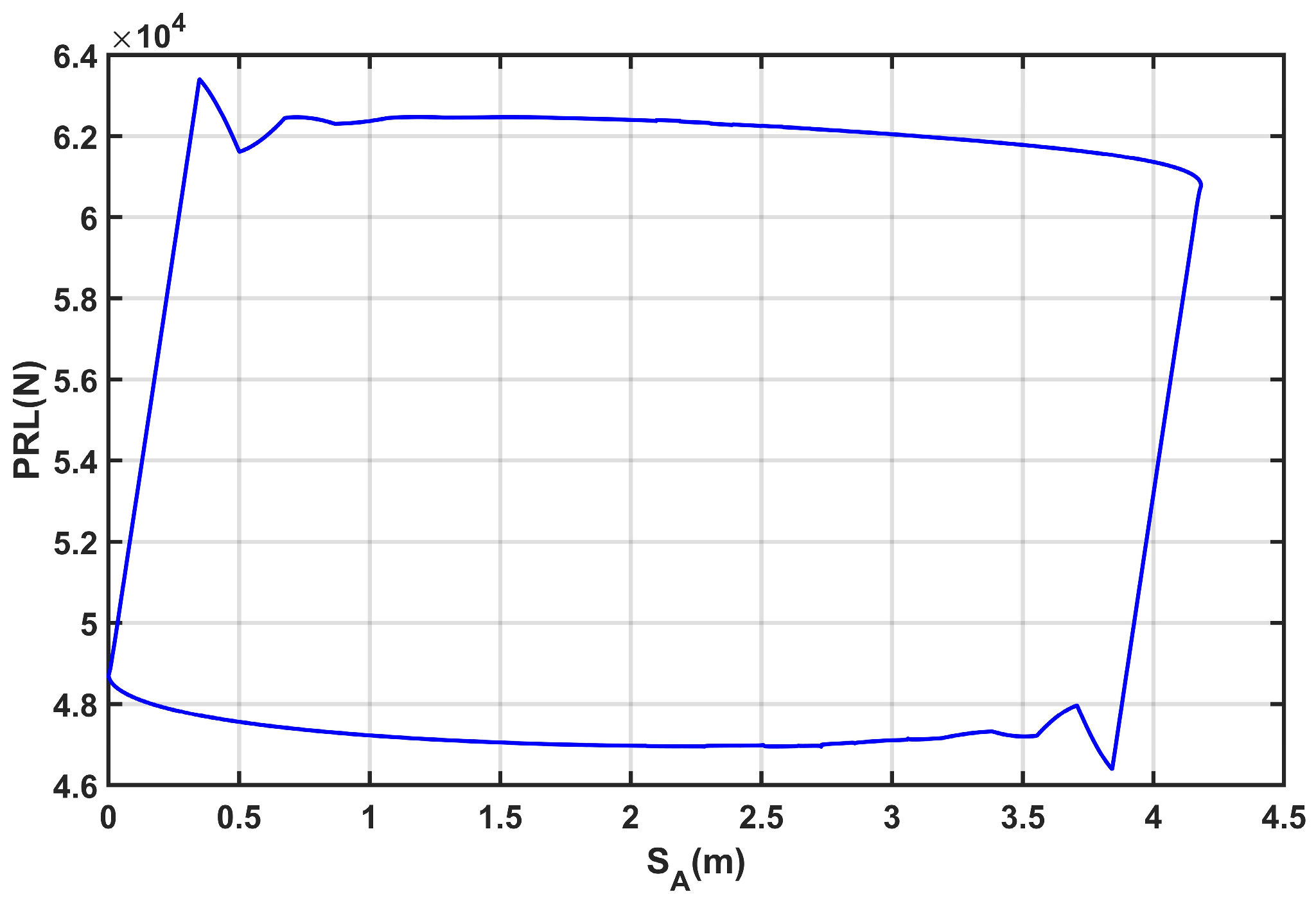
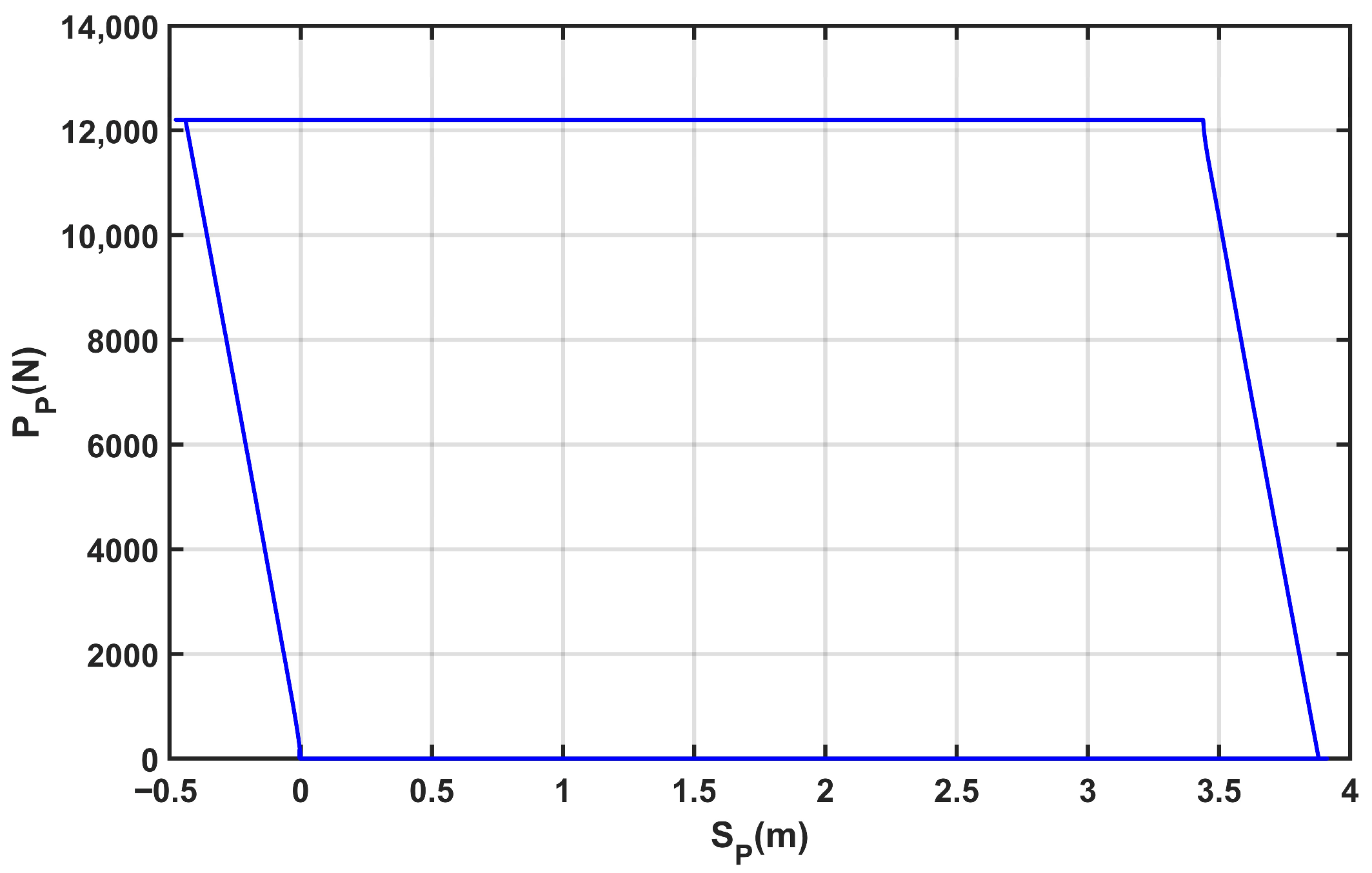
Based on the polished rod displacement and pump load, the central difference method can be used to solve the wave equation of the sucker rod string, and then the polished rod load P R L ( t ) of the pumping unit and the pump displacement S P ( t ) during one stroke cycle can be obtained. With displacement as the abscissa and load as the ordinate, the polished-rod power diagram and pump power diagram of the beam pumping well can finally be obtained. Then, the effective pump stroke S P E of the oil pump can be determined by analyzing the pump power diagram, which is a key parameter for calculating the well liquid production rate.
The calculation of the effective pump stroke relies on solving the wave equation of the sucker rod string. Since this equation does not admit an analytical solution, numerical methods such as the finite difference method or the Fourier series method are typically employed, which inevitably introduce truncation errors that lead to deviations in the computed results. Furthermore, the wave equation describing the vibration of the sucker rod string is itself an idealized simplification and cannot fully capture the complex vibration behavior encountered in practice. Therefore, in this paper, the aforementioned errors and unmodeled dynamics are collectively treated as an uncertainty term. Accordingly, the effective pump stroke can be expressed as the sum of the numerical solution of the wave equation and a bounded uncertain parameter, based on which the fluid production rate model is established as follows:
Q = 360 π D 2 ( S P E + Δ ) n
where D denotes the pump diameter of the beam pump, Δ represents the bounded uncertainty.
Based on the principle of mass conservation, during the operation of the pumping unit, the total amount of crude oil in the wellbore is equal to the difference between the liquid volume flowing into the wellbore from the reservoir per unit time and the liquid volume produced by the pumping unit. Thus, the following dynamic liquid level model can be obtained:
d H d t = 4 Q i n Q π D c i 2 D t e 2
where Q i n is the liquid volume flowing into the wellbore from the reservoir, Q is the liquid production rate of the beam pumping well, D c i is the inner diameter of the casing, and D t e is the outer diameter of the tubing.
Q i n can be obtained from the inflow performance relationship (IPR) curve. For the multiphase flow IPR curve, the expression is given as follows:
Q i n = Q max 2 V P ¯ r P b 2 V P ¯ r P b + P b V 1 P b P w f 2 2 V P b P ¯ r P b + P b P w f P ¯ r P b + 1
where Q max is the maximum liquid production rate per unit time, P r ¯ is the average downhole reservoir pressure, P b is the saturation pressure, and V is the recovery degree coefficient, which is the ratio of cumulative oil production to total geological reserves within the statistical period, P w f is the bottom hole flowing pressure.
For the multiphase flow wellbore, the bottom-hole flow pressure calculation model is established as follows:
P w f = p c + ρ o g ρ g g H p H + ρ g g H p + p L
where ρ g is the relative density of the gas phase, H p is the depth at the pump inlet, and p L is the liquid pressure from the reservoir to the pump inlet.
It can be seen from (6)–(8) that in constructing the dynamic liquid level model, the influence of multiphase flow factors is fully considered in this paper. By analyzing the IPR model of reservoir inflow and the bottom hole pressure calculation model under multiphase flow conditions, the developed dynamic liquid level model effectively captures the multiphase flow characteristics within the wellbore. However, mechanisms such as gas expansion, slug flow, or liquid column inertia cannot be explicitly incorporated into the dynamic liquid level model. Therefore, these mechanisms are treated as unmodeled dynamics and are uniformly integrated into the lumped disturbance term, allowing the dynamic liquid level model to be expressed as follows:
d H d t = 4 Q i n 360 π D 2 ( S P E + Δ ) n π D c i 2 D t e 2 + d
where d represents the lumped disturbance, which accounts for both reservoir pressure fluctuations and unmodeled system dynamics.
In summary, the overall model logic of the beam pumping well is as follows: Based on the pumping speed of the beam pumping well, the change in the crank angle during the stroke cycle is calculated, and then the polished rod displacement of the pumping unit is obtained by solving the four-bar linkage mechanism model. Further, the pump load is obtained by combining the pump load model, thereby determining the boundary conditions of the wave equation. The pump power card is obtained by solving the wave equation, and the effective pump stroke is determined, so as to calculate the liquid production rate of the beam pumping well during the stroke cycle. Finally, the dynamic liquid level position of the well is calculated by combining the dynamic liquid level model.

3. Robust Model Predictive Control Design for the Dynamic Fluid Level System

Due to the complex reservoir geological conditions, it is very easy to affect the effective pump stroke and dynamic liquid level of the beam pumping well. Therefore, in this section, the impacts caused by reservoir geological conditions are summarized as model parameter uncertainties and external disturbances. Combined with the dynamic liquid level model constructed in Section 2, the following discrete model is obtained:
H ( k + 1 ) = H ( k ) + 1440 π D 2 ( S P E + Δ ) n ( k ) 4 Q i n ( k ) 60 π D c i 2 D t e 2 + d ( k ) Q i n = Q max 2 V P ¯ r P b 2 V P ¯ r P b + P b V 1 P b P w f 2 2 V P b P ¯ r P b + P b P w f P ¯ r P b + 1 P w f = p c + ρ o g ρ g g H p H + ρ g g H p + p L
where H ( k ) is the dynamic liquid level height, Δ is the bounded uncertainty of the effective pump stroke S P E , n ( k ) is the stroke per minute of the pumping unit., used as the control input, d ( k ) is the bounded disturbance, Q i n ( k ) is the liquid volume flowing into the bottom of the well from the reservoir, P w f ( k ) is the bottom hole flowing pressure, and the other parameters are constants.
At the same time, according to the oilfield equipment and oil production requirements, the following constraint conditions are given:
H min H ( k ) H max ,   n min n ( k ) n max
The control objective of this paper is to design a tube-based robust model predictive control algorithm suitable for the dynamic liquid level system of beam pumping wells. Under the above bounded uncertainties and disturbances, the dynamic liquid level H ( k ) is kept within a small neighborhood of the target value H * , and is satisfied lim sup k | H ( k ) H * | ε , where ε > 0 is the allowable steady-state accuracy.

3.1. Dynamic Fluid Level Model Transformation and Linearization

To facilitate the design of prediction and control algorithms, let x ( k ) = H ( k ) H * ,   u ( k ) = n ( k ) n * , where ( H * , n * ) is the target operating point. The dynamic liquid level model is expanded into a first-order Taylor series at this operating point to obtain a linearized incremental model:
x ( k + 1 ) = A x ( k ) + B u ( k ) + E Δ + w d ( k ) ,
where w d ( k ) includes external disturbances d ( k ) and linearization residuals, A , B , E can be calculated by analytical differentiation or numerical differentiation:
A = 1 1 n Q i n H | H , n 1 π ( D c i 2 D t e 2 ) 360 B = n α ( S P E + Δ ) n Q i n n | ( H , n , Δ = 0 ) E = α = D 2 D c i 2 D t e 2
Let w ˜ ( k ) = E Δ + w d ( k ) , w ˜ ( k ) w ¯ , the incremental model can be rewritten as:
x ( k + 1 ) = A x ( k ) + B u ( k ) + w ˜ ( k )
The linearization is performed around a nominal operating point corresponding to the target dynamic fluid level. This linear approximation is valid within a bounded neighborhood where the higher-order terms remain small relative to the linear terms. In the context of beam-pumping well control, the operating range is inherently constrained by physical limits (e.g., minimum and maximum allowable fluid levels), and the system nonlinearity is moderate within this range, ensuring that the linearization error remains bounded. Furthermore, the tube-based robust MPC framework explicitly accounts for this linearization error as part of the lumped disturbance, and the robust positively invariant set is designed to accommodate such residual errors, thereby mitigating any adverse impact on control performance.

3.2. Tube-RMPC Design for the Dynamic Fluid Level System

Based on the Tube-RMPC framework, the control law is divided into two parts: the nominal optimal control law and the local feedback control law. The actual control law can be designed as:
u ( k ) = u ¯ ( k ) + K ( x ( k ) x ¯ ( k ) )
where u ¯ ( k ) is the nominal optimal control law, and K is the linear feedback gain.
The nominal system prediction model for the dynamic liquid level is:
x ¯ ( k + 1 ) = A x ¯ ( k ) + B u ¯ ( k ) .
Define the error e ( k ) = x ( k ) x ¯ ( k ) , then the error dynamics are as follows:
e ( k + 1 ) = ( A + B K ) e ( k ) + w ˜ ( k )
It can be seen that the error depends only on the disturbance w ˜ ( k ) and is independent of the nominal control law.
(1)
Nominal Optimal Control Law Solution.
Let the disturbance set W = { w ˜ : w ˜ w ¯ } , and define the robust positively invariant (RPI) set Z of errors to satisfy A c l Z W Z , A c l = A + B K , denotes the Minkowski sum.
To ensure that the real trajectory is within the constraints, the nominal trajectory must satisfy:
x ¯ ( k + i | k ) X Z u ¯ ( k + i | k ) U K Z
where X , U represent the system state constraint set and the input constraint set, respectively, and represents the Pontryagin difference.
Define X s = X Z and U s = U K Z as the tightened system state constraint set and the tightened input constraint set, respectively. Set the prediction horizon length as N p , the weight matrix Q 0 , R 0 , and the terminal weight P 0 . At time k , solve the following finite-horizon optimization problem:
min { u ¯ ( k + i k ) } i = 0 N p 1 J = i = 0 N p 1 ( x ¯ ( k + i k ) Q 2 + u ¯ ( k + i k ) R 2 ) + x ¯ ( k + N p k ) P 2 s . t .   x ¯ ( k + i + 1 k ) = A x ¯ ( k + i k ) + B u ¯ ( k + i k ) , x ¯ ( k k ) = x ( k ) ,   x ¯ ( k + i k ) X s , u ¯ ( k + i k ) U s , i = 0 , , N 1 ,   x ¯ ( k + N p k ) X f ,
where X f X s is the terminal constraint invariant set and satisfies ( A + B K ) X f X f .
The detailed calculation procedure for the terminal constraint invariant set X f is as follows: (1) The initial terminal constraint set is defined as X f 0 = X s { x K x U s } ; (2) Iterative calculation: X f i + 1 = { x x X f i ( A + B K ) x X f i } ; (3) Convergence criterion: when X f i + 1 = X f i , the maximal terminal constraint invariant set X f is finally obtained.
The detailed calculation procedure for the RPI set Z is as follows: (1) Initialization: Z 0 = { 0 } ; (2) Iterative update: Z i + 1 = ( A + B K ) Z i W ; (3) Convergence criterion: when Z i + 1 = Z i , the minimal RPI set Z is obtained. In engineering implementation, a polyhedral approximation is typically adopted, and the final RPI set is obtained through numerical computation by solving linear matrix inequalities.
By substituting the calculated terminal constraint invariant set and RPI set into the aforementioned nominal optimization problem and solving it, the nominal optimal control law u ¯ * ( k ) is obtained.
(2)
Solution of Robust Feedback Gain K .
The design purpose of K is to stabilize A c l = A + B K , thereby reducing the performance loss caused by constraint shrinkage. Select the weight Q x 0 ,   R u 0 , and solve the following Riccati equation:
P k = A T P k A A T P k B ( R u + B T P B ) 1 B T P A + Q x
The corresponding robust state feedback gain can be obtained:
K = ( R u + B T P B ) 1 B T P A
In summary, substituting the solved nominal optimal control law and robust state feedback gain in, the actual robust control law can be obtained:
u ( k ) = u ¯ * ( k ) + K ( x ( k ) x ¯ ( k ) )
(3)
Recursive Feasibility Analysis.
Recursive feasibility is a key property in model predictive control that ensures the closed-loop system persistently satisfies constraints: if a feasible solution exists at the initial time, then it exists at all subsequent times. In this section, we rigorously prove the recursive feasibility of the proposed Tube-RMPC algorithm, with a given lemma as follows.
Lemma 1
([24]). Under the conditions that the feedback gain  K  renders  A + B K  Schur stable and  Z  is the RPI set of error, if the initial error  e ( 0 ) Z  and all disturbances satisfy  w ˜ W , then  e ( k ) Z  for all  k 0 .
On this basis, the recursive feasibility of the Tube-RMPC algorithm for the dynamic liquid level system is summarized as the following theorem.
Theorem 1.
Consider the actual dynamic liquid level system and the nominal system. Given the initial nominal state  x ¯ ( 0 ) X s  and initial error  e ( 0 ) Z , if the optimization problem (19) has a feasible solution at  k = 0 , then under the Tube-RMPC algorithm, the optimization problem has a feasible solution at all times  k 0 .
Proof. 
Assume that the optimal solution sequence of the optimization problem (19) at time k is u ¯ * ( k k ) , u ¯ * ( k + 1 k ) , , u ¯ * ( k + N 1 k ) , and the corresponding nominal state sequence is x ¯ * ( k k ) , x ¯ * ( k + 1 k ) , , x ¯ * ( k + N 1 k ) , x ¯ * ( k + N k ) , where x ¯ * ( k + N k ) X f . □
Furthermore, at time k + 1 , following the nominal system shift idea, define the initial state of the nominal system as:
x ¯ ( k + 1 k + 1 ) = x ¯ * ( k + 1 k )
Meanwhile, determine the candidate optimal solution at time k + 1 as:
u ¯ ( k + 1 k + 1 ) = u ¯ * ( k + 1 k ) u ¯ ( k + 2 k + 1 ) = u ¯ * ( k + 2 k ) u ¯ ( k + N 1 k + 1 ) = u ¯ * ( k + N 1 k )
Based on the nominal system, the nominal system state under the above candidate solution can be obtained recursively:
x ¯ ( k + i + 1 k + 1 ) = A x ¯ ( k + i k + 1 ) + B u ¯ ( k + i k + 1 ) , i = 1 , 2 , , N 1
Since both the system initial state and the candidate solution are obtained by shifting the optimal solution sequence from the previous time instant, it can be concluded that
x ¯ ( k + i k + 1 ) = x ¯ * ( k + i k ) , i = 1 , 2 , , N
Based on this, design the terminal control law at time k + 1 as:
u ¯ ( k + N k + 1 ) = K x ¯ ( k + N k + 1 ) = K x ¯ * ( k + N k )
Therefore, the terminal state can be presented as:
x ¯ ( k + N + 1 k + 1 ) = A x ¯ ( k + N k + 1 ) + B u ¯ ( k + N k + 1 ) = ( A + B K ) x ¯ * ( k + N k )
Since x ¯ * ( k + N k ) X f and X f is an invariant set with respect to A + B K it can be obtained that x ¯ ( k + N + 1 k + 1 ) X f , i.e., the terminal state satisfies the terminal constraint; similarly, the terminal control law satisfies the input contraction constraint U s , i.e., u ¯ ( k + N k + 1 ) = K x ¯ * ( k + N k ) U s .
Furthermore, at k + 1 time, the state error can be written as:
e ( k + 1 ) = x ( k + 1 ) x ¯ * ( k + 1 k ) = ( A + B K ) e ( k ) + w ˜ ( k )
Therefore, by Lemma 1, the state error satisfies e ( k + 1 ) Z . In summary, at time k + 1 , the candidate solution and its corresponding nominal state satisfy the respective input and state constraints, and the state error satisfies the robust positive invariant set constraint, indicating that the nominal optimal problem has a feasible solution at this time. Furthermore, by mathematical induction, for all k 0 , the nominal optimal problem (19) has a feasible solution. Q.E.D.
Regarding the closed-loop stability under the proposed algorithm, the following lemma is presented in this paper:
Lemma 2
([24]). For system (14), if the feedback gain  K  is such that  A + B K  is Schur stable,  Z  is the minimal robust positively invariant set for the error, and the terminal constraint set  X f  is positively invariant with respect to  A + B K , then the closed-loop system with the control law  u ( k ) = u ¯ ( k ) + K ( x ( k ) x ¯ ( k ) )  is input-to-state stable, i.e.,  lim k x ( k ) max e .

4. Simulation Verification

To verify the effectiveness and stability of the proposed robust model predictive control method in the dynamic liquid level control of oil wells, based on the beam pumping well system model established in Section 2, PID and conventional model predictive control algorithms are selected as comparative algorithms for simulation verification. The total number of simulation steps is 100, i.e., 100 stroke cycles.
Case1: The following two types of disturbances are considered:
(1)
Uncertainty of effective stroke: Δ ( k ) 0.1 S P E , 0.1 S P E ;
(2)
External disturbance of dynamic liquid level: d ( k ) 10 m , 10 m .
The disturbance sequences all follow a uniform distribution, and the same disturbance input is used for the three control algorithms. The values of relevant model parameters are given in Table 1.
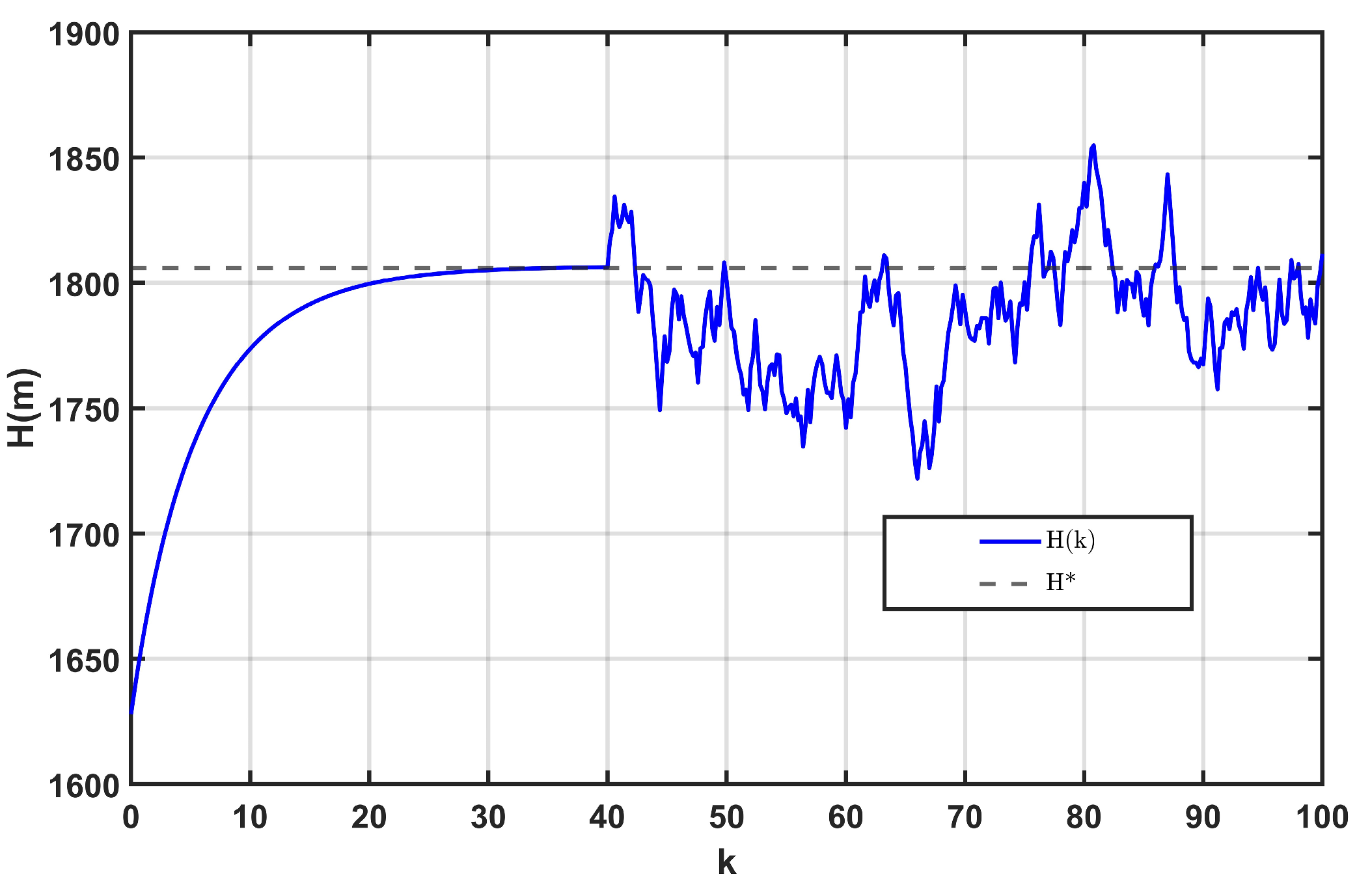
To verify the rationality and accuracy of the proposed model, simulation tests are conducted under a fixed stroke-per-minute operating condition. The initial dynamic fluid level is set to H(0) = 1628 m, with a stroke rate of n = 5 spm. An external disturbance is introduced at time step k = 40.
The simulation results are shown in Figure 2, Figure 3 and Figure 4. Figure 2 and Figure 3 presents the polished-rod power diagram and pump power diagram of the beam pumping well system under the fixed SPM condition. It can be observed that the developed model accurately captures the general characteristics of the actual polished-rod power diagram and pump power diagram. Since the model consolidates various disturbances and uncertainties into the dynamic fluid level model, the introduction of the disturbance does not significantly alter the shape of the power diagram.
Figure 4 illustrates the time evolution of the dynamic fluid level under the fixed SPM. In the absence of disturbances, the fluid level rapidly converges to a stable value, indicating that the well can fully utilize the reservoir inflow capacity under the current pumping regime, thereby ensuring production while minimizing energy consumption. However, when the disturbance is introduced, the dynamic fluid level deviates from its nominal value and exhibits pronounced fluctuations. This indicates that the reservoir inflow has become unsteady, necessitating adjustment of the pumping SPM to rebalance production and inflow capacity, so as to prevent a reduction in oil output or an increase in ineffective energy consumption.
To evaluate the effectiveness and superiority of the proposed Tube-RMPC algorithm, comparative simulations are conducted using both the PID controller and the conventional MPC as benchmarks. The corresponding controller parameters are listed in Table 2. External disturbances are present throughout the entire simulation.
The controller parameters for Tube-RMPC are selected based on standard control design principles. The prediction horizon N p is chosen to be sufficiently long to capture the dominant system dynamics while maintaining computational efficiency. The weighting matrices Q , R are selected to prioritize tracking accuracy while penalizing excessive control effort; these values were tuned to achieve a balanced trade-off between response speed and input smoothness.
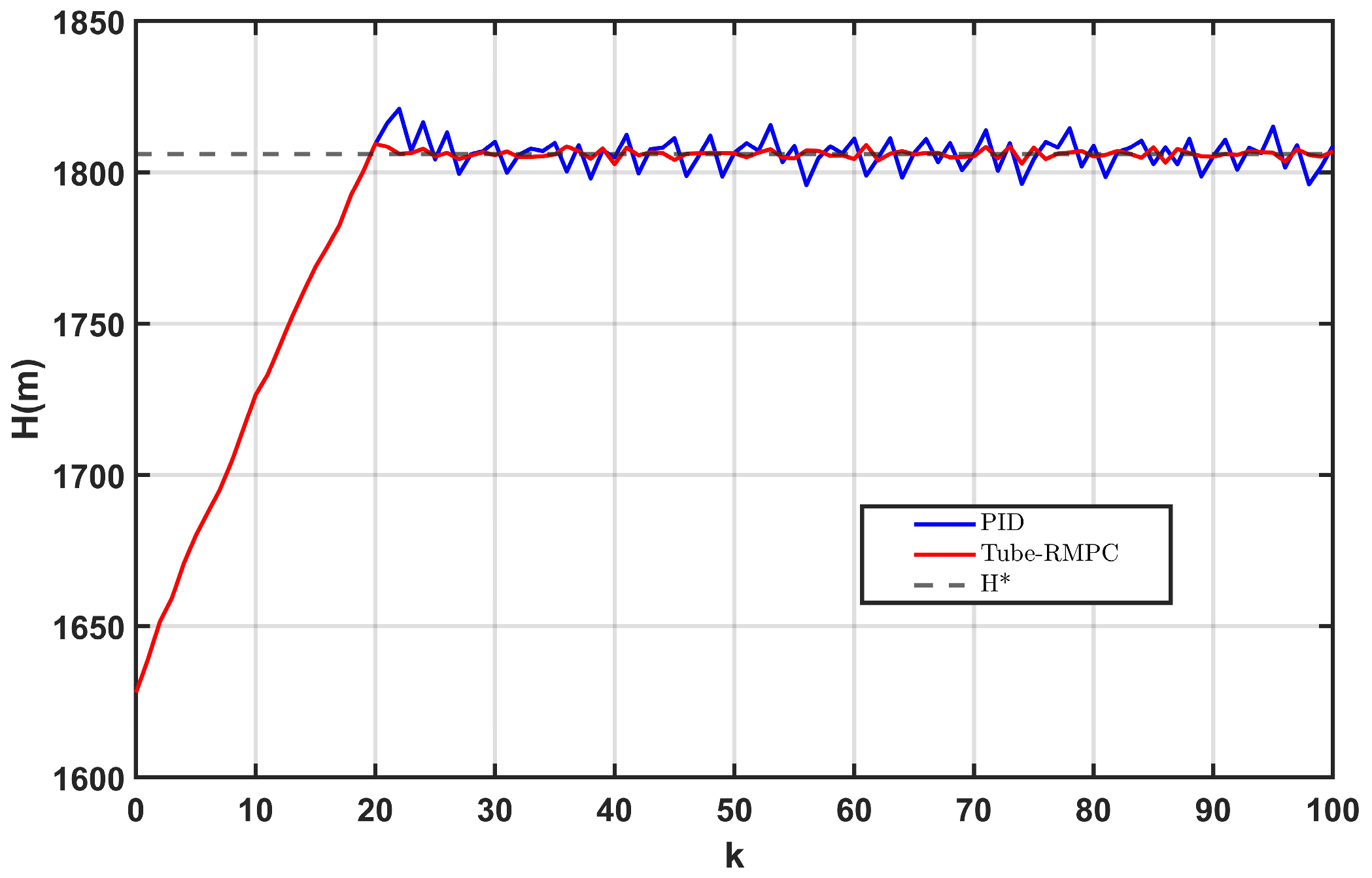
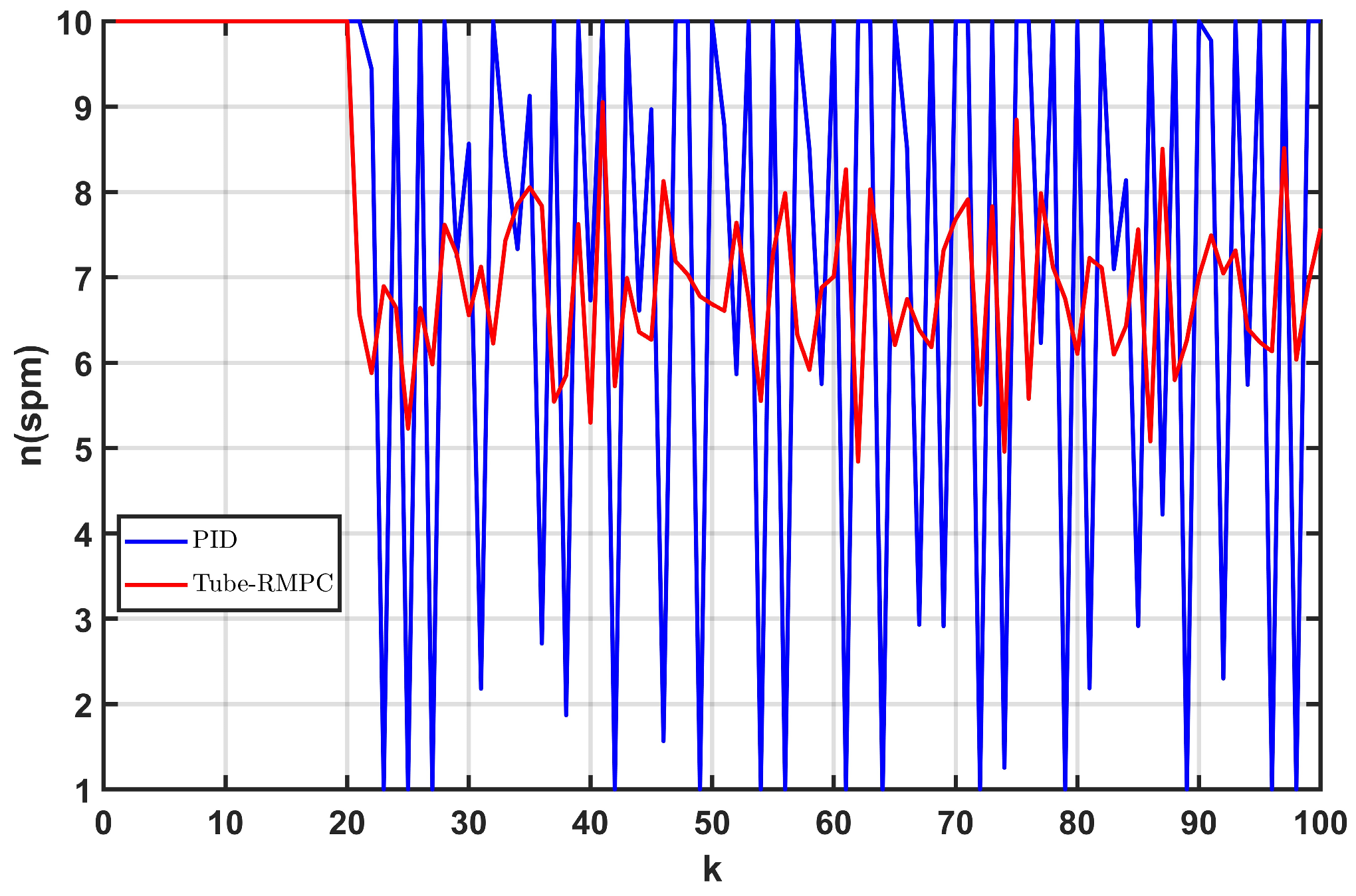
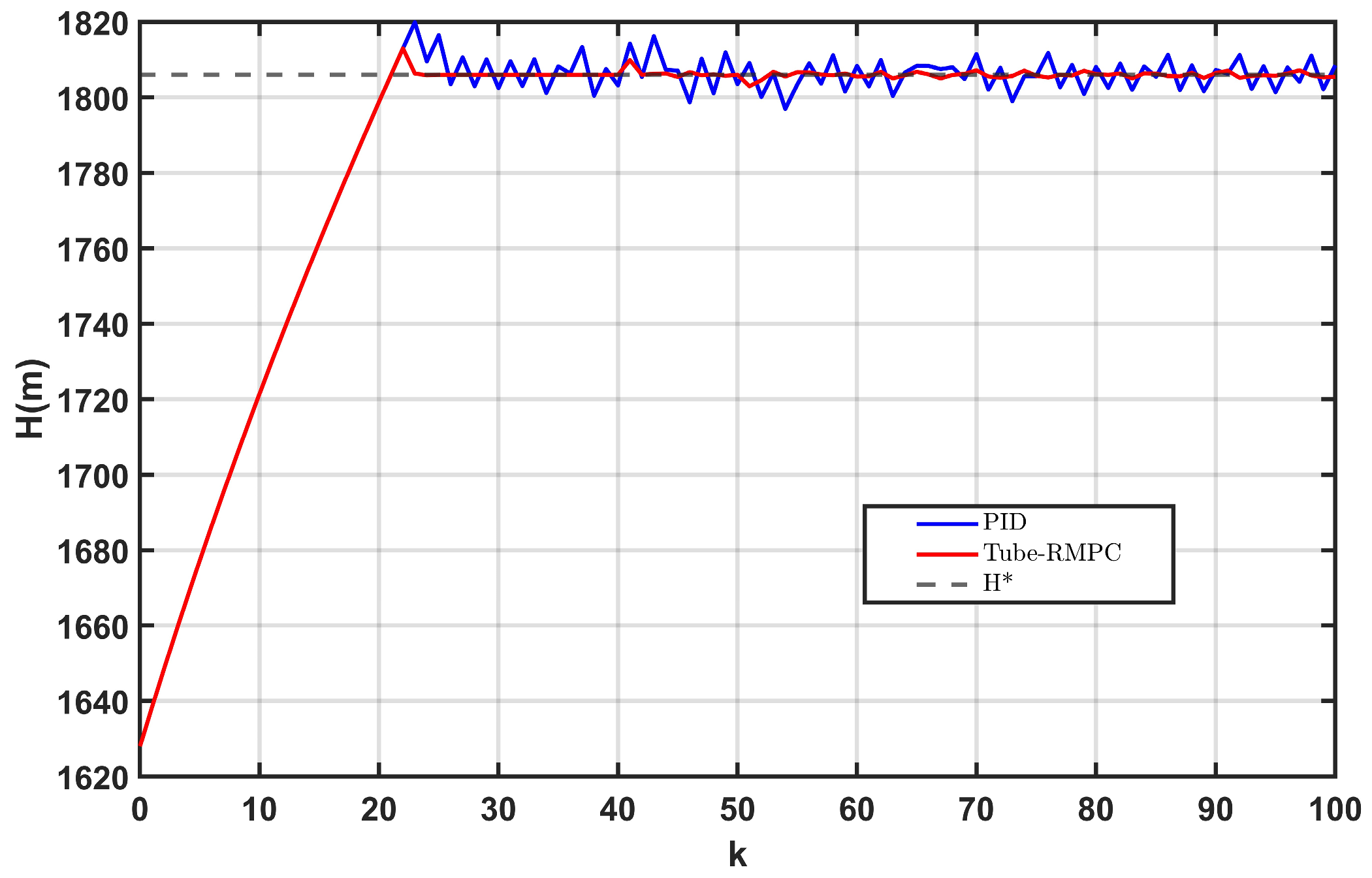
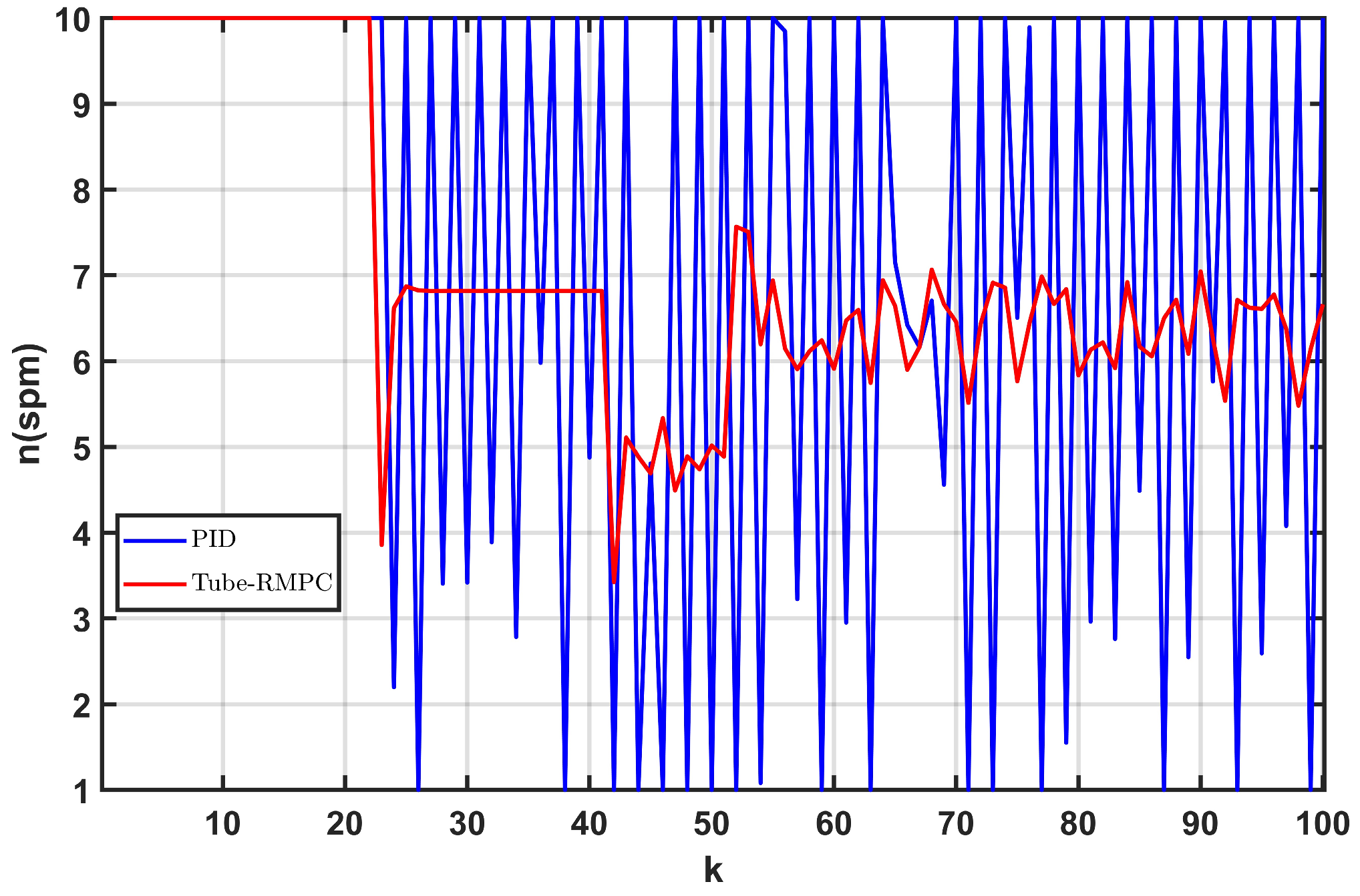
The simulation results are presented in Figure 5, Figure 6, Figure 7 and Figure 8. Figure 5 and Figure 6 present the dynamic liquid level and stroke frequency curves of the rod pumping well system under PID control and the proposed Tube MPC, respectively. The results show that in the presence of both system uncertainties and external disturbances, both control strategies are capable of maintaining the dynamic liquid level around the desired range. However, compared with PID control, the proposed Tube MPC algorithm significantly suppresses the fluctuation amplitude of the dynamic liquid level, allowing it to converge to a narrower stable region. The underlying mechanism lies in the fact that Tube MPC effectively decouples the disturbance from the system response by constructing a robust invariant set and a nominal trajectory, thereby mitigating the excitation effect of uncertainties on the system output and enhancing the smoothness of liquid level control. Meanwhile, the stroke frequency commands generated by this algorithm exhibit smoother variations, with significantly smaller fluctuations compared to those under PID control. Such smooth control input characteristics help reduce transient impact loads on the sucker rod string and transmission mechanism during direction reversal and speed variation, thereby alleviating mechanical wear and extending the service life of the equipment.
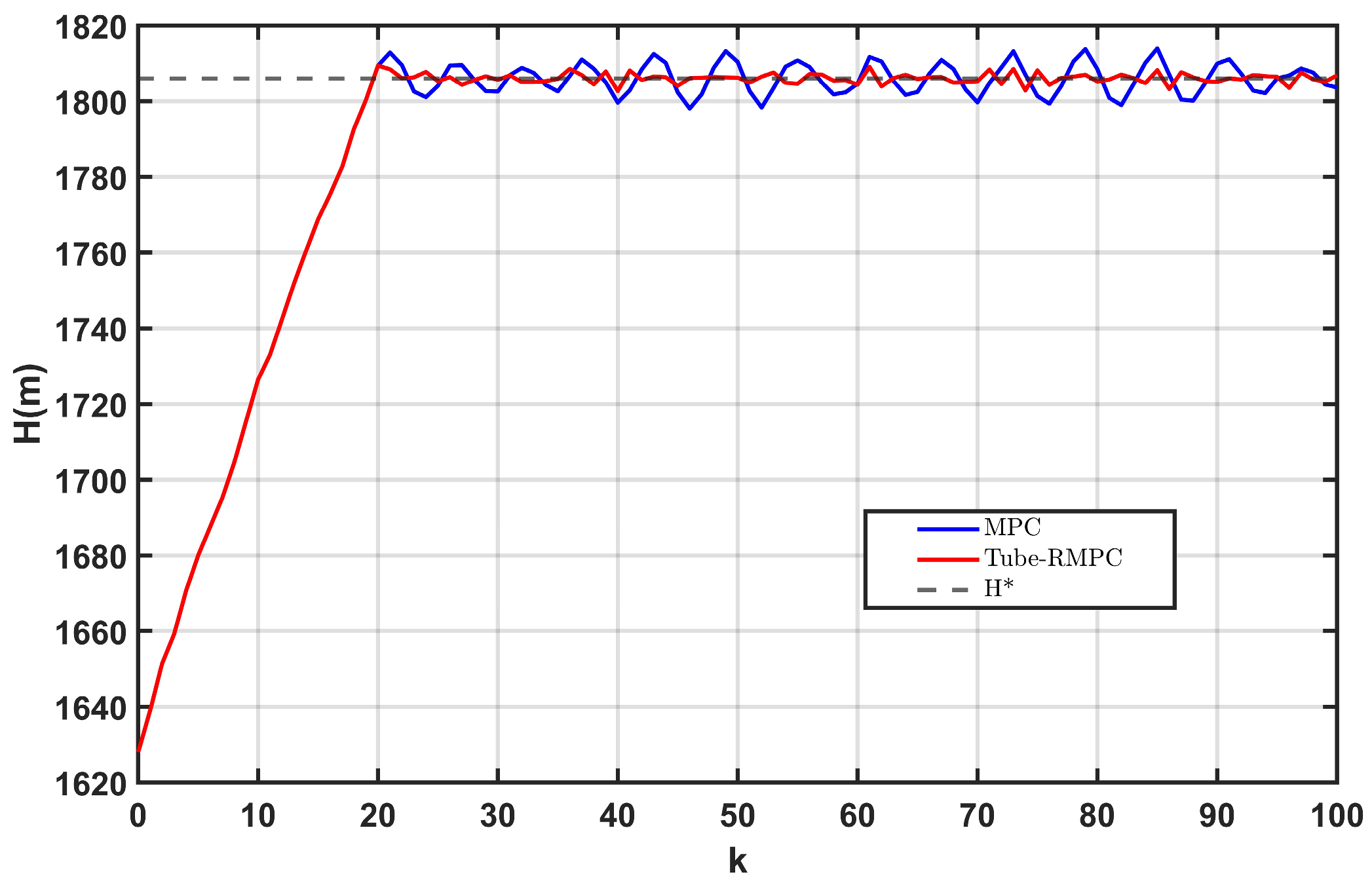
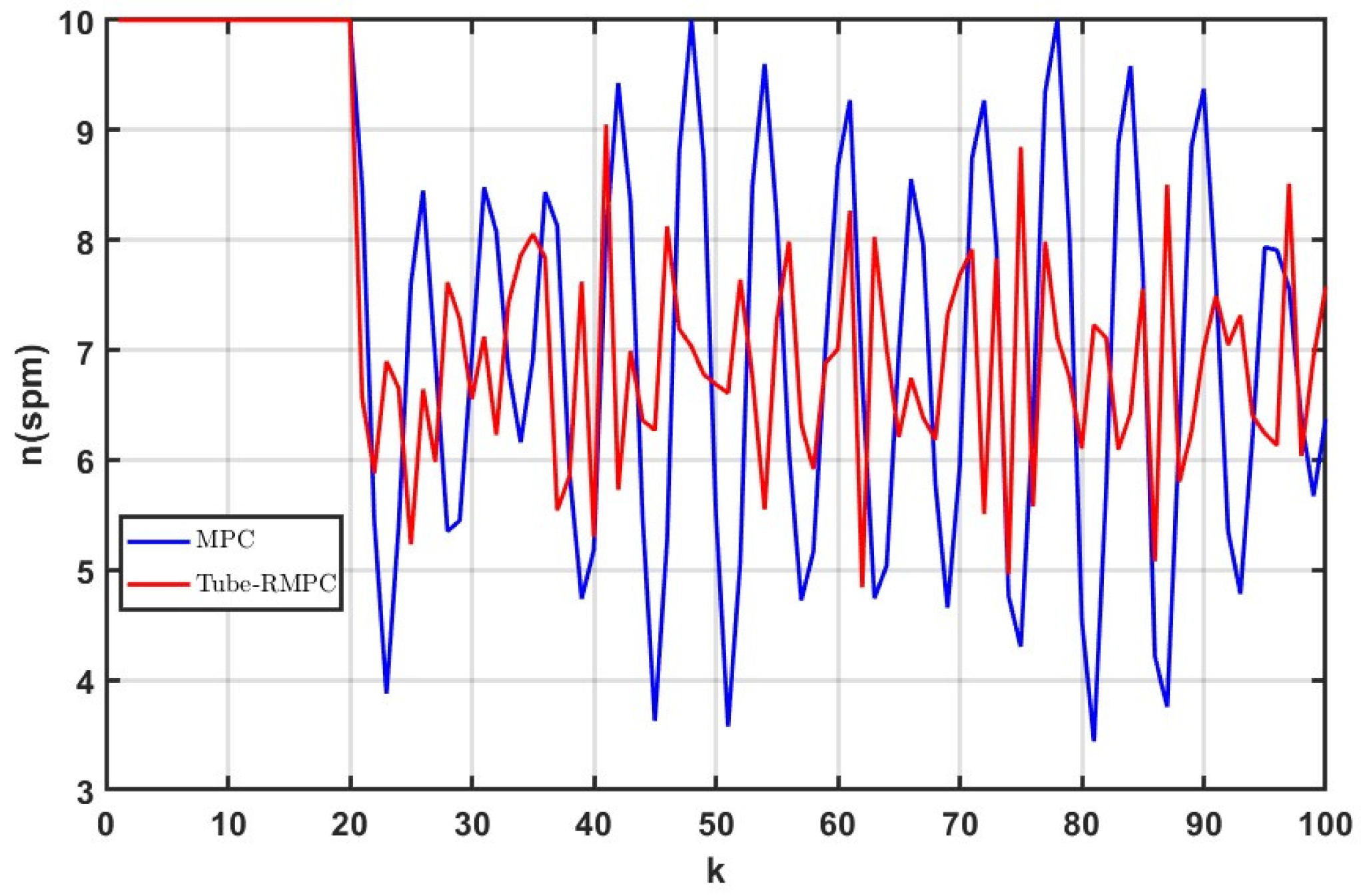
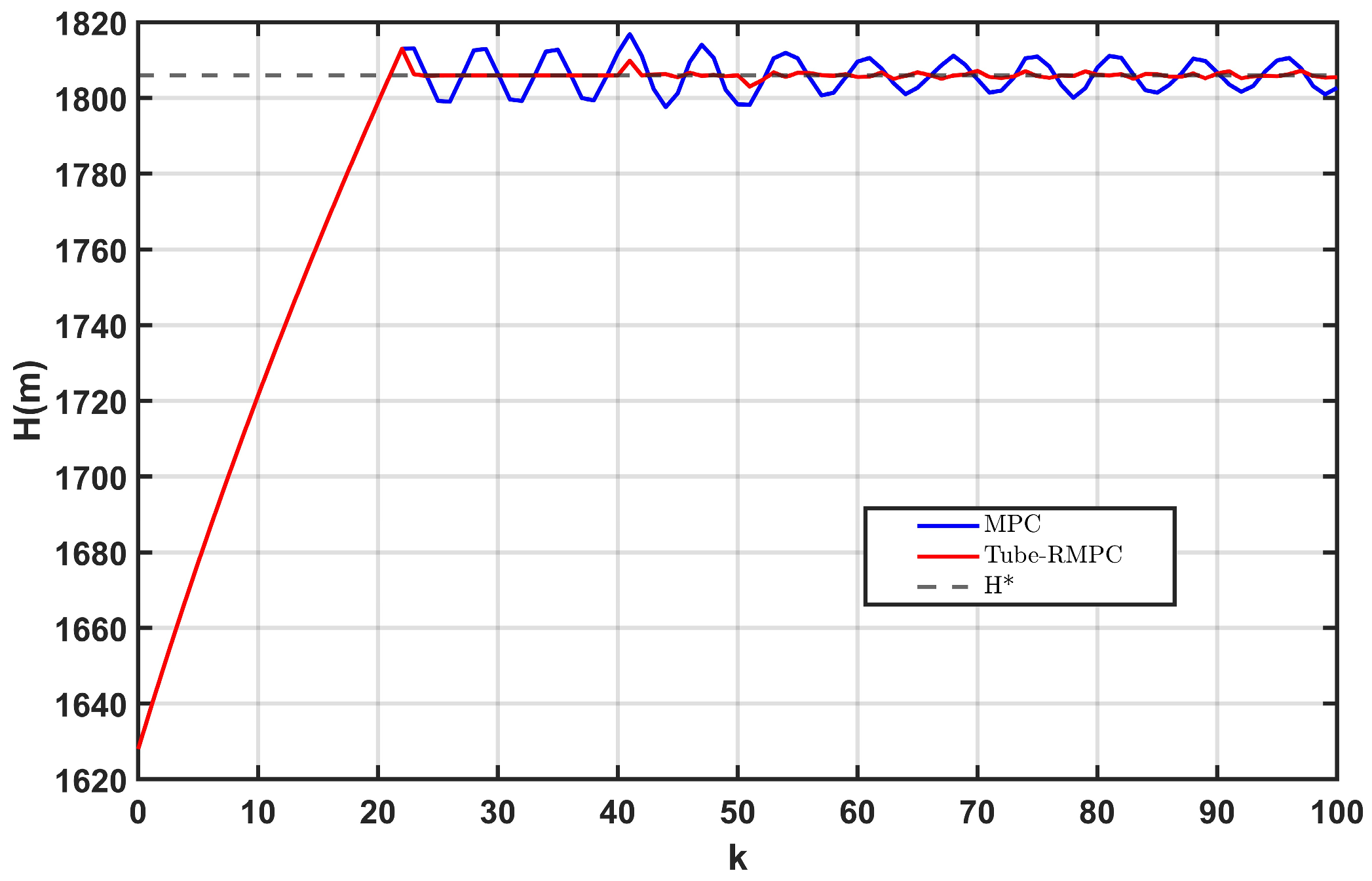
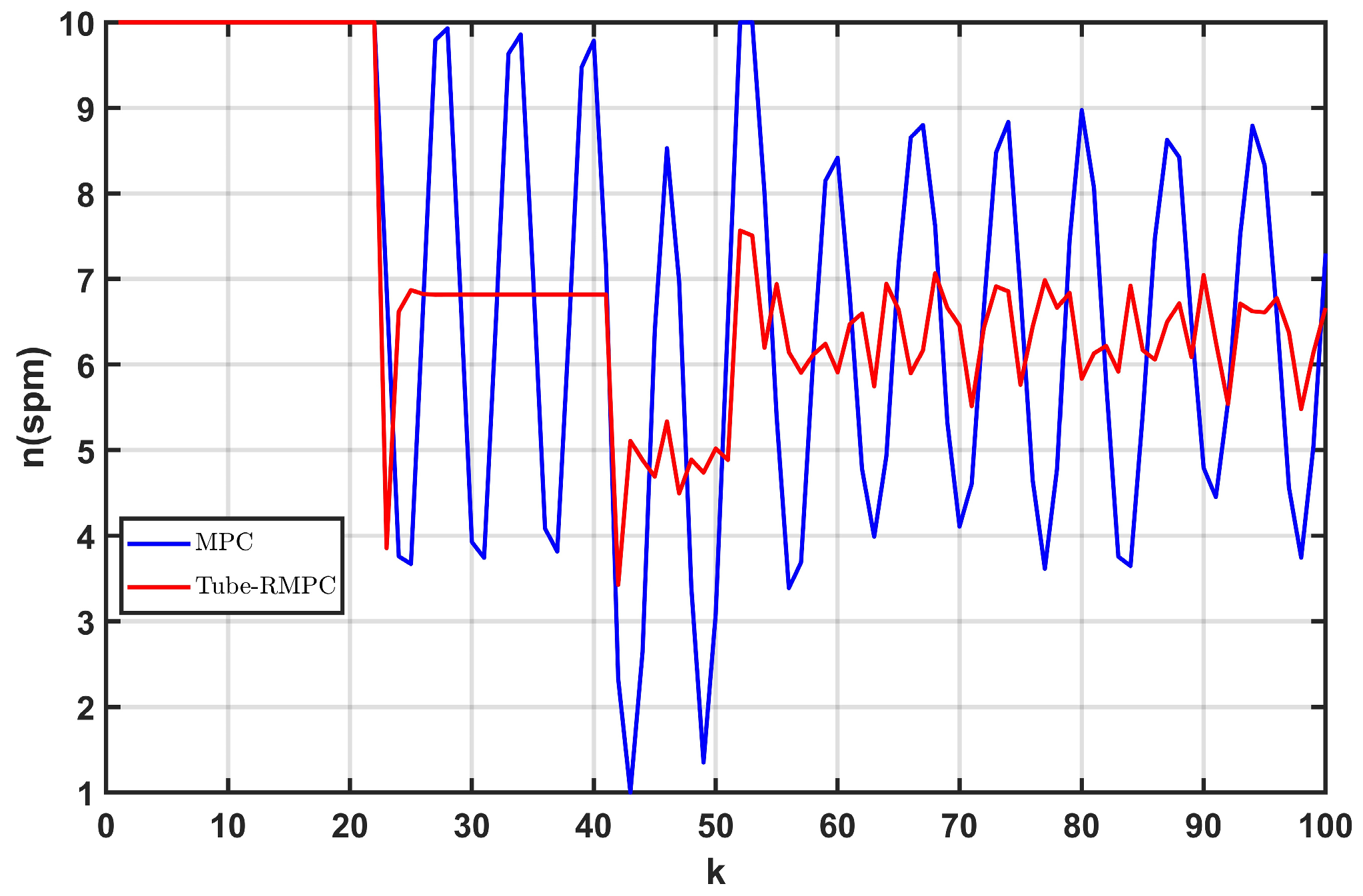
Figure 7 and Figure 8 further compare the control performance of conventional MPC and Tube MPC. In the presence of uncertainties and disturbances, both model predictive control algorithms are able to maintain the dynamic liquid level near the target value. However, compared with conventional MPC, Tube MPC exhibits stronger disturbance rejection capability, resulting in further improved smoothness of the system output. The advantage lies in that conventional MPC requires frequent adjustments of control inputs under disturbances to maintain constraint satisfaction, whereas Tube MPC, through the decoupled design of the nominal trajectory and the error tube constructed offline, confines the impact of disturbances within the tube, thereby significantly reducing the fluctuation magnitude of the control inputs while ensuring constraint satisfaction.
To quantitatively evaluate the control performance of the three algorithms, the integral of squared error (ISE), integral of absolute error (IAE), integral of time-weighted squared error (ITSE), and integral of time-weighted absolute error (ITAE) are employed to assess the overall performance of each control strategy. The specific numerical values of these performance indices are summarized in Table 3.
Based on the values presented in Table 3, a quantitative comparison among the PID, conventional MPC, and the proposed Tube-based MPC strategies is conducted. Overall, the Tube-based MPC achieves the best performance across all four metrics, demonstrating its effectiveness in enhancing the overall control performance of the system.
Specifically, regarding the metrics that reflect cumulative errors, the Tube-based MPC yields the lowest ISE and IAE values, indicating minimal overall control error. Compared with PID control, the IAE of Tube-based MPC reduces by approximately 13.1%, reflecting a significant improvement in error suppression. In terms of time-domain metrics that consider both error magnitude and duration, the advantages of Tube-based MPC are even more pronounced: its ITSE and ITAE values are significantly lower than those of both PID and conventional MPC. Notably, the ITAE value of Tube-based MPC decreases by approximately 46.4% compared to PID and by about 40.4% compared to conventional MPC. These results quantitatively indicate that the proposed algorithm effectively suppresses persistent deviations, substantially shortens the regulation time, and markedly enhances both the dynamic stability and steady-state accuracy of the system.
In summary, the quantitative comparison of performance indices further confirms the conclusions drawn from the simulation analysis. The Tube-based MPC not only exhibits smaller dynamic fluid level fluctuations and smoother control inputs but also demonstrates superior overall control performance, as evidenced by the systematic reduction in ISE, IAE, ITSE, and ITAE values, highlighting its effectiveness in handling system uncertainties and external disturbances.
Case 2: To further validate the robustness of the proposed algorithm under actual disturbances, this section simulates disturbances encountered in the actual operation of the rod pumping well system, such as gas lock and sudden reduction in reservoir inflow. Since the impact of gas lock is primarily reflected in the effective pump stroke, the following disturbances are set:
S P E ( k ) = S P E ( k ) 1 + 0.2 × ( 2 × r a n d ( 1 ) 1 )   i f   k > 40 Q i n ( k ) = Q i n ( k ) 5 + 0.5 × ( 2 × r a n d ( 1 ) 1 )   i f   k > 50
The above expression reduces the calculated values of the effective stroke and reservoir inflow at specific moments through the constructed sucker rod string model and multiphase flow IPR model, thereby simulating disturbance scenarios encountered in actual production processes, such as gas lock and sudden reduction in reservoir inflow. It can be seen from this expression that both types of disturbances can be uniformly described within the framework of uncertainty terms and lumped disturbances. In this section, PID and MPC are also adopted as benchmark algorithms to validate the effectiveness of the proposed control strategy, with the relevant control parameters kept consistent with those in the previous section.
The simulation results are shown in Figure 9, Figure 10, Figure 11 and Figure 12. It can be observed from Figure 9 and Figure 11 that, compared with the PID and MPC algorithms, the proposed Tube-RMPC algorithm exhibits smaller system output fluctuations when dealing with typical disturbances such as gas lock and sudden changes in reservoir inflow, demonstrating stronger robustness. This advantage is mainly attributed to the algorithm’s ability to decouple disturbances from the nominal control and achieve active suppression of uncertainties through a feedback correction mechanism. As further illustrated in Figure 10 and Figure 12, when a disturbance occurs, Tube-RMPC can adjust the control input magnitude more promptly, enabling rapid recovery after the disturbance. In contrast, PID control responds sluggishly to disturbances and struggles to effectively mitigate their impact on output stability; while MPC is capable of some response, its ability to compensate for unmodeled disturbances is limited due to its reliance on a deterministic model assumption. Based on the above comparisons, the proposed algorithm demonstrates favorable robustness and dynamic response capability in handling typical disturbances encountered in oil wells.

5. Conclusions

This paper analyzes the surface and downhole components of the rod pumping well system separately and establishes the coupling relationship between them through the sucker rod string. Based on this, a system model of the rod pumping well is constructed, which enables the estimation of core parameters such as dynamic liquid level and fluid production rate using surface measurements. On this basis, considering model uncertainties arising from the complexity of reservoir geology and external disturbances, the tube model predictive control (Tube-RMPC) algorithm is introduced based on the developed model. By constructing a terminal constraint set and solving a robust optimization problem, a robust control method suitable for dynamic liquid level regulation is formed. Simulation results demonstrate that the proposed algorithm exhibits strong robustness against system model uncertainties and disturbances. It should be noted that the Tube-RMPC algorithm proposed in this paper is built upon the currently developed rod pumping well system model. Although unmodeled dynamics and modeling errors are uniformly incorporated into the uncertainty and lumped disturbance terms during the modeling process, certain simplifications still exist. Therefore, its applicability in practical engineering remains to be further validated, which constitutes a key direction for future research.

Author Contributions

Conceptualization, D.Z.; Data curation, C.Z.; Software, Y.Y.; Validation and Methodology, J.F.; Formal analysis, F.L.; Writing—original draft, G.Q. and Y.D. All authors have read and agreed to the published version of the manuscript.

Funding

This research received no external funding.

Data Availability Statement

Data available on request due to restrictions.

Conflicts of Interest

The authors declare no conflict of interest.

References

  1. Gao, Z.; Jia, S. Modeling and Control for Beam Pumping Units: An Overview. Processes 2024, 12, 1468. [Google Scholar] [CrossRef]
  2. Sun, Y.; Li, Q.; Jia, Q.; Sun, C.; Lei, Y. Intelligent Operation Control System of Pumping Unit for Supply and Production Balance of Production Well; Springer Series in Geomechanics and Geoengineering; Springer: Berlin/Heidelberg, Germany, 2024; pp. 345–353. Available online: https://link.springer.com/chapter/10.1007/978-981-97-0260-2_29 (accessed on 1 April 2026).
  3. Zhan, K. Research and Evaluation of Intelligent Control and Optimization Technology Based on Pump Fillage for Beam Pump Unit; Springer Series in Geomechanics and Geoengineering; Springer: Berlin/Heidelberg, Germany, 2023; pp. 7070–7081. Available online: https://link.springer.com/chapter/10.1007/978-981-99-1964-2_600 (accessed on 1 April 2026).
  4. Ma, B.; Dong, S. A Hybrid Prediction Model for Pumping Well System Efficiency Based on Stacking Integration Strategy. Int. J. Energy Res. 2024, 2024, 8868949. [Google Scholar] [CrossRef]
  5. Ren, Y.; Yang, D.; Zhang, W.; Wei, Z.; Li, J.; Wu, G. Echo Monitoring Technology—The ‘Smart Guardian’ of the Dynamic Liquid Level in Oil and Gas Wells. Sci. Discov. 2024, 12, 156–162. [Google Scholar] [CrossRef]
  6. Dong, S.; Zhao, L.; Wang, S.; Cui, X. Simulation Models of Longitudinal Vibration of Sucker Rod String of Polymer Flooding Rod Pumping Systems. J. Syst. Simul. 2008, 20, 309–313. [Google Scholar]
  7. Zhou, H. Optimization and Application of Directional Well Beam Pumping Unit Model; Springer Series in Geomechanics and Geoengineering; Springer: Berlin/Heidelberg, Germany, 2024; pp. 235–242. Available online: https://link.springer.com/chapter/10.1007/978-981-97-0260-2_20 (accessed on 1 April 2026).
  8. Feng, Z.; Tan, J.; Sun, Y.; Zhang, D.; Duan, W. 3D-Dynamic Modelling and Performance Analysis of Service Behavior for Beam Pumping Unit. Math. Probl. Eng. 2018, 2018, 9205251. [Google Scholar] [CrossRef]
  9. Feng, Z.; Tan, J.; Fang, X.; Ding, H. Dynamic Model and Working Performance of Beam Pumping Unit. J. Balk. Tribol. Assoc. 2017, 23, 101–113. [Google Scholar]
  10. Li, X.; Gao, X.; Hou, Y.; Yan, B.; Wang, H. Coupled Dynamic Modeling for Polished Rod Load of Beam Pumping Unit. J. Northeast. Univ. 2016, 137, 1225–1229. [Google Scholar] [CrossRef]
  11. Mehdi, F.; Mohammad, J.A.; Yousef, R.; Morteza, A.; Mehran, G. Experimental design and manufacturing of a smart control system for horizontal separator based on PID controller and integrated production model. J. Pet. Explor. Prod. Technol. 2024, 14, 2273–2295. [Google Scholar] [CrossRef]
  12. Torres, L.H.S.; Schnitman, L. Sucker-Rod Pumping of Oil Wells: Modeling and Process Control. WSEAS Trans. Syst. 2018, 17, 53–63. [Google Scholar]
  13. Konstantopoulos, G.C.; Baldivieso-Monasterios, P.R. State-Limiting PID Controller for a Class of Nonlinear Systems with Constant Uncertainties. Int. J. Robust Nonlinear Control 2020, 30, 1770–1787. [Google Scholar] [CrossRef]
  14. Hansen, B.; Tolbert, B.; Vernon, C.; Hedengren, J.D. Model Predictive Automatic Control of Sucker Rod Pump System with Simulation Case Study. Comput. Chem. Eng. 2019, 121, 265–284. [Google Scholar] [CrossRef]
  15. Mayne, D.Q.; Rawlings, J.B.; Rao, C.V.; Scokaert, P.O.M. Constrained Model Predictive Control: Stability and Optimality. Automatica 2000, 36, 789–814. [Google Scholar] [CrossRef]
  16. Mayne, D.Q. Model Predictive Control: Recent Developments and Future Promise. Automatica 2014, 50, 2967–2986. [Google Scholar] [CrossRef]
  17. Limon, D.; Alvarado, I.; Alamo, T.; Camacho, E.F. Robust Tube-Based MPC for Tracking of Constrained Linear Systems with Additive Disturbances. J. Process Control 2010, 20, 248–260. [Google Scholar] [CrossRef]
  18. Kingsley, O.O.; Andrew, E.E.; Olisakwe, H.C. Towards an Integrated Model for Predictive Well Control Using Real-Time Drilling Fluid Data. Glob. J. Res. Eng. Technol. 2024, 2, 1–10. [Google Scholar] [CrossRef]
  19. Karthik, B.; Minou, R.; Vural, S.; Hakan, C.; Zinyat, A.; Suleyman, T.; Ummugul, B.; Cenk, T. Status of Data-Driven Methods and their Applications in Oil and Gas Industry. In SPE Europec Featured at 80th EAGE Conference and Exhibition; SPE: Santa Clara, CA, USA, 2018; Available online: https://onepetro.org/SPEEURO/proceedings/18EURO/18EURO/D031S005R007/216186?guestAccessKey= (accessed on 1 April 2026).
  20. Saghir, F.; Gonzalez, P.; Behrenbruch, P. Application of Streaming Analytics for Artificial Lift Systems: A Human-in-the-Loop Approach for Analysing Clustered Time-Series Data from Progressive Cavity Pumps. Neural Comput. Appl. 2023, 35, 1247–1277. [Google Scholar] [CrossRef]
  21. Yin, J.; Sun, D.; Ma, H. Identification of the Four-Bar Linkage Size in a Beam Pumping Unit Based on Cubature Kalman Filter. Machines 2022, 10, 1133. [Google Scholar] [CrossRef]
  22. Gibbs, S.G. Predicting the Behavior of Sucker-Rod Pumping Systems. J. Pet. Technol. 1963, 15, 769–778. [Google Scholar] [CrossRef]
  23. Jian, J.Y.; Dong, S.; Sheng, Y.Y. Predicting Multi-Tapered Sucker-Rod Pumping Systems with The Analytical Solution. J. Pet. Sci. Eng. 2021, 197, 108115. [Google Scholar] [CrossRef]
  24. Ping, X.; Yao, J.; Ding, B.; Li, Z. Tube-Based Output Feedback Robust MPC for LPV Systems with Scaled Terminal Constraint Sets. IEEE Trans. Cybern. 2022, 152, 7563–7576. [Google Scholar] [CrossRef] [PubMed]
Figure 1. Simplified schematic of the pumping unit’s four-bar linkage mechanism.
Processes 14 01232 g001
Figure 2. Simulated polished-rod power diagram of the beam pumping well.
Processes 14 01232 g002
Figure 3. Simulated pump power diagram of the beam pumping well.
Processes 14 01232 g003
Figure 4. Time variation in dynamic fluid level.
Processes 14 01232 g004
Figure 5. Case 1: Dynamic fluid level responses with PID and Tube-RMPC.
Processes 14 01232 g005
Figure 6. Case 1: Control input (stroke rate) responses with PID and Tube-RMPC.
Processes 14 01232 g006
Figure 7. Case 1: Dynamic fluid level responses with MPC and Tube-RMPC.
Processes 14 01232 g007
Figure 8. Case 1: Control input (stroke rate) responses with MPC and Tube-RMPC.
Processes 14 01232 g008
Figure 9. Case 2: Dynamic fluid level responses with PID and Tube-RMPC.
Processes 14 01232 g009
Figure 10. Case 2: Control input (stroke rate) responses with PID and Tube-RMPC.
Processes 14 01232 g010
Figure 11. Case 2: Dynamic fluid level responses with MPC and Tube-RMPC.
Processes 14 01232 g011
Figure 12. Case 2: Control input (stroke rate) responses with MPC and Tube-RMPC.
Processes 14 01232 g012
Table 1. Model parameters of the beam pumping well system.
ParameterValueParameterValue
L A 4.36 m A r 3.80 × 10⁻⁴ m2
L C 2.25 m A p 0.002 m2
L I 3.03 m p o 0.39 × 10⁶ Pa
L K 4.72 m p c 0.10 × 10⁶ Pa
L P 3.80 m ω 0 0.2
L R 1.16 m ρ o 0.93 × 10³ kg/m3
L 1800 m E r 2.06 × 10¹¹ Pa
D 0.0022 m P r ¯ 5.59 × 10⁶ Pa
D c i 0.159 m Q max 15.378 m3/day
D t e 0.07 m c 5122 m/s
N 1890 m υ 3.07
Table 2. Controller parameter values of comparative control algorithms.
Control AlgorithmController Parameter Values
PIDKp = 0.5, Ki = 0.02, Kd = 0
MPCNp = 20, Nc = 5, Q = 1, R = 0.01
Tube-RMPCNp = 20, Q = 1, R = 0.01, Qx = 1, Ru = 0.1
Table 3. Values of control performance indices.
Control AlgorithmPerformance IndexValues
PIDISE2.1006 × 105
IAE2.0998 × 103
ITSE1.2421 × 106
ITAE3.3004 × 104
MPCISE2.0915 × 105
IAE2.0404 × 103
ITSE1.1962 × 106
ITAE2.9678 × 104
Tube MPCISE2.0796 × 105
IAE1.8243 × 103
ITSE1.1229 × 106
ITAE1.7675 × 104
Disclaimer/Publisher’s Note: The statements, opinions and data contained in all publications are solely those of the individual author(s) and contributor(s) and not of MDPI and/or the editor(s). MDPI and/or the editor(s) disclaim responsibility for any injury to people or property resulting from any ideas, methods, instructions or products referred to in the content.