Article

Current-Induced Scour Process Beneath Submarine Piggyback Pipelines: Influence of Geometry Configuration

1
School of Energy Resources, China University of Geosciences (Beijing), Beijing 100083, China
2
State Key Laboratory of Ocean Engineering, Shanghai Jiao Tong University, Shanghai 200240, China
3
School of Ocean and Civil Engineering, Shanghai Jiao Tong University, Shanghai 200240, China
*
Authors to whom correspondence should be addressed.
Processes 2026, 14(7), 1178; https://doi.org/10.3390/pr14071178
Submission received: 6 February 2026 / Revised: 31 March 2026 / Accepted: 3 April 2026 / Published: 6 April 2026
(This article belongs to the Topic Advanced Technology for Oil and Nature Gas Exploration)

Abstract

In offshore engineering, piggyback pipelines have been widely used in recent years, making it practically important to assess scour beneath such pipelines. In this study, the local scour beneath pipelines in a piggyback configuration is numerically investigated. The model is based on the two-dimensional Reynolds-Averaged Navier–Stokes (RANS) equations, utilizing the RNG k-ε turbulence model for closure. Sediment movement is characterized by incorporating both the bed load and suspended load transport. The numerical model is validated against published experimental data. The effect of the gap ratio G/D and the position angle α on the scour and time-averaged force coefficients of piggyback pipelines with a diameter ratio d/D = 0.375 is examined, where G is the gap between two pipelines, α is the angle between the line connecting centers of two pipelines and the inflow direction, D is the main pipeline diameter, and d is the small pipeline diameter. The results demonstrate that the largest scour depth is obtained at α = 90° regardless of the gap ratio G/D. At G/D = 0.25, 0.375 and 0.5, the smallest equilibrium scour depth is observed at α = 135°, which is characterized by the suppression of vortex formation behind the main pipeline. The effect of the position angle α on the time-averaged force coefficients of the small pipeline is more significant at smaller gap ratios. The mean drag coefficient on the main pipeline attains its maximum value at α = 90°, and reaches its minimum value when α = 45° for all of the gap ratios examined. The equivalent pipeline method will not only underestimate the equilibrium scour depth, but also significantly underestimate the magnitude of time-averaged force coefficients.

1. Introduction

Submarine pipelines are an essential medium for transporting oil and gas in the exploitation of marine resources. When a pipeline is directly laid on or shallowly buried in an erodible seabed, a seepage flow can be induced by the background flow owing to the pressure difference between the upstream and downstream side of the pipeline. A mixture of sand and water may break through the gap under the pipeline if the pressure difference exceeds a critical value. This process, known as piping, is recognized as the primary mechanism initiating scour [1,2]. After this stage, a small channel is formed beneath the pipeline, which may enlarge under the action of currents and waves, and then free spans develop along the spanwise direction. Free-spanning pipelines are susceptible to vortex-induced vibrations or sagging into scour holes. These phenomena can threaten pipeline integrity and safe operation, potentially leading to significant structural damage [3,4]. Therefore, understanding the scour mechanism beneath pipelines is of utmost importance for engineering practice.
Over recent decades, considerable efforts have been devoted to the local scour beneath single pipelines due to its practical importance. Based on the potential flow theory, an analytical model capable of estimating the maximum scour depth beneath pipelines under unidirectional current was developed [5]. However, the potential flow model cannot capture the downstream scour profile well, which is due to the fact that this model cannot simulate the vortex shedding process [6]. More recently, numerical methods based on the RANS equations, closed with turbulence models such as the RNG k-ε model [7] and k-ω model [8], were developed. These numerical methods can reproduce the equilibrium scour depths and scour profiles observed in indoor experiments well, serving as imperative tools along with experimental methods for better interpreting the scour phenomena. Thereafter, extensive investigations have been conducted considering complex background flow conditions [9,10,11,12,13,14,15], various soil properties [16,17,18,19,20], pipeline vibration [21,22,23,24,25,26], and scour along the spanwise direction [27,28,29,30].
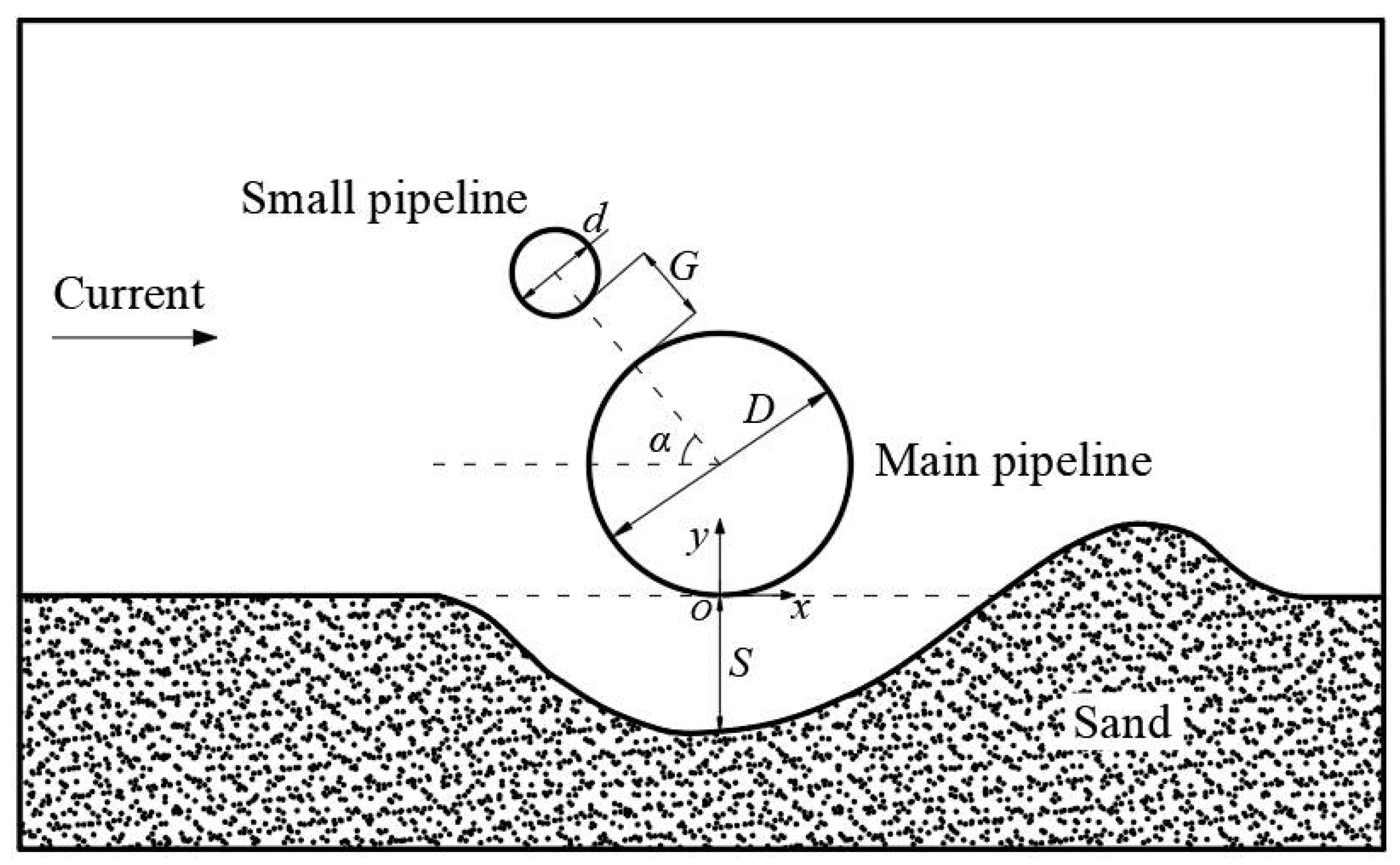
To reduce the maintenance costs, two pipelines laid in tandem, or bundled together forming so-called piggyback pipelines, have become increasingly popular in recent years. Although significant progress has been made in understanding local scour beneath single pipelines, studies on pipeline bundles have received less attention. Several studies have been conducted on the local scour around double pipelines in tandem under fixed [31,32,33] and vibrating conditions [34,35]. These studies indicated that the gap between two pipelines has a significant influence on the scour and flow characteristics around pipelines. For the piggyback pipeline depicted in Figure 1, the main pipeline is usually used to transport crude oil, while the small pipeline is used to transport the monitoring signal and the oil displacement material [36]. This configuration can address the difficulty of restarting after the main pipeline shuts down. The installation of the small pipeline modifies the flow field around the piggyback pipeline system, subsequently influencing scour evolution. Ref. [37] examined the applicability of the equivalent pipeline method in estimating scour around pipelines in a piggyback arrangement with G/D = 0.1 and d/D = 0.2. It was found that the equivalent pipeline method may lead to an unsafe design despite the equivalent pipeline having a larger effective size in the cross-flow direction. The geometry of the piggyback pipeline tends to generate a larger wake region. Ref. [38] examined the effect of the gap ratio G/D on the local scour around the piggyback pipeline, identifying a critical gap ratio below which only one vortex street forms. The scour depth reaches its maximum value at this critical gap ratio. Numerical simulations revealed that reducing the gap ratio G/D slightly increases the upstream seabed slope angle but decreases the downstream slope angle [39]. Regarding the angular position of the small pipeline, Ref. [40] found that scour development is significantly intensified when the position angle lies between 30° and 165°. This issue was also experimentally studied by Ref. [41] and similar conclusions were drawn. Ref. [42] performed numerical simulations to study scour beneath piggyback pipelines under high Shields number in a new configuration proposed in Ref. [43]. In their research, two small pipelines were laid on the upstream and downstream side of the main pipeline. The results indicated that the additional small pipelines contribute to reducing the maximum scour depth and the accumulation of sediments at the back face of the downstream pipeline, resulting in significantly lower scour depth. Ref. [44] numerically studied the influence of small pipe location on local scour around piggyback pipelines for the G/D = 0 condition, where a wide range of position angle α is covered. The results revealed that the minimum equilibrium scour depth is attained at α = 222°. Recently, Ref. [45] numerically investigated the local scour around piggyback pipelines under wave and current, with emphasis on the effect of the diameter ratio and the gap ratio. It has been demonstrated that both the gap ratio G/D and the position angle α have significant influences on the flow field around the piggyback pipeline [46,47], which will inevitably affect the scour development beneath. So far, the combined effect of G/D and α on the scour beneath piggyback pipelines remains unclear. To the best of our knowledge, this study represents the first comprehensive investigation into the effect of the gap ratio G/D and the position angle α on the local scour around piggyback pipelines. The applicability of the equivalent pipeline method is also evaluated, revealing its limitations in estimating both scour depth and hydrodynamic forces for piggyback configurations.
The rest of the paper is organized as follows. The theoretical background is described in Section 2. Section 3 illustrates the computational set-up and validation cases. The effect of the gap ratio G/D and the position angle α on the scour and time-averaged force coefficients on the piggyback pipeline is discussed in Section 4. Section 5 examines the capacity of equivalent pipeline methods in evaluating the scour beneath and forces on the piggyback pipeline. The key conclusions are outlined in Section 6.

2. Governing Equations

2.1. Flow Model

A two-dimensional numerical simulation framework is implemented using the commercial CFD code FLOW-3D. Based on the FAVOR method [48], the geometric properties and boundaries of the model can be captured efficiently. The flow is governed by the incompressible RANS equations with the continuity equation, given by
u A x x + v A y y = 0
u t + 1 V F u A x u x + v A y u y = 1 ρ p x + G x + f x
v t + 1 V F u A x v x + v A y v y = 1 ρ p y + G y + f y
where u and v are the fluid velocity in the x and y directions; Ax and Ay are the fractional area open to flow in the x and y directions; VF is the fractional volume open to flow; ρ is the fluid density; p is the pressure; Gx and Gy are the gravitational accelerations, and only the gravity in the y direction is considered; and fx and fy are the viscous accelerations in the x and y directions, which can be referred to in [49].
The RNG k-ε model is used as a closure for the governing equations of the fluid. Its capacity in scour modeling has been well established [7]. This model includes the transport equation of the turbulent kinetic energy k and the dissipation rate ε:
k t + 1 V F u A x k x + v A y k y = P T + D k ε
ε t + 1 V F u A x ε x + v A y ε y = C 1 ε k P T + D ε C 2 ε 2 k
where PT is the kinetic energy production term generated by the velocity gradient; Dk and Dε are the diffusion terms; and C1 and C2 are dimensionless terms, which can be referred to in Ref. [50].
The fluid surface is tracked by the volume of fluid (VOF) method [51]:
F t + 1 V F F A x u x + F A y v y = 0
where F is the volumetric ratio function.

2.2. Sediment Transport Model

In the present model, the effect of drag force is implicitly incorporated through the flow-induced bed shear stress, which directly determines the local Shields number and thus governs sediment incipient motion and transport intensity. The model accounts for both suspended load and bed load transport. A dimensionless sediment diameter is first defined:
d = d 50 ρ ρ s ρ g μ 2 1 3
where d50 is the median diameter of the sediment; ρs is the density of the sediment; and μ is the dynamic viscosity of the fluid. Due to computational constraints, direct modeling of individual particle incipient motion is infeasible. Therefore, empirical formulas are employed to establish the critical condition for packed sediment movement. The critical Shields parameter θcr is defined as [52]
θ c r = 0.3 1 + 1.2 d + 0.055 1 exp 0.02 d
When the fluid flows down a sloping bed, sediment particles exhibit greater susceptibility to mobilization. Consequently, θcr requires modification to account for the slope effect, resulting in the adjusted parameter θ c r :
θ c r = θ c r cos ψ sin β + cos 2 β tan 2 φ sin 2 ψ sin 2 β tan φ
where ψ is the angle between the flow and the upslope direction; β is the angle of the slope of the bed; and φ is the angle of repose for the sediment.
The local Shields number θ is calculated as
θ = τ g d 50 ρ s ρ
where τ is the flow-induced bed shear stress. Then, the entrainment lift velocity ul normal to the seabed can be computed as [53]
u l = 0.018 d 0.3 θ θ c r 1.5 g d 50 ρ s ρ f ρ f
The lift velocity governs the rate at which the bed sediment is entrained into the suspension. The settling velocity us0 is given by [52]
u s 0 = υ d 50 10.36 2 + 1.049 d 3 0.5 10.36
where υ is the kinematic viscosity of the fluid, and the settling motion is assumed to occur in the gravity direction. To account for particle–particle interactions, Richardson–Zaki’s correlation is applied to the settling velocity [54]:
u s = u s 0 1 min ( 0.5 , c s ) ξ
where us is the modified settling velocity in the gravity direction; cs is the concentration of suspended sediments; and ζ = 3.3 is the Richardson–Zaki coefficient.
The bed load constitutes a mode of sediment transport characterized by particles rolling and saltating along the surface of the packed sediment bed. Within each computational cell, the bed load motion is assumed to coincide with the direction of the local fluid flow. The bed load transport rate is calculated as [55]
q b = 8 θ θ cr 1.5 ρ s ρ ρ d 50 3 1 2
The bed load velocity ub in each computation cell is computed as [55]
u b = 8 θ θ c r 1.5 δ f b ρ s ρ ρ d 50 3 1 2
where fb is the maximum solid fraction of packed bed; and δ is the bed load thickness, which takes the form [56]
δ = 0.3 d 50 d 0.7 θ θ c r 1 1 2
The concentration cs of suspended load is obtained by solving the convection–diffusion equation:
c s t + 1 V F u A x c s x + ( v u s ) A y c s y = 1 V F A x D c s x + A y D c s y
where the diffusivity Df is given by
D = υ t σ c
where υt is the eddy viscosity and σc is the Schmidt number with a constant value of 1.0.
Then, the morphological change of the packed bed is updated using the mass conservation equation:
y b t = 1 1 n x q b + q s
where yb is the seabed level, qb is the bed load transport rate in the x direction, and n = 0.36 represents the porosity of the sandy seabed. The suspended sediment transport rate qs is determined through the integration of the sediment flux over the entire water depth:
q s = y b + y a y s c s u d y
where ys is the free surface level and ya is a reference level set as 2.5 d50.

2.3. Force Coefficients

The hydrodynamic forces acting on the pipeline are evaluated by integrating the pressure and shear stress over the pipeline surface. The drag force coefficient CD and lift force coefficient CL are defined as
C D = F D 1 2 ρ U D i
C L = F L 1 2 ρ U D i
where FD and FL are the drag force and lift force, respectively; U is the undisturbed velocity; and Di is the pipeline diameter. For the piggyback pipeline system, the force coefficients are normalized using the equivalent pipeline diameter, i.e., Di = D + G + d.

3. Computation Overview and Model Validation

3.1. Computational Overview

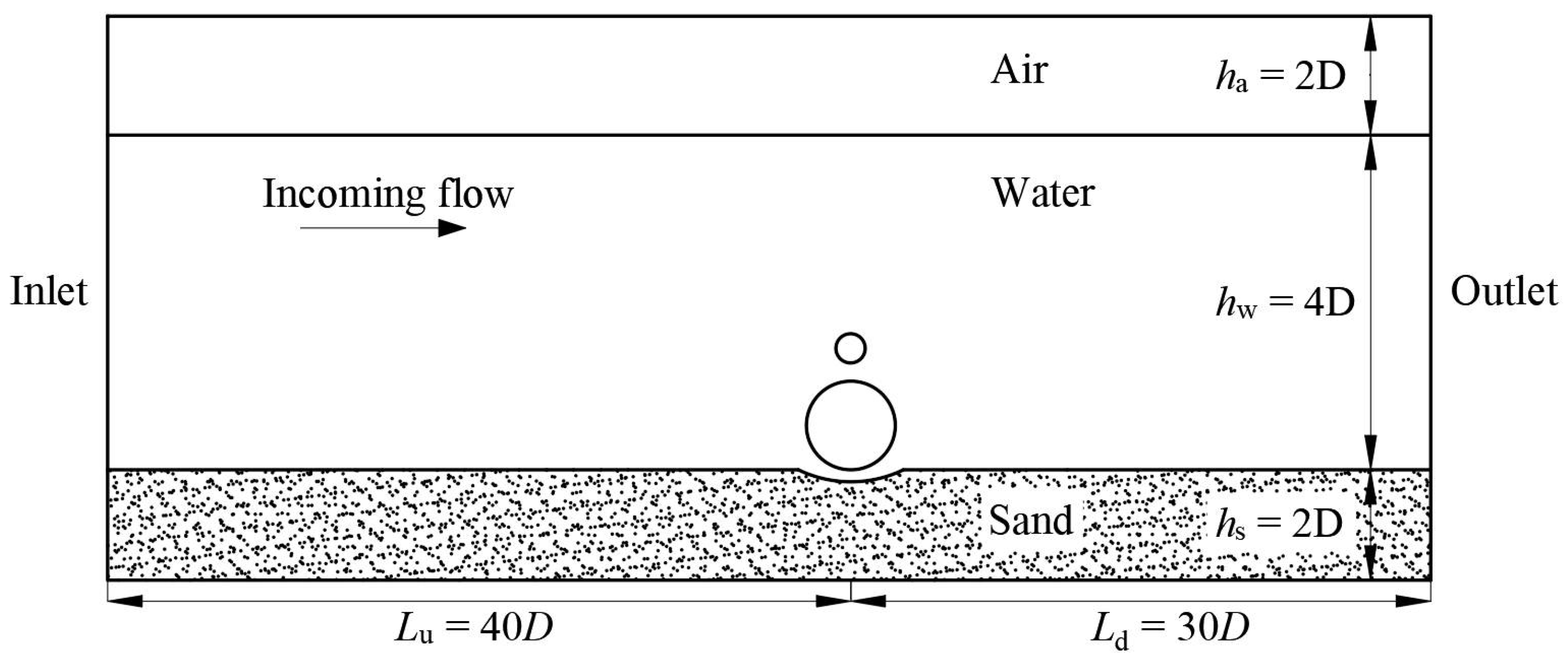
It is assumed that a steady current approaches the pipeline perpendicularly and the flow parameters do not vary along the spanwise direction. In this case, 2D scour modeling is favored [57]. The numerical simulations are carried out in a rectangular domain with 70D × 10D, as depicted in Figure 2. The height of the initial water level hw = 4D, and the height of the sandy seabed hs = 2D. The distances from the inlet and outlet boundaries to the center of the main pipeline are Lu = 40D and Ld = 30D, respectively. Prior to the scour simulation, a numerical channel is established to achieve a fully developed flow field. This fully developed flow profile is then imposed at the inlet boundary. At the outlet boundary, zero-gradient conditions are specified for both velocity and turbulence quantities, with a reference pressure set to zero. Atmospheric pressure is applied at the top boundary. No-slip boundary conditions are enforced on the pipeline surface and the bottom wall. The pipeline is hydraulic-smooth. To facilitate scour initiation, an initial scour hole with 0.08D is prescribed below the pipeline. This artificial hole has been demonstrated to exert negligible influence on subsequent scour evolution in prior studies [58,59].

3.2. Mesh Dependency and Model Validation

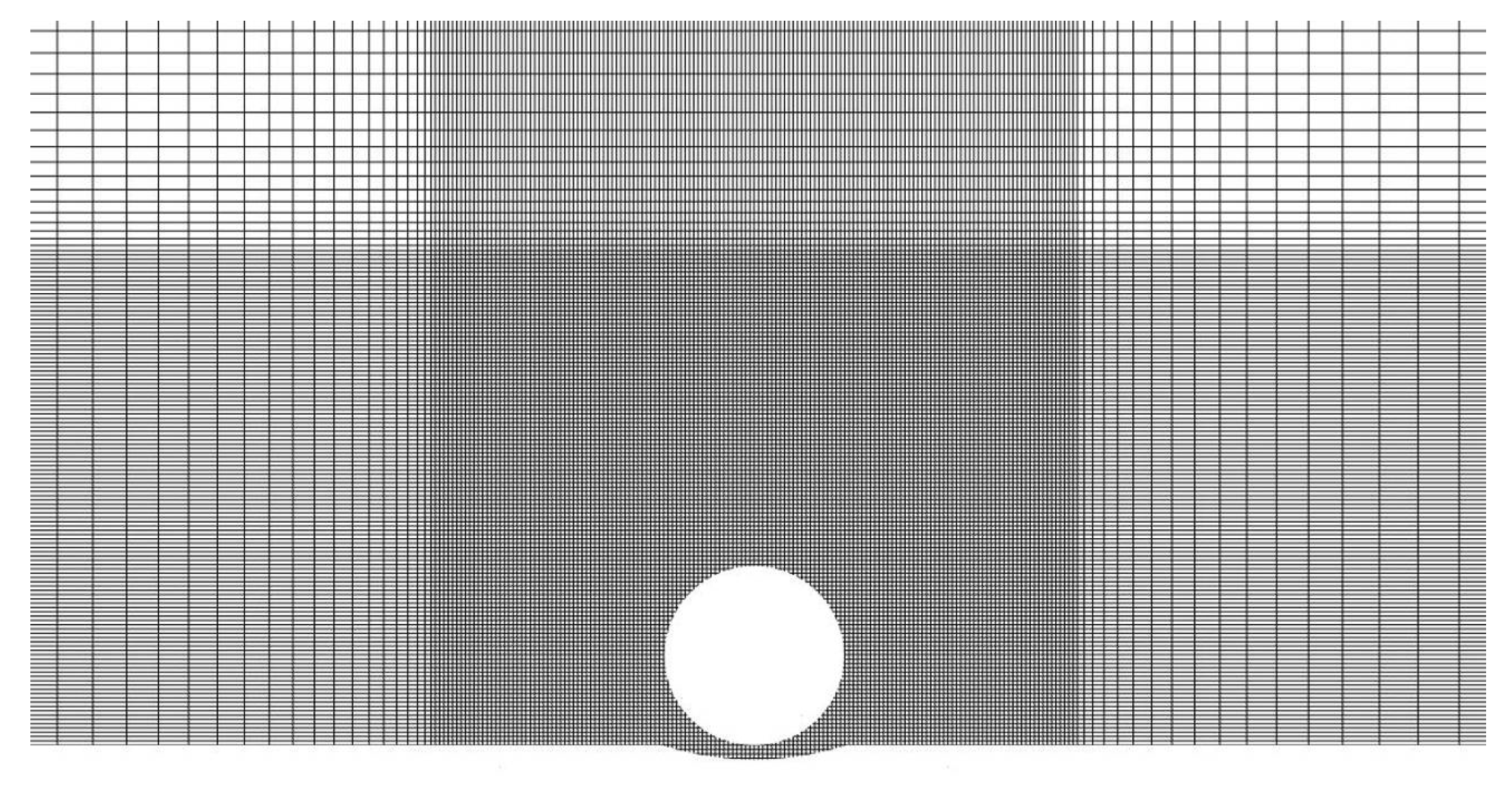
The experimental results of Ref. [60] on local scour beneath a single pipeline are used as a benchmark test for mesh dependency and model validation. The parameters are set the same as those used by Ref. [60]. The properties of the sand used in the experiment are the median diameter, d50 = 0.36 mm; the critical Shields parameter, θcr = 0.05; porosity, n = 0.64; and specific gravity, s = 2.65. The diameter of the pipeline D = 0.1 m and the undisturbed inflow velocity U = 0.5 m/s. The constant water level hw = 0.35 m. To improve the computation efficiency, the meshes around the pipeline are refined and meshes away from the pipeline are sparse, as shown in Figure 3. A mesh sensitivity analysis is conducted to evaluate the influence of grid resolution on the numerical results. Four meshes are employed, as shown in Table 1. It can be seen that the difference between the results from the two finest meshes, Mesh A and Mesh B, is negligible. To balance the requirement for numerical accuracy and the need for computational efficiency, Mesh B was selected for subsequent simulations.
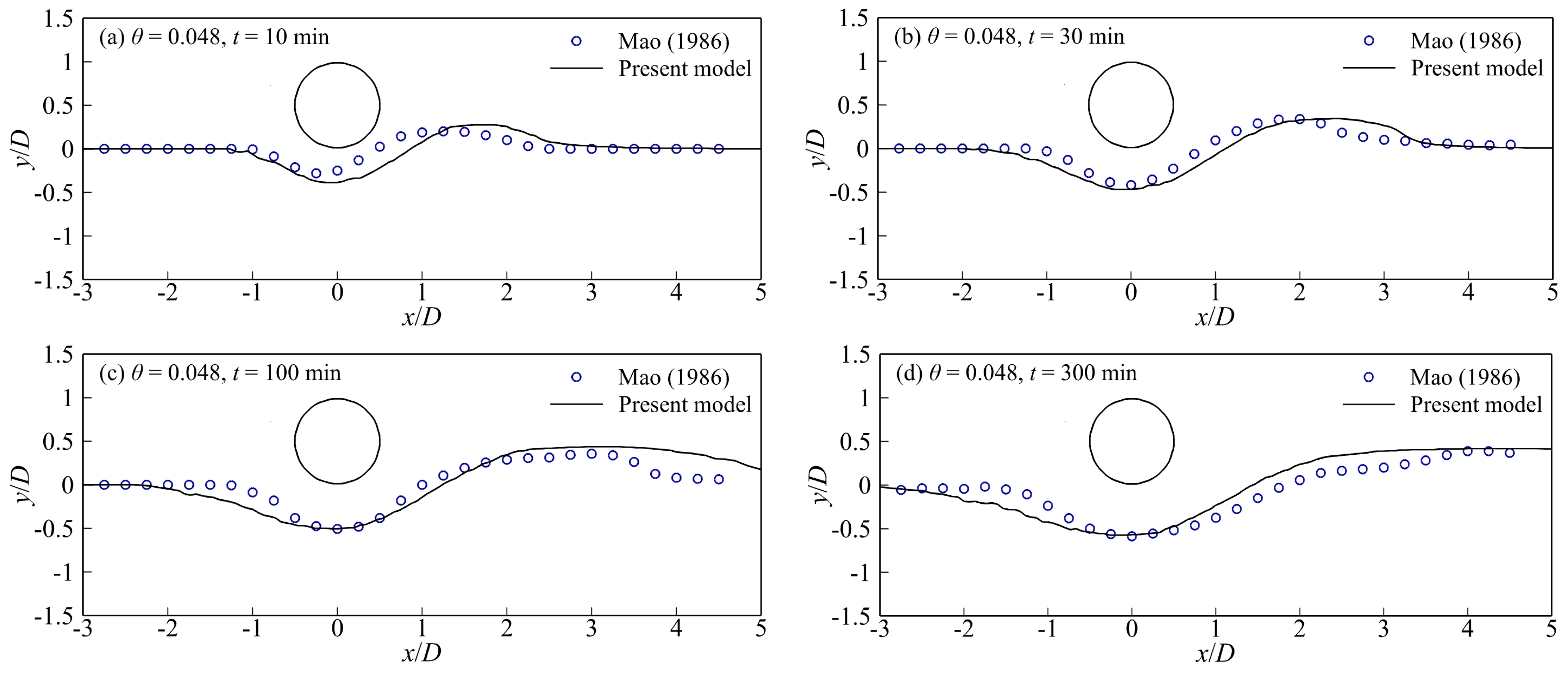
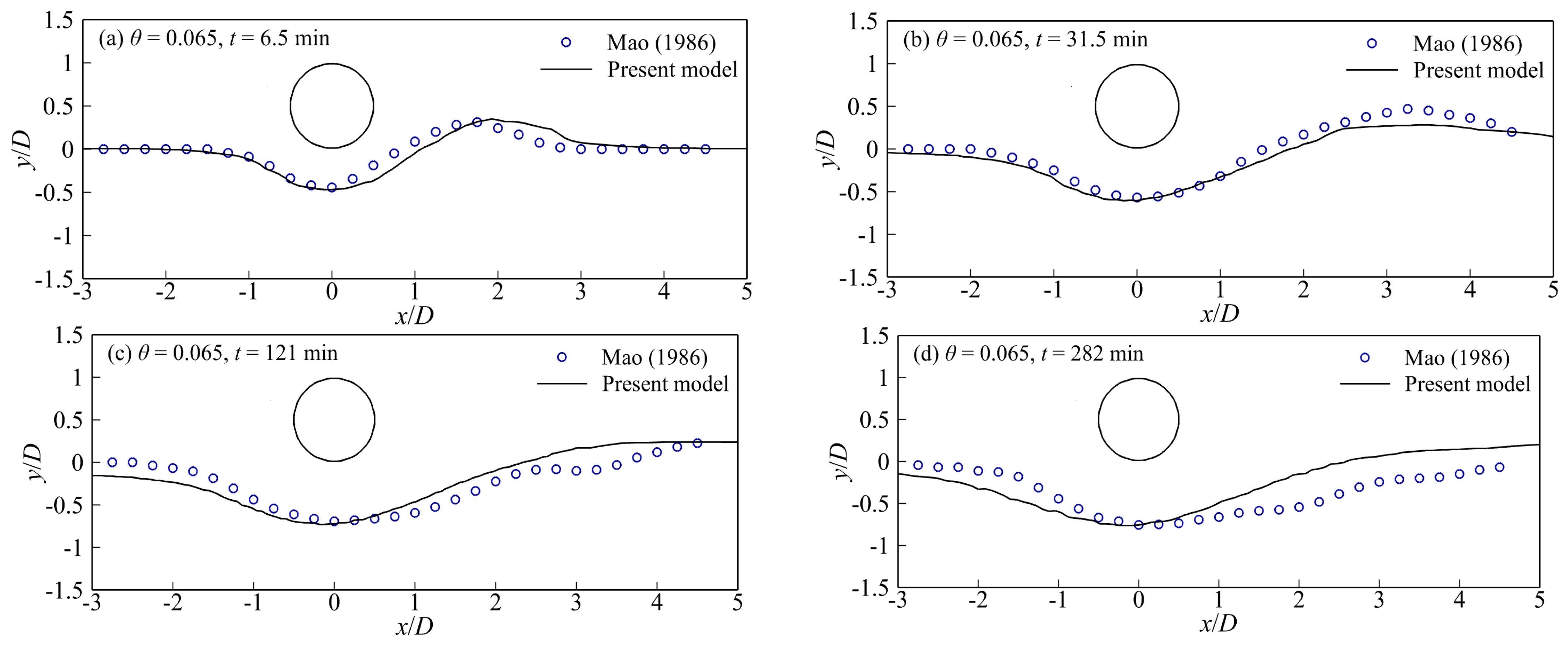
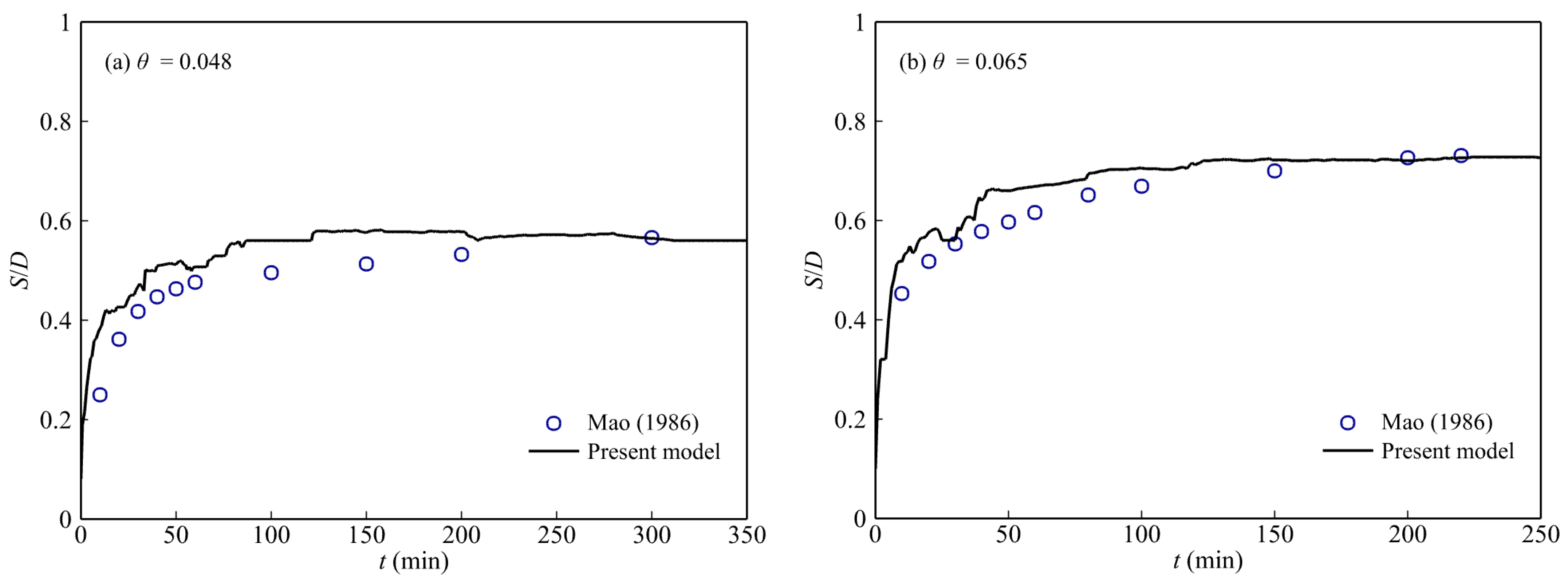
Figure 4 compares the temporal evolution of scour depth obtained in the current numerical study with published experimental data, for both clear-water (θ = 0.048) and live-bed (θ = 0.065) conditions. The numerical results demonstrate good agreement with the experimental data. However, during the initial scour phase, the simulated scour depths exceed the experimental measurements by a small margin, which can be attributed to the introduction of the initial hole. The error analysis between measured and simulated values of the equilibrium scour depth is presented in Table 2. It demonstrates that the numerical results closely match the experimental results. Figure 5 and Figure 6 present the scour profile at different time instants. During the initial scour phase, a deposition mound develops immediately downstream of the pipeline, as evidenced in the figure. With time, the deposition mound moves farther downstream. Under the live-bed condition (θ = 0.065), the numerical model marginally underpredicts the downstream scour at the equilibrium stage. This discrepancy potentially arises from several factors, including the inherent assumptions of the RANS equations, the uniform sediment bed material representation, and the empirical nature of the sediment transport formulations employed. Additionally, the scour profiles in the experiment were measured when the flow is stopped, and the disturbed flow fields will also influence the scour profiles. Nevertheless, the numerical model effectively reproduces the temporal evolution of scour depth and captures the key characteristics of scour hole development.

4. Numerical Results

The validated model is adopted to investigate the scour phenomena beneath piggyback pipelines in this section. The calculation parameters are as follows. The diameter of the main pipeline D is 0.1 m. The diameter ratio d/D is 0.375. The water depth is kept at 0.4 m. The median diameter of the bed material d50 is 0.24 mm. The corresponding critical Shields parameter is 0.0425 according to Equation (7). The undisturbed velocity U is 0.45 m/s, and the corresponding Shields parameter θ is 0.108, which lies in the live-bed regime. The Reynolds number based on the main pipeline diameter is 4.5 × 10⁴, which lies in the sub-critical regime.

4.1. Local Scour Beneath Piggyback Pipelines

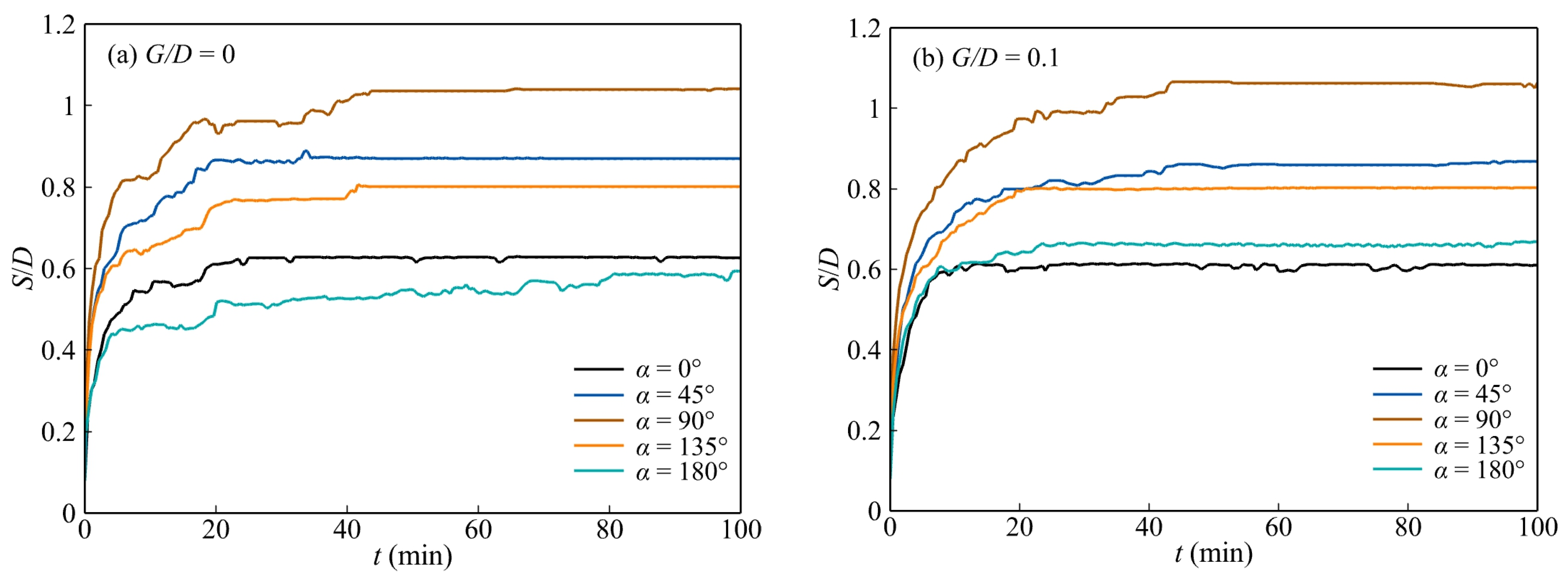
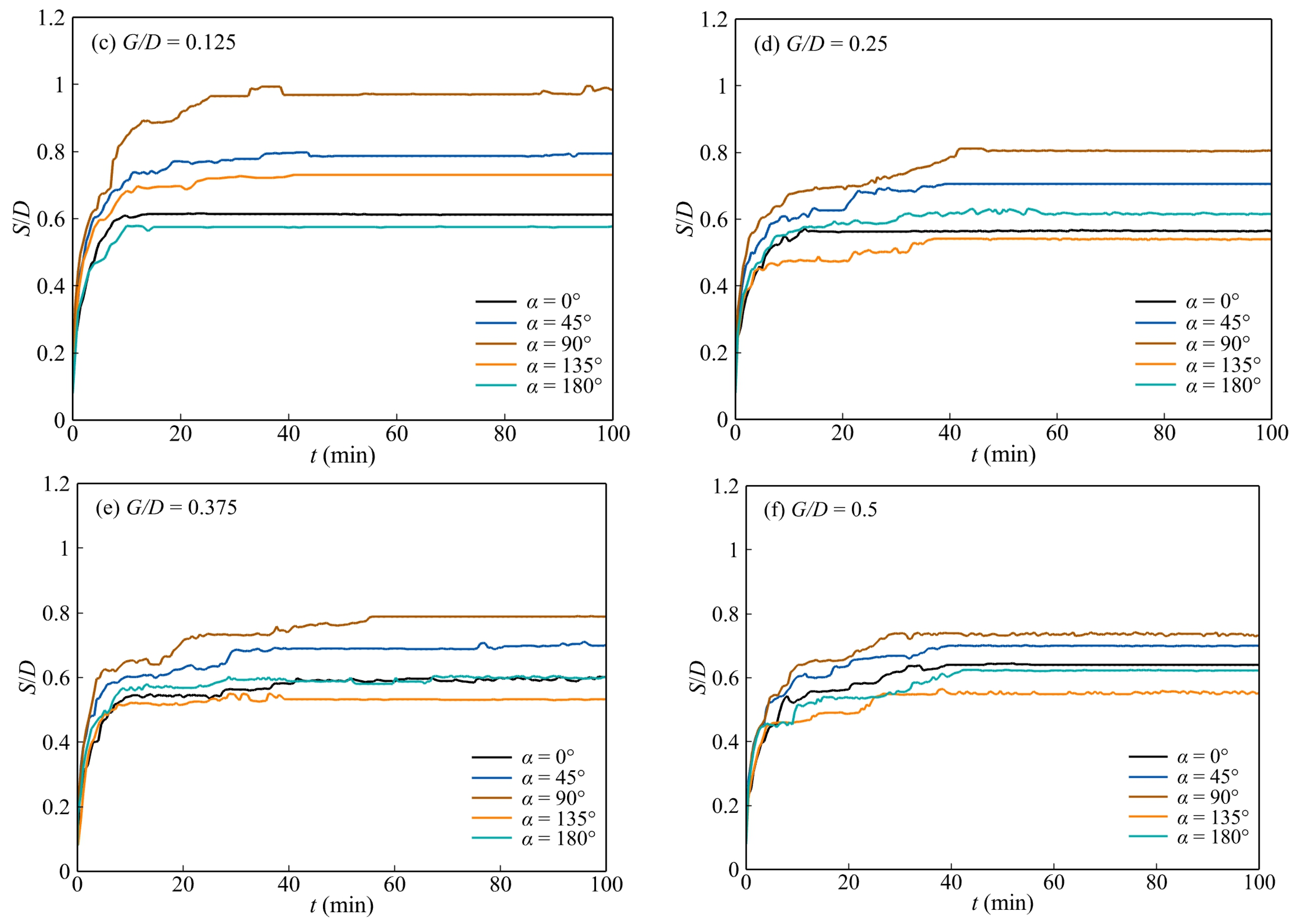
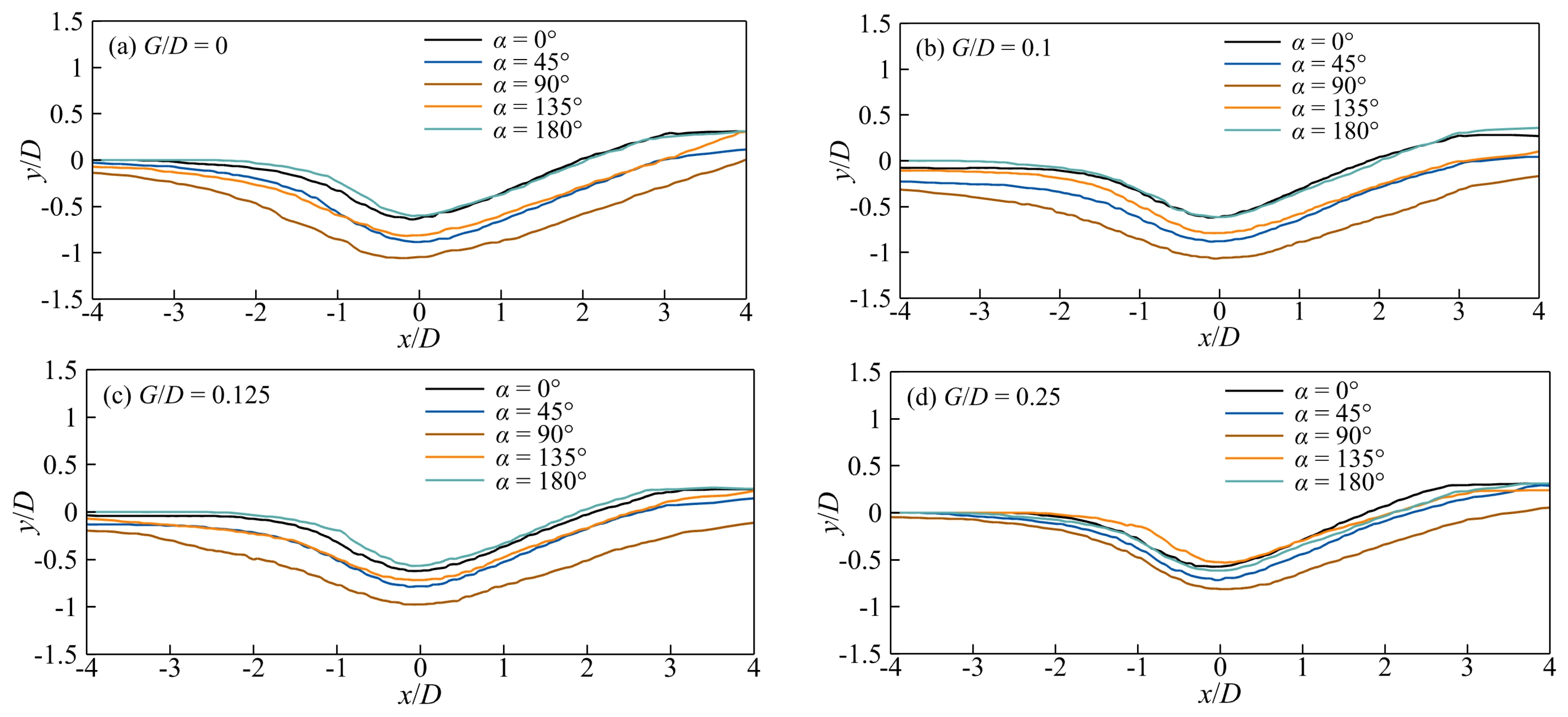
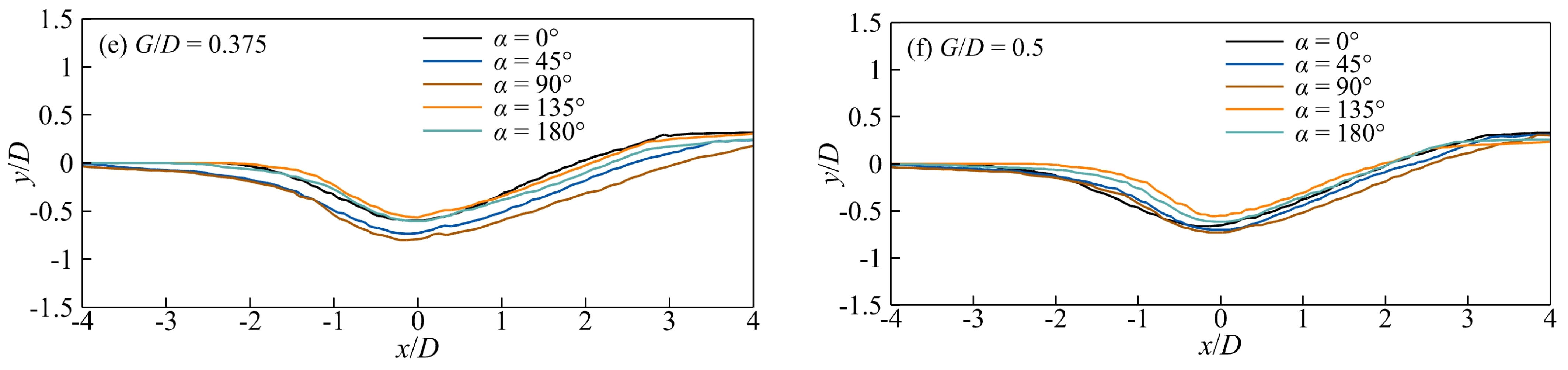
The time histories of the non-dimensional scour depth S/D for position angles α = 0°, 45°, 90°, 135° and 180° under gap ratios G/D = 0, 0.1, 0.125, 0.25, 0.375 and 0.5 are shown in Figure 7. The scour profiles at the equilibrium stage are depicted in Figure 8. It is clearly shown that for all of the gap ratios G/D examined, the α = 90° configuration yields the largest scour depth. This configuration is characterized by the largest cross-flow area, where more fluid can be blocked and diverted into the scour hole. Due to the strong contraction of the pipeline, the extent of the scour hole is significantly enlarged compared with other configurations. For G/D = 0, 0.125 and 0.25, the smallest scour depth occurs at α = 0° or α = 180°, where the cross-section area is the smallest. It is interesting to observe that for G/D = 0.25, 0.375 and 0.5, the minimum shifts to α = 135°. This phenomenon will be explained later. Moreover, with the increase in G/D, both the equilibrium scour depth and the scour profile become less sensitive to α. For example, the maximum value of the scour depth is 75% and 32% larger than the minimum value for G/D = 0 and G/D = 0.5, respectively. This is due to the fact that an increasing G/D means less interference between the small pipeline and the main pipeline.
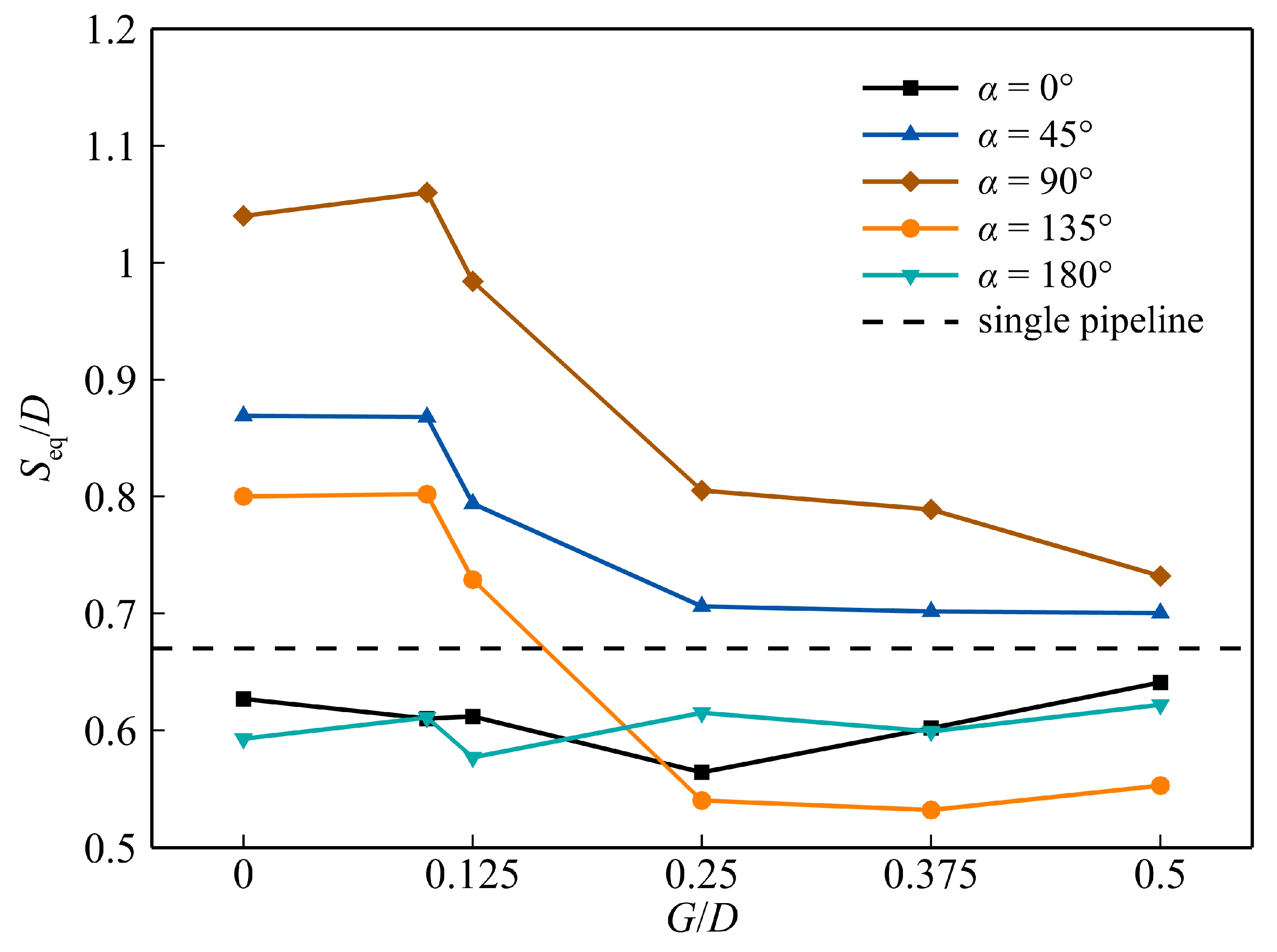
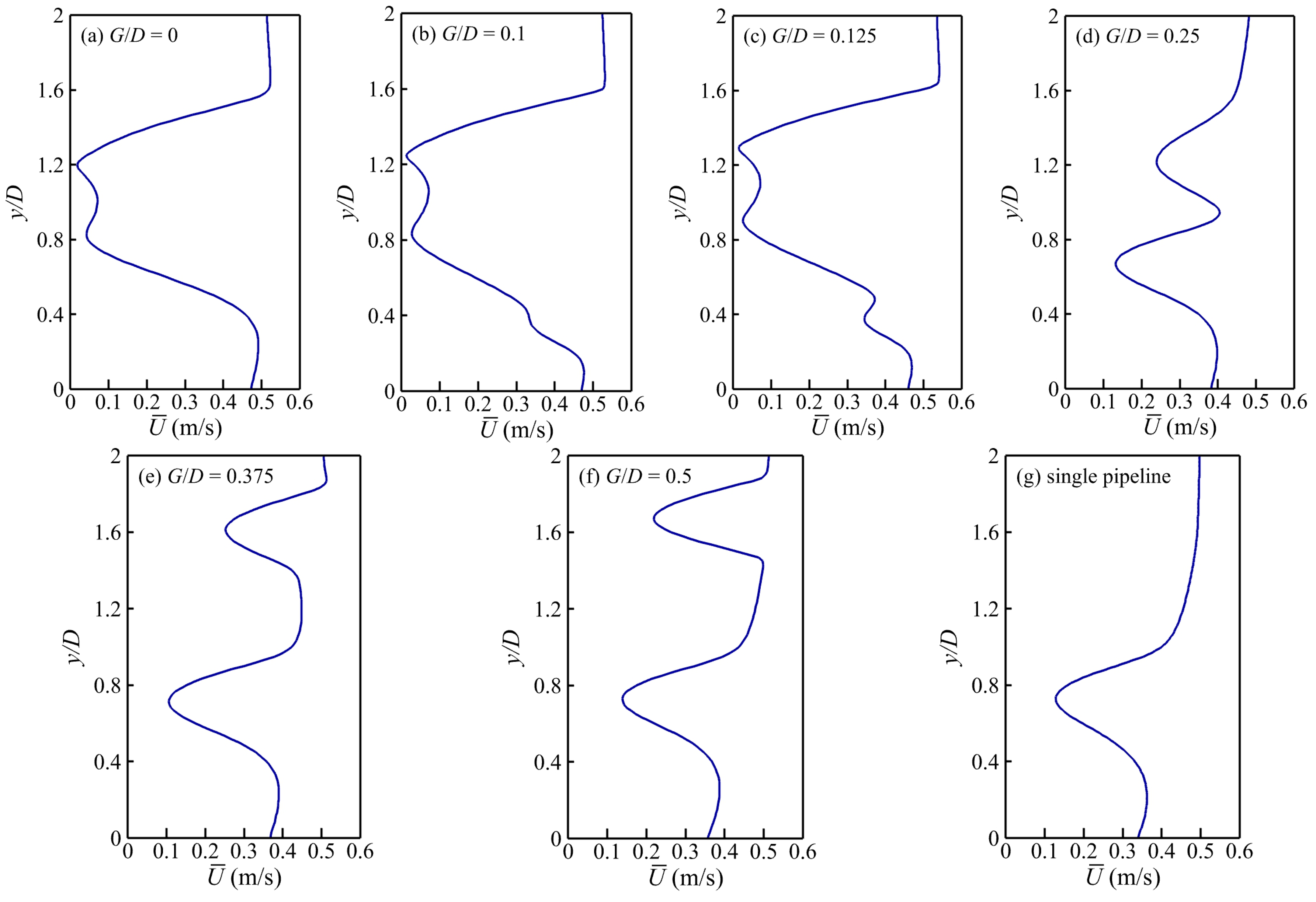
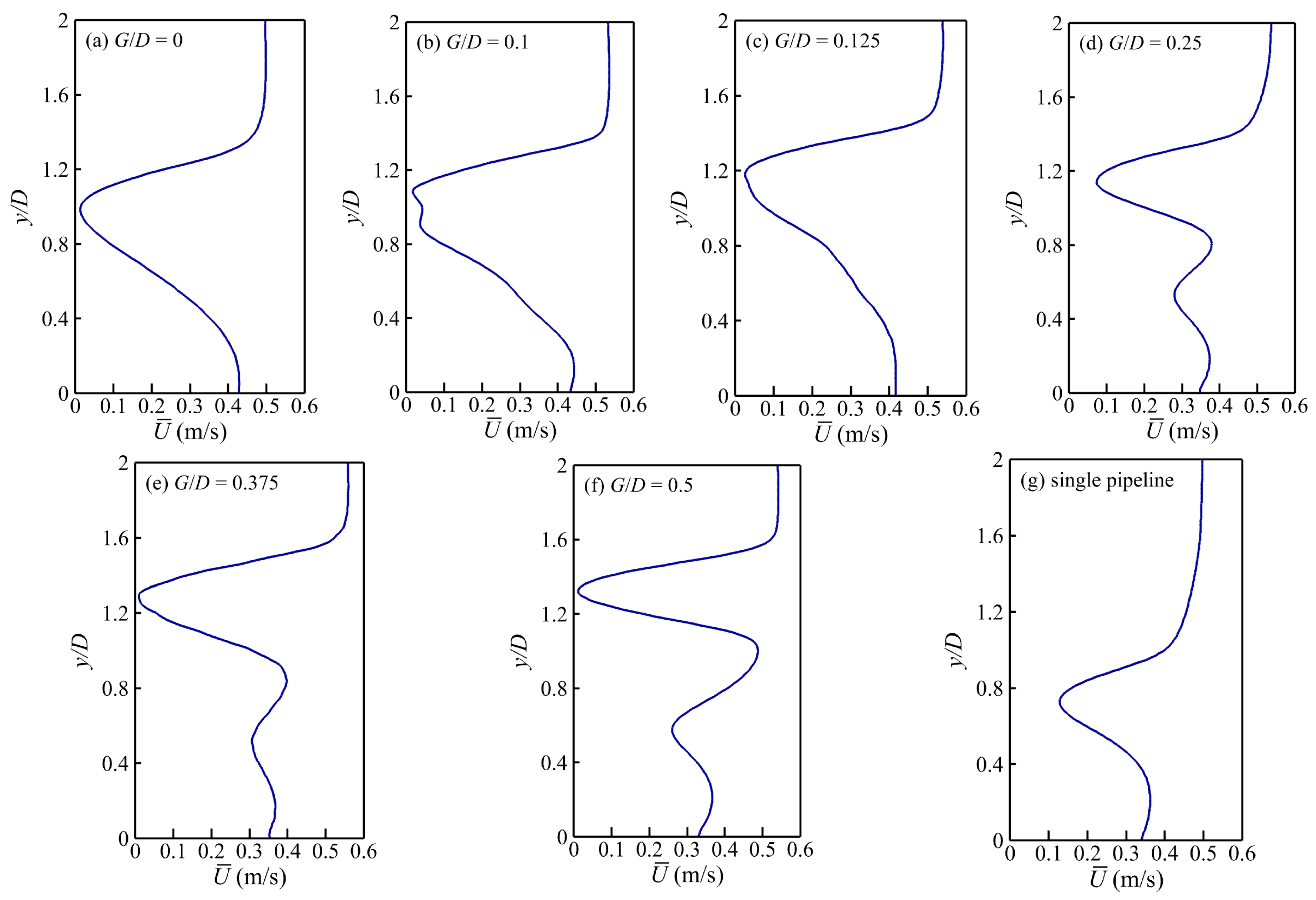
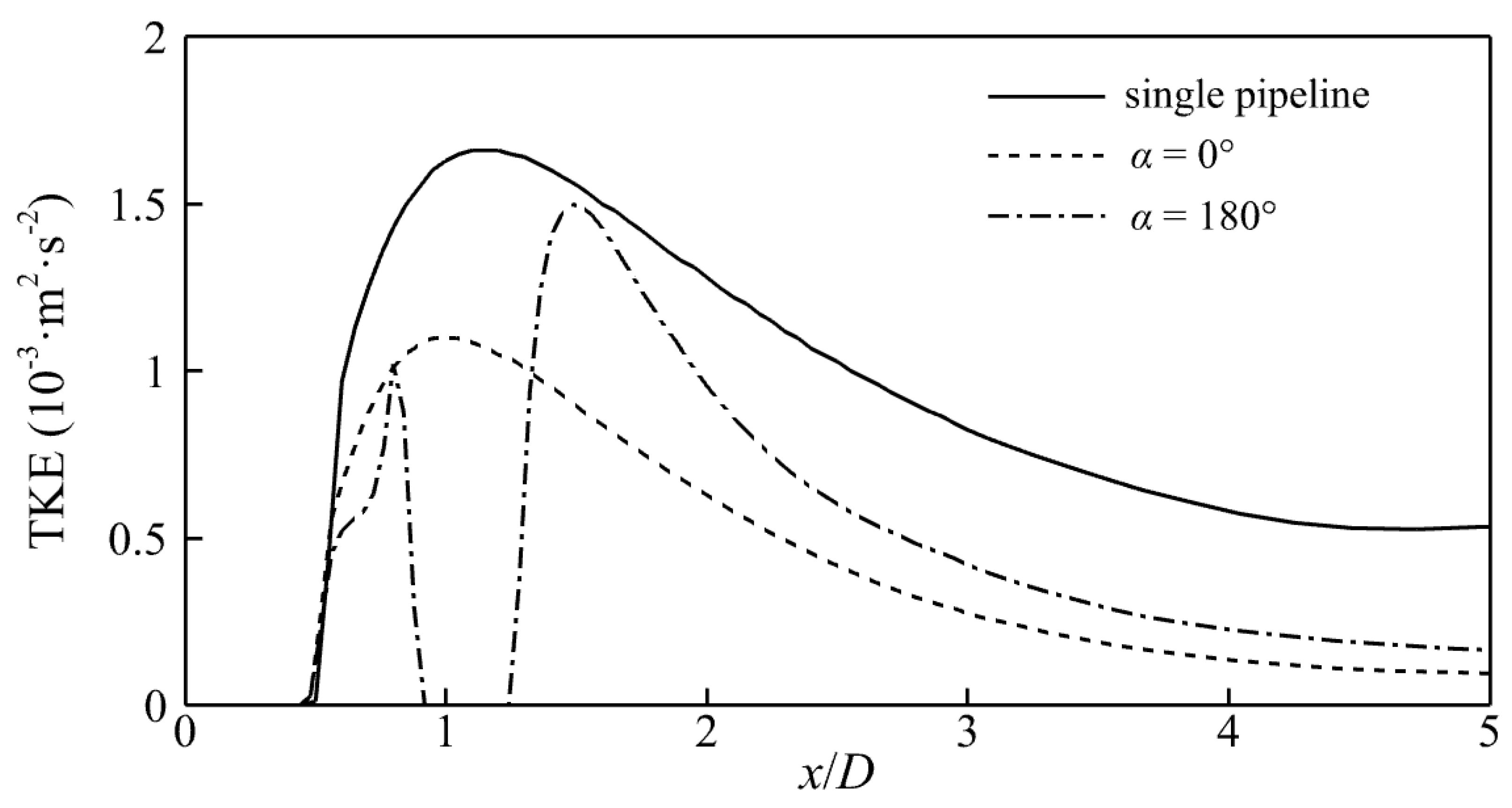
Figure 9 shows the variation in the equilibrium scour depth with the gap ratio G/D. For comparison purposes, the single pipeline case is also included. The figure illustrates that, for α = 90°, the equilibrium scour depth first increases to a maximum value of 1.06 at G/D = 0.1 when G/D varies from nil, and subsequently declines with the further increases in G/D. This phenomenon is comparable to the experimental observations of Ref. [61], although a different diameter ratio d/D is adopted. For G/D = 1, the flow through the gap is weak so that the two pipelines act as a single bluff body with a larger blockage area in the cross-flow direction compared with the G/D = 0 configuration. This increased blockage area gives rise to a larger wake region, generating a greater pressure difference around the pipeline; thus, a larger scour depth beneath the pipeline is observed. With the further increase in G/D, the flow through the gap will influence the shear layer formation of both pipelines. More specifically, the mean velocity profiles at x/D = 1.5D downstream of the pipeline after reaching the equilibrium stage are shown in Figure 10. It can be observed that, for G/D = 0.25, 0.375 and 0.5, there are two dips of velocity deficit, with the lower part being at the same scale as the single pipeline case. The velocity deficit correlates with the presence of the reversed flow, characterizing the flow behavior within the recirculation zone. This implies that with the increase in G/D, vortices are shed separately from the main pipeline and the small pipeline. The dependence of the equilibrium scour depth on G/D for α = 45° resembles that for α = 90°. For all of the G/D values examined, the scour depth beneath the piggyback pipeline for α = 45° and α = 90° is always greater than that beneath the single pipeline. As previously mentioned, although the projection area in the cross-flow direction for α = 135° is larger than that for the single pipeline, the equilibrium scour depth for α = 135° is smaller than that for the single pipeline when G/D = 0.25, 0.375 and 0.5, with the minimum equilibrium scour depth 0.53 achieved at G/D = 0.375. Figure 11 presents the mean velocity profiles located 1.5D downstream of the main pipeline center at the equilibrium stage for α = 135°. The results indicate that the velocity profile for G/D = 0, 0.1 and 0.125 is characterized by a single large velocity deficit. Similar to those observed for the α = 90° configuration, there are two dips of velocity loss for G/D = 0.25, 0.375 and 0.5. The difference is that the velocity deficit at the lower part is much weaker than that for the single pipeline. Although at higher elevation behind the small pipeline, a large velocity deficit can be observed, this region is far away from the seabed, which may exert less influence on scour development. With the increase in G/D, the wake velocity profile is narrowed and moves to higher elevation. This suggests that, at these gap ratios, the vortex shedding from the main pipeline is suppressed, which can be ascribed to the inhibition effect posed by the small pipeline and the nearby seabed. When the two pipelines are in a tandem arrangement, i.e., α = 0° and α = 180°, the equilibrium scour depth is reduced compared with that of the single pipeline case, irrespective of the value of G/D. Taking G/D = 0.375 for example, the turbulent kinematic energy (TKE) at y/D = 0.5 downstream the pipeline is depicted in Figure 12. It is observed that TKE downstream of the single pipeline is significantly larger than that for α = 0° and α = 180° configurations. A larger TKE indicates a larger suction pressure [62]; consequently, more sediments can be mobilized. In this tandem configuration, the smaller pipeline acts as a spoiler attached to the main pipeline. The pipeline system exhibits characteristics of a more streamlined body relative to a single isolated pipeline, thereby reducing flow disturbances. Under such configurations, the shear layers from the two pipelines will interfere with each other, which suppresses the vortex shedding to some extent. Furthermore, with the further increase in G/D from 0.5, the interaction between the pipelines is expected to weaken gradually. Consequently, the equilibrium scour depth approaches that of a single pipeline irrespective of the position angle α.

4.2. Time-Averaged Force Coefficients on the Pipeline

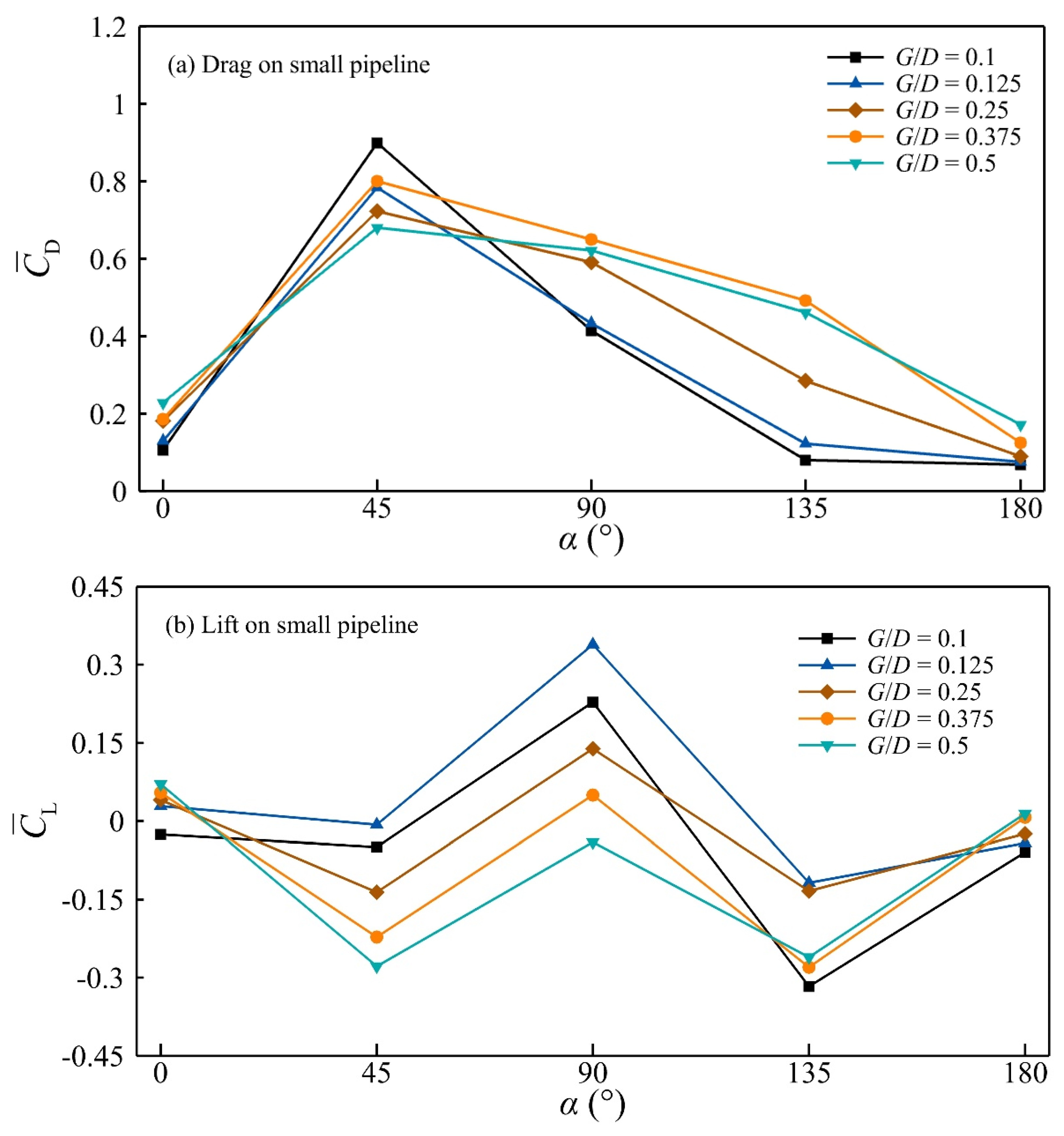
This section will examine the time-averaged force coefficients on the pipeline after the scour reaches the equilibrium stage. Figure 13 presents the time-averaged force coefficients on the small pipeline. As can be seen from Figure 13a, for all G/D examined, the time-averaged drag force coefficient on the small pipeline first increases to a maximum value as α increases from 0° to 45°. Then, with the increase in α from 45° to 180°, the drag coefficients gradually decrease. When the small pipeline is placed in front of the main pipeline (α = 0°) or immersed in the wake region of the main pipeline (α = 180°), the time-averaged drag coefficient on the small pipeline is relatively small and not sensitive to the variation of the gap ratio G/D. The time-averaged drag coefficient attains its maximum value at α = 45°. In addition, the effect of the position angle α on the mean drag coefficient is more significant at smaller gap ratios. As illustrated in Figure 13b, the curve for the time-averaged lift coefficient is generally W-shaped. The magnitude and direction of the mean lift is dependent on both the position angle α and the gap ratio G/D. Similar to those observed for the mean drag coefficient, for α = 0° and α = 180° configurations, the effect of the gap ratio G/D on the time-averaged lift coefficient is not significant. Additionally, when the small pipeline is placed on top of the main pipeline, i.e., α = 90°, the time-averaged lift coefficient follows a positive upward trend for all gap ratios examined except G/D = 0.5.
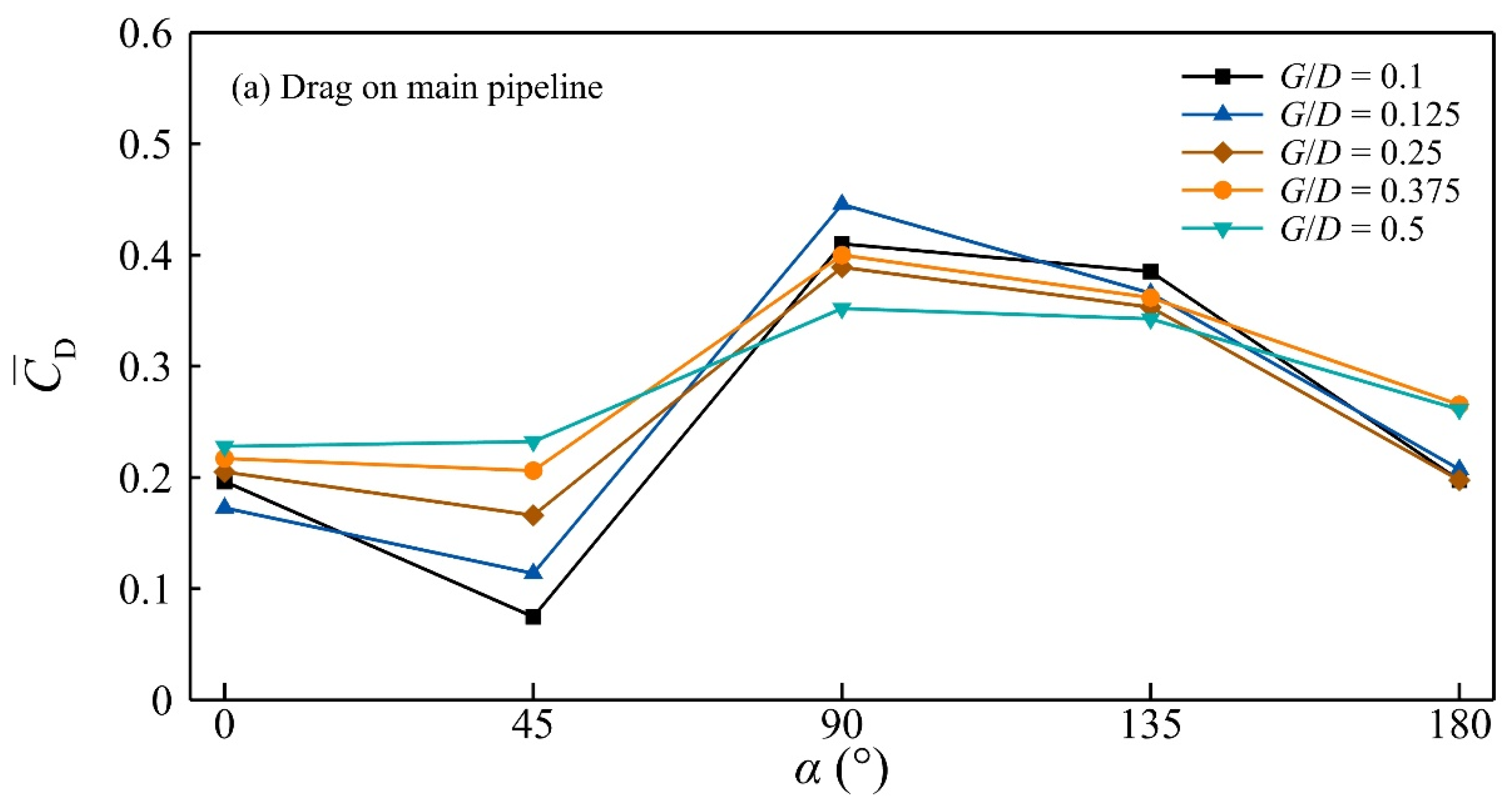
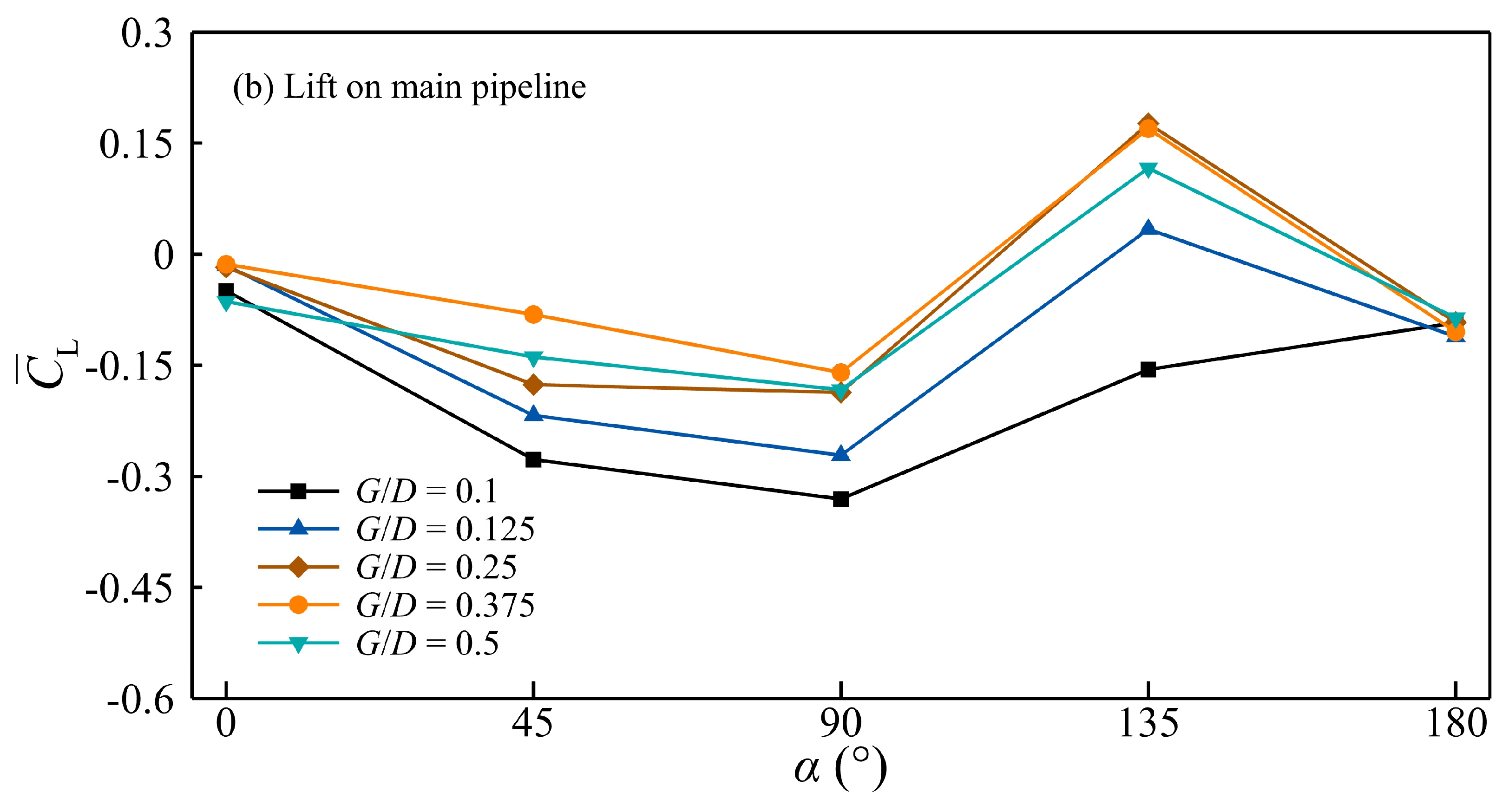
The time-averaged force coefficient on the main pipeline is shown in Figure 14. As shown in Figure 14a, the time-averaged drag coefficient attains its maximum value at α = 90° for all gap ratios G/D examined, while the time-averaged drag coefficient reaches its minimum value when α = 45°, which is contrary to those observed for the small pipeline. The effect of the position angle α on the time-averaged drag is more significant at smaller gap ratios. In general, as the small pipeline is placed at the upstream side of the main pipeline, the time-averaged drag coefficient is small. For most cases, the time-averaged lift coefficient is negative, but for α = 135°, positive values are observed when G/D is larger than 0.1. Comparing Figure 13 and Figure 14, it can be observed that the variation of the force coefficient on the small pipeline is more sensitive to the variation of the position angle α. The reason is that the main pipeline has a larger diameter and thus a larger capacity to shield the incoming flow, and changing the position angle α will greatly affect the effective Reynolds number for the small pipeline.
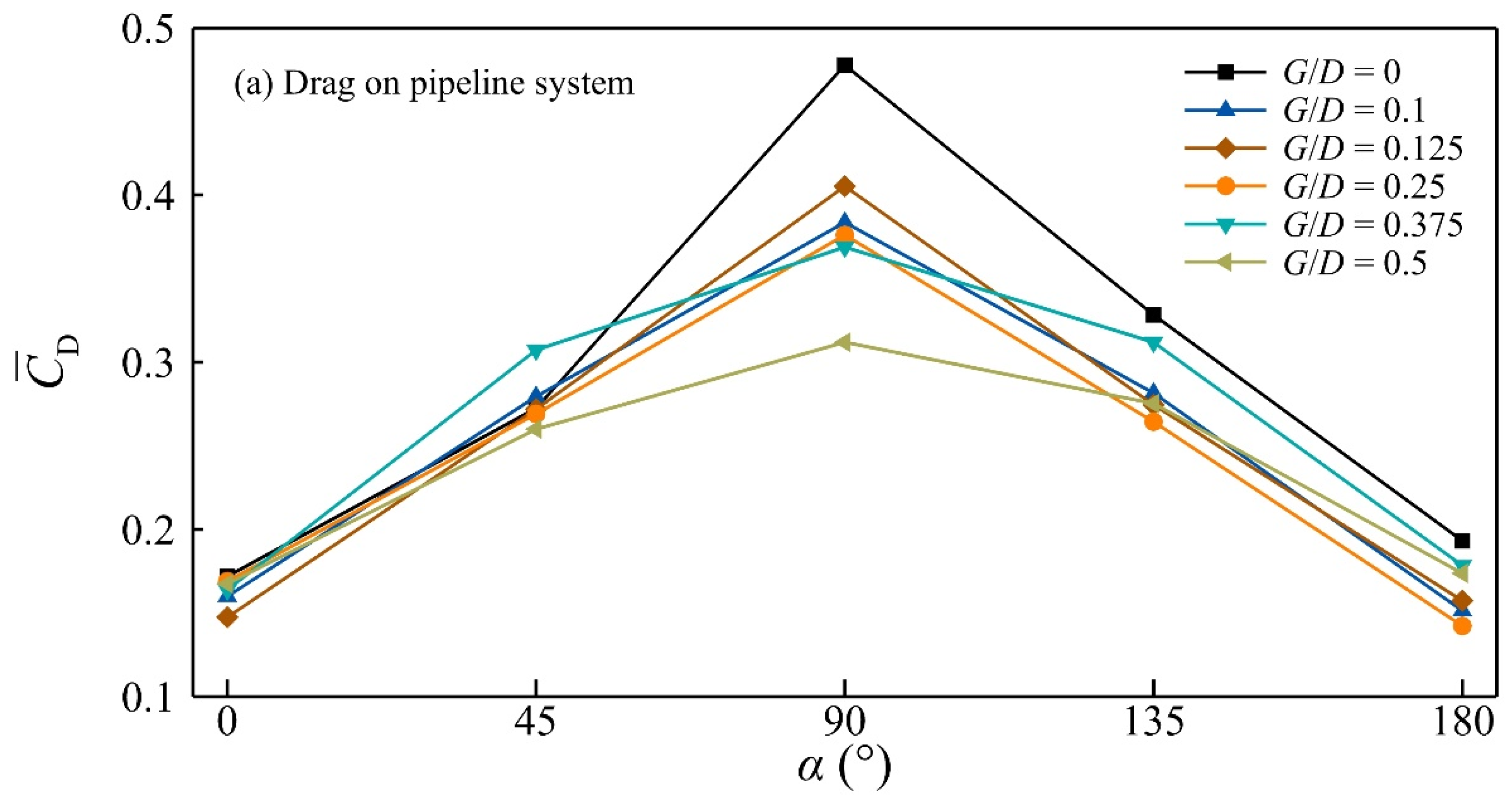
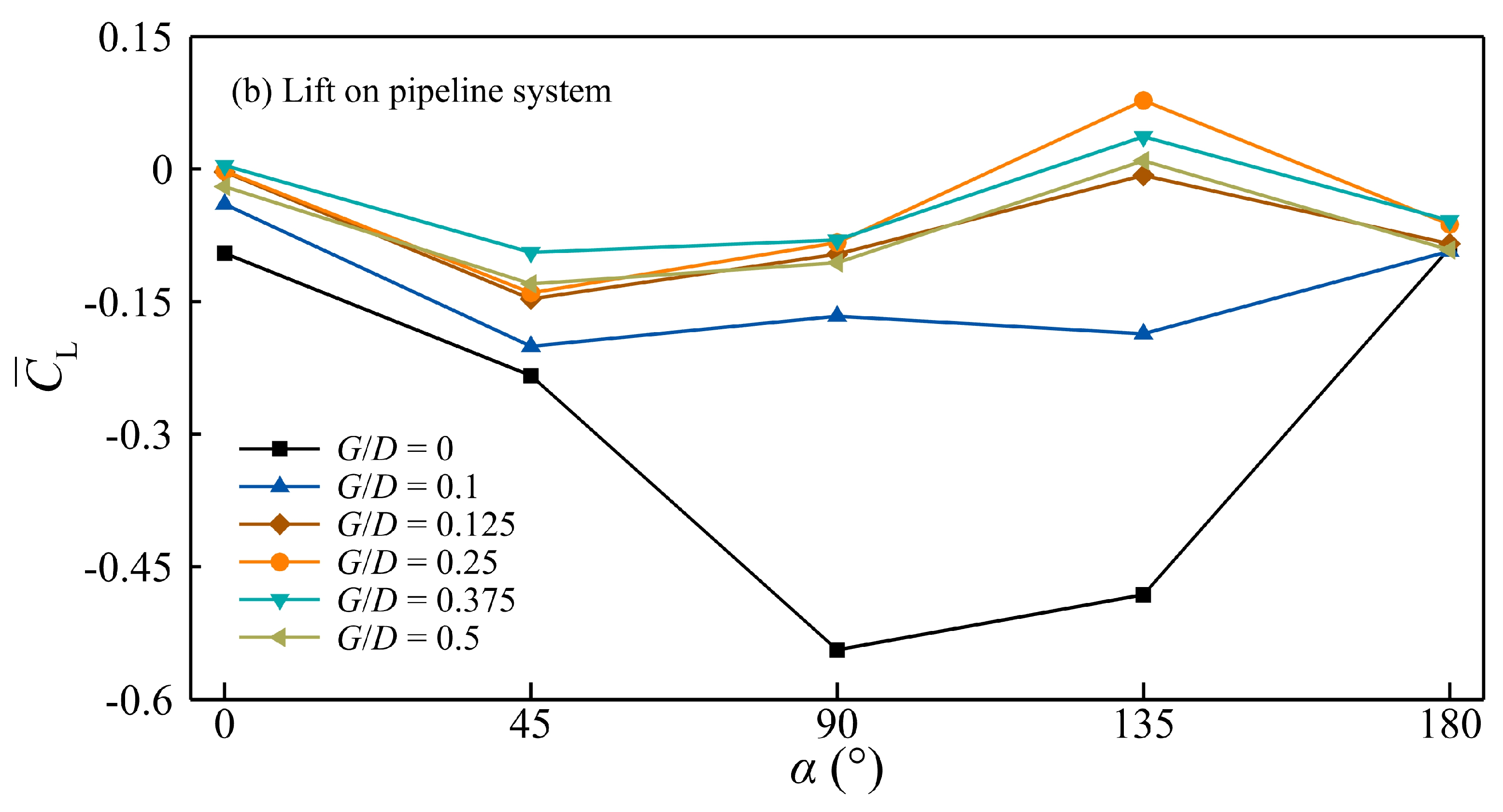
Figure 15 shows the time-average force coefficients on the piggyback pipeline system. For α = 0° and 180°, the pipeline system behaves as a more streamlined body compared with other configurations, and both the time-averaged drag and lift coefficients show a relatively small value regardless of the gap ratio G/D. When α changes from 0° to 90°, the mean drag coefficient for the pipeline system increases, and then decreases when α changes from 90° to 180°. From Figure 15b, it can be observed that the mean lift coefficients are all negative regardless of the position angle α for G/D = 0, 0.1 and 0.125, which is beneficial for the self-burial process of the pipeline. Similar to those observed for the main pipeline, the upward lift can be observed for the α = 135° configuration when the gap ratio is larger than 0.1, as the main pipeline dominates the force coefficients.

5. Discussion

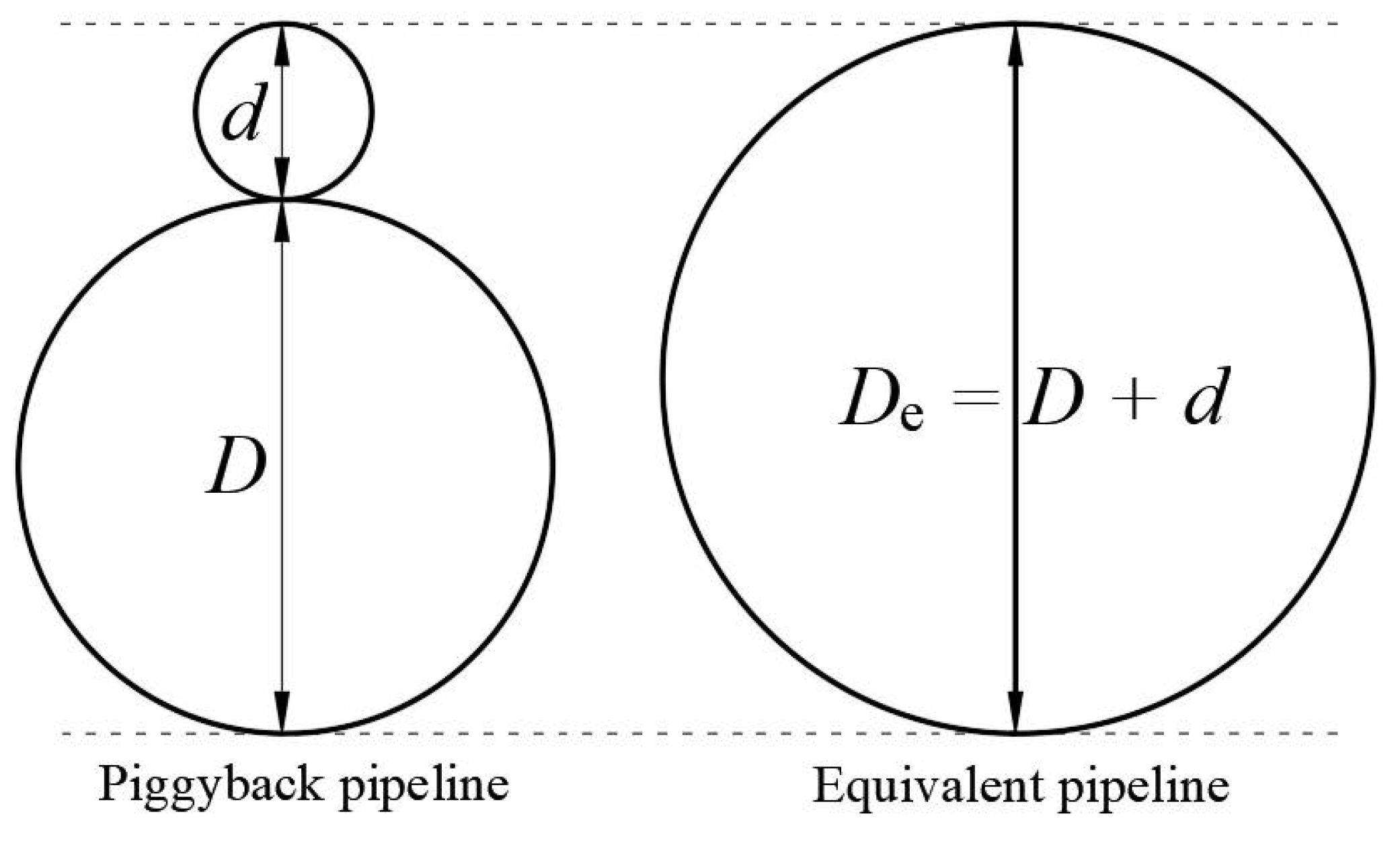
In engineering practice, it is common to evaluate hydrodynamic loads on the piggyback pipeline and local scour depth using the equivalent pipeline method, as this method is simple [63]. In this method, the piggyback pipeline is modeled as one pipeline with diameter De = d + D, as depicted in Figure 16. From the aforementioned investigations, it is clear that both the gap ratio G/D and the position angle α will significantly affect scour development. Obviously, when G/D is greater than zero, the flow through the gap will lead to a more complex flow field, and then the equivalent pipeline cannot be used as an alternative method. Additionally, the orientation-dependent properties cannot be simulated by the equivalent pipeline method. Therefore, only the G/D = 0 and α = 90° configuration is analyzed herein.
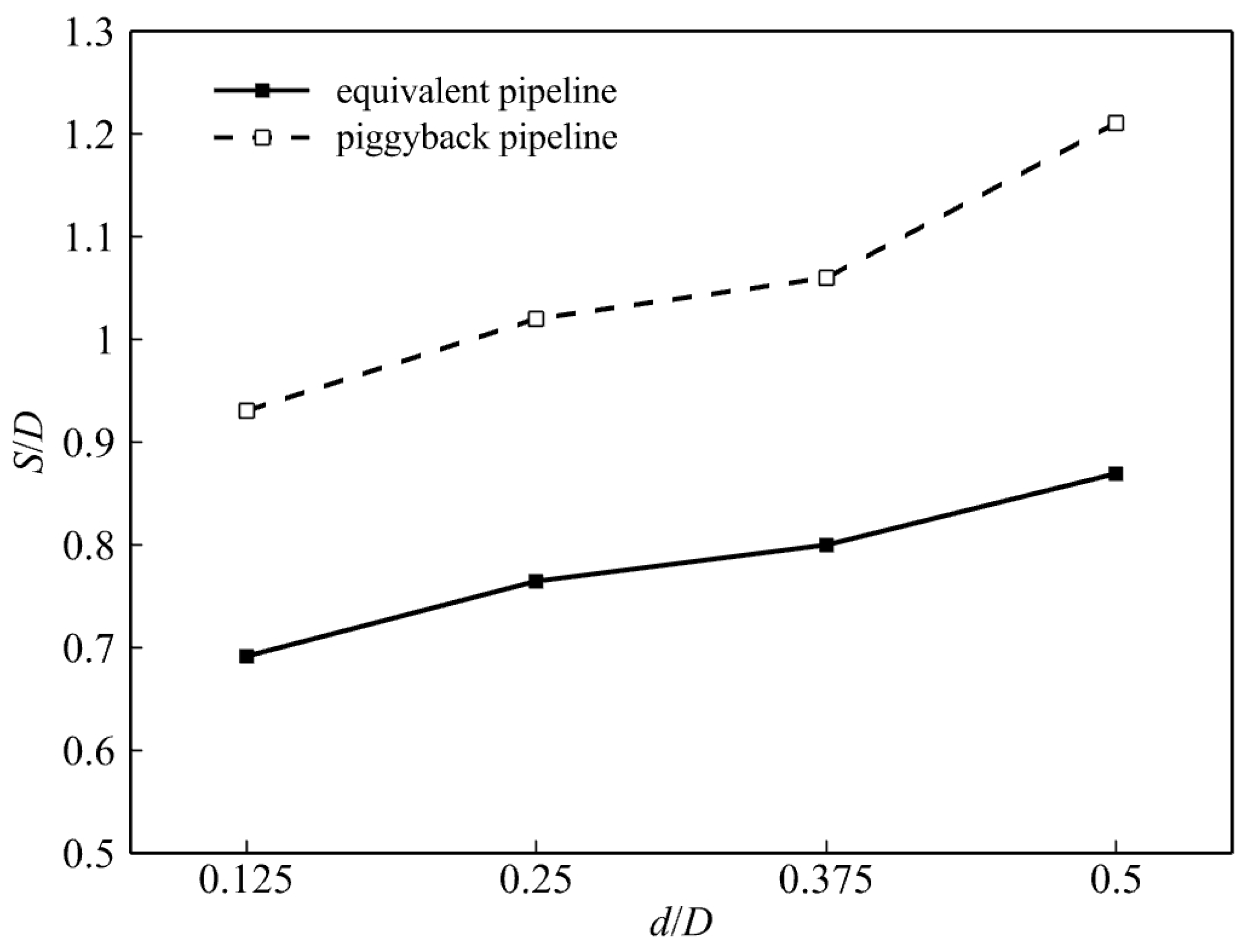
A comparison of the equilibrium scour depth between the equivalent pipeline and the piggyback pipeline under different diameter ratios d/D is shown in Figure 17. The equilibrium scour depth for piggyback pipelines is larger than its counterpart regardless of the diameter ratio d/D, with an increase factor ranging from 1.33 to 1.39 depending on d/D.
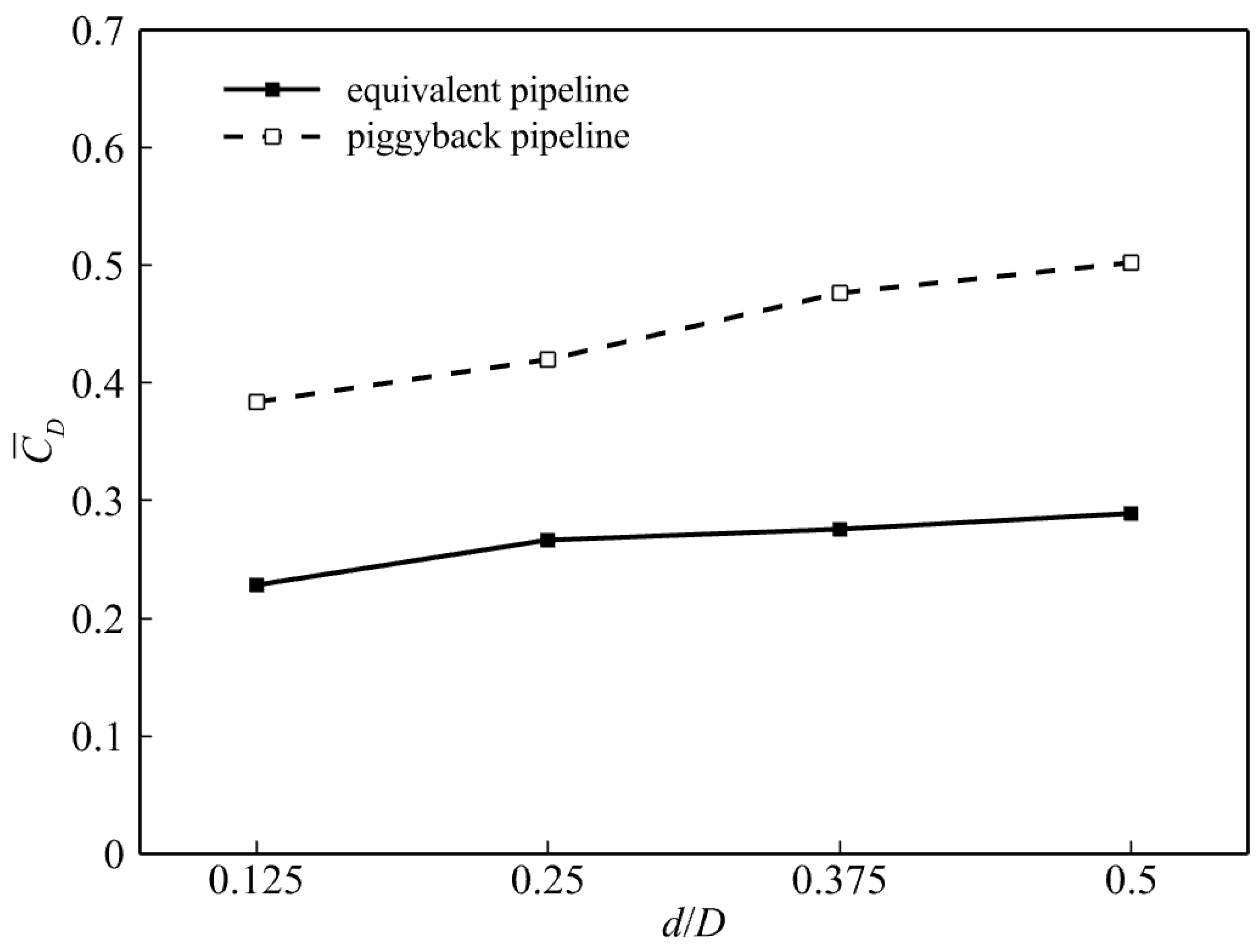
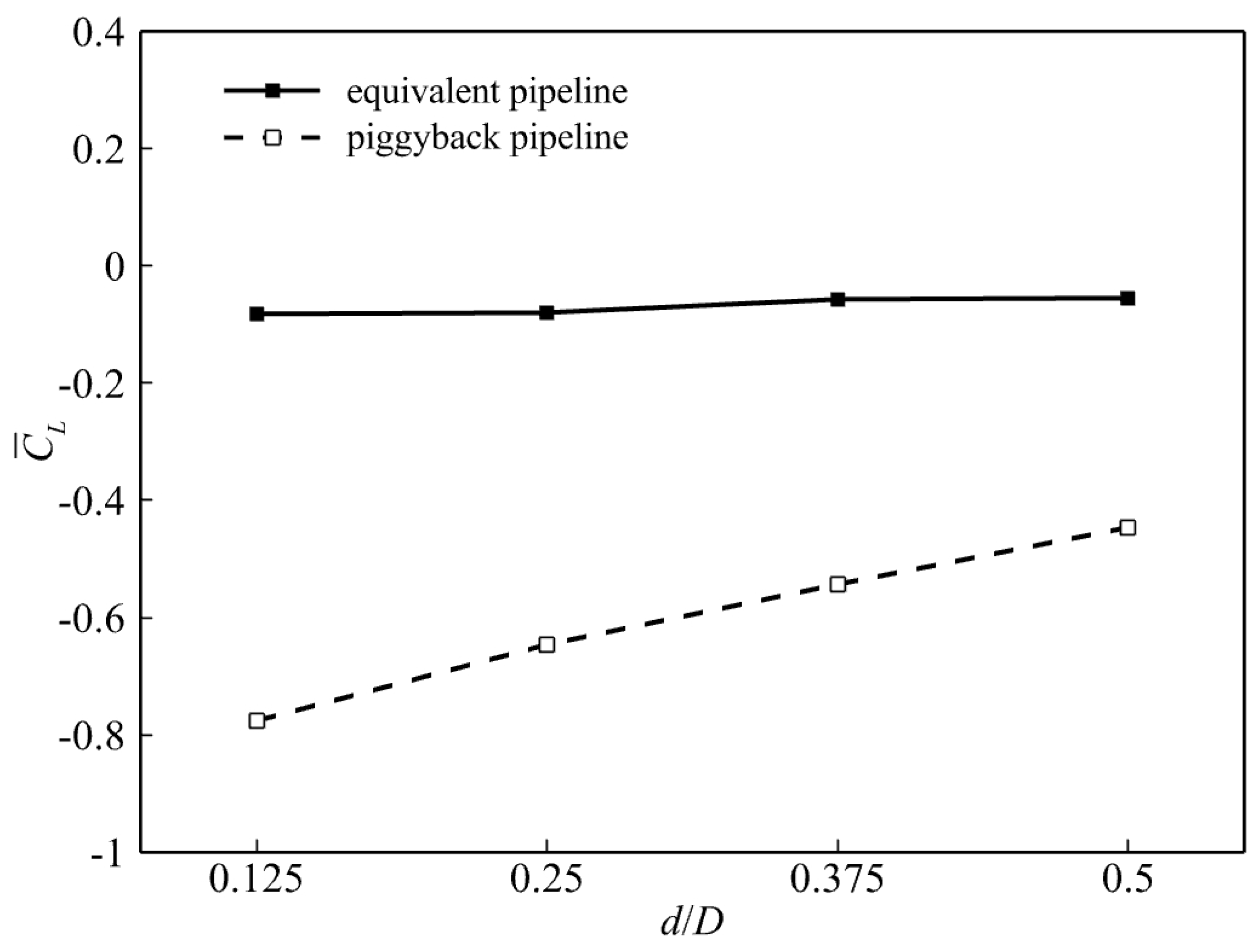
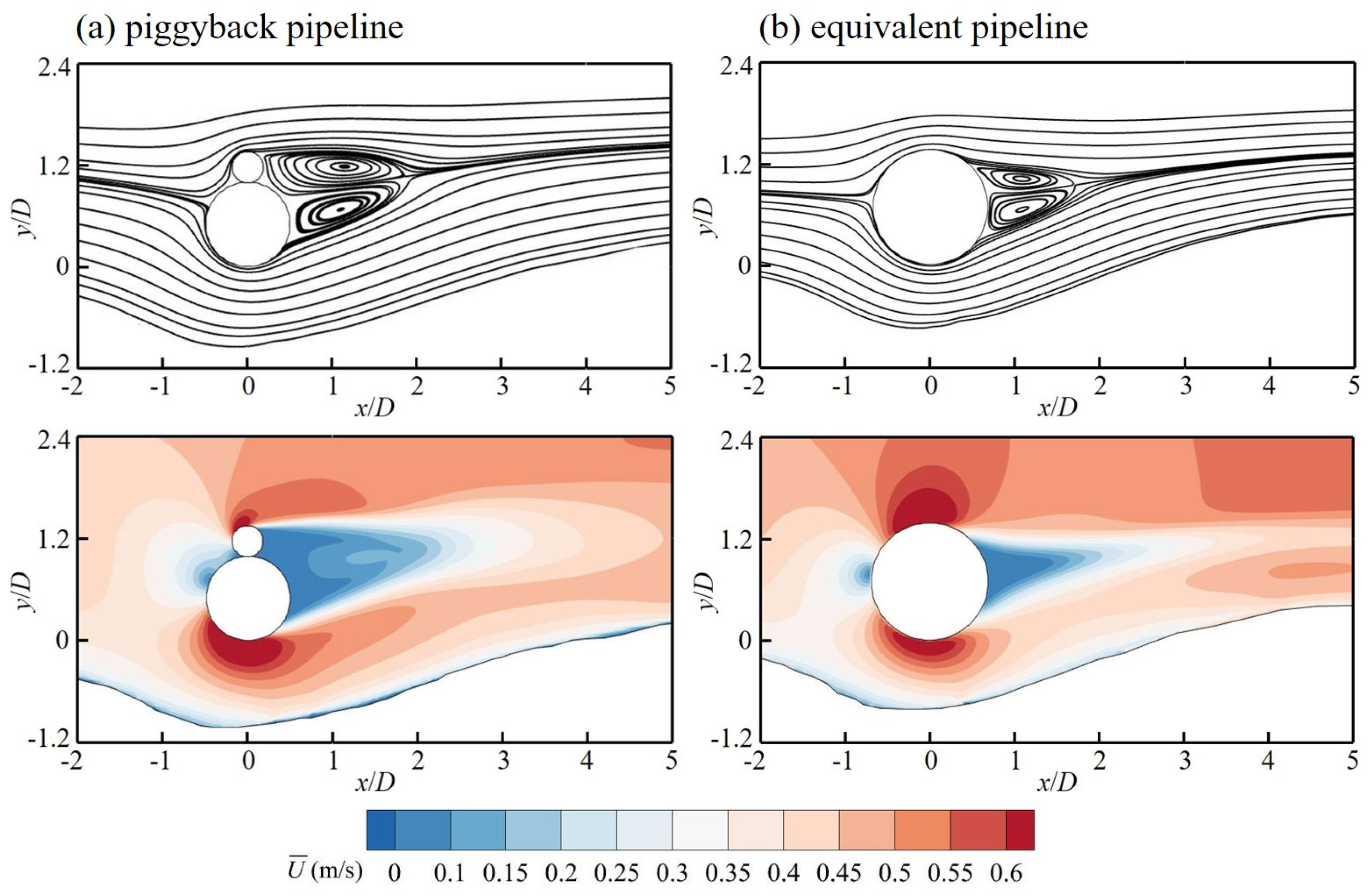
Comparisons of the time-averaged drag coefficient and lift coefficient are shown in Figure 18 and Figure 19, respectively. The magnitude of both the drag and lift coefficient for piggyback pipelines are larger than that for equivalent pipelines, especially the lift coefficient. Figure 20 shows the time-averaged velocities and streamlines when d/D = 0.375 after the equilibrium stage as an example for illustrating the above phenomena. It is clearly shown that the wake region behind the piggyback pipeline is much larger than behind the equivalent pipeline. This larger wake region will force the main stream beneath the pipeline closer to the seabed, increasing bed shear stresses and leading to more sediment erosion. Additionally, due to the geometric asymmetry of the piggyback pipeline, the overall velocity magnitude at the lower side of the pipeline is much larger than its counterpart at the upper side, which leads to lower pressure at the lower side; then, a larger time-averaged lift force acting toward the seabed can be observed. From the perspective of pipeline stability, while the larger lift force acting toward the seabed benefits the self-burial process, the increased drag force will exacerbate lateral deflection, which is detrimental to lateral stability.

6. Conclusions

Numerical simulations were conducted to study current-induced scour beneath piggyback pipelines. The effects of the gap ratio G/D and the position angle α on the local scour and time-averaged force coefficients on the pipeline were investigated, and a discussion on the equivalent pipeline method was carried out. The key findings can be summarized as follows.
(1) The largest equilibrium scour depth occurs at α = 90° for all of the gap ratios G/D examined. The α = 0° and α = 180° configurations can inhibit scour development irrespective of gap ratios, as these two configurations are more streamlined than a single circular pipeline. For gap ratios G/D = 0.25, 0.375 and 0.5, the smallest scour depth is observed at α = 135°. At this position angle, the small pipeline and the sandy seabed act like barriers that inhibit the wake strength behind the main pipeline, which, in turn, inhibit scour hole expansion.
(2) The influence of the position angle α on the time-averaged force coefficients of the small pipeline is more significant at smaller gap ratios. The time-averaged drag coefficient on the main pipeline attains its maximum value at α = 90°, and reaches its minimum value when α = 45°. As α increases from nil to 90°, the mean drag coefficient on the pipeline system increases, and subsequently decreases with the further increase in α. At small gap ratios, i.e., G/D = 0, 0.1 and 0.125, the time-averaged lift coefficient on the pipeline system is negative, acting toward the sandy bed, which is beneficial for the self-burial process.
(3) The equilibrium scour depth beneath the piggyback pipeline is significantly greater than that beneath the equivalent pipeline. The equivalent pipeline method will significantly underestimate the time-averaged drag and lift of piggyback pipelines.
(4) The findings regarding how specific positions of the small pipeline exacerbate or mitigate scour depth have practical importance for offshore piggyback pipeline design and safety. Further investigations should focus on complex environmental loading conditions, such as combined wave current, tidal, and extreme storm events.

Author Contributions

Conceptualization, H.Z. and Y.S. (Yunwei Shi); Investigation, J.H. and J.L.; Data curation, Y.S. (Yunlong Sun) and J.H.; Writing—original draft, Y.Z. and Y.S. (Yunlong Sun); Writing—review and editing, H.Z.; Visualization, J.H. and J.L.; Supervision, H.Z. and Y.S. (Yunwei Shi). All authors have read and agreed to the published version of the manuscript.

Funding

This work is supported by the Fundamental Research Funds for the Central Universities (No. 2-9-2024-049) and the State Key Laboratory of Ocean Engineering (Shanghai Jiao Tong University).

Data Availability Statement

The original contributions presented in this study are included in the article. Further inquiries can be directed to the corresponding authors.

Conflicts of Interest

The authors declare no conflicts of interest.

References

  1. Chiew, Y. Mechanics of local scour around submarine pipelines. J. Hydraul. Eng. 1990, 116, 515–529. [Google Scholar] [CrossRef]
  2. Sumer, B.M.; Truelsen, C.; Sichmann, T.; Fredsøe, J. Onset of scour below pipelines and self-burial. Coast. Eng. 2001, 42, 313–335. [Google Scholar] [CrossRef]
  3. Sui, T.; Staunstrup, L.; Carstensen, S.; Fuhrman, D. Span shoulder migration in three-dimensional current-induced scour beneath submerged pipeline. Coast. Eng. 2021, 164, 103776. [Google Scholar] [CrossRef]
  4. Zhang, T.; Zhang, S.; Yang, D.; Huang, G. Numerical investigation on competitive mechanism between internal and external effects of submarine pipeline undergoing vortex-induced vibration. Ocean Eng. 2022, 266, 112744. [Google Scholar] [CrossRef]
  5. Chao, J.; Hennessy, P.V. Local scour under ocean outfall pipelines. J. Water Pollut. Control Fed. 1972, 44, 1443–1447. [Google Scholar]
  6. Li, F.J.; Cheng, L. Prediction of lee-wake scouring of pipelines in currents. J. Waterw. Port Coast. Ocean Eng. 2001, 127, 106–112. [Google Scholar] [CrossRef]
  7. Lu, L.; Li, Y.; Qin, J. Numerical simulation of the equilibrium profile of local scour around submarine pipelines based on renormalized group turbulence model. Ocean Eng. 2005, 32, 2007–2019. [Google Scholar] [CrossRef]
  8. Liang, D.; Cheng, L.; Li, F. Numerical modeling of flow and scour below a pipeline in currents. Part II: Scour simulation. Coast. Eng. 2005, 52, 43–62. [Google Scholar] [CrossRef]
  9. Larsen, B.E.; Fuhrman, D.R.; Sumer, B.M. Simulation of wave-plus-current scour beneath submarine pipelines. J. Waterw. Port Coast. Ocean Eng. 2016, 142, 04016003. [Google Scholar] [CrossRef]
  10. Zhang, Q.; Draper, S.; Cheng, L.; An, H. Scour below a subsea pipeline in time varying flow conditions. Appl. Ocean Res. 2016, 55, 151–162. [Google Scholar] [CrossRef]
  11. Ahmad, N.; Bihs, H.; Myrhaug, D.; Kamath, A.; Arntsen, Ø.A. Numerical modelling of pipeline scour under the combined action of waves and current with free-surface capturing. Coast. Eng. 2019, 148, 19–35. [Google Scholar] [CrossRef]
  12. Komata, R. Evaluation of tsunami scouring on subsea pipelines. IOP Conf. Ser. Environ. Earth Sci. 2019, 326, 012010. [Google Scholar] [CrossRef]
  13. Li, Y.; Ong, M.C.; Fuhrman, D.R.; Larsen, B.E. Numerical investigation of wave-plus-current induced scour beneath two submarine pipelines in tandem. Coast. Eng. 2020, 156, 103619. [Google Scholar] [CrossRef]
  14. Vosoughi, H.; Hajikandi, H. Scour around submarine pipes due to high-amplitude transient waves. Water Sci. Eng. 2020, 13, 154–161. [Google Scholar] [CrossRef]
  15. Zhao, E.; Dong, Y.; Tang, Y.; Sun, J. Numerical investigation of hydrodynamic characteristics and local scour mechanism around submarine pipelines under joint effect of solitary waves and currents. Ocean Eng. 2021, 222, 108553. [Google Scholar] [CrossRef]
  16. Postacchini, M.; Brocchini, M. Scour depth under pipelines placed on weakly cohesive soils. Appl. Ocean Res. 2015, 52, 73–79. [Google Scholar] [CrossRef]
  17. Mohr, H.; Draper, S.; Cheng, L.; White, D.J. Predicting the rate of scour beneath subsea pipelines in marine sediments under steady flow conditions. Coast. Eng. 2016, 110, 111–126. [Google Scholar] [CrossRef]
  18. Li, Y.; Ong, M.C.; Fuhrman, D.R. CFD investigation of scour beneath a submarine pipeline with the effect of upward seepage. Coast. Eng. 2020, 156, 103624. [Google Scholar] [CrossRef]
  19. Zang, Z.; Chen, Y.; Zhang, J.; Tian, Y.; Esteban, M.D. Experimental study on local scour and onset of VIV of a pipeline on a silty seabed under steady currents. Appl. Ocean Res. 2021, 109, 102560. [Google Scholar] [CrossRef]
  20. Zang, Z.; Zhao, M.; Chen, E.; Zhang, Q. Numerical modeling of local scour around a subsea pipeline on a cohesive seabed under steady currents. Mar. Georesour. Geotechnol. 2025, 43, 467–479. [Google Scholar] [CrossRef]
  21. Sumer, B.M.; Mao, Y.; Fredsøe, J. Interaction between vibrating pipe and erodible bed. J. Waterw. Port Coast. Ocean Eng. 1988, 144, 81–92. [Google Scholar] [CrossRef]
  22. Gao, F.; Yang, B.; Wu, Y.; Yan, S. Steady current induced seabed scour around a vibrating pipeline. Appl. Ocean Res. 2006, 28, 291–298. [Google Scholar] [CrossRef]
  23. Zhao, M.; Cheng, L. Numerical investigation of local scour below a vibrating pipeline under steady currents. Coast. Eng. 2010, 57, 397–406. [Google Scholar] [CrossRef]
  24. Tofany, N.; Low, Y.M.; Lee, C.H.; Chiew, Y.M. Two-phase flow simulation of scour beneath a vibrating pipeline during the tunnel erosion stage. Phys. Fluids 2019, 31, 113302. [Google Scholar] [CrossRef]
  25. Shi, Y.; Yang, H.; Wei, J.; Yu, H.; Liu, Y.; Ge, S.; Bai, Z.; Li, S. Numerical study of scour below vibrating pipelines under waves and currents. Ocean Eng. 2022, 266, 112718. [Google Scholar] [CrossRef]
  26. Dhamelia, V.; Zhao, M.; Hu, P.; Mia, M.R. Numerical investigation of the local scour around subsea pipelines in combined steady and oscillatory flow. Int. J. Offshore Polar Eng. 2023, 33, 47–53. [Google Scholar] [CrossRef]
  27. Wu, Y.; Chiew, Y.M. Mechanics of pipeline scour propagation in the spanwise direction. J. Waterw. Port Coast. Ocean Eng. 2015, 141, 04014045. [Google Scholar] [CrossRef]
  28. Najafzadeh, M.; Saberi-Movahed, F. GMDH-GEP to predict free span expansion rates below pipelines under waves. Mar. Georesour. Geotechnol. 2019, 37, 375–392. [Google Scholar] [CrossRef]
  29. Dogan, M.; Arisoy, Y. The propagation of wave scour along the spanwise direction of submarine pipelines in case of clear-water regime. Coast. Eng. 2021, 168, 103958. [Google Scholar] [CrossRef]
  30. Sui, T.; Yang, Q.; Staunstrup, L.; Carstensen, S.; Huang, J.; Zhang, C.; Zheng, J.; Fuhrman, D.R. Wave-plus-current induced span shoulder migration in three-dimensional scour around submarine pipeline. Coast. Eng. 2024, 194, 104622. [Google Scholar] [CrossRef]
  31. Westerhorstmann, J.H.; Machemehl, J.L.; Jo, C.H. Effect of pipe spacing on marine pipeline scour. In Proceedings of the Second International Offshore and Polar Engineering Conference, San Francisco, CA, USA, 14–19 June 1992. [Google Scholar]
  32. Zhao, M.; Vaidya, S.; Zhang, Q.; Cheng, L. Local scour around two pipelines in tandem in steady current. Coast. Eng. 2015, 98, 1–15. [Google Scholar] [CrossRef]
  33. Hu, D.; Tang, W.; Sun, L.; Li, F.; Ji, X.; Duan, Z. Numerical simulation of local scour around two pipelines in tandem using CFD-DEM method. Appl. Ocean Res. 2019, 93, 101968. [Google Scholar] [CrossRef]
  34. Zhang, Q.; Zhou, X.; Wang, J.; Li, W. Dynamic interaction between two parallel submarine pipelines considered vortex-induced vibration and local scour. Mar. Georesour. Geotechnol. 2019, 37, 609–621. [Google Scholar] [CrossRef]
  35. Liang, W.; Lou, M.; Fan, C.; Zhao, D.; Li, X. Coupling effect of vortex-induced vibration and local scour of double tandem pipelines in steady current. Ocean Eng. 2023, 286, 115495. [Google Scholar] [CrossRef]
  36. Jakobsen, M.L.; Sayer, P. Hydrodynamic forces on piggyback pipelines. In Proceedings of the 5th International Offshore and Polar Engineering Conference, Hague, The Netherlands, 11–16 June 1995; pp. 139–147. [Google Scholar]
  37. Liang, D.; Cheng, L. Numerical study of scour around a pipeline bundle. Proc. Inst. Civil. Eng.-Marit. Eng. 2008, 161, 89–95. [Google Scholar] [CrossRef]
  38. Zhao, M.; Cheng, L. Numerical modeling of local scour below a piggyback pipeline in currents. J. Hydraul. Eng. 2008, 134, 1452–1463. [Google Scholar] [CrossRef]
  39. Zhao, E.; Mu, L.; Qin, H.; Jiang, H. Study on dynamic slope angle of sandy seabed around the submarine piggyback pipeline in steady flow. J. Mar. Eng. Technol. 2021, 20, 324–336. [Google Scholar] [CrossRef]
  40. Yang, S.; Guo, Y.; Shi, B.; Yu, G.; Yang, L.; Zhang, M. Numerical investigation of the influence of the small pipeline on local scour morphology around the piggyback pipeline. Ocean Eng. 2021, 240, 109973. [Google Scholar] [CrossRef]
  41. Salehi, S.; Azimi, A. Effects of spoiler and piggyback on local scour under single and twin submerged pipes. Ocean Eng. 2022, 261, 112137. [Google Scholar] [CrossRef]
  42. Fraga, V.S.; Yin, G.; Ong, M.C.; Myrhaug, D. CFD investigation on scour beneath different configurations of piggyback pipelines under steady current flow. Coast. Eng. 2022, 172, 104060. [Google Scholar] [CrossRef]
  43. Yang, S.; Shi, B.; Guo, Y.; Yang, L. Investigation on scour protection of submarine piggyback pipelines. Ocean Eng. 2019, 182, 442–450. [Google Scholar] [CrossRef]
  44. Yang, S.; Yang, L.; Guo, Y.; Zhao, E.; Yu, G.; Zhang, M. Numerical simulation of the small pipeline placement on hydrodynamics and local scouring of the piggyback pipeline. Ocean Eng. 2025, 323, 120642. [Google Scholar] [CrossRef]
  45. Zhao, E.; Liang, Z.; Lu, Z.; Liang, P.; Jiang, F.; Qin, H.; Zhang, Z.; Yang, S. Investigation on the interaction between the piggyback pipeline and the sediment seabed under wave and current. Comput. Geotech. 2025, 188, 107582. [Google Scholar] [CrossRef]
  46. Zang, Z.; Gao, F. Steady current induced vibration of near-bed piggyback pipelines: Configuration effects on VIV suppression. Appl. Ocean Res. 2014, 46, 62–69. [Google Scholar] [CrossRef]
  47. Janocha, M.L.; Ong, M.C. Vortex-induced vibrations of piggyback pipelines near the horizontal plane wall in the upper transition regime. Mar. Struct. 2021, 75, 102872. [Google Scholar] [CrossRef]
  48. Hirt, C.W.; Sicilian, J.M. A porosity technique for the definition obstacles in rectangular cell meshes. In Proceedings of the 4th International Conference on Numerical Ship Hydrodynamics; National Academy of Sciences: Washington, DC, USA, 1985; pp. 450–568. [Google Scholar]
  49. Zhang, Q.; Zhou, X.; Wang, J. Numerical investigation of local scour around three adjacent piles with different arrangements under current. Ocean Eng. 2017, 142, 625–638. [Google Scholar] [CrossRef]
  50. Yakhot, V.; Orszag, S.A.; Thangam, S.; Gatski, T.B.; Speziale, C.G. Development of turbulence models for shear flows by a double expansion technique. Phys. Fluids 1992, 4, 1510–5120. [Google Scholar] [CrossRef]
  51. Hirt, C.W.; Nichols, B.D. Volume of fluid (VOF) method for the dynamics of free boundaries. J. Comput. Phys. 1981, 39, 201–225. [Google Scholar] [CrossRef]
  52. Soulsby, R. Dynamic of Marine Sands; Thomas Telford Publications: London, UK, 1997. [Google Scholar]
  53. Winterwerp, J.C.; Bakker, W.T.; Mastbergen, D.R.; Van Rossum, H. Hyperconcentrated sand-water mixture flows over erodible bed. J. Hydraul. Eng. 1992, 118, 1508–1525. [Google Scholar] [CrossRef]
  54. Meyer-Peter, E.; Müller, R. Formulas for bed-load transport. In Proceedings of the 2nd Meeting of the International Association for Hydraulic Structures, Stockholm, Sweden, 6–9 June 1948; pp. 39–64. [Google Scholar]
  55. Richadson, J.; Zaki, W. Sedimentation and fluidisation: Part I. Trans. Inst. Chem. Eng. 1954, 32, 35–53. [Google Scholar]
  56. Van Rijn, L.C. Sediment transport, Part I: Bed load transport. J. Hydraul. Eng. 1984, 110, 1431–1456. [Google Scholar] [CrossRef]
  57. Zhao, M. A comprehensive review of the research on local scour below subsea pipelines under steady currents and waves. Ocean Eng. 2025, 318, 120114. [Google Scholar] [CrossRef]
  58. Brørs, B. Numerical modeling of flow and scour at pipelines. J. Hydraul. Eng. 1999, 125, 511–523. [Google Scholar] [CrossRef]
  59. Liang, D.; Cheng, L. Numerical model for wave-induced scour below a submarine pipeline. J. Waterw. Port Coast. Ocean Eng. 2005, 131, 193–202. [Google Scholar] [CrossRef]
  60. Mao, Y. The Interaction Between a Pipeline and an Erodible Bed; Series Paper; Institute of Hydrodynamics and Hydraulic Engineering, Technical University of Denmark: Lyngby, Denmark, 1986. [Google Scholar]
  61. Asrari, S.; Hakimzadeh, H.; Kardan, N. Investigation on the local scour beneath piggyback pipelines under clear-water conditions. China Ocean Eng. 2021, 35, 422–431. [Google Scholar] [CrossRef]
  62. Wang, J.; Zheng, H.; Tian, Z. Numerical simulation with a TVD–FVM method for circular cylinder wake control by a fairing. J. Fluids Struct. 2015, 57, 15–31. [Google Scholar] [CrossRef]
  63. Lee, C.F.; Ji, G.; Janocha, M.J.; Ong, M.C.; Borsheim, A. Numerical simulation of piggyback pipelaying under current loadings. Mar. Struct. 2023, 91, 103478. [Google Scholar] [CrossRef]
Figure 1. Diagram of the piggyback pipeline.
Processes 14 01178 g001
Figure 2. Computation domain.
Processes 14 01178 g002
Figure 3. Meshes around the pipeline.
Processes 14 01178 g003
Figure 4. Comparison of the time histories of scour depth. (a) θ = 0.048; (b) θ = 0.065 [60].
Processes 14 01178 g004
Figure 5. Comparison of the scour profiles at different instants when θ = 0.048. (a) t = 10 min; (b) t = 30 min; (c) t = 100 min; (d) t = 300 min [60].
Processes 14 01178 g005
Figure 6. Comparison of the scour profiles at different instants when θ = 0.065. (a) t = 6.5 min; (b) t = 31.5 min; (c) t = 121 min; (d) t = 282 min [60].
Processes 14 01178 g006
Figure 7. Time histories of scour depth for different position angles under different gap ratios. (a) G/D = 0; (b) G/D = 0.1; (c) G/D = 0.125; (d) G/D = 0.25; (e) G/D = 0.375; (f) G/D = 0.5.
Processes 14 01178 g007aProcesses 14 01178 g007b
Figure 8. Scour profiles for different position angles under different gap ratios. (a) G/D = 0; (b) G/D = 0.1; (c) G/D = 0.125; (d) G/D = 0.25; (e) G/D = 0.375; (f) G/D = 0.5.
Processes 14 01178 g008aProcesses 14 01178 g008b
Figure 9. Variation of equilibrium scour depth with gap ratio.
Processes 14 01178 g009
Figure 10. Velocity profiles at x/D = 1.5 for α = 90°. (a) G/D = 0; (b) G/D = 0.1; (c) G/D = 0.125; (d) G/D = 0.25; (e) G/D = 0.375; (f) G/D = 0.5; (g) single pipeline.
Processes 14 01178 g010
Figure 11. Velocity profiles at x/D = 1.5 for α = 135°. (a) G/D = 0; (b) G/D = 0.1; (c) G/D = 0.125; (d) G/D = 0.25; (e) G/D = 0.375; (f) G/D = 0.5; (g) single pipeline.
Processes 14 01178 g011
Figure 12. Turbulent kinematic energy at y/D = 0.5.
Processes 14 01178 g012
Figure 13. Time-averaged force coefficient on the small pipeline. (a) drag force coefficient; (b) lift force coefficient.
Processes 14 01178 g013
Figure 14. Time-averaged force coefficient on the main pipeline. (a) drag force coefficient; (b) lift force coefficient.
Processes 14 01178 g014aProcesses 14 01178 g014b
Figure 15. Time-averaged force coefficient on the pipeline system. (a) drag force coefficient; (b) lift force coefficient.
Processes 14 01178 g015aProcesses 14 01178 g015b
Figure 16. Diagram of the equivalent pipeline.
Processes 14 01178 g016
Figure 17. Comparison of the equilibrium scour depth.
Processes 14 01178 g017
Figure 18. Comparison of the time-averaged drag coefficient.
Processes 14 01178 g018
Figure 19. Comparison of the time-averaged lift coefficient.
Processes 14 01178 g019
Figure 20. Comparison of the time-averaged streamlines and velocities. (a) piggyback pipeline; (b) equivalent pipeline.
Processes 14 01178 g020
Table 1. Mesh sensitivity analysis.
CaseTotal Number of CellsEquilibrium Scour Depth (θ = 0.048)Equilibrium Scour Depth (θ = 0.065)
Mesh A88,0680.055 m0.072 m
Mesh B70,5000.056 m0.072 m
Mesh C48,9060.058 m0.075 m
Mesh D20,2000.065 m0.088 m
Table 2. Error analysis between measured and simulated values of the equilibrium scour depth.
CaseExperimentSimulationAbsolute ErrorRelative Error
θ = 0.0480.057 m0.056 m0.001 m1.8%
θ = 0.0650.074 m0.072 m0.002 m2.7%
Disclaimer/Publisher’s Note: The statements, opinions and data contained in all publications are solely those of the individual author(s) and contributor(s) and not of MDPI and/or the editor(s). MDPI and/or the editor(s) disclaim responsibility for any injury to people or property resulting from any ideas, methods, instructions or products referred to in the content.