Article

Investigation of CO2-CH4-H2O Diffusion in Gas Reservoirs: Combining Experimental Measurement and Molecular Dynamics Simulation

1
State Key Laboratory of Oil and Gas Reservoir Geology and Exploitation, Southwest Petroleum University, Chengdu 610500, China
2
Shenzhen Key Laboratory of Natural Gas Hydrates & Institute of Major Scientific Facilities for New Materials & Academy for Advanced Interdisciplinary Studies, Southern University of Science and Technology, Shenzhen 518055, China
3
Research Institute of Exploration and Development, PetroChina Xinjiang Oilfield Company, Karamay 834000, China
*
Author to whom correspondence should be addressed.
Processes 2026, 14(7), 1177; https://doi.org/10.3390/pr14071177
Submission received: 6 March 2026 / Revised: 30 March 2026 / Accepted: 1 April 2026 / Published: 6 April 2026

Abstract

Accurate prediction of CO2 diffusion in multicomponent fluids is crucial for efficient enhanced oil and gas recovery (EGR) and carbon capture, utilization and storage (CCUS) operations. Conventional experimental methods struggle to accurately reproduce diffusion processes under reservoir conditions and provide limited insight into molecular-scale mechanisms. Therefore, a detailed microscopic understanding of CO2 diffusion in complex fluids is urgently needed. In this study, the diffusion behavior and underlying mechanism of the CO2-CH4-H2O system under reservoir temperature and pressure conditions were explored using both experimental techniques and molecular dynamics (MD) simulations. The results indicate that at 354.15 K, the diffusion coefficients follow the order DCH4 > DCO2 > DFick and decrease with increasing pressure. Higher CO2 concentrations and water content lead to a reduction in DCO2. Gravity exhibits a relatively minor influence, slightly enhancing DCO2 while marginally reducing DCH4. Near the critical point, a significant decrease in the thermodynamic factor indicates drastic changes in thermodynamic properties. Furthermore, the presence of water promotes CO2 enrichment at the gas-water interface, consequently reducing both DCO2 and DCH4. This work provides valuable insights into bulk-phase transport in multicomponent aquifer systems under reservoir conditions and offers theoretical support for optimizing gas injection strategies and improving the efficiency of EGR and CCUS processes.

1. Introduction

CCUS technology has attracted widespread global attention as a key strategy for mitigating CO2 emissions in the pursuit of carbon neutrality [1,2]. In geological CO2 storage, the primary objective is to inject captured CO2 into deep underground porous media (e.g., depleted oil and gas reservoirs or saline aquifers) for long-term and secure storage. When CCUS is coupled with enhanced oil and gas recovery, the injected supercritical CO2 interacts with in-situ fluids and formation water, forming a complex CO2-CH4-H2O multicomponent system within the reservoir [3,4,5]. In such systems, CO2 plays a critical role in governing the overall phase behavior and mass transport properties. It alters the solubility and distribution of CH4 and H2O, shifts phase boundaries, and modifies the stability of gas–liquid equilibria [6,7,8,9,10]. These changes directly affect diffusion coefficients and mixing dynamics, thereby governing the migration and interaction of components over time. At a macroscopic scale, these microscale processes impact fluid displacement efficiency, CO2 trapping mechanisms, and potential leakage risks. Therefore, understanding the role of CO2 in controlling the thermophysical behavior of these systems is not only critical for improving EGR and CCUS performance but also forms the basis for accurately predicting their transport behavior in the bulk phase [11]. Such understanding is essential for assessing CO2 storage capacity, ensuring long-term security, and optimizing injection strategies.
However, accurately obtaining the bulk diffusion parameters and elucidating the microscopic transport mechanisms of these complex multi-component systems under reservoir temperature and pressure conditions presents considerable challenges. Li et al. [12] determined the single molecular diffusion coefficient of each component in the solvent/CO2 mixture in heavy oil under reservoir conditions using the pressure decay theory, and found that the molecular diffusion coefficient of the solvent in heavy oil was significantly greater than that of CO2 in heavy oil. Wang et al. [13] calculated the diffusion coefficient of CO2 in liquid and porous media at 50 MPa and 393 K by using pressure decay method and numerical simulation method. It was found that the diffusion coefficient increased with the increase of permeability and decreased with the increase of water saturation. Although traditional experimental methods provide essential macroscopic data under reservoir conditions, they often fail to capture molecular-scale mechanisms such as interfacial interactions and hydrogen bonding [14]. Advanced techniques like Quasi-Elastic Neutron Scattering (QENS) and Pulsed Field Gradient Nuclear Magnetic Resonance (PFG-NMR) can partially overcome these limitations [15,16,17], yet their application is frequently constrained by high experimental costs. MD simulations complement these approaches by offering atomic-level insights into diffusion behavior and intermolecular forces.
Specifically, MD simulation has been widely employed as a powerful tool for studying fluid behavior at atomic and molecular scales in various geological media. Numerous studies have successfully employed MD simulations to investigate gas diffusion behavior in complex geological media. For example, for the coal system, Liu et al. [18] studied the diffusion behavior of CH4, CO2 and N2 in the vitrinite of medium-rank coal by MD simulation, and obtained the diffusion coefficient in the saturated adsorption state. The order is D (N2) > D (CO2) > D (CH4), and is affected by gas concentration, temperature and pressure. Long [19] studied the gas loading, diffusion and adsorption characteristics of CH4, CO2 and N2 in coal pore models with different pore sizes by MD, revealing that the adsorption capacity and adsorption heat ranked as CO2 > CH4 > N2, and the diffusion follows CH4 > N2 > CO2, and the larger pore size is more conducive to gas diffusion. Gao [20] also used molecular simulation to study the adsorption characteristics and diffusion rules of CH4, N2, CO2 and H2O in coal. The results show that the adsorption capacity and diffusion coefficient of CO2 are the largest under the same conditions, and the adsorption of CO2 is the least affected by the component content. Hu et al. [21] systematically studied the self-diffusion and multi-component diffusion characteristics of CO2-CH4 mixture in a coal matrix, and found that the component diffusion was coupled with each other. For kerogen, Vasileiadis [22] studied the effects of porosity and shale gas composition on the adsorption and transport properties of kerogen structure. It was found that the gas adsorption amount was linearly related to the porosity of kerogen, the diffusion was anisotropic, and the diffusion coefficient was linearly related to the limited pore size. Yuan [23] used Grand canonical Monte Carlo (GCMC) and MD methods to study the adsorption and diffusion behavior of gas and water on different types of kerogen models. The results showed that the adsorption and diffusion capacity of CO2 decreased with the increase of water content, but the adsorption selectivity of CO2/CH4 increased with the increase of water content. Bonnaud et al. [24] also studied the competitive adsorption and diffusion of CH4/CO2 mixture in kerogen by MD. In addition, in the silica nanopore model, Mohammed [25] studied the organization and transport behavior of CO2 and CH4 molecules through MD simulation. It was found that the diffusion behavior was regulated by wall hydrophobicity, and the diffusion coefficient of CH4 on some modified pores was higher than that of CO2 molecules. Zhao et al. [26] simulated the self-diffusion coefficient of various gases (including CO2) in supercritical water, and concluded that temperature, density and viscosity were the main influencing factors and deduced the correlation. In general, these simulation studies accurately reveal the microscopic influence mechanism of gas type, pore structure, component content and medium type on adsorption and diffusion behavior.
At the same time, molecular simulation is also used to analyze the influence of specific external conditions on gas behavior. For example, Bai et al. [27] studied the desorption behavior of CH4 after injecting N2 and CO2 into a coal model containing adsorbed methane at different temperatures, indicating that the effect of CO2 on promoting CH4 desorption is better than that of N2, and high temperature is conducive to CH4 movement, which is closely related to the application of injected gas. Yang [28] studied the microscopic mechanism of adsorption and diffusion of CH4 and CO2 in coal under ultrasonic excitation through experiments and MD methods, and found that ultrasonic excitation can promote the diffusion behavior, which provides a new idea for strengthening desorption. Zhang [29] studied the effect of uniaxial strain on the adsorption-migration of CH4/CO2/N2 in bituminous coal micropores by MD simulation, and revealed the influence of in-situ stress changes on gas occurrence and migration. The conclusion is that the adsorption concentration is positively correlated with the strain, the strain affects the thermodynamic factor and Henry’s constant, and the CH4 self-diffusion coefficient is greater than CO2/N2. In summary, molecular simulation can not only accurately simulate the diffusion behavior of fluid under formation conditions, but also conduct in-depth exploration of specific external conditions, thus revealing its microscopic influence on fluid diffusion. Although a larger number of studies have focused on the influence of porous media on CO2 transport, an accurate understanding of its basic diffusion behavior in an unconstrained bulk phase is still a key prerequisite for constructing more complex porous media models and optimizing the design of fluid components.
In addition, both numerical simulation and laboratory experiments show that ignoring the nano-scale diffusion effect in porous media will overestimate the recovery of CH4 and other gases [30,31,32,33]. The water phase in the reservoir environment greatly increases the complexity of molecular transport. For example, the formation of water film will affect the interaction between gas and mineral surface, and then change the diffusion behavior of gas [34,35,36]. At the same time, the weak acid formed by CO2 dissolved in water will react with carbonate minerals in the reservoir, induce mineral dissolution, and dynamically change the pore structure, forming a complex reactive transport process [37]. These complex microscopic mechanisms and coupling effects make it difficult to accurately describe the traditional macroscopic models based on the continuum hypothesis, which limits the accurate prediction of reservoir fluid behavior and ultimate recovery/storage. To better understand these mechanisms, simplified systems under controlled conditions are often employed.
In this study, the diffusion kinetics and intermolecular interaction mechanisms of a representative CO2-CH4-H2O ternary system were systematically investigated using a combination of experimental measurements and molecular dynamics simulations. The CH4-CO2 binary system was initially investigated via experimental and molecular simulation approaches, followed by extension to the CH4-CO2-H2O ternary system using molecular dynamics simulations. This system is critically important as it reflects the actual fluid composition encountered in CO2-EGR and CCUS projects, where injected CO2 interacts with residual methane and formation water. By integrating high-pressure gas chromatography experiments with molecular dynamics simulations, this study bridges macroscopic observations and molecular-scale insights. The insights gained from analyzing the thermodynamic factor, radial distribution functions, van der Waals interactions, and density distributions contribute to the understanding of multicomponent fluid transport under the conditions investigated and provide theoretical support for optimizing gas injection strategies and improving the predictive accuracy of models for CCUS and EGR applications.

2. Experiment and Simulation Preparation

2.1. Experiment Methods

In this study, high-pressure gas chromatography (HPGC) was used to measure the bulk molecular diffusion coefficients of the target gas components under different temperature and pressure conditions. The method is based on the Taylor dispersion principle and calculates the diffusion coefficient by analyzing the broadening of chromatographic peaks due to axial diffusion and radial convection as the sample is transported in a diffuser.
The experimental setup, designed to measure gas concentrations during diffusion, is schematically shown in Figure 1. The core components include a temperature-controlled chamber equipped with two gas sample cylinders and a PVT cell (DBR Group of Companies, Edmonton, AB, Canada) serving as the diffusion chamber. The diffusion chamber has an inner diameter of 3.15 cm and a depth of 23.0 cm, and is designed to withstand a maximum pressure of 70 MPa and a temperature of up to 473 K. The control of the gas flow path is achieved through two valves. The use of two syringe pumps (Nanchong Southwest Petroleum New Technology Co., Ltd., Nanchong, China) allows for precise control of the transfer and volume operation of the gas. Pump 1 is connected to the inlet of the gas sample cylinder via valve 1. Valve 2 connects the outlet of the gas sample cylinder to the diffusion cylinder. The outlet of the diffusion cartridge is connected to pump 2, which in turn is connected to the gas chromatograph’s inlet (Agilent Technologies, Santa Clara, CA, USA) for analysis. The chamber maintains a stable, controlled temperature for the gas sample and the diffusion cartridge during the experiment.
The detailed specifications and uncertainties of the key experimental equipment are summarized in Table 1.
CO2 (99.99% purity) and CH4 (99.95% purity) were supplied by Chengdu Keyuan Gas Co., Ltd., Chengdu, Sichuan, China. The binary gas mixture was prepared with carbon dioxide and methane at a ratio of 9:1, and the total uncertainty of composition was ±0.5%. The content of natural gas components is shown in Table 2. Gas chromatography was performed using an Agilent 7890B gas chromatography system equipped with a thermal conductivity detector (TCD) and a HP-PLOT column. High purity helium (99.99%) was used as the carrier gas, and the flow rate was 2.0 mL/min. All measurements were performed in a three-fold manner, and the results were reported as mean ± standard deviation. The expanded uncertainty k = 2 of the measured diffusion coefficient is estimated to be within ±5%, taking into account the uncertainties of temperature (±0.1 K), pressure (±0.02 MPa) and chromatographic peak area integral (±2.0%).
The procedure for measuring the diffusion coefficient is as follows:
  • Sample preparation: injection gas and formation gas samples were prepared. The purity of all gas samples was ensured to meet experimental requirements.
  • System purging: the air inside the diffusion cylinder was removed by flushing the system via Pump 2, and the piston was pushed to its uppermost position to eliminate residual gases.
  • Sample injection: the gas sample was connected to the top of the diffusion cylinder. CO2 was slowly injected using the high-pressure displacement Pump 1, followed by the injection of the prepared formation gas after system stabilization. To minimize nonlinear effects, the injection rate was controlled at 0.05 mL/min.
  • Component transfer and detection: the gas sample entered the diffusion column, where axial diffusion and radial dispersion occurred simultaneously during flow. Gas samples were collected from the diffusion cylinder at 2, 4, 8, and 16 h for gas chromatographic analysis. The concentration changes of the upper gas phase were monitored, and chromatographic peaks were recorded.
  • Data recording and reproducibility: the retention time, peak shape, and peak width of chromatographic signals were accurately recorded. All experiments were performed in triplicate to ensure data reliability and reproducibility.
  • Diffusion coefficient calculation: the molecular diffusion coefficient D of each component was calculated based on known parameters, including carrier gas velocity, diffusion column length, and inner diameter.
All experiments were conducted at 354.15 K and pressures of 5, 10, and 14 MPa. Each measurement was repeated three times. The overall uncertainty of diffusion coefficients was estimated to be within ±5%.

2.2. Modelling

Based on the experimental conditions described above, a molecular simulation system was constructed. In this model, CH4 represents natural gas, H2O represents formation water, and the CH4-CO2 mixture represents the injected gas.
The simulation pressures were set at 2, 5, 8, 10, and 14 MPa to systematically investigate the diffusion behavior of CO2 and CH4 near the critical point and under supercritical conditions. CO2 injection mole fractions of 0.5, 0.7, 0.9, and 1.0 were selected to represent typical gas injection scenarios. The temperature was fixed at 354.15 K to simulate reservoir conditions, while pressure was controlled by adjusting the system density [38]. The corresponding density values were obtained from the NIST database and are summarized in Table 3.
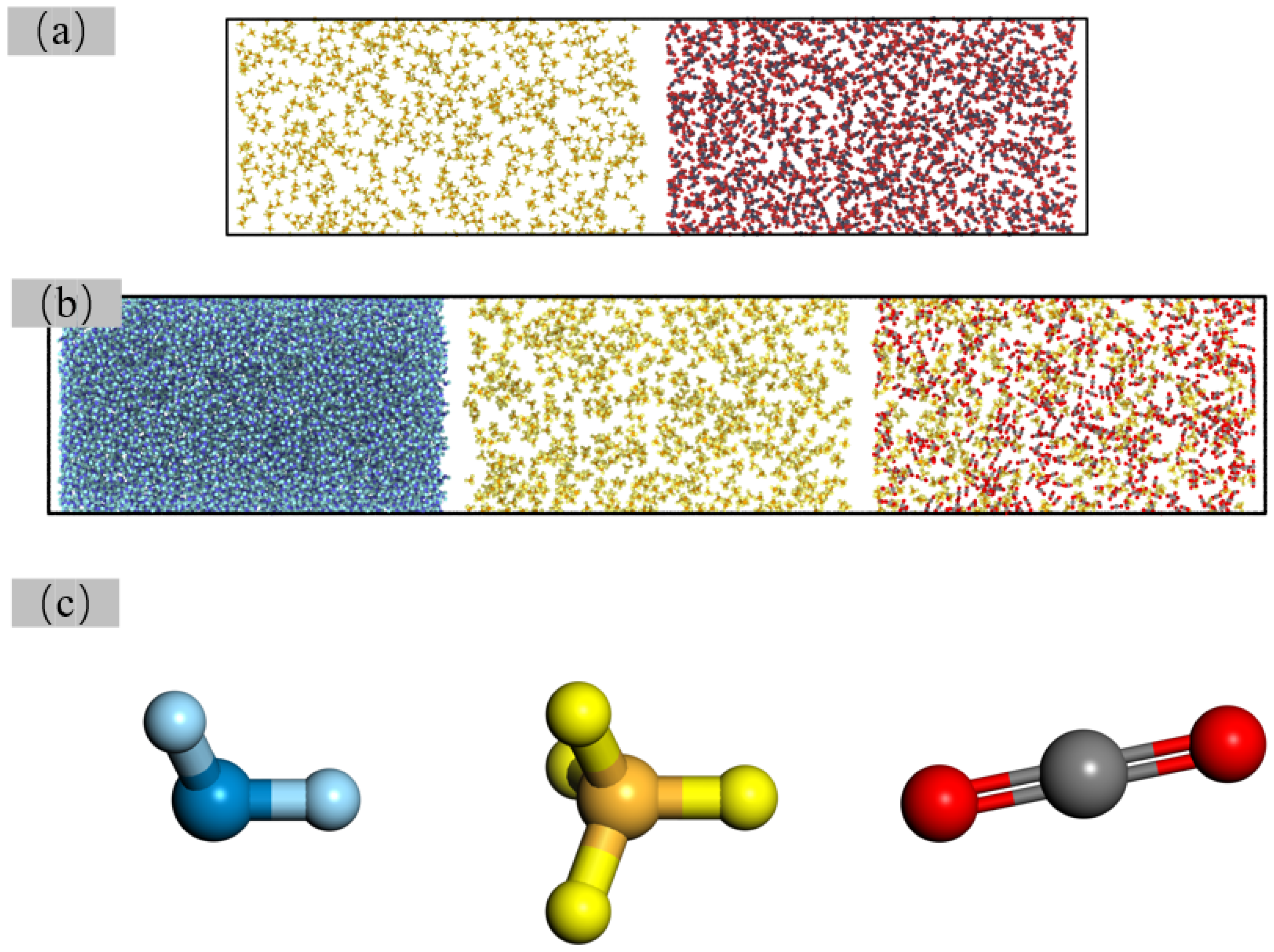
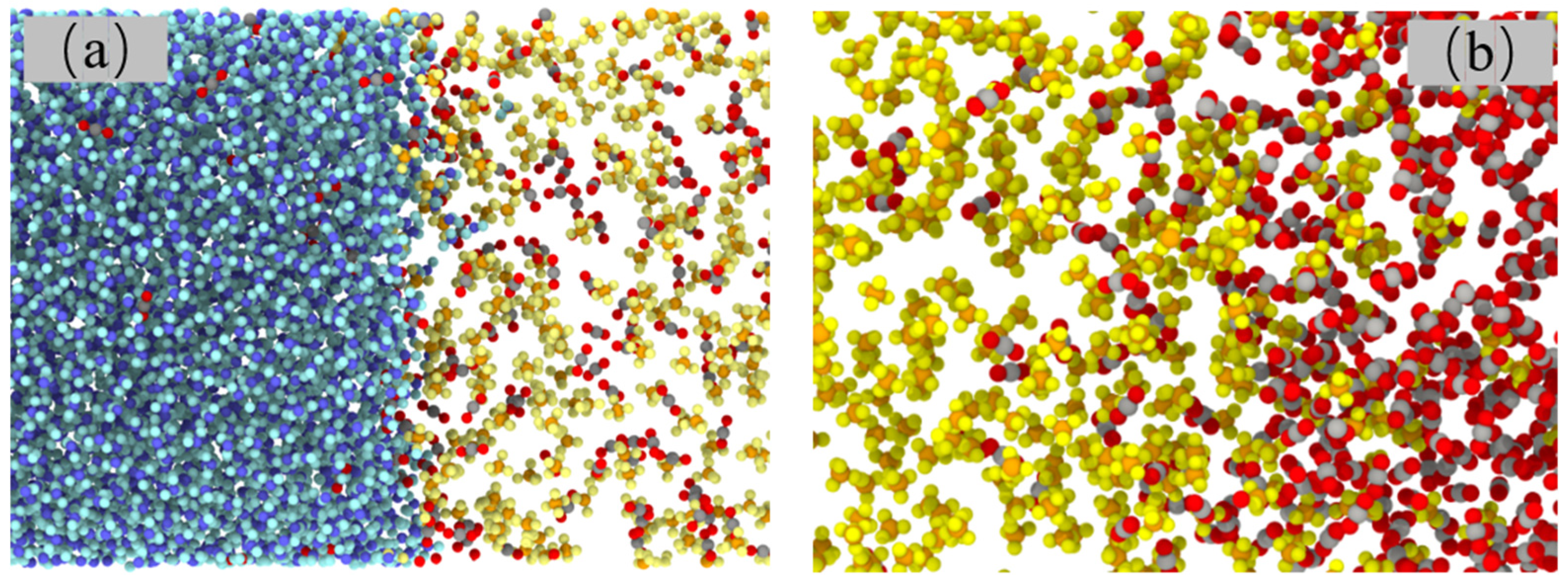
To maintain consistency with the experimental setup, a binary simulation model was first established, as shown in Figure 2a. For the ternary system, a simulation box was constructed with dimensions of 5 × 5 × 10 nm3 for the formation water phase and 5 × 5 × 20 nm3 for the gas phase, as illustrated in Figure 2b. Periodic boundary conditions were applied in all directions. Carbon walls were placed at both ends of the z-axis to confine the system.
Along the z-direction, the injected gas, natural gas, and formation water were arranged sequentially. The molecular structures of H2O, CH4, and CO2 used in the simulations are shown in Figure 2c.

2.3. Simulation Details

MD simulations were employed to investigate the diffusion behavior of CO2 and natural gas under reservoir conditions, with particular emphasis on the effects of temperature, pressure, fluid composition, water content, and gravity on CO2-CH4 diffusion.
A two-stage simulation protocol was adopted. First, the mixed system containing injected gas and natural gas was fully equilibrated to obtain a uniform composition and thermodynamic equilibrium state. Subsequently, a production run was performed based on the equilibrated configuration to calculate diffusion coefficients at specified temperature and pressure conditions. All simulations were carried out using LAMMPS (Large-scale Atomic/Molecular Massively Parallel Simulator, https://www.lammps.org).
In the simulation system, the OPLS-AA force field was used for alkanes [39], the Trappe force field for CO2 [40], and the SPC force field for H2O [41]. The Lennard-Jones parameters and charge parameters are shown in Table 4.
The Lennard–Jones (LJ) interactions were truncated at a cutoff radius of 1.5 nm. Long-range electrostatic interactions were calculated using the particle–particle particle–mesh (PPPM) method. Gravity was introduced by applying a constant acceleration of 9.8 m/s2 to all fluid molecules.
Energy minimization was first performed for 1 × 10⁶ steps to eliminate unfavorable contacts. This was followed by 1 × 10⁶ steps of equilibration under the NVT ensemble to ensure thermodynamic stability. After equilibration, a production run of 2 × 10⁶ steps was conducted for data collection. The simulation time step was set to 1 fs, resulting in a total simulation time of 4 ns. System configurations were recorded every 1000 steps.
To ensure the reliability of the calculated diffusion coefficients, the mean square displacement (MSD) of both CO2 and CH4 was monitored. A clear linear relationship between MSD and time was observed after approximately 1.5 ns, indicating the onset of the diffusive regime. The remaining simulation time (2.5 ns) provided sufficient sampling for stable averaging. Convergence was further confirmed by comparing diffusion coefficients calculated from the final 2 ns with those obtained from the entire trajectory, with deviations less than 5%.

2.4. Model Verification

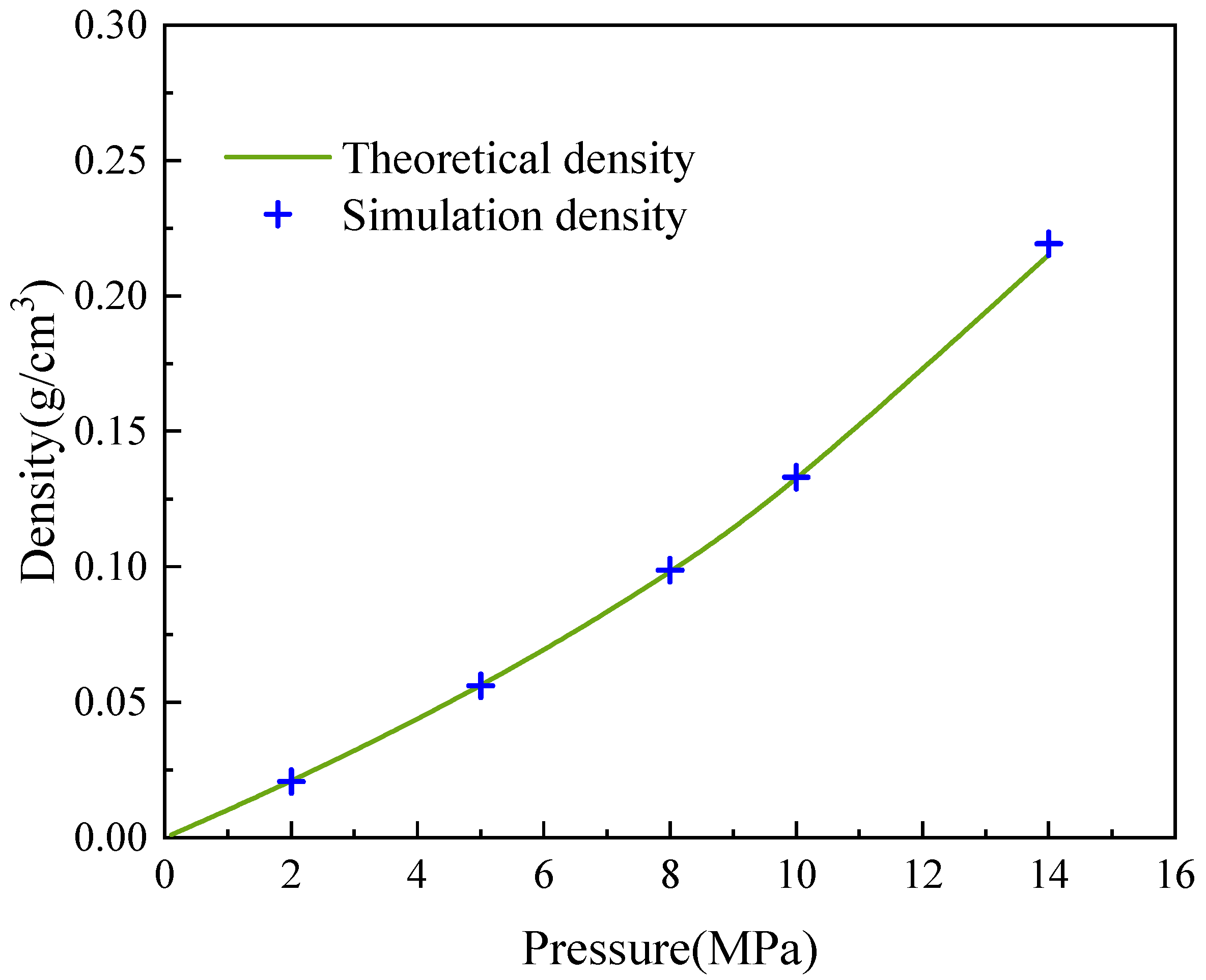
Accurate force field selection is essential for ensuring the reliability of simulation results. Therefore, the simulated fluid densities were compared with reference data from the NIST database, as shown in Figure 3. The excellent agreement between simulated and reference densities confirms that the selected force fields can reliably reproduce the thermophysical properties of the system.
The finite-size effect must be considered when calculating diffusion coefficients using MD simulations [42]. Previous studies have demonstrated that the simulation box size under periodic boundary conditions can significantly influence the calculated diffusion coefficients, particularly due to hydrodynamic interactions, as reported by Simonnin [43]. Therefore, finite-size correction is required.
In this study, all diffusion coefficients were corrected using the Yeh-Hummer (YH) method [44]:
D = D L + k B T γ 6 π η L
where D() is the diffusion coefficient in the infinite box, the ideal real system, L is the simulation box length, η is the shear viscosity, kB is the Boltzmann constant, T is the absolute temperature, and γ is a dimensionless constant.
To evaluate the validity of representing natural gas using pure methane, diffusion coefficients obtained from the pure methane system were compared with those from a real gas system containing components such as N2, C2H6, and C5H12 (Table 5). At 354.15 K and 14 MPa, the self-diffusion coefficient of methane in the simplified system shows good agreement with that in the real gas system, with deviations within 15%.
This result supports the feasibility of using pure methane as a representative component for bulk-phase diffusion studies under the investigated conditions. Therefore, to reduce computational complexity, methane was used to represent hydrocarbon components in subsequent simulations.
However, this simplification may not be universally applicable. At higher pressures or for specific compositions, minor components may significantly influence diffusion behavior by altering fluid viscosity, density, and intermolecular interactions. Therefore, the conclusions of this study are mainly applicable to methane-dominated systems. Future work should consider the effects of additional components for more accurate predictions in complex systems.

3. Result and Discussion

3.1. Experimental Results

The diffusion behavior of the mixed system of injected gas with 90% CO2 content and formation gas at 5, 10, 14 MPa was studied and tested, as shown in Figure 4. The diffusion coefficients of CH4 at 5, 10, and 14 MPa are 2.578 × 10⁻⁷, 1.049 × 10⁻⁷, and 6.402 × 10⁻⁸ m2/s. For CO2, the corresponding diffusion coefficients at 5, 10, and 14 MPa are 1.288 × 10⁻⁷, 7.712 × 10⁻⁸, and 6.258 × 10⁻⁸ m2/s.
To validate the reliability of the experimental results, the measured diffusion coefficients were compared with data reported in the literature. At a temperature of 354.15 K, the diffusion coefficients obtained in this study are generally lower than those reported by Higgoda et al. [45] at 355 K for the CO2-CH4 binary system. For instance, at 10 MPa, our measured DCO2 is 7.712 × 10⁻⁸ m2/s, while Higgoda et al. [45] reported approximately 1.1654 × 10⁻⁷ m2/s from molecular simulations under similar conditions. This deviation may be attributed to the use of real gas mixtures in our experiments versus pure components in simulations, as well as the influence of diffusion cell walls. Additionally, Zhang et al. [46] reported CO2 self-diffusion coefficients of about 1.505 × 10⁻⁷ m2/s at 373 K and 10 MPa, which are higher than our values at 354.15 K, consistent with the expected temperature dependence. Overall, all values remain on the order of 10−8 m2/s, supporting the reasonableness of our experimental measurements.

3.2. Diffusion Coefficient of Binary Fluid

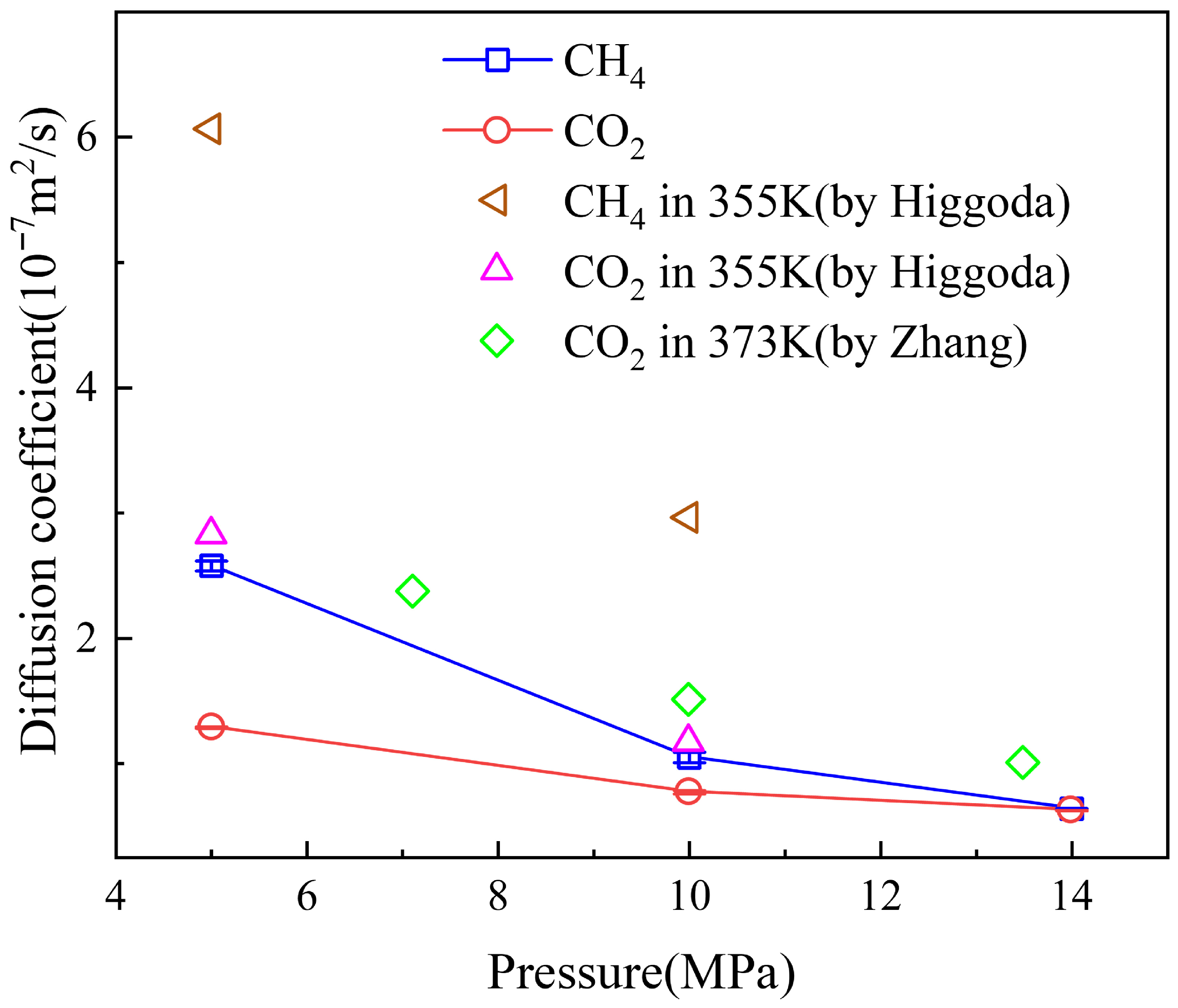
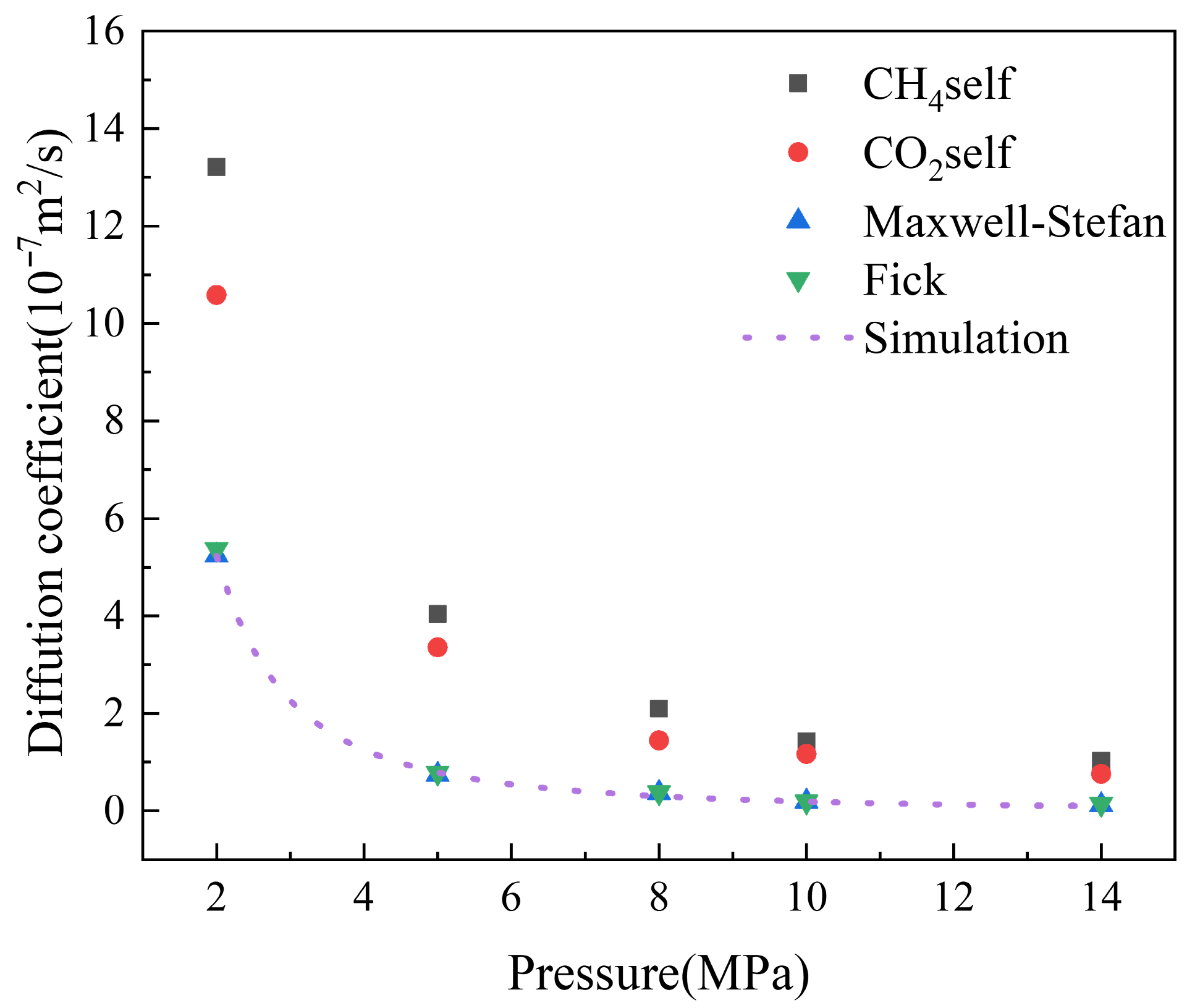
At 354.15 K, the diffusion behavior of the CO2-CH4 system was investigated using molecular dynamics simulations under various pressures and CO2 mole fractions. The calculated diffusion coefficients are presented in Figure 5. Consistent with previous molecular simulation studies, the diffusion coefficient of CH4 is higher than that of CO2 over the entire pressure range considered. For instance, Vella [47] reported that CH4 diffuses faster than CO2 under ideal gas conditions, which is mainly attributed to the stronger intermolecular interactions of CO2. This behavior can be interpreted from a molecular perspective. Although the molecular diameter of CH4 (0.38 nm) is slightly larger than that of CO2 (0.33 nm), CO2 exhibits higher polarizability, resulting in stronger van der Waals and electrostatic interactions with surrounding molecules. Moreover, as a linear and more polarizable molecule, CO2 is more likely to form transient intermolecular associations, which hinder its mobility. In contrast, CH4 is a nonpolar molecule with weaker intermolecular interactions, allowing it to diffuse more readily under the identical conditions.
This bulk-phase result contrasts with the behavior commonly observed in micro-nano systems, where CO2 often diffuses faster than CH4 due to confinement effects, as reported by Liu et al. [18]. Nevertheless, bulk-phase diffusion provides a fundamental basis for understanding confined transport. Given that most reservoir pore sizes are significantly larger than molecular dimensions, molecular diffusion remains the dominant mass-transfer mechanism, underscoring the importance of bulk-phase analysis. In addition, the self-diffusion coefficients are slightly higher than the corresponding Maxwell–Stefan and Fick diffusion coefficients, as self-diffusion reflects the mobility of individual molecules, whereas mutual diffusion is influenced by intermolecular interactions between different species.
Furthermore, as shown in Figure 5, the self-diffusion coefficients of CO2 and CH4 converge with increasing pressure. At 354.15 K, CH4 becomes supercritical above 4.6 MPa, and its diffusion coefficient drops sharply; CO2 enters the supercritical state above 8 MPa, after which the two coefficients approach each other. Near the critical point, long-range density fluctuations dominate diffusion, and as noted by Zhao et al. [26], such fluctuations weaken differences in diffusion behavior between molecular species. As pressure increases further, the intense thermal motion in the supercritical state largely overcomes the electrostatic interactions that distinguish polar CO2 from nonpolar CH4, further promoting convergence of the diffusion coefficients.
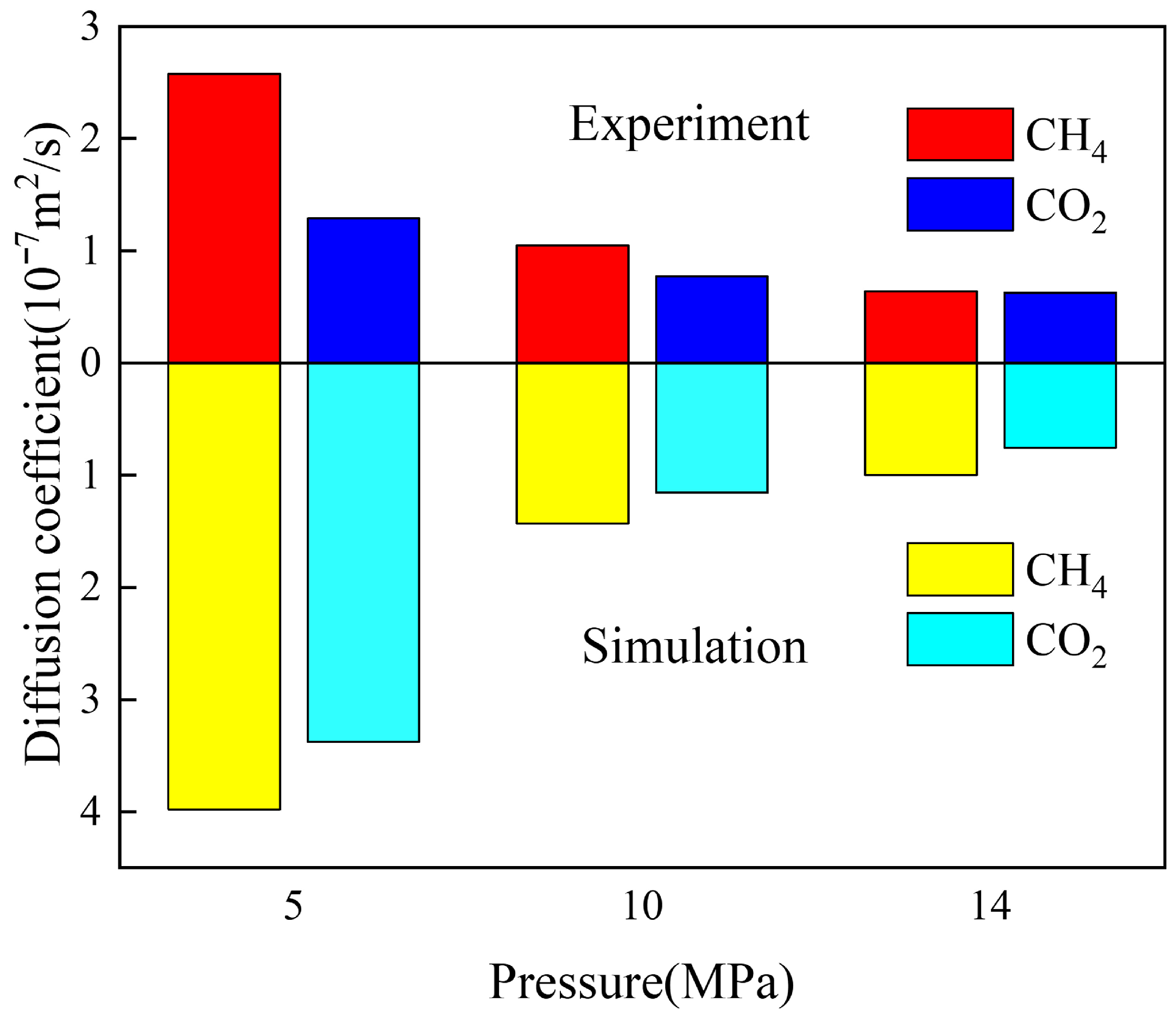
Figure 6 illustrates the results of the experimental and simulated diffusion coefficients. Although the diffusion laws obtained by experiments and simulations are consistent, the diffusion coefficients obtained by simulations are always greater than those obtained by experiments. This discrepancy can primarily be attributed to the use of real gas mixtures in the experiments, while the simulations were based on simplified pure-component systems. In addition, the physical constraints imposed by the diffusion cell walls in the experiments may hinder molecular diffusion. As shown in Table 5, other components or impurities in the real gas may form agglomerates, which hinder the diffusion of molecules, resulting in low experimental measurements.
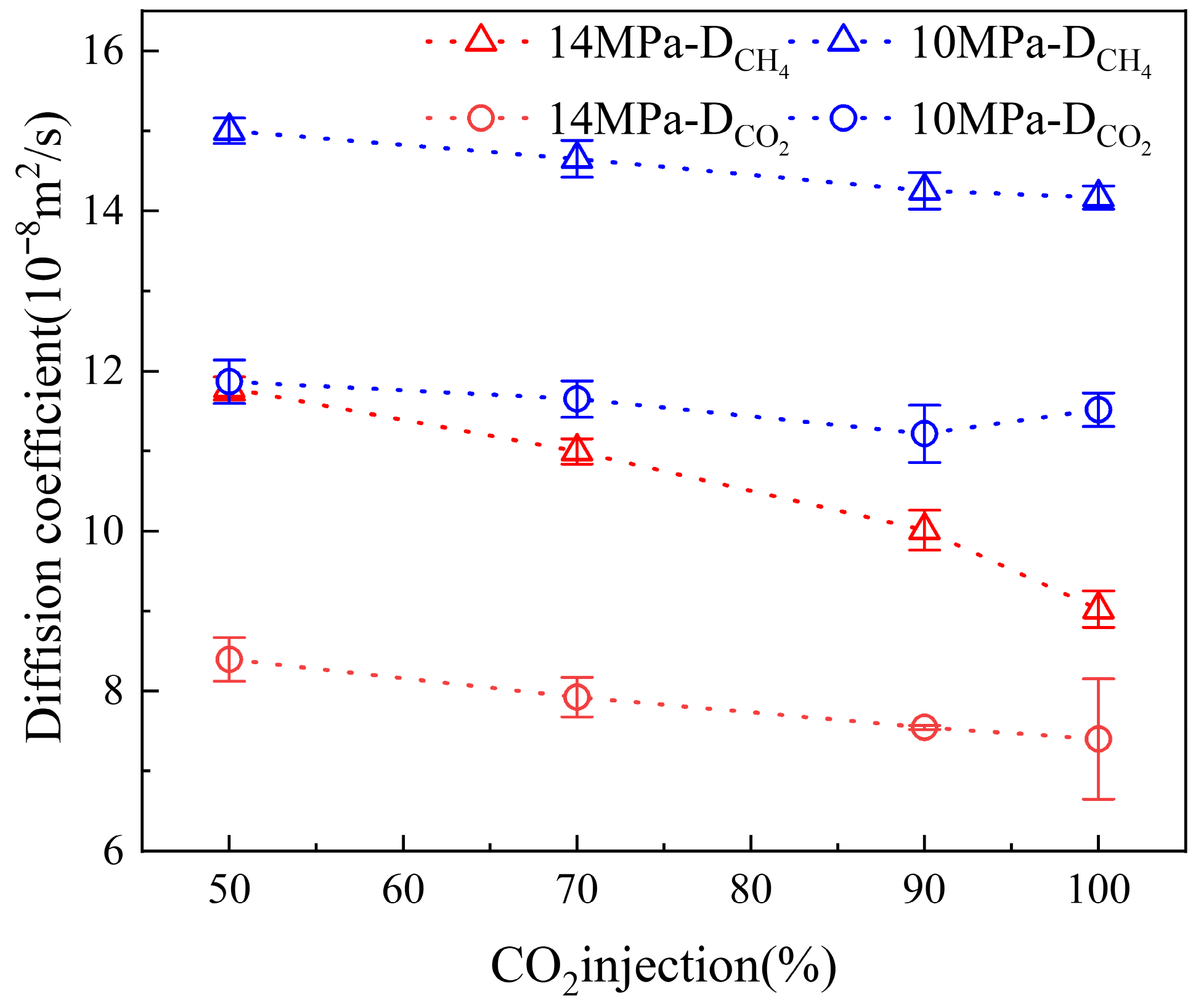
As shown in Figure 7, the diffusion coefficient of the system decreases with the increase of CO2 mole fraction. Hu et al. [21] reported this phenomenon. This behavior is primarily attributed to enhanced intermolecular interactions among polar CO2 molecules in the dense supercritical fluid, which increase resistance to molecular diffusion. Under supercritical conditions, binary mixtures exhibit significant non-ideal behavior. Moreover, the self-diffusion coefficient is no longer only determined by temperature and molecular properties, but is closely related to the mole fraction of the component. Although the concentration gradient is the driving force of macroscopic diffusion, the intermolecular interaction and the resulting molecular migration ability are significantly affected by the composition of the mixture. In contrast, as the pressure decreases, the system behavior is closer to the ideal gas state, and the kinetic factors affecting the diffusion are less dependent on the composition of the mixture. Therefore, in the lower pressure region, the change of the diffusion coefficient by the injected gas composition is relatively small.
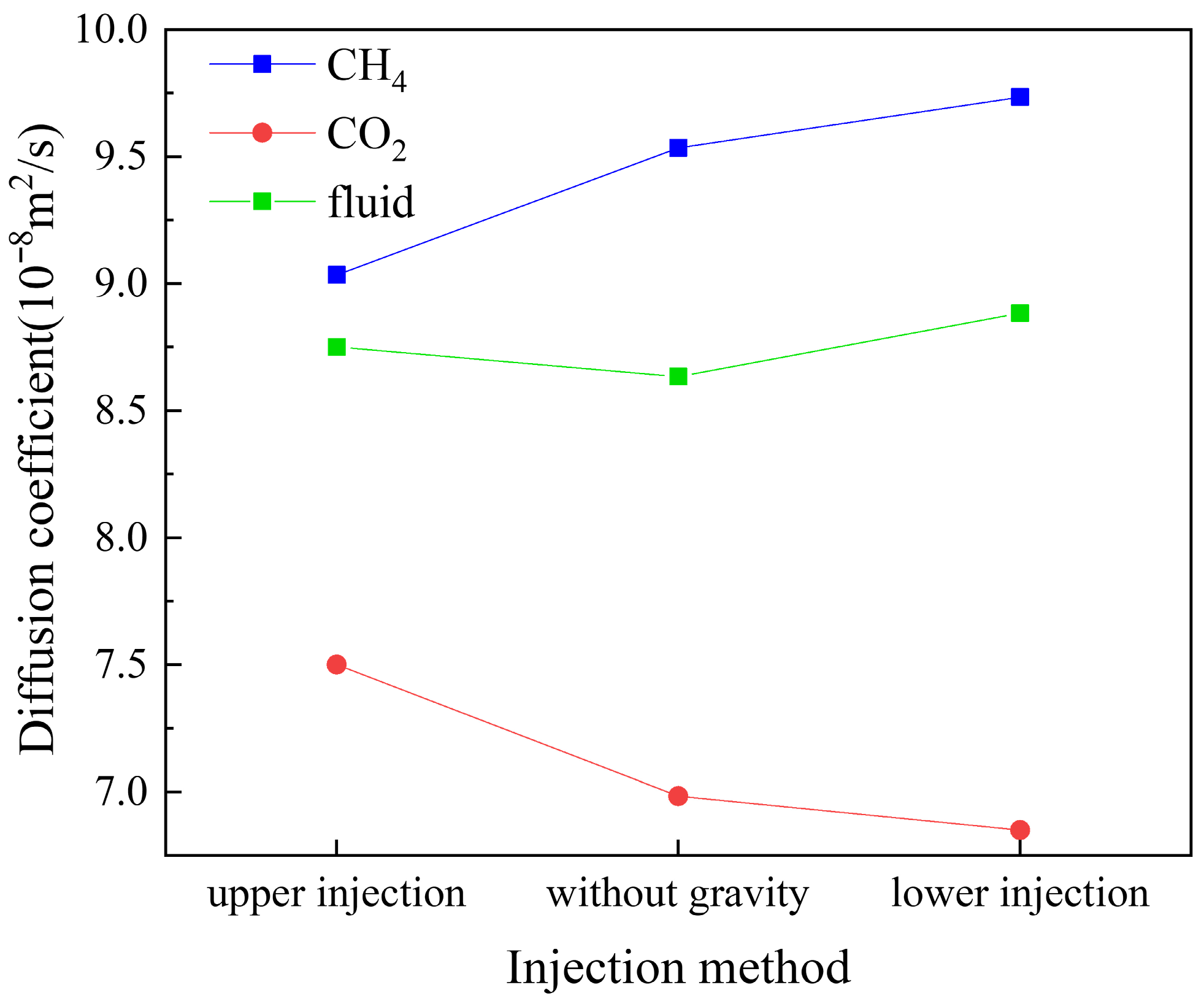
In this study, MD simulation was used to investigate the effects of gravity and different gas injection positions on the diffusion behavior of the system. The calculation results are shown in Figure 8. Under formation conditions, gravity has a weak promoting effect on the migration process of fluid molecules. Although the diffusion coefficient increases slightly, its influence is not enough to change the order of magnitude of diffusion, and has limited influence on the actual macroscopic mixing of injected gas and formation gas. Under the influence of gravity, the effect of gas injection position (upper or lower) on the overall diffusion behavior of the system was further examined. The results indicate that the injection position has a negligible impact on the average diffusion coefficient of the mixture. However, the gas injection position has a significant effect on the diffusion behavior of the component itself: the upper gas injection significantly weakens the diffusion of methane and enhances the diffusion of carbon dioxide, while the lower gas injection is opposite. This arises from two mechanisms: gravity stratification, driven by the molecular mass difference, which causes CH4 to accumulate in the upper region and CO2 in the lower region, and density-driven convection, triggered when heavier CO2 is injected below lighter CH4 (unstable configuration), which promotes vertical mixing and enhances CH4 diffusion.

3.3. Thermodynamic Factor Γ

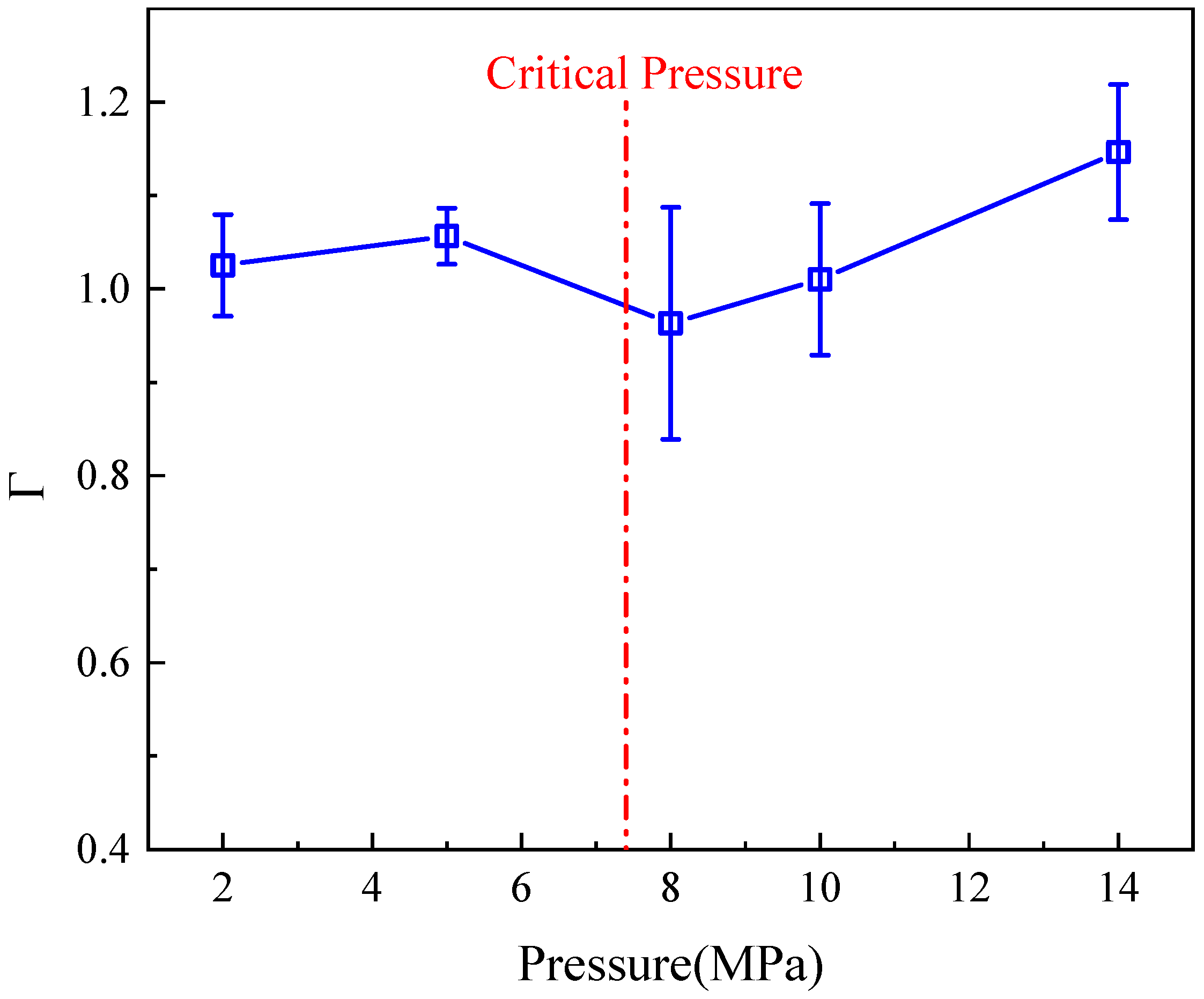
The thermodynamic factor Γ quantifies the non-ideality of a mixture [48], where Γ = 1 indicates ideal behavior, and Γ 1 reflects deviation from ideality. The CO2-CH4 system was simulated by MD, and the thermodynamic factor Γ data after equilibrium are shown in Figure 9. Except for a significant minimum value region, Γ is generally greater than 1, indicating positive deviation from ideality, which becomes more pronounced as pressure increases.
According to its definition, the thermodynamic factor approaches zero near the phase transition point. At this condition, the system exhibits minimal resistance to compositional fluctuations, resulting in a pronounced minimum in the thermodynamic factor, often manifested as a “well” in the profile.
As shown in Figure 9, the thermodynamic factor of the CO2 system reaches a very low value in the pressure range of 8–10 MPa, indicating that the system is close to its critical point (the critical pressure of CO2 is approximately 7.38 MPa). In this near-critical region, although the system exists in a supercritical state above the critical pressure and no macroscopic phase transition occurs, the thermodynamic factor is still strongly influenced by critical fluctuations and decreases significantly.
Furthermore, a Widom line extends into the supercritical region from the critical point. Along this line, the properties of the supercritical fluid undergo a continuous but rapid transition from gas-like to liquid-like behavior. Correspondingly, thermodynamic response functions, including the thermodynamic factor, typically exhibit extrema or peak variations in this region.

3.4. Characterization of CO2-CH4 Interaction

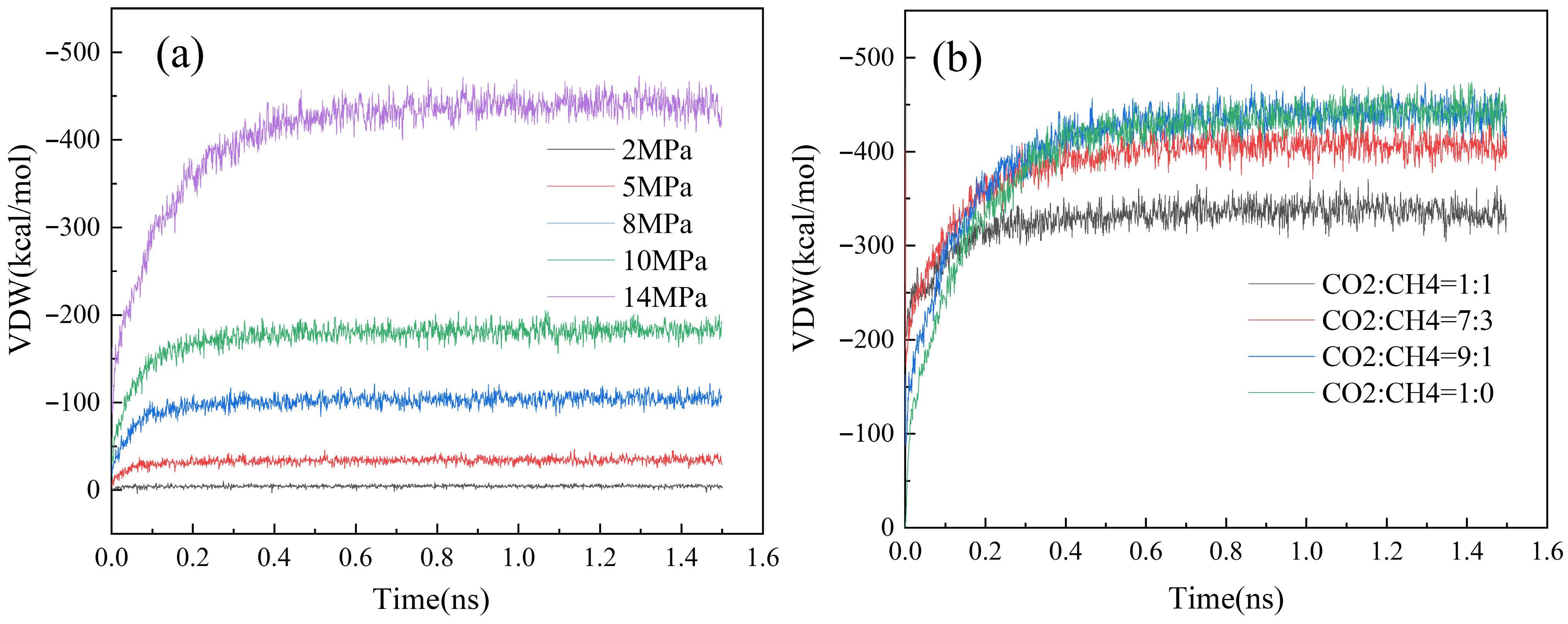
The MD simulation of CO2-CH4 system was carried out, and the van der Waals interaction of the system under different pressures was analyzed. The calculation results are shown in Figure 10a. It can be seen from the figure that the van der Waals interaction energy of the system after equilibrium significantly increases with the rising pressure. This directly reflects that the increased pressure leads to the increase of the density of the system and the decrease of the average distance between molecules, which enhances the attraction between molecular pairs. In the high-pressure supercritical state, the molecules are in a state of high density and frequent contact. This allows a single molecule to interact with more adjacent molecules, and the superposition of all interactions leads to a significant decrease in the total attractive potential of the system. This enhanced van der Waals interaction at high density plays an important role in understanding fluid structure and diffusion behavior.
The van der Waals interaction of the system under different injection gas concentrations was analyzed. The calculation results are shown in Figure 10b. It can be seen from the figure that the van der Waals interaction energy of the system after equilibrium increases with the increase of CO2 component concentration. This is mainly due to the change of system composition: with the increase of CO2 molar fraction, the number of CO2 molecules per unit volume increases relatively, and CO2 molecules have higher polarizability and quadrupole moment than CH4, and their intermolecular and cross-interaction potential energy is lower. At high concentrations, the proportion of interactions involving CO2 molecules increases. These stronger interactions lead to an increase in the overall van der Waals attraction of the system. The van der Waals interaction increases with the concentration, which is expected to affect the diffusion behavior of the components and the phase equilibrium of the system.

3.5. Ternary Fluid Diffusion Coefficient

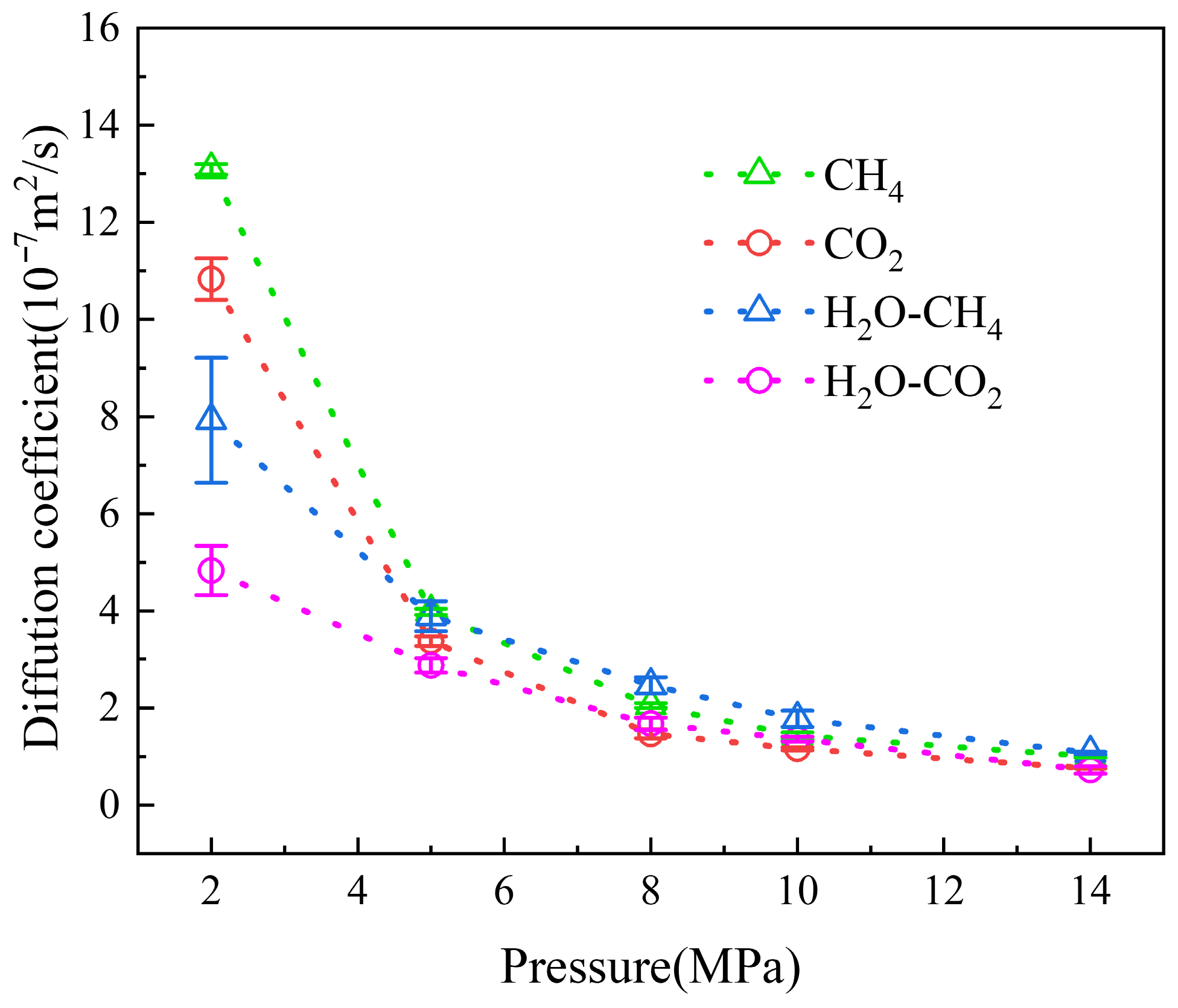
In this study, the effect of water content on the diffusion behavior of CO2-CH4 system was investigated by MD simulation. The calculation results are shown in Figure 11. In the range of temperature and pressure studied, water always exists in the form of liquid dense fluid, which does not reach the supercritical state, so it does not involve the special effect of supercritical water. Under the condition of water, the diffusion coefficients of CH4 and CO2 decreased, which is consistent with the simulation work of Mohammadi et al. [49]. They found that the diffusion coefficient decreased significantly with the increase of water content, which was attributed to the higher solubility and stronger hydrogen bond interaction between CO2 and water.
It is worth noting that the decrease of CO2 diffusion coefficient is more significant than that of CH4. This is mainly due to the higher solubility of CO2 in water and the stronger interaction between CO2 and water molecules, which have a more obvious hindrance to the migration of CO2. In contrast, the diffusion coefficient of methane is less affected due to its low solubility and weak interaction with water. The effect of water on diffusion is obviously pressure dependent: the effect is particularly significant at low pressure, while the effect of water molecules on diffusion coefficient is relatively limited at a high-pressure and supercritical state.

3.6. Molecular Spatial Distribution Characteristics

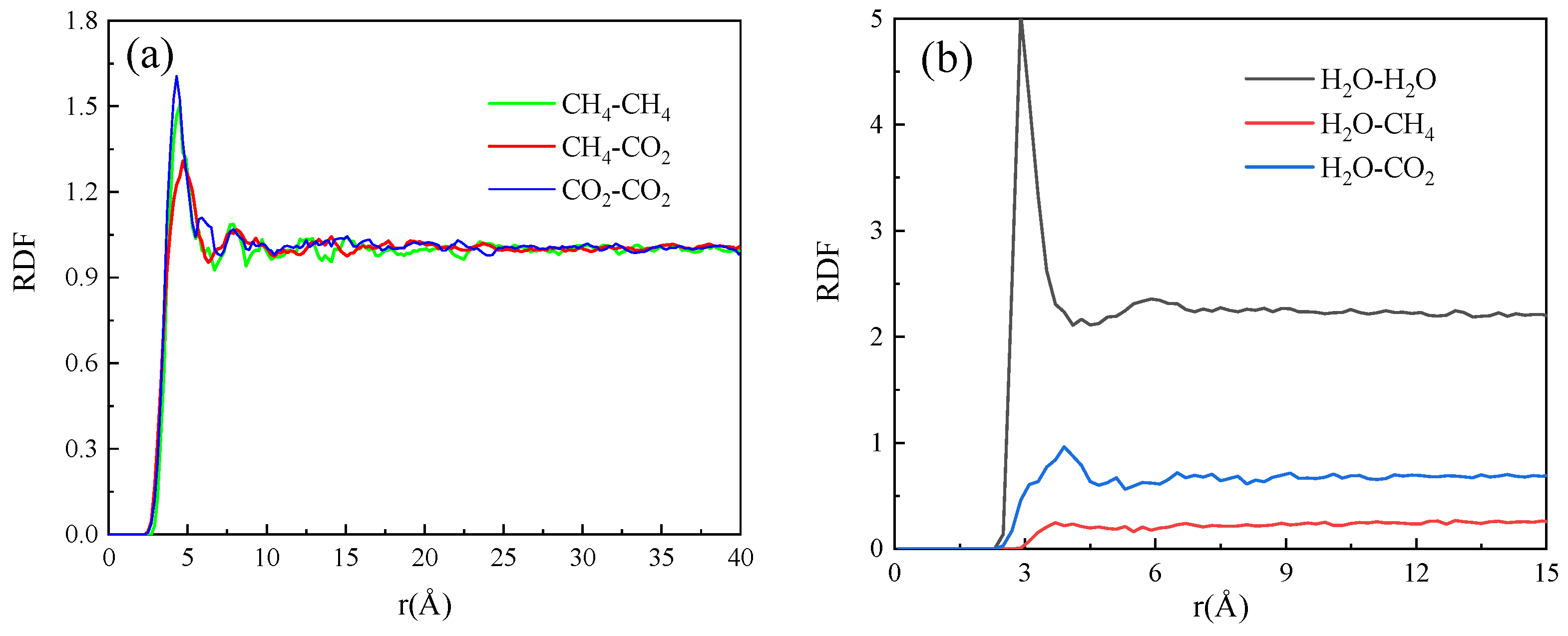
The CO2-CH4 system was simulated by MD, and the radial distribution function (RDF) data of the system after equilibrium were analyzed. As shown in Figure 12, the RDF between gases has a peak at 4.5 Å, indicating that there is a short-range interaction between gas molecules. The RDF of H2O-H2O shows a peak at 2.8 Å, which is a typical hydrogen bond structure of liquid water. The RDF of H2O-CO2 has a peak at 4 Å, but H2O-CH4 does not. This is attributed to the weak electrostatic interaction between the quadrupole moment of CO2 and the dipole moment of water, while the H2O-CH4 is mainly a weak van der Waals force.
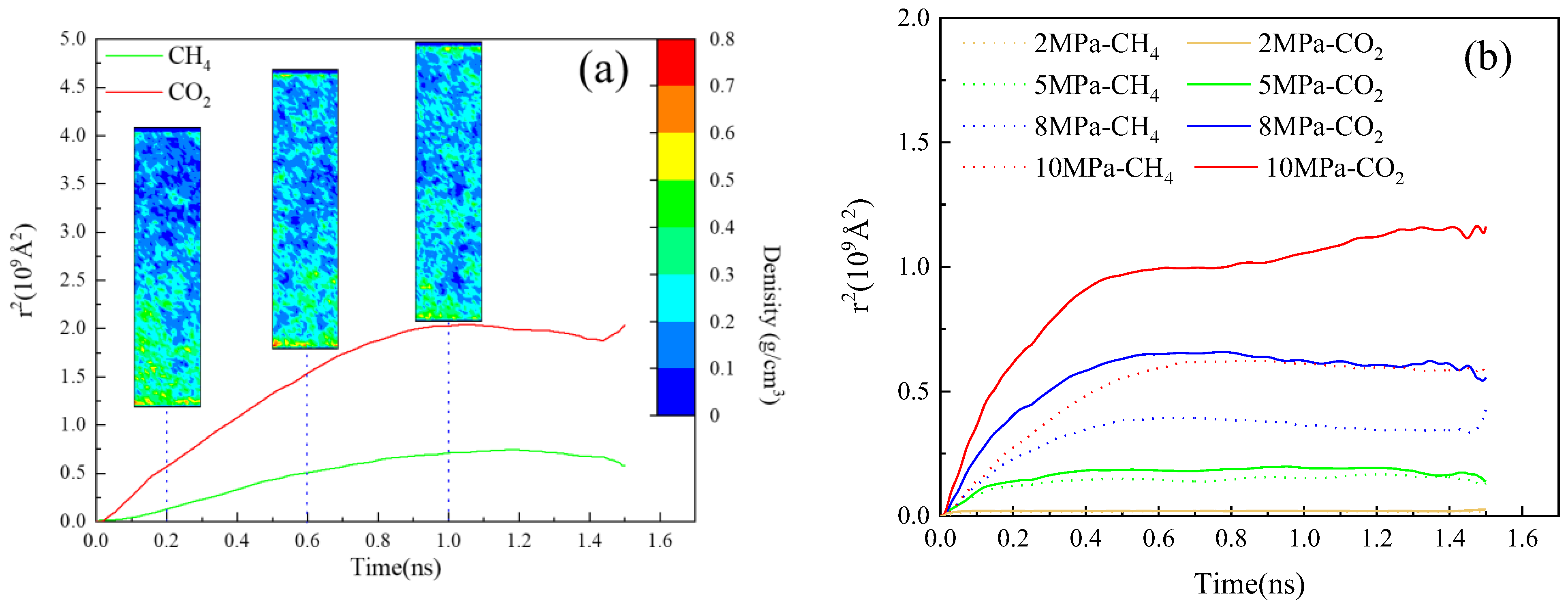
In this study, MD simulation was used to explore the evolution of the system density distribution during the diffusion process, as shown in Figure 13a. Through the statistical analysis of the displacement of different types of molecules in the diffusion process, the overall diffusion dynamics can be characterized. The results show that the macroscopic displacement of each component tends to be stable at about 1 ns, indicating that the system has basically reached the equilibrium conditions required for diffusion analysis.
As shown in Figure 13b, it is observed that the total axial diffusion displacement of CO2 is much larger than that of CH4 under high pressure, although the self-diffusion coefficient of CH4 is higher than that of CO2 in this pressure range. This phenomenon can be explained by the difference in the number density of the two molecules: at high pressure, the molecular number density of CO2 is significantly higher than that of CH4, while below 8 MPa, there is no significant difference in the number density between the two molecules. Therefore, when calculating or measuring the displacement parameters involving the total number of molecules, the higher number of molecules of CO2 compensates for its lower individual mobility, resulting in a total displacement greater than that of CH4.
Fluid interface primarily forms between immiscible fluids with significant differences in properties, which is usually related to different phase states. In this study, although CO2 and CH4 are in a supercritical state, water remains liquid because the critical pressure of water is much higher than the temperature and pressure of the system. This phase difference and the immiscibility between supercritical gas mixtures and liquid water lead to the formation of a stable molecular interface.
This simulation finding is consistent with the field practice of CO2 geological storage: when supercritical CO2 is injected into water-bearing porous rocks, a clear interface will be formed with formation water. Due to the immiscibility of the two-phase fluids and the difference in density, CO2 tends to occupy the upper space of the pores with the continuous phase, while water is distributed in the lower part. The interface is stabilized by capillary force in the pore structure.
Figure 14a illustrates the aggregation of CO2 molecules at the gas-water interface. This indicates that there is a preferential adsorption behavior of gas molecules at the interface, in which CO2 molecules with stronger polarity are more easily adsorbed at the interface than methane. Figure 14b depicts a snapshot of the initial contact between CO2 and CH4, where no distinct interface is formed between the two gases. Although CH4 is in a supercritical state and CO2 is a dense gas, a clear molecular interface cannot be formed between the two components. This is because the transition between gas and supercritical fluid is a continuous physical gradient process rather than a sudden phase transition.
Although this study did not quantitatively analyze the direct effect of dissolution on diffusion and mass transfer, considering the possible reaction between CO2 and water and the long-term effect of dissolution, this could have a further impact on the efficiency of CO2 geological storage. Therefore, in-depth study of the effects of dissolution and related chemical reactions on long-term storage is an important direction that needs attention in the future.

4. Conclusions

This study systematically investigates the diffusion behavior of CO2-CH4-H2O systems under reservoir conditions using combined experimental and molecular simulation approaches.
The results demonstrate that diffusion coefficients follow the order DCH4 > DCO2 > DFick and decrease with increasing pressure. CO2 concentration and water content significantly reduce diffusion due to enhanced intermolecular interactions and interfacial effects. Gravity has a negligible impact on overall diffusion behavior.
Near the critical region, strong non-ideal behavior is observed, characterized by a pronounced minimum in the thermodynamic factor. Water induces interfacial enrichment of CO2, further hindering diffusion.
These findings provide fundamental insights into multicomponent transport mechanisms and offer theoretical support for optimizing CO2 injection strategies in CCUS and EGR applications. Future work should extend this analysis to confined porous systems to better represent realistic reservoir conditions.

Author Contributions

Methodology, Z.W., H.T., K.F., L.X., X.W. and Y.Z.; resources, X.Z.; data curation, X.Z. and H.T.; writing—original draft preparation, X.Z.; writing—review and editing, Z.W., X.Z., K.F., J.Z. and Y.L.; visualization, X.Z.; supervision, Z.W.; funding acquisition, Z.W. All authors have read and agreed to the published version of the manuscript.

Funding

This research was supported by the National Natural Science Foundation of China (Grant Nos. U23B2085, 52074236, and 42402037).

Data Availability Statement

The original contributions presented in this study are included in the article. Further inquiries can be directed to the corresponding author.

Acknowledgments

The authors wish to thank the Southwest Petroleum University for supporting this project.

Conflicts of Interest

Author Jianfei Zhao was employed by the Research Institute of Exploration and Development, PetroChina Xinjiang Oilfield Company. The remaining authors declare that the research was conducted in the absence of any commercial or financial relationships that could be construed as a potential conflict of interest. The company had no role in the design of the study; in the collection, analyses, or interpretation of data; in the writing of the manuscript, or in the decision to publish the results.

Abbreviations

The following abbreviations are used in this manuscript:
CCUSCarbon capture, utilization and storage
EGREnhanced oil and gas recovery
QENSQuasi-Elastic Neutron Scattering
PFG-NMRPulsed Field Gradient Nuclear Magnetic Resonance
HPGCHigh-pressure gas chromatography
MDMolecular Dynamics
GCMCGrand canonical Monte Carlo

References

  1. Liu, E.; Lu, X.; Wang, D. A Systematic Review of Carbon Capture, Utilization and Storage: Status, Progress and Challenges. Energies 2023, 16, 2865. [Google Scholar] [CrossRef]
  2. Vitillo, J.G.; Eisaman, M.D.; Aradóttir, E.S.P.; Passarini, F.; Wang, T.; Sheehan, S.W. The role of carbon capture, utilization, and storage for economic pathways that limit global warming to below 1.5°C. iScience 2022, 25, 104237. [Google Scholar] [CrossRef] [PubMed]
  3. Liang, B.; Chen, C.; Jia, C.; Wang, C.; Wang, X.; Zha, Y.; Meng, Z.; Wang, H. Carbon capture, utilization and storage (CCUS) in oil and gas reservoirs in China: Status, opportunities and challenges. Fuel 2024, 375, 132353. [Google Scholar] [CrossRef]
  4. Liu, Z.; Gao, M.; Zhang, X.; Liang, Y.; Guo, Y.; Liu, W.; Bao, J. CCUS and CO2 injection field application in abroad and China: Status and progress. Geoenergy Sci. Eng. 2023, 229, 212011. [Google Scholar] [CrossRef]
  5. Rui, Z.; Liu, T.; Wen, X.; Meng, S.; Li, Y.; Dindoruk, B. Investigating the Synergistic Impact of CCUS-EOR. Engineering 2025, 48, 16–40. [Google Scholar] [CrossRef]
  6. Al Ghafri, S.Z.S.; Forte, E.; Maitland, G.C.; Rodriguez-Henríquez, J.J.; Martin Trusler, J.P. Experimental and Modeling Study of the Phase Behavior of (Methane + CO2 + Water) Mixtures. J. Phys. Chem. B 2014, 118, 14461–14478. [Google Scholar] [CrossRef]
  7. Legoix, L.; Ruffine, L.; Donval, J.P.; Haeckel, M. Phase Equilibria of the CH4-CO2 Binary and the CH4-CO2-H2O Ternary Mixtures in the Presence of a CO2-Rich Liquid Phase. Energies 2017, 10, 2034. [Google Scholar] [CrossRef]
  8. Kastanidis, P.; Michalis, V.K.; Romanos, G.E.; Stubos, A.K.; Economou, I.G.; Tsimpanogiannis, I.N. Solubility of Methane and Carbon Dioxide in the Aqueous Phase of the Ternary (Methane + Carbon Dioxide + Water) Mixture: Experimental Measurements and Molecular Dynamics Simulations. J. Chem. Eng. Data 2018, 63, 1027–1035. [Google Scholar] [CrossRef]
  9. Liu, Y.; Larson, T.E.; Nicot, J.P. Theoretical and Experimental Study of Controls on CO2 Dissolution and CH4 Outgassing Rates. Energy Procedia 2014, 63, 4773–4781. [Google Scholar] [CrossRef][Green Version]
  10. Loring, J.S.; Bacon, D.H.; Springer, R.D.; Anderko, A.; Gopinath, S.; Yonkofski, C.M.; Thompson, C.J.; McGrail, B.P.; Rosso, K.M.; Schaef, H.T. Water Solubility at Saturation for CO2–CH4 Mixtures at 323.2 K and 9.000 MPa. J. Chem. Eng. Data 2017, 62, 1608–1614. [Google Scholar] [CrossRef]
  11. Wang, W.; Xie, Q.; An, S.; Bakhshian, S.; Kang, Q.; Wang, H.; Xu, X.; Su, Y.; Cai, J.; Yuan, B. Pore-scale simulation of multiphase flow and reactive transport processes involved in geologic carbon sequestration. Earth-Sci. Rev. 2023, 247, 104602. [Google Scholar] [CrossRef]
  12. Li, H.; Yang, D. Determination of Individual Diffusion Coefficients of Solvent/CO2 Mixture in Heavy Oil with Pressure-Decay Method. SPE J. 2016, 21, 131–143. [Google Scholar] [CrossRef]
  13. Wang, Z.; Hou, J. Measurement of CO2 diffusion coefficients in both bulk liquids and carven filling porous media of fractured-vuggy carbonate reservoirs at 50 MPa and 393 K. RSC Adv. 2021, 11, 19712–19722. [Google Scholar] [CrossRef]
  14. Liu, F.; Gao, X.; Du, J.; Lin, L.; Hou, D.; Luo, J.; Zhao, J. Microscopic mechanism of enhancing shale oil recovery through CO2 flooding- insights from molecular dynamics simulations. J. Mol. Liq. 2024, 410, 125593. [Google Scholar] [CrossRef]
  15. Kruteva, M. Dynamics studied by Quasielastic Neutron Scattering (QENS). Adsorption 2021, 27, 875–889. [Google Scholar] [CrossRef]
  16. Chmelik, C.; Kärger, J. In situ study on molecular diffusion phenomena in nanoporous catalytic solids. Chem. Soc. Rev. 2010, 39, 4864. [Google Scholar] [CrossRef] [PubMed]
  17. Schneider, D.; Mehlhorn, D.; Zeigermann, P.; Kärger, J.; Valiullin, R. Transport properties of hierarchical micro–mesoporous materials. Chem. Soc. Rev. 2016, 45, 3439–3467. [Google Scholar] [CrossRef] [PubMed]
  18. Liu, J.; Li, S.; Wang, Y. Molecular Dynamics Simulation of Diffusion Behavior of CH4, CO2, and N2 in Mid-Rank Coal Vitrinite. Energies 2019, 12, 3744. [Google Scholar] [CrossRef]
  19. Long, H.; Lin, H.; Yan, M.; Bai, Y.; Tong, X.; Kong, X.; Li, S. Adsorption and diffusion characteristics of CH4, CO2, and N2 in micropores and mesopores of bituminous coal: Molecular dynamics. Fuel 2021, 292, 120268. [Google Scholar] [CrossRef]
  20. Gao, D.; Hong, L.; Wang, J.; Zheng, D. Molecular simulation of gas adsorption characteristics and diffusion in micropores of lignite. Fuel 2020, 269, 117443. [Google Scholar] [CrossRef]
  21. Hu, H.; Du, L.; Xing, Y.; Li, X. Detailed study on self- and multicomponent diffusion of CO2-CH4 gas mixture in coal by molecular simulation. Fuel 2017, 187, 220–228. [Google Scholar] [CrossRef]
  22. Vasileiadis, M.; Peristeras, L.D.; Papavasileiou, K.D.; Economou, I.G. Transport Properties of Shale Gas in Relation to Kerogen Porosity. J. Phys. Chem. C 2018, 122, 6166–6177. [Google Scholar] [CrossRef]
  23. Yuan, S.; Gang, H.Z.; Liu, Y.F.; Zhou, L.; Irfan, M.; Yang, S.Z.; Mu, B.Z. Adsorption and Diffusion Behaviors of CO2 and CH4 Mixtures in Different Types of Kerogens and Their Roles in Enhanced Energy Recovery. Sustainability 2022, 14, 14949. [Google Scholar] [CrossRef]
  24. Bonnaud, P.A.; Oulebsir, F.; Galliero, G.; Vermorel, R. Modeling competitive adsorption and diffusion of CH4/CO2 mixtures confined in mature type-II kerogen: Insights from molecular dynamics simulations. Fuel 2023, 352, 129020. [Google Scholar] [CrossRef]
  25. Mohammed, S.; Sunkara, A.K.; Walike, C.E.; Gadikota, G. The Role of Surface Hydrophobicity on the Structure and Dynamics of CO2 and CH4 Confined in Silica Nanopores. Front. Clim. 2021, 3, 713708. [Google Scholar] [CrossRef]
  26. Zhao, X.; Jin, H. Correlation for self-diffusion coefficients of H2, CH4, CO, O2 and CO2 in supercritical water from molecular dynamics simulation. Appl. Therm. Eng. 2020, 171, 114941. [Google Scholar] [CrossRef]
  27. Bai, Y.; Lin, H.F.; Li, S.G.; Yan, M.; Long, H. Molecular simulation of N2 and CO2 injection into a coal model containing adsorbed methane at different temperatures. Energy 2021, 219, 119686. [Google Scholar] [CrossRef]
  28. Yang, W.; Wang, L.; Yang, K.; Fu, S.; Tian, C.; Pan, R. Molecular insights on influence of CO2 on CH4 adsorption and diffusion behaviour in coal under ultrasonic excitation. Fuel 2024, 355, 129519. [Google Scholar] [CrossRef]
  29. Zhang, Q.; Zhu, H.; Kang, R. Influence of uniaxial strain loading on the adsorption-diffusion properties of binary components of CH4/CO2 in micropores of bituminous coal by macromolecular simulation. Powder Technol. 2023, 427, 118715. [Google Scholar] [CrossRef]
  30. Gamal Rezk, M.; Foroozesh, J. Uncertainty effect of CO2 molecular diffusion on oil recovery and gas storage in underground formations. Fuel 2022, 324, 124770. [Google Scholar] [CrossRef]
  31. Hemmat Esfe, M.; Esfandeh, S.; Hosseinizadeh, E. Nanofluid flooding in a randomized heterogeneous porous media and investigating the effect of capillary pressure and diffusion on oil recovery factor. J. Mol. Liq. 2020, 320, 113646. [Google Scholar] [CrossRef]
  32. Wang, S.; Zhang, M.; Zhang, Y.; Lei, Z.; Feng, Q.; Xu, S.; Zhang, J. Mechanisms of CO2 huff and puff enhanced oil recovery and storage within shale nanopores. Chem. Eng. J. 2025, 506, 160098. [Google Scholar] [CrossRef]
  33. Yang, M.; Huang, S.; Zhao, F.; Yang, C. A novel hybrid finite-infinite diffusion model for determining CO2 diffusion coefficient in oil-saturated porous media: Applications for enhanced oil recovery and geological carbon storage. Energy 2025, 316, 134621. [Google Scholar] [CrossRef]
  34. Hong, L.; Lin, J.; Gao, D.; Zheng, D.; Wang, W. Molecular simulation of the effect of water content on CO2, CH4, and N2 adsorption characteristics of coal. Sci. Rep. 2024, 14, 18190. [Google Scholar] [CrossRef]
  35. Sui, H.; Zhang, F.; Wang, Z.; Wang, D.; Wang, Y. Effect of Kerogen Maturity, Water Content for Carbon Dioxide, Methane, and Their Mixture Adsorption and Diffusion in Kerogen: A Computational Investigation. Langmuir 2020, 36, 9756–9769. [Google Scholar] [CrossRef]
  36. Zhou, J.; Jin, Z.; Luo, K.H. Effects of Moisture Contents on Shale Gas Recovery and CO2 Sequestration. Langmuir 2019, 35, 8716–8725. [Google Scholar] [CrossRef]
  37. Seyyedi, M.; Mahmud, H.K.B.; Verrall, M.; Giwelli, A.; Esteban, L.; Ghasemiziarani, M.; Clennell, B. Pore Structure Changes Occur During CO2 Injection into Carbonate Reservoirs. Sci. Rep. 2020, 10, 3624. [Google Scholar] [CrossRef]
  38. Zhu, S.; Yu, H.; Yan, G.; Li, J.; Cao, A.; Sun, C. Miscibility Process of Hydrocarbon Mixture Gas and Crude Oil: Insights from Molecular Dynamics. Ind. Eng. Chem. Res. 2021, 60, 13710–13718. [Google Scholar] [CrossRef]
  39. Jorgensen, W.L.; Maxwell, D.S.; Tirado-Rives, J. Development and Testing of the OPLS All-Atom Force Field on Conformational Energetics and Properties of Organic Liquids. J. Am. Chem. Soc. 1996, 118, 11225–11236. [Google Scholar] [CrossRef]
  40. Higgoda, U.A.; Kankanamge, C.J.; Hellmann, R.; Koller, T.M.; Fröba, A.P. Fick diffusion coefficients of binary fluid mixtures consisting of methane, carbon dioxide, and propane via molecular dynamics simulations based on simplified pair-specific ab initio-derived force fields. Fluid Phase Equilibria 2019, 502, 112257. [Google Scholar] [CrossRef]
  41. Orsi, M. Comparative assessment of the ELBA coarse-grained model for water. Mol. Phys. 2014, 112, 1566–1576. [Google Scholar] [CrossRef]
  42. Celebi, A.T.; Jamali, S.H.; Bardow, A.; Vlugt, T.J.H.; Moultos, O.A. Finite-size effects of diffusion coefficients computed from molecular dynamics: A review of what we have learned so far. Mol. Simul. 2021, 47, 831–845. [Google Scholar] [CrossRef]
  43. Simonnin, P.; Noetinger, B.; Nieto-Draghi, C.; Marry, V.; Rotenberg, B. Diffusion under Confinement: Hydrodynamic Finite-Size Effects in Simulation. J. Chem. Theory Comput. 2017, 13, 2881–2889. [Google Scholar] [CrossRef]
  44. Yeh, I.C.; Hummer, G. System-Size Dependence of Diffusion Coefficients and Viscosities from Molecular Dynamics Simulations with Periodic Boundary Conditions. J. Phys. Chem. B 2004, 108, 15873–15879. [Google Scholar] [CrossRef]
  45. Higgoda, U.A.; Hellmann, R.; Koller, T.M.; Fröba, A.P. Self-diffusion coefficient and viscosity of methane and carbon dioxide via molecular dynamics simulations based on new ab initio-derived force fields. Fluid Phase Equilibria 2019, 481, 15–27. [Google Scholar] [CrossRef]
  46. Zhang, T.; Zhang, B.; Zhang, J.; Jin, H. Numerical Study of Self-Diffusion Coefficients for H2, O2, CO, and CH4 in Transcritical CO2 with Molecular Dynamics Simulation. Ind. Eng. Chem. Res. 2025, 64, 7587–7597. [Google Scholar] [CrossRef]
  47. Vella, J.R. Fick Diffusion Coefficients of the Gaseous CH4–CO2 System from Molecular Dynamics Simulations Using TraPPE Force Fields at 101.325, 506.625, 1013.25, 2533.12, and 5066.25 kPa. J. Chem. Eng. Data 2019, 64, 3672–3681. [Google Scholar] [CrossRef]
  48. Guevara-Carrion, G.; Ancherbak, S.; Mialdun, A.; Vrabec, J.; Shevtsova, V. Diffusion of methane in supercritical carbon dioxide across the Widom line. Sci. Rep. 2019, 9, 8466. [Google Scholar] [CrossRef]
  49. Mohammadi, A.; Mccague, C.; Alvar, E.N.; Kim, P.; Bahrami, M. Measuring Gas Diffusivity of Partially Water-Saturated Gas Diffusion Layers. J. Electrochem. Soc. 2025, 172, 124517. [Google Scholar] [CrossRef]
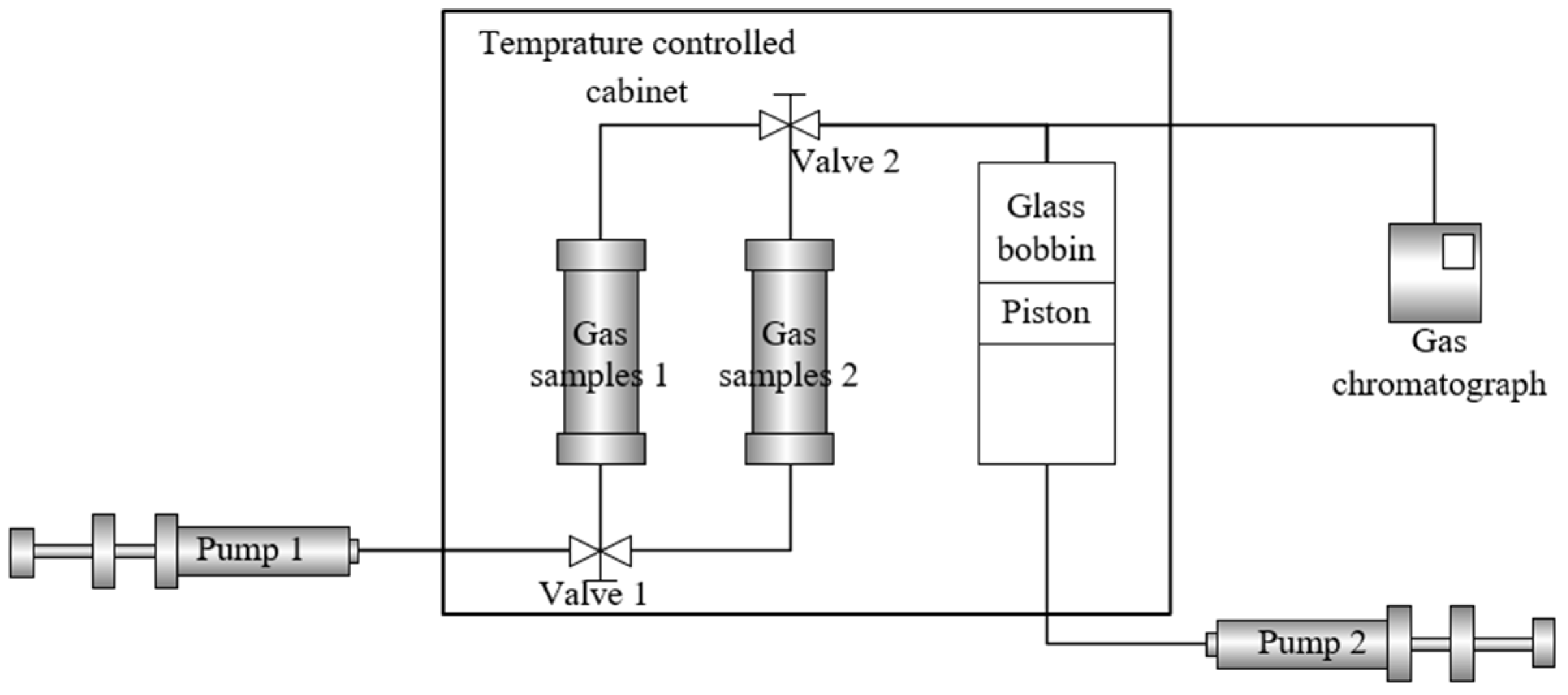
Figure 1. Diagram of experimental device.
Processes 14 01177 g001
Figure 2. (a) Initial configuration of binary diffusion model; (b) initial configuration of ternary diffusion model; (c) molecular model H2O, CH4, CO2 (blue: H2O; yellow: CH4; red-gray: CO2).
Processes 14 01177 g002
Figure 3. Comparison of theoretical density and simulated densities of mixed fluid.
Processes 14 01177 g003
Figure 4. Experimental diffusion coefficients under different pressures.
Processes 14 01177 g004
Figure 5. Calculated diffusion coefficients under different pressures.
Processes 14 01177 g005
Figure 6. Comparison of experimental and simulated diffusion coefficients.
Processes 14 01177 g006
Figure 7. Self-diffusion coefficient under different injection gas concentration conditions.
Processes 14 01177 g007
Figure 8. Effect of gas injection mode on diffusion coefficient.
Processes 14 01177 g008
Figure 9. Variation of thermodynamic factors with pressure. (The red dotted line represents the critical pressure of carbon dioxide).
Processes 14 01177 g009
Figure 10. Van der Waals interaction energy: (a) under different pressures; (b) under different injection gas ratios.
Processes 14 01177 g010
Figure 11. Effect of water content on diffusion coefficient.
Processes 14 01177 g011
Figure 12. Intermolecular radial distribution functions: (a) Gas-gas radial distribution; (b) Water-gas radial distribution.
Processes 14 01177 g012
Figure 13. Variation of axial displacement with time: (a) 14 MPa; (b) 2, 5, 8, 10 MPa.
Processes 14 01177 g013
Figure 14. Molecular interfaces: (a) Gas-water interface; (b) Contact of two gases.
Processes 14 01177 g014
Table 1. Specifications and uncertainties of key experimental equipment.
EquipmentParameterSpecification/ValueUncertainty
PVT cellinner diameter3.15 cm±0.01 cm
Depth23 cm±0.05 cm
Maximum pressure70 MPa
Maximum temperature473 K
pumpPressure range0–70 MPa±0.02 MPa
Temperature-controlledTemperature range273–473 K±0.1 K
Gas chromatographDetectorTCD
Carrier gasHelium
Gas mixing systemCO2 mole fraction0.9±0.5%
Table 2. Natural gas component content.
ComponentContent (%)ComponentContent (%)
N225.04C2-NC43.44
CO25.05IC5-C60.81
CH465.67C7+0
Table 3. Fluid density in 90% CO2 injection gas simulation system.
Pressure (MPa)Natural Gas (g/cm3)Injected Gas (g/cm3)Stratum Water (g/cm3)
20.01110.02960.8633
50.02830.08180.8645
80.04610.14780.8656
100.05810.20330.8664
140.08230.34800.8680
Table 4. Non-bonded interaction parameters.
MoleculeTypeMolar MassElectric Charge (e)σ (nm)ε (KJ/mol)
CH4H1.007970.0600.2500.012552
C12.0107−0.2400.3500.276144
CO2C12.01070.7000.2800.224475
O15.9994−0.3500.3050.656799
H2OH1.007970.4100
O15.9994−0.820.31660.649984
Table 5. Diffusion coefficients of methane system and real system.
System TypesSelf-Diffusion Coefficient (m2/s)
CH4CO2
Methane system1.0267 × 10−77.5500 × 10⁻⁸
Real system8.6333 × 10−86.4833 × 10⁻⁸
Disclaimer/Publisher’s Note: The statements, opinions and data contained in all publications are solely those of the individual author(s) and contributor(s) and not of MDPI and/or the editor(s). MDPI and/or the editor(s) disclaim responsibility for any injury to people or property resulting from any ideas, methods, instructions or products referred to in the content.