Review

Catalytic CO2 Fixation via Glycerol Carbonate Synthesis: Review of Silica Hybrids and Ionic Liquid Advancements

by
Adriele Sabrina Todero
,
Paloma Truccolo Reato
,
Fabiana de Oliveira Pereira
,
Rogélly Baldin
,
Alexander Junges
,
Rogério Marcos Dallago
and
Marcelo Luis Mignoni
*
Department of Engineering, Universidade Regional Integrada do Alto Uruguai e das Missões, Central Campus, Erechim 99709-910, RS, Brazil
*
Author to whom correspondence should be addressed.
Processes 2026, 14(7), 1151; https://doi.org/10.3390/pr14071151
Submission received: 4 March 2026 / Revised: 26 March 2026 / Accepted: 31 March 2026 / Published: 3 April 2026
(This article belongs to the Special Issue CCUS for Carbon Neutrality: Innovations and Applications)

Abstract

This review explores the catalytic conversion of carbon dioxide (CO2) into glycerol carbonate (GC), positioning this pathway as a sustainable strategy that couples environmental mitigation with the valorization of surplus glycerol from biodiesel production. Glycerol carbonate maintains extensive industrial utility as a green solvent, chemical intermediate, and functional component in polymers, cosmetics, and packaging. Distinct from prior literature, this study specifically evaluates the use of amorphous silica from rice husk ash (RHA) as a sustainable, low-cost support, analyzing the synergistic effect between Nb2O5, NiO, and ionic liquids in hybrid catalyst architectures. The review evaluates diverse catalytic frameworks, with a primary focus on heterogeneous systems. Silica-based materials are highlighted, particularly those synthesized from rice husk ash, which is an abundant amorphous silica source. The sol–gel method is identified as a robust route for engineering porous matrices with high surface areas and tunable structural properties. Furthermore, the doping of silica with metal oxides, such as niobium oxide (Nb2O5) and nickel oxide (NiO), is discussed as a strategic approach to introduce synergistic acid–base sites and redox properties that facilitate CO2 activation. The integration of ionic liquids into hybrid systems is also examined as a promising frontier to enhance reaction kinetics and selectivity. Finally, this review delineates the nexus between agro-industrial waste management and the reduction in greenhouse gas emissions, proposing a circular economy framework for the biodiesel value chain.

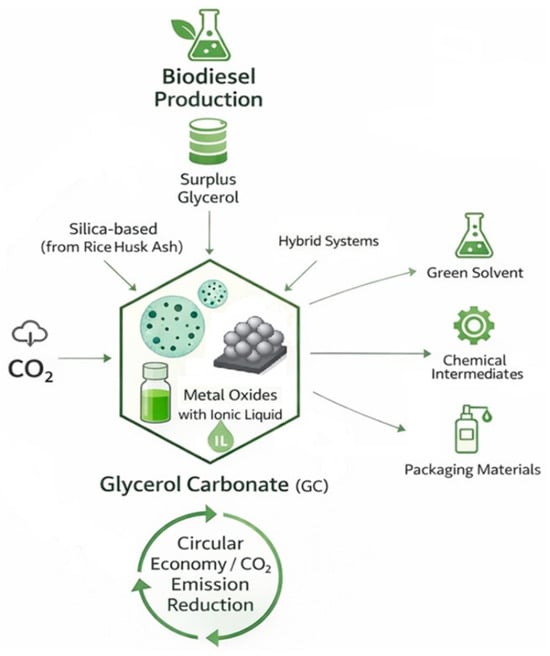
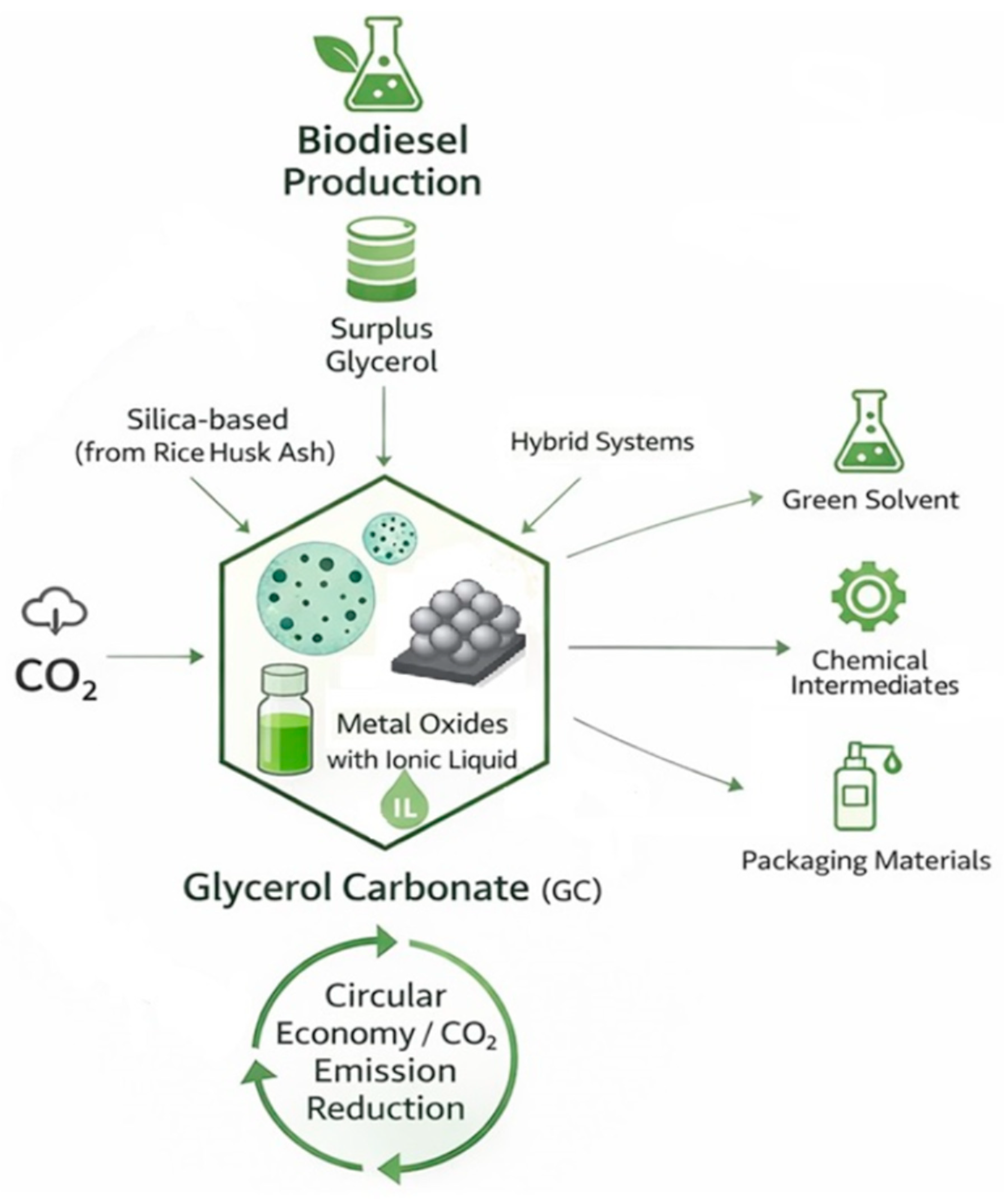
Graphical Abstract

1. Introduction

While several reviews focus on homogeneous systems or commercial supports, this work fills a gap by correlating the textural properties of agro-industrial waste-derived silica with the stability of doped metal phases (Nb/Ni) and the role of ionic liquids in CO2 activation. The continuous increase in carbon dioxide (CO2) emissions, mainly resulting from the burning of fossil fuels, industrial processes, deforestation, and intensive agricultural activities, has intensified environmental impacts and the global climate crisis [1,2]. The accumulation of CO2 in the atmosphere enhances the greenhouse effect, accelerates global warming, and is associated with extreme climate events such as glacier melting, ocean acidification, and biodiversity loss [3,4,5]. In this context, the development of technologies for CO2 reduction, capture, and reuse has become a strategic priority across different industrial sectors.
At the same time, the growth in biofuel production, especially biodiesel, has resulted in a large availability of glycerol as a byproduct of oil transesterification [6,7]. In this context, both crude glycerol and purified glycerol are coproducts of the biodiesel manufacturing process; however, crude glycerol has a lower purity level, typically in the range of 60–80%, compared to refined or synthetic glycerol. This lower purity limits its application in sectors that require a high degree of specification, such as the food, pharmaceutical, and cosmetic industries [8,9,10]. Although biodiesel’s main advantage is its lower CO2 emissions compared to fossil fuels [11,12], the accumulation of crude glycerol generates economic and environmental challenges, including treatment costs and pollution risks [13].
The catalytic conversion of glycerol with CO2 to obtain glycerol carbonate stands out as a strategy to reduce the carbon intensity of industrial processes and strengthen the biodiesel value chain [14]. It has been investigated through both direct routes between glycerol and CO2 and indirect pathways, such as epoxidation followed by carbonation, including the application of continuous reactors [15,16].
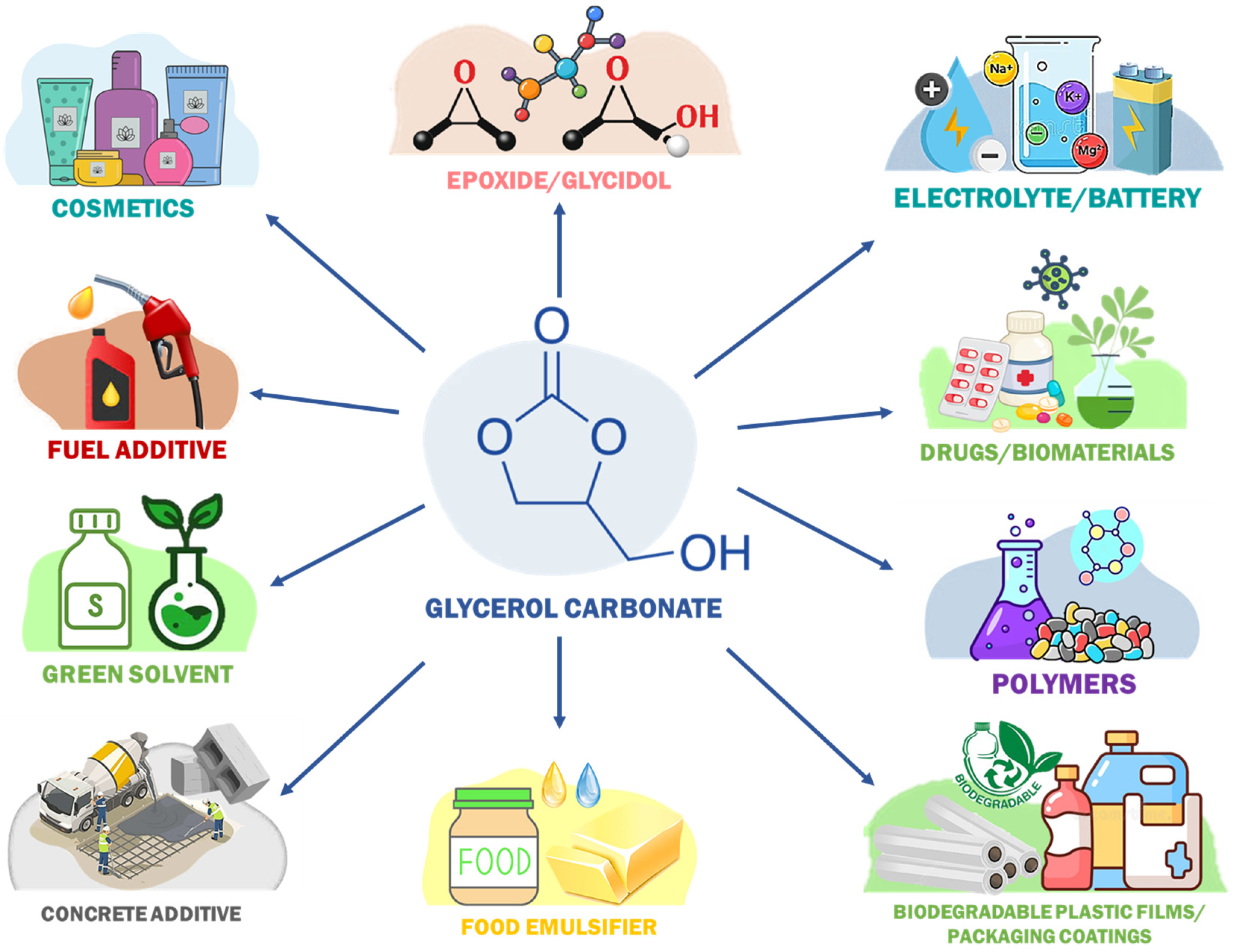
From an industrial perspective, glycerol carbonate is notable for its multifunctional character and low toxicity, acting as a humectant, green solvent, and precursor of polyurethanes and polymers applicable to food and packaging [17,18,19,20]. Its application contributes to the replacement of fossil-based inputs and to the reduction in waste and emissions in the food supply chain. Figure 1 shows these and other diverse applications of this compound.
In summary, this work aims to discuss the catalytic conversion of CO2 into glycerol carbonate, highlighting more efficient, stable, and environmentally friendly heterogeneous materials. It seeks to contribute to integration and value creation in strategic industrial sectors, strengthening a technological and sustainable approach.
Despite advances in heterogeneous catalysis, limitations such as the low solubility of CO2 in glycerol and the thermal stability of catalysts still persist. This review emphasizes how the incorporation of ionic liquids and metal doping with niobium and nickel can overcome these barriers and optimize catalytic performance.

2. Carbon Dioxide (CO2)

In the contemporary context, the increasing concentration of CO2 in the atmosphere has become one of the main drivers of the global environmental crisis, largely intensified by anthropogenic activities. The burning of fossil fuels for energy generation, industrial processes that emit large volumes of CO2, deforestation that reduces carbon sequestration capacity, and intensive agricultural practices significantly contribute to this atmospheric accumulation [1,2]. Excess CO2 intensifies the greenhouse effect by trapping heat in the atmosphere, promoting a rise in the global average temperature, with particularly pronounced impacts in polar regions [3,4]. The resulting ice melt reduces Earth’s albedo, increases solar radiation absorption, and reinforces global warming [5], triggering systemic effects such as extreme climate events, ocean acidification, biodiversity loss, cryosphere degradation, and environmental instabilities on a global scale.
One of the most promising uses of CO2 is in the production of synthetic fuels, such as methanol and e-diesel [21,22,23]. These fuels can replace fossil-based alternatives in sectors that are difficult to decarbonize, such as aviation and maritime transport, offering a more sustainable mobility solution [24,25].
In the plastics and polymers sector, significant advances have been made in converting CO2 into polycarbonates and polyurethanes. These materials can be used in packaging, insulating foams, and automotive components, promoting more sustainable alternatives compared to traditional petrochemicals [26,27,28,29].
Another example is the chemical fixation of CO2, in which catalysts play a crucial role, as they enable the activation of CO2, a thermodynamically stable and chemically inert compound, thus making its conversion into value-added products feasible [30,31,32]. Reactions such as cycloaddition with epoxides to form cyclic carbonates, carboxylation of organic substrates, and selective hydrogenation are examples of processes that depend on efficient catalysts to occur under mild temperature and pressure conditions [15,16].
Among the most explored catalysts for this purpose are materials functionalized with ionic liquids (ILs) and ionic solids (ISs), which exhibit high performance in CO2 capture and activation [33]. This efficiency is associated with the presence of amine groups, whose lone pair of electrons on nitrogen interacts with the electrophilic carbon of CO2, favoring its activation through the formation of species such as carbamates or dipolar intermediates resulting from the nucleophilic addition of the amine to the CO2 molecule [34,35,36]. This interaction increases CO2 polarization and lowers the energy barrier of subsequent steps, facilitating its insertion into organic substrates [37].
Additionally, the basic character of amines enhances CO2 affinity and selective adsorption on the catalytic surface, increasing the local concentration of the reactant [38]. When these amine-based systems are supported on mesoporous materials or combined with metal centers, a cooperative effect is established between basic sites (CO2 activation) and acidic or metallic sites (substrate activation), resulting in greater catalytic efficiency, selectivity, and yield in conversion reactions under mild conditions [34,39,40,41].
The integration of carbon capture, conversion, and reuse technologies can not only mitigate emissions, but also stimulate new sustainable and innovative business models aligned with the Sustainable Development Goals (SDGs), particularly SDG 3 (Good Health and Well-Being), SDG 9 (Industry, Innovation and Infrastructure), SDG 12 (Responsible Consumption and Production), SDG 13 (Climate Action), SDG 14 (Life Below Water), and SDG 15 (Life on Land) [42,43].
The CO2 molecule exhibits high thermodynamic stability and low intrinsic reactivity, factors that limit its transformation and directly influence its performance in catalytic processes [44,45]. CO2 has a linear geometry (O=C=O), resulting from sp hybridization of carbon, which evenly distributes electron pairs and gives the molecule a zero-dipole moment [46,47]. In catalysis, the high stability of CO2 leads to large activation barriers and thermodynamically unfavorable equilibria for valorization reactions, such as cyclic carbonate formation and reduction processes [48].
In heterogeneous systems, adsorption on metal surfaces or oxides, especially at acid/base sites, promotes polarization of the C=O bonds [49,50]. In homogeneous systems, coordination to metal centers facilitates its insertion into metal/hydride or metal/carbon bonds [51,52]. In reduction reactions, coupled electron and proton transfer is crucial to enhance selectivity and efficiency [53,54].

3. Glycerol in the Biodiesel Production Chain

Biodiesel, obtained mainly through the transesterification of vegetable oils or animal fats, is a renewable biofuel of significant relevance to the global energy matrix [55,56,57]. In Brazil, it stands out as strategic due to the country’s agricultural base, infrastructure, and public policies such as the National Program for the Production and Use of Biodiesel (PNPB) [58], with production exceeding 6 billion liters in 2023 and ranking third worldwide [59], driven by the mandatory blending of B14 and the future requirement to blend B20 [60]. However, the sector’s expansion intensifies glycerol generation, whose accumulation devalues the product in the market and may cause environmental impacts, reinforcing the need for valorization strategies [61,62,63].
Glycerol, a byproduct of this reaction, accounts for approximately 10% of the total mass generated in the process [64,65,66,67,68]. Also known as glycerin, glycerol (C3H8O3) is an organic compound belonging to the alcohol class, specifically a triol, due to the presence of three hydroxyl (–OH) groups in its molecular structure [69,70].
It appears as a colorless, viscous, hygroscopic liquid with a sweet taste and is completely miscible in water [71,72]. In addition to being obtained through the transesterification reaction in biodiesel production, glycerol can naturally occur in oils and fats in the form of triglycerides [73,74]. Due to its physicochemical properties, such as high polarity, elevated boiling point, and strong hydrogen-bonding capacity, glycerol has wide applications across different industrial sectors [75,76].
In the cosmetic industry, it acts as a humectant and emollient in formulations of creams, lotions, and soaps [77,78]. In the food sector, it is used as a multifunctional additive (classified as E422), performing preservative, sweetening, and humectant functions [79,80]. In the pharmaceutical field, it is employed in the formulation of syrups, gelatin capsules, and suppositories due to its biocompatibility and safety for human use [81].
Additionally, glycerol constitutes an important raw material in the chemical industry, being used in the synthesis of resins, plasticizers, solvents, and explosives, such as nitroglycerin [82]. However, the high availability of crude glycerol, which is impure and contains contaminants from biodiesel production, limits its direct application and reinforces the need for technological routes that add value to this compound.
One of the most favorable alternatives is microbial fermentation to obtain 1,3-propanediol (1,3-PDO), a monomer used in the production of polymers such as polytrimethylene terephthalate (PTT) [83]. Another possibility is the production of acrylic acid, which can be obtained from the selective oxidation of glycerol using heterogeneous catalysts, such as mixed vanadium and tungsten oxides. This product is widely used in the manufacture of plastics, paints, and adhesives [84,85,86]. Finally, another alternative is the cycloaddition reaction of CO2 to form glycerol carbonates, a process that combines residual glycerol valorization with CO2 mitigation [87,88,89].

4. Chemical Fixation of CO2 for Glycerol Carbonate (GC)

Cyclic carbonates stand out as high value-added derivatives obtained from CO2, with applications ranging from green solvents and intermediates for polymer synthesis to electrolytes for lithium-ion batteries and coordinating agents in catalytic systems [90,91].
Their production occurs mainly through the reaction of CO2 with epoxides or alcohols, using basic catalysts, Lewis acids, or bifunctional systems capable of promoting the simultaneous activation of the reactants, an essential step given the thermodynamic limitations associated with CO2 insertion [92,93]. In addition, these compounds are characterized by low toxicity, high chemical stability, and good biodegradability.
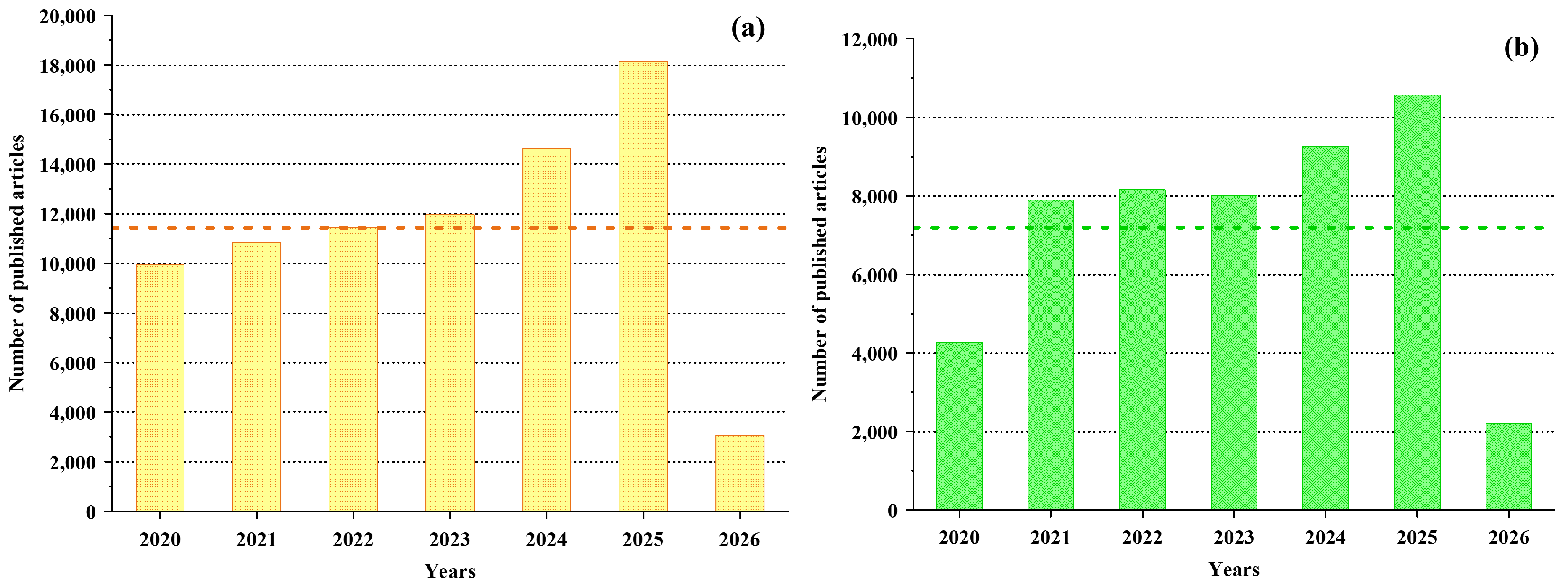
The bibliographic search conducted on 18 February 2026, in electronic databases, including ScienceDirect, Springer Nature, Wiley Online Library, Taylor & Francis, ACS, MDPI, and SciELO, using the terms “Chemical Fixation of CO2” and “Glycerol Carbonate” in the title, abstract, and keywords, and considering research articles, book chapters, and short communications published from 2020 to 2026, resulted in the data presented in Figure 2.
The analysis of the bibliographic search reveals a consistent growth in the number of publications related to “Chemical Fixation of CO2” and “Glycerol Carbonate” over the period from 2020 to 2025. In the case of chemical CO2 fixation, a continuous upward trend is observed, with a gradual increase between 2020 and 2023 and a more pronounced intensification from 2024 onward, reaching a peak in 2025. This trend reflects the strengthening of scientific and technological interest driven by global discussions on emission mitigation and the development of sustainable pathways.
Similarly, publications on glycerol carbonate show a significant increase from 2020 to 2021, relative stability until 2023, and a new marked rise from 2024 onward, culminating in the highest number of publications in 2025. This pattern highlights its consolidation as a strategic topic linked to glycerol valorization and green chemistry. In both cases, the lower number recorded in 2026 is due to the fact that the survey was conducted at the beginning of the year and therefore does not yet represent the total expected number of publications, confirming the continued expansion of these research areas in the international scientific landscape.
Table 1 presents literature studies addressing the chemical fixation of CO2 for the production of glycerol carbonate. The systematization of the table highlights different types of catalysts, as well as the reaction conditions, together with their respective performances.
The reaction conditions summarized in Table 1 reveal that, while high pressures (above 5.0 MPa) favor CO2 solubility, hybrid catalysts utilizing ionic liquids can achieve high yields under milder conditions (0.1–2.0 MPa). This shift is critical for industrial viability, as it reduces capital expenditure (CAPEX) associated with high-pressure reactors. The mesoporous nature of RHA-silica is instrumental here, providing a high internal surface area that facilitates the interaction between the diluted CO2 and the active sites even at lower pressures.
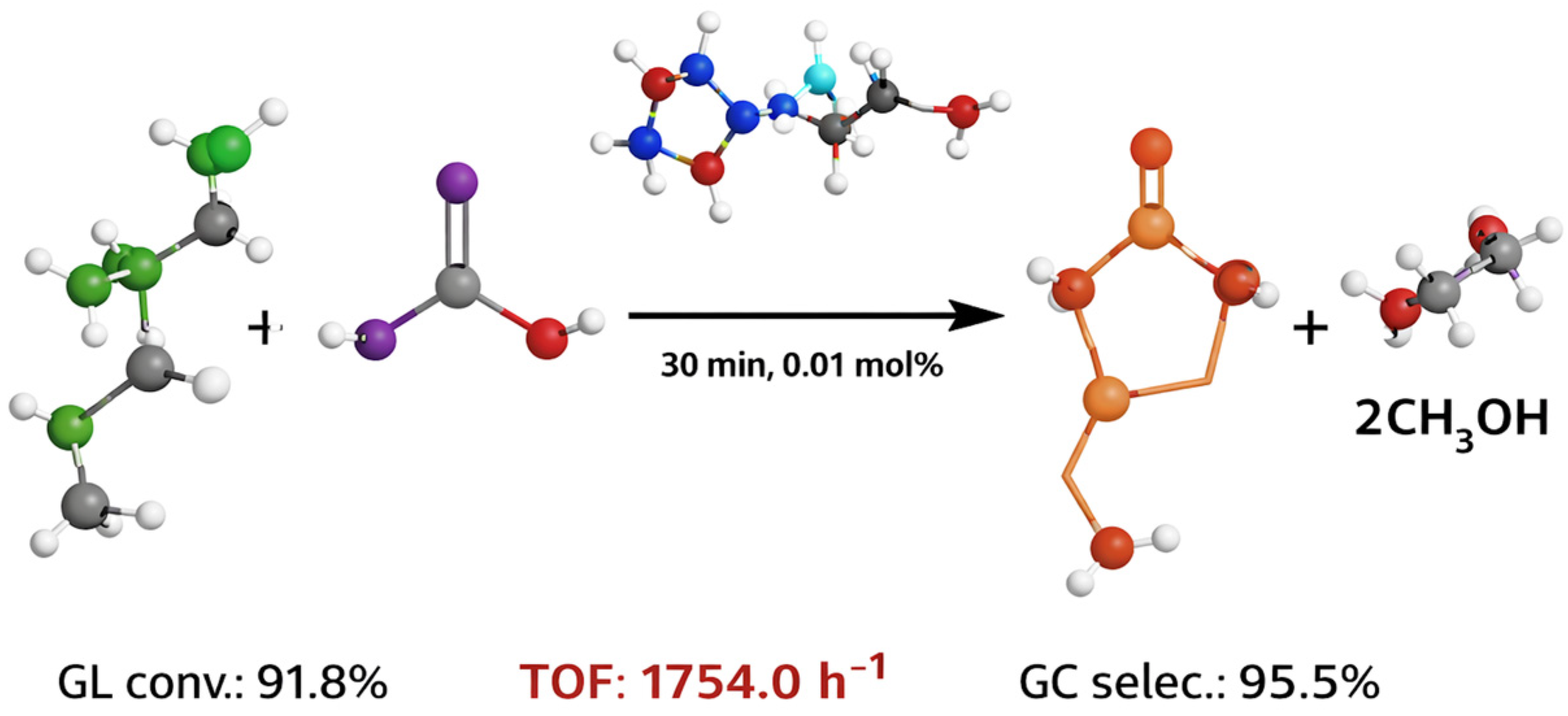
From Table 1, it can be observed that the catalytic performance in the conversion of CO2 into glycerol carbonate (GC) is strongly related to the nature of the catalyst and the operational conditions employed, especially temperature, pressure, and reaction time. Homogeneous systems or catalysts functionalized with well-defined basic sites, such as triethylamine [95] and, as shown in Figure 3, guanidine-based ionic liquids [97], achieve high yields (≈90% and ≈87.7%, respectively) under relatively mild conditions, demonstrating high catalytic efficiency.
Similarly, functionalized polymers also reach high yield and selectivity values (≈90% and 98.9%), indicating that catalysts with accessible basic sites favor the simultaneous activation of CO2 and glycerol [106]. In addition, mixed oxide systems have shown superior performance compared to isolated oxides, as evidenced by the hybrid Ni/Nb system [109]. In this case, the combination of metallic species suggests a bifunctional activation mechanism in which Ni contributes redox and/or basic sites associated with glycerol activation, while Nb, due to its strong Lewis acidity, acts in stabilizing reaction intermediates such as carbamates, promoting reaction progression and increasing yield.
In contrast, several simple or mixed metal oxides exhibit moderate or low yields, even under more severe pressure and temperature conditions, suggesting limitations associated with CO2 activation and insufficient synergy between acidic and basic sites [98,104]. Pure MgO achieved a yield of only 12.76%, whereas the combined Au/MgO system reached 87%, demonstrating that the isolated presence of basic sites is not sufficient to promote high catalytic efficiency [104]. These results indicate that factors such as adequate metal dispersion and higher surface area, features that can be enhanced through the use of supports such as rice husk ash-derived silica, play a decisive role in, as they improve accessibility to active sites and optimize the utilization of the reaction performance catalytic phase.
Moreover, structured materials such as MOFs and mesoporous supports can provide high selectivity; however, this does not always translate into high yields, highlighting that overall efficiency depends on the balance among structure, composition, and reaction conditions. In the specific case of mesoporous supports, a frequently critical aspect is the stability of active species against leaching, particularly in systems operating in liquid media [111]. Despite the high efficiency and tunability of ionic liquid-based catalysts, their industrial implementation is often hindered by stability challenges, most notably the leaching of active phases into the reaction medium and the high viscosity of reactants like glycerol, which can trap active species and complicate recycling. To address these issues, the immobilization of ILs onto RHA-derived silica via the sol–gel method promotes stronger anchoring and robust electrostatic interactions within the mesoporous framework. This structural confinement significantly reduces metal and IL loss compared to simple impregnation methods, thereby enhancing the potential for multiple reuse cycles without substantial performance degradation. While these hybrid architectures offer a more sustainable path, further long-term stability tests remain essential to fully validate their industrial viability.
Various catalytic approaches have been explored for the conversion of CO2 into glycerol carbonate, including supported metal oxides (CaO, MgO, Nb2O5, NiO), functionalized mesoporous materials (such as SBA-15 and MCM-41), graphene-based composites, and catalysts doped with metal cations to tune acid–base and redox properties [104,112]. The incorporation of ionic liquids (ILs), particularly imidazolium-based ([BMIM]Br, [EMIM]Cl) and quaternary ammonium (TBAB) species, is also noteworthy. These are generally applied by impregnation onto supports such as silica, SBA-15, or alumina, forming hybrid heterogeneous systems [39,113]. In these materials, ILs enhance CO2 solubility in the reaction medium and promote its activation through the interaction of the anion (Br, Cl) with the electrophilic carbon, in addition to assisting in intermediate stabilization and reactive species activation [36]. This combined action improves the interaction between reactants and active sites, resulting in higher conversion rates and selectivity toward glycerol carbonate.

5. Advances in Heterogeneous Catalysts for Glycerol Carbonate Synthesis

5.1. Silica-Based Materials as Catalytic Supports

The use of alternative silica sources has gained relevance in the context of sustainable chemistry, especially when associated with the valorization of agro-industrial residues. In this scenario, rice husk ash (RHA) stands out as a strategic raw material, since rice production is a pillar of the global agri-food sector and generates large volumes of husk as a byproduct, which, after controlled combustion, may contain more than 90% amorphous SiO2 [114,115].
Brazil ranks 11th in the world in rice production [116] and presents a promising outlook: the National Supply Company projects, for the 2024/2025 harvest, a production of 12.1 million tons, driven by the expansion of cultivated area and favorable profitability [117]. Rio Grande do Sul leads national production, followed by Santa Catarina and Mato Grosso [118], maintaining an average of 8 million tons per harvest, even in the face of the floods of 2023 and 2024 [117,119]. For every ton of processed rice, approximately 200 kg of husk is generated, and about 20% of this mass is converted into ash after combustion [120], representing an environmental liability that can be transformed into a high value-added resource.
RHA is predominantly composed of silica (80–95%) and may contain alumina, iron oxides, calcium, magnesium, sodium, and potassium, depending on combustion conditions [115]. The silica morphology may vary between crystalline and amorphous forms, the latter being more desirable due to its higher reactivity and better performance in industrial applications [121]. Combustion temperature is decisive: above 700 °C, the formation of crystalline phases such as cristobalite and tridymite, less reactive forms, is favored [122], whereas controlled combustion between 500 and 700 °C promotes amorphous silica with suitable pozzolanic properties. The textural properties of amorphous silica derived from RHA are highly dependent on the combustion conditions. Controlled processing typically yields materials with high surface areas (often exceeding 200–400 m2/g) and a predominant mesoporous structure (2–50 nm). This mesoporosity is crucial for overcoming diffusion limitations associated with the high viscosity and molecular volume of glycerol [123]. Although RHA processing involves calcination (500–700 °C), its carbon balance is superior to commercial fumed silica, which requires temperatures above 1000 °C and generates corrosive by-products like HCl. Thus, RHA serves as both an environmental and energetic alternative.
The presence of pores in the mesoporous range (2–50 nm) ensures greater accessibility to active sites, reduces internal diffusion resistance, and promotes better utilization of the active phase, contributing to higher catalytic activity and system efficiency [124,125,126,127]. These structural and chemical characteristics enable various RHA applications in sectors such as civil construction, the chemical industry, and agriculture [128], including high-performance concretes and cements [129], advanced ceramics, catalysts, and the synthesis of nanostructured silica.
Studies have demonstrated its efficiency in removing heavy metals, synthetic dyes, organic compounds, and nutrients such as phosphorus and nitrogen from wastewater [130,131], both in its natural form and when chemically modified [128,132]. It can also act in coagulation–flocculation processes [133] and as a catalyst support in advanced oxidation processes, such as photocatalysis [134].
In the synthesis of mesoporous materials, MCM-41-RHA and SBA-15-RHA have been produced for solid hydrogen storage, showing good adsorption performance with nickel impregnation up to 10%, particularly in the 5% sample, which maintained stability after five cycles [135]. Similarly, RHA was employed in the synthesis of ZSM-5 zeolite combined with fly ash; when modified with iron/copper, the zeolite achieved 99% degradation of tetracycline in 10 min via a Fenton-type oxidation process [136]. In aquaculture, its application as a silicon fertilizer and heavy metal adsorbent increased dissolved silicate concentration and achieved mercury removal of up to 97.41% after NaOH modification [137].
In the energy field, RHA has been investigated as a heterogeneous catalyst in biodiesel production. A yield of 89.97% was obtained in the transesterification of waste oil using catalysts containing 10% strontium oxide calcined at 900 °C, under conditions of 65 °C, an oil/methanol ratio of 1:18, 6% catalyst loading, and 1 h of reaction, meeting international quality standards [138].
For CO2-related applications, RHA has been combined with ashes from coal co-combustion as a source of silica and alumina in the synthesis of zeolites for CO2 capture, producing a material with high surface area and significant adsorption capacity [139]. Another study reported silica extracted from RHA converted into aerogel and subsequently functionalized with APTES, resulting in a material with active amine groups capable of adsorbing 0.88 mol of CO2/kg, demonstrating improved capture performance through combined physisorption and chemisorption mechanisms [140]. The in situ incorporation of RHA in the synthesis of MIL-101(Cr) significantly increased its surface area and pore volume, resulting in a 14–27% enhancement in CO2 adsorption capacity, greater CO2/N2 selectivity, and improved overall capture performance compared to the unmodified material [141].
Several studies highlight RHA as a sustainable and low-cost alternative for catalytic and environmental applications [142,143,144]. One example is its use in crude glycerol purification, enabling its application in higher value-added routes and contributing to the circular economy [145]. Its conversion into mesoporous silica allows the production of catalytic supports with adequate dispersion of active species and tunable acid–base properties. Porosity control is essential, since the high viscosity and molecular size of glycerol may cause diffusion limitations in microporous materials [146].
In this context, silica extracted from RHA presents suitable properties to act as a precursor in the sol–gel technique, a versatile method for obtaining porous materials with high structural homogeneity, in which silica serves as a silicon source for gel formation that, after hydrolysis and condensation steps, generates solids with tunable physicochemical properties [147,148,149].

5.2. Sol–Gel Route and Silica Functionalization: Structural and Catalytic Influence

Silica-based materials stand out as versatile catalytic supports due to their high surface area, thermal and chemical stability, and the possibility of structural modification through different synthetic routes [150,151]. Among these routes, the sol–gel method is widely applied in obtaining homogeneous matrices with controlled pore distribution and active sites [152,153]. Based on the transition from a colloidal solution (sol) to a three-dimensional crosslinked network (gel), the process occurs through hydrolysis and condensation reactions of metallic precursors, generally alkoxides or salts dissolved in appropriate solvents [154,155,156].
During hydrolysis, metal-bound hydroxyl groups are formed [157], which subsequently undergo condensation, generating metal–oxygen–metal bonds and consolidating the inorganic structure [155]. Depending on the drying conditions, xerogels, aerogels, or thin films can be obtained [158,159]. Aerogels are characterized by supercritical drying and ultralow density [160], whereas xerogels result from conventional drying with greater structural shrinkage [161]. Hydrogels, formed from hydrophilic polymers, exhibit high water absorption capacity [162].
Among the advantages of the method are low processing temperature, homogeneous distribution of components, and ease of incorporating different species into the inorganic matrix [163,164], factors that broaden its application in sensors, biomaterials, photonics, functional coatings, and electroceramics [165,166,167,168].
In catalysis, the sol–gel route enables the production of materials with high dispersion of active phases [169,170]. The high efficiency of TiO2 nanoparticles synthesized via this method was observed in the degradation of methylene blue (80.89%) and in the oxidation of benzaldehyde to benzoic acid (94%) [84]. Another study reported high adsorption capacity of Pb(II) and Cd(II) by porous SiO2 nanoparticles [171], as well as the development of a heterogeneous Fenton catalyst based on La-doped MgFe2O4 with high efficiency in carbamazepine removal [172].
The preparation of porous supports for metal oxides via the sol–gel method promotes high dispersion, thermal stability, and structural control of materials [173]. This characteristic has been explored both in the synthesis of catalysts for transesterification in biodiesel production [174,175] and in glycerol valorization toward higher value-added routes [176]. In this context, functionalization of the silica matrix obtained via sol–gel allows the controlled incorporation of metal oxides with tunable acid–base and redox properties, enhancing catalytic performance.
Particularly noteworthy is the introduction of species such as Nb2O5 and TiO2, whose structural and electronic characteristics can modulate acidity, metal dispersion, and metal–support interactions, highlighting the potential of the sol–gel technique as an effective strategy for homogeneous metal incorporation and for the development of advanced catalytic systems.

5.3. Metal Doping: Niobium Oxide (Nb2O5), Nickel Oxide (NiO), and Graphene-Based Hybrid Systems

The doping of silica-based materials with metal oxides has proven to be an efficient strategy to optimize the acid–base, electronic, and structural properties of catalysts applied to the conversion of CO2 into glycerol carbonate. Among these metals, niobium (Nb) and nickel (Ni) stand out due to their chemical versatility and the broad technological applications associated with their compounds, particularly niobium oxide (Nb2O5) and nickel oxide (NiO), which are widely studied as catalytic promoters.
Niobium is a group 5 element with the atomic number 41, characterized by high ductility, corrosion resistance, and a metallic gray appearance. Discovered in 1801, it occurs naturally mainly in minerals such as columbite, tantalite and pyrochlore, the latter being the primary industrial source [177,178]. Brazil holds approximately 98% of global niobium reserves, with deposits concentrated in the states of Minas Gerais and Goiás, giving the country a strategic role in the production and development of advanced niobium-based materials [179,180]. In technological applications, niobium is prominent in high-performance alloys, superconductors, electronic devices, and especially as an active component in heterogeneous catalysts [181,182,183].
Among its compounds, Nb2O5 is one of the most relevant due to its high thermal stability, surface acidity, semiconducting behavior, and good dielectric properties [184,185]. This oxide may exhibit different crystalline structures, monoclinic, orthorhombic, or tetragonal, depending on synthesis and calcination conditions. In heterogeneous catalysis, Nb2O5 is widely employed in reactions involving Lewis and Brønsted acid sites, such as dehydration, selective oxidation, cracking, and cycloaddition, reinforcing its potential in glycerol carbonation reactions [186,187,188]. Incorporating Nb2O5 into a silica matrix obtained via the sol–gel method enhances active site dispersion, improves mass transport, and promotes the simultaneous adsorption of CO2 and glycerol key aspects for carbonate intermediate formation.
Similarly, Ni is a group 10 transition metal widely recognized for its corrosion resistance, thermal stability, and electronic and magnetic properties [189,190,191]. Naturally found in ores such as laterites and sulfides, nickel is globally distributed and extensively mined in countries such as Indonesia, the Philippines, Russia, and Brazil [192,193,194].
Historically used in metal alloys and stainless steels, nickel also plays a crucial role in heterogeneous catalysis, particularly in hydrogenation, dehydrogenation, cracking, hydrocarbon reforming, and Fischer–Tropsch processes [195,196]. In sustainability-related applications, nickel catalysts have been employed in biomass conversion, biogas reforming, and CO2 activation due to their ability to facilitate reactions involving C–H and C–C bond transformations [197,198,199].
NiO, in particular, stands out for its redox properties, thermal stability, and applications in electrocatalysis and energy storage [200,201]. It is widely used in the catalyst industry, battery electrodes, and ceramic films, with coloration ranging from green to black depending on its stoichiometry [202,203,204,205]. Synthesis techniques such as sol–gel, coprecipitation, and hydrothermal methods allow control over morphology, surface area, and crystallinity, resulting in more active catalysts that are resistant to sintering, especially when supported on mesoporous silica, alumina, or zeolites [32,206,207].
Studies indicate that the ideal weight ratio between Nb and Ni on mesoporous silica ranges from 1:1 to 2:1. In these systems, the sol–gel method ensures atomic dispersion of NiO and Nb2O5 species within the silica matrix, preventing thermal sintering and maintaining Lewis acidity for intermediate stabilization, as it integrates Lewis acidity, redox properties, and thermal stability—features desirable for CO2 conversion reactions. Simultaneous doping can generate important synergistic effects, increasing the density of active sites, improving CO2 polarization, and enhancing selectivity toward glycerol carbonate formation. Recent studies also demonstrate the potential of incorporating graphene or graphene oxides as structuring additives, promoting improved metal dispersion, increased surface area, and enhanced electronic interaction between metallic phases and the support [208]. These hybrid materials offer additional advantages, such as high stability and resistance to deactivation, making them particularly attractive for sustainable CO2 valorization processes.
Within this context, ionic liquids stand out for their high capacity to solubilize and activate CO2, especially when containing basic anions. They can act as co-catalysts by stabilizing intermediates and facilitating glycerol activation. When immobilized in matrices containing Nb2O5 and NiO, they combine the advantages of homogeneous and heterogeneous catalysis, contributing to improved efficiency, selectivity, and stability of the catalytic system in glycerol carbonate formation.
The high dispersion of Ni and Nb species, achieved through the sol–gel incorporation into the RHA framework, prevents the formation of large crystalline aggregates that typically lead to catalyst deactivation. Characterization studies in similar systems suggest that maintaining metal particles below 10 nm is essential for sustained activity over multiple cycles, a feature provided by the stabilizing effect of the amorphous silica walls.

5.4. Role of Ionic Liquids and Ionic Solids in the Conversion of CO2 into Glycerol Carbonate

Ionic liquids (ILs) and ionic solids constitute distinct classes of compounds that have gained prominence due to their unique physicochemical properties and broad spectrum of technological applications. Initially, these compounds were referred to as “room-temperature molten salts.” However, debates regarding the accuracy of the term “molten salts” and even the definition of “room temperature” which varies according to geographic region and season led to the adoption and consolidation of the term “ionic liquids” [209]. ILs are salts composed exclusively of ions that remain liquid at temperatures below 100 °C, with many being liquid at room temperature [37]. They generally consist of bulky organic cations, such as imidazolium, pyridinium, ammonium, or phosphonium, combined with organic or inorganic anions [210,211]. The high structural asymmetry of these ions hinders crystalline packing, which explains their low melting points and pronounced liquid character.
Among their main properties are low vapor pressure, high thermal stability, good ionic conductivity, and excellent solvation capacity [37,212,213]. These characteristics make ILs particularly attractive for applications in organic synthesis, homogeneous and heterogeneous catalysis, selective extractions, electrochemistry, lubrication, and energy storage [214,215]. In the environmental context, several ILs have stood out in CO2 capture, activation, and conversion, since many contain basic sites capable of strongly interacting with this linear and relatively unreactive molecule [216,217].
The possibility of tailoring the structure of an ionic liquid through the selection of its cation and anion is fundamental for the development of customized catalytic systems. Modifications in the chemical nature of these ions allow control over properties such as polarity, viscosity, acidity, or basicity, thereby adjusting IL performance for specific applications [218,219,220]. As a result, the use of ILs functionalized with acidic or basic groups has been promoted, showing high performance in esterification, transesterification, and alkylation reactions, and even being employed as catalysts or co-catalysts in biodiesel production [221,222].
In the specific case of glycerol conversion with CO2 to form glycerol carbonate, ionic liquids can perform multiple catalytic roles [223]. They can promote CO2 activation through basic anions capable of forming carbonate- or carbamate-type intermediates, thereby increasing system reactivity [224]. Additionally, they improve miscibility between CO2 and glycerol, minimizing diffusion limitations typical of this reaction. When immobilized on solid supports, ILs can also modify the surface properties of heterogeneous catalysts, adjusting acidity, basicity, and medium polarity [225,226]. Furthermore, they are able to stabilize reactive intermediate species, enabling the process to proceed under milder temperature and pressure conditions [36,225].
Beyond ionic liquids, it is important to distinguish their role from that of ionic solids, which are crystalline compounds composed of three-dimensional networks of strongly bonded cations and anions, such as chlorides, fluorides, sulfates, and metal oxides [227,228]. These materials exhibit high melting points and hardness and are widely used in heterogeneous catalysis, sensors, ceramics, and solid-state batteries [229]. Despite their structural and functional differences, ionic liquids and ionic solids share the presence of strong electrostatic interactions, which facilitates their combination in hybrid systems.
Although ILs are often classified as “green solvents” due to their low volatility, it is important to recognize limitations related to toxicity, synthesis cost, and low biodegradability, factors that still restrict their large-scale application [230].
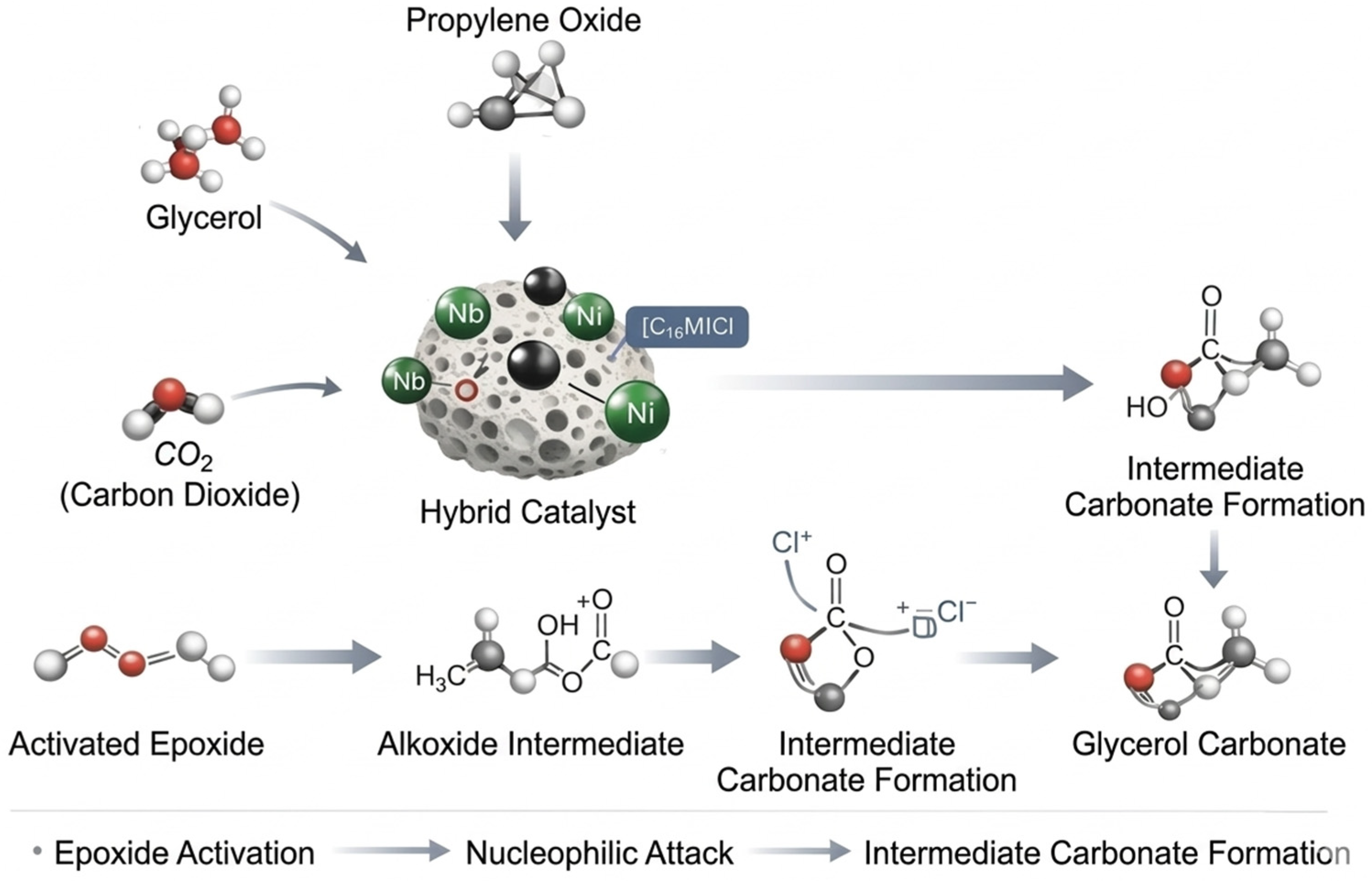
Indeed, the incorporation of ionic liquids into porous solid supports such as silica, zeolites, modified clays, or carbon-based materials has emerged as an attractive strategy for sustainable catalysis. These hybrid materials combine the chemical versatility of ILs with the structural stability and high surface area of solids, resulting in more selective, less corrosive, and more easily recoverable catalysts [231,232]. A critical challenge in ionic liquid-based systems is the leaching of the active phase. However, the mesoporous structure of RHA-derived silica provides steric confinement that minimizes this loss, allowing for better recyclability over multiple catalytic cycles compared to non-porous supports. In the conversion of CO2 into glycerol carbonate, such systems simultaneously enable CO2 activation, enhance mass transport, and stabilize active catalytic sites, significantly improving the overall efficiency of the process. Figure 4 represents the possible catalytic reaction mechanism.
The superior performance of hybrid systems based on RHA-SiO2/Nb/Ni/IL can be attributed to a multifunctional cooperative activation mechanism, where each component plays a specific and complementary role, as widely reported for CO2 conversion systems integrating metal sites and ionic liquids [177,233,234,235,236,237]. Initially, the Ni and Nb metal oxides dispersed within the amorphous silica matrix act as Lewis acid sites and redox centers, enhancing substrate activation and facilitating electron transfer processes [177,236]. In particular, Nb-based species (Nb2O5) are well known for their strong Lewis acidity and oxophilicity, which promote the deprotonation of glycerol hydroxyl groups and the formation of reactive glycerol-alkoxide intermediates, a key step in carbonate formation [235,236].
Concurrently, the ionic liquid (IL) phase plays a crucial role in CO2 activation. Previous studies have demonstrated that halide-based ILs (e.g., Cl, Br) act as nucleophilic species capable of attacking the electrophilic carbon of CO2, leading to polarization and activation of the molecule, thus lowering the energy barrier for its insertion into organic substrates [233,234,237]. This dual activation—glycerol by Nb sites and CO2 by the IL—constitutes the core of the synergistic catalytic mechanism.
Furthermore, the RHA-derived silica support is not merely a passive carrier. Its high specific surface area and mesoporous structure ensure optimal dispersion and accessibility of the active Ni and Nb species, which is essential for catalytic efficiency [177,235]. In addition, the presence of surface silanol groups (–Si–OH) can promote hydrogen bonding interactions with reactants and intermediates, stabilizing transition states and facilitating the overall reaction pathway [177]. Finally, the intrinsic hydrophilicity of the silica support contributes to the efficient desorption of glycerol carbonate, preventing active site blockage and enabling catalyst recyclability over multiple cycles [233,235].

6. Conclusions

In conclusion, the catalytic conversion of CO2 into glycerol carbonate stands as a compelling paradigm for integrating carbon mitigation with biomass valorization, directly addressing two critical challenges of the modern chemical industry. This review demonstrates that the rational design of hybrid catalysts, particularly those based on rice husk ash-derived silica, enables a decisive shift in performance by combining sustainability with advanced functionality. The synergistic interaction between Nb2O5 and NiO introduces a finely tuned balance of Lewis acidity, basicity, and redox properties, while the incorporation of ionic liquids fundamentally transforms the reaction landscape by enhancing CO2 activation and overcoming mass transfer limitations. Together, these features redefine the efficiency limits of heterogeneous systems, enabling high selectivity and conversion under significantly milder conditions.
Despite these advances, the transition from laboratory-scale innovation to industrial deployment remains a critical bottleneck. Key challenges, including long-term catalyst stability, ionic liquid leaching, and process scalability, must be systematically addressed to unlock the full technological potential of these systems. Future efforts should prioritize the development of robust, recyclable, and economically viable catalytic platforms, as well as the integration of reaction and separation processes. Ultimately, the convergence of waste-derived materials, multifunctional catalysis, and process intensification positions this approach at the forefront of sustainable chemical manufacturing, with the potential to redefine CO2 utilization pathways and contribute meaningfully to a low-carbon industrial future.

Author Contributions

Investigation and Writing—original draft, A.S.T., P.T.R., F.d.O.P. and R.B.; Writing—review and editing.; A.J. and R.M.D.; Project administration and Writing—review and editing, M.L.M. All authors have read and agreed to the published version of the manuscript.

Funding

This research received no external funding.

Data Availability Statement

Not applicable.

Conflicts of Interest

The authors declare no conflicts of interest.

References

  1. Makepa, D.C.; Chihobo, C.H. Sustainable Pathways for Biomass Production and Utilization in Carbon Capture and Storage—A Review. Biomass Convers. Biorefin. 2025, 15, 11397–11419. [Google Scholar] [CrossRef]
  2. Duraiswami, R.A. Global Carbon Capture and Storage Efforts: Challenges and Opportunities. J. Geol. Soc. India 2025, 101, 143–148. [Google Scholar] [CrossRef]
  3. Jha, M.K.; Dev, M. Impacts of Climate Change. In Smart Internet of Things for Environment and Healthcare; Springer: Cham, Switzerland, 2024; pp. 139–159. [Google Scholar]
  4. Soeder, D.J. Greenhouse Gas and Climate Change. In Energy Futures; Springer Nature Switzerland: Cham, Switzerland, 2025; pp. 97–141. [Google Scholar]
  5. Soukharev, B. How Positive Climate Feedbacks Amplify Global Warming. In Global Warming and Mass Migration; Springer Nature Switzerland: Cham, Switzerland, 2025; pp. 49–112. [Google Scholar]
  6. Farouk, S.M.; Tayeb, A.M.; Abdel-Hamid, S.M.S.; Osman, R.M. Recent Advances in Transesterification for Sustainable Biodiesel Production, Challenges, and Prospects: A Comprehensive Review. Environ. Sci. Pollut. Res. 2024, 31, 12722–12747. [Google Scholar] [CrossRef]
  7. Mhetras, N.; Gokhale, D. Sustainable Biodiesel Production: Importance of Feedstock Resources and Production Methods. RSC Adv. 2025, 15, 26739–26754. [Google Scholar] [CrossRef]
  8. Chol, C.G.; Dhabhai, R.; Dalai, A.K.; Reaney, M. Purification of Crude Glycerol Derived from Biodiesel Production Process: Experimental Studies and Techno-Economic Analyses. Fuel Process. Technol. 2018, 178, 78–87. [Google Scholar] [CrossRef]
  9. Moklis, M.H.; Cheng, S.; Cross, J.S. Current and Future Trends for Crude Glycerol Upgrading to High Value-Added Products. Sustainability 2023, 15, 2979. [Google Scholar] [CrossRef]
  10. Awogbemi, O.; Desai, D.A. Recent Advances in Purification Technologies for Biodiesel-Derived Crude Glycerol. Int. J. Ambient Energy 2025, 46, 1–20. [Google Scholar] [CrossRef]
  11. Nisa, F.U. Biofuel: A Unique Solution for the Future Energy Crisis. In Environmental Sustainability of Biofuels; Elsevier: Amsterdam, The Netherlands, 2023; pp. 219–236. [Google Scholar]
  12. Tulashie, S.K.; Alale, E.M.; Agudah, P.Q.; Osei, C.A.; Munumkum, C.A.; Gah, B.K.; Baidoo, E.B. A Review on the Production of Biodiesel from Waste Cooking Oil: A Circular Economy Approach. Biofuels 2025, 16, 99–119. [Google Scholar] [CrossRef]
  13. Khan, S.A.; de Carvalho Arabidian, V.; da Silveira Junior, N.; de Farias, B.S.; Kessler, F.; Paes, R.L.; de Almeida Pinto, L.A.; Cadaval Junior, T.R.S. Valorization Glycerol Produced as a By-Product in the Biodiesel Industry: An Insight into Technical and Economic Studies. In Biorefinery of Industrial Effluents for a Sustainable Circular Economy; Elsevier: Amsterdam, The Netherlands, 2025; pp. 307–316. [Google Scholar]
  14. Huang, T.-W.; Yu, B.-Y. Technological Assessment of Glycerol Carbonate (GC) Synthesis via Direct Conversion of Carbon Dioxide: An Examination of Process Design, Techno-Economic Analysis, Life Cycle Assessment, and Safety Evaluation. Process Saf. Environ. Prot. 2025, 201, 107485. [Google Scholar] [CrossRef]
  15. Gao, Z.; Liu, Y.; Wu, S.; Tang, J.; Yuan, K.; Pan, C.; Yu, G. Metal-Decorated Porous Organic Polymers: Bridged the Gap between Organic and Inorganic Scaffolds. Chin. J. Chem. 2024, 42, 2902–2934. [Google Scholar] [CrossRef]
  16. Zhao, B.; Li, C.; Hu, T.; Gao, Y.; Fan, L.; Zhang, X. Robust {Pb10}-Cluster-Based Metal–Organic Framework for Capturing and Converting CO2 into Cyclic Carbonates under Mild Conditions. Inorg. Chem. 2024, 63, 14183–14192. [Google Scholar] [CrossRef]
  17. Sahani, S.; Upadhyay, S.N.; Sharma, Y.C. Critical Review on Production of Glycerol Carbonate from Byproduct Glycerol through Transesterification. Ind. Eng. Chem. Res. 2021, 60, 67–88. [Google Scholar] [CrossRef]
  18. Rozulan, N.; Halim, S.A.; Razali, N.; Lam, S.S. A Review on Direct Carboxylation of Glycerol Waste to Glycerol Carbonate and Its Applications. Biomass Convers. Biorefin. 2022, 12, 4665–4682. [Google Scholar] [CrossRef]
  19. Silvia Shelly Otaviano da, S. Obtenção de Carbonato de Glicerol Assistida Por Ultrassom e Síntese de Inibidor de Incrustação Biodegradável. Ph.D.Thesis, Universidade Federal do Ceará, Fortaleza, Brazil, 2023. [Google Scholar]
  20. Karmee, S.K. A Review on Preparation and Applications of Glycerol Carbonate: Focus Biocatalysis. Biocatal. Biotransform. 2024, 42, 286–307. [Google Scholar] [CrossRef]
  21. Ravi, S.S.; Mazumder, J.; Sun, J.; Brace, C.; Turner, J.W. Techno-Economic Assessment of Synthetic E-Fuels Derived from Atmospheric CO2 and Green Hydrogen. Energy Convers. Manag. 2023, 291, 117271. [Google Scholar] [CrossRef]
  22. Uddin, M.N.; Wang, F. Fuelling a Clean Future: A Systematic Review of Techno-Economic and Life Cycle Assessments in E-Fuel Development. Appl. Sci. 2024, 14, 7321. [Google Scholar] [CrossRef]
  23. Dell’Aversano, S.; Villante, C.; Gallucci, K.; Vanga, G.; Di Giuliano, A. E-Fuels: A Comprehensive Review of the Most Promising Technological Alternatives towards an Energy Transition. Energies 2024, 17, 3995. [Google Scholar] [CrossRef]
  24. Brynolf, S.; Hansson, J.; Anderson, J.E.; Skov, I.R.; Wallington, T.J.; Grahn, M.; Korberg, A.D.; Malmgren, E.; Taljegård, M. Review of Electrofuel Feasibility—Prospects for Road, Ocean, and Air Transport. Prog. Energy 2022, 4, 042007. [Google Scholar] [CrossRef]
  25. Uchida, N.; Onorati, A.; Novella, R.; Agarwal, A.K.; Abdul-Manan, A.F.; Kulzer, A.C.; Di Iorio, S.; Gordillo, V.; Günthner, M.; Jena, A.; et al. E-Fuels in IC Engines: A Key Solution for a Future Decarbonized Transport. Int. J. Engine Res. 2025, 26, 1675–1702. [Google Scholar] [CrossRef]
  26. Grignard, B.; Gennen, S.; Jérôme, C.; Kleij, A.W.; Detrembleur, C. Advances in the Use of CO2 as a Renewable Feedstock for the Synthesis of Polymers. Chem. Soc. Rev. 2019, 48, 4466–4514. [Google Scholar] [CrossRef] [PubMed]
  27. Kaur, R.; Singh, P.; Tanwar, S.; Varshney, G.; Yadav, S. Assessment of Bio-Based Polyurethanes: Perspective on Applications and Bio-Degradation. Macromol 2022, 2, 284–314. [Google Scholar] [CrossRef]
  28. Siragusa, F.; Detrembleur, C.; Grignard, B. The Advent of Recyclable CO2-Based Polycarbonates. Polym. Chem. 2023, 14, 1164–1183. [Google Scholar] [CrossRef]
  29. Franz, A.W.; Buchholz, S.; Albach, R.W.; Schmid, R. Towards Greener Polymers: Trends in the German Chemical Industry. Green Carbon 2024, 2, 33–44. [Google Scholar] [CrossRef]
  30. Alli, Y.A.; Oladoye, P.O.; Ejeromedoghene, O.; Bankole, O.M.; Alimi, O.A.; Omotola, E.O.; Olanrewaju, C.A.; Philippot, K.; Adeleye, A.S.; Ogunlaja, A.S. Nanomaterials as Catalysts for CO2 Transformation into Value-Added Products: A Review. Sci. Total Environ. 2023, 868, 161547. [Google Scholar] [CrossRef]
  31. Hou, M.; Li, X.; Fu, Y.; Wang, L.; Lin, D.; Wang, Z. Degradation of Iodinated X-Ray Contrast Media by Advanced Oxidation Processes: A Literature Review with a Focus on Degradation Pathways. Chin. Chem. Lett. 2023, 34, 107723. [Google Scholar] [CrossRef]
  32. Kim, T.; Paul, B.; Kwon, D.; Nam, S.C.; Jo, C. Nickel Nanoparticles Supported on Nonreducible Mesoporous Materials: Effects of Framework Types on the Catalytic Decomposition of Methane. Bull. Korean Chem. Soc. 2021, 42, 168–171. [Google Scholar] [CrossRef]
  33. An, X.; Wang, P.; Ma, X.; Du, X.; Hao, X.; Yang, Z.; Guan, G. Application of Ionic Liquids in CO2 Capture and Electrochemical Reduction: A Review. Carbon Resour. Convers. 2023, 6, 85–97. [Google Scholar] [CrossRef]
  34. Alguacil, F.J.; Robla, J.I. Using Ionic Liquids to Improve CO2 Capture. Molecules 2024, 29, 5388. [Google Scholar] [CrossRef]
  35. Dongare, S.; Zeeshan, M.; Aydogdu, A.S.; Dikki, R.; Kurtoğlu-Öztulum, S.F.; Coskun, O.K.; Muñoz, M.; Banerjee, A.; Gautam, M.; Ross, R.D.; et al. Reactive Capture and Electrochemical Conversion of CO2 with Ionic Liquids and Deep Eutectic Solvents. Chem. Soc. Rev. 2024, 53, 8563–8631. [Google Scholar] [CrossRef]
  36. Wang, Y.; Wang, Y.; Zhao, Y.; Fu, J.; Liu, Z. Ionic Liquids Promoted Transformation of Carbon Dioxide. Chem. Rev. 2025, 125, 6057–6129. [Google Scholar] [CrossRef]
  37. Zhou, T.; Gui, C.; Sun, L.; Hu, Y.; Lyu, H.; Wang, Z.; Song, Z.; Yu, G. Energy Applications of Ionic Liquids: Recent Developments and Future Prospects. Chem. Rev. 2023, 123, 12170–12253. [Google Scholar] [CrossRef]
  38. Zhao, Z.; Wang, K.; Tao, H.; Zhang, Z.; Lin, W.; Xiao, Q.; Jiang, L.; Li, H.; Wang, C. Thermodynamic Regulation of Carbon Dioxide Capture by Functionalized Ionic Liquids. Chem. Soc. Rev. 2025, 54, 2091–2126. [Google Scholar] [CrossRef] [PubMed]
  39. Zhao, Y.; Han, B.; Liu, Z. Ionic-Liquid-Catalyzed Approaches under Metal-Free Conditions. Acc. Chem. Res. 2021, 54, 3172–3190. [Google Scholar] [CrossRef]
  40. Friess, K.; Izák, P.; Kárászová, M.; Pasichnyk, M.; Lanč, M.; Nikolaeva, D.; Luis, P.; Jansen, J.C. A Review on Ionic Liquid Gas Separation Membranes. Membranes 2021, 11, 97. [Google Scholar] [CrossRef]
  41. Stanton Ribeiro, M.; Zanatta, M.; Corvo, M.C. Ionic Liquids and Biomass as Carbon Precursors: Synergistically Answering a Call for CO2 Capture and Conversion. Fuel 2022, 327, 125164. [Google Scholar] [CrossRef]
  42. Fei, W.; Opoku, A.; Agyekum, K.; Oppon, J.A.; Ahmed, V.; Chen, C.; Lok, K.L. The Critical Role of the Construction Industry in Achieving the Sustainable Development Goals (SDGs): Delivering Projects for the Common Good. Sustainability 2021, 13, 9112. [Google Scholar] [CrossRef]
  43. Garcia-Saravia Ortiz-de-Montellano, C.; Samani, P.; van der Meer, Y. How Can the Circular Economy Support the Advancement of the Sustainable Development Goals (SDGs)? A Comprehensive Analysis. Sustain. Prod. Consum. 2023, 40, 352–362. [Google Scholar] [CrossRef]
  44. Zhang, Z.; Zheng, Y.; Qian, L.; Luo, D.; Dou, H.; Wen, G.; Yu, A.; Chen, Z. Emerging Trends in Sustainable CO2-Management Materials. Adv. Mater. 2022, 34, e2201547. [Google Scholar] [CrossRef]
  45. Li, H.; Zhao, J.; Luo, L.; Du, J.; Zeng, J. Symmetry-Breaking Sites for Activating Linear Carbon Dioxide Molecules. Acc. Chem. Res. 2021, 54, 1454–1464. [Google Scholar] [CrossRef] [PubMed]
  46. Ge, Q.; Liu, Y.; You, W.; Li, Y.; Wang, W.; Yang, L.; Xie, L.; Li, K.; Wang, L.; Ma, M.; et al. Substantially Improved Efficiency and Selectivity of Carbon Dioxide Reduction by Superior Hydrated Electron in Microdroplet. Sci. Adv. 2025, 11, eadx5714. [Google Scholar] [CrossRef]
  47. Vuong, K.A.; Dang, N.H.; Truong, L.P.; Pham, M.-T.; Hoat, D.M.; Dang, M.T.; Chang-Chien, G.-P.; Nguyen, D.K. Enhanced Sensing Characteristics of N Doped and (N, O) Co-Doped Molybdenum Disulfide to Detect Toxic Gases: A Comprehensive First-Principles Study. RSC Adv. 2026, 16, 3662–3680. [Google Scholar] [CrossRef] [PubMed]
  48. González-Arias, J.; Villora-Picó, J.J.; Reina, T.R. Perspective on Sustainable Strategies for Integrating Catalytic CO2 Valorization in Industrial Processes: Advances, Challenges, and Opportunities. Discov. Catal. 2025, 2, 23. [Google Scholar] [CrossRef]
  49. Jing, R.; Lu, X.; Wang, J.; Xiong, J.; Qiao, Y.; Zhang, R.; Yu, Z. CeO2-Based Frustrated Lewis Pairs via Defective Engineering: Formation Theory, Site Characterization, and Small Molecule Activation. Small 2024, 20, e2310926. [Google Scholar] [CrossRef] [PubMed]
  50. Ye, Y.; Wu, Q.; Xu, Z.J. Minireview on Decoding Electrocatalytic CO2 Reduction via Lewis Acid–Base Chemistry: Advances and Outlook. Energy Fuels 2025, 39, 17763–17778. [Google Scholar] [CrossRef]
  51. Chang, C.; Rad, S.; Gan, L.; Li, Z.; Dai, J.; Shahab, A. Review of the Sol–Gel Method in Preparing Nano TiO2 for Advanced Oxidation Process. Nanotechnol. Rev. 2023, 12, 1–23. [Google Scholar] [CrossRef]
  52. Karapapa, P.; Mondal, S.; Zeglio, E.; Das, B. From CO2 to C1 Liquid Fuels: Molecular Electrochemical Production of Formic Acid and Methanol. Angew. Chem. Int. Ed. 2026, 65, e2226. [Google Scholar] [CrossRef]
  53. Marcandalli, G.; Monteiro, M.C.O.; Goyal, A.; Koper, M.T.M. Electrolyte Effects on CO2 Electrochemical Reduction to CO. Acc. Chem. Res. 2022, 55, 1900–1911. [Google Scholar] [CrossRef]
  54. Saha, P.; Amanullah, S.; Dey, A. Selectivity in Electrochemical CO2 Reduction. Acc. Chem. Res. 2022, 55, 134–144. [Google Scholar] [CrossRef]
  55. Mishra, V.K.; Goswami, R. A Review of Production, Properties and Advantages of Biodiesel. Biofuels 2018, 9, 273–289. [Google Scholar] [CrossRef]
  56. Khanal, A.; Shah, A. Oilseeds to Biodiesel and Renewable Jet Fuel: An Overview of Feedstock Production, Logistics, and Conversion. Biofuels Bioprod. Biorefining 2021, 15, 913–930. [Google Scholar] [CrossRef]
  57. Nikolic, B.; Markovic, S.; Petrovic, N.; Marinkovic, D.; Jovanovic, V. Biodiesel and Feedstocks Possibilities and Characteristics: A Review. Therm. Sci. 2025, 29, 3477–3490. [Google Scholar] [CrossRef]
  58. Gomes De Castro, A.M.; Lima, S.M.V.; de Siqueira, F.L.T. The Biodiesel Agro-Industrial Complex in Brazil and the Performance of the National Biodiesel Production Program. In Agroenergy; Elsevier: Amsterdam, The Netherlands, 2024; pp. 93–114. [Google Scholar]
  59. Pires, V.D.; Cavalcante, R.M.; Young, A.F. Process Simulation and Economic Evaluation of Biodiesel Production from Several Feedstocks in Brazil. Braz. J. Chem. Eng. 2023, 42, 317–344. [Google Scholar] [CrossRef]
  60. Santos, A.L.R.; Marinho, E.S.; Rufino Bezerra Neto, J.; Sousa, B.A.; Figueredo, I.M.; Luna, F.M.T.; Cavalcante, C.L.; Nascimento, T.L.; Rios, M.A.S.; de Lima-Neto, P. Study of Molecular Arrangement and Density Estimation of Soybean Oil Biodiesel-Diesel Blends Employing Molecular Dynamic Simulation. Fuel 2024, 377, 132760. [Google Scholar] [CrossRef]
  61. Wan Osman, W.N.A.; Rosli, M.H.; Mazli, W.N.A.; Samsuri, S. Comparative Review of Biodiesel Production and Purification. Carbon Capture Sci. Technol. 2024, 13, 100264. [Google Scholar] [CrossRef]
  62. Aquino, A.S.; da Silva, M.F.; de Almeida, T.S.; Bilheri, F.N.; Converti, A.; de Melo, J.C. Mapping of Alternative Oilseeds from the Brazilian Caatinga and Assessment of Catalytic Pathways toward Biofuels Production. Energies 2022, 15, 6531. [Google Scholar] [CrossRef]
  63. Brêda, G.C.; Aguieiras, E.C.G.; Cipolatti, E.P.; Greco-Duarte, J.; Collaço, A.C.d.A.; Costa Cavalcanti, E.D.; de Castro, A.M.; Freire, D.M.G. Current Approaches to Use Oil Crops By-Products for Biodiesel and Biolubricant Production: Focus on Biocatalysis. Bioresour. Technol. Rep. 2022, 18, 101030. [Google Scholar] [CrossRef]
  64. Bohlouli, A.; Mahdavian, L. Catalysts Used in Biodiesel Production: A Review. Biofuels 2021, 12, 885–898. [Google Scholar] [CrossRef]
  65. Malabadi, R.B.; Sadiya, M.R.; Kolkar, K.P.; Chalannavar, R.K. Biodiesel Production via Transesterification Reaction. Open Access Res. J. Sci. Technol. 2023, 9, 010–020. [Google Scholar] [CrossRef]
  66. Armylisas, A.H.N.; Hoong, S.S.; Tuan Ismail, T.N.M. Characterization of Crude Glycerol and Glycerol Pitch from Palm-Based Residual Biomass. Biomass Convers. Biorefin. 2024, 14, 28341–28353. [Google Scholar] [CrossRef] [PubMed]
  67. Elsayed, M.; Eraky, M.; Osman, A.I.; Wang, J.; Farghali, M.; Rashwan, A.K.; Yacoub, I.H.; Hanelt, D.; Abomohra, A. Sustainable Valorization of Waste Glycerol into Bioethanol and Biodiesel through Biocircular Approaches: A Review. Environ. Chem. Lett. 2024, 22, 609–634. [Google Scholar] [CrossRef]
  68. Carolina Sérgi Gomes, M.; Fernandes Medeiros, J.; Martins Moreira, W.; Marques Paschoal, S.; Oliveira Defendi, R.; Curvelo Pereira, N. Purification of Crude Glycerol Derived from Biodiesel Production Process Using Ceramic Membranes: Experimental Studies and Modeling of Flux Behavior. Sep. Purif. Technol. 2025, 354, 129042. [Google Scholar] [CrossRef]
  69. Santos, J.F.; Silva, C.W.C.; Silva, B.P.G.; Britto-Costa, P.H.; Costa, C.S.; Otubo, L.; Carbonari, A.W.; Cabrera-Pasca, G.A. Enhancing Cassava Starch Bioplastics with Vismia Guianensis Alcoholic Extract: Characterization with Potential Applications. Polymers 2025, 17, 419. [Google Scholar] [CrossRef] [PubMed]
  70. Sousa, A.P.O.; Lima, M.C.S.; Costa, W.R.P.; Nascimento, R.C.A.M.; Delgado, J.M.P.Q.; Lima, A.G.B.; Amorim, L.V. Effect of Interaction Between Expandable Minerals and Glycerin-Based Fluids on the Occurrence of Accretion. Minerals 2025, 15, 245. [Google Scholar] [CrossRef]
  71. Olson, A.L.; Tunér, M.; Verhelst, S. A Concise Review of Glycerol Derivatives for Use as Fuel Additives. Heliyon 2023, 9, e13041. [Google Scholar] [CrossRef]
  72. Pal, D.B.; Yadav, S.; Jana, S.K.; Tiwari, A.K. Waste Biomass Conversion in Useful Various Chemicals. In Sustainable Clean Energy Production Using Waste Biomass; Springer: Singapore, 2024; pp. 75–100. [Google Scholar]
  73. Alashek, F.; Keshe, M.; Alhassan, G. Preparation of Glycerol Derivatives by Entered of Glycerol in Different Chemical Organic Reactions: A Review. Results Chem. 2022, 4, 100359. [Google Scholar] [CrossRef]
  74. Ali Ijaz Malik, M.; Zeeshan, S.; Khubaib, M.; Ikram, A.; Hussain, F.; Yassin, H.; Qazi, A. A Review of Major Trends, Opportunities, and Technical Challenges in Biodiesel Production from Waste Sources. Energy Convers. Manag. X 2024, 23, 100675. [Google Scholar] [CrossRef]
  75. Pradhan, G.; Pradhan, S.; Singh, R. Valorization of Biodiesel Waste Glycerol to Sustainable Chemicals. Biofuels Bioprod. Biorefining 2026, 20, 332–351. [Google Scholar] [CrossRef]
  76. Latinović, L.; Marković, S.; Tomašević, V.; Raut, J. Glycerol in the Industrial Metalworking: A Critical Narrative Review of Benefits, Limitations, and Application Range for Waste Management and Sustainability. Eur. J. Sustain. Dev. 2026, 15, 768. [Google Scholar] [CrossRef]
  77. Kurebayashi, A.K.; Phan, K.; Abdoh, A.; Andreo-Filho, N.; Lopes, P.S.; Mohammed, Y.; Leite-Silva, V.R. Strategic Approaches in Formulation Development for Atopic Dermatitis. Cosmetics 2024, 11, 113. [Google Scholar] [CrossRef]
  78. Khanal, A.; Giri, J.; Dall’Acqua, S.; Adhikari, R. Vegetable Oils-Based Cosmetics. In Vegetable Oil-Based Polymers and their Surface Applications; Elsevier: Amsterdam, The Netherlands, 2024; pp. 139–161. [Google Scholar]
  79. Ruzibayev, A.; Abdurakhimov, A.; Calvo-Gomez, O.; Akhmedova, S.; Kurambayev, S. Purification of Crude Glycerol Derived from Hydrogenated Cottonseed and Its Use in Confectionary Products. Rural Sustain. Res. 2024, 51, 81–93. [Google Scholar] [CrossRef]
  80. Gayathri, A.; Ashok, V.; Jayabharathi, J.; Thiruvengadam, D.; Thanikachalam, V. Multifunctional Iron–Cobalt Heterostructure (FeCoHS) Electrocatalysts: Accelerating Sustainable Hydrogen Generation through Efficient Water Electrolysis and Urea Oxidation. Nanoscale 2025, 17, 3958–3972. [Google Scholar] [CrossRef]
  81. Kak Bchkol, D.H.; Mohammed, O.S. Review of the Controlled Drug Delivery Method, Dosage Form Categorization, and Therapeutic Impact on the Human Body. Span. J. Innov. Integr. 2025, 39, 88–109. [Google Scholar]
  82. Bhaduri, K.; Ghosh, A.; Chowdhury, B. Catalytic Conversion of Biomass-Derived Glycerol to Value-Added Chemicals. In Catalysis for Clean Energy and Environmental Sustainability; Springer International Publishing: Cham, Switzerland, 2021; pp. 459–504. [Google Scholar]
  83. Fokum, E.; Zabed, H.M.; Yun, J.; Zhang, G.; Qi, X. Recent Technological and Strategical Developments in the Biomanufacturing of 1,3-Propanediol from Glycerol. Int. J. Environ. Sci. Technol. 2021, 18, 2467–2490. [Google Scholar] [CrossRef]
  84. Ahmad, M.Y.; Basir, N.I.; Abdullah, A.Z. A Review on One-Pot Synthesis of Acrylic Acid from Glycerol on Bi-Functional Catalysts. J. Ind. Eng. Chem. 2021, 93, 216–227. [Google Scholar] [CrossRef]
  85. Sánchez-Gómez, J.A.; Cabrera-Ruiz, J.; Hernández, S. Design and Optimization of an Intensified Process to Produce Acrylic Acid as Added Product Value from Glycerol Generated in the Biodiesel Production. Chem. Eng. Res. Des. 2022, 184, 543–553. [Google Scholar] [CrossRef]
  86. de Arriba, A.; Delgado, D.; Concepción, P.; López Nieto, J.M. Mixed Metal Oxide Bronzes as Catalysts for the Gas-Phase Aerobic Transformation of Glycerol to Acrylic Acid: Single or Double Catalytic Bed Approaches. Catal. Today 2025, 443, 114965. [Google Scholar] [CrossRef]
  87. de Caro, P.; Bandres, M.; Urrutigoïty, M.; Cecutti, C.; Thiebaud-Roux, S. Recent Progress in Synthesis of Glycerol Carbonate and Evaluation of Its Plasticizing Properties. Front. Chem. 2019, 7, 308. [Google Scholar] [CrossRef]
  88. Lukato, S.; Kasozi, G.N.; Naziriwo, B.; Tebandeke, E. Glycerol Carbonylation with CO2 to Form Glycerol Carbonate: A Review of Recent Developments and Challenges. Curr. Res. Green Sustain. Chem. 2021, 4, 100199. [Google Scholar] [CrossRef]
  89. Procopio, D.; Di Gioia, M.L. An Overview of the Latest Advances in the Catalytic Synthesis of Glycerol Carbonate. Catalysts 2022, 12, 50. [Google Scholar] [CrossRef]
  90. Trapasso, G.; Aricò, F. Organic Carbonates as Green Media: From Laboratory Syntheses to Industrial Applications. Green Chem. 2025, 27, 6925–6966. [Google Scholar] [CrossRef]
  91. Della Monica, F.; Brandolese, A.; Di Carmine, G.; Selva, M.; Fiorani, G.; Izzo, L. En Route Toward Sustainable Polycarbonates via Large Cyclic Carbonates. ChemSusChem 2025, 18, e202500030. [Google Scholar] [CrossRef]
  92. Ghosh, D.; Dabas, S.; Kalose, S.A.; Gotgi, N.M.; Subramanian, S. CO2 and Asymmetry: Reviewing the Advances in Enantioselective Catalytic Strategies. Catal. Sci. Technol. 2025, 15, 618–646. [Google Scholar] [CrossRef]
  93. Kafash, S.; Abdolmaleki, A. Synthesis of Ternary Deep Eutectic Solvent as a Green Catalyst for CO2 and Epoxides to Cyclic Carbonate. Fuel 2025, 401, 135859. [Google Scholar] [CrossRef]
  94. Hammond, C.; Lopez-Sanchez, J.A.; Hasbi Ab Rahim, M.; Dimitratos, N.; Jenkins, R.L.; Carley, A.F.; He, Q.; Kiely, C.J.; Knight, D.W.; Hutchings, G.J. Synthesis of Glycerol Carbonate from Glycerol and Urea with Gold-Based Catalysts. Dalton Trans. 2011, 40, 3927. [Google Scholar] [CrossRef]
  95. Ochoa-Gómez, J.R.; Gómez-Jiménez-Aberasturi, O.; Ramírez-López, C.A.; Nieto-Mestre, J.; Maestro-Madurga, B.; Belsué, M. Synthesis of Glycerol Carbonate from 3-Chloro-1,2-Propanediol and Carbon Dioxide Using Triethylamine as Both Solvent and CO2 Fixation–Activation Agent. Chem. Eng. J. 2011, 175, 505–511. [Google Scholar] [CrossRef]
  96. Kondawar, S.E.; Potdar, A.S.; Rode, C.V. Solvent-Free Carbonylation of Glycerol with Urea Using Metal Loaded MCM-41 Catalysts. RSC Adv. 2015, 5, 16452–16460. [Google Scholar] [CrossRef]
  97. Wang, X.; Zhang, P.; Cui, P.; Cheng, W.; Zhang, S. Glycerol Carbonate Synthesis from Glycerol and Dimethyl Carbonate Using Guanidine Ionic Liquids. Chin. J. Chem. Eng. 2017, 25, 1182–1186. [Google Scholar] [CrossRef]
  98. Liu, J.; He, D. Transformation of CO2 with Glycerol to Glycerol Carbonate by a Novel ZnWO4-ZnO Catalyst. J. CO2 Util. 2018, 26, 370–379. [Google Scholar] [CrossRef]
  99. Alassmy, Y.A.; Paalman, P.J.; Pescarmona, P.P. One-pot Fixation of CO2 into Glycerol Carbonate Using Ion-Exchanged Amberlite Resin Beads as Efficient Metal-free Heterogeneous Catalysts. ChemCatChem 2021, 13, 475–486. [Google Scholar] [CrossRef]
  100. Krisnandi, Y.K.; Eckelt, R.; Atia, H.; Adam, M.; Saragi, I.R.; Martin, A.; Richter, M. ZnO/SiO2 Composite as Catalyst for the Transformation of Glycerol to Glycerol Carbonate. Makara J. Sci. 2020, 24, 6–49. [Google Scholar] [CrossRef]
  101. Hu, C.; Yoshida, M.; Chen, H.-C.; Tsunekawa, S.; Lin, Y.-F.; Huang, J.-H. Production of Glycerol Carbonate from Carboxylation of Glycerol with CO2 Using ZIF-67 as a Catalyst. Chem. Eng. Sci. 2021, 235, 116451. [Google Scholar] [CrossRef]
  102. Takeuchi, K.; Matsumoto, K.; Fukaya, N.; Sato, K.; Choi, J. Synthesis of Glycerol Carbonate from Glycerol and CO2 Using CaO as a Dehydrating Agent. Asian J. Org. Chem. 2022, 11, e202200212. [Google Scholar] [CrossRef]
  103. Tran, C.H.; Choi, H.-K.; Lee, E.-G.; Moon, B.-R.; Song, W.; Kim, I. Prussian Blue Analogs as Catalysts for the Fixation of CO2 to Glycidol to Produce Glycerol Carbonate and Multibranched Polycarbonate Polyols. J. CO2 Util. 2023, 74, 102530. [Google Scholar] [CrossRef]
  104. Koranian, P.; Kumar Dalai, A.; Sammynaiken, R. Production of Glycerol Carbonate from Glycerol and Carbon Dioxide Using Metal Oxide Catalysts. Chem. Eng. Sci. 2024, 286, 119687. [Google Scholar] [CrossRef]
  105. Ke, Y.-H.; Xu, H.; Wang, X.; Liu, H.; Yuan, H. Production of Glycerol Carbonate by Coupling Glycerol and CO2 over Various Metal Oxide Catalyst. J. CO2 Util. 2024, 83, 102813. [Google Scholar] [CrossRef]
  106. Luo, C.; Tang, H.; Lu, H.; Wu, K.; Liu, Y.; Zhu, Y.; Wang, B.; Liang, B. Construction of DBU–Based Poly (Ionic Liquid)s for the Conversion of CO2, Glycerol, and Propylene Oxide into Glycerol Carbonate. ChemCatChem 2024, 16, e202301648. [Google Scholar] [CrossRef]
  107. Pattanaik, P.P.; Geekuri, M.; Ranjithkumar, K.; Gunasekar, G.H.; Nakka, L. Harnessing Mg–Zn–Ce Ternary Mixed Oxide Nanostructure-Based Catalysts for Efficient Carbonylation of Glycerol with CO2 to Glycerol Carbonate. ACS Appl. Nano Mater. 2024, 7, 23580–23591. [Google Scholar] [CrossRef]
  108. Sarkar, A.; Tyagi, T.; Sharma, S.; Joshi, V.; Gogoi, P.; Puzari, A.; Paul, B. Synthesis of Glycerol Carbonate from Glycerol and CO2 over Cu/In2O3/ZnO Nanostructured Catalyst. Catal. Today 2025, 448, 115164. [Google Scholar] [CrossRef]
  109. Xing, N.; Zhang, Y.; Jian, W.; Zhang, Y.; Li, S. Production of Glycerol Carbonate from Carboxylation of Glycerol with CO2 Using 0.3ZnO-CaO-SBA-15 as Catalyst. Chem. Eng. Res. Des. 2026, 225, 74–84. [Google Scholar] [CrossRef]
  110. Khalid, A.; Alotibi, S. Synthesis of Glycerol Carbonate via Direct Carbonation of Glycerol in CO2 over Pd/CeO2/TiO2 Catalyst. J. Supercrit. Fluids 2026, 229, 106827. [Google Scholar] [CrossRef]
  111. Hoff, K.L.; Eisenacher, M. Process Intensification Strategies for Esterification: Kinetic Modeling, Reactor Design, and Sustainable Applications. Int. J. Mol. Sci. 2025, 26, 7214. [Google Scholar] [CrossRef]
  112. Ye, Y.; Qu, Y.; Sun, J. Functionalized Mesoporous SiO2 Materials for CO2 Capture and Catalytic Conversion to Cyclic Carbonates. Catal. Rev. 2024, 66, 2153–2208. [Google Scholar] [CrossRef]
  113. Barrulas, R.V.; Zanatta, M.; Corvo, M.C. Porous Ionic Liquid Derived Materials for CO2 Emissions Mitigation. In Advanced Functional Porous Materials; Springer: Cham, Switzerland, 2022; pp. 613–659. [Google Scholar]
  114. Hossain, M.T.; Zaman, M.; Sakib, S.; Mahmud, S.M.I. Hazard Assessment of Rice Husk Ash Generated from Rice Mills in Bangladesh and Way Forward to Overcome or Adopt the Hazards. IOP Conf. Ser. Mater. Sci. Eng. 2024, 1305, 012016. [Google Scholar] [CrossRef]
  115. Hamidu, I.; Afotey, B.; Kwakye-Awuah, B.; Anang, D.A. Synthesis of Silica and Silicon from Rice Husk Feedstock: A Review. Heliyon 2025, 11, e42491. [Google Scholar] [CrossRef] [PubMed]
  116. Lennon, S. 2024/25: Rice Harvest Expected to Grow 14% in Brazil. Available online: https://www.agrolink.com.br/noticias/2024-25--safra-de-arroz-deve-crescer-14--no-brasil_497893.html (accessed on 25 February 2026).
  117. CONAB. Outlook Points to Further Increase in Rice and Bean Planting Area in the 2024–2025 Crop Year. Available online: https://www.gov.br/conab/pt-br/assuntos/noticias/perspectiva-aponta-para-novo-aumento-na-area-de-arroz-e-feijao-na-safra-2024-2025 (accessed on 23 February 2026).
  118. de Azevedo, A.R.G.; Amin, M.; Hadzima-Nyarko, M.; Saad Agwa, I.; Zeyad, A.M.; Tayeh, B.A.; Adesina, A. Possibilities for the Application of Agro-Industrial Wastes in Cementitious Materials: A Brief Review of the Brazilian Perspective. Clean. Mater. 2022, 3, 100040. [Google Scholar] [CrossRef]
  119. IRGA, Rio Grande do Sul Rice Institute. Rio Grande do Sul Rice Harvest Is Sufficient to Supply the Brazilian Market. 2024. Available online: https://irga.rs.gov.br/safra-gaucha-de-arroz-e-suficiente-para-abastecer-mercado-brasileiro (accessed on 25 February 2026).
  120. Piyathissa, S.D.S.; Kahandage, P.D.; Namgay; Zhang, H.; Noguchi, R.; Ahamed, T. Introducing a Novel Rice Husk Combustion Technology for Maximizing Energy and Amorphous Silica Production Using a Prototype Hybrid Rice Husk Burner to Minimize Environmental Impacts and Health Risk. Energies 2023, 16, 1120. [Google Scholar] [CrossRef]
  121. Raju, J.; Vamsi Nagaraju, T.; Varma, V.C.; Subhan Alisha, S.; Jagadeep, K. Eco-Efficient Biowaste and Aqua Waste as Cementitious Material in High Performance Concrete. Mater. Today Proc. 2023, 87, 307. [Google Scholar] [CrossRef]
  122. Fernandes, I.J.; Moraes, C.A.M.; Egea, J.R.J.; Sousa, V.C. Production and Characterization of Silica Materials from Rice Husk Ash by Different Combustion Processes. Powder Technol. 2024, 436, 119473. [Google Scholar] [CrossRef]
  123. Zhang, M.; Li, L.; Yang, F.; Zhang, S.; Zhang, H.; Zhu, Y.; An, J. Thermal Activation of High-Alumina Coal Gangue Auxiliary Cementitious Admixture: Thermal Transformation, Calcining Product Formation and Mechanical Properties. Materials 2024, 17, 415. [Google Scholar] [CrossRef]
  124. Ferreira, J.M.M.; Sousa-Aguiar, E.F.; Aranda, D.A.G. FCC Catalyst Accessibility—A Review. Catalysts 2023, 13, 784. [Google Scholar] [CrossRef]
  125. Feba Mohan, M.; Praseetha, P.N. Prospects of Biopolymers Based Nanocomposites for the Slow and Controlled Release of Agrochemicals Formulations. J. Inorg. Organomet. Polym. Mater. 2023, 33, 3845–3860. [Google Scholar] [CrossRef]
  126. Tan, M.; Hua, Q.; Zhang, C.; Zhang, H.; Huang, B.; Feng, F.; Gao, Y.; Zhang, X.; Zhang, F.; Yang, N.; et al. Creating Abundant Gas–Solid–Liquid Triple-Phase Interfaces in Hierarchical Porous Structure for Efficient Electrochemical CO2 Reduction. Adv. Funct. Mater. 2025, 35, 3486. [Google Scholar] [CrossRef]
  127. Wu, W.; Wang, Y.; Hu, X. Mass Transfer Driven Pore Engineering of Activated Carbon from the Activation of Biomass. Green Chem. 2026, 28, 3486–3511. [Google Scholar] [CrossRef]
  128. Vijaya; Idrishi, R.; Singh, S.; Islam, M. Processing of Rice Husk and Its Applications. In Rice Husk Biomass; Springer: Singapore, 2025; pp. 1–26. [Google Scholar]
  129. Torres-Ortega, R.; Torres-Sanchez, D.; Lopez-Lara, T. Mechanical Properties of Hydraulic Concretes with Partial Replacement of Portland Cement by Pozzolans Obtained from Agro-Industrial Residues: A Review. Heliyon 2025, 11, e41004. [Google Scholar] [CrossRef] [PubMed]
  130. Kithinji Kinoti, I.; Ogunah, J.; Muturia M’Thiruaine, C.; Marangu, J.M. Adsorption of Heavy Metals in Contaminated Water Using Zeolite Derived from Agro-Wastes and Clays: A Review. J. Chem. 2022, 2022, 1–25. [Google Scholar] [CrossRef]
  131. Lugo-Arias, J.; Vargas, S.B.; Maturana, A.; González-Álvarez, J.; Lugo-Arias, E.; Rico, H. Nutrient Removal from Aqueous Solutions Using Biosorbents Derived from Rice and Corn Husk Residues: A Systematic Review from the Environmental Management Perspective. Water 2024, 16, 1543. [Google Scholar] [CrossRef]
  132. Sarma, J.; Kalita, A.; Sharma, P.; Bora, M.; Rajkhowa, S. Removal of Organic Pollutants from Waste Water by Adsorption onto Rice Husk-Based Adsorbents, an Agricultural Waste. In Recent Trends in Wastewater Treatment; Springer International Publishing: Cham, Switzerland, 2022; pp. 287–313. [Google Scholar]
  133. Mohamed, F.M.; Alfalous, K.A. The Effectiveness of Activated Silica Derived from Rice Husk in Coagulation Process Compared with Inorganic Coagulants for Wastewater Treatment. Egypt. J. Aquat. Res. 2020, 46, 131–136. [Google Scholar] [CrossRef]
  134. Thi Mai, N.; Van Thanh, D.; Nhat Huy, N.; Danh Bich, D.; Thi Minh Hang, T.; Huu Hao, N.; Manh Khai, N. Red Mud Supported on Rice Husk Biochar as Sono-Photo-Fenton Catalysts for Degradation of Ciprofloxacin in Water. Sep. Purif. Technol. 2025, 354, 129039. [Google Scholar] [CrossRef]
  135. Gebretatios, A.G.; Banat, F.; Witoon, T.; Cheng, C.K. Synthesis of Sustainable Rice Husk Ash-Derived Nickel-Decorated MCM-41 and SBA-15 Mesoporous Silica Materials for Hydrogen Storage. Int. J. Hydrogen Energy 2024, 51, 255–266. [Google Scholar] [CrossRef]
  136. Zhao, Y.; Gu, S.; Li, L.; Wang, M. From Waste to Catalyst: Growth Mechanisms of ZSM-5 Zeolite from Coal Fly Ash & Rice Husk Ash and Its Performance as Catalyst for Tetracycline Degradation in Fenton-like Oxidation. Environ. Pollut. 2024, 345, 123509. [Google Scholar] [CrossRef]
  137. Jiang, W.; Zhang, K.; Wang, L.; Wang, W.; Du, M.; Li, R.; Fang, J.; Jiang, Z. Utilization of Rice Husk Ash as a Potential Catalyst for Diatom Growth and Adsorbent for Heavy Metals in Aquaculture Systems. Aquaculture 2025, 595, 741533. [Google Scholar] [CrossRef]
  138. Sulaiman, N.F.; Leong, Y.W.; Lee, S.L.; Goh, Z.W.; Yahya, S.S.M.; Sofiah, A.G.N. Process Optimization of Rice Husk Ash Supported Catalyst in Biodiesel Synthesis Using Response Surface Methodology Approach. Fuel 2024, 358, 130165. [Google Scholar] [CrossRef]
  139. Jin, Y.; Xu, Q.; Zheng, F.; Lu, J. Enhancement in CO2 Adsorption by Zeolite Synthesized from Co-Combustion Ash of Coal and Rice Husk Modified with Lithium Ion. J. Energy Inst. 2023, 110, 101348. [Google Scholar] [CrossRef]
  140. Rani, N.H.A.; Mohammad, N.F.; Jamaludin, S.I.S.; Teo, N.F.M.K.; Sah, N.S.M.; Jalil, M.J. Synthesis and Characterization of Amine Impregnated Silica Aerogel from Rice Husk for CO2 Adsorption. Recent Innov. Chem. Eng. 2021, 13, 407–417. [Google Scholar] [CrossRef]
  141. Panda, D.; Saini, C.; Kumar, E.A.; Singh, S.K. In Situ Casting of Rice Husk Ash in Metal Organic Frameworks Induces Enhanced CO2 Capture Performance. Sci. Rep. 2020, 10, 20219. [Google Scholar] [CrossRef]
  142. Tobío-Pérez, I.; Domínguez, Y.D.; Machín, L.R.; Pohl, S.; Lapuerta, M.; Piloto-Rodríguez, R. Biomass-based Heterogeneous Catalysts for Biodiesel Production: A Comprehensive Review. Int. J. Energy Res. 2022, 46, 3782–3809. [Google Scholar] [CrossRef]
  143. Ngaini, Z.; Jamil, N.; Wahi, R.; Shahrom, F.D.; Ahmad, Z.A.; Farooq, S. Convenient Conversion of Palm Fatty Acid Distillate to Biodiesel via Rice Husk Ash Catalyst. Bioenergy Res. 2022, 15, 1316–1326. [Google Scholar] [CrossRef]
  144. Nabgan, W.; Jalil, A.A.; Nabgan, B.; Jadhav, A.H.; Ikram, M.; Ul-Hamid, A.; Ali, M.W.; Hassan, N.S. Sustainable Biodiesel Generation through Catalytic Transesterification of Waste Sources: A Literature Review and Bibliometric Survey. RSC Adv. 2022, 12, 1604–1627. [Google Scholar] [CrossRef]
  145. Jariah, N.F.; Hassan, M.A.; Taufiq-Yap, Y.H.; Roslan, A.M. Technological Advancement for Efficiency Enhancement of Biodiesel and Residual Glycerol Refining: A Mini Review. Processes 2021, 9, 1198. [Google Scholar] [CrossRef]
  146. Hasakul, T.; Srinophakun, P.; Thanapimmetha, A.; Lueangwattanapong, K.; Chiarasumran, N.; Srisakunchan, A.; Rattanaphra, D.; Kingkam, W.; Saisriyoot, M. Solvent-Free Glycerol Hydrogenolysis through Skeletal Copper Catalyst. Resour. Chem. Mater. 2026; in press. [CrossRef]
  147. Alhadhrami, A.; Mohamed, G.G.; Sadek, A.H.; Ismail, S.H.; Ebnalwaled, A.A.; Almalki, A.S.A. Behavior of Silica Nanoparticles Synthesized from Rice Husk Ash by the Sol–Gel Method as a Photocatalytic and Antibacterial Agent. Materials 2022, 15, 8211. [Google Scholar] [CrossRef]
  148. Aprilia, S.; Rosnelly, C.M.; Zuhra; Fitriani, F.; Haffiz Akbar, E.; Raqib, M.; Rahmah, K.; Amin, A.; Baity, R.A. Synthesis of Amorphous Silica from Rice Husk Ash Using the Sol–Gel Method: Effect of Alkaline and Alkaline Concentration. Mater. Today Proc. 2023, 87, 225–229. [Google Scholar] [CrossRef]
  149. Setiawati, M.; Saggaf, A.; Hasyim, S. Nano Silica Synthesis from Rice Husk Ash and Fly Ash: A Review. J. Phys. Conf. Ser. 2024, 2928, 012008. [Google Scholar] [CrossRef]
  150. Lakhani, P.; Bhanderi, D.; Modi, C.K. Support Materials Impact on Green Synthesis and Sustainable Processing via Heterogeneous Catalysis. Discov. Catal. 2024, 1, 2. [Google Scholar] [CrossRef]
  151. Bae, J.Y.; Jang, S.G.; Cho, J.; Kang, M. Amine-Functionalized Mesoporous Silica for Efficient CO2 Capture: Stability, Performance, and Industrial Feasibility. Int. J. Mol. Sci. 2025, 26, 4313. [Google Scholar] [CrossRef]
  152. Burg, A.; Yadav, K.K.; Meyerstein, D.; Kornweitz, H.; Shamir, D.; Albo, Y. Effect of Sol–Gel Silica Matrices on the Chemical Properties of Adsorbed/Entrapped Compounds. Gels 2024, 10, 441. [Google Scholar] [CrossRef]
  153. Mustapha, N.; Hjiri, M. Advances in Eco-Efficient and Accelerated Sol–Gel Routes for Hybrid Nanostructures. J. Solgel Sci. Technol. 2026, 117, 59. [Google Scholar] [CrossRef]
  154. Innocenzi, P. Overview of the Sol–Gel Process. In Springer Handbook of Aerogels; Springer: Cham, Switzerland, 2023; pp. 53–69. [Google Scholar]
  155. Ben Arbia, M.; Helal, H.; Comini, E. Recent Advances in Low-Dimensional Metal Oxides via Sol-Gel Method for Gas Detection. Nanomaterials 2024, 14, 359. [Google Scholar] [CrossRef]
  156. Song, X.; Segura-Egea, J.J.; Díaz-Cuenca, A. Sol–Gel Technologies to Obtain Advanced Bioceramics for Dental Therapeutics. Molecules 2023, 28, 6967. [Google Scholar] [CrossRef] [PubMed]
  157. Kessler, V.G.; Seisenbaeva, G.A. Molecular Mechanisms of the Metal Oxide Sol-Gel Process and Their Application in Approaches to Thermodynamically Challenging Complex Oxide Materials. J. Solgel Sci. Technol. 2023, 107, 190–200. [Google Scholar] [CrossRef]
  158. Gizli, N.; Çok, S.S.; Koç, F. Aerogel, Xerogel, and Cryogel: Synthesis, Surface Chemistry, and Properties—Practical Environmental Applications and the Future Developments. In Advanced Materials for Sustainable Environmental Remediation; Elsevier: Amsterdam, The Netherlands, 2022; pp. 195–229. [Google Scholar]
  159. Mummaleti, G.; Kong, F. Fabrication, Properties and Applications of Xerogels in Food Processing. J. Agric. Food Res. 2023, 11, 100506. [Google Scholar] [CrossRef]
  160. Wang, C.; Bai, L.; Xu, H.; Qin, S.; Li, Y.; Zhang, G. A Review of High-Temperature Aerogels: Composition, Mechanisms, and Properties. Gels 2024, 10, 286. [Google Scholar] [CrossRef]
  161. Pérez-Moreno, A.; Piñero, M.; Fernández-Montesinos, R.; Pinaglia-Tobaruela, G.; Reyes-Peces, M.V.; Mesa-Díaz, M.d.M.; Vilches-Pérez, J.I.; Esquivias, L.; de la Rosa-Fox, N.; Salido, M. Chitosan-Silica Hybrid Biomaterials for Bone Tissue Engineering: A Comparative Study of Xerogels and Aerogels. Gels 2023, 9, 383. [Google Scholar] [CrossRef]
  162. El Sayed, M.M. Production of Polymer Hydrogel Composites and Their Applications. J. Polym. Environ. 2023, 31, 2855–2879. [Google Scholar] [CrossRef]
  163. Preda, S.; Pandele-Cușu, J.; Petrescu, S.V.; Ciobanu, E.M.; Petcu, G.; Culiță, D.C.; Apostol, N.G.; Costescu, R.M.; Raut, I.; Constantin, M.; et al. Photocatalytic and Antibacterial Properties of Doped TiO2 Nanopowders Synthesized by Sol−Gel Method. Gels 2022, 8, 673. [Google Scholar] [CrossRef] [PubMed]
  164. Chang, J.; Mao, J.-X.; Ding, M.; Zhang, J.; Chen, X. Evaluating the Catalytic Activities of PNCNP Pincer Group 10 Metal Hydride Complexes: Pd-Catalyzed Reduction of CO2 to the Formic Acid Level with NH3·BH3 and NaBH4 under Ambient Conditions. Inorg. Chem. 2023, 62, 4971–4979. [Google Scholar] [CrossRef]
  165. Sfameni, S.; Rando, G.; Rosaria Plutino, M. Perspective Chapter: Functional Sol-Gel Based Coatings for Innovative and Sustainable Applications. In Sol-Gel Method—Recent Advances; IntechOpen: London, UK, 2023. [Google Scholar]
  166. Kumar, D.R.S.A.; Viswanath, B.A.; Raghul, P. A Review of Preparation and Characterization of Sol-Gel Coating ForCorrosion Mitigation. Int. J. Eng. Technol. Manag. Sci. 2024, 8, 11–24. [Google Scholar] [CrossRef]
  167. Zielińska, A.; Karczewski, J.; Eder, P.; Kolanowski, T.; Szalata, M.; Wielgus, K.; Szalata, M.; Kim, D.; Shin, S.R.; Słomski, R.; et al. Scaffolds for Drug Delivery and Tissue Engineering: The Role of Genetics. J. Control. Release 2023, 359, 207–223. [Google Scholar] [CrossRef]
  168. Gara, D.K.; Gujjala, R.; Prasad P, S.; Madaboosi, N. Sol–Gel Synthesis and Characterization of Silica Intertwined Bismuth-Based Bioactive Glass Coalescence Possibility towards Biological Applications. J. Nanoparticle Res. 2024, 26, 85. [Google Scholar] [CrossRef]
  169. Rex, A.; dos Santos, J.H.Z. The Use of Sol–Gel Processes in the Development of Supported Catalysts. J. Solgel Sci. Technol. 2023, 105, 30–49. [Google Scholar] [CrossRef]
  170. Ren, Y.; Yang, Y.; Wei, M. Recent Advances on Heterogeneous Non-Noble Metal Catalysts toward Selective Hydrogenation Reactions. ACS Catal. 2023, 13, 8902–8924. [Google Scholar] [CrossRef]
  171. El-Feky, H.H.; Behiry, M.S.; Amin, A.S.; Nassar, M.Y. Facile Fabrication of Nano-Sized SiO2 by an Improved Sol–Gel Route: As an Adsorbent for Enhanced Removal of Cd(II) and Pb(II) Ions. J. Inorg. Organomet. Polym. Mater. 2022, 32, 1129–1141. [Google Scholar] [CrossRef]
  172. Ivanets, A.; Prozorovich, V.; Ruzimuradov, O.; Su, X.; Hosseini-Bandegharaei, A.; Wang, Z.; Srivastava, V.; Sillanpää, M. Sol–Gel Synthesis and Characterization of Heterogeneous Fenton Catalysts for Enhanced Carbamazepine Degradation. J. Solgel Sci. Technol. 2023, 108, 325–338. [Google Scholar] [CrossRef]
  173. Zhi, M.; Tang, H.; Wu, M.; Ouyang, C.; Hong, Z.; Wu, N. Synthesis and Photocatalysis of Metal Oxide Aerogels: A Review. Energy Fuels 2022, 36, 11359–11379. [Google Scholar] [CrossRef]
  174. Shimada, G.B.; Cestari, A. Synthesis of Heterogeneous Catalysts by the Hydrolytic Sol-Gel Method for the Biodiesel Production. Renew. Energy 2020, 156, 389–394. [Google Scholar] [CrossRef]
  175. Maroa, S.; Inambao, F. A Review of Sustainable Biodiesel Production Using Biomass Derived Heterogeneous Catalysts. Eng. Life Sci. 2021, 21, 790–824. [Google Scholar] [CrossRef]
  176. Baccile, N.; Babonneau, F.; Thomas, B.; Coradin, T. Introducing Ecodesign in Silica Sol–Gel Materials. J. Mater. Chem. 2009, 19, 8537. [Google Scholar] [CrossRef]
  177. Oliveira, L.; Pereira, M.; Pacheli Heitman, A.; Filho, J.; Oliveira, C.; Ziolek, M. Niobium: The Focus on Catalytic Application in the Conversion of Biomass and Biomass Derivatives. Molecules 2023, 28, 1527. [Google Scholar] [CrossRef] [PubMed]
  178. de Oliveira, T.F.; Tenório, J.A.S.; Espinosa, D.C.R. An Overview on Recent Separation and Purification Strategies for Recovery of Nb and Ta from Primary and Secondary Ore Sources. Miner. Eng. 2023, 201, 108224. [Google Scholar] [CrossRef]
  179. Syed, F.; Arif, S.; Ahmed, I.; Khalid, N. Groundnut (Peanut) (Arachis Hypogaea). In Oilseeds: Health Attributes and Food Applications; Springer: Singapore, 2021; pp. 93–122. [Google Scholar]
  180. Soares, E.; Santos, T.; Mazzaro, F.; Almeida, F.; Mendes, B.; Gomes, R.; Fonseca, T. Assessment of the Use of Tailings Based on the Legal Requirements for Radiation Protection, from Niobium Mining in Minas Gerais–Brazil. Braz. J. Radiat. Sci. 2023, 11. [Google Scholar] [CrossRef]
  181. McCaffrey, D.M.; Nassar, N.T.; Jowitt, S.M.; Padilla, A.J.; Bird, L.R. Embedded Critical Material Flow: The Case of Niobium, the United States, and China. Resour. Conserv. Recycl. 2023, 188, 106698. [Google Scholar] [CrossRef]
  182. Singh, J.; Hashmi, A.W.; Kumar, A.; Dogra, N.; Kumar, P.; Meena, R.V.; Beniwal, A.S. Short Review on Critical Rare Earth Materials in Aerospace Industry. AIP Conf. Proc. 2024, 3217, 1–10. [Google Scholar]
  183. Guerrero-Pérez, M.O. The Fascinating Effect of Niobium as Catalytic Promoting Agent. Catal. Today 2020, 354, 19–25. [Google Scholar] [CrossRef]
  184. Mahdi, M.M.; Salim, E.T.; Obaid, A.S. A Comparison Study of Au@Nb2O5 Core–Shell Nanoparticle Using Two Different Laser Flounces. Plasmonics 2025, 20, 6313–6326. [Google Scholar] [CrossRef]
  185. Sultana, R.; Islam, K.; Chakraborty, S. Tuning Optical and Electrochemical Properties of Nb2O5 Thin Films via WO3 Doping. Trans. Electr. Electron. Mater. 2025, 26, 48–59. [Google Scholar] [CrossRef]
  186. Guedes, A.P.d.M.; De Miranda, D.L.R.T.; Gondim, A.D.; Lima Junior, C.G. Niobium Pentoxide as an Acid Catalyst: An Overview. J. Eng. Exact Sci. 2024, 10, 19766. [Google Scholar] [CrossRef]
  187. Liu, J.; Zhang, B. Construction of the Co3O4/Nb2O5 Composite Catalyst with a Prickly Spherelike Architecture for CO2 Cycloaddition with Styrene Oxide. Inorg. Chem. 2024, 63, 19299–19308. [Google Scholar] [CrossRef] [PubMed]
  188. Patle, K.L.; Pardhi, P.; Pantawane, S.; Sarve, D.T.; Ekhe, J.; Wasewar, K.L. Nb2O5 Supported Metal-Based Heterogeneous Catalysts for Hydrodeoxygenation (HDO) of Lignin-Derived Molecules: A Powerful Tool for Generating Fuel-Additive Products Including Hydrocarbons. Catal. Rev. 2025, 67, 1–53. [Google Scholar] [CrossRef]
  189. Peana, M.; Pelucelli, A.; Medici, S.; Cappai, R.; Nurchi, V.M.; Zoroddu, M.A. Metal Toxicity and Speciation: A Review. Curr. Med. Chem. 2021, 28, 7190–7208. [Google Scholar] [CrossRef] [PubMed]
  190. Sayyed, M.I.; Mahmoud, K.A.; Mohammed, F.Q.; Kaky, K.M. A Comprehensive Evaluation of Mg-Ni Based Alloys Radiation Shielding Features for Nuclear Protection Applications. Nucl. Eng. Technol. 2024, 56, 1830–1835. [Google Scholar] [CrossRef]
  191. Odegbemi, F.; Idowu, G.A.; Adebayo, A.O. Nickel Recovery from Spent Nickel-Metal Hydride Batteries Using LIX-84I-Impregnated Activated Charcoal. Environ. Nanotechnol. Monit. Manag. 2021, 15, 100452. [Google Scholar] [CrossRef]
  192. Wuxun, G. Notes on the Ancient Mines. In The ECPH Encyclopedia of Mining and Metallurgy; Springer Nature: Singapore, 2024; pp. 1464–1465. [Google Scholar]
  193. Vahed, A.; Mackey, P.J.; Warner, A.E.M. “Around the Nickel World in Eighty Days”: A Virtual Tour of World Nickel Sulphide and Laterite Operations and Technologies. In Proceedings of the 5th International Symposium on Nickel and Cobalt; Springer: Cham, Switzerland, 2021; pp. 3–39. [Google Scholar]
  194. Mudd, G.M.; Jowitt, S.M. The New Century for Nickel Resources, Reserves, and Mining: Reassessing the Sustainability of the Devil’s Metal. Econ. Geol. 2022, 117, 1961–1983. [Google Scholar] [CrossRef]
  195. Zhang, S.; Liu, X.; Xu, Y.; Tang, Y. Temperature-Dependent Hydrogenation, Hydrodeoxygenation, and Hydrogenolysis of Anisole on Nickel Catalysts. Catalysts 2023, 13, 1418. [Google Scholar] [CrossRef]
  196. Busca, G.; Spennati, E.; Riani, P.; Garbarino, G. Properties, Industrial Applications and Future Perspectives of Catalytic Materials Based on Nickel and Alumina: A Critical Review. Catalysts 2024, 14, 552. [Google Scholar] [CrossRef]
  197. Bezerra Silva, C.; Lugo-Pimentel, M.; Ceballos, C.M.; Lavoie, J.-M. An Investigation of the Catalytic Activity of Inconel and Stainless Steel Powders in Reforming Primary Syngas. Sustainability 2025, 17, 980. [Google Scholar] [CrossRef]
  198. Yu, W.; Si, X.; Li, M.; Liu, Z.; Lu, R.; Lu, F. Catalytic Conversion of Biomass Waste to Methane without External Hydrogen Source. Chin. J. Catal. 2025, 71, 246–255. [Google Scholar] [CrossRef]
  199. Meloni, E.; Martino, M.; Iervolino, G.; Ruocco, C.; Renda, S.; Festa, G.; Palma, V. The Route from Green H2 Production through Bioethanol Reforming to CO2 Catalytic Conversion: A Review. Energies 2022, 15, 2383. [Google Scholar] [CrossRef]
  200. Pan, J.; Li, C.; Peng, Y.; Wang, L.; Li, B.; Zheng, G.; Song, M. Application of Transition Metal (Ni, Co and Zn) Oxides Based Electrode Materials for Ion-Batteries and Supercapacitors. Int. J. Electrochem. Sci. 2023, 18, 100233. [Google Scholar] [CrossRef]
  201. Subhadarshini, S.; Peyada, N.K.; Goswami, D.K.; Das, N.C. Review of Battery-Type Transition Metal (Cu, Co, and Ni) Oxide Based Electrodes: From Fundamental Science to Fabrication of a Hybrid Supercapacitor Device. Energy Fuels 2024, 38, 11455–11493. [Google Scholar] [CrossRef]
  202. Kannan, K.; Radhika, D.; Sadasivuni, K.K.; Reddy, K.R.; Raghu, A.V. Nanostructured Metal Oxides and Its Hybrids for Photocatalytic and Biomedical Applications. Adv. Colloid Interface Sci. 2020, 281, 102178. [Google Scholar] [CrossRef]
  203. Dey, S.; Mehta, N.S. Oxidation of Carbon Monoxide over Various Nickel Oxide Catalysts in Different Conditions: A Review. Chem. Eng. J. Adv. 2020, 1, 100008. [Google Scholar] [CrossRef]
  204. Brussino, P.; Banús, E.D.; Ulla, M.A.; Bortolozzi, J.P. NiO-Based Ceramic Structured Catalysts for Ethylene Production: Substrates and Active Sites. Catal. Today 2022, 383, 84–92. [Google Scholar] [CrossRef]
  205. Sicius, H. Nickel Group: Elements of the Tenth Subgroup. In Handbook of the Chemical Elements; Springer Berlin Heidelberg: Berlin, Heidelberg, 2024; pp. 757–794. [Google Scholar]
  206. Ekeoma, B.C.; Yusuf, M.; Johari, K.; Abdullah, B. Mesoporous Silica Supported Ni-Based Catalysts for Methane Dry Reforming: A Review of Recent Studies. Int. J. Hydrogen Energy 2022, 47, 41596–41620. [Google Scholar] [CrossRef]
  207. Tarpoudi Baheri, Y.; Homayounfard, A.M. A Review of Synthesis Strategies for Nickel Cobaltite-Based Composites in Supercapacitor Applications. Synth. Sinter. 2024, 4, 41–53. [Google Scholar] [CrossRef]
  208. Todero, A.S.; de Oliveira Pereira, F.; Reato, P.T.; Finkler, D.; Junges, A.; Dallago, R.M.; Bernardo-Gusmão, K.; Mignoni, M.L. Synthesis and Reactivity of Nb/Graphene-MCM-48 and Al/Graphene-MCM-48 IN CO2 Chemical Fixation. Catal. Today 2025, 445, 115085. [Google Scholar] [CrossRef]
  209. Reato, P.T.; Todero, A.S.; de Oliveira Pereira, F.; Dallago, R.M.; Bernardo-Gusmão, K.; Mignoni, M.L. Mesoporous Materials of the MCM Type: Synthesis, Application, Use of Ionic Solids and Functionalization with Graphene: A Review. Silicon 2023, 15, 4345–4364. [Google Scholar] [CrossRef]
  210. Gonçalves, A.R.P.; Paredes, X.; Cristino, A.F.; Santos, F.J.V.; Queirós, C.S.G.P. Ionic Liquids—A Review of Their Toxicity to Living Organisms. Int. J. Mol. Sci. 2021, 22, 5612. [Google Scholar] [CrossRef]
  211. Abafe Diejomaoh, O.T.; Inyang, V.M.; Azim, M.M. A Complete Study on the Synthesis of Ionic Liquids. In Ionic Liquids and Their Application in Green Chemistry; Elsevier: Amsterdam, The Netherlands, 2023; pp. 13–26. [Google Scholar]
  212. Simon, Ž.; Dharmasiri, B.; Harte, T.; Sherrell, P.C.; Henderson, L.C. From Stress to Charge: Investigating the Piezoelectric Response of Solvate Ionic Liquid in Structural Energy Storage Composites. Mater. Horiz. 2024, 11, 4321–4328. [Google Scholar] [CrossRef]
  213. Harte, T.; Dharmasiri, B.; Simon, Ž.; Hayne, D.J.; Eyckens, D.J.; Henderson, L.C. Solvate Ionic Liquids: Past, Present and Future. J. Mater. Chem. A Mater. 2025, 13, 12746–12784. [Google Scholar] [CrossRef]
  214. Sood, K.; Saini, Y.; Thakur, K.K. Ionic Liquids in Catalysis: A Review. Mater. Today Proc. 2023, 81, 739–744. [Google Scholar] [CrossRef]
  215. Pereira, J.; Souza, R.; Moita, A. A Review of Ionic Liquids and Their Composites with Nanoparticles for Electrochemical Applications. Inorganics 2024, 12, 186. [Google Scholar] [CrossRef]
  216. Mota-Lima, A.; Alcantara, M.L.; Pérez-Sanz, F.J.; Bazito, R.C.; Vidinha, P.; Alves, R.M.B.; Oller Nascimento, C.A. Review—High-Pressure Carbon Dioxide Separation Using Ionic Liquids: A CO2-Electrocatalysis Perspective. J. Electrochem. Soc. 2021, 168, 086502. [Google Scholar] [CrossRef]
  217. Ali, S.A.; Mulk, W.U.; Ullah, Z.; Khan, H.; Zahid, A.; Shah, M.U.H.; Shah, S.N. Recent Advances in the Synthesis, Application and Economic Feasibility of Ionic Liquids and Deep Eutectic Solvents for CO2 Capture: A Review. Energies 2022, 15, 9098. [Google Scholar] [CrossRef]
  218. Khan, R.A.; Mohammed, H.A.; Sulaiman, G.M.; Al Subaiyel, A.; Karuppaiah, A.; Rahman, H.; Makhathini, S.; Ramburrun, P.; Choonara, Y.E. Molecule(s) of Interest: I. Ionic Liquids–Gateway to Newer Nanotechnology Applications: Advanced Nanobiotechnical Uses’, Current Status, Emerging Trends, Challenges, and Prospects. Int. J. Mol. Sci. 2022, 23, 14346. [Google Scholar] [CrossRef] [PubMed]
  219. Hu, Y.; Xing, Y.; Yue, H.; Chen, T.; Diao, Y.; Wei, W.; Zhang, S. Ionic Liquids Revolutionizing Biomedicine: Recent Advances and Emerging Opportunities. Chem. Soc. Rev. 2023, 52, 7262–7293. [Google Scholar] [CrossRef]
  220. Arora, S.; Verma, N. A Review: Advancing Organic Electronics through the Lens of Ionic Liquids and Polymerized Ionic Liquids. RSC Appl. Polym. 2024, 2, 317–355. [Google Scholar] [CrossRef]
  221. Gholinejad, M.; Zareh, F.; Sheibani, H.; Nájera, C.; Yus, M. Magnetic Ionic Liquids as Catalysts in Organic Reactions. J. Mol. Liq. 2022, 367, 120395. [Google Scholar] [CrossRef]
  222. Bai, L.; Wang, L.; Liu, Y.; Liu, Z.; Ying, A. PANF Supported Polymeric Ionic Liquids: Amphiphilic Microenvironment for Efficient Preparation of Biodiesel. Fuel 2023, 341, 127791. [Google Scholar] [CrossRef]
  223. Gosu, V.; Arora, S.; Subbaramaiah, V.; Srivastava, V.C.; Gupta, R.B. Glycerol Carbonate Synthesis: Critical Analysis of Prospects and Challenges with Special Emphasis on Influencing Parameters for Catalytic Transesterification. ACS Sustain. Resour. Manag. 2024, 1, 816–841. [Google Scholar] [CrossRef]
  224. Bresciani, G.; Biancalana, L.; Pampaloni, G.; Marchetti, F. Recent Advances in the Chemistry of Metal Carbamates. Molecules 2020, 25, 3603. [Google Scholar] [CrossRef] [PubMed]
  225. Dupont, J.; Leal, B.C.; Lozano, P.; Monteiro, A.L.; Migowski, P.; Scholten, J.D. Ionic Liquids in Metal, Photo-, Electro-, and (Bio) Catalysis. Chem. Rev. 2024, 124, 5227–5420. [Google Scholar] [CrossRef]
  226. Ramajayam, J.G.; Samal, P.; Lakshmipathy, M.V.; Perumal, T.; Govindarajan, M.; Baidya, T.; Yadav, K.K.; Bhutto, J.K.; Alreshidi, M.A.; Hakami, H. Emerging Roles of Ionic Liquids in Biodiesel: A Review on Catalysis, Process Design, and Recyclability. Energy Fuels 2025, 39, 15961–15990. [Google Scholar] [CrossRef]
  227. Sun, Q.; Zhu, S.; Shen, Z.; Liu, Y.; Wu, C.; Kang, L.; Yang, Y. Molten-Salt Assisted Synthesis of Two-Dimensional Materials and Energy Storage Application. Mater. Today Chem. 2023, 29, 101419. [Google Scholar] [CrossRef]
  228. Rosenholm, J.B. Packing in Multimodal Crystals and Particle Assemblies as Models for Dynamic Packing during Spontaneous and Enforced Particle Movement: Settling, Viscosity and Elasticity. Adv. Colloid Interface Sci. 2024, 331, 103165. [Google Scholar] [CrossRef] [PubMed]
  229. Knauth, P.; Tuller, H.L. Solid-State Ionics: Roots, Status, and Future Prospects. J. Am. Ceram. Soc. 2002, 85, 1654–1680. [Google Scholar] [CrossRef]
  230. de Jesus, S.S.; Maciel Filho, R. Are Ionic Liquids Eco-Friendly? Renew. Sustain. Energy Rev. 2022, 157, 112039. [Google Scholar] [CrossRef]
  231. Pereira, J.; Souza, R.; Moreira, A.; Moita, A. An Overview of the Ionic Liquids and Their Hybrids Operating in Electrochemical Cells and Capacitors. Ionics 2024, 30, 4343–4385. [Google Scholar] [CrossRef]
  232. Mousa, N.; Abu-Jdayil, B.; Zekri, A.Y. Recent Advances in the Utilization of Imidazolium-Based Ionic Liquids for Chemical-Enhanced Oil Recovery: A Comprehensive Review. Chem. Rec. 2025, 25, e202500096. [Google Scholar] [CrossRef]
  233. Inrirai, P.; Keogh, J.; Centeno-Pedrazo, A.; Artioli, N.; Manyar, H. Recent advances in processes and catalysts for glycerol carbonate production via direct and indirect use of CO2. J. CO2 Util. 2024, 80, 10269. [Google Scholar] [CrossRef]
  234. Xiao, L.; Su, D.; Yue, C.; Wu, W. Protic ionic liquids: A highly efficient catalyst for synthesis of cyclic carbonate from carbon dioxide and epoxides. J. CO2 Util. 2014, 6, 1–6. [Google Scholar] [CrossRef]
  235. Pawar, A.A.; Kim, H. Transformation of glycerol and CO2 to glycerol carbonate over ionic liquids-composite catalysts: Activity, stability, and effect of Li/Al metal oxide. J. Ind. Eng. Chem. 2024, 133, 172–182. [Google Scholar] [CrossRef]
  236. Mohammed, A.A.A.; Ebrahimi, P.; Yuda, A.; Al-Marri, M.J.; Kumar, A.; Ali, M.; Saad, H.S. Role of Ca in Ni-Ca/fumed-SiO2 catalysts for CO2 catalytic conversion to methane. Top. Catal. 2025, 68, 1003–1016. [Google Scholar] [CrossRef]
  237. Foo, G.S.; Wei, D.; Sholl, D.S.; Sievers, C. Role of Lewis and Brønsted acid sites in the dehydration of glycerol over niobia. ACS Catal. 2014, 4, 3180–3192. [Google Scholar] [CrossRef]
Figure 1. Applications of glycerol carbonate.
Processes 14 01151 g001
Figure 2. (a) Chemical fixation CO2. (b) Glycerol carbonate.
Processes 14 01151 g002
Figure 3. Reaction scheme using an ionic liquid to produce glycerol carbonate based on the literature [97].
Processes 14 01151 g003
Figure 4. Possible mechanism of the catalytic reaction.
Processes 14 01151 g004
Table 1. Performance of catalysts in the CO2 fixation reaction with glycerol carbonate production.
Catalyst (Best Performance)Optimal Reaction ConditionPerformanceReference
* T (°C)* P (MPa)* t (h)Selectivity (%)Yield (%)Cycles
Gold supported on Magnesium Oxide (Au/MgO)1400.16-60-[94]
Triethylamine (TEA)1002.518790-[95]
Zinc supported on MCM-41 mesoporous silica140/1450.1598743[96]
Guanidine-based Ionic Liquid [TMG][TFE]800.10.595.487.7-[97]
Zinc Tungstate and Zinc Oxide (ZnWO4-ZnO)150561006.55[98]
Ion-exchange resin Amberlite (Amb-OH-910-I)11522-814[99]
Zinc Oxide on Silica (ZnO/SiO2)1400.004677.8364.3-[100]
Cobalt Metal–Organic Framework (ZIF-67)2100.31298296[101]
Zinc Triflates and Phenanthroline170548100805[102]
Prussian Blue Analogue Zn(II)-Co(III)120269481/845[103]
Pure Magnesium Oxide MgO15082446.912.76-[104]
Copper Oxide (CuO)1203569.461.87[105]
Ionic Liquid Polymer (P-DVB-DBUVBI-1)1002698.9905[106]
Ternary Oxide Mg/Zn/CeO15045-585[107]
Cu/In2O3/ZnO
Nanostructure
150556424.465[108]
Zinc and Calcium
Oxide on SBA-15 silica
1103476.249.35[109]
Palladium on Cerium and Titanium Oxide Pd/CeO2/TiO2150456020.45[110]
* T (temperature), P (pressure), and t (time).
Disclaimer/Publisher’s Note: The statements, opinions and data contained in all publications are solely those of the individual author(s) and contributor(s) and not of MDPI and/or the editor(s). MDPI and/or the editor(s) disclaim responsibility for any injury to people or property resulting from any ideas, methods, instructions or products referred to in the content.