Quantitative Identification of Main Controlling Factors for Tight Sandstone Reservoir Sensitivity Based on PLS: A Case Study of the Yanchang Formation in the Xunyi–Yijun Area, Southern Ordos Basin
Abstract
1. Introduction
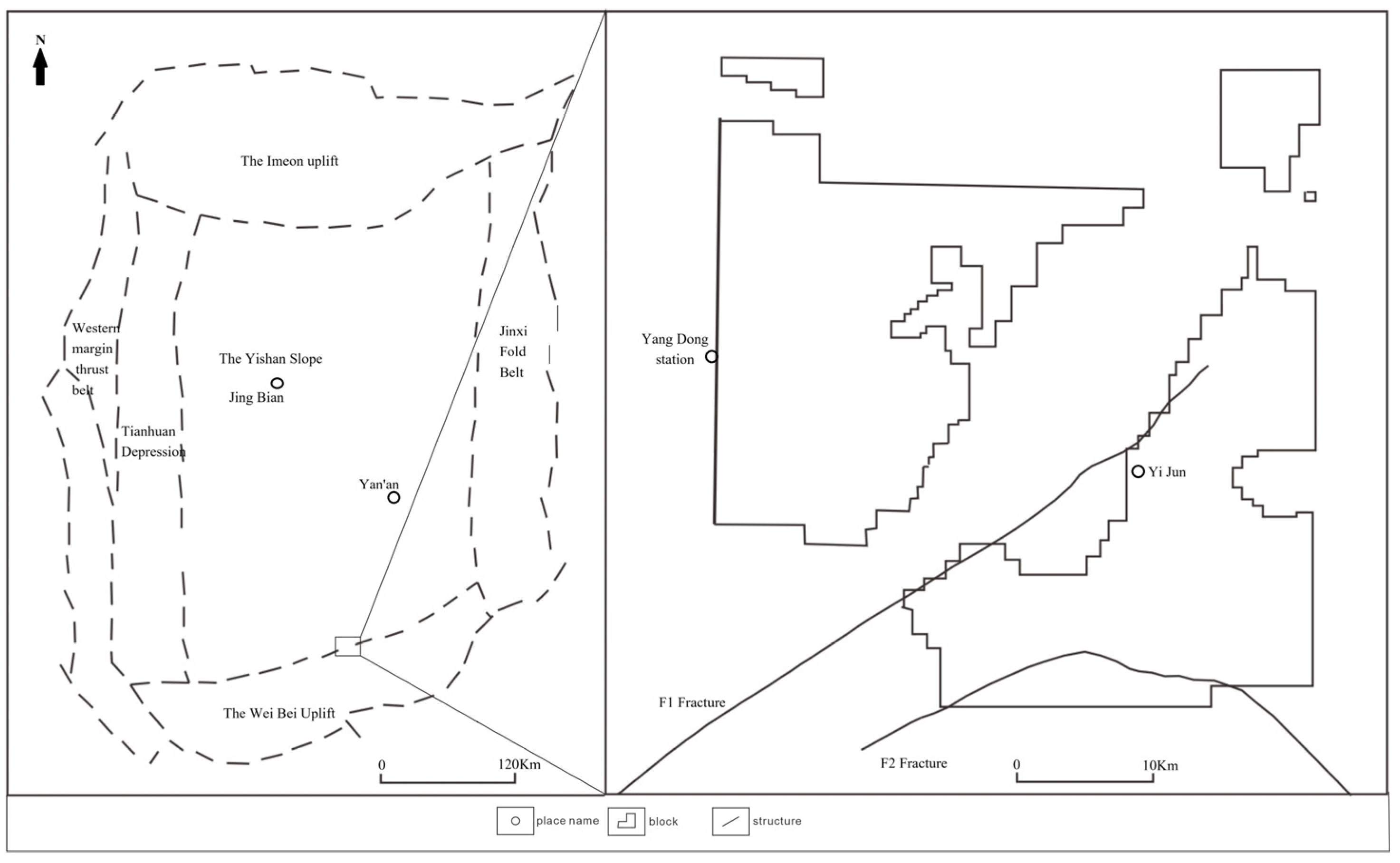
2. Regional Geological Setting
3. Materials and Methods
3.1. Sample Selection
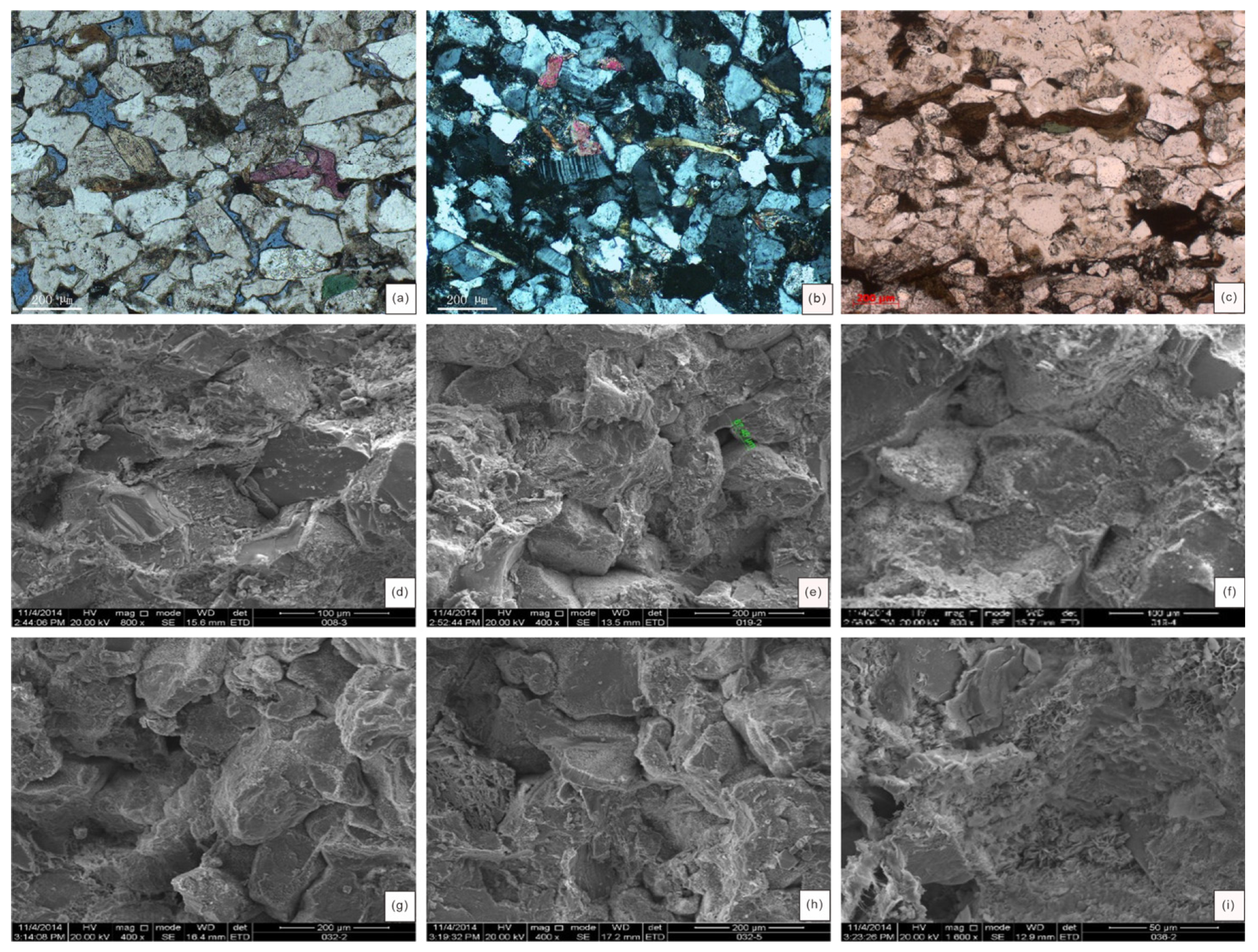
3.2. Microstructure Characterization
3.3. Sample Composition Identification
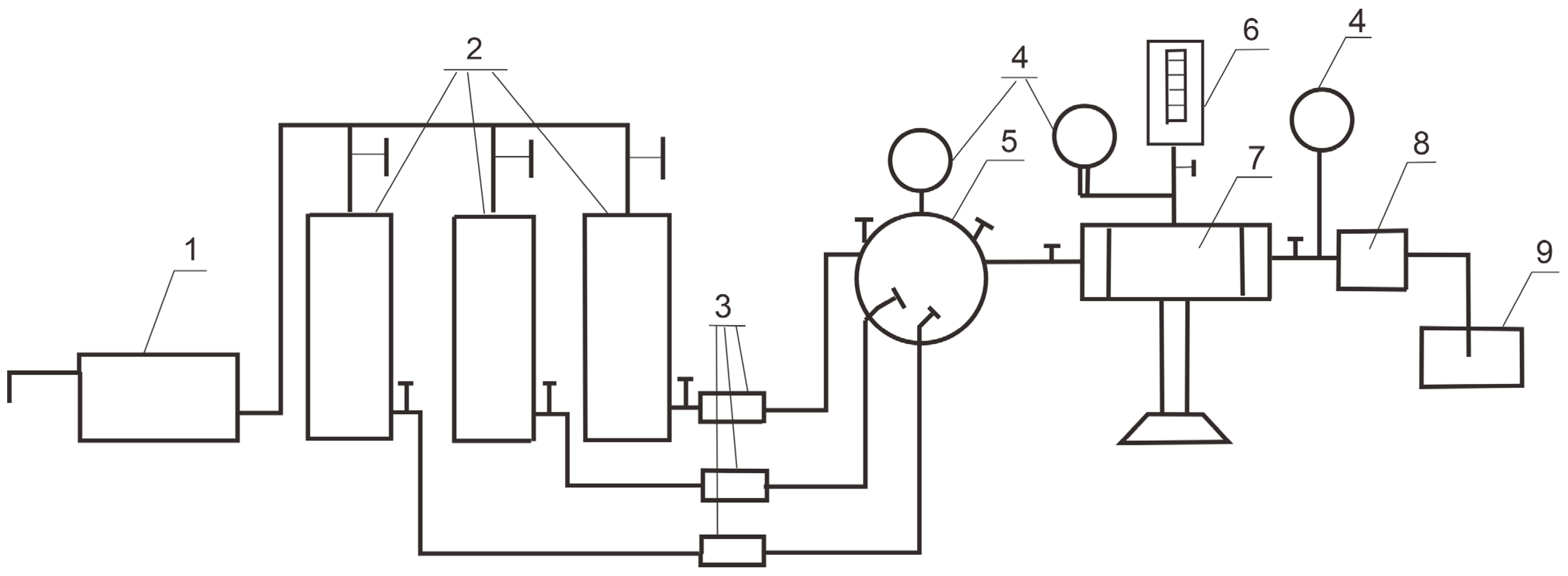
3.4. Sensitivity Measurement

3.5. High-Pressure Mercury Intrusion Porosimetry
3.6. Establishment of the PLS Model
4. Result
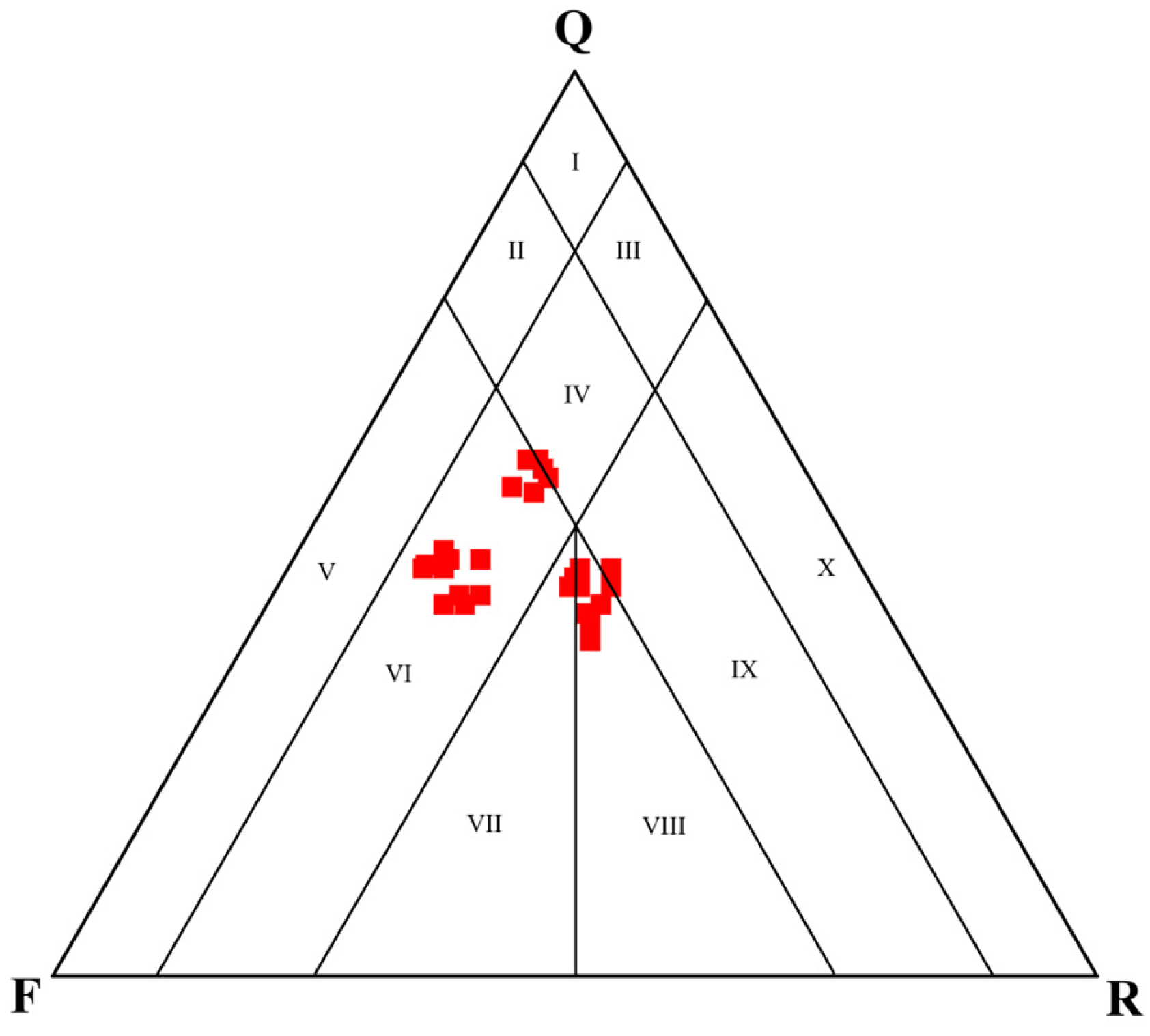
4.1. Reservoir Petrological Characteristics
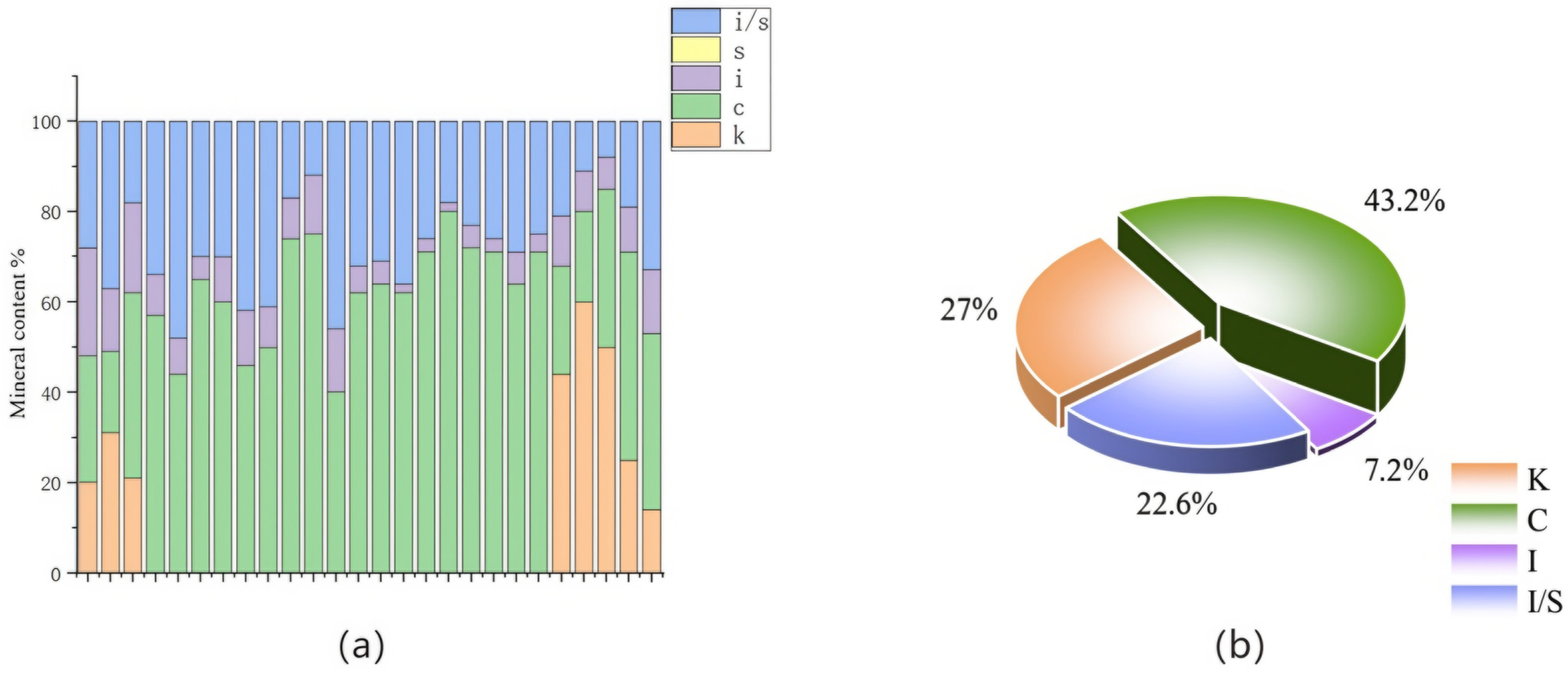
4.2. Clay Mineral Composition
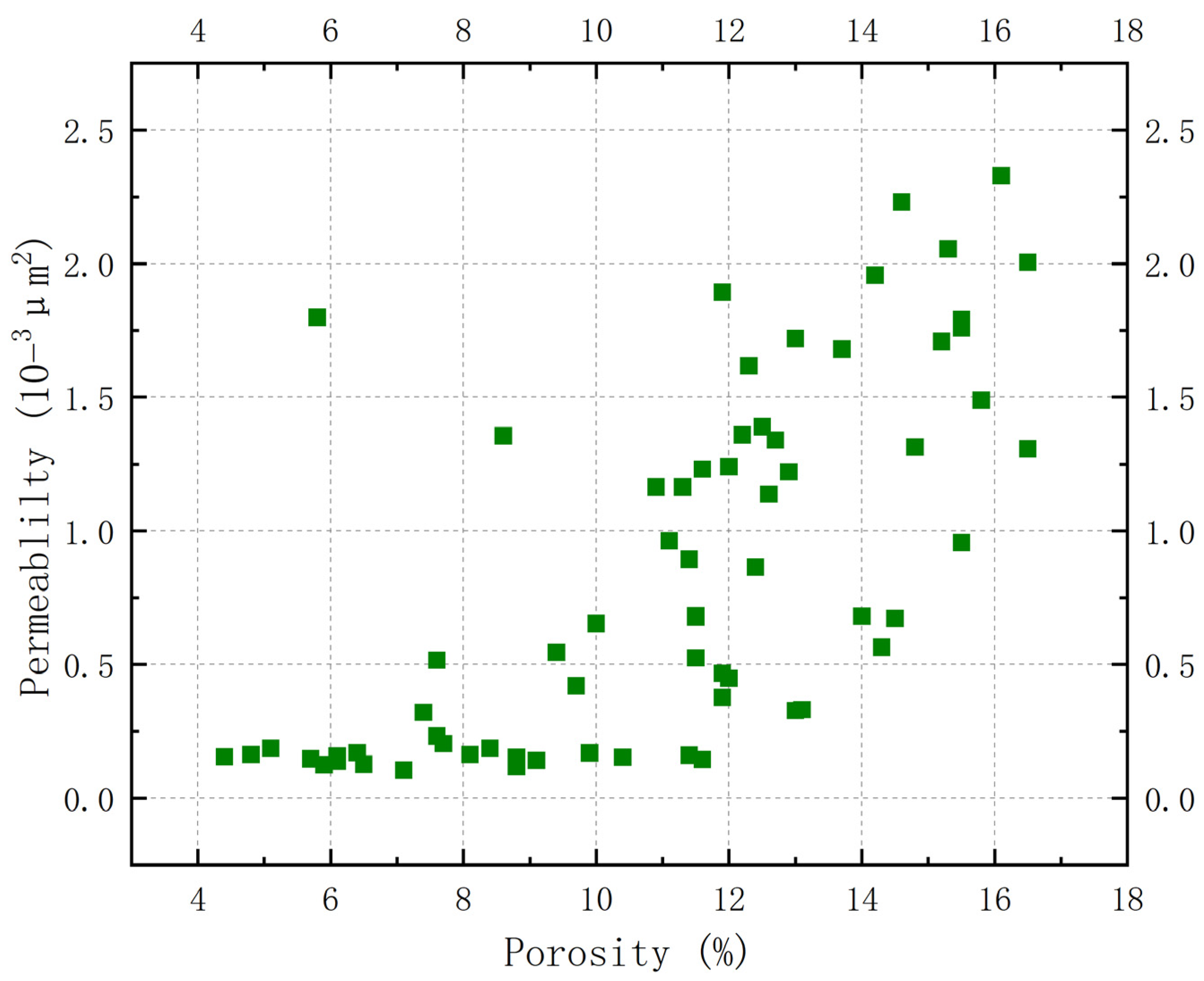
4.3. Pore-Permeability Structure Characteristics
4.4. Reservoir Sensitivity Characteristics
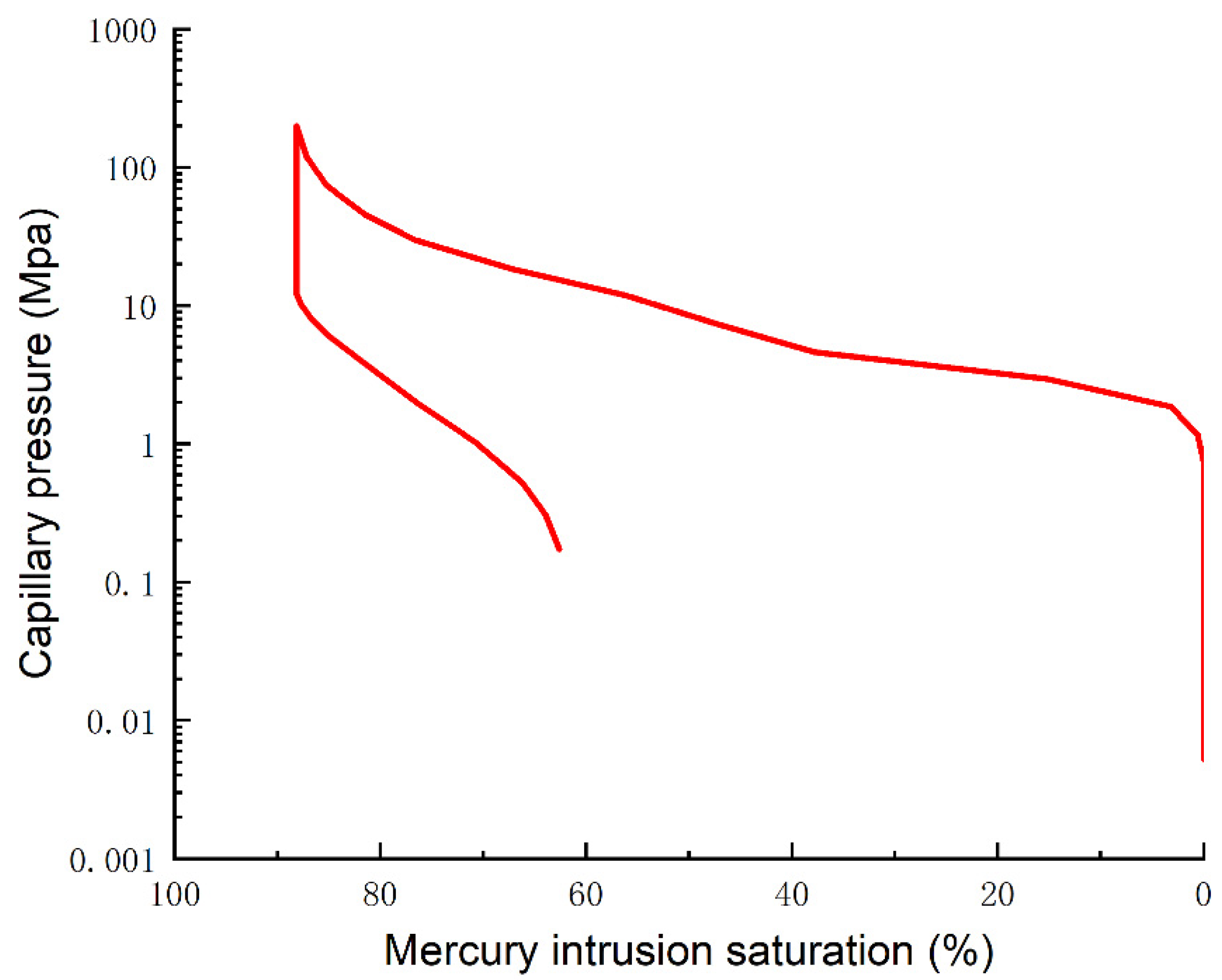
4.5. Pore-Throat Structure Characteristics
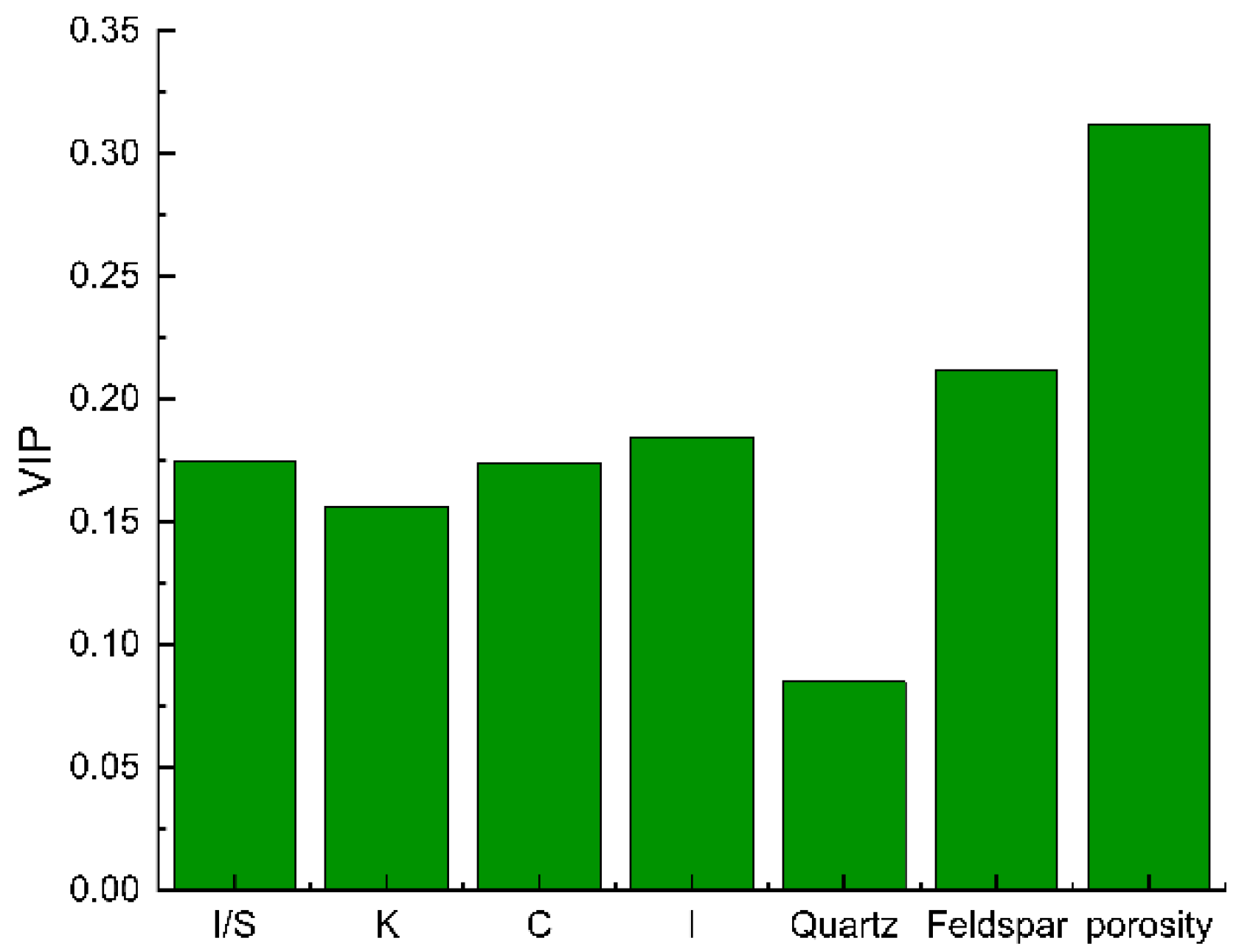
4.6. Controlling Factors of Reservoir Sensitivity
5. Discussion
5.1. Differentiated Regulation Mechanisms of Clay Minerals on Various Sensitivities Under a Multivariate Coupling System
5.1.1. Coupled Regulation of Water Sensitivity by Clay Minerals
5.1.2. Regulatory Role of Clay Minerals on Velocity Sensitivity
5.1.3. Differential Effects of Clay Minerals on Acid Sensitivity and Alkali Sensitivity
5.2. Macro-Regulatory Role of Reservoir Petrological Characteristics on Sensitivity
5.2.1. Macro-Regulatory Mechanism of Porosity on Various Sensitivities
5.2.2. Modulating Role of Detrital Minerals on Sensitivity
5.3. Microscopic Modulation Mechanisms of Diagenetic Evolution and Mineral Occurrence on Sensitivity
5.3.1. Fundamental Control of Compaction on Sensitivity
5.3.2. Differential Modulation of Sensitivity by Cementation
5.3.3. Dual Effects of Dissolution on Sensitivity
5.4. Multi-Factor Coupling Model of Reservoir Sensitivity Damage and Methodological Implications
6. Conclusions
- The PLS model results indicate that reservoir sensitivity is controlled by the combined effects of multiple factors. Specifically, porosity, feldspar, and mixed-layer illite/smectite (I/S) minerals contribute significantly to different types of sensitivity. Through VIP analysis for various sensitivity types, this study confirms the relatively dominant role of porosity in reservoir sensitivity, particularly concerning velocity sensitivity and acid sensitivity. Furthermore, the influence of I/S minerals on water sensitivity is prominent, reflected by their relatively high VIP value in the PLS model, suggesting that their swellability has a direct impact on reservoir water sensitivity.
- This study reveals the complex relationship between the sensitivity of tight sandstone reservoirs and the occurrence state and evolutionary characteristics of minerals during diagenesis. By combining SEM observations with the PLS model, this research further validates the role of the honeycomb-like texture of I/S minerals in promoting hydration swelling and correlates this with their contribution to water sensitivity in the PLS model. This finding provides a new methodological framework for evaluating the sensitivity of tight sandstone reservoirs and offers theoretical support for developing relevant reservoir protection strategies. The study also indicates that the impacts of quartz overgrowth and feldspar dissolution on the reservoir are dual-faceted. While secondary pores generated by feldspar dissolution can improve porosity, the reprecipitation of dissolution byproducts can form pore-blocking cements, further influencing reservoir permeability.
- Although this study effectively analyzed reservoir sensitivity using the PLS model, the relatively low cumulative explained variance of the model suggests that interactions among multiple factors and unconsidered geological variables may affect a complete interpretation of reservoir sensitivity. Limitations in sample size and the local adaptability of experimental conditions could also influence the generalizability of the model results. Future research can build upon this study by expanding the sample size, considering tight sandstone reservoir sensitivity in different regions and sedimentary settings, and delving deeper into the mechanisms of mineral dissolution-reprecipitation during diagenesis and their control on reservoir sensitivity. Such efforts will contribute to a more comprehensive understanding of the multi-factor regulatory mechanisms in tight sandstone reservoirs and provide more accurate predictions and protection strategies for practical development.
Author Contributions
Funding
Data Availability Statement
Conflicts of Interest
References
- Pan, H.; Du, Y.; Zuo, Q.; Xie, Z.; Zhou, Y.; Xu, A.; Zhang, J.; Guo, Y. Stress Sensitivity of Tight Sandstone Reservoirs Under the Effect of Pore Structure Heterogeneity. Processes 2025, 13, 1960. [Google Scholar] [CrossRef]
- Li, X.; Gu, K.; Xu, W.; Song, J.; Pan, H.; Dong, Y.; Yang, X.; You, H.; Wang, L.; Fu, Z.; et al. Effects of Pore Water Content on Stress Sensitivity of Tight Sandstone Oil Reservoirs: A Study of the Mahu Block (Xinjiang Province, China). Processes 2023, 11, 3153. [Google Scholar] [CrossRef]
- Hu, Z.; Hu, M. The Reservoir Sensitivity of Triassic Baikouquan Formation in Mahu Depression. Processes 2023, 11, 3142. [Google Scholar] [CrossRef]
- Chen, Z.; Li, G.; Yang, X.; Zhang, Y. Experimental Study on Tight Sandstone Reservoir Gas Permeability Improvement Using Electric Heating. Energies 2022, 15, 1438. [Google Scholar] [CrossRef]
- Zhou, X.; Wei, J.; Zhao, J.; Zhang, X.; Fu, X.; Shamil, S.; Abdumalik, G.; Chen, Y.; Wang, J. Study on pore structure and permeability sensitivity of tight oil reservoirs. Energy 2024, 288, 129632. [Google Scholar] [CrossRef]
- Feng, J.; Wang, Q.; Li, M.; Li, X.; Zhou, K.; Tian, X.; Niu, J.; Yang, Z.; Zhang, Q.; Sun, M. Pore Pressure Prediction for High-Pressure Tight Sandstone in the Huizhou Sag, Pearl River Mouth Basin, China: A Machine Learning-Based Approach. J. Mar. Sci. Eng. 2024, 12, 703. [Google Scholar] [CrossRef]
- Liu, Z.; Shi, B.; Ge, T.; Sui, F.; Wang, Y.; Zhang, P.; Chang, X.; Liu, Y.; Wang, Y.; Wang, Z. Tight sandstone reservoir sensitivity and damage mechanism analysis: A case study from Ordos Basin, China and implications for reservoir damage prevention. Energy Geosci. 2022, 3, 394–416. [Google Scholar] [CrossRef]
- Chang, B.; Tong, Q.; Cao, C.; Zhang, Y. Effect of pore-throat structure on movable fluid and gas–water seepage in tight sandstone from the southeastern Ordos Basin, China. Sci. Rep. 2025, 15, 7714. [Google Scholar] [CrossRef]
- Song, X.; Feng, C.; Li, T.; Zhang, Q.; Pan, X.; Sun, M.; Ge, Y. Quantitative classification evaluation model for tight sandstone reservoirs based on machine learning. Sci. Rep. 2024, 14, 20712. [Google Scholar] [CrossRef]
- Li, Y.; Zhou, B.; Ren, D.; Peng, F.; Wang, G.; Li, W.; Chen, F.; Long, W. Multi-scale digital rock-based sensitivity evaluation and optimization of stimulation strategies in tight sandstone reservoirs. J. Pet. Explor. Prod. Technol. 2025, 15, 155. [Google Scholar] [CrossRef]
- Yao, J.; Deng, X.; Zhao, Y.; Han, T.; Chu, M.; Pang, J. Characteristics of tight oil in Triassic Yanchang Formation, Ordos Basin. Pet. Explor. Dev. 2013, 40, 161–169. [Google Scholar] [CrossRef]
- Yue, H.; Feng, M.; Liu, X.; Wenlian, X.; Jian, S.H.I.; Yue’e, L.I.; Juan, C.A.O. Impact of differential diagenesis on the reservoir quality of tight sandstone: An example from Chang 81 submember, Wuqi-Shunning area, Ordos Basin. Nat. Gas Explor. Dev. 2025, 48, 26–38. [Google Scholar]
- Kristály, F. Effects of clay mineral and physico-chemical variables on sandstone rock permeability. J. Oil Gas Petrochem. Sci. 2018, 1, 18–26. [Google Scholar]
- Zhao, N.; Wang, L.; Sima, L.; Guo, Y.; Zhang, H. Understanding stress-sensitive behavior of pore structure in tight sandstone reservoirs under cyclic compression using mineral, morphology, and stress analyses. J. Pet. Sci. Eng. 2022, 218, 110987. [Google Scholar] [CrossRef]
- Li, G.; Cai, W.; Meng, Y.; Wang, L.; Wang, L.; Zhang, X. Experimental evaluation on the damages of different drilling modes to tight sandstone reservoirs. Nat. Gas Ind. B 2017, 4, 256–263. [Google Scholar] [CrossRef]
- Liu, J.; Ding, W.; Yang, H.; Liu, Y. Quantitative Multiparameter Prediction of Fractured Tight Sandstone Reservoirs: A Case Study of the Yanchang Formation of the Ordos Basin, Central China. SPE J. 2021, 26, 3342–3373. [Google Scholar] [CrossRef]
- Jiang, T.; Wei, T.; Fan, X.; Xu, W.; Li, Y. Sensitivity Analysis of Tight Sandstone Reservoirs in the C-P Coal Measures on the Eastern Margin of the Ordos Basin. Geol. J. China Univ. 2020, 26, 313–322. [Google Scholar] [CrossRef]
- Gao, P.; Hu, J.; Hu, S. Mesozoic and Cenozoic Tectono-Thermal Reconstruction of the Southern Ordos Basin: Revealed by Apatite Fission Track and (U-Th)/He Dating. Minerals 2024, 14, 172. [Google Scholar] [CrossRef]
- Deng, S.; Lu, Y.; Luo, Z.; Fan, R.; Li, X.; Zhao, Y.; Ma, X.; Zhu, R.; Cui, J. Subdivision and age of the Yanchang Formation and the Middle/Upper Triassic boundary in Ordos Basin, North China. Sci. China Earth Sci. 2018, 61, 1419–1439. [Google Scholar] [CrossRef]
- Huang, Y.; Yu, X.; Fu, C. Depositional Architecture of Aggrading Delta Front Distributary Channels and Corresponding Depositional Evolution Process in Ordos Basin: Implications for Deltaic Reservoir Prediction. Water 2025, 17, 528. [Google Scholar] [CrossRef]
- Wang, L.J.; Yue, X.X.; Li, L.S.; Wang, Y.Q. Pore Development Characteristics and Main Controlling Factors of Tight Oil Reservoirs in the 7th Member of Triassic Yanchang Formation, Xunyi Area, Ordos Basin. Pet. Geol. Exp. 2024, 46, 1135–1144. [Google Scholar]
- Zhu, X. Sedimentary Petrology, 1st ed.; Petroleum Industry Press: Beijing, China, 2008; pp. 109–114. [Google Scholar]
- Wang, Y.; Zhou, L.; Jiao, Z.; Shang, Q. Sensitivity Evaluation of Tight Sandstone Reservoirs in the Yanchang Formation of Northern Shaanxi Area, Ordos Basin. J. Jilin Univ. Earth Sci. Ed. 2018, 48, 981–990. [Google Scholar]
- Gong, Q.; Shou, J.; Jiang, Z.; Huang, G.; Wamg, Y.; Ni, G. Sensitivity Evaluation of Triassic Baikouquan Formation Reservoirs in Wuerhe Oilfield, Junggar Basin. Oil Gas Geol. 2012, 33, 307–313. [Google Scholar]
- Duan, Z.; Xue, Y.; Zhang, Z.; Yang, L.; Cai, Y. Research on a Quantitative Evaluation Method for Reservoir Damage Induced by Waterflooding Rate Sensitivity in Tight Oil Reservoirs. Energies 2025, 18, 2259. [Google Scholar] [CrossRef]
- Zhai, W.; Li, Y.; Peng, S.; Yang, L.; Fan, S.; Zhao, W.; Liu, Y. Effect of Clay Minerals on the Sensitivity of Ultra-Low Permeability Sandstone Reservoirs: A Case Study of the Chang 6 Reservoir in Zhenjing Area, Ordos Basin. Complex Hydrocarb. Reserv. 2025, 18, 333–341. [Google Scholar] [CrossRef]
- Cook, J.E.; Goodwin, L.B.; Boutt, D.F.; Tobin, H.J. The Effect of Systematic Diagenetic Changes on the Mechanical Behavior of a Quartz-Cemented Sandstone. Geophysics 2015, 80, D145–D160. [Google Scholar] [CrossRef]
- Whitney, G. Role of Water in the Smectite-to-Illite Reaction. Clays Clay Miner. 1990, 38, 343–350. [Google Scholar] [CrossRef]
- Zhou, Y.; Yang, W.; Yin, D. Experimental Investigation on Reservoir Damage Caused by Clay Minerals after Water Injection in Low Permeability Sandstone Reservoirs. J. Pet. Explor. Prod. Technol. 2022, 12, 915–924. [Google Scholar] [CrossRef]
- Wang, L. Clay Stabilization in Sandstone Reservoirs and the Perspectives for Shale Reservoirs. Adv. Colloid Interface Sci. 2020, 276, 102087. [Google Scholar] [CrossRef]
- Zhang, N.; Yin, D.; Bo, W.; Wang, Y.; Sun, Y.; Cao, X.; Cao, G. Characterization of Movable Particle Transport and Plugging Mechanism in Fractured Low-Permeability Reservoirs. Geosystem Eng. 2025, 1–15. [Google Scholar] [CrossRef]
- Baker, J.C.; Uwins, P.J.R.; Mackinnon, I.D.R. ESEM Study of Authigenic Chlorite Acid Sensitivity in Sandstone Reservoirs. J. Pet. Sci. Eng. 1993, 8, 269–277. [Google Scholar] [CrossRef]
- Zhong, X.; Zhu, Y.; Liu, L.; Yang, H.; Li, Y.; Xie, Y.; Liu, L. The Characteristics and Influencing Factors of Permeability Stress Sensitivity of Tight Sandstone Reservoirs. J. Pet. Sci. Eng. 2020, 191, 107221. [Google Scholar] [CrossRef]
- Nadeau, P.H. An Experimental Study of the Effects of Diagenetic Clay Minerals on Reservoir Sands. Clays Clay Miner. 1998, 46, 18–26. [Google Scholar] [CrossRef]
- Waqar, M.F.; Guo, S.; Qi, S.; Karim, M.A.M.; Zada, K.; Ahmed, I.; Shang, Y. Influence of Mineralogical and Petrographic Properties on the Mechanical Behavior of Granitic and Mafic Rocks. Minerals 2025, 15, 747. [Google Scholar] [CrossRef]
- Pallatt, N.; Wilson, J.; McHardy, B. The Relationship Between Permeability and the Morphology of Diagenetic Illite in Reservoir Rocks. J. Pet. Technol. 1984, 36, 2225–2227. [Google Scholar] [CrossRef]
- Baker, J.C.; Uwins, P.J.R.; Mackinnon, I.D.R. ESEM Study of Illite/Smectite Freshwater Sensitivity in Sandstone Reservoirs. J. Pet. Sci. Eng. 1993, 9, 83–94. [Google Scholar] [CrossRef]
- Leder, F.; Park, W.C. Porosity Reduction in Sandstone by Quartz Overgrowth. AAPG Bull. 1986, 70, 1713–1728. [Google Scholar] [CrossRef]
- Lorenz, J.C. Stress-Sensitive Reservoirs. J. Pet. Technol. 1999, 51, 61–63. [Google Scholar] [CrossRef]
- Liu, B.; Wang, Y.; Yu, H.; Li, X.; Zhao, L. Investigation of the Relationship Between Reservoir Sensitivity and Injectivity Impedance in Low-Permeability Reservoirs. Processes 2025, 13, 3283. [Google Scholar] [CrossRef]



| Reservoir Sensitivity | R2 | RMSE |
|---|---|---|
| Water sensitivity | 0.0445 | 8.12% |
| Velocity sensitivity | 0.3654 | 5.93% |
| Acid sensitivity | 0.5118 | 4.87% |
| Alkali sensitivity | 0.5656 | 4.21% |
| Stress sensitivity | 0.2292 | 6.75% |
| Formation | Types of Sensitivity | Maximum Value | Minimum Value |
|---|---|---|---|
| Chang 3 | Water sensitivity | 51.1% | 6% |
| Velocity sensitivity | 68.4% | 5.98% | |
| Acid sensitivity | 40% | 3.86% | |
| Alkali sensitivity | 43.4% | 0.26% | |
| Stress sensitivity | 69.2% | 9.5% |
| Independent Variables | I/S | K | C | I | Quartz | Feldspar | Porosity |
|---|---|---|---|---|---|---|---|
| VIP | 0.1745 | 0.1563 | 0.1741 | 0.1845 | 0.0849 | 0.2120 | 0.3115 |
Disclaimer/Publisher’s Note: The statements, opinions and data contained in all publications are solely those of the individual author(s) and contributor(s) and not of MDPI and/or the editor(s). MDPI and/or the editor(s) disclaim responsibility for any injury to people or property resulting from any ideas, methods, instructions or products referred to in the content. |
© 2026 by the authors. Licensee MDPI, Basel, Switzerland. This article is an open access article distributed under the terms and conditions of the Creative Commons Attribution (CC BY) license.
Share and Cite
Lei, Y.; Zhang, J.; Zhang, T.; Zhang, F.; Wang, B.; Zhang, Z.; Suo, R. Quantitative Identification of Main Controlling Factors for Tight Sandstone Reservoir Sensitivity Based on PLS: A Case Study of the Yanchang Formation in the Xunyi–Yijun Area, Southern Ordos Basin. Processes 2026, 14, 1147. https://doi.org/10.3390/pr14071147
Lei Y, Zhang J, Zhang T, Zhang F, Wang B, Zhang Z, Suo R. Quantitative Identification of Main Controlling Factors for Tight Sandstone Reservoir Sensitivity Based on PLS: A Case Study of the Yanchang Formation in the Xunyi–Yijun Area, Southern Ordos Basin. Processes. 2026; 14(7):1147. https://doi.org/10.3390/pr14071147
Chicago/Turabian StyleLei, Yitao, Jingong Zhang, Tao Zhang, Feng Zhang, Bolong Wang, Zhaoyu Zhang, and Ruilong Suo. 2026. "Quantitative Identification of Main Controlling Factors for Tight Sandstone Reservoir Sensitivity Based on PLS: A Case Study of the Yanchang Formation in the Xunyi–Yijun Area, Southern Ordos Basin" Processes 14, no. 7: 1147. https://doi.org/10.3390/pr14071147
APA StyleLei, Y., Zhang, J., Zhang, T., Zhang, F., Wang, B., Zhang, Z., & Suo, R. (2026). Quantitative Identification of Main Controlling Factors for Tight Sandstone Reservoir Sensitivity Based on PLS: A Case Study of the Yanchang Formation in the Xunyi–Yijun Area, Southern Ordos Basin. Processes, 14(7), 1147. https://doi.org/10.3390/pr14071147