Article

Carbon Flow Tracking and Optimal Scheduling of Distributed Integrated Energy Systems Embedding Biomass Combined Heat and Power

1
Department of Energy and Power Engineering, Tsinghua University, Beijing 100084, China
2
State Grid Hebei Electric Power Co., Ltd., Shijiazhuang 050000, China
3
State Key Lab of Power System Operation and Control, Beijing 100084, China
*
Author to whom correspondence should be addressed.
Processes 2026, 14(7), 1128; https://doi.org/10.3390/pr14071128
Submission received: 3 February 2026 / Revised: 22 March 2026 / Accepted: 24 March 2026 / Published: 31 March 2026
(This article belongs to the Special Issue Process Safety and Control Strategies for Urban Clean Energy Systems)

Abstract

Distributed integrated energy systems embedding biomass combined heat and power (BCHP) have the potential to enhance energy supply reliability in rural areas and to support the low-carbon transformation. However, the sources and transmission paths of car-bon emissions remain difficult to quantify due to the multi-energy coupling and diverse conversion processes. To address these issues, this study develops a carbon flow tracking and scheduling strategy for BCHP-integrated distributed energy systems. First, a bio-chemical reaction process model for BCHP is established to enable a life cycle-based carbon emission accounting. Second, the flexible heat-to-power ratio characteristics of BCHP are considered to more accurately reflect multi-energy coupling under varying operating conditions. Third, a dual-objective optimal scheduling model is constructed by combining node carbon potential with operating costs, enabling the system to simultaneously minimize operating costs and carbon emissions. A case study of an integrated energy system in Anping County, Hebei Province, demonstrates that the proposed method reduces total carbon emissions by over 9.8%, increases renewable energy utilization by 15.2%, and lowers operating costs by 7.5%. The results reveal the carbon flow characteristics and emission reduction potential of rural distributed integrated energy systems embedding BCHP, providing methodological support and empirical evidence for refined low-carbon governance.

1. Introduction

Distributed integrated energy systems (DIES) are small-scale, modular energy systems deployed at or near end users to provide localized multi-energy supply. Unlike most traditional large-scale centralized energy systems, DIES feature spatial proximity between energy generation and consumption, thereby reducing transmission losses, prioritizing local utilization, and improving renewable energy integration. DIES feature spatially proximate energy generation and consumption, thereby reducing transmission losses, prioritizing local utilization, and improving the integration of renewable energy [1,2].
Rural and remote areas possess abundant biomass resources for power generation, including agricultural residues (e.g., straw, husks, and shells), woody biomass (e.g., pellets, chips, and sawdust), industrial and municipal sludge, and dedicated energy crops [3,4]. Using biomass as fuel for combined heat and power (BCHP) enables the simultaneous generation of electricity and heat, achieving total system efficiencies of 80% or higher [5]. Consequently, BCHP plants fueled by agricultural residues have become a widely adopted option for heat and power supply worldwide [6]. Extensive studies have investigated BCHP systems based on various biomass feedstocks, including agricultural residues, forestry residues, and energy crops, with a focus on energy efficiency, economic performance, and environmental benefits [7]. In addition, co-firing biomass with coal has been shown to effectively reduce pollutant emissions and to enhance the overall environmental performance of BCHP systems.
From the perspective of system modeling and operational mechanisms, recent studies have increasingly focused on capturing the internal operation characteristics of BCHP systems and their dependence on gasification processes and feedstock properties [8]. Further studies have incorporated the effects of the energy variations associated with different chemical reaction products during biomass gasification [9]. In addition, comparative analyses have been conducted to evaluate the emission characteristics of BCHP systems under different biomass waste feedstocks, highlighting the influence of feedstock selection on system emissions [10]. Although these studies have clarified how gasification processes and feedstock types affect the operation of BCHP, they lack the detailed modeling of biochemical reaction pathways and do not clearly analyze the carbon flow associated with different reactions.
Currently, extensive research has been conducted on the low-carbon economic dispatch modeling of DIES [11,12]. Reference [13] investigated electric–thermal–gas coupling, considered the impact of equipment input power variations on operating efficiency, and established a low-carbon economic dispatch model based on variable operating characteristics of equipment. References [14,15,16] introduce tiered carbon trading and deep reinforcement learning-based strategies into integrated energy system dispatch, effectively guiding and constraining system carbon emissions through market mechanisms and data-driven optimization.
Another major research direction concentrates on improving the economic efficiency and low-carbon performance of integrated energy systems through user-side flexibility exploitation and advanced multi-objective optimization methods. References [17,18,19,20] considered demand response strategies for park users, which improved the economic efficiency and low-carbon performance of park operation to some extent. To further improve the convergence and solution quality of multi-objective optimization, Reference [21] proposed a multi-objective particle swarm optimization algorithm based on the multi-strategy improvement of hybrid energy storage configuration. In addition, Reference [22] applied an elite non-dominated sorting and grid index-based multi-objective crawling search algorithm to wind farm layout optimization. References [23,24] used NSGA-II and NSGA-III algorithms to solve multi-objective optimization problems, respectively. The above-mentioned solution algorithms have good applicability and convergence for multi-objective optimization problems in energy systems.
To address the limitations of conventional emission accounting approaches, carbon flow theory has been introduced to analyze the spatial and temporal distribution of carbon emissions in energy networks. The theoretical foundation of carbon flow tracing lies in the proportional sharing principle for power flow [25], which for the first time enables systematic tracing of power flows in meshed networks and serves as the core theoretical basis for subsequent carbon flow tracing methods. On this basis, a formal carbon emission flow (CEF) analysis framework for power networks has been established [26,27], which realizes the quantitative tracing of carbon emissions from generation to demand by defining core metrics such as nodal carbon intensity and carbon emission flow rate. Subsequently, this framework has been further extended to multi-energy systems, forming a generalized carbon emission flow model applicable to energy hubs with coupled electricity, heat, and gas carriers [28]. This model is adaptable to the coupling characteristics of multiple energy carriers and is highly relevant to the BCHP-integrated networks studied in this work. Some recent studies have further extended carbon flow analysis to integrated energy systems by incorporating multiple energy carriers and life cycle emission factors [29,30,31]. Nevertheless, most existing carbon flow models are developed for large-scale power networks and rely mainly on electrical power flow information, which limits their applicability to distributed energy systems with complex energy conversion processes such as BCHP [32]. A comparative summary of related studies is presented in Table 1, which highlights the gaps in current research and the key contributions of this work.
This paper studies the carbon emission factor modeling and low-carbon operation of a DIES embedded with BCHP, with particular emphasis on accurately characterizing the BCHP process and its related carbon transfer. The main contributions are as follows:
(1)
A carbon flow tracking framework for a typical BCHP-embedded DIES is con-structed, achieving refined life cycle carbon emission accounting by clearly modeling the chemical reaction process of BCHP;
(2)
The flexible thermoelectric ratio characteristics of BCHP are incorporated into the system model to more accurately represent the multi-energy coupling and energy–carbon interaction characteristics under rural operating conditions;
(3)
By coupling node carbon potential with operating costs, a multi-objective optimization scheduling model is established for the BCHP-embedded system to simultaneously minimize operating costs and carbon emissions.
Section 2 presents the BCHP-integrated energy system model for the rural network. Section 3 develops the carbon emission accounting model. Section 4 formulates the multi-objective optimal scheduling model. Section 5 presents the case study simulations and discussion.

2. Distributed Integrated Energy Systems and Carbon Flow Model

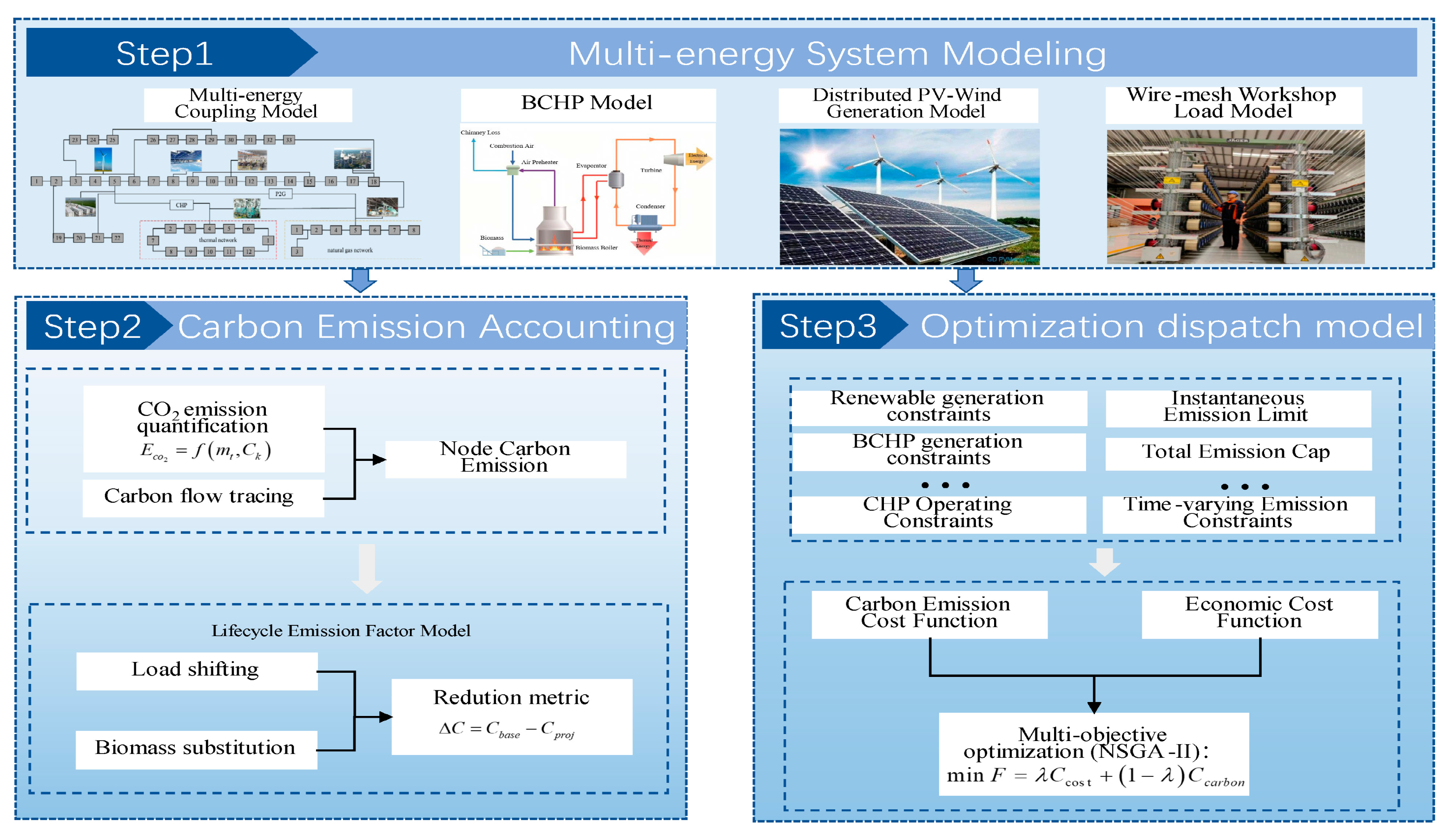
The overall workflow is summarized in four steps, as shown in Figure 1, including multi-energy system modeling, carbon emission accounting, mitigation potential assessment, and construction of the optimization dispatch model. This framework links multi-energy physical models with carbon flow and mitigation potential analyses to support the subsequent formulation of dispatch strategies.

2.1. BCHP Model

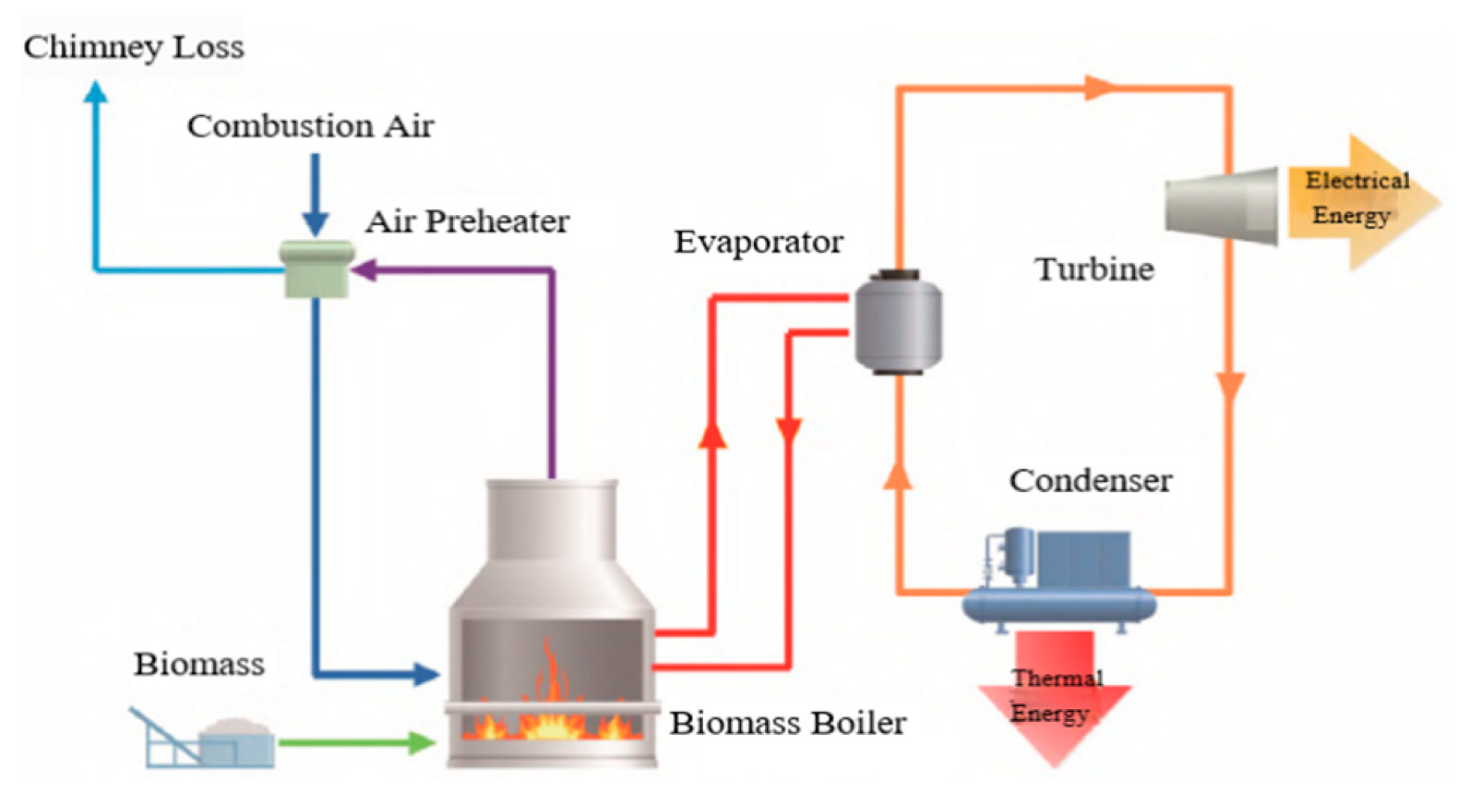
Biomass can be converted into electricity through combustion while generating heat, and such heat can be further converted into additional electricity via thermodynamic cycles. In the biomass boiler of Figure 2, the solid biomass can be represented by an empirical formula C x H y O z . Under air gasification conditions, it is first converted into a combustible gas mixture, and the overall gasification process can be simplified as follows:
C x H y O z + w H 2 O + v O 2 a CO + b H 2 + c CO 2 + d CH 4 + e H 2 O
where a e denote the molar coefficients of the main gasification products. Under air gasification conditions, the key elementary reactions include the following:
C + H 2 O CO + H 2 C + CO 2 2 CO CO + H 2 O CO 2 + H 2
These elementary reactions describe the main conversion pathways of the organic carbon in biomass inside the biomass boiler and jointly determine the composition of the producer gas that provides the heat for steam generation in Figure 2.
Part of the combustible components, especially CH 4 , are then burned in the boiler or gas engine of the BCHP unit to provide heat for power generation. The complete combustion reaction of methane is as follows:
CH 4 + 2 O 2 CO 2 + 2 H 2 O
According to the reaction stoichiometry, 1 mol CH 4 corresponds to 1 mol CO 2 in the flue gas. The thermal power of the fuel input can be expressed as follows:
P f u e l = m ˙ b i o L H V b i o
where m ˙ b i o is the mass flow rate of the biomass fuel and L H V b i o is its lower heating value.
During anaerobic digestion or biogas production, the internal organic matter of biomass can be abstracted mainly as CxHyOz–type substances composed of carbon, hydrogen, and oxygen, and also contains a certain proportion of nitrogen- and sulfur-containing components. The main organic components differ significantly among biomass from different sources, leading to differences in releasable carbon, methane yield, and the volume fraction of recovered CO2. To establish a traceable pathway from biomass sources to energy conversion, a component vector is introduced as follows:
s r = C r , H r , O r , N r , S r T
where C r , H r , O r , N r , S r denote the mass percentages of carbon, hydrogen, oxygen, nitrogen, and sulfur in biomass type r, respectively; the subscript r indicates the biomass source category.
On the basis of this component vector, the effective carbon ratio of the releasable carbon factor for biomass can be defined as follows:
f b i o , r = α r C r 100
where α r represents the fraction of carbon contained in the biomass fuel that is ultimately released to the atmosphere after considering carbon losses occurring throughout the biomass supply chain. These losses arise during preprocessing, storage, transportation, and combustion processes. The effective carbon ratio can be expressed as follows:
α r = 1 k = 1 n λ k
In this expression, λ k denotes the carbon loss rate associated with the (k)-th stage of the biomass supply chain.
Field investigations conducted in Anping County indicated that several processes contribute to carbon losses before final emission. During preprocessing operations, such as crushing and drying, a portion of biomass carbon is released in the form of volatile organic compounds and water vapor. The carbon loss rate associated with this stage is estimated to be λ 1 = 0.08 . During storage under outdoor covered conditions, microbial activity leads to the partial decomposition of biomass material and results in an additional carbon loss rate of λ 2 = 0.04 . During short-distance transportation by truck over a distance of approximately 20 km, fuel consumption and minor material degradation lead to a carbon loss rate of λ 3 = 0.02 . During combustion, a small fraction of carbon remains in ash residues rather than being emitted to the atmosphere, and the corresponding carbon loss rate is λ 4 = 0.01 .
The total carbon loss rate across the biomass supply chain is therefore k = 1 4 λ k = 0.15 . Based on this value, the effective carbon ratio for corn straw pellets is calculated as α r = 0.85 .
For other biomass feedstocks, such as wood chips and rice husk, the effective carbon ratio varies slightly due to differences in moisture content, carbon composition, and physical characteristics during handling and processing. In typical rural biomass energy systems, the effective carbon ratio of common biomass fuels generally lies within the range α r = 0.82 ~ 0.88 . This range can therefore be adopted as a reasonable parameter interval for carbon accounting in distributed biomass-based energy systems.
The parameter f b i o , r reflects the effective carbon content of biomass that participates in the gasification–combustion process and is the basic parameter for constructing BCHP carbon emission factors.
For the BCHP unit that simultaneously produces electricity and heat, the total carbon emissions are allocated to the two energy outputs, based on the exergy efficiency principle, to realize traceable carbon flow distribution in the electricity and thermal networks. The allocation model is as follows:
C B C H P , t t o t a l = C B C H P , t e l e c + C B C H P , t h e a t
C B C H P , t e l e c = η e l e c P B C H P , t e l e c η e l e c P B C H P , t e l e c + η h e a t P B C H P , t h e a t × C B C H P , t t o t a l
C B C H P , t h e a t = η h e a t P B C H P , t h e a t η e l e c P B C H P , t e l e c + η h e a t P B C H P , t h e a t × C B C H P , t t o t a l
where C B C H P , t t o t a l is the total carbon emission of the BCHP unit at time t , C B C H P , t e l e c and C B C H P , t h e a t are the carbon emissions allocated to electricity and heat output, respectively, η e l e c and η h e a t are the power generation and heating efficiency of the BCHP unit, and P B C H P , t e l e c and P B C H P , t h e a t are the electric and thermal power output of the BCHP unit at time t .

2.2. Distributed Photovoltaic and Wind Turbine Models

The power output of photovoltaic (PV) power generation is related to factors such as solar irradiance, and its output model is as follows:
P P V ( t ) = P P V , S T C G ( t ) G S T C [ 1 +   α P ( T c ( t ) T S T C ) ]
In the formula, G S T C represents standard solar irradiance with a value of 1000 W / m 2 , T S T C represents standard temperature with a value of 25   ° C , α P represents standard power temperature coefficient with a value of 0.0045 / ° C , P P V , S T C represents the rated power output of the photovoltaic system under standard test conditions, P P V ( t ) represents the actual power output of the photovoltaic system at time t , G ( t ) represents the actual solar irradiance at time t , and T c ( t ) represents the actual surface temperature of the photovoltaic cell at time t .
The power output of wind power generation is determined by the rated power of the wind turbine and wind speed, and its output model is as follows:
P w t ( t ) = 0 , v 0 , v q r or v e , + v 3 v q r 3 v q c 3 v q r 3 P w t , e ( t ) , v v q r , v q c P w t , e ( t ) , v v q c , v e
In the formula, P w t ( t ) is the wind power output in time period t, P w t , e ( t ) is the rated power of the wind turbine in time period t, v q c is the cut-in wind speed of the wind turbine, and v c is the rated wind speed of the wind turbine.

2.3. Carbon Emission Accounting Model

The carbon flow tracking in this study is based on the proportional sharing principle, which is the theoretical foundation of carbon emission flow analysis. For any node i in the energy network, the total inflow carbon flow equals the total outflow carbon flow (carbon flow conservation), and the carbon flow of each outflow branch is allocated in proportion to its active power share in the total outflow power of the node. The explicit mathematical formulations are as follows:
j Ω i , i n F i j , t c a r b o n + C i , t i n j e c t i o n = j Ω i , o u t F j i , t c a r b o n
F j i , t c a r b o n = P j i , t k Ω i , o u t P k i , t × j Ω i , i n F i j , t c a r b o n + C i , t i n j e c t i o n
where Ω i , i n and Ω i , o u t are the sets of inflow and outflow branches of node i , respectively, F i j , t c a r b o n is the carbon flow rate of branch i j at time t (kg CO2/h), C i , t i n j e c t i o n is the carbon emission injection at node i at time t (from local sources such as BCHP and grid-purchased electricity, kg CO2/h), and P j i , t is the active power of branch j i at time t (kW).
Building upon the gasification and combustion reactions in Section 2.1, the carbon contained in biomass is eventually oxidized to CO2 and released with the generation of electrical and thermal energy. According to the biomass composition vector and the effective carbon ratio defined in Equations (5) and (6), the CO2 emissions of the BCHP unit can be quantified in two equivalent ways.
For a BCHP unit consuming multiple types of biomass fuels, the total CO2 emissions over a scheduling horizon can then be calculated in a mechanism-oriented form as follows:
E CO 2 carb = r m ˙ bio , r   f bio , r   11 3
where m ˙ bio , r is the mass flow rate of biomass fuel type r , f bio , r denotes the effective mass fraction of carbon in biomass type r that actually participates in the gasification–combustion process, and 11 / 3 is the molecular–weight ratio converting carbon mass to CO2 mass. This formulation links the CO2 emissions of the BCHP directly to the elemental composition of biomass and the reaction pathways described in Section 2.1.
After obtaining the carbon emissions of the BCHP (building cooling, heating, and power) unit, it is necessary to map the carbon emissions from different energy sources within the system to the network nodes, thereby characterizing the spatial distribution of carbon emissions in the integrated energy system. The system’s carbon emissions mainly originate from the power generation process of the BCHP unit and the electricity purchased from the main grid.
The carbon emissions corresponding to grid-purchased electricity are calculated based on the purchased power and the marginal emission factor of the grid. The grid marginal emission factor reflects the average carbon emissions generated per unit of electricity production. Therefore, a larger amount of purchased electricity corresponds to higher embodied carbon emissions introduced into the system. This emission amount is regarded as a carbon emission source injected into the system from the grid connection node.
The carbon emissions generated by the BCHP unit are first allocated to the node to which it is connected, serving as the carbon emission injection for that node. Subsequently, the carbon emissions are transmitted within the system according to the direction of power flow in the electrical network and are allocated to downstream nodes based on the proportion of power flow at each node, thereby forming the carbon emission transmission path within the system. The total carbon emissions at a node consist of the carbon emissions produced by local energy conversion equipment and the carbon emissions introduced by purchasing electricity from the grid. Based on this, the nodal carbon intensity is further defined to describe the carbon emission intensity carried per unit of power flow.
For multi-energy conversion equipment (electric boiler, gas boiler, P2G, etc.), the carbon flow rate of the output energy equals the carbon flow rate of the input energy plus the direct carbon emissions of the equipment itself. The carbon intensity conversion model is established as follows:
F o u t , t c a r b o n = F i n , t c a r b o n + C d e v i c e , t d i r e c t
λ o u t , t = F o u t , t c a r b o n P o u t , t = λ i n , t P i n , t + C d e v i c e , t d i r e c t P o u t , t
where λ o u t , t and λ i n , t are the carbon emission intensity of the output and input energy of the equipment (kg CO2/kWh), P o u t , t and P i n , t are the output and input power of the equipment, and C d e v i c e , t d i r e c t is the direct carbon emission from the operation of the equipment itself (e.g., gas combustion emissions of boilers).
Node carbon potential φ i t is defined as the carbon emissions carried by unit power flowing through node i at time t, which characterizes the carbon emission intensity of the network node. Its calculation formula is as follows:
φ i ( t ) = E i , CO 2 ( t ) P i ( t )
where E i , CO 2 ( t ) is the total carbon emission of node i at time t and P i ( t ) is the transmission power of node i at time t. In the subsequent carbon flow tracking model, the BCHP CO2 emissions obtained from Equation (18) will be mapped to the network nodes through node carbon potentials to characterize the spatiotemporal distribution of carbon flows in the distributed integrated energy system.

2.4. Energy Storage System Model

The energy storage system (ESS) realizes a time-series transfer of electric energy through charge and discharge, and its state of charge (SOC) dynamic balance equation is established as follows:
S O C t = S O C t 1 + η c h P c h , t Δ t E r a t e d P d c h , t Δ t η d c h E r a t e d
where S O C t and S O C t 1 are the state of charge of the ESS at time t and t 1 , respectively, η c h and η d c h are the charge and discharge efficiency of the ESS, with a typical value of 0.95, P c h , t and P d c h , t are the charge and discharge power of the ESS at time t (kW), with P c h , t P d c h , t = 0 (no simultaneous charge and discharge at the same time), Δ t is the time step, set to 1 h, and E r a t e d is the rated capacity of the ESS (kWh).

2.5. Carbon Emission Reduction Evaluation Model

The carbon emission reduction effect achieved by the system in this study is not the result of a single factor, but a comprehensive outcome of the synergy and coupling between the inherent low-carbon characteristics of the BCHP system and the optimized operational scheduling strategies. Both play their respective roles and support each other in the emission reduction process, jointly forming the low-carbon emission reduction system of the distributed integrated energy system. Among them, the BCHP system is the core foundation for achieving carbon emission reduction. It uses straw pellets as fuel to replace traditional fossil energy, and relies on the carbon cycle characteristics of the biomass life cycle to reduce the carbon emission intensity per unit energy output of the system from the energy supply side. Compared with the coal-fired energy supply mode, it fundamentally reduces carbon emission generation and is a prerequisite for the system to have a low-carbon emission reduction capacity. Optimized operational scheduling strategies, such as load time-series shifting and flexible peak-shaving, are the key means to realize carbon emission reduction. Through the spatiotemporal reconstruction of demand-side loads, the power demand during high-carbon periods is avoided, the utilization efficiency of renewable energy is improved, and the low-carbon energy supply value of the BCHP system is maximized, transforming the inherent low-carbon potential of the system into actual emission reduction benefits. Neither of the two can be absent: without the low-carbon energy supply foundation of the BCHP system, scheduling strategies alone can only realize the spatiotemporal transfer of carbon emissions and cannot achieve total volume reduction; without optimized operational scheduling strategies, the low-carbon characteristics of the BCHP system cannot be fully released, and the overall emission reduction efficiency of the system will be significantly reduced. The carbon emission reduction measured in this study is exactly the comprehensive emission reduction result under the synergy of the above-mentioned supply-side low-carbon energy replacement and demand-side optimized scheduling.

2.5.1. Load Regulation Carbon Emission Reduction Calculation Model

The load of the wire-mesh factory is dominated by productive equipment and supplemented by auxiliary systems. For modeling purposes, wire-drawing and weaving machines are treated as inflexible productive loads; while drying furnaces, air compressors, water pumps, and lighting are regarded as adjustable loads. Load regulation is implemented through time-series shifting and flexible peak-shaving under the process constraints of the factory, so as to reduce electricity consumption during high-carbon periods and to quantify the corresponding carbon emission reduction potential.
For adjustable loads, the calculation model of carbon emissions under the baseline scenario is based on the principle of multiplying electricity consumption by emission factors. The specific mathematical expression is as follows:
D l o a d , b a s e = t = 1 8760 n = 1 N P n , t , b a s e × e t , e l e c × Δ t
Among them, D l o a d , b a s e is characterized as the total annual carbon emissions of adjustable loads under the baseline operating condition, P n , t , b a s e is referred to as the active power of the n-th type of load node at hour t under the baseline scenario, e t , e l e c is the grid marginal carbon emission factor at hour t, Δ t is the time interval, set as 1 h, P n , t , b a s e is the power of the n-th type of adjustable load at hour t under the baseline scenario, Δ t is the time interval, and N is the number of adjustable load nodes.
For time-shifting regulation, part of the load originally scheduled in high-carbon periods is transferred to low-carbon periods. The daily emission reduction is determined by the transferred power Δ P s h i f t i n g , the difference between the carbon emission factors of the high-carbon and low-carbon periods, and the length of the transfer period. For peak-shaving regulation, flexible loads are curtailed during high-carbon hours; the daily emission reduction depends on the curtailed power Δ P p e a k , the carbon emission factor of the corresponding period, and the preset curtailment duration. By quantifying the emission reductions delivered by these two strategies, the overall carbon reduction potential of load regulation in the wire-mesh factory can be assessed, where the annual total reduction is obtained as the sum of the yearly contributions from time-shifting and peak-shaving, denoted as Δ D s h i f t i n g , y e a r and Δ D p e a k , y e a r , respectively.

2.5.2. Biomass Carbon Sequestration and Emission Reduction Calculation Model

Biomass carbon sequestration is achieved using straw pellets as biomass fuel, a material that is distributed around the wire-mesh factory and exhibits high availability. In the baseline scenario, without implementing alternative measures, the system solely relies on coal combustion for energy supply, and its carbon emissions are expressed as follows:
D b = Q c × e c  
where D b denotes the carbon emissions under the baseline scenario, Q c represents the coal consumption, and e c stands for the carbon emission factor of coal.
When biomass partially replaces coal, the carbon emissions under the project scenario include residual coal combustion emissions, biomass supply chain emissions, and natural decomposition emissions from the unused portion of the biomass. Based on the energy balance relationship, the required biomass quantity is expressed as follows:
M b i o = Q c × R × L H V c L H V b i o × γ b i o
The carbon emissions generated from the natural decomposition of the unused biomass are expressed as follows:
D d = M b i o × β × C b i o × 11 3
where L H V c denotes the lower heating value of coal and L H V b i o represents the lower heating value of straw pellets with L H V b i o = 15 MJ/kg ; where C b i o denotes the carbon content with C b i o = 0.45 tC/t , R denotes the carbon content with R = 0.8 , γ b i o denotes the biomass utilization efficiency with γ b i o = 0.9 , and β denotes the natural decomposition release rate with β = 0.3 , the Equation can be written as follows:
  D s   =   D a b s D e m i t + D b D p
where D a b s denotes the amount of CO2 absorbed during biomass growth, D e m i t represents the amount of CO2 released during combustion, and D p stands for the total carbon emissions under the project scenario.

3. Optimized Scheduling Model

The selection of Power-to-Gas (P2G) rather than conventional coal-fired power generation or nuclear power as the core energy conversion component of a biomass-based combined heat and power (BCHP) distributed integrated energy system in rural areas (Anping County, Hebei Province) is primarily based on four considerations.
First, from the perspective of technological compatibility, P2G enables electricity-to-gas conversion, thereby mitigating the curtailment of renewable electricity, such as rural photovoltaic and wind power. It can also form a complementary multi-energy coupling with BCHP units. By contrast, coal-fired and nuclear power plants generally operate with relatively fixed heat-to-power ratios and limited operational flexibility, making them unsuitable for the small-scale and variable load characteristics typical of rural energy systems.
Second, regarding alignment with low-carbon objectives, the P2G conversion process produces zero direct carbon emissions and can capture CO2 for methanation, enabling the synthesis of methane. This feature is highly consistent with the low-carbon characteristics of biomass-based energy systems. By comparison, coal-fired power generation is inherently carbon-intensive and would offset emission reduction benefits, while nuclear power, although low-carbon, presents fundamental conflicts with rural distributed deployment due to its stringent safety requirements and site-selection constraints.
Third, in terms of scenario adaptability, P2G technologies are characterized by modular design, flexible installation, and relatively low initial investment, which makes them well suited to rural areas where energy demand is spatially dispersed and infrastructure conditions are relatively limited. Conversely, coal-fired power plants require large-scale environmental protection facilities, and nuclear power plants demand highly restrictive site conditions, both of which make their deployment in rural contexts impractical.
Finally, from the perspective of economic synergy, P2G systems feature relatively low operational costs and can utilize surplus low-cost renewable electricity, thereby reducing the overall electricity procurement costs of the system. By contrast, coal-fired power generation entails high fuel and environmental compliance costs, while nuclear power involves substantial capital investment and operation and maintenance expenses, rendering both economically infeasible for small-scale rural energy systems.

Optimization Objective

Economic single-objective optimization aims to minimize the total system operating costs. Its objective function is the standalone form of the economic cost component F e c o from the multi-objective model, expressed as follows:
min F e c o = t C g r i d P g r i d , t + C B C H P P B C H P , t + C E E S P E E S , t + C P V P P V , t + C W T P W T , t + C f l e x P f l e x , t + C P 2 G P P 2 G , t
where C g r i d represents the grid electricity purchase cost, C B C H P denotes BCHP operational costs, C P V signifies photovoltaic generation costs, C E E S , t indicates energy storage system operational costs, C f l e x reflects flexible load regulation costs, and C P 2 G represents P2G operational costs. P g r i d , t , P B C H P , t , P P V , t , P W T , t , Δ P f l e x , t , P E E S , t , and P P 2 G , t denote the respective power outputs at corresponding time points.
The carbon emission optimization model aims to minimize the system’s total carbon emissions. The system’s total carbon emissions can be expressed as the weighted sum of power outputs from various energy sources multiplied by their corresponding carbon emission factors, as follows:
min F c a r b o n = t s α s P s , t
where α s is the carbon emission factor for energy form s and P s , t is the output power of energy form s at time t . Therefore, α s P s , t represents the carbon emissions caused by this energy form at time t . Energy type s represents the different supply and conversion sources in the system, including electricity, photovoltaic, wind power, and BCHP.
In this formulation, the constraints in Equations (27)–(32) jointly describe the operating limits of flexible loads and equipment, the power and energy balance in each time interval, and the system-wide carbon emission caps, as detailed below. Equation (27) limits the regulation range of the aggregated flexible loads at each time step, ensuring that the absolute value of the power adjustment does not exceed the specified maximum value. Equation (28) enforces the intraday energy-neutral requirement for load regulation, i.e., the upward and downward adjustments of flexible loads over the whole scheduling horizon must sum to zero. Equation (29) specifies the power balance of the wire-mesh factory at each time step, requiring that the electricity supplied by PV, wind turbines, the main grid, and the BCHP unit matches the total load demand, including the power consumed by P2G facilities and energy storage units. Equations (30) and (31) impose the operating limits of generation and conversion equipment, so that the outputs of PV, wind, and P2G units cannot exceed their rated capacities determined by equipment sizing and renewable-resource availability. Equation (32) defines the instantaneous total carbon emissions of the system at time t as the sum of emissions from all load categories and network losses, and constrains this value below the maximum permissible emission C m a x ( t ) . Equation (33) accumulates the total carbon emissions over the entire scheduling horizon to obtain C sum , and requires that the cumulative emissions do not exceed the upper bound C limit . Equations (35)–(38) jointly define the safe operation boundaries of the energy storage system, including the limits of charge and discharge power, the range of state of charge, and the energy balance requirement within the scheduling cycle, to ensure the stable and reliable operation of the ESS.
Δ P flex , t Δ P flex max
t Δ P flex , t = 0
P PV , t + P WT , t + P Grid , t + P BCHP , t = P load , t + P P 2 G , t + P ESS , t
0 P PV , t P PV max
0 P WT , t P WT max
0 P P 2 G , t P P 2 G max
C total ( t ) = i = 1 N L i ( t )   C f , i ( t ) + P loss ( t )   C f grid C max ( t )
C sum = t = 1 T C total ( t ) C limit
0 P c h , t P c h , m a x ,   t
0 P d c h , t P d c h , m a x ,   t
S O C m i n S O C t S O C m a x ,   t
S O C 0 = S O C T
In these Equations, Δ P f l e x , t is the aggregated regulation power of flexible loads at time t , Δ P f l e x m a x is the maximum allowable adjustment, P PV , t , P WT , t , P Grid , t , P BCHP , t , P P 2 G , t , and P ESS , t are the outputs of PV, wind, grid, BCHP, P2G, and energy storage units, respectively, C total ( t ) is the total system carbon emission at time t , C sum is the cumulative carbon emission over the scheduling horizon, C max ( t ) and C limit denote the instantaneous and cumulative emission upper bounds, respectively, P c h , m a x and P d c h , m a x are the maximum charge and discharge power of the ESS, S O C m i n and S O C m a x are the upper and lower limits of SOC, with typical values of 0.1 and 0.9, and S O C 0 and S O C T are the SOC at the beginning and end of the scheduling cycle, to ensure energy balance within the scheduling period.
NSGA-II yields a set of non-dominated solutions that approximate the Pareto front between operating costs and total CO2 emissions. Since the subsequent time-series dispatch plots and tables require a single representative schedule, we select one compromise solution from the final Pareto set using a reproducible ideal-point criterion. Specifically, the two objectives are first min–max normalized over the obtained Pareto set, and the solution with the minimum Euclidean distance to the utopia point is chosen, as follows:
x * = arg min x P f ˜ cos t ( x ) 2 + f ˜ CO 2 ( x ) 2

4. Case Study Analysis

4.1. Scenario Setting

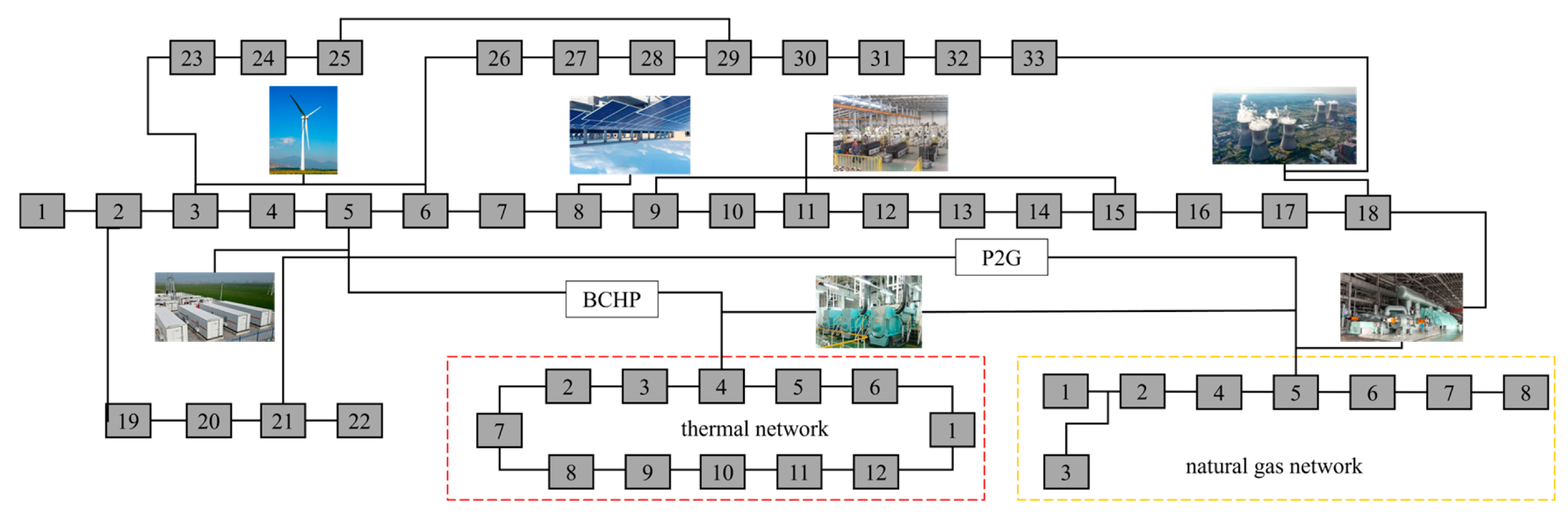
The distributed integrated energy system located in Anping County in Hebei Province is selected for the case study. The system is constructed by extending the IEEE 33 bus distribution network. The overall structure of the coupled electricity, thermal, and natural gas subsystems is illustrated in Figure 3.
In the electrical network, the WT generation units are connected to buses 3 and 6, and the PV generation unit is connected to bus 8. The BCHP unit is integrated at bus 5 and supplies electricity to the distribution network while delivering heat to the thermal network. Among the load nodes, bus 18 represents the aggregated residential and public service loads in the rural demonstration area. In this study, the wire-mesh factory connected to bus 11 is selected as the representative industrial user. Its main production processes include wire drawing, mesh weaving, and plastic coating, which are driven by a large number of induction motors, welding machines, and coating lines, and therefore constitute the dominant internal electrical loads. These loads require a stable and continuous electricity supply and exhibit significant differences in demand levels between daytime and nighttime. The thermal network is represented by a 12-node ring structure, while the gas network is modeled as an 8-node natural-gas system including gas sources and P2G units.
The P2G unit is deployed in the system to match the intermittent output of distributed PV/wind and the flexible thermoelectric ratio of BCHP, making it a suitable choice for the rural DIES in Anping County from the perspectives of technical compatibility, low-carbon performance, and scenario adaptability.

4.2. Parameter Setting

The rated capacities and conversion coefficients of all major equipment, together with the associated economic parameters, are summarized in Table 2. The grid carbon intensity, electricity purchase price, biogas-based generation cost, PV operation and maintenance cost, and carbon trading price are adopted as typical values, as listed in Table 2.
The carbon trading price is set to 0.08 CNY/kg CO2 as a conservative low-end scenario to avoid overstating the economic impact of carbon pricing in the studied rural DIES.
To investigate the impact of different low-carbon operation strategies on system performance, three typical operating scenarios are designed in this study, as summarized in Table 3.
“Biomass carbon fixation” in this study refers to biomass carbon sequestration during feedstock growth and the net emission change induced by biomass replacing coal; it does not refer to post-combustion carbon capture.
The model is solved in the Python 3.9 environment using the Gurobi solver (https://www.gurobi.com/). The computational platform is a personal computer equipped with an Intel i7-12700F processor and 16 GB of memory (Intel Corp., Santa Clara, CA, USA). The system operates over a 24-h period with a time step of 1 h. By comparing the simulation results under the three scenarios, the variation of carbon emissions and the distribution characteristics of carbon flows at different nodes are analyzed to verify the effectiveness and applicability of the proposed low-carbon optimization method.
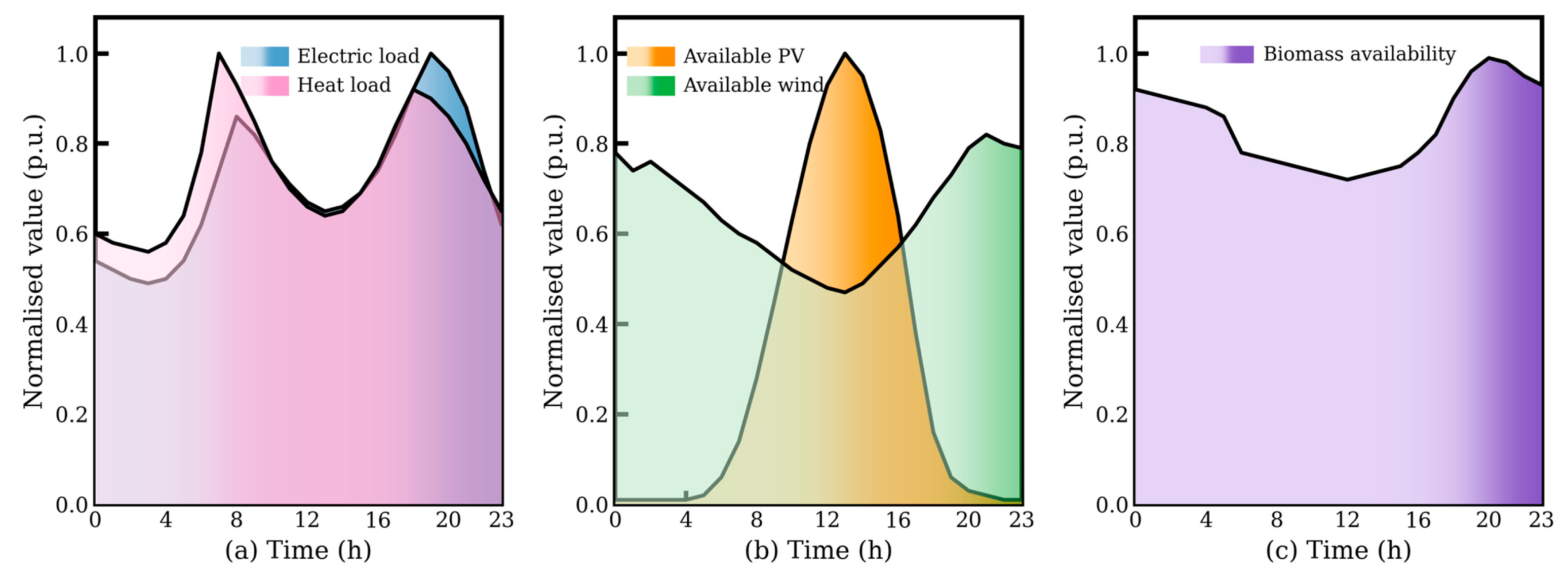
Figure 4 shows the typical 24-h input profiles used in the case study, including the load profiles, the available PV/wind generation, and the biomass availability.
The emission accounting and reduction evaluation formulations in Section 2.4 are generic and can be applied to any time horizon by aggregating the hourly values. In this case study, we conduct a representative 24-h simulation with Δ t = 1   h to obtain the daily cumulative emissions and reductions. The annual reduction potential reported in Section 4.3.3 is then estimated by linearly extrapolating the daily results to a full year, assuming that the selected day is representative of typical operating conditions in terms of load level, renewable availability, and dispatch pattern.
The NSGA-II algorithm is used for the multi-objective optimization, with a population size of 80 and a maximum of 150 generations. Simulated binary crossover and polynomial mutation are adopted. The search terminates when the maximum generation is reached. Additionally, an early-stopping rule is applied if the improvement of the hypervolume indicator is smaller than 10 4 for 20 consecutive generations, listed in Table 4.

4.3. Results Analysis

4.3.1. Dispatch Results Under Different Schemes

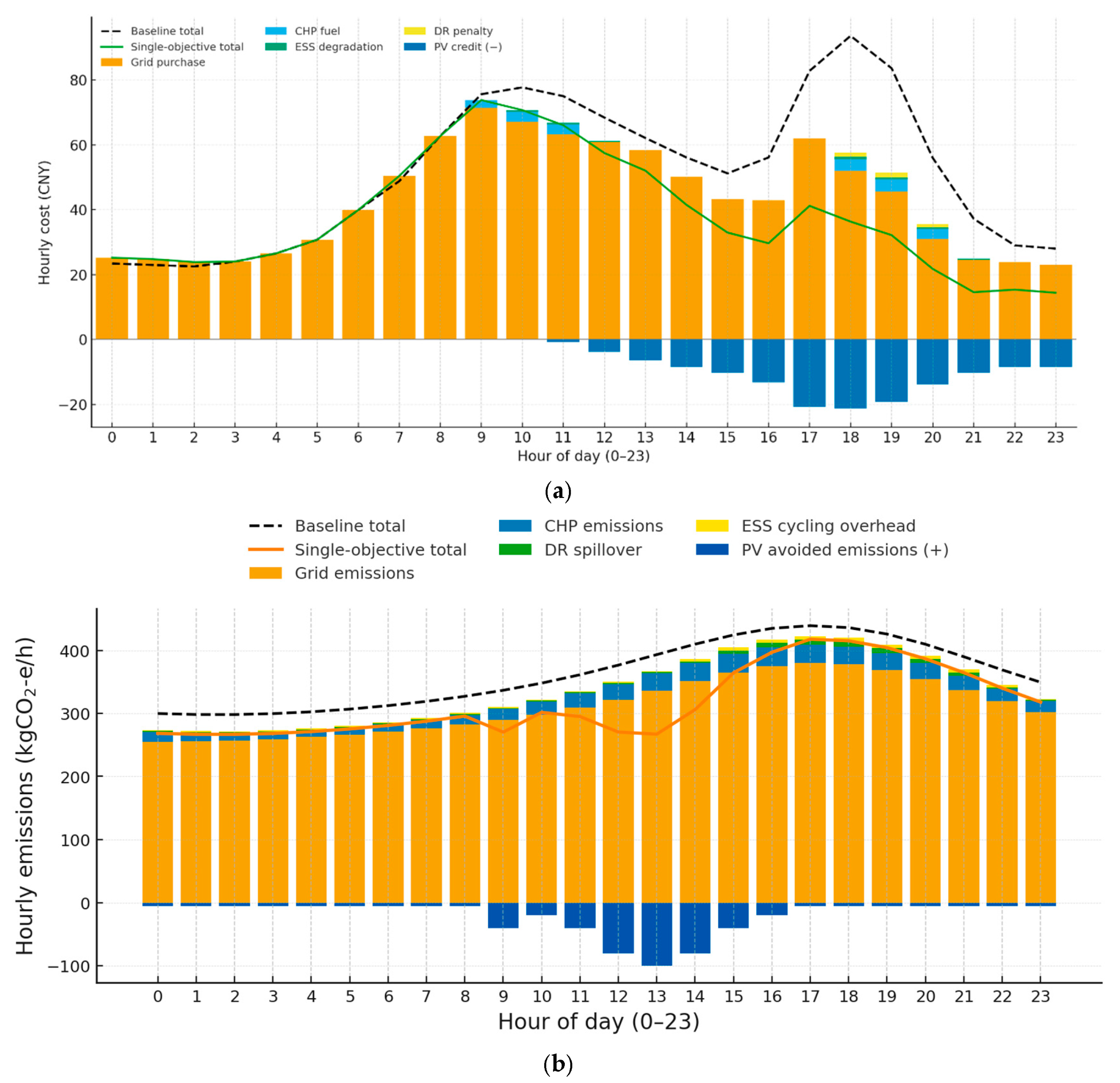
Figure 5 summarizes the 24-h optimal dispatch results of the wire-mesh factory, where stacked bars and overlaid curves describe the hourly profiles of operating costs and carbon emissions under different scheduling schemes. In the single-objective economic dispatch, four cost components are considered: electricity purchase from the grid, BCHP fuel, energy storage degradation, and demand response penalty. Figure 5a illustrates the hourly decomposition of these cost components, whereas Figure 5b presents the corresponding decomposition of hourly carbon emissions under the same dispatch schedule. As shown in Figure 5b, the optimized hourly emissions curve lies entirely below the baseline. When solar irradiance is high, PV generation markedly offsets total emissions; while, during the evening peak, coordinated operation of the ESS and a small amount of BCHP output helps moderate the peak emissions.
In addition, the results show a clear time-of-use charging/discharging pattern for the EES. During the daytime periods with relatively high PV output and lower grid import demand, the EES mainly operates in the charging mode to absorb surplus electricity. By contrast, during the evening and night peak-load periods, when grid electricity purchase increases, the EES switches to the discharging mode to reduce peak import power and to mitigate the associated growth in carbon emissions. Correspondingly, the SOC gradually increases during the charging periods and then decreases during the evening peak discharging process, while remaining within the prescribed upper and lower bounds throughout the scheduling horizon.
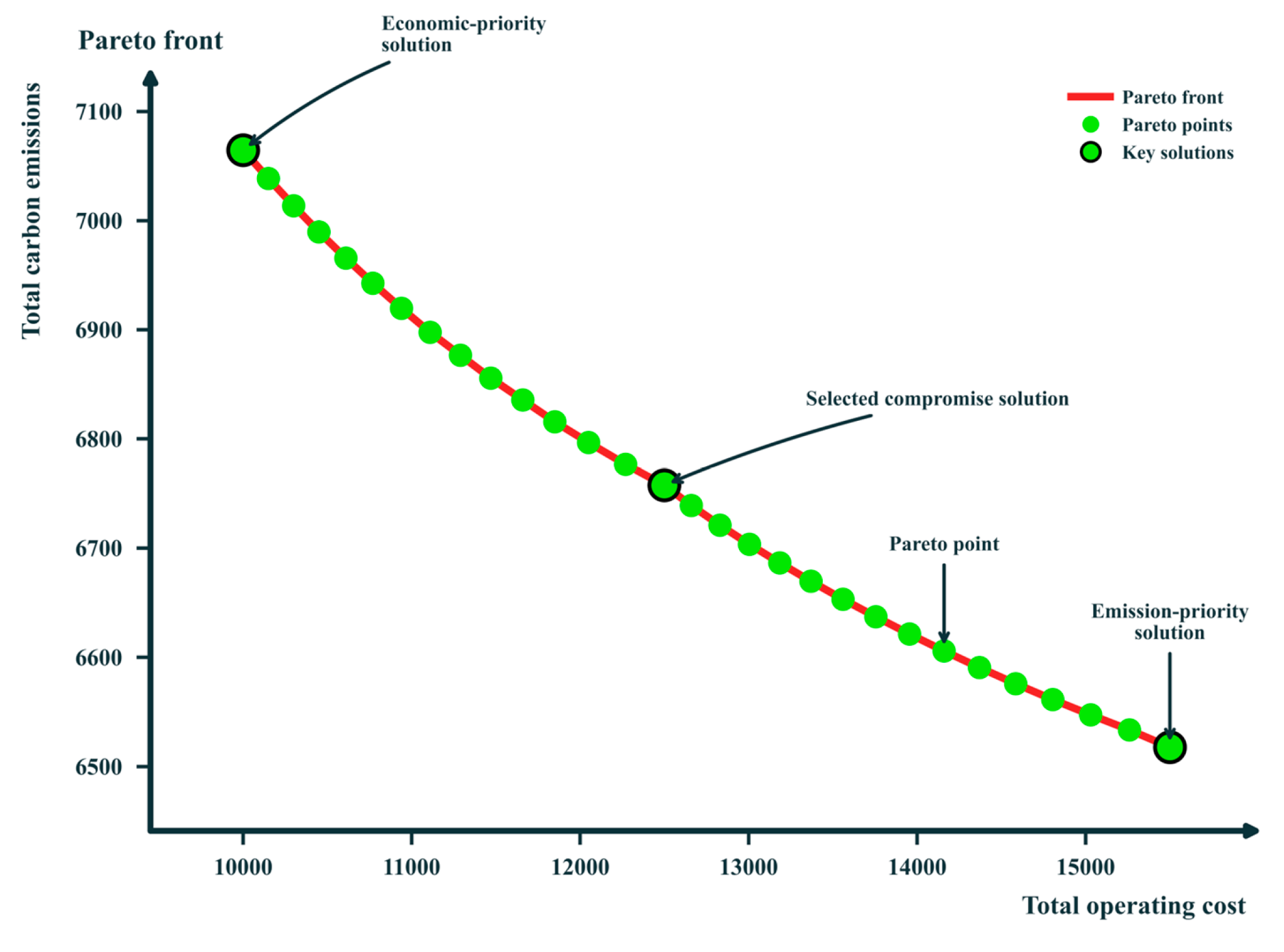
The resulting Pareto front is shown in Figure 6, where each point represents a non-dominated dispatch solution, and the highlighted point denotes the selected compromise solution.
The near-monotonic and locally quasi-linear shape of the Pareto front in Figure 6 is mainly attributed to the limited dispatch degrees of freedom in the studied rural DIES. Under the fixed 24-h demand profile, BCHP heat-to-power coupling, EES state-of-charge constraints, and device-capacity limits, movement along the Pareto set is achieved primarily through incremental substitution among grid electricity, BCHP output, EES charging/discharging, and limited load shifting. Since the main supply options in this case exhibit relatively stable unit operating costs and carbon emission intensities, the two objectives become strongly correlated over the explored range, making the front appear visually close to linear. However, this does not imply that carbon emissions are simply proportional to cost. As shown in Table 5, moving from the economic solution (10,000 CNY/day) to the selected compromise solution (12,500 CNY/day) reduces the emissions by 307.2 kg CO2/day at an additional cost of 2500 CNY/day, corresponding to a marginal abatement cost of 8.14 CNY/kg CO2; whereas further shifting to the low-carbon solution (15,500 CNY/day) yields an additional 239.7 kg CO2/day reduction but requires another 3000 CNY/day, i.e., 12.52 CNY/kg CO2. The increasing marginal abatement cost confirms that a genuine trade-off exists between the two objectives, even though the Pareto front appears locally quasi-linear in this case.
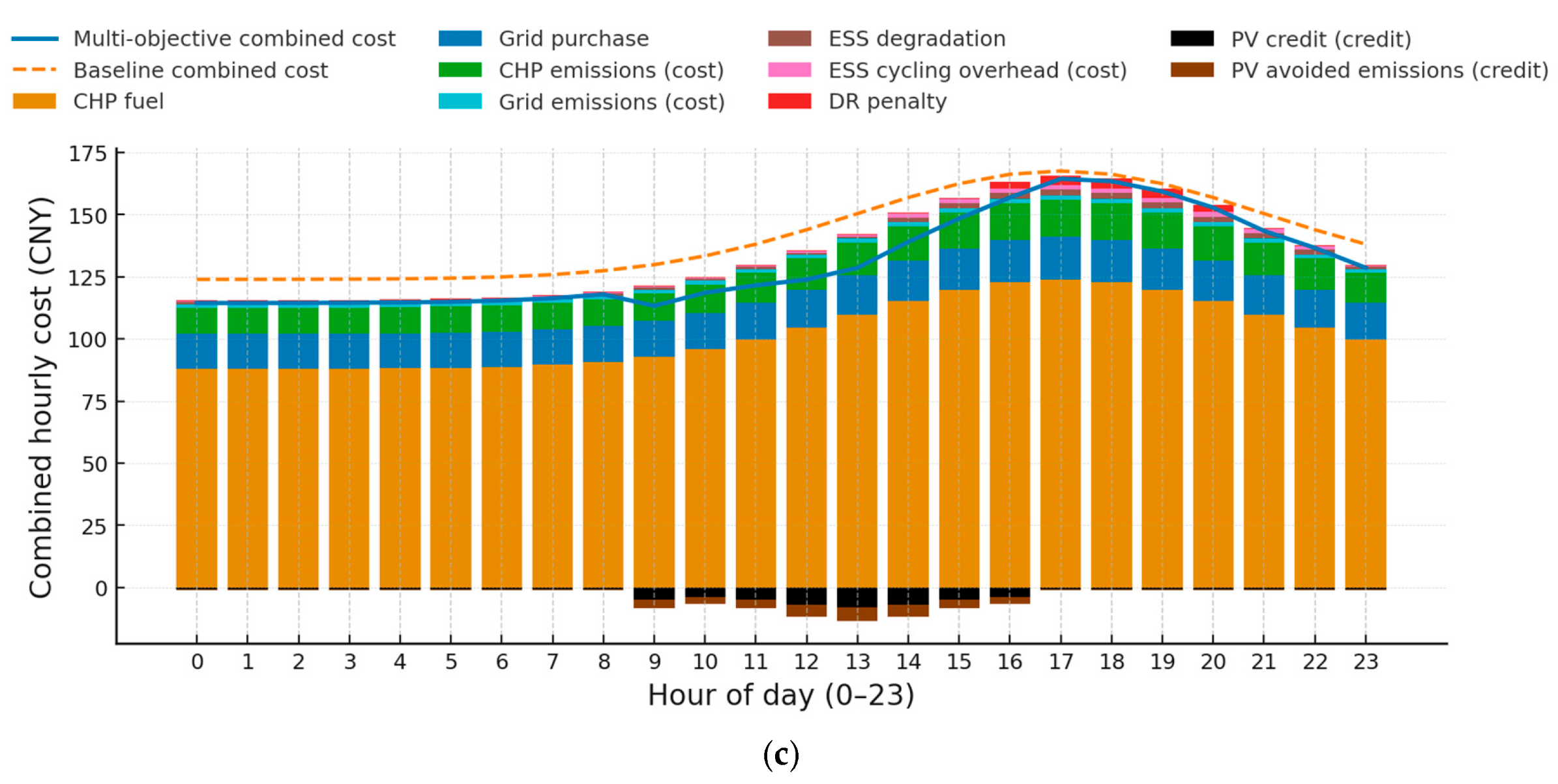
In the multi-objective dispatch, NSGA-II first provides a Pareto set balancing operating costs and carbon emissions, and a single compromise schedule is then selected from the Pareto set using the ideal-point criterion described above. With limited pre-charging and peak-shaving, part of the load and storage operation is shifted forward in time, so the rise from afternoon to evening remains controlled. Compared with the purely emission-oriented scheme, the overall costs at the evening peak does not increase, the additional cycling and lifetime degradation of storage stay within an acceptable range, and the spillover term of demand response is compressed, indicating that the chosen weights suppress the evening rebound that would otherwise occur from over-pursuing clean time periods.
Energy storage and demand response are no longer triggered only by a single signal, such as electricity price or carbon intensity, but respond to the combined marginal cost. This preserves the midday clean-energy benefit while avoiding a combination of high costs and high emissions in the evening.

4.3.2. Economic Performance

Let the daily cumulative emissions under the baseline and a scheduling scheme be E base and E sch , respectively, then Δ E tot = E base E sch . The contribution from load shifting is quantified by evaluating the flexible load profile change under the time-varying carbon intensity at the load node: Δ E shift = t ( P flex base ( t ) P flex sch ( t ) ) Δ t , where κ t is the carbon intensity (g CO2/kWh) at time t , and P flex ( t ) denotes the aggregated flexible load power. The remaining part is attributed to the supply-side generation mix (including the low-carbon nature and dispatch of BCHP/renewables): Δ E mix = Δ E tot Δ E shift . As reported in Table 6, load shifting accounts for 17%, 45%, and 35% of the total reduction in the economic, low-carbon and multi-objective schemes, respectively; therefore, the majority of the reported emission reductions is primarily driven by the low-carbon supply mix, with operational scheduling providing an additional contribution.
The single-objective economic scheme reduces daily emissions to 7.06 × 10 3 kg·day−1, a decrease of 0.43 × 10 3 kg (5.7%) relative to the baseline, of which about 0.073 × 10 3 kg comes from load shifting. For the single-objective low-carbon scheme, daily emissions are 6.52 × 10 3 kg·day−1, 0.97 × 10 3 kg (13.0%) lower than the baseline, with the load side contributing about 0.44 × 10 3 kg. The multi-objective scheme strikes a balance between costs and emissions, with daily emissions of 6.76 × 10 3 kg·day−1, 0.73 × 10 3 kg (9.8%) lower than the baseline, and load-side measures contributing about 0.26 × 10 3 kg.
Using the aggregated 24-h emissions in Table 6, moving from the economic solution ( C E = 52,000 CNY/day) to the selected compromise solution ( C M = 54,500 CNY/day) reduces emissions by 307.2 kg CO2/day at an additional cost of 2500 CNY/day, corresponding to a marginal abatement cost of 8.14 CNY/kg CO2. Further shifting from the compromise to the low-carbon solution ( C L = 57,500 CNY/day) delivers an additional 239.7 kg CO2/day reduction with a cost increment of 3000 CNY/day, i.e., 12.52 CNY/kg CO2, indicating an increasing marginal cost of abatement when pursuing lower emissions.

4.3.3. Sensitivity Analysis

Field-level measurements for the studied rural DIES are not available to conduct a full-scale empirical validation; therefore, we provide a sensitivity analysis to quantify the uncertainty of the model evaluation. Specifically, for the three representative schedules, we keep the dispatch decisions unchanged and perturb the key evaluation parameters in the emission-accounting and economic-assessment layers. The grid marginal carbon intensity profile γ t is scaled by ± 10 % , and the effective carbon-related parameter of the biomass in the BCHP accounting model is perturbed by ± 10 % . The resulting ranges of daily cumulative emissions and the corresponding reductions relative to the baseline are summarized in Table 7. This analysis shows how sensitive the reported emission reductions are to plausible parameter uncertainty, without altering the core optimization framework.
The E range is obtained as the minimum and maximum values resulting from ±10% perturbations applied separately to γ t and the Bio parameter. Because the baseline value is kept at its nominal level, the upper-bound perturbed emission of the single-objective economic scheme slightly exceeds the nominal baseline, yielding a negative value. This indicates a slight emission increase under pessimistic parameter perturbation rather than an error in the sensitivity calculation.

4.3.4. Carbon Emissions and Reduction Potential

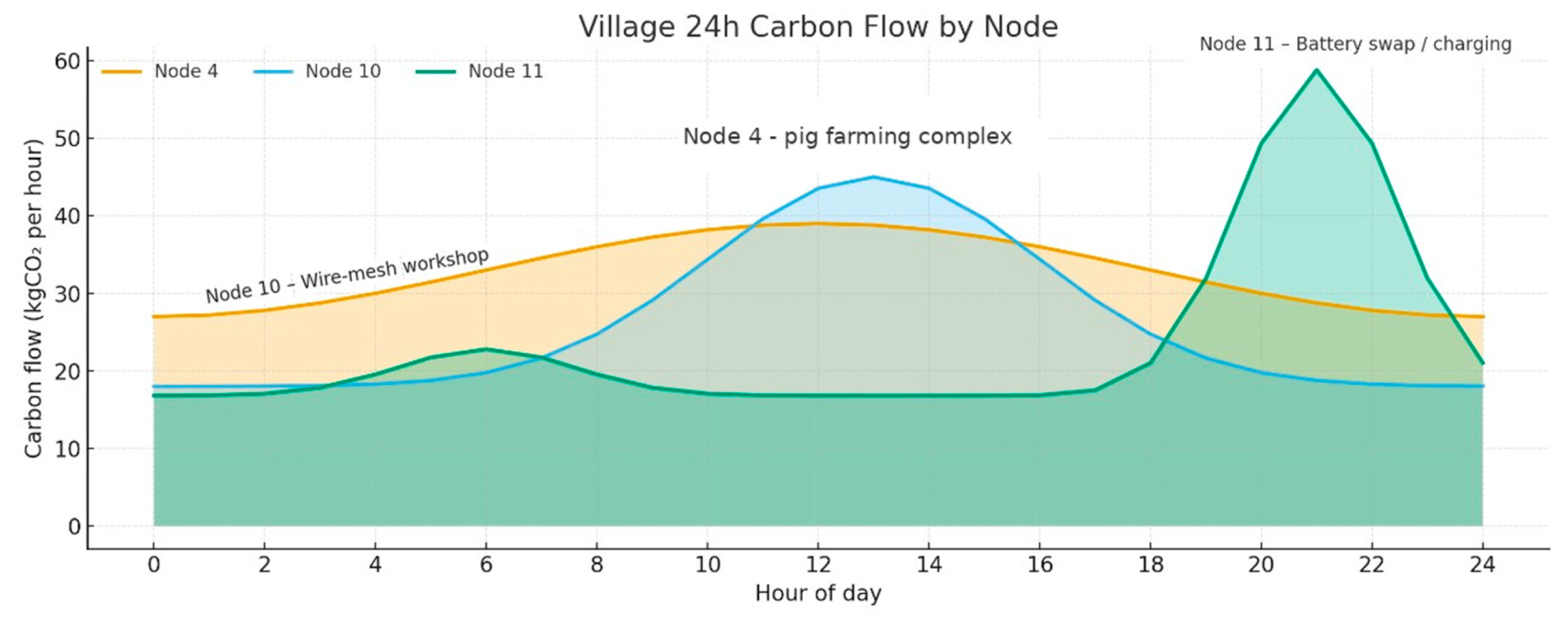
Figure 7 shows the 24-h carbon-emission curves of the key load nodes. The pig farming complex varies slowly over the whole day. The wire-mesh workshop starts to rise in the morning, reaches a peak of about 40–45 kg CO2/h around noon, and then drops clearly in the afternoon, forming a single-peak profile. The battery swap/charging load remains low during the daytime, but exhibits a sharp peak of about 50–60 kg CO2/h between 19:00 and 22:00, followed by a rapid decline, showing a night-peaking pattern.
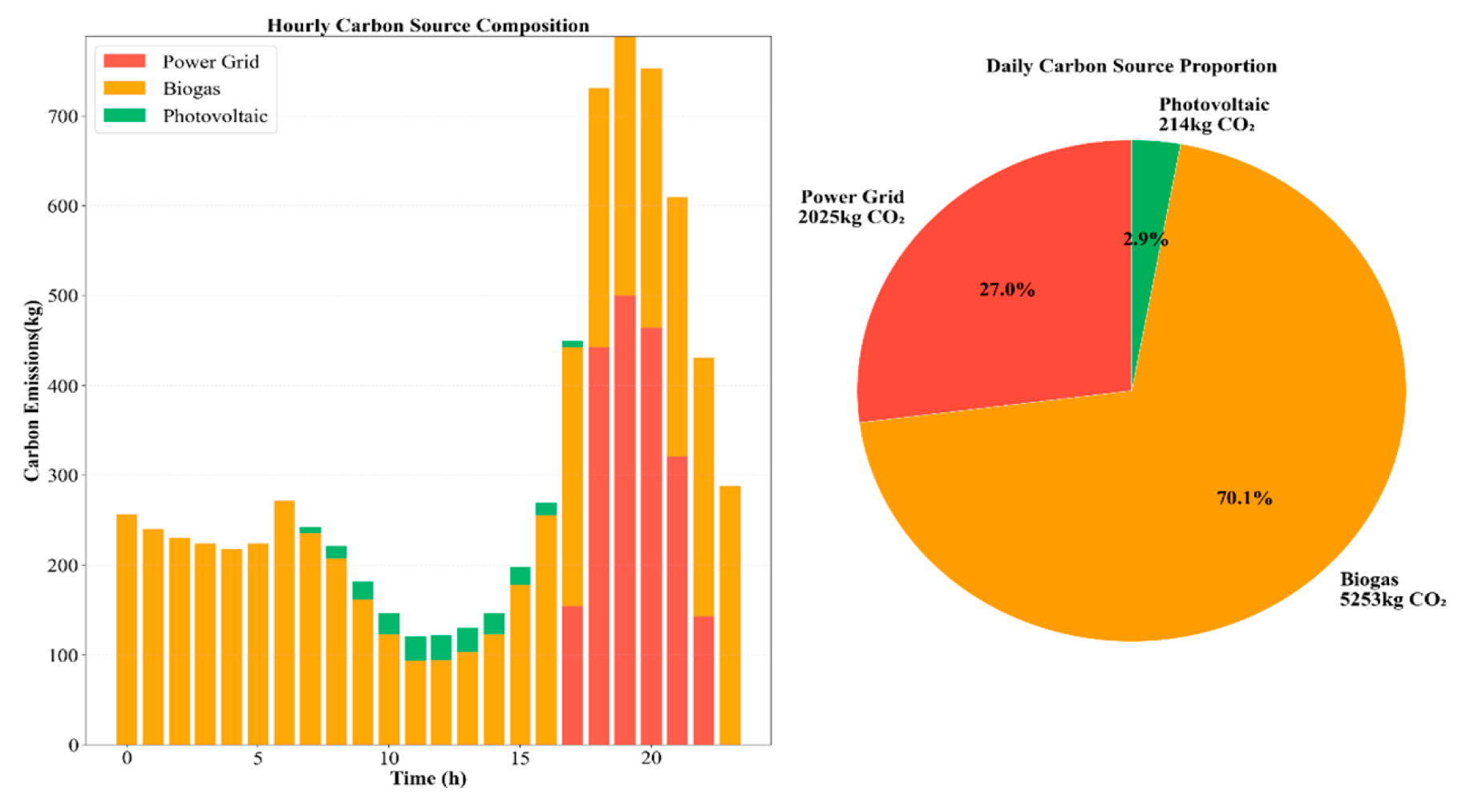
Figure 8 analyzes the composition of carbon emission sources in the baseline scenario. The shaded areas use the same colors as the corresponding curves and are included only to visually highlight the magnitude and temporal variation of the hourly carbon flow at each node. In the total emissions over 24 h, biogas power generation contributes 5253.0 kg (70.1%), electricity purchased from the grid contributes 2025.0 kg (27.0%), and PV generation accounts for 213.6 kg (2.9%). The hourly distribution shows that carbon emissions from the power grid increase significantly between 18:00 and 22:00, reaching a peak of 500 kg CO2 per hour. Biogas generation operates steadily throughout the day and constitutes the main source of carbon emissions.
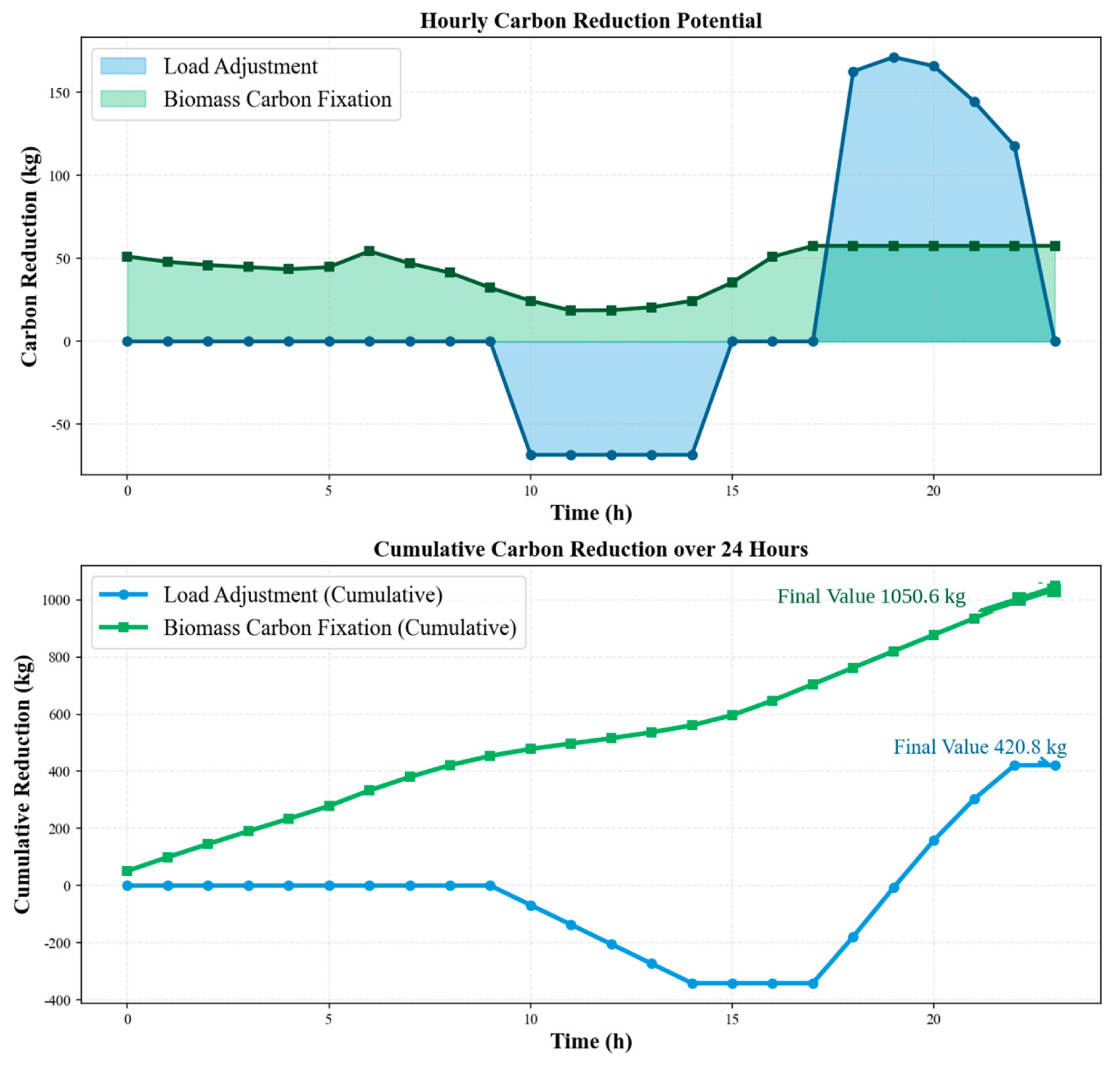
Figure 9 quantitatively compares the carbon reduction potentials of the two strategies. In the upper panel, the shaded areas indicate the hourly carbon-reduction contributions relative to zero, where blue denotes load adjustment and green denotes biomass carbon fixation. For the load adjustment strategy, emission reductions mainly occur between 18:00 and 22:00, with a maximum hourly reduction of 171.36 kg at 19:00 and a net daily reduction of 422.47 kg due to increased emissions around 10:00–14:00. The biomass carbon fixation strategy provides relatively uniform reductions throughout the day, closely following the biogas generation profile, and yielding a cumulative daily reduction of 1050.60 kg. From the slopes of the cumulative curves, the hourly reduction efficiency of biomass carbon fixation is about 2.5 times that of load adjustment, and implementing both strategies jointly yields a daily reduction of 924.97 kg, corresponding to an annual carbon reduction potential of 337.61 t CO2.

5. Conclusions

This paper develops a multi-objective optimal scheduling framework based on carbon flow tracking for a distributed integrated energy system embedding BCHP, and conducts an analysis for a representative rural integrated energy system in Anping County, Hebei Province. The main conclusions are as follows:
  • A carbon source tracking and carbon emission factor modeling method for the BCHP process is proposed. By introducing a biomass composition vector and an effective carbon ratio, a mapping relationship of carbon flows over the entire BCHP process is established, thereby realizing life cycle carbon emission accounting for BCHP.
  • A distributed integrated energy system model with coupled electricity, heat, and gas flows is constructed, in which the flexible heat-to-power ratio of BCHP, distributed photovoltaic generation, wind turbines, energy storage, and flexible loads are all considered. By introducing node carbon potential and jointly considering node power, thermal demand, and carbon emission intensity, the spatiotemporal distribution characteristics of carbon flows at different nodes and in different periods are characterized.
  • A dual-objective optimal scheduling model that minimizes operating costs and carbon emissions is established, and the NSGA-II algorithm is employed to obtain a uniformly distributed Pareto solution set. The case study results show that, compared with the baseline scenario, the multi-objective scheduling scheme reduces both the daily cumulative carbon emissions and the operating costs of the system while maintaining economic feasibility and effectiveness of the proposed carbon flow tracking and low-carbon dispatch strategy in rural distributed integrated energy systems embedding BCHP.

Author Contributions

Conceptualization, G.T. and P.L.; methodology, G.T.; software, G.T.; validation, G.T. and P.L.; formal analysis, G.T.; investigation, G.T.; resources, G.T.; data curation, G.T.; writing—original draft preparation, G.T.; writing—review and editing, G.T.; visualization, G.T.; supervision, G.T.; project administration, G.T.; funding acquisition, P.L. All authors have read and agreed to the published version of the manuscript.

Funding

The authors gratefully acknowledge the support by the National Key Research and Development Program of China (2023YFC3807201) as well as the project funding from State Grid Hebei Electric Power Company (B604ZF250060).

Data Availability Statement

The original contributions presented in this study are included in the article. Further inquiries can be directed to the corresponding author.

Conflicts of Interest

Author Guang Tian was employed by the company State Grid Hebei Electric Power Co., Ltd. The remaining author declares that the research was conducted in the absence of any commercial or financial relationships that could be construed as a potential conflict of interest. This study received funding from State Grid Hebei Electric Power Company (B604ZF250060). The funder was not involved in the study design, collection, analysis, interpretation of data, the writing of this article or the decision to submit it for publication.

References

  1. Xie, H.; Guo, J.; Li, Y.; Liu, X.; Shen, Y. A price mechanism design for regional integrated energy market considering carbon emissions. Electr. Power Syst. Res. 2023, 218, 109177. [Google Scholar] [CrossRef]
  2. Hou, G.; Jian, X. Distributionally robust chance-constrained economic dispatch of multi-area electricity–gas–heat integrated energy systems. Electr. Power Syst. Res. 2023, 217, 109090. [Google Scholar] [CrossRef]
  3. Kimming, M.; Sundberg, C.; Nordberg, Å.; Baky, A.; Bernesson, S.; Norén, O.; Hansson, P.-A. Biomass from agriculture in small-scale combined heat and power plants—A comparative life cycle assessment. Biomass Bioenergy 2011, 35, 1572–1581. [Google Scholar] [CrossRef]
  4. Parajuli, R.; Løkke, S.; Østergaard, P.A.; Knudsen, M.T.; Schmidt, J.H.; Dalgaard, T. Life Cycle Assessment of district heat production in a straw fired CHP plant. Biomass Bioenergy 2014, 68, 115–134. [Google Scholar] [CrossRef]
  5. Adhikari, S.; Nam, H.; Chakraborty, J.P. Conversion of solid wastes to fuels and chemicals through pyrolysis. In Waste Biorefinery; Elsevier: Amsterdam, The Netherlands, 2018; pp. 239–263. [Google Scholar]
  6. Benetto, E.; Popovici, E.C.; Rousseaux, P.; Blondin, J. Life cycle assessment of fossil CO2 emissions reduction scenarios in coal-biomass based electricity production. Energy Convers. Manag. 2004, 45, 3053–3074. [Google Scholar] [CrossRef]
  7. Judl, J.; Koskela, S.; Korpela, T.; Karvosenoja, N.; Häyrinen, A.; Rantsi, J. Net environmental impacts of low-share wood pellet co-combustion in an existing coal-fired CHP production in Helsinki, Finland. Energy 2014, 77, 844–851. [Google Scholar] [CrossRef]
  8. Wang, J.J.; Yang, K.; Xu, Z.L.; Fu, C.; Li, L.; Zhou, Z.-K. Combined methodology of optimization and life cycle inventory for a biomass gasification based BCHP system. Biomass Bioenergy 2014, 67, 32–45. [Google Scholar] [CrossRef]
  9. Wang, J.J.; Xu, Z.L.; Jin, H.G.; Shi, G.-H.; Fu, C.; Yang, K. Design optimization and analysis of a biomass gasification based BCHP system: A case study in Harbin, China. Renew. Energy 2014, 71, 572–583. [Google Scholar] [CrossRef]
  10. Sadhukhan, J.; Zhao, Y.; Shah, N.; Brandon, N.P. Performance analysis of integrated biomass gasification fuel cell (BGFC) and biomass gasification combined cycle (BGCC) systems. Chem. Eng. Sci. 2010, 65, 1942–1954. [Google Scholar] [CrossRef]
  11. Ruan, Y.; Liu, Q.; Li, Z.; Wu, J. Optimization and analysis of Building Combined Cooling, Heating and Power (BCHP) plants with chilled ice thermal storage system. Appl. Energy 2016, 179, 738–754. [Google Scholar] [CrossRef]
  12. Wang, J.; Zhai, Z.J.; Zhang, C.; Jing, Y. Environmental impact analysis of BCHP system in different climate zones in China. Energy 2010, 35, 4208–4216. [Google Scholar] [CrossRef]
  13. Kong, X.; Zhang, H.; Zhang, D.; Huo, X.; Pang, C. Hierarchical distributed optimal scheduling decision-making method for district integrated energy system based on analysis target cascade. Electr. Power Syst. Res. 2024, 234, 110533. [Google Scholar] [CrossRef]
  14. Yang, J.; Lei, L.; Liu, D.; Luo, W. A distributed dispatch approach for district-level electric-heat-gas integrated energy systems considering carbon emission and green certificate trading. Electr. Power Syst. Res. 2025, 244, 111541. [Google Scholar] [CrossRef]
  15. Zhang, Y.; Han, Y.; Liu, D.; Dong, X. Low-carbon economic dispatch of electricity-heat-gas integrated energy systems based on deep reinforcement learning. J. Mod. Power Syst. Clean Energy 2023, 11, 1827–1841. [Google Scholar] [CrossRef]
  16. Wang, L.; Hou, C.; Ye, B.; Wang, X.; Yin, C.; Cong, H. Optimal operation analysis of integrated community energy system considering the uncertainty of demand response. IEEE Trans. Power Syst. 2021, 36, 3681–3691. [Google Scholar] [CrossRef]
  17. Zeng, A.; Zou, Y.; Hao, S.; Ning, J.; Ni, L. Comprehensive demand response strategy of industrial users in the park considering the stepped carbon trading mechanism. High Volt. Eng. 2022, 48, 4352–4363. [Google Scholar]
  18. Lyu, X.; Liu, T.; Liu, X.; He, C.; Nan, L.; Zeng, H. Low-carbon robust economic dispatch of park-level integrated energy system considering price-based demand response and vehicle-to-grid. Energy 2023, 263, 125739. [Google Scholar] [CrossRef]
  19. Liu, Z.; Xing, H.; Luo, Y.; Ye, Y.; Shi, Y. Low-carbon economic dispatch of an integrated energy system based on carbon emission flow theory. J. Electr. Eng. Technol. 2023, 18, 1613–1624. [Google Scholar] [CrossRef]
  20. Yang, T.; Wang, Q.; Wang, X.; Wang, L.; Geng, Y. Low-carbon economic distributed dispatch for district-level integrated energy system considering privacy protection and demand response. Appl. Energy 2025, 383, 125389. [Google Scholar] [CrossRef]
  21. Xu, X.; Wang, K.; Ma, W.; Wu, C.-L.; Huang, X.-R.; Ma, Z.-X.; Li, Z.-H. Multi-objective particle swarm optimization algorithm based on multi-strategy improvement for hybrid energy storage optimization configuration. Renew. Energy 2024, 223, 120086. [Google Scholar] [CrossRef]
  22. Zheng, Y.; Wang, J.; Zhu, J.; Zhang, X.-Y.; Xing, Y.-X.; Zhang, Y.-H. MORSA: Multi-objective reptile search algorithm based on elite non-dominated sorting and grid indexing mechanism for wind farm layout optimization problem. Energy 2024, 293, 130771. [Google Scholar] [CrossRef]
  23. Wang, Q.; Ming, T.; Chen, Q.; Wu, Y. A novel TLFD-GA algorithm for multi-objectives optimization of ORC power plants with the effect of pressure drop considered. Energy 2024, 293, 130652. [Google Scholar] [CrossRef]
  24. Nouri, S.M.; Alemi-Rostami, M.; Kahe, G. Multi-objective optimization of two-stage AC-DC power supply for reliability and efficiency using NSGA-II and meta-heuristic honey bee algorithms. Energy Rep. 2023, 10, 3174–3185. [Google Scholar] [CrossRef]
  25. Bialek, J.W. Tracing the flow of electricity. IEE Proc. Gener. Transm. Distrib. 1996, 143, 313–320. [Google Scholar] [CrossRef]
  26. Kang, C.; Zhou, T.; Chen, Q.; Xu, Q.; Xia, Q.; Ji, Z. Carbon emission flow in networks. Sci. Rep. 2012, 2, 479. [Google Scholar] [CrossRef]
  27. Kang, C.; Zhou, T.; Chen, Q.; Wang, J.; Sun, Y.; Xia, Q.; Yan, H. Carbon emission flow from generation to demand: A network-based model. IEEE Trans. Smart Grid 2015, 6, 2386–2394. [Google Scholar] [CrossRef]
  28. Cheng, Y.; Zhang, N.; Wang, Y.; Yang, J.; Kang, C.; Xia, Q. Modeling carbon emission flow in multiple energy systems. IEEE Trans. Smart Grid 2019, 10, 3562–3574. [Google Scholar] [CrossRef]
  29. Zhang, H.; Sun, W.; Li, W.; Ma, G. A carbon flow tracing and carbon accounting method for exploring CO2 emissions of the iron and steel industry: An integrated material–energy–carbon hub. Appl. Energy 2022, 309, 118485. [Google Scholar] [CrossRef]
  30. Cao, F.; Shu, Y.; Li, C.; Gao, X. Loss apportionment of UHV transmission network based on classification power flow tracing method. China Electr. Power 2018, 51, 54–60. [Google Scholar]
  31. Liu, K.; Yang, W.; Wang, D.; Jia, H.; He, G.; Song, Y.; Fan, M. Research on active power dispatch and demand response strategy of renewable energy based on distribution network power flow tracing. Proc. CSEE 2018, 38, 5714–5726. [Google Scholar]
  32. Wang, C.; Li, P.; Yang, Z.; Wang, H. Dynamic tracking of life cycle carbon emissions in power grids based on a flow network model. Sci. Rep. 2025, 15, 26990. [Google Scholar] [CrossRef]
Figure 1. Overall framework of the distributed integrated energy system. (the black dots in Step 3 represent ellipses).
Processes 14 01128 g001
Figure 2. Main working principle of the BCHP unit.
Processes 14 01128 g002
Figure 3. Topology of the multi-energy flow.
Processes 14 01128 g003
Figure 4. Typical 24-h input profiles: (a) normalised electric and heat load profiles; (b) normalised available PV and wind power profiles; (c) normalised biomass availability profile.
Processes 14 01128 g004
Figure 5. Optimal dispatch results: (a) Hourly cost breakdown under single-objective economic scheduling; (b) Hourly carbon emission breakdown under single-objective economic scheduling; (c) Hourly combined cost breakdown under the compromise solution of multi-objective optimization.
Processes 14 01128 g005aProcesses 14 01128 g005b
Figure 6. Pareto front of the multi-objective dispatch.
Processes 14 01128 g006
Figure 7. Distribution of 24-h carbon flow of loads.
Processes 14 01128 g007
Figure 8. Analysis of carbon emission source composition.
Processes 14 01128 g008
Figure 9. Carbon reduction potential curves.
Processes 14 01128 g009
Table 1. Summary and Comparison of Relevant Studies on Carbon Flow Modeling and Multi-Energy Dispatch (✓: covered, ✗: not covered).
ReferenceSystem TypeCarbon Flow ModelingBCHP Process ModelingMulti-Energy CouplingOptimization DispatchKey Contribution
[8]BCHP systemThermodynamic performance analysis
[11,12]Integrated energy systemLow-carbon economic dispatch
[17,18,19]Industrial park IESDemand response-based optimization
[29,30]Power systemCarbon flow tracing in power networks
This paperBCHP-based DIESCarbon flow tracking and multi-objective scheduling for BCHP-integrated distributed energy systems
Table 2. Technical and economic parameters of equipment.
CategoryItemValue/Description
Equipment parametersBCHP unitHeat: 0.50; Electricity: 0.40; Rated power: 300 kW
P2G unitConversion coefficient: 0.60; Rated power: 100 kW
Electric boilerConversion coefficient: 0.90; Rated power: 200 kW
Gas boilerConversion coefficient: 0.80; Rated power: 400 kW
Wind powerRated power: 150 kW
PVRated power: 200 kW
Economic parametersGrid purchase price
(weighted TOU average)
0.60 CNY/kWh
Biogas-based power generation cost0.25 CNY/kWh
PV operation and maintenance cost0.10 CNY/kWh
Carbon trading price0.08 CNY/kg CO2
Note: USD equivalents are calculated using the annual average exchange rate of 1 USD = 7.1875 CNY (2025), based on the Federal Reserve “Foreign Exchange Rates—G.5A Annual”.
Table 3. Scenario Configuration.
Configuration ElementBaseline ScenarioLoad Adjustment
Scenario
Biomass Carbon
Fixation Scenario
Grid electricity
Renewable energy (PV, Wind)
Energy storage system
BCHP units
Flexible load shifting-
Biomass fuel replacement--
Note: “✓” indicates that the corresponding configuration element is included/enabled in that scenario, while “-” indicates that it is not included/not enabled.
Table 4. Optimization settings and termination criteria.
ItemSymbol/DescriptionValue
NSGA-II population size N pop 80
Maximum generations G max 150
Crossover probability p c 0.90
Mutation probability p m 0.02
Gurobi optimality gapMIPGap 10 4
Gurobi feasibility toleranceFeasibilityTol 10 6
Gurobi time limitTimeLimit300 s
Table 5. Trade-off comparison of representative Pareto solutions.
SolutionTotal Operating
Cost (CNY/Day)
Total Carbon
Emissions (kg CO2/Day)
Incremental
Cost (CNY/Day)
Incremental Emission
Reduction (kg CO2/Day)
Marginal Abatement
Cost (CNY/kg CO2)
Economic solution10,0007064.6
Selected compromise solution12,5006757.42500307.28.14
Low-carbon solution15,5006517.73000239.712.52
Table 6. Daily cumulative emissions and reductions.
ScenarioTotal Carbon
Emissions (kg CO2/Day)
Reduction Relative
to Baseline (%)
Contribution from
Load Shifting (%)
Baseline7491.6--
Single-objective economic7064.65.7%17%
Single-objective low-carbon6517.713.0%45%
Multi-objective6757.49.8%35%
Table 7. Ranges of daily cumulative emissions and reductions.
ScenarioBase E (kg CO2/Day)E Range (kg CO2/Day, ±10%)Red. Range (%)
Single-objective economic7064.66570.1–7559.1−0.9–12.3
Multi-objective6757.46264.1–7250.73.2–16.4
Single-objective low-carbon6517.76022.4–7013.06.4–19.6
Disclaimer/Publisher’s Note: The statements, opinions and data contained in all publications are solely those of the individual author(s) and contributor(s) and not of MDPI and/or the editor(s). MDPI and/or the editor(s) disclaim responsibility for any injury to people or property resulting from any ideas, methods, instructions or products referred to in the content.