Next Article in Journal
Biodegradation Potential of Microplastics by Comamonas testosteroni in Wastewater and Sludge
Previous Article in Journal
Hierarchical Model Predictive Control with Inferential Soft Sensing for Stabilizing Thermal Gradients in Agricultural Biomass Gasification
Previous Article in Special Issue
Comparison of Wheat Quality, Antioxidant Activity, and Mycotoxins Under Organic and Conventional Farming
 
 
Due to scheduled maintenance work on our servers, there may be short service disruptions on this website between 11:00 and 12:00 CEST on March 28th.
Review

The Interconnection Between 3D and 4D Printing and Rheology: From Extrusion and Nozzle Deposition to Final Product Functionality


by
Thomas Goudoulas
1 and
Theodoros Varzakas
2,*
1
Lehrstuhl für Brau- und Getränketechnologie, TUM School of Life Sciences, Technical University of Munich, 85354 Freising, Germany
2
Department of Food Science and Technology, University of the Peloponnese, Antikalamos, 24100 Kalamata, Greece
*
Author to whom correspondence should be addressed.
Processes 2026, 14(7), 1055; https://doi.org/10.3390/pr14071055
Submission received: 8 March 2026 / Revised: 18 March 2026 / Accepted: 23 March 2026 / Published: 25 March 2026
(This article belongs to the Special Issue Rheological Properties of Food Products)

Abstract

The successful application of 3D and 4D food printing is fundamentally governed by the rheology and microstructure of edible inks. These factors control every step, from extrusion and nozzle deposition to the final product functionality. This review systematically examines how formulation variables, including starch/protein composition, water content, and hydrocolloids, determine the network architecture and critical rheological properties, such as yield stress and viscoelasticity. These properties determine printing outcomes such as filament formation, stacking accuracy, and the stability of sensitive components. This review explores 4D printing as a “3D + 1D function,” where printed structures provide additional features over time, such as a controlled color change or bioactive release, while post-printing treatment often activates these features. Through case studies of novel inks, we show how interfacial chemistry and process parameters influence texture and stability. Finally, we discuss the application of rheological metrics for predicting printability and outline the critical need for developing multi-parameter, process-relevant printability indices to advance the field of digital food manufacturing.

1. Introduction

Three-dimensional (3D) food printing has transitioned from an exploratory fabrication method to a digitally controlled manufacturing strategy capable of tailoring geometry, texture, porosity, and nutritional composition with high spatial precision. However, the feasibility of extrusion-based food printing is governed less by hardware sophistication than by the physicochemical behavior of edible inks under flow and after deposition. Recent critical syntheses emphasize that printability emerges from a delicate balance between shear-induced fluidization inside the nozzle and rapid structural recovery once the material is deposited [1,2]. Thus, rheology—rather than composition alone—acts as the central determinant linking formulation to structural fidelity.
The extension toward four-dimensional (4D) food printing further elevates the importance of this coupling. By introducing time as a functional dimension, 4D systems enable printed structures to undergo programmed transformations triggered by thermal, pH, enzymatic, hydration, or other environmental stimuli. In such systems, the rheological and microstructural characteristics that ensure successful filament formation and stacking must also support controlled post-printing evolution [3]. Consequently, 4D food printing can be conceptualized as “3D structure plus temporally activated functionality,” where network architecture dictates not only geometric stability but also transformation kinetics and diffusion-driven processes [4].
Across the recent literature, three tightly interconnected elements repeatedly emerge as governing factors: network architecture, critical rheological parameters, and process mechanics. Gel-based edible inks—particularly starch–hydrocolloid and protein–polysaccharide composites—have been systematically mapped in terms of composition–rheology–geometry relationships, revealing that yield stress, storage modulus, and thixotropic recovery define operational printability windows [1,5,6]. Composite starch systems reinforced with carrageenan or alginate demonstrate how modest compositional shifts can shift inks from spreading-dominant to self-supporting regimes [7,8]. Similarly, plant protein-based matrices and alternative protein systems illustrate how mechanical strength and infill architecture can be engineered to replicate conventional food textures while maintaining extrusion stability [9,10].
Yet viscosity alone is insufficient to predict performance. Experimental and modeling studies increasingly converge on the role of yield stress, viscoelastic balance (G′/G″), and recovery kinetics as primary determinants of filament integrity and multi-layer stacking accuracy [11,12]. Advanced analyses further propose dimensionless frameworks linking elastoviscoplastic behavior to die swelling, spreading, and deposition regimes, suggesting that predictive printability indices must integrate rheological and process variables rather than treating them independently [13]. Computational fluid dynamics (CFD) modeling reinforces this integration by demonstrating how shear rate distributions and pressure gradients within the nozzle geometry directly translate into structural outcomes after extrusion [14].
Beyond geometric fidelity, the functional performance of printed foods increasingly depends on internal architecture and interfacial engineering. Emulsion-based systems and coaxial extrusion strategies enable encapsulation and protection of sensitive bioactives, significantly enhancing storage stability and bioaccessibility relative to non-structured formulations [15,16]. 3D printing of dairy products benefits from physical, chemical, or enzymatic modification and additive incorporation, improving printability and nutrition. Hydrophilic gels, calcium, and lipids enhance gel properties and structural fidelity [17]. Cellulose-based inks, especially with carboxymethyl cellulose, offer shear-thinning and thermal stability, particularly at low concentration, supporting custom nutritionally controlled foods for future applications [18]. Likewise, gel-in-gel constructs for probiotic delivery demonstrate that controlled rheology not only preserves structural precision but also improves microbial survival and release kinetics during digestion [19]. These findings illustrate a critical conceptual shift: the same rheological descriptors that govern extrusion also regulate mass transfer, degradation, and stimuli-responsive behavior in the final product.
Despite rapid progress, the literature remains partially fragmented. Foundational reviews address edible ink categories and rheological fundamentals [20,21,22], while emerging perspectives focus on intelligent systems integrating monitoring and control [4,23,24], or functional and bioactive-enriched formulations that develop low glycemic index food inks for diabetic patients through in vivo studies [25]. However, a unified framework that systematically connects ingredient-level network formation, quantitative rheological metrics, extrusion mechanics, structural fidelity, and post-printing functionality is still evolving. Without such integration, formulation development remains largely empirical, limiting scalability and reproducibility.
This review synthesizes advances from 2020 onward to articulate a coherent continuum of materials–rheology–process–function for 3D and 4D food printing. Our goal is to provide guidelines for testing the performance of various inks and printed food matrices rather than conducting an extensive descriptive technological analysis. By positioning rheology as the mechanistic bridge between formulation and final product performance, we aim to consolidate current knowledge into a structured perspective that supports rational ink design, predictive printability assessment, and the development of multi-parameter indices suitable for next-generation digital food manufacturing.
A schematic model illustrating the conceptual chain developed in the subsequent sections is presented in Figure 1.

2. Network Architecture in Edible Ink Formulations

2.1. Gel Network Formation and Molecular Architecture

The success of 3D food printing depends on the formation and stability of gel networks that reconcile two competing physical requirements: low resistance to flow under nozzle shear stress during extrusion, and rapid recovery of elastic structure after deposition to preserve geometric integrity. Qin et al. [1] established the critical foundation for understanding how formulation variables determine network architecture, defining edible hydrogels as the central material class reconciling these needs through hydrogel formulations spanning gelatin, alginate, pectin, carrageenan, agar, and starch-based gels and protein–polysaccharide composites.
Network architecture is determined by primary stabilization mechanisms that fall into distinct categories: ionic crosslinking (exemplified by β-carrageenan systems achieving storage moduli >4000 Pa through K+ coordination [26]), physical–ionic hybrids (gelatin–alginate systems with moderate density, G′ ~2500 Pa through Ca2+ bridging [27]), hydrogen-bonded polysaccharide blends (xanthan-locust bean gum achieving G′ ~2800 Pa through van der Waals forces), and dual-crosslinked protein-polysaccharide systems (gelatin-Type B and k-carrageenan) achieving superior G′ ~5000 Pa through combined ionic and covalent interactions [28]. The delicate balance between attractive and repulsive forces facilitates effective self-assembly, while excessive intermolecular forces result in functional instability and phase separation.
The molecular assembly process in gelatin-based systems differs fundamentally from starch-based networks. Oyinloye & Yoon [29] demonstrated that oil incorporation (both saturated coconut oil and unsaturated soybean oil) modulates the gelatin network structure dramatically: coconut oil at 1–3 g/100 g increases density via protein–lipid interactions, while soybean oil above 5 g/100 g causes phase separation and porosity. Network density quantitatively relates to microstructural features observable through scanning electron microscopy (SEM) and Fourier-transform infrared spectroscopy (FTIR), with Ahmad et al. [14] demonstrating that FTIR analysis reveals gel strengthening primarily driven by non-covalent interactions, hydrogen bonding, and electrostatic effects.

2.2. Composition-Dependent Network Properties

Starch concentration exerts critical control over network formation. Rodríguez-Herrera et al. [11] established that nixtamalized corn flour content in the range of 30–32.5 wt% optimizes both extrudability and self-supporting structural recovery, with concentrations below 30% resulting in excessive material spreading and flattening, while concentrations exceeding 32.5% reduce extrudability significantly. The optimal range reflects the balance point where starch gelatinization (occurring at ~71.8 ± 0.2 °C for arrowroot starch creates sufficient network crosslinking without compromising flow properties under extrusion pressure [12]). Similar concentration values have been reported for corn starch, albeit requiring higher processing temperatures (+10 °C) for full gelatinization [30], whereas potato starch can be effectively used at lower concentrations (≈20% w/v) due to its higher swelling capacity [26]. These differences reflect variations in the amylose/amylopectin ratio and granule structure, which influence gelatinization behavior and, consequently, the rheological properties required for printability.
Water content functions as the primary gelation trigger, with research establishing that 65–80 wt% water represents the critical range for stable gel formation. Deviations below 60% result in incomplete gelation and reduced network strength, while water contents exceeding 85% reduce printability due to over-hydration, weakening intermolecular bonding. Dushina et al. [31] quantitatively demonstrated this principle: lupine callus tissue inks with 80 g/100 mL callus (CT80) exhibited significantly reduced viscosity (5.6 kPa·s at 20 °C versus 75.4 kPa·s for control CT0 samples) and storage modulus values 7.9 times lower than controls, with fracture stress reduced from 13,241 ± 2329 Pa to 1621 ± 711 Pa.
Hydrocolloid selection determines the nature of gel network formation. Nikolaou et al. [26] demonstrated that β-carrageenan-reinforced starch gels consistently achieve superior viscoelastic behavior (G′ > 4000 Pa), optimal tan δ values (0.096–0.169), and yield stress conducive to stable extrusion (up to 350 Pa in gelatin-β-carrageenan systems), achieving 93–96% structural fidelity with <4% dimensional deviation. Bai et al. [32] showed that konjac glucomannan and curdlan blends synergistically enhance gel properties: konjac glucomannan concentration at 2.25% combined with curdlan at 0.75% (KGM/CD ratio 3:1) achieved optimal printing accuracy of 4.97 ± 0.45% with superior flow behavior index (n = 0.049 ± 0.014), indicating enhanced flowability.
The synthesized network architecture data demonstrates that dual-crosslinked systems (gelatin-β-carrageenan) achieve G′ ~5000 Pa with tan δ ~0.18, while starch–protein systems exhibit lower G′ (~1500 Pa) but offer distinct mechanical advantages through protein aggregation mechanisms. Kaliampakou et al. [27] employed principal component analysis and Taguchi’s design of experiments, showing that viscosity, tan δ, G′, and G” collectively govern blend behavior, with 85% pore area printability achieved through optimized parameter settings.

2.3. Microstructural Characterization and Spatial Organization

Network structure exhibits hierarchical organization across multiple length scales. Oliveira et al. [33] developed phase-separated edible inks through segregative phase separation using gellan gum matrix structured with whey protein isolate beads ranging from below 5 μm to over 100 μm in diameter, demonstrating that controlled microstructure enables high-speed printing (>25–50 mm/s) at low forces (<50 N) and stresses (<500 Pa). The key insight emerged that reducing bead size and length increases viscosity, enhancing the dimensional accuracy of printed structures.
Low-field nuclear magnetic resonance (LFNMR) analysis provides a quantitative assessment of water distribution and network rigidity. Li et al. [28] combined FTIR, XRD, LFNMR, and SEM to demonstrate that hybrid binary systems (gelatin-Type B with k-carrageenan) with optimized ratios produce reduced free water content relative to bound water, indicating tighter network crosslinking and superior structural recovery post-printing.
Network mechanical properties assessed through texture analysis directly correlate with printability outcomes. Liu et al. [34] comprehensively characterized cereal–legume starch-based gels formulated with germinated brown rice and red adzuki bean flours, achieving hardness values of 1066.74 ± 102.09 N for the RG2:1 formulation (red adzuki bean:germinated brown rice = 2:1) with printing accuracy of 99.37 ± 0.39%, demonstrating that optimal hardness ranges and springiness values (0.64 ± 0.10) translate directly to superior 3D printing fidelity.

3. Critical Rheological Properties Governing Printability

3.1. Yield Stress and Extrusion Stability

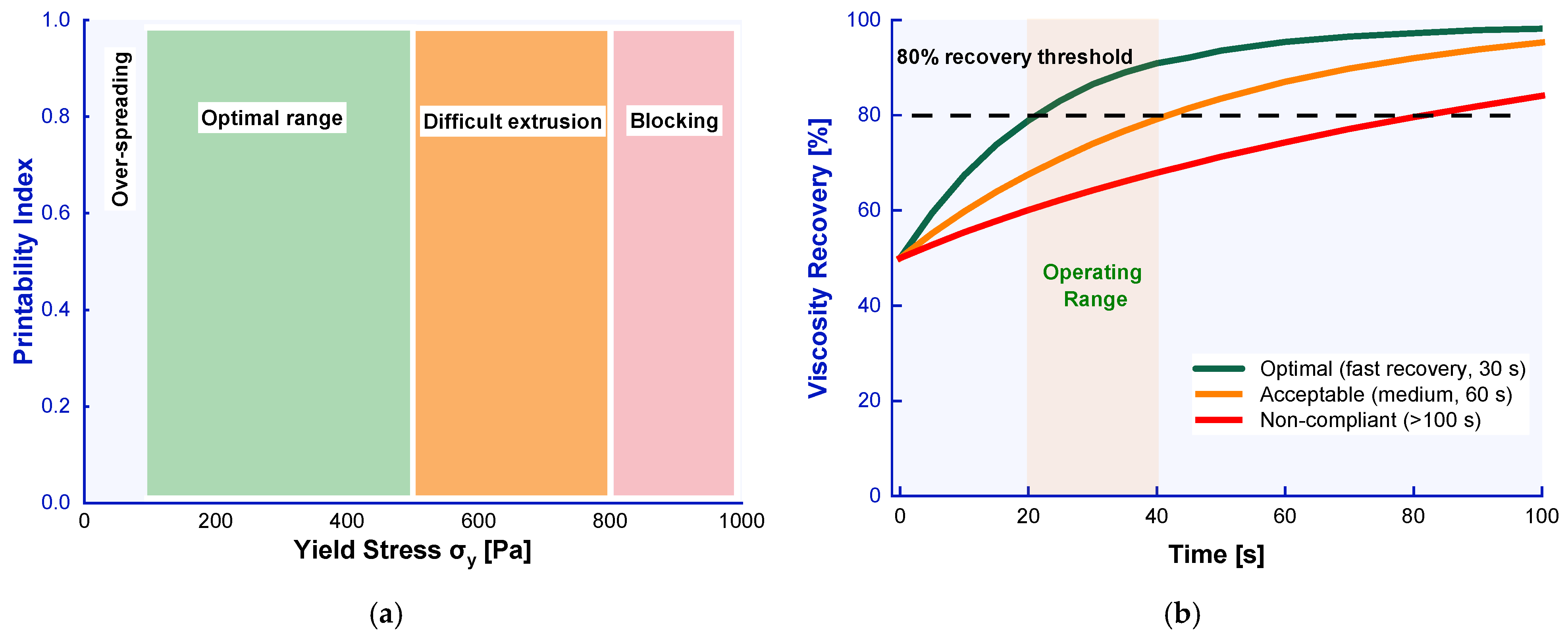
The success of extrusion-based printing depends critically on optimizing the rheological envelope by tuning the critical rheological properties. Kadival et al. [22] demonstrate that yield stress, storage modulus, and apparent viscosity must be simultaneously tuned to enable stable extrusion while maintaining structural fidelity post-deposition, with optimal values achieved through both formulation design and pre-processing modifications. Yield stress (σy), the minimum stress required to initiate material flow, represents one of the most critical parameters determining whether extrusion-based printing succeeds or fails. Recently, Choudhury et al. [35] analyzed skim milk (SM) powder to peanut-based chenna inks, achieving direct ink writing through cold extrusion with yield stress, loss/storage modulus optimization at 2:1 composition of SM:peanut chenna with optimal processing parameters. Agarwal et al. [36] quantitatively assessed yield stress variation across psyllium husk (PH)–gelatin (G) blends: the 50PH + 50G formulation (optimal for 3D printing) exhibited 109.16 ± 9.85 Pa yield stress, the 75PH + 25G formulation σy = 268.74 ± 13.56 Pa, and the 100PH reference σy = 18.59 ± 4.21 Pa. These data demonstrated that formulation composition enables precise yield stress tuning, with the selected 50PH + 50G blend achieving the highest mechanical strength (Young’s modulus 9.17 ± 0.088 kPa) among tested ratios despite having lower yield stress than the 75PH + 25G alternative, indicating complex relationships between yield stress and other mechanical properties. Additionally, stable printability for nixtamalized corn doughs occurs within specific yield stress ranges [11], demonstrating the fundamental principle that σy < 100 Pa results in excessive spreading and material collapse, while σy > 500 Pa causes extrusion difficulties and potential nozzle blockage. Typically, the optimal operating window spans 100–500 Pa, with σy ~250 Pa providing a balance between extrudability and structural retention [7,11,26,28,35,36].

3.2. Viscoelasticity and the Storage–Loss Moduli Balance

The viscoelastic balance between elastic (storage modulus G′) and viscous (loss modulus G”) behavior fundamentally determines whether printed structures maintain geometric fidelity or collapse post-deposition. Herrada-Manchón et al. [2] established that essential hydrogel rheology characterization requires measurement of yield stress, shear-thinning behavior, thixotropy, viscoelasticity, and gelling mechanisms, emphasizing that understanding these characteristics is essential for optimizing extrusion-based 3D printing. The critical principle emerges that optimal 3D printing inks require G′ >> G” (storage modulus dominance) to provide structural integrity, while G′ >> σy ensures self-supporting capability without excessive spreading. Nikolaou et al. [26] demonstrated that β-carrageenan–starch composites consistently achieve storage moduli >4000 Pa—establishing this as a practical threshold for gel-like behavior and structural self-support. For comparison, Kaliampakou et al. [27] showed that gelatin–alginate systems achieve G′ ~2500 Pa with maintained elastic character (tan δ = 0.35), while Bai et al. [32] documented that konjac glucomannan–curdlan optimal systems reach G′ ~3200 Pa with superior tan δ = 0.22 (indicating elastic dominance). The pattern emerges that ionic-crosslinked systems (carrageenan-based) and dual-crosslinked systems (gelatin–carrageenan) achieve the highest G′ values, while co-polymer systems with weaker interaction mechanisms (starch–protein isolate) achieve G′ ~1500 Pa, limiting their applicability without additional stabilizers.
The loss modulus (G”) represents the viscous component enabling flow, but must remain below 1200 Pa in optimal formulations to prevent excessive material spreading. Ahmad et al. [14] employed computational fluid dynamics (CFD) simulations using ANSYS Fluent 2019 R1 to model how rheological parameters translate to extrusion pressure and shear rate distributions, validating that modified thixotropic protocols based on actual shear conditions during printing provide accurate predictions of ink performance. The critical insight emerged that KCl-crosslinked kappa–carrageenan inks show excellent multi-layer printability despite lower viscosity recovery (relative to uncrosslinked inks) because elevated mechanical stability imparted by KCl enables effective structural recovery.

3.3. Loss Tangent and Network Elasticity Dominance

The loss tangent (tan δ = G”/G′) measures the ratio of dissipated (viscous) to stored (elastic) energy; optimal values below 0.3 signal elastic-dominated networks for shape retention after printing. Agarwal et al. [36] showed that tan δ <0.25 indicates strong elasticity and excellent recovery, 0.25–0.50 is a transition zone with intermediate properties, and >0.50 signals viscous dominance and poor shape retention. De Salvo et al. [37] optimized phytosterol-enriched oleogels, finding that dynamic moduli must support self-structuring: gelation at 78.37 °C and storage modulus G′ = 3.07 ± 0.032 Pa·s yield good extrusion flow, while G′ = 3.07 × 10⁶ Pa ensures room temperature stability. This shows post-extrusion elastic recovery is a second key printability window.

3.4. Apparent Viscosity and Filament Formation

Apparent viscosity (η) governs filament diameter and geometric resolution (η ∝ filament width). Nguyen et al. [38] determined optimal viscosity for rice protein–starch systems at 1–10 kPa·s, with best printability at 17.5% rice protein and 15% starch. Rapid, reversible recovery in rice protein systems is essential for stable multi-layer deposition without excessive flow or collapse. Dushina et al. [31] quantified viscosity changes: CT-free ink (CT0) increased from 9.6 to 75.4 kPa·s during cooling (50→20 °C), while CT80 ink changed only 0.9 to 5.6 kPa·s—a 13-fold reduction in temperature sensitivity. Adding plant callus tissue broadens processing windows but reduces structural integrity by dampening viscoelastic response. Higher volumetric flow rates raise shear stress during extrusion, directly affecting filament geometry and required extrusion pressure.

3.5. Thixotropy, Recovery Kinetics, and Structural Integrity

Thixotropic behavior—shear-thinning under stress and rapid viscosity recovery—enables extrusion at practical pressures and maintains geometric precision after printing. Three-interval thixotropy tests have been widely adopted in food printing studies [5,39]. In these studies, standardized recovery assessments specify that more than 80% deformation and nearly 100% structural recovery indicate optimal printability, whereas less than 50% recovery suggests poor elastic recovery for multi-layer builds. Thixotropy tests evaluate structural integrity by cycling application of low and high deformations, i.e., around 1%, simulating the rest state, whereas 100% and higher, from the printing phase. The key parameter for printability is the gel’s recovery kinetics—the rate and extent of structural regeneration after each destructive shear cycle—which ultimately determines its ability to maintain shape fidelity during multi-layer fabrication [5,39,40].
Loss tangent at nozzle strain and yield stress control extrusion behavior, while elastic modulus dictates post-printing stability, highlighting that different rheological parameters dominate distinct stages and require multi-stage optimization. Recovery timescales differ widely: optimal formulations regain 80% viscosity within 30 s, supporting rapid printing (>300 mm/min); 60 s recovery suits moderate speeds (100–300 mm/min); >100 s limits use to slow (<50 mm/min) or single-layer printing [11,41,42].
As shown in Figure 2, successful extrusion requires the ink’s yield stress to fall within an optimal window—too low causes spreading, too high leads to clogging. The thixotropic recovery curve illustrates the rapid structural regeneration needed for multi-layer stability. Table 1 summarizes the previously discussed rheological parameters in recent experimental works.
Collectively, these rheological parameters define a hierarchical printability framework: yield stress establishes the extrusion window, viscoelastic balance (G′/G″) determines post-deposition shape retention, and thixotropic recovery kinetics govern multi-layer stability. Together, they form an interdependent set of criteria that must be simultaneously satisfied—optimizing one parameter in isolation is insufficient without considering its impact on the others.

4. Process Characteristics and Parameter Optimization

The rheological framework established above directly informs the selection and optimization of printing parameters. Yield stress determines the minimum extrusion pressure required; viscosity governs flow behavior through the nozzle; and recovery kinetics determine acceptable printing speeds and layer heights. The following sections examine how these rheological properties interact with specific process variables to achieve dimensional accuracy and structural fidelity.

4.1. Nozzle Diameter and Printing Resolution Trade-Off

Nozzle diameter is a fundamental parameter governing the trade-off between extrusion stability and printing resolution. Across the studies summarized in Table 2, diameters typically range from 0.8 to 2.5 mm, with the optimal selection consistently depending on the interplay between nozzle geometry and material rheology [7,11,28,34,37,40,41,42]. Smaller diameters improve filament precision but require higher extrusion pressures and increase clogging risk. This limitation is clearly illustrated by Santhoshkumar et al. [39], where a 0.84 mm nozzle failed to print a pearl millet–banana formulation, whereas a 1.22 mm nozzle provided optimal extrusion continuity and accuracy. Conversely, larger diameters (≥1.56 mm) facilitated flow but compromised geometric fidelity due to over-extrusion and thick filament deposition [39]. The optimal window is therefore material-specific, as Theagarajan et al. [44] found that 1.2 and 1.5 mm nozzles gave superior print precision for rice starch, while Soni et al. [30] identified optimal performance at 1.5 mm for corn starch-based inks. Beyond these examples, the broader dataset in Table 2 confirms that nozzle diameters in the range of 1.0–1.5 mm are most frequently associated with high printing accuracy across diverse food systems, including starch gels [34,45] and other paste-like formulations [41,42]. The interaction between nozzle size and rheology is further illustrated by die swell, where elastic recovery after extrusion causes filament expansion. Finite-element modeling of surimi paste showed that die swell increased from 9.8% to 14.1% as nozzle diameter decreased from 1.2 to 0.6 mm, due to higher stored elastic energy [46]. These findings collectively underscore that nozzle diameter must be optimized alongside printing speed, extrusion rate, and material rheology (viscosity, yield stress) to ensure stable extrusion and shape retention. Overall, smaller nozzles enhance printing precision but increase pressure requirements and susceptibility to flow instabilities, whereas larger nozzles improve throughput and extrusion reliability but limit geometric resolution.

4.2. Printing Speed, Layer Height, and Dimensional Accuracy

Printing speed controls deposition rate and inter-layer bonding, with optimal values highly formulation-dependent. Santhoshkumar et al. [39] found that pearl millet–banana inks performed best at 600 mm/min, 360 rpm motor speed, and 1.22 mm nozzle, achieving 92% accuracy. In contrast, butterfly pea flower inks required 40 mm/min for optimal results, indicating that less elastic inks need reduced speeds for precision. Reducing layer height from 1.0 mm to 0.2 mm increases accuracy from 75–82% to 97–99%. The optimal range (0.3–0.5 mm) yields 96–98% accuracy with efficient processing. Optimal print quality is achieved when the nozzle diameter-to-layer height ratio is 0.5–0.55, offering an empirical guideline for parameter selection [34,38,43,45]. Post-printing shape changes reveal that infill levels strongly affect dimensions and hardness: 40% infill produces 37% lower hardness than 100% due to greater porosity [42,47,48]. Fermentation-driven shape change also correlates with infill pattern, underscoring the need for integrated optimization of design and post-processing [39,42]. Table 2 presents the extrusion-based 3D food printing process parameters reported in experimental studies.

4.3. Temperature Control and Thermal Stability

Processing temperature modulates viscosity, gelation kinetics, and bioactive stability, requiring careful balance specific to each ink formulation. Distinct optimal temperatures exist for different material classes: starch-based inks optimize at ~25 °C (room temperature, minimizing viscosity change while avoiding starch granule swelling), while protein-based inks optimize at ~60 °C (enhancing protein functionality while maintaining adequate flow properties). Nguyen et al. [38] achieved optimal rice protein–starch system performance at 60 °C, demonstrating rapid and reversible response characteristics enabling multi-layer printing. The critical safe temperature range spans 40–60 °C, avoiding thermal degradation of sensitive compounds (anthocyanins, polyphenols, probiotics) while maintaining adequate rheological properties for extrusion. Above 70 °C, accelerated degradation of sensitive compounds occurs.

4.4. Extrusion Parameters and Filament Uniformity

Extrusion rate (volumetric flow) controls filament diameter and structural consistency. Optimal extrusion parameters differ by food ink type, with extrusion rate reflecting material properties. Motor speed (rpm) sets the pump’s rotation and volumetric output. Studies show that optimal motor speed must be paired with nozzle size and print speed; actual delivery rate depends on motor speed and pump geometry, requiring experimental calibration for each printer setup [30,42]. Santhoshkumar et al. [39] found that pearl millet-fortified formulations achieve optimal printability and stability at specific extrusion rates, printing speeds, and nozzle sizes. The linear relationship between extrusion rate and filament diameter allows precise prediction of filament size from the set extrusion rate [30].

4.5. Multi-Parameter Optimization and Interaction Effects

Nozzle diameter, printing speed, layer height, and extrusion rate interact, requiring simultaneous—not sequential—optimization. Optimal results occur at 300–400 mm/min printing speeds and 6–10 mm3/s extrusion rates, balancing processing speed and structural quality. Central composite design systematically optimizes extrusion parameters by evaluating multiple factors [48]. Principal component analysis groups samples, revealing high print fidelity at specific nozzle diameters, extrusion rates, speeds, and layer heights [47,48]. Response surface methodology and statistical design of experiments offer robust frameworks for uncovering parameter interactions [30,38,43]. Machine learning optimization, using gray relational analysis of multiple objectives, identifies and validates optimal parameter combinations with low experimental error rates versus theoretical predictions. Data-driven frameworks thus offer practical, efficient tools for parameter optimization without exhaustive experimental trials.

4.6. Printing Accuracy and Fidelity Metrics

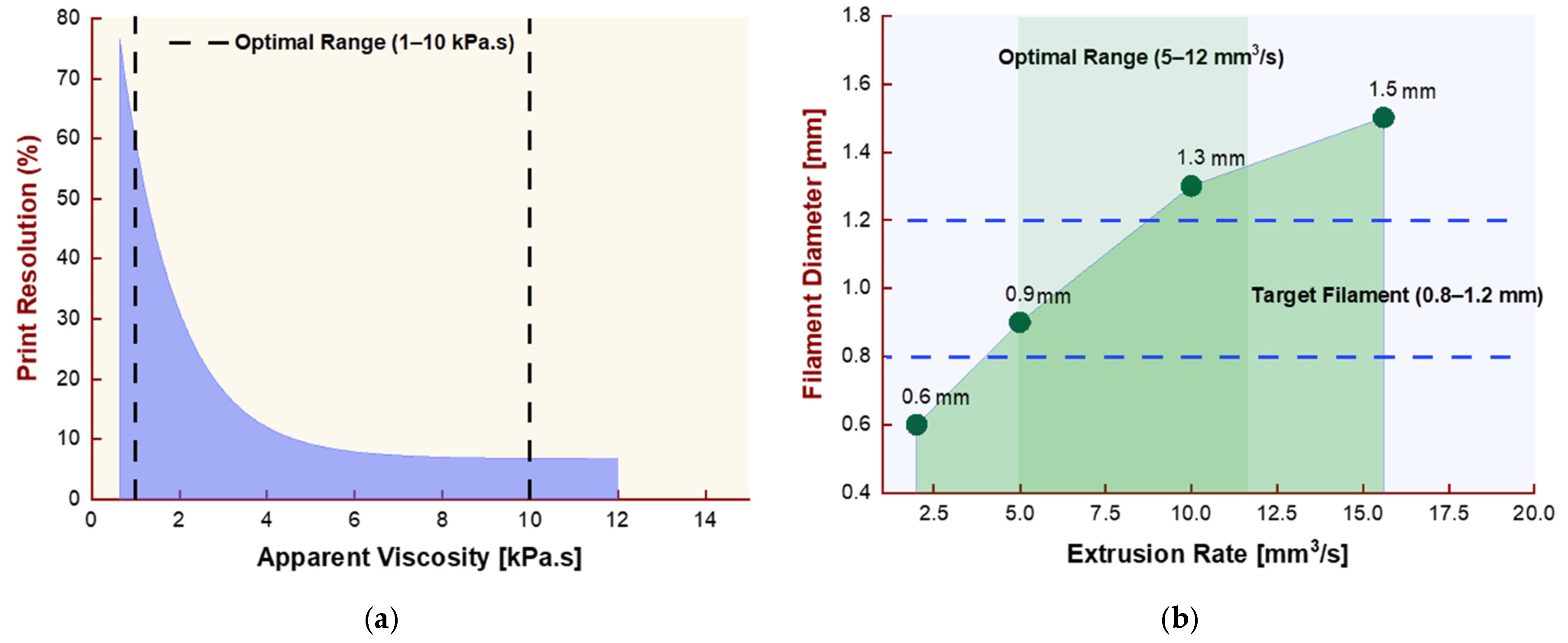
As discussed in Section 3.4, viscosity directly influences filament formation; here, we examine how this translates to dimensional accuracy through parameter selection. Printing accuracy measures how closely fabricated structures match digital designs, assessed by dimensional and image analysis. Among food inks, cereal–legume starch gels yield the highest accuracy (99.37%), specialty systems reach 98% and 96%, while chocolate-based inks lag at 88% due to thermal sensitivity and viscosity–temperature complexities. These differences highlight the challenge of ensuring structural stability across material types. Systematic quality assessment of 3D-printed cereal products identifies key parameters: ink mechanical properties, printed object shapes (e.g., image analysis, calculations), and final products via microscopy, instrumental, and sensory texture evaluation [49,50]. This framework shows that printability covers not only initial dimensional accuracy but also long-term stability and sensory quality after processing. In the context of 3D food printing, resolution determines the structural fidelity and surface smoothness of edible constructs, directly influencing both the sensory “mouthfeel” and the precision of intricate internal geometries [51,52]. By optimizing nozzle diameters and layer heights, we can minimize visible layering to achieve the refined textures and tight tolerances essential for complex, multi-component food designs [30,49,50]. The interrelation between critical ranges of process parameters and rheological parameters is shown in Figure 3.
The interplay between rheological properties and process parameters is illustrated in Figure 3. As shown in Figure 3a, optimal print resolution requires the ink viscosity to fall within a material-specific window—too low causes filament spreading and loss of detail, while too high leads to extrusion difficulties and surface roughness. Figure 3b further demonstrates that filament diameter scales with extrusion rate, but the exact relationship depends on nozzle diameter and ink rheology. Together, these relationships define the printable regime for a given formulation.
Accurate dimensional prediction depends on integrating material rheology and process parameters. Combining experimental tests, numerical modeling, and neural networks allows optimization by classifying filament deposition into regimes: quasi-Newtonian flow, round deposition, spreading, tearing, and layer-pressing. This approach explains how rheology (yield stress, plastic viscosity) and process variables (nozzle diameter, height, speed, extrusion velocity) shape filament geometry—directly informing food printing optimization.

5. 4D: Post-Printing Treatment and Temporal Activation of Printed Structures

Four-dimensional (4D) food printing extends extrusion-based 3D printing by integrating triggered changes into the printed construct, where functionality evolves after fabrication through controlled activation (e.g., time-dependent transformations). In food systems, the “fourth dimension” is most often expressed not as dramatic shape morphing alone, but as post-printing stimulus-triggered changes in mass transfer, including delayed hydration, programmed softening, controlled color transitions, and staged bioactive release. This behavior emerges from the coupled design of material formulation, printed architecture (e.g., infill and porosity), and post-printing treatments, which together define activation kinetics and the stability of nutrients and bioactives [53,54,55]. The successful 4D functionality described in this section does not emerge independently but builds directly on the rheological principles established earlier. Yield stress and viscoelasticity determine whether printed structures can withstand post-processing without deformation; network architecture governs diffusion pathways for stimuli (heat, moisture, enzymes); and thixotropic recovery affects how structures respond to repeated environmental changes. Thus, rheological design is not merely a prerequisite for printing—it is the foundation upon which programmable 4D responses are built.

5.1. Thermal Post-Processing as Activation: Structure Consolidation and Bioactive Preservation

Thermal post-processing functions as an activation step that can consolidate printed networks through starch gelatinization and protein crosslinking, while simultaneously altering moisture content and diffusion pathways [45]. Moisture loss is a critical activation variable as it governs both mechanical evolution and transport control. Documented thermal treatment led to 35.6% weight reduction (water loss) in food systems, correlating with network consolidation and controlled moisture gradients that enable timed release behavior [42]. In butterfly pea flower (BPF)-based printed structures, steaming maintained higher dimensional fidelity than water-immersion cooking or oven heating and supported strong bioactive preservation. Anthocyanin retention was more than 90% using steam, whereas microwave drying produced 74–85% retention, demonstrating that processing route can shift bioactive losses about 10% within a single formulation class [56].
In aronia-loaded printed gels, thermal treatment is reported to trigger starch gelatinization and protein network formation, which subsequently governs the release rate of polyphenols (including anthocyanins) during gastrointestinal digestion [57]. In this activation logic, thermal treatment reduces early-stage diffusion (by tightening the gel network and reducing free water) while supporting later-stage release when environmental conditions (e.g., intestinal pH) become favorable for solubilization and absorption [57]. Localized blue laser irradiation provides an alternative to conventional heating. Fujiwara et al. [58] created a “Laser Cook Fusion” system using a 450 nm laser to gel curdlan-based inks with vegetable powders (tomato, pumpkin, ukogi). Local heating (84–91 °C) allows precise, support-free fabrication of multi-layered hollow structures and tunable mechanical properties. Tomato-based inks showed vertical rupture forces of 5.72 ± 0.37 N.
Activation timescales vary with the target outcome and geometry. Reported thermal treatment durations range from minutes (rapid steaming; ~5–10 min for small constructs) to tens of minutes or longer (slow oven drying; ~45–90 min for broader moisture control), reflecting the need to match treatment duration to construct size, internal design, and desired post-printing evolution pathway [55,56].

5.2. Fermentation-Driven Activation: Time-Programmed Softening, Porosity Effects, and Nutritional Evolution

Fermentation provides a biological activation route that can reshape texture and internal structure without external physical triggers. In printed idli batter systems, constructs at 40% infill showed 37% lower hardness than 100% infill, while pearl millet fortification (20% w/w) accelerated fermentation and amplified structural changes [42]. A practical process window of 12–36 h at 30–40 °C is reported for effective fermentation [42]. Critically, these effects are architecture-mediated: higher infill density reduces pore space, limiting gas diffusion and slowing fermentation, while open structures promote gas cell expansion and microbial activity [59]. Thus, fermentation emerges as a structure–transport–biochemical coupling mechanism, where infill patterns and porosity govern gas retention, acid diffusion, and texture evolution. Probiotic-driven fermentation in dairy–protein–starch systems offers additional functionality. In purple potato puree with milk, Lactobacillus bulgaricus and Streptococcus thermophilus fermentation (6–8 h, 37 °C) increased probiotic counts while suppressing mold [60]. pH reduction triggered anthocyanin color change from purple to red—a 4D response signaling fermentation progress, while hardness decreased by 22.6% after 6 h, with added tea polyphenols [60].
For applications to elderly, five probiotics (4% w/w) added to brown rice inks reduced significantly apparent viscosity and storage modulus, improving extrudability and printability [61]. Texture analysis revealed significant reductions in adhesiveness, gumminess, and hardness versus controls, with three probiotic formulations meeting easy-to-swallow criteria. Starch crystallinity decreased, and short-chain fatty acids (acetic, butanoic, octanoic) increased, enhancing in vitro digestibility while maintaining probiotic viability above 7 log CFU/g post-digestion. Probiotics may produce enzymes that reduce the particle size of brown rice and break down the macromolecular polysaccharides in brown rice starch during the fermentation process, resulting in a lower content of cellulose, pectin, and other substances and reduced ink viscosity.
Fermentation mechanisms are architecture- and formulation-dependent: printed geometry governs gas retention and pore evolution [42], while probiotic selection determines texture modification and nutritional enhancement [60,61,62]. This enables integration with broader fermentation innovation in plant-based foods, where microbial metabolism can be used alongside printing to steer sensory profile development and functional performance over time [62].

5.3. Digestive Environment Activation: pH, Ionic Strength, Hydration, and Staged Release

A significant portion of food-relevant 4D behavior aligns naturally with gastrointestinal stimuli, where hydration and chemical gradients serve as intrinsic activators. pH-responsive mechanisms regulate swelling, deswelling, relaxation, and electrostatic interactions, enabling staged release during transitions from the stomach to the intestine. The efficacy of such digestive environment activation is intrinsically linked to the printed product’s internal architecture. As reviewed by Lombardi et al. [63], the controlled design of hierarchical porosity—combining macro- and micro-scale pores—can modulate enzyme penetration and diffusion pathways, thereby directly influencing the kinetics of nutrient release and matrix degradation. This positions porosity not just as a textural element, but as a tunable parameter for governing bioaccessibility in 4D-printed foods. Beyond simple shape transformation, 4D printing with zein-based specimens utilizes the water-driven self-assembly of hydrophobic fibrils to achieve temporal functional heterogeneity in both degradation and release kinetics [64]. Notably, Zhang et al. [64] demonstrated that by modulating the composition of the supporting bath, this behavior can be finely tuned: conduits printed in 75% water exhibit a porous architecture that results in 88.2 ± 1.17% degradation over 10 days under protease XIV exposure, while 40% water baths yield more compact structures that limit enzyme penetration and provide significantly lower degradation with stable wall thickness.
Ionic responsiveness provides a parallel activation mechanism because salts and pH gradients in digestive fluids modify polymer hydration, crosslinking balance, and network stability. In a food printing context, coaxially printed starch/alginate–pectin hydrogels showed pH-responsive behavior and maintained structural fidelity while enabling encapsulation functionality, demonstrating how edible printed hydrogels can be designed for environment-dependent integrity and release [65]. Pectin hydrogels provide a clear pH-linked quantitative framework for food-relevant behavior: gelation is inhibited under acidic gastric conditions (around pH 2.0–3.0), becomes favorable in the small intestine (pH 6.0–6.5), and can further consolidate in the colon-like range (pH 7.5–8.0), enabling environment-dependent control over integrity and release [66]. Zhang et al. [67] showed that coating Lactiplantibacillus plantarum with whey protein nanofibrils via supramolecular biointerfacial self-assembly improves probiotic survival at pH 2.0 and 11.0. The nanofibrils act as a stable physical barrier, allowing the inclusion of viable probiotics in 3D-printed dysphagia foods in accordance with international standards.
Emulsion gels extend this logic by coupling interfacial stability with digestive conditions. Protein–polysaccharide complexes that stabilize emulsion gel inks are modulated by pH-dependent electrostatic interactions, enabling programmed gel formation or breakdown and supporting controlled release of hydrophobic bioactives through digestion-linked interfacial changes [68]. Within a 4D framework, these systems support sequential responses: constructs can remain stable through early exposure and activate later through hydration, pH shifts, ionic changes, and enzymatic action, yielding time-dependent release profiles rather than a single-step response [53].

5.4. Multi-Stimulus Systems and Application Targets: From Delivery to Medical Nutrition

Multi-stimulus designs combine physical consolidation (thermal), biological remodeling (fermentation), and digestive triggers (pH/ionic strength/hydration) to achieve programmable performance. Bigel architectures—hydrogel–oleogel hybrids—provide an additional design degree of freedom by separating hydrophilic and lipophilic domains, enabling dual-phase control where the hydrogel governs water-driven transport and the oleogel supports lipophilic protection and enzymatic breakdown pathways [69].
Application-driven 4D food printing emphasizes functional outcomes that evolve over time: improved stability of sensitive compounds during processing and storage, followed by controlled bioaccessibility during digestion [57]. The evaluation of final product functionality—nutritional and sensory—is vital for the impact of 3D-printed foods. Herdeiro et al. [70] assessed snacks with edible insect meals (Tenebrio molitor, Alphitobius diaperinus), providing key post-printing data: protein content reached ~14 g/100 g, antioxidant capacity increased (DPPH from 3.53 to 9 μmol TEAC/g for A. diaperinus), and sensory scores were acceptable (~4.5–4.9/9). These quantitative results in nutrition and palatability illustrate the “evolved state” 4D printing seeks, stressing the importance of future strategies that deliver both physiological benefits and consumer acceptance. Similarly, an effort to develop a snack cracker that utilizes imperfect vegetables (3D-printed snacks from upcycled broccoli and carrot powders) as alternative ingredients that add value both nutritionally and economically has also been reported [71].
Medical nutrition provides a strong target domain, including texture-managed foods designed for safe swallowing and improved palatability, where printed architecture and post-processing jointly govern time-dependent softening and stability [72]. The internal structural design of printed products—including infill density, layer orientation, and compartmentalization—critically determines quality retention and nutritional preservation during post-processing interventions [72], as demonstrated in dysphagia applications [41,73,74,75,76]. Sesame oil bodies (SOBs) have recently attracted attention in dysphagia-oriented food design because they naturally contain bioactive compounds and exhibit suitable rheological behavior for extrusion-based printing [77,78]. Such lipid–protein structures enable the formulation of soft-textured foods with improved nutritional value while maintaining printability. Protein-based inks and plant-based meat analog formulations further extend this concept by enabling formulation-driven control of network architecture and post-processing texture development.

5.5. Emerging Multiphase Architectures for Functional 3D Food Printing

The research efforts and the systems discussed in this section are considered as advanced interfacial/multiphase strategies for tuning printability and post-printing functionality.

5.5.1. Coaxial Food Printing

Multiphase structuring approaches such as coaxial extrusion have expanded the functional capabilities of food printing. Emulsion gels and bigels—biphasic systems combining hydrogel and oleogel phases—have emerged as promising printable materials and fat mimetics [79,80,81,82,83,84]. These systems provide simultaneous control of hydrophilic and lipophilic domains, improving mechanical strength and structural stability. For example, Johansson et al. [85] demonstrated that pea protein-based bigels can be used for single-, dual-, and coaxial-material printing, producing structures with enhanced mechanical integrity. Comparable improvements in structural stability have also been reported for other emulsion gel formulations [86].

5.5.2. Gels Utilizing Nanoparticles and Nanorods

Nanostructured stabilizers further enhance food inks. Starch nanoparticles can be used to stabilize emulsions because they can adsorb at the oil–water interface, forming physical barriers, hence causing a reduction in droplet interactions [87]. They can also interact with carrageenan, a colloidal polysaccharide, forming 3D gel networks, thereby empowering system stability and mechanical strength [88]. Starch nanorods (SNRs) have been synthesized at different aspect ratio shapes with the aid of alkaline hydrolysis–nanoprecipitation facilitated by thermal regulation, as reported by Chen et al. [89] and Ruan et al. [90]. Starch nanorods (SNRs) with prismatic, ellipsoidal, and spindle-shaped morphologies have also been employed to stabilize docosahexaenoic acid (DHA)-rich algal oil emulsion gels as reported by Zhong et al. [91].

5.5.3. Protein-Based Pickering Emulsion 3D Printing

Pickering emulsion-based 3D printing represents another emerging strategy. This method uses stable Pickering emulsions as inks for the creation of complex food structures with high precision [92,93]. Layer-by-layer deposition is being used for the control of shape and function [94,95,96]. Pickering emulsion stability and rheology can be improved with the aid of xanthan gum (XG), a natural polysaccharide. If combined with proteins, XG forms stable interfacial networks, increasing phase viscosity [97,98]. Marine protein-based platforms such as mussel adhesive protein (MAP), a natural biopolymer rich in 3,4-dihydroxyphenylalanine (DOPA), combined with xanthan gum (XG) were employed to stabilize Pickering emulsion gels and showed long-term stability and reliable printability [99].
Across the above 4D activation routes, a common principle emerges: the printed network’s rheological characteristics prescribe the food response. Porosity and network density, interrelated to mechanical properties and entanglement/crosslinking, governs diffusion rates, swelling, and degradation behavior. Inevitably, these shared rheological factors link all 4D mechanisms within a unified design approach.

6. Outlook: Multi-Parameter Interactions in 3D/4D Food Printing

Successful 3D food printing depends on optimizing three interconnected domains: (1) network architecture, which sets fundamental gel properties via formulation; (2) critical rheological properties, which control material flow and recovery; and (3) process characteristics, which translate material properties into fabrication outcomes.
Critical parameters—such as storage modulus, yield stress, viscosity, loss tangent, nozzle diameter, printing speed, layer height, extrusion rate, starch, and water content—jointly determine printing outcomes. Secondary factors (loss modulus, print temperature, extrusion pressure, protein, and hydrocolloid content) further refine these effects. Optimal parameter ranges are material-specific, necessitating experimental validation for new formulations.
Multi-parameter interactions are critical: G′ enhances stability, while yield stress avoids spreading and extrusion issues. Smaller nozzles require slower speeds and lower viscosities; higher printing speeds (>400 mm/min) with low-viscosity inks risk filament thinning unless a high G′ is maintained. Small layer heights demand higher G′ for structure, and starch content below 20% undermines network strength, whereas the upper limit should be particularly identified. Complex, multi-component systems, such as ionic-crosslinked and dual-crosslinked systems, deliver superior mechanical properties at the cost of increased complexity. Processing parameters—such as printing speeds and nozzle diameters—vary up to 50-fold across formulations, making formulation-specific optimization essential.
In the framework presented here, multi-parameter optimization—formulation, rheology, and process conditions—enables precise 3D printing and forms the basis for 4D food printing. Post-printing stimuli then activate time-dependent structural and functional changes, connecting static fabrication to dynamic, programmable food constructs.
The reviewed literature reveals four core design principles for extrusion-based 3D/4D food printing. Formulations must deliver a balanced rheological profile according to the following:
I.
High G′ (i.e., G′ > 4000 Pa) generally increases stability and stacking accuracy, but excessive stiffness impairs extrudability unless balanced by strong shear-thinning.
II.
Yield stress at 100–300 Pa, which performs best for most formulations. Above 500 Pa, extrusion is difficult; below 100 Pa, spreading occurs.
III.
Thixotropic recovery exceeding 80% within 30 s to enable both smooth extrusion and shape fidelity.
IV.
Network architecture—particularly porosity and crosslink density—requires engineering not only for printability but also to control diffusion, swelling, and degradation rates during 4D activation.
Moreover, the discussed framework here shows that 3D/4D food printing success depends as well on the following process parameters:
  • Nozzle diameter and printing speed are interdependent: smaller nozzles require slower speeds and lower viscosities; larger nozzles handle higher viscosities and faster deposition rates. The typical utilized diameter is 1.2 mm.
  • Printing speeds above 400 mm/min with low-viscosity inks risk filament thinning and collapse unless elasticity is maintained. Although a wide range is observed, the usual range is between 900 (15 mm/s) and 1500 (25 mm/s).
  • Layer heights below 0.3 mm can improve fidelity but require strong elastic recovery, typically from higher G′ (typically between 0.8 and 1 mm).
Integrating formulation, rheology, and processing builds a comprehensive framework that advances 3D/4D food printing toward commercial and multi-material applications.

Critical Research Gaps and Future Directions

The current literature employs diverse rheological measurement protocols, making direct comparison across research efforts challenging. The field would benefit substantially from the development of standardized measurement protocols, critical threshold values for key parameters, multi-parameter printability indices, and process-relevant measurement conditions. While individual publications demonstrate specific formulation–property linkages, comprehensive maps of how formulation variables systematically affect network architecture and printing performance remain unfinished. Future research should develop high-throughput formulation screening, quantitative composition–property maps, material selection frameworks, and cross-material comparison studies. Although current research efforts tend to address network characterization and process optimization together, a significant amount of research still tackles these separately. Integration would require coupled formulation–process optimization, machine learning models, dynamic measurement approaches, and real-time feedback control systems. While biomedical 4D printing applications have advanced substantially, food-specific applications remain underdeveloped. Priority research areas include personalized nutrition, dysphagia-adapted foods, food waste reduction, regulatory pathways for 3D-printed food products, and scalability and economics demonstrations.

Author Contributions

Conceptualization, T.G. and T.V.; methodology, T.G. and T.V.; validation, T.G. and T.V.; resources, T.G. and T.V.; writing—original draft preparation, T.G. and T.V.; writing—review and editing, T.G. and T.V.; visualization, T.G. and T.V. All authors have read and agreed to the published version of the manuscript.

Funding

This research received no external funding.

Data Availability Statement

No new data were created or analyzed in this study.

Conflicts of Interest

The authors declare no conflicts of interest.

References

  1. Qin, Z.; Yang, Y.; Zhang, Z.; Li, F.; Hou, Z.; Li, Z.; Shi, J.; Shen, T. A critical review: Gel-based edible inks for 3D food printing—Materials, rheology-geometry mapping, and control. Gels 2025, 11, 780. [Google Scholar] [CrossRef] [PubMed]
  2. Herrada-Manchón, H.; Fernandez, M.A.; Aguilar, E. Essential guide to hydrogel rheology in extrusion 3D printing: How to measure it and why it matters. Gels 2023, 9, 517. [Google Scholar] [CrossRef]
  3. Fragal, E.H.; Poirier, A.; Bleses, D.; Silva, Y.F.G.; Baccile, N.; Rharbi, Y. Microbial biosurfactant hydrogels with tunable rheology for precision 3D printing of soft scaffolds. Soft Matter 2025, 21, 4476–4487. [Google Scholar] [CrossRef]
  4. Fahmy, A.R.; Derossi, A.; Jekle, M. Four-Dimensional (4D) printing of dynamic foods—Definitions, considerations, and current scientific status. Foods 2023, 12, 3410. [Google Scholar] [CrossRef]
  5. Heckl, M.P.; Korber, M.; Jekle, M.; Becker, T. Relation between deformation and relaxation of hydrocolloids-starch based bio-inks and 3D printing accuracy. Food Hydrocoll. 2023, 137, 108326. [Google Scholar] [CrossRef]
  6. Liu, W.; Chen, L.; McClements, D.J.; Peng, X.; Jin, Z. Recent trends of 3D printing based on starch-hydrocolloid in food, biomedicine and environment. Crit. Rev. Food Sci. Nutr. 2024, 64, 8948–8962. [Google Scholar] [CrossRef]
  7. Nikolaou, E.N.; Apostolidis, E.; Nikolidaki, E.; Karvela, E.; Stergiou, A.; Kourtis, T.; Karathanos, V.T. The development and optimization of extrusion-based 3D food printing inks using composite starch gels enriched with various proteins and hydrocolloids. Gels 2025, 11, 574. [Google Scholar] [CrossRef]
  8. Taqdissillah, D.; Irsyad, M.; Whulanza, Y. Development of sago starch-alginate hydrogels for extrusion-based 3D food printing. East.-Eur. J. Enterp. Technol. 2025, 4, 31–41. [Google Scholar] [CrossRef]
  9. Chen, Y.; Zhang, M.; Bhandari, B. 3D printing of steak-like foods based on textured soybean protein. Foods 2021, 10, 2011. [Google Scholar] [CrossRef]
  10. Afnan, Z.; Khalid, U.; Ali, Z.; Khalid, F. Plant based ingredients in 3D food printing: A sustainable approach to personalized nutrition. Haya Saudi J. Life Sci. 2025, 10, 606–617. [Google Scholar] [CrossRef]
  11. Rodríguez-Herrera, V.V.; Umeda, T.; Kozu, H.; Sasaki, T.; Kobayashi, I. Printability of nixtamalized corn dough during screw-based three-dimensional food printing. Foods 2024, 13, 293. [Google Scholar] [CrossRef]
  12. Xu, M.; Dong, Q.; Huang, G.; Zhang, Y.; Lu, X.; Zhang, J.; Zhang, K.; Huang, Q. Physical and 3D printing properties of arrowroot starch gels. Foods 2022, 11, 2140. [Google Scholar] [CrossRef] [PubMed]
  13. Mishra, A.A.; Chandregowda, M.; Fai, J.; Bek, M.; Terry, A.E.; Nygård, K.; Arlov, D.; Kádár, R. Tunable elasto-viscoplastic properties of polymer blends for 3D printing applications. Macromol. Rapid Commun. 2025, 46, 2500249. [Google Scholar] [CrossRef]
  14. Ahmad, S.; Alam, H.; Thareja, P. 3D Printing of hydrogels: A synergistic approach of rheology and computational fluid dynamics (CFD) modeling. RSC Adv. 2025, 15, 39369–39390. [Google Scholar] [CrossRef] [PubMed]
  15. De Farias, P.M.; Matheus, J.R.V.; Maniglia, B.C.; Le-Bail, P.; Le-Bail, A.; Schmid, M.; Fai, A.E.C. Bibliometric mapping analysis of Pickering emulsion applied in 3D food printing. Int. J. Food Sci. Technol. 2024, 59, 2186–2196. [Google Scholar] [CrossRef]
  16. Ahmadzadeh, S.; Barekat, S.; Ubeyitogullari, A. Enhancing lutein and anthocyanins stability and bioaccessibility through simultaneous encapsulation using coaxial 3D food printing. npj Sci. Food 2025, 9, 96. [Google Scholar] [CrossRef] [PubMed]
  17. Dou, X.; Ren, J. The application of dairy products and their derivatives as edible inks in 3D printing technology: A review. Int. J. Food Sci. 2024, 59, 8630–8644. [Google Scholar] [CrossRef]
  18. Azman, N.Y.; Fuzi, S.; Abdul Manas, N.H. Development of cellulose based food-ink from cellulose powder. Food Res. 2024, 8, 16–21. [Google Scholar] [CrossRef]
  19. Yu, J. Personalized delivery of probiotics and prebiotics via 3D food printing. Metabolites 2025, 15, 744. [Google Scholar] [CrossRef]
  20. Domalska, Z.; Jakubczyk, E. Characteristics of food printing inks and their impact on selected product properties. Foods 2025, 14, 393. [Google Scholar] [CrossRef]
  21. Agunbiade, A.O.; Song, L.; Agunbiade, O.J.; Ofoedu, C.E.; Chacha, J.S.; Duguma, H.T.; Hossaini, S.M.; Rasaq, W.A.; Shorstkii, I.; Osuji, C.M.; et al. Potentials of 3D extrusion-based printing in resolving food processing challenges: A perspective review. J. Food Process Eng. 2022, 45, e13996. [Google Scholar] [CrossRef]
  22. Kadival, A.; Kour, M.; Meena, D.; Mitra, J. Extrusion-based 3D food printing: Printability assessment and improvement techniques. Food Bioprocess Technol. 2023, 16, 987–1008. [Google Scholar] [CrossRef]
  23. Derossi, A.; Spence, C.; Corradini, M.G.; Jekle, M.; Fahmy, A.R.; Caporizzi, R.; Devahastin, S.; Moses, J.A.; Le-Bail, A.; Zhou, W.; et al. Personalized, digitally designed 3D printed food towards the reshaping of food manufacturing and consumption. npj Sci. Food 2024, 8, 54. [Google Scholar] [CrossRef]
  24. Seol, J.; Kim, J.; Hong, Y.; Cha, M.; Park, S.; Jang, K.J.; Kim, S.J.; Son, H.I. Toward intelligent 3D food printing: A review on the perspective of materials, fabrication, monitoring, and control. Crit. Rev. Food Sci. Nutr. 2025, 65, 546–562. [Google Scholar] [CrossRef]
  25. Chen, Y.; Bi, S.; Gu, J.; Che, Q.; Liu, R.; Li, W.; Dai, T.; Wang, D.; Zhang, X.; Zhang, Y. Achieving personalized nutrition for patients with diabetic complications via 3D food printing. Int. J. Bioprint. 2024, 10, 1862. [Google Scholar] [CrossRef]
  26. Nikolaou, E.N.; Karvela, E.; Apostolidis, E.; Karathanos, V.T. Effects of different mechanical processing methods on physicochemical properties of potato starch-plant protein-carrageenan composite gels. Food Meas. 2025, 19, 2926–2941. [Google Scholar] [CrossRef]
  27. Kaliampakou, C.; Lagopati, N.; Charitidis, C.A. Direct ink writing of alginate-gelatin hydrogel: An optimization of ink property design and printing process efficacy. Appl. Sci. 2023, 13, 8261. [Google Scholar] [CrossRef]
  28. Li, Y.; Cheng, Z.; Zhang, J.; Xu, S.; Cai, Y.; Ding, Y.; Lyu, F. Effect of protein-polysaccharide hybrid gelator system on the material properties and 3D extrusion printability of mashed potatoes. J. Food Sci. 2024, 89, 2347–2358. [Google Scholar] [CrossRef]
  29. Oyinloye, T.M.; Yoon, W.B. Impact of saturated and unsaturated oils on the nonlinear viscoelasticity, microstructure, and 3D printability of fish myofibrillar-protein-based pastes and gels. Gels 2025, 11, 295. [Google Scholar] [CrossRef] [PubMed]
  30. Soni, R.; Bhandarkar, V.V.; Ponappa, K.; Tandon, P. 3D extrusion printability of corn starch and optimization of process parameters for optimal food layered manufacturing. Manuf. Lett. 2025, 44, 948–957. [Google Scholar] [CrossRef]
  31. Dushina, E.; Popov, S.; Zlobin, A.I.; Martinson, E.; Paderin, N.; Vityazev, F.; Belova, K.; Litvinets, S. Effect of homogenized callus tissue on the rheological and mechanical properties of 3D-printed food. Gels 2024, 10, 42. [Google Scholar] [CrossRef]
  32. Bai, C.; Liu, R.; Shen, L.; Yu, Z.; Hu, J. Effects of konjac glucomannan and curdlan on the 3D printability and physicochemical properties of germinated brown rice gel. Foods 2025, 14, 1764. [Google Scholar] [CrossRef] [PubMed]
  33. Oliveira, S.M.; Fasolin, L.H.; Vicente, A.A.; Fuciños, P.; Pastrana, L.M. Printability, microstructure, and flow dynamics of phase-separated edible 3D inks. Food Hydrocoll. 2020, 109, 106120. [Google Scholar] [CrossRef]
  34. Liu, R.; Yu, Z.; Song, J.; Shen, L.; Yin, Y. Evaluation of 3D printing of cereal-legume starch-based gels formulated with red adzuki bean and germinated brown rice flour. Foods 2025, 14, 1791. [Google Scholar] [CrossRef] [PubMed]
  35. Choudhury, D.B.; Kumari, S.; Hazarika, M.K. 3D printed sweets made with peanut chenna and milk: A new frontier in food technology. J. Food Process Eng. 2024, 47, e14528. [Google Scholar] [CrossRef]
  36. Agarwal, P.; Poddar, S.; Varshney, N.; Sahi, A.K.; Vajanthri, K.Y.; Yadav, K.; Parmar, A.S.; Mahto, S.K. Printability assessment of psyllium husk (isabgol)-gelatin blends using rheological and mechanical properties. J. Biomater. Appl. 2021, 35, 1132–1142. [Google Scholar] [CrossRef]
  37. De Salvo, M.I.D.; Palla, C.A.; Cotabarren, I.M. Development of an operational map for the 3D printing of phytosterol-enriched oleogels: Rheological insights and applications in nutraceutical design. Gels 2025, 14, 200. [Google Scholar] [CrossRef]
  38. Nguyen, T.; Ahmadzadeh, S.; Schöberl, H.; Ubeyitogullari, A. Optimizing printability of rice protein-based formulations using extrusion-based 3D food printing. Food Sci. Nutr. 2024, 13, e4713. [Google Scholar] [CrossRef]
  39. Santhoshkumar, P.; Raja, V.; Priyadarshini, S.R.; Moses, J.A. Evaluating the 3D printability of pearl millet flour with banana pulp blends. J. Sci. Food Agric. 2024, 104, 7010–7023. [Google Scholar] [CrossRef]
  40. Bercea, M. Rheology as a tool for fine-tuning the properties of printable bioinspired gels. Molecules 2023, 28, 2766. [Google Scholar] [CrossRef]
  41. Liu, Z.; Bhandari, B.; Guo, C.; Zheng, W.; Cao, S.; Lu, H.; Mo, H.; Li, H. 3D printing of shiitake mushroom incorporated with gums as dysphagia diet. Foods 2021, 10, 2189. [Google Scholar] [CrossRef]
  42. Raja, V.; Moses, J.A.; Anandharamakrishnan, C. Effect of 3D printing conditions and post-printing fermentation on pearl millet fortified idli. J. Sci. Food Agric. 2022, 103, 2145–2154. [Google Scholar] [CrossRef]
  43. Lee, J.B.; Yoon, N.Y.; Bae, Y.J.; Kwon, G.Y.; Sohn, S.K.; Lee, H.R.; Kim, H.J.; Kim, M.J.; Park, H.E.; Shim, K.B. Optimizing 3D food printing of surimi via regression analysis: Physical properties and additve formulations. Foods 2025, 14, 889. [Google Scholar] [CrossRef] [PubMed]
  44. Theagarajan, R.; Moses, J.A.; Anandharamakrishnan, C. 3D extrusion printability of rice starch and optimization of process variables. Food Bioprocess Technol. 2020, 13, 1048–1062. [Google Scholar] [CrossRef]
  45. Lee, C.K.W.; Xu, Y.; Yuan, Q.; Chan, Y.H.; Poon, W.Y.; Zhong, H.; Chen, S.; Li, M.G. Advanced 3D food printing with simultaneous cooking and generative AI design. Adv. Mater. 2025, 37, 2408282. [Google Scholar] [CrossRef] [PubMed]
  46. Oyinloye, T.M.; Yoon, W.B. Investigation of flow field, die swelling, and residual stress in 3D printing of surimi paste using the finite element method. Innov. Food Sci. Emerg. Technol. 2022, 78, 103008. [Google Scholar] [CrossRef]
  47. Kong, D.; Zhang, M.; Mujumdar, A.S.; Li, J. Feasibility of hydrocolloid addition for 3D printing of Qingtuan with red bean filling as a dysphagia food. Food Res. Int. 2023, 165, 112469. [Google Scholar] [CrossRef]
  48. Feng, M.; Zhang, M.; Bhandari, B.; Li, C.; Mujumdar, A.S. Utilizing 3D printing to create sustainable novel food products with innovative ingredients. Innov. Food Sci. Emerg. Technol. 2025, 99, 103873. [Google Scholar] [CrossRef]
  49. Čukelj Mustač, N.; Pastor, K.; Kojić, J.; Voučko, B.; Ćurić, D.; Rocha, J.M.; Novotni, D. Quality assessment of 3D-printed cereal-based products. LWT 2023, 184, 115065. [Google Scholar] [CrossRef]
  50. Uribe-Alvarez, R.; Crofton, E.; Kilcawley, K.; Skibinska, I.; Coleman-Vaughan, C.; Murphy, C.P.; O’Shea, N. Sensory characterisation and volatile analysis of 3D-printed dairy protein-based snack structures. Int. J. Food Prop. 2025, 28, 2573182. [Google Scholar] [CrossRef]
  51. Liu, Z.; Zhang, M.; Bhandari, B.; Wang, Y. 3D printing: Printing precision and application in food sector. Trends Food Sci. Technol. 2017, 69, 83–94. [Google Scholar] [CrossRef]
  52. Mantihal, S.; Prakash, S.; Bhandari, B. Texture-modified 3D printed dark chocolate: Sensory evaluation and consumer perception study. J. Texture Stud. 2019, 50, 386–399. [Google Scholar] [CrossRef]
  53. Pérez-Monterroza, E.J.; Chaux-Gutiérrez, A.M.; de Moura, M.R.; Aouada, F.A. Fundamentals and functional applications of 3D and 4D printing in food manufacturing. Processes 2025, 13, 4043. [Google Scholar] [CrossRef]
  54. Chen, X.; Zhang, M.; Tang, T. Microwave-induced rapid shape change of 4D printed vegetable-based food. Foods 2023, 12, 2158. [Google Scholar] [CrossRef] [PubMed]
  55. He, C.; Zhang, M.; Fang, Z. 3D printing of food: Pretreatment and post-treatment of materials. Crit. Rev. Food Sci. Nutr. 2020, 60, 2379–2392. [Google Scholar] [CrossRef] [PubMed]
  56. Soni, R.; Ponappa, K.; Tandon, P. Advancing sustainable food layered manufacturing through 3D printing and post-processing of butterfly pea flower. Rapid Prototyp. J. 2026, 32, 1–8. [Google Scholar] [CrossRef]
  57. Zhou, Q.; Nan, X.; Zhang, S.; Zhang, L.; Chen, J.; Li, J.; Wang, H.; Ruan, Z. Effect of 3D food printing processing on polyphenol system of loaded Aronia melanocarpa and post-processing evaluation of 3D printing products. Foods 2023, 12, 2068. [Google Scholar] [CrossRef]
  58. Fujiwara, K.; Igeta, Y.; Toba, K.; Ogawa, J.; Furukawa, H.; Hashizume, M.; Noji, T.; Teratani, K.; Ito, N. Laser Cook Fusion: Layer-specific gelation in 3D food printing via blue laser irradiation. Food Bioprocess Technol. 2025, 18, 6265–6281. [Google Scholar] [CrossRef]
  59. Zhang, L.; Lou, Y.; Schutyser, M.A.I. 3D printing of cereal-based food structures containing probiotics. Food Struct. 2018, 18, 14–22. [Google Scholar] [CrossRef]
  60. Chen, J.; Teng, X.; Zhang, M.; Bhandari, B.; Adhikari, B.; Yu, D. 5 D food printing with color change induced by probiotic growth in a starch-protein-based gel system. Food Bioprocess Technol. 2023, 16, 2304–2314. [Google Scholar] [CrossRef]
  61. Huang, J.; Zhang, M.; Mujumdar, A.S.; Wang, Y.; Li, C. Improvement of 3D printing age-friendly brown rice food on rough texture, swallowability, and in vitro digestibility using fermentation properties of different probiotics. Food Chem. 2024, 460, 140701. [Google Scholar] [CrossRef]
  62. Boukid, F.; Hassoun, A.; Zouari, A.; Tülbek, M.Ç.; Mefleh, M.; Aït-Kaddour, A.; Castellari, M. Fermentation for designing innovative plant-based meat and dairy alternatives. Foods 2023, 12, 1005. [Google Scholar] [CrossRef]
  63. Lombardi, L.; Gala, L.D.; Esposito, C.; Tammaro, D. Porous architecture in 3D food printing: Advances in formulation, process control, and sustainable structural design. Compr. Rev. Food Sci. Food Saf. 2025, 24, e70304. [Google Scholar] [CrossRef] [PubMed]
  64. Zhang, Y.; Raza, A.; Xue, Y.-Q.; Yang, G.; Hayat, U.; Yu, J.; Liu, C.; Wang, H.-J.; Wang, J.-Y. Water-responsive 4D printing based on self-assembly of hydrophobic protein “Zein” for the control of degradation rate and drug release. Bioact. Mater. 2023, 23, 343–352. [Google Scholar] [CrossRef] [PubMed]
  65. Lenie, M.D.R.; Ahmadzadeh, S.; Bockstaele, F.V.; Ubeyitogullari, A. Development of a pH-responsive system based on starch and alginate-pectin hydrogels using coaxial 3D food printing. Food Hydrocoll. 2024, 153, 109989. [Google Scholar] [CrossRef]
  66. Said, N.S.; Olawuyi, I.F.; Lee, W.Y. Pectin hydrogels: Gel-forming behaviors, mechanisms, and food applications. Gels 2023, 9, 732. [Google Scholar] [CrossRef]
  67. Zhang, Y.; Wang, Y.; Dai, X.; Li, Y.; Jiang, B.; Li, D.; Liu, C.; Feng, Z. Biointerfacial supramolecular self-assembly of whey protein isolate nanofibrils on probiotic surface to enhance survival and application to 3D printing dysphagia foods. Food Chem. 2024, 460, 140720. [Google Scholar] [CrossRef]
  68. De Farias, B.S.; de Cunha, L.B.; Christ Ribeiro, A.; Jaeschke, D.P.; Gonçalves, J.O.; Fernandes, S.S.; Cadaval, T.R.S.A., Jr.; Pinto, L.A.D.A. Designing emulsion gels for 3D food printing: Structure, stability, and functional applications. Surfaces 2025, 8, 64. [Google Scholar] [CrossRef]
  69. Hashemi, B.; Jafarzadeh, S.; Mohammadi, R.; Jafari, S.M. Application of oleogels, hydrogels and bigels as novel structured materials in 3D/4D food printing. Adv. Colloid Interface Sci. 2025, 343, 103578. [Google Scholar] [CrossRef]
  70. Herdeiro, F.M.; Carvalho, M.O.; Nunes, M.C.; Raymundo, A. Development of healthy snacks incorporating meal from tenebrio molitor and alphitobius diaperinus using 3D printing technology. Foods 2024, 13, 179. [Google Scholar] [CrossRef]
  71. Ahmadzadeh, S.; Clary, T.; Rosales, A.; Ubeyitogullari, A. Upcycling imperfect broccoli and carrots into healthy snacks using an innovative 3D food printing approach. Food Sci. Nutr. 2023, 12, 84–93. [Google Scholar] [CrossRef]
  72. Wang, X.; Zhang, M.; Phuhongsung, P.; Mujumdar, A. Impact of internal structural design on quality and nutritional properties of 3D printed food products during post-printing: A critical review. Crit. Rev. Food Sci. Nutr. 2022, 64, 3713–3724. [Google Scholar] [CrossRef]
  73. Lorenz, T.; Iskandar, M.M.; Baeghbali, V.; Ngadi, M.O.; Kubow, S. 3D food printing applications related to dysphagia: A narrative review. Foods 2022, 11, 1789. [Google Scholar] [CrossRef]
  74. Qiu, L.; Zhang, M.; Bhandari, B.; Chitrakar, B.; Chang, L. Investigation of 3D printing of apple and edible rose blends as a dysphagia food. Food Hydrocoll. 2023, 135, 108184. [Google Scholar] [CrossRef]
  75. Xu, B.; Wang, X.; Chitrakar, B.; Xu, Y.; Wei, B.; Wang, B.; Lin, L.; Guo, Z.; Zhou, C.; Ma, H. Effect of various physical modifications of pea protein isolate (PPI) on 3D printing behavior and dysphagia properties of strawberry-PPI gels. Food Hydrocoll. 2025, 158, 110498. [Google Scholar] [CrossRef]
  76. Yang, Y.; Yang, R.; Fang, Y.; Hou, H.; Zhao, L. Interfacial thickness and roughness of sesame oil bodies by pH regulation for 3D printed dysphagia foods: Texture, rheology, and oral tribology. Food Res. Int. 2026, 229, 118501. [Google Scholar] [CrossRef] [PubMed]
  77. Villa, C.; Teixeira, C.; Carriço-Sá, B.; Dias, C.; Costa, J.; Mafra, I. Enzymatic hydrolysis as a strategy to reduce allergenicity in sesame (Sesamum indicum) proteins. Innov. Food Sci. Emerg. Technol. 2025, 106, 104284. [Google Scholar] [CrossRef]
  78. Yang, R.; Cheng, Z.; Zhao, Y.; Song, Y.; Shi, X.; Yu, H.; Zhao, L. Peanut oil body as a food-grade ink for 3D printing: Preparation, characterization and performance. Food Res. Int. 2025, 212, 116486. [Google Scholar] [CrossRef]
  79. Chao, E.; Li, J.; Duan, Z.; Fan, L. Bigels as emerging biphasic systems: Properties, applications, and prospects in the food industry. Food Hydrocoll. 2024, 154, 110089. [Google Scholar] [CrossRef]
  80. Chao, E.; Yu, Q.; Li, J.; Fan, L.; Zhou, Y. Intra-phase reinforcement of chitin nanocrystals in bicontinuous bigels: A strategy for high-precision 3D food printing. Carbohydr. Polym. 2026, 379, 124948. [Google Scholar] [CrossRef]
  81. Cen, S.; Meng, Z. Advances of plant-based fat analogs in 3D printing: Manufacturing strategies, printabilities, and food applications. Food Res. Int. 2024, 197, 115178. [Google Scholar] [CrossRef]
  82. Cen, S.; Li, S.; Meng, Z. Advances of protein-based emulsion gels as fat analogues: Systematic classification, formation mechanism, and food application. Food Res. Int. 2024, 191, 114703. [Google Scholar] [CrossRef]
  83. Liu, X.; Cheng, Y.; Sun, T.; Lu, Y.; Huan, S.; Liu, S.; Li, W.; Li, Z.; Liu, Y.; Rojas, O.J.; et al. Recent advances in plant-based edible emulsion gels for 3D-printed foods. Annu. Rev. Food Sci. Technol. 2025, 16, 63–79. [Google Scholar] [CrossRef]
  84. Zhong, Y.; Wang, B.; Lv, W.; Wu, Y.; Lv, Y.; Sheng, S. Recent research and applications in lipid-based food and lipid-incorporated bioink for 3D printing. Food Chem. 2024, 458, 140294. [Google Scholar] [CrossRef]
  85. Johansson, L.; Badager, I.; Krona, A.; Abdollahi, M. Printability and interfacial performance of emulsion gels and bigels in multi-material dual and coaxial food 3D printing. Food Hydrocoll. 2026, 172, 111964. [Google Scholar] [CrossRef]
  86. Sinha, S.S.; Upadhyay, A.; Singh, A.; Mishra, S.; Pandey, N. Bigels a versatile gel composite for tailored application in food industries: A review. Food Struct. 2024, 41, 100380. [Google Scholar] [CrossRef]
  87. Dominguez, R.; Munekata, P.E.S.; Pateiro, M.; Lopez-Fernandez, O.; Lorenzo, J.M. Immobilization of oils using hydrogels as strategy to replace animal fats and improve the healthiness of meat products. Curr. Opin. Food Sci. 2021, 37, 135–144. [Google Scholar] [CrossRef]
  88. Li, X.; Fan, L.; Liu, Y.; Li, J. New insights into food O/W emulsion gels: Strategies of reinforcing mechanical properties and outlook of being applied to food 3D printing. Crit. Rev. Food Sci. Nutr. 2023, 63, 1564–1586. [Google Scholar] [CrossRef] [PubMed]
  89. Chen, M.; Ma, W.; Yao, S.; Wan, B.; He, Z.; Kong, X.; Li, D.; Liu, D.; Xu, E. Morphological modulation of starch chains from nanorod to nanospindle via temperature-controlled rearrangement. Int. J. Biol. Macromol. 2025, 288, 138670. [Google Scholar] [CrossRef] [PubMed]
  90. Ruan, S.; Tang, J.; Qin, Y.; Wang, J.; Yan, T.; Zhou, J.; Gao, D.; Xu, E.; Liu, D. Mechanical force-induced dispersion of starch nanoparticles and nanoemulsion: Size control, dispersion behaviour, and emulsified stability. Carbohydr. Polym. 2022, 275, 118711. [Google Scholar] [CrossRef]
  91. Zhong, Y.; Chen, M.; Yao, S.; Zhu, Q.; Kong, X.; Zhang, H.; Liu, D.; Xu, E. 3D-printable docosahexaenoic acid-rich algal oil emulsion gels functionalized by multi-shaped starch nanorods. Carbohydr. Polym. 2026, 376, 124840. [Google Scholar] [CrossRef]
  92. Li, D.; Yin, H.; Wu, Y.; Feng, W.; Xu, K.-F.; Xiao, H.; Li, C. Ultrastable high internal phase Pickering emulsions: Forming mechanism, processability, and application in 3D printing. J. Agric. Food Chem. 2023, 71, 18829–18841. [Google Scholar] [CrossRef]
  93. Li, M.; Feng, L.; Xu, Y.; Nie, M.; Li, D.; Zhou, C.; Dai, Z.; Zhang, Z.; Zhang, M. Rheological property, β-carotene stability and 3D printing characteristic of whey protein isolate emulsion gels by adding different polysaccharides. Food Chem. 2023, 414, 135702. [Google Scholar] [CrossRef]
  94. Kuo, Y.-L.; Chou, Y.-J.; Hu, J.-Y.; Ting, Y. Pickering emulsion emulsified using novel cellulose nanofibers significantly lowers the lipid release rate and cellular absorption. Food Funct. 2024, 15, 4399–4408. [Google Scholar] [CrossRef] [PubMed]
  95. Zhang, M.; Cheng, L.; Hong, Y.; Li, Z.; Li, C.; Ban, X.; Gu, Z. Effects of hydrocolloids on mechanical properties, viscoelastic and microstructural properties of starch-based modeling clay. Int. J. Biol. Macromol. 2024, 266, 130963. [Google Scholar] [CrossRef] [PubMed]
  96. Zhang, X.; Liu, Z.; Shi, W. Pickering emulsion stabilized by grass carp myofibrillar protein via one-step: Study on microstructure, processing stability and stabilization mechanism. Food Chem. 2024, 447, 139014. [Google Scholar] [CrossRef]
  97. Li, L.; Geng, M.; Tan, X.; Teng, F.; Li, Y. Insight on the interaction between soybean protein isolate and ionic/non-ionic polysaccharides: Structural analysis, oil-water interface properties investigation and double emulsion formation. Food Hydrocoll. 2024, 150, 109754. [Google Scholar] [CrossRef]
  98. Li, Y.; Wang, J.; Ying, R.; Huang, M.; Hayat, K. Protein-stabilized Pickering emulsions interacting with inulin, xanthan gum and chitosan: Rheology and 3D printing behaviour. Carbohydr. Polym. 2024, 326, 121658. [Google Scholar] [CrossRef] [PubMed]
  99. An, Z.; Hu, L.; Gong, X.; Wang, W.; Zhang, J.; Mo, H.; Xu, D.; Liu, Z. Exploring mussel adhesive protein as a natural Pickering emulsion stabilizer for 3D food printing applications. J. Food Eng. 2026, 406, 112811. [Google Scholar] [CrossRef]
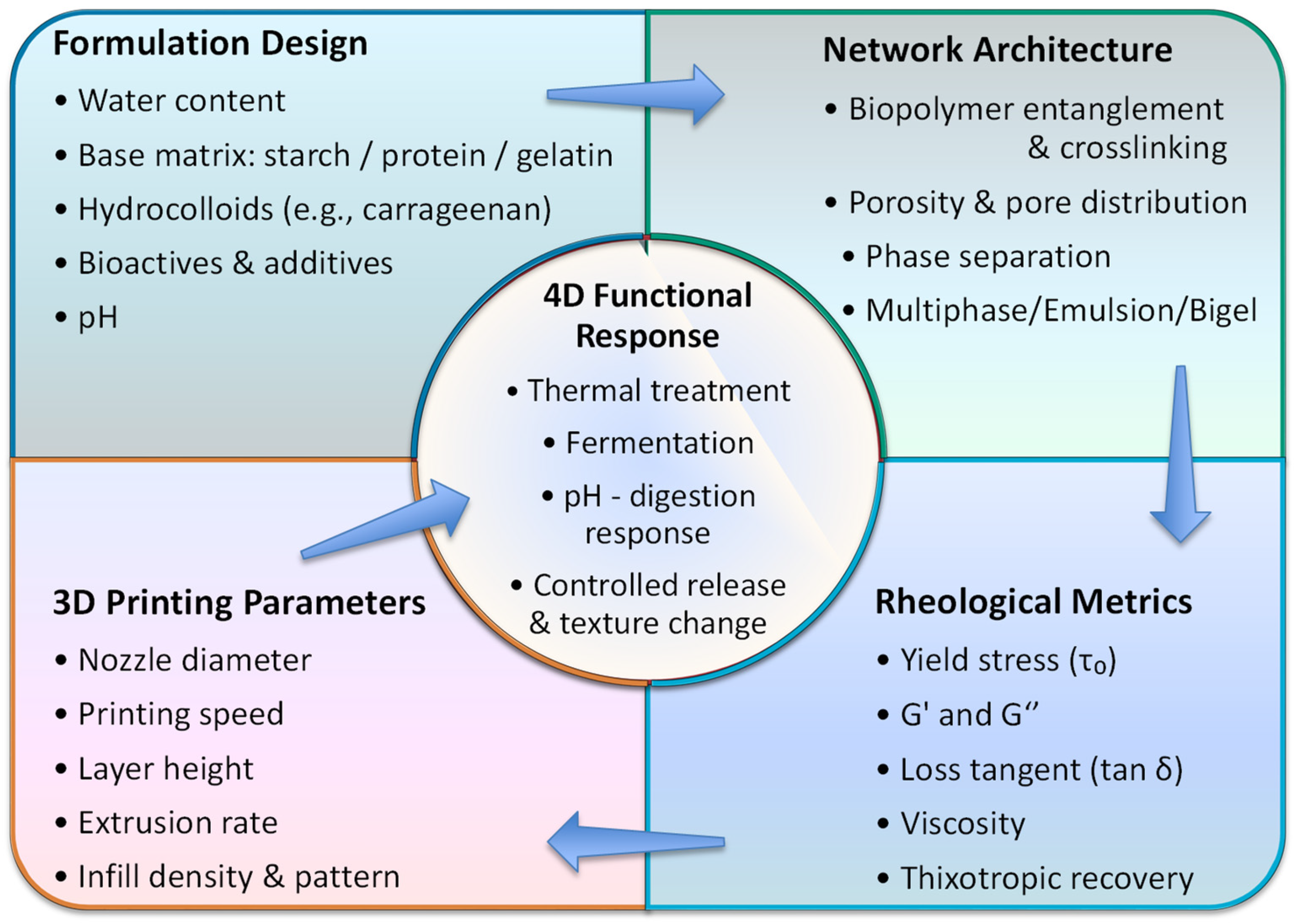
Figure 1. Materials–rheology–process–function continuum in 3D/4D food printing, showing the connecting relationships from formulation design to network architecture, rheological properties, printing parameters, and final 4D functional responses.
Processes 14 01055 g001
Figure 2. Critical metrics in relation to ink rheological properties affecting 3D food printing: (a) yield stress operating regions; (b) thixotropy recovery post-extrusion. The parameters’ ranges shown are compiled from the experimental studies summarized in Table 1.
Processes 14 01055 g002
Figure 3. Process parameters and rheological properties governing 3D food fine printability: (a) interrelation of ink viscosity and resolution; (b) filament diameter and extrusion rate. The ranges shown are compiled from the experimental studies summarized in Table 2.
Processes 14 01055 g003
Table 1. Key rheological metrics (G′, G″, η, σy) for experimentally evaluated extrusion-based 3D food printing formulations. Values are reproduced from the cited studies or digitized/extracted from reported tables and figures.
Ref.G′ [Pa]G″ [Pa]η [Pa·s]Yield Stress [Pa]SystemNote
[7]446–970793–348957–1309181–4392starch gels + proteins + hydrocolloids K-index [Pa·sn]: 57.3–912
[11]200–7 × 10⁴~50–104~10–1059.4–3220nixtamalized corn doughFlour 25–40%
[26]1150–6909100–1400N/A32–455potato starch + plant proteins + carrageenan-
[28]~1.00 × 10⁴–1.22 × 10⁴~1.50 × 10³–2.05 × 103313.48470.69mashed potatoes + k-carrageenan + gelatin-B -
[29]~1800–1.3 × 104200–2700N/AN/Afish myofibrillar–protein pastes with oilsfor >55 °C, G′ higher for moderate lipids than the oil-free control
[31]1.34 × 10⁴–2.28 × 1041750–33809600–7.54 × 10⁴N/Aagar + mashed potato + lupin -
[34]~1000–4 × 10⁴~300–3 × 10⁴~30–8000N/Acereal–legume starch-based + hydrocolloid mixtureK-index [Pa·sn]: 500–995
[36]180–7000150–80049–53118.6–268.7psyllium husk (PH)/gelatin blendsK-index [Pa·sn]: 49.3–530
[37]~1 × 10⁶–5 × 10⁶~7.9 × 10⁴–4.0 × 10⁵~0.013–0.5
&
~1–1000 (*)
NRphytosterol-enriched monoglyceride (MG) oleogels(*) as for wt% phytosterols (up to 40%) and shear rates
[38]~1000–2 × 10⁴~200–3500~0.8–5000N/Arice protein–corn starch gels (high-amylose)-
[41]3.96 × 10⁴–6.09 × 10⁴~2000–8000273–2122268–1803shiitake mushroom paste with gums (AG/XG/KG)-
[42]150–3.43 × 10457.3–8335160–3.53 × 10416.6–96.3rice–black gram idli batter + pearl millet flouryield stress from Herschel–Bulkley model
[43]~6000–4.5 × 10⁴~2000–80001.74 × 103–2.58 × 10⁴N/Asurimi paste inks with starch–salt–waterstarch enhances G′, and G″; water and salt enhance fluidity
Table 2. Printing settings reported in experimental extrusion-based 3D food printing studies (print quality metric as defined in each study).
Ref.Nozzle Diameter (mm)Printing Speed (mm/min)Layer Height (mm)Extrusion Rate (mm3/s)Printing Accuracy (%)
[7]1.01200 (20 mm/s)1.02.2%N/A
[11]2.01200 (20 mm/s)2.0N/AN/A
[34]1.21500 (25 mm/s)0.84 N/ASSI (%) > 99
[37]0.8360–360 (1–6 mm/s)1.0N/AN/A
[41]1.21500 (25 mm/s)1.2N/AN/A
[43]1.94900 (15 mm/s)1.2 5.75 (actual)layer sharpness ~39.8% to 55.8%
[42]1.22400–1400various7.8 to 27.3shape evaluation
[46]1.0900 (15 mm/s)1.025N/A
[30]1, 1.5, 2, 2.5, 31800–4200 (30–70 mm/s)N/AN/AN/A
[45]1.0780 (13 mm/s)0.7N/A82.7%
Disclaimer/Publisher’s Note: The statements, opinions and data contained in all publications are solely those of the individual author(s) and contributor(s) and not of MDPI and/or the editor(s). MDPI and/or the editor(s) disclaim responsibility for any injury to people or property resulting from any ideas, methods, instructions or products referred to in the content.