Article

Interaction of Air Curtain Jets and Thermal Plumes: A Combination of Scale-Down Experiments and Numerical Simulations

1
School of Environmental and Chemical Engineering, Shanghai University, Shanghai 200444, China
2
Zhongce Rubber Group Co., Ltd., Hangzhou 310008, China
3
Varun (Shanghai) Environmental Engineering Technology Co., Ltd., Shanghai 200444, China
*
Authors to whom correspondence should be addressed.
Processes 2026, 14(6), 996; https://doi.org/10.3390/pr14060996
Submission received: 4 February 2026 / Revised: 2 March 2026 / Accepted: 18 March 2026 / Published: 20 March 2026
(This article belongs to the Section Process Control, Modeling and Optimization)

Abstract

Push–pull exhaust systems are widely applied for controlling industry-processing fumes, and their performance is fundamentally governed by the coupling interaction among the air-curtain jet (“push”), the buoyant thermal plume generated by the heat source, and the converging flow induced by the exhaust hood (“pull”). However, the dynamic characteristics and design criteria of this coupled flow field under large temperature differences remain insufficiently explored. Here, a series of scaled experiments combined with numerical simulations is conducted to systematically investigate the coupling behavior of the air-curtain jet and the thermal plume, and two quantitative performance indicators, namely plume deflection height and flow rate along the plume deflection path, are proposed to evaluate flow control effectiveness and energy dissipation. An orthogonal experimental design is further employed to analyze the sensitivity of heat-source and air-curtain parameters with respect to these indicators. The results demonstrate that the air temperature reaches its maximum at approximately 0.8 m downstream of the air-curtain outlet, and that both the supply velocity and outlet width of the air curtain are dominant parameters exerting statistically significant influences on plume deflection height and flow rate along the path (p < 0.01). Furthermore, the Archimedes number effectively characterizes the competition between jet inertia and plume buoyancy in the coupled flow field, with its appropriate value preliminarily recommended to be controlled below 40. This study provides quantitative insights for the engineering design of push–pull exhaust systems operating under high thermal load conditions.

1. Introduction

As a major global manufacturing hub, the rapid growth of industrial production worldwide has acted as a double-edged sword, driving economic development while simultaneously causing severe environmental pollution [1,2]. In the rubber industry, for example, the vulcanization process releases high concentrations of pollutants and waste heat, leading to pervasive fume accumulation and particulate deposition within production workshops [3]. Rubber fumes contain carcinogenic and mutagenic compounds, including aromatic amines, polycyclic aromatic hydrocarbons, and N-nitrosamines [4], which pose a serious threat to respiratory health and increase the risk of leukemia and lung cancer [5,6]. Given the well-documented carcinogenicity of rubber fumes [7], strict control of indoor pollutant concentrations and effective reduction of occupational exposure have become urgent priorities. However, effective exposure control fundamentally depends on the accurate understanding of fume transport mechanisms under extremely high-temperature conditions.
To effectively control rubber fumes, a thorough understanding of their diffusion mechanisms is essential. Specifically, fume temperatures often exceed 200 °C, with a large temperature gradient relative to the ambient environment that generates strong buoyant plumes. Understanding how this buoyant plume affects indoor air distribution is key to designing exhaust systems capable of efficiently removing harmful rubber fumes. Significant theoretical progress has been achieved in this field. Since the classical plume theory proposed by Morton et al. in the 1960s [8], subsequent studies have continuously refined plume modeling frameworks. Hurt and Kaye [9] experimentally compared plumes under different initial conditions and introduced the concept of virtual origin correction. Scase et al. [10] investigated plume evolution in stratified environments and reported a contraction of the initial plume spreading radius. Hurt and Bremer [11] systematically reviewed the development of plume theory, deriving coupled governing equations and discussing analytical solution strategies. In addition, Dhotre et al. [12] employed large-eddy simulation to elucidate the flow characteristics of gas–liquid plumes, while Kondrashov et al. [13] experimentally visualized plume temperature fields and boundary-layer evolution generated by different heat sources. Despite these advances, significant challenges remain in translating plume theory into engineering practice. particularly under conditions involving large heat-release areas, extreme temperature differences, and strong external jet interactions. Rubber fumes typically originate from large vulcanization presses, and conventional overhead exhaust hoods often fail to effectively capture rising plumes, resulting in pollutant leakage [3]. In this context, various advanced local exhaust technologies have been developed, including jet-assisted exhaust hoods [14], curved vortex exhaust hoods [15], advanced Aaberg hoods [16], and spray-integrated exhaust systems [17]. Among these, parallel push–pull ventilation systems [18] are particularly well suited for rubber fume control due to their high capture efficiency, strong resistance to external disturbances, and low energy consumption. Nevertheless, the current literature still lacks physically interpretable and engineering-oriented quantitative indicators capable of characterizing the coupled jet–plume flow field.
Herein, we develop an advanced theoretical framework for high-temperature industrial fume control by systematically elucidating the coupled flow mechanisms between horizontal air-curtain jets and extremely high-temperature thermal plumes under large temperature differences. Scaled experimental measurements in conjunction with high-fidelity numerical simulations are conducted to resolve the spatiotemporal characteristics of the coupled flow field. Two physically meaningful quantitative indicators, plume deflection height and flow rate along the plume path, are introduced to characterize plume control effectiveness and flow-field resistance to jet interference. An orthogonal experimental design combined with single-factor analysis is applied to quantify the effects of heat-source parameters (temperature and characteristic size) and air-curtain parameters (jet velocity, outlet size, and inclination angle) on coupling behavior and indicator sensitivity. The relative dominance, interaction mechanisms, and parameter sensitivities are clarified, providing robust theoretical guidance and quantitative data support for the optimized design of high-performance push–pull ventilation systems operating under extreme thermal conditions.

2. Materials and Methods

2.1. Jet-Plume Coupling Experiment Simulation

The actual equipment, such as vulcanizing machines, horizontal air curtains, and exhaust hoods, is enormous, making the construction of a full-scale experimental platform significantly difficult. Therefore, a scaled-down platform with identical flow and thermodynamic characteristics is built based on the similarity principle. For rubber vulcanization, the development of high-temperature fume and its capture involves flow and heat transfer processes from natural convection and forced convection. When determining the similarity ratio for the scaled-down platform, three key similarity numbers must be considered: the Grashof number (Gr), the Reynolds Number (Re), and the Archimedes number (Ar), defined as Equations (1)–(3). The first characterizes the relative magnitude of fluid buoyancy versus viscous forces, the second characterizes the relative magnitude of fluid inertial forces versus viscous forces, while the third can be calculated using the first two similarity numbers, characterizing the relative magnitude of fluid buoyancy forces versus inertial forces. In this work, Re governs the similarity of the air curtain jets, Gr governs the similarity of the heat source plumes, while Ar governs the similarity of the coupled flow field. In this work, both the prototype and the scaled flows are within the self-modeling region, which means that further increasing Re no longer changes the friction factor, and the Reynolds criterion ceases to be applicable for determining similarity. Therefore, similarity between the prototype and the scaled models can be established by considering only Gr. The geometric scale ratio between the prototype and the scaled model is 1:5. Table 1 calculates the similarity ratios for variables involved in the scaled-down platform. This work focuses on revealing flow characteristics under the interaction of parallel jets and plumes, disregarding the influence of exhaust convergence on the coupled flow field. Therefore, this work addresses a “push-plume” sub-problem, intended as a precursor to complete push–pull system design. Detailed platform similarity ratios, specific structural dimensions, measuring instrument parameters, and experimental conditions can be found in Text S1.
G r = g α v t L 3 ν 2
R e = ρ v L μ
A r = g L 3 ρ l ( ρ ρ l ) μ 2 = G r R e 2
where g is gravitational acceleration, 9.8 m/s2; α v is volume change coefficient; t is temperature difference between the fluid and the boundary layer, K; L is characteristic length, m; ρ l is fluid density, kg/m3; ν is kinematic viscosity, m2/s; ρ is density of fluid, kg/m3; v is flow velocity, m/s; μ is viscosity, kg/(m·s); ρ l is density of another fluid, kg/m3.
Figure 1 illustrates the layout of the scaled experimental platform, the measurement point locations, and the measuring instruments. The scaled platform primarily consists of a heat source device and an air curtain device. The measurement points for air velocity and temperature are located on vertical and horizontal lines perpendicular to the center of the heat source and the outlet of the air curtain. Air temperature is measured and recorded using the WZY-1 temperature recorder (Tianjian Huayi Science & Technology Development Co., Ltd., Beijing, China), with a resolution of 0.1 °C and a deviation of ±0.5 °C. Air velocity is measured using the WWFWZY-1 universal anemometer (Tianjian Huayi Science & Technology Development Co., Ltd., Beijing, China), with a resolution of 0.01 m/s and a deviation of ±5%. Data are recorded every 2 s. To eliminate random errors, each experimental condition needs to be repeated three times. Table 2 presents the parameter settings for the experimental conditions.

2.2. Jet-Plume Coupling Theoretical Model

A numerical model based on computational fluid dynamics (CFD) was constructed to analyze the complex flow structure of the air curtain-plume coupled flow field. This method obtains high-resolution full-field flow field information by solving the governing equations, possessing higher spatial resolution and modeling flexibility than experimental methods. The numerical simulation follows the standard CFD procedure, employing the experimentally validated Realizable k-ε turbulence model and the SIMPLE algorithm, whose reliability has been validated in the literature [19,20,21]. Mesh independence verification and wall function testing were conducted to ensure that the calculation results are unaffected by mesh scale and boundary layer treatment. The air distribution in the coupled flow field was simulated using five different grid quantities. The results indicate that when the mesh number exceeds 1.07 M, the velocity distribution along the heat source axis tends to stabilize; therefore, the mesh file with 1.07 M cells was adopted as the standard mesh for numerical simulation. To control the yPlus value at the wall, 15 layers of boundary layer mesh affected by air viscosity were added in the near-wall region. The first layer mesh height was set to 0.00118 m, with a growth rate of 1.2, resulting in a yPlus value of 1. Enhanced wall treatment was selected as the wall function. Complete modeling details are provided in Text S2.
Regarding the boundary condition settings for the fluid within the computational domain, the mixed air was assumed to be an incompressible ideal gas, and heat dissipation caused by viscous forces of the gas was neglected. Air density follows the Boussinesq approximation, which simplifies the calculation of thermally gradient-driven flows. Both the air curtain outlet and the heat source opening were set as velocity inlets, while the fluid domain boundaries were set as pressure outlets. The CFD governing equations were solved using second-order upwind spatial discretization and the SIMPLE scheme for pressure-velocity coupling. The convergence criteria required scaled residuals for mass and energy to be less than 1 × 10⁻³ and 1 × 10⁻⁶, respectively.

2.3. Parameter Sensitivity Orthogonal Analysis

The air curtain and heat source possess multiple parameters. Different parameter combinations result in distinct distributions of the coupled flow field. Performing numerical calculations for all combinations is impractical, as computational resources increase exponentially with each additional parameter. Orthogonal experimental design can analyze the sensitivity of results to various factors while considerably reducing the number of conditions. Therefore, an orthogonal experimental method is employed to analyze the influence of air curtain and heat source parameters on the coupled flow field. The air curtain parameters selected are outlet width, height above floor, supply air velocity, and supply air angle. Each parameter is set at three levels. Considering the stable formation of the structure of the air curtain jet, the outlet width is selected as 0.04, 0.06, and 0.08 m. Considering the coverage effect of the air curtain jet on the heat source plume, the height above the floor is selected as 1.0, 1.5, and 2.0 m, the supply air velocity is selected as 5.0, 6.5, and 8.0 m/s, and the supply air angle is set as 10°, 0°, and −10°. Heat source parameters include heating power and annular opening diameter. Based on the field measurement data from rubber vulcanization workshops, the heat dissipation of a single tire is approximately 15 kW, with inner and outer diameters of 0.7 and 1.4 m, respectively [22]. Therefore, the heating power is selected as 12, 15, and 18 kW, and the annular opening outer diameter is set as 1.0, 1.4, and 1.8 m (the inner diameter being half the outer diameter). An L27 (313) orthogonal array is established for the six factors and corresponding three levels, as shown in Table S1. Based on the principles of orthogonal experimental design, this form represents the minimal orthogonal array capable of reflecting the interactions among the factors while reserving empty columns for error analysis.

2.4. Performance Assessment Indicator

To evaluate the suppression effect of air curtain jets on heat source plumes, the plume deflection height is introduced, defined as the deflection height of the plume axis relative to the horizontal air curtain, with units in m. When the momentum of the air curtain jet exceeds that of the plume, the horizontal air curtain effectively suppresses plume development, resulting in a smaller plume deflection height. When the momentum of the air curtain jet is insufficient to suppress the plume, the plume breaks through the barrier of the horizontal air curtain jet, resulting in a larger plume deflection height. Figure S1A illustrates the concept of plume deflection height. This indicator aims to determine the optimal installation position of the exhaust hood in a subsequent study on push–pull exhaust systems. After determining the position of the exhaust hood, the exhaust flow rate must be further specified. Therefore, the flow rate along the plume deflection path is introduced, defined as the entrainment flow rate within the plume boundary, with units in kg/s. As the plume continuously entrains in the surrounding ambient air during its development, the flow rate along the path steadily increases. The plume flow rate corresponding to the exhaust hood cross-section represents the effective exhaust flow rate for capturing high-temperature fumes. Given the considerable temperature gradient between the plume and ambient air, the flow boundary exceeding a 1% temperature difference (the difference between the heat source temperature and ambient temperature) is defined as the plume boundary, as shown by the red region in Figure S1B. This indicator aims to determine the hood opening area and exhaust flow rate.

3. Results and Discussion

3.1. Characteristics of the Coupled Flow Field from Scaled-Down Experiments

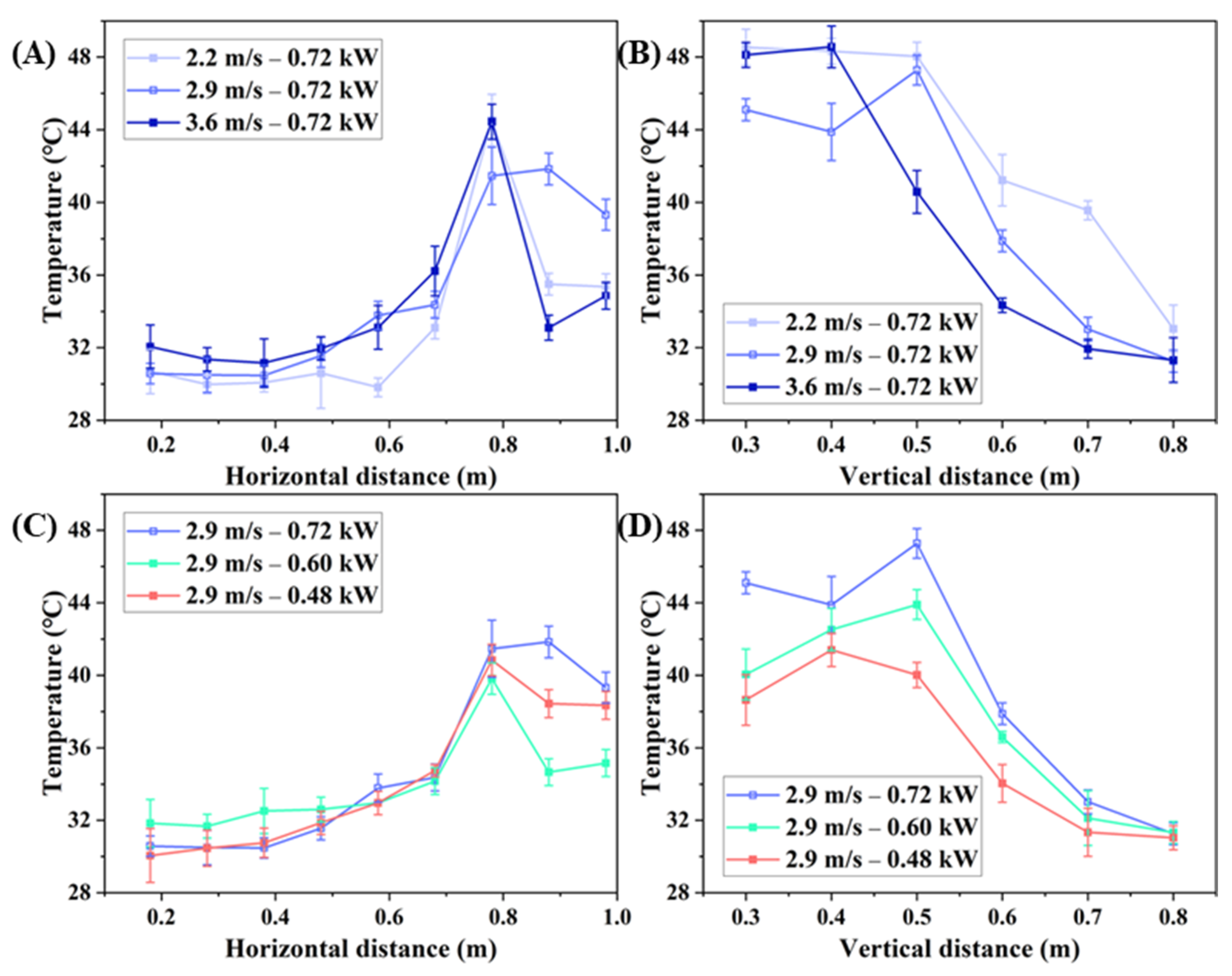
The characteristics of the coupled flow field are analyzed based on experimentally measured temperature profiles, velocity profiles, and visualized air curtain jet structures. Figure 2 displays the temperature profiles along horizontal and vertical lines under two scenarios: constant heating power with varying air curtain supply air velocity (corresponding to Conditions 1, 2, and 3 in Table 2); and constant supply air velocity with varying heating power (corresponding to Conditions 2, 4, and 5 in Table 2). Results indicate that when the heating power is constant at 0.72 kW, the temperature at horizontal measurement points first increases and then decreases with increasing horizontal distance. Air temperature reaches its peak at a distance of 0.8 m from the air curtain outlet. This occurs because the thermal plume deflects under the impact of the horizontal air curtain jet. The distance between the deflected plume axis and the air curtain outlet is around 0.8 m at the air curtain height. For vertical measurement points, the coupled flow field temperature exhibits a trend of initially remaining constant, then decaying with increasing vertical height. When the air curtain supply air velocity is constant at 2.2 m/s, for horizontal measurement points, the coupled flow field temperature follows the same pattern as described above, increasing then decreasing with horizontal distance. Air temperature also peaks at a distance of 0.8 m from the air curtain outlet, with higher temperatures corresponding to greater heating power. For vertical measurement points, the coupled flow field temperature exhibits a trend of increasing then decreasing with increasing vertical height. Therefore, the higher the heating power, the higher the air temperature at vertical measurement points.
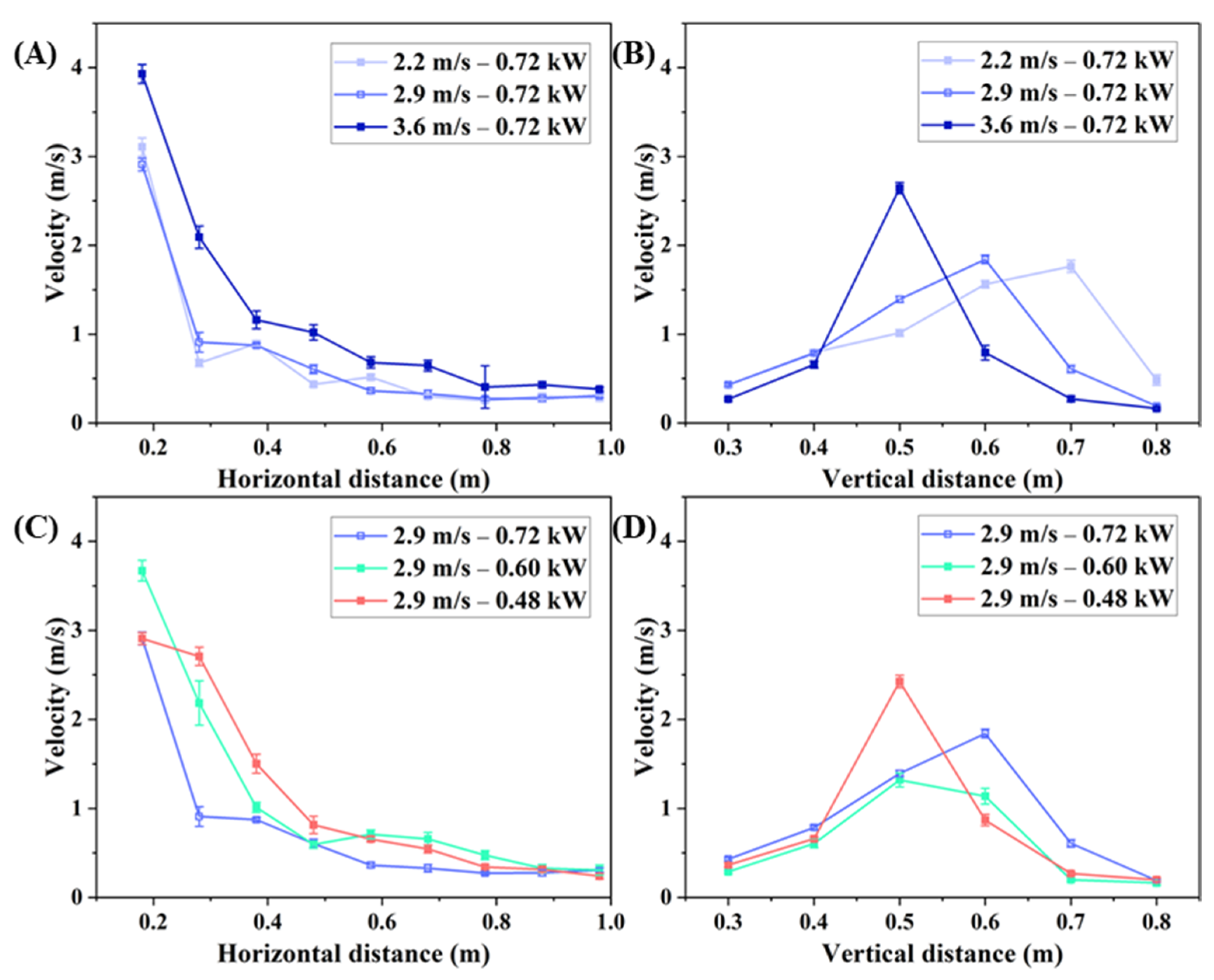
The velocity profiles along the horizontal and vertical directions under two operating scenarios are shown in Figure 3. When the heating power is maintained at 0.72 kW, the velocity of the coupled flow field at horizontal measurement points decreases rapidly with increasing horizontal distance and then gradually stabilizes. It can be observed that the velocity profile at the air curtain supply air velocity of 3.6 m/s is generally higher than those at air curtain velocities of 2.2 and 2.9 m/s. This can be attributed to the magnitude of relative momentum between the air curtain jet and the heat source plume. For vertical measurement points, the coupled flow field velocity increases with vertical height before decreasing. The height corresponding to the velocity peak varies: the higher the air curtain velocity, the lower the vertical height at which the coupled flow field velocity peak occurs. This occurs because higher air curtain velocities cause greater plume deflection, resulting in a larger deviation between the plume axis and the vertical measurement line, and a lower height at which plume momentum is sustained. When the air curtain velocity is constant at 2.2 m/s, the variation trends of the coupled flow field velocity along both horizontal and vertical measurement lines follow the aforementioned patterns.
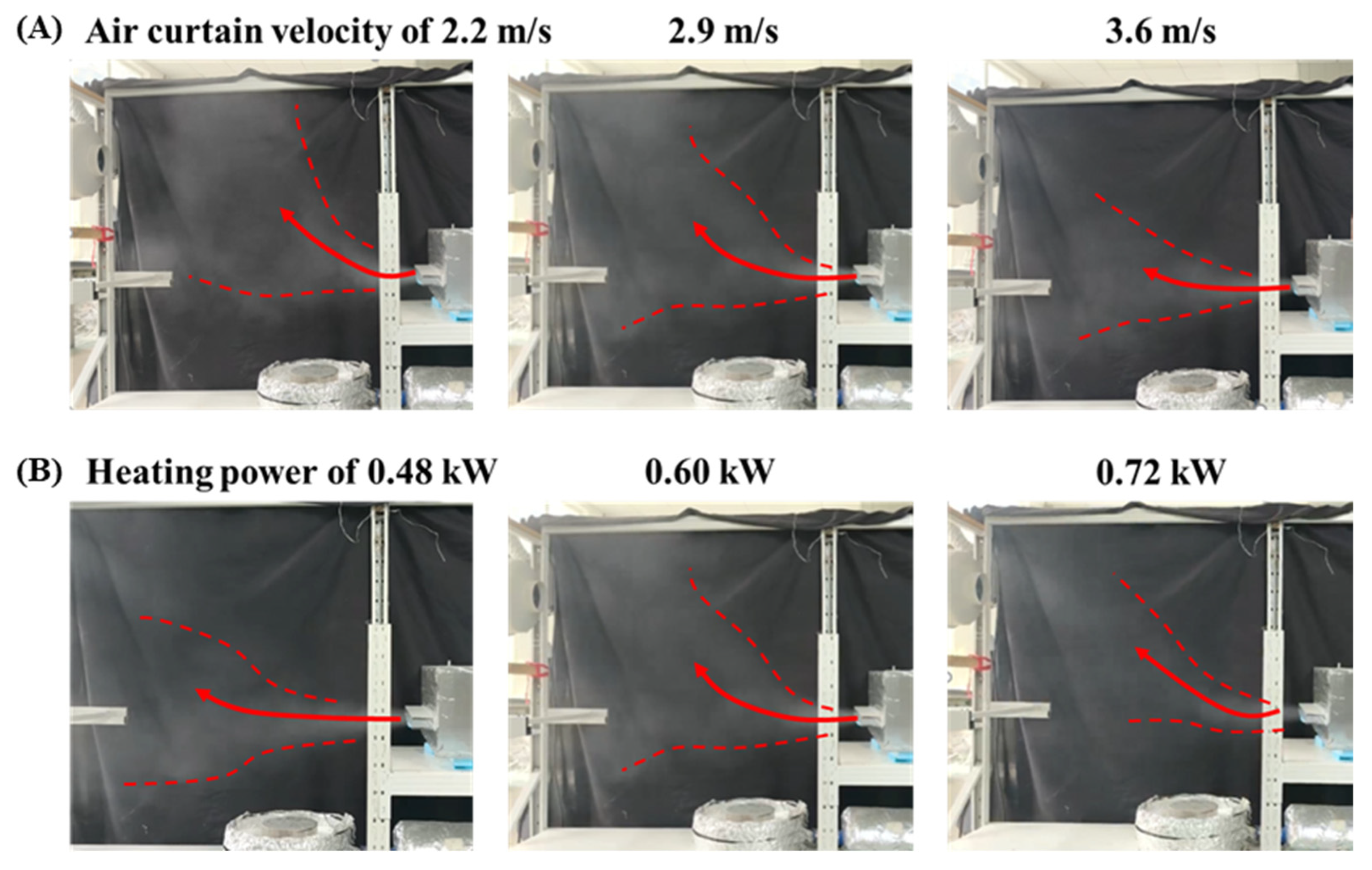
The visualized air curtain jet structures under two operating scenarios are illustrated in Figure 4, where the solid and dashed red lines denote the jet centerline trajectory and the flow boundary, respectively; at a constant heating power of 0.72 kW, increasing the air curtain velocity leads to a contraction of the jet structure and a reduction in trajectory lift due to the interaction with the heat source plume. When the air curtain velocity is constant at 2.2 m/s, increasing the heating power causes the air curtain jet trajectory to rise more considerably. Therefore, the flow characteristics of the coupled flow field are jointly determined by the air curtain jet and the heat source plume. The influencing factors discussed in this section are limited to the air curtain velocity and the heating power. The sensitivity of multiple factors affecting the coupled flow field characteristics is analyzed through numerical simulation below.

3.2. Orthogonal Experimental Analysis

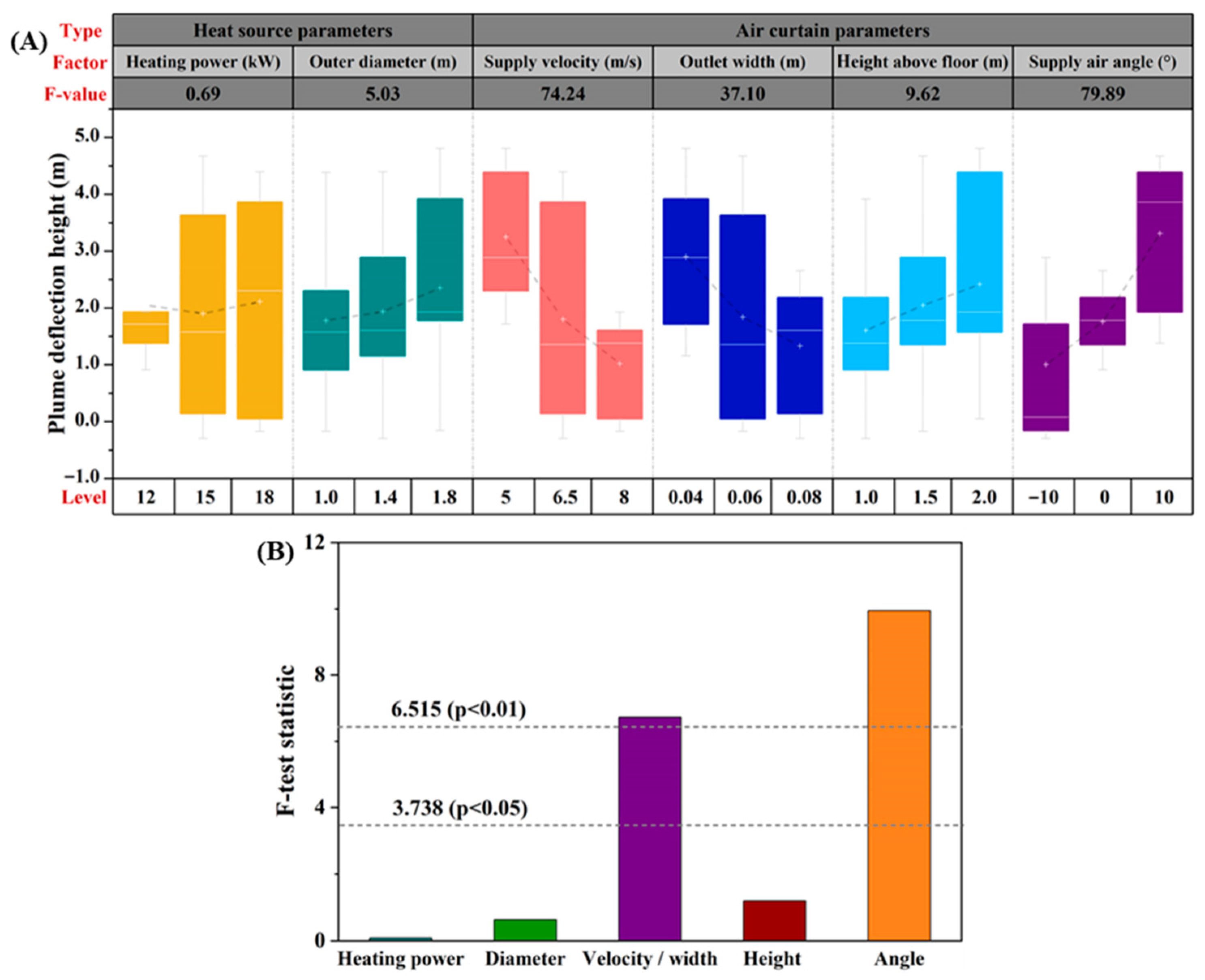
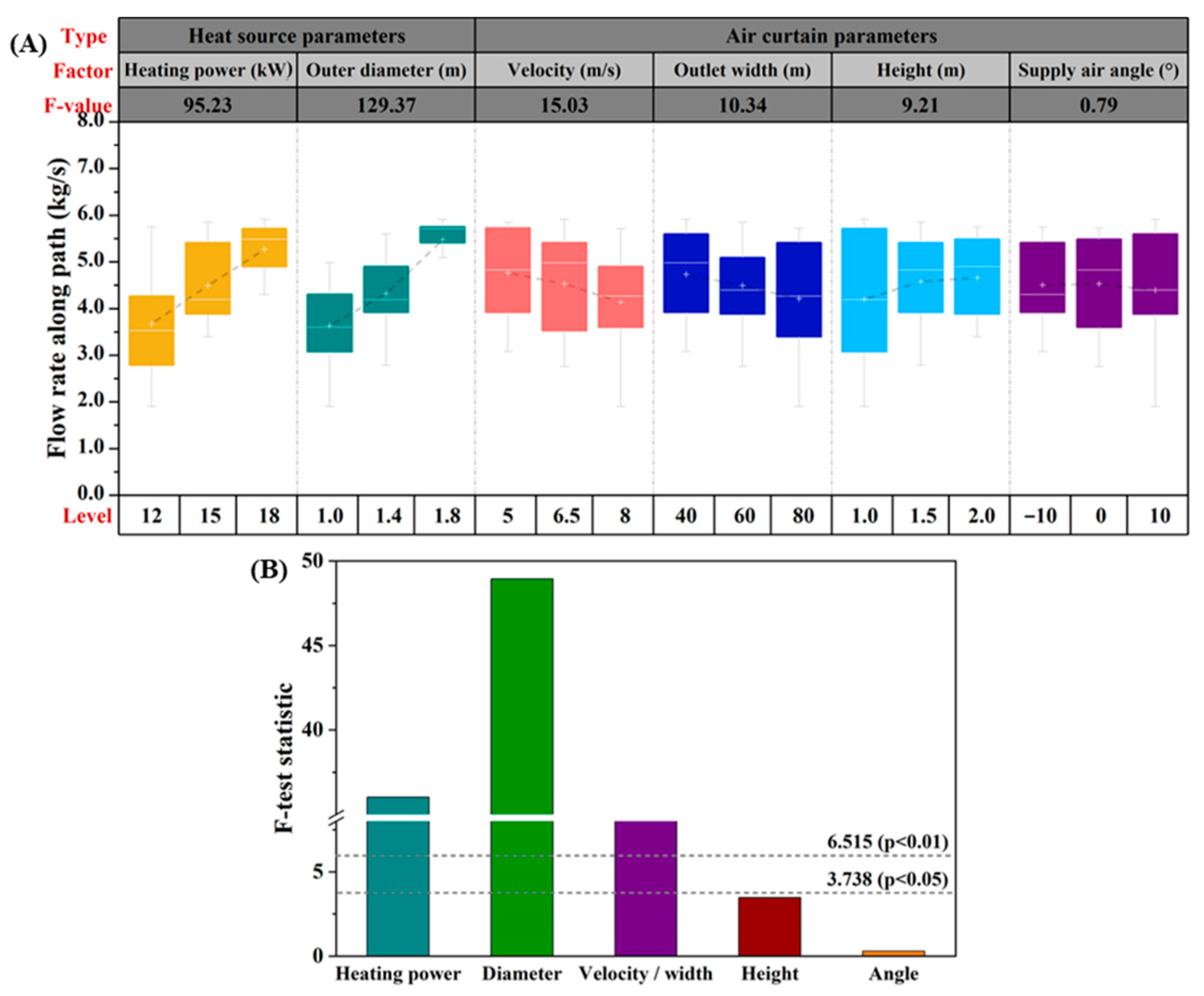
The results of orthogonal experiments on the characteristics of the coupled flow field are analyzed, with the influencing factors including air curtain supply air velocity, outlet width, height above the floor, supply air angle, heating power, and heat source outer diameter; the levels of each factor are listed in Table 2. Figure 5A presents the orthogonal experimental results for the plume deflection height. It can be observed that the plume deflection height is positively correlated with heat source diameter, air curtain height, and air curtain angle, negatively correlated with air curtain velocity and air curtain width, and unrelated to heating power. The greater the air curtain jet momentum, the stronger the jet inertial force, resulting in stronger suppression of the plume and a smaller plume deflection height. Figure 5B presents the F-test statistics for each factor, ranking their significance levels. Results indicate that the p-values for air curtain angle, air curtain velocity, and air curtain width are all less than 0.01, confirming their statistically significant influence on plume deflection height. The remaining three factors do not reach the p-value threshold of 0.05. Therefore, the factors influencing plume deflection height are ranked in descending order of significance as follows: air curtain angle, air curtain velocity, air curtain width, air curtain height, heat source diameter, and heating power.
Figure 6A presents the orthogonal experimental results for the flow rate along the plume deflection path. It can be observed that the flow rate along the path is positively correlated with heating power, heat source diameter, and air curtain height, negatively correlated with air curtain velocity and air curtain width, and shows no apparent pattern with air curtain angle. Greater heat source intensity enhances plume buoyancy, providing a stronger driving force to overcome the obstruction of the air curtain jet, resulting in a higher flow rate along the path. Figure 6B presents the F-test statistics for each factor, ranking their significance levels. Results indicate that the p-values for heating power, heat source diameter, air curtain velocity, and air curtain width are all less than 0.01, confirming their statistical significance. The remaining two factors do not reach the p-value threshold of 0.05. Therefore, the factors influencing the flow rate along the path, ranked from highest to lowest significance, are as follows: heat source diameter, heating power, air curtain velocity, air curtain width, air curtain height, and air curtain angle.

3.3. Single-Factor Analysis

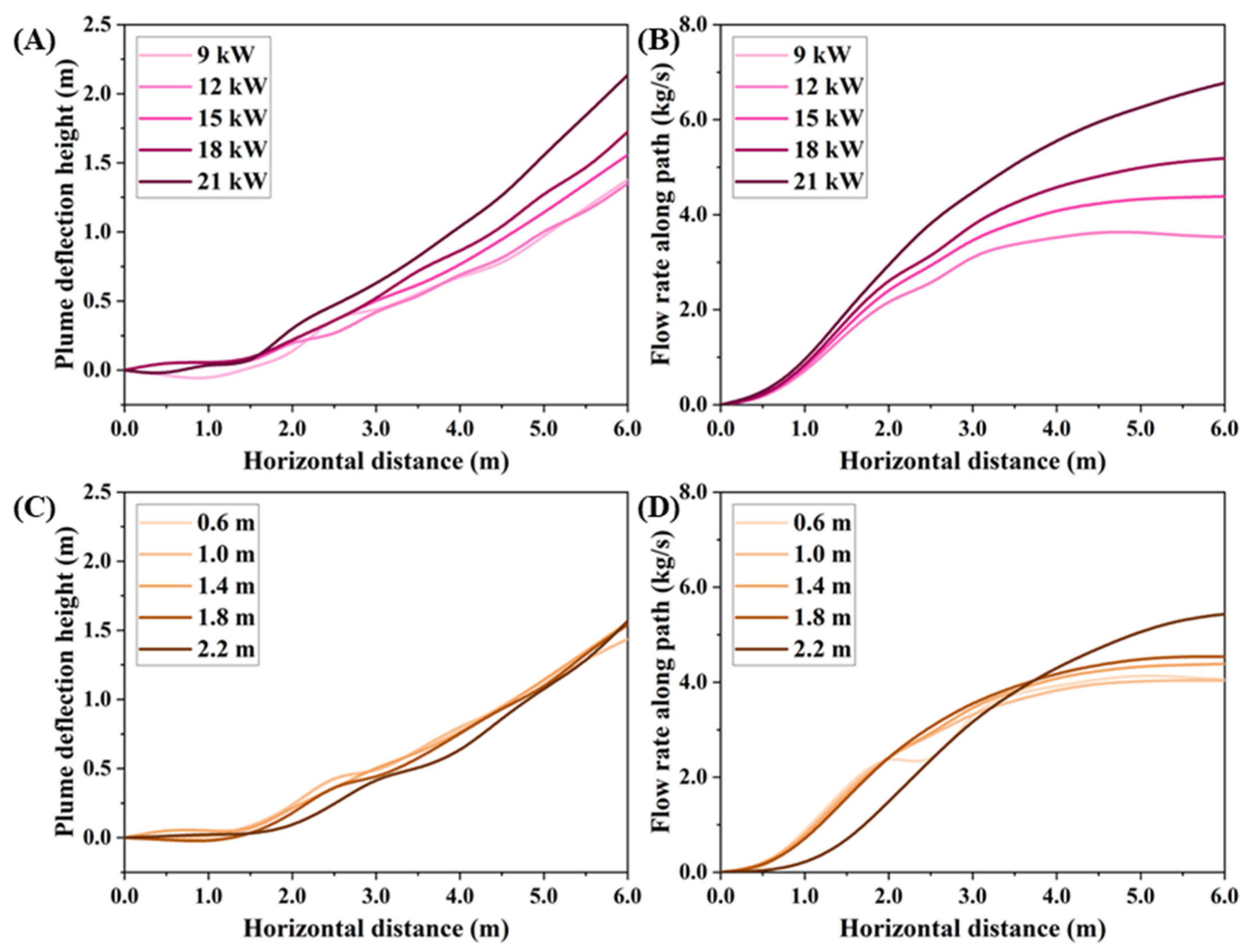
The effects of key parameters on the coupled flow field characteristics are examined through single-factor analysis, focusing on plume deflection height and flow rate along the path; the heating power ranges from 9 to 21 kW, the heat source outer diameter from 0.6 to 2.2 m, the air curtain supply velocity from 3.5 to 9.5 m/s, and the outlet width from 0.02 to 0.10 m, whereas the height above floor and the supply air angle are maintained at 1.5 m and 0°, respectively. Figure 7 illustrates the horizontal distribution of plume deflection height and flow rate along the path under varying heat source factors. These data are extracted from velocity streamlines and temperature counters shown in Figure S2. Figure 7A,B shows that both plume deflection height and flow rate along the path increase with distance from the air curtain outlet under different heating powers, consistent with plume development trends. The greater the heating power, the larger the growth rate (gradient) in plume deflection height and flow rate along the path. At the same heating power, as the horizontal distance increases, the increase in deflection height remains stable, while the increase in flow rate along the path gradually decreases. This is because the ability of the plume to entrain ambient air progressively weakens. Figure 7C,D shows that the heat source outer diameter has no effect on plume deflection height. However, its influence on the flow rate along the path exhibits two patterns: the diameter of 2.2 m and diameters ranging from 0.6 to 1.8 m. A possible explanation is that the plume structure with a diameter of 2.2 m extends beyond the coverage of the air curtain jet, whereas the plume structures with diameters ranging from 0.6 to 1.8 m remain within the coverage of the air curtain jet.
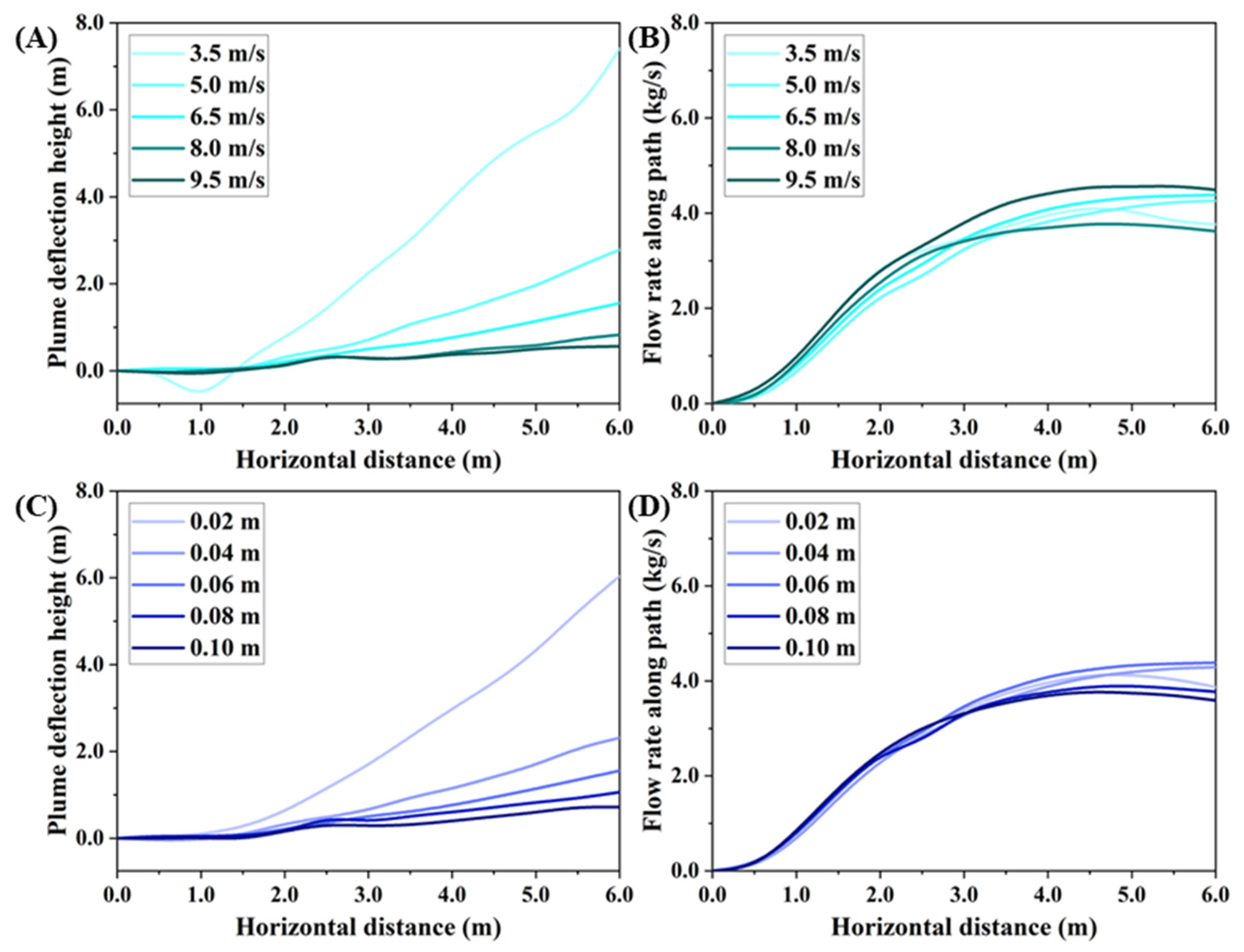
The horizontal distributions of plume deflection height and flow rate along the path under varying air curtain parameters are presented in Figure 8, with the data extracted from the velocity streamlines and temperature contours shown in Figure S3. Figure 8A,B indicate that variations in air curtain supply velocity affect the flow rate along the path by less than 10%, whereas a pronounced influence is observed on the plume deflection height. At a supply air velocity of 3.5 m/s, the air curtain jet fails to suppress the rising thermal plume, resulting in a higher deflection height compared to other conditions. At a horizontal distance of 6 m, the deflection height reaches 7.5 m. When the supply air velocity is within the range of 5 to 9.5 m/s, the deflection height gradually decreases as the velocity increases. At the velocity of 5 m/s, the plume deflection height is 3 m, only 40% of that at the velocity of 3.5 m/s. Figure 8C,D show that the influence patterns of outlet width on plume deflection height and flow rate along the path align with those of supply air velocity. At an outlet width of 0.02 m, the plume deflection height is 6.2 m, which is 2.9 times that at an outlet width of 0.04 m.

3.4. Calculation of Archimedes’ Number

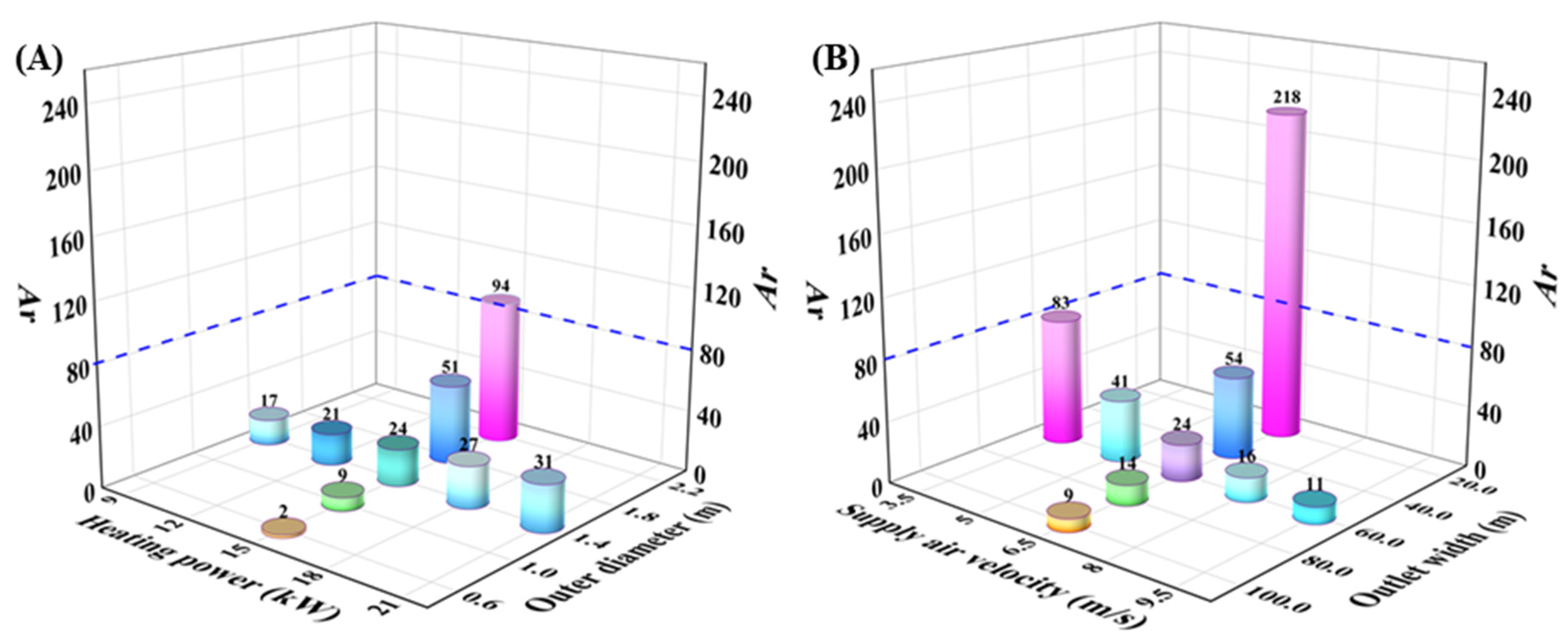
Based on the analysis of the aforementioned results, the characteristics of the coupled flow field are primarily governed by the relative strengths of the heat source plume and the air curtain jet. In fact, Ar can be used to compare the intensity of natural convection and forced convection in mixed flow scenarios, defined as the ratio of thermal buoyancy to inertial forces. Therefore, Ar for the coupled flow field under each condition in Section 3.3 is calculated, as shown in Figure 9. The results indicate that Ar exhibits a positive correlation with heating power and heat source diameter, while showing a negative correlation with air curtain velocity and outlet width. The maximum Ar value of 218 corresponds to the condition with an air curtain velocity of 6.5 m/s and an outlet width of 0.02 m in Figure 9B. The minimum Ar value is 2, corresponding to the condition with a heating power of 15 kW and a heat source diameter of 0.6 m in Figure 9A. The number of conditions with Ar exceeding 80 is only three. Among all 18 conditions, two-thirds have Ar values below 40. For these conditions, the thermal plume is effectively suppressed by the air curtain jet. Therefore, it is recommended that Ar values be controlled within 40. However, in practical applications, a smaller Ar is not necessarily better. This is because a smaller Ar increases the inertial force of the air curtain jet, requiring a larger supply air flow rate at the cost of excessive ventilation energy consumption (air curtain supply and hood exhaust). In general, the appropriate range of Ar must be determined in conjunction with the exhaust hood design, which is a key focus for our future work.

4. Conclusions

In summary, a scaled experimental platform integrating an air-curtain system and a heat source was proposed to investigate the coupled flow behavior, and the temperature and velocity distributions within the flow field were experimentally characterized. The results indicate that the air temperature along the horizontal direction first increases and then decreases, reaching a maximum at approximately 0.8 m from the air-curtain outlet, while the airflow velocity decays rapidly in the near field and gradually stabilizes downstream; meanwhile, the interaction structure between the air-curtain jet and the thermal plume was visualized using smoke particle tracing. To quantitatively evaluate the coupled flow characteristics, the plume deflection height and the flow velocity along the deflection path were introduced as evaluation indices. Orthogonal experimental analysis demonstrated that the air-curtain supply angle, supply velocity, and outlet width have significant effects on plume deflection height (p < 0.01), while the effects of heating power, outer diameter, and height above floor were not significant. The heating power, heat-source diameter, air-curtain supply velocity, and outlet width significantly affect the flow velocity along the deflection path (p < 0.01), while the effects of height above floor and supply air angle were not significant. Single-factor analyses further clarified the independent influences of key parameters on the coupled flow behavior. Furthermore, the Archimedes number (Ar) was employed to assess the relative dominance of plume buoyancy and jet inertia, revealing that Ar increases with increasing heat-source diameter and heating power but decreases with increasing air-curtain supply velocity and outlet width. Therefore, in practical engineering applications, the appropriate range of Ar should be determined by comprehensively balancing coupled flow characteristics, exhaust hood design requirements, and ventilation energy consumption.

Supplementary Materials

The following supporting information can be downloaded at: https://www.mdpi.com/article/10.3390/pr14060996/s1, Figure S1. Assessment indicator: (A) Plume deflection height; (B) Flow rate along plume deflection path. Figure S2. Velocity streamlines and temperature counters under variations in heat source factors: (A) Heating power; (B) Outer diameter. Figure S3. Velocity streamlines and temperature counters under variations in air curtain factors: (A) Supply air velocity; (B) Outlet width. Figure S4. Measurement instrument: (A) WZY-1 temperature recorder; (B) WWFWZY-1 universal anemometer. Figure S5. Geometric modelling and mesh generation for prototype platform. Figure S6. Comparison of simulation results and experimental data: (A,B) Air velocity; (C,D) Air temperature. Table S1. Orthogonal experimental design array.

Author Contributions

Conceptualization, B.S.; methodology, X.W.; validation, B.P.; formal analysis, Y.Z.; investigation, Y.W.; resources, J.G.; writing—original draft preparation, B.S. and C.N.; writing—review and editing, Z.J. All authors have read and agreed to the published version of the manuscript.

Funding

This work was supported by the Vulcanization Fume Collection Retrofit Project [grant number DY-HJE24006].

Data Availability Statement

Data is contained within the article.

Conflicts of Interest

Authors Bo Pang and Jian Gu are employed by Zhngce Rubber Group Co., Ltd. Authors Yujie Zhang and Yizhou Wu are employed by Varun (Shanghai) Environmental Engineering Technology Co., Ltd. The authors declare no conflicts of interest. The remaining authors declare that the research was conducted in the absence of any commercial or financial relationships that could be construed as a potential conflict of interest.

References

  1. Hao, Y.; Gai, Z.; Yan, G.; Wu, H.; Irfan, M. The spatial spillover effect and nonlinear relationship analysis between environmental decentralization, government corruption and air pollution: Evidence from China. Sci. Total Environ. 2021, 763, 144183. [Google Scholar] [CrossRef] [PubMed]
  2. Wu, X.; Yang, Y.; Gong, Y.; Deng, Z.; Wang, Y.; Wu, W.; Zheng, C.; Zhang, Y. Advances in air pollution control for key industries in China during the 13th five-year plan. J. Environ. Sci. 2023, 123, 446–459. [Google Scholar] [CrossRef] [PubMed]
  3. Zhang, Z.; Zhang, Y.; Zou, L.; Ou, Z.; Luo, D.; Liu, Z.; Huang, Z.; Fei, L.; Wang, X. Intermediate-volatility aromatic hydrocarbons from the rubber products industry in China. Sci. Total Environ. 2023, 898, 165583. [Google Scholar] [CrossRef] [PubMed]
  4. Bolognesi, C.; Moretto, A. Genotoxic risk in rubber manufacturing industry: A systematic review. Toxicol. Lett. 2014, 230, 345–355. [Google Scholar] [CrossRef]
  5. Nett, R.J.; Cox-Ganser, J.M.; Hubbs, A.F.; Ruder, A.M.; Cummings, K.J.; Huang, Y.T.; Kreiss, K. Non-malignant respiratory disease among workers in industries using styrene—A review of the evidence. Am. J. Ind. Med. 2017, 60, 163–180. [Google Scholar] [CrossRef] [PubMed]
  6. Boniol, M.; Koechlin, A.; Boyle, P. Meta-analysis of occupational exposures in the rubber manufacturing industry and risk of cancer. Int. J. Epidemiol. 2017, 46, 1940–1947. [Google Scholar] [CrossRef]
  7. Baan, R.; Grosse, Y.; Straif, K.; Secretan, B.; El Ghissassi, F.; Bouvard, V.; Benbrahim-Tallaa, L.; Guha, N.; Freeman, C.; Galichet, L.; et al. A review of human carcinogens—Part F: Chemical agents and related occupations. Lancet Oncol. 2009, 10, 1143–1144. [Google Scholar] [CrossRef]
  8. Morton, B.R.; Taylor, F.R.S.; Turner, J.S. Turbulent gravitational convection from maintained and instantaneous sources. Proc. R. Soc. Lond. Ser. A Math. Phys. Sci. 1956, 234, 1–23. [Google Scholar] [CrossRef]
  9. Hunt, G.R.; Kaye, N.G. Virtual origin correction for lazy turbulent plumes. J. Fluid Mech. 2001, 435, 377–396. [Google Scholar] [CrossRef]
  10. Scase, M.M.; Caulfield, C.P.; Dalziel, S.B.; Hunt, J.C.R. Time-dependent plumes and jets with decreasing source strengths. J. Fluid Mech. 2006, 563, 443–461. [Google Scholar] [CrossRef]
  11. Hunt, G.R.; Bremer, T.S. Classical plume theory: 1937–2010 and beyond. IMA J. Appl. Math. 2010, 76, 424–448. [Google Scholar] [CrossRef]
  12. Dhotre, M.T.; Niceno, B.; Smith, B.L.; Simiano, M. Large-eddy simulation (LES) of the large scale bubble plume. Chem. Eng. Sci. 2009, 64, 2692–2704. [Google Scholar] [CrossRef]
  13. Kondrashov, A.; Sboev, I.; Dunaev, P. Evolution of convective plumes adjacent to localized heat sources of various shapes. Int. J. Heat Mass Transf. 2016, 103, 298–304. [Google Scholar] [CrossRef]
  14. Fan, J.; Yang, Y.; Wang, Y.; Zhang, Y.; Wei, Y.; Liu, F.; Zhu, N. Emission and local ventilation control of droplets generated by condensation and bubble-bursting during pickling. Sust. Cities Soc. 2022, 76, 103491. [Google Scholar] [CrossRef]
  15. Cao, Z.; Zhang, C.; Zhai, C.; Wang, Y.; Wang, M.; Zhao, T.; Lv, W.; Huang, Y. Evaluation of a novel curved vortex exhaust system for pollutant removal. Build. Environ. 2021, 200, 107931. [Google Scholar] [CrossRef]
  16. Zhao, R.; Qian, H.; Liu, L.; Zheng, X. Comprehensive performance evaluation of a novel Aaberg exhaust system reinforced by a swirling jet. Build. Environ. 2020, 167, 106451. [Google Scholar] [CrossRef]
  17. Guo, S.; Huang, Y.; Wang, Y.; Wang, Z.; Zhang, Y.; Wang, Z.; Rong, J. Analysis of parameters for spray-local exhaust ventilation (SLEV) to minimize high-temperature smoke pollutants and reduce energy consumption. Sust. Cities Soc. 2024, 107, 105464. [Google Scholar] [CrossRef]
  18. Wang, Y.; Quan, M.; Zhou, Y.; Cao, Y.; Xie, C.; Li, L. Experimental study on the flow field and economic characteristics of parallel push-pull ventilation system. Energy Built Environ. 2020, 1, 393–403. [Google Scholar] [CrossRef]
  19. Wang, Y.; Shen, X.; Yoo, S.; Long, Z.; Ito, K. Error analysis of human inhalation exposure simulation in industrial workshop. Build. Environ. 2022, 224, 109573. [Google Scholar] [CrossRef]
  20. Liu, Z.; Yin, D.; Hu, L.; He, J.; Cao, G. Bacteria-carrying particles diffusion in the operating room due to the interaction between human thermal plume and ventilation systems: An experimental-numerical simulation study. Energy Build. 2022, 270, 112277. [Google Scholar] [CrossRef]
  21. Liu, Z.; Wu, M.; Cao, H.; Liu, H.; Wang, H.; Lv, J.; Rong, R.; He, J. Impact of the visitor walking speed and glass barriers on airflow and Bioaerosol particles distribution in the typical open tomb. Build. Environ. 2022, 225, 109649. [Google Scholar] [CrossRef]
  22. Liu, K.; Yang, S.; Zeng, L.; Gao, J.; Hou, Y.; Cao, C.; Shi, B.; Mo, X.; Zhang, Q.; Hou, C. Combining push-pull airflow and top draft hood for local exhaust of tyre vulcanization process. Energy Built Environ. 2020, 1, 296–306. [Google Scholar] [CrossRef]
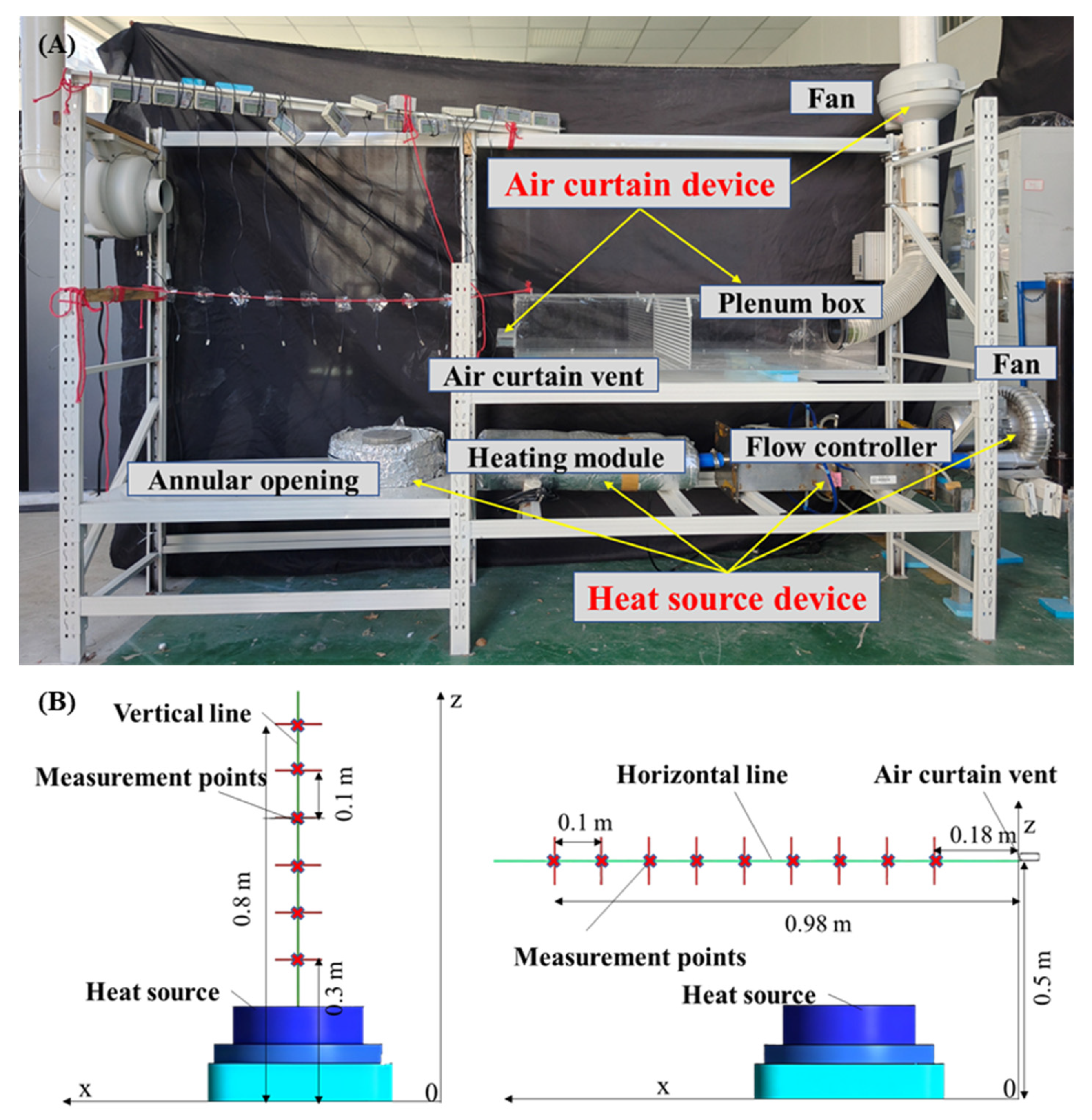
Figure 1. Scaled-down experimental platform: (A) Component and layout; (B) Measurement point location.
Processes 14 00996 g001
Figure 2. Impact of different heating power and air curtain velocity on temperature distribution along horizontal and vertical lines in coupled flow fields through experimental measurements: (A,B) Constant heating power with varying air curtain supply air velocity; (C,D) Constant air curtain supply air velocity with varying heating power.
Processes 14 00996 g002
Figure 3. Impact of different heating power and air curtain velocity on air velocity distribution along horizontal and vertical lines in coupled flow fields: (A,B) Constant heating power with varying air curtain velocity; (C,D) Constant air curtain velocity with varying heating power.
Processes 14 00996 g003
Figure 4. Visualization of air curtain jet structures in coupled flow fields: (A) Constant heating power with varying air curtain velocity; (B) Constant air curtain velocity with varying heating power. The red arrow and the red dashed line represent the axis and boundary of the air curtain jet, respectively.
Processes 14 00996 g004
Figure 5. Significance analysis of plume deflection height: (A) Orthogonal experimental results; (B) F-test statistics.
Processes 14 00996 g005
Figure 6. Significance analysis of flow rate along plume deflection path: (A) Orthogonal experimental results; (B) F-test statistics.
Processes 14 00996 g006
Figure 7. Impact of different heat source factors on plume deflection height and flow rate along path: (A,B) Heating power; (C,D) Outer diameter.
Processes 14 00996 g007
Figure 8. Impact of different air curtain factors on plume deflection height and flow rate along path: (A,B) Supply air velocity; (C,D) Outlet width.
Processes 14 00996 g008
Figure 9. Ar of coupled flow fields under variations in: (A) Heat source factors; (B) Air curtain factors.
Processes 14 00996 g009
Table 1. Variables and similarity ratios of the platform.
ComponentVariablePrototype PlatformScaled-Down PlatformSimilarity Ratios
Heat source deviceOuter (inner) diameter/m1.4 (0.7)0.28 (0.14)1:5
Temperature/°C2002001:1
Heating power/kW18/15/120.72/0.60/0.481:25
Air curtain deviceOutlet length/m20.41:5
Outlet width/m0.04/0.06/0.080.008/0.012/0.0161:5
Air supply velocity/m·s−15.0/6.5/8.02.2/2.9/3.61:2.2
Table 2. Scale experimental conditions.
ConditionAir Supply Velocity/m·s−1Heating Power/kW
12.20.72
22.90.72
33.60.72
42.90.60
52.90.48
Disclaimer/Publisher’s Note: The statements, opinions and data contained in all publications are solely those of the individual author(s) and contributor(s) and not of MDPI and/or the editor(s). MDPI and/or the editor(s) disclaim responsibility for any injury to people or property resulting from any ideas, methods, instructions or products referred to in the content.