Article

Design and Optimization of a Hybrid Microwave–Soxhlet Extraction Process for Bioactive Lipid Recovery from Shrimp Waste


1
Department of Seafood Processing, Faculty of Marine Sciences, Tarbiat Modares University, Noor 46414-356, Iran
2
Department of Pharmacy, Faculty of Health and Medical Sciences, University of Copenhagen, Universitetsparken 2, DK-2100 Copenhagen, Denmark
3
Department of Food Sciences and Nutrition, College of Agricultural & Marine Sciences, Sultan Qaboos University, Al-Khoud 123, Muscat P.O. Box 34, Oman
*
Author to whom correspondence should be addressed.
Processes 2026, 14(6), 915; https://doi.org/10.3390/pr14060915
Submission received: 7 February 2026 / Revised: 5 March 2026 / Accepted: 11 March 2026 / Published: 12 March 2026
(This article belongs to the Section Separation Processes)

Abstract

Seafood processing generates large volumes of by-products that are often underutilized despite their potential as sources of high-value bioactive lipids. In this study, a hybrid process integrating microwave (MW) pretreatment with Soxhlet (SOX) extraction was developed and optimized to intensify the recovery of astaxanthin (ASX)- and ω-3 PUFA-rich oil from green tiger shrimp (Penaeus semisulcatus) residues. Response surface methodology (RSM) comprising 22 experimental runs was applied to optimize key MW process variables, including power (100–400 W) and irradiation time (30–90 s). Both factors significantly influenced oil yield, with optimal operating conditions identified at 400 W and 75 s. MW pretreatment promoted structural disruption of shrimp shells, as confirmed by scanning electron microscopy, thereby enhancing solvent penetration and mass transfer. Solvent selection further affected extraction performance: hexane:isopropanol (1:1, v/v) achieved the highest oil yield (3.86 g/100 g dry weight), while hexane:acetone produced extracts with the highest ASX concentration (1032.24 µg/g oil), ω-3 PUFA content (29.85%), and antioxidant activity (93.30% DPPH scavenging). Colorimetric analysis supported these results, with increased redness (a* = 18.12) correlating with ASX enrichment. Overall, this integrated MW-SOX process represents an effective process-intensification strategy for sustainable shrimp waste valorization and production of bioactive lipid fractions.

1. Introduction

The rapid expansion of the global crustacean processing industry has led to the generation of vast quantities of waste, primarily in the form of shells. Current annual worldwide estimates of these residues, which pose both environmental concerns and opportunities for valorization, are 6–8 million tons [1]. In this respect, shrimp by-products are particularly interesting owing to their richness in valuable bioactive compounds. Among these, omega-3 polyunsaturated fatty acids (ω-3 PUFAs), including eicosapentaenoic acid (EPA) and docosahexaenoic acid (DHA), and carotenoids such as astaxanthin (ASX) have gained increasing attention owing to their nutritional value and potential use in various food, pharmaceutical, and cosmetic applications [2].
ASX, the major carotenoid in shrimp oil, is responsible for its distinctive reddish-orange coloration; this xanthophyll pigment is naturally produced by microalgae and, subsequently, accumulated in crustaceans through the food chain [3]. It exceptionally exhibits a superior antioxidant activity, which was reported to be several times stronger than other well-investigated carotenoids (such as lutein, zeaxanthin, and canthaxanthin), and up to 100-fold greater than α-tocopherol [4]. In addition to a strong inherent antioxidant activity, its bioactivities include anti-inflammatory activity and cardioprotective and neuroprotective effects [5]. These properties have significantly boosted the demand for ASX in functional food, nutraceutical, and pharmaceutical markets. With a compound annual growth rate (CAGR) of ~14.7% in the period of 2025–2030, the estimated global ASX market of USD 1.69 billion in 2024 is projected to reach USD 3.89 billion by 2030 [6]. Despite this, most commercially available ASX is synthetically produced, and, therefore, there is a growing interest in introducing natural alternatives with prioritized sustainability considerations as preferred by consumers [7]. Thus, extracting ASX from shrimp-processing residues offers the dual benefits of waste reduction and the production of high-value natural products.
Despite the added value of ω-3 PUFAs and ASX, it is still challenging to extract these bioactive compounds from shrimp due to the rigid and complex structure of their exoskeletons, which are built of a composite through strong hydrogen-bonding and covalent interactions among their major constituents (e.g., chitin, proteins, and calcium carbonate). Efficient pretreatments are therefore essential to disrupt these matrices and enhance oil recovery. Among different methods, the microwave (MW) irradiation method has emerged as a promising green pretreatment method, causing rapid heating and structural disruptions [8]. It, therefore, improves solvent penetration and release of intracellular compounds. Compared to conventional extraction methods, MW-assisted processes further reduce organic solvent usage and processing time, thereby lowering the environmental impact of extraction [9]. Recent studies have shown the superior efficiency of MW technology for isolating pigments, antioxidants, and lipids from plant and marine matrices [10,11].
Despite these advances, most previous studies have primarily focused on direct MW-assisted extraction systems or on coupling MW pretreatment with advanced techniques such as supercritical CO2 extraction, often targeting single-response outcomes such as oil yield or ASX recovery. For example, Nunes et al. [12] combined MW pretreatment with supercritical CO2 extraction of crustacean shells, whereas Wang et al. [13] comparatively evaluated solvent systems without integrating a MW-induced structural modification step. In contrast, systematic investigation of MW pretreatment as a dedicated matrix-disruption strategy prior to conventional Soxhlet extraction remains limited. Moreover, previous reports rarely applied a multi-response optimization framework that simultaneously evaluates oil yield, carotenoid recovery, antioxidant activity, color parameters, and fatty acid composition under different solvent systems. Therefore, the potential synergistic relationship between MW-induced structural alteration and solvent-dependent mass-transfer enhancement in shrimp waste valorization has not yet been comprehensively elucidated.
Building on these advances, the present work investigated the integration of microwave (MW) pretreatment with Soxhlet (SOX) extraction for the recovery of shrimp oil enriched with astaxanthin (ASX) and ω-3 PUFAs. Response surface methodology (RSM) was employed to systematically optimize the interactive effects of MW power and irradiation time under different single and binary solvent systems (ethanol (EtOH), hexane (Hex), hexane:acetone (Hex:Ace), and hexane:isopropanol (Hex:IPA); 1:1 v/v). Unlike previous studies that focused primarily on single-response extraction efficiency or direct MW-assisted systems, this work adopts an integrated multi-response optimization framework by simultaneously evaluating oil yield, ASX recovery, antioxidant activity, fatty acid composition, and structural modifications of the shrimp shell matrix via scanning electron microscopy (SEM). By elucidating the solvent-dependent enhancement behavior induced by MW pretreatment, this study provides mechanistic insight and a scalable hybrid process-design strategy for sustainable shrimp waste valorization.

2. Results and Discussion

2.1. Optimization of the MW Pretreatment Process

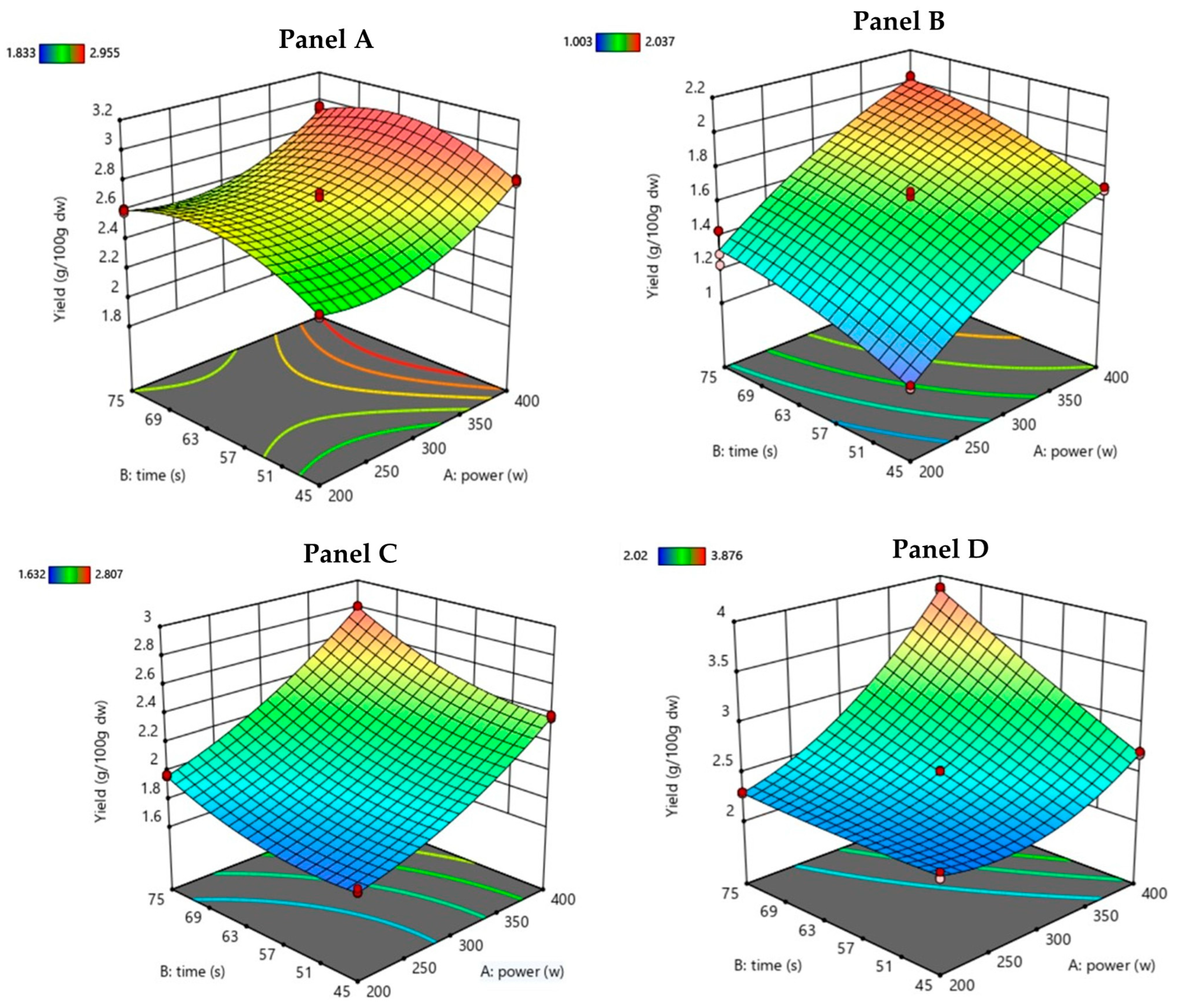
According to the central composite design (CCD) outlined in Table 2, a total of 22 experimental runs were conducted using RSM. The results demonstrated that both independent variables, irradiation time (X1) and MW power (X2), had significant effects (p < 0.05) on oil recovery from the shrimp waste across all single (or binary) solvent systems (EtOH, Hex, Hex:Ace, and Hex:IPA). The oil yields varied between 2.28 and 3.85 g/100 g dry weight (dw) for Hex:IPA, 2.80–2.92 g/100 g dw for EtOH, 1.73–2.81 g/100 g dw for Hex:Ace, and 1.01–2.01 g/100 g dw for Hex. The highest oil recovery within the investigated design space was obtained at 400 W and 75 s. The response surface contour plots (Figure 1A–D) illustrate the combined effects of time and power on oil yield for different single solvents and binary organic solvent systems. As shown in Figure 1, the extraction efficiency markedly increased with increasing MW power and exposure time, reaching the highest response within the investigated design range. Beyond this level, excessive treatment may risk thermal degradation of bioactive compounds, which has also been noted in other studies [8]. Thus, optimizing MW parameters is critical to balance improved mass transfer with the thermal stability of bioactive compounds. The statistical adequacy of the selected quadratic RSM models for all solvent systems is summarized in Table 1. The models exhibited high coefficients of determination (R2 = 0.9862–0.9993) and adjusted R2 values (0.9809–0.9990), indicating strong agreement between experimental and predicted data within the investigated design space. Predicted R2 was available for the Hex:Ace system (0.9934). For EtOH, Hex, and Hex:IPA, predicted R2 and PRESS statistics were not defined due to leverage values equal to 1.0000, as indicated by the software. Lack-of-fit could not be estimated for these systems due to zero degrees of freedom. For the Hex:Ace system, a statistically significant lack-of-fit (p = 0.0042) was observed and is acknowledged as a limitation, suggesting that additional design points or replication could further improve model robustness. Independent validation experiments further confirmed the predictive capability of the developed models, with deviations between predicted and experimental oil yields ranging from 0.02% to 4.28% (Table 1).
The optimal condition identified for maximizing oil yield (400 W, 75 s) did not result in any measurable reduction in ASX content or antioxidant activity. In fact, this condition corresponded to the highest bioactive performance observed among the tested treatments. Therefore, within the investigated experimental range, no detectable trade-off between oil yield and bioactive preservation was identified.
The enhanced oil recovery observed in this study can be attributed to the disruptive effects of MW irradiation, which induces rapid internal heating, enhances localized pressure, and leads to structural breakdown of the shrimp residues (see Section 3.2). This disruption is most likely associated with increased solvent penetration into the shrimp residues and greater accessibility to the encased oil and carotenoids within the shrimp residues. It is worth noting that the MW mechanism is well established in the literature: MW energy interacts with polar molecules through dipole rotation and ionic conduction, converting electromagnetic energy into heat [14]. In the present study (Table 2), the efficiency of the employed modified extraction process depends not only on MW parameters, but also on the solvent characteristics, the shrimp matrix composition, and the moisture content of the shrimp residues [9]. Here, the extraction solvent selection is particularly important, as the polarity and the dielectric properties of the solvent determine the ability to absorb MW energy. According to Grosso et al. [15], the dissipation factor (tan δ = ε″/ε′, where δ, ε″, and ε′ are dissipation factor, dielectric loss factor, and dielectric constant, respectively) reflects the capacity of a solvent to convert MW energy into heat. Polar solvents such as water (ε′ = 78.3) more effectively absorb MW energy than EtOH (ε′ = 24.3), which partly explains the effectiveness of the hydroalcoholic medium used in this study [16]. The influence of MW conditions on extraction has also been highlighted in recent studies. For example, Vu et al. [17] demonstrated that increasing MW power from 240 to 960 W improved phenolic recovery from banana peel, confirming the positive correlation between the irradiation intensity and the bioactive compound yield. In the case of crustaceans, Nunes et al. [12] combined MW pretreatment with supercritical CO2 extraction for crab shell, showing that ASX extraction was achieved up to 12 times faster compared to non-pretreated samples, highlighting the synergy between MW pretreatment and advanced extraction methods.

2.2. Scanning Electron Microscopy (SEM) Imaging of the Morphology of Shrimp Shell Residues

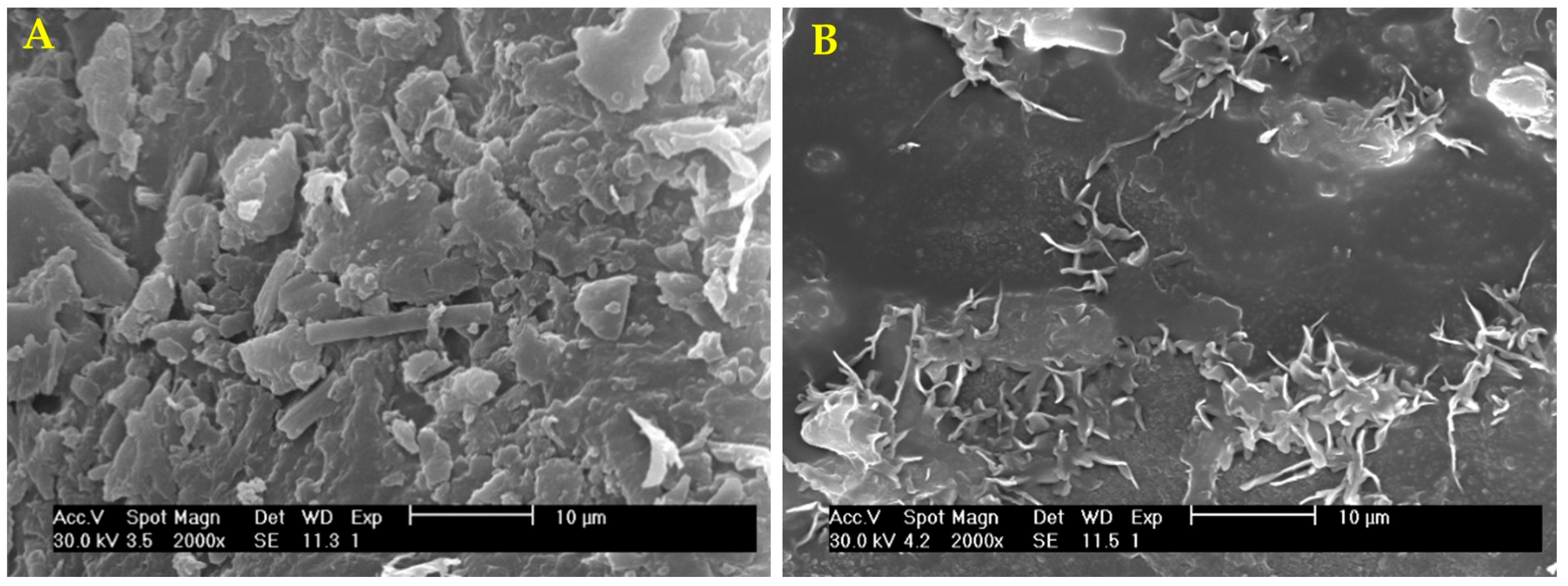
Under the optimal conditions mentioned above (400 W, 75 s), the effect of MW pretreatment on the morphology of shrimp shell residues was evaluated using SEM (Figure 2). It is worth noting that the shrimp exoskeleton is a natural biocomposite composed mainly of calcium carbonate, chitin, and proteins interconnected through hydrogen bonding, ionic interactions, and van der Waals forces, which together confer rigidity and unique structural stability [18]. Prior to the pretreatment method, the freeze-dried shrimp waste exhibited a relatively compact, multilayered, and porous surface with thick, irregular fragments (Figure 2A). In contrast, the employed MW pretreatment method induced marked structural alterations in the freeze-dried shrimp waste. As shown in Figure 2B, the pretreated shell displayed disrupted and fragmented nanofibrous features with variable lengths and thicknesses in the range of 400–500 nm, along with a more uniform texture. Such significant morphological modifications are attributed to the rapid internal heating and the localized pressure generated during MW irradiation. This creates abrupt thermal stresses, leading to microfractures that eventually induce breakdown of the structural matrix. As discussed below (see Section 3.3), this enhanced surface disruption is most likely associated with an improved organic solvent penetration level and more efficient mass transfer, thereby contributing to higher oil and ASX recovery. Similar findings have been reported in extraction studies on other biological matrices. For example, Nunes et al. [12] observed a significant cell wall disruption in crab shell residues subjected to MW pretreatment prior to supercritical fluid extraction, while de Moura et al. [14] demonstrated severe cracking and fragmentation of Nannochloropsis oculata cells on employing MW pretreatment that led to a shortened lipid extraction time. Comparable results have also been documented in extraction studies conducted on plant materials [8,11]. For example, Samanta and Ghosh [11] showed that MW irradiation of turmeric residues led to cell wall rupture and enhanced release of the intracellular curcuminoids, while Liu and Li [8] reported on an enhanced polyphenol extraction from tea leaves, which was attributed to microstructural collapses induced by the MW pretreatment. These studies, together with the present results, confirm that MW pretreatment induces consistent structural disintegration across diverse biomass types, thereby improving the efficiency of downstream extraction processes.

2.3. Shrimp Oil Yield

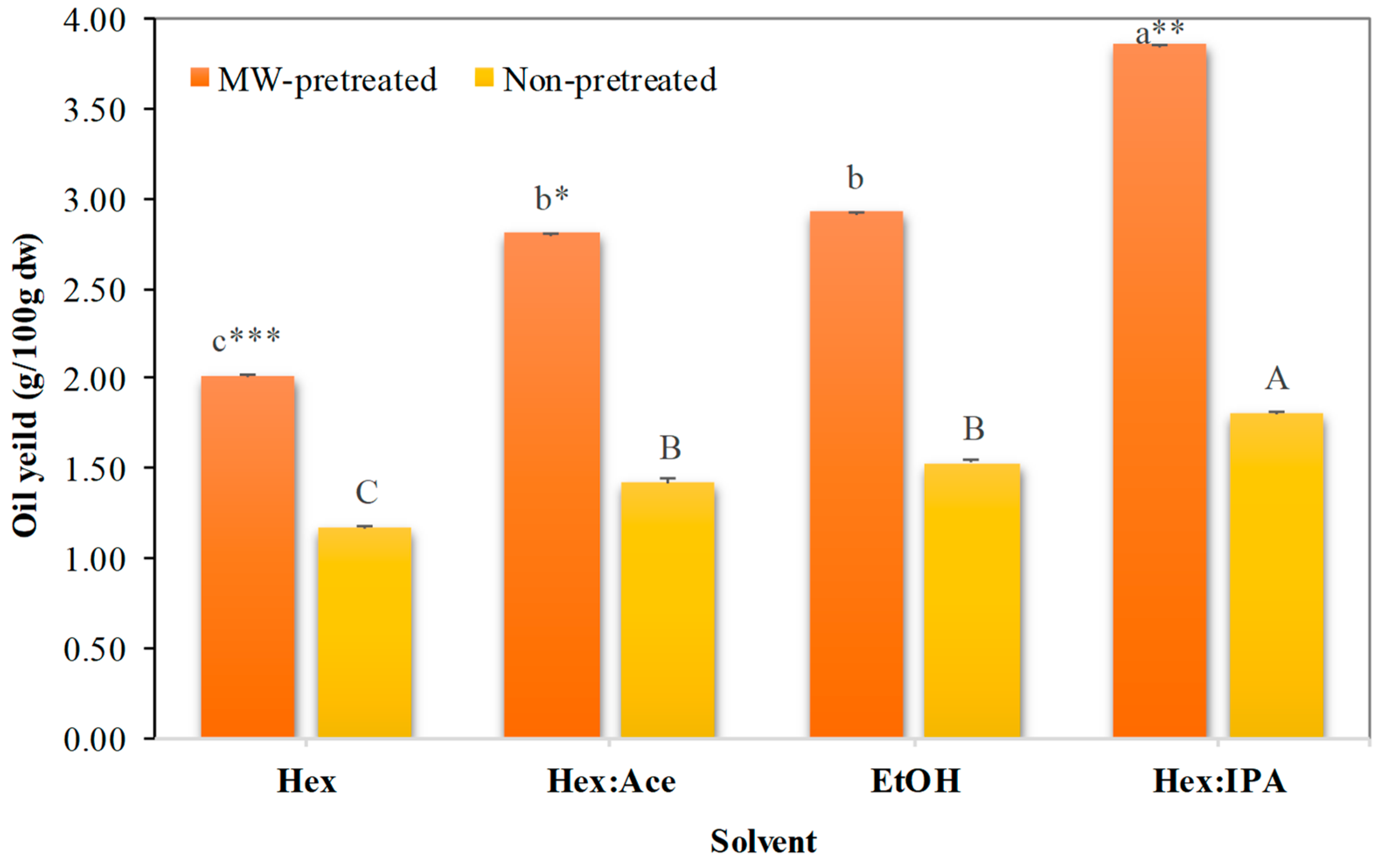
Soxhlet (SOX) extraction is widely regarded as a reliable benchmark method for recovering lipids and carotenoids from biological matrices. To evaluate the effectiveness of MW pretreatment in this study, it was worth determining the shrimp oil yield by SOX extraction with and without MW exposure using different organic solvents (or binary organic solvent systems). As shown in Figure 3, MW pretreatment markedly improved the oil recovery, with yields ranging from 2.02 to 3.86 g/100 g dw, compared to 1.17 to 1.81 g/100 g dw in non-pretreated samples, which were used as controls (p < 0.05). These findings clearly demonstrate the positive role of MW irradiation in significantly enhancing lipid extraction efficiency. Similar effects have been reported by Vu et al. [19], who observed that the MW pretreatment method led to a disruption of the cellular walls and membranes, thereby facilitating faster release of the bioactive compounds. More recently, Liu and Li [8] reported comparable improvements in polyphenol recovery from tea leaves following MW pretreatment, underscoring its general effectiveness across diverse biomass types.
The efficiency of shrimp oil extraction was also found to be dependent on the organic solvent type and binary organic system composition. As shown in Figure 3, the highest oil yield (3.86 g/100 g dw) was achieved in MW-pretreated samples extracted using the binary organic Hex:IPA system (p < 0.05). This was followed by EtOH alone (2.93 g/100 g dw), Hex:Ace (2.81 g/100 g dw), and Hex alone (2.02 g/100 g dw). These results highlight the important role of the organic solvent’s physicochemical properties and polarity in modulating the lipid extraction efficiency. Moreover, the solvent-dependent magnitude of yield enhancement observed after MW pretreatment suggests that structural disruption alone does not fully account for the extraction behavior. While MW irradiation promotes matrix fragmentation, pore formation, and increased surface area, the efficiency of subsequent lipid recovery is governed by solvent–matrix affinity and diffusion dynamics within the disrupted structure [20]. In particular, solvents with balanced polarity may more effectively penetrate heterogeneous microdomains generated by MW-induced microfractures, thereby enhancing solubilization of both neutral and polar lipid fractions. This indicates that the improvement in extraction efficiency arises from a synergistic interaction between MW-driven structural modification and solvent-specific mass transfer characteristics rather than from a uniform disruption effect [21].
Here, it is worth noting that the shrimp oil typically contains phospholipids and other polar and amphiphilic lipids, which may require using polar solvents for their efficient extraction, whereas carotenoids such as ASX are preferentially soluble in non-polar organic solvents [13]. Thus, the use of binary solvent systems combining polar and non-polar organic solvents enhances the extraction efficiency by simultaneously targeting different lipid classes (polar, non-polar, and amphiphilic ingredients). This synergistic effect on the extraction efficiency upon using binary combinations of solvents is supported by earlier findings. Gulzar and Benjakul [22] reported that utilization of a binary organic solvent system composed of Hex and IPA (prepared at a ratio of 1:1 (v/v)) yielded the highest lipid recovery (25.32% dw) from Litopenaeus vannamei cephalothorax as compared to single-solvent extractions. More recently, Chaari et al. [9] emphasized that the organic solvent selection strongly influences MW-assisted extraction outcomes due to differences in the dielectric constants and the dissipation factors among the most commonly used organic solvents, which play important roles in determining how effectively the MW energy is absorbed and converted into heat. In agreement with these studies, the superior performance of the binary organic Hex:IPA (1:1, v/v) system in the present work can be attributed to both its balanced polarity and its high MW absorption capacity, which together facilitate more efficient matrix disruption and solute diffusion from the shrimp residues to the employed binary organic solvent system.
While the binary solvent systems (Hex:Ace and Hex:IPA) demonstrated superior oil recovery in the present study, considerations of solvent safety and industrial applicability remain essential. In this work, post-extraction evaporation ensured effective solvent removal, and no residual organic solvents were detected in the final oil extracts. At an industrial scale, solvent recovery systems are routinely implemented to comply with regulatory limits for edible oil processing. From a sustainability perspective, ethanol-based systems represent a greener alternative; however, the current results reveal a trade-off between extraction efficiency and solvent polarity. Therefore, solvent selection should balance extraction performance with safety, environmental impact, and economic feasibility.

2.4. ASX Content in the Extracted Shrimp Oil

As presented in Table 3, MW pretreatment significantly enhanced ASX recovery from the shrimp waste across all organic single/binary solvent systems as compared to non-pretreated controls. Among the tested organic solvent systems, the Hex:Ace system provided the highest ASX yield (1032.24 µg/g oil), followed by Hex alone (985.84 µg/g oil), the binary Hex:IPA system (791.87 µg/g oil), and EtOH alone (291.88 µg/g oil). These results highlight the crucial role of solvent polarity and composition in carotenoid recovery. Consistent with the present findings, Wang et al. [13] reported that Ace outperformed EtOH and Hex for ASX extraction, owing to its favorable solubility characteristics. Ace is considered particularly effective because of its polarity and structural similarity to ASX molecules, which contain conjugated double bonds and carbonyl groups that promote strong solute–solvent interactions. Indeed, Ace has been repeatedly identified as one of the most suitable organic solvents for carotenoid recovery from crustaceans and microalgae as compared with EtOH, methanol, acetonitrile, or Hex [9,12].
ASX, the dominant carotenoid in shrimp, mainly occurs in esterified forms bound to fatty acids within the shell matrix [23]. Thus, binary organic solvent systems combining polar and non-polar solvents, such as Hex:Ace or Hex:IPA, are particularly advantageous since they can better match the intermediate polarity of ASX esters. These systems with mixed polarities both facilitate the disruption of lipid–protein complexes and enhance the release of the esterified carotenoids from the shell matrix, ultimately leading to higher recovery yields as compared with single-solvent extraction systems.

2.5. Determination of the Color Intensity of the Extracted Shrimp Oil

Color is an important quality attribute of ASX-rich lipid extracts, as it is closely linked to carotenoid concentration, and therefore, it plays a critical role in consumer acceptance and marketability in both the food and nutraceutical industries [4]. The CIELab parameters (L*, a*, and b*) for oils extracted with and without MW pretreatment are presented in Table 3. Overall, the MW pretreatment (at the optimal conditions: 400 W and 75 s) significantly enhanced the color intensities of the extracted shrimp oils as compared to controls (untreated samples) (p < 0.05). The increase in the a* (redness) index was particularly evident in all single/binary organic solvent systems, confirming a greater release from the shrimp shell matrix and an enhanced solubility of the extracted ASX pigments. Among the pretreated samples, the binary Hex:Ace organic system yielded the highest a* value (18.13 ± 0.04), followed by Hex alone > binary Hex:IPA system > EtOH alone, consistent with the corresponding ASX contents in these solvent systems. This is in line with previous studies [2,24,25] reporting on strong correlations between the redness levels (a* values) and the corresponding carotenoid contents in foods (such as potato and shrimp oils). Although a* correlated strongly with ASX concentrations in our samples, the L* index did not follow a simple or universal relationship with the corresponding carotenoid content. In particular, the EtOH extract exhibited the lowest L* despite containing the least ASX. This unexpectedly dark appearance is likely due to the following interplay of complex factors: (i) plausible co-extraction of polar impurities such as proteins, phenolics, or oxidized compounds, and (ii) appearance of turbidity that may be caused by suspended particles in the organic systems from the disrupted shrimp shell matrix. Both of these factors can contribute to a reduced lightness, independent of carotenoid content [26,27]. However, turbidity was not quantitatively measured in the present study, and this interpretation is based on visual observations and colorimetric trends rather than direct turbidity assessment. Future studies, incorporating quantitative turbidity measurements, would provide more definitive clarification of this relationship. In contrast, both solvent systems (Hex alone and Hex:Ace system) showed superior performance in this study as they produced clearer lipid extracts. This most likely indicates a significant decrease in the co-extraction efficiency of polar impurities, resulting in both higher ASX content and higher L* values. Mixed binary organic solvents (such as the Hex:Ace system) are known to combine an enhanced carotenoid solubility with the production of cleaner extracts [28]. Therefore, L* should be interpreted with caution in oil matrices and should be reported together with the sample clarity and/or the turbidity data. However, the a* parameter (the redness level) is a more reliable color proxy for qualitatively assessing the carotenoid concentration in the oil extract [29]. It is worth noting that the b* parameter (the yellowness level) also varied among the four employed organic solvents: EtOH produced oil extracts with weaker yellow tones, while the binary Hex:Ace and Hex:IPA systems exhibited higher b* values, most likely reflecting the combined presence of carotenoids and residual lipid fractions in these extracts. Similar relationships between carotenoid concentrations and CIELab values have been reported for other shrimp oil extracts [22].

2.6. The Antioxidant Activity of the Extracted Shrimp Oil

It was important to assess the antioxidant potential of the extracted ASX-rich shrimp oils. The employed DPPH radical scavenging assay indicated the significant influence of the pretreatment method on the antioxidant activity of the extracted shrimp oil. As presented in Table 3, the MW pretreatment significantly (p < 0.05) enhanced the scavenging activity, regardless of the organic solvent type and the composition of the binary organic solvent system. This is most likely attributed to an increase in ASX content as compared to controls (non-pretreated samples). For example, the pretreated binary Hex:Ace extract system had higher scavenging activity (93.30%) than the controls (non-pretreated samples with scavenging activities of 84.16%). This means that the pretreatment led to an increase of about 10% in the scavenging activity. A higher increase (about 20.5%) was detected upon replacement of the binary Hex:Ace extract system by EtOH (the pretreatment increased the scavenging activity from 61.40% to 74.01%). These findings provide a clear positive correlation between ASX concentration and antioxidant efficacy, and agree well with previous studies, reporting an improved radical scavenging capacity upon utilization of extracts with relatively high carotenoid levels [9,29]. Nevertheless, although ASX is a major contributor to the antioxidant capacity of shrimp oil, other co-extracted lipid-soluble antioxidants (e.g., tocopherols) may also contribute to the observed DPPH radical scavenging activity. Moreover, the DPPH assay reflects the overall radical scavenging capacity and does not distinguish between the contributions of individual compounds.
Our results indicated that the organic solvent type and composition of the binary organic system played a decisive role in modulating the scavenging activity. The Hex:Ace system yielded the highest DPPH inhibition (93.30%), followed by Hex alone (79.27%), the binary Hex:IPA system (76.16%), and EtOH alone (74.01%). The superior performance of the Hex:Ace system is consistent with its ability to enhance the solubility of both polar and non-polar components, thereby extracting a broader spectrum of antioxidants, including ASX esters and lipid-soluble compounds [28]. In contrast, EtOH, being a strongly polar solvent, was less effective at recovering hydrophobic antioxidants (pigments such as carotenoids). This explains the obtained lower antioxidant values in the present study despite the MW pretreatment of EtOH extracts. Similar solvent-dependent effects have been reported by Gulzar and Benjakul [22] for shrimp oil extracts, and by Wang et al. [13], who found that Ace- and Hex-based organic solvents provided crustacean lipid extracts with stronger antioxidant activities as compared to those of EtOH extracts.
The strong antioxidant activity of ASX itself is attributed to its unique molecular structure. The polyene chain effectively scavenges radicals through an electron delocalization effect, while the hydroxyl and keto groups on the terminal rings enhance metal-chelating activity and allow free radical quenching at both ends of the molecule [29]. This dual mechanism explains why ASX is regarded as one of the most potent marine-derived antioxidants. Taken together, these findings confirm that both organic solvent selection and MW pretreatment critically affect the antioxidative capacities of extracted shrimp oils. Binary organic solvent systems (such as the Hex:Ace system) maximize ASX recovery and bioactivity, and therefore, they offer a promising strategy for producing antioxidant-rich lipid extracts suitable for functional foods, nutraceuticals, and cosmetic formulations.

2.7. Fatty Acid Profile of Shrimp Oil

Table 4 presents the fatty acid (FA) compositions of the shrimp oil extracts. Across all single/binary organic systems, the saturated fatty acids (SFAs) ranged from 40.12 to 42.43%, the monounsaturated fatty acids (MUFAs) were in the range of 19.44–24.04%, and the polyunsaturated fatty acids (PUFAs) were in the range of 25.63–29.85%. These findings demonstrated a clear organic solvent-dependent impact on the content of ω-3 PUFAs and omega-6 (ω-6) PUFAs. Particularly, among the solvents, the binary organic solvent system (Hex:Ace) yielded the highest proportion of PUFAs (29.85%) and total content of ω-3 PUFAs (11.74%), while Hex and Hex:IPA extracts contained higher MUFAs (24.04% and 23.12%, respectively). These results emphasize that the organic solvent polarity plays a pivotal role in shaping the FA profile of the shrimp oil extract. Non-polar solvents such as Hex selectively extract neutral lipids (mainly triacylglycerols), which are often enriched in SFAs and MUFAs. This most likely explains the elevated content of MUFAs in the Hex extract (24.04%). By contrast, binary organic systems containing Ace or EtOH exhibit higher polarity and are, therefore, more efficient in recovering polar lipids, including phospholipids, which are typically enriched in long-chain PUFAs [13,30,31]. The superior performance of the binary organic Hex:Ace system can be attributed to its ability to enhance the solubility of both neutral and polar lipid classes, thereby recovering a broader range of FAs, including ω-3 PUFAs and ASX esters. Wang et al. [13] also highlighted the solvent-specific differences in FA profiles, reporting on PUFA contents of 42.78% and 36.1%, respectively, in EtOH and EtOH:Hex systems used to extract the oil from L. vannamei residues. These higher values, compared with those obtained in the present study, may reflect differences in shrimp species, seasonal factors, diet, and processing methods. Our results and those reported by Wang et al. [13] still confirm the strong influence of the employed organic solvent system on FA recovery.
From a nutritional standpoint, the high proportion of ω-3 PUFAs in the binary Hex:Ace extract highlights its potential as a source of bioactive lipids with well-documented cardioprotective, anti-inflammatory, and neuroprotective properties. These health benefits are primarily attributed to the ability of ω-3 PUFAs, particularly EPA and DHA, to modulate membrane fluidity, reduce inflammatory mediator synthesis, and improve lipid metabolism [32]. However, the greater degree of unsaturation that imparts these beneficial activities also renders the extract more prone to oxidative degradation, emphasizing the importance of co-extracted antioxidants such as ASX in preserving oxidative stability. Furthermore, although Hex:Ace is an efficient solvent system for PUFA recovery, the final extracts were subjected to controlled solvent evaporation under reduced pressure to ensure the complete removal of organic residues, as reported in similar extraction studies [13,30]. Overall, these results confirm that careful solvent selection and subsequent solvent-removal steps can yield shrimp oils enriched in ω-3 PUFAs and ASX, suitable for further formulation into functional or nutraceutical applications.

3. Materials and Methods

3.1. Sample Preparation and Chemicals

Green tiger shrimp (Penaeus semisulcatus) by-products were collected from a shrimp-processing facility in Bushehr Province, Iran, and transported to the laboratory on ice. The residues (cephalothorax, carapace, and tail) were freeze-dried for 48 h using a freeze-dryer (OPR-FDU-7012, Operon Co., Ltd., Gimpo, Republic of Korea). The dried material was then ground in a laboratory blender (Depose, Moulinex, Écully, France) and sieved to obtain particles with a size of ≤450 μm. Analytical-grade solvents, including ethanol (EtOH), acetone (Ace), hexane (Hex), isopropyl alcohol (IPA), and methanol (MeOH), as well as 2,2-diphenyl-1-picrylhydrazyl (DPPH) reagent and boron trifluoride (BF3), were purchased from Sigma-Aldrich (St. Louis, MO, USA) and Merck (Darmstadt, Germany).

3.2. Microwave (MW) Pretreatment Method

The MW pretreatment was applied at three power levels (100, 200, and 400 W) and three irradiation times (30, 60, and 90 s) prior to Soxhlet (SOX) extraction. MW pretreatment was performed using a laboratory microwave reactor, and the reported power values correspond to nominal output levels specified by the manufacturer. The shrimp powder was suspended in a hydroalcoholic solution (EtOH:water, 1:1 v/v) in a glass vessel and subjected to MW irradiation at the designated power and time conditions. The hydroalcoholic medium was used to enhance dielectric heating and promote uniform energy absorption within the shrimp matrix during pretreatment, and it does not correspond to the subsequent extraction solvents. Temperature was not directly monitored during irradiation; however, the relatively short exposure times and the absence of observable degradation in subsequent bioactive analyses suggest that excessive thermal damage did not occur. After irradiation, samples were immediately cooled in an ice bath to approximately 40 °C and subsequently processed for oil extraction [33].

3.3. Scanning Electron Microscopy (SEM)

The structural modifications of shrimp shell residues before and after MW pretreatment were examined using a Philips XL30 ESEM (Philips, Eindhoven, The Netherlands) operated at 30 kV. Prior to imaging, the samples were sputter-coated with a thin layer of gold (~300 Å) under an argon atmosphere.

3.4. SOX Extraction of Shrimp Oil

Shrimp oil was extracted using the SOX method, as described by Rodrigues et al. [34], with slight modifications. Approximately 3 g of shrimp powder was placed in a thimble and extracted with 250 mL of a single organic solvent (EtOH or Hex) or the binary organic solvent systems of Hex:Ace (or Hex:IPA), which were prepared at 1:1 v/v. These single organic solvents and binary organic systems were used for 2 h at their boiling points (in the range of 49.8–64.4 °C, depending on the solvent). In this study, the single organic solvent (or the binary organic system)-to-sample ratio was maintained at 4:1 (v/w). Following extraction, the lipid-rich fraction, containing ASX and other soluble compounds, was concentrated under reduced pressure at 56 °C using a rotary evaporator (Heidolph, Schwabach, Germany). The extract was further dried in an oven at 40 °C for 1–3 h, cooled in a desiccator, and weighed to determine the mass of the recovered oil.

3.5. Determination of Total Oil Yield

According to Equation (1), the extraction efficiency, expressed as a percentage, was determined as the weight ratio of the mass of extracted oil using the SOX extraction method to the initial dry weight of the shrimp waste [2]:
T o t a l   o i l ( % ) = W o i l   W s a m p l e   100
where Woil is the weight of extracted oil and Wsample is the weight of the sample.

3.6. Determination of ASX Content

The extracted lipid fraction was dissolved in Hex, and its absorbance was recorded at a wavelength of 440 nm by using a UV-Vis spectrophotometer (UV-2600, Shimadzu, Kyoto, Japan). The concentration of ASX was determined using Equation (2) [29]:
A S X   µ g / g = A × D   × 10 6 100   × G   × d   ×   E 1 c m 1 %
where A is the absorbance at 440 nm, D is the volume of the extract dissolved in Hex, 106 is the dilution factor, G is the sample weight (g), d is the cuvette path length (cm), and E 1 c m 1 % is the extinction coefficient (2100).

3.7. Color Analysis of the Extracted Shrimp Oil

The color of the extracted shrimp oil was measured using a Micromatch Plus portable reflectance spectrophotometer (Sheen Instruments Ltd., Kingston, UK).The obtained results were expressed in the CIELab system as follows: L* (lightness, 0 = black to 100 = white), a* (red–green axis, +a* = red, −a* = green), and b* (yellow–blue axis, +b* = yellow, −b* = blue) [35].

3.8. Determination of Antioxidant Activity (DPPH Assay)

The antioxidant capacity of the shrimp oil was evaluated using the DPPH radical scavenging assay as described in the previous report of Chintong et al. [36]. The scavenging activity was extraction efficiency (%) of the obtained color reduction, according to Equation (3):
DPPH% = [(ADPPH − AS)/ADPPH] × 100
where ADPPH is the absorbance of the control solution and AS is the absorbance after addition of the shrimp oil sample.

3.9. Gas Chromatography (GC) Analysis of Fatty Acids

The fatty acid composition of the extracted shrimp oil was determined using a Unicam 4600 GC system (Cambridge, UK) equipped with a flame ionization detector (FID) and a BPX 70 capillary column (30 m × 0.25 mm, 0.22 μm film thickness). The oven temperature was initially held at 160 °C for 5 min, increased to 180 °C at 20 °C/min, and held for 9 min, then raised to 190 °C at 1 °C/min and maintained at 190 °C for 10 min. The injector and detector temperatures were 280 °C and 240 °C, respectively. Helium (99.999%) was used as the carrier gas. The fatty acids were identified by comparing the sample retention times with those of a standard fatty acid methyl ester mixture [37].

3.10. Statistical Analysis

All experiments were performed in triplicate. The effects of solvent type on oil yield and ASX content were analyzed using factorial experiments in a completely randomized design. The obtained data were subjected to analysis of variance (ANOVA) using the General Linear Model in SPSS software (v.16.0, Chicago, IL, USA). Mean comparisons were conducted using Duncan’s multiple range test at a significance level of p < 0.05. To optimize MW pretreatment conditions, response surface methodology (RSM) with a central composite design (CCD) was applied. Statistical modeling, regression analysis, and generation of two-dimensional surface plots were performed using Design-Expert software (v.10.0.7, Minneapolis, MN, USA). A two-factor central composite design (CCD) comprising 22 experimental runs was applied to model the effects of MW power (A) and irradiation time (B) on oil yield, including replicated center points (300 W, 60 s) to estimate pure error. Model adequacy was assessed using analysis of variance (ANOVA), coefficient of determination (R2), adjusted R2, predicted R2 (when applicable), and lack-of-fit tests. In cases where PRESS statistics were not defined due to leverage values equal to 1.0000, predicted R2 could not be calculated, and this limitation is explicitly acknowledged. Outliers were identified using externally studentized residual diagnostics in Design-Expert and were excluded prior to final model fitting.

4. Conclusions

This study demonstrated the effectiveness of integrating microwave (MW) pretreatment with Soxhlet (SOX) extraction as a sustainable strategy for recovering astaxanthin (ASX) and ω-3 PUFA-rich oil from Penaeus semisulcatus by-products. Unlike previous studies that focused primarily on single-response extraction efficiency or advanced extraction technologies, this work demonstrates that strategic integration of MW-induced matrix disruption with conventional Soxhlet extraction (SOX) can achieve multi-objective process intensification within a scalable framework. Optimization of the extraction process, through response surface methodology (RSM), revealed that MW pretreatment at 400 W and 75 s is the most favorable setting for inducing a significant alteration in the shrimp shell morphology and structural features, which is most likely associated with improving organic solvent accessibility. Among the tested organic solvent extract systems, the binary Hex:IPA system achieved the highest oil recovery (3.85 g/100 g dry weight), whereas replacement of IPA by Ace (through use on the Hex:Ace system) provided the most balanced performance. This system yielded the highest ASX concentration (1032.24 µg/g oil), superior antioxidant activity (93.30%), and the greatest content of PUFAs (29.85%). These outcomes highlight that the organic solvent polarity plays a decisive role in modulating both the yield and the quality of shrimp oil. Binary organic solvent systems are attractive for extracting bioactive-rich lipid fractions from biomass as they offer distinct advantages. Further, our findings indicate that the combined MW-SOX process is aligned with principles of green processing. This integrated MW-SOX approach enhances extraction efficiency and may contribute to process intensification by improving yield within the same extraction time. Although a formal analysis of energy and solvent consumption was beyond the scope of this study, the observed enhancement suggests potential for future optimization toward reduced processing time and improved resource efficiency. Overall, this integrated approach provides a promising platform for the selective recovery of high-added-value carotenoids and ω-3 PUFA from shrimp-processing residues. It supports, therefore, environmental sustainability and provides important functional ingredients that are increasingly needed in various food, nutraceutical, and pharmaceutical applications. Future research should focus further on stability against oxidation and encapsulation strategies to protect ASX and ω-3 PUFAs during storage and use. These key advancements are needed to achieve long-term functionality and ensure a market potential of shrimp-derived bioactive oils within a circular bioeconomy framework.

Author Contributions

Z.M.: Data curation, formal analysis, investigation, software, and writing—original draft. S.F.H.: Conceptualization, methodology, resources, supervision, writing—original draft, and writing—review and editing. A.Y.: Supervision and writing—review and editing. A.A.-A.: Methodology, resources, and supervision. All authors have read and agreed to the published version of the manuscript.

Funding

This research was funded by the Center for International Scientific Studies & Collaboration of Iran (CISSC; Grant No. 4020561) and the Iran National Science Foundation (INSF; Grant No. 4042859).

Data Availability Statement

The original contributions presented in this study are included in the article. Further inquiries can be directed to the corresponding author.

Conflicts of Interest

The authors declare no conflicts of interest.

References

  1. Vicente, F.A.; Ventura, S.P.; Passos, H.; Dias, A.C.; Torres-Acosta, M.A.; Novak, U.; Likozar, B. Crustacean waste biorefinery as a sustainable cost-effective business model. Chem. Eng. J. 2022, 442, 135937. [Google Scholar] [CrossRef]
  2. Roy, V.C.; Getachew, A.T.; Cho, Y.J.; Park, J.S.; Chun, B.S. Recovery and bio-potentialities of astaxanthin-rich oil from shrimp (Penaeus monodon) waste and mackerel (Scomberomous niphonius) skin using concurrent supercritical CO2 extraction. J. Supercrit. Fluids 2020, 159, 104773. [Google Scholar] [CrossRef]
  3. Šimat, V.; Rathod, N.B.; Čagalj, M.; Hamed, I.; Generalić Mekinić, I. Astaxanthin from crustaceans and their byproducts: A bioactive metabolite candidate for therapeutic application. Mar. Drugs 2022, 20, 206. [Google Scholar] [CrossRef] [PubMed]
  4. Ambati, R.R.; Phang, S.M.; Ravi, S.; Aswathanarayana, R.G. Astaxanthin: Sources, extraction, stability, biological activities and its commercial applications—A review. Mar. Drugs 2014, 12, 128–152. [Google Scholar] [CrossRef]
  5. Ahmadkelayeh, S.; Hawboldt, K. Extraction of lipids and astaxanthin from crustacean by-products: A review on supercritical CO2 extraction. Trends Food Sci. Technol. 2020, 103, 94–108. [Google Scholar] [CrossRef]
  6. Grand View Research Inc. Global Astaxanthin Market Size, Share & Trends Analysis Report, 2024–2030; Grand View Research Inc.: San Francisco, CA, USA, 2025; Available online: https://www.grandviewresearch.com/industry-analysis/global-astaxanthin-market (accessed on 4 October 2025).
  7. Stachowiak, B.; Szulc, P. Astaxanthin for the food industry. Molecules 2021, 26, 2666. [Google Scholar] [CrossRef]
  8. Liu, X.; Li, F. Microwave-assisted extraction of bioactive components from Angelica dahurica using the tailor-made natural deep eutectic solvents. Biomed. Chromatogr. 2023, 37, e5639. [Google Scholar] [CrossRef] [PubMed]
  9. Chaari, M.; Akermi, S.; Elhadef, K.; Said-Al Ahl, H.A.; Hikal, W.M.; Mellouli, L.; Smaoui, S. Microwave-assisted extraction of bioactive and nutraceuticals. In Bioactive Extraction and Application in Food and Nutraceutical Industries; Sarkar, T., Pati, S., Eds.; Springer: New York, NY, USA, 2024; pp. 79–102. [Google Scholar] [CrossRef]
  10. Nonglait, D.L.; Gokhale, J.S. Review insights on the demand for natural pigments and their recovery by emerging microwave-assisted extraction (MAE). Food Bioprocess Technol. 2024, 17, 1681–1705. [Google Scholar] [CrossRef]
  11. Samanta, R.; Ghosh, M. Optimization of microwave-assisted extraction technique for flavonoids and phenolics from the leaves of Oroxylum indicum (L.) Kurtz using Taguchi L9 orthogonal design. Pharmacogn. Mag. 2023, 19, 97–104. [Google Scholar] [CrossRef]
  12. Nunes, A.N.; Roda, A.; Gouveia, L.F.; Fernandez, N.; Bronze, M.R.; Matias, A.A. Astaxanthin extraction from marine crustacean waste streams: An integrate approach between microwaves and supercritical fluids. ACS Sustain. Chem. Eng. 2021, 9, 3050–3059. [Google Scholar] [CrossRef]
  13. Wang, J.L.; Yu, Z.L.; Yin, F.W.; Li, D.Y.; Liu, H.L.; Song, L.; Zhou, D.Y. Comparison of different solvents for extraction of oils from by-products of shrimps Penaeus vannamei and Procambarus clarkia. J. Food Process. Preserv. 2021, 45, e15754. [Google Scholar] [CrossRef]
  14. de Moura, R.R.; Etges, B.J.; dos Santos, E.O.; Martins, T.G.; Roselet, F.; Abreu, P.C.; Primel, E.G.; D’Oca, M.G. Microwave-assisted extraction of lipids from wet microalgae paste: A quick and efficient method. Eur. J. Lipid Sci. Technol. 2018, 120, 1700419. [Google Scholar] [CrossRef]
  15. Grosso, C.; Valentão, P.; Ferreres, F.; Andrade, P.B. Alternative and efficient extraction methods for marine-derived compounds. Mar. Drugs 2015, 13, 3182–3230. [Google Scholar] [CrossRef]
  16. Ruen-ngam, D.; Shotipruk, A.; Pavasant, P. Comparison of extraction methods for recovery of astaxanthin from Haematococcus pluvialis. Sep. Sci. Technol. 2010, 46, 64–70. [Google Scholar] [CrossRef]
  17. Vu, H.T.; Scarlett, C.J.; Vuong, Q.V. Maximising recovery of phenolic compounds and antioxidant properties from banana peel using microwave-assisted extraction and water. J. Food Sci. Technol. 2019, 56, 1360–1370. [Google Scholar] [CrossRef]
  18. Miron, A.; Filho, C.; Fierascu, R.; Neblea, I.E.; Chiriac, A.L.; Sarbu, A.; Iovu, H.; Iordache, T.V. Calcium carbonate enriched-chitosan prepared from shrimp shell waste. Chem. Proc. 2022, 7, 80. [Google Scholar] [CrossRef]
  19. Vu, H.T.; Scarlett, C.J.; Vuong, Q.V. Phenolic compounds within banana peel and their potential uses: A review. J. Funct. Foods 2018, 40, 238–248. [Google Scholar] [CrossRef]
  20. Lee, C.S.; Binner, E.; Winkworth-Smith, C.; John, R.; Gomes, R.; Robinson, J. Enhancing natural product extraction and mass transfer using selective microwave heating. Chem. Eng. Sci. 2016, 149, 97–103. [Google Scholar] [CrossRef]
  21. Wang, N.; Xu, A.; Liu, K.; Zhao, Z.; Li, H.; Gao, X. Performance of green solvents in microwave-assisted pretreatment of lignocellulose. Chem. Eng. J. 2024, 482, 148786. [Google Scholar] [CrossRef]
  22. Gulzar, S.; Benjakul, S. Ultrasound waves increase the yield and carotenoid content of lipid extracted from cephalothorax of Pacific white shrimp (Litopenaeus vannamei). Eur. J. Lipid Sci. Technol. 2018, 120, 1700495. [Google Scholar] [CrossRef]
  23. Huang, J.; Hui, B. Feed-induced variation in the carotenoid composition of brine shrimp. eFood 2020, 1, 247–253. [Google Scholar] [CrossRef]
  24. Bengtsson, A.; Larsson Alminger, M.; Svanberg, U. In vitro bioaccessibility of β-carotene from heat-processed orange-fleshed sweet potato. J. Agric. Food Chem. 2009, 57, 9693–9698. [Google Scholar] [CrossRef]
  25. Liu, X.; McClements, D.J.; Cao, Y.; Xiao, H. Chemical and physical stability of astaxanthin-enriched emulsion-based delivery systems. Food Biophys. 2016, 11, 302–310. [Google Scholar] [CrossRef]
  26. Frangipane, M.T.; Cecchini, M.; Monarca, D.; Massantini, R. Effects of filtration processes on the quality of extra-virgin olive oil—Literature update. Foods 2023, 12, 2918. [Google Scholar] [CrossRef]
  27. Lohvina, H.; Sándor, M.; Wink, M. Effect of ethanol solvents on total phenolic content and antioxidant properties of seed extracts of fenugreek (Trigonella foenum-graecum L.) varieties and determination of phenolic composition by HPLC-ESI-MS. Diversity 2021, 14, 7. [Google Scholar] [CrossRef]
  28. Morón-Ortiz, Á.; Mapelli-Brahm, P.; Meléndez-Martínez, A.J. Sustainable green extraction of carotenoid pigments: Innovative technologies and bio-based solvents. Antioxidants 2024, 13, 239. [Google Scholar] [CrossRef]
  29. Sharayei, P.; Azarpazhooh, E.; Zomorodi, S.; Einafshar, S.; Ramaswamy, H.S. Optimization of ultrasonic-assisted extraction of astaxanthin from green tiger (Penaeus semisulcatus) shrimp shell. Ultrason. Sonochem. 2021, 76, 105666. [Google Scholar] [CrossRef]
  30. Ahmadkelayeh, S.; Cheema, S.K.; Hawboldt, K. Supercritical CO2 extraction of lipids and astaxanthin from Atlantic shrimp by-products with static co-solvents: Process optimization and mathematical modeling studies. J. CO2 Util. 2022, 58, 101938. [Google Scholar] [CrossRef]
  31. Aubourg, S.P.; Rodríguez, A.; Trigo, M.; Medina, I. Yield enhancement of valuable lipid compounds from squid (Doryteuthis gahi) waste by ethanol/acetone extraction. Foods 2023, 12, 2649. [Google Scholar] [CrossRef] [PubMed]
  32. Calder, P.C. Omega-3 fatty acids and inflammatory processes: From molecules to man. Biochem. Soc. Trans. 2017, 45, 1105–1115. [Google Scholar] [CrossRef] [PubMed]
  33. Da Porto, C.; Decorti, D.; Natolino, A. Microwave pretreatment of Moringa oleifera seed: Effect on oil obtained by pilot-scale supercritical carbon dioxide extraction and Soxhlet apparatus. J. Supercrit. Fluids 2016, 107, 38–43. [Google Scholar] [CrossRef]
  34. Rodrigues, L.A.; Pereira, C.V.; Leonardo, I.C.; Fernandez, N.; Gaspar, F.B.; Silva, J.M.; Reis, R.L.; Duarte, A.R.C.; Paiva, A.; Matias, A.A. Terpene-based natural deep eutectic systems as efficient solvents to recover astaxanthin from brown crab shell residues. ACS Sustain. Chem. Eng. 2020, 8, 2246–2259. [Google Scholar] [CrossRef]
  35. Haq, M.; Ahmed, R.; Cho, Y.J.; Chun, B.S. Quality properties and bio-potentiality of edible oils from Atlantic salmon by-products extracted by supercritial carbon dioxide and conventional methods. Waste Biomass Valorization 2017, 8, 1953–1967. [Google Scholar] [CrossRef]
  36. Chintong, S.; Phatvej, W.; Rerk-Am, U.; Waiprib, Y.; Klaypradit, W. In vitro antioxidant, antityrosinase, and cytotoxic activities of astaxanthin from shrimp waste. Antioxidants 2019, 8, 128. [Google Scholar] [CrossRef] [PubMed]
  37. Eskandari, Z.; Hosseini, S.F.; Yaghmur, A. Production of omega-3 fatty acid concentrates from common kilka oil: Optimization of the urea complexation process. Molecules 2024, 29, 2430. [Google Scholar] [CrossRef]
Figure 1. Response surface 3D plots showing effects of MW power and time on oil yield (g/100 g dw) with two different single organic solvents and two different binary organic solvent systems: (A) EtOH, (B) Hex, (C) Hex:Ace, and (D) Hex:IPA.
Processes 14 00915 g001
Figure 2. SEM images of shrimp waste: (A) before MW pretreatment and (B) after MW pretreatment (the pretreatment method was employed at 400 W and 75 s). Scale bar = 10 µm.
Processes 14 00915 g002
Figure 3. Effect of MW pretreatment on shrimp oil yield extracted with two different single organic solvents and two different binary organic solvent systems. The pretreatment was conducted under optimal conditions (400 W, 75 s). Non-pretreated oil yields were used as controls. Different letters indicate significant differences among treatments (p < 0.05); * p < 0.05, ** p < 0.01, *** p < 0.001.
Processes 14 00915 g003
Table 1. Statistical adequacy of quadratic RSM models for oil yield.
SolventR2Adj R2Pred R2Lack-of-Fit (p-Value)Validation Deviation (%)
EtOH0.99250.9896Not defined Not estimable (df = 0)4.28
Hex0.98620.9809Not defined Not estimable (df = 0)0.02
Hex:Ace0.99890.99850.99340.00420.31
Hex:IPA0.99930.9990Not defined Not estimable (df = 0)0.02
Predicted R2 not defined due to leverage values equal to 1.0000.
Table 2. Central composite design and responses for shrimp oil yield using two different single organic solvents (EtOH and Hex) or two different binary organic solvent systems.
RunVariable LevelsResponse (Oil Yield, g/100 g dw)
X1: Time (s)X2: Power (W)EtOHHexHex:AceHex:IPA
1603002.7111.6352.0262.515
2603002.6441.6232.0232.528
3603002.7221.6032.0322.507
4603002.6431.6662.0312.5
5603002.6921.622.0272.517
6603002.691.6122.032.494
7752002.61.231.9642.3
8752002.5881.2951.9752.29
9752002.6111.4341.9652.286
10452002.41.0071.7252.315
11452002.4111.0031.7512.25
12452002.4221.0241.7212.275
13454002.81.6712.3932.716
14454002.8111.692.3772.696
15454002.7881.6712.3712.683
16754002.9332.0372.7943.876
17754002.8882.0052.8073.841
18754002.9552.012.825 g3.848
19601001.033 a1.631 d1.6321.672 j
20903001.811 b1.7562.496 h2.476 k
21605001.855 c2.671 e2.755 i2.578 l
22303001.8331.544 f2.0552.02
a–l: Outliers were identified using externally studentized residual diagnostics generated by Design-Expert software and were excluded from the final model fitting prior to ANOVA.
Table 3. Effect of MW pretreatment on ASX content, DPPH scavenging activity, and CIELab color parameters of shrimp oil extracted with two different organic solvents (EtOH and Hex) and two different binary organic solvent systems.
SolventAstaxanthin Content (µg/g)DPPH (%)L* (Brightness)a* (Red–Green)b* (Yellow–Blue)
Pretreatment
(400 w, 75 s)
EtOH291.88 ± 1.20 dF74.01 ± 3.15 cC15.29 ± 0.05 dD10.03 ± 0.03 dE16.80 ± 0.06 cBC
Hex985.84 ± 1.72 bB79.27 ± 1.13 bBC21.15 ± 0.06 bA16.13 ± 0.04 bB19.70 ± 0.10 aA
Hex:Ace1032.24 ± 3.10 aA93.30 ± 1.10 aA23.21 ± 0.05 aA18.13 ± 0.04 aA19.74 ± 0.08 aA
Hex:IPA791.87 ± 1.20 cC76.16 ± 1.47 bcC19.31 ± 0.02 cB14.14 ± 0.04 cC18.88 ± 0.04 bAB
No pretreatment (controls)
EtOH204.27 ± 2.10 dF61.40 ± 1.26 dD15.01 ± 0.01 dD10.00 ± 0.04 dE16.63 ± 0.09 cC
Hex626.65 ± 1.32 bD72.64 ± 1.40 bC20.01 ± 0.05 bA15.13 ± 0.04 bC18.57 ± 0.02 aAB
Hex:Ace916.30 ± 1.92 aB84.16 ± 2.11 aB21.11 ± 0.07 aA17.97 ± 0.03 aA17.99 ± 0.08 aB
Hex:IPA456.00 ± 0.90 cE65.13 ± 2.31 cD17.24 ± 0.09 cC12.27 ± 0.06 cD17.91 ± 0.04 bB
Values are expressed as mean ± standard deviation. Different lowercase letters within the same group indicate significant differences (p < 0.05). Different uppercase letters within the same column denote significant differences (p < 0.05) between the groups.
Table 4. Fatty acid composition (% of total fatty acids) of shrimp oil extracts, which were obtained using four different single and binary organic solvent systems under optimized MW pretreatment conditions (at 400 W and 75 s).
Solvent
Fatty AcidsEtOHHexHex:AceHex:IPA
Myristic acid (C14)4.44 ± 0.18 c4.50 ± 0.07 c4.98 ± 0.12 c4.71 ± 0.05 c
Pentadecanoic acid (C15)1.19 ± 0.00 e1.24 ± 0.02 e1.36 ± 0.04 f1.85 ± 0.44 e
Palmitic acid (C16)15.90 ± 0.21 a15.76 ± 0.89 a14.90 ± 0.24 a13.47 ± 0.91 a
Heptadecanoic acid (C17)1.88 ± 0.06 e1.52 ± 0.00 e4.49 ± 0.02 c4.24 ± 0.12 c
Stearic acid (C18)8.42 ± 0.02 b6.88 ± 0.26 b6.77 ± 0.09 b8.14 ± 0.52 b
Arachidic acid (C20)2.40 ± 0.01 d2.99 ± 0.11 d2.24 ± 0.08 e2.06 ± 0.06 d
Behenic acid (C22)2.07 ± 0.12 d2.70 ± 0.23 d2.02 ± 0.20 e2.33 ± 0.16 d
Tricosanoic acid (C23)2.42 ± 0.00 d2.65 ± 0.03 d3.56 ± 0.24 d2.60 ± 0.08 d
Lignoceric acid (C24)1.74 ± 0.05 e1.88 ± 0.03 e2.11 ± 0.15 e2.40 ± 0.18 d
∑SFAs40.4640.1242.4341.8
Elaidic acid (C18:1n9t)5.49 ± 0.07 b5.53 ± 0.14 b3.24 ± 0.14 b2.52 ± 0.03 c
Oleic acid (C18:1n9c)10.23 ± 0.06 a12.47 ± 0.35 a10.35 ± 0.08 a12.14 ± 0.67 a
Cis-11-Eicosenoic acid (C20:1)1.01 ± 0.00 c1.69 ± 0.09 d1.41 ± 0.23 d1.04 ± 0.05 d
Erucic acid (C22:1n9)1.74 ± 0.10 c2.86 ± 0.26 c2.84 ± 0.40 bc5.88 ± 0.33 b
Nervonic acid (C24:1)1.23 ± 0.06 c1.49 ± 0.03 d1.60 ± 0.14 d1.54 ± 0.07 d
∑MUFAs19.724.0419.4423.12
Linoleic acid (C18:2n6c) 11.42 ± 0.12 a10.82 ± 0.81 a10.67 ± 0.31 a10.66 ± 0.44 a
γ-Linolenic acid (C18:3n6)1.03 ± 0.05 e1.43 ± 0.00 d1.85 ± 0.08 e1.47 ± 0.00 e
α-Linolenic acid (C18:3n3)/ALA 2.73 ± 0.07 c3.28 ± 0.07 b6.16 ± 0.10 b3.44 ± 0.42 b
Cis-7,11,14-Eicosatrienoic acid (C20:3n6)2.48 ± 0.05 c2.90 ± 0.21 b3.75 ± 0.18 c2.06 ± 0.01 d
Cis-11,14,17-Eicosatrienoic acid (C20:3n3)1.98 ± 0.07 d1.36 ± 0.47 d1.52 ± 0.00 e1.40 ± 0.81 e
Arachidonic acid (C20:4n6) 3.36 ± 0.06 b2.13 ± 0.14 c1.84 ± 0.02 e1.64 ± 0.05 e
Eicosapentaenoic acid (EPA, C20:5n3)2.29 ± 0.12 c1.95 ± 0.13 c1.67 ± 0.04 e2.52 ± 0.11 c
Docosahexaenoic acid (DHA, C22:6n3)2.03 ± 0.01 d3.02 ± 0.22 b2.39 ± 0.08 d2.44 ± 0.00 c
∑PUFAs27.3226.8929.8525.63
∑ω-3 PUFAs9.039.6111.749.8
∑ω-6 PUFAs18.2917.2818.1115.83
SFAs, saturated fatty acids; MUFAs, monounsaturated fatty acids; PUFAs, polyunsaturated fatty acids. Values are expressed as mean ± SD. Different letters within the same column indicate significant differences among treatments (p < 0.05).
Disclaimer/Publisher’s Note: The statements, opinions and data contained in all publications are solely those of the individual author(s) and contributor(s) and not of MDPI and/or the editor(s). MDPI and/or the editor(s) disclaim responsibility for any injury to people or property resulting from any ideas, methods, instructions or products referred to in the content.